Mark 13:9

Greek (Tischendorf 8th ed.) Mark 13:9 appears in the Greek New Testament. The text above is from the Tischendorf 8th edition. Each word links to its Strong’s number and a concise gloss. Click any word for its full Thayer’s Greek Lexicon entry.

Download image
Cite this verse

Mark 13:9 (World English Bible). Public Domain. Lemma interlinear Bible study tool, https://lemma.gebible.app/v/mark/13/9.

Show BibTeX & RIS
BibTeX
RIS
English Translation
But watch yourselves, for they will deliver you up to councils. You will be beaten in synagogues. You will stand before rulers and kings for my sake, for a testimony to them.
World English Bible · Public Domain
Download a study sheet

One document with this verse’s original text, its word-by-word gloss line, the meaning frame, cross-references with their text, attributed commentary, and full source and license credits — printable, and it pastes into notes with its structure intact.

This verse Autodidact and up

Study sheet (.html) Plain text (.txt)

A passage Seminary Student

Up to 50 verses in one chapter. A passage sheet keeps up to 6 commentary sources and 12 cross-references per verse, in the order this page ranks them, and says so on the sheet whenever that leaves anything out. Ask for a single verse and you get the Autodidact verse sheet above.

Everything on this page stays free to read, with no account — the sheet is a download of what is already on screen, not access to it.

Want to remove ads? Support Godless Engineer
Compare translations 3

The same verse in 3 English versions, stacked beneath the original-language interlinear above. Click any original word for its lexicon entry.

Each is an independent rendering of the whole verse — the interlinear is not word-aligned to these translations.

Highlighted words mark where these versions differ — a whole-verse word diff, not a word-by-word alignment.

  • World English Bible Public Domain
    But watch yourselves, for they will deliver you up to councils. You will be beaten in synagogues. You will stand before rulers and kings for my sake, for a testimony to them.
  • King James Version Public Domain
    But take heed to yourselves: for they shall deliver you up to councils; and in the synagogues ye shall be beaten: and ye shall be brought before rulers and kings for my sake, for a testimony against them.
  • unfoldingWord Literal Text CC BY-SA 4.0
    But you, watch yourselves! They will hand you over to councils, and in synagogues you will be beaten, and you will be made to stand before governors and kings for my sake, for a testimony to them.

unfoldingWord Literal Text — © unfoldingWord, licensed CC BY-SA 4.0. Word-aligned USFM3 via Door43 (git.door43.org/unfoldingWord/en_ult).

Versions to compare (up to 4)

3 of 4 selected

Show all 19 translations

Every available English version of this verse, each an independent rendering of the whole verse.

  • World English Bible Public Domain
    But watch yourselves, for they will deliver you up to councils. You will be beaten in synagogues. You will stand before rulers and kings for my sake, for a testimony to them.
  • Berean Standard Bible Public Domain
    So be on your guard. You will be delivered over to the councils and beaten in the synagogues. On My account you will stand before governors and kings as witnesses to them.
  • Majority Standard Bible Public Domain
    So be on your guard. For you will be delivered over to the councils and beaten in the synagogues. On My account you will stand before governors and kings as witnesses to them.
  • King James Version Public Domain
    But take heed to yourselves: for they shall deliver you up to councils; and in the synagogues ye shall be beaten: and ye shall be brought before rulers and kings for my sake, for a testimony against them.
  • American Standard Version (1901) Public Domain
    But take ye heed to yourselves: for they shall deliver you up to councils; and in synagogues shall ye be beaten; and before governors and kings shall ye stand for my sake, for a testimony unto them.
  • Revised Version (1885) Public Domain
    But take ye heed to yourselves: for they shall deliver you up to councils; and in synagogues shall ye be beaten; and before governors and kings shall ye stand for my sake, for a testimony unto them.
  • Geneva Bible (1599) Public Domain
    But take ye heede to your selues: for they shall deliuer you vp to the Councils, and to the Synagogues: ye shalbe beaten, and brought before rulers and Kings for my sake, for a testimoniall vnto them.
  • Douay-Rheims (1899) Public Domain
    But look to yourselves. For they shall deliver you up to councils, and in the synagogues you shall be beaten, and you shall stand before governors and kings for my sake, for a testimony unto them.
  • Young's Literal Translation Public Domain
    `And take ye heed to yourselves, for they shall deliver you up to sanhedrims, and to synagogues, ye shall be beaten, and before governors and kings ye shall be set for my sake, for a testimony to them;
  • Literal Standard Version CC BY-SA 4.0
    And take heed to yourselves, for they will deliver you up to Sanhedrins, and to synagogues, you will be beaten, and before governors and kings you will be set for My sake, for a testimony to them;
  • Unlocked Literal Bible CC BY-SA 4.0
    Be on your guard. They will deliver you up to councils, and you will be beaten in synagogues. You will stand before both governors and kings for my sake, as a testimony to them.
  • unfoldingWord Literal Text CC BY-SA 4.0
    But you, watch yourselves! They will hand you over to councils, and in synagogues you will be beaten, and you will be made to stand before governors and kings for my sake, for a testimony to them.
  • Darby Bible Public Domain
    But *ye*, take heed to yourselves, for they shall deliver you up to sanhedrims and to synagogues: ye shall be beaten and brought before rulers and kings for my sake, for a testimony to them;
  • World Messianic Bible Public Domain
    “But watch yourselves, for they will deliver you up to councils. You will be beaten in synagogues. You will stand before rulers and kings for my sake, for a testimony to them.
  • Webster's Bible Public Domain
    But take heed to yourselves: for they will deliver you up to councils; and in the synagogues ye will be beaten: and ye will be brought before rulers and kings for my sake, for a testimony against them.
  • Free Bible Version CC BY-SA 4.0
    Watch out for yourselves! They will hand you over to the courts to be tried. You will be beaten in synagogues. Because of me you will have to stand before governors and kings, and you will be witnesses to them.
  • Bible in Basic English Public Domain
    But take care: for they will give you up to the Sanhedrins; and in Synagogues you will be whipped; and you will be taken before rulers and kings because of me, for a sign to them.
  • Text-Critical English NT CC BY 4.0
    “You must watch out for yourselves, for they will deliver you up to councils, and you will be beaten in synagogues. For my sake you will even be set before governors and kings as witnesses to them.
  • Tyndale New Testament (1534) Public Domain
    But take ye hede to youre selves. For they shall bringe you vp to the counsels and into the synagoges and ye shalbe beaten: ye and shalbe brought before rulers and kynges for my sake for a testimoniall vnto them.

Literal Standard Version (2020), Covenant Press — licensed CC BY-SA 4.0. Text via the HelloAO Bible API (eBible.org). Unlocked Literal Bible (unfoldingWord) — licensed CC BY-SA 4.0. Text via the HelloAO Bible API (eBible.org). unfoldingWord Literal Text — © unfoldingWord, licensed CC BY-SA 4.0. Word-aligned USFM3 via Door43 (git.door43.org/unfoldingWord/en_ult). Free Bible Version, Dr. Jonathan Gallagher — licensed CC BY-SA 4.0. Text via the HelloAO Bible API (eBible.org).

Word by word

More ways to search: Search by grammar → Find every occurrence → Compare this word →

Practice this passage: Drill this verse → Learn its vocabulary →

ὠδίνων
ōdín
G5604
“birth pangs”
Noun, Genitive, Plural, Feminine
Part of Speech
Noun
Case
Genitive
Number
Plural
Gender
Feminine
Full Thayer's Definition

Origin: akin to G3601

TDNT: 20:07,1

1. the pain of childbirth, travail pain, birth pangs 2. intolerable anguish, in reference to the dire calamities precede the advent of the Messiah
  1. ἀρχὴ archḗ G746 “beginning” Noun, Nominative, Singular, Feminine
  2. ταῦτα hoûtos G3778 “this” Demonstrative pronoun, Nominative, Plural, Neuter
  3. Βλέπετε blépō G991 “to see” Verb, Present, Active, Imperative, 2nd person, Plural
  4. δὲ dé G1161 “but” Conjunction
  5. ὑμεῖς hymeîs G5210 “you” Personal pronoun, 2nd person, Nominative, Plural
  6. ἑαυτούς heautoû G1438 “himself” Reflexive pronoun, 2nd person, Accusative, Plural, Masculine
  7. παραδώσουσιν paradídōmi G3860 “to deliver” Verb, Future, Active, Indicative, 3rd person, Plural
  8. ὑμᾶς hymeîs G5210 “you” Personal pronoun, 2nd person, Accusative, Plural
  9. εἰς eis G1519 “into” Preposition
  10. συνέδρια synédrion G4892 “assembly” Noun, Accusative, Plural, Neuter
  11. καὶ kaí G2532 “and” Conjunction
  12. εἰς eis G1519 “into” Preposition
  13. συναγωγὰς synagōgḗ G4864 “gathering” Noun, Accusative, Plural, Feminine
  14. δαρήσεσθε dérō G1194 “to flay” Verb, Future, Passive, Indicative, 2nd person, Plural
  15. καὶ kaí G2532 “and” Conjunction
  16. ἐπὶ epí G1909 “upon” Preposition
  17. ἡγεμόνων hēgemṓn G2232 “ruler” Noun, Genitive, Plural, Masculine
  18. καὶ kaí G2532 “and” Conjunction
  19. βασιλέων basileús G935 “king” Noun, Genitive, Plural, Masculine
  20. σταθήσεσθε hístēmi G2476 “to stand” Verb, Future, Passive, Indicative, 2nd person, Plural
  21. ἕνεκεν héneka G1752 “for” Preposition
  22. ἐμοῦ egṓ G1473 “I” Personal pronoun, 1st person, Genitive, Singular
  23. εἰς eis G1519 “into” Preposition
  24. μαρτύριον martýrion G3142 “testimony” Noun, Accusative, Singular, Neuter
  25. αὐτοῖς autós G846 “he” Personal pronoun, Dative, Plural, Masculine

About this verse

These counts appear in no published source. They are computed here, from the morphology-tagged text and Lemma’s own curated glosses. What Lemma adds →

26
words
21
distinct lemmas
Gospels
section

Notable vocabulary

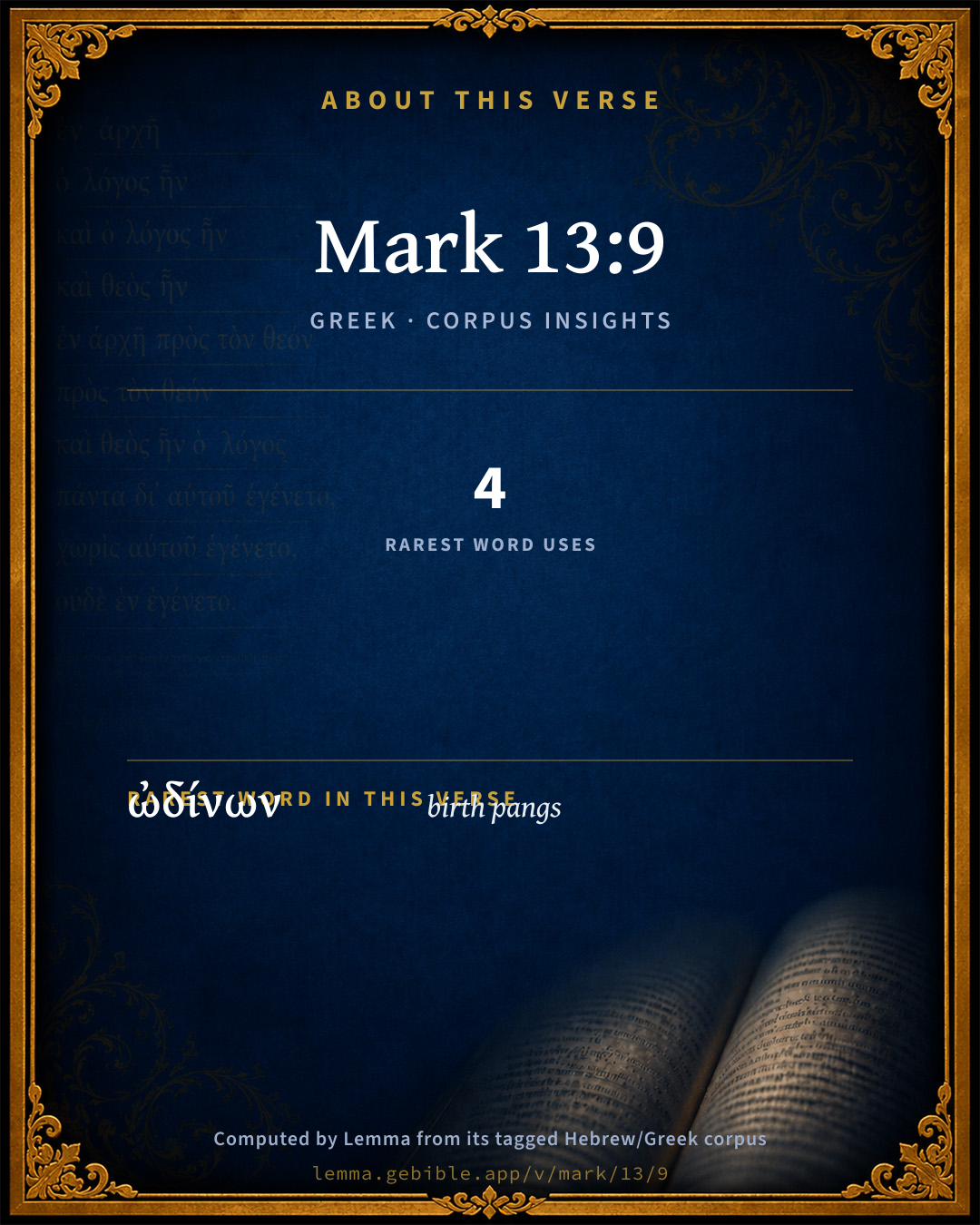
The rarest word here is ὠδίνων birth pangs G5604 — appearing just 4 times in the whole Greek New Testament.

Shared distinctive vocabulary

ὠδίνων birth pangs G5604 occurs in 4 verses of the Greek New Testament. Also found in:

Repetition

Words recur within this verse:

Cross-references

33

Topical passages linked to Mark 13:9 in the Treasury of Scripture Knowledge — connected by theme and wording, ordered by reader-vote popularity; previews shown in the World English Bible.

  • Matthew 10:17–18 But beware of men: for they will deliver you up to councils, and in their synagogues they will scourge you.
  • John 16:2 They will put you out of the synagogues. Yes, the time comes that whoever kills you will think that he offers service to God.
  • Mark 13:5 Jesus, answering, began to tell them, "Be careful that no one leads you astray.
  • 1 Corinthians 4:9–13 For, I think that God has displayed us, the apostles, last of all, like men sentenced to death. For we are made a spectacle to the world, both to angels and men.
  • Philippians 1:29 Because it has been granted to you on behalf of Christ, not only to believe in him, but also to suffer on his behalf,
  • Matthew 23:34–37 Therefore, behold, I send to you prophets, wise men, and scribes. Some of them you will kill and crucify; and some of them you will scourge in your synagogues, and persecute from city to city;
  • Matthew 24:9–10 Then they will deliver you up to oppression, and will kill you. You will be hated by all of the nations for my name's sake.
  • Mark 1:44 and said to him, "See you say nothing to anybody, but go show yourself to the priest, and offer for your cleansing the things which Moses commanded, for a testimony to them."
  • Mark 6:11 Whoever will not receive you nor hear you, as you depart from there, shake off the dust that is under your feet for a testimony against them. Assuredly, I tell you, it will be more tolerable for Sodom and Gomorrah in the day of judgment than for that city!"
  • Luke 9:5 As many as don't receive you, when you depart from that city, shake off even the dust from your feet for a testimony against them."
  • Luke 21:16–18 You will be handed over even by parents, brothers, relatives, and friends. Some of you they will cause to be put to death.
  • John 15:20 Remember the word that I said to you: 'A servant is not greater than his lord.' If they persecuted me, they will also persecute you. If they kept my word, they will keep yours also.
  • Acts 4:1–21 As they spoke to the people, the priests and the captain of the temple and the Sadducees came to them,
  • Acts 5:17–40 But the high priest rose up, and all those who were with him (which is the sect of the Sadducees), and they were filled with jealousy,
  • Acts 6:11–15 Then they secretly induced men to say, "We have heard him speak blasphemous words against Moses and God."
  • Acts 7:54–8:3 Now when they heard these things, they were cut to the heart, and they gnashed at him with their teeth.
  • Acts 9:1–2 But Saul, still breathing threats and slaughter against the disciples of the Lord, went to the high priest,
  • Acts 9:13–14 But Ananias answered, "Lord, I have heard from many about this man, how much evil he did to your saints at Jerusalem.
  • Acts 9:16 For I will show him how many things he must suffer for my name's sake."
  • Acts 12:1–3 Now about that time, Herod the king stretched out his hands to oppress some of the assembly.
  • Acts 16:20–24 When they had brought them to the magistrates, they said, "These men, being Jews, are agitating our city,
  • Acts 21:11 Coming to us, and taking Paul's belt, he bound his own feet and hands, and said, "Thus says the Holy Spirit: 'So will the Jews at Jerusalem bind the man who owns this belt, and will deliver him into the hands of the Gentiles.'"
  • Acts 21:31–40 As they were trying to kill him, news came up to the commanding officer of the regiment that all Jerusalem was in an uproar.
  • Acts 22:19–20 I said, 'Lord, they themselves know that I imprisoned and beat in every synagogue those who believed in you.
  • Acts 23:1–2 Paul, looking steadfastly at the council, said, "Brothers, I have lived before God in all good conscience until this day."
  • Acts 25:1–26 Festus therefore, having come into the province, after three days went up to Jerusalem from Caesarea.
  • 2 Corinthians 11:23–27 Are they servants of Christ? (I speak as one beside himself) I am more so; in labors more abundantly, in prisons more abundantly, in stripes above measure, in deaths often.
  • 2 Thessalonians 1:5 This is an obvious sign of the righteous judgment of God, to the end that you may be counted worthy of the Kingdom of God, for which you also suffer.
  • Revelation 1:9 I John, your brother and partner with you in oppression, Kingdom, and perseverance in Christ Jesus, was on the isle that is called Patmos because of God's Word and the testimony of Jesus Christ.
  • Revelation 2:10 Don't be afraid of the things which you are about to suffer. Behold, the devil is about to throw some of you into prison, that you may be tested; and you will have oppression for ten days. Be faithful to death, and I will give you the crown of life.
  • Revelation 2:13 "I know your works and where you dwell, where Satan's throne is. You hold firmly to my name, and didn't deny my faith in the days of Antipas my witness, my faithful one, who was killed among you, where Satan dwells.
  • Revelation 6:9–11 When he opened the fifth seal, I saw underneath the altar the souls of those who had been killed for the Word of God, and for the testimony of the Lamb which they had.
  • Acts 24:1–9 After five days, the high priest, Ananias, came down with certain elders and an orator, one Tertullus. They informed the governor against Paul.

Cross-references courtesy of OpenBible.info (CC BY 4.0).

Commentary

Notes on Mark 13:9 from classic Christian and Jewish commentators (each source and its license shown beneath its notes). The classic Christian expositions comment on the surrounding passage and are grouped to its opening verse, so a note may address several verses; the Jewish commentaries on the Tanakh (Rashi and others) are per-verse, so they appear only where the commentator wrote on this verse.

Lemma curates 59 commentaries, every one of them public domain or Creative Commons licensed, each selected and text-cleaned for this edition rather than reprinted as found. About our sources →

Ellicott's Commentary for English Readers

(9) But take heed to yourselves.—The emphatic repetition of the warning is peculiar to St. Mark (comp. Mar_13:23). The description of the sufferings of the disciples (Mar_13:9-13) is found in Luk_21:12 and in Mat_10:17-22 (where see Notes), but not in St. Matthew’s report of this discourse.

A Bible Commentary for English Readers, edited by Charles John Ellicott (1878–1897) — public domain. Text from a community e-Sword module.

Joseph Benson's Commentary

Mar 13:9. Take heed to yourselves — Walk circumspectly, and arm yourselves both with patience and fortitude, that you may be able to perform your duty amid all the opposition and persecution which you shall meet with. For they shall deliver you up to councils, &c. — See note on Mat 10:17; Mat 24:9. And in the synagogues ye shall be beaten — “It is certain,” says Whitby, “both from Scripture and the Jewish writers, that whipping and beating were punishments used in the synagogues of the Jews. Thus Paul says, he punished the Christians oft in every synagogue, Act 26:11; and that he did beat in the synagogue those that believed, Act 22:19 : and that it was usual to whip both their wise men and their disciples, when they had acted perversely, in their synagogues, is fully proved by Campegius Vitringa de Synag. Ver.” And ye shall be brought before rulers and kings — Thus Peter and John were called before the sanhedrim; James and Peter before Herod; and Paul before Nero the emperor, as well as before the Roman governors, Gallio, Felix, and Festus; and some were beaten, as Peter and John, (Act 5:40,) Paul and Silas. For a testimony against them — The persecutions which you shall suffer shall become a glorious proof, both of your innocence, and of their guilt in rejecting the gospel. See note on Mat 10:18.

Joseph Benson's Commentary on the Old and New Testaments (1811–1818) — public domain. Text from a community e-Sword module.

Tyndale Open Study Notes

Tyndale Open Resources

13:9 The second watch out! warns of persecution that was to come upon Christians (see 6:11; 8:34-38; 10:30; see 4:17). Jewish Christians would be brought before local councils of Jewish leaders, who had authority over Jewish communities. We read of such a council in Matt 10:17 and probably in Matt 5:22 (see also Acts 4:1-22). • beaten in the synagogues: Paul’s beatings in 2 Cor 11:24-25 were probably inflicted in the local synagogue. • The followers of Jesus would also be susceptible to trial before governors and kings (see Acts 23:24; 24:10-27; 25:1–26:32). Such trials were due to their being followers of Jesus (Mark 13:9, 13), not on account of real wrongdoing (see 1 Pet 4:14-16).

Tyndale Open Study Notes — © Tyndale Open Resources, licensed CC BY-SA 4.0. Text via the HelloAO Bible API.

Bengel's Gnomon

Johann Albrecht Bengel

Mar 13:9. Δὲ, but) Do not concern yourselves about other matters, Mar 13:11: only take heed to yourselves.—παραδώσουσι, they shall deliver you up) From this verse to Mar 13:13, the words are parallel to Mat 10:17-18. Therefore Mark is not an epitomizer of Matthew.—εἰς) An abbreviated mode of expression: ye shall be brought into the synagogues, amidst stripes. See Glass. canon 2 de verbo. Or rather εἰς is for ἐν, as in Mar 13:16. At all events the mention of stripes is consonant with the synagogues. Mat 10:17; Mat 23:34.—αὐτοῖς, to them [against them]) viz. the Jews.

Bengel's Gnomon of the New Testament — English translation (T&T Clark, Edinburgh, 1860) — public domain. Text from a community e-Sword module.

Meyer's Critical & Exegetical Commentary

Heinrich August Wilhelm Meyer

Mar_13:9-13. See on Mat_24:9; Mat_14:10-13; Luk_21:12-18. Mark has here interwoven some things from the discourse which is found at Mat_10:17-22.

ἀρχαί] prefixed with emphasis: beginnings of sorrows (comp. τὸ τέλος, Mar_13:7) are these.

βλέπετε δὲ κ.τ.λ.] but look ye (ye on your part, in the midst of these sorrows that surround you) to yourselves, how your own conduct must be. Comp. on βλέπ. ἑαυτ., 2Jn_1:8; Gal_6:1.

συνέδρια] judicial assemblies, as Mat_10:17.

καὶ εἰς συναγωγ.] attaches itself, as εἰς συνέδρια precedes, most naturally to this (Luther, Castalio, Erasmus, Beza, Calovius, Elz., Lachmann), so that with δαρήσεσθε begins a further step of the description. The more usual connection with δαρήσεσθε, preferred also by Buttmann, neut. Gr. p. 287 [E. T. 333] and Bleek, is inadmissible, because εἰς cannot be taken in the pregnant meaning (instead of ἐν; for the element of motion towards is not implied in δαρήσ.), and because the explanation (see my first edition): ye shall be brought under blows of scourges into synagogues (comp. Bengel, Lange), is not accordant with fact, since the scourging took place in the synagogues; see on Mat_10:17; Act_22:19. That δαρήσ. comes in asyndetically, is in keeping with the emotional character of the discourse.

εἰς μαρτύρ. αὐτοῖς] i.e. in order that a testimony may be given to them, the rulers and kings, namely, regarding me (comp. previously ἕνεκεν ἐμοῦ), regarding my person and my work (not: intrepidi, quo causam meam defendatis, animi, Fritzsche)which, no doubt, involves their inexcusableness in the event of their unbelief; but it is arbitrary to explain the dative here just as if it were εἰς κατηγορίαν κ. ἔλεγχον αὐτῶν (Euthymius Zigabenus, Theophylact, and many others). Comp. on Mat_10:18.

Mar_13:10. And this your vocation fraught with suffering will not soon pass away; among all nations (πάντα has the emphasis) must first (before the end of the sorrows appears, comp. ἀρχαὶ ὠδίνων, Mar_13:9), etc. These words are neither disturbing nor inappropriate (as Köstlin judges, p. 352, comp. Schenkel and Weiss); they substantially agree with Mat_24:14, and do not betray a more advanced position in point of time on Marks part (Hilgenfeld), nor are they concocted by the latter out of κ. τοῖς ἔθνεσιν, Mat_10:18 (Weiss).

Mar_13:11. μελετᾶτε the proper word for the studying of discourses. See Wetstein. The opposite of extemporizing. Comp. Dem. 1129, 9 : μελετᾶν τὴν ἀπολογίαν ὑπὲρ ἑαυτῶν.

δοθῇ] has the emphasis.

οὐ γάρ ἐστε ὑμεῖς] of them it is absolutely denied that they are the speakers. Comp. on Mat_10:20.

Mar_13:12. See on Mat_10:21. From that hostile delivering up, however (comp. παραδιδόντες, Mar_13:11), neither the relationship of brother nor of child, etc., will protect my confessors.

Mar_13:13. ὑπομείνας] according to the context here: in the confession of my name. See above, διὰ τὸ ὄνομά μου. See, moreover, on Mat_24:13. The τέλος is that of the ὠδίνων, Mar_13:9, not that of the theocratic period of the worlds history (Schenkel).

Meyer — Critical and Exegetical Commentary on the New Testament — English translation by Peter Christie, edited by Frederick Crombie (T&T Clark, 1880) — public domain. Text from a community e-Sword module.

Expositor's Greek Testament

ed. W. Robertson Nicoll

Mar 13:9-13 . Third sign, drawn from apostolic experiences (Mat 24:9-13 , Luk 21:12-19 ). On the hypothesis that this is an interpolation into the discourse, having no organic connection with it, vide on Mt. The contents of this section, especially in Mk.’s version, correspond closely to Mat 10:17-22 . But the question, in which of the two discourses the logion has the more historical setting, is not thereby settled. Some utterance of the sort was certainly germane to the present situation.

Mar 13:9 . βλέπετε , etc.: not meant to strike a depressing note, but to suggest that the most interesting omens should be found in their own experiences as the Apostles of the faith, which, however full of tribulation, would yet be, on the whole, victorious. παραδώσουσι , etc.: the tribulations are not disguised, but the blunt statement only lends emphasis to the declaration in Mar 13:10 that, notwithstanding, the Gospel must ( δεῖ ) and shall be proclaimed on a wide scale. εἰς συναγωγὰς δαρήσεσθε : the εἰς here is pregnant = you, delivered to the synagogues, shall be maltreated. Bengel renders: “in synagogas inter verbera agemini” = ye shall be driven into the synagogues with clubs. So Nösgen.

The Expositor's Greek Testament, edited by W. Robertson Nicoll (1897–1910) — public domain. Text from a community e-Sword module.

Geneva Bible (1599)

Geneva Bible translators

The hearing of you preaching shall be a most evident witness against them, so that they shall not be able to pretend ignorance.

Geneva Bible (1599) marginal notes — public domain. Text via Bolls.life.

Adam Clarke's Commentary

Verse 9. Councils] συνεδρια, Sanhedrins. The grand Sanhedrin consisted of seventy-two elders; six chosen out of each tribe; this was the national council of state; and the small Sanhedrins, which were composed of twenty-three counsellors.

Synagogues] Courts of justice for villages, &c., consisting of three magistrates, chosen out of the principal directors of the synagogue in that place.

Rulers] Or governors. The Roman deputies, such as Pontius Pilate, &c.

Kings] The tetrarchs of Judea and Galilee, who bore this name. See Mr 6:27.

Adam Clarke's Commentary on the Bible (1810–1826) — public domain. Text from a community e-Sword/MySword module.

The Cambridge Bible for Schools and Colleges

gen. ed. J. J. S. Perowne

9. to councils] Of the actual hearers of the Lord some were destined to find this true within little more than fifty days. Thus, in Act_4:3, we find all the Apostles brought before the Sanhedrim, and again in Act_5:18; Act_5:27. Similarly, St Paul was brought before the same Council, Act_23:1.

in the synagogues ye shall be beaten] “Of the Jews,” says St Paul (2Co_11:24), “five times received I forty stripes save one;” “thrice was I beaten with rods.” It was part of the duties of the Chazzan, or minister in each synagogue, to maintain order, and scourge the condemned.

before rulers and kings] Thus St Paul stood before Felix (Act_24:10-22), before Festus (Act_25:1-11), before Agrippa (Act_26:1-23), before Nero (2Ti_4:16). Our Lord also, we may believe, alluded to the general persecutions of the Christians in later times, and especially to that of the emperor Nero, in which St Peter and St Paul suffered martyrdom.

The Cambridge Bible for Schools and Colleges (gen. ed. J. J. S. Perowne; Cambridge University Press, 1878–1918) — public domain. Text from a community e-Sword module.

John Gill's Exposition

But take heed to yourselves,.... This does not so much regard their doctrine and conversation, they were to take heed to; in which sense this phrase is sometimes used; but the security of their persons and lives; and the advice is, to take care of them selves, as much as in them lay, how they came into the hands of the persecuting Jews, and exposed themselves to danger, when at any time it could be avoided:

for they shall deliver you up to councils; their greater and lesser sanhedrim; the one consisting of seventy one persons, the other of twenty three, and the least of three only; and before the greater of these, Peter and John were brought, quickly, after the ascension of Christ:

and in the synagogues ye shall be beaten; with forty stripes, save one, as the Apostle Paul was, five, times:

and ye shall be brought before rulers; governors of Roman provinces, as the same apostle was, before Gallio, Festus, and Felix:

and kings for my sake; for the sake of professing Christ, and preaching his Gospel; as some of the apostles were, before Herod, Agrippa, Nero, Domitian, and others:

for a testimony against them: both against the rulers and kings before whom they should be brought, and bear a testimony for Christ, and against the Jews, who should bring them thither; See Gill on Mat 10:17; see Gill on Mat 10:18.

John Gill's Exposition of the Whole Bible (1746–1763) — public domain (CC PDM 1.0). Text via the HelloAO Bible API.

Trapp's Complete Commentary

John Trapp

9 But take heed to yourselves: for they shall deliver you up to councils; and in the synagogues ye shall be beaten: and ye shall be brought before rulers and kings for my sake, for a testimony against them.

Ver. 9. See Mat 10:17; Mat 24:9. {See Trapp on "Mat 10:17"} {See Trapp on "Mat 24:9"}

John Trapp, A Commentary or Exposition upon All the Books of the Old and New Testament (1647–1656) — public domain. Text from a community e-Sword module.

Albert Barnes' Notes on the Bible

Take heed to yourselves - Be cautious that no man deceive you; or, take care of your lives, not to run into unnecessary danger.

To councils - The higher ecclesiastical courts of the Jews, including the Sanhedrin, or great council of the nation.

Rulers and kings - Referring to Roman officers.

For a testimony against them - Rather to bear testimony to them, or to be witnesses “before them” of the truth. This was” for the sake” of Jesus, or because they were attached to him; and God would overrule it so that at the same time they should bear witness “to” the rulers of the truth, as was the case with Peter and John, Acts 4; with Stephen, Acts 6–7; and with Paul, Acts 23; Act 24:24-25.

Albert Barnes' Notes on the Bible (1834–1885) — public domain. Text from a community e-Sword/MySword module.

Haydock's Catholic Bible Commentary

In the synagogues, or assemblies. The word is here taken for assemblies of judges, and of justice. --- For a testimony to them; i.e. that you may bear witness of me and my doctrine, and also against them. (Witham) --- Some solicitude perhaps had seized upon the minds of the disciples, when they were informed by their divine Master, that they should stand accused before kings, and princes of the earth, for fear they should not be able, for want of human learning, to make a proper defence. Our Saviour therefore says: be not thoughtful beforehand; for when we are brought to the bar in defence of our holy faith, it is only necessary for us, under such circumstances, to make an offer of our will; Christ himself will speak for us: and in our answers will be infused the grace of the Holy Ghost: for it is not you that speak, but the Holy Ghost. (Ven. Bede)

George Leo Haydock (1774–1849), Haydock's Catholic Family Bible and Commentary, 1859 edition — public domain. Excludes Psalms (Douay-Rheims chapter numbering differs from Protestant) and Deuterocanonical books (Catholic canon only).

Matthew Poole's English Annotations

This, so far as concerneth those to whom Christ spake, can only be a sign of the destruction of Jerusalem; but so far as it concerneth others, it is also a sign of the end of the world. It is the fifth sign he gives them; the persecution of the ministers of Christ and the saints of God, for the preaching and profession of the gospel. See Poole on "Mat 24:9".

Matthew Poole's English Annotations on the Holy Bible (1683–1685) — public domain. Text from a community e-Sword/MySword module.

Whedon's Commentary on the Bible

Daniel D. Whedon

9. They shall deliver you — From the sorrows of the Jews our Lord now turns to the persecutions of the Christians. Compare Mat_24:9. The fulfilment of the predictions of the Christian persecutions is thus given by Whitby:

“1. They suffered “a great fight of afflictions,” (Heb_10:32-33,) being persecuted by those of their own nation, (1Th_2:14-15,) and suffering fiery trials from them. 1Pe_4:12. “I persecuted them,” saith St. Paul, “to strange cities.” Act_26:11.

2. They were imprisoned: Peter, Act_4:3; Paul and Silas, Act_16:23; 2Co_11:23; “I delivered up to prison men and women.” Act_22:4. “I shut up many of the saints in prison,” saith St. Paul. Act_26:10.

3. They were beaten in the synagogue: St. Paul and Silas, Act_16:23; 2Co_11:23-25; Peter and John, Act_5:18.

4. They were brought before councils and sanhedrims: Peter and John, Act_4:3; Act_4:6; the disciples, Act_8:3. Before kings: James and Peter before Herod, Act_12:1-2; Paul and Peter before Nero. Before rulers: Paul before Gallio, Felix, and Festus. Act_18:12; Act_23:33; Act_25:6.

5. They were killed: Stephen by the judgment of the council, Act_7:59; James the Greater by Herod, Act_12:1; the Less by Ananus the high priest; yea, multitudes of Christians were persecuted to the death by Saul, Act_22:4; by Nero, Tacit. Annal. 15, p. 363; by the Jews, Justin. Mart. Dial. cum Tryph., p. 234, 235.

6. We learn from Tacitus, in the place forecited, that Christians were delivered up by their parents, brethren, kinsfolk, friends; from Josephus, that contention sprang up in their very houses; and that the Idumeans slew many of their own kindred; and from the Scripture, that the Jews persecuted those of their own country. 1Th_2:14.

7. That upon occasion of these persecutions “the love of many waxed cold, and many Jews” revolted from the Christian faith. And, lastly, of the care of God in preserving his faithful servants in this time of imminent danger, Eusebius informs us, saying, that “before the war all the faithful of the Church of Jerusalem were astonished by an oracle delivered by revelation to men approved there, to depart from the city, and to get over Jordan, and to go to Pella.” The occasion of this departure was, saith Dr. Hammond, wonderful; for Cestus Gallus then besieged the city; and if he would, saith Josephus, he might easily have taken it, and put an end to the war; but he, without cause, raising the siege and going from it, many eminent Jews fled from the city as from a sinking ship, among whom doubtless were those Christians who remained after the destruction of Jerusalem.”

Daniel D. Whedon (gen. ed.), Commentary on the Old and New Testaments (1874–1909) — public domain. Text from a community e-Sword module.

John Wesley's Explanatory Notes

Luke xxi, 12.

John Wesley, Explanatory Notes Upon the Whole Bible (1754–1765) — public domain. Text via the GEBible commentary corpus.

Kretzmann's Popular Commentary

Paul E. Kretzmann

Persecution of the believers:

v. 9. But take heed to yourselves; for they shall deliver you up to councils; and in the synagogues ye shall be beaten; and ye shall be brought before rulers and kings for My sake, for a testimony against them.

v. 10. And the Gospel must first be published among all nations.

v. 11. But when they shall lead you and deliver you up, take no thought beforehand what ye shall speak, neither do ye premeditate; but whatsoever shall be given you in that hour, that speak ye; for it is not ye that speak, but the Holy Ghost.

Incessant watchfulness, untiring vigilance, the Lord enjoins upon His disciples. For the Jews and their leaders would not passively permit the extension of the Christian influence, the spread of the Christian religion. All their various courts would be called upon to hinder the work of the apostles and their assistants. Christ bluntly tells them: You, delivered to the synagogues, shall be maltreated. And for His sake they would have to stand before rulers and kings. All this will be a testimony not to them, but against them. It will be marked down in the judgment-book of God as another item calling down His punishment upon the enemies of His Word. As we read throughout the Acts of the Apostles, and in individual accounts given by St. Paul in his letters, these prophecies were literally fulfilled. And there is little difference between those days and ours, only that at the present time expediency and political measures are urged by the enemies of the pure Gospel in persecuting the believers throughout the world. But, in the midst of it all, Christ’s prophecy shines like a beacon light: And to all nations the Gospel must first be preached. In those days the apostles filled the known world with the glorious news of the salvation gained by Jesus for all men, and in our days there are always some to be found that go out in utter selflessness to bring the news of the reconciliation of God with men through the blood of Christ to every nation. With this promise to guide them, to cheer them, to fill them with new courage every day, the prospect of suffering injustice before the powers that be holds no terror for the believers. Christ tells them not to worry beforehand how they might duly defend themselves against the false accusations. At the critical moment He promises to give them the right words which they may use in defending themselves. The Holy Ghost would directly inspire their utterances, so that their defense would be, in each instance, a powerful vindication of the truth of the Gospel and of the power of God. And the history of the Church since the time of the apostles narrates instances in number which show that God, in times of great crises, awakens men with extraordinary abilities and powers to defend the Scriptures against false accusations and to vindicate Christianity. Though we do not yield to a false enthusiasm in their case, as, for instance, in that of Luther, and are far from claiming direct inspiration for them, yet we know that in their preaching, also in defense of the truth of the eternal Gospel, it was God and His Spirit that was with them.

Paul E. Kretzmann, Popular Commentary of the Bible (1921–1924) — public domain. Text from a community e-Sword module.

The People's New Testament

B. W. Johnson

9. Take heed to yourselves. In Matthew's report persecution is foretold, but the injunctions of verses 9, 10, 11, or rather given in Matt. 10:18–20, on which see notes. Take heed. Not to escape persecution, but to be ready for it. They shall deliver you to councils. Jewish courts. Besides the great national council, the Sanhedrim, each principal town had a smaller council, or local Sanhedrim. In the synagogues ye shall be beaten. In every Jewish synagogue there were three magistrates authorized to inflict certain punishments, scourging being one. The number of stripes could not exceed forty (Deut. 25:3); hence they always stopped at thirty-nine. Governors and kings. Roman officials, such as Felix, Festus, Gallio, King Agrippa and Nero.

B. W. Johnson's The People's New Testament with Notes (1889–1891) — public domain. Electronic text from the Christian Classics Ethereal Library (CCEL) ThML edition.

unfoldingWord translationNotes

Door43 World Missions Community

Be on your guard

"Be ready for what people will do to you"

will deliver you up to councils

"take you and put you under the control of councils"

you will be beaten

This can be stated in active form. AT: "people will beat you" (See: Active or Passive)

You will stand before

This means to be put on trial and judged. AT: "You will be put on trial before" or "You will be brought to trial and judged by" (See: Idiom)

for my sake

"because of me" or "on account of me"

as a testimony to them

This means they will testify about Jesus. This can be made clear. AT: "and testify to them about me" or "and you will tell them about me" (See: Assumed Knowledge and Implicit Information)

But the gospel must first be proclaimed to all the nations

Jesus is still speaking about things that must happen before the end comes. This can be made clear. AT: "But the gospel must first be proclaimed to all the nations before the end will come" (See: Assumed Knowledge and Implicit Information)

translationWords

deliver

council

synagogue

govern

king

testimony

good news

preach

nation

unfoldingWord translationNotes — © Distant Shores Media and the Door43 World Missions Community, licensed CC BY-SA 4.0. Source: git.door43.org/Door43/en_tn.

Cambridge Greek Testament for Schools and Colleges

9. [2908][2909] omit γάρ after παραδώσουσιν. It is probably an insertion.

[2908] Codex Vaticanus. 4th cent., but perhaps a little later than א. In the Vatican Library almost since its foundation by Pope Nicolas V., and one of its greatest treasures. The whole Gospel, ending at Mar 16:8. Photographic facsimile, 1889.

[2909] Codex Regius. 8th cent. An important witness. At Paris. Contains Mar 1:1 to Mar 10:15; Mar 10:30 to Mar 15:1; Mar 15:20 to Mar 16:20, but the shorter ending is inserted between Mar 16:8 and Mar 16:9, showing that the scribe preferred it to the longer one.

9. βλέπετε δὲ ὑμεῖς ἑαυτούς. Mk only. The pronouns are in emphatic juxtaposition. “Let other people attend to these disturbances in society and in nature; but do ye look to yourselves.” This use of βλέπω is very rare, but it has been found in a papyrus-letter of A.D. 41; βλέπω σεαυτόν. The reflexive ἑαυτούς with the second person is freq. in N.T. (Mar 9:50), esp. in Paul; ὑμῶν αὐτῶν, κ.τ.λ. is rare (1Co 5:13). Syr-Sin. omits the words.

παραδώσουσιν. “Your fellow-countrymen will hand you over to councils,” i.e. to the elders of the local synagogues, who as religious magistrates had considerable authority. See on Luk 12:11; Luk 21:12. Saul of Tarsus was among the first who fulfilled this prediction as a persecuting Jew, and later as a persecuted Christian. see on 2Co 11:24. In Mat 10:17-20 and Luk 12:11-12 we have passages similar to this. They may be doublets; but it is not impossible that these cautions were given more than once.

καὶ εἰς συναγωγάς. These words are amphibolous and are commonly taken with what follows as a pregnant constr.; “and ye shall be taken into synagogues and beaten”; see on Mar 13:3; Mar 13:16. “Ye shall be beaten into the synagogues,” i.e. driven into them with whips, is certainly wrong. It is better to take the words with what precedes; They will deliver you up to councils and to synagogues; ye will be beaten. This harmonizes well with the abruptness of the preceding verses. Syr-Sin. has “They shall deliver you up to the people and to councils; and ye shall stand before kings and ye shall be beaten before governors for My sake, for a testimony to them, and to all nations.”

ἕνεκεν ἐμοῦ. Cf. Mar 8:35, Mar 10:29.

εἰς μαρτύριον αὐτοῖς. Testimony to the rulers and kings, who, but for the persecution of Christians, might never have known about Christ. This applies to both Jewish and heathen potentates: St James and St Peter persecuted by Herod Agrippa I. illustrate the former; St Paul before Festus and Herod Agrippa II. illustrates both. A sagacious person might have seen that what is predicted here was probable. Even those who do not admit that Jesus had supernatural foresight need not suppose that this is a pseudoprophecy, constructed to fit the persecutions of Apostles, and attributed to Christ.

Cambridge Greek Testament for Schools and Colleges (Cambridge University Press, 1896; 21 vols, various authors incl. Carr, Maclear, Plummer, Farrar, Lumby, Moule, M. R. James, Simcox) — public domain. Text from a community e-Sword module.

Alford’s Greek Testament

Henry Alford

9.] ἀρχαί is put forward for emphasis—the mere beginnings.

ὑμεῖς likewise has the emphasis—let your care be …

εἰς συναγ., a pregnant construction—‘ye shall be taken into the synagogues and beaten there.’ So also in ver. 16. Bp. Wordsw. explains the εἰς, “Ye will be exposed before the eyes of congregations in synagogues, for their pleasure:” and ἐν συν. would mean, “in the buildings, without any reference to the people in them.” But how will this apply to ὁ εἰς τὸν ἀγρὸν ὤν ver. 16? Meyer, with Lachmann ., would punctuate after συναγωγάς, and take δαρήσεσθε by itself. This is most improbable, especially when we remember that the synagogues were the places where the scourging was inflicted (see Act 22:19), not to mention the objection to taking the verb thus by itself, which seems to me (against Meyer) alien from the character of the discourse.

Henry Alford, The Greek Testament (1849–1861) — public domain. Text from a community e-Sword module.

International Critical Commentary

9. Βλέπετε δὲ ὑμεῖς ἑαυτούς. ὑμεῖς is emphatic. But do ye take heed to yourselves. They are not to go about after false Messiahs nor studying portents; they will have their work to do in looking after themselves. παραδώσουσι ὑμᾶς—they will deliver you up. συνέδρια—councils. The word is used of the local tribunals to be found in Jewish towns, modelled somewhat after the Sanhedrim, the great council of Jerusalem. καὶ εἰς συναγωγὰς—and into synagogues. The words belong to the preceding παραδώσουσιν, and δαρήσεσθε stands by itself. It reads, They will deliver you up to councils and to synagogues. You will be beaten.2 The synagogues were the ecclesiastical tribunal of the town, as the συνέδρια were the municipal court. ἡγεμόνων—the word used in Greek to denote the Roman provincial governors. To sum up, συνέδρια and συναγωγαί were Jewish tribunals,1 and ἡγεμόνες and βασιλεῖς were Gentile rulers. They were to be brought before both. ἕνεκεν ἐμοῦ—for my sake. It was to be because of their attachment to him, that they were to be brought to trial. εἰς μαρτύριον αὐτοῖς—for a testimony to them. This was the Divine purpose of their appearance before earthly tribunals. They were to stand there to testify to Jesus.

Omit γὰρ after παραδώσουσι, Tisch. (Treg.) Treg. marg. WH. BL Memph.

International Critical Commentary — older volumes (1896–1929), various authors — public domain. Text from a community e-Sword module.

Vincent's Word Studies in the New Testament

Marvin R. Vincent

Sorrows [ωδινων] . Rev., rightly, travail; for the word is used especially of birth - throes.

Shall ye be beaten [δαρησεσθε] . The verb literally means to skin or flay, and by a slang usage, like our phrase to tan or hide, comes to mean to cudgel or beat.

Marvin R. Vincent, Word Studies in the New Testament (1887–1900) — public domain. Text from a community e-Sword/MySword module.

Lesson kit

Teaching starters — assembled from the data on this page, not authored interpretation. Every prompt links to the verse data it draws on. Edit before teaching.

Mark, in the Gospels, opens this verse with 26 words (21 distinct Greek lemmas). Its most distinctive word is ōdín (“birth pangs”). A historical commentator’s framing appears above. Read the whole chapter for the surrounding context.

Discussion questions

  1. The word ōdín carries the sense “birth pangs.” How does it shape the verse?
  2. Matthew 24:8 shares the word «birth pangs» with this verse. How do the two illuminate each other?
  3. “into” occurs 3× in this one verse. What is the effect of the repetition?
  4. These translations render this verse differently. What is at stake in choosing one wording over another?
  5. Reading how Ellicott's Commentary for English Readers and Joseph Benson's Commentary read this verse, where do the two commentators agree and where do they part?

Things to notice

Reading settings

Reading text

Shown beneath each verse's original-language words.

Old Testament
Old Testament edition

Read the OT as the Masoretic Hebrew (MT) or the Greek Septuagint (LXX).

English shown for the Greek Septuagint (in the Hebrew ↔ Greek comparison).

Comparing translations? Open the Compare panel on any verse page to stack up to four side by side.