
Revelation 3:18

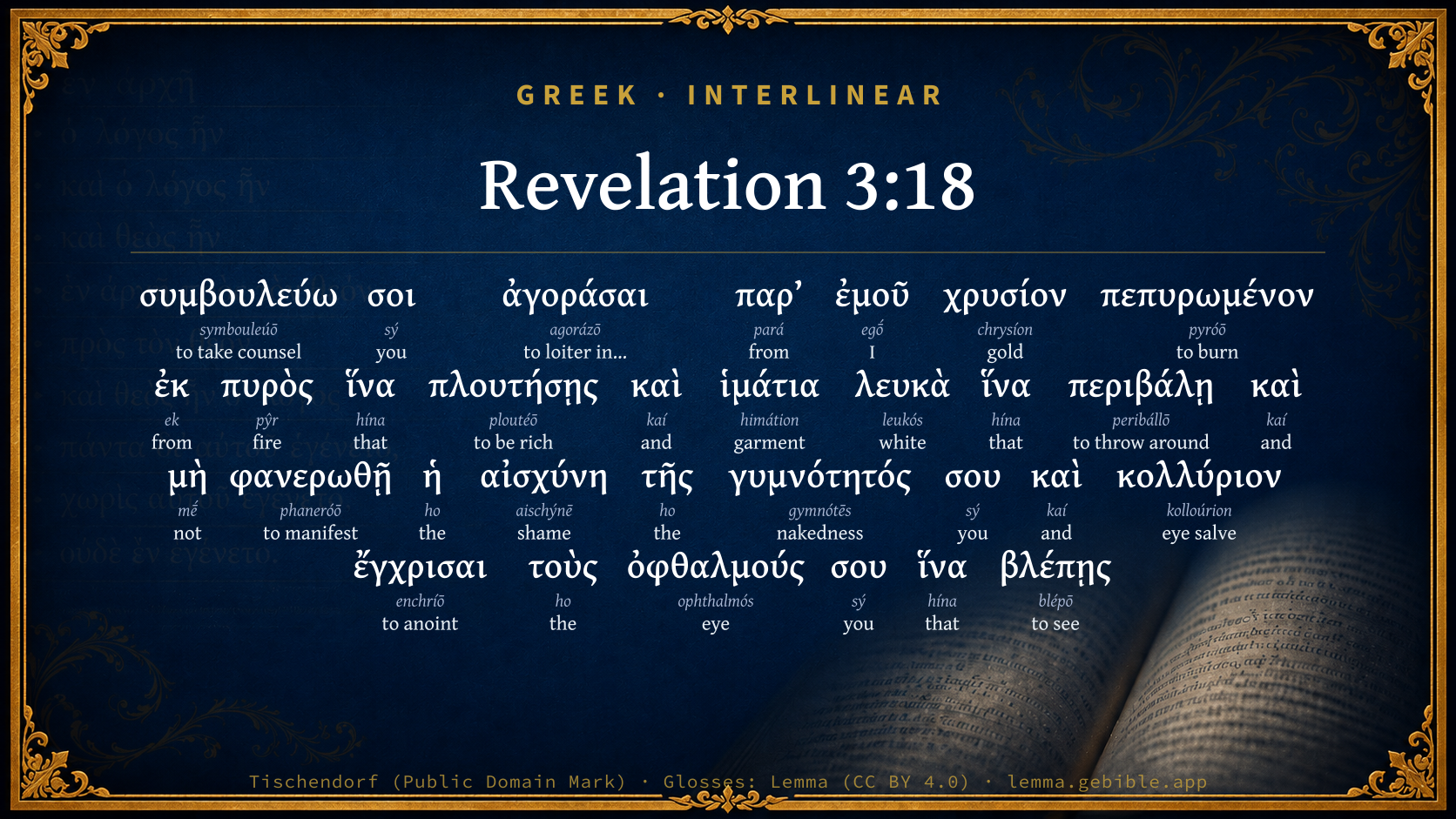
Greek (Tischendorf 8th ed.) Revelation 3:18 appears in the Greek New Testament. The text above is from the Tischendorf 8th edition. Each word links to its Strong’s number and a concise gloss. Click any word for its full Thayer’s Greek Lexicon entry.
Download image
Cite this verse

Revelation 3:18 (World English Bible). Public Domain. Lemma interlinear Bible study tool, https://lemma.gebible.app/v/revelation/3/18.

Show BibTeX & RIS
BibTeX
RIS
English Translation
I counsel you to buy from me gold refined by fire, that you may become rich; and white garments, that you may clothe yourself, and that the shame of your nakedness may not be revealed; and eye salve to anoint your eyes, that you may see.
World English Bible · Public Domain
Highlights
  • 2 hapax legomena — only here in the Greek New Testament
  • 2 first appearances in the Greek New Testament
Full analysis ↓
Download a study sheet

One document with this verse’s original text, its word-by-word gloss line, the meaning frame, cross-references with their text, attributed commentary, and full source and license credits — printable, and it pastes into notes with its structure intact.

This verse Autodidact and up

Study sheet (.html) Plain text (.txt)

A passage Seminary Student

Up to 50 verses in one chapter. A passage sheet keeps up to 6 commentary sources and 12 cross-references per verse, in the order this page ranks them, and says so on the sheet whenever that leaves anything out. Ask for a single verse and you get the Autodidact verse sheet above.

Everything on this page stays free to read, with no account — the sheet is a download of what is already on screen, not access to it.

Want to remove ads? Support Godless Engineer
Compare translations 3

The same verse in 3 English versions, stacked beneath the original-language interlinear above. Click any original word for its lexicon entry.

Each is an independent rendering of the whole verse — the interlinear is not word-aligned to these translations.

Highlighted words mark where these versions differ — a whole-verse word diff, not a word-by-word alignment.

  • World English Bible Public Domain
    I counsel you to buy from me gold refined by fire, that you may become rich; and white garments, that you may clothe yourself, and that the shame of your nakedness may not be revealed; and eye salve to anoint your eyes, that you may see.
  • King James Version Public Domain
    I counsel thee to buy of me gold tried in the fire, that thou mayest be rich; and white raiment, that thou mayest be clothed, and that the shame of thy nakedness do not appear; and anoint thine eyes with eyesalve, that thou mayest see.
  • unfoldingWord Literal Text CC BY-SA 4.0
    I advise you to buy from me gold refined by fire so that you might become rich and white garments so that you might clothe yourself and the shame of your nakedness might not be shown and salve to anoint your eyes so that you might see.

unfoldingWord Literal Text — © unfoldingWord, licensed CC BY-SA 4.0. Word-aligned USFM3 via Door43 (git.door43.org/unfoldingWord/en_ult).

Versions to compare (up to 4)

3 of 4 selected

Show all 19 translations

Every available English version of this verse, each an independent rendering of the whole verse.

  • World English Bible Public Domain
    I counsel you to buy from me gold refined by fire, that you may become rich; and white garments, that you may clothe yourself, and that the shame of your nakedness may not be revealed; and eye salve to anoint your eyes, that you may see.
  • Berean Standard Bible Public Domain
    I counsel you to buy from Me gold refined by fire so that you may become rich, white garments so that you may be clothed and your shameful nakedness not exposed, and salve to anoint your eyes so that you may see.
  • Majority Standard Bible Public Domain
    I counsel you to buy from Me gold refined by fire so that you may become rich, white garments so that you may be clothed and your shameful nakedness not exposed, and salve to anoint your eyes so that you may see.
  • King James Version Public Domain
    I counsel thee to buy of me gold tried in the fire, that thou mayest be rich; and white raiment, that thou mayest be clothed, and that the shame of thy nakedness do not appear; and anoint thine eyes with eyesalve, that thou mayest see.
  • American Standard Version (1901) Public Domain
    I counsel thee to buy of me gold refined by fire, that thou mayest become rich; and white garments, that thou mayest clothe thyself, and `that' the shame of thy nakedness be not made manifest; and eyesalve to anoint thine eyes, that thou mayest see.
  • Revised Version (1885) Public Domain
    I counsel thee to buy of me gold refined by fire, that thou mayest become rich; and white garments, that thou mayest clothe thyself, and that the shame of thy nakedness be not made manifest; and eyesalve to anoint thine eyes, that thou mayest see.
  • Geneva Bible (1599) Public Domain
    I counsell thee to bye of me gold tried by the fire, that thou maiest bee made rich: and white raiment, that thou maiest be clothed, and that thy filthie nakednesse doe not appeare: and anoynt thine eyes with eye salue, that thou maiest see.
  • Douay-Rheims (1899) Public Domain
    I counsel thee to buy of me gold fire tried, that thou mayest be made rich; and mayest be clothed in white garments, and that the shame of thy nakedness may not appear; and anoint thy eyes with eyesalve, that thou mayest see.
  • Young's Literal Translation Public Domain
    I counsel thee to buy from me gold fired by fire, that thou mayest be rich, and white garments that thou mayest be arrayed, and the shame of thy nakedness may not be manifest, and with eye-salve anoint thine eyes, that thou mayest see.
  • Literal Standard Version CC BY-SA 4.0
    I counsel you to buy from Me gold fired by fire, that you may be rich, and white garments that you may be clothed, and the shame of your nakedness may not be revealed, and with eye-salve anoint your eyes, that you may see.
  • Unlocked Literal Bible CC BY-SA 4.0
    Listen to my advice: Buy from me gold refined by fire so that you may become rich, and brilliant white garments so you may clothe yourself and not show the shame of your nakedness, and salve to anoint your eyes so you will see.
  • unfoldingWord Literal Text CC BY-SA 4.0
    I advise you to buy from me gold refined by fire so that you might become rich and white garments so that you might clothe yourself and the shame of your nakedness might not be shown and salve to anoint your eyes so that you might see.
  • Darby Bible Public Domain
    I counsel thee to buy of me gold purified by fire, that thou mayest be rich; and white garments, that thou mayest be clothed, and that the shame of thy nakedness may not be made manifest; and eye-salve to anoint thine eyes, that thou mayest see.
  • World Messianic Bible Public Domain
    I counsel you to buy from me gold refined by fire, that you may become rich; and white garments, that you may clothe yourself, and that the shame of your nakedness may not be revealed; and eye salve to anoint your eyes, that you may see.
  • Webster's Bible Public Domain
    I counsel thee to buy of me gold tried in the fire, that thou mayest be rich; and white raiment, that thou mayest be clothed, and that the shame of thy nakedness may not appear; and anoint thy eyes with eye-salve, that thou mayest see.
  • Free Bible Version CC BY-SA 4.0
    I advise you to buy from me gold refined by fire so you may be rich; and have white clothes so you can be properly dressed and you won't reveal your nakedness and shame; and ointment to put on your eyes so you can see.
  • Bible in Basic English Public Domain
    If you are wise you will get from me gold tested by fire, so that you may have true wealth; and white robes to put on, so that your shame may not be seen; and oil for your eyes, so that you may see.
  • Text-Critical English NT CC BY 4.0
    I counsel yoʋ to buy from me gold refined by fire so that yoʋ can become rich, and white garments so that yoʋ can clothe yoʋrself and the shame of yoʋr nakedness will not be exposed, and eye salve to anoint yoʋr eyes so that yoʋ can see.
  • Tyndale New Testament (1534) Public Domain
    I counsell the to bye of me golde tryed in the fyre that thou mayste be riche and whyte raymet that thou mayste be clothed that thy fylthy nakednes do not apere: and anoynt thyne eyes with eye salve that thou mayste se.

Literal Standard Version (2020), Covenant Press — licensed CC BY-SA 4.0. Text via the HelloAO Bible API (eBible.org). Unlocked Literal Bible (unfoldingWord) — licensed CC BY-SA 4.0. Text via the HelloAO Bible API (eBible.org). unfoldingWord Literal Text — © unfoldingWord, licensed CC BY-SA 4.0. Word-aligned USFM3 via Door43 (git.door43.org/unfoldingWord/en_ult). Free Bible Version, Dr. Jonathan Gallagher — licensed CC BY-SA 4.0. Text via the HelloAO Bible API (eBible.org).

Word by word

More ways to search: Search by grammar → Find every occurrence → Compare this word →

Practice this passage: Drill this verse → Learn its vocabulary →

κολλύριον
kolloúrion
G2854
“eye salve”
Noun, Accusative, Singular, Neuter
Part of Speech
Noun
Case
Accusative
Number
Singular
Gender
Neuter
Full Thayer's Definition

Origin: from a presumed derivative of kollura (a cake - prob akin to the base of G2853 )

TDNT: None

1. a preparation composed of various materials and used as a remedy for tender eyelids
  1. συμβουλεύω symbouleúō G4823 “to take counsel” Verb, Present, Active, Indicative, 1st person, Singular
  2. σοι sý G4771 “you” Personal pronoun, 2nd person, Dative, Singular
  3. ἀγοράσαι agorázō G59 “to loiter in marketplace” Verb, Aorist, Active, Infinitive
  4. παρ’ pará G3844 “from” Preposition
  5. ἐμοῦ egṓ G1473 “I” Personal pronoun, 1st person, Genitive, Singular
  6. χρυσίον chrysíon G5553 “gold” Noun, Accusative, Singular, Neuter
  7. πεπυρωμένον pyróō G4448 “to burn” Verb, Perfect, Passive, Participle, Accusative, Singular, Neuter
  8. ἐκ ek G1537 “from” Preposition
  9. πυρὸς pŷr G4442 “fire” Noun, Genitive, Singular, Neuter
  10. ἵνα hína G2443 “that” Conjunction
  11. πλουτήσῃς ploutéō G4147 “to be rich” Verb, Aorist, Active, Subjunctive, 2nd person, Singular
  12. καὶ kaí G2532 “and” Conjunction
  13. ἱμάτια himátion G2440 “garment” Noun, Accusative, Plural, Neuter
  14. λευκὰ leukós G3022 “white” Adjective, Accusative, Plural, Neuter
  15. ἵνα hína G2443 “that” Conjunction
  16. περιβάλῃ peribállō G4016 “to throw around” Verb, Aorist, Middle, Subjunctive, 2nd person, Singular
  17. καὶ kaí G2532 “and” Conjunction
  18. μὴ mḗ G3361 “not” Particle, Negative
  19. φανερωθῇ phaneróō G5319 “to manifest” Verb, Aorist, Passive, Subjunctive, 3rd person, Singular
  20. ἡ ho G3588 “the” Article, Nominative, Singular, Feminine
  21. αἰσχύνη aischýnē G152 “shame” Noun, Nominative, Singular, Feminine
  22. τῆς ho G3588 “the” Article, Genitive, Singular, Feminine
  23. γυμνότητός gymnótēs G1132 “nakedness” Noun, Genitive, Singular, Feminine
  24. σου sý G4771 “you” Personal pronoun, 2nd person, Genitive, Singular
  25. καὶ kaí G2532 “and” Conjunction
  26. ἔγχρισαι enchríō G1472 “to anoint” Verb, Aorist, Active, Infinitive
  27. τοὺς ho G3588 “the” Article, Accusative, Plural, Masculine
  28. ὀφθαλμούς ophthalmós G3788 “eye” Noun, Accusative, Plural, Masculine
  29. σου sý G4771 “you” Personal pronoun, 2nd person, Genitive, Singular
  30. ἵνα hína G2443 “that” Conjunction
  31. βλέπῃς blépō G991 “to see” Verb, Present, Active, Subjunctive, 2nd person, Singular

About this verse

These counts appear in no published source. They are computed here, from the morphology-tagged text and Lemma’s own curated glosses. What Lemma adds →

32
words
24
distinct lemmas
Revelation
section

Notable vocabulary

2 hapax legomena — words that appear only here in the entire Greek New Testament:

  • κολλύριον eye salve G2854
  • ἔγχρισαι to anoint G1472

First appearance in Scripture

These words make their first canonical appearance in the Greek New Testament here:

  • κολλύριον eye salve G2854
  • ἔγχρισαι to anoint G1472

Shared distinctive vocabulary

γυμνότητός nakedness G1132 occurs in 3 verses of the Greek New Testament. Also found in:
Repetition

Words recur within this verse:

Cross-references

33

Topical passages linked to Revelation 3:18 in the Treasury of Scripture Knowledge — connected by theme and wording, ordered by reader-vote popularity; previews shown in the World English Bible.

  • Revelation 16:15 "Behold, I come like a thief. Blessed is he who watches, and keeps his clothes, so that he doesn't walk naked, and they see his shame."
  • 1 Peter 1:7 that the proof of your faith, which is more precious than gold that perishes even though it is tested by fire, may be found to result in praise, glory, and honor at the revelation of Jesus Christ--
  • Isaiah 55:1 Ho, everyone who thirsts, come you to the waters, and he who has no money; come you, buy, and eat; yes, come, buy wine and milk without money and without price.
  • Revelation 19:8 It was given to her that she would array herself in bright, pure, fine linen: for the fine linen is the righteous acts of the saints.
  • Malachi 3:3 and he will sit as a refiner and purifier of silver, and he will purify the sons of Levi, and refine them as gold and silver; and they shall offer to Yahweh offerings in righteousness.
  • Matthew 13:44 "Again, the Kingdom of Heaven is like a treasure hidden in the field, which a man found, and hid. In his joy, he goes and sells all that he has, and buys that field.
  • Revelation 7:13 One of the elders answered, saying to me, "These who are arrayed in white robes, who are they, and from where did they come?"
  • Psalms 32:8 I will instruct you and teach you in the way which you shall go. I will counsel you with my eye on you.
  • Daniel 12:2 Many of those who sleep in the dust of the earth shall awake, some to everlasting life, and some to shame and everlasting contempt.
  • James 2:5 Listen, my beloved brothers. Didn't God choose those who are poor in this world to be rich in faith, and heirs of the Kingdom which he promised to those who love him?
  • Revelation 3:4–5 Nevertheless you have a few names in Sardis that did not defile their garments. They will walk with me in white, for they are worthy.
  • Psalms 73:24 You will guide me with your counsel, And afterward receive me to glory.
  • 1 Corinthians 3:12–13 But if anyone builds on the foundation with gold, silver, costly stones, wood, hay, or stubble;
  • 2 Corinthians 8:9 For you know the grace of our Lord Jesus Christ, that, though he was rich, yet for your sakes he became poor, that you through his poverty might become rich.
  • Proverbs 23:23 Buy the truth, and don't sell it: Get wisdom, discipline, and understanding.
  • Isaiah 47:3 Your nakedness shall be uncovered, yes, your shame shall be seen: I will take vengeance, and will spare no man.
  • Micah 1:11 Pass on, inhabitant of Shaphir, in nakedness and shame. The inhabitant of Zaanan won't come out. The wailing of Beth Ezel will take from you his protection.
  • Nahum 3:5 "Behold, I am against you," says Yahweh of Hosts, "and I will lift your skirts over your face. I will show the nations your nakedness, and the kingdoms your shame.
  • Revelation 2:9 "I know your works, oppression, and your poverty (but you are rich), and the blasphemy of those who say they are Jews, and they are not, but are a synagogue of Satan.
  • Revelation 3:17 Because you say, 'I am rich, and have gotten riches, and have need of nothing;' and don't know that you are the wretched one, miserable, poor, blind, and naked;
  • Luke 12:21 So is he who lays up treasure for himself, and is not rich toward God."
  • 2 Corinthians 5:3 if so be that being clothed we will not be found naked.
  • Jeremiah 13:26 Therefore will I also uncover your skirts on your face, and your shame shall appear.
  • John 9:6–11 When he had said this, he spat on the ground, made mud with the saliva, anointed the blind man's eyes with the mud,
  • Matthew 25:9 But the wise answered, saying, 'What if there isn't enough for us and you? You go rather to those who sell, and buy for yourselves.'
  • 1 John 2:20–27 You have an anointing from the Holy One, and you know the truth.
  • Psalms 16:7 I will bless Yahweh, who has given me counsel. Yes, my heart instructs me in the night seasons.
  • Psalms 107:11 Because they rebelled against the words of God, And condemned the counsel of the Most High.
  • Proverbs 1:25 But you have ignored all my counsel, And wanted none of my reproof;
  • Proverbs 1:30 They wanted none of my counsel. They despised all my reproof.
  • Proverbs 19:20 Listen to counsel and receive instruction, That you may be wise in your latter end.
  • Ecclesiastes 8:2 I say, "Keep the king's command!" because of the oath to God.
  • 1 Timothy 6:18 that they do good, that they be rich in good works, that they be ready to distribute, willing to communicate;

Cross-references courtesy of OpenBible.info (CC BY 4.0).

Commentary

Notes on Revelation 3:18 from classic Christian and Jewish commentators (each source and its license shown beneath its notes). The classic Christian expositions comment on the surrounding passage and are grouped to its opening verse, so a note may address several verses; the Jewish commentaries on the Tanakh (Rashi and others) are per-verse, so they appear only where the commentator wrote on this verse.

Lemma curates 59 commentaries, every one of them public domain or Creative Commons licensed, each selected and text-cleaned for this edition rather than reprinted as found. About our sources →

Whedon's Commentary on the Bible

Daniel D. Whedon

18. In view of their boasts of temporal wealth the Lord gives them counsel to secure eternal goods.

Buy—They are rich by material trade; suppose they now “buy the truth and sell it not.” In view of their poor, blind, and naked condition, let them secure gold, eyesalve, and white raiment. Trench, though interpreting Rev_3:17 as boasting of spiritual goods, has here an excellent note, which clearly shows that he ought to have interpreted it of the temporal. “To the merchants and factors of this wealthy mercantile city he addresses himself in their own dialect. Laodicea was a city of extensive money transactions; Cicero, journeying to or from his province, proposes to take up money there. (Ep. ad Div. Rev_2:17; Rev_3:5.) Christ here invites to dealings with him. He has gold so fine that none will reject it. The wools of Laodicea, of raven blackness, were famous throughout the world; but he has raiment of dazzling white for those who will put it on. There were ointments for which certainly many of the Asiatic cities were famous; but he, as he will presently announce, has eyesalve more precious than them (they?) all.” All this shows that the passage contrasts a spiritual wealth, in Rev_3:18, with a boast of temporal wealth, in Rev_3:17.

Gold tried in the fire—Rather, from the fire, as if just withdrawn from the fire, and so fresh and brilliant.

White raiment—Note on Rev_3:5.

Shame of thy nakedness—Vivid image of the “shame and everlasting contempt” of the great moral exposures at the judgment day.

The images of spiritual wealth here are susceptible of specific application. The pure, well tried gold may represent faith, the condition of all salvation, and which, when pure and well tried by experience, becomes a fidelity, and a saving perseverance and ripening for heaven. The white raiment is the divine justification from faith, the robe of righteousness, which approves itself as white before men—as pure and right—and before God as acceptable for eternal life. The eyesalve is the spirit of discernment, the blended gift of the Spirit and of personal experience, by which things are seen as they truly are in the light of eternity.

Daniel D. Whedon (gen. ed.), Commentary on the Old and New Testaments (1874–1909) — public domain. Text from a community e-Sword module.

MacLaren's Expositions of Holy Scripture

Alexander MacLaren

Isaiah

FLIMSY GARMENTS

Isa 59:6. - Rev 3:18.

The force of these words of the prophet is very obvious. He has been pouring out swift, indignant denunciation on the evil-doers in Israel; and, says he, ‘they hatch cockatrice’s eggs and spin spiders’ webs,’ pointing, as I suppose, to the patient perseverance, worthy of a better cause, which bad men will exercise in working out their plans. Then with a flash of bitter irony, led on by his imagination to say more than he had meant, he adds this scathing parenthesis, as if he said, ‘Yes, they spin spiders’ webs, elaborate toil and creeping contrivance, and what comes of it all! The flimsy foul thing is swept away by God’s besom sooner or later. A web indeed! but they will never make a garment out of it. It looks like cloth, but it is useless.’ That is the old lesson that all sin is profitless and comes to nothing.

I venture to connect with that strongly figurative declaration of the essential futility of godless living, our second text, in which Jesus uses a similar figure to express one aspect of His gifts to the believing soul. He is ready to clothe it, so that ‘being clothed, it will not be found naked.’

I. Sin clothes no man even here.

Notice in passing what a hint there is of the toil and trouble that men are so willing to take in a wrong course. Hatching and spinning both suggest protracted, sedulous labour. And then the issue of it all is- nothing.

Take the plainest illustrations of this truth first-the breach of common laws of morality, the indulgence, for instance, in dissipation. A man gets a certain coarse delight out of it, but what does he get besides? A weakened body, a tyrannous craving, ruined prospects, oftenest poverty and shame, the loss of self-respect and love; of moral excellences, of tastes for what is better. He is not a beast, and he cannot live for pure animalism without injuring himself.

Then take actual breaches of human laws. How seldom these ‘pay,’ even in the lowest sense. Thieves are always poor. The same experience of futility dogs all coarse and palpable breaches of morality. It is always true that ‘He that breaketh a hedge, a serpent shall bite him.’

The reasons are not far to seek. This is, on the whole, God’s world, a world of retribution. Things are, on the whole, on the side of goodness. God is in the world, and that is an element not to be left out in the calculation. Society is on the side of goodness to a large extent. The constitution of a man’s own soul, which God made, works in the same direction. Young men who are trembling on the verge of youthful yieldings to passion, are tempted to fancy that they can sow sin and not reap suffering or harm. Would that they settled it in their thoughts that he who fires a fuse must expect an explosion!

But the same rule applies to every godless form of life. Take our Manchester temptation, money or success in business. Take ambition. Take culture, literary fame. Take love and friendship. What do they all come to, if godless? I do not point to the many failures, but suppose success: would that make you a happy man? If you won what you wanted, would it be enough? What ‘garments’ for your conscience, for your sense of sin, for your infinite longings would success in any godless course provide? You would have what you wanted, and what would it bring with it? Cares and troubles and swift satiety, and not seldom incapacity to enjoy what you had won with so much toil. If you gained the prize, you would find clinging to it something that you did not bargain for, and that took most of the dazzle away from it.

II. The rags are all stripped off some day.

Death is a becoming naked as to the body, and as to all the occupations that terminate with bodily life. It necessarily involves the loss of possessions, the cessation of activities, the stripping off of self-deceptions, and exposure to the gaze of the Judge, without defence. The godless soul will ‘be found naked’ and ashamed. All ‘works of darkness,’ laden with rich blossom or juicy fruit though they have seemed to be, will then be seen to be in tragic truth ‘fruitless.’ A life’s spinning and weaving, and not a rag to cover the toiler after all! Is that ‘productive labour’?

III. Christ will clothe you.

‘White raiment.’ Pure character. Covering before the Judge. Festal robe of Victory.

‘Buy’-how? By giving up self.

Revelation

CHRIST’S COUNSEL TO A LUKEWARM CHURCH

Rev 3:18

After the scathing exposure of the religious condition of this Laodicean Church its members might have expected something sterner than ‘counsel.’ There is a world of love and pity, with a dash of irony, in the use of that softened expression. He does not willingly threaten, and He never scolds; but He rather speaks to men’s hearts and their reason, and comes to them as a friend, than addresses Himself to their fears.

Whether there be any truth or not in the old idea that these letters to the seven churches are so arranged as, when taken in sequence, to present a fore-glimpse of the successive conditions of the Church till the second coming of our Lord, it is at least a noteworthy fact that the last of them in order is the lowest in spiritual state. That church was ‘lukewarm’; neither cold ‘- untouched by the warmth of the Spirit of Christ at all - ‘nor hot’ - adequately inflamed thereby.

That is the worst sort of people to get at, and it is no want of charity to say that Laodicea is repeated in a thousand congregations, and that Laodiceans are prevalent in every congregation. All our Christian communities are hampered by a mass of loose adherents with no warmth of consecration, no glow of affection, no fervor of enthusiasm; and they bring down the temperature, as snow-covered mountains over which the wind blows make the thermometer drop on the plains. It is not for me to diagnose individual conditions, but it is for me to take note of widespread characteristics and strongly running currents; and it is for you to settle whether the characteristics are yours or not.

So I deal with Christ’s advice to a lukewarm church, and I hope to do it in the spirit of the Master who counseled, and neither scolded nor threatened.

I. Now I observe that the first need of the lukewarm church is to open its eyes to see facts.

I take it that the order in which the points of this counsel are given is not intended to be the order in which they are obeyed. I dare say there is no thought of sequence in the succession of the clauses. But if there is, I think that a little consideration will show us that that which comes last in mention is to be first in fulfilment.

Observe that the text falls into two distinct parts, and that the counsel to buy does not extend- need, and it is ordinarily read as if it did - to the last item in our Lord’s advice. These Laodiceans are bid to ‘buy of Him’ ‘gold’ and ‘raiment,’ but they are bid to use the ‘eye salve’ that they ‘may see.’ No doubt, whatever is meant by that ‘eye salve’ comes from Him, as does everything else. But my point is that these people are supposed already to possess it, and that they are bid to employ it. And, taking that point of view, I think we can come to the understanding of what is meant.

No doubt the exhortation, ‘anoint thine eyes with eye salve, that thou mayest see,’ may be so extended as to refer to the general condition of spiritual blindness which attaches to humanity, apart from the illuminating and sight-giving work of Jesus Christ. That true Light, which lighteneth every man that cometh into the world, has a threefold office as the result of all the parts of which there comes to our darkened eyes the vision of the things that are. He reveals the objects to see; He gives the light by which we see them; and He gives us eyes to see with. He shows us God, immortality, duty, men’s condition, men’s hopes, and He takes from us the cataract which obscures, the shortsightedness which prevents us from beholding things that are far off and the obliquity of vision which forbids us to look steadily and straight at the things .which it is worth our while to behold. ‘For judgment am I come into the world,’ said He, ‘that they which see not might see.’ And it is possible that the general illuminating influence of Christ’s mission and work, and especially the illuminating power of His Spirit dwelling in men’s spirits, may be included in the thoughts of the eye salve with which we are to anoint our eyes as, whence context seems to me rather to narrow the age of the meaning of this part of our Lord’s counsel. For these Laodiceans had the conceit of their own sufficing wealth, of their own prosperous religious condition, and were blind as bats to the real facts that they were miserable and poor and naked.’ Therefore our Lord says: Anoint thine eyes with eye salve, that thou mayest see - recognize your true state; do not live in this dream that you are satisfactorily united to Myself, when all the while the thread of connection is so slender that it is all but snapped. Behold Me as I am, and the things that I reveal to you as they are; and then you will see yourselves as you are.’

So, then, there comes out of this exhortation this thought, that a symptom constantly accompanying the lukewarm condition is absolute unconsciousness of it. In all regions the worse a man is the less he knows it. It is the good people that know themselves to be bad; the bad ones, when they think about themselves, conceit themselves to be good. It is the men in the van of the march that feel the prick of the impulse to press farther: the laggards are quite content to stop in the rear. The higher a man climbs, in any science, or in the practice of any virtue, the more clearly he sees the unsealed peaks above him. The frost-bitten limb is quite comfortable. It is when life begins to come back into it that it tingles and aches. And so these Laodiceans were like the Jewish hero of old, who prostituted his strength, and let them shear away his locks while his lazy head lay in the harlot’s lap: he went out ‘to shake himself’ as of old times, and knew not that the Spirit of God had departed from him. So, brethren, the man in this audience who most needs to be roused and startled into a sense of his tepid religionism is the man that least suspects the need, and would be most surprised if a more infallible and penetrating voice than mine were to come and say to him, ‘Thou - thou art the man.’ ‘Anoint thine eyes with eye salve, that thou mayest see’; and let the light, which Christ pours upon unseen things, pour itself revealing into your hearts, that you may no longer dream of yourselves as ‘rich, and increased with goods, and having need of nothing’; but may know that you are poor and blind and naked.

Another thought suggested by this part of the counsel is that the blind man must himself rub in the eye salve. Nobody else can do it for him. True! it comes, like every other good thing, from the Christ in the heavens; and, as I have already said, if we will attach specific meanings to every part of a metaphor, that ‘eye salve’ may be the influence of the Divine Spirit who convicts men of sin. But whatever it is, you have to apply it to your own eyes. Translate that into plain English, and it is just this, by the light of the knowledge of God and duty and human nature, which comes rushing in a flood of illumination from the central sun of Christ’s mission and character, test yourselves. Our forefathers made too much of self-examination as a Christian duty, and pursued it often for mistaken purposes. But this generation makes far too light of it. Whilst I would not say to anybody, ‘Poke into the dark places of your own hearts in order to find out whether you are Christian people or not,’ for that will only come to diffidence and despair, I would say, ‘Do not be a stranger to yourselves, but judge yourselves rigidly, by the standard of God’s Word, of Christ’s example, and in all your search, ask Him to give you that ‘candle of the Lord,’ which will shine into the dustiest corners and the darkest of our hearts, and reveal to us, if we truly wish it, all the cobwebs and unconsidered litter and rubbish, if not venomous creatures, that are gathered there. Apply the eye salve; it will be keen, it will bite; welcome the smart, and be sure that anything is good for you which takes away the veil that self-complacency casts over your true condition, and lets the light of God into the cellars and dark places of your souls.

II. The second need of the lukewarm church is the true wealth which Christ gives.

‘I counsel thee to buy of Me gold tried in the fire.’ Now there may be many different ways of putting the thought that is conveyed here, but I think the deepest truth of human nature is that the only wealth for a man is the possession of God. And so instead of, as many commentators do, suggesting interpretations which seem to me to be inadequate, I think we go to the root of the matter when we find the meaning of the wealth which Christ counsels us to buy of Him in the possession of God Himself, who is our true treasure and durable riches.

That wealth alone makes us paupers truly rich. For there is nothing else that satisfies a man’s craving and supplies a man’s needs. ‘He that loveth silver shall not be satisfied with silver, nor he that loveth abundance, with increase’; but if we have the gold of God, we are rich to all intents of bliss; and if we have Him not, if we are ‘for ever roaming with a hungry heart,’ and though we may have a large balance at our bankers, and much wealth in our coffers, and ‘houses full of silver and gold,’ we are poor indeed.

That wealth has immunity from all accidents. No possession is truly mine of which any outward contingency or circumstance can deprive me. But this wealth, the wealth of a heart enriched with the possession of God, whom it knows, loves, trusts, and obeys, this wealth is incorporated with a man’s very being, and enters into the substance of his nature; and so nothing can deprive him of it. That which moth or rust can corrupt; that which thieves can break through and steal; that which is at the mercy of the accidents of a commercial community or of the fluctuations of trade; that is no wealth for a man. Only something which passes into me, and becomes so interwoven with my being as is the dye with the wool, is truly wealth for me. And such wealth is God.

The only possession which we can take with us when our nerveless hands drop all other goods, and our hearts are untwined from all other loves, is this durable riches. ‘Shrouds have no pockets,’ as the grim proverb has it. But the man that has God for his portion carries all his riches with him into the darkness, whilst of the man that made creatures his treasure it is written: ‘His glory shall not descend after him.’ Therefore, dear brethren, let us all listen to that counsel, and buy of Jesus gold that is tried in the fire.

III. The third need of a lukewarm church is the raiment that Christ gives.

The wealth which He bids us buy of Him belongs mostly to our inward life; the raiment which He proffers us to wear, as is natural to the figure, applies mainly to our outward lives, and signifies the dress of our spirits as these are presented to the world.

I need not remind you of how frequently this metaphor is employed throughout the Scriptures, both in the Old and the New Testament - from the vision granted to one of the prophets, in which he saw the high priest standing before God, clothed in filthy garments, which were taken off him by angel hands, and he draped in pure and shining vestures - down to our Lord’s parable of the man that had not on the wedding garment; and Paul’s references to putting off and putting on the old and the new man with his deeds. Nor need I dwell upon the great frequency with which, in this book of the Revelation, the same figure occurs. But the sum and substance of the whole thing is just this, that we can get from Jesus Christ characters that are pure and radiant with the loveliness and the candour of His own perfect righteousness. Mark that here we are not bidden to put on the garment, but to take it from His hands. True, having taken it, we are to put it on, and that implies daily effort. So my text puts this counsel in its place in the whole perspective of a combined Christian truth, and suggests the combination of faith which receives, and of effort which puts on, the garment that Christ gives. No thread of it is woven in our own looms, nor have we the making of the vesture, but we have the wearing of it.

There is nothing in the world vainer than effort after righteousness which is not based on faith. There is nothing more abnormal and divergent from the true spirit of the New Testament than faith, so-called, which is not accompanied with daily effort. On the one hand we must be contented to receive; on the other hand we must be earnest to appropriate. ‘Buy of Me gold,’ and then we are rich. ‘Buy of Me raiment,’ and then - listen to the voice that says, Put off the old man with his deeds, and put on the new man of God created in righteousness and holiness of truth.’

IV. Lastly, all supply of these needs is to be bought.

‘Buy of Me.’ There is nothing in that counsel contradictory to the great truth that ‘the gift of God is eternal life.’ That buying is explained by the great gospel invitation, long centuries before the gospel - ‘Ho! every one that thirsteth, come ye to the waters, . . . buy, and eat, . . . without money and without price.’ It is explained by our Lord’s twin parables of the treasure hid in a field, which, when a man had found, he went and sold all that he had and bought the field; and of the pearl of great price which, when the merchantman searching had discovered, he went and sold all that he had that he might possess the one.

For what is all that we have? Self! and we have to give away self that we may buy the riches and the robes. The only thing that is needed is to get rid, once and for all, of that conceit that we have anything that we can offer as the equivalent for what we desire. He that has opened his eyes, and sees himself as he is, poor and naked, and so comes to sue in forma pauperis, and abandons all trust in self, he is the man who buys of Christ the gold and the vesture. If we will thus rightly estimate ourselves, and estimating ourselves, have not only the negative side of faith, which is self-distrust, but the positive, which is absolute reliance on Him, we shall not ask in vain. He counsels us to buy, and if we take His advice and come, saying, ‘Nothing in my hand I bring,’ He will not stultify Himself by refusing to give us what He has bid us ask. ‘What things were given to me; those I counted loss for Christ. Yea! doubtless, and I count all things but loss for the excellency of the knowledge of Christ Jesus my Lord.’ If we, with opened eyes, go to Him thus, we shall come away from Him enriched and clothed, and say, ‘My soul shall be joyful in my God, for He hath clothed me with the garments of salvation; He hath covered me with the robe of righteousness.’

Alexander MacLaren, Expositions of Holy Scripture (1904–1910) — public domain. Text from a community e-Sword module.

Tyndale Open Study Notes

Tyndale Open Resources

3:18 Jesus’ prescription for Laodicea required a complete change of attitude from self-reliance to dependence on God. • buy gold from me: Materially, they could buy whatever they wanted, but they needed to acquire the treasures of heaven so they would have spiritual riches through faith in Christ. • purified by fire: While material wealth will not withstand God’s purging by fire (cp. 1 Cor 3:12-15), spiritual wealth has eternal value. • White garments represent spiritual purity. Black wool cloth and garments were prized exports of the city of Laodicea. This famous black wool cloth was a source of Laodicea’s material wealth; it probably represents the Laodiceans’ proud and unredeemed spiritual condition. • Laodicea’s material prosperity was also due to their well-known Phrygian eye ointment, which may have been used there in the eye clinic associated with the famed physician Demosthenes Philalethes. The Laodiceans needed to buy ointment from Christ through faith. Only his eye salve would enable them to see their sin and repent.

Tyndale Open Study Notes — © Tyndale Open Resources, licensed CC BY-SA 4.0. Text via the HelloAO Bible API.

Bengel's Gnomon

Johann Albrecht Bengel

Rev 3:18. Συμβουλεύω, I give counsel) But if the Superior Being in the meantime lays aside His power, that very fact may possibly be the mark of a mind the more estranged, as if the servant is rebuked by his Lord, and the Lord says, I advise you to take heed to yourself. We give advice even to friends, but not while we rebuke them.—ἡ αἰσχύνη) The Hebrew ערוה is sometimes rendered in the Septuagint by αἰσχύνη.—κολλούριον) namely ἀγοράσαι, to buy, for the purpose of anointing. [This is the last thing. Riches with clothing precede.—V. g.] Celsus speaks at largo on eye-salve.

Bengel's Gnomon of the New Testament — English translation (T&T Clark, Edinburgh, 1860) — public domain. Text from a community e-Sword module.

Expositor's Greek Testament

ed. W. Robertson Nicoll

Rev 3:18 . The counsel is conveyed in the dialect of the local situation. ἀγοράσαι in the poor man’s market (Isa 55:1 , cf. Mat 6:19-20 ), significant words as addressed to the financial centre of the district. “From me,” is emphatic; the real life is due to man’s relation with Christ, not to independent efforts upon his own part. Local Christians needed to be made sensitive to their need of Christ; in Laodicea evidently, as in Bunyan’s Mansoul, Mr. Desires-awake dwelt in a very mean cottage. “Refined” = genuine and fresh, as opposed to counterfeit and traditional ( cf. Plato, Rep. iii. 413 e , 416 e ). For παιδεία wrought upon the people of God by a divine Davidic king whose words are πεπυρωμένα ὑπὲρ χρυσίον τίμιον , see Ps. Sol. 17:47, 48. ἱμάτια . Laodicea was a famous manufacturing centre, whose trade largely consisted of tunics and cloth for garments. The allusion is ( cf. below, on Rev 3:20 and Rev 16:15 ) to careless Christians caught off their guard by the suddenness of the second advent. κολλούριον or κολλύριον ( cf. the account of a blind soldier’s cure by a god [Aesculapius?] who bade him κολλύριον συντρῖψαι , Dittenberger’s Sylloge Inscript. Graec. 807, 15 f.), an eye-salve for tender eyes: an allusion to the “Phrygian powder” used by oculists of the famous medical school at Laodicea ( C. B. P. i. 52). To the Christian Jesus supplies that enlightenment which the Jews found in the law (Psa 19:8 ); “uerba legis corona sunt capitis, collyrium oculis” ( Tract. Siphra fol. 143, 2); “uerba legis corona sunt capitis, torques collo, collyrium oculis” (Vajikra R., fol. 156, 1). True self-knowledge can be gained only by the help of Christ, i.e. , in the present case mediated by Christian prophecy. Like Victor., Lightfoot ( Colossians , p. 44) interprets this allusion by the light of Eph 1:8 , Col 1:27 , as a rebuke to the vaunted intellectual resources of the Church; but there is no need thus to narrow the reference. It is to be observed that John does not threaten Laodicea with the loss of material wealth ( cf. Pirke Aboth , cited above on Rev 2:9 ) in order to have her spiritual life revived.

The Expositor's Greek Testament, edited by W. Robertson Nicoll (1897–1910) — public domain. Text from a community e-Sword module.

Jamieson, Fausset & Brown

Robert Jamieson, A. R. Fausset & David Brown

Gentle and loving irony. Take My advice, thou who fanciest thyself in need of nothing. Not only art thou not in need of nothing, but art in need of the commonest necessaries of existence. He graciously stoops to their modes of thought and speech: Thou art a people ready to listen to any counsel as to how to buy to advantage; then, listen to My counsel (for I am "Counsellor," Isa 9:6), buy of ME" (in whom, according to Paul's Epistle written to the neighboring Colosse and intended for the Laodicean Church also, Col 2:1, Col 2:3; Col 4:16, are hidden all the treasures of wisdom and knowledge). "Buy" does not imply that we can, by any work or merit of ours, purchase God's free gift; nay the very purchase money consists in the renunciation of all self-righteousness, such as Laodicea had (Rev 3:17). "Buy" at the cost of thine own self-sufficiency (so Paul, Phi 3:7-8); and the giving up of all things, however dear to us, that would prevent our receiving Christ's salvation as a free gift, for example, self and worldly desires. Compare Isa 55:1, "Buy . . . without money and price."

of me--the source of "unsearchable riches" (Eph 3:8). Laodicea was a city of extensive money transactions [CICERO].

gold tried in, &c.--literally, "fired (and fresh) from the fire," that is, just fresh from the furnace which has proved its purity, and retaining its bright gloss. Sterling spiritual wealth, as contrasted with its counterfeit, in which Laodicea boasted itself. Having bought this gold she will be no longer poor (Rev 3:17).

mayest be rich--Greek, "mayest be enriched."

white raiment--"garments." Laodicea's wools were famous. Christ offers infinitely whiter raiment. As "gold tried in the fire" expresses faith tested by fiery trials: so "white raiment," Christ's righteousness imputed to the believer in justification and imparted in sanctification.

appear--Greek, "be manifested," namely, at the last day, when everyone without the wedding garment shall be discovered. To strip one, is in the East the image of putting to open shame. So also to clothe one with fine apparel is the image of doing him honor. Man can discover his shame, God alone can cover it, so that his nakedness shall not be manifested at last (Col 3:10-14). Blessed is he whose sin is so covered. The hypocrite's shame may be manifested now; it must be so at last.

anoint . . . with eye-salve--The oldest manuscripts read, "(buy of Me) eye-salve (collyrium, a roll of ointment), to anoint thine eyes." Christ has for Laodicea an ointment far more precious than all the costly unguents of the East. The eye is here the conscience or inner light of the mind. According as it is sound and "single" (Greek, "haplous," "simple"), or otherwise, the man sees aright spiritually, or does not. The Holy Spirit's unction, like the ancient eye-salve's, first smarts with conviction of sin, then heals. He opens our eyes first to ourselves in our wretchedness, then to the Saviour in His preciousness. TRENCH notices that the most sunken churches of the seven, namely, Sardis and Laodicea, are the ones in which alone are specified no opponents from without, nor heresies from within. The Church owes much to God's overruling Providence which has made so often internal and external foes, in spite of themselves, to promote His cause by calling forth her energies in contending for the faith once delivered to the saints. Peace is dearly bought at the cost of spiritual stagnation, where there is not interest enough felt in religion to contend about it at all.

Jamieson, Fausset & Brown — Commentary Critical and Explanatory on the Whole Bible (1871) — public domain (CC PDM 1.0). Text via the HelloAO Bible API.

Adam Clarke's Commentary

Verse 18. I counsel thee] O fallen and deceived soul, hear Jesus! Thy case is not hopeless. Buy of me.

Gold tried in the fire] Come and receive from me, without money and without price, faith that shall stand in every trial: so gold tried in the fire is here understood. But it may mean pure and undefiled religion, or that grace or Divine influence which produces it, which is more valuable to the soul than the purest gold to the body. They had before imaginary riches; this alone can make them truly rich.

White raiment] Holiness of heart and life.

Anoint thine eyes] Pray for, that ye may receive, the enlightening influences of my Spirit, that ye may be convinced of your true state, and see where your help lies.

Adam Clarke's Commentary on the Bible (1810–1826) — public domain. Text from a community e-Sword/MySword module.

Ellicott's Commentary for English Readers

(18) I counsel thee to buy.—There is, perhaps, a touch of irony here. How could the poor and naked buy? But the irony has no sting, for the counsel but recalled the invitation of the prophet to buy “without money and without price” (Isa_55:1).

Gold—i.e., golden coin, “tried,” or, fired out of fire, and so free from alloy or dross. Trench suggests that “gold” here stands for faith. Does not, however, the self-deceiving state of this Church rather point to love as the missing grace? The Laodiceans were as those who had many graces in appearance; they were not unlike one who had gifts, tongues, understanding, liberality, but lacked that fervent love without which all was as nothing (1Co_13:1-3); or, to use Trench’s own image, they were lacking in the only grace accepted as currency in the kingdom of God.

“O merchantman at heaven’s mart for heavenly ware,

Love is the only coin which passes there.”

But the possession of this love would bring their zeal out of the tepid into the fervent state. Such love, pure and fervent, could only spring from God, who would shed abroad His love in their hearts (Rom_5:5).

White raiment.—The putting on of apparel and the stripping of it off were tokens of honour and humiliation. (See 2Sa_10:1; Isa. 67:2,3; Hos_2:3; Hos_2:9; Zec_3:3-5; Rev_16:15; Luk_15:22.) The wedding-feast was at hand. The unclad would then be put to shame (Mat_22:11-13). Let them be prepared against this by putting on Christ (Col_3:10-14) and His righteousness (Php_3:9), that the shame of their nakedness do not appear—or, much better, be not made manifest.

Eyesalve.—They were blind; they were proud of their intellectual wealth; they boasted of their enlightenment. (Comp. Col_2:8.) Self-deceived, they thought, like the Pharisees, that they saw. (Comp. Joh_9:40-41.) Better would it be for them that they should receive the anointing of the Holy One (1Jn_2:20), which would teach them all things, and especially reveal to them their self-ignorance. This anointing might be painful, but “the eyes of their understanding would be enlightened” (such is the remarkably parallel thought in the Epistle to the Ephesians), and they would be enabled to see and appreciate things spiritual. (Comp. Joh_9:7; Joh_9:25; 1Co_2:10-14; Eph_1:18; Eph_5:19.)

A Bible Commentary for English Readers, edited by Charles John Ellicott (1878–1897) — public domain. Text from a community e-Sword module.

The Cambridge Bible for Schools and Colleges

gen. ed. J. J. S. Perowne

18. I counsel thee] “There is deep irony in this word. One who has need of nothing, yet needs counsel on the vital points of self-preservation.”

to buy] Cf. Isa_55:1 : the counsel to a poor beggar to buy is of course meaningless, unless he can buy “without money and without price,” or, as the Hebrew of that passage more literally means, “for (what is) not money and for (what is) not a price.” Thus the word is not a mere synonym for “receive:” the sense is, “Thou hast nothing to give, but thou must give all that thou hast” (Mat_13:44; Mat_13:46). The nothingness of human merit is a reason against exalting self, but not a reason for sparing self: the Lord does not bid us say, “We are unprofitable servants: we cannot and need not do what it is our duty to do.” (Luk_17:10.)

gold tried in the fire] Right in sense, though “fresh burnt from the fire” would be perhaps more literal: cf. Rev_1:15, where the same participle is used as here. The meaning of the “gold” is defined in the next words: it stands for spiritual “riches” of any sort.

white raiment] As in Rev_3:4-5.

that the shame &c.] Cf. Rev_16:15.

and anoint thine eyes with eyesalve] Read and eyesalve to anoint thine eyes. Collyrium was the common dressing for weak eyes, and could be applied by a barber (see Horace’s Satires, passim), but perhaps hardly by the patient himself.

The Cambridge Bible for Schools and Colleges (gen. ed. J. J. S. Perowne; Cambridge University Press, 1878–1918) — public domain. Text from a community e-Sword module.

John Gill's Exposition

Behold, I stand at the door and knock,.... The phrase of standing at the door may be expressive of the near approach, or sudden coming of Christ to judgment, see Jam 5:9; and his knocking may signify the notice that will be given of it, by some of the immediate forerunners and signs of his coming; which yet will be observed but by a few, such a general sleepiness will have seized all professors of religion; and particularly may intend the midnight cry, which will, in its issue, rouse them all:

if any man hear my voice; in the appearances of things and providences in the world:

and open the door; or show a readiness for the coming of Christ, look and wait for it, and be like such that will receive him with a welcome:

I will come unto him, and sup with him, and he with me; to and among these will Christ appear when he comes in person; and these being like wise virgins, ready, having his grace in their hearts, and his righteousness upon them, he will take them at once into the marriage chamber, and shut the door upon the rest; when they shall enjoy a thousand years communion with him in person here on earth; when the Lamb on the throne will feed them with the fruit of the tree of life, and lead them to fountains of living water, and his tabernacle shall be among them.

John Gill's Exposition of the Whole Bible (1746–1763) — public domain (CC PDM 1.0). Text via the HelloAO Bible API.

Trapp's Complete Commentary

John Trapp

18 I counsel thee to buy of me gold tried in the fire, that thou mayest be rich; and white raiment, that thou mayest be clothed, and that the shame of thy nakedness do not appear; and anoint thine eyes with eyesalve, that thou mayest see.

Ver. 18. I counsel thee] Having first convinced thee, Rev 3:17, who before wert uncounselable; the Gibeonites sent not for Joshua till besieged; the Gileadites sought not after Jephthah till distressed; nor will men hearken after Christ till driven out of themselves.

To buy of me] "Buy the truth and sell it not." Make a thorough sale of sin and all (with the wise merchant) to purchase Christ the pearl of price, for whom St Paul (that great trader both by sea and land, 2Co 11:23; 2Co 11:25-26) counted all but dung and dog’s meat, Php 3:7-8. Diogenes taxed the folly of the men of his times (may not we the men of ours?) quod res pretiosas minimo emerent, venderentque vilissimas plurimo, that they undervalued the best things, but overvalued the worst.

Gold tried in the fire] Precious faith, 1Pe 1:7.

White raiment] The righteousnesses of the saints, that of justification, and the other of sanctification.

And that the shame of thy nakedness] But be covered as the priest’s nakedness was by his linen breeches. Nature teacheth us to cover our nakedness; therefore when a man hath committed a sin, he blusheth; the blood as it were would cover the sin. Aaron by making the golden calf had made the people naked unto their shame among their enemies, Exo 32:25. Maximilian the emperor, when he yielded up the ghost, gave charge that none should see his dead body naked. Erat enim omnium mortalium verecundissimus, saith mine author. Buy we this white raiment of Christ; so shall our sins never shame us.

Eyesalve] That unction, 1Jn 2:20. Light and sight, the saving, knowledge of heavenly mysteries.

John Trapp, A Commentary or Exposition upon All the Books of the Old and New Testament (1647–1656) — public domain. Text from a community e-Sword module.

Albert Barnes' Notes on the Bible

I counsel thee to buy of me gold tried in the fire - Pure gold; such as has been subjected to the action of heat to purify it from dross. See the notes on 1Pe 1:7. Gold here is emblematic of religion - as being the most precious of the metals, and the most valued by human beings. They professed to be rich, but were not; and he counsels them to obtain from him what would make them truly rich.

That thou mayest be rich - In the true and proper sense of the word. With true religion; with the favor and friendship of the Redeemer, they would have all that they really needed, and would never be in want.

And white raiment - The emblem of purity and salvation. See the notes on Rev 3:4. This is said in reference to the fact Rev 3:17 that they were then naked.

That thou mayest be clothed - With the garments of salvation. This refers, also, to true religion, meaning that what the Redeemer furnishes will answer the same purpose in respect to the soul which clothing does in reference to the body. Of course it cannot be understood literally, nor should the language be pressed too closely, as if there was too strict a resemblance.

And that the shame of thy nakedness do not appear - We clothe the body as well for decency as for protection against cold, and storm, and heat. The soul is to be clothed that the “shame” of its sinfulness may not be exhibited, and that it may not be offensive and repellent in the sight.

And anoint thine eyes with eye-salve - In allusion to the fact that they were blind, Rev 3:17. The word “eye-salve” - κολλούριον kollourion - occurs no where else in the New Testament. It is a diminutive from κολλύρα kollura - collyra - a coarse bread or cake, and means properly a small cake or cracknel. It is applied to eye-salve as resembling such a cake, and refers to a medicament prepared for sore or weak eyes. It was compounded of various substances supposed to have a healing quality. See Wetstein, in loco. The reference here is to a spiritual healing - meaning that, ill respect to their spiritual vision, what he would furnish would produce the same effect as the collyrium or eye-salve would in diseased eyes. The idea is, that the grace of the gospel enables people who were before blind to see clearly the character of God, the beauty of the way of salvation, the loveliness of the person and work of Christ, etc. See the notes on Eph 1:18.

Albert Barnes' Notes on the Bible (1834–1885) — public domain. Text from a community e-Sword/MySword module.

Matthew Poole's English Annotations

Buying being the usual way amongst men to procure what they want, it is not to be wondered at, that the procuring of that spiritual blessing here mentioned is expressed under this notion; though our buying of God spiritual good things be (as the prophet expresseth it, Isa 55:1) without money and without price. It is not to be doubted, but that which is here propounded to be bought (that is, obtained, and procured by such ways and means as God hath directed) is Christ himself, with all his benefits, in whom there is a sufficient spiritual supply for all our spiritual wants; that which to the soul will answer whatever gold serveth the body for; and which to the soul answereth what clothing is to the body, viz. righteousness, wherein a soul may stand before God; and that which will answer what salves are to the body for the cure of its wounds, viz. consolation, and healing of all spiritual wounds and infirmities; in short, whatever thou hast need of, considered either as poor, wretched, and miserable, or as blind and naked.

Matthew Poole's English Annotations on the Holy Bible (1683–1685) — public domain. Text from a community e-Sword/MySword module.

The Pulpit Commentary

I counsel thee to buy of me gold tried in the fire, that thou mayest be rich; gold refined by the fire (Revised Version). It is doubtful whether ver. 17 should be connected with ver. 18 or with ver. 16 whether the self-satisfied condition of the Church is given as the reason why "I will spue thee out of my mouth," or as the reason why "I counsel thee to buy of me." The Revised Version follows the Authorized Version in connecting yore. 17 and 18; and this view is supported by Alford, Bengel, Dusterdieck, Ebrard. But Trench prefers the other view. The Authorized Version seems correct, for the reason why "I will spue thee" is given in ver. 16, and another separate reason would probably (though not certainly) not be added. Though St. Paul (Col_2:3) had pointed out to the Laodiceans (see on the epistle generally, vers. 14-22; and el. Col_4:16) where "are hid all the treasures of wisdom and knowledge," they had not heeded the lesson, and now Christ once more counsels them to obtain true riches from the proper source. They are to buy from me; the emphasis being laid on me, in contradistinction to their trust in themselves. They are poor (ver. 17), and must therefore obtain gold refined by the fire gold superior to that on the possession of which they so prided themselves, that they may indeed be rich. To buy this gold by giving something of equal value in exchange, they were truly unable. Yet it was to be bought, and would entail the sacrifice of something which, though perhaps dear to them, would be nothing in comparison with the return they would obtain. Note the Revised Version rendering may become rich, repeating and enforcing the fact of their present destitution. And white raiment, that thou mayest be clothed. Laodicea is said to have been famous for the raven blackness of the wool which was prepared and dyed there. This, perhaps, explains the point of the reproof contained in these words. "Notwithstanding thy trust in the excellence of the apparel for which thou aft famous, thou art yet naked (ver. 17), and needest clothing; that clothing can be obtained only from me, and is far superior to that of which thou boastest, since it is white, the emblem of all that is purest and best; not black, like your own, which is a type of darkness, the darkness of ignorance and sin. Mine is indeed the garment of righteousness, the marriage garment with which thou mayest enter the presence of thy King." And that the shame of thy nakedness do not appear. The nakedness will certainly be made apparent at some time. If it be persistently overlooked or ignored now, it will be made more glaring in the future, when God turns upon it the brightness of his presence. In the Revised Version "appear" is even more emphatically rendered "be made manifest" ( fanerwyh). "Stripping," in the Bible, is commonly used to denote putting to shame: Hanun cut off the garments of David"s servants; (2Sa_10:4) the King of Assyria was to lead away the Egyptians naked and barefoot (Isa_20:4; see also; Rev_16:15) while supplying with clothes, or an additional quantity of clothes, was intended to show honour: thus Pharaoh arrayed Joseph in vestures of fine linen; (Gen_41:42) Joseph gave Benjamin five changes of raiment. (Gen_45:22; see also Est_6:9 Eze_16:10 Dan_5:29 Zec_3:4 Luk_15:22) And anoint thine eyes with eyesalve, that thou mayest see. This is, of course, a reference in the "blindness" of ver. 17, of which the Laodiceans were ignorant. "Eyesalve" is kollourioncollyrium, perhaps so called because made up in the shape of a cake of breadcollyra. We cannot but think, in connexion with this passage, of the miracle of the healing of the blind man by the anointing of his eyes by our Lord a miracle witnessed and related by St. John. (Joh 9) The subsequent incidents and discourse, too, forcibly illustrate the state of the Laodiceans, so much like that of the Pharisees, to whom were addressed the words, "If ye were blind, ye should have no sin; but now ye say, We see; therefore your sin remaineth" (see on ver. 15).

The Pulpit Commentary (1880–1919), ed. H.D.M. Spence-Jones & Joseph S. Exell — public domain. Text from a community e-Sword module.

John Wesley's Explanatory Notes

I counsel thee - who art poor, and blind, and naked. To buy of me - Without money or price. Gold purified in the fire - True, living faith, which is purified in the furnace of affliction. And white raiment - True holiness. And eyesalve - Spiritual illumination; the "unction of the Holy One," which teacheth all things.

John Wesley, Explanatory Notes Upon the Whole Bible (1754–1765) — public domain. Text via the GEBible commentary corpus.

The People's New Testament

B. W. Johnson

18. I counsel thee to buy of me gold. “In Christ are all the treasures of wisdom” (Col. 2:3). White raiment. That they may have the wedding garments (Matt. 22:11–13). Anoint thine eyes with eye salve. The unction of the Holy Spirit (1 John 2:20).

B. W. Johnson's The People's New Testament with Notes (1889–1891) — public domain. Electronic text from the Christian Classics Ethereal Library (CCEL) ThML edition.

Cambridge Greek Testament for Schools and Colleges

18. ἐγχρῖσαι. Text. Rec[139] reads ἔγχρισον with P 1. Latt. ungue, inunge.

[139] Rec. Textus Receptus as printed by Scrivener.

18. συμβουλεύω σοι. “There is deep irony in this word One who has need of nothing, yet needs counsel on the vital points of self-preservation.” Alford.

ἀγοράσαι. Cf. Isa 55:1 ὅσοι μὴ ἔχετε ἀργύριον, βαδίσαντες ἀγοράσατε, καὶ φάγετε ἄνευ ἀργυρίου καὶ τιμῆς: the counsel to a poor beggar to buy is of course meaningless, unless he can buy “without money and without price,” or, as the Hebrew of that passage more literally means, “for (what is) not money and for (what is) not a price.” Thus the word is not a mere synonym for “receive”: the sense is, “Thou hast nothing to give, but thou must give all that thou hast” (Mat 13:44; Mat 13:46). The nothingness of human merit is a reason against exalting self, but not a reason for sparing self: the Lord does not bid us say, “We are unprofitable servants: we cannot and need not do what it is our duty to do.” (Luk 17:10)

χρυσίον πεπυρωμένον ἐκ πυρός. Vg[142] aurum ignitum probatum. The fire would not remove the dross from the gold, but either detect it or prove that the gold was already pure. A. V[143] is right in sense, though “fresh burnt from the fire” would be perhaps more literal: cf. Rev 1:15, where the same participle is used as here. The meaning of the “gold” is defined in the next words: it stands for spiritual “riches” of any sort.

[142] Vulgate.

[143] Authorised Version.

ἱμάτια λενκά. As in Rev 3:4-5.

καὶ μὴ φανερωθῇ. Cf. Rev 16:15.

καὶ κολλύριον ἐγχρῖσαι τοὺς ὀφθαλμούς σου. “And eyesalve to anoint thine eyes.” κολλύριον (the name comes from a bread poultice) was the common dressing for weak eyes, and could be applied by a barber (see Horace Sat. I. vii. 3), but perhaps hardly by the patient himself.

Cambridge Greek Testament for Schools and Colleges (Cambridge University Press, 1896; 21 vols, various authors incl. Carr, Maclear, Plummer, Farrar, Lumby, Moule, M. R. James, Simcox) — public domain. Text from a community e-Sword module.

Alford’s Greek Testament

Henry Alford

18.] In these verses, the χλιαρότης is further expanded, as inducing miserable unconsciousness of defect and need, and empty self-sufficiency. And the charge comes in the form of solemn and affectionate counsel. Because (this ὅτι forms the reason of συμβουλεύω below: = seeing that … Cf. a similar construction in ch. 18:7, 8) thou sayest [that] I am rich, and am become wealthy, and have need in nothing (the three expressions form a climax: the first giving the fact of being rich, the second the process of having become so (in which there is not merely outward fact, but some self-laudation: cf. ref. Hosea), the third the result, self-sufficingness. From the whole context it is evident that not outward worldly wealth, but imagined spiritual riches, are in question. The former is held to be meant by Andr., Areth., Aretius, Corn.-a-lap., Bengel, Ewald, Züllig, al., the latter by Bede, Lyra, Ribera, Alcas., Grot., Calov., Vitringa, Eich., De W., Hengst., Ebrard, Düsterd., Trench. Stern thinks the wealth is partly worldly (Cicero, Epist. ad div. ii. 17, iii. 5; Strabo xii. 16: see on the wealth of Laodicea the Prolegg.), and partly spiritual. But thus the correspondence in our sentence would be confused. Stern is doubtless so far right, that the imagined spiritual self-sufficingness was the natural growth of an outwardly prosperous condition: but the great self-deceit of which the Lord here complains was not concerning worldly wealth, which was a patent fact, but concerning spiritual, which was a baseless fiction), and knowest not that thou (σύ, emphatic; “thou, of all others:” corresponding to the use of the article below) art the wretched and [the] pitiable one (ὁ, as distinguished above others (not as De W., al., “the well-known”), as the person to whom above all others the epithets belong. And these epithets are especially opposed to οὐδὲν χρείαν ἔχω), and poor and blind and naked (are these adjectives all subordinate to ὁ preceding, or are they new predicates dependent on εἶ? Better the latter, if only for the reason that the counsel which follows takes up these three points in order, thereby bringing them out as distinct from and not subordinate to the two preceding), I advise thee (there is a deep irony in this word. One who has need of nothing, yet needs counsel on the vital points of self-preservation) to buy (at the cost only of thy good self-opinion. That a πτωχός should be advised to buy gold and raiment, and ointment, might of itself shew what kind of buying is meant, even if Isa 55:1, ἀγοράσατε … ἄνευ ἀργυρίου κ. τιμῆς, had not clearly defined it. Yet notwithstanding such clear warning not to go wrong, the Roman-Catholic expositors have here again handled the word of God deceitfully, and explained, as Lyra, “Emere, operibus bonis:” Corn.-a-lap., “verbum ergo emendi significat, quod multa debet homo facere, et multa conferre, ut idoneus sit a Deo accipere ista dona.” Bede and Ribera, somewhat better, “derelictis omnibus,” Bede: “etiam cum voluptatum dispendio,” Rib. (which however is travelling out of the context, making the wealth to be earthly riches): Estius, better still, but curiously characteristic, “Emere significat aliquod studium præcedens, quo ambiat charitatem (his interpretation of χρυσίον πεπυρ.): quod tamen etiam ex Deo est. Unde statui potest meritum congruum, respectu justificationis.” Far better again Ansbert, though missing the point of ἀγοράσαι: “Numquid is qui miser et miserabilis et pauper et cæcus et nudus redarguitur, aliquid boni habet, quod pro tanto bono largitori suo tribuat, nisi forte prius ab ipso accipiat quod pro accipiendis aliis illi tribuat? Sic certe invenit quod det, qui nisi desuper acceperit, non habet quod det.” Augustine seems to be on the right track for the meaning of ἀγοράσαι when he says, “contende ut pro nomine Christi aliquid patiaris.” The term continues the irony. “All this lofty self-sufficiency must be expended in the labour of getting from Me these absolute necessaries.” So most of the later expositors. So even the R.-Cath. Stern, but disguising the truth under an appearance of a ‘quid pro quo;’ “Welches ist der Kaufpreis? Hat nicht der Herr selbst gesagt, dass sie arm seien und elend, nakt und jammerlich? Ihr Herz sollen sie Christo hingeben, ihr Fuhlen, Denken, Wollen, und thatkraftiges Handeln; sich selbst ganz und gar dem Herrn zur Leibeigenschaft opfern, Mat 13:45, Mat 13:46”) from me (who am the source of all true spiritual wealth, Eph 3:8) gold (fresh) burnt from the fire (the ἐκ gives the sense of being just fresh from the burning or smelting, and thus not only tried by the process, but bright and new from the furnace. This is better than, with many Commentators, to make the ἐκ almost = ὑπό, signifying the source from which the πύρωσις comes, as ch. 8:11.

In the interpretation, this gold represents all spiritual πλοῦτος, in its sterling reality, as contrasted with that merely imaginary sort on which the Laodiceans prided themselves. It is narrowing it too much to interpret it as caritas (cf. Estius above), or fides, as Aret., Vitringa, Hengstb., al., or indeed any one spiritual grace, as distinguished from the sum total of them all), that thou mayest be (aor., literally, mayest have become, viz., by the purchase) rich: and white garments (Düsterd. rightly remarks that the white garments are distinct from the gold only in constituting a different image in the form of expression, not really in the thing signified. On the meaning, see ver. 4, ch. 7:14, 19:8. The lack of righteousness, which can be only bought from Christ, and that at the price of all fancied righteousness of our own, is just as much a πτωχεία as the other), that thou mayest be clothed, and that the shame of thy nakedness be not made manifest (the choice of the word φανερωθῇ seems as if some particular time were in view when such manifestation would take place. If we are to assign one, it will naturally be that of the Lord’s coming, when τοὺς πάντας ἡμᾶς φανερωθῆναι δεῖ ἔμπροσθεν τοῦ βήματος τοῦ χριστοῦ, 2Co 5:10: when the Lord of the Church will come to see his guests, and all not clad in the wedding robe will be cast out, Mat 22:11 ff.), and collyrium (the use of which is apparent from what follows. The κολλύριον was so called from its shape, being a stick or roll of ointment for the eyes, in the shape of a bread-cake, κόλλυρα or -ρις, 2Ki 6:19, LXX) to anoint (from reff. Tobit, ἐγχρίειν appears to have been the common technical word for anointing the eyes) thine eyes, that thou mayest see (in the spiritual interpretation, this collyrium will import the anointing of the Holy Spirit, which, like the gold of His unsearchable riches, and the white garment of His righteousness, is to be obtained from him, Joh 16:7 (πέμψω αὐτὸν …), 14 (ἐκ τοῦ ἐμοῦ λήμψεται.…); Act 2:33 (ἐξέχεεν τοῦτο), and also at the price of the surrender of our own fancied wisdom. The analogy of 1Jn 2:20, 1Jn 2:27 is not to be overlooked: see notes at those places).

Henry Alford, The Greek Testament (1849–1861) — public domain. Text from a community e-Sword module.

Vincent's Word Studies in the New Testament

Marvin R. Vincent

I counsel [συμβουλευω] . With a certain irony. Though He might command, yet He advises those who are, in their own estimation, supplied with everything.

To buy. Compare Isa 4:1; Mt 13:44, 46. Those who think themselves rich, and yet have just been called beggars by the Lord, are advised by Him to buy. The irony, however, covers a sincere and gracious invitation. The goods of Christ are freely given, yet they have their price - renunciation of self and of the world.

Gold [χρυσιον] . Often of gold money or ornaments. So 1Pe 1:18; Act 3:6; 1Pe 3:3. Also of native gold and gold which has been smelted and wrought (Heb 9:4). There may very properly be a reference to the extensive money transactions of Laodicea.

Tried in the fire [πεπυρωμενον εκ πορος] . The verb means to burn, to be on fire : in the perfect passive, as here, kindled, made to glow; thence melted by fire, and so refined. Rev., refined by, fire. By fire is, literally, out of the fire (ejk; see on Chapter Rev 2:7).

White raiment. Rev., garments. See on verse 4.

Mayest be clothed [περιβαλη] . Rev., more literally, mayest clothe thyself. See on verse 5.

Do not appear [μη φανερωθη] . Rev., more literally, be not made manifest. See on Joh 21:1. Stripping and exposure is a frequent method of putting to open shame. See 2Sa 10:4; Isa 20:4; Isa 47:23; Eze 16:37. Compare also Mt 22:11 - 13; Col 3:10 - 14.

Anoint thine eyes with eye - salve [κολλουριον εγχρισον τους οφθαλμους σου] . The correct reading is egcrisai, the infinitive, to anoint, instead of the imperative. So Rev., eye - salve to anoint thine eyes. Kollourion, of which the Latin collyrium is a transcript, is a diminutive of kollura a roll of coarse bread. See 1Ki 14:3, Sept.; A. V., cracknels. Here applied to a roll or stick of ointment for the eyes. Horace, describing his Brundisian journey, relates how, at one point, he was troubled with inflamed eyes, and anointed them with black eye - salve (nigra collyria. Sat., 1, 5, 30). Juvenal, describing a superstitious woman, says : "If the corner of her eye itches when rubbed, she consults her horoscope before calling for salve" (collyria; 6., 577). The figure sets forth the spiritual anointing by which the spiritual vision is purged. Compare Augustine, "Confessions, 7, 7, 8." Through my own swelling was I separated from Thee; yea, my pride - swollen face closed up mine eyes.... It was pleasing in Thy sight to reform my deformities; and by inward goads didst Thou rouse me, that I should be ill at ease until Thou wert manifested to my inward sight. Thus, by the secret hand of Thy medicining, was my swelling abated, and the troubled and bedimmed eyesight of my mind, by the smarting anointings of healthful sorrows, was from day to day healed. " Compare 1Jo 2:20, 27.

Marvin R. Vincent, Word Studies in the New Testament (1887–1900) — public domain. Text from a community e-Sword/MySword module.

Lesson kit

Teaching starters — assembled from the data on this page, not authored interpretation. Every prompt links to the verse data it draws on. Edit before teaching.

Revelation, in the Revelation, opens this verse with 32 words (24 distinct Greek lemmas). Its most distinctive word is kolloúrion (“eye salve”). A historical commentator’s framing appears above. Read the whole chapter for the surrounding context.

Discussion questions

  1. What does “eye salve” (kolloúrion) contribute to the verse as a whole?
  2. 2 words here appear nowhere else in the Greek New Testament. Why might the author reach for such rare wording?
  3. 2 words make their first appearance in Scripture here. What does this debut establish?
  4. How does Romans 8:35, which shares the word «nakedness», read alongside this verse?
  5. What does the repetition of “you” (3× in this one verse) do in this verse?
  6. These translations render this verse differently. What is at stake in choosing one wording over another?
  7. Compare how Whedon's Commentary on the Bible and MacLaren's Expositions of Holy Scripture read this verse. Where do they agree or differ?

Things to notice

  • 2 words in this verse appear nowhere else in the Greek New Testament.
  • 2 words make their first canonical appearance in Scripture here.
  • These translations choose different wording for 21 words in this verse.
  • “you” occurs 3× in this single verse.
  • 24 distinct Greek lemmas span 32 words in this verse.

Reading settings

Reading text

Shown beneath each verse's original-language words.

Old Testament
Old Testament edition

Read the OT as the Masoretic Hebrew (MT) or the Greek Septuagint (LXX).

English shown for the Greek Septuagint (in the Hebrew ↔ Greek comparison).

Comparing translations? Open the Compare panel on any verse page to stack up to four side by side.