
Proverbs 12:13

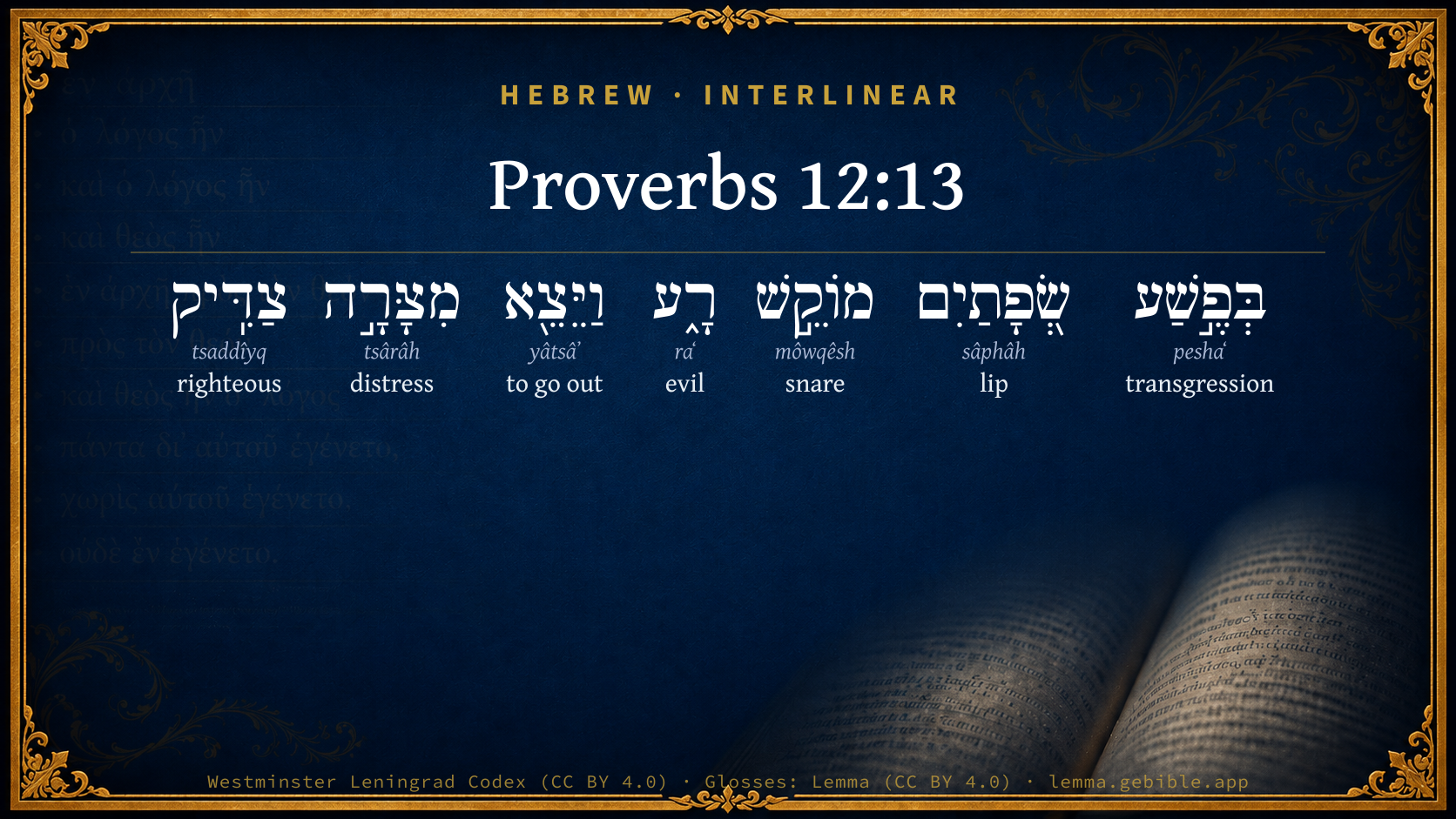
Hebrew (Westminster Leningrad Codex) Proverbs 12:13 appears in the Hebrew Old Testament. The text above is from the Westminster Leningrad Codex. Each word links to its Strong’s number, a concise gloss, and parsing drawn from the Open Scriptures Hebrew Bible morphology. Click any word for its full Brown-Driver-Briggs (BDB) entry.
Download image
Cite this verse

Proverbs 12:13 (World English Bible). Public Domain. Lemma interlinear Bible study tool, https://lemma.gebible.app/v/proverbs/12/13.

Show BibTeX & RIS
BibTeX
RIS
English Translation
An evil man is trapped by sinfulness of lips, But the righteous shall come out of trouble.
World English Bible · Public Domain
Download a study sheet

One document with this verse’s original text, its word-by-word gloss line, the meaning frame, cross-references with their text, attributed commentary, and full source and license credits — printable, and it pastes into notes with its structure intact.

This verse Autodidact and up

Study sheet (.html) Plain text (.txt)

A passage Seminary Student

Up to 50 verses in one chapter. A passage sheet keeps up to 6 commentary sources and 12 cross-references per verse, in the order this page ranks them, and says so on the sheet whenever that leaves anything out. Ask for a single verse and you get the Autodidact verse sheet above.

Everything on this page stays free to read, with no account — the sheet is a download of what is already on screen, not access to it.

Want to remove ads? Support Godless Engineer
Compare translations 3

The same verse in 3 English versions, stacked beneath the original-language interlinear above. Click any original word for its lexicon entry.

Each is an independent rendering of the whole verse — the interlinear is not word-aligned to these translations.

Highlighted words mark where these versions differ — a whole-verse word diff, not a word-by-word alignment.

  • World English Bible Public Domain
    An evil man is trapped by sinfulness of lips, But the righteous shall come out of trouble.
  • King James Version Public Domain
    The wicked is snared by the transgression of his lips: but the just shall come out of trouble.
  • unfoldingWord Literal Text CC BY-SA 4.0
    In the transgression of lips the snare of an evil, but a righteous will go out from distress.

unfoldingWord Literal Text — © unfoldingWord, licensed CC BY-SA 4.0. Word-aligned USFM3 via Door43 (git.door43.org/unfoldingWord/en_ult).

Versions to compare (up to 4)

3 of 4 selected

Show all 18 translations

Every available English version of this verse, each an independent rendering of the whole verse.

  • World English Bible Public Domain
    An evil man is trapped by sinfulness of lips, But the righteous shall come out of trouble.
  • Berean Standard Bible Public Domain
    An evil man is trapped by his rebellious speech, but a righteous man escapes from trouble.
  • Majority Standard Bible Public Domain
    An evil man is trapped by his rebellious speech, but a righteous man escapes from trouble.
  • King James Version Public Domain
    The wicked is snared by the transgression of his lips: but the just shall come out of trouble.
  • American Standard Version (1901) Public Domain
    In the transgression of the lips is a snare to the evil man; But the righteous shall come out of trouble.
  • Revised Version (1885) Public Domain
    In the transgression of the lips is a snare to the evil man: but the righteous shall come out of trouble.
  • Geneva Bible (1599) Public Domain
    The euill man is snared by the wickednesse of his lips, but the iust shall come out of aduersitie.
  • Douay-Rheims (1899) Public Domain
    For the sins of the lips ruin draweth nigh to the evil mall: but the just shall escape out of distress.
  • Young's Literal Translation Public Domain
    In transgression of the lips `is' the snare of the wicked, And the righteous goeth out from distress.
  • Literal Standard Version CC BY-SA 4.0
    The snare of the wicked [is] in transgression of the lips, || And the righteous goes out from distress.
  • Unlocked Literal Bible CC BY-SA 4.0
    An evil person is trapped by his wicked talk, but the righteous person escapes from trouble.
  • unfoldingWord Literal Text CC BY-SA 4.0
    In the transgression of lips the snare of an evil, but a righteous will go out from distress.
  • Darby Bible Public Domain
    In the transgression of the lips is an evil snare; but a righteous [man] shall go forth out of trouble.
  • World Messianic Bible Public Domain
    An evil man is trapped by sinfulness of lips, but the righteous shall come out of trouble.
  • Webster's Bible Public Domain
    The wicked is snared by the transgression of his lips: but the just shall come out of trouble.
  • Free Bible Version CC BY-SA 4.0
    The wicked trap themselves by their own sinful words, but good people escape trouble.
  • Bible in Basic English Public Domain
    In the sin of the lips is a net which takes the sinner, but the upright man will come out of trouble.
  • JPS Tanakh (1917) Public Domain
    In the transgression of the lips is a snare to the evil man; but the righteous cometh out of trouble.

Literal Standard Version (2020), Covenant Press — licensed CC BY-SA 4.0. Text via the HelloAO Bible API (eBible.org). Unlocked Literal Bible (unfoldingWord) — licensed CC BY-SA 4.0. Text via the HelloAO Bible API (eBible.org). unfoldingWord Literal Text — © unfoldingWord, licensed CC BY-SA 4.0. Word-aligned USFM3 via Door43 (git.door43.org/unfoldingWord/en_ult). Free Bible Version, Dr. Jonathan Gallagher — licensed CC BY-SA 4.0. Text via the HelloAO Bible API (eBible.org).

Word by word

More ways to search: Search by grammar → Find every occurrence → Compare this word →

Practice this passage: Drill this verse → Learn its vocabulary →

About this verse

These counts appear in no published source. They are computed here, from the morphology-tagged text and Lemma’s own curated glosses. What Lemma adds →

7
words
7
distinct lemmas
Wisdom
section

Shared distinctive vocabulary

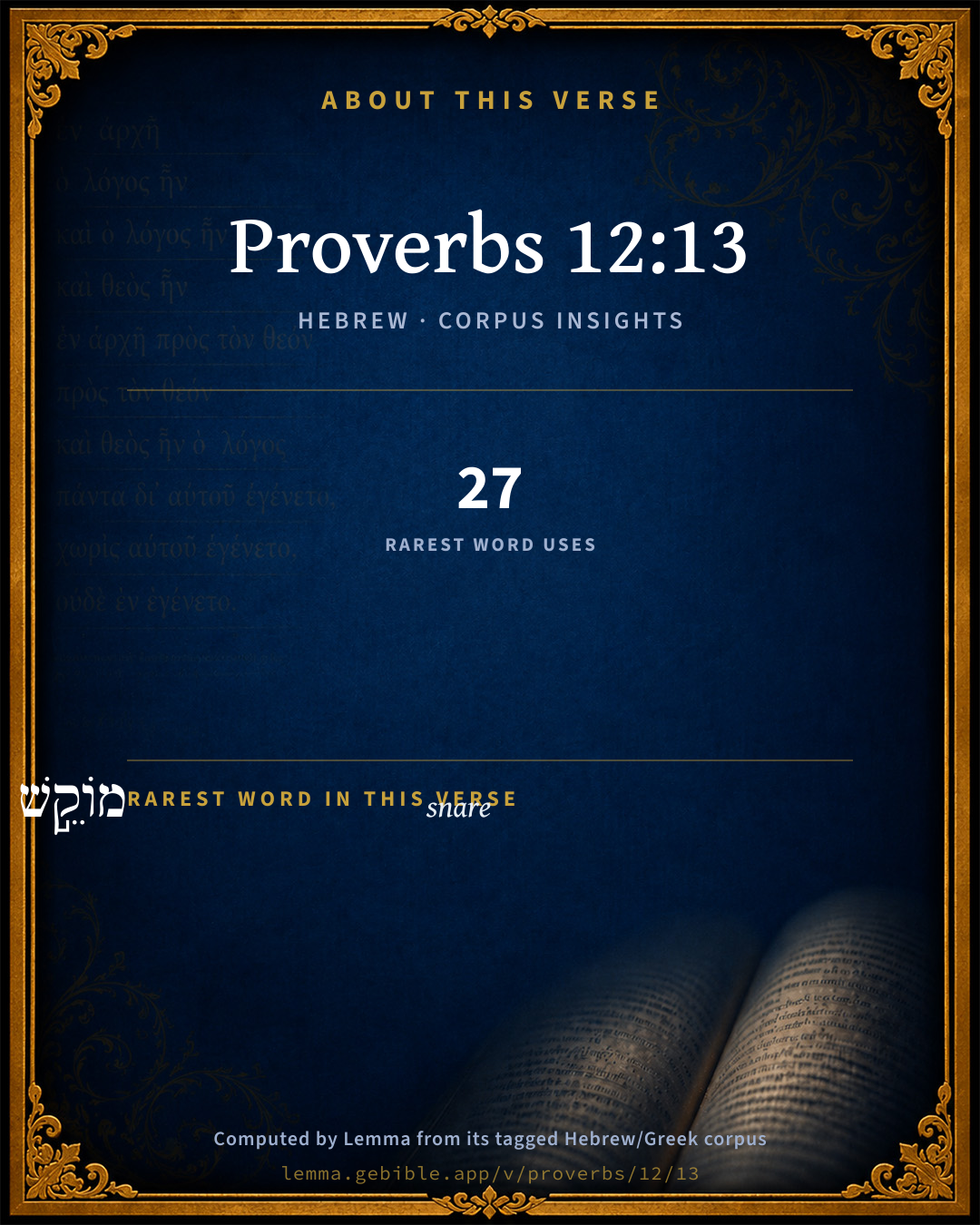
מוֹקֵ֣שׁ snare H4170 occurs in 27 verses of the Hebrew Bible. Also found in:

Grammatical profile

  • 1 verb
  • 4 nouns
  • 2 adjectives

Verb forms

  • וַיֵּצֵ֖א Qal · Sequential Imperfect

Hebrew & Septuagint length

In English translation the verse runs 17 words from the Hebrew and 36 from the Septuagint (LXX English) — the Septuagint runs noticeably longer here. See the side-by-side →

A rough comparison of the two English renderings, which tokenize alike — not a word-level alignment.

Word counts can differ between the Hebrew and the Greek without any difference in meaning — e.g. the Hebrew direct-object marker אֵת has no separate Greek word, and Greek often adds the article ὁ.

Cross-references

16

Topical passages linked to Proverbs 12:13 in the Treasury of Scripture Knowledge — connected by theme and wording, ordered by reader-vote popularity; previews shown in the World English Bible.

  • Proverbs 21:23 Whoever guards his mouth and his tongue Keeps his soul from troubles.
  • Psalms 64:8 Their own tongues shall ruin them. All who see them will shake their heads.
  • Proverbs 11:8 A righteous person is delivered out of trouble, And the wicked takes his place.
  • Proverbs 6:2 You are trapped by the words of your mouth. You are ensnared with the words of your mouth.
  • Daniel 6:24 The king commanded, and they brought those men who had accused Daniel, and they cast them into the den of lions, them, their children, and their wives; and the lions had the mastery of them, and broke all their bones in pieces, before they came to the bottom of the den.
  • Proverbs 18:6–7 A fool's lips come into strife, And his mouth invites beatings.
  • Ecclesiastes 7:18 It is good that you should take hold of this. Yes, also from that don't withdraw your hand; for he who fears God will come forth from them all.
  • 2 Peter 2:9 the Lord knows how to deliver the godly out of temptation and to keep the unrighteous under punishment for the day of judgment;
  • Genesis 48:16 the angel who has redeemed me from all evil, bless the lads, and let my name be named on them, and the name of my fathers Abraham and Isaac. Let them grow into a multitude in the midst of the earth."
  • 2 Samuel 4:9 David answered Rechab and Baanah his brother, the sons of Rimmon the Beerothite, and said to them, As Yahweh lives, who has redeemed my soul out of all adversity,
  • 1 Kings 2:23 Then king Solomon swore by Yahweh, saying, God do so to me, and more also, if Adonijah has not spoken this word against his own life.
  • Psalms 5:6 You will destroy those who speak lies. Yahweh abhors the blood-thirsty and deceitful man.
  • Psalms 34:19 Many are the afflictions of the righteous, But Yahweh delivers him out of them all.
  • Proverbs 15:2 The tongue of the wise commends knowledge, But the mouth of fools gush out folly.
  • Matthew 27:25 All the people answered, "May his blood be on us, and on our children!"
  • Romans 8:35–37 Who shall separate us from the love of Christ? Could oppression, or anguish, or persecution, or famine, or nakedness, or peril, or sword?

Cross-references courtesy of OpenBible.info (CC BY 4.0).

Hebrew and Greek witnesses Masoretic Hebrew ↔ Greek Septuagint

The same verse in the two great witnesses to the Old Testament, shown verse-for-verse.

Here the Septuagint runs noticeably longer than the Hebrew — LXX2012 (modern English Septuagint) 36 words vs World English Bible 17. A rough length comparison of the two English translations, not a word-level alignment — read both below.

These are two independent witnesses, not word-aligned to each other, and the Septuagint is shown in lemma (dictionary) form.

Hebrew Proverbs 12:13 Masoretic · Westminster Leningrad Codex

בְּפֶ֣שַׁע שְׂ֭פָתַיִם מוֹקֵ֣שׁ רָ֑ע וַיֵּצֵ֖א מִצָּרָ֣ה צַדִּֽיק

An evil man is trapped by sinfulness of lips, But the righteous shall come out of trouble.

World English Bible · Public Domain

Greek LXX Proverbs 12:13 Septuagint · lemma form

διά ἁμαρτία χεῖλος ἐνπίπτω εἰς παγίς ἁμαρτωλός ἐκφεύγω δέ ἐκ αὐτός δίκαιος ὁ βλέπω λεῖος ἐλεέω ὁ δέ συνἀντάω ἐν πύλη ἐκθλίβω ψυχή

For the sin of his lips a sinner falls into snare; but a righteous man escapes from them. He whose looks are gentle shall be pitied, but he that contends in the gates will afflict souls.

LXX2012 (modern English Septuagint) · Public Domain

On this verse, Keil & Delitzsch discusses the Septuagint’s reading. Read the note in Commentary ↓

Hebrew: Westminster Leningrad Codex (CC BY 4.0). Greek: Septuagint (public domain); English from LXX2012 (modern English Septuagint) (Public Domain). How the Septuagint differs from the Hebrew →

Commentary

Notes on Proverbs 12:13 from classic Christian and Jewish commentators (each source and its license shown beneath its notes). The classic Christian expositions comment on the surrounding passage and are grouped to its opening verse, so a note may address several verses; the Jewish commentaries on the Tanakh (Rashi and others) are per-verse, so they appear only where the commentator wrote on this verse.

Lemma curates 59 commentaries, every one of them public domain or Creative Commons licensed, each selected and text-cleaned for this edition rather than reprinted as found. About our sources →

Trapp's Complete Commentary

John Trapp

Pro 12:13 The wicked is snared by the transgression of [his] lips: but the just shall come out of trouble.

Ver. 13. The wicked is snared by the transgression of his lips.] His heart is oft so full of venom that it cannot be hid, but blisters his tongue, and breaks out at his lips to his own ruin, as it befell Story, Campian, Garnet, and other Popish poisonous spiders, who were swept down by the hand of justice, and drew their last thread in the triangle of Tyburn. Detexit facinus fatuus, et non implevit, as Tacitus saith of one that was sent by the senate to despatch Nero, but exposed and betrayed himself.

But the just shall come out of trouble.] They suffer sometimes for their bold and free invectives against the evils of the times, or otherwise for discharging their consciences, but they shall surely be delivered. "There is yet one man," saith Ahab, "Micaiah the son of Imlah, by whom we may inquire of the Lord: but I hate him; for he doth not prophesy good concerning me, but evil." {1Ki 22:8} It is very probable that Micaiah was that disguised prophet who brought to Ahab the fearful message of displeasure and death for dismissing Benhadad, for which he was ever since fast in prison, deep in disgrace. But God, "with the temptation, made a way for him to escape." So he did for Peter; {Act 12:7-11} Paul; {2Ti 4:6-8} all the apostles. {Act 4:13-21} John Baptist, indeed, was, without any law, right, or reason, beheaded in prison, as though God had known nothing at all of him, said George Marsh the martyr. {a} And the same may be said of sundry other faithful withesses to the truth, but then by death they entered into life eternal. Mors fuit aerumnarum requies, which was Chaucer’s motto. Besides that, heaven upon earth they had during their troubles. Philip, Landgrave of Hesse, being a long time prisoner under Charles V, was demanded what upheld him all that while. Respondit, divinas consolationes martyrum se sensisse, he answered - that he had felt the divine comforts of the martyrs. The best comforts are usually reserved for the worst times.

{a} Acts and Mon., fol. 1423.

John Trapp, A Commentary or Exposition upon All the Books of the Old and New Testament (1647–1656) — public domain. Text from a community e-Sword module.

The Biblical Illustrator

Joseph S. Exell

Pro_12:13

The wicked is snared by the transgression of his lips.

Lies, the snare that liars are caught in

The Supreme has set many snares, in the constitution of things, for the detection and punishment of evil-doers. The liars own tongue betrays him. In some of its movements, ere he is aware, it touches the spring which brings down the avenging stroke. It is instructive to read with this view the detailed account of a criminal trial. In the faltering and fall of a false witness you should see and reverence the righteousness of God. When a man is not true, the great labour of his life must be to make himself appear true; but if a man be true, he need not concern himself about appearances. He may go forward, and tread boldly; his footing is sure. (R. F. Horton, D.D.)

The Biblical Illustrator, edited by Joseph S. Exell (c. 1880s–1900s) — public domain. Text from a community e-Sword module.

Joseph Benson's Commentary

Pro 12:13-14. The wicked is snared — Brought into trouble; by the transgression of his lips — By his wicked speeches against God and men; but the just shall come out of trouble — Namely, by his wise, and holy, and inoffensive words, whereby he pacifieth men, and pleases God, and therefore is favoured with his protection. A man shall be satisfied, &c., by the fruit of his mouth — By his pious and profitable discourses. And the recompense of a man’s hands — That is, of his works, of which the hand is the great instrument; shall be rendered unto him — Namely, by God, to whom the work of retribution belongs.

Joseph Benson's Commentary on the Old and New Testaments (1811–1818) — public domain. Text from a community e-Sword module.

Keil & Delitzsch

C. F. Keil & F. Delitzsch

Proverbs regarding injurious and beneficial words, wise hearing and prudent silence.

13 In the transgression of the lips there lies a dangerous snare;

The righteous escapeth from trouble.

The consecutive modus (ויּצא) is here of greater weight than e.g., at Pro 11:8, where the connection follows without it (ויּבא) from the idea of the change of place. The translation: but the righteous ... restores ויצא (ויצא), and ignores the syllogistic relation of the members of the proverb, which shows itself here (cf. the contrary, Pro 11:9) to a certain degree by ויּצא. Ewald displaces this relation, for he paraphrases: "any one may easily come into great danger by means of inconsiderate words; yet it is to be hoped that the righteous may escape, for he will guard himself against evil from the beginning." He is right here in interpreting צרה and מוקשׁ רע as the designation of danger into which one is betrayed by the transgressions of his lips, but "inconsiderate words" are less than פּשׁע שׂפתים. One must not be misled into connecting with פּשׁע the idea of missing, or a false step, from the circumstance that פּשׁע means a step; both verbs have, it is true, the common R. פש with the fundamental idea of placing apart or separating, but פּשׁע has nothing to do with פּשׁע (step = placing apart of the legs), but denotes (as Arab. fusuwḳ fisḳ, from the primary meaning diruptio, diremtio) a sinning, breaking through and breaking off the relation to God (cf. e.g., Pro 28:24), or even the restraints of morality (Pro 10:19). Such a sinning, which fastens itself to, and runs even among the righteous, would not be called פשׁע, but rather חטּאת (Pro 20:9). According to this the proverb will mean that sinful words bring into extreme danger every one who indulges in them - a danger which he can with difficulty escape; and that thus the righteous, who guards himself against sinful words, escapes from the distress (cf. with the expression, Ecc 7:18) into which one is thereby betrayed. רע is the descriptive and expressive epithet to מוקשׁ (cf. Ecc 9:12): a bad false trap, a malicious snare, for מוקשׁ is the snare which closes together and catches the bird by the feet. This proverb is repeated at Pro 29:6, peculiarly remodelled. The lxx has after Pro 12:13 another distich:

He who is of mild countenance findeth mercy;

He who is litigious oppresseth souls.

(נפשׁות, or rather, more in accordance with the Hebrew original: oppresseth himself, נפשׁו.)

Keil & Delitzsch — Biblical Commentary on the Old Testament (1861–1891) — public domain (CC PDM 1.0). Text via the HelloAO Bible API. (Old Testament only.)

Matthew Henry's Commentary

See here, 1. The wicked entangling themselves in trouble by their folly, when God in justice leaves them to themselves. They are often snared by the transgression of their lips and their throats are cut with their own tongues. By speaking evil of dignities they expose themselves to public justice; by giving ill language they become obnoxious to private resentments, are sued for defamation, and actions on the case for words are brought against them. Many a man has paid dearly in this world for the transgression of his lips, and has felt the lash on his back for want of a bridle upon his tongue, Psa 64:8. 2. The righteous extricating themselves out of trouble by their own wisdom, when God in mercy comes in for their succour: The just shall come out of such troubles as the wicked throw themselves headlong into. It is intimated that the just may perhaps come into trouble; but, though they fall, they shall not be utterly cast down, Psa 34:19.

Matthew Henry's Commentary on the Whole Bible (1708–1710) — public domain (CC PDM 1.0). Text via the HelloAO Bible API.

Jamieson, Fausset & Brown

Robert Jamieson, A. R. Fausset & David Brown

The wicked is snared, &c.--The sentiment expanded. While the wicked, such as liars, flatterers, &c., fall by their own words, the righteous are unhurt. Their good conduct makes friends, and God rewards them.

Jamieson, Fausset & Brown — Commentary Critical and Explanatory on the Whole Bible (1871) — public domain (CC PDM 1.0). Text via the HelloAO Bible API.

Adam Clarke's Commentary

Verse 13. The wicked is snared by the transgression of his lips] A man who deals in lies and false oaths will sooner or later be found out to his own ruin. There is another proverb as true as this: A liar had need of a good memory; for as the truth is not in him, he says and unsays, and often contradicts himself.

Adam Clarke's Commentary on the Bible (1810–1826) — public domain. Text from a community e-Sword/MySword module.

Ellicott's Commentary for English Readers

(13) The wicked is cursed by the transgression of his lips.—For his words, the product of his evil heart, while designed to injure others, often bring the offender himself into trouble (Psa_7:16), and moreover, as being the true index of the inner life of the soul, are being stored up as a witness against him at the day of judgment” (Mat_12:37). The “just man,” on the contrary, avoids all this “trouble.”

A Bible Commentary for English Readers, edited by Charles John Ellicott (1878–1897) — public domain. Text from a community e-Sword module.

The Cambridge Bible for Schools and Colleges

gen. ed. J. J. S. Perowne

13. The wicked is snared] Rather:

In the transgression of the lips is a snare to the evil man,

R.V. text; comp. A.V. marg., and for the sentiment, Pro_18:7. This is preferable to the rendering of R.V. marg., an evil snare, because it preserves the balance of the verse: the evil man, by the wicked and deceitful words which he uses to prosecute his purposes, entangles himself in a snare: the righteous man, by his righteous dealing, though he fall into trouble, is delivered out of it and walks at liberty.

The LXX. add:

“He that hath regard to gentleness shall obtain mercy;

But he that opposeth men in the gates will trouble souls.”

The Cambridge Bible for Schools and Colleges (gen. ed. J. J. S. Perowne; Cambridge University Press, 1878–1918) — public domain. Text from a community e-Sword module.

John Gill's Exposition

The wicked is snared by the transgression of his lips,.... A wicked man often brings himself into trouble by giving his tongue too great a liberty, and by making free with the characters of others; sometimes by treasonable speeches against his sovereign; sometimes by bearing false Witness, and by lies and perjuries, of which he is convicted in open court; and by calumnies, reproaches, detraction, and scandal raised by him, and cast on his neighbour, who sues him for these things: or "in the transgression of the lips is an evil snare"; or "the snare of an evil man" (y); by the wicked things they say they lay a snare for others, which the simple and incautious are taken in; so heretics ensnare men by their good words and fair speeches, and plausibility of their doctrines; so antichrist, by lies in hypocrisy, and by his deceivableness of unrighteousness;

but the just shall come out of trouble; or escape it; he escapes the snare that is laid for him, and so the trouble consequent upon it; a just man escapes trouble by not giving his tongue the liberty wicked men do; and when he by any means falls into trouble, he gets out of it again by giving good words to those in whose hands he is; and by his prayers and supplications unto God. The righteous are sometimes in trouble, and in such sort of trouble as others are not; by reason of their own corruptions, Satan's temptations, the hidings of God's face, as well as various outward afflictions; out of all which the Lord delivers them sooner or later, in life or in death, Psa 34:19. Jarchi exemplifies this in the case of righteous Noah, who escaped the flood, when the world of the ungodly were destroyed by it, for the transgression of their lips, saying, as in Job 21:15, "what is the Almighty?" &c.

(y) "in praevaricatione labiorum laqueos malus", Montanus, Michaelis, Schultens, so Junius & Tremellius, Piscator, Cocceius; "vel laqueus hominis mali", Mercerus, Gejerus.

John Gill's Exposition of the Whole Bible (1746–1763) — public domain (CC PDM 1.0). Text via the HelloAO Bible API.

Haydock's Catholic Bible Commentary

Lips. Liars often become the victims of their own deceit.

George Leo Haydock (1774–1849), Haydock's Catholic Family Bible and Commentary, 1859 edition — public domain. Excludes Psalms (Douay-Rheims chapter numbering differs from Protestant) and Deuterocanonical books (Catholic canon only).

Matthew Poole's English Annotations

The wicked is snared, i.e. brought into trouble,

by the transgression of his lips, by his wicked speeches against God and men. The just shall come out of trouble, to wit, by his wise, and holy, and inoffensive speeches, whereby he pacifieth men, and gaineth God’s favour and protection.

Matthew Poole's English Annotations on the Holy Bible (1683–1685) — public domain. Text from a community e-Sword/MySword module.

Whedon's Commentary on the Bible

Daniel D. Whedon

13. Wicked… snared — Well rendered by Conant: “In the transgression of the lips is an evil snare.” A man is often ensnared by his malicious or envious talk, or by his prevarications and falsehoods. Compare Ecc_10:12. Trouble — Strait or distress.

Daniel D. Whedon (gen. ed.), Commentary on the Old and New Testaments (1874–1909) — public domain. Text from a community e-Sword module.

The Pulpit Commentary

The wicked is snared by the transgression of his lips; rather, in the transgression of the lips is an evil snare. (Pro_18:7) A man by speaking unadvisedly or intemperately brings trouble upon himself, involves himself in difficulties which he did not foresee. Often when he has spoken in order to injure others, the slander or the censure has redounded on himself. (comp. Psa_7:15, 16 9:16) The just; the man who does not offend with his lips, avoids these snares. The Septuagint here introduces a couplet not found in the Hebrew: "He who looketh gently (oo blepwn leia ) shall obtain mercy; but he who frequents the gates or, "contends in the gates," sunantwn en pulaiv will harass souls." This seems to mean the man who is calm and considerate for others will himself be treated with pity and consideration; (Mat_5:7) but he who is a gossip, or a busybody, or litigious, will be always vexing his neighbours.

The Pulpit Commentary (1880–1919), ed. H.D.M. Spence-Jones & Joseph S. Exell — public domain. Text from a community e-Sword module.

Bridges on Proverbs

Charles Bridges

We have seen the intense desire of the wicked to snare others in the net. Here he is snared himself: The transgressions of his lips become the snare of his life. (Pro 18:7 . Psa 64:8 .) ’Many have felt the lash upon their backs for the want of a bridle on their tongues.’†1 Such a snare were the lips of the Amalekite bringing the tidings of Saul’s death. Expecting a reward, he found his death. (2Sa 4:9-12 .) Such also was Adonijah’s deceitful petition (1Ki 2:22-23 ); the hypocritical loyalty of Daniel’s enemies (Dan 6:7-8, Dan 6:24 ); the fearful imprecation of the devoted nation. (Mat 27:25 .) The lips of the wicked miss their mark, and become the instruments of his ruin. (Psa 35:8 .)

On the other hand, the godly exercise of the lips often delivers out of the trouble, into which the wicked rush headlong. (Jer 26:12-16 .) The noble confession of Caleb and Joshua brought them safe out of the trouble, which was frowning upon their rebellious brethren. (Num 14:6-10, Num 14:24 .) And even when the just "are overtaken with" a transgression of the lips, still their faithful God makes a difference. He will not indeed wink at sin in his own children. (Amo 3:2 .) But while his covenant provides stripes for their transgressions, it ensures deliverance in the end. (Psa 89:32-33 .) Thus a presumptuous confidence is restrained; and a humbling, self-abasing, tender confidence is established.

Footnotes:

†1 Henry in loco.

Charles Bridges, An Exposition of the Book of Proverbs (1846) — public domain. Text from a community e-Sword module.

Kretzmann's Popular Commentary

Paul E. Kretzmann

v. 13. The wicked is snared by the transgression of his lips, his own speeches prove a dangerous snare to him, so that he is overthrown; but the just shall come out of trouble, escaping from the net which was placed for his feet.

Paul E. Kretzmann, Popular Commentary of the Bible (1921–1924) — public domain. Text from a community e-Sword module.

unfoldingWord translationNotes

Door43 World Missions Community

An evil person is trapped by his wicked talk

"Trapped" represents being caught in a snare or being tricked. This can be stated in active form. AT: "The wicked things an evil person says will trap him" (See: Metonymy and Active or Passive)

just as the work of his hands rewards him

The phrase, "the work of his hands" represents work done by physical labor. AT: "just as the good work he does rewards him" (See: Metonymy)

translationWords

evil

trouble

fruit

word

works

reward

unfoldingWord translationNotes — © Distant Shores Media and the Door43 World Missions Community, licensed CC BY-SA 4.0. Source: git.door43.org/Door43/en_tn.

Rashi

Rabbi Shlomo Yitzchaki (Rashi)

Because of the transgression of the lips Because of the transgression of the lips of the generation of the Flood, who said (Job 21:15): “What is the Almighty that we should serve Him?” an evil snare came upon them, and Noah, the righteous man, came out of the trouble.

Rashi on the Tanakh — English translations: “The Judaica Press complete Tanach with Rashi, translated by A. J. Rosenberg” (CC BY 4.0); “Pentateuch with Rashi's commentary by M. Rosenbaum and A.M. Silbermann, 1929-1934” (public domain); “The Metsudah Tanach series, Lakewood, N.J” (CC BY 4.0); and “The Book of Joshua, Metsudah Publications, 1997” (CC BY 4.0). Text via Sefaria.

Lesson kit

Teaching starters — assembled from the data on this page, not authored interpretation. Every prompt links to the verse data it draws on. Edit before teaching.

Proverbs, in the Wisdom, opens this verse with 7 words (7 distinct Hebrew lemmas). Its most distinctive word is môwqêsh (“snare”). The Greek Septuagint runs longer here. A historical commentator’s framing appears above. Read the whole chapter for the surrounding context.

Discussion questions

  1. How does “snare” (môwqêsh) shape what this verse is saying?
  2. Exodus 10:7 shares the word «snare» with this verse. How do the two illuminate each other?
  3. Compared with the Hebrew, the Septuagint runs longer here. What questions does that raise?
  4. The translations on this page render this verse differently — a whole-verse word diff, not a word-by-word alignment. What might account for the different wordings?
  5. The verb «וַיֵּצֵ֖א» is Qal Sequential Imperfect. How does its form color the action?
  6. Reading how Trapp's Complete Commentary and The Biblical Illustrator read this verse, where do the two commentators agree and where do they part?

Things to notice

Reading settings

Reading text

Shown beneath each verse's original-language words.

Old Testament
Old Testament edition

Read the OT as the Masoretic Hebrew (MT) or the Greek Septuagint (LXX).

English shown for the Greek Septuagint (in the Hebrew ↔ Greek comparison).

Comparing translations? Open the Compare panel on any verse page to stack up to four side by side.