Revelation 17:8

Greek (Tischendorf 8th ed.) Revelation 17:8 appears in the Greek New Testament. The text above is from the Tischendorf 8th edition. Each word links to its Strong’s number and a concise gloss. Click any word for its full Thayer’s Greek Lexicon entry.
Download image
Cite this verse

Revelation 17:8 (World English Bible). Public Domain. Lemma interlinear Bible study tool, https://lemma.gebible.app/v/revelation/17/8.

Show BibTeX & RIS
BibTeX
RIS
English Translation
The beast that you saw was, and is not; and is about to come up out of the abyss and to go into destruction. Those who dwell on the earth and whose names have not been written in the book of life from the foundation of the world will marvel when they see that the beast was, and is not, and shall be present.
World English Bible · Public Domain
Download a study sheet

One document with this verse’s original text, its word-by-word gloss line, the meaning frame, cross-references with their text, attributed commentary, and full source and license credits — printable, and it pastes into notes with its structure intact.

This verse Autodidact and up

Study sheet (.html) Plain text (.txt)

A passage Seminary Student

Up to 50 verses in one chapter. A passage sheet keeps up to 6 commentary sources and 12 cross-references per verse, in the order this page ranks them, and says so on the sheet whenever that leaves anything out. Ask for a single verse and you get the Autodidact verse sheet above.

Everything on this page stays free to read, with no account — the sheet is a download of what is already on screen, not access to it.

Want to remove ads? Support Godless Engineer
Compare translations 3

The same verse in 3 English versions, stacked beneath the original-language interlinear above. Click any original word for its lexicon entry.

Each is an independent rendering of the whole verse — the interlinear is not word-aligned to these translations.

Highlighted words mark where these versions differ — a whole-verse word diff, not a word-by-word alignment.

  • World English Bible Public Domain
    The beast that you saw was, and is not; and is about to come up out of the abyss and to go into destruction. Those who dwell on the earth and whose names have not been written in the book of life from the foundation of the world will marvel when they see that the beast was, and is not, and shall be present.
  • King James Version Public Domain
    The beast that thou sawest was, and is not; and shall ascend out of the bottomless pit, and go into perdition: and they that dwell on the earth shall wonder, whose names were not written in the book of life from the foundation of the world, when they behold the beast that was, and is not, and yet is.
  • unfoldingWord Literal Text CC BY-SA 4.0
    The beast that you saw was and is not but is about to come up from the abyss, and it is going to destruction, and the ones living on the earth whose names have not been written in the Book of Life from the foundation of the world will wonder, seeing the beast that was and is not but will come.

unfoldingWord Literal Text — © unfoldingWord, licensed CC BY-SA 4.0. Word-aligned USFM3 via Door43 (git.door43.org/unfoldingWord/en_ult).

Versions to compare (up to 4)

3 of 4 selected

Show all 19 translations

Every available English version of this verse, each an independent rendering of the whole verse.

  • World English Bible Public Domain
    The beast that you saw was, and is not; and is about to come up out of the abyss and to go into destruction. Those who dwell on the earth and whose names have not been written in the book of life from the foundation of the world will marvel when they see that the beast was, and is not, and shall be present.
  • Berean Standard Bible Public Domain
    The beast that you saw—it was, and now is no more, but is about to come up out of the Abyss and go to its destruction. And those who dwell on the earth whose names were not written in the Book of Life from the foundation of the world will marvel when they see the beast that was, and is not, and yet will be.
  • Majority Standard Bible Public Domain
    The beast that you saw—it was, and now is no more, but is about to come up out of the Abyss and go to its destruction. And those who dwell on the earth whose names were not written in the Book of Life from the foundation of the world will marvel when they see the beast that was, and is not, and yet will be.
  • King James Version Public Domain
    The beast that thou sawest was, and is not; and shall ascend out of the bottomless pit, and go into perdition: and they that dwell on the earth shall wonder, whose names were not written in the book of life from the foundation of the world, when they behold the beast that was, and is not, and yet is.
  • American Standard Version (1901) Public Domain
    The beast that thou sawest was, and is not; and is about to come up out of the abyss, and to go into perdition. And they that dwell on the earth shall wonder, `they' whose name hath not been written in the book of life from the foundation of the world, when they behold the beast, how that he was, and is not, and shall come.
  • Revised Version (1885) Public Domain
    The beast that thou sawest was, and is not; and is about to come up out of the abyss, and to go into perdition. And they that dwell on the earth shall wonder, they whose name hath not been written in the book of life from the foundation of the world, when they behold the beast, how that he was, and is not, and shall come.
  • Geneva Bible (1599) Public Domain
    The beast that thou hast seene, was, and is not, and shall ascend out of the bottomles pit, and shall goe into perdition, and they that dwell on the earth, shall wonder (whose names are not written in the booke of life from the foundation of ye world) when they behold the beast that was, and is not, and yet is.
  • Douay-Rheims (1899) Public Domain
    The beast, which thou sawest, was, and is not, and shall come up out of the bottomless pit, and go into destruction: and the inhabitants on the earth (whose names are not written in the book of life from the foundation of the world) shall wonder, seeing the beast that was, and is not.
  • Young's Literal Translation Public Domain
    `The beast that thou didst see: it was, and it is not; and it is about to come up out of the abyss, and to go away to destruction, and wonder shall those dwelling upon the earth, whose names have not been written upon the scroll of the life from the foundation of the world, beholding the beast that was, and is not, although it is.
  • Literal Standard Version CC BY-SA 4.0
    The beast that you saw: it was, and it is not, and it is about to come up out of the abyss, and to go away to destruction, and those dwelling on the earth will wonder, whose names have not been written on the Scroll of Life from the foundation of the world, beholding the beast that was, and is not, although it is.
  • Unlocked Literal Bible CC BY-SA 4.0
    The beast you saw existed, does not exist now, but is about to come up from the bottomless pit. Then it will go on to destruction. Those who live on the earth, those whose names have not been written in the Book of Life since the foundation of the world—they will be astounded when they see the beast that existed, does not exist now, but is about to come.
  • unfoldingWord Literal Text CC BY-SA 4.0
    The beast that you saw was and is not but is about to come up from the abyss, and it is going to destruction, and the ones living on the earth whose names have not been written in the Book of Life from the foundation of the world will wonder, seeing the beast that was and is not but will come.
  • Darby Bible Public Domain
    The beast which thou sawest was, and is not, and is about to come up out of the abyss and go into destruction: and they who dwell on the earth, whose names are not written from the founding of the world in the book of life, shall wonder, seeing the beast, that it was, and is not, and shall be present.
  • World Messianic Bible Public Domain
    The beast that you saw was, and is not; and is about to come up out of the abyss and to go into destruction. Those who dwell on the earth and whose names have not been written in the book of life from the foundation of the world will marvel when they see that the beast was, and is not, and shall be present.
  • Webster's Bible Public Domain
    The beast that thou sawest, was, and is not; and shall ascend out of the bottomless pit, and go into perdition: and they that dwell on the earth shall wonder, whose names were not written in the book of life from the foundation of the world, when they behold the beast that was, and is not, and yet is.
  • Free Bible Version CC BY-SA 4.0
    The beast you saw once was, but is not, will soon come up again out of the Abyss, and will then be completely destroyed. Those that live on the earth who don't have their names written in the book of life will be amazed when they see the beast that once was but is not, and yet shall return.
  • Bible in Basic English Public Domain
    The beast which you saw was, and is not; and is about to come up out of the great deep, and to go into destruction. And those who are on the earth, whose names have not been put in the book of life from the first, will be full of wonder when they see the beast, that he was, and is not, and still will be.
  • Text-Critical English NT CC BY 4.0
    The beast that yoʋ saw was, and is not, and is about to come up out of the abyss and go to destruction. Those who dwell on the earth, everyone whose name has not been written in the book of life from the foundation of the world, will be amazed when they see that the beast was and is not and will be back.
  • Tyndale New Testament (1534) Public Domain
    The best that thou seest was and is not and shall ascende out of the bottomlesse pytt and shall goo into perdicion and they that dwell on the erth shall wondre (whose names are not wrytten in the boke of lyfe from the begynnynge of the worlde) when they beholde the best that was and ys nott.

Literal Standard Version (2020), Covenant Press — licensed CC BY-SA 4.0. Text via the HelloAO Bible API (eBible.org). Unlocked Literal Bible (unfoldingWord) — licensed CC BY-SA 4.0. Text via the HelloAO Bible API (eBible.org). unfoldingWord Literal Text — © unfoldingWord, licensed CC BY-SA 4.0. Word-aligned USFM3 via Door43 (git.door43.org/unfoldingWord/en_ult). Free Bible Version, Dr. Jonathan Gallagher — licensed CC BY-SA 4.0. Text via the HelloAO Bible API (eBible.org).

Word by word

More ways to search: Search by grammar → Find every occurrence → Compare this word →

Practice this passage: Drill this verse → Learn its vocabulary →

ἀβύσσου
ábyssos
G12
“abyss”
Noun, Genitive, Singular, Feminine
Part of Speech
Noun
Case
Genitive
Number
Singular
Gender
Feminine
Full Thayer's Definition

Origin: from G1 (as a negative particle) and a variation of G1037

TDNT: 01:09,2

1. bottomless 2. unbounded 3. the abyss a. the pit b. the immeasurable depth c. of Orcus, a very deep gulf or chasm in the lowest parts of the earth used as the common receptacle of the dead and especially as the abode of demons
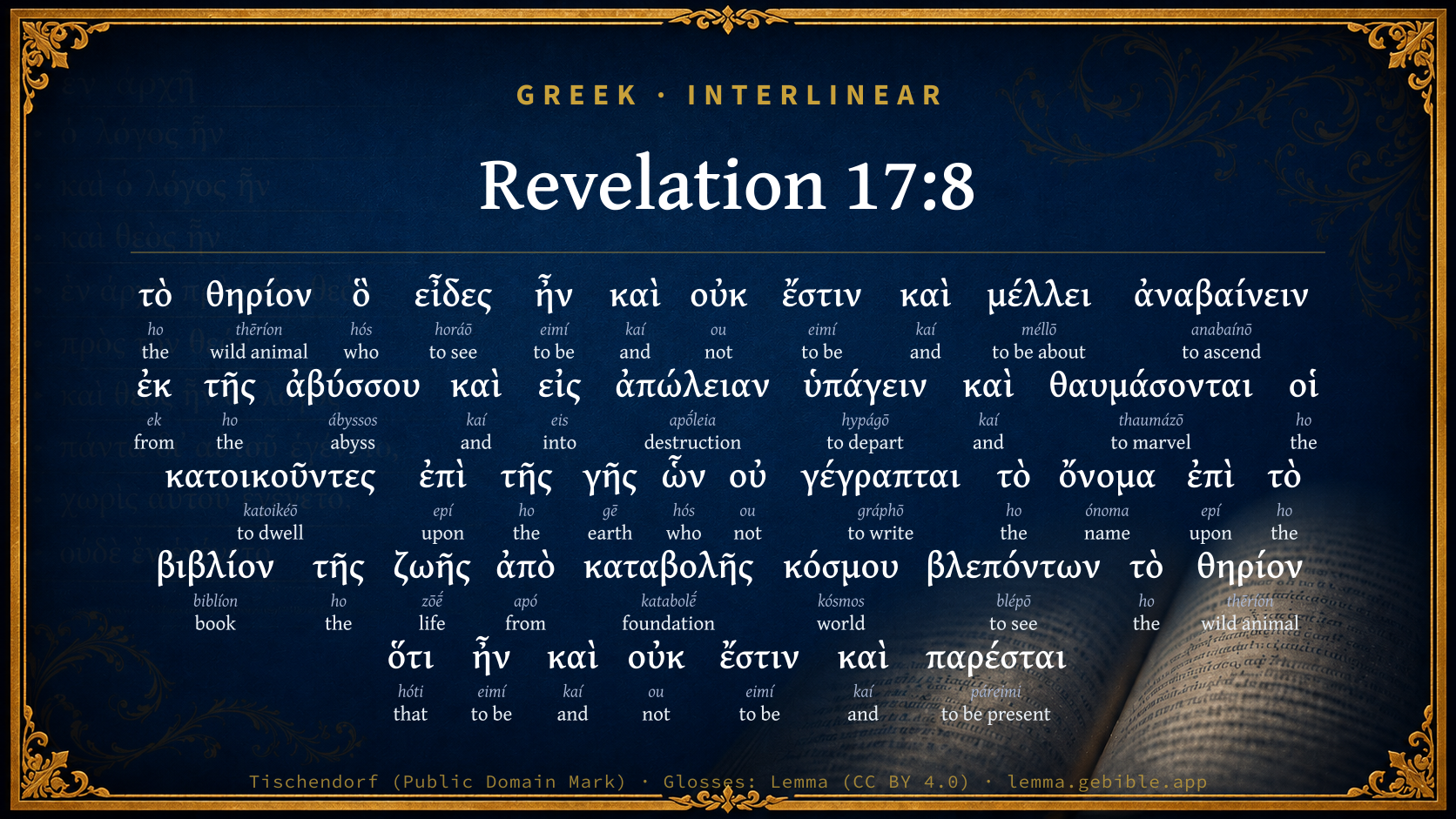
  1. τὸ ho G3588 “the” Article, Nominative, Singular, Neuter
  2. θηρίον thēríon G2342 “wild animal” Noun, Nominative, Singular, Neuter
  3. ὃ hós G3739 “who” Relative pronoun, Accusative, Singular, Neuter
  4. εἶδες horáō G3708 “to see” Verb, Aorist, Active, Indicative, 2nd person, Singular
  5. ἦν eimí G1510 “to be” Verb, Imperfect, Active, Indicative, 3rd person, Singular
  6. καὶ kaí G2532 “and” Conjunction
  7. οὐκ ou G3756 “not” Particle, Negative
  8. ἔστιν eimí G1510 “to be” Verb, Present, Active, Indicative, 3rd person, Singular
  9. καὶ kaí G2532 “and” Conjunction
  10. μέλλει méllō G3195 “to be about” Verb, Present, Active, Indicative, 3rd person, Singular
  11. ἀναβαίνειν anabaínō G305 “to ascend” Verb, Present, Active, Infinitive
  12. ἐκ ek G1537 “from” Preposition
  13. τῆς ho G3588 “the” Article, Genitive, Singular, Feminine
  14. καὶ kaí G2532 “and” Conjunction
  15. εἰς eis G1519 “into” Preposition
  16. ἀπώλειαν apṓleia G684 “destruction” Noun, Accusative, Singular, Feminine
  17. ὑπάγειν hypágō G5217 “to depart” Verb, Present, Active, Infinitive
  18. καὶ kaí G2532 “and” Conjunction
  19. θαυμάσονται thaumázō G2296 “to marvel” Verb, Future, Middle, Indicative, 3rd person, Plural
  20. οἱ ho G3588 “the” Article, Nominative, Plural, Masculine
  21. κατοικοῦντες katoikéō G2730 “to dwell” Verb, Present, Active, Participle, Nominative, Plural, Masculine
  22. ἐπὶ epí G1909 “upon” Preposition
  23. τῆς ho G3588 “the” Article, Genitive, Singular, Feminine
  24. γῆς gē G1093 “earth” Noun, Genitive, Singular, Feminine
  25. ὧν hós G3739 “who” Relative pronoun, Genitive, Plural, Masculine
  26. οὐ ou G3756 “not” Particle, Negative
  27. γέγραπται gráphō G1125 “to write” Verb, Perfect, Passive, Indicative, 3rd person, Singular
  28. τὸ ho G3588 “the” Article, Nominative, Singular, Neuter
  29. ὄνομα ónoma G3686 “name” Noun, Nominative, Singular, Neuter
  30. ἐπὶ epí G1909 “upon” Preposition
  31. τὸ ho G3588 “the” Article, Accusative, Singular, Neuter
  32. βιβλίον biblíon G975 “book” Noun, Accusative, Singular, Neuter
  33. τῆς ho G3588 “the” Article, Genitive, Singular, Feminine
  34. ζωῆς zōḗ G2222 “life” Noun, Genitive, Singular, Feminine
  35. ἀπὸ apó G575 “from” Preposition
  36. καταβολῆς katabolḗ G2602 “foundation” Noun, Genitive, Singular, Feminine
  37. κόσμου kósmos G2889 “world” Noun, Genitive, Singular, Masculine
  38. βλεπόντων blépō G991 “to see” Verb, Present, Active, Participle, Genitive, Plural, Masculine
  39. τὸ ho G3588 “the” Article, Nominative, Singular, Neuter
  40. θηρίον thēríon G2342 “wild animal” Noun, Nominative, Singular, Neuter
  41. ὅτι hóti G3754 “that” Conjunction
  42. ἦν eimí G1510 “to be” Verb, Imperfect, Active, Indicative, 3rd person, Singular
  43. καὶ kaí G2532 “and” Conjunction
  44. οὐκ ou G3756 “not” Particle, Negative
  45. ἔστιν eimí G1510 “to be” Verb, Present, Active, Indicative, 3rd person, Singular
  46. καὶ kaí G2532 “and” Conjunction
  47. παρέσται páreimi G3918 “to be present” Verb, Future, Middle deponent, Indicative, 3rd person, Singular

About this verse

These counts appear in no published source. They are computed here, from the morphology-tagged text and Lemma’s own curated glosses. What Lemma adds →

48
words
28
distinct lemmas
Revelation
section

Notable vocabulary

The rarest word here is ἀβύσσου abyss G12 — appearing just 9 times in the whole Greek New Testament.

Shared distinctive vocabulary

ἀβύσσου abyss G12 occurs in 9 verses of the Greek New Testament. Also found in:

Repetition

Words recur within this verse:

Cross-references

23

Topical passages linked to Revelation 17:8 in the Treasury of Scripture Knowledge — connected by theme and wording, ordered by reader-vote popularity; previews shown in the World English Bible.

  • Revelation 11:7 When they have finished their testimony, the beast that comes up out of the abyss will make war with them, and overcome them, and kill them.
  • Revelation 17:11 The beast that was, and is not, is himself also an eighth, and is of the seven; and he goes to destruction.
  • Revelation 3:10 Because you kept my command to endure, I also will keep you from the hour of testing, which is to come on the whole world, to test those who dwell on the earth.
  • Revelation 9:1–2 The fifth angel sounded, and I saw a star from the sky which had fallen to the earth. The key to the pit of the abyss was given to him.
  • Revelation 19:15–21 Out of his mouth proceeds a sharp, double-edged sword, that with it he should strike the nations. He will rule them with a rod of iron. He treads the winepress of the fierceness of the wrath of God, the Almighty.
  • Revelation 3:5 He who overcomes will be arrayed in white garments, and I will in no way blot his name out of the book of life, and I will confess his name before my Father, and before his angels.
  • Revelation 13:1–12 Then I stood on the sand of the sea. I saw a beast coming up out of the sea, having ten horns and seven heads. On his horns were ten crowns, and on his heads, blasphemous names.
  • Revelation 14:8–20 Another, a second angel, followed, saying, "Babylon the great has fallen, which has made all the nations to drink of the wine of the wrath of her sexual immorality."
  • Daniel 7:11 I saw at that time because of the voice of the great words which the horn spoke; I saw even until the animal was slain, and its body destroyed, and it was given to be burned with fire.
  • Matthew 25:34 Then the King will tell those on his right hand, 'Come, blessed of my Father, inherit the Kingdom prepared for you from the foundation of the world;
  • John 17:24 Father, I desire that they also whom you have given me be with me where I am, that they may see my glory, which you have given me, for you loved me before the foundation of the world.
  • Ephesians 1:4 even as he chose us in him before the foundation of the world, that we would be holy and without blemish before him in love;
  • Titus 1:2 in hope of eternal life, which God, who can't lie, promised before eternal times;
  • Revelation 20:12 I saw the dead, the great and the small, standing before the throne, and they opened books. Another book was opened, which is the book of life. The dead were judged out of the things which were written in the books, according to their works.
  • Daniel 7:7 After this I saw in the night-visions, and, behold, a fourth animal, awesome and powerful, and strong exceedingly; and it had great iron teeth; it devoured and broke in pieces, and stamped the residue with its feet: and it was diverse from all the animals that were before it; and it had ten horns.
  • Daniel 7:26 But the judgment shall be set, and they shall take away his dominion, to consume and to destroy it to the end.
  • Daniel 11:45 He shall plant the tents of his palace between the sea and the glorious holy mountain; yet he shall come to his end, and none shall help him.
  • Acts 15:18 All his works are known to God from eternity.'
  • 2 Thessalonians 2:3–8 Let no one deceive you in any way. For it will not be, unless the departure comes first, and the man of sin is revealed, the son of destruction,
  • Revelation 16:1–18 I heard a loud voice out of the temple, saying to the seven angels, "Go and pour out the seven bowls of the wrath of God on the earth!"
  • Revelation 20:10 The devil who deceived them was thrown into the lake of fire and sulfur, where the beast and the false prophet are also. They will be tormented day and night forever and ever.
  • Revelation 20:15 If anyone was not found written in the book of life, he was cast into the lake of fire.
  • 1 Peter 1:20 who was foreknown indeed before the foundation of the world, but was revealed at the end of times for your sake,

Cross-references courtesy of OpenBible.info (CC BY 4.0).

Where the printed editions differ

1 variant

Places in this verse where the major printed Greek editions disagree on the wording in a way that affects the translation — a comparison of editions, not a manuscript-by-manuscript collation. The editions are the modern critical texts (Nestlé-Aland 28/27, SBL, Westcott-Hort, Tregelles, Tyndale House) and the traditional texts behind the KJV (the Textus Receptus and the Byzantine/Majority text). It is not a claim about which reading is original.

  1. Different wording
    παρέσται.

    “it will exist.”

    In NA28NA27TynSBLWHTregByz Not in TR

    ἔστιν (estin) 'it is' occurs in traditional manuscripts (TR) instead of παρέσται. (parestai) 'it will exist.' in older manuscripts (NA28+NA27+Tyn+SBL+WH+Treg+Byz)

Textual data: Translators Amalgamated Greek New Testament (STEPBible TAGNT) · CC BY 4.0.

Commentary

Notes on Revelation 17:8 from classic Christian and Jewish commentators (each source and its license shown beneath its notes). The classic Christian expositions comment on the surrounding passage and are grouped to its opening verse, so a note may address several verses; the Jewish commentaries on the Tanakh (Rashi and others) are per-verse, so they appear only where the commentator wrote on this verse.

Lemma curates 59 commentaries, every one of them public domain or Creative Commons licensed, each selected and text-cleaned for this edition rather than reprinted as found. About our sources →

Joseph Benson's Commentary

Rev 17:8-14. The beast that thou sawest, &c. — The mystery of the beast is first explained, and the beast is considered first in general, (Rev 17:8,) under a threefold state or succession, as existing, and then ceasing to be, and then reviving again, so as to become another and the same. He was, and is not — Καιπερ εστιν, and yet is, or, according to other copies, και παρεσται, and shall come, shall ascend out of the bottomless pit — A beast in the prophetic style, as we before observed, is a tyrannical idolatrous empire; and the Roman empire was idolatrous under the heathen emperors, and then ceased to be so for some time under the Christian emperors, and then became idolatrous again under the Roman pontiffs, and so hath continued ever since. It is the same idolatrous power revived again; but only in another form; and all the corrupt part of mankind, whose names were not enrolled as good citizens in the registers of heaven, are pleased at the revival of it; but in this last form it shall go into perdition — It shall not, as it did before, cease for a time and revive again, but shall be destroyed for ever.

After this general account of the beast, follows an explanation of the particular emblems, with a short preface, intimating that they are deserving of the deepest attention, and are a proper exercise and trial of the understanding. Here is the mind which hath wisdom, Rev 17:9 — As it was said upon a former occasion, Rev 13:8, Here is wisdom: let him that hath understanding count, &c. The seven heads have a double signification: they are, primarily, seven mountains on which the woman sitteth — On which the capital city is seated; which all know to be the situation of Rome. It is observed too, that new Rome, or Constantinople, is situated on seven mountains: but these are very rarely mentioned, and mentioned only by obscure authors in comparison of the others; and besides the seven mountains, other particulars also must coincide, which cannot be found in Constantinople. It is evident, therefore, that the city seated on seven mountains must be Rome; and a plainer description could not be given of it without expressing the name, which there might be several wise reasons for concealing.

As the seven heads signify seven mountains, so they also signify seven kings reigning over them. And they are seven kings — Or kingdoms, or forms of government, as the word imports, and hath been shown to import in former instances. Five are fallen — Five of these forms of government are already past; and one is — The sixth is now subsisting. The five fallen are kings, and consuls, and dictators, and decemvirs, and military tribunes with consular authority; as they are enumerated and distinguished by the two greatest Roman historians, Livy and Tacitus. The sixth is the power of the Cesars or emperors, which was subsisting at the time of the vision. An end was put to the imperial name, A.D. 476, by Odoacer. king of the Heruli. He and his successors, the Ostrogoths, assumed the title of kings of Italy; but though the name was changed the power still continued much the same. This, therefore, cannot well be called a new form of government; it may rather be considered as a continuation of the imperial power, or as a renovation of the kingly authority. Consuls are reckoned but one form of government, though their office was frequently suspended, and after a time restored again: and in the same manner kings may be counted but one form of government, though the name was resumed after an interval of so many years. A new form of government was not erected till Rome fell under the obedience of the eastern emperor, and the emperor’s lieutenant, the exarch of Ravenna, dissolved all the former magistracies, and constituted a duke of Rome, to govern the people, and to pay tribute to the exarchate of Ravenna. Rome had never experienced this form of government before; and this was, perhaps, the other which, in the apostle’s days, was not yet come, and when he cometh he must continue a short space — For Rome was reduced to a dukedom, tributary to the exarch of Ravenna, by Longinus, who was sent exarch A.D. 566 or 568; and the city revolted from the eastern emperor to the pope, A.D. 727; which is a short space, in comparison of the imperial power, which preceded, and lasted above five hundred years; and in comparison of the Papal power, which followed, and hath now continued about one thousand years. But still it may be doubted whether this is properly a new form of government, Rome being still subject to the imperial power, by being subject to the Greek emperor’s deputy, the exarch of Ravenna: and, according as you determine this point, the beast that was, and is not — Was, while idolatrous, and was not, while not idolatrous, will appear to be the seventh or eighth. If you reckon this a new form of government, the beast that now is, is the eighth; if you do not reckon this a new form of government, the beast is of the seven; but whether he be the seventh or eighth, he is the last form of government, and goeth into perdition — It appears evidently that the sixth form of government, which was subsisting in St. John’s time, is the imperial; and what form of government hath succeeded to that in Rome, and hath continued for a long space of time, but the Papal? The beast, therefore, upon which the woman rideth, is the Roman government in its last form; and this, all must acknowledge, is the Papal, and not the imperial.

Having thus explained the mystery of the seven heads, the angel proceeds to the explanation of the ten horns, (Rev 17:12-14,) which, says he, are ten kings, who have received no kingdom as yet — And consequently they were not in being at the time of the vision; and indeed the Roman empire was not divided into ten kingdoms till some time after it was become Christian. But they receive power as kings one hour — Or rather, at the same time, or for the same length of time; with the beast — It is true in both senses, they rise and fall together with the beast; and consequently they are not to be reckoned before the rise and establishment of the beast. Kingdoms they might be before, but they were not before kingdoms or horns of the beast, till they embraced his religion, and submitted to his authority; and the beast strengthened them, as they again strengthened the beast. It is upon the seventh or last head of the beast that the horns were seen growing together, that is, upon the Roman empire in its seventh or last form of government; and they are not, like the heads, successive, but contemporary kingdoms. These have one mind, and shall give their power and strength unto the beast, Rev 17:13 — Which is easily understood and applied to the princes and states in communion with the Church of Rome. However they may differ in other respects, yet they agree in submitting implicitly to the authority of the Roman Church, and in defending its rights and prerogatives against all opposers. But where were ever ten kings or kingdoms who were all unanimous in their submissions to the Roman empire, and voluntarily contributed their power and strength, their forces and riches, to support and maintain it? These shall make war with the Lamb, and the Lamb shall overcome them, Rev 17:14 — They persecute the true Church of Christ, but the true church shall in the end prevail and triumph over them; which particulars have been fulfilled in part already, and will be more fully accomplished hereafter.

Joseph Benson's Commentary on the Old and New Testaments (1811–1818) — public domain. Text from a community e-Sword module.

Whedon's Commentary on the Bible

Daniel D. Whedon

2. Angel’s exposition of the Beast, Rev_17:7-14.

The angel will now solve the mystery of this woman, whose name is Mystery.

8. And first he explains (Rev_17:8-14) the beast, then (Rev_17:15-18) the woman.

Bottomless pit—Or sea, compare Rev_13:1.

And yet is—Better reading, And yet shall be. The other phrases of this verse will be explained at Rev_17:10.

Daniel D. Whedon (gen. ed.), Commentary on the Old and New Testaments (1874–1909) — public domain. Text from a community e-Sword module.

Tyndale Open Study Notes

Tyndale Open Resources

17:8-11 The destruction within this vision contrasts with the destiny of the people of God in the new heaven and earth (see 21:1-4).

17:8 The beast . . . was once alive but isn’t now . . . will soon come up: When Domitian became emperor (AD 81–96), he was as evil as Nero (both were fierce persecutors of the church), and many thought he was the embodiment of Nero’s spirit, if not Nero himself (perhaps similar to the way that John the Baptist was considered to embody Elijah’s spirit; see Mal 4:5; Matt 11:14; Luke 1:17; John 1:21). • you saw: The past tense indicates that the angel’s interpretation took place after John’s vision. • was once alive but isn’t now: This contrasts with God, “who is, who always was, and who is still to come” (Rev 1:4, 8). • the bottomless pit: See study note on 9:1-12. • In contrast to God’s people, the people of this world are not written in the Book of Life (see 20:11-15). They will be amazed by the apparent resurrection of the beast (see study note on 17:10-11; see also 13:13-17).

Tyndale Open Study Notes — © Tyndale Open Resources, licensed CC BY-SA 4.0. Text via the HelloAO Bible API.

Bengel's Gnomon

Johann Albrecht Bengel

Rev 17:8. Ἦν, κ.τ.λ., was, etc.) There are three periods of the duration of the beast: the times of which are by conjecture related in the book, Erkl. Offenb. p. 1147, etc. But, (1.) To the problem there given there may be added a certain secondary course of the number of the beast, from the completion of his rising out of the sea, in the time of Alexander III., A. 1169, to A. 1836. (2.) That which I said above, on ch. Rev 13:1, Proposition 10, Observ. 29, may be compared. (3.) The whole of that 10th Proposition may be reviewed to explain many parts of this 17th chapter.—[187] βλεπόντων[188]) The Genitive by itself put absolutely, as Luk 8:20, λεγόντων.—ὅτι, that) The point of view, by reason of which the inhabitants of the earth wonder at the beast: thus altogether, ὅτι, Joh 9:8.—καὶ παρέσται[189]) The ancient authorities, with the greatest agreement, have this reading: some, καὶ πάρεστιν. It is not so clear respecting M. and Pet. 3 only. See App. Crit. Ed. ii. on this passage. Erasmus himself, if he were alive, would, as I think, yield the victory to so many MSS., which are now accessible, and would wonder at his followers, who so superstitiously preserve the readings formerly established by him with difficulty. When I deny, that the particle καίπερ is anywhere used by John, Wolf retorts, that not even the word παρέσται is used by John.[190] But the two cases are dissimilar. For no idiomatic usage excludes the verb παρέσται. The Hebrew usage, which John greatly follows, almost everywhere renders the particle although, by å or καὶ, according to Noldii Concord, pp. 292, 293, not by καίπερ. Another argument is to be added, which plainly refutes the construction of Erasmus, καίπερ ἐστίν. For all the passages of the New Testament teach, that καίπερ is not construed with a verb, but with a participle: 2Pe 1:12; Heb 5:8; Heb 7:5; Heb 12:17; and especially Php 3:4. And thus οἱ ἔξω. Demosth., ΤΑῦΤΑ ΜΝΗΜΟΝΕΎΕΤΕ ῬΗΘΈΝΤΑ, ΚΑΊΠΕΡ ὌΝΤΕς Οὐ ΔΕΙΝΟῚ ΤΟῪς ἈΔΙΚΟῦΝΤΑς ΜΕΜΝῆΣΘΑΙ. The same, ἝΚΑΣΤΟΝ ὐΜῶΝ, ΚΑΊΠΕΡ ἈΚΡΙΒῶς ΕἸΔΌΤΑ, ὍΜΩς ὐΠΟΜΝῆΣΑΙ ΒΟΎΛΟΜΑΙ. The same, ΔΕῖ ΜΕ, ΚΑΊΠΕΡ Οὐ ΦΙΛΟΛΟΊΔΟΡΟΝ ὌΝΤΑ ΦΎΣΕΙ, ΑὐΤᾺ ΤᾺ ἈΝΑΓΚΑΙΌΤΑΤΑ ΕἸΠΕῖΝ ΠΕΡῚ ΑὐΤΟῦ. Aristotle, Ἀλλὰ καίπερ ὄντος τοιούτου τοῦ παρόντος λόγου, πειρατέον βοηθεῖν. Euripides, ΚἈΓΏ Σʼ ἹΚΝΟῦΜΑΙ, ΚΑῚ ΓΥΝΉ ΠΕΡ ΟὖΣʼ ὍΜΩς, ΤΟῖς ΔΕΟΜΈΝΟΙΣΙΝ ὨΦΕΛΕῖΝ, ΟἿΌς ΤΕ Δʼ ΕἾ. Sophocles, Γινώσκω σαφῶς, Καίπερ σκοτεινὸς (that is, ὢν) τήν γε σὴν αὐδὴν ὅμως. Dion, ΤᾺ ΤΟῦ ΤΙΒΕΡΊΟΥ ἜΡΓΑ, ΚΑΊΠΕΡ (Xiphilinus, ΚΑῚ) ΧΑΛΕΠΏΤΑΤΑ ΔΌΞΑΝΤΑ ΓΕΓΟΝΈΝΑΙ, ΠΑΡᾺ ΤᾺ ΓΑΐΟΥ—ΠΑΡΉΝΕΓΚΑΝ. Zosimus, Καίπερ ἐν τούτοις ὄντι τῷ στρατοπέδῳ, περὶ φιλίας ὅμως ἐποιοῦντο λόγους οἱ Πέρσαι. Julian, ΚΑΊΠΕΡ ΤΑῦΤΑ ΠΟΛΥΠΡΑΓΜΟΝῶΝ, ᾘΔΕῖΤΟ ΤῸ ΜΈΓΕΘΟς ΑὐΤΟῦ Τῆς ἈΡΕΤῆς. But if any one affirms that ΚΑΊΠΕΡ is construed also with a verb, let him prove it by examples, and those too in which ΠΕΡ is not ΠΑΡΈΛΚΟΝ, as in Apollonius Rhodius, but signifies although. The nature of the particle does not permit it: for even the simple words, of which καίπερ is compounded, namely καὶ (for although) less frequently, and ΠΕΡ (in Devarius), never take a verb joined with them. A more weighty argument is, that the conjecture ΚΑΊΠΕΡ takes away much from the sentiment: for the wonder of them that dwell on the earth is excited not so much by that, that the beast was and is not, as by this, that the beast ΠΑΡΈΣΤΑΙ, will be present. Enough of criticism: but not however to no purpose. The passage is momentous. That tetragrammaton, יהוה, LORD, has a magnificent periphrasis, ὁ ὢν καὶ ὁ ἦν καὶ ὁ ἐρχόμενος, who is, and who was, and who is to come. But the dwellers on the earth wonder at the beast, as though a kind of antitetragrammaton; for he was, and is not, and will be present. The Lord is described as ὁ ἐρχόμενος, coming: the beast ΠΑΡΈΣΤΑΙ, will be present, when that other king comes, Rev 17:10; and that ΠΑΡΟΥΣΊΑ (comp. altogether 2 Thessalonians 2) is by far the most destructive. To the Hebrew word, בוא, both ἜΡΧΟΜΑΙ and ΠΆΡΕΙΜΙ correspond in the LXX.; and in this place, ΚΑῚ ΠΑΡΈΣΤΑΙ most appropriately accords with ἮΝ ΚΑΙ ΟὐΚ ἜΣΤΙ, and it conveys a meaning something less, than if it were said, ΚΑῚ ἜΡΧΕΤΑῚ, or ΚΑῚ ἜΣΤΑΙ.

[187] ἐκ τῆς ἀβύσσου, out of the bottomless pit) The beast ascends out of the sea, when he begins to be: at last he will ascend out of the bottomless pit.—V. g.

[188] Vulg. h and Rec. Text read βλέποντες. AB read βλεπόντων.—E.

[189] ABh read καὶ πάοεσται. Rec. Text, without old authority, reads καίπέρ ἐστιν. Vulg. omits the words.—E.

[190] Since the remarks which here follow belong not only to Criticism, but also to sacred Philology, I was unwilling to reject them, although they are inserted in the Apparatus.—E. B.

Bengel's Gnomon of the New Testament — English translation (T&T Clark, Edinburgh, 1860) — public domain. Text from a community e-Sword module.

Expositor's Greek Testament

ed. W. Robertson Nicoll

Rev 17:8 . As the Beast seen by the seer cannot be described as non-existent, it must denote here (as in Rev 13:3 f., though differently) not the empire but the emperor, or one of its own heads. Such an identification was natural in the ancient world especially, where a king and his capital or state were interchangeable terms. The emperor, here Nero redivivus ( cf. the saying of Apollonius, cited in Philostr. Vit. Apol. iv. 38: “Regarding this wild beast,” i.e. , Nero, “I know not how many heads he has”), embodied the empire. The Beast is a sort of revenant . To rise from the abyss was the conventional origin of the Beast ( cf. Rev 11:7 ) even in the primitive tradition; the Nero-antichrist, however, introduces the fresh horror of a monster breaking loose even from death. True, he goes to perdition eventually, but not before all except the elect have succumbed to the fascination of his second advent. The Beast of the source here is evidently the antichrist figure of Rev 11:7 (also a Jewish source) transformed into Nero redivivus. There is less reason to suspect the hand of the Christian editor in 8 (Bousset) than in 9 a (J. Weiss).

The Expositor's Greek Testament, edited by W. Robertson Nicoll (1897–1910) — public domain. Text from a community e-Sword module.

Geneva Bible (1599)

Geneva Bible translators

That is as many as have not learned the providence of God, according to the faith of the Saints, shall marvel at these grievous and often changes when they shall consider, the selfsame beast, which is the Roman Empire, to have been, not to be, and to be and still molested with perpetual mutation, and yet in the same to stand and continue. This in mine opinion is the most simple exposition of this place, and confirmed by the event of the things themselves. Although by the last change also, by which the Empire, that before was civil became Ecclesiastical, is not obscurely signified by these words: of which two, the first exercised cruelty upon the bodies of the saints: the other also upon their souls: the first by human order and policy, the other under the color of the law of God, and of Religion, raged and imbrued itself with the blood of the godly.

The meaning is, that beast which thou sawest before (Rev. 13:1) and which yet thou hast now seen, was, (I say was) even from Julius Caesar in respect of beginning, rising up, station, glory, dominion, manner and stock, from the house of Julius: and yet is not now the same, if thou look unto the house and stock for the dominion of this family was translated unto another, after the death of Nero from the other unto a third, from a third unto a fourth, and so forth was varied and altered by innumerable changes. Finally, the Empire is one, as it were one beast: but exceedingly varied by kindreds, families, and persons. It was therefore (saith S. John) in the kindred or house of Julius: and now it is not in that kindred, but translated unto another.

The story of the beast hath a triple description of him. The first is a distinction of this beast from all that ever hath been at any time: which distinction is contained in this verse: The second is a delineation or painting out of the beast by things present, by which he might even at that time be known of the godly, and this delineation is according to his heads, verses 2, 10, 11. The third is an historical foretelling of things to come, and to be done by him: and these are ascribed unto his horns, verses 12, 13, 14. This beast is that Empire of Rome, of which I spake, chap. 13:11, according to the mutations and changes whereof which then had already happened, the holy Ghost hath distinguished and set out the same. The Apostle distinguisheth this beast from all others in these words. The beast which thou sawest, was and is not. For so I expound the words of the Apostle for evidence’s sake as I will further declare in the notes following.

As if he should say, Also the same that is, shall shortly not be: but shall ascend out of the depth, or out of the sea (as was said, Rev. 13:1) that is, shall be a new stock from amongst the nations without difference, and shall in the same state go unto destruction or ruin, and perish: and so shall successively new Princes or Emperors come and go, arise and fall, the body of the beast remaining still, but tossed with so many and often alterations, as no man can but marvel that this beast was able to stand and hold out, in so many mutations. Verily no Empire that ever was tossed with so many changes, and as it were with so many tempests of the sea, ever continued so long.

Geneva Bible (1599) marginal notes — public domain. Text via Bolls.life.

Jamieson, Fausset & Brown

Robert Jamieson, A. R. Fausset & David Brown

beast . . . was, and is not--(Compare Rev 17:11). The time when the beast "is not" is the time during which it has "the deadly wound"; the time of the seventh head becoming Christian externally, when its beast-like character was put into suspension temporarily. The healing of its wound answers to its ascending out of the bottomless pit. The beast, or Antichristian world power, returns worse than ever, with satanic powers from hell (Rev 11:7), not merely from the sea of convulsed nations (Rev 13:1). Christian civilization gives the beast only a temporary wound, whence the deadly wound is always mentioned in connection with its being healed up the non-existence of the beast in connection with its reappearance; and Daniel does not even notice any change in the world power effected by Christianity. We are endangered on one side by the spurious Christianity of the harlot, on the other by the open Antichristianity of the beast; the third class is Christ's little flock."

go--So B, Vulgate, and ANDREAS read the future tense. But A and IRENÆUS, "goeth."

into perdition--The continuance of this revived seventh (that is, the eighth) head is short: it is therefore called "the son of perdition," who is essentially doomed to it almost immediately after his appearance.

names were--so Vulgate and ANDREAS. But A, B, Syriac, and Coptic read the singular, "name is."

written in--Greek, "upon."

which--rather, "when they behold the beast that it was," &c. So Vulgate.

was, and is not, and yet is--A, B, and ANDREAS read, "and shall come" (literally, "be present," namely, again: Greek, "kai parestai"). The Hebrew, "tetragrammaton," or sacred four letters in Jehovah, "who is, who was, and who is to come," the believer's object of worship, has its contrasted counterpart in the beast "who was, and is not, and shall be present," the object of the earth's worship [BENGEL]. They exult with wonder in seeing that the beast which had seemed to have received its death blow from Christianity, is on the eve of reviving with greater power than ever on the ruins of that religion which tormented them (Rev 11:10).

Jamieson, Fausset & Brown — Commentary Critical and Explanatory on the Whole Bible (1871) — public domain (CC PDM 1.0). Text via the HelloAO Bible API.

Adam Clarke's Commentary

Verse 8. The beast that thou sawest was, and is not; and shall ascend out of the bottomless pit, and go into perdition] The beast is the Latin kingdom; (ηλατινηβασιλεια;) consequently the beast was, that is, was in existence previously to the time of St. John; (for Latinus was the first king of the Latins, and Numitor the last;) is not now, because the Latin nation has ceased long ago to be an independent power, and is now under the dominion of the Romans; but shall ascend out of the bottomless pit, that is, the Latin kingdom, the antichristian power, or that which ascendeth out of the abyss or bottomless pit, is yet in futurity. But it is added:-

And they that dwell on the earth shall wonder, whose names there not written in the book of life from the foundation of the world, when they behold the beast that was, and is not, and yet is.] By the earth is here meant the Latin world; therefore the meaning is, that all who dwell in the Latin world shall adhere to the idolatrous and blasphemous religion of the Latin Church, which is supported by the Latin empire, except those who abide by the sacred Scriptures, receiving them as the only rule of faith and practice. These believe in the true Sacrifice, and keep themselves unspotted from the corruption that is in the world. But the inhabitants of the Latin world, under the dominion of the Romish religion, shall wonder when they behold the beast, or Latin empire; that is, as Lord Napier remarks, "shall have in great admiration, reverence, and estimation, this great monarchie." They shall wonder at it, by considering it the most sacred empire in the world, that in which God peculiarly delights; but those that so wonder have not their names written in the book of life, but are such as prefer councils to Divine revelation, and take their religion from missals, rituals, and legends, instead of the sacred oracles: hence they are corrupt and idolatrous, and no idolater hath inheritance in the kingdom of God. In the preceding part of the verse the beast is considered in three states, as that which was, and is not, and shall ascend out of the bottomless pit; here a fourth is introduced, and yet is. This is added to show that, though the Latins were subjugated by the Romans, nevertheless the Romans themselves were Latins; for Romulus the founder of their monarchy, was a Latin; consequently that denominated in St. John's days the Roman empire was, in reality, the Latin kingdom; for the very language of the empire was the Latin, and the Greek writers, who lived in the time of the Roman empire, expressly tell us that those formerly called Latins are now named Romans. The meaning of the whole verse is therefore as follows: The corrupt part of mankind shall have in great admiration the Latin empire yet in futurity, which has already been, but is now extinct, the Romans having conquered it; and yet is still in being; for, though the Latin nation has been subjugated, its conquerors are themselves Latins. But it may be objected against the interpretation here given, that these phrases are spoken of the beast upon which the apostle saw the woman, or Latin Church, sit; for the angel says, The beast that THOU SAWEST was, and is not, c. what reference, therefore, can the Latin empire, which supports the Latin Church, have to the Latin kingdom which subsisted before St. John's time, or to the Roman empire which might properly be so denominated! This objection has very great weight at first sight, and cannot be answered satisfactorily till the angel's explanation of the heads and horns of the beast have been examined; therefore it is added:-

Adam Clarke's Commentary on the Bible (1810–1826) — public domain. Text from a community e-Sword/MySword module.

The Cambridge Bible for Schools and Colleges

gen. ed. J. J. S. Perowne

8. was, and is not] On the whole, ancient tradition where it speaks, and modern criticism, agree in the interpretation of these words. Nero, who killed himself in June a.d. 68, “had been, and was not” at the date of this vision: but his reappearance was looked for by many, with various feelings of hope and fear. “When his dethronement and execution were imminent, it was said that he had talked of going to the East, and establishing his throne at Jerusalem (see on Rev_11:9): while one form (see on Rev_16:12) of the belief that he survived, was that he had fled to the Parthians, and would return under their protection.

Now St John is not to be held responsible for all the opinions, superstitious or at least irrational, that were held by his pagan contemporaries about the return of Nero from the East. But when we find that the belief in Nero’s destined return was held by Christians for the next four centuries, if not longer, when it had quite passed out of the minds of pagans, it becomes probable that St John was answerable for their belief; at any rate, they grounded it on his words. And it is possible that he means to tell us, that the Antichrist who is to come will actually be Nero risen from the dead (we notice, that in the words of the text his death, the reality of which is historically certain, is not denied, but affirmed): more probably, Antichrist will be a new Nero in the same way as he will be a new Antiochus, an enemy of God as they were, typified by them inasmuch as they were actuated by his spirit. It is needless to suppose with M. Renan that Nero is called “the Beast” in allusion to a loathsome atrocity said to be committed by him disguised as one: the analogy of Daniel 7 is what determines the image.

shall ascend out of the bottomless pit] Rev_11:7, where see note. Perhaps there is a distinction between the appearance of the Beast indicated here and that of Rev_13:1. The persecuting Roman Empire, which was antichristian in posse, arose “out of the sea” like other Empires of the earth (Dan_7:3), out of the confused and often sinful, but not infra-natural, turmoil of the life of this world. But the final and developed antichristian and persecuting power, the Empire of Antichrist himself, will have a directly infernal source.

go into perdition] So Rev_17:11 : cf. 2Th_2:3. The fulfilment of this threat is indicated in Rev_19:20.

shall wonder] Rev_13:3-4.

whose names were not written] Rev_13:8. We should almost certainly read, are [or is] not written, as there: and probably name for “names.”

that was] Read, that he was.

and yet is] Read, and shall come: lit. shall be here: the word is cognate with that ordinarily used of the Coming of Christ.

The Cambridge Bible for Schools and Colleges (gen. ed. J. J. S. Perowne; Cambridge University Press, 1878–1918) — public domain. Text from a community e-Sword module.

John Gill's Exposition

The beast which thou sawest was, and is not,.... It is added at the end of the verse where the same description is given, "and yet is"; this beast is to be understood not of the devil, who "was" the god of this world, "is not", being cast out by Christ, and yet is in being; for he, the dragon, is distinguished from this beast, and indeed from him the beast has his seat, power, and authority, Rev 13:1 nor any particular emperor, as Domitian, a cruel and savage one, who was in power in Vespasian's time, when he was abroad, and then was out of it upon his return, and yet afterwards was in again, being as one sent from hell, and went at last into perdition; but the Roman empire itself is intended, as we have seen, which carried and supported the Papacy; and variously may this be interpreted; as that it was in the hands of the Romans originally, and long continued with them, but now "is not", in John's time, being in the hands of Trajan, a Spaniard, "and yet is" in being, Rome being the metropolis of it: it was a very powerful and flourishing empire, "and is not", being destroyed by the Goths and Vandals, "and yet is" a large empire under the jurisdiction of antichrist; it was an idolatrous empire, which encouraged the worshipping of Heathen gods, "and is not" guilty of the same idolatrous practices it was, as the worshipping of Jupiter, Mars, &c. "and yet is" much given to idolatry in another way, worshipping the virgin Mary, and other saints; it "was" under kings, consuls, dictators, tribunes, decemvirs, and emperors, it "is not" in such a form of government, "and yet is" under its seventh head the pope; "Rome was", but "is not" the same it has been, in some respects, and yet is the same, for idolatry, cruelty, &c. it has the image of old Rome, when Pagan, and under the power of the dragon; and though antichrist was not risen up in the empire to an head, to supreme power yet it was in being in the apostles' times, and began to work, and by degrees to show itself. In short, the meaning is, that this beast "was" the Roman empire, as Pagan, described by a dragon with seven heads, and ten horns, with crowns on the heads, but is not as yet in the Apostle John's time, as Papal, described with seven heads, and ten horns, and crowns on the horns.

And shall ascend out of the bottomless pit: out of hell, from whence the antichristian beast has its power; see Rev 11:8 otherwise all civil power is from God, but not antichristian power, that is from the devil:

and go into perdition; everlasting destruction, the lake which burns with fire and brimstone; this will be the end of the beast, Rev 19:20.

and they that dwell on the earth shall wonder; the inhabitants of the Roman empire, earthly minded men, shall have the beast in great veneration, and follow and worship him; see Rev 13:3

whose names were not written in the book of life from the foundation of the world; none but reprobates, not any of the elect of God, are the admirers and worshippers of antichrist; See Gill on Rev 13:8.

when they beheld the beast that was, and is not, and yet is; the Roman empire in glory, under the emperors, destroyed by the Goths, and revived in the Papacy. The Vulgate Latin and Ethiopic versions leave out the last clause,

and yet is.

John Gill's Exposition of the Whole Bible (1746–1763) — public domain (CC PDM 1.0). Text via the HelloAO Bible API.

Trapp's Complete Commentary

John Trapp

8 The beast that thou sawest was, and is not; and shall ascend out of the bottomless pit, and go into perdition: and they that dwell on the earth shall wonder, whose names were not written in the book of life from the foundation of the world, when they behold the beast that was, and is not, and yet is.

Ver. 8. Was and is not] Was before the time of this revelation in the Roman government, which was afterwards usurped by the pope. A thing that the first bishops of Rome dreamed not of. And yet Tertullian (Lib. de Pudicitia) taxes the rising ambition of the popes in his time, thus: I hear, saith he, that there is an edict set forth, and that very peremptory, in these terms, Pontifex, scilicet maximus, Episcopus Episcoporum dicit, Thus saith the high priest, the bishop of bishops. (Baron. Annul. tom. 4.) Odi fastum illius Ecclesiae, I hate the pride of the Church of Rome, saith Basil.

Go into perdition] Go, not run; by degrees, not all at once. He now takes long strides toward the bottomless pit; which is but a little before him, and even gapes for him. There stands a cold sweat on all his limbs already.

Shall wonder] Admiration bred superstition; and illumination draws men off it. Julius Palmer, martyr, was a most obstinate Papist all King Edward’s days; and yet afterwards, in Queen Mary’s time, suffered most cruel death at the Papists’ hands at Newbury, for the most ready and zealous profession of the truth. His words to one Bullingham, walking in Paul’s after his conversion, were these; Oh that God had revealed these matters unto me in time past! I would have bequeathed this Romish religion, or rather irreligion, to the devil of hell, from whence it came. Believe them not, Bullingham, I will rather have these knees pared off than I will kneel to yonder jackanapes {a} (meaning the rood). {a}

And yet is] In regard of that imperial power then extant, which the pope should afterwards take to himself.

{a} Applied contemptuously to a crucifix. Obs. ŒD

{b} The cross upon which Christ suffered; the cross as the symbol of the Christian faith. Now only arch. ŒD

John Trapp, A Commentary or Exposition upon All the Books of the Old and New Testament (1647–1656) — public domain. Text from a community e-Sword module.

Albert Barnes' Notes on the Bible

The beast that thou sawest was, and is not - In the close of the verse it is added, “and yet is” - “the beast that was, and is not, and yet is.” There are three things affirmed here: first, that there is a sense in which it might be said of the power here referred to, that it “was,” or that, before this, it had an existence; second, that there was a sense in which it might be said that it is “not,” that is, that it had become practically extinct; and third, that there is a sense in which that power would be so revived that it might be said that it “still is.” The “beast” here referred to is the same that is mentioned in Rev 17:3, and in Rev 13:1, Rev 13:3,Rev 13:11-16. That is, there was one great formidable power, having essentially the same origin, though manifested under somewhat different modifications, to one and all of which might, in their different manifestations, be given the same name, “the beast.”

And shall ascend out of the bottomless pit - ἐκ τῆς ἀβύσσου ek tēs abussou. On the meaning of the word here used, see the notes on Rev 9:1. The meaning here is, that this power would seem to come up from the nether world. It would appear at one time to be extinct, but would revive again as if coming from the world over which Satan presides, and would, in its revived character, be such as might be expected from such an origin.

And go into perdition - That is, its end will be destruction. It will not be permanent, but will be overthrown and destroyed. The word perdition here is properly rendered by Prof. Stuart “destruction,” but nothing is indicated by the word of the “nature” of the destruction that would come upon it.

And they that dwell on the earth - The inhabitants of the earth generally; that is, the matter referred to will be so remarkable as to attract general attention.

Shall wonder - It will be so contrary to the regular course of events, so difficult of explanation, so remarkable in itself, as to excite attention and surprise.

Whose names were not written in the book of life from the foundation of the world - See this explained in the notes on Rev 13:8. The idea seems to be, that those whose names are written in the book of life, or who are truly the friends of God, would not be drawn off in admiration of the beast, or in rendering homage to it.

When they behold the beast that was, and is not, and yet is - That is, the power that once was mighty; that had declined to such a state that it became, as it were, extinct; and that was revived again with so much of its original strength, that it might be said that it still exists. The fact of its being revived in this manner, as well as the nature of the power itself, seemed suited to excite this admiration.

Albert Barnes' Notes on the Bible (1834–1885) — public domain. Text from a community e-Sword/MySword module.

Haydock's Catholic Bible Commentary

The beast which thou sawest. This beast, which supports Babylon, may signify the power of the devil; which was, and is not, being much limited by the coming of Christ, but shall again exert itself under antichrist. The seven heads of this beast are seven mountains or empires, instruments of his tyranny; of which five were then fallen, as above, chap. xiii. ver. 1. The beast itself is said to be the eighth, and is of the seventh; because they all act under the devil, and by his instigation, so that his power is in them all, yet so as to make up, as it were, an eighth empire distinct from them all. (Challoner)

George Leo Haydock (1774–1849), Haydock's Catholic Family Bible and Commentary, 1859 edition — public domain. Excludes Psalms (Douay-Rheims chapter numbering differs from Protestant) and Deuterocanonical books (Catholic canon only).

Matthew Poole's English Annotations

The beast that thou sawest; this beast was the Roman empire, the scarlet coloured beast which carried the whore, Rev 17:3.

Was, and is not; was of old, in Rome’s pagan state, and is not, not in that form, not now pagan;

and yet is (as is said in the close of the verse) the same in another form, idolatrous and persecuting.

And shall ascend out of the bottomless pit; either, out of the sea, which signifies a multitude of people; or, from hell; the word signifies both.

And go into perdition; and shall certainly be destroyed.

And they that dwell on the earth shall wonder, &c.: but before he goes into perdition he shall so cheat the world, that the generality of the people shall wonder at the beast, {see Rev 8:8} setting aside those who are chosen of God to eternal salvation; the one hundred and forty-four thousand, mentioned Rev 14:3. I conceive that which hath made interpreters so divided in their notions about this beast is, because those words, and yet is, are not added in the beginning of the verse, which being understood, there appears no difficulty considerable; for it is certain the Roman empire was from before Christ, and continued pagan till the year 310; then was not pagan, but Christian, yet after some years was again as idolatrous and bloody against Christians, as the old pagan empire was; especially when swallowed up by the pope, the beast with two horns like a lamb. This is the beast with seven heads and ten horns, Rev 13:1.

Matthew Poole's English Annotations on the Holy Bible (1683–1685) — public domain. Text from a community e-Sword/MySword module.

The Pulpit Commentary

The beast that thou sawest was, and is not; and shall ascend out of the bottomless pit, and go into perdition; and is about to come up out of the abyss (Revised Version). "And to go" (upagein) is read in a, B. P, Vulgate, and almost all cursives; while upagei , "he goeth," is found in A, 12, Arethas, Irenaeus. The latter part of this passage is related again in Rev_19:20. The beast, as we have seen is the world power Satan in his character of "prince of this world." Three stages are marked out in the existence of this world power: first, it was; second, it is not now; thirdly, it reappears, to be cast into perdition. The first period describes the condition of things before the sacrifice of Christ. Then it was that Satan ruled supreme in the world; that the power of the worldthe beast was. But Christ overcame the world; (Joh_16:33) henceforth to all true believers there is "peace," although they may "have tribulation" in the world; (Joh_16:33) for the faithful Christian the power of the worldthe beast is not. Yet, though for the true servant of God there is a sense in which it may be said that this power has no existence, it nevertheless exists in the abyss, that is, in its natural abiding place in the world, among the worldly minded, and thus may cause "tribulation" to the faithful. A further downfall is, therefore, prepared for it that which will take place at the last day, when it "will ascend from the abyss to go into perdition." This nonexistence, contemporaneously with existence and subsequent reappearance, is exactly what is described in the wound healed. (Rev_13:3; see also the remainder of this verse) The period, therefore, embraced in these words is that of the whole existence of this world. It coincides with the period referred to in Rev_12:14, Rev_12:17, and in Rev_20:3. Throughout the Apocalypse the word abussov , translated "bottomless pit" (Authorized Version) and "abyss" (Revised Version), is used to describe the dwelling place of Satan (see Rev_9:1, Rev_9:2, 11 11:7 20:1, 3) while working in the world. "Perdition" is described in Rev_19:20 as the "lake of fire burning with brimstone." And they that dwell on the earth shall wonder, whose names were not written in the book of life from the foundation of the world, when they behold the beast that was, and is not, and yet is; whose name hath not been written upon the book... beast, how that he was, and is not, and shall be present. The last words show exactly what is meant in the first part of the verse (which see). The first words are a repetition of words in Rev_13:8 (which see).

The Pulpit Commentary (1880–1919), ed. H.D.M. Spence-Jones & Joseph S. Exell — public domain. Text from a community e-Sword module.

John Wesley's Explanatory Notes

The beast which thou sawest (namely, verse 3) chap. xvii, 3 was, &c. This is a very observable and punctual description of the beast, verses 8, 10, 11. chap. xvii, 8, 10, 11 His whole duration is here divided into three periods, which are expressed in a fourfold manner.

I. He,

1. Was; 2 And is not;

3. And will ascend out of the bottomless pit, and go into perdition.

II. He,

1. Was;

2. And is not;

3. And will be again.

III. The seven heads are seven hills and seven kings:

1. Five are fallen;

2. One is;

3. The other is not come; and when he cometh, he must continue a short space.

IV. He,

1. Was;

2. And is not; 3 Even he is the eighth, and is one of the seven, and goeth into perdition. The first of these three is described in the thirteenth chapter. chap. xiii, 1-18 This was past when the angel spoke to St. John. The second was then in its course; the third woe to come. And is not - The fifth phial brought darkness upon his kingdom: the woman took this advantage to seat herself upon him. Then it might be said, He is not. Yet shall he afterwards ascend out of the bottomless pit - Arise again with diabolical strength and fury. But he will not reign long: soon after his ascent he goeth into perdition forever.

John Wesley, Explanatory Notes Upon the Whole Bible (1754–1765) — public domain. Text via the GEBible commentary corpus.

The People's New Testament

B. W. Johnson

8. The beast that thou sawest was, and is not. See notes just referred to. The beast that existed then, when John wrote, was to receive a deadly wound, and to appear again in a new form. They whose name hath not been written. Are not of God's spiritual children. From the foundation of the world. The meaning of this expression is to be sought in 13:8. Their names were written in the book of life which had existed from the time referred to in 13:8, when the plan of redemption was prepared in the counsels of God.

B. W. Johnson's The People's New Testament with Notes (1889–1891) — public domain. Electronic text from the Christian Classics Ethereal Library (CCEL) ThML edition.

unfoldingWord translationNotes

Door43 World Missions Community

the bottomless pit

This is an extremely deep narrow hole. Possible meanings are 1) the pit has no bottom; it continues to go down further forever or 2) the pit is so deep that it is as if it had no bottom. See how you translated this in Revelation 9:1.

Then it will go on to destruction

The noun "destruction" can be translated with a verb. AT: "Then he will be destroyed" or "Then God will destroy him" (See: Abstract Nouns and Active or Passive)

it will go on to destruction

The certainty of what will happen in the future is spoken of as if the beast were going to it. (See: Active or Passive and Metaphor)

those whose names have not been written

This can be stated in active form. AT: "those whose names God did not write" (See: Active or Passive)

since the foundation of the world

The angel speaks of God creating the world as if he laid the world's foundation, like one would lay the foundation of a building. AT: "before God created the world" (See: Metaphor)

translationWords

beast

pit

Book of Life

found

unfoldingWord translationNotes — © Distant Shores Media and the Door43 World Missions Community, licensed CC BY-SA 4.0. Source: git.door43.org/Door43/en_tn.

Cambridge Greek Testament for Schools and Colleges

8. ὑπάγειν. Lach[604] and W. H[605] (text) read ὑπάγει with A; Iren[606] int. Primas[607] vadit.

[604] Lachmann’s larger edition.

[605] H. Westcott aud Hort.

[606] St Irenaeus in the old Latin Version.

[607] Primasius, edited by Haussleiter.

καὶ παρέσται. Text. Rec[608] reads καίπερ ἐστίν; אc and 1 καὶ πάρεστιν.

[608] Rec. Textus Receptus as printed by Scrivener.

8. ἦν, καὶ οὐκ ἔστιν. On the whole, ancient tradition, where it speaks, and modern criticism agree in the interpretation of these words. Nero, who killed himself in June A.D. 68, “had been, and was not” at the date of this vision: but his reappearance was looked for by many, with various feelings of hope and fear. When his dethronement and execution were imminent, it was said that he had talked of going to the East, and establishing his throne at Jerusalem (see on Rev 11:9): while one form (see on Rev 16:12) of the belief that he survived was that he had fled to the Parthians, and would return under their protection.

Now St John is not to be held responsible for all the opinions, superstitious or at least irrational, that were held by his pagan contemporaries about the return of Nero from the East. But when we find that the belief in Nero’s destined return was held by Christians for the next four centuries, if not longer, when it had quite passed out of the minds of pagans, it becomes probable that St John was answerable for their belief; at any rate, they grounded it on his words. And it is possible that he means to tell us, that the Antichrist who is to come will actually be Nero risen from the dead (we notice, that in the words of the text his death, the reality of which is historically certain, is not denied, but affirmed): more probably, Antichrist will be a new Nero in the same way as he will be a new Antiochus, an enemy of God as they were, typified by them inasmuch as they were actuated by his spirit. It is needless to suppose with M. Renan that Nero is called “the Beast” in allusion to a loathsome atrocity said to be committed by him disguised as one: the analogy of Daniel 7. is what determines the image.

μέλλει ἀναβαίνειν ἐκ τῆς ἀβύσσου. Rev 11:7, where see note. Perhaps there is a distinction between the appearance of the Beast indicated here and that of Rev 13:1. The persecuting Roman Empire, which was antichristian in posse, arose “out of the sea” like other Empires of the earth (Dan 7:3), out of the confused and often sinful, but not infra-natural, turmoil of the life of this world. But the final and developed antichristian and persecuting power, the Empire of Antichrist himself, will have a directly infernal source.

εἰς ἀπώλειαν ὑπάγειν. So Rev 17:11: cf. 2Th 2:3. The fulfilment of this threat is indicated in Rev 19:20.

θαυμάσονται. Rev 13:3-4.

ὧν οὐ γέγραπται τὸ ὄνομα. Rev 13:8.

βλεπόντων. The genitive may either be absolute, as it must be in Rev 1:15 if πεπυρωμένης be right, or irregularly attracted to ὦν.

καὶ παρέσται. The word is designedly chosen to remind readers of the Parousia.

Cambridge Greek Testament for Schools and Colleges (Cambridge University Press, 1896; 21 vols, various authors incl. Carr, Maclear, Plummer, Farrar, Lumby, Moule, M. R. James, Simcox) — public domain. Text from a community e-Sword module.

Vincent's Word Studies in the New Testament

Marvin R. Vincent

To go into perdition [υπαγειν] . Some good texts read uJpagei, goeth. For the verb, see on Joh 6:21; Joh 8:21.

In the book [επι] . Lit., upon.

From the foundation of the world. In ordinary New Testament Greek these words would belong to are written. construe with the words immediately preceding. Compare ch. 13 8, and Mt 25:34.

And yet is [καιπερ εστιν] . Read kai parestai, and shall come. Lit., shall be present.

Marvin R. Vincent, Word Studies in the New Testament (1887–1900) — public domain. Text from a community e-Sword/MySword module.

Lesson kit

Teaching starters — assembled from the data on this page, not authored interpretation. Every prompt links to the verse data it draws on. Edit before teaching.

Revelation, in the Revelation, opens this verse with 48 words (28 distinct Greek lemmas). Its most distinctive word is ábyssos (“abyss”). A historical commentator’s framing appears above. Read the whole chapter for the surrounding context.

Discussion questions

  1. How does “abyss” (ábyssos) shape what this verse is saying?
  2. How does Luke 8:31, which shares the word «abyss», read alongside this verse?
  3. What does the repetition of “to be” (4× in this one verse) do in this verse?
  4. These translations render this verse differently. What is at stake in choosing one wording over another?
  5. Compare how Joseph Benson's Commentary and Whedon's Commentary on the Bible read this verse. Where do they agree or differ?

Things to notice

Reading settings

Reading text

Shown beneath each verse's original-language words.

Old Testament
Old Testament edition

Read the OT as the Masoretic Hebrew (MT) or the Greek Septuagint (LXX).

English shown for the Greek Septuagint (in the Hebrew ↔ Greek comparison).

Comparing translations? Open the Compare panel on any verse page to stack up to four side by side.