Revelation 16:15

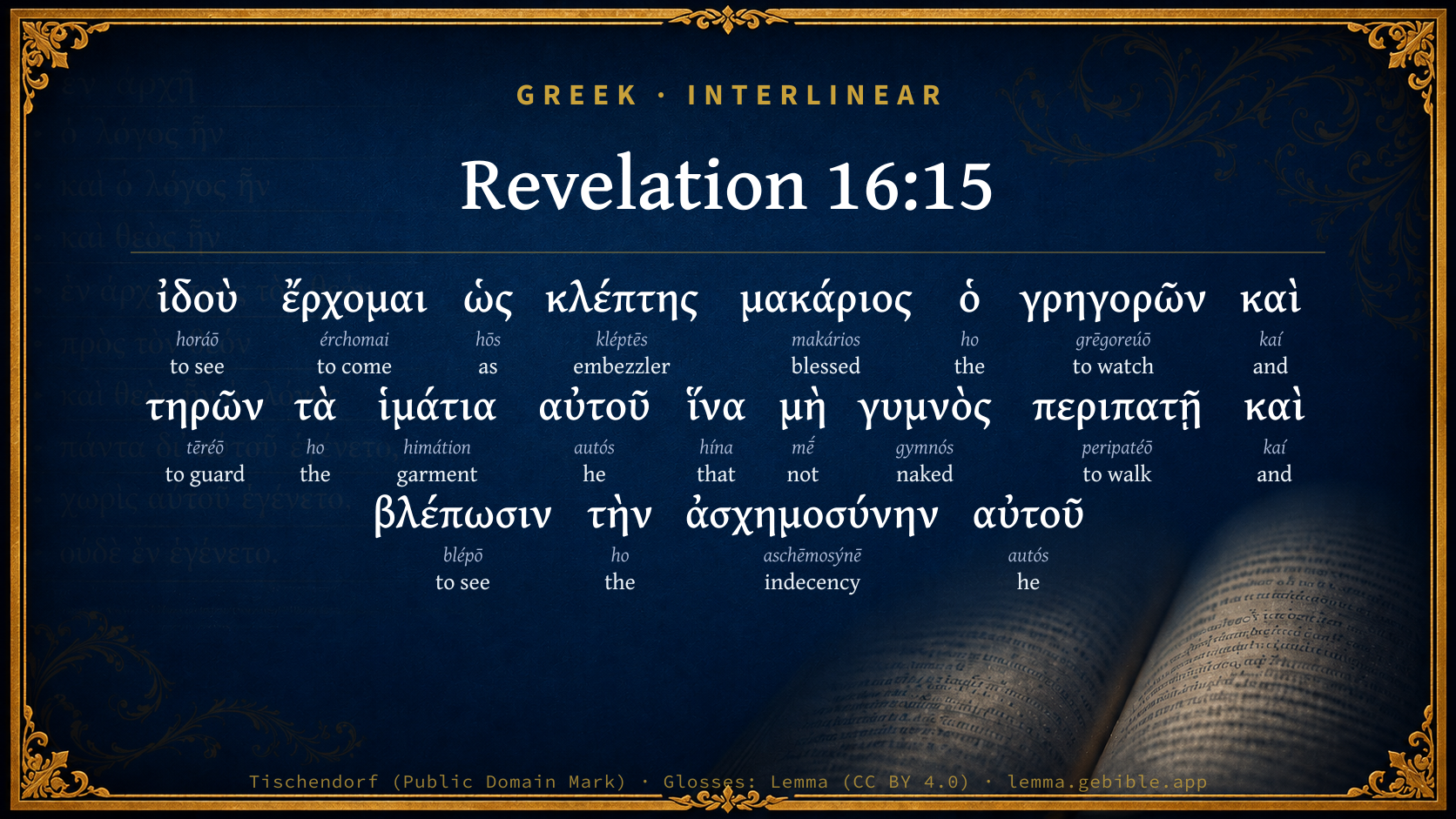
Greek (Tischendorf 8th ed.) Revelation 16:15 appears in the Greek New Testament. The text above is from the Tischendorf 8th edition. Each word links to its Strong’s number and a concise gloss. Click any word for its full Thayer’s Greek Lexicon entry.
Download image
Cite this verse

Revelation 16:15 (World English Bible). Public Domain. Lemma interlinear Bible study tool, https://lemma.gebible.app/v/revelation/16/15.

Show BibTeX & RIS
BibTeX
RIS
English Translation
"Behold, I come like a thief. Blessed is he who watches, and keeps his clothes, so that he doesn't walk naked, and they see his shame."
World English Bible · Public Domain
Download a study sheet

One document with this verse’s original text, its word-by-word gloss line, the meaning frame, cross-references with their text, attributed commentary, and full source and license credits — printable, and it pastes into notes with its structure intact.

This verse Autodidact and up

Study sheet (.html) Plain text (.txt)

A passage Seminary Student

Up to 50 verses in one chapter. A passage sheet keeps up to 6 commentary sources and 12 cross-references per verse, in the order this page ranks them, and says so on the sheet whenever that leaves anything out. Ask for a single verse and you get the Autodidact verse sheet above.

Everything on this page stays free to read, with no account — the sheet is a download of what is already on screen, not access to it.

Want to remove ads? Support Godless Engineer
Compare translations 3

The same verse in 3 English versions, stacked beneath the original-language interlinear above. Click any original word for its lexicon entry.

Each is an independent rendering of the whole verse — the interlinear is not word-aligned to these translations.

Highlighted words mark where these versions differ — a whole-verse word diff, not a word-by-word alignment.

  • World English Bible Public Domain
    "Behold, I come like a thief. Blessed is he who watches, and keeps his clothes, so that he doesn't walk naked, and they see his shame."
  • King James Version Public Domain
    Behold, I come as a thief. Blessed is he that watcheth, and keepeth his garments, lest he walk naked, and they see his shame.
  • unfoldingWord Literal Text CC BY-SA 4.0
    (“Behold! I am coming like a thief! Blessed the one watching and keeping his garments so that he might not walk around naked and they see his indecency.”)

unfoldingWord Literal Text — © unfoldingWord, licensed CC BY-SA 4.0. Word-aligned USFM3 via Door43 (git.door43.org/unfoldingWord/en_ult).

Versions to compare (up to 4)

3 of 4 selected

Show all 19 translations

Every available English version of this verse, each an independent rendering of the whole verse.

  • World English Bible Public Domain
    "Behold, I come like a thief. Blessed is he who watches, and keeps his clothes, so that he doesn't walk naked, and they see his shame."
  • Berean Standard Bible Public Domain
    “Behold, I am coming like a thief. Blessed is the one who remains awake and clothed, so that he will not go naked and let his shame be exposed.”
  • Majority Standard Bible Public Domain
    “Behold, I am coming like a thief. Blessed is the one who remains awake and clothed, so that he will not go naked and let his shame be exposed.”
  • King James Version Public Domain
    Behold, I come as a thief. Blessed is he that watcheth, and keepeth his garments, lest he walk naked, and they see his shame.
  • American Standard Version (1901) Public Domain
    (Behold, I come as a thief. Blessed is he that watcheth, and keepeth his garments, lest he walked naked, and they see his shame.)
  • Revised Version (1885) Public Domain
    (Behold, I come as a thief. Blessed is he that watcheth, and keepeth his garments, lest he walk naked, and they see his shame.)
  • Geneva Bible (1599) Public Domain
    (Beholde, I come as a theefe. Blessed is he that watcheth and keepeth his garments, least hee walke naked, and men see his filthines)
  • Douay-Rheims (1899) Public Domain
    Behold, I come as a thief. Blessed is he that watcheth, and keepeth his garments, lest he walk naked, and they see his shame.
  • Young's Literal Translation Public Domain
    `lo, I do come as a thief; happy `is' he who is watching, and keeping his garments, that he may not walk naked, and they may see his unseemliness,' --
  • Literal Standard Version CC BY-SA 4.0
    (“Behold, I come as a thief; blessed [is] he who is watching, and keeping his garments, that he may not walk naked, and they may see his unseemliness.”)
  • Unlocked Literal Bible CC BY-SA 4.0
    (“Look! I am coming as a thief! Blessed is the one who keeps watching, keeping his garments on so that he will not go out naked and they see his shameful condition.”)
  • unfoldingWord Literal Text CC BY-SA 4.0
    (“Behold! I am coming like a thief! Blessed the one watching and keeping his garments so that he might not walk around naked and they see his indecency.”)
  • Darby Bible Public Domain
    (Behold, I come as a thief. Blessed [is] he that watches and keeps his garments, that he may not walk naked, and that they [may not] see his shame.)
  • World Messianic Bible Public Domain
    “Behold, I come like a thief. Blessed is he who watches, and keeps his clothes, so that he doesn’t walk naked, and they see his shame.”
  • Webster's Bible Public Domain
    Behold, I come as a thief. Blessed is he that watcheth, and keepeth his garments, lest he walk naked, and they see his shame.
  • Free Bible Version CC BY-SA 4.0
    (Pay attention! I will come like a thief. Blessed are those who keep watch, and have their clothes ready so that they don't have to go out naked and be embarrassed.)
  • Bible in Basic English Public Domain
    (See, I come as a thief. Happy is he who is watching and keeps his robes, so that he may not go unclothed, and his shame be seen.)
  • Text-Critical English NT CC BY 4.0
    (“Behold, I am coming like a thief! Blessed is he who stays awake and keeps his garments on, so that he will not walk around naked and have people see his shame.”)
  • Tyndale New Testament (1534) Public Domain
    Beholde I come as a thefe. Happy is he that watcheth and kepeth his garmentes Lest he be founde naked and men se his filthynes.

Literal Standard Version (2020), Covenant Press — licensed CC BY-SA 4.0. Text via the HelloAO Bible API (eBible.org). Unlocked Literal Bible (unfoldingWord) — licensed CC BY-SA 4.0. Text via the HelloAO Bible API (eBible.org). unfoldingWord Literal Text — © unfoldingWord, licensed CC BY-SA 4.0. Word-aligned USFM3 via Door43 (git.door43.org/unfoldingWord/en_ult). Free Bible Version, Dr. Jonathan Gallagher — licensed CC BY-SA 4.0. Text via the HelloAO Bible API (eBible.org).

Word by word

More ways to search: Search by grammar → Find every occurrence → Compare this word →

Practice this passage: Drill this verse → Learn its vocabulary →

ἀσχημοσύνην
aschēmosýnē
G808
“indecency”
Noun, Accusative, Singular, Feminine
Part of Speech
Noun
Case
Accusative
Number
Singular
Gender
Feminine
Full Thayer's Definition

Origin: from G809

TDNT: None

1. unseemliness, an unseemly deed a. of a woman's genitals b. of one's nakedness, shame
  1. ἰδοὺ horáō G3708 “to see” Verb, Aorist, Middle, Imperative, 2nd person, Singular
  2. ἔρχομαι érchomai G2064 “to come” Verb, Present, Middle or Passive deponent, Indicative, 1st person, Singular
  3. ὡς hōs G5613 “as” Adverb
  4. κλέπτης kléptēs G2812 “embezzler” Noun, Nominative, Singular, Masculine
  5. μακάριος makários G3107 “blessed” Adjective, Nominative, Singular, Masculine
  6. ὁ ho G3588 “the” Article, Nominative, Singular, Masculine
  7. γρηγορῶν grēgoreúō G1127 “to watch” Verb, Present, Active, Participle, Nominative, Singular, Masculine
  8. καὶ kaí G2532 “and” Conjunction
  9. τηρῶν tēréō G5083 “to guard” Verb, Present, Active, Participle, Nominative, Singular, Masculine
  10. τὰ ho G3588 “the” Article, Accusative, Plural, Neuter
  11. ἱμάτια himátion G2440 “garment” Noun, Accusative, Plural, Neuter
  12. αὐτοῦ autós G846 “he” Personal pronoun, Genitive, Singular, Masculine
  13. ἵνα hína G2443 “that” Conjunction
  14. μὴ mḗ G3361 “not” Particle, Negative
  15. γυμνὸς gymnós G1131 “naked” Adjective, Nominative, Singular, Masculine
  16. περιπατῇ peripatéō G4043 “to walk” Verb, Present, Active, Subjunctive, 3rd person, Singular
  17. καὶ kaí G2532 “and” Conjunction
  18. βλέπωσιν blépō G991 “to see” Verb, Present, Active, Subjunctive, 3rd person, Plural
  19. τὴν ho G3588 “the” Article, Accusative, Singular, Feminine
  20. αὐτοῦ autós G846 “he” Personal pronoun, Genitive, Singular, Masculine

About this verse

These counts appear in no published source. They are computed here, from the morphology-tagged text and Lemma’s own curated glosses. What Lemma adds →

21
words
17
distinct lemmas
Revelation
section

Notable vocabulary

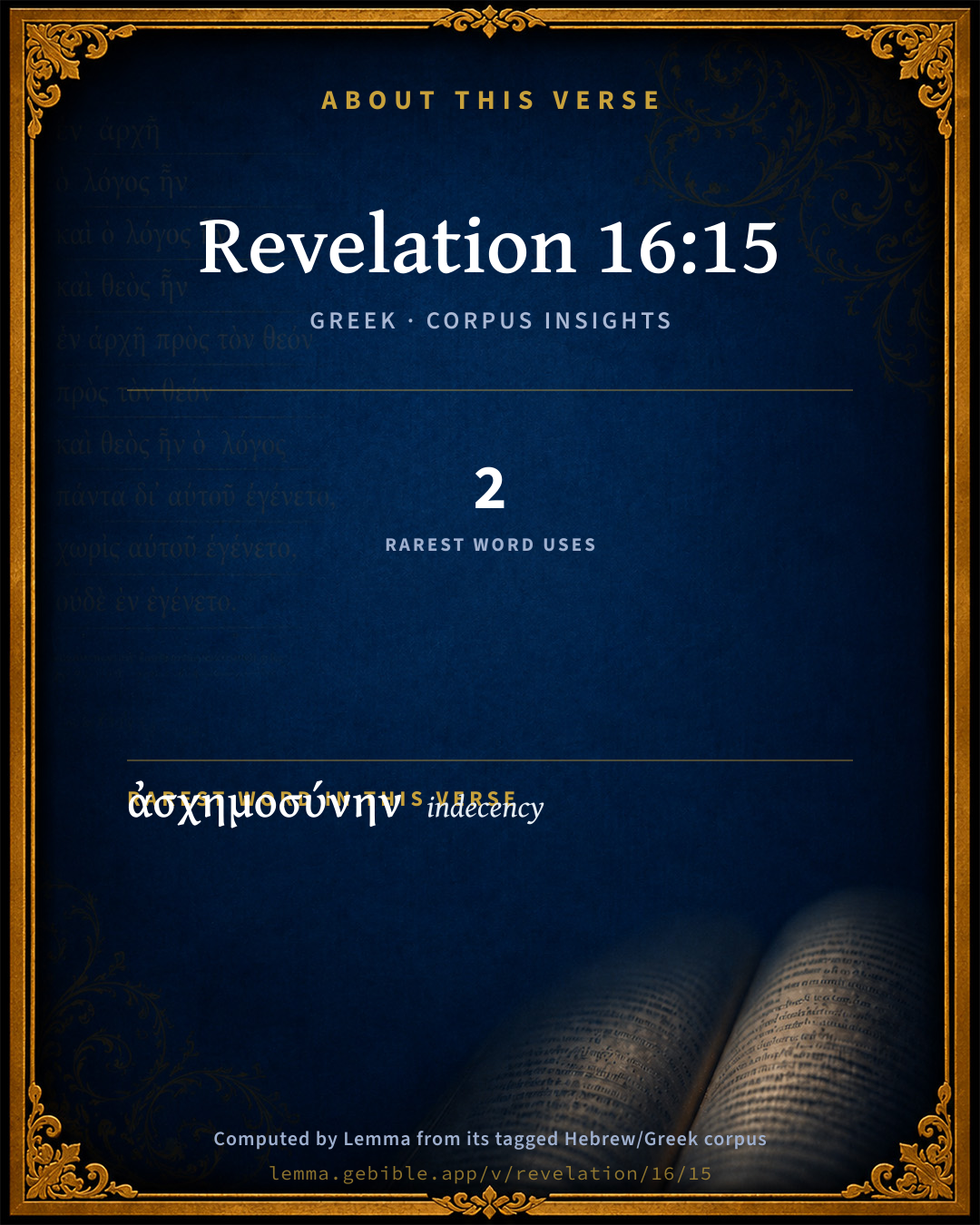
The rarest word here is ἀσχημοσύνην indecency G808 — appearing just 2 times in the whole Greek New Testament.

Shared distinctive vocabulary

ἀσχημοσύνην indecency G808 occurs in 2 verses of the Greek New Testament. Also found in:

Repetition

Words recur within this verse:

Cross-references

20

Topical passages linked to Revelation 16:15 in the Treasury of Scripture Knowledge — connected by theme and wording, ordered by reader-vote popularity; previews shown in the World English Bible.

  • 1 Thessalonians 5:2–3 For you yourselves know well that the day of the Lord comes like a thief in the night.
  • Matthew 24:42–43 Watch therefore, for you don't know in what hour your Lord comes.
  • 2 Peter 3:10 But the day of the Lord will come as a thief in the night; in which the heavens will pass away with a great noise, and the elements will be dissolved with fervent heat, and the earth and the works that are in it will be burned up.
  • Revelation 3:18 I counsel you to buy from me gold refined by fire, that you may become rich; and white garments, that you may clothe yourself, and that the shame of your nakedness may not be revealed; and eye salve to anoint your eyes, that you may see.
  • Revelation 3:3–4 Remember therefore how you have received and heard. Keep it, and repent. If therefore you won't watch, I will come as a thief, and you won't know what hour I will come upon you.
  • Luke 12:37–43 Blessed are those servants, whom the lord will find watching when he comes. Most assuredly I tell you, that he will dress himself, and make them recline, and will come and serve them.
  • Matthew 25:13 Watch therefore, for you don't know the day nor the hour in which the Son of Man is coming.
  • Mark 13:33–37 Watch, keep alert, and pray; for you don't know when the time is.
  • 2 Corinthians 5:3 if so be that being clothed we will not be found naked.
  • Mark 14:38 Watch and pray, that you may not enter into temptation. The spirit indeed is willing, but the flesh is weak."
  • Luke 21:36 Therefore be watchful all the time, asking that you may be counted worthy to escape all these things that will happen, and to stand before the Son of Man."
  • Isaiah 47:3 Your nakedness shall be uncovered, yes, your shame shall be seen: I will take vengeance, and will spare no man.
  • Matthew 26:41 Watch and pray, that you don't enter into temptation. The spirit indeed is willing, but the flesh is weak."
  • Acts 20:31 Therefore watch, remembering that for a period of three years I didn't cease to admonish everyone night and day with tears.
  • 1 Thessalonians 5:6 so then let's not sleep, as the rest do, but let's watch and be sober.
  • 1 Peter 4:7 But the end of all things is near. Therefore be of sound mind, self-controlled, and sober in prayer.
  • Ezekiel 16:37 therefore see, I will gather all your lovers, with whom you have taken pleasure, and all those who you have loved, with all those who you have hated; I will even gather them against you on every side, and will uncover your nakedness to them, that they may see all your nakedness.
  • Habakkuk 2:15 "Woe to him who gives his neighbor drink, pouring your inflaming wine until they are drunk, so that you may gaze at their naked bodies!
  • Exodus 32:25 When Moses saw that the people had broken loose, (for Aaron had let them loose for a derision among their enemies),
  • Hosea 2:3 Lest I strip her naked, And make her bare as in the day that she was born, And make her like a wilderness, And set her like a dry land, And kill her with thirst.

Cross-references courtesy of OpenBible.info (CC BY 4.0).

Commentary

Notes on Revelation 16:15 from classic Christian and Jewish commentators (each source and its license shown beneath its notes). The classic Christian expositions comment on the surrounding passage and are grouped to its opening verse, so a note may address several verses; the Jewish commentaries on the Tanakh (Rashi and others) are per-verse, so they appear only where the commentator wrote on this verse.

Lemma curates 59 commentaries, every one of them public domain or Creative Commons licensed, each selected and text-cleaned for this edition rather than reprinted as found. About our sources →

Joseph Benson's Commentary

Rev 16:15-16. Behold, I come as a thief — Suddenly and unexpectedly. Observe the beautiful abruptness; I, Jesus Christ. Hear him! Thus, when it is foretold that these evil agents will use great art and address in support of their bad cause, the Spirit of wisdom adds a useful caution, warning the faithful servants of Christ to be on their guard against the emissaries of hell, lest they should be deceived to their own destruction. Blessed is he that watcheth — That looks continually for him that comes quickly; and keepeth his garments on him — Which men usually put off when they sleep; that is, that keepeth himself clothed with the robe of righteousness, the garment of salvation; lest he walk naked, and they see his shame — Lest he lose the graces which he takes no care to keep, and others see his sin and punishment. And he gathered them together — The true construction is, And they gathered them together; that is, the evil spirits and agents, before mentioned, gather all the forces of the Popish princes together; into a place called, in the Hebrew tongue, Armageddon — That is, the mountain of destruction. Mageddon, or Megiddo, is a place frequently mentioned in the Old Testament, well known in ancient times for many memorable occurrences; in particular, the slaughter of the kings of Canaan, related Jdg 5:19. Here the narrative appears to break off, but is resumed again chap. Rev 19:19.

Joseph Benson's Commentary on the Old and New Testaments (1811–1818) — public domain. Text from a community e-Sword module.

Tyndale Open Study Notes

Tyndale Open Resources

16:15 Readers are warned to look because the Lord will come as unexpectedly as a thief (see also 3:3; Matt 24:43; 25:13; 1 Thes 5:2; 2 Pet 3:10). Being ready for his coming requires preparation; those who are not prepared will not have the proper clothing and will find themselves naked (see Matt 22:11-13). This imagery recalls the two failing churches: lifeless Sardis, which is told to “wake up” (Rev 3:2), and lukewarm Laodicea, which is advised to obtain proper clothing (3:18).

Tyndale Open Study Notes — © Tyndale Open Resources, licensed CC BY-SA 4.0. Text via the HelloAO Bible API.

Bengel's Gnomon

Johann Albrecht Bengel

Rev 16:15. Τὴν ἀσχημοσύνην) ערוה, the LXX. generally render ἀσχημοσύνη.

Bengel's Gnomon of the New Testament — English translation (T&T Clark, Edinburgh, 1860) — public domain. Text from a community e-Sword module.

Geneva Bible (1599)

Geneva Bible translators

A parenthesis for admonition in which God warneth his holy servants who rest in the expectation of Christ, always to address their minds unto his coming, and to look unto themselves, that they be not shamefully made naked and circumvented of these unclean spirits, and so they be miserable unprepared at the coming of their Lord.

Geneva Bible (1599) marginal notes — public domain. Text via Bolls.life.

Jamieson, Fausset & Brown

Robert Jamieson, A. R. Fausset & David Brown

The gathering of the world kings with the beast against the Lamb is the signal for Christ's coming; therefore He here gives the charge to be watching for His coming and clothed in the garments of justification and sanctification, so as to be accepted.

thief-- (Mat 24:43; Pe2 3:10).

they--saints and angels.

shame--literally, "unseemliness" (Greek, "aschemosunee"): Greek, Co1 13:5 : a different word from the Greek in Rev 3:18 (Greek, "aischunee").

Jamieson, Fausset & Brown — Commentary Critical and Explanatory on the Whole Bible (1871) — public domain (CC PDM 1.0). Text via the HelloAO Bible API.

Adam Clarke's Commentary

Verse 15. Behold, I come as a thief.] Here is a sudden but timely warning to put every man on his guard, when this sudden and generally unexpected tribulation should take place.

Keepeth his garments, lest he walk naked] Here is a plain allusion to the office of him who was called the prefect or overseer, of the mountain of the temple. His custom was to go his rounds during the watches of the night; and if he found any of the Levites sleeping on his watch, he had authority to beat him with a stick, and burn his vestments. See Middoth, fol. 34, 1, and Tamid. fol. 27, 2; 28, 1. Such a person being found on his return home naked, it was at once known that he had been found asleep at his post, had been beaten, and his clothes burnt; thus his shame was seen-he was reproached for his infidelity and irreligion.

Adam Clarke's Commentary on the Bible (1810–1826) — public domain. Text from a community e-Sword/MySword module.

Ellicott's Commentary for English Readers

(15) Behold, I come . . .—Translate, Behold, I come as a thief. It is the oft-repeated Scripture warning (Rev_3:3; 1Th_5:2-3; 2Pe_3:10. Comp. Luk_12:35-40). It reminds us not only that our Lord may come unexpectedly, but that He may even come and we be unaware. There is one day when He will come, and every eye will behold Him; but He comes in various ways and forms to bless and to test man. Blessed are they who are ready, watching. But vigilance is not enough: the garments must be kept. The powers of evil are abroad. Sloth and pleasure may counsel ease, and tempt the watcher to lay aside his garments and take rest and sleep. The earnest watcher desires, like St. Paul, to be found in Christ, clad in the true righteousness of faith (Php_3:9).

A Bible Commentary for English Readers, edited by Charles John Ellicott (1878–1897) — public domain. Text from a community e-Sword module.

The Cambridge Bible for Schools and Colleges

gen. ed. J. J. S. Perowne

15. Behold, I come] St John apparently hears, and writes down as he hears, the words of Christ spoken in the midst of his vision.

as a thief] See Rev_3:3 and references.

Blessed is he that watcheth] The image is that of St Mat_24:43, though in the phrase there may be a reminiscence of the different image of St Luk_12:37.

and keepeth his garments] The forewarned householder sits up with his clothes on, and the thief will decamp as soon as he sees him. If he were not forewarned, he might hear the thief at work, and start naked out of bed, but would be too late for anything but a fruitless chase in unseemly and ridiculous guise. It seems quite irrelevant to fancy an allusion to the curious Jewish custom, that if a priest fell asleep on night duty in the Temple, his clothes were set on fire—which of course would have the effect of making him throw them off, and run away naked.

his shame] Lit. uncomeliness, as 1Co_12:23.

The Cambridge Bible for Schools and Colleges (gen. ed. J. J. S. Perowne; Cambridge University Press, 1878–1918) — public domain. Text from a community e-Sword module.

John Gill's Exposition

And he gathered them together,.... Or rather "they gathered them together", as the Syriac version renders it; for though the verb is singular, a noun plural goes before it, as in Rev 16:14 and the same spirits that are there said to go forth, to gather the kings gether, these will gather them together; will persuade the Papal, Pagan, and Mahometan powers, the remains of them in the several parts of the world, to join together, and make one effort for the reviving of their declining, and almost ruined interests: for which purpose they will be brought together,

into a place called in the Hebrew tongue Armageddon; which may be the same with Har-megiddo, the mountain of Megiddo; for the Hebrew word is read "Ar" by the Greeks; so the city Argarize is interpreted the mountain of the most High (d): and this refers either to the slaying of Josiah in the valley of Megiddo, which occasioned such mourning, that it became proverbial for any great sorrow; see Ch2 35:22 where it is called the valley of Megiddon; or rather to the slaughter of Sisera's army at the waters of Megiddo, by Barak, Jdg 5:19 suggesting that the same would be the fate of these united powers. Some derive the word from and which signify "the destruction of their troops", or "armies"; and so designs not any place, that has been or is, but which will be so called from the issue of this battle; and since it is an Hebrew name that will be given it, it may lead us to conclude it will be somewhere in Judea, and very likely no other than the valley of Jehoshaphat, where all nations will be gathered; and which is called the valley of decision, where will be the day of the Lord, and multitudes will be slain, Joe 3:2 though the name will suit any place where there will be a defeat of these enemies; but this vial only brings them together; the utter destruction of them is reserved for the next.

(d) Euseb, Prepar. Evangel. l. 9. c. 17. p. 419.

John Gill's Exposition of the Whole Bible (1746–1763) — public domain (CC PDM 1.0). Text via the HelloAO Bible API.

Trapp's Complete Commentary

John Trapp

15 Behold, I come as a thief. Blessed is he that watcheth, and keepeth his garments, lest he walk naked, and they see his shame.

Ver. 15. I come as a thief] Who gives no warning. {See Trapp on "Mat 24:44"} I come suddenly, secretly, yea, and also violently and terribly. See Rev 3:3; Luk 12:34; 1Th 5:2.

Blessed is he that watcheth] The prophecy is here interrupted {as Gen 49:18} to forewarn and forearm the saints; Luk 12:37-38; Luk 12:43, they are three times said to be blessed that watch.

And keepeth his garments] Keepeth himself unspotted of the world, undefiled in the way.

Lest he walk naked, &c.] See Rev 3:18.

John Trapp, A Commentary or Exposition upon All the Books of the Old and New Testament (1647–1656) — public domain. Text from a community e-Sword module.

Albert Barnes' Notes on the Bible

Behold, I come as a thief - That is, suddenly and unexpectedly. See the Mat 24:43 note; 1Th 5:2 note. This is designed evidently to admonish people to watch, or to be in readiness for his coming, since, whenever it would occur, it would be at a time when people were not expecting him.

Blessed is he that watcheth - Compare Mat 24:42-44. The meaning here is, that he who watches for these events, who marks the indications of their approach, and who is conscious of a preparation for them, is in a better and happier state of mind than he on whom they come suddenly and unexpectedly.

And keepeth his garments - The allusion here seems to be to one who, regardless of danger, or of the approach of an enemy, should lay aside his garments and lie down to sleep. Then the thief might come and take away his garments, leaving him naked. The essential idea, therefore, here, is the duty of vigilance. We are to be awake to duty and to danger; we are not to be found sleeping at our post; we are to be ready for death - ready for the coming of the Son of man.

Lest he walk naked - His raiment being carried away while he is asleep.

And they see his shame - Compare the notes on Rev 3:18. The meaning here is, that, as Christians are clothed with the garments of righteousness, they should not lay them aside, so that their spiritual nakedness should be seen. They are to be always clothed with the robes of salvation; always ready for any event, however soon or suddenly it may come upon them.

Albert Barnes' Notes on the Bible (1834–1885) — public domain. Text from a community e-Sword/MySword module.

Matthew Poole's English Annotations

I come as a thief; that is, I come suddenly and unexpectedly: see Mat 24:43,44; Lu 12:39; 1Th 5:2; Rev 3:3. It may be understood either of Christ’s coming to the last judgment, or of his coming in his vindicative providence to be revenged on his enemies.

Blessed is he that watcheth, he is a happy man that maketh it his business to keep himself from sin, in prospect of any such coming,

and keepeth his garments, and that persevereth in my ways and truth;

lest he walk naked, and they see his shame; for if he doth not, he will be found one of those that are not clothed with my righteousness, and his hypocrisy will appear to all men.

Matthew Poole's English Annotations on the Holy Bible (1683–1685) — public domain. Text from a community e-Sword/MySword module.

Whedon's Commentary on the Bible

Daniel D. Whedon

15. Behold—A solemn warning to watchfulness against being seduced by the spirits of devils into the antichristic army. He who is “the way, the truth, and the life,” steals upon us in the midst of these vain shows “as a thief;”—”a thief,” not in his hostile purpose, but in his difficulty of recognition. Yet unless one watcheth and keepeth his garments he will be left to nakedness and shame. The loose garments of the oriental sleeper are easily purloined, and the victim is liable, when he wakes, to walk naked. His safeguard is vigilance.

Daniel D. Whedon (gen. ed.), Commentary on the Old and New Testaments (1874–1909) — public domain. Text from a community e-Sword module.

The Pulpit Commentary

Behold, I come as a thief. The very words addressed to the Church at Sardis, (Rev_3:3) and similar to those connected by our blessed Lord with the great day (see ver. 14). The mention of that day, and perhaps the knowledge that the battle is a daily one (see on ver. 14), naturally leads to the solemn warning given here. It is worth notice how St. John adopts this idea; and this of itself should suffice to demonstrate the incorrectness of endeavoring to compute the times and seasons, as has been done by so many Apocalyptic writers. (cf. also Mat_24:43 Luk_12:39 1Th_5:2, 4 2Pe_3:10) Blessed is he that watcheth, and keepeth his garments, lest he walk naked, and they see his shame. The same figure again as in Rev_3:17. Isaac Williams correctly points out that these words seem to indicate that the battle of ver. 14 is a daily one, in which Christians are themselves engaged (see on ver. 14). The garment is the garment of righteousness, the fervent love of God. (see on Rev_3:17)

The Pulpit Commentary (1880–1919), ed. H.D.M. Spence-Jones & Joseph S. Exell — public domain. Text from a community e-Sword module.

John Wesley's Explanatory Notes

Behold, I come as a thief - Suddenly, unexpectedly. Observe the beautiful abruptness. I - Jesus Christ. Hear him. Happy is he that watcheth. - Looking continually for him that "cometh quickly." And keepeth on his garments - Which men use to put off when they sleep. Lest he walk naked, and they see his shame - Lest he lose the graces which he takes no care to keep, and others see his sin and punishment.

John Wesley, Explanatory Notes Upon the Whole Bible (1754–1765) — public domain. Text via the GEBible commentary corpus.

Burkitt's Expository Notes on the New Testament

William Burkitt

These consolatory words of Christ seem to be inserted here for the support of the faithful servants of God, against those great preparations of the enemy in the day of battle.

Behold, says Christ, I then come as a thief, secretly, suddenly, and unexpectedly, to destroy these enemies when they least expect me; and then I am at hand to take vengeance on them, and to deliver my church when they least think of me: Blessed is he that watcheth, namely, against those temptations which he will be then exposed to: and keepeth his garments, that is, his profession unspotted from sin, and the defilements of antichrist; lest he walk naked, that is, appear as a man destitute of uprightness and sincerity; and they see his shame, which ever follows upon a sinful course.

Note here, 1. That when Christ comes, he comes suddenly, even as a thief cometh.

2. That although Christ comes suddenly, and as a thief; yet he is pleased to give us warning of his coming: Behold, I come.

3. That when Christ’s coming is near at hand, there is danger that many for want of watchfulness will lose their garments.

4. That is, to such as through negligence shall lose their garments, this misery will befall them; they shall walk naked, and men shall see their shame.

5. That those few who watch and keep their garments, are certainly in a happy and blessed condition: Blessed is he that watcheth and keepeth his garments.

William Burkitt's Expository Notes on the New Testament (1700–1703) — public domain. Text from a community e-Sword module.

The People's New Testament

B. W. Johnson

15. Behold, I come as a thief. This is interposed in order to give a place for exhortation to be always ready. The Lamb comes when men do not see him.

B. W. Johnson's The People's New Testament with Notes (1889–1891) — public domain. Electronic text from the Christian Classics Ethereal Library (CCEL) ThML edition.

unfoldingWord translationNotes

Door43 World Missions Community

General Information:

Verse 15 is a break from the main story line of John's vision. These are words spoken by Jesus. The story line continues in verse 16.

Look! I am coming ... his shameful condition

This is in parentheses to show that it is not part of the story line in the vision. Rather, this is something that the Lord Jesus said. It can be stated clearly that the Lord Jesus said this, as in the UDB. (See: Assumed Knowledge and Implicit Information)

I am coming as a thief

Jesus will come at a time when people do not expect him, just as a thief comes when not expected. See how you translated a similar phrase in Revelation 3:3. (See: Simile)

keeping his garments on

Living the right way is spoken of as keeping one's clothes on. AT: "doing what is right, like keeping his clothes on" (See: Metaphor)

keeping his garments on

Some versions translate, "keeping his garments with him."

they see his shameful condition

Here the word "they" refers to other people.

They brought them together

"The spirits of the demons brought the kings and their armies together"

the place that is called

This can be stated in active form. AT: "the place that people call" (See: Active or Passive)

Armageddon

This is the name of a place. (See: How to Translate Names)

translationWords

bless

watch

shame

Hebrew

unfoldingWord translationNotes — © Distant Shores Media and the Door43 World Missions Community, licensed CC BY-SA 4.0. Source: git.door43.org/Door43/en_tn.

Cambridge Greek Testament for Schools and Colleges

15. ἔρχομαι. א* Primas[563] read ἔρχεται.

[563] Primasius, edited by Haussleiter.

15. ἰδοὺ ἔρχομαι. St John, or another prophet, apparently hears, and writes down as he hears, the words of Christ spoken in the midst of the vision.

ὡς κλέπτης. See Rev 3:3 and references.

μακάριος ὁ γρηγορῶν. This may refer again, as in St Mat 24:43, to a watchful householder ready for the secret and sudden coming of the thief, or, as in St Luk 12:37, to a watchful servant, ready for the coming as sudden and as secret of his Lord.

καὶ τηρῶν. The forewarned householder, if the figure be taken from him, sits up with his clothes on, and the thief will decamp as soon as he sees him. If he were not forewarned, he might hear the thief at work and start naked out of bed, but would be too late for anything but a fruitless chase in unseemly and ridiculous guise. If this be the sense, ὁ γρηγορῶν καὶ τηρῶν must mean, who watches and does not lose: there is no more authority for this sense of τηρεῖν than for the sense of λιβανωτόν in Rev 8:3. If the figure be taken from servants waiting for their Lord, possibly we are to understand that the garments are kept not from loss but from defilement, as in Rev 3:4. The slothful servant is careless too, and either dares not shew himself in the raiment he has defiled, or is stripped of it. As primitive Christianity had many points of contact with Essenism it is not impossible that there may be something like an allusion to the sacred white dress the Essenes reserved for their meals, which were a daily sacrifice and sacrament. This is less irrelevant than the allusion some suggest to the curious Jewish custom that if a priest fell asleep on night duty in the Temple, his clothes were set on fire—which of course would have the effect of making him throw them off and run away naked.

βλέπωσιν. Impersonal, as Rev 12:6.

ἀσχημοσύνην. Lit. “uncomeliness,” cf. τὰ ἀσχήμονα 1Co 12:23.

Cambridge Greek Testament for Schools and Colleges (Cambridge University Press, 1896; 21 vols, various authors incl. Carr, Maclear, Plummer, Farrar, Lumby, Moule, M. R. James, Simcox) — public domain. Text from a community e-Sword module.

Vincent's Word Studies in the New Testament

Marvin R. Vincent

Behold - shame. These words are parenthetical.

As a thief. Compare Mt 24:43; Luk 12:39; 1Th 5:2, 4; 2Pe 3:10.

Watcheth [γρηρορων] . See on Mr 13:35; 1Pe 5:8 Keepeth his garments. "During the night the captain of the Temple made his rounds. On his approach the guards had to rise and salute him in a particular manner. Any guard found asleep when on duty was beaten, or his garments were set on fire. The confession of one of the Rabbins is on record that, on a certain occasion, his own maternal uncle had actually undergone the punishment of having his clothes set on fire by the captain of the Temple" (Edersheim, "The Temple," etc.).

Shame [ασχημοσυνην] . Only here and Rom 1:27. From aj not and schma fashion. Deformity, unseemliness; nearly answering to the phrase not in good form.

Marvin R. Vincent, Word Studies in the New Testament (1887–1900) — public domain. Text from a community e-Sword/MySword module.

Lesson kit

Teaching starters — assembled from the data on this page, not authored interpretation. Every prompt links to the verse data it draws on. Edit before teaching.

Revelation, in the Revelation, opens this verse with 21 words (17 distinct Greek lemmas). Its most distinctive word is aschēmosýnē (“indecency”). A historical commentator’s framing appears above. Read the whole chapter for the surrounding context.

Discussion questions

  1. How does “indecency” (aschēmosýnē) shape what this verse is saying?
  2. Romans 1:27 shares the word «indecency» with this verse. How do the two illuminate each other?
  3. “the” occurs 3× in this one verse. What is the effect of the repetition?
  4. The translations on this page render this verse differently — a whole-verse word diff, not a word-by-word alignment. What might account for the different wordings?
  5. Reading how Joseph Benson's Commentary and Tyndale Open Study Notes read this verse, where do the two commentators agree and where do they part?

Things to notice

Reading settings

Reading text

Shown beneath each verse's original-language words.

Old Testament
Old Testament edition

Read the OT as the Masoretic Hebrew (MT) or the Greek Septuagint (LXX).

English shown for the Greek Septuagint (in the Hebrew ↔ Greek comparison).

Comparing translations? Open the Compare panel on any verse page to stack up to four side by side.