
1 Kings 17:23

Hebrew (Westminster Leningrad Codex) 1 Kings 17:23 appears in the Hebrew Old Testament. The text above is from the Westminster Leningrad Codex. Each word links to its Strong’s number, a concise gloss, and parsing drawn from the Open Scriptures Hebrew Bible morphology. Click any word for its full Brown-Driver-Briggs (BDB) entry.
Download image
Cite this verse

1 Kings 17:23 (World English Bible). Public Domain. Lemma interlinear Bible study tool, https://lemma.gebible.app/v/1-kings/17/23.

Show BibTeX & RIS
BibTeX
RIS
English Translation
Elijah took the child, and brought him down out of the chamber into the house, and delivered him to his mother; and Elijah said, Behold, your son lives.
World English Bible · Public Domain
Download a study sheet

One document with this verse’s original text, its word-by-word gloss line, the meaning frame, cross-references with their text, attributed commentary, and full source and license credits — printable, and it pastes into notes with its structure intact.

This verse Autodidact and up

Study sheet (.html) Plain text (.txt)

A passage Seminary Student

Up to 50 verses in one chapter. A passage sheet keeps up to 6 commentary sources and 12 cross-references per verse, in the order this page ranks them, and says so on the sheet whenever that leaves anything out. Ask for a single verse and you get the Autodidact verse sheet above.

Everything on this page stays free to read, with no account — the sheet is a download of what is already on screen, not access to it.

Want to remove ads? Support Godless Engineer
Compare translations 3

The same verse in 3 English versions, stacked beneath the original-language interlinear above. Click any original word for its lexicon entry.

Each is an independent rendering of the whole verse — the interlinear is not word-aligned to these translations.

Highlighted words mark where these versions differ — a whole-verse word diff, not a word-by-word alignment.

  • World English Bible Public Domain
    Elijah took the child, and brought him down out of the chamber into the house, and delivered him to his mother; and Elijah said, Behold, your son lives.
  • King James Version Public Domain
    And Elijah took the child, and brought him down out of the chamber into the house, and delivered him unto his mother: and Elijah said, See, thy son liveth.
  • unfoldingWord Literal Text CC BY-SA 4.0
    And Elijah took the child, and he brought him down from the upper room to the house, and he gave him to his mother. And Elijah said, “See, your son lives.”

unfoldingWord Literal Text — © unfoldingWord, licensed CC BY-SA 4.0. Word-aligned USFM3 via Door43 (git.door43.org/unfoldingWord/en_ult).

Versions to compare (up to 4)

3 of 4 selected

Show all 18 translations

Every available English version of this verse, each an independent rendering of the whole verse.

  • World English Bible Public Domain
    Elijah took the child, and brought him down out of the chamber into the house, and delivered him to his mother; and Elijah said, Behold, your son lives.
  • Berean Standard Bible Public Domain
    Then Elijah took the child, brought him down from the upper room into the house, and gave him to his mother. “Look, your son is alive,” Elijah declared.
  • Majority Standard Bible Public Domain
    Then Elijah took the child, brought him down from the upper room into the house, and gave him to his mother. “Look, your son is alive,” Elijah declared.
  • King James Version Public Domain
    And Elijah took the child, and brought him down out of the chamber into the house, and delivered him unto his mother: and Elijah said, See, thy son liveth.
  • American Standard Version (1901) Public Domain
    And Elijah took the child, and brought him down out of the chamber into the house, and delivered him unto his mother; and Elijah said, See, thy son liveth.
  • Revised Version (1885) Public Domain
    And Elijah took the child, and brought him down out of the chamber into the house, and delivered him unto his mother: and Elijah said, See, thy son liveth.
  • Geneva Bible (1599) Public Domain
    And Eliiah tooke the childe, and brought him downe out of the chamber into the house, and deliuered him vnto his mother, and Eliiah sayd, Behold, thy sonne liueth.
  • Douay-Rheims (1899) Public Domain
    And Elias took the child, and brought him down from the upper chamber to the house below, and delivered him to his mother, and said to her: Behold thy son liveth.
  • Young's Literal Translation Public Domain
    And Elijah taketh the lad, and bringeth him down from the upper chamber of the house, and giveth him to his mother, and Elijah saith, `See, thy son liveth!'
  • Literal Standard Version CC BY-SA 4.0
    And Elijah takes the boy, and brings him down from the upper chamber of the house, and gives him to his mother, and Elijah says, “See, your son lives!”
  • Unlocked Literal Bible CC BY-SA 4.0
    Elijah took the child and brought him out of his room down into the house; he handed the boy to his mother and said, “See, your son is alive.”
  • unfoldingWord Literal Text CC BY-SA 4.0
    And Elijah took the child, and he brought him down from the upper room to the house, and he gave him to his mother. And Elijah said, “See, your son lives.”
  • Darby Bible Public Domain
    And Elijah took the child, and brought him down from the upper chamber into the house, and delivered him to his mother; and Elijah said, See, thy son lives.
  • World Messianic Bible Public Domain
    Elijah took the child and brought him down out of the room into the house, and delivered him to his mother; and Elijah said, “Behold, your son lives.”
  • Webster's Bible Public Domain
    And Elijah took the child, and brought him down from the chamber into the house, and delivered him to his mother: and Elijah said, See, thy son liveth.
  • Free Bible Version CC BY-SA 4.0
    Elijah took the boy and brought him down from the room into the house, and gave him to his mother. “See, your son is alive,” Elijah told her.
  • Bible in Basic English Public Domain
    And Elijah took the child down from his room into the house and gave him to his mother and said to her, See, your son is living.
  • JPS Tanakh (1917) Public Domain
    And Elijah took the child, and brought him down out of the upper chamber into the house, and delivered him unto his mother; and Elijah said: 'See, thy son liveth.'

Literal Standard Version (2020), Covenant Press — licensed CC BY-SA 4.0. Text via the HelloAO Bible API (eBible.org). Unlocked Literal Bible (unfoldingWord) — licensed CC BY-SA 4.0. Text via the HelloAO Bible API (eBible.org). unfoldingWord Literal Text — © unfoldingWord, licensed CC BY-SA 4.0. Word-aligned USFM3 via Door43 (git.door43.org/unfoldingWord/en_ult). Free Bible Version, Dr. Jonathan Gallagher — licensed CC BY-SA 4.0. Text via the HelloAO Bible API (eBible.org).

Word by word

More ways to search: Search by grammar → Find every occurrence → Compare this word →

Practice this passage: Drill this verse → Learn its vocabulary →

הָעֲלִיָּה֙
ʻălîyâh
H5944
“the · roof chamber”
Particle, Definite Article + Noun, Common, Feminine, Singular, Absolute
Part of Speech
Particle + Noun
Type
Common
Gender
Feminine
Number
Singular
State
Absolute
Full BDB Definition

Origin: from H5927

TWOT: 1624f

roof-room, roof chamber
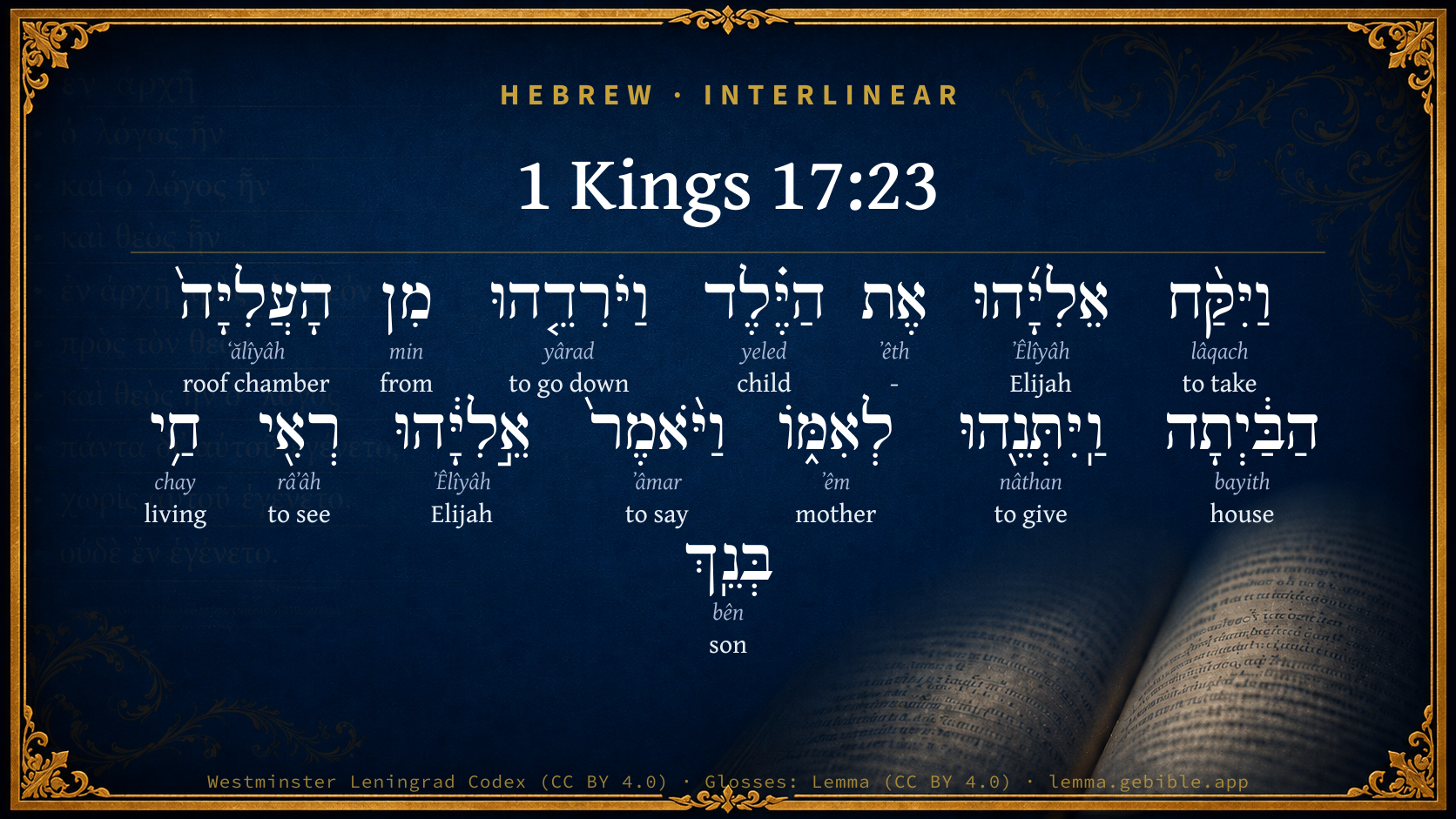
  1. וַיִּקַּ֨ח lâqach H3947 “and · to take” Conjunction + Verb, Qal, Sequential Imperfect, 3rd Person, Masculine, Singular
  2. אֵלִיָּ֜הוּ ʼÊlîyâh H452 “Elijah” Noun, Proper
  3. אֶת ʼêth H853 “-” Particle, Direct Object
  4. הַיֶּ֗לֶד yeled H3206 “the · child” Particle, Definite Article + Noun, Common, Masculine, Singular, Absolute
  5. וַיֹּרִדֵ֤הוּ yârad H3381 “and · to go down · him” Conjunction + Verb, Hiphil, Sequential Imperfect, 3rd Person, Masculine, Singular + Suffix, Personal, 3rd Person, Masculine, Singular
  6. מִן min H4480 “from” Preposition
  7. הַבַּ֔יְתָה bayith H1004 “the · house · toward” Particle, Definite Article + Noun, Common, Masculine, Singular, Absolute + Suffix, Demonstrative
  8. וַֽיִּתְּנֵ֖הוּ nâthan H5414 “and · to give · him” Conjunction + Verb, Qal, Sequential Imperfect, 3rd Person, Masculine, Singular + Suffix, Personal, 3rd Person, Masculine, Singular
  9. לְאִמּ֑וֹ ʼêm H517 “to/for · mother · his” Preposition + Noun, Common, Feminine, Singular, Construct + Suffix, Personal, 3rd Person, Masculine, Singular
  10. וַיֹּ֨אמֶר֙ ʼâmar H559 “and · to say” Conjunction + Verb, Qal, Sequential Imperfect, 3rd Person, Masculine, Singular
  11. אֵ֣לִיָּ֔הוּ ʼÊlîyâh H452 “Elijah” Noun, Proper
  12. רְאִ֖י râʼâh H7200 “see” Verb, Qal, Imperative, 2nd Person, Feminine, Singular
  13. חַ֥י chay H2416 “living” Adjective, Adjective, Masculine, Singular, Absolute
  14. בְּנֵֽךְ bên H1121 “son · your” Noun, Common, Masculine, Singular, Construct + Suffix, Personal, 2nd Person, Feminine, Singular

About this verse

These counts appear in no published source. They are computed here, from the morphology-tagged text and Lemma’s own curated glosses. What Lemma adds →

15
words
14
distinct lemmas
Historical
section

Notable vocabulary

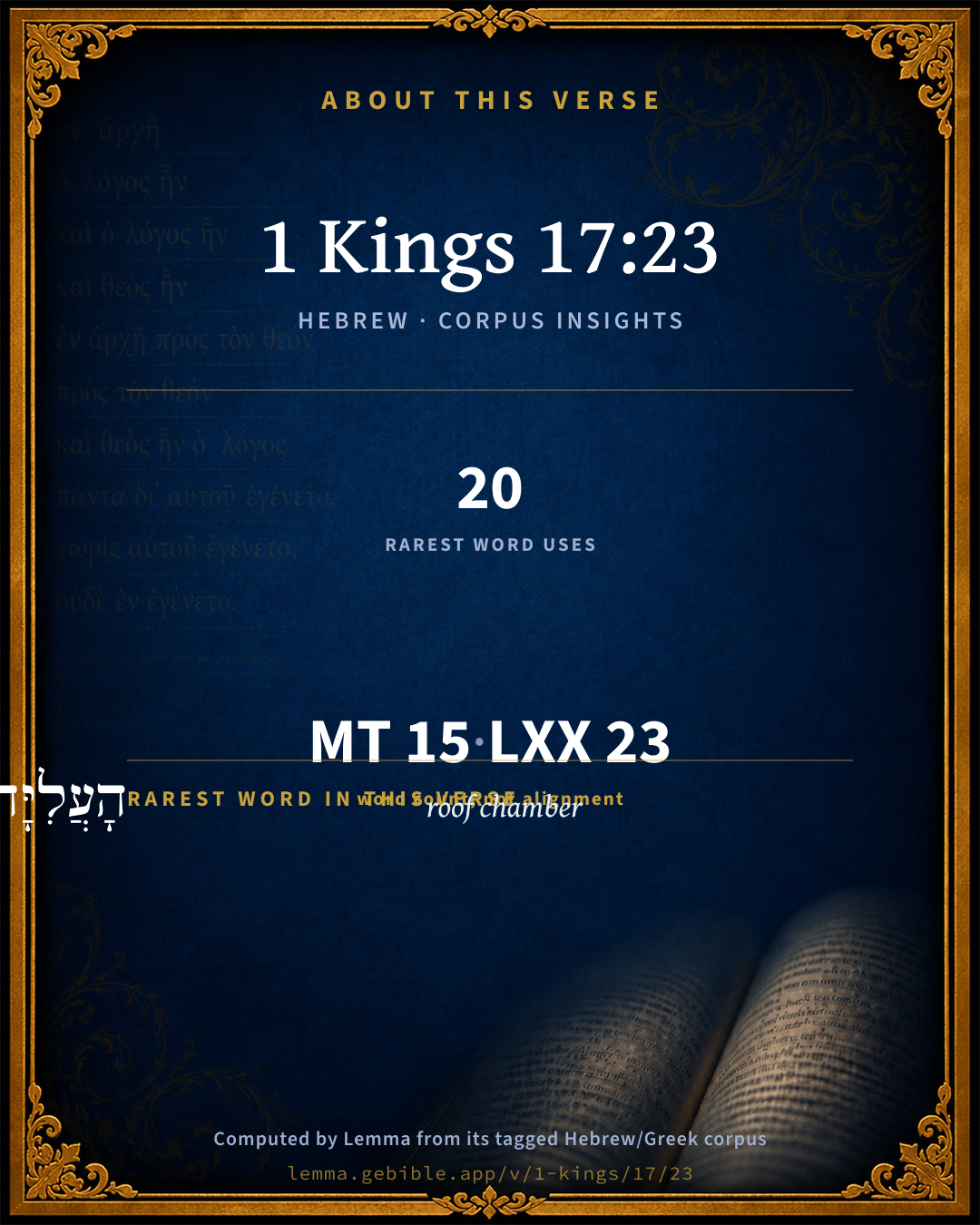
The rarest word here is הָעֲלִיָּה֙ roof chamber H5944 — appearing just 20 times in the whole Hebrew Bible.

Shared distinctive vocabulary

הָעֲלִיָּה֙ roof chamber H5944 occurs in 20 verses of the Hebrew Bible. Also found in:

Grammatical profile

  • 5 verbs
  • 7 nouns
  • 1 adjective
  • 1 preposition
  • 1 particle

Verb forms

  • וַיִּקַּ֨ח Qal · Sequential Imperfect
  • וַיֹּרִדֵ֤הוּ Hiphil · Sequential Imperfect
  • וַֽיִּתְּנֵ֖הוּ Qal · Sequential Imperfect
  • וַיֹּ֨אמֶר֙ Qal · Sequential Imperfect
  • רְאִ֖י Qal · Imperative

Repetition

A word recurs within this verse — often emphatic in Hebrew:

  • אֵלִיָּ֜הוּ Elijah H452 ×2

Hebrew & Septuagint length

In English translation the verse runs 28 words from the Hebrew and 25 from the Septuagint (LXX English) — closely comparable.

A rough comparison of the two English renderings, which tokenize alike — not a word-level alignment.

Word counts can differ between the Hebrew and the Greek without any difference in meaning — e.g. the Hebrew direct-object marker אֵת has no separate Greek word, and Greek often adds the article ὁ.

In the original languages it is 15 Hebrew tokens and 23 Greek tokens — but the two are counted differently (Hebrew bundles its prefixes and suffixes into one token; the Greek is in lemma form), so that isn’t a like-for-like length.

Cross-references

4

Topical passages linked to 1 Kings 17:23 in the Treasury of Scripture Knowledge — connected by theme and wording, ordered by reader-vote popularity; previews shown in the World English Bible.

  • 2 Kings 4:36–37 He called Gehazi, and said, Call this Shunammite. So he called her. When she was come in to him, he said, Take up your son.
  • Luke 7:15 He who was dead sat up, and began to speak. And he gave him to his mother.
  • Acts 9:41 He gave her his hand, and raised her up. Calling the saints and widows, he presented her alive.
  • Hebrews 11:35 Women received their dead by resurrection. Others were tortured, not accepting their deliverance, that they might obtain a better resurrection.

Cross-references courtesy of OpenBible.info (CC BY 4.0).

Hebrew and Greek witnesses Masoretic Hebrew ↔ Greek Septuagint

The same verse in the two great witnesses to the Old Testament, shown verse-for-verse.

These are two independent witnesses, not word-aligned to each other, and the Septuagint is shown in lemma (dictionary) form.

Hebrew 1 Kings 17:23 Masoretic · Westminster Leningrad Codex

וַיִּקַּ֨ח אֵלִיָּ֜הוּ אֶת הַיֶּ֗לֶד וַיֹּרִדֵ֤הוּ מִן הָעֲלִיָּה֙ הַבַּ֔יְתָה וַֽיִּתְּנֵ֖הוּ לְאִמּ֑וֹ וַיֹּ֨אמֶר֙ אֵ֣לִיָּ֔הוּ רְאִ֖י חַ֥י בְּנֵֽךְ

Elijah took the child, and brought him down out of the chamber into the house, and delivered him to his mother; and Elijah said, Behold, your son lives.

World English Bible · Public Domain

Greek LXX 1 Kings 17:23 Septuagint · lemma form

καί καταἄγω αὐτός ἀπό ὁ ὑπερῷον εἰς ὁ οἶκος καί δίδωμι αὐτός ὁ μήτηρ αὐτός καί εἶπον ηλιου βλέπω ζάω ὁ υἱός σύ

and he brought him down from the upper chamber into the house, and gave him to his mother; and Eliu said, See, your son lives.

LXX2012 (modern English Septuagint) · Public Domain

Hebrew: Westminster Leningrad Codex (CC BY 4.0). Greek: Septuagint (public domain); English from LXX2012 (modern English Septuagint) (Public Domain). How the Septuagint differs from the Hebrew →

Targum (Aramaic paraphrase)

1

The Targum is the ancient Jewish Aramaic paraphrase of the Hebrew Scriptures — an interpretive translation, not the Hebrew text itself. Onkelos (literal) and Pseudo-Jonathan (expansive) render the Torah, and Jonathan the Prophets. Coverage is partial: where no permissively-licensed English translation exists for a verse, only the Aramaic is shown. This is verse-level text, not a word-by-word alignment to the Hebrew.

  1. Targum Jonathan Prophets (Joshua–Malachi)
    וּנְסִיב אֵלִיָהוּ יַת רַבְיָא וְאַחֲתֵיהּ מִן עִלִיתָא לְבֵיתָא וְיַהֲבֵיהּ לְאִמֵיהּ וַאֲמַר לָהּ אֵלִיָהוּ חֲזֵי חַיָא בְרִיךְ:

    (no public-domain English translation for this verse)

    Targum Jonathan — Aramaic: “Mikraot Gedolot” (public domain). English: “Sefaria Community Translation” (CC0 1.0 (public-domain dedication)); “London "Chaldee Paraphrase," 1871” (public domain). Text via Sefaria.

Commentary

Notes on 1 Kings 17:23 from classic Christian and Jewish commentators (each source and its license shown beneath its notes). The classic Christian expositions comment on the surrounding passage and are grouped to its opening verse, so a note may address several verses; the Jewish commentaries on the Tanakh (Rashi and others) are per-verse, so they appear only where the commentator wrote on this verse.

Lemma curates 59 commentaries, every one of them public domain or Creative Commons licensed, each selected and text-cleaned for this edition rather than reprinted as found. About our sources →

Trapp's Complete Commentary

John Trapp

1Ki 17:23 And Elijah took the child, and brought him down out of the chamber into the house, and delivered him unto his mother: and Elijah said, See, thy son liveth.

Ver. 23. And delivered him unto his mother.] Of this the apostle seemeth to write, when he saith, "Women received their dead raised to life again." {Heb 11:35}

John Trapp, A Commentary or Exposition upon All the Books of the Old and New Testament (1647–1656) — public domain. Text from a community e-Sword module.

Joseph Benson's Commentary

1Ki 17:23-24. Elijah said, See, thy son liveth — And see the power of prayer, and the power of him that hears and answers prayer, that kills and makes alive. The woman said, Now by this I know that thou art a man of God — Though she believed it before, and termed him a man of God, (1Ki 17:18,) which she might well do, having been a daily witness of the miraculous increase of the meal and oil; yet, when she saw he did not cure her sick child, but suffered him to grow worse, and die, she began to doubt of it: but upon seeing her son revive, her faith revived with him, and was mightily confirmed. For, through the joy of having him restored to her again, this latter miracle appeared to her much greater than the former. The word of the Lord in thy mouth is truth — The God whom thou professest to believe in, is the only true God; and the doctrine and religion which thou teachest, is the only true religion; and therefore henceforth I wholly renounce the worship of idols.

Joseph Benson's Commentary on the Old and New Testaments (1811–1818) — public domain. Text from a community e-Sword module.

John Gill's Exposition

And the woman said to Elijah, now by this I know that thou art a man of God,.... She took him to be one at his first coming to her; she was in a great measure confirmed in it by the miracle of the barrel of meal and cruse of oil; but upon the death of her son, which she was ready to impute to the prophet, she was staggered at it; but now, by his resurrection from the dead, was fully assured of it:

and that the word of the Lord in thy mouth is truth; she had known before that what he said concerning the meal and oil not failing was true; but now she was more and more convinced and assured that the God, whose prophet he was, was the true God, and that the religion he professed was the true religion, and he a true prophet, and that all his prophecies would be exactly fulfilled.

Next: 1 Kings Chapter 18

John Gill's Exposition of the Whole Bible (1746–1763) — public domain (CC PDM 1.0). Text via the HelloAO Bible API.

Whedon's Commentary on the Bible

Daniel D. Whedon

23. Thy son liveth — This is the first recorded instance of a resurrection from the dead. Many suppose that this youth became that servant of Elijah mentioned 1Ki_18:43; 1Ki_19:3. An old tradition affirms his identity with the prophet Jonah, who afterwards proclaimed the word of the Lord to Nineveh.

Daniel D. Whedon (gen. ed.), Commentary on the Old and New Testaments (1874–1909) — public domain. Text from a community e-Sword module.

The Pulpit Commentary

And Elijah took the child, and brought him down out of the chamber into the house Probably the hYli was reached by an outside staircase, and did not directly communicate with the lower rooms. (Mat_24:17; Mar_2:4; 2Ki_9:13) and delivered him unto his mother: and Elijah said, See, thy son liveth.

The Pulpit Commentary (1880–1919), ed. H.D.M. Spence-Jones & Joseph S. Exell — public domain. Text from a community e-Sword module.

Lesson kit

Teaching starters — assembled from the data on this page, not authored interpretation. Every prompt links to the verse data it draws on. Edit before teaching.

1 Kings, in the Historical, opens this verse with 15 words (14 distinct Hebrew lemmas). Its most distinctive word is ʻălîyâh (“roof chamber”). A historical commentator’s framing appears above. Read the whole chapter for the surrounding context.

Discussion questions

  1. What does “roof chamber” (ʻălîyâh) contribute to the verse as a whole?
  2. Judges 3:20 shares the word «roof chamber» with this verse. How do the two illuminate each other?
  3. “Elijah” occurs 2× in this one verse. What is the effect of the repetition?
  4. These translations render this verse differently; the difference is in the English rendering, not the original. What questions does that raise?
  5. The verb «וַיִּקַּ֨ח» is Qal Sequential Imperfect. How does its form color the action?
  6. Reading how Trapp's Complete Commentary and Joseph Benson's Commentary read this verse, where do the two commentators agree and where do they part?

Things to notice

Reading settings

Reading text

Shown beneath each verse's original-language words.

Old Testament
Old Testament edition

Read the OT as the Masoretic Hebrew (MT) or the Greek Septuagint (LXX).

English shown for the Greek Septuagint (in the Hebrew ↔ Greek comparison).

Comparing translations? Open the Compare panel on any verse page to stack up to four side by side.