
Judges 19:30

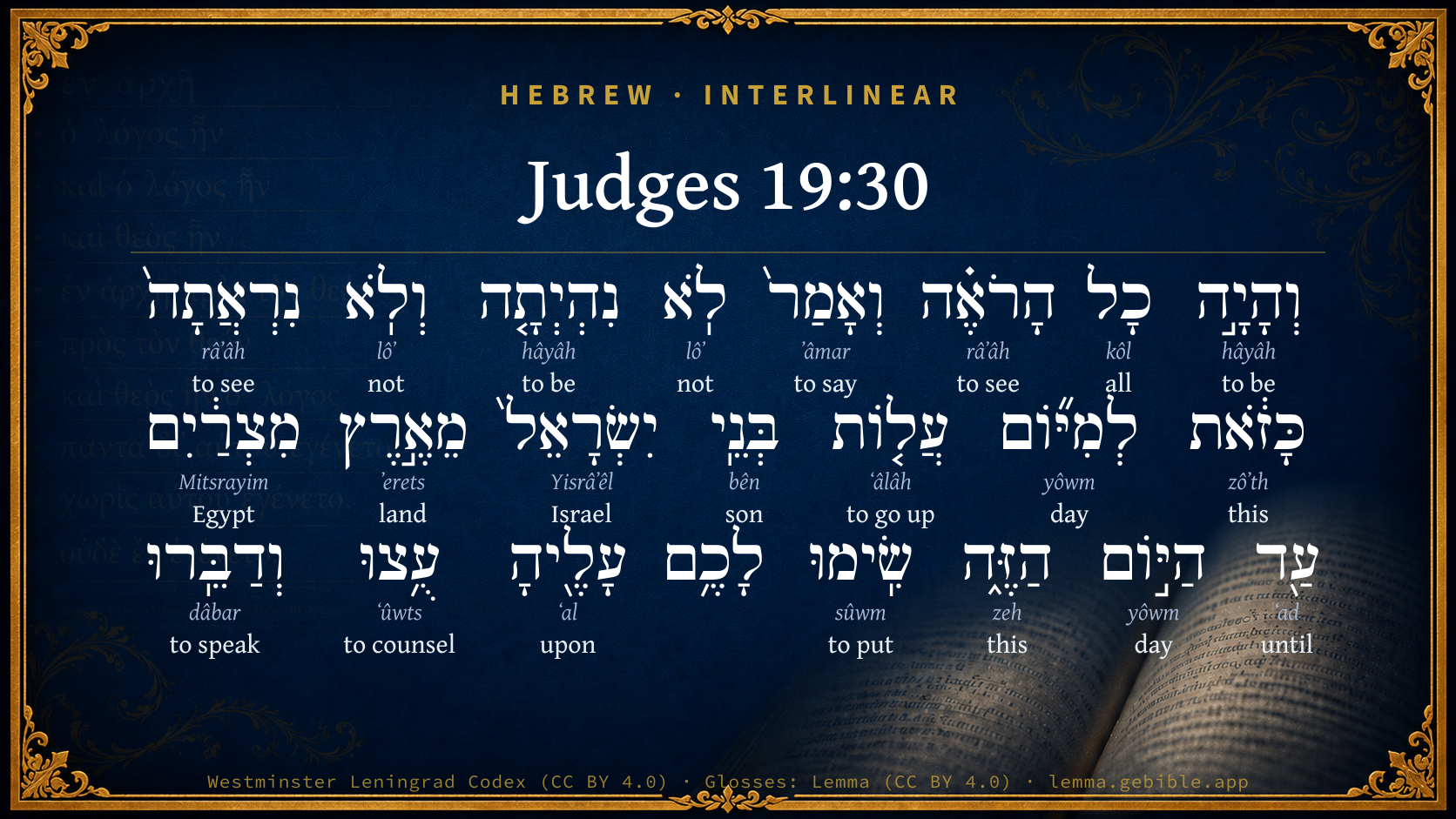
Hebrew (Westminster Leningrad Codex) Judges 19:30 appears in the Hebrew Old Testament. The text above is from the Westminster Leningrad Codex. Each word links to its Strong’s number, a concise gloss, and parsing drawn from the Open Scriptures Hebrew Bible morphology. Click any word for its full Brown-Driver-Briggs (BDB) entry.
Download image
Cite this verse

Judges 19:30 (World English Bible). Public Domain. Lemma interlinear Bible study tool, https://lemma.gebible.app/v/judges/19/30.

Show BibTeX & RIS
BibTeX
RIS
English Translation
It was so, that all who saw it said, There was no such deed done nor seen from the day that the children of Israel came up out of the land of Egypt to this day: consider it, take counsel, and speak.
World English Bible · Public Domain
Highlights
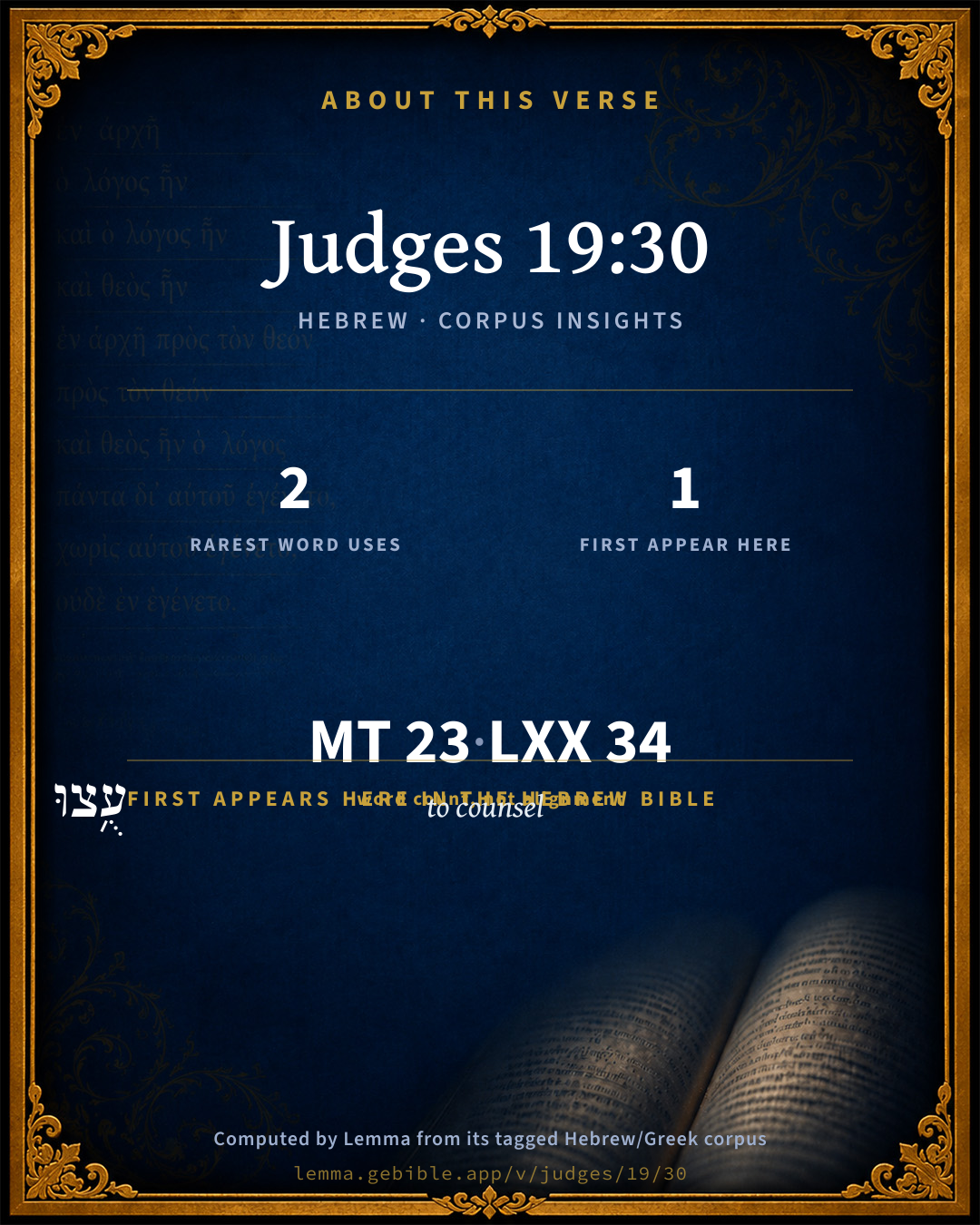
  • 1 first appearance in the Hebrew Bible
Full analysis ↓
Download a study sheet

One document with this verse’s original text, its word-by-word gloss line, the meaning frame, cross-references with their text, attributed commentary, and full source and license credits — printable, and it pastes into notes with its structure intact.

This verse Autodidact and up

Study sheet (.html) Plain text (.txt)

A passage Seminary Student

Up to 50 verses in one chapter. A passage sheet keeps up to 6 commentary sources and 12 cross-references per verse, in the order this page ranks them, and says so on the sheet whenever that leaves anything out. Ask for a single verse and you get the Autodidact verse sheet above.

Everything on this page stays free to read, with no account — the sheet is a download of what is already on screen, not access to it.

Want to remove ads? Support Godless Engineer
Compare translations 3

The same verse in 3 English versions, stacked beneath the original-language interlinear above. Click any original word for its lexicon entry.

Each is an independent rendering of the whole verse — the interlinear is not word-aligned to these translations.

Highlighted words mark where these versions differ — a whole-verse word diff, not a word-by-word alignment.

  • World English Bible Public Domain
    It was so, that all who saw it said, There was no such deed done nor seen from the day that the children of Israel came up out of the land of Egypt to this day: consider it, take counsel, and speak.
  • King James Version Public Domain
    And it was so, that all that saw it said, There was no such deed done nor seen from the day that the children of Israel came up out of the land of Egypt unto this day: consider of it, take advice, and speak your minds.
  • unfoldingWord Literal Text CC BY-SA 4.0
    And it happened, everyone was seeing, and he said, “Like this has not been done and has not been seen from the day of the coming up of the sons of Israel from the land of Egypt up to this day. Set for yourselves upon it! Take counsel, and speak!”

unfoldingWord Literal Text — © unfoldingWord, licensed CC BY-SA 4.0. Word-aligned USFM3 via Door43 (git.door43.org/unfoldingWord/en_ult).

Versions to compare (up to 4)

3 of 4 selected

Show all 18 translations

Every available English version of this verse, each an independent rendering of the whole verse.

  • World English Bible Public Domain
    It was so, that all who saw it said, There was no such deed done nor seen from the day that the children of Israel came up out of the land of Egypt to this day: consider it, take counsel, and speak.
  • Berean Standard Bible Public Domain
    And everyone who saw it said, “Nothing like this has been seen or done from the day the Israelites came out of the land of Egypt until this day. Think it over, take counsel, and speak up!”
  • Majority Standard Bible Public Domain
    And everyone who saw it said, “Nothing like this has been seen or done from the day the Israelites came out of the land of Egypt until this day. Think it over, take counsel, and speak up!”
  • King James Version Public Domain
    And it was so, that all that saw it said, There was no such deed done nor seen from the day that the children of Israel came up out of the land of Egypt unto this day: consider of it, take advice, and speak your minds.
  • American Standard Version (1901) Public Domain
    And it was so, that all that saw it said, There was no such deed done nor seen from the day that the children of Israel came up out of the land of Egypt unto this day: consider it, take counsel, and speak.
  • Revised Version (1885) Public Domain
    And it was so, that all that saw it said, There was no such deed done nor seen from the day that the children of Israel came up out of the land of Egypt unto this day: consider of it, take counsel, and speak.
  • Geneva Bible (1599) Public Domain
    And all that saw it, said, There was no such thing done or seene since the time that the children of Israel came vp from the lande of Egypt vnto this day: consider the matter, consult and giue sentence.
  • Douay-Rheims (1899) Public Domain
    And when every one had seen this, they all cried out: There was never such a thing done in Israel from the day that our fathers came up out of Egypt, until this day: give sentence, and decree in common what ought to be done.
  • Young's Literal Translation Public Domain
    And it hath come to pass, every one who seeth hath said, `There hath not been -- yea, there hath not been seen like this, from the day of the coming up of the sons of Israel out of the land of Egypt till this day; set your `heart' upon it, take counsel, and speak.'
  • Literal Standard Version CC BY-SA 4.0
    And it has come to pass, everyone who sees has said, “There has not been—indeed, there has not been seen [anything] like this, from the day of the coming up of the sons of Israel out of the land of Egypt until this day; set your [heart] on it, take counsel, and speak.”
  • Unlocked Literal Bible CC BY-SA 4.0
    All who saw this said, “Such a thing has never been done or seen from the day the people of Israel came up out of the land of Egypt to this present day. Think about it! Give us advice! Tell us what to do!”
  • unfoldingWord Literal Text CC BY-SA 4.0
    And it happened, everyone was seeing, and he said, “Like this has not been done and has not been seen from the day of the coming up of the sons of Israel from the land of Egypt up to this day. Set for yourselves upon it! Take counsel, and speak!”
  • Darby Bible Public Domain
    And all who saw it said, "Such a thing has never happened or been seen from the day that the people of Israel came up out of the land of Egypt until this day; consider it, take counsel, and speak."
  • World Messianic Bible Public Domain
    It was so, that all who saw it said, “Such a deed has not been done or seen from the day that the children of Israel came up out of the land of Egypt to this day! Consider it, take counsel, and speak.”
  • Webster's Bible Public Domain
    And it was so, that all that saw it, said, There hath been no such deed done nor seen from the day that the children of Israel came from the land of Egypt to this day: consider of it, take advice, and speak your minds.
  • Free Bible Version CC BY-SA 4.0
    Everyone who saw her said, “Nothing like this has ever been seen before, from the time the Israelites left Egypt up until now. You should think about what happened to her! Decide what to do! Speak up!”
  • Bible in Basic English Public Domain
    And he gave orders to the men whom he sent, saying, This is what you are to say to all the men of Israel, Has ever an act like this been done from the day when the children of Israel came out of Egypt to this day? Give thought to it, turning it over in your minds, and give your opinion of it.
  • JPS Tanakh (1917) Public Domain
    And it was so, that all that saw it said: 'Such a thing hath not happened nor been seen from the day that the children of Israel came up out of the land of Egypt unto this day; consider it, take counsel, and speak.'

Literal Standard Version (2020), Covenant Press — licensed CC BY-SA 4.0. Text via the HelloAO Bible API (eBible.org). Unlocked Literal Bible (unfoldingWord) — licensed CC BY-SA 4.0. Text via the HelloAO Bible API (eBible.org). unfoldingWord Literal Text — © unfoldingWord, licensed CC BY-SA 4.0. Word-aligned USFM3 via Door43 (git.door43.org/unfoldingWord/en_ult). Free Bible Version, Dr. Jonathan Gallagher — licensed CC BY-SA 4.0. Text via the HelloAO Bible API (eBible.org).

Word by word

More ways to search: Search by grammar → Find every occurrence → Compare this word →

Practice this passage: Drill this verse → Learn its vocabulary →

עֻ֥צוּ
ʻûwts
H5779
“counsel”
Verb, Qal, Imperative, 2nd Person, Masculine, Plural
Part of Speech
Verb
Stem
Qal
Form
Imperative
Person
2nd Person
Gender
Masculine
Number
Plural
Full BDB Definition

Origin: a primitive root

TWOT: 1584

(Qal) to counsel, plan
  1. וְהָיָ֣ה hâyâh H1961 “and · to be” Conjunction + Verb, Qal, Sequential Perfect, 3rd Person, Masculine, Singular
  2. כָל kôl H3605 “all of” Noun, Common, Masculine, Singular, Construct
  3. הָרֹאֶ֗ה râʼâh H7200 “the · seeing” Particle, Definite Article + Verb, Qal, Participle Active, Masculine, Singular, Absolute
  4. וְאָמַר֙ ʼâmar H559 “and · to say” Conjunction + Verb, Qal, Sequential Perfect, 3rd Person, Masculine, Singular
  5. לֹֽא lôʼ H3808 “not” Particle, Negative
  6. נִהְיְתָ֤ה hâyâh H1961 “to be” Verb, Niphal, Perfect, 3rd Person, Feminine, Singular
  7. וְלֹֽא lôʼ H3808 “and · not” Conjunction + Particle, Negative
  8. נִרְאֲתָה֙ râʼâh H7200 “to see” Verb, Niphal, Perfect, 3rd Person, Feminine, Singular
  9. כָּזֹ֔את zôʼth H2063 “like/as · this” Preposition + Pronoun, Demonstrative, Feminine, Singular
  10. לְמִיּ֞וֹם yôwm H3117 “to/for · from · day of” Preposition + Preposition + Noun, Common, Masculine, Singular, Construct
  11. עֲל֤וֹת ʻâlâh H5927 “to go up” Verb, Qal, Infinitive Construct
  12. בְּנֵֽי bên H1121 “sons of” Noun, Common, Masculine, Plural, Construct
  13. יִשְׂרָאֵל֙ Yisrâʼêl H3478 “Israel” Noun, Proper
  14. מֵאֶ֣רֶץ ʼerets H776 “from · land of” Preposition + Noun, Common, Both, Singular, Construct
  15. מִצְרַ֔יִם Mitsrayim H4714 “Egypt” Noun, Proper
  16. עַ֖ד ʻad H5704 “until” Preposition
  17. הַיּ֣וֹם yôwm H3117 “the · day” Particle, Definite Article + Noun, Common, Masculine, Singular, Absolute
  18. הַזֶּ֑ה zeh H2088 “the · this” Particle, Definite Article + Pronoun, Demonstrative, Masculine, Singular
  19. שִֽׂימוּ sûwm H7760 “put” Verb, Qal, Imperative, 2nd Person, Masculine, Plural
  20. עָלֶ֖יהָ ʻal H5921 “upon · her” Preposition + Suffix, Personal, 3rd Person, Feminine, Singular
  21. וְדַבֵּֽרוּ dâbar H1696 “and · speak” Conjunction + Verb, Piel, Imperative, 2nd Person, Masculine, Plural

About this verse

These counts appear in no published source. They are computed here, from the morphology-tagged text and Lemma’s own curated glosses. What Lemma adds →

23
words
18
distinct lemmas
Historical
section

Notable vocabulary

The rarest word here is עֻ֥צוּ to counsel H5779 — appearing just 2 times in the whole Hebrew Bible.

First appearance in Scripture

This word makes its first canonical appearance in the Hebrew Bible here:

  • עֻ֥צוּ to counsel H5779

Shared distinctive vocabulary

עֻ֥צוּ to counsel H5779 occurs in 2 verses of the Hebrew Bible. Also found in:

Grammatical profile

  • 9 verbs
  • 7 nouns
  • 2 pronouns
  • 3 prepositions
  • 2 particles

Verb forms

  • וְהָיָ֣ה Qal · Sequential Perfect
  • הָרֹאֶ֗ה Qal · Participle Active
  • וְאָמַר֙ Qal · Sequential Perfect
  • נִהְיְתָ֤ה Niphal · Perfect
  • נִרְאֲתָה֙ Niphal · Perfect
  • עֲל֤וֹת Qal · Infinitive Construct
  • שִֽׂימוּ Qal · Imperative
  • עֻ֥צוּ Qal · Imperative
  • וְדַבֵּֽרוּ Piel · Imperative

Repetition

Words recur within this verse — often emphatic in Hebrew:

  • וְהָיָ֣ה to be H1961 ×2
  • הָרֹאֶ֗ה to see H7200 ×2
  • לְמִיּ֞וֹם day H3117 ×2
  • לֹֽא not H3808 ×2

Hebrew & Septuagint length

In English translation the verse runs 42 words from the Hebrew and 51 from the Septuagint (LXX English) — closely comparable.

A rough comparison of the two English renderings, which tokenize alike — not a word-level alignment.

Word counts can differ between the Hebrew and the Greek without any difference in meaning — e.g. the Hebrew direct-object marker אֵת has no separate Greek word, and Greek often adds the article ὁ.

In the original languages it is 23 Hebrew tokens and 34 Greek tokens — but the two are counted differently (Hebrew bundles its prefixes and suffixes into one token; the Greek is in lemma form), so that isn’t a like-for-like length.

Cross-references

7

Topical passages linked to Judges 19:30 in the Treasury of Scripture Knowledge — connected by theme and wording, ordered by reader-vote popularity; previews shown in the World English Bible.

  • Judges 20:7 Behold, you children of Israel, all of you, give here your advice and counsel.
  • Proverbs 13:10 Pride only breeds quarrels, But with ones who take advice is wisdom.
  • Proverbs 11:14 Where there is no wise guidance, the nation falls, But in the multitude of counselors there is victory.
  • Proverbs 15:22 Where there is no counsel, plans fail; But in a multitude of counselors they are established.
  • Proverbs 20:18 Plans are established by advice; By wise guidance you wage war!
  • Proverbs 24:6 For by wise guidance you wage your war; And victory is in many advisors.
  • Hosea 9:9 They have deeply corrupted themselves, As in the days of Gibeah. He will remember their iniquity. He will punish them for their sins.

Cross-references courtesy of OpenBible.info (CC BY 4.0).

Hebrew and Greek witnesses Masoretic Hebrew ↔ Greek Septuagint

The same verse in the two great witnesses to the Old Testament, shown verse-for-verse.

These are two independent witnesses, not word-aligned to each other, and the Septuagint is shown in lemma (dictionary) form.

Hebrew Judges 19:30 Masoretic · Westminster Leningrad Codex

וְהָיָ֣ה כָל הָרֹאֶ֗ה וְאָמַר֙ לֹֽא נִהְיְתָ֤ה וְלֹֽא נִרְאֲתָה֙ כָּזֹ֔את לְמִיּ֞וֹם עֲל֤וֹת בְּנֵֽי יִשְׂרָאֵל֙ מֵאֶ֣רֶץ מִצְרַ֔יִם עַ֖ד הַיּ֣וֹם הַזֶּ֑ה שִֽׂימוּ לָכֶ֥ם עָלֶ֖יהָ עֻ֥צוּ וְדַבֵּֽרוּ

It was so, that all who saw it said, There was no such deed done nor seen from the day that the children of Israel came up out of the land of Egypt to this day: consider it, take counsel, and speak.

World English Bible · Public Domain

Greek LXX Judges 19:30 Septuagint · lemma form

καί γίγνομαι πᾶς ὁ βλέπω λέγω οὐ γίγνομαι καί οὐ ὁράω ὡς οὗτος ἀπό ἡμέρα ἀνάβασις υἱός ἰσραήλ ἐκ γῆ αἴγυπτος καί ἕως ὁ ἡμέρα οὗτος τίθημι σύ αὐτός ἐπί αὐτός βουλή καί λαλέω

And it was so, that every one who saw it said, Such a day as this has not happened nor has been seen from the day of the going up of the children of Israel out of the land of Egypt until this day: take you⌃ counsel concerning it, and speak.

LXX2012 (modern English Septuagint) · Public Domain

On this verse, The Cambridge Bible for Schools and Colleges discusses the Septuagint’s reading. Read the note in Commentary ↓

Hebrew: Westminster Leningrad Codex (CC BY 4.0). Greek: Septuagint (public domain); English from LXX2012 (modern English Septuagint) (Public Domain). How the Septuagint differs from the Hebrew →

Targum (Aramaic paraphrase)

1

The Targum is the ancient Jewish Aramaic paraphrase of the Hebrew Scriptures — an interpretive translation, not the Hebrew text itself. Onkelos (literal) and Pseudo-Jonathan (expansive) render the Torah, and Jonathan the Prophets. Coverage is partial: where no permissively-licensed English translation exists for a verse, only the Aramaic is shown. This is verse-level text, not a word-by-word alignment to the Hebrew.

  1. Targum Jonathan Prophets (Joshua–Malachi)
    וַהֲוָה כָּל דְחָזֵי וַאֲמַר לָא הֲוַת וְלָא אִתְחֲזִיאַת כַּהֲדָא לְמִן יוֹמָא דִי סְלִיקוּ בְּנֵי יִשְׂרָאֵל מֵאַרְעָא דְמִצְרָיִם עַד יוֹמָא הָדֵין שַׁווּ לִבְּכוֹן עֲלָהּ אִתְיַעְצוּ וּמַלִילוּ:

    (no public-domain English translation for this verse)

    Targum Jonathan — Aramaic: “Mikraot Gedolot” (public domain). English: “Sefaria Community Translation” (CC0 1.0 (public-domain dedication)); “London "Chaldee Paraphrase," 1871” (public domain). Text via Sefaria.

Commentary

Notes on Judges 19:30 from classic Christian and Jewish commentators (each source and its license shown beneath its notes). The classic Christian expositions comment on the surrounding passage and are grouped to its opening verse, so a note may address several verses; the Jewish commentaries on the Tanakh (Rashi and others) are per-verse, so they appear only where the commentator wrote on this verse.

Lemma curates 59 commentaries, every one of them public domain or Creative Commons licensed, each selected and text-cleaned for this edition rather than reprinted as found. About our sources →

Trapp's Complete Commentary

John Trapp

Jdg 19:30 And it was so, that all that saw it said, There was no such deed done nor seen from the day that the children of Israel came up out of the land of Egypt unto this day: consider of it, take advice, and speak [your minds].

Ver. 30. There was no such deed done.] So that it grew to a proverb, "They have deeply corrupted themselves, as in the days of Gibeah." {Hos 9:9} And that this should be done so soon after Joshua’s death, is a just wonder.

John Trapp, A Commentary or Exposition upon All the Books of the Old and New Testament (1647–1656) — public domain. Text from a community e-Sword module.

Joseph Benson's Commentary

Jdg 19:30. All said, There was no such deed done or seen, &c. — All who saw it, and heard the relation, were so moved with horror at it that they called upon each other to consult and give their opinion in what manner justice should be done upon the lewd and inhuman Gibeathites; as follows in the next chapter.

Joseph Benson's Commentary on the Old and New Testaments (1811–1818) — public domain. Text from a community e-Sword module.

Geneva Bible (1599)

Geneva Bible translators

For this was like the sin of Sodom for the which God rained down fire and brimstone from heaven.

Geneva Bible (1599) marginal notes — public domain. Text via Bolls.life.

Adam Clarke's Commentary

Verse 30. There was no such deed done nor seen] They were all struck with the enormity of the crime; and considered it a sovereign disgrace to all the tribes of Israel.

Consider of it] Literally, Put it to yourselves; take counsel upon it; and speak. This was the prelude to the council held, and the subsequent operations, which are mentioned in the following chapter.

I HAVE passed over the abominable transactions of this chapter as lightly as I could, and shall make no apology to the learned or unlearned reader for leaving some things untranslated.

What a blessing are wholesome laws, and a vigorous and attentive magistracy! These wretched people had no form of government, and every one did what was right in his own eyes: their own eye (corrupt inclination) was the measure and rule of their conduct; and how bad a rule, the abuse and murder of the Levite's wife testify. Reader, bless God for a civil government.

Adam Clarke's Commentary on the Bible (1810–1826) — public domain. Text from a community e-Sword/MySword module.

Ellicott's Commentary for English Readers

(30) The verse shows that the Levite had successfully gauged the depths of moral indignation that still lay in the hearts of his countrymen. The story of the deed thrilled through all Palestine and awoke a determined desire for retribution upon the guilty inhabitants of Gibeah. The whole nation felt the stain and shame (Hos_9:9; Hos_10:9).

A Bible Commentary for English Readers, edited by Charles John Ellicott (1878–1897) — public domain. Text from a community e-Sword module.

The Cambridge Bible for Schools and Colleges

gen. ed. J. J. S. Perowne

30. After unto this day the LXX. cod. A etc. contains an addition which no doubt formed part of the original text. Restoring this addition to its proper place at the beginning of the verse we may read: And he commanded the men whom he sent, saying, Thus shall ye say to all the men of Israel, Did ever such a thing as this happen, from the day that the children of Israel came up out of Egypt unto this day? Consider of it, take counsel, and speak, And it was so, that all that saw it said, There was no such deed done nor seen from the day that the children of Israel came up out of the land of Egypt unto this day. Note that both clauses end with unto this day: the first fell out through homoioteleuton. Consider of it … speak is much more suitable as the Levite’s message than as the exclamation of those who discussed the summons.

came up out of the land of Egypt] The Exodus is frequently referred to as the birth-day of Israel’s national life, cf. Jdg_6:13, 1Sa_8:8, 2Sa_7:6, Amo_2:10; Amo_9:7, Mic_6:4 etc.

The outrage at Gibeah is referred to in Hos_9:9; Hos_10:9-10. The text of the latter passage is uncertain and difficult; ‘their two transgressions’ is generally taken as an allusion to the want of hospitality and the immoral conduct of the men of Gibeah. The Targum on Hos_10:9, however, intiverance. The connexion between (3) and (4) is illustrerprets ‘the days of Gibeah’ as referring to the setting up of the kingdom in Gibeah in the time of Saul; and some modern scholars accept this view. It is true that Israel, which avenged the crime with such righteous zeal, could not fairly be blamed for it; on the other hand, the Benjamites of Gibeah formed a part of Israel, and the entire nation would, in accordance with ancient ideas, be considered as involved in the guilt (cf. Jdg_20:10 b). It is not necessary to suppose that Hosea based his allusion on the present narrative; the tradition which he knew may have differed in some respects.

The Cambridge Bible for Schools and Colleges (gen. ed. J. J. S. Perowne; Cambridge University Press, 1878–1918) — public domain. Text from a community e-Sword module.

John Gill's Exposition

And it was so, that all that saw it,.... The dismembered pieces of the dead body, and were made acquainted with the cause of it; for so Josephus (b) says, he gave the messengers a command to declare what was the cause of her death:

said, there was no such deed done nor seen, from the day that the children of Israel came out of Egypt, unto this day; meaning not so much the cutting in pieces the dead body, and sending it to different parts; though that was awful and shocking, as the complicated wickedness committed at Gibeah, which was the cause of it, to which reference is had, Hos 9:9 this is an observation of the writer of this book, Samuel; but what follows are the words either of those the Levite sent, who were bid to deliver them to those to whom the pieces were sent, or else of the persons present at the time of the delivery of the pieces to them, or whom they got together to disclose the matter to:

consider of it, take advice, and speak your minds; well weigh and think of the matter within yourselves, consult with one another what is proper to be done, and give your opinion freely without any reserve.

(b) Ut supra. (Antiqu. l. 5. c. 2. sect. 8.)

Next: Judges Chapter 20

John Gill's Exposition of the Whole Bible (1746–1763) — public domain (CC PDM 1.0). Text via the HelloAO Bible API.

Haydock's Catholic Bible Commentary

Egypt, that is for the space of eighty years. (Salien) --- Indeed the annals of all past ages could hardly furnish an instance of such barbarous lust. --- Done. In every city, people gathered together to consult how the crime was to be expiated; (Haydock) and all agreed to assemble before the Lord. (Calmet) --- Grabe’s Septuagint observes, that the Levite "gave order to the men, to whom he sent, saying, these things shall you speak to every Israelite. If such a word (or thing) has come to pass, from the day of the coming up of the sons of Israel out of Egypt, till the present day? Take ye advice concerning it, and speak." (Haydock)

George Leo Haydock (1774–1849), Haydock's Catholic Family Bible and Commentary, 1859 edition — public domain. Excludes Psalms (Douay-Rheims chapter numbering differs from Protestant) and Deuterocanonical books (Catholic canon only).

Matthew Poole's English Annotations

No such deed; so wicked and abominable.

Consider of it, take advice, and speak your minds; let us meet together, and seriously consider, and every one freely speak what is to be done in this case.

Matthew Poole's English Annotations on the Holy Bible (1683–1685) — public domain. Text from a community e-Sword/MySword module.

Whedon's Commentary on the Bible

Daniel D. Whedon

30. No such deed done nor seen — It has its only parallel in the history of ancient Sodom, long before Israel’s exodus from the land of Egypt. Compare Gen_19:1-11.

Daniel D. Whedon (gen. ed.), Commentary on the Old and New Testaments (1874–1909) — public domain. Text from a community e-Sword module.

The Pulpit Commentary

And it was so, etc. Some translate this verse quite differently. They understand the whole verse as what the Levite said when he sent the twelve pieces of the murdered woman to the twelve tribes, as thus: He sent her into all the coasts of Israel (ver. 29), saying, It shall come to pass that all who see it will say, There hath been nothing done and nothing seen like this from the day, etc. But the A.V makes very good sense, and the Hebrew will bear it. Consider of it, etc. The general sense of the whole nation was to call a national council to decide what to do. The Levite had succeeded in arousing the indignation of the twelve tribes to avenge his terrible wrong.

Unparalleled crime: the spirit and method in which its problems are to be met

The narrative of the book has been gradually deepening in tragic interest and moral importance; it now reaches its climax. The sentence which the people themselves passed upon this crime is repeated, that public inquiry may be directed to the significance of it, to the causes of its production, and the means for preventing the recurrence of similar enormities. To the author the unity of the nation, publicly represented in the tabernacle at Shiloh and the throne of the new kingdom, as the outward symbols of theocratic government, is the grand specific, and the proof of this may be said to be the dogmatic purpose of his work. Studying the same problem in its modern illustrations, we are carried onward to a deeper and more radical cause, and, consequently, to the need of a more potent and inward influence of restraint and salvation. But do we study sufficiently, from the higher philosophic and religious standpoint, the great crimes that startle us from day to day? Would it not be a "means of grace" by no means to be despised were we to grapple with the spiritual and practical bearings of such occurrences? There could not well be a more judicious course in such events than that advised by the writer. It is terse, natural, philosophic.

I PERSONAL MEDITATION. Consider it. " In all its relations; our own as well as others. Let it show us the measure of public declension in morals and religion. Ask what neglect in the matter of education, social fellowship, or religious teaching and influence will account for it. How far am I as an individual in sympathy with the ideas, customs, and whole cast of public life in my time? How far am I my brother"s keeper? Can anything be done to rouse the public conscience to a keener and more influential activity? How easy or how difficult would a similar clime be to myself? Prayers that I may be kept from such a thing, and may lead others into a better way.

II CONSULTATION. Not at random, but of persons qualified to advise. The deliberations of the "Prisoners" Aid Society" would furnish a model for practical discussion. But "statistics" will never solve the problem. It is a question of human depravity, and a general repentance and alarmed attention is needed.

III JUDGMENT. A careful, mature, well-informed and advised opinion; but, as being the opinion of the nation, it must be carried into effect. Something must be done, as well as thought. How valuable and influential such a judgment! It carries within itself the seeds of reformation and the conditions of recovery. M.

The duty of considering painful subjects.

I IT IS WRONG FOR THE CHURCH TO IGNORE THE WICKEDNESS OF THE WORLD. The Church is not at liberty to enjoy the flowers and fruits of her "little garden walled around" to the neglect of the waste howling wilderness outside. She has no right to shut her eyes to the world"s sin while she dreams fair dreams of the ultimate perfection of mankind. A good deal of foolish optimism is talked by people who will not take the trouble to inquire into the real state of society. That is a false fastidiousness which refuses to take note of dark subjects because they are revolting and contaminating. True purity will be shocked not simply at the knowledge of evil, but more at the existence of it, and will find expression not merely in shunning the sight of it, but in actively overcoming it. Such action, however, can only be taken after the evil has been recognised. It is, therefore, the work of the Church to consider seriously the fearful evils of profligacy, intemperance, and social corruption generally. The duty of contemplating heavenly things is no excuse for ignoring the evil of the world, which it is our express duty to enlighten and purify by means of the gospel of Christ.

II MONSTROUS WICKEDNESS SHOULD EXCITE DEEP AND SERIOUS CONSIDERATION. It is easy to be indignant. But the hasty passion of indignation may do more harm than good. It may strike in the wrong place; it may only touch superficial symptoms and leave the root of the evil; and it is likely to die down as quickly as it springs up. Great sins should be visited not with the rage of vindictiveness, but with grave, severe justice. We should "consider and take advice," reflect, consult, discuss the cause and the remedy. Undisciplined human nature will express horror and seek revenge at the revelation of a great crime. It wants Christian thoughtfulness and a deep, sad conviction of duty to practise self-restraint in the moment of indignation, and to investigate the painful subject with care after the interest of a temporary excitement has flagged.

III IT IS OUR DUTY TO SPEAK OUT AND TAKE ACTION IN RELATION TO PAINFUL SUBJECTS WHEN ANYTHING CAN BE DONE TO EFFECT AN IMPROVEMENT. Evils are allowed to go unchecked because a false modesty dreads to speak of them. The men and women who overcome this and bravely advocate unpopular questions should be treated with all honour by the Christian Church. If the Christian does nothing to check the vicious practices and corrupt institutions which surround him, he becomes responsible for their continued existence. A.

The Pulpit Commentary (1880–1919), ed. H.D.M. Spence-Jones & Joseph S. Exell — public domain. Text from a community e-Sword module.

John Wesley's Explanatory Notes

Speak - Let us meet together, and seriously consider, and every one freely speak what is to be done in this case.

John Wesley, Explanatory Notes Upon the Whole Bible (1754–1765) — public domain. Text via the GEBible commentary corpus.

Lesson kit

Teaching starters — assembled from the data on this page, not authored interpretation. Every prompt links to the verse data it draws on. Edit before teaching.

Judges, in the Historical, opens this verse with 23 words (18 distinct Hebrew lemmas). Its most distinctive word is ʻûwts (“to counsel”). A historical commentator’s framing appears above. Read the whole chapter for the surrounding context.

Discussion questions

  1. How does “to counsel” (ʻûwts) shape what this verse is saying?
  2. This is the first place “to counsel” appears in Scripture (first appears here). What does its debut here establish?
  3. How does Isaiah 8:10, which shares the word «to counsel», read alongside this verse?
  4. What does the repetition of “to be” (2× in this one verse) do in this verse?
  5. The translations on this page render this verse differently — a whole-verse word diff, not a word-by-word alignment. What might account for the different wordings?
  6. «וְהָיָ֣ה» is a Qal Sequential Perfect verb. How does that grammatical form shape the action described?
  7. Compare how Trapp's Complete Commentary and Joseph Benson's Commentary read this verse. Where do they agree or differ?

Things to notice

Reading settings

Reading text

Shown beneath each verse's original-language words.

Old Testament
Old Testament edition

Read the OT as the Masoretic Hebrew (MT) or the Greek Septuagint (LXX).

English shown for the Greek Septuagint (in the Hebrew ↔ Greek comparison).

Comparing translations? Open the Compare panel on any verse page to stack up to four side by side.