

Revelation 1:11
Greek (Tischendorf 8th ed.) Revelation 1:11 appears in the Greek New Testament. The text above is from the Tischendorf 8th edition. Each word links to its Strong’s number and a concise gloss. Click any word for its full Thayer’s Greek Lexicon entry.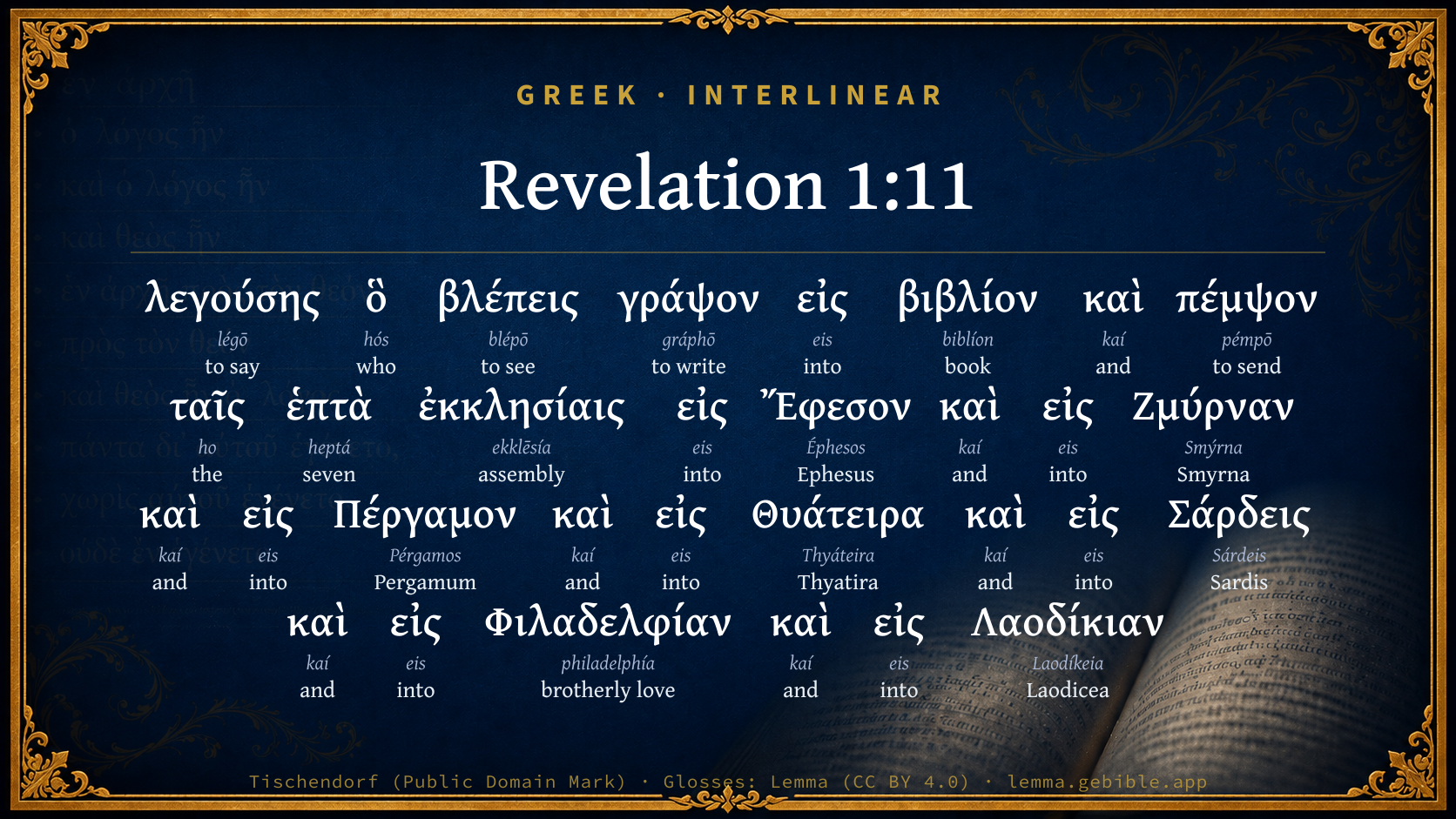
saying, "What you see, write in a book and send to the seven assemblies: to Ephesus, Smyrna, Pergamum, Thyatira, Sardis, Philadelphia, and to Laodicea."
Download a study sheet
One document with this verse’s original text, its word-by-word gloss line, the meaning frame, cross-references with their text, attributed commentary, and full source and license credits — printable, and it pastes into notes with its structure intact.
This verse Autodidact and up
A passage Seminary Student
Up to 50 verses in one chapter. A passage sheet keeps up to 6 commentary sources and 12 cross-references per verse, in the order this page ranks them, and says so on the sheet whenever that leaves anything out. Ask for a single verse and you get the Autodidact verse sheet above.
Everything on this page stays free to read, with no account — the sheet is a download of what is already on screen, not access to it.
Compare translations 3
The same verse in 3 English versions, stacked beneath the original-language interlinear above. Click any original word for its lexicon entry.
Each is an independent rendering of the whole verse — the interlinear is not word-aligned to these translations.
Highlighted words mark where these versions differ — a whole-verse word diff, not a word-by-word alignment.
-
World English Bible Public Domain
saying, "What you see, write in a book and send to the seven assemblies: to Ephesus, Smyrna, Pergamum, Thyatira, Sardis, Philadelphia, and to Laodicea."
-
King James Version Public Domain
Saying, I am Alpha and Omega, the first and the last: and, What thou seest, write in a book, and send it unto the seven churches which are in Asia; unto Ephesus, and unto Smyrna, and unto Pergamos, and unto Thyatira, and unto Sardis, and unto Philadelphia, and unto Laodicea.
-
unfoldingWord Literal Text CC BY-SA 4.0
saying, “Write what you see on a scroll and send it to the seven churches—to Ephesus and to Smyrna and to Pergamum and to Thyatira and to Sardis and to Philadelphia and to Laodicea.”
unfoldingWord Literal Text — © unfoldingWord, licensed CC BY-SA 4.0. Word-aligned USFM3 via Door43 (git.door43.org/unfoldingWord/en_ult).
Show all 19 translations
Every available English version of this verse, each an independent rendering of the whole verse.
-
World English Bible Public Domain
saying, "What you see, write in a book and send to the seven assemblies: to Ephesus, Smyrna, Pergamum, Thyatira, Sardis, Philadelphia, and to Laodicea."
-
Berean Standard Bible Public Domain
saying, “Write on a scroll what you see and send it to the seven churches: to Ephesus, Smyrna, Pergamum, Thyatira, Sardis, Philadelphia, and Laodicea.”
-
Majority Standard Bible Public Domain
saying, “Write on a scroll what you see and send it to the seven churches: to Ephesus, Smyrna, Pergamum, Thyatira, Sardis, Philadelphia, and Laodicea.”
-
King James Version Public Domain
Saying, I am Alpha and Omega, the first and the last: and, What thou seest, write in a book, and send it unto the seven churches which are in Asia; unto Ephesus, and unto Smyrna, and unto Pergamos, and unto Thyatira, and unto Sardis, and unto Philadelphia, and unto Laodicea.
-
American Standard Version (1901) Public Domain
saying, What thou seest, write in a book and send `it' to the seven churches: unto Ephesus, and unto Smyrna, and unto Pergamum, and unto Thyatira, and unto Sardis, and unto Philadelphia, and unto Laodicea.
-
Revised Version (1885) Public Domain
saying, What thou seest, write in a book, and send it to the seven churches; unto Ephesus, and unto Smyrna, and unto Pergamum, and unto Thyatira, and unto Sardis, and unto Philadelphia, and unto Laodicea.
-
Geneva Bible (1599) Public Domain
Saying, I am Alpha and Omega, that first and that last: and that which thou seest, write in a booke, and send it vnto the seuen Churches which are in Asia, vnto Ephesus, and vnto Smyrna, and vnto Pergamus, and vnto Thyatira, and vnto Sardis, and vnto Philadelphia, and vnto Laodicea.
-
Douay-Rheims (1899) Public Domain
Saying: What thou seest, write in a book, and send to the seven churches which are in Asia, to Ephesus, and to Smyrna, and to Pergamus, and to Thyatira, and to Sardis, and to Philadelphia, and to Laodicea.
-
Young's Literal Translation Public Domain
`I am the Alpha and the Omega, the First and the Last;' and, `What thou dost see, write in a scroll, and send to the seven assemblies that `are' in Asia; to Ephesus, and to Smyrna, and to Pergamos, and to Thyatira, and to Sardis, and to Philadelphia, and to Laodicea.'
-
Literal Standard Version CC BY-SA 4.0
“I am the Alpha and the Omega, the First and the Last,” and, “Write what you see in a scroll, and send [it] to the seven assemblies that [are] in Asia: to Ephesus, and to Smyrna, and to Pergamos, and to Thyatira, and to Sardis, and to Philadelphia, and to Laodicea.”
-
Unlocked Literal Bible CC BY-SA 4.0
It said, “Write what you see in a book, and send it to the seven churches—to Ephesus, to Smyrna, to Pergamum, to Thyatira, to Sardis, to Philadelphia, and to Laodicea.”
-
unfoldingWord Literal Text CC BY-SA 4.0
saying, “Write what you see on a scroll and send it to the seven churches—to Ephesus and to Smyrna and to Pergamum and to Thyatira and to Sardis and to Philadelphia and to Laodicea.”
-
Darby Bible Public Domain
saying, What thou seest write in a book, and send to the seven assemblies: to Ephesus, and to Smyrna, and to Pergamos, and to Thyatira, and to Sardis, and to Philadelphia, and to Laodicea.
-
World Messianic Bible Public Domain
saying, “What you see, write in a book and send to the seven assemblies: to Ephesus, Smyrna, Pergamum, Thyatira, Sardis, Philadelphia, and to Laodicea.”
-
Webster's Bible Public Domain
Saying, I am Alpha and Omega, the first and the last: and, What thou seest, write in a book, and send it to the seven churches which are in Asia; to Ephesus, and to Smyrna, and to Pergamos, and to Thyatira, and to Sardis, and to Philadelphia, and to Laodicea.
-
Free Bible Version CC BY-SA 4.0
It told me, “Write down in a book what you see and send it to the seven churches: Ephesus, Smyrna, Pergamum, Thyatira, Sardis, Philadelphia, and Laodicea.”
-
Bible in Basic English Public Domain
Saying, What you see, put in a book, and send it to the seven churches; to Ephesus and to Smyrna and to Pergamos and to Thyatira and to Sardis and to Philadelphia and to Laodicea.
-
Text-Critical English NT CC BY 4.0
saying, “ Write what yoʋ see in a book and send it to the seven churches: to Ephesus, Smyrna, Pergamum, Thyatira, Sardis, Philadelphia, and Laodicea.”
-
Tyndale New Testament (1534) Public Domain
sayinge: I am Alpha and Omega the fyrst and the laste. That thou seist write in a boke and sende it vnto the congregacions which are in Asia vnto Ephesus and vnto Smyrna and vnto Pargamos and vnto Thiatira and vnto Sardis and vnto Philadelphia and vnto Laodicia.
Literal Standard Version (2020), Covenant Press — licensed CC BY-SA 4.0. Text via the HelloAO Bible API (eBible.org). Unlocked Literal Bible (unfoldingWord) — licensed CC BY-SA 4.0. Text via the HelloAO Bible API (eBible.org). unfoldingWord Literal Text — © unfoldingWord, licensed CC BY-SA 4.0. Word-aligned USFM3 via Door43 (git.door43.org/unfoldingWord/en_ult). Free Bible Version, Dr. Jonathan Gallagher — licensed CC BY-SA 4.0. Text via the HelloAO Bible API (eBible.org).
Word by word
More ways to search: Search by grammar → Find every occurrence → Compare this word →
Practice this passage: Drill this verse → Learn its vocabulary →
- Appears 2× in the Greek New Testament
- First appears here
- Part of Speech
- Noun
- Case
- Accusative
- Number
- Singular
- Gender
- Feminine
Full Thayer's Definition
- λεγούσης légō G3004 “to say” Verb, Present, Active, Participle, Genitive, Singular, Feminine
- ὃ hós G3739 “who” Relative pronoun, Accusative, Singular, Neuter
- βλέπεις blépō G991 “to see” Verb, Present, Active, Indicative, 2nd person, Singular
- γράψον gráphō G1125 “to write” Verb, Aorist, Active, Imperative, 2nd person, Singular
- εἰς eis G1519 “into” Preposition
- βιβλίον biblíon G975 “book” Noun, Accusative, Singular, Neuter
- καὶ kaí G2532 “and” Conjunction
- πέμψον pémpō G3992 “to send” Verb, Aorist, Active, Imperative, 2nd person, Singular
- ταῖς ho G3588 “the” Article, Dative, Plural, Feminine
- ἑπτὰ heptá G2033 “seven” Adjective, Numeral (indeclinable)
- ἐκκλησίαις ekklēsía G1577 “assembly” Noun, Dative, Plural, Feminine
- εἰς eis G1519 “into” Preposition
- Ἔφεσον Éphesos G2181 “Ephesus” Noun, Accusative, Singular, Feminine
- καὶ kaí G2532 “and” Conjunction
- εἰς eis G1519 “into” Preposition
- Ζμύρναν Smýrna G4667 “Smyrna” Noun, Accusative, Singular, Feminine
- καὶ kaí G2532 “and” Conjunction
- εἰς eis G1519 “into” Preposition
- Πέργαμον Pérgamos G4010 “Pergamum” Noun, Accusative, Singular, Feminine
- καὶ kaí G2532 “and” Conjunction
- εἰς eis G1519 “into” Preposition
- Θυάτειρα Thyáteira G2363 “Thyatira” Noun, Accusative, Plural, Neuter
- καὶ kaí G2532 “and” Conjunction
- εἰς eis G1519 “into” Preposition
- Σάρδεις Sárdeis G4554 “Sardis” Noun, Accusative, Plural, Feminine
- καὶ kaí G2532 “and” Conjunction
- εἰς eis G1519 “into” Preposition
- Φιλαδελφίαν philadelphía G5360 “brotherly love” Noun, Accusative, Singular, Feminine
- καὶ kaí G2532 “and” Conjunction
- εἰς eis G1519 “into” Preposition
- Λαοδίκιαν Laodíkeia G2993 “Laodicea” Noun, Accusative, Singular, Feminine
About this verse
These counts appear in no published source. They are computed here, from the morphology-tagged text and Lemma’s own curated glosses. What Lemma adds →
- 31
- words
- 18
- distinct lemmas
- Revelation
- section
Notable vocabulary
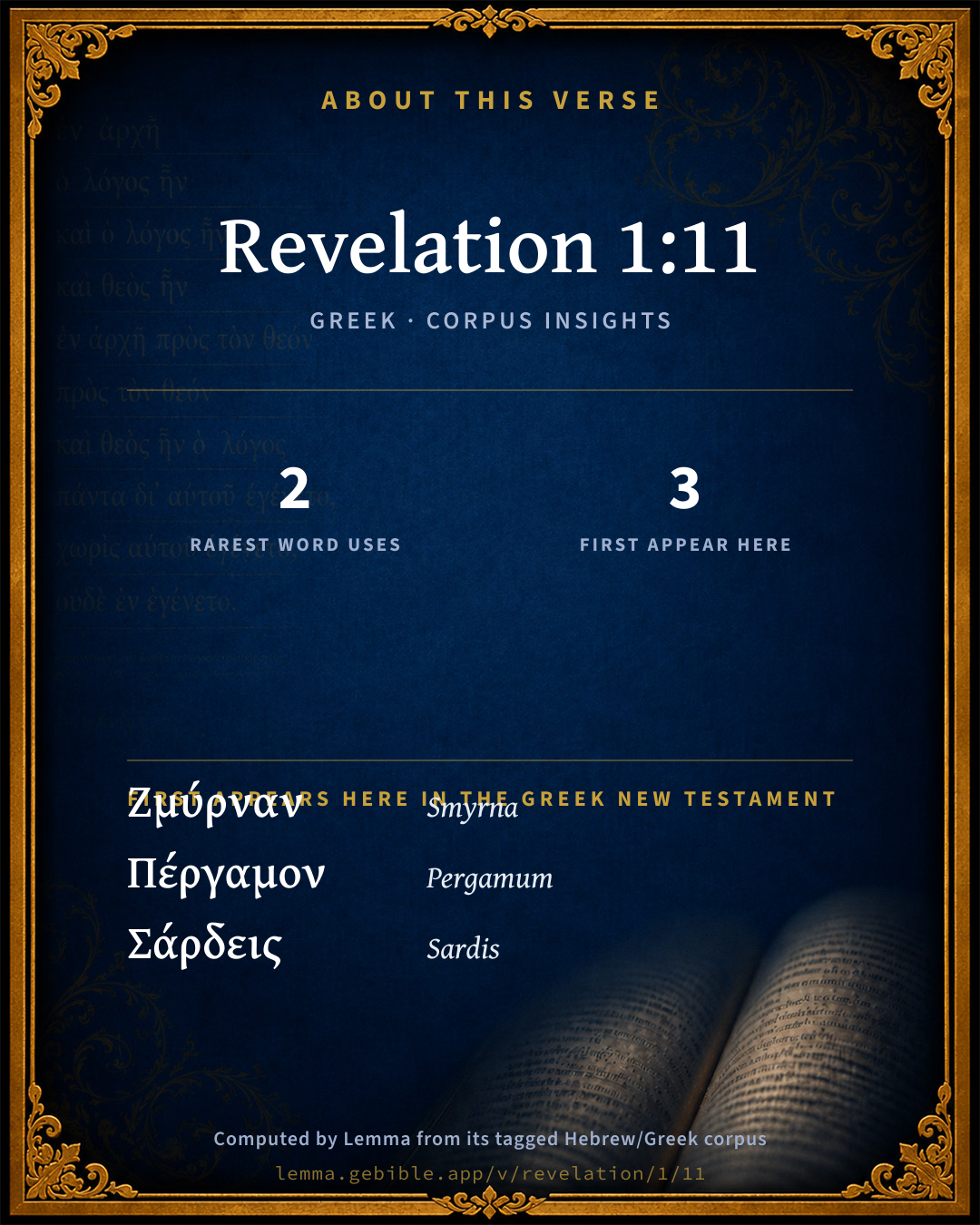
The rarest word here is Ζμύρναν Smyrna G4667 — appearing just 2 times in the whole Greek New Testament.
First appearance in Scripture
These words make their first canonical appearance in the Greek New Testament here:
Shared distinctive vocabulary
Ζμύρναν Smyrna G4667 occurs in 2 verses of the Greek New Testament. Also found in:
Cross-references
28Topical passages linked to Revelation 1:11 in the Treasury of Scripture Knowledge — connected by theme and wording, ordered by reader-vote popularity; previews shown in the World English Bible.
- Jeremiah 30:2 Thus speaks Yahweh, the God of Israel, saying, Write you all the words that I have spoken to you in a book.
- Habakkuk 2:2 Yahweh answered me, "Write the vision, and make it plain on tablets, that he may run who reads it.
- Colossians 4:15–16 Greet the brothers who are in Laodicea, and Nymphas, and the assembly that is in his house.
- Revelation 3:1 "And to the angel of the assembly in Sardis write: He who has the seven Spirits of God, and the seven stars says these things: "I know your works, that you have a reputation of being alive, but you are dead.
- Isaiah 30:8 Now go, write it before them on a tablet, and inscribe it in a book, that it may be for the time to come forever and ever.
- Ephesians 1:1 Paul, an apostle of Christ Jesus through the will of God, to the saints who are at Ephesus, and the faithful in Christ Jesus:
- Revelation 1:4 John, to the seven assemblies that are in Asia: Grace to you and peace, from God, who is and who was and who is to come; and from the seven Spirits who are before his throne;
- Revelation 2:8 "To the angel of the assembly in Smyrna write: "The first and the last, who was dead, and has come to life says these things:
- Revelation 2:12 "To the angel of the assembly in Pergamum write: "He who has the sharp two-edged sword says these things:
- Revelation 2:18 "To the angel of the assembly in Thyatira write: "The Son of God, who has his eyes like a flame of fire, and his feet are like burnished brass, says these things:
- Revelation 3:7 "To the angel of the assembly in Philadelphia write: "He who is holy, he who is true, he who has the key of David, he who opens and no one can shut, and who shuts and no one opens, says these things:
- Revelation 3:14 "To the angel of the assembly in Laodicea write: "The Amen, the Faithful and True Witness, the Head of God's creation, says these things:
- Deuteronomy 31:19 Now therefore write you this song for you, and teach you it the children of Israel: put it in their mouths, that this song may be a witness for me against the children of Israel.
- 1 Timothy 1:3 As I exhorted you to stay at Ephesus when I was going into Macedonia, that you might charge certain men not to teach a different doctrine,
- Acts 18:19–21 He came to Ephesus, and he left them there; but he himself entered into the synagogue, and reasoned with the Jews.
- Acts 18:24 Now a certain Jew named Apollos, an Alexandrian by race, an eloquent man, came to Ephesus. He was mighty in the Scriptures.
- Acts 19:1–41 It happened that, while Apollos was at Corinth, Paul, having passed through the upper country, came to Ephesus, and found certain disciples.
- Acts 20:17 From Miletus he sent to Ephesus, and called to himself the elders of the assembly.
- 1 Corinthians 15:32 If I fought with animals at Ephesus for human purposes, what does it profit me? If the dead are not raised, then "let us eat and drink, for tomorrow we die."
- 1 Corinthians 16:8 But I will stay at Ephesus until Pentecost,
- Revelation 1:2 who testified to God's word, and of the testimony of Jesus Christ, about everything that he saw.
- Revelation 1:8 "I am the Alpha and the Omega," says the Lord God, "who is and who was and who is to come, the Almighty."
- Revelation 1:17 When I saw him, I fell at his feet like a dead man. He laid his right hand on me, saying, "Don't be afraid. I am the first and the last,
- Revelation 1:19–2:1 Write therefore the things which you have seen, and the things which are, and the things which will happen hereafter;
- Revelation 10:4 When the seven thunders sounded, I was about to write; but I heard a voice from the sky saying, "Seal up the things which the seven thunders said, and don't write them."
- Revelation 14:13 I heard the voice from heaven saying, "Write, 'Blessed are the dead who die in the Lord from now on.'" "Yes," says the Spirit, "that they may rest from their labors; for their works follow with them."
- Revelation 19:9 He said to me, "Write, 'Blessed are those who are invited to the marriage supper of the Lamb.'" He said to me, "These are true words of God."
- Revelation 21:5 He who sits on the throne said, "Behold, I am making all things new." He said, "Write, for these words of God are faithful and true."
Cross-references courtesy of OpenBible.info (CC BY 4.0).
Where the printed editions differ
2 variantsPlaces in this verse where the major printed Greek editions disagree on the wording in a way that affects the translation — a comparison of editions, not a manuscript-by-manuscript collation. The editions are the modern critical texts (Nestlé-Aland 28/27, SBL, Westcott-Hort, Tregelles, Tyndale House) and the traditional texts behind the KJV (the Textus Receptus and the Byzantine/Majority text). It is not a claim about which reading is original.
-
Extra text
ἐγώ ἐιμι τὸ Α καὶ τὸ Ω, ὃ πρῶτος καὶ ὁ ἔσχατος· καὶ
“I myself am the Alpha and the Omega the first and the last; and”
In TR Not in NA28NA27TynSBLWHTregByzἐγώ ἐιμι τὸ Α καὶ τὸ Ω, ὃ πρῶτος καὶ ὁ ἔσχατος· καὶ (egō eimi to A kai to Ō ho prōtos kai ho eschatos kai) 'I myself am the Alpha and the Omega the first and the last; and' is only in traditional manuscripts (TR)
-
Extra text
ταῖς ἐν Ἀσίᾳ·
“<the> in Asia:”
In TR Not in NA28NA27TynSBLWHTregByzταῖς ἐν Ἀσίᾳ· (tais en Asia) 'in Asia:' is only in traditional manuscripts (TR)
Textual data: Translators Amalgamated Greek New Testament (STEPBible TAGNT) · CC BY 4.0.
Lesson kit
Teaching starters — assembled from the data on this page, not authored interpretation. Every prompt links to the verse data it draws on. Edit before teaching.
Revelation, in the Revelation, opens this verse with 31 words (18 distinct Greek lemmas). Its most distinctive word is Smýrna (“Smyrna”). A historical commentator’s framing appears above. Read the whole chapter for the surrounding context.
Discussion questions
- How does “Smyrna” (Smýrna) shape what this verse is saying?
- 3 words here appear for the first time in Scripture. What is being introduced at this debut?
- Revelation 2:8 shares the word «Smyrna» with this verse. How do the two illuminate each other?
- “into” occurs 8× in this one verse. What is the effect of the repetition?
- These translations render this verse differently; the difference is in the English rendering, not the original. What questions does that raise?
- Reading how Tyndale Open Study Notes and Bengel's Gnomon read this verse, where do the two commentators agree and where do they part?
Things to notice
- 3 words make their first canonical appearance in Scripture here.
- These translations choose different wording for 18 words in this verse.
- “into” occurs 8× in this single verse.
- 18 distinct Greek lemmas span 31 words in this verse.
Commentary
Notes on Revelation 1:11 from classic Christian and Jewish commentators (each source and its license shown beneath its notes). The classic Christian expositions comment on the surrounding passage and are grouped to its opening verse, so a note may address several verses; the Jewish commentaries on the Tanakh (Rashi and others) are per-verse, so they appear only where the commentator wrote on this verse.
Lemma curates 59 commentaries, every one of them public domain or Creative Commons licensed, each selected and text-cleaned for this edition rather than reprinted as found. About our sources →
Tyndale Open Study Notes
Tyndale Open Resources
Tyndale Open Study Notes — © Tyndale Open Resources, licensed CC BY-SA 4.0. Text via the HelloAO Bible API.
Bengel's Gnomon
Johann Albrecht Bengel
Bengel's Gnomon of the New Testament — English translation (T&T Clark, Edinburgh, 1860) — public domain. Text from a community e-Sword module.
Meyer's Critical & Exegetical Commentary
Heinrich August Wilhelm Meyer
Meyer — Critical and Exegetical Commentary on the New Testament — English translation by Peter Christie, edited by Frederick Crombie (T&T Clark, 1880) — public domain. Text from a community e-Sword module.
Expositor's Greek Testament
ed. W. Robertson Nicoll
The Expositor's Greek Testament, edited by W. Robertson Nicoll (1897–1910) — public domain. Text from a community e-Sword module.
Jamieson, Fausset & Brown
Robert Jamieson, A. R. Fausset & David Brown
Jamieson, Fausset & Brown — Commentary Critical and Explanatory on the Whole Bible (1871) — public domain (CC PDM 1.0). Text via the HelloAO Bible API.
Adam Clarke's Commentary
Adam Clarke's Commentary on the Bible (1810–1826) — public domain. Text from a community e-Sword/MySword module.
Ellicott's Commentary for English Readers
A Bible Commentary for English Readers, edited by Charles John Ellicott (1878–1897) — public domain. Text from a community e-Sword module.
The Cambridge Bible for Schools and Colleges
gen. ed. J. J. S. Perowne
The Cambridge Bible for Schools and Colleges (gen. ed. J. J. S. Perowne; Cambridge University Press, 1878–1918) — public domain. Text from a community e-Sword module.
John Gill's Exposition
John Gill's Exposition of the Whole Bible (1746–1763) — public domain (CC PDM 1.0). Text via the HelloAO Bible API.
Trapp's Complete Commentary
John Trapp
John Trapp, A Commentary or Exposition upon All the Books of the Old and New Testament (1647–1656) — public domain. Text from a community e-Sword module.
Albert Barnes' Notes on the Bible
Albert Barnes' Notes on the Bible (1834–1885) — public domain. Text from a community e-Sword/MySword module.
Matthew Poole's English Annotations
Matthew Poole's English Annotations on the Holy Bible (1683–1685) — public domain. Text from a community e-Sword/MySword module.
Whedon's Commentary on the Bible
Daniel D. Whedon
Daniel D. Whedon (gen. ed.), Commentary on the Old and New Testaments (1874–1909) — public domain. Text from a community e-Sword module.
The Pulpit Commentary
The Pulpit Commentary (1880–1919), ed. H.D.M. Spence-Jones & Joseph S. Exell — public domain. Text from a community e-Sword module.
John Wesley's Explanatory Notes
John Wesley, Explanatory Notes Upon the Whole Bible (1754–1765) — public domain. Text via the GEBible commentary corpus.
The People's New Testament
B. W. Johnson
B. W. Johnson's The People's New Testament with Notes (1889–1891) — public domain. Electronic text from the Christian Classics Ethereal Library (CCEL) ThML edition.
Cambridge Greek Testament for Schools and Colleges
Cambridge Greek Testament for Schools and Colleges (Cambridge University Press, 1896; 21 vols, various authors incl. Carr, Maclear, Plummer, Farrar, Lumby, Moule, M. R. James, Simcox) — public domain. Text from a community e-Sword module.
Alford’s Greek Testament
Henry Alford
Henry Alford, The Greek Testament (1849–1861) — public domain. Text from a community e-Sword module.