Romans 8:25

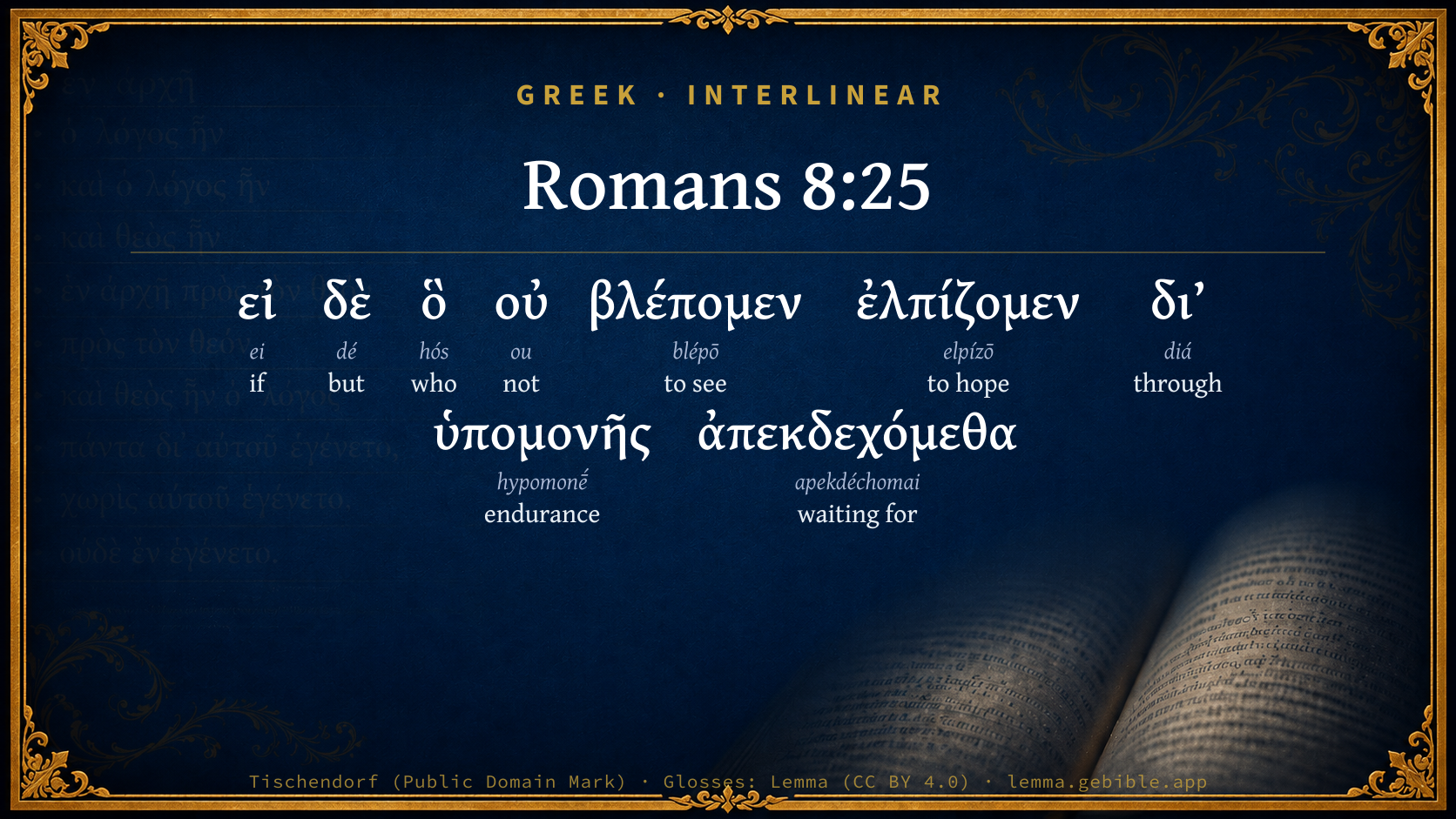
Greek (Tischendorf 8th ed.) Romans 8:25 appears in the Greek New Testament. The text above is from the Tischendorf 8th edition. Each word links to its Strong’s number and a concise gloss. Click any word for its full Thayer’s Greek Lexicon entry.
Download image
Cite this verse

Romans 8:25 (World English Bible). Public Domain. Lemma interlinear Bible study tool, https://lemma.gebible.app/v/romans/8/25.

Show BibTeX & RIS
BibTeX
RIS
English Translation
But if we hope for that which we don't see, we wait for it with patience.
World English Bible · Public Domain
Download a study sheet

One document with this verse’s original text, its word-by-word gloss line, the meaning frame, cross-references with their text, attributed commentary, and full source and license credits — printable, and it pastes into notes with its structure intact.

This verse Autodidact and up

Study sheet (.html) Plain text (.txt)

A passage Seminary Student

Up to 50 verses in one chapter. A passage sheet keeps up to 6 commentary sources and 12 cross-references per verse, in the order this page ranks them, and says so on the sheet whenever that leaves anything out. Ask for a single verse and you get the Autodidact verse sheet above.

Everything on this page stays free to read, with no account — the sheet is a download of what is already on screen, not access to it.

Want to remove ads? Support Godless Engineer
Compare translations 3

The same verse in 3 English versions, stacked beneath the original-language interlinear above. Click any original word for its lexicon entry.

Each is an independent rendering of the whole verse — the interlinear is not word-aligned to these translations.

Highlighted words mark where these versions differ — a whole-verse word diff, not a word-by-word alignment.

  • World English Bible Public Domain
    But if we hope for that which we don't see, we wait for it with patience.
  • King James Version Public Domain
    But if we hope for that we see not, then do we with patience wait for it.
  • unfoldingWord Literal Text CC BY-SA 4.0
    But if we hope for what we do not see, with endurance we are eagerly expecting.

unfoldingWord Literal Text — © unfoldingWord, licensed CC BY-SA 4.0. Word-aligned USFM3 via Door43 (git.door43.org/unfoldingWord/en_ult).

Versions to compare (up to 4)

3 of 4 selected

Show all 19 translations

Every available English version of this verse, each an independent rendering of the whole verse.

  • World English Bible Public Domain
    But if we hope for that which we don't see, we wait for it with patience.
  • Berean Standard Bible Public Domain
    But if we hope for what we do not yet see, we wait for it patiently.
  • Majority Standard Bible Public Domain
    But if we hope for what we do not yet see, we wait for it patiently.
  • King James Version Public Domain
    But if we hope for that we see not, then do we with patience wait for it.
  • American Standard Version (1901) Public Domain
    But if we hope for that which we see not, `then' do we with patience wait for it.
  • Revised Version (1885) Public Domain
    But if we hope for that which we see not, then do we with patience wait for it.
  • Geneva Bible (1599) Public Domain
    But if we hope for that we see not, we doe with patience abide for it.
  • Douay-Rheims (1899) Public Domain
    But if we hope for that which we see not, we wait for it with patience.
  • Young's Literal Translation Public Domain
    and if what we do not behold we hope for, through continuance we expect `it'.
  • Literal Standard Version CC BY-SA 4.0
    And if what we do not behold we hope for, through continuance we expect [it].
  • Unlocked Literal Bible CC BY-SA 4.0
    But if we have certain hope about what we do not see, we wait for it with patience.
  • unfoldingWord Literal Text CC BY-SA 4.0
    But if we hope for what we do not see, with endurance we are eagerly expecting.
  • Darby Bible Public Domain
    But if what we see not we hope, we expect in patience.
  • World Messianic Bible Public Domain
    But if we hope for that which we don’t see, we wait for it with patience.
  • Webster's Bible Public Domain
    But if we hope for what we see not, then with patience we wait for it.
  • Free Bible Version CC BY-SA 4.0
    Since we're hoping for what we haven't yet seen, we wait for it patiently.
  • Bible in Basic English Public Domain
    But if we have hope for that which we see not, then we will be able to go on waiting for it.
  • Text-Critical English NT CC BY 4.0
    But if we hope for what we do not see, we eagerly wait for it with patient endurance.
  • Tyndale New Testament (1534) Public Domain
    But and yf we hope for that we se not then do we with pacience abyde for it.

Literal Standard Version (2020), Covenant Press — licensed CC BY-SA 4.0. Text via the HelloAO Bible API (eBible.org). Unlocked Literal Bible (unfoldingWord) — licensed CC BY-SA 4.0. Text via the HelloAO Bible API (eBible.org). unfoldingWord Literal Text — © unfoldingWord, licensed CC BY-SA 4.0. Word-aligned USFM3 via Door43 (git.door43.org/unfoldingWord/en_ult). Free Bible Version, Dr. Jonathan Gallagher — licensed CC BY-SA 4.0. Text via the HelloAO Bible API (eBible.org).

Word by word

More ways to search: Search by grammar → Find every occurrence → Compare this word →

Practice this passage: Drill this verse → Learn its vocabulary →

About this verse

These counts appear in no published source. They are computed here, from the morphology-tagged text and Lemma’s own curated glosses. What Lemma adds →

9
words
9
distinct lemmas
Pauline Epistles
section

Notable vocabulary

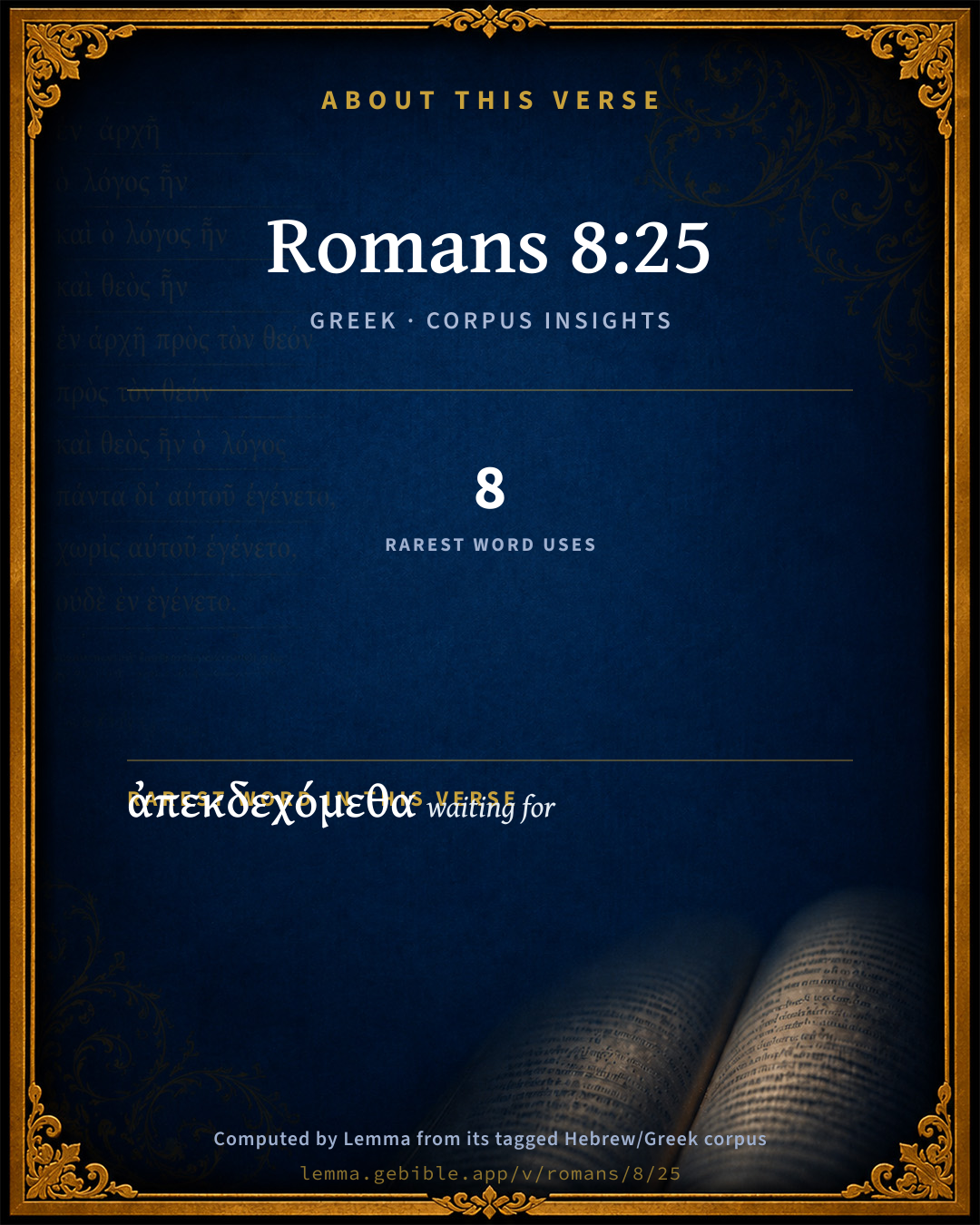
The rarest word here is ἀπεκδεχόμεθα waiting for G553 — appearing just 8 times in the whole Greek New Testament.

Shared distinctive vocabulary

ἀπεκδεχόμεθα waiting for G553 occurs in 8 verses of the Greek New Testament. Also found in:

Cross-references

26

Topical passages linked to Romans 8:25 in the Treasury of Scripture Knowledge — connected by theme and wording, ordered by reader-vote popularity; previews shown in the World English Bible.

  • Romans 12:12 rejoicing in hope; enduring in troubles; continuing steadfastly in prayer;
  • Hebrews 10:36 For you need endurance so that, having done the will of God, you may receive the promise.
  • Psalms 27:14 Wait for Yahweh. Be strong, and let your heart take courage. Yes, wait for Yahweh.
  • Lamentations 3:25–26 Yahweh is good to those who wait for him, to the soul that seeks him.
  • 1 Thessalonians 1:3 remembering without ceasing your work of faith and labor of love and patience of hope in our Lord Jesus Christ, before our God and Father.
  • Hebrews 12:1–3 Therefore let us also, seeing we are surrounded by so great a cloud of witnesses, lay aside every weight and the sin which so easily entangles us, and let us run with patience the race that is set before us,
  • James 5:7–11 Be patient therefore, brothers, until the coming of the Lord. Behold, the farmer waits for the precious fruit of the earth, being patient over it, until it receives the early and late rain.
  • Psalms 130:5–7 I wait for Yahweh. My soul waits. I hope in his word.
  • Luke 21:19 By your endurance you will win your lives.
  • Colossians 1:11 strengthened with all power, according to the might of his glory, for all endurance and perseverance with joy;
  • Genesis 49:18 I have waited for your salvation, Yahweh.
  • Psalms 37:7–9 Rest in Yahweh, and wait patiently for him. Don't fret because of him who prospers in his way, Because of the man who makes wicked plots happen.
  • Isaiah 25:9 It shall be said in that day, Behold, this is our God; we have waited for him, and he will save us: this is Yahweh; we have waited for him, we will be glad and rejoice in his salvation.
  • 2 Thessalonians 3:5 May the Lord direct your hearts into the love of God, and into the patience of Christ.
  • Psalms 62:5–6 My soul, wait in silence for God alone, For my expectation is from him.
  • Romans 8:23 Not only so, but ourselves also, who have the first fruits of the Spirit, even we ourselves groan within ourselves, waiting for adoption, the redemption of our body.
  • Psalms 62:1 My soul rests in God alone. My salvation is from him.
  • Isaiah 26:8 Yes, in the way of your judgments, Yahweh, have we waited for you; to your name, even to your memorial [name], is the desire of our soul.
  • Luke 8:15 That in the good ground, these are such as in an honest and good heart, having heard the word, hold it tightly, and bring forth fruit with patience.
  • Romans 2:7 to those who by patience in well-doing seek for glory and honor and incorruptibility, eternal life;
  • Hebrews 6:12 that you won't be sluggish, but imitators of those who through faith and patience inherited the promises.
  • Revelation 1:9 I John, your brother and partner with you in oppression, Kingdom, and perseverance in Christ Jesus, was on the isle that is called Patmos because of God's Word and the testimony of Jesus Christ.
  • James 1:3–4 knowing that the testing of your faith produces endurance.
  • Revelation 14:12 Here is the patience of the saints, those who keep the commandments of God, and the faith of Jesus."
  • Hebrews 6:15 Thus, having patiently endured, he obtained the promise.
  • Revelation 13:10 If anyone has captivity, he will go. If anyone is with the sword, he must be killed. Here is the endurance and the faith of the saints.

Cross-references courtesy of OpenBible.info (CC BY 4.0).

Commentary

Notes on Romans 8:25 from classic Christian and Jewish commentators (each source and its license shown beneath its notes). The classic Christian expositions comment on the surrounding passage and are grouped to its opening verse, so a note may address several verses; the Jewish commentaries on the Tanakh (Rashi and others) are per-verse, so they appear only where the commentator wrote on this verse.

Lemma curates 59 commentaries, every one of them public domain or Creative Commons licensed, each selected and text-cleaned for this edition rather than reprinted as found. About our sources →

Bengel's Gnomon

Johann Albrecht Bengel

Rom 8:25. Εἰ δὲ, but if) The patient waiting of believers is deduced from the nature of hope.

Bengel's Gnomon of the New Testament — English translation (T&T Clark, Edinburgh, 1860) — public domain. Text from a community e-Sword module.

Meyer's Critical & Exegetical Commentary

Heinrich August Wilhelm Meyer

Rom_8:25. Διʼ ὑπομ.] With patience, perseveringly. Heb_12:1; Kühner, II. 1, p. 418.

The indicative ἀπεκδεχ., which is not, with Estius, Koppe, Köllner, and others, to be taken as exspectare debemus, does not announce the virtuous operation (Grotius), but simply the situation, which the circumstance that we hope without seeing involves. The ethical position assigned to us is, that we patiently wait for the object of our hope.

Meyer — Critical and Exegetical Commentary on the New Testament — English translation by Peter Christie, edited by Frederick Crombie (T&T Clark, 1880) — public domain. Text from a community e-Sword module.

Godet's Commentaries

Frédéric Louis Godet

Vv. 25. This verse is not, as Meyer thinks, a deduction fitted to close the first reason of encouragement. In this case an οὖν, therefore, would have been necessary rather than δέ, now, or but. The meaning but (Osterv., Oltram.) well suits the contrast between the ideas of hoping (Rom 8:25) and seeing (Rom 8:24). Yet it seems to me that the meaning now is preferable. It is not a conclusion; it is a step in the argument intended to prove the painful state of waiting attaching even to believers. The emphasis is on the words δἰ ὑπομονῆς, with perseverance, and the general meaning is this: “Now, obliged as we yet are to hope without seeing, waiting necessarily takes the character of perseverance.” To understand this thought, it is enough to recall the etymological meaning of the word ὑπομένειν: to hold out under a burden. We wait with perseverance amounts therefore to saying: “It is only by holding out under the burden of present sufferings that we can expect with certainty the hoped-for future.” The conclusion is this: We are not therefore yet in our normal condition; otherwise why endurance?

Frédéric Louis Godet — Commentaries on Luke, John, Romans, and 1 Corinthians — English translation (T&T Clark, Edinburgh, 1870s–1890s) — public domain. Text from a community e-Sword module.

Hodge's Commentary on Romans, Ephesians & First Corinthians

Charles Hodge

Rom_8:24, Rom_8:25

The apostle, intending to show that the present afflictions of believers are not inconsistent with their being the children of God, and are therefore no ground of discouragement, refers not only to their comparative insignificance, but also to the necessity which there is, from the nature of the case, for these sufferings: Salvation, in its fullness, is not a present good, but a matter of hope, and of course future; and if future, it follows that we must wait for it in patient and joyful expectation. While, therefore, waiting for salvation is necessary, from the nature of the case, the nature of the blessing waited for, converts expectation into desire, and enables us patiently to endure all present evils.

For we are saved by hope, τῇ γὰρ ἐλπίδι ἐσώθημεν. At the close of preceding verse, Paul had spoken of believers as waiting for the adoption. They thus wait, because salvation is not a present good, but a future one. We are saved in hope, i.e., in prospect. The dative (ἐλπίδι) does not in this case express the means by which anything is done, but the condition or circumstances in which it is, or the way and manner in which it occurs. It is therefore analogous to our forms of expression, we have a thing in expectation or prospect. Salvation is a blessing we have in hope, not in possession: if it be the one, it cannot be the other, since hope that is seen is not hope. It lies in the nature of hope, that its object must be future. The word hope is here used objectively for the thing hoped for, as in Col_1:5, The hope that is laid up for you in heaven; Heb_6:18; Eph_1:18, etc. The latter clause of the verse, for what a man seeth, why doth he yet hope for; is only a confirmation of the previous declaration, that it lies in the nature of hope to have reference to the future. This passage, says Olshausen, is specially important for determining the true nature of hope. It stands opposed to βλέπειν, seeing which supposes the object to be externally present. It is, however, no less opposed to the entire absence of its object. It is on the contrary, the inward possession of the things hoped for, so far as they are spiritual. A man can believe, and hope for eternal things, only so far as they are inwardly present to him. Therefore it is that Christian hope is something so exalted. It is the daughter of experience (Rom_5:4), and maketh not ashamed. It is the sister of faith and love. Good wishes, desires, and longings, are not hope, because they do not involve the real possession of the things longed for.

Rom_8:25

But if we hope for that we see not, etc. That is, If hope has reference to the unseen and the future, then, as salvation is a matter of hope, it is a matter to be waited for. It results, therefore, from the nature of the plan of redemption, that the full fruition of its blessing should not be obtained at once, but that through much tribulation believers should enter into the kingdom; consequently, their being called upon to suffer is not at all inconsistent with their being sons and heirs. Then do we with patience wait for it; δι ̓ ὑπομονῆς, with constancy, or firmness, which includes the idea of patience, as its consequence. There is something more implied in these words than that salvation, because unseen, must be waited for. This, no doubt, from the connection, is the main idea; but we not only wait, but we wait with patience, or constancy. There is something in the very expectation of future good, and especially of such good, the glory that shall be revealed in us, to produce not only patient but even joyful endurance of all present suffering. Spes ista, says Grotius, non infructuosa est in nobis, egregiam virtutem operatur, malorum fortem tolerationem.

Charles Hodge — Commentary on Romans (1835), First Corinthians (1857), and Ephesians (1856) — public domain. Text from a community e-Sword module.

Jamieson, Fausset & Brown

Robert Jamieson, A. R. Fausset & David Brown

But if we hope for that we see not, then do we with patience wait for it--that is, then, patient waiting for it is our fitting attitude.

Jamieson, Fausset & Brown — Commentary Critical and Explanatory on the Whole Bible (1871) — public domain (CC PDM 1.0). Text via the HelloAO Bible API.

Adam Clarke's Commentary

Verse 25. But if we hope for that we see not] If we have a well-grounded expectation of our resurrection and final glorification, knowing that such things are necessarily future, and must for a certain time be delayed; then do we patiently wait for them, continue patiently to endure the common ills of life, and whatever tribulations we may be exposed to in consequence of our Christian profession; for we know, FAITHFUL is he who has promised. Hope is a sort of universal blessing, and one of the greatest which God has granted to man. To mankind, in general, life would be intolerable without it; and it is as necessary as faith is even to the followers of God.

The ancients have a very instructive and elegant fable concerning it. "Prometheus having made a human body, went up to heaven, and stole some celestial fire to animate it: Jupiter, incensed at the theft, sent down Pandora, with a box full of diseases and plagues of every kind, as an ensnaring present to Prometheus; but he refused to accept it. Epimetheus took and opened it, and instantly all those diseases, c., by which mankind have been made miserable, flew out, and spread themselves over the whole earth and only HOPE remained at the bottom of the box." This fable explains itself, as to its main design. Men find life, with its various and unavoidable ills, only supportable by the hope they have of not only getting safely through them, but of enjoying a state of blessedness in the end. Hope is still at the bottom; and therefore man is encouraged to bear up in all the pressures of life. Take away hope, and then black despair and indescribable wretchedness would be the instant result. Hope stands justly among the highest mercies of God.

Adam Clarke's Commentary on the Bible (1810–1826) — public domain. Text from a community e-Sword/MySword module.

John Calvin's Commentaries

25. If then what we see not, etc. This is an argument derived from what the antecedent implies; for patience necessarily follows hope. For when it is grievous to be without the good you may desire, unless you sustain and comfort yourselves with patience, you must necessarily faint through despair. Hope then ever draws patience with it. Thus it is a most apt conclusion — that whatever the gospel promises respecting the glory of the resurrection, vanishes away, except we spend our present life in patiently bearing the cross and tribulations. For if life be invisible, we must have death before our eyes: if glory be invisible, then our present state is that of degradation. And hence if you wish to include in a few words the meaning of the whole passage, arrange Paul’s arguments in this way, “To all the godly there is salvation laid up in hope; it is the character of hope to look forward to future and absent benefits: then the salvation of the faithful is not visible. Now hope is not otherwise sustained than by patience; then the salvation of the faithful is not to be consummated except by patience.”

It may be added, that we have here a remarkable passage, which shows, that patience is an inseparable companion of faith; and the reason of this is evident, for when we console ourselves with the hope of a better condition, the feeling of our present miseries is softened and mitigated, so that they are borne with less difficulty.

John Calvin's Commentaries (1540-1563) — public domain. Text from the Calvin Translation Society English edition (1840s-50s) via the Christian Classics Ethereal Library (ccel.org). Calvin's coverage is partial (roughly two-thirds of the Bible); uncommented books and verses are honest gaps, never fabricated. The 19th-century editor's footnotes and remarks are omitted so the notes are faithfully Calvin's own voice.

Ellicott's Commentary for English Readers

(25) If salvation were something that could be seen, something that could be grasped by sight, then there would be no room for hope. As it is we do not see it; we do hope for it; and, therefore, we patiently endure the sufferings that lie upon the road to it.

A Bible Commentary for English Readers, edited by Charles John Ellicott (1878–1897) — public domain. Text from a community e-Sword module.

The Cambridge Bible for Schools and Colleges

gen. ed. J. J. S. Perowne

25. But if we hope, &c.] The emphasis here is double; (a) on the fact that we do hope for a given thing; i.e. look for it with a reason for so doing; (b) on the fact that it is (by its nature as an object of hope) out of sight. Of this general statement, the particular case is the Hope of Glory; and the inference is that we must be at once patient and intent (see next note) in waiting for it. But this particular application is left to be understood.

wait] Same word as Rom_8:19, where see note.

The Cambridge Bible for Schools and Colleges (gen. ed. J. J. S. Perowne; Cambridge University Press, 1878–1918) — public domain. Text from a community e-Sword module.

John Gill's Exposition

But if we hope for that we see not,.... Whether it be the hour of death, or the second coming of Christ, or the resurrection of the dead, and eternal glory; all which are unseen by us, and to be hoped for:

then do we with patience wait for it; as that which is certain and real, as something valuable, which will be satisfying, and be received with the utmost joy. This supposes, that the persons who wait for it believe it, and their interest in it, at least hope they have one; that they have a valuable esteem and affection for it; that they are not in a state of perfection and happiness; and that they sit loose by the things of this world, and are ready to part with the one, and grasp the other: the manner of their waiting is "with patience"; a grace, of which God is the efficient, Christ is the exemplar, and the word the means; and which is of great use under afflictions from the hand of God, under the reproaches and persecutions of men, under desertions and want of answers in prayer, under the temptations of Satan, and in the expectation of the heavenly glory.

John Gill's Exposition of the Whole Bible (1746–1763) — public domain (CC PDM 1.0). Text via the HelloAO Bible API.

Trapp's Complete Commentary

John Trapp

25 But if we hope for that we see not, then do we with patience wait for it.

Ver. 25. Then do we with patience] Religious men find it more easy to bear evil than to wait till the promised good be enjoyed, Heb 10:36. The spoiling of their goods required patience; but this more than ordinary.

John Trapp, A Commentary or Exposition upon All the Books of the Old and New Testament (1647–1656) — public domain. Text from a community e-Sword module.

Albert Barnes' Notes on the Bible

But if we hope ... - The effect here stated is one which exists everywhere. Where there is a strong desire for an object, and a corresponding expectation of obtaining it - which constitutes true hope - then we can wait for it with patience. Where there is a strong desire without a corresponding expectation of obtaining it, there is impatience. As the Christian has a strong desire of future glory, and as he has an expectation of obtaining it just in proportion to that desire, it follows that he may bear trials and persecutions patiently in the hope of his future deliverance. Compared with our future glory, our present sufferings are light, and but for a moment; 2Co 4:17. In the hope of that blessed eternity which is before him, the Christian can endure the severest trial, and bear the intensest pain without a complaint.

Albert Barnes' Notes on the Bible (1834–1885) — public domain. Text from a community e-Sword/MySword module.

Matthew Poole's English Annotations

q.d. If we indeed hope for redemption and salvation, which is out of sight, then it is meet that we do with patience digest and bear all our present evils and sufferings; true hope is accompanied always with a patient waiting for the things hoped for; therefore you read of the patience of hope, 1Th 1:3; see Heb 6:12; 10:36.

Matthew Poole's English Annotations on the Holy Bible (1683–1685) — public domain. Text from a community e-Sword/MySword module.

Whedon's Commentary on the Bible

Daniel D. Whedon

25. If… hope… patience—If the distant reward call forth our persistent hope, then patience and perseverance in well doing, and the perfection and fitting of our character for the consummation, ensue.

Daniel D. Whedon (gen. ed.), Commentary on the Old and New Testaments (1874–1909) — public domain. Text from a community e-Sword module.

Godbey's Commentary on the New Testament

William B. Godbey

25. “For that which is seen is not hope; for that which one sees, why does he also hope for it? But if we hope for that which we do not see, we wait for it with patience.” Glorification is purely a matter of hope, as none can receive it in this life. Hence the fanaticism of those who profess it. We see here it is not a matter of possession, but of hope. Hence, through hope, we enjoy it in anticipation. The hackneyed testimony, “I hope I am a Christian,” is incorrect. Paul here says we do not hope for what we have, but what we have not. If you are a Christian, you have present salvation, attested by the Holy Spirit. The very fact that it is with you a matter of hope is prima facie evidence against you, i. e., that you do not possess it.

Justification and sanctification are, for this life, and a matter of conscious possession, while glorification is for the future state, and a matter of hope. This Epistle is beautifully climacteric in the development of the gracious economy; conviction, Chapters 1, 2 and 3; justification, Chapters 4 and 5; sanctification, Chapter 6; experience of justification, Chapter 7; experience of sanctification, Chapter 8:1-16, gloriously attested by the witness of the Spirit; glorification, Chapter 8:17-28, realized at the end of this life and here participated in the prelibations of hope.

William B. Godbey, Commentary on the New Testament (1896–1900) — public domain. Text from a community e-Sword module.

McGarvey & Pendleton's Commentaries

J. W. McGarvey

But if we hope for that which we see not, then do we with patience wait for it . [We groan, I say, waiting for this future blessing. For when we were converted and saved from the world, we were not so saved that all salvation includes was bestowed upon us; but we were saved unto a salvation which even yet exists largely in hope. If it were otherwise, we would now see the things which we still hope for. But when hope is attained it ceases to be hope, for hope applies only to the unattained, not to the attained. But if our full salvation is not yet seen or attained, then should we patiently wait for its attainment, which will be accomplished when we are at last revealed as God's children.]

J. W. McGarvey (with Philip Y. Pendleton), Commentaries on the New Testament (The Fourfold Gospel, 1914; Acts; and the epistles) — public domain. Text from a community e-Sword/MySword module.

The People's New Testament

B. W. Johnson

25. But if we hope, etc. Hope has its blessed office. If we hope for a blessed realization to come, we can labor for it and wait for it with patience. The hopeless soul despairs.

B. W. Johnson's The People's New Testament with Notes (1889–1891) — public domain. Electronic text from the Christian Classics Ethereal Library (CCEL) ThML edition.

Cambridge Greek Testament for Schools and Colleges

25. δι’ ὑπομονῆς = in a condition of endurance, ὑ. is steady resistance to adverse influences; and this is the peculiar Christian temper under present conditions; cf. Heb 12:1; 1Th 1:3; 2Th 3:5; Rev 14:12; for διὰ cf. Rom 2:27, Rom 14:20.

Cambridge Greek Testament for Schools and Colleges (Cambridge University Press, 1896; 21 vols, various authors incl. Carr, Maclear, Plummer, Farrar, Lumby, Moule, M. R. James, Simcox) — public domain. Text from a community e-Sword module.

Alford’s Greek Testament

Henry Alford

25.] For (confirmation of the last assertion, proving hope to be our present state of salvation)—in hope were we (not, ‘are we,’ nor ‘have we been’) saved: i.e. our first apprehension of, and appropriation to ourselves of, salvation which is by faith in Christ, was effected in the condition of hope: which hope (Thol.) is in fact faith in its prospective attitude,—that faith which is ὑπόστασις ἐλπιζομένων, Heb 11:1. The dat. ἐλπίδι is not a dat. of reference,—‘according to hope,’—but of the form or condition. Now hope that is seen (the object or fulfilment of which is present and palpable) is not hope: for that which any one sees, why does he [also (or, at all)] hope for? If καί is to stand in the text, it conveys, after an interrogative word, a sense of the utter superfluity of the thing questioned about, as being irrelevant, and out of the question. ‘Qui interrogat τί χρὴ προσδοκᾷν; exspectat aliquid, sed dubius est quid eveniat. Qui interrogat τί χρὴ καὶ προσδοκᾷν; desperat de salute, nec eam usquam exspectari posse existimat.’ Bremi in Demosth. Phil. i. 46, cited in Hartung, Partikellehre, i. 137.

25.] But if that which we do not see, we hope for, with patience we wait for it. Patience (endurance) is the state, in which,—through which as a medium,—our waiting takes place: hence διʼ ὑπομονῆς, as ἔγραψα ὑμ. διὰ πολλῶν δακρύων, 2Co 2:4.

Henry Alford, The Greek Testament (1849–1861) — public domain. Text from a community e-Sword module.

International Critical Commentary

25. The point of these two verses is that the attitude of hope, so distinctive of the Christian, implies that there is more in store for him than anything that is his already.

διʼ ὑπομονῆς: constancy and fortitude under persecution, &c., pointing back to the ‘sufferings’ of ver. 18 (cf. on 2:7; 5:4; and for the use of διά 2:27).

The Renovation of Nature

We have already quoted illustrations of St. Paul’s language from some of the Jewish writings which are nearest to his own in point of time. They are only samples of the great mass of Jewish literature. To all of it this idea of a renovation of Nature, the creation of new heavens and a new earth is common, as part of the Messianic expectation which was fulfilled unawares to many of those by whom it was entertained. The days of the Messiah were to be the ‘seasons of refreshing,’ the ‘times of restoration of all things,’ which were to come from the face of the Lord (Act 3:19, Act 3:21). The expectation had its roots in the O. T., especially in those chapters of the Second Part of Isaiah in which the approaching Return from Captivity opens up to the prophet such splendid visions for the future. The one section Isa 65:17-25 might well be held to warrant most of the statements in the Apocrypha and Talmud.

The idea of the ‘new heavens and new earth’ is based directly upon Isa 65:17, and is found clearly stated in the Book of Enoch, xlv. 4f. ‘I will transform the heaven and make it an eternal blessing and light. And I will transform the earth and make it a blessing and cause Mine elect ones to dwell upon it’ (where see Charles’ note). There is also an application of Psa 114:4, with an added feature which illustrates exactly St. Paul’s ἀποκάλυψις τῶν υἱῶν τοῦ Θεοῦ: ‘In those days will the mountains leap like rams and the hills will skip like lambs satisfied with milk, and they will all become angels in heaven. Their faces will be lighted up with joy, because in those days the Elect One has appeared, and the earth will rejoice and the righteous will dwell upon it, and the elect will go to and fro upon it’ ( Enoch li. 4 f.). We have given parallels enough from 4 Ezra and the Apocalypse of Baruch, and there is much in the Talmud to the same effect (cf. Weber, Altsyn. Theol. p. 380 ff.; Schürer, Neutest. Zeitgesch. ii. 453 ff., 458 f.; Edersheim, Life and Times, &c. ii. 438).

It is not surprising to find the poetry of the prophetic writings hardened into fact by Jewish literalism; but it is strange when the products of this mode of interpretation are attributed to our Lord Himself on authority no less ancient than that of Papias of Hierapolis, professedly drawing from the tradition of St. John. Yet Irenaeus (Adv. Haer. V. xxxiii. 3) quotes in such terms the following: ‘The days will come, in which vines shall grow, each having ten thousand shoots and on each shoot ten thousand branches, and on each branch again ten thousand twigs, and on each twig ten thousand clusters, and on each cluster ten thousand grapes, and each grape when pressed shall yield five and twenty measures of wine … Likewise also a grain of wheat shall produce ten thousand heads, and every head shall have ten thousand grains, and every grain ten pounds of fine flour, bright and clean; and the other fruits, seeds and the grass shall produce in similar proportions, and all the animals using these fruits which are products of the soil, shall become in their turn peaceable and harmonious.’ It happens that this saying, or at least part of it, is actually extant in Apoc. Bar. xxix. 5 (cf. Orac. Sibyll. iii. 620-623, 744 ff.), so that it clearly comes from some Jewish source. In view of an instance like this it seems possible that even in the N. T. our Lord’s words may have been defined in a sense which was not exactly that originally intended owing to the current expectation which the disciples largely shared.

And yet on the whole, even if this expectation was by the Jews to some extent literalized and materialized, some of its essential features were preserved. Corresponding to the new abode prepared for it there was to be a renewed humanity: and that not only in a physical sense based on Isa 35:5 f. (‘Then the eyes of the blind shall be opened, and the ears of the deaf shall be unstopped,’ &c.), but also in a moral sense; the root of evil was to be plucked out of the hearts of men and a new heart was to be implanted in them: the Spirit of God was to rest upon them (Weber, Altsyn. Theol. p. 382). There was to be no unrighteousness in their midst, for they were all to be holy (Ps. Sol. 17:28 f., 36, &c.). The Messiah was to rule over the nations, but not merely by force; Israel was to be a true light to the Gentiles (Schürer, op. cit. p. 456).

If we compare these Jewish beliefs with what we find here in the Epistle to the Romans there are two ways in which the superiority of the Apostle is most striking. (1) There runs through his words an intense sympathy with nature in and for itself. He is one of those (like St. Francis of Assisi) to whom it is given to read as it were the thoughts of plants and animals. He seems to lay his ear to the earth and the confused murmur which he hears has a meaning for him: it is creation’s yearning for that happier state intended for it and of which it has been defrauded. (2) The main idea is not, as it is so apt to be with the Rabbinical writers, the mere glorification of Israel. By them the Gentiles are differently treated. Sometimes it is their boast that the Holy Land will be reserved exclusively for Israel: ‘the sojourner and the stranger shall dwell with them no more’ (Ps. Sol. 17:31). The only place for the Gentiles is ‘to serve him beneath the yoke’ (ibid. ver. 32). The vision of the Gentiles streaming to Jerusalem as a centre of religion is exceptional, as it must be confessed that it is also in O. T. Prophecy. On the other hand, with St. Paul the movement is truly cosmic. The ‘sons of God’ are not selected for their own sakes alone, but their redemption means the redemption of a world of being besides themselves.

THE ASSISTANCE OF THE SPIRIT

8:26, 27. Meanwhile the Holy Spirit itself assists in our prayers.

26Nor are we alone in our struggles. The Holy Spirit supports our helplessness. Left to ourselves we do not know what prayers to offer or how to offer them. But in those inarticulate groans which rise from the depths of our being, we recognize the voice of none other than the Holy Spirit. He makes intercession; and His intercession is sure to be answered. 27For God Who searches the inmost recesses of the heart can interpret His own Spirit’s meaning. He knows that His own Will regulates Its petitions, and that they are offered for men dedicated to His service.

International Critical Commentary — older volumes (1896–1929), various authors — public domain. Text from a community e-Sword module.

Lesson kit

Teaching starters — assembled from the data on this page, not authored interpretation. Every prompt links to the verse data it draws on. Edit before teaching.

Romans, in the Pauline Epistles, opens this verse with 9 words (9 distinct Greek lemmas). Its most distinctive word is apekdéchomai (“waiting for”). A historical commentator’s framing appears above. Read the whole chapter for the surrounding context.

Discussion questions

  1. What does “waiting for” (apekdéchomai) contribute to the verse as a whole?
  2. How does Romans 8:19, which shares the word «waiting for», read alongside this verse?
  3. These translations render this verse differently; the difference is in the English rendering, not the original. What questions does that raise?
  4. Compare how Bengel's Gnomon and Meyer's Critical & Exegetical Commentary read this verse. Where do they agree or differ?

Things to notice

Reading settings

Reading text

Shown beneath each verse's original-language words.

Old Testament
Old Testament edition

Read the OT as the Masoretic Hebrew (MT) or the Greek Septuagint (LXX).

English shown for the Greek Septuagint (in the Hebrew ↔ Greek comparison).

Comparing translations? Open the Compare panel on any verse page to stack up to four side by side.