
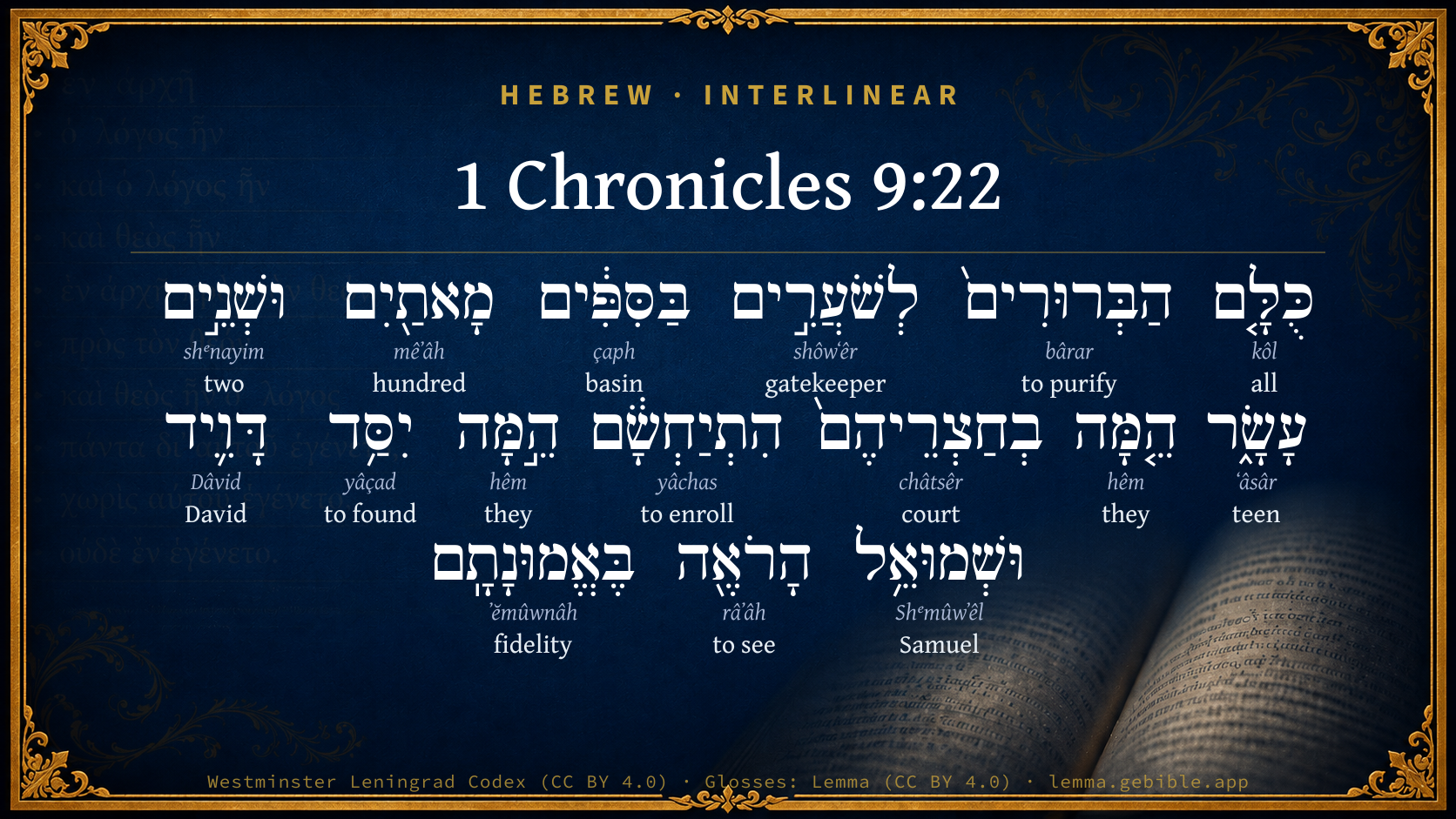
1 Chronicles 9:22

Hebrew (Westminster Leningrad Codex) 1 Chronicles 9:22 appears in the Hebrew Old Testament. The text above is from the Westminster Leningrad Codex. Each word links to its Strong’s number, a concise gloss, and parsing drawn from the Open Scriptures Hebrew Bible morphology. Click any word for its full Brown-Driver-Briggs (BDB) entry.
Download image
Cite this verse

1 Chronicles 9:22 (World English Bible). Public Domain. Lemma interlinear Bible study tool, https://lemma.gebible.app/v/1-chronicles/9/22.

Show BibTeX & RIS
BibTeX
RIS
English Translation
All these who were chosen to be porters in the thresholds were two hundred and twelve. These were reckoned by genealogy in their villages, whom David and Samuel the seer did ordain in their office of trust.
World English Bible · Public Domain
Download a study sheet

One document with this verse’s original text, its word-by-word gloss line, the meaning frame, cross-references with their text, attributed commentary, and full source and license credits — printable, and it pastes into notes with its structure intact.

This verse Autodidact and up

Study sheet (.html) Plain text (.txt)

A passage Seminary Student

Up to 50 verses in one chapter. A passage sheet keeps up to 6 commentary sources and 12 cross-references per verse, in the order this page ranks them, and says so on the sheet whenever that leaves anything out. Ask for a single verse and you get the Autodidact verse sheet above.

Everything on this page stays free to read, with no account — the sheet is a download of what is already on screen, not access to it.

Want to remove ads? Support Godless Engineer
Compare translations 3

The same verse in 3 English versions, stacked beneath the original-language interlinear above. Click any original word for its lexicon entry.

Each is an independent rendering of the whole verse — the interlinear is not word-aligned to these translations.

Highlighted words mark where these versions differ — a whole-verse word diff, not a word-by-word alignment.

  • World English Bible Public Domain
    All these who were chosen to be porters in the thresholds were two hundred and twelve. These were reckoned by genealogy in their villages, whom David and Samuel the seer did ordain in their office of trust.
  • King James Version Public Domain
    All these which were chosen to be porters in the gates were two hundred and twelve. These were reckoned by their genealogy in their villages, whom David and Samuel the seer did ordain in their set office.
  • unfoldingWord Literal Text CC BY-SA 4.0
    All of them were chosen as gatekeepers at the thresholds, 212. They were enrolled in their villages. They, David and Samuel the seer established in their trust.

unfoldingWord Literal Text — © unfoldingWord, licensed CC BY-SA 4.0. Word-aligned USFM3 via Door43 (git.door43.org/unfoldingWord/en_ult).

Versions to compare (up to 4)

3 of 4 selected

Show all 18 translations

Every available English version of this verse, each an independent rendering of the whole verse.

  • World English Bible Public Domain
    All these who were chosen to be porters in the thresholds were two hundred and twelve. These were reckoned by genealogy in their villages, whom David and Samuel the seer did ordain in their office of trust.
  • Berean Standard Bible Public Domain
    The number of those chosen to be gatekeepers at the thresholds was 212. They were registered by genealogy in their villages. David and Samuel the seer had appointed them to their positions of trust.
  • Majority Standard Bible Public Domain
    The number of those chosen to be gatekeepers at the thresholds was 212. They were registered by genealogy in their villages. David and Samuel the seer had appointed them to their positions of trust.
  • King James Version Public Domain
    All these which were chosen to be porters in the gates were two hundred and twelve. These were reckoned by their genealogy in their villages, whom David and Samuel the seer did ordain in their set office.
  • American Standard Version (1901) Public Domain
    All these that were chosen to be porters in the thresholds were two hundred and twelve. These were reckoned by genealogy in their villages, whom David and Samuel the seer did ordain in their office of trust.
  • Revised Version (1885) Public Domain
    All these which were chosen to be porters in the gates were two hundred and twelve. These were reckoned by genealogy in their villages, whom David and Samuel the seer did ordain in their set office.
  • Geneva Bible (1599) Public Domain
    All these were chosen for porters of the gates, two hundreth and twelue, which were nombred according to their genealogies by their townes. Dauid established these and Samuel the Seer in their perpetuall office.
  • Douay-Rheims (1899) Public Domain
    All these that were chosen to be porters at the gates, were two hundred and twelve: and they mere registered in their proper towns: whom David and Samuel the seer appointed in their trust.
  • Young's Literal Translation Public Domain
    All of those who are chosen for gatekeepers at the thresholds `are' two hundred and twelve; they `are' in their villages, by their genealogy; they whom David and Samuel the seer appointed in their office.
  • Literal Standard Version CC BY-SA 4.0
    All of those who are chosen for gatekeepers at the thresholds [are] two hundred and twelve; they [are] in their villages, by their genealogy; they whom David and Samuel the seer appointed in their office.
  • Unlocked Literal Bible CC BY-SA 4.0
    All those who were chosen as gatekeepers at the entrances numbered 212. Their names were recorded in the people's records in their villages. David and Samuel the seer had placed them into their positions of trust.
  • unfoldingWord Literal Text CC BY-SA 4.0
    All of them were chosen as gatekeepers at the thresholds, 212. They were enrolled in their villages. They, David and Samuel the seer established in their trust.
  • Darby Bible Public Domain
    All these chosen to be doorkeepers at the thresholds were two hundred and twelve. These were registered by genealogy according to their villages: David and Samuel the seer had instituted them in their trust.
  • World Messianic Bible Public Domain
    All these who were chosen to be gatekeepers in the thresholds were two hundred twelve. These were listed by genealogy in their villages, whom David and Samuel the seer ordained in their office of trust.
  • Webster's Bible Public Domain
    All these who were chosen to be porters in the gates were two hundred and twelve. These were reckoned by their genealogy in their villages, whom David and Samuel the seer ordained in their set office.
  • Free Bible Version CC BY-SA 4.0
    In total there were 212 chosen to be gatekeepers at the entrances. They recorded their genealogies in their home towns. David and Samuel the prophet had selected their forefathers for their faithfulness.
  • Bible in Basic English Public Domain
    There were two hundred and twelve whose business it was to keep the doorway. These were listed by families in the country places where they were living, whom David and Samuel the seer put in their responsible positions.
  • JPS Tanakh (1917) Public Domain
    All these that were chosen to be porters in the gates were two hundred and twelve. These were reckoned by genealogy in their villages, whom David and Samuel the seer did ordain in their set office.

Literal Standard Version (2020), Covenant Press — licensed CC BY-SA 4.0. Text via the HelloAO Bible API (eBible.org). Unlocked Literal Bible (unfoldingWord) — licensed CC BY-SA 4.0. Text via the HelloAO Bible API (eBible.org). unfoldingWord Literal Text — © unfoldingWord, licensed CC BY-SA 4.0. Word-aligned USFM3 via Door43 (git.door43.org/unfoldingWord/en_ult). Free Bible Version, Dr. Jonathan Gallagher — licensed CC BY-SA 4.0. Text via the HelloAO Bible API (eBible.org).

Word by word

More ways to search: Search by grammar → Find every occurrence → Compare this word →

Practice this passage: Drill this verse → Learn its vocabulary →

הַבְּרוּרִים֙
bârar
H1305
“the · purified”
Particle, Definite Article + Verb, Qal, Participle Passive, Masculine, Plural, Absolute
Part of Speech
Particle + Verb
Stem
Qal
Form
Participle Passive
Gender
Masculine
Number
Plural
State
Absolute
Full BDB Definition

Origin: a primitive root

TWOT: 288

to purify, select, polish, choose, purge, cleanse or make bright, test or prove - (Qal) - to purge, purge out, purify - to choose, select - to cleanse, make shining, polish - to test, prove - (Niphal) to purify oneself - (Piel) to purify - (Hiphil) - to purify - to polish arrows - (Hithpael) - to purify oneself - to show oneself pure, just, kind
  1. כֻּלָּ֤ם kôl H3605 “all · their” Noun, Common, Masculine, Singular, Construct + Suffix, Personal, 3rd Person, Masculine, Plural
  2. לְשֹׁעֲרִ֣ים shôwʻêr H7778 “to/for · gatekeepers” Preposition + Noun, Common, Masculine, Plural, Absolute
  3. בַּסִּפִּ֔ים çaph H5592 “in/at the · basins” Preposition, Determined + Noun, Common, Masculine, Plural, Absolute
  4. מָאתַ֖יִם mêʼâh H3967 “hundred” Adjective, Cardinal number, Both, Dual, Absolute
  5. וּשְׁנֵ֣ים shᵉnayim H8147 “and · two” Conjunction + Adjective, Cardinal number, Masculine, Dual, Absolute
  6. עָשָׂ֑ר ʻâsâr H6240 “teen” Adjective, Cardinal number, Masculine, Singular, Absolute
  7. הֵ֤מָּה hêm H1992 “they” Pronoun, Personal, 3rd Person, Masculine, Plural
  8. בְחַצְרֵיהֶם֙ châtsêr H2691 “in/at · courts · their” Preposition + Noun, Common, Both, Plural, Construct + Suffix, Personal, 3rd Person, Masculine, Plural
  9. הִתְיַחְשָׂ֔ם yâchas H3187 “to enroll · them” Verb, Hithpael, Infinitive Construct + Suffix, Personal, 3rd Person, Masculine, Plural
  10. הֵ֣מָּה hêm H1992 “they” Pronoun, Personal, 3rd Person, Masculine, Plural
  11. יִסַּ֥ד yâçad H3245 “to found” Verb, Piel, Perfect, 3rd Person, Masculine, Singular
  12. דָּוִ֛יד Dâvid H1732 “David” Noun, Proper
  13. וּשְׁמוּאֵ֥ל Shᵉmûwʼêl H8050 “and · Samuel” Conjunction + Noun, Proper
  14. הָרֹאֶ֖ה râʼâh H7200 “the · seer” Particle, Definite Article + Noun, Common, Masculine, Singular, Absolute
  15. בֶּאֱמוּנָתָֽם ʼĕmûwnâh H530 “in/at · fidelity · their” Preposition + Noun, Common, Feminine, Singular, Construct + Suffix, Personal, 3rd Person, Masculine, Plural

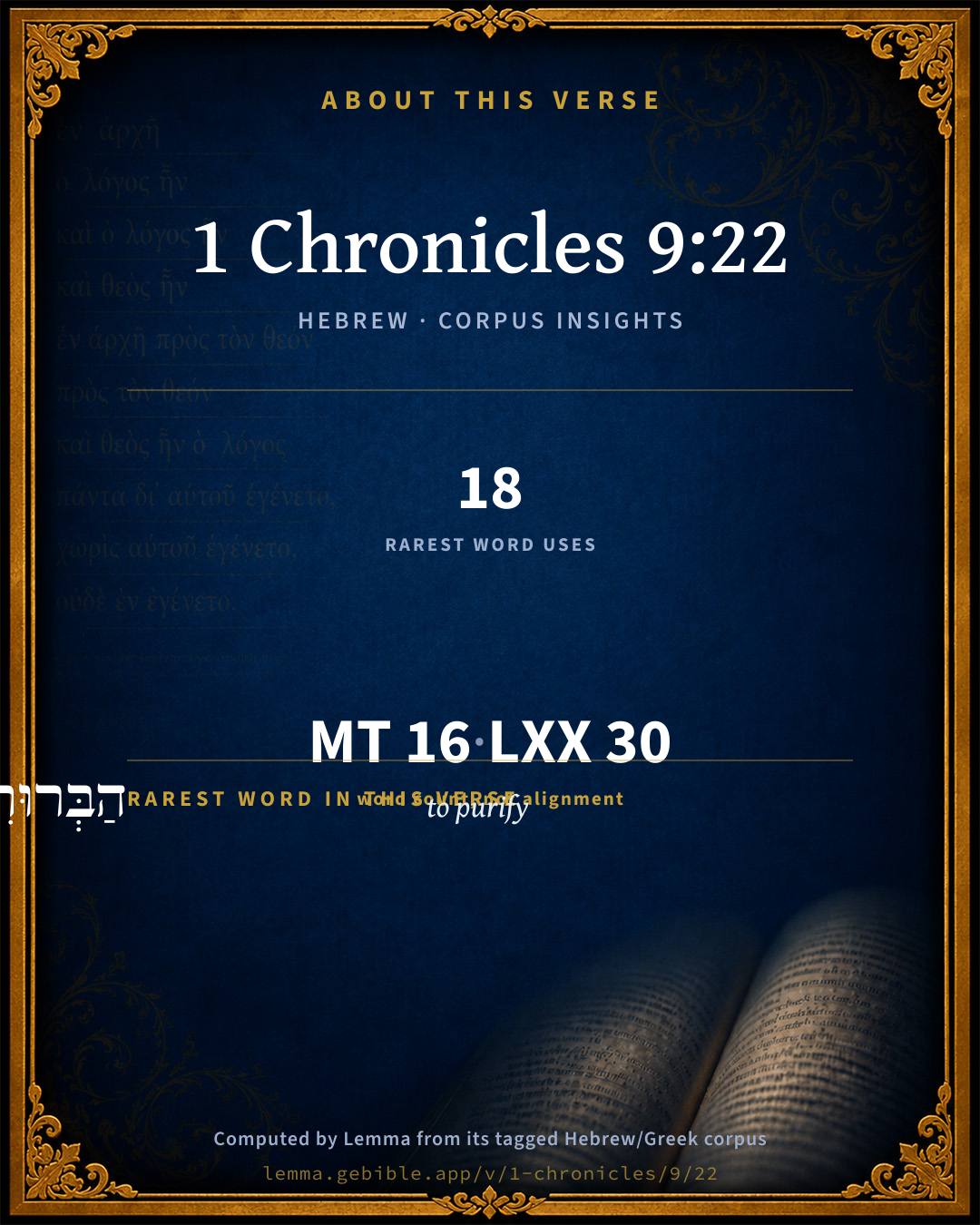
About this verse

These counts appear in no published source. They are computed here, from the morphology-tagged text and Lemma’s own curated glosses. What Lemma adds →

16
words
15
distinct lemmas
Historical
section

Notable vocabulary

The rarest word here is הַבְּרוּרִים֙ to purify H1305 — appearing just 18 times in the whole Hebrew Bible.

Shared distinctive vocabulary

הַבְּרוּרִים֙ to purify H1305 occurs in 16 verses of the Hebrew Bible. Also found in:

Grammatical profile

  • 3 verbs
  • 8 nouns
  • 3 adjectives
  • 2 pronouns

Verb forms

  • הַבְּרוּרִים֙ Qal · Participle Passive
  • הִתְיַחְשָׂ֔ם Hithpael · Infinitive Construct
  • יִסַּ֥ד Piel · Perfect

Repetition

A word recurs within this verse — often emphatic in Hebrew:

  • הֵ֤מָּה they H1992 ×2

Hebrew & Septuagint length

In English translation the verse runs 37 words from the Hebrew and 31 from the Septuagint (LXX English) — closely comparable.

A rough comparison of the two English renderings, which tokenize alike — not a word-level alignment.

Word counts can differ between the Hebrew and the Greek without any difference in meaning — e.g. the Hebrew direct-object marker אֵת has no separate Greek word, and Greek often adds the article ὁ.

In the original languages it is 16 Hebrew tokens and 30 Greek tokens — but the two are counted differently (Hebrew bundles its prefixes and suffixes into one token; the Greek is in lemma form), so that isn’t a like-for-like length.

Cross-references

15

Topical passages linked to 1 Chronicles 9:22 in the Treasury of Scripture Knowledge — connected by theme and wording, ordered by reader-vote popularity; previews shown in the World English Bible.

  • 1 Samuel 9:9 (In earlier times in Israel, when a man went to inquire of God, thus he said, Come, and let us go to the seer; for he who is now called a Prophet was before called a Seer.)
  • 1 Chronicles 23:1–32 Now David was old and full of days; and he made Solomon his son king over Israel.
  • 1 Chronicles 9:31 Mattithiah, one of the Levites, who was the firstborn of Shallum the Korahite, had the office of trust over the things that were baked in pans.
  • 1 Chronicles 28:13 also for the divisions of the priests and the Levites, and for all the work of the service of the house of Yahweh, and for all the vessels of service in the house of Yahweh;
  • 1 Chronicles 9:16 and Obadiah the son of Shemaiah, the son of Galal, the son of Jeduthun, and Berechiah the son of Asa, the son of Elkanah, who lived in the villages of the Netophathites.
  • 1 Chronicles 9:25–26 Their brothers, in their villages, were to come in every seven days from time to time to be with them:
  • 1 Chronicles 25:1–26 Moreover, David and the captains of the host set apart for the service certain of the sons of Asaph, and of Heman, and of Jeduthun, who should prophesy with harps, with psalteries, and with cymbals: and the number of those who did the work according to their service was:
  • 1 Chronicles 26:1–2 For the divisions of the doorkeepers: of the Korahites, Meshelemiah the son of Kore, of the sons of Asaph.
  • 1 Chronicles 28:21 Behold, there are the divisions of the priests and the Levites, for all the service of the house of God: and there shall be with you in all manner of work every willing man who has skill, for any manner of service: also the captains and all the people will be entirely at your command.
  • 2 Chronicles 31:15 Under him were Eden, and Miniamin, and Jeshua, and Shemaiah, Amariah, and Shecaniah, in the cities of the priests, in their office of trust, to give to their brothers by divisions, as well to the great as to the small:
  • 2 Chronicles 31:18 and those who were reckoned by genealogy of all their little ones, their wives, and their sons, and their daughters, through all the congregation: for in their office of trust they sanctified themselves in holiness.
  • Nehemiah 11:25–30 As for the villages, with their fields, some of the children of Judah lived in Kiriath Arba and the towns of it, and in Dibon and the towns of it, and in Jekabzeel and the villages of it,
  • Nehemiah 11:36 Of the Levites, certain divisions in Judah [were joined] to Benjamin.
  • Nehemiah 12:28–29 The sons of the singers gathered themselves together, both out of the plain round about Jerusalem, and from the villages of the Netophathites;
  • Nehemiah 12:44 On that day were men appointed over the chambers for the treasures, for the heave-offerings, for the first fruits, and for the tithes, to gather into them, according to the fields of the cities, the portions appointed by the law for the priests and Levites: for Judah rejoiced for the priests and for the Levites who waited.

Cross-references courtesy of OpenBible.info (CC BY 4.0).

Hebrew and Greek witnesses Masoretic Hebrew ↔ Greek Septuagint

The same verse in the two great witnesses to the Old Testament, shown verse-for-verse.

These are two independent witnesses, not word-aligned to each other, and the Septuagint is shown in lemma (dictionary) form.

Hebrew 1 Chronicles 9:22 Masoretic · Westminster Leningrad Codex

כֻּלָּ֤ם הַבְּרוּרִים֙ לְשֹׁעֲרִ֣ים בַּסִּפִּ֔ים מָאתַ֖יִם וּשְׁנֵ֣ים עָשָׂ֑ר הֵ֤מָּה בְחַצְרֵיהֶם֙ הִתְיַחְשָׂ֔ם הֵ֣מָּה יִסַּ֥ד דָּוִ֛יד וּשְׁמוּאֵ֥ל הָרֹאֶ֖ה בֶּאֱמוּנָתָֽם

All these who were chosen to be porters in the thresholds were two hundred and twelve. These were reckoned by genealogy in their villages, whom David and Samuel the seer did ordain in their office of trust.

World English Bible · Public Domain

Greek LXX 1 Chronicles 9:22 Septuagint · lemma form

πᾶς ὁ ἐκλεκτός ὁ πύλη ἐν ὁ πύλη διακόσιοι καί δέκα δύο οὗτος ἐν ὁ αὐλή αὐτός ὁ καταλοχισμός αὐτός οὗτος ἵστημι δαυίδ καί σαμουηλ ὁ βλέπω ὁ πίστις αὐτός

All the chosen porters in the gates were two hundred and twelve, these were in their courts, this was their distribution: these David and Samuel the seer established in their charge.

LXX2012 (modern English Septuagint) · Public Domain

Hebrew: Westminster Leningrad Codex (CC BY 4.0). Greek: Septuagint (public domain); English from LXX2012 (modern English Septuagint) (Public Domain). How the Septuagint differs from the Hebrew →

Commentary

Notes on 1 Chronicles 9:22 from classic Christian and Jewish commentators (each source and its license shown beneath its notes). The classic Christian expositions comment on the surrounding passage and are grouped to its opening verse, so a note may address several verses; the Jewish commentaries on the Tanakh (Rashi and others) are per-verse, so they appear only where the commentator wrote on this verse.

Lemma curates 59 commentaries, every one of them public domain or Creative Commons licensed, each selected and text-cleaned for this edition rather than reprinted as found. About our sources →

John Gill's Exposition

In four quarters were the porters,.... For, according to the Targum on Ch1 9:22 there were twenty four wards:

towards the east, west, north, and south; and, as the same paraphrase has it, six wards to the east, six to the west, six to the north, and six to the south.

John Gill's Exposition of the Whole Bible (1746–1763) — public domain (CC PDM 1.0). Text via the HelloAO Bible API.

Trapp's Complete Commentary

John Trapp

1Ch 9:22 All these [which were] chosen to be porters in the gates [were] two hundred and twelve. These were reckoned by their genealogy in their villages, whom David and Samuel the seer did ordain in their set office.

Ver. 22. In their set office.] Or, For their fidelity. Or, In their trust, committed unto them by God and the commonwealth.

John Trapp, A Commentary or Exposition upon All the Books of the Old and New Testament (1647–1656) — public domain. Text from a community e-Sword module.

The Biblical Illustrator

Joseph S. Exell

1Ch_9:22

And Samuel the seer.

Samuel, the prophet of the Lord

Samuel was the last of the judges (1Sa_8:4-5). Samuel was the first of the prophets (Act_3:24).

I. Samuel in his childhood. He had a praying mother (1Sa_1:26-27). He had an early call to serve God (1Sa_2:18). He had a special message from the Lord (1Sa_3:8-9).

II. Samuel when he became a man. He was the one by whom God spake to the People (1Sa_3:19-21). He was the one by whom God defended the people (1Sa_7:12-13). He was the one by whom God instructed the people (1Sa_12:23-24). He was the one by whom God gave a king over the people (1Sa_10:24-25).

III. Samuel when he drew near his end. He appealed to the people (1Sa_12:2-3). He reasoned with the people (1Sa_12:7). He died with the respect of the people (1Sa_25:1). Lessons: Begin to serve the Lord early. Determine to follow the Lord fully. Be ready to hear the Lord only. Be persuaded to trust the Lord entirely. Samuel as the last of the judges was great. Samuel as the first of the prophets was greater. But for the greatest honour which Samuel had, see Psa_99:6. (The Clergymans Magazine.)

The Biblical Illustrator, edited by Joseph S. Exell (c. 1880s–1900s) — public domain. Text from a community e-Sword module.

Joseph Benson's Commentary

1Ch 9:22. These were reckoned in their villages — Where their usual residence was, and whence they came to Jerusalem in their courses. Whom David and Samuel did ordain — In the times of the judges there was much disorder both in the Jewish state and church, and the Levites came to the tabernacle promiscuously, and as their inclinations or occasions brought them. But Samuel, observing they were greatly increased, began to think of establishing order in their ministration. And these intentions of his, probably, were communicated to David, who, after his own peaceable settlement in his throne, revived and perfected Samuel’s design, and took care to put it in execution.

Joseph Benson's Commentary on the Old and New Testaments (1811–1818) — public domain. Text from a community e-Sword module.

Keil & Delitzsch

C. F. Keil & F. Delitzsch

In four quarters were the porters,.... For, according to the Targum on Ch1 9:22 there were twenty four wards:

towards the east, west, north, and south; and, as the same paraphrase has it, six wards to the east, six to the west, six to the north, and six to the south.

Keil & Delitzsch — Biblical Commentary on the Old Testament (1861–1891) — public domain (CC PDM 1.0). Text via the HelloAO Bible API. (Old Testament only.)

Geneva Bible (1599)

Geneva Bible translators

Or, for their fidelity.

Geneva Bible (1599) marginal notes — public domain. Text via Bolls.life.

Ellicott's Commentary for English Readers

(22) All these which were chosen to be porters in the gates (Heb., thresholds) were two hundred and twelve.—This seems to assign the number of warders at the epoch of which the chronicler, or, rather, his source, is writing. Neh_11:19 makes the total of the porters one hundred and seventy-two. According to Ezr_2:42, one hundred and thirty-nine returned with Zerubbabel. Under David, the number of warders was ninety-three (1Ch_26:8-11).

These were reckoned by their genealogy in their villages.—Rather, these—in their villages was their registration.

These.—That is, their ancestors. Guilds and corporations do not die.

Whom David and Samuel the seer did ordain in their set office.—These David and Samuel had ordained in their office of trust, or, in permanence. No mention is made elsewhere of Samuel’s part in arranging the Levitical service. He died before David’s accession (1Sa_25:1). Tradition doubtless associated him with David in the work of religious reform, and from what is known of his relation to the sovereigns of his day, the statement of the text may be held true in spirit, if not in the letter.

A Bible Commentary for English Readers, edited by Charles John Ellicott (1878–1897) — public domain. Text from a community e-Sword module.

The Cambridge Bible for Schools and Colleges

gen. ed. J. J. S. Perowne

22. All these] Cp. Ezr_2:41 (= Neh_7:45); Neh_11:19. The discrepancy in numbers between Chron. and Neh. and also between Nehemiah 7 and Nehemiah 11 may be explained by supposing some difference in the manner of reckoning or some difference in the period referred to

in their villages] Cp. note on 1Ch_9:16.

David and Samuel the seer] The Chronicler attributes to David the organisation of the priests (1Ch_24:3), of the Levites (1Ch_23:27; 1Ch_24:31), of the singers (1Ch_25:1 ff.), and of the doorkeepers (in this passage). Samuel the seer is here associated with David in the work, perhaps as having himself exercised the doorkeeper’s office (1Sa_3:15). We have however no evidence outside Chron. of Samuel’s organising work for the sanctuary.

set office] R.V. mg. trust. The meaning is “office of trust”; cp. 1Ch_9:26; 1Ch_9:31; 2Ch_31:15; 2Ch_31:18.

The Cambridge Bible for Schools and Colleges (gen. ed. J. J. S. Perowne; Cambridge University Press, 1878–1918) — public domain. Text from a community e-Sword module.

Albert Barnes' Notes on the Bible

The porters, like the singers Neh 12:29, dwelt for the most part in the villages round Jerusalem. They were the descendants of those originally selected for the work by David. David’s arrangements are here regarded as having had the sanction of Samuel - which would imply that he planned them in the lifetime of Saul, while he was still a fugitive and an outlaw.

Albert Barnes' Notes on the Bible (1834–1885) — public domain. Text from a community e-Sword/MySword module.

Haydock's Catholic Bible Commentary

Towns, where they resided, when they were not on duty. (Menochius) --- Seer, or prophet. (Haydock) --- We read not of his making any such regulation. But he probably made it after the misconduct of the sons of Heli, and when the ark was brought back. (Calmet) --- He might also give private instructions to David for the same purpose; (Haydock) as Gad and Nathan did, 2 Paralipomenon xxix. 25. The same plans were still adopted, though the number of Levites was small. (Calmet) --- Trust, while they were at the head of affairs, and acting by God’s authority. Literally, "in their faith;" (Haydock) enlightened from above, and regulating matters according to the dispositions, which they discovered in the sacred ministers: or rather Hebrew, "in their established employment," which was to subsist in future ages. (Calmet)

George Leo Haydock (1774–1849), Haydock's Catholic Family Bible and Commentary, 1859 edition — public domain. Excludes Psalms (Douay-Rheims chapter numbering differs from Protestant) and Deuterocanonical books (Catholic canon only).

Matthew Poole's English Annotations

In their villages; where their usual residence was, and whence they came to Jerusalem in their courses.

Did ordain: in the times of the judges there was much disorder and confusion, both in the Jewish state and church, and the Levites came to the tabernacle promiscuously, and as their inclinations or occasions brought them. But Samuel, the best of judges, having some prospect and good hopes of deliverance from their enemies, and of a happy settlement of the Israelitish church and nation, and observing that the Levites were greatly increased he began to think of establishing some order among the Levites in their ministration about the tabernacle. And these intentions of his probably were communicated by him to David, who after Samuel’s death, and his own peaceable settlement in his throne, revived and perfected Samuel’s design, and took care to put it in execution.

In their set office, Heb. in their faith, or faithfulness, i.e. either,

1. In their office, which is called faithfulness, because this is required in that office. Or,

2. In the faithful discharge of their duty, and in obedience to the will of God, signified to them by revelation, or by the Spirit, as it is said of David, 1Ch 28:12, which they received by faith, and accordingly designed, and David executed it. And so this is added to show that this was no human invention, as some might conceive, but a Divine appointment, to which all ought to submit.

Matthew Poole's English Annotations on the Holy Bible (1683–1685) — public domain. Text from a community e-Sword/MySword module.

Whedon's Commentary on the Bible

Daniel D. Whedon

22. Whom David and Samuel the seer did ordain — This statement adds further to the dignity and honour of the office of the porters. But Samuel the seer was dead long before David reorganized and arranged the various departments of the sanctuary service, and so this passage is to be understood of Samuel’s indirect assistance in the matter, either by planning and advising with David on the subject during his lifetime, or, as is more probable, by actually taking measures to organize and arrange the Levites for service during the reign of Saul. “The mention of Samuel after David,” says Keil, “has not a chronological signification, but David is named first on account of his connexion with the matter in hand, for the thorough reorganization of the worship, and the classification of the persons engaged in carrying it on, originated with David. For these arrangements of David, however, Samuel had prepared the way in his struggle for the restoration of the theocracy, and of the worship which had fallen into desuetude under Eli and his profligate sons. To do this in any measure he must have, without doubt, ordained trustworthy men to the individual offices, and thus have prepared the way for King David.”

Daniel D. Whedon (gen. ed.), Commentary on the Old and New Testaments (1874–1909) — public domain. Text from a community e-Sword module.

The Pulpit Commentary

The seer. It is to be noticed that the compiler of Chronicles uses elsewhere, as here, the "aforetime" name of the prophet, according to 1Sa_9:9. Note in this verse the linking together of the names of David and Samuel, to the ignoring of that of Saul. In their set office. Keil would translate, "Upon their fidelity, i.e. because they had been found faithful." But our margin translates happily, "in their trust," which will include, in part, the thought of Keil, and will suit our ver. 26.

Samuel"s life-work.

The assertion made in this verse, that Samuel was concerned in the organization of the tabernacle service, comes upon us with surprise. We are to suppose that he provided for the reformation of the ritual and ministrations in the tabernacle after the confusions in the days of the judges; though this statement is not found in any other place in the Old Testament. "Samuel the seer was zealous for the external ordinances of God"s house, and the precursor of David in this respect." We have side hints given us in the Scriptures of work done by great and good men which is not detailed so as to become a part of history. We need not assume that the whole of any man"s story is preserved; only such parts as are likely to prove permanently interesting and instructive. An instance may be found in the case of David. His public life of incident pushes back out of sight his valuable labours in connection with the sanctuary order and worship. So the worthy estimating of any human life is a difficult, nearly an impossible thing, seeing that we have not the whole before us, nor can we fairly judge the relative value of the parts. Full estimates of human lives must be left to God and the future. It is full of instructive significance that, as the generations pass, wholly different estimates are taken of historic characters, as other and fuller information concerning them comes to light. This may be illustrated in the cases of Lord Bacon, whose moral character recent writers are able to clear, and Protector Cromwell, whose portraiture Carlyle has at last succeeded in worthily drawing. Apply these thoughts to Samuel, and estimate

I HIS KNOWS WORK AS A JUDGE. He belongs to the class so called, and was a deliverer and a magistrate, combining the offices which were characteristic of this order of men. In his deliverings grandly loyal to Jehovah. In his magistracy pure-handed and abidingly faithful to men. Everywhere and in everything making character, piety, and integrity tell for good.

II HIS UNKNOWN WORK AS A RELIGIOUS REFORMER. Explain the influences upon a national religion of such changes and troubles as marked the time of the judges. Such conditions do not imperil personal piety, they rather intensify it, as may be seen in the story of the persecuted Christians in Madagascar; but they do imperil the order and ceremonial of religion, and especially in such a case as that of Israel, in which the religion was centralized on one spot, and to it all the worshippers had to come at fixed intervals. Samuel would not only have to restore the tabernacle system and services, but also to revive the religious spirit of the people; and to this, doubtless, his earnest attention was directed in his regular circuits for the administration of justice.

III His ASSUMED WORK AS THE FOUNDER OF THE SCHOOLS OF THE PROPHETS. For on this part of his work we have no certain information. "In his time we first hear of what in modern phraseology are called the "schools of the prophets." Their immediate mission consisted in uttering religious hymns or songs, accompanied by musical instruments psaltery, tabret, pipe and harp, and cymbals. In them the characteristic element was that the silent seer of visions found an articulate voice, gushing forth in a rhythmical flow, which at once riveted the attention of the hearer. These or such as these were the gifts which under Samuel were now organized, if one may so say, into a system. From them went forth an influence which awed and inspired even the wild and reckless soldiers of that lawless age. Amongst them we find the first authors distinctly named, in Hebrew literature, of actual books which descended to later generations. Thither, in that age of change and dissolution, Samuel gathered round him all that was generous and devout in the people of God.

Learn to estimate aright men"s secondary influence and work, for in this God may judge otherwise than we are wont to do, and put our last first. R.T.

The Pulpit Commentary (1880–1919), ed. H.D.M. Spence-Jones & Joseph S. Exell — public domain. Text from a community e-Sword module.

John Wesley's Explanatory Notes

Villages - Where their usual residence was, and whence they came to Jerusalem in their courses. Ordain - In the times of the Judges there was much disorder both in the Jewish state and church, and the Levites came to the tabernacle promiscuously, and as their inclinations or occasions brought them. But Samuel observing they were greatly increased, began to think of establishing order in their ministration. And these intentions of his probably were communicated to David, who after his own peaceable settlement in his throne, revived and perfected Samuel's design, and took care to put it in execution.

John Wesley, Explanatory Notes Upon the Whole Bible (1754–1765) — public domain. Text via the GEBible commentary corpus.

unfoldingWord translationNotes

Door43 World Missions Community

General Information:

(See: Numbers)

who were chosen as gatekeepers

It is not clear who chose these men, so if you have to translate in active form, use your language's most general way of doing so. AT: "whom they had chosen to be gatekeepers" (See: Active or Passive)

numbered 212

"numbered two hundred and twelve" (See: Numbers)

Their names were recorded in the people's records in their villages

This can be translated in active form. AT: "The records in peoples' villages included the names of these men" (See: Active or Passive)

their children

"their descendants"

gatekeepers were posted

This can be translated in active form. AT: "men guarded the entrances" (See: Active or Passive)

on all four sides, toward the east, west, north, and south

The words "east, west, north, and south" explain the words "all four sides."

translationWords

name

people group

David

Samuel

prophet

trust

children

house of God

tabernacle

unfoldingWord translationNotes — © Distant Shores Media and the Door43 World Missions Community, licensed CC BY-SA 4.0. Source: git.door43.org/Door43/en_tn.

Rashi

Rabbi Shlomo Yitzchaki (Rashi)

whom David and Samuel the seer established permanently - Heb. בֶּאֱמוּנָתָם, in their permanence.

Rashi on the Tanakh — English translations: “The Judaica Press complete Tanach with Rashi, translated by A. J. Rosenberg” (CC BY 4.0); “Pentateuch with Rashi's commentary by M. Rosenbaum and A.M. Silbermann, 1929-1934” (public domain); “The Metsudah Tanach series, Lakewood, N.J” (CC BY 4.0); and “The Book of Joshua, Metsudah Publications, 1997” (CC BY 4.0). Text via Sefaria.

Lesson kit

Teaching starters — assembled from the data on this page, not authored interpretation. Every prompt links to the verse data it draws on. Edit before teaching.

1 Chronicles, in the Historical, opens this verse with 16 words (15 distinct Hebrew lemmas). Its most distinctive word is bârar (“to purify”). A historical commentator’s framing appears above. Read the whole chapter for the surrounding context.

Discussion questions

  1. What does “to purify” (bârar) contribute to the verse as a whole?
  2. 2 Samuel 22:27 shares the word «to purify» with this verse. How do the two illuminate each other?
  3. “they” occurs 2× in this one verse. What is the effect of the repetition?
  4. The translations on this page render this verse differently — a whole-verse word diff, not a word-by-word alignment. What might account for the different wordings?
  5. The verb «הַבְּרוּרִים֙» is Qal Participle Passive. How does its form color the action?
  6. Reading how John Gill's Exposition and Trapp's Complete Commentary read this verse, where do the two commentators agree and where do they part?

Things to notice

Reading settings

Reading text

Shown beneath each verse's original-language words.

Old Testament
Old Testament edition

Read the OT as the Masoretic Hebrew (MT) or the Greek Septuagint (LXX).

English shown for the Greek Septuagint (in the Hebrew ↔ Greek comparison).

Comparing translations? Open the Compare panel on any verse page to stack up to four side by side.