Exodus 23:8

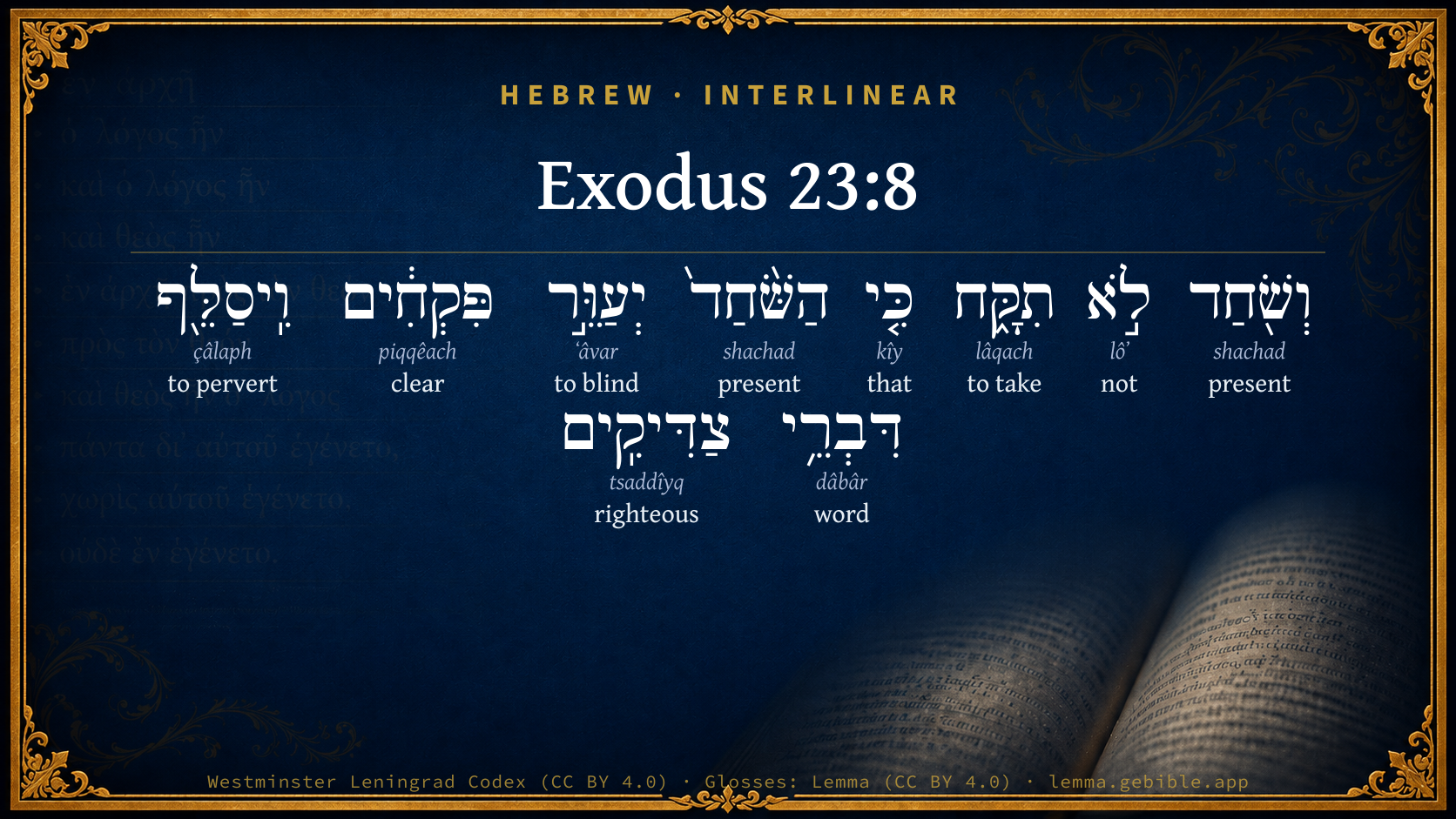
Hebrew (Westminster Leningrad Codex) Exodus 23:8 appears in the Hebrew Old Testament. The text above is from the Westminster Leningrad Codex. Each word links to its Strong’s number, a concise gloss, and parsing drawn from the Open Scriptures Hebrew Bible morphology. Click any word for its full Brown-Driver-Briggs (BDB) entry.
Download image
Cite this verse

Exodus 23:8 (World English Bible). Public Domain. Lemma interlinear Bible study tool, https://lemma.gebible.app/v/exodus/23/8.

Show BibTeX & RIS
BibTeX
RIS
English Translation
You shall take no bribe, for a bribe blinds those who have sight and perverts the words of the righteous.
World English Bible · Public Domain
Highlights
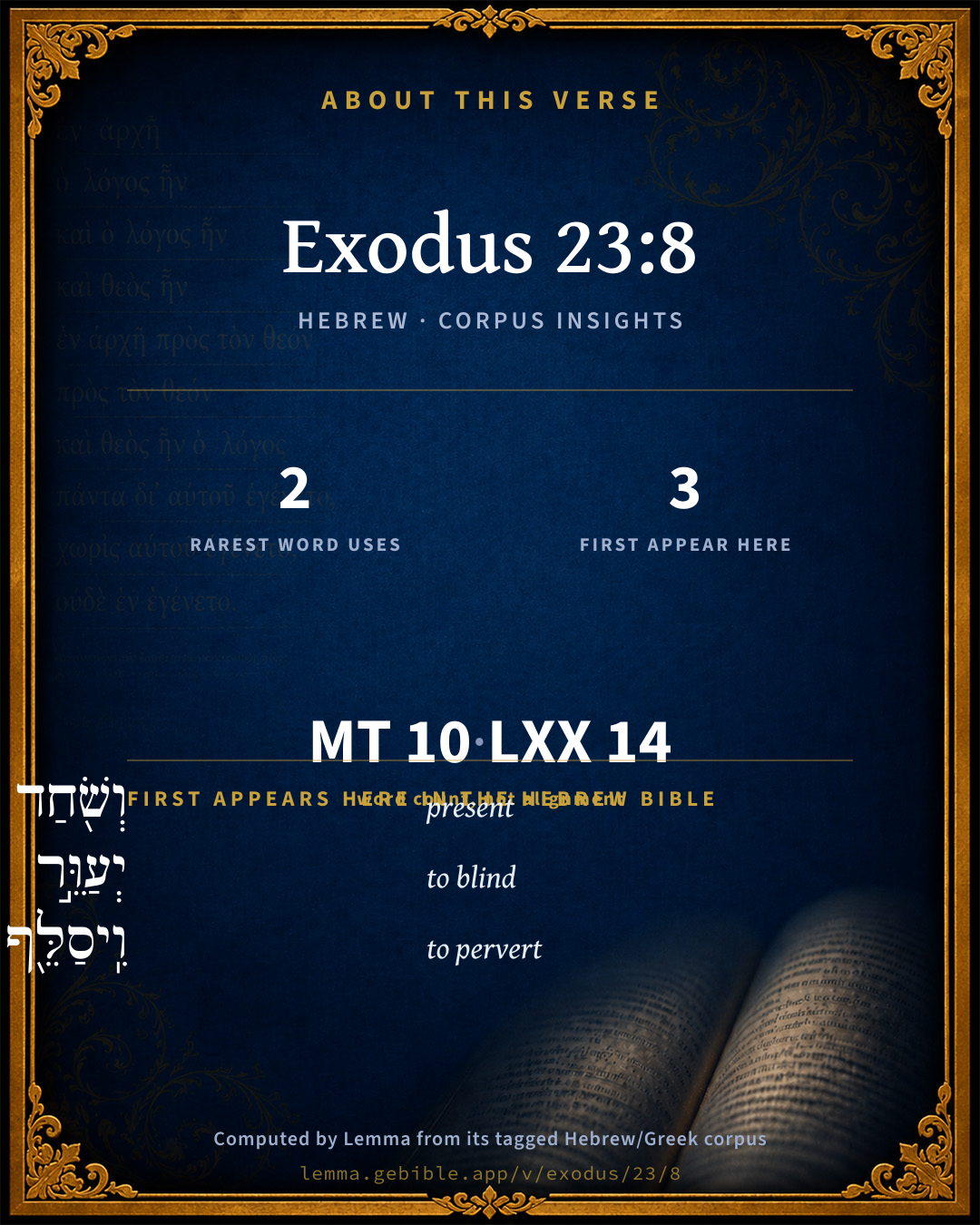
  • 3 first appearances in the Hebrew Bible
Full analysis ↓
Download a study sheet

One document with this verse’s original text, its word-by-word gloss line, the meaning frame, cross-references with their text, attributed commentary, and full source and license credits — printable, and it pastes into notes with its structure intact.

This verse Autodidact and up

Study sheet (.html) Plain text (.txt)

A passage Seminary Student

Up to 50 verses in one chapter. A passage sheet keeps up to 6 commentary sources and 12 cross-references per verse, in the order this page ranks them, and says so on the sheet whenever that leaves anything out. Ask for a single verse and you get the Autodidact verse sheet above.

Everything on this page stays free to read, with no account — the sheet is a download of what is already on screen, not access to it.

Want to remove ads? Support Godless Engineer
Compare translations 3

The same verse in 3 English versions, stacked beneath the original-language interlinear above. Click any original word for its lexicon entry.

Each is an independent rendering of the whole verse — the interlinear is not word-aligned to these translations.

Highlighted words mark where these versions differ — a whole-verse word diff, not a word-by-word alignment.

  • World English Bible Public Domain
    You shall take no bribe, for a bribe blinds those who have sight and perverts the words of the righteous.
  • King James Version Public Domain
    And thou shalt take no gift: for the gift blindeth the wise, and perverteth the words of the righteous.
  • unfoldingWord Literal Text CC BY-SA 4.0
    And you shall not take a bribe, for the bribe blinds the clear-sighted, and it perverts the words of the righteous.

unfoldingWord Literal Text — © unfoldingWord, licensed CC BY-SA 4.0. Word-aligned USFM3 via Door43 (git.door43.org/unfoldingWord/en_ult).

Versions to compare (up to 4)

3 of 4 selected

Show all 18 translations

Every available English version of this verse, each an independent rendering of the whole verse.

  • World English Bible Public Domain
    You shall take no bribe, for a bribe blinds those who have sight and perverts the words of the righteous.
  • Berean Standard Bible Public Domain
    Do not accept a bribe, for a bribe blinds those who see and twists the words of the righteous.
  • Majority Standard Bible Public Domain
    Do not accept a bribe, for a bribe blinds those who see and twists the words of the righteous.
  • King James Version Public Domain
    And thou shalt take no gift: for the gift blindeth the wise, and perverteth the words of the righteous.
  • American Standard Version (1901) Public Domain
    And thou shalt take no bribe: for a bribe blindeth them that have sight, and perverteth the words of the righteous.
  • Revised Version (1885) Public Domain
    And thou shalt take no gift: for a gift blindeth them that have sight, and perverteth the words of the righteous.
  • Geneva Bible (1599) Public Domain
    Thou shalt take no gift: for the gift blindeth the wise, and peruerteth the wordes of the righteous.
  • Douay-Rheims (1899) Public Domain
    Neither shalt thou take bribes, which even blind the wise, and pervert the words of the just.
  • Young's Literal Translation Public Domain
    `And a bribe thou dost not take; for the bribe bindeth the open-`eyed', and perverteth the words of the righteous.
  • Literal Standard Version CC BY-SA 4.0
    And you do not take a bribe, for the bribe binds the open-[eyed] and perverts the words of the righteous.
  • Unlocked Literal Bible CC BY-SA 4.0
    Never take a bribe, for a bribe blinds those who see, and perverts honest people's words.
  • unfoldingWord Literal Text CC BY-SA 4.0
    And you shall not take a bribe, for the bribe blinds the clear-sighted, and it perverts the words of the righteous.
  • Darby Bible Public Domain
    And thou shalt take no bribe; for the bribe blindeth those whose eyes are open, and perverteth the words of the righteous.
  • World Messianic Bible Public Domain
    “You shall take no bribe, for a bribe blinds those who have sight and perverts the words of the righteous.
  • Webster's Bible Public Domain
    And thou shalt take no gift: for the gift blindeth the wise, and perverteth the words of the righteous.
  • Free Bible Version CC BY-SA 4.0
    Don't accept bribes, for a bribe blinds those who can see, and undermines the evidence of the honest.
  • Bible in Basic English Public Domain
    Take no rewards in a cause: for rewards make blind those who have eyes to see, and make the decisions of the upright false.
  • JPS Tanakh (1917) Public Domain
    And thou shalt take no gift; for a gift blindeth them that have sight, and perverteth the words of the righteous.

Literal Standard Version (2020), Covenant Press — licensed CC BY-SA 4.0. Text via the HelloAO Bible API (eBible.org). Unlocked Literal Bible (unfoldingWord) — licensed CC BY-SA 4.0. Text via the HelloAO Bible API (eBible.org). unfoldingWord Literal Text — © unfoldingWord, licensed CC BY-SA 4.0. Word-aligned USFM3 via Door43 (git.door43.org/unfoldingWord/en_ult). Free Bible Version, Dr. Jonathan Gallagher — licensed CC BY-SA 4.0. Text via the HelloAO Bible API (eBible.org).

Word by word

More ways to search: Search by grammar → Find every occurrence → Compare this word →

Practice this passage: Drill this verse → Learn its vocabulary →

About this verse

These counts appear in no published source. They are computed here, from the morphology-tagged text and Lemma’s own curated glosses. What Lemma adds →

10
words
9
distinct lemmas
Pentateuch
section

Notable vocabulary

The rarest word here is פִּקְחִ֔ים clear H6493 — appearing just 2 times in the whole Hebrew Bible.

First appearance in Scripture

These words make their first canonical appearance in the Hebrew Bible here:

  • וְשֹׁ֖חַד present H7810
  • יְעַוֵּ֣ר to blind H5786
  • וִֽיסַלֵּ֖ף to pervert H5557

Shared distinctive vocabulary

פִּקְחִ֔ים clear H6493 occurs in 2 verses of the Hebrew Bible. Also found in:

Grammatical profile

  • 3 verbs
  • 3 nouns
  • 2 adjectives
  • 1 conjunction
  • 1 particle

Verb forms

  • תִקָּ֑ח Qal · Imperfect
  • יְעַוֵּ֣ר Piel · Imperfect
  • וִֽיסַלֵּ֖ף Piel · Imperfect

Repetition

A word recurs within this verse — often emphatic in Hebrew:

  • וְשֹׁ֖חַד present H7810 ×2

Hebrew & Septuagint length

In English translation the verse runs 20 words from the Hebrew and 18 from the Septuagint (LXX English) — closely comparable.

A rough comparison of the two English renderings, which tokenize alike — not a word-level alignment.

Word counts can differ between the Hebrew and the Greek without any difference in meaning — e.g. the Hebrew direct-object marker אֵת has no separate Greek word, and Greek often adds the article ὁ.

In the original languages it is 10 Hebrew tokens and 14 Greek tokens — but the two are counted differently (Hebrew bundles its prefixes and suffixes into one token; the Greek is in lemma form), so that isn’t a like-for-like length.

Cross-references

16

Topical passages linked to Exodus 23:8 in the Treasury of Scripture Knowledge — connected by theme and wording, ordered by reader-vote popularity; previews shown in the World English Bible.

  • Deuteronomy 16:19 You shall not wrest justice: you shall not respect persons; neither shall you take a bribe; for a bribe does blind the eyes of the wise, and pervert the words of the righteous.
  • Proverbs 17:23 A wicked man receives a bribe in secret, To pervert the ways of justice.
  • Isaiah 5:23 Who acquit the guilty for a bribe, But deny justice for the innocent!
  • Proverbs 15:27 He who is greedy for gain troubles his own house, But he who hates bribes will live.
  • 1 Samuel 8:3 His sons didn't walk in his ways, but turned aside after lucre, and took bribes, and perverted justice.
  • Deuteronomy 10:17 For Yahweh your God, he is God of gods, and Lord of lords, the great God, the mighty, and the awesome, who doesn't regard persons, nor takes reward.
  • Psalms 26:10 In whose hands is wickedness, Their right hand is full of bribes.
  • Ecclesiastes 7:7 Surely extortion makes the wise man foolish; and a bribe destroys the understanding.
  • 1 Samuel 12:3 Here I am: witness against me before Yahweh, and before his anointed: whose ox have I taken? or whose donkey have I taken? or whom have I defrauded? whom have I oppressed? or of whose hand have I taken a ransom to blind my eyes therewith? and I will restore it you.
  • Proverbs 17:8 A bribe is a precious stone in the eyes of him who gives it; Wherever he turns, he prospers.
  • Proverbs 19:4 Wealth adds many friends, But the poor is separated from his friend.
  • Ezekiel 22:12 In you have they taken bribes to shed blood; you have taken interest and increase, and you have greedily gained of your neighbors by oppression, and have forgotten me, says the Lord Yahweh.
  • Amos 5:12 For I know how many your offenses, And how great are your sins-- You who afflict the just, Who take a bribe, And who turn aside the needy in the courts.
  • Micah 7:3 Their hands are on that which is evil to do it diligently. The ruler and judge ask for a bribe; And the powerful man dictates the evil desire of his soul. Thus they conspire together.
  • Isaiah 1:13 Bring no more vain offerings. Incense is an abomination to me; New moons, Sabbaths, and convocations: I can't bear with evil assemblies.
  • Hosea 4:18 Their drink has become sour. They play the prostitute continually. Her rulers dearly love their shameful way.

Cross-references courtesy of OpenBible.info (CC BY 4.0).

Hebrew and Greek witnesses Masoretic Hebrew ↔ Greek Septuagint

The same verse in the two great witnesses to the Old Testament, shown verse-for-verse.

These are two independent witnesses, not word-aligned to each other, and the Septuagint is shown in lemma (dictionary) form.

Hebrew Exodus 23:8 Masoretic · Westminster Leningrad Codex

וְשֹׁ֖חַד לֹ֣א תִקָּ֑ח כִּ֤י הַשֹּׁ֨חַד֙ יְעַוֵּ֣ר פִּקְחִ֔ים וִֽיסַלֵּ֖ף דִּבְרֵ֥י צַדִּיקִֽים

You shall take no bribe, for a bribe blinds those who have sight and perverts the words of the righteous.

World English Bible · Public Domain

Greek LXX Exodus 23:8 Septuagint · lemma form

καί δῶρον οὐ λαμβάνω ὁ γάρ δῶρον ἐκτυφλόω ὀφθαλμός βλέπω καί λυμαίνω ῥῆμα δίκαιος

And you shall not receive gifts; for gifts blind the eyes of the seeing, and corrupt just words.

LXX2012 (modern English Septuagint) · Public Domain

Hebrew: Westminster Leningrad Codex (CC BY 4.0). Greek: Septuagint (public domain); English from LXX2012 (modern English Septuagint) (Public Domain). How the Septuagint differs from the Hebrew →

Targum (Aramaic paraphrase)

2

The Targum is the ancient Jewish Aramaic paraphrase of the Hebrew Scriptures — an interpretive translation, not the Hebrew text itself. Onkelos (literal) and Pseudo-Jonathan (expansive) render the Torah, and Jonathan the Prophets. Coverage is partial: where no permissively-licensed English translation exists for a verse, only the Aramaic is shown. This is verse-level text, not a word-by-word alignment to the Hebrew.

  1. Targum Onkelos Torah (Genesis–Deuteronomy)
    וְשׁוֹחֲדָא לָא תְקַבֵּל אֲרֵי שׁוֹחֲדָא מְעַוֵר עֵינֵי חַכִּימִין וּמְקַלְקֵל פִּתְגָמִין תְּרִיצִין:

    (no public-domain English translation for this verse)

    Targum Onkelos — Aramaic: “Onkelos Genesis” (public domain); “Onkelos Exodus” (public domain); “Onkelos Leviticus” (public domain); “Onkelos Numbers” (public domain); “Onkelos Deuteronomy” (public domain). English: “Sefaria Community Translation” (CC0 1.0 (public-domain dedication)); “J.W. Etheridge. The Targums of Onkelos and Jonathan Ben Uzziel on the Pentateuch. London: Longmans, Green, 1862” (public domain). Text via Sefaria.

  2. Targum Pseudo-Jonathan Torah (Genesis–Deuteronomy)
    וְשׁוֹחֲדָא לָא תְקַבֵּיל אֲרוּם שׁוֹחֲדָא מְסַמֵּי עֵינוֹי נַסְבוֹי וּמְטַלְטֵל חַכִּימַיָא מִמוֹתְבָנֵיהוֹן וּמְקַלְקֵל פִּתְגָּמִין תְּרִיצִין דְּמִכְתָּבִין בְּאוֹרַיְיתָא וּמְעַרְבֵב מִילֵי זַכָּאִין בְּפוּמְהוֹן בְּשַׁעַת דִּינָא

    And thou mayest not receive a bribe; for a bribe blindeth their eyes who have taken it, and casteth down the wise from their seats, and perverteth the right words which are written in the law, and confoundeth the words that are in the mouth of the innocent in the hour of judgment.

    Targum Pseudo-Jonathan — Aramaic: “Targum Jonathan on Genesis” (public domain); “Targum Jonathan on Exodus” (public domain); “Targum Jonathan on Leviticus” (public domain); “Targum Jonathan on Numbers” (public domain); “Targum Jonathan on Deuteronomy” (public domain). English: “The Targum of Jonathan ben Uzziel, trans. J. W. Etheridge, London, 1862” (public domain). Text via Sefaria.

Commentary

Notes on Exodus 23:8 from classic Christian and Jewish commentators (each source and its license shown beneath its notes). The classic Christian expositions comment on the surrounding passage and are grouped to its opening verse, so a note may address several verses; the Jewish commentaries on the Tanakh (Rashi and others) are per-verse, so they appear only where the commentator wrote on this verse.

Lemma curates 59 commentaries, every one of them public domain or Creative Commons licensed, each selected and text-cleaned for this edition rather than reprinted as found. About our sources →

Trapp's Complete Commentary

John Trapp

Exo 23:8 And thou shalt take no gift: for the gift blindeth the wise, and perverteth the words of the righteous.

Ver. 8. And thou shalt take no gift.] Rain is good, and ground is good; yet Ex eorum coniunctione fit lutum, saith Stapleton. So giving is kind, and taking is courteous, yet the mixing of them makes the smooth paths of justice foul and uneven.

John Trapp, A Commentary or Exposition upon All the Books of the Old and New Testament (1647–1656) — public domain. Text from a community e-Sword module.

Joseph Benson's Commentary

Exo 23:8. Thou shalt take no gift — From those whose causes are depending before thee; because, if thou dost not sell justice for it, thou wilt both seem and be tempted to do so. The gift blindeth the wise — Bribes and interest cast a mist before the eyes, and bias the judgment and affections even of those who are otherwise wise and discerning. Besides, a habit of taking bribes will, in time, quite extinguish the light of reason, and destroy the sense of right and wrong. See Ecc 7:7. And perverteth the words of the righteous — The words or sentence of those who would otherwise be righteous: or perverteth the cause of the righteous, and all he can say in his own defence, and and procures a wrong sentence to be given against him.

Joseph Benson's Commentary on the Old and New Testaments (1811–1818) — public domain. Text from a community e-Sword module.

Geneva Bible (1599)

Geneva Bible translators

Hebrew, seeing.

Geneva Bible (1599) marginal notes — public domain. Text via Bolls.life.

Adam Clarke's Commentary

Verse 8. Thou shalt take no gift] A strong ordinance against selling justice, which has been the disgrace and ruin of every state where it has been practised. In the excellent charter of British liberties called Magna Charta, there is one article expressly on this head: Nulli vendemus, nulli negabimus aut differemus, rectum aut justitiam. - Art. xxxiii. "To none will we sell, to none will we deny or defer, right or justice." This was the more necessary in those early and corrupt times, as he who had most money, and gave the largest presents (called then oblata) to the king or queen, was sure to gain his cause in the king's court; whether he had right and justice on his side or not.

Adam Clarke's Commentary on the Bible (1810–1826) — public domain. Text from a community e-Sword/MySword module.

Ellicott's Commentary for English Readers

(8) Thou shalt take no gift—i.e., no bribe. Corruption has been always rife in the East, and the pure administration of justice is almost unknown there. Signal punishments by wise rulers have sometimes checked the inveterate evil (Herod. v. 25). But it recurs again and again—“Naturam expellas furca, tarnen usque recurret.” According to Josephus (contr. Ap. ii. 27), the Jewish law punished with death the judge who took a bribe. But Hebrew judges seem practically to have been no better than Oriental judges generally. (See 1Sa_8:3; Psa_26:10; Pro_17:23; Isa_1:23; Isa_5:23; Mic_3:9-11, &c.) The corrupt Administration of justice was one of the crying evils which provoked God’s judgments against His people, and led, in the first instance, to the Babylonian captivity, and afterwards to the Roman conquest.

A Bible Commentary for English Readers, edited by Charles John Ellicott (1878–1897) — public domain. Text from a community e-Sword module.

The Cambridge Bible for Schools and Colleges

gen. ed. J. J. S. Perowne

8. gift (twice)] bribe, as the same word is rendered in EVV. of 1Sa_8:3, Isa_33:15, and in RV. of Eze_22:12. It is true, ‘gift’ had this sense in Old English; but the Heb. word means distinctively a ‘bribe,’ and there are places in which the sense of ‘gift’ is not clear. The same word (shôḥad) is also sometimes rendered ‘reward.’ See for allusions to the practice of taking bribes, Isa_1:23; Isa_5:23, Mic_3:11, Eze_22:12, Psa_26:10, Pro_17:8; Pro_17:23; it is what the righteous man never does, Psa_15:5, Isa_33:15, nor Jehovah, Deu_10:17; it is forbidden, as here, in Deu_16:19, and cursed, if its object be to ‘slay an innocent person,’ in Deu_27:25. The prevalence of bribery in the East is notorious; see a singular case, in which the chief Ḳaḍi of Cairo was implicated, in Lane, Mod. Egyptians, i. 145 ff.

for a bribe blindeth the open-eyed, and subverteth the cause (RVm.) of the righteous] The whole verse is repeated verbatim in Deu_16:19, except that ‘eyes of the wise’ is substituted for ‘open-eyed.’ For ‘words,’ i.e. statements, arguments, pleas, which in a forensic connexion are tantamount in the aggregate to a ‘case’ or ‘cause,’ see Exo_24:14, with the note, Jos_20:4 (lit. ‘his words’), 2Sa_15:3 (lit. ‘thy words’). For ‘subverteth,’ cf. Pro_19:3; Pro_22:12 (‘overthroweth’).

The Cambridge Bible for Schools and Colleges (gen. ed. J. J. S. Perowne; Cambridge University Press, 1878–1918) — public domain. Text from a community e-Sword module.

John Gill's Exposition

Also thou shall not oppress a stranger,.... As these were not to be vexed and oppressed in a private manner and by private men, see Exo 22:21 so neither in a public manner, and in a public court of judicature, or by judges on the bench when their cause was before them, by not doing them justice, showing a partiality to those of their own nation against a stranger; whereas a stranger ought to have equal justice done him as a native, and the utmost care should be taken that he has no injury done him, and the rather because he is a stranger:

for ye know the heart of a stranger; the fears he is possessed of, the inward distress of his soul, the anxiety of his mind, the tenderness of his heart, the workings of his passions, his grief and sorrow, and dejection of spirit: the Targum of Jonathan is,""the groaning of the soul of a stranger": this the Israelitish judges knew, having had a very late experience of it:"

seeing ye were strangers in the land of Egypt; where they had been vexed and oppressed, brought into hard bondage, and groaned under it; and therefore it might be reasonably thought and expected that they would have a heart sympathizing with strangers, and use them well, and especially see that justice was done them, and no injury or oppression of any kind.

John Gill's Exposition of the Whole Bible (1746–1763) — public domain (CC PDM 1.0). Text via the HelloAO Bible API.

Haydock's Catholic Bible Commentary

Bribes, which naturally induce the receiver to shew favour, and therefore cannot be too carefully avoided. The Athenians put to death those who bribed the judges, and required the latter to restore ten-fold. (Calmet)

George Leo Haydock (1774–1849), Haydock's Catholic Family Bible and Commentary, 1859 edition — public domain. Excludes Psalms (Douay-Rheims chapter numbering differs from Protestant) and Deuterocanonical books (Catholic canon only).

Matthew Poole's English Annotations

Thou shalt take no gift, namely, from such whose causes are depending before thee; because if thou dost not sell justice for it, yet thou wilt both seem to do so, and be tempted to do so. Compare Deu 16:19; 1Sa 8:3; Pro 17:8,23; 19:6.

The wise, or, the open-eyed, and quick-sighted, who in this case cannot see, partly because they will not see, and partly because interest and affection do exceedingly corrupt the judgment, and render it very partial.

The words of the righteous, i.e. the judgment of the righteous judges, i.e. of them who before were such, and are inclined to be so, and probably would be so, were they not tempted with bribes; or of them who by their place should be righteous. So they are called righteous, to admonish them of their duty to be so, and to aggravate their sin when they are unrighteous, and consequently to aggravate the mischief of gifts, which make those unrighteous whose office obligeth them to be righteous. Or thus,

the matters or causes of the righteous, which may be understood not of the judges, but of the parties pleading, whose righteous cause is by this means perverted by the judge, and a wrong sentence given.

Matthew Poole's English Annotations on the Holy Bible (1683–1685) — public domain. Text from a community e-Sword/MySword module.

Whedon's Commentary on the Bible

Daniel D. Whedon

8. Take no gift — That is, as a bribe. The marginal references show how repeatedly this sin is condemned in the Scriptures.

Daniel D. Whedon (gen. ed.), Commentary on the Old and New Testaments (1874–1909) — public domain. Text from a community e-Sword module.

The Pulpit Commentary

And thou shalt take no gift. The worst sin of a judge, and the commonest in the East, is to accept abribe from one of the parties to a suit, and give sentence accordingly. As such a practice defeats the whole end for which the administration of justice exists, it is, when detected, for the most part, punished capitally. Josephus tells us that it was so among the Jews (Contr. Apion. 2:27); but the Mosaic code, as it has come down to us, omits to fix the penalty. Whatever it was, it was practically set at nought. Eli"s sons "turned aside after lucre, and took bribes, and perverted judgment". (1Sa_8:3) In David"s time, men"s hands were "full of bribes". (Psa_26:10) Solomon complains of wicked men" taking gifts out of their bosoms to pervert the ways of judgment". (Pro_17:23) Isaiah is never weary of bearing witness against the princes of his day, who" love gifts and follow after rewards"; who (Isa_1:23) "justify the wicked for reward, and take away the righteousness of the righteous from him". (Isa_5:23) Micah adds his testimony this, I pray you, ye heads of the house of Jacob and princes of the house of Israel, that abhor judgment and pervert all equity. They build up Zion with blood, and Jerusalem with iniquity. The heads thereof judge for reward". (Exo_3:9-11) The gift blindeth the wise. See Deu_16:19.

The Pulpit Commentary (1880–1919), ed. H.D.M. Spence-Jones & Joseph S. Exell — public domain. Text from a community e-Sword module.

Rashi

Rabbi Shlomo Yitzchaki (Rashi)

ושחד לא תקח AND THOU SHALT TAKE NO GIFT, even if you mean to give a true judgment in favour of the giver, and it is a matter of course that you must not accept one to wrest judgment, and therefore there is no need for Scripture to forbid this, for with regard to wresting judgment, whether you take a bribe or not, it is distinctly stated, (Deuteronomy 16:19) “Thou shalt not wrest judgment” (Ketubot 105a).

יעור פקחים [FOR THE BRIBE] BLINDETH THE OPEN-EYED — Even if he be well-versed in the Torah and takes a bribe, in the end his mind will become confused, what he has learnt will be forgotten, and the light of his eyes will become dim (Mekhilta; Ketubot 105a).

ויסלף — render it as the Targum does: ויקלקל “makes bad”, “perverts”....

דברי צדיקים means, the words which have been described by the term “righteous”, viz., the judgments of truth uttered on Sinai. Thus, too, does the Targum take it: words that are תריצין, upright.

Rashi on the Tanakh — English translations: “The Judaica Press complete Tanach with Rashi, translated by A. J. Rosenberg” (CC BY 4.0); “Pentateuch with Rashi's commentary by M. Rosenbaum and A.M. Silbermann, 1929-1934” (public domain); “The Metsudah Tanach series, Lakewood, N.J” (CC BY 4.0); and “The Book of Joshua, Metsudah Publications, 1997” (CC BY 4.0). Text via Sefaria.

Lesson kit

Teaching starters — assembled from the data on this page, not authored interpretation. Every prompt links to the verse data it draws on. Edit before teaching.

Exodus, in the Pentateuch, opens this verse with 10 words (9 distinct Hebrew lemmas). Its most distinctive word is piqqêach (“clear”). A historical commentator’s framing appears above. Read the whole chapter for the surrounding context.

Discussion questions

  1. The word piqqêach carries the sense “clear.” How does it shape the verse?
  2. 3 words make their first appearance in Scripture here. What does this debut establish?
  3. How does Exodus 4:11, which shares the word «clear», read alongside this verse?
  4. What does the repetition of “present” (2× in this one verse) do in this verse?
  5. The translations on this page render this verse differently — a whole-verse word diff, not a word-by-word alignment. What might account for the different wordings?
  6. «תִקָּ֑ח» is a Qal Imperfect verb. How does that grammatical form shape the action described?
  7. Compare how Trapp's Complete Commentary and Joseph Benson's Commentary read this verse. Where do they agree or differ?

Things to notice

Reading settings

Reading text

Shown beneath each verse's original-language words.

Old Testament
Old Testament edition

Read the OT as the Masoretic Hebrew (MT) or the Greek Septuagint (LXX).

English shown for the Greek Septuagint (in the Hebrew ↔ Greek comparison).

Comparing translations? Open the Compare panel on any verse page to stack up to four side by side.