

Colossians 2:8
Greek (Tischendorf 8th ed.) Colossians 2:8 appears in the Greek New Testament. The text above is from the Tischendorf 8th edition. Each word links to its Strong’s number and a concise gloss. Click any word for its full Thayer’s Greek Lexicon entry.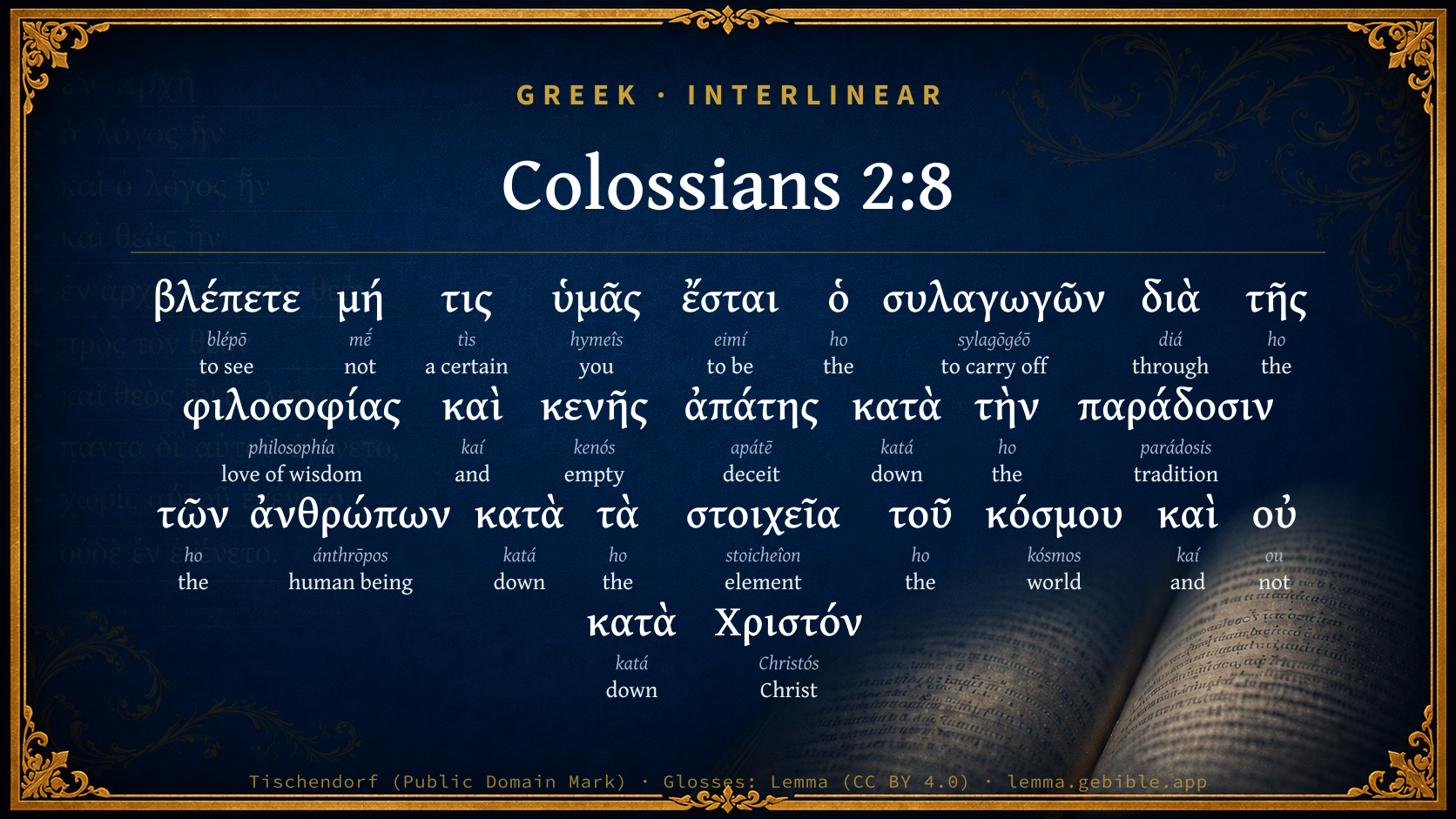
Be careful that you don't let anyone rob you through his philosophy and vain deceit, after the tradition of men, after the elements of the world, and not after Christ.
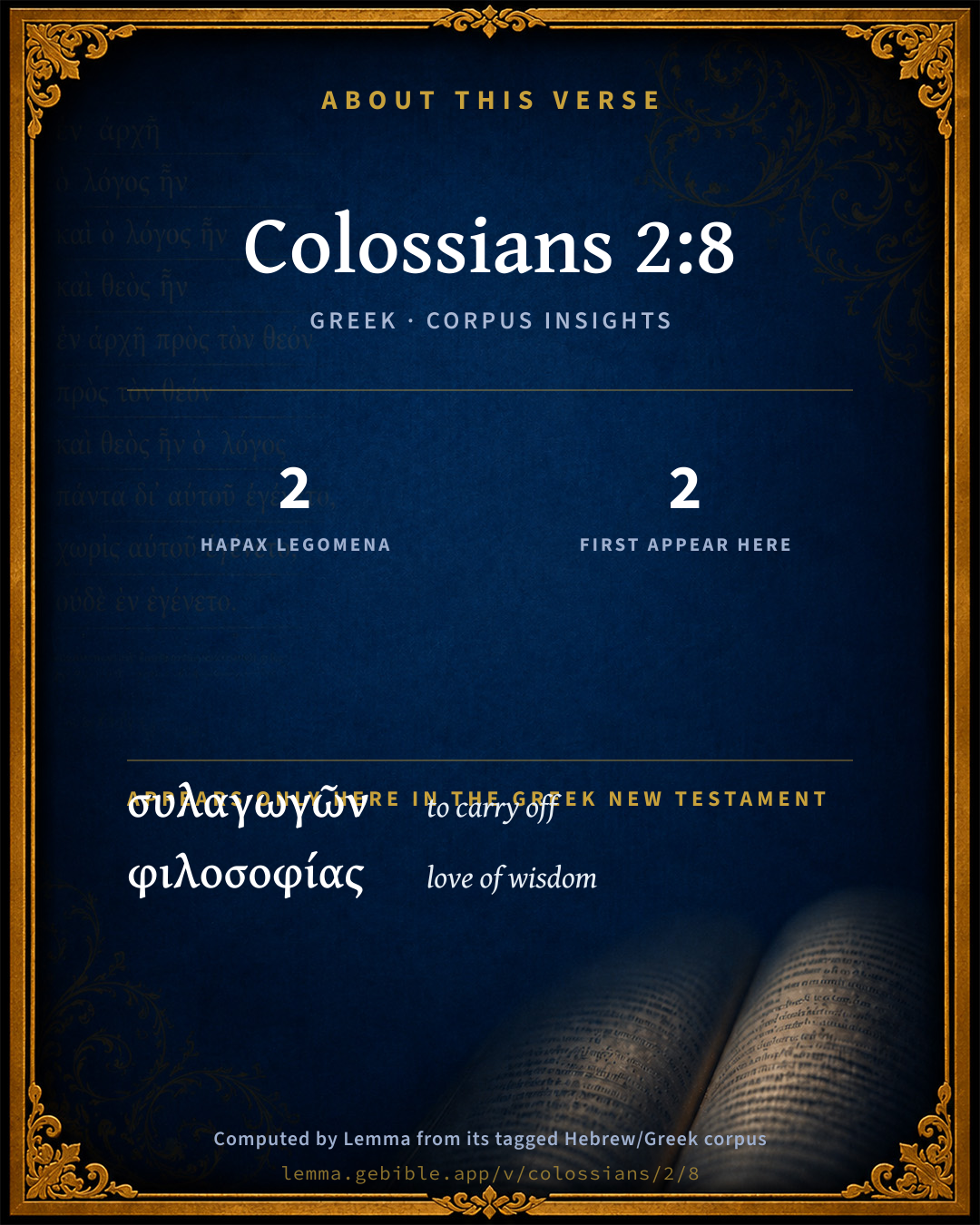
- 2 hapax legomena — only here in the Greek New Testament
- 2 first appearances in the Greek New Testament
Download a study sheet
One document with this verse’s original text, its word-by-word gloss line, the meaning frame, cross-references with their text, attributed commentary, and full source and license credits — printable, and it pastes into notes with its structure intact.
This verse Autodidact and up
A passage Seminary Student
Up to 50 verses in one chapter. A passage sheet keeps up to 6 commentary sources and 12 cross-references per verse, in the order this page ranks them, and says so on the sheet whenever that leaves anything out. Ask for a single verse and you get the Autodidact verse sheet above.
Everything on this page stays free to read, with no account — the sheet is a download of what is already on screen, not access to it.
Compare translations 3
The same verse in 3 English versions, stacked beneath the original-language interlinear above. Click any original word for its lexicon entry.
Each is an independent rendering of the whole verse — the interlinear is not word-aligned to these translations.
Highlighted words mark where these versions differ — a whole-verse word diff, not a word-by-word alignment.
-
World English Bible Public Domain
Be careful that you don't let anyone rob you through his philosophy and vain deceit, after the tradition of men, after the elements of the world, and not after Christ.
-
King James Version Public Domain
Beware lest any man spoil you through philosophy and vain deceit, after the tradition of men, after the rudiments of the world, and not after Christ.
-
unfoldingWord Literal Text CC BY-SA 4.0
Beware lest someone will be the one taking you captive through philosophy and empty deceit, according to the tradition of men, according to the elemental teaching of the world, and not according to Christ.
unfoldingWord Literal Text — © unfoldingWord, licensed CC BY-SA 4.0. Word-aligned USFM3 via Door43 (git.door43.org/unfoldingWord/en_ult).
Show all 19 translations
Every available English version of this verse, each an independent rendering of the whole verse.
-
World English Bible Public Domain
Be careful that you don't let anyone rob you through his philosophy and vain deceit, after the tradition of men, after the elements of the world, and not after Christ.
-
Berean Standard Bible Public Domain
See to it that no one takes you captive through philosophy and empty deception, which are based on human tradition and the spiritual forces of the world rather than on Christ.
-
Majority Standard Bible Public Domain
See to it that no one takes you captive through philosophy and empty deception, which are based on human tradition and the spiritual forces of the world rather than on Christ.
-
King James Version Public Domain
Beware lest any man spoil you through philosophy and vain deceit, after the tradition of men, after the rudiments of the world, and not after Christ.
-
American Standard Version (1901) Public Domain
Take heed lest there shall be any one that maketh spoil of you through his philosophy and vain deceit, after the tradition of men, after the rudiments of the world, and not after Christ:
-
Revised Version (1885) Public Domain
Take heed lest there shall be any one that maketh spoil of you through his philosophy and vain deceit, after the tradition of men, after the rudiments of the world, and not after Christ:
-
Geneva Bible (1599) Public Domain
Beware lest there be any man that spoile you through philosophie, and vaine deceit, through the traditions of men, according to the rudiments of the world, and not after Christ.
-
Douay-Rheims (1899) Public Domain
Beware lest any man cheat you by philosophy, and vain deceit; according to the tradition of men, according to the elements of the world, and not according to Christ:
-
Young's Literal Translation Public Domain
See that no one shall be carrying you away as spoil through the philosophy and vain deceit, according to the deliverance of men, according to the rudiments of the world, and not according to Christ,
-
Literal Standard Version CC BY-SA 4.0
See that no one will be carrying you away as spoil through philosophy and vain deceit, according to the tradition of men, according to the rudiments of the world, and not according to Christ,
-
Unlocked Literal Bible CC BY-SA 4.0
See that no one captures you through philosophy and empty deceit, according to the tradition of men, conforming to the elements of the world, and not conforming to Christ.
-
unfoldingWord Literal Text CC BY-SA 4.0
Beware lest someone will be the one taking you captive through philosophy and empty deceit, according to the tradition of men, according to the elemental teaching of the world, and not according to Christ.
-
Darby Bible Public Domain
See that there be no one who shall lead *you* away as a prey through philosophy and vain deceit, according to the teaching of men, according to the elements of the world, and not according to Christ.
-
World Messianic Bible Public Domain
Be careful that you don’t let anyone rob you through his philosophy and vain deceit, after the tradition of men, after the elemental spirits of the world, and not after Messiah.
-
Webster's Bible Public Domain
Beware lest any man make a prey of you through philosophy and vain deceit, after the tradition of men, after the rudiments of the world, and not after Christ.
-
Free Bible Version CC BY-SA 4.0
Watch out that nobody enslaves you through their philosophy and worthless delusions, following human traditions and concepts of this world, and not following Christ.
-
Bible in Basic English Public Domain
Take care that no one takes you away by force, through man's wisdom and deceit, going after the beliefs of men and the theories of the world, and not after Christ:
-
Text-Critical English NT CC BY 4.0
Be careful that no one takes you captive through philosophy and empty deceit, according to the tradition of men and the elements of the world, and not according to Christ.
-
Tyndale New Testament (1534) Public Domain
Beware lest eny man come and spoyle you thorow philosophy and disceatfull vanitie, thorow the tradicions of me and ordinaunces after the worlde and not after christ.
Literal Standard Version (2020), Covenant Press — licensed CC BY-SA 4.0. Text via the HelloAO Bible API (eBible.org). Unlocked Literal Bible (unfoldingWord) — licensed CC BY-SA 4.0. Text via the HelloAO Bible API (eBible.org). unfoldingWord Literal Text — © unfoldingWord, licensed CC BY-SA 4.0. Word-aligned USFM3 via Door43 (git.door43.org/unfoldingWord/en_ult). Free Bible Version, Dr. Jonathan Gallagher — licensed CC BY-SA 4.0. Text via the HelloAO Bible API (eBible.org).
Word by word
More ways to search: Search by grammar → Find every occurrence → Compare this word →
Practice this passage: Drill this verse → Learn its vocabulary →
- Appears 1× in the Greek New Testament
- First appears here
- Part of Speech
- Verb
- Tense
- Present
- Voice
- Active
- Mood
- Participle
- Case
- Nominative
- Number
- Singular
- Gender
- Masculine
Full Thayer's Definition
- βλέπετε blépō G991 “to see” Verb, Present, Active, Imperative, 2nd person, Plural
- μή mḗ G3361 “not” Particle, Negative
- τις tìs G5100 “a certain” Indefinite pronoun, Nominative, Singular, Masculine
- ὑμᾶς hymeîs G5210 “you” Personal pronoun, 2nd person, Accusative, Plural
- ἔσται eimí G1510 “to be” Verb, Future, Middle deponent, Indicative, 3rd person, Singular
- ὁ ho G3588 “the” Article, Nominative, Singular, Masculine
- συλαγωγῶν sylagōgéō G4812 “to carry off” Verb, Present, Active, Participle, Nominative, Singular, Masculine
- διὰ diá G1223 “through” Preposition
- τῆς ho G3588 “the” Article, Genitive, Singular, Feminine
- φιλοσοφίας philosophía G5385 “love of wisdom” Noun, Genitive, Singular, Feminine
- καὶ kaí G2532 “and” Conjunction
- κενῆς kenós G2756 “empty” Adjective, Genitive, Singular, Feminine
- ἀπάτης apátē G539 “deceit” Noun, Genitive, Singular, Feminine
- κατὰ katá G2596 “down” Preposition
- τὴν ho G3588 “the” Article, Accusative, Singular, Feminine
- παράδοσιν parádosis G3862 “tradition” Noun, Accusative, Singular, Feminine
- τῶν ho G3588 “the” Article, Genitive, Plural, Masculine
- ἀνθρώπων ánthrōpos G444 “human being” Noun, Genitive, Plural, Masculine
- κατὰ katá G2596 “down” Preposition
- τὰ ho G3588 “the” Article, Accusative, Plural, Neuter
- στοιχεῖα stoicheîon G4747 “element” Noun, Accusative, Plural, Neuter
- τοῦ ho G3588 “the” Article, Genitive, Singular, Masculine
- κόσμου kósmos G2889 “world” Noun, Genitive, Singular, Masculine
- καὶ kaí G2532 “and” Conjunction
- οὐ ou G3756 “not” Particle, Negative
- κατὰ katá G2596 “down” Preposition
- Χριστόν Christós G5547 “Christ” Noun, Accusative, Singular, Masculine
About this verse
These counts appear in no published source. They are computed here, from the morphology-tagged text and Lemma’s own curated glosses. What Lemma adds →
- 27
- words
- 19
- distinct lemmas
- Pauline Epistles
- section
Notable vocabulary
2 hapax legomena — words that appear only here in the entire Greek New Testament:
First appearance in Scripture
These words make their first canonical appearance in the Greek New Testament here:
Shared distinctive vocabulary
ἀπάτης deceit G539 occurs in 7 verses of the Greek New Testament. Also found in:
Cross-references
33Topical passages linked to Colossians 2:8 in the Treasury of Scripture Knowledge — connected by theme and wording, ordered by reader-vote popularity; previews shown in the World English Bible.
- 1 Timothy 6:20 Timothy, guard that which is committed to you, turning away from the empty chatter and oppositions of the knowledge which is falsely so called;
- Ephesians 5:6 Let no one deceive you with empty words. For because of these things, the wrath of God comes on the children of disobedience.
- Matthew 7:15 "Beware of false prophets, who come to you in sheep's clothing, but inwardly are ravening wolves.
- Galatians 4:9 But now that you have come to know God, or rather to be known by God, why do you turn back again to the weak and miserable elements, to which you desire to be in bondage all over again?
- 1 Corinthians 3:18–19 Let no one deceive himself. If anyone thinks that he is wise among you in this world, let him become a fool, that he may become wise.
- Romans 1:21–22 Because, knowing God, they didn't glorify him as God, neither gave thanks, but became vain in their reasoning, and their senseless heart was darkened.
- Colossians 2:20 If you died with Christ from the elements of the world, why, as though living in the world, do you subject yourselves to ordinances,
- 2 Timothy 3:13 But evil men and impostors will grow worse and worse, deceiving and being deceived.
- Jeremiah 29:8 For thus says Yahweh of hosts, the God of Israel: Don't let your prophets who are in the midst of you, and your diviners, deceive you; neither listen you to your dreams which you cause to be dreamed.
- Hebrews 13:9 Don't be carried away by various and strange teachings, for it is good that the heart be established by grace, not by food, through which those who were so occupied were not benefited.
- 2 Peter 3:17 You therefore, beloved, knowing these things beforehand, beware lest, being carried away with the error of the wicked, you fall from your own steadfastness.
- 2 John 1:8 Watch yourselves, that we don't lose the things which we have accomplished, but that we receive a full reward.
- 2 Corinthians 10:5 throwing down imaginations and every high thing that is exalted against the knowledge of God, and bringing every thought into captivity to the obedience of Christ;
- Galatians 4:3 So we also, when we were children, were held in bondage under the elements of the world.
- Colossians 2:18 Let no one rob you of your prize by a voluntary humility and worshipping of the angels, dwelling in the things which he has not seen, vainly puffed up by his fleshly mind,
- Ephesians 4:20 But you did not learn Christ that way;
- 1 Peter 1:18 knowing that you were redeemed, not with corruptible things, with silver or gold, from the useless way of life handed down from your fathers,
- Matthew 15:2–9 "Why do your disciples disobey the tradition of the elders? For they don't wash their hands when they eat bread."
- Romans 16:17 Now I beg you, brothers, look out for those who are causing the divisions and occasions of stumbling, contrary to the doctrine which you learned, and turn away from them.
- Galatians 1:14 I advanced in the Jews' religion beyond many of my own age among my countrymen, being more exceedingly zealous for the traditions of my fathers.
- Philippians 3:2 Beware of the dogs, beware of the evil workers, beware of the false circumcision.
- Deuteronomy 6:12 then beware lest you forget Yahweh, who brought you forth out of the land of Egypt, out of the house of bondage.
- Matthew 16:6 Jesus said to them, "Take heed and beware of the yeast of the Pharisees and Sadducees."
- Colossians 2:22 (all of which perish with use), according to the precepts and doctrines of men?
- Mark 7:3–13 (For the Pharisees, and all the Jews, don't eat unless they wash their hands and forearms, holding to the tradition of the elders.
- Acts 17:18 Some of the Epicurean and Stoic philosophers also were conversing with him. Some said, "What does this babbler want to say?" Others said, "He seems to be advocating foreign deities," because he preached Jesus and the resurrection.
- Matthew 10:17 But beware of men: for they will deliver you up to councils, and in their synagogues they will scourge you.
- Acts 17:32 Now when they heard of the resurrection of the dead, some mocked; but others said, "We want to hear you again concerning this."
- 1 Corinthians 1:19–23 For it is written, "I will destroy the wisdom of the wise, I will bring the discernment of the discerning to nothing."
- Ephesians 2:2 in which you once walked according to the course of this world, according to the prince of the powers of the air, the spirit who now works in the children of disobedience;
- 1 Corinthians 15:35–36 But someone will say, "How are the dead raised?" and, "With what kind of body do they come?"
- 2 Timothy 2:17–18 and their word will consume like gangrene, of whom is Hymenaeus and Philetus;
- Song of Solomon 2:15 Catch for us the foxes, The little foxes that spoil the vineyards; For our vineyards are in blossom. Beloved
Cross-references courtesy of OpenBible.info (CC BY 4.0).
Lesson kit
Teaching starters — assembled from the data on this page, not authored interpretation. Every prompt links to the verse data it draws on. Edit before teaching.
Colossians, in the Pauline Epistles, opens this verse with 27 words (19 distinct Greek lemmas). Its most distinctive word is sylagōgéō (“to carry off”). A historical commentator’s framing appears above. Read the whole chapter for the surrounding context.
Discussion questions
- The word sylagōgéō carries the sense “to carry off.” How does it shape the verse?
- This verse holds 2 words here found nowhere else in the Greek New Testament. What might the rare words draw attention to?
- 2 words here appear for the first time in Scripture. What is being introduced at this debut?
- Matthew 13:22 shares the word «deceit» with this verse. How do the two illuminate each other?
- “down” occurs 3× in this one verse. What is the effect of the repetition?
- These translations render this verse differently; the difference is in the English rendering, not the original. What questions does that raise?
- Reading how The Biblical Illustrator and Joseph Benson's Commentary read this verse, where do the two commentators agree and where do they part?
Things to notice
- 2 words in this verse appear nowhere else in the Greek New Testament.
- 2 words make their first canonical appearance in Scripture here.
- These translations choose different wording for 23 words in this verse.
- “down” occurs 3× in this single verse.
- 19 distinct Greek lemmas span 27 words in this verse.
Commentary
Notes on Colossians 2:8 from classic Christian and Jewish commentators (each source and its license shown beneath its notes). The classic Christian expositions comment on the surrounding passage and are grouped to its opening verse, so a note may address several verses; the Jewish commentaries on the Tanakh (Rashi and others) are per-verse, so they appear only where the commentator wrote on this verse.
Lemma curates 59 commentaries, every one of them public domain or Creative Commons licensed, each selected and text-cleaned for this edition rather than reprinted as found. About our sources →
The Biblical Illustrator
Joseph S. Exell
The Biblical Illustrator, edited by Joseph S. Exell (c. 1880s–1900s) — public domain. Text from a community e-Sword module.
Joseph Benson's Commentary
Joseph Benson's Commentary on the Old and New Testaments (1811–1818) — public domain. Text from a community e-Sword module.
Whedon's Commentary on the Bible
Daniel D. Whedon
Daniel D. Whedon (gen. ed.), Commentary on the Old and New Testaments (1874–1909) — public domain. Text from a community e-Sword module.
The Expositor's Bible
William Robertson Nicoll, ed., The Expositor's Bible (London: Hodder & Stoughton, 1887–1910) — public domain. 65 of 66 books (1 Corinthians is not separately keyed, as that volume carries no machine-parseable verse references); section-level commentary keyed to the opening verse. Introductory and overview sections not keyed to a specific passage are excluded.
Tyndale Open Study Notes
Tyndale Open Resources
Tyndale Open Study Notes — © Tyndale Open Resources, licensed CC BY-SA 4.0. Text via the HelloAO Bible API.
Bengel's Gnomon
Johann Albrecht Bengel
Bengel's Gnomon of the New Testament — English translation (T&T Clark, Edinburgh, 1860) — public domain. Text from a community e-Sword module.
Meyer's Critical & Exegetical Commentary
Heinrich August Wilhelm Meyer
Meyer — Critical and Exegetical Commentary on the New Testament — English translation by Peter Christie, edited by Frederick Crombie (T&T Clark, 1880) — public domain. Text from a community e-Sword module.
Expositor's Greek Testament
ed. W. Robertson Nicoll
The Expositor's Greek Testament, edited by W. Robertson Nicoll (1897–1910) — public domain. Text from a community e-Sword module.
Cambridge Greek Testament for Schools and Colleges
Cambridge Greek Testament for Schools and Colleges (Cambridge University Press, 1896; 21 vols, various authors incl. Carr, Maclear, Plummer, Farrar, Lumby, Moule, M. R. James, Simcox) — public domain. Text from a community e-Sword module.
Geneva Bible (1599)
Geneva Bible translators
Geneva Bible (1599) marginal notes — public domain. Text via Bolls.life.
Jamieson, Fausset & Brown
Robert Jamieson, A. R. Fausset & David Brown
Jamieson, Fausset & Brown — Commentary Critical and Explanatory on the Whole Bible (1871) — public domain (CC PDM 1.0). Text via the HelloAO Bible API.
Adam Clarke's Commentary
Adam Clarke's Commentary on the Bible (1810–1826) — public domain. Text from a community e-Sword/MySword module.
John Calvin's Commentaries
John Calvin's Commentaries (1540-1563) — public domain. Text from the Calvin Translation Society English edition (1840s-50s) via the Christian Classics Ethereal Library (ccel.org). Calvin's coverage is partial (roughly two-thirds of the Bible); uncommented books and verses are honest gaps, never fabricated. The 19th-century editor's footnotes and remarks are omitted so the notes are faithfully Calvin's own voice.
Ellicott's Commentary for English Readers
A Bible Commentary for English Readers, edited by Charles John Ellicott (1878–1897) — public domain. Text from a community e-Sword module.
The Cambridge Bible for Schools and Colleges
gen. ed. J. J. S. Perowne
The Cambridge Bible for Schools and Colleges (gen. ed. J. J. S. Perowne; Cambridge University Press, 1878–1918) — public domain. Text from a community e-Sword module.
John Gill's Exposition
John Gill's Exposition of the Whole Bible (1746–1763) — public domain (CC PDM 1.0). Text via the HelloAO Bible API.
Trapp's Complete Commentary
John Trapp
John Trapp, A Commentary or Exposition upon All the Books of the Old and New Testament (1647–1656) — public domain. Text from a community e-Sword module.
Albert Barnes' Notes on the Bible
Albert Barnes' Notes on the Bible (1834–1885) — public domain. Text from a community e-Sword/MySword module.
Haydock's Catholic Bible Commentary
George Leo Haydock (1774–1849), Haydock's Catholic Family Bible and Commentary, 1859 edition — public domain. Excludes Psalms (Douay-Rheims chapter numbering differs from Protestant) and Deuterocanonical books (Catholic canon only).
Matthew Poole's English Annotations
Matthew Poole's English Annotations on the Holy Bible (1683–1685) — public domain. Text from a community e-Sword/MySword module.
The Pulpit Commentary
The Pulpit Commentary (1880–1919), ed. H.D.M. Spence-Jones & Joseph S. Exell — public domain. Text from a community e-Sword module.
John Wesley's Explanatory Notes
John Wesley, Explanatory Notes Upon the Whole Bible (1754–1765) — public domain. Text via the GEBible commentary corpus.
Scofield Reference Notes
C. I. Scofield
The Scofield Reference Bible (1917 edition), notes by C. I. Scofield — public domain. Text from a community e-Sword module.
Burkitt's Expository Notes on the New Testament
William Burkitt
William Burkitt's Expository Notes on the New Testament (1700–1703) — public domain. Text from a community e-Sword module.
The People's New Testament
B. W. Johnson
B. W. Johnson's The People's New Testament with Notes (1889–1891) — public domain. Electronic text from the Christian Classics Ethereal Library (CCEL) ThML edition.
unfoldingWord translationNotes
Door43 World Missions Community
unfoldingWord translationNotes — © Distant Shores Media and the Door43 World Missions Community, licensed CC BY-SA 4.0. Source: git.door43.org/Door43/en_tn.
Alford’s Greek Testament
Henry Alford
Henry Alford, The Greek Testament (1849–1861) — public domain. Text from a community e-Sword module.
International Critical Commentary
International Critical Commentary — older volumes (1896–1929), various authors — public domain. Text from a community e-Sword module.
Vincent's Word Studies in the New Testament
Marvin R. Vincent
Marvin R. Vincent, Word Studies in the New Testament (1887–1900) — public domain. Text from a community e-Sword/MySword module.
Lightfoot's Colossians and Philemon
J. B. Lightfoot
J. B. Lightfoot, St Paul's Epistles to the Colossians and Philemon: a revised text with introductions, notes and dissertations (London: Macmillan, 1875) — public domain. Electronic text from Project Gutenberg (ebook #50857). Covers Colossians and Philemon only (the verse-by-verse notes; introductions and dissertations are omitted); Lightfoot's companion Galatians and Philippians volumes are not included, as the available public-domain scans carry garbled Greek that cannot be faithfully reproduced.