
Proverbs 4:25

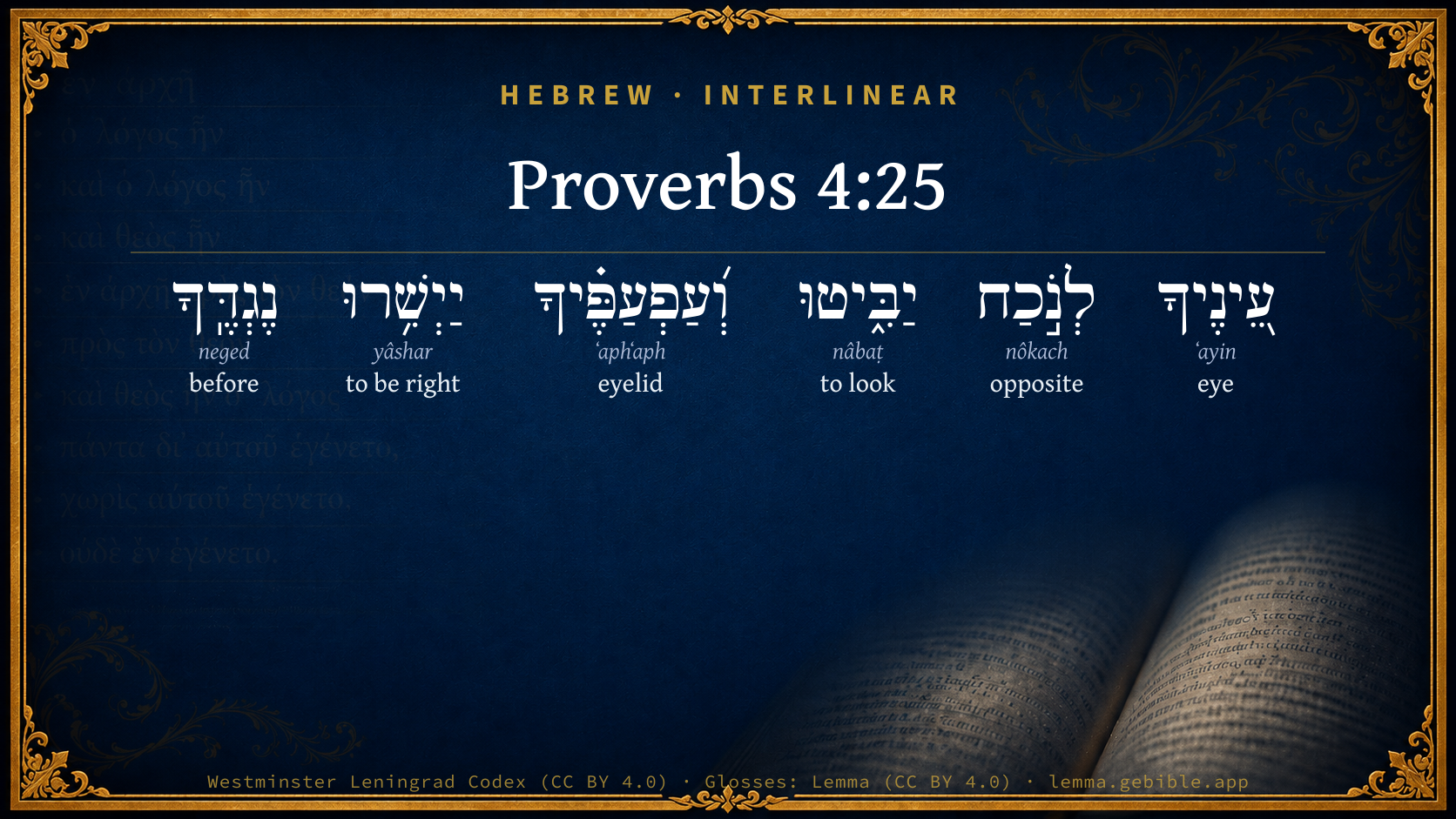
Hebrew (Westminster Leningrad Codex) Proverbs 4:25 appears in the Hebrew Old Testament. The text above is from the Westminster Leningrad Codex. Each word links to its Strong’s number, a concise gloss, and parsing drawn from the Open Scriptures Hebrew Bible morphology. Click any word for its full Brown-Driver-Briggs (BDB) entry.
Download image
Cite this verse

Proverbs 4:25 (World English Bible). Public Domain. Lemma interlinear Bible study tool, https://lemma.gebible.app/v/proverbs/4/25.

Show BibTeX & RIS
BibTeX
RIS
English Translation
Let your eyes look straight ahead. Fix your gaze directly before you.
World English Bible · Public Domain
Download a study sheet

One document with this verse’s original text, its word-by-word gloss line, the meaning frame, cross-references with their text, attributed commentary, and full source and license credits — printable, and it pastes into notes with its structure intact.

This verse Autodidact and up

Study sheet (.html) Plain text (.txt)

A passage Seminary Student

Up to 50 verses in one chapter. A passage sheet keeps up to 6 commentary sources and 12 cross-references per verse, in the order this page ranks them, and says so on the sheet whenever that leaves anything out. Ask for a single verse and you get the Autodidact verse sheet above.

Everything on this page stays free to read, with no account — the sheet is a download of what is already on screen, not access to it.

Want to remove ads? Support Godless Engineer
Compare translations 3

The same verse in 3 English versions, stacked beneath the original-language interlinear above. Click any original word for its lexicon entry.

Each is an independent rendering of the whole verse — the interlinear is not word-aligned to these translations.

Highlighted words mark where these versions differ — a whole-verse word diff, not a word-by-word alignment.

  • World English Bible Public Domain
    Let your eyes look straight ahead. Fix your gaze directly before you.
  • King James Version Public Domain
    Let thine eyes look right on, and let thine eyelids look straight before thee.
  • unfoldingWord Literal Text CC BY-SA 4.0
    Cause your eyes to gaze to the front, and cause your eyelids to be straight in front of you.

unfoldingWord Literal Text — © unfoldingWord, licensed CC BY-SA 4.0. Word-aligned USFM3 via Door43 (git.door43.org/unfoldingWord/en_ult).

Versions to compare (up to 4)

3 of 4 selected

Show all 18 translations

Every available English version of this verse, each an independent rendering of the whole verse.

  • World English Bible Public Domain
    Let your eyes look straight ahead. Fix your gaze directly before you.
  • Berean Standard Bible Public Domain
    Let your eyes look forward; fix your gaze straight ahead.
  • Majority Standard Bible Public Domain
    Let your eyes look forward; fix your gaze straight ahead.
  • King James Version Public Domain
    Let thine eyes look right on, and let thine eyelids look straight before thee.
  • American Standard Version (1901) Public Domain
    Let thine eyes look right on, And let thine eyelids look straight before thee.
  • Revised Version (1885) Public Domain
    Let thine eyes look right on, and let thine eyelids look straight before thee.
  • Geneva Bible (1599) Public Domain
    Let thine eyes beholde the right, and let thine eyelids direct thy way before thee.
  • Douay-Rheims (1899) Public Domain
    Let thy eyes look straight on, and let thy eyelids go before thy steps.
  • Young's Literal Translation Public Domain
    Thine eyes do look straightforward, And thine eyelids look straight before thee.
  • Literal Standard Version CC BY-SA 4.0
    Your eyes look straightforward, || And your eyelids look straight before you.
  • Unlocked Literal Bible CC BY-SA 4.0
    Let your eyes look straight ahead and fix your gaze straight before you.
  • unfoldingWord Literal Text CC BY-SA 4.0
    Cause your eyes to gaze to the front, and cause your eyelids to be straight in front of you.
  • Darby Bible Public Domain
    Let thine eyes look right on, and let thine eyelids look straight before thee.
  • World Messianic Bible Public Domain
    Let your eyes look straight ahead. Fix your gaze directly before you.
  • Webster's Bible Public Domain
    Let thy eyes look right on, and let thy eyelids look straight before thee.
  • Free Bible Version CC BY-SA 4.0
    Focus on what's ahead of you; look at what's in front of you.
  • Bible in Basic English Public Domain
    Keep your eyes on what is in front of you, looking straight before you.
  • JPS Tanakh (1917) Public Domain
    Let thine eyes look right on, and let thine eyelids look straight before thee.

Literal Standard Version (2020), Covenant Press — licensed CC BY-SA 4.0. Text via the HelloAO Bible API (eBible.org). Unlocked Literal Bible (unfoldingWord) — licensed CC BY-SA 4.0. Text via the HelloAO Bible API (eBible.org). unfoldingWord Literal Text — © unfoldingWord, licensed CC BY-SA 4.0. Word-aligned USFM3 via Door43 (git.door43.org/unfoldingWord/en_ult). Free Bible Version, Dr. Jonathan Gallagher — licensed CC BY-SA 4.0. Text via the HelloAO Bible API (eBible.org).

Word by word

More ways to search: Search by grammar → Find every occurrence → Compare this word →

Practice this passage: Drill this verse → Learn its vocabulary →

About this verse

These counts appear in no published source. They are computed here, from the morphology-tagged text and Lemma’s own curated glosses. What Lemma adds →

6
words
6
distinct lemmas
Wisdom
section

Notable vocabulary

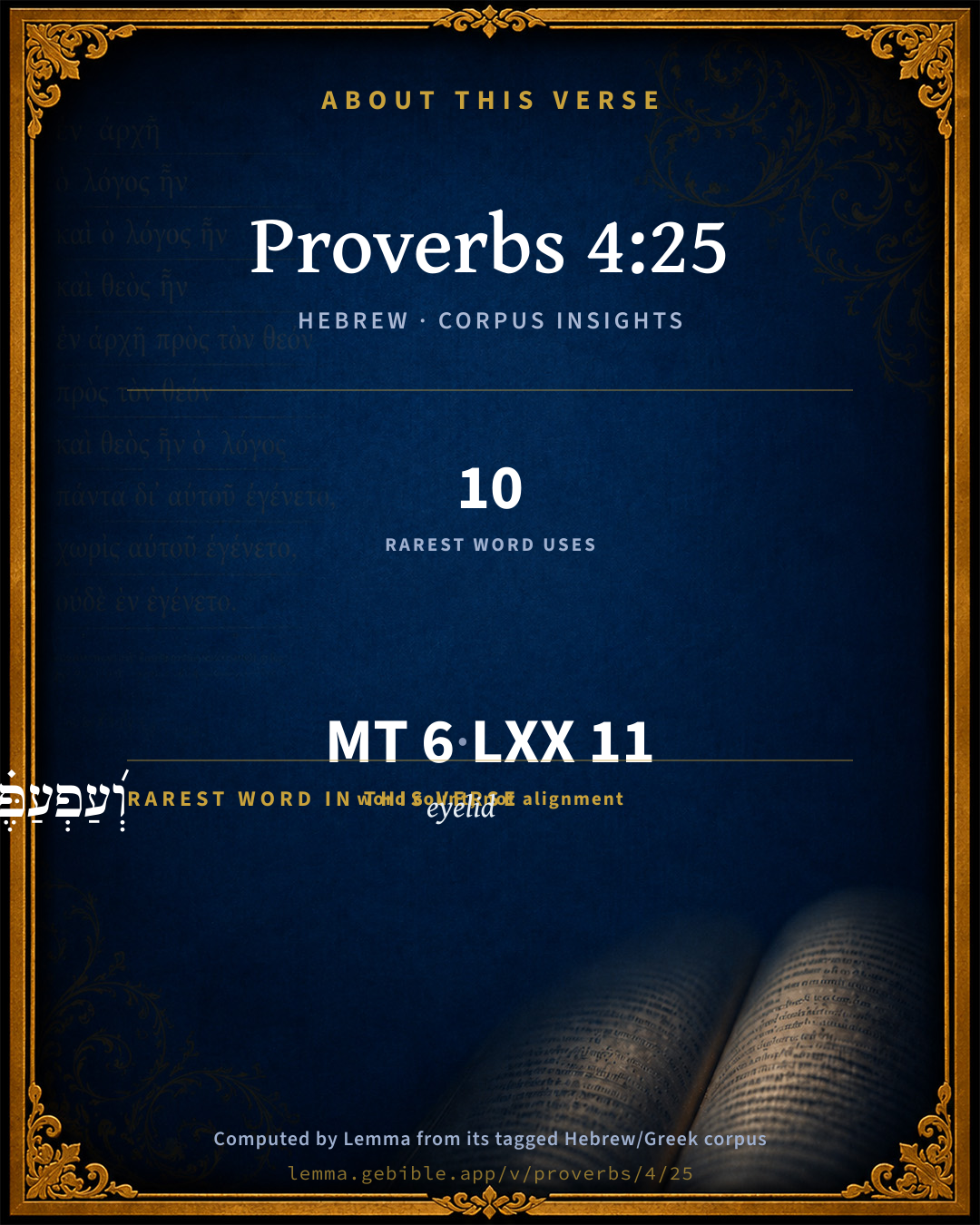
The rarest word here is וְ֝עַפְעַפֶּ֗יךָ eyelid H6079 — appearing just 10 times in the whole Hebrew Bible.

Shared distinctive vocabulary

וְ֝עַפְעַפֶּ֗יךָ eyelid H6079 occurs in 10 verses of the Hebrew Bible. Also found in:

Grammatical profile

  • 2 verbs
  • 3 nouns
  • 1 preposition

Verb forms

  • יַבִּ֑יטוּ Hiphil · Jussive
  • יַיְשִׁ֥רוּ Hiphil · Jussive

Hebrew & Septuagint length

In English translation the verse runs 12 words from the Hebrew and 14 from the Septuagint (LXX English) — closely comparable.

A rough comparison of the two English renderings, which tokenize alike — not a word-level alignment.

Word counts can differ between the Hebrew and the Greek without any difference in meaning — e.g. the Hebrew direct-object marker אֵת has no separate Greek word, and Greek often adds the article ὁ.

In the original languages it is 6 Hebrew tokens and 11 Greek tokens — but the two are counted differently (Hebrew bundles its prefixes and suffixes into one token; the Greek is in lemma form), so that isn’t a like-for-like length.

Cross-references

5

Topical passages linked to Proverbs 4:25 in the Treasury of Scripture Knowledge — connected by theme and wording, ordered by reader-vote popularity; previews shown in the World English Bible.

  • Psalms 119:37 Turn my eyes away from looking at worthless things. Revive me in your ways.
  • Matthew 6:22 "The lamp of the body is the eye. If therefore your eye is sound, your whole body will be full of light.
  • Job 31:1 "I made a covenant with my eyes, How then should I look lustfully at a young woman?
  • Proverbs 23:33 Your eyes will see strange things, And your mind will imagine confusing things.
  • Proverbs 23:5 Why do you set your eyes on that which is not? For it certainly sprouts wings like an eagle and flies in the sky.

Cross-references courtesy of OpenBible.info (CC BY 4.0).

Hebrew and Greek witnesses Masoretic Hebrew ↔ Greek Septuagint

The same verse in the two great witnesses to the Old Testament, shown verse-for-verse.

These are two independent witnesses, not word-aligned to each other, and the Septuagint is shown in lemma (dictionary) form.

Hebrew Proverbs 4:25 Masoretic · Westminster Leningrad Codex

עֵ֭ינֶיךָ לְנֹ֣כַח יַבִּ֑יטוּ וְ֝עַפְעַפֶּ֗יךָ יַיְשִׁ֥רוּ נֶגְדֶּֽךָ

Let your eyes look straight ahead. Fix your gaze directly before you.

World English Bible · Public Domain

Greek LXX Proverbs 4:25 Septuagint · lemma form

ὁ ὀφθαλμός σύ ὀρθός βλέπω ὁ δέ βλέφαρον σύ νεύω δίκαιος

Let your eyes look right on, and let your eyelids assent to just things.

LXX2012 (modern English Septuagint) · Public Domain

On this verse, The Pulpit Commentary discusses the Septuagint’s reading. Read the note in Commentary ↓

Hebrew: Westminster Leningrad Codex (CC BY 4.0). Greek: Septuagint (public domain); English from LXX2012 (modern English Septuagint) (Public Domain). How the Septuagint differs from the Hebrew →

Commentary

Notes on Proverbs 4:25 from classic Christian and Jewish commentators (each source and its license shown beneath its notes). The classic Christian expositions comment on the surrounding passage and are grouped to its opening verse, so a note may address several verses; the Jewish commentaries on the Tanakh (Rashi and others) are per-verse, so they appear only where the commentator wrote on this verse.

Lemma curates 59 commentaries, every one of them public domain or Creative Commons licensed, each selected and text-cleaned for this edition rather than reprinted as found. About our sources →

Trapp's Complete Commentary

John Trapp

Pro 4:25 Let thine eyes look right on, and let thine eyelids look straight before thee.

Ver. 25. Let thine eyes look right on.] E regione, vel in rectum. Let them be fixed upon right objects. Get that stoic eye of our Saviour; get a patriarch’s eye; be well skilled in Moses’s optics; {Heb 11:27} have oculum in metam, which was Ludovicus Vives’s motto. Do as mariners that have their eye on the star, their hand on the stern. A man may not look intently upon that which he may not love. The disciples were set agog by beholding the beauty of the temple. {Mat 24:2} If therefore thine eye offend thee, or cause thee to offend, pull it out of the old Adam, and set it in the new man. If thou use it not well, thou wilt wish that thou hadst pulled it out indeed, as Democritus did.

John Trapp, A Commentary or Exposition upon All the Books of the Old and New Testament (1647–1656) — public domain. Text from a community e-Sword module.

The Biblical Illustrator

Joseph S. Exell

Pro_4:25

Let thine eyes look right on, and let thine eyelids look straight before thee.

Eyes right

These words occur in a passage wherein the wise man exhorts us to take care of all parts of our nature, which he indicates by members of the body. Every part of our nature needs to be carefully watched, lest in any way it should become the cause of sin. Any one member or faculty is readily able to defile all the rest, and therefore every part must be guarded with care. Having eyes, use them; using them, take care to use them honestly. Some persons are always as if they were asleep. Others are somewhat awake mentally, but are not looking right on; they are star-gazing; they lead but a purposeless life. A man ought to have a way; it should be a straight way; and in that straight way he should persevere. The best way for a man is the way which God has made for him. When you are on the Kings highway, you may go ahead without fear.

I. Let Christ be your way. If He be, you will begin first to seek to have Christ. Then you will want to know Christ. Then you will go on to obey Christ. Then you will seek to be like Christ.

II. Set your eyes on Christ as your way. Think of Him, consider Him, study Him.

1. That you may know the way of life, let your eyes be fixed on Him.

2. That you may follow Him well, follow Him wholly. Gather up all your faculties to go after the Lord.

3. Look alone to Jesus, and do this to keep your spirits up. Some live in retrospection; others in unhealthy introspection; and yet others carry much too far a sort of circumspection. If you begin to look two ways at a time, you will miss the Lord Jesus. Under the Jewish law no man who had a squint was allowed to be a priest.

III. Let your eyes distinctly and directly look to Christ alone.

1. Look not to any human guide.

2. Look to Christ for yourself.

3. Look not to any secondary aims.

4. Forget all things when seeing Christ.

5. Take care that you continue gazing upon Christ until you have faith in Him. (C. H. Spurgeon.)

Simplicity

What is in these terms specially indicated is simplicity of principle and aim; singleness of motive; an upright, unswerving regard to duty. The path of duty is one. It is narrow and straight. On it the eye should constantly and steadily be set--looking right on, not to any seducing objects that present themselves on the one hand or on the other. Many things may allure--may hold out tempting seductions from the onward path. Many other paths may appear more smooth, more easy, and in all respects for the time more desirable; but the one and only question must ever be, What is duty? (R. Wardlaw, D.D.)

Looking to our way of life

Gods people have their minds made up as to all those things which concern their everlasting interests. But to know our way is of little use unless we keep that way in view. There are many spiritual travellers who know the way to Zion, but have not their faces thitherward. The text is an important motto for every man who is setting out for heaven. To understand the use and value of this precept, consider it--

I. As it applies to the faith of the child of God. By the faith is meant the great doctrines on which their hopes are grounded. Often, in our experience, we are tempted to entertain unworthy thoughts of the gracious Saviour; to mix up our own works with the plan of His redemption, to place the confidence in frames and feelings, in notions and professions, which should be placed in Him alone. Against such temptations the text provides a remedy. Keep Jesus constantly in view.

II. As it applies to the duties of the child of God. The text is a preservative against unlawful pleasures and indulgences. It is an exhortation to a close and constant obedience to the revealed will of God, and to the duty of Christian integrity--to an honest, upright, guileless conduct in all our dealings with mankind. Seek, then, strength from God, that you may continue steadfast in the holy course of life, as advised in this text. (A. Roberts, M. A.)

The Biblical Illustrator, edited by Joseph S. Exell (c. 1880s–1900s) — public domain. Text from a community e-Sword module.

Jamieson, Fausset & Brown

Robert Jamieson, A. R. Fausset & David Brown

Let . . . before thee--that is, pursue a sincere and direct purpose, avoiding temptations.

Jamieson, Fausset & Brown — Commentary Critical and Explanatory on the Whole Bible (1871) — public domain (CC PDM 1.0). Text via the HelloAO Bible API.

Ellicott's Commentary for English Readers

(25) Let thine eyes look right on.—Comp. the advice of Sir_7:36, “Whatsoever thou takest in hand, remember the end,” and of Heb_12:2, to look “unto Jesus, the author and finisher of our faith.”

A Bible Commentary for English Readers, edited by Charles John Ellicott (1878–1897) — public domain. Text from a community e-Sword module.

John Gill's Exposition

Let thine eyes look right on,.... To the path of truth and holiness, without turning or looking to the right hand or left, as it is afterwards expressed; to the word of truth, as the rule to walk by; to Christ, the author and finisher of faith, from whom all grace, and the supplies of it, are to be had; and to the mark, for the prize of the high calling of God;

and thine eyelids look straight before thee; to the precepts of the word, to observe them; to the promises of it for encouragement; to the examples of the saints gone before, as motives to excite diligence, and to exercise patience, faith, and hope; to the mercy of our Lord Jesus Christ for eternal life, and to the blessed hope laid up in heaven.

John Gill's Exposition of the Whole Bible (1746–1763) — public domain (CC PDM 1.0). Text via the HelloAO Bible API.

Haydock's Catholic Bible Commentary

Steps. Be attentive to thy own affairs, Proverbs xvii. 24.

George Leo Haydock (1774–1849), Haydock's Catholic Family Bible and Commentary, 1859 edition — public domain. Excludes Psalms (Douay-Rheims chapter numbering differs from Protestant) and Deuterocanonical books (Catholic canon only).

Matthew Poole's English Annotations

Direct all thine actions by a good intention, to a right end, and keep thy mind fixed upon that way which leads to it, and neither look nor turn aside to the right hand nor to the left, as it follows, Pro 4:27.

Matthew Poole's English Annotations on the Holy Bible (1683–1685) — public domain. Text from a community e-Sword/MySword module.

Whedon's Commentary on the Bible

Daniel D. Whedon

25. Eyelids look straight — Rather, be straight or level. A caution against all insincerity of word or conduct. Comp. Pro_6:13; Pro_10:10; Mat_6:22-23.

Daniel D. Whedon (gen. ed.), Commentary on the Old and New Testaments (1874–1909) — public domain. Text from a community e-Sword module.

The Pulpit Commentary

Let thine eyes look right on, and let thine eyelids lock straight before thee. "To look right on" and "to look straight before one" is to fix the eyes steadily and unswervingly upon an object before them, not to allow the gaze to deflect either to the right hand or to the left. As a noun, the word nokakh, rendered "right on," signifies what is straight in front of one; adverbially, it has the same meaning as that given in the Authorized Version. The corresponding "before" (neged) is substantively the side of any object which is opposite one, and as a preposition is equivalent to "before," "in the presence of," like the Latin coram. The versions (LXX, Syriac, Targum) take nokakh in the sense of "right things:" "Let thine eyes look at right things;" contemplate them, aim at justice and equity. This meaning is given to the cognate adjective nakoakh in Pro_8:9 Pro_24:26 Isa_26:10 Isa_30:10 Isa_59:14; but in the Proverbs the word nokakh only occurs twice (here and ver. 21), either as an adverb, "right on," "straightforwardly," or as a preposition, "before." Look straight. Gesenius takes this verb yashar in hiph., "to make straight," as used elliptically: "Let thine eyelids direct a way before thee;" but the meaning is the same as "Let them look straight before thee." The Syriac, Gejerus, and Holden render, "Let thine eyelids direct thy way before thee;" i.e. do nothing rashly, but everything with premeditation; examine thy conduct, and see that it is right. The verb yashar has this meaning, "to direct," in Pro_3:6 Pro_11:5, but it is here used intransitively (Mercerus). Eyelids ( aph"appim); so called from their fluttering, rapid motion, here used by way of poetic parallelism with "eyes." What the command inculcates is simplicity of aim or principle, singleness of motive. The moral gaze is to be steadily fixed, because if it wanders indolently, lasciviously, aimlessly, it imperils the purity of the soul. This verse may be understood, as Zockler, as containing a command levelled against dishonest practices. The man who intends to cheat his neighbour looks this way and that how he may deceive him. Such an interpretation may be maintained on the ground that the former verse is directed against falsehood in speech; this against falsehood in action. But the former view is preferable. If you wish to keep the heart, you must be guided by simplicity of aim; look not aside either to the one hand or to the other, lest you may be led astray by the seductions and temptations which imperil the onward and upward progress of the soul. The passage reminds us of the "single eye" (aplouv ), "simple," i.e. intent on heaven and God, of Mat_6:22.

Vers. 25-27. Spiritual drilling.

The whole man must be drilled into form and disciplined into orderly action, just as the whole armour of God is necessary for the protection of the soldier of Christ. It is not enough for safety to wear a helmet while the breast is exposed, nor to bare the head while the lees are covered; and it is not enough for service that part of our nature is trained to obedience. We must seek to have all in right order.

I THE HEART. This must be guarded most sedulously, and before all else. We cannot have our actions right in the sight of God while the heart is perverted. The attempt to secure this only ends in hypocrisy. The first duty of the soldier is loyalty. The first duty of the Christian is fidelity. Nevertheless, though the fountain must be pure if the stream is to be pure, its purity will not secure the water against subsequent defilement. It is not enough to think of the state of the heart, we must also consider the course of our actions. A pseudo-spirituality ends in indifference to morals, and even in positive immorality. St. Paul did not think his work done when he had laid the foundation of the Christian character. He sought the "edification," the "building up," of it by detailed and earnest instruction in Christian morals.

II THE LIPS. The first and most ready expression of the state of the heart is in our conversation. "Out of the abundance of the heart the mouth speaketh." Now, it is important to remember that we are responsible for our words. For "every idle word that men shall speak, they shall give account thereof in the day of judgment". (Mat_12:36) Words are deeds. They carry influence and linger in memories and are transmitted from one to another long after the speaker has forgotten them.

III THE EYES. The eye is one of the chief gateways of knowledge. According to the objects on which we fix it, the class of our knowledge will be determined. It is the guide in our actions. Now, it is requisite that the Christian have:

1. A straight and single" sight, (see Mat_6:22) looking only at the truth, with no stray glances at the innumerable deceptions of low self-interest.

2. A long sight, looking at the end of the race the Celestial City, neither allured by the fascinations of Vanity Fair nor distracted by the horrors of the Valley of the Shadow of Death.

3. An upward gaze fixed on God and Christ rather than on worldly loss or gain.

IV THE FEET. All the life leads on to the outgoings of activity. The ultimate question is In what way are we going? Here the requisite is that the feet should go straight on. There are many ways of wrong, only one of right; hence the breadth of the former and the narrowness of the latter. We must especially avoid the error of falling into extremes. While shunning the track to the left let us see that we do not go off on that to the right. The path of duty is between these extremes. Yet the way to find it is not by seeking for a mean and so only accepting a compromise, but by aiming at the true and the right and pressing straight on to them irrespective of all conflicting influences.

The Pulpit Commentary (1880–1919), ed. H.D.M. Spence-Jones & Joseph S. Exell — public domain. Text from a community e-Sword module.

John Wesley's Explanatory Notes

Right on - Direct all thine actions to a right end, and keep thy mind fixed upon that way which leads to it, and neither look or turn aside to the right-hand or the left.

John Wesley, Explanatory Notes Upon the Whole Bible (1754–1765) — public domain. Text via the GEBible commentary corpus.

Rashi

Rabbi Shlomo Yitzchaki (Rashi)

Let your eyes look forward Let them look to truth and uprightness.

and let your eyelids look straight ahead of you Let them look at what is upright, to straighten your way before you.

Rashi on the Tanakh — English translations: “The Judaica Press complete Tanach with Rashi, translated by A. J. Rosenberg” (CC BY 4.0); “Pentateuch with Rashi's commentary by M. Rosenbaum and A.M. Silbermann, 1929-1934” (public domain); “The Metsudah Tanach series, Lakewood, N.J” (CC BY 4.0); and “The Book of Joshua, Metsudah Publications, 1997” (CC BY 4.0). Text via Sefaria.

Lesson kit

Teaching starters — assembled from the data on this page, not authored interpretation. Every prompt links to the verse data it draws on. Edit before teaching.

Proverbs, in the Wisdom, opens this verse with 6 words (6 distinct Hebrew lemmas). Its most distinctive word is ʻaphʻaph (“eyelid”). A historical commentator’s framing appears above. Read the whole chapter for the surrounding context.

Discussion questions

  1. The word ʻaphʻaph carries the sense “eyelid.” How does it shape the verse?
  2. Job 3:9 shares the word «eyelid» with this verse. How do the two illuminate each other?
  3. These translations render this verse differently; the difference is in the English rendering, not the original. What questions does that raise?
  4. The verb «יַבִּ֑יטוּ» is Hiphil Jussive. How does its form color the action?
  5. Reading how Trapp's Complete Commentary and The Biblical Illustrator read this verse, where do the two commentators agree and where do they part?

Things to notice

Reading settings

Reading text

Shown beneath each verse's original-language words.

Old Testament
Old Testament edition

Read the OT as the Masoretic Hebrew (MT) or the Greek Septuagint (LXX).

English shown for the Greek Septuagint (in the Hebrew ↔ Greek comparison).

Comparing translations? Open the Compare panel on any verse page to stack up to four side by side.