
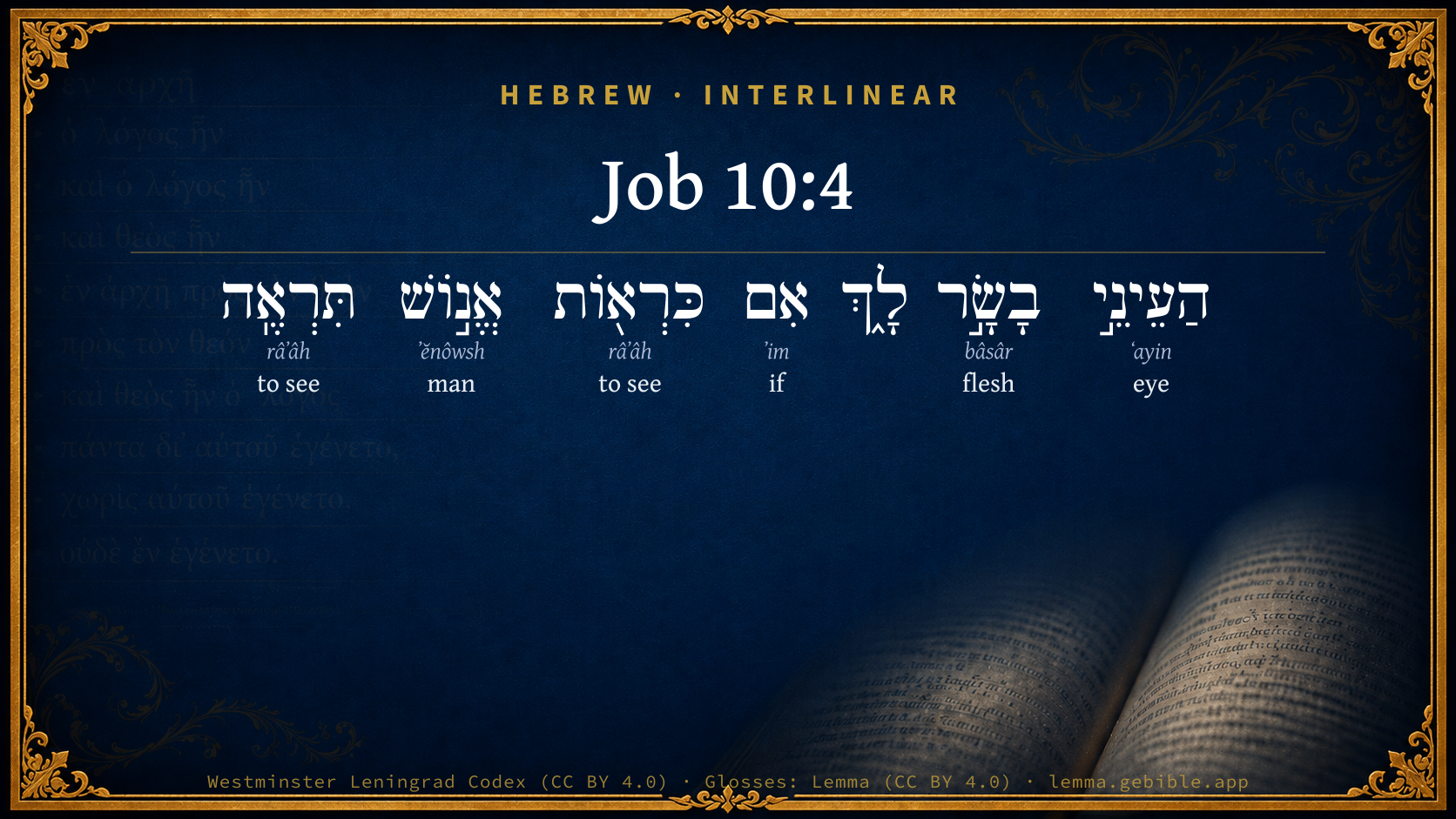
Job 10:4

Hebrew (Westminster Leningrad Codex) Job 10:4 appears in the Hebrew Old Testament. The text above is from the Westminster Leningrad Codex. Each word links to its Strong’s number, a concise gloss, and parsing drawn from the Open Scriptures Hebrew Bible morphology. Click any word for its full Brown-Driver-Briggs (BDB) entry.
Download image
Cite this verse

Job 10:4 (World English Bible). Public Domain. Lemma interlinear Bible study tool, https://lemma.gebible.app/v/job/10/4.

Show BibTeX & RIS
BibTeX
RIS
English Translation
Do you have eyes of flesh? Or do you see as man sees?
World English Bible · Public Domain
Download a study sheet

One document with this verse’s original text, its word-by-word gloss line, the meaning frame, cross-references with their text, attributed commentary, and full source and license credits — printable, and it pastes into notes with its structure intact.

This verse Autodidact and up

Study sheet (.html) Plain text (.txt)

A passage Seminary Student

Up to 50 verses in one chapter. A passage sheet keeps up to 6 commentary sources and 12 cross-references per verse, in the order this page ranks them, and says so on the sheet whenever that leaves anything out. Ask for a single verse and you get the Autodidact verse sheet above.

Everything on this page stays free to read, with no account — the sheet is a download of what is already on screen, not access to it.

Want to remove ads? Support Godless Engineer
Compare translations 3

The same verse in 3 English versions, stacked beneath the original-language interlinear above. Click any original word for its lexicon entry.

Each is an independent rendering of the whole verse — the interlinear is not word-aligned to these translations.

Highlighted words mark where these versions differ — a whole-verse word diff, not a word-by-word alignment.

  • World English Bible Public Domain
    Do you have eyes of flesh? Or do you see as man sees?
  • King James Version Public Domain
    Hast thou eyes of flesh? or seest thou as man seeth?
  • unfoldingWord Literal Text CC BY-SA 4.0
    eyes of flesh to you? If you see according to the seeing of a man?

unfoldingWord Literal Text — © unfoldingWord, licensed CC BY-SA 4.0. Word-aligned USFM3 via Door43 (git.door43.org/unfoldingWord/en_ult).

Versions to compare (up to 4)

3 of 4 selected

Show all 18 translations

Every available English version of this verse, each an independent rendering of the whole verse.

  • World English Bible Public Domain
    Do you have eyes of flesh? Or do you see as man sees?
  • Berean Standard Bible Public Domain
    Do You have eyes of flesh? Do You see as man sees?
  • Majority Standard Bible Public Domain
    Do You have eyes of flesh? Do You see as man sees?
  • King James Version Public Domain
    Hast thou eyes of flesh? or seest thou as man seeth?
  • American Standard Version (1901) Public Domain
    Hast thou eyes of flesh? Or seest thou as man seeth?
  • Revised Version (1885) Public Domain
    Hast thou eyes of flesh, or seest thou as man seeth?
  • Geneva Bible (1599) Public Domain
    Hast thou carnall eyes? or doest thou see as man seeth?
  • Douay-Rheims (1899) Public Domain
    Hast thou eyes of flesh: or, shalt thou see as man seeth?
  • Young's Literal Translation Public Domain
    Eyes of flesh hast Thou? As man seeth -- seest Thou?
  • Literal Standard Version CC BY-SA 4.0
    Do you have eyes of flesh? Do You see as man sees?
  • Unlocked Literal Bible CC BY-SA 4.0
    Do you have eyes of flesh? Do you see like a man sees?
  • unfoldingWord Literal Text CC BY-SA 4.0
    eyes of flesh to you? If you see according to the seeing of a man?
  • Darby Bible Public Domain
    Hast thou eyes of flesh? or seest thou as man seeth?
  • World Messianic Bible Public Domain
    Do you have eyes of flesh? Or do you see as man sees?
  • Webster's Bible Public Domain
    Hast thou eyes of flesh? or seest thou as man seeth?
  • Free Bible Version CC BY-SA 4.0
    Do you have human eyes? Do you see like human beings do?
  • Bible in Basic English Public Domain
    Have you eyes of flesh, or do you see as man sees?
  • JPS Tanakh (1917) Public Domain
    Hast Thou eyes of flesh? or seest Thou as man seeth?

Literal Standard Version (2020), Covenant Press — licensed CC BY-SA 4.0. Text via the HelloAO Bible API (eBible.org). Unlocked Literal Bible (unfoldingWord) — licensed CC BY-SA 4.0. Text via the HelloAO Bible API (eBible.org). unfoldingWord Literal Text — © unfoldingWord, licensed CC BY-SA 4.0. Word-aligned USFM3 via Door43 (git.door43.org/unfoldingWord/en_ult). Free Bible Version, Dr. Jonathan Gallagher — licensed CC BY-SA 4.0. Text via the HelloAO Bible API (eBible.org).

Word by word

More ways to search: Search by grammar → Find every occurrence → Compare this word →

Practice this passage: Drill this verse → Learn its vocabulary →

About this verse

These counts appear in no published source. They are computed here, from the morphology-tagged text and Lemma’s own curated glosses. What Lemma adds →

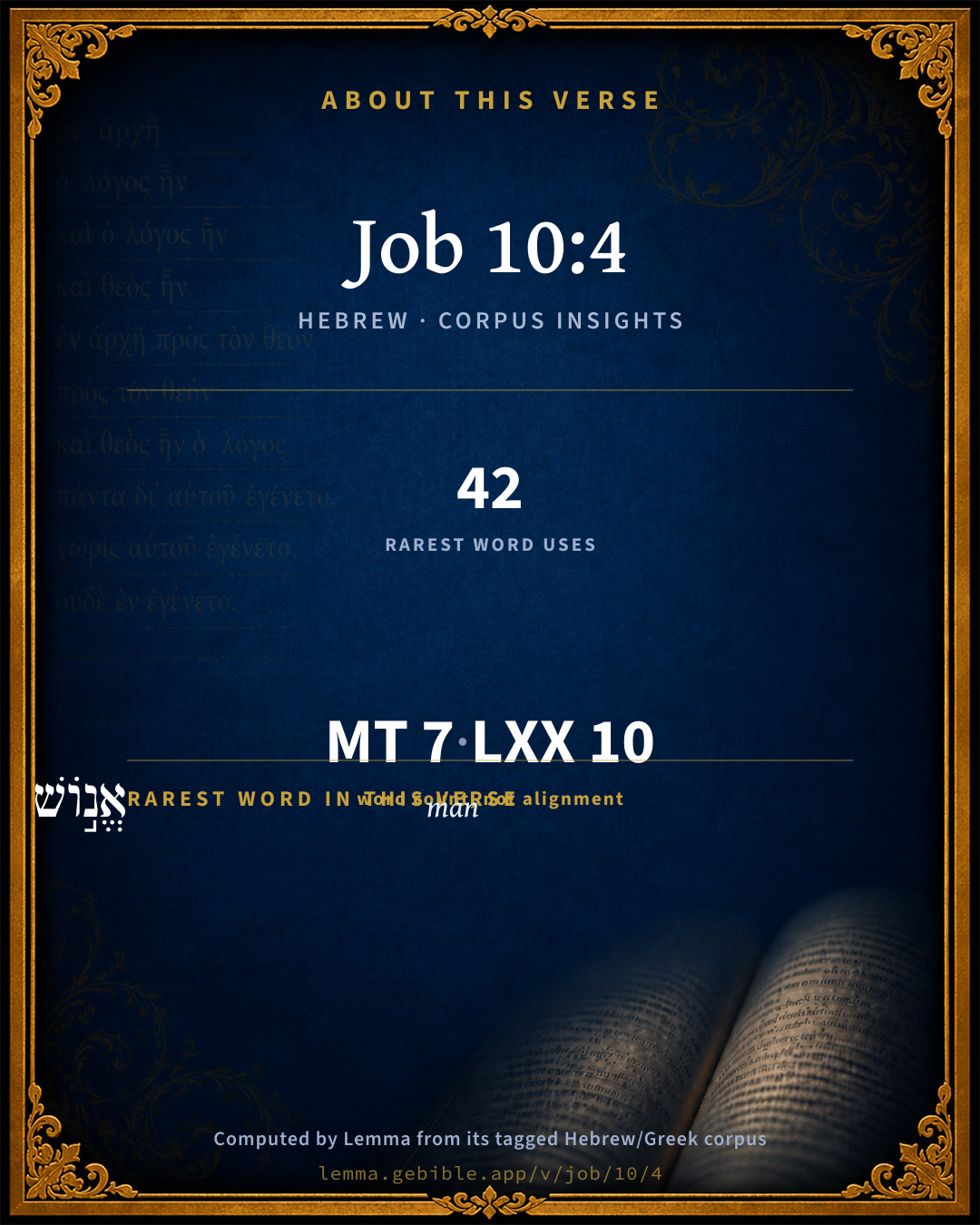
7
words
5
distinct lemmas
Wisdom
section

Shared distinctive vocabulary

אֱנ֣וֹשׁ man H582 occurs in 41 verses of the Hebrew Bible. Also found in:

Grammatical profile

  • 2 verbs
  • 3 nouns
  • 1 preposition
  • 1 conjunction

Verb forms

  • כִּרְא֖וֹת Qal · Infinitive Construct
  • תִּרְאֶֽה Qal · Imperfect

Repetition

A word recurs within this verse — often emphatic in Hebrew:

  • כִּרְא֖וֹת to see H7200 ×2

Hebrew & Septuagint length

In English translation the verse runs 13 words from the Hebrew and 16 from the Septuagint (LXX English) — closely comparable.

A rough comparison of the two English renderings, which tokenize alike — not a word-level alignment.

Word counts can differ between the Hebrew and the Greek without any difference in meaning — e.g. the Hebrew direct-object marker אֵת has no separate Greek word, and Greek often adds the article ὁ.

In the original languages it is 7 Hebrew tokens and 10 Greek tokens — but the two are counted differently (Hebrew bundles its prefixes and suffixes into one token; the Greek is in lemma form), so that isn’t a like-for-like length.

Cross-references

4

Topical passages linked to Job 10:4 in the Treasury of Scripture Knowledge — connected by theme and wording, ordered by reader-vote popularity; previews shown in the World English Bible.

  • 1 Samuel 16:7 But Yahweh said to Samuel, "Don't look on his face, or on the height of his stature; because I have rejected him: for [Yahweh sees] not as man sees; for man looks at the outward appearance, but Yahweh looks at the heart."
  • Job 9:32 For he is not a man, as I am, that I should answer him, That we should come together in judgment.
  • Luke 16:15 He said to them, "You are those who justify yourselves in the sight of men, but God knows your hearts. For that which is exalted among men is an abomination in the sight of God.
  • Revelation 1:14 His head and his hair were white as white wool, like snow. His eyes were like a flame of fire.

Cross-references courtesy of OpenBible.info (CC BY 4.0).

Hebrew and Greek witnesses Masoretic Hebrew ↔ Greek Septuagint

The same verse in the two great witnesses to the Old Testament, shown verse-for-verse.

These are two independent witnesses, not word-aligned to each other, and the Septuagint is shown in lemma (dictionary) form.

Hebrew Job 10:4 Masoretic · Westminster Leningrad Codex

הַעֵינֵ֣י בָשָׂ֣ר לָ֑ךְ אִם כִּרְא֖וֹת אֱנ֣וֹשׁ תִּרְאֶֽה

Do you have eyes of flesh? Or do you see as man sees?

World English Bible · Public Domain

Greek LXX Job 10:4 Septuagint · lemma form

ἦ ὥσπερ βροτός ὁράω καταὁράω ἤ καθώς ὁράω ἄνθρωπος βλέπω

Or do you see as a mortal sees? or will you look as a man sees?

LXX2012 (modern English Septuagint) · Public Domain

Hebrew: Westminster Leningrad Codex (CC BY 4.0). Greek: Septuagint (public domain); English from LXX2012 (modern English Septuagint) (Public Domain). How the Septuagint differs from the Hebrew →

Commentary

Notes on Job 10:4 from classic Christian and Jewish commentators (each source and its license shown beneath its notes). The classic Christian expositions comment on the surrounding passage and are grouped to its opening verse, so a note may address several verses; the Jewish commentaries on the Tanakh (Rashi and others) are per-verse, so they appear only where the commentator wrote on this verse.

Lemma curates 59 commentaries, every one of them public domain or Creative Commons licensed, each selected and text-cleaned for this edition rather than reprinted as found. About our sources →

Trapp's Complete Commentary

John Trapp

Job 10:4 Hast thou eyes of flesh? or seest thou as man seeth?

Ver. 4. Hast thou eyes of flesh?] Which see but the surface of things, and not that neither in the dark. Hast thou not fiery eyes, Rev 1:14, that need no outward light, but see by sending out a ray, and pierce the inward parts also? Hast thou not made the eye? yea, the optic virtue in the eye, which seeth all and is seen of none? If the sun be the eye of the world, God is much more. The Greeks give him his name from seeing, because he seeth through and through; eyes he hath, but not of flesh; he seeth, but not as man.

Or seest thou as man seeth?] Art thou subject to error, ignorance, partiality, popularity, &c.? Proceedest thou not according to truth (yea, truth in the inward parts), and not according to opinion or appearance? Of a judge it is said, that he doth neque suspicere, nec despicere, nec respicere, nec circumspicere, neither look up nor down, nor this way nor that, but straight forward to the cause, and not to the person. Of a just law it is said, that it is a heart without affection, an eye without lust, a mind without passion, a treasurer which keepeth for every man what he hath, and distributeth to every man what he ought to have; so and much more than so is God, whatever thoughts might arise sometimes in Job’s heart to the contrary.

John Trapp, A Commentary or Exposition upon All the Books of the Old and New Testament (1647–1656) — public domain. Text from a community e-Sword module.

Joseph Benson's Commentary

Job 10:4. Hast thou eyes of flesh? — No. Eyes of flesh cannot see in the dark: but darkness hideth not from God. Eyes of flesh are but in one place at a time, and can see but a little way. But the eyes of the Lord are in every place, and run to and fro through the whole earth. Eyes of flesh will shortly be darkened by age, and shut up by death. But the eyes of God are ever the same, nor does his sight ever decay. Or seest thou as man — Man sees the outside only, and judges by appearances: but thou seest my heart.

Joseph Benson's Commentary on the Old and New Testaments (1811–1818) — public domain. Text from a community e-Sword module.

Geneva Bible (1599)

Geneva Bible translators

Doest thou this of ignorance?

Geneva Bible (1599) marginal notes — public domain. Text via Bolls.life.

Jamieson, Fausset & Brown

Robert Jamieson, A. R. Fausset & David Brown

Dost Thou see as feebly as man? that is, with the same uncharitable eye, as, for instance, Job's friends? Is Thy time as short? Impossible! Yet one might think, from the rapid succession of Thy strokes, that Thou hadst no time to spare in overwhelming me.

Jamieson, Fausset & Brown — Commentary Critical and Explanatory on the Whole Bible (1871) — public domain (CC PDM 1.0). Text via the HelloAO Bible API.

Adam Clarke's Commentary

Verse 4. Hast thou eyes of flesh!] Dost thou judge as man judges? Illustrated by the next clause, Seest thou as man seeth?

Adam Clarke's Commentary on the Bible (1810–1826) — public domain. Text from a community e-Sword/MySword module.

The Cambridge Bible for Schools and Colleges

gen. ed. J. J. S. Perowne

4. Job hazards the supposition that God has eyes like men and may see amiss, to account for His mistaken treatment of him.

The Cambridge Bible for Schools and Colleges (gen. ed. J. J. S. Perowne; Cambridge University Press, 1878–1918) — public domain. Text from a community e-Sword module.

John Gill's Exposition

Hast thou eyes of flesh?.... God has eyes, but not fleshly ones; he has eyes of love, grace, and mercy, which are always upon his people for good, and are never withdrawn from them; and he has eyes of displeasure and wrath on sinful men, to destroy them; these are not made of flesh, or like the eyes of flesh and blood, or of men; fleshy eyes cannot see at any great distance, and only in one place at a time, and only one object after another; they cannot see in the dark, and what they are, and only outward objects; and in these they are sometimes deceived, and at length fail: but the eyes of God see all things, at the greatest distance; he looks down from heaven, and beholds all the children of men on earth, and all their actions; his eyes are in every place, beholding the evil and the good; he can see in the dark as well as in the light, the darkness and the light are both alike to him; he beholds not only outward actions and visible objects, but the hearts of men, and all that is in them; nor is he ever deceived, nor will his sight ever fail: though Job, perhaps, may mean carnal eyes; that is, evil ones, as especially envious ones are: "is thine eye evil?" Mat 20:15; that is, envious; and it is as if Job should say, dost thou envy me my former prosperity and peace, that thou searchest so narrowly into my conduct to find iniquity in me, and take advantage against me?

or seest thou as man seeth? look with hatred and envy, as one man does upon another: so seemed the dispensations of God towards Job, as if he did, as he suggests.

John Gill's Exposition of the Whole Bible (1746–1763) — public domain (CC PDM 1.0). Text via the HelloAO Bible API.

Albert Barnes' Notes on the Bible

Hast thou eyes of flesh? - Eyes like man. Dost thou look upon man with the same disposition to discern faults; the same uncharitableness and inclination to construe everything in the severest manner possible, which characterizes man? Possibly Job may have reference here to the harsh judgment of his friends, and means to ask whether it could be possible for God to evince the same feelings in judging of him which they had done.

Albert Barnes' Notes on the Bible (1834–1885) — public domain. Text from a community e-Sword/MySword module.

Haydock's Catholic Bible Commentary

Seeth, judging only of the exterior. (Tirinus) (Ver. 6.)

George Leo Haydock (1774–1849), Haydock's Catholic Family Bible and Commentary, 1859 edition — public domain. Excludes Psalms (Douay-Rheims chapter numbering differs from Protestant) and Deuterocanonical books (Catholic canon only).

Matthew Poole's English Annotations

Of flesh, i.e. of a man, who is called flesh, as Gen 6:13; Isa 40:6.

Seest thou as man seeth? Man seeth outsides only, and judgeth by appearances, and is liable to many mistakes, and cannot search out secret faults without forcing men by cruel usage to accuse themselves: but thou needest none of these arts; thou seest my heart and mine uprightness, which my friends do not see, who therefore are more excusable in charging me with hypocrisy: but thou knowest all things, thou needest not examine me by tortures, as thou now dost, Job 10:6. For thou knowest that I am not wicked, as he saith, Job 10:7, and therefore do not thou deal with me as if I were wicked.

Matthew Poole's English Annotations on the Holy Bible (1683–1685) — public domain. Text from a community e-Sword/MySword module.

Whedon's Commentary on the Bible

Daniel D. Whedon

4. Eyes of flesh — A second reason is, that God is not limited by human faculties. He sees not through the external sense but by intuition. He has not to reason, as man does, from what appears. His sight is thwarted by no dimming veil of sense, but He at once comprehends the heart.

Daniel D. Whedon (gen. ed.), Commentary on the Old and New Testaments (1874–1909) — public domain. Text from a community e-Sword module.

The Pulpit Commentary

Hast thou eyes of flesh? or seest thou as man seeth? Notwithstanding the anthropomorphism of their language, the sacred writers are as fully aware as their modern critics of the immateriality of God, and the immense gap that separates his nature from human nature. It is on this that Job now dwells. God, being so much above man, having eyes that are not of flesh, and seeing not as man sooth, ought not to judge as man judges, with partiality, or prejudice, or even with extreme severity (ver. 6).

God"s vision of man.

How does God see us? Is he SO far above us that he cannot quite see us as we are? Is he so great that he cannot conceive of our littleness? Are his ideas so different from our own that he cannot understand our life and sympathize with it? Or is not God so supreme in his vision of man that he cannot make the mistakes we make, and must see us truly just as we are? If w, why does God seem to act as though he had man"s limited vision? Questions of this sort seem to be perplexing Job. How can they be met?

I GOD SEES US TRULY AS WE ARE. It is no attribute of infinity to be above seeing what is small. Because God is infinite he can descend to the infinitely little as well as comprehend the infinitely great. Moreover, he does not treat us as insignificant beings unworthy of his notice, but he regards us as his children. The very hairs of our head are numbered by God. His greatness is seen in the truth and thoroughness of his vision. He does not look through distorting media, nor does he only see one aspect of things, as is the case with us. He sees all round everything, and he looks through all things. There is no secret hidden from God. He understands what he sees, for his infinite vision is accompanied by an infinite comprehension.

II GOD JUDGES US BY A HIGHER STANDARD THAN OURS. We are hampered by narrow ideas; our judgment is warped and cramped by prejudice and error. Our ignorance, folly, and sin even mar the very standards by which we judge. God"s estimate is supremely fair, and it is after the very highest and purest ideas of judgment.

III GOD"S STANDARD OF JUDGMENT IS NOT ALIEN TO OURS. We might be dismayed by the very elevation and perfection of God"s method of judgment, thinking it totally different from our own. If this were the case conscience would be a delusion. But God is the Creator of conscience, and though this is limited, and in a measure perverted, still it retains the essential character given to it by God. "God made man in his own image". (Gen_1:26) Therefore man"s honest judgment must be a reflection of God"s judgment. God sees as we see, so far as we see truly. His judgment is just the correction and perfection of our judgment.

IV GOD HAS ENTERED INTO OUR LIFE THAT HE MAY SEE US WITH OUR OWN EYES. This seems to be part of the purpose of the Incarnation. Christ is a brother-Man. He looks at us with human eyes. One with us by nature, he can perfectly understand us. We cannot even understand our favourite dog when he turns to us his dumb, pathetic gaze, for he is of a different species. Christ became one with us, one of our species. Thus we can understand him, and he can perfectly sympathize with us. Apart from Christ, God seems to be distant and altogether different from ourselves. In Christ he is one with us, near to us, and able to regard us with the eyes of a Brother. W.F.A.

The Pulpit Commentary (1880–1919), ed. H.D.M. Spence-Jones & Joseph S. Exell — public domain. Text from a community e-Sword module.

John Wesley's Explanatory Notes

Eyes of faith - No. Eyes of flesh cannot see in the dark: but darkness hideth not from God. Eyes of flesh are but in one place at a time, and can see but a little way. But the eyes of the Lord are in every place, and run to and fro thro' the whole earth. Eyes of flesh will shortly be darkened by age, and shut up by death. But the eyes of God are ever the same, nor does his sight ever decay. As man - Man sees the outside only, and Judges by appearances: but thou seest mine heart.

John Wesley, Explanatory Notes Upon the Whole Bible (1754–1765) — public domain. Text via the GEBible commentary corpus.

unfoldingWord translationNotes

Door43 World Missions Community

Do you have eyes of flesh? Do you see like a man sees?

These two questions have nearly the same meaning. These questions expect a negative answer to emphasize that God does not see or understand things the same way a man does. They can be expressed as statements. AT: "You do not have eyes of flesh, and you do not see like a man sees." (See: Parallelism and Rhetorical Question)

Are your days like the days of mankind or your years like the years of people ... and there is no one who can rescue me from your hand?

This question expects a negative answer to emphasize that God is eternal and man's days are limited. It can be expressed as a statement. AT: "Your days are not like the days of mankind and your years are not like the years of people ... and there is no one who can rescue me from your hand." (See: Rhetorical Question)

your days like the days of mankind ... your years like the years of people

These two phrases have nearly the same meaning. (See: Parallelism)

your days

"the number of your days"

your years

"the number of your years"

inquire after my iniquity ... search after my sin

These two phrases have nearly the same meaning. (See: Parallelism)

inquire after

"seek after"

from your hand

Here "your hand" represents God's power. AT: "from your power" (See: Synecdoche)

translationWords

flesh

inquire

iniquity

sin

guilt

unfoldingWord translationNotes — © Distant Shores Media and the Door43 World Missions Community, licensed CC BY-SA 4.0. Source: git.door43.org/Door43/en_tn.

Lesson kit

Teaching starters — assembled from the data on this page, not authored interpretation. Every prompt links to the verse data it draws on. Edit before teaching.

Job, in the Wisdom, opens this verse with 7 words (5 distinct Hebrew lemmas). Its most distinctive word is ʼĕnôwsh (“man”). A historical commentator’s framing appears above. Read the whole chapter for the surrounding context.

Discussion questions

  1. How does “man” (ʼĕnôwsh) shape what this verse is saying?
  2. Deuteronomy 32:26 shares the word «man» with this verse. How do the two illuminate each other?
  3. “to see” occurs 2× in this one verse. What is the effect of the repetition?
  4. These translations render this verse differently. What is at stake in choosing one wording over another?
  5. The verb «כִּרְא֖וֹת» is Qal Infinitive Construct. How does its form color the action?
  6. Reading how Trapp's Complete Commentary and Joseph Benson's Commentary read this verse, where do the two commentators agree and where do they part?

Things to notice

Reading settings

Reading text

Shown beneath each verse's original-language words.

Old Testament
Old Testament edition

Read the OT as the Masoretic Hebrew (MT) or the Greek Septuagint (LXX).

English shown for the Greek Septuagint (in the Hebrew ↔ Greek comparison).

Comparing translations? Open the Compare panel on any verse page to stack up to four side by side.