Exodus 4:11

Hebrew (Westminster Leningrad Codex) Exodus 4:11 appears in the Hebrew Old Testament. The text above is from the Westminster Leningrad Codex. Each word links to its Strong’s number, a concise gloss, and parsing drawn from the Open Scriptures Hebrew Bible morphology. Click any word for its full Brown-Driver-Briggs (BDB) entry.
Download image
Cite this verse

Exodus 4:11 (World English Bible). Public Domain. Lemma interlinear Bible study tool, https://lemma.gebible.app/v/exodus/4/11.

Show BibTeX & RIS
BibTeX
RIS
English Translation
Yahweh said to him, "Who made man's mouth? Or who makes one mute, or deaf, or seeing, or blind? Isn't it I, Yahweh?
World English Bible · Public Domain
Highlights Full analysis ↓
Download a study sheet

One document with this verse’s original text, its word-by-word gloss line, the meaning frame, cross-references with their text, attributed commentary, and full source and license credits — printable, and it pastes into notes with its structure intact.

This verse Autodidact and up

Study sheet (.html) Plain text (.txt)

A passage Seminary Student

Up to 50 verses in one chapter. A passage sheet keeps up to 6 commentary sources and 12 cross-references per verse, in the order this page ranks them, and says so on the sheet whenever that leaves anything out. Ask for a single verse and you get the Autodidact verse sheet above.

Everything on this page stays free to read, with no account — the sheet is a download of what is already on screen, not access to it.

Want to remove ads? Support Godless Engineer
Compare translations 3

The same verse in 3 English versions, stacked beneath the original-language interlinear above. Click any original word for its lexicon entry.

Each is an independent rendering of the whole verse — the interlinear is not word-aligned to these translations.

Highlighted words mark where these versions differ — a whole-verse word diff, not a word-by-word alignment.

  • World English Bible Public Domain
    Yahweh said to him, "Who made man's mouth? Or who makes one mute, or deaf, or seeing, or blind? Isn't it I, Yahweh?
  • King James Version Public Domain
    And the LORD said unto him, Who hath made man's mouth? or who maketh the dumb, or deaf, or the seeing, or the blind? have not I the LORD?
  • unfoldingWord Literal Text CC BY-SA 4.0
    And Yahweh said to him, “Who put a mouth in mankind, or who makes a mute or a deaf or a seeing or a blind? Is it not I, Yahweh?

unfoldingWord Literal Text — © unfoldingWord, licensed CC BY-SA 4.0. Word-aligned USFM3 via Door43 (git.door43.org/unfoldingWord/en_ult).

Versions to compare (up to 4)

3 of 4 selected

Show all 18 translations

Every available English version of this verse, each an independent rendering of the whole verse.

  • World English Bible Public Domain
    Yahweh said to him, "Who made man's mouth? Or who makes one mute, or deaf, or seeing, or blind? Isn't it I, Yahweh?
  • Berean Standard Bible Public Domain
    And the LORD said to him, “Who gave man his mouth? Or who makes the mute or the deaf, the sighted or the blind? Is it not I, the LORD?
  • Majority Standard Bible Public Domain
    And the LORD said to him, “Who gave man his mouth? Or who makes the mute or the deaf, the sighted or the blind? Is it not I, the LORD?
  • King James Version Public Domain
    And the LORD said unto him, Who hath made man's mouth? or who maketh the dumb, or deaf, or the seeing, or the blind? have not I the LORD?
  • American Standard Version (1901) Public Domain
    And Jehovah said unto him, Who hath made man's mouth? Or who maketh `a man' dumb, or deaf, or seeing, or blind? Is it not I, Jehovah?
  • Revised Version (1885) Public Domain
    And the LORD said unto him, Who hath made man’s mouth? or who maketh a man dumb, or deaf, or seeing, or blind? is it not I the LORD?
  • Geneva Bible (1599) Public Domain
    Then the Lord said vnto him, Who hath giuen the mouth to man? or who hath made the domme, or the deafe, or him that seeth, or the blinde? haue not I the Lord?
  • Douay-Rheims (1899) Public Domain
    The Lord said to him: Who made man's mouth? or who made the dumb and the deaf, the seeing and the blind? did not I?
  • Young's Literal Translation Public Domain
    And Jehovah saith unto him, `Who appointed a mouth for man? or who appointeth the dumb, or deaf, or open, or blind? is it not I, Jehovah?
  • Literal Standard Version CC BY-SA 4.0
    And YHWH says to him, “Who appointed a mouth for man? Or who appoints the mute, or deaf, or open, or blind? Is it not I, YHWH?
  • Unlocked Literal Bible CC BY-SA 4.0
    Yahweh said to him, “Who is it who made man's mouth? Who makes a man mute or deaf or seeing or blind? Is it not I, Yahweh?
  • unfoldingWord Literal Text CC BY-SA 4.0
    And Yahweh said to him, “Who put a mouth in mankind, or who makes a mute or a deaf or a seeing or a blind? Is it not I, Yahweh?
  • Darby Bible Public Domain
    And Jehovah said to him, Who gave man a mouth? or who maketh dumb, or deaf, or seeing, or blind? [have] not I, Jehovah?
  • World Messianic Bible Public Domain
    The LORD said to him, “Who made man’s mouth? Or who makes one mute, or deaf, or seeing, or blind? Isn’t it I, the LORD?
  • Webster's Bible Public Domain
    And the LORD said to him, Who hath made man's mouth? or who maketh the dumb, or deaf, or the seeing, or the blind? have not I the LORD.
  • Free Bible Version CC BY-SA 4.0
    “Who gave people mouths?” the Lord asked him. “Who makes people deaf or dumb, able to see or blind? It's I, the Lord, who does that.
  • Bible in Basic English Public Domain
    And the Lord said to him, Who has made man's mouth? who takes away a man's voice or hearing, or makes him seeing or blind? Is it not I, the Lord?
  • JPS Tanakh (1917) Public Domain
    And the LORD said unto him: 'Who hath made man's mouth? or who maketh a man dumb, or deaf, or seeing, or blind? is it not I the LORD?

Literal Standard Version (2020), Covenant Press — licensed CC BY-SA 4.0. Text via the HelloAO Bible API (eBible.org). Unlocked Literal Bible (unfoldingWord) — licensed CC BY-SA 4.0. Text via the HelloAO Bible API (eBible.org). unfoldingWord Literal Text — © unfoldingWord, licensed CC BY-SA 4.0. Word-aligned USFM3 via Door43 (git.door43.org/unfoldingWord/en_ult). Free Bible Version, Dr. Jonathan Gallagher — licensed CC BY-SA 4.0. Text via the HelloAO Bible API (eBible.org).

Word by word

More ways to search: Search by grammar → Find every occurrence → Compare this word →

Practice this passage: Drill this verse → Learn its vocabulary →

פִקֵּ֖חַ
piqqêach
H6493
“clear”
Adjective, Adjective, Masculine, Singular, Absolute
Part of Speech
Adjective
Type
Adjective
Gender
Masculine
Number
Singular
State
Absolute
Full BDB Definition

Origin: from H6491

TWOT: 1803a

seeing, clear-sighted
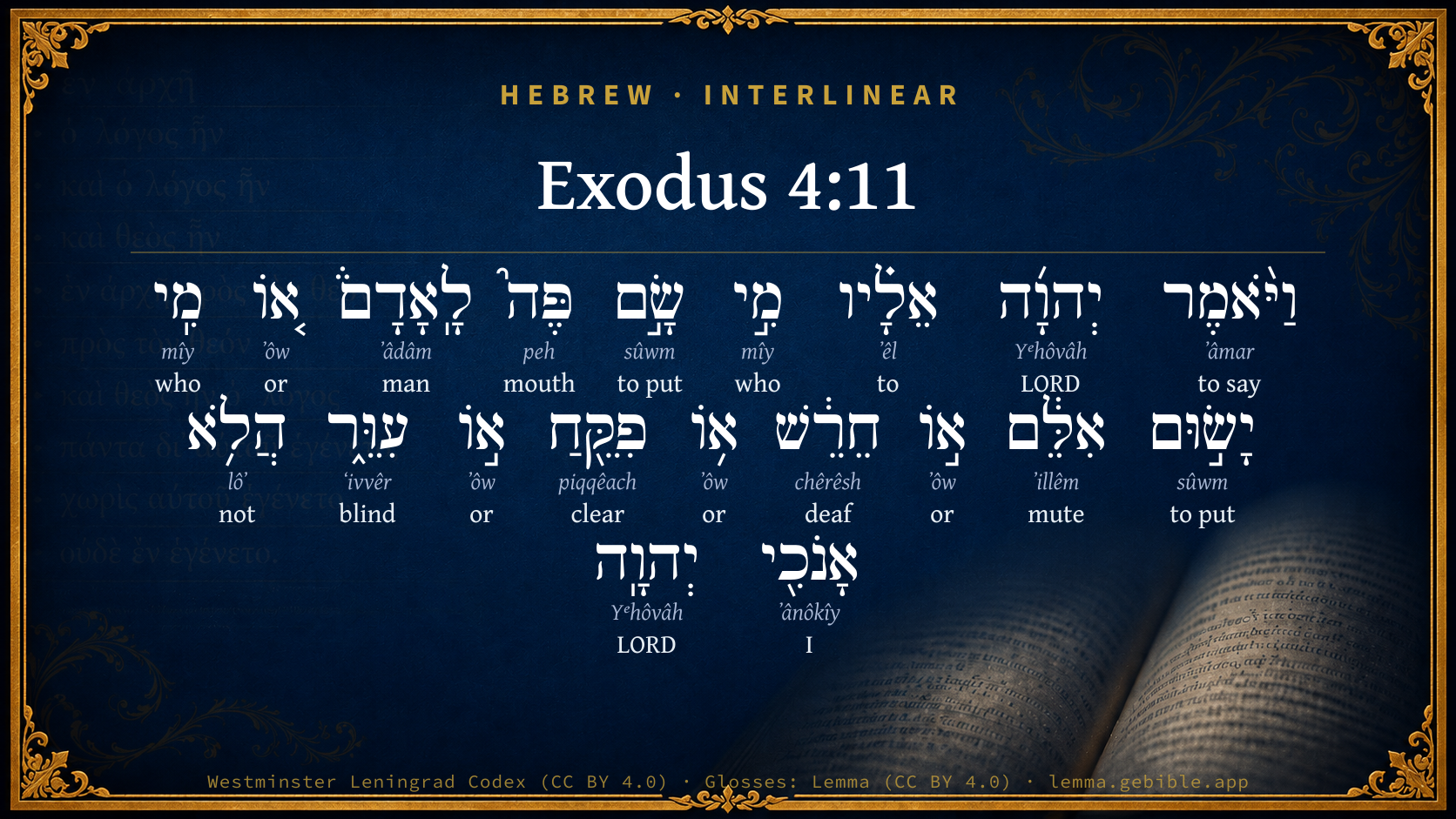
  1. וַיֹּ֨אמֶר ʼâmar H559 “and · to say” Conjunction + Verb, Qal, Sequential Imperfect, 3rd Person, Masculine, Singular
  2. יְהוָ֜ה Yᵉhôvâh H3068 “LORD” Noun, Proper
  3. אֵלָ֗יו ʼêl H413 “to · him” Preposition + Suffix, Personal, 3rd Person, Masculine, Singular
  4. מִ֣י mîy H4310 “who” Particle, Interrogative
  5. שָׂ֣ם sûwm H7760 “to put” Verb, Qal, Perfect, 3rd Person, Masculine, Singular
  6. פֶּה֮ peh H6310 “mouth” Noun, Common, Masculine, Singular, Absolute
  7. לָֽאָדָם֒ ʼâdâm H120 “to/for the · man” Preposition, Determined + Noun, Common, Masculine, Singular, Absolute
  8. א֚וֹ ʼôw H176 “or” Conjunction
  9. מִֽי mîy H4310 “who” Particle, Interrogative
  10. יָשׂ֣וּם sûwm H7760 “to put” Verb, Qal, Imperfect, 3rd Person, Masculine, Singular
  11. אִלֵּ֔ם ʼillêm H483 “mute” Adjective, Adjective, Masculine, Singular, Absolute
  12. א֣וֹ ʼôw H176 “or” Conjunction
  13. חֵרֵ֔שׁ chêrêsh H2795 “deaf” Adjective, Adjective, Masculine, Singular, Absolute
  14. א֥וֹ ʼôw H176 “or” Conjunction
  15. א֣וֹ ʼôw H176 “or” Conjunction
  16. עִוֵּ֑ר ʻivvêr H5787 “blind” Adjective, Adjective, Masculine, Singular, Absolute
  17. הֲלֹ֥א lôʼ H3808 “not” Particle, Interrogative + Particle, Negative
  18. אָנֹכִ֖י ʼânôkîy H595 “I” Pronoun, Personal, 1st Person, Common, Singular
  19. יְהוָֽה Yᵉhôvâh H3068 “LORD” Noun, Proper

About this verse

These counts appear in no published source. They are computed here, from the morphology-tagged text and Lemma’s own curated glosses. What Lemma adds →

20
words
14
distinct lemmas
Pentateuch
section

Notable vocabulary

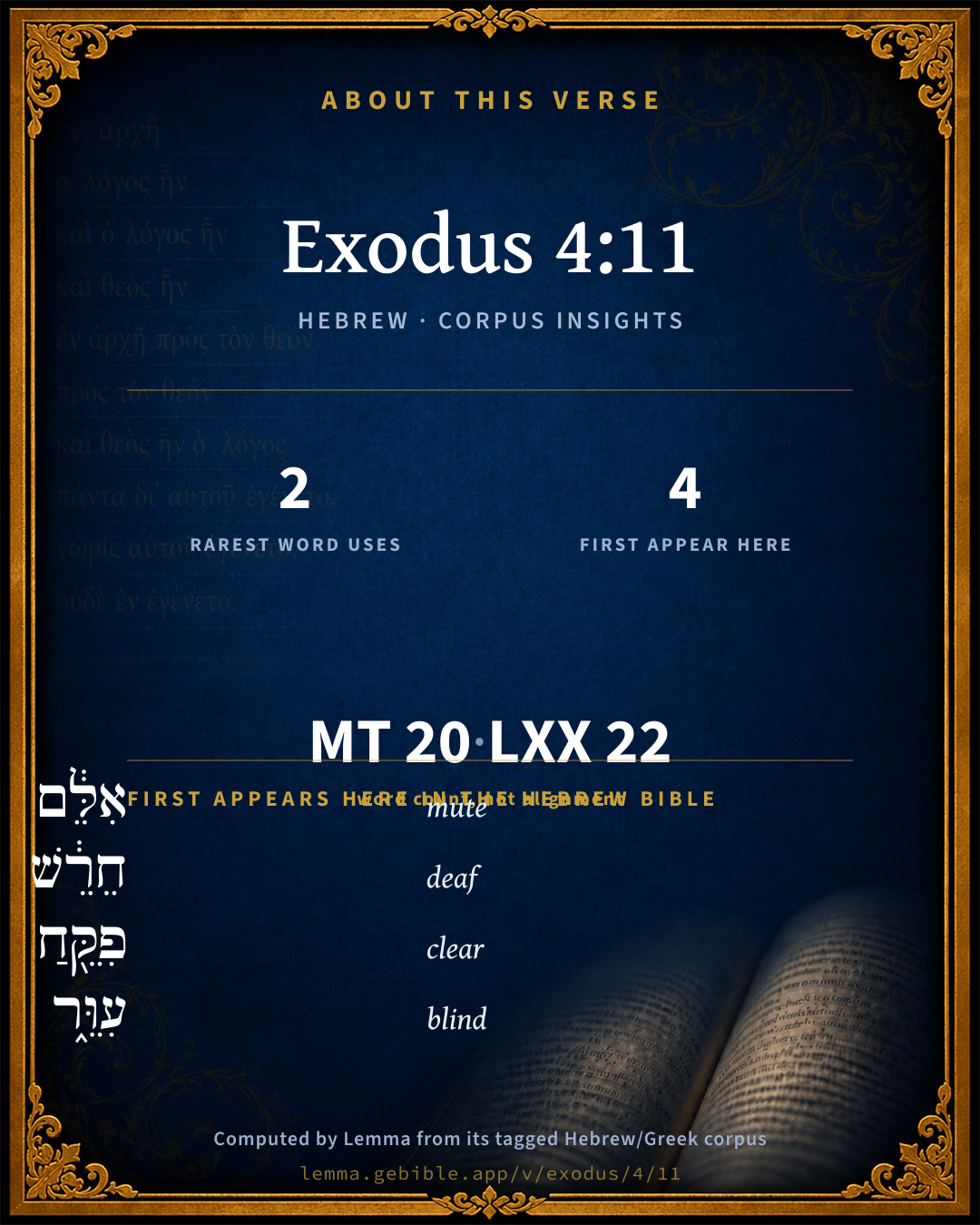
The rarest word here is פִקֵּ֖חַ clear H6493 — appearing just 2 times in the whole Hebrew Bible.

First appearance in Scripture

These words make their first canonical appearance in the Hebrew Bible here:

  • אִלֵּ֔ם mute H483
  • חֵרֵ֔שׁ deaf H2795
  • פִקֵּ֖חַ clear H6493
  • עִוֵּ֑ר blind H5787

Shared distinctive vocabulary

פִקֵּ֖חַ clear H6493 occurs in 2 verses of the Hebrew Bible. Also found in:

Grammatical profile

  • 3 verbs
  • 4 nouns
  • 4 adjectives
  • 1 pronoun
  • 1 preposition
  • 4 conjunctions
  • 3 particles

Verb forms

  • וַיֹּ֨אמֶר Qal · Sequential Imperfect
  • שָׂ֣ם Qal · Perfect
  • יָשׂ֣וּם Qal · Imperfect

Repetition

Words recur within this verse — often emphatic in Hebrew:

  • יְהוָ֜ה LORD H3068 ×2
  • שָׂ֣ם to put H7760 ×2
  • א֚וֹ or H176 ×4
  • מִ֣י who H4310 ×2

Hebrew & Septuagint length

In English translation the verse runs 23 words from the Hebrew and 34 from the Septuagint (LXX English) — the Septuagint runs noticeably longer here. See the side-by-side →

A rough comparison of the two English renderings, which tokenize alike — not a word-level alignment.

Word counts can differ between the Hebrew and the Greek without any difference in meaning — e.g. the Hebrew direct-object marker אֵת has no separate Greek word, and Greek often adds the article ὁ.

In the original languages it is 20 Hebrew tokens and 22 Greek tokens — but the two are counted differently (Hebrew bundles its prefixes and suffixes into one token; the Greek is in lemma form), so that isn’t a like-for-like length.

Cross-references

13

Topical passages linked to Exodus 4:11 in the Treasury of Scripture Knowledge — connected by theme and wording, ordered by reader-vote popularity; previews shown in the World English Bible.

  • Psalms 146:8 Yahweh opens the eyes of the blind. Yahweh raises up those who are bowed down. Yahweh loves the righteous.
  • Ezekiel 3:26–27 and I will make your tongue cleave to the roof of your mouth, that you shall be mute, and shall not be to them a reprover; for they are a rebellious house.
  • Amos 3:6 Does the trumpet alarm sound in a city, Without the people being afraid? Does evil happen to a city, And Yahweh hasn't done it?
  • Psalms 94:9 He who implanted the ear, won't he hear? He who formed the eye, won't he see?
  • Isaiah 6:7 He touched my mouth with it, and said, "Behold, this has touched your lips; and your iniquity is taken away, and your sin forgiven."
  • Psalms 51:15 Lord, open my lips. My mouth shall declare your praise.
  • Jeremiah 1:6 Then said I, Ah, Lord Yahweh! behold, I don't know how to speak; for I am a child.
  • Jeremiah 1:9 Then Yahweh put forth his hand, and touched my mouth; and Yahweh said to me, Behold, I have put my words in your mouth:
  • Genesis 18:14 Is anything too hard for Yahweh? At the set time I will return to you, when the season comes round, and Sarah will have a son."
  • Ezekiel 33:22 Now the hand of Yahweh had been on me in the evening, before he who was escaped came; and he had opened my mouth, until he came to me in the morning; and my mouth was opened, and I was no more mute.
  • Isaiah 42:7 to open the blind eyes, to bring out the prisoners from the dungeon, and those who sit in darkness out of the prison-house.
  • Isaiah 35:5–6 Then the eyes of the blind shall be opened, and the ears of the deaf shall be unstopped.
  • Matthew 11:5 the blind receive their sight, the lame walk, the lepers are cleansed, the deaf hear, the dead are raised up, and the poor have good news preached to them.

Cross-references courtesy of OpenBible.info (CC BY 4.0).

Hebrew and Greek witnesses Masoretic Hebrew ↔ Greek Septuagint

The same verse in the two great witnesses to the Old Testament, shown verse-for-verse.

Here the Septuagint runs noticeably longer than the Hebrew — LXX2012 (modern English Septuagint) 34 words vs World English Bible 23. A rough length comparison of the two English translations, not a word-level alignment — read both below.

These are two independent witnesses, not word-aligned to each other, and the Septuagint is shown in lemma (dictionary) form.

Hebrew Exodus 4:11 Masoretic · Westminster Leningrad Codex

וַיֹּ֨אמֶר יְהוָ֜ה אֵלָ֗יו מִ֣י שָׂ֣ם פֶּה֮ לָֽאָדָם֒ א֚וֹ מִֽי יָשׂ֣וּם אִלֵּ֔ם א֣וֹ חֵרֵ֔שׁ א֥וֹ פִקֵּ֖חַ א֣וֹ עִוֵּ֑ר הֲלֹ֥א אָנֹכִ֖י יְהוָֽה

Yahweh said to him, "Who made man's mouth? Or who makes one mute, or deaf, or seeing, or blind? Isn't it I, Yahweh?

World English Bible · Public Domain

Greek LXX Exodus 4:11 Septuagint · lemma form

εἶπον δέ κύριος πρός μωυσῆς τίς δίδωμι στόμα ἄνθρωπος καί τίς ποιέω δύσκωφος καί κωφός βλέπω καί τυφλός οὐ ἐγώ ὁ θεός

And the Lord said to Moses, Who has given a mouth to man, and who has made the very hard of hearing, and the deaf, the seeing and the blind? have not I, God?

LXX2012 (modern English Septuagint) · Public Domain

Hebrew: Westminster Leningrad Codex (CC BY 4.0). Greek: Septuagint (public domain); English from LXX2012 (modern English Septuagint) (Public Domain). How the Septuagint differs from the Hebrew →

Targum (Aramaic paraphrase)

2

The Targum is the ancient Jewish Aramaic paraphrase of the Hebrew Scriptures — an interpretive translation, not the Hebrew text itself. Onkelos (literal) and Pseudo-Jonathan (expansive) render the Torah, and Jonathan the Prophets. Coverage is partial: where no permissively-licensed English translation exists for a verse, only the Aramaic is shown. This is verse-level text, not a word-by-word alignment to the Hebrew.

  1. Targum Onkelos Torah (Genesis–Deuteronomy)
    וַאֲמַר יְיָ לֵהּ מָן שַׁוִי פּוּמָא לַאֲנָשָׁא אוֹ מָן שַׁוִי אִלְמָא אוֹ חֵרְשָּׁא אוֹ פִקְחָא אוֹ עַוִירָא הֲלָא אֲנָא יְיָ:

    (no public-domain English translation for this verse)

    Targum Onkelos — Aramaic: “Onkelos Genesis” (public domain); “Onkelos Exodus” (public domain); “Onkelos Leviticus” (public domain); “Onkelos Numbers” (public domain); “Onkelos Deuteronomy” (public domain). English: “Sefaria Community Translation” (CC0 1.0 (public-domain dedication)); “J.W. Etheridge. The Targums of Onkelos and Jonathan Ben Uzziel on the Pentateuch. London: Longmans, Green, 1862” (public domain). Text via Sefaria.

  2. Targum Pseudo-Jonathan Torah (Genesis–Deuteronomy)
    וַאֲמַר יְיָ לֵיהּ מַאן הוּא דְשַׁוֵי מַמְלֵל פּוּמָא בְּפוּם אָדָם קַדְמָאִי אוֹ מַאן שַׁוִי אַלִימָא אוֹ חַרְשָׁא אוֹ פִּתִיחָא אוֹ סַמְיָא הֲלָא אֲנָא יְיָ

    And the Lord said, Who is he who first put the language of the mouth into the mouth of man? or who hath appointed the dumb or the deaf, the open-seeing or the blind, but I the Lord?

    Targum Pseudo-Jonathan — Aramaic: “Targum Jonathan on Genesis” (public domain); “Targum Jonathan on Exodus” (public domain); “Targum Jonathan on Leviticus” (public domain); “Targum Jonathan on Numbers” (public domain); “Targum Jonathan on Deuteronomy” (public domain). English: “The Targum of Jonathan ben Uzziel, trans. J. W. Etheridge, London, 1862” (public domain). Text via Sefaria.

Commentary

Notes on Exodus 4:11 from classic Christian and Jewish commentators (each source and its license shown beneath its notes). The classic Christian expositions comment on the surrounding passage and are grouped to its opening verse, so a note may address several verses; the Jewish commentaries on the Tanakh (Rashi and others) are per-verse, so they appear only where the commentator wrote on this verse.

Lemma curates 59 commentaries, every one of them public domain or Creative Commons licensed, each selected and text-cleaned for this edition rather than reprinted as found. About our sources →

Trapp's Complete Commentary

John Trapp

Exo 4:11 And the LORD said unto him, Who hath made man’s mouth? or who maketh the dumb, or deaf, or the seeing, or the blind? have not I the LORD?

Ver. 11. Who hath made man’s mouth?] There is no mouth into which God cannot put fit words. Balaam’s ass was enabled by God to convince his master. Whereas by a man, never so full and fluent, he cannot bring forth his conceptions, without the obstetrication of God’s assistance. {Pro 16:1}

John Trapp, A Commentary or Exposition upon All the Books of the Old and New Testament (1647–1656) — public domain. Text from a community e-Sword module.

Tyndale Open Study Notes

Tyndale Open Resources

4:11 God created the organs of speech and has ordained every person’s particular abilities in this area. He is able to use what he has made and ordained.

Tyndale Open Study Notes — © Tyndale Open Resources, licensed CC BY-SA 4.0. Text via the HelloAO Bible API.

Adam Clarke's Commentary

Verse 11. Who hath made man's mouth? &c.] Cannot he who formed the mouth, the whole organs of speech, and hath given the gift of speech also, cannot he give utterance? God can take away those gifts and restore them again. Do not provoke him: he who created the eye, the ear, and the mouth, hath also made the blind, the deaf, and the dumb.

Adam Clarke's Commentary on the Bible (1810–1826) — public domain. Text from a community e-Sword/MySword module.

Ellicott's Commentary for English Readers

(11) Who maketh.—Rather, hath made.

A Bible Commentary for English Readers, edited by Charles John Ellicott (1878–1897) — public domain. Text from a community e-Sword module.

The Cambridge Bible for Schools and Colleges

gen. ed. J. J. S. Perowne

11. God gives man all his faculties; and therefore, it is implied, can give Moses fluency. The words are spoken in a tone of reproof.

The Cambridge Bible for Schools and Colleges (gen. ed. J. J. S. Perowne; Cambridge University Press, 1878–1918) — public domain. Text from a community e-Sword module.

John Gill's Exposition

And the Lord said unto him, who hath made man's mouth?.... Made that itself, and put in it the power and faculty of speech, even into the mouth of the first man, Adam, as the Targum of Jonathan; and so of every other man, did not the Lord do it? none else could, and therefore he that made it, and made it capable of speaking, could remove any impediments in it, and cause it to speak freely and fluently:

or who maketh the dumb, or deaf, or the seeing, or the blind? have not I, the Lord? as all the senses, and the perfection of them, are from him, so all the imperfections in them are according to his good pleasure; what he suffers to be, and can remedy when he thinks fit: it is he that gives the seeing eye and hearing ear, can and does make blind and deaf, that gives also the speaking mouth, and makes that dumb, and can open it again as he pleases! and what is it that he cannot do?

John Gill's Exposition of the Whole Bible (1746–1763) — public domain (CC PDM 1.0). Text via the HelloAO Bible API.

The Pulpit Commentary

Vers. 11-13. Who hath made man"s mouth! God could and would have cured the defect in Moses" speech, whatever it was; could and would have added eloquence to his other gifts, if he had even at this point yielded himself up unreservedly to his guidance and heartily accepted his mission. Nothing is too hard for the Lord. He gives all powers sight, and hearing, and speech included to whom he will. He would have been "with Moses" mouth," removing all hesitation or indistinctness, and have "taught him what to say supplied the thought and the language by which to express it if Moses would have let him. But the reply in ver. 13 shut up the Divine bounty, prevented its outpour, and left Moses the ineffective speaker which he was content to be. The words, O my Lord, send, I pray thee, by the hand of him whom Thou wilt send, are curt and ungracious; much curter in the original than in our version. They contain a grudging acquiescence. But for the deprecatory particle with which they commence the same as in ver. 10, they would be almost rude. And we see the result in the next verse.

God the Giver of our faculties.

See

1. His power in the creation of them. "Who hath made," etc. Wisdom also.Eyes, ears, organs of speech miracles of contrivance.

2. His goodness in the bestowal of them. A reason for thankfulness.

3. His providence in the deprivation of them. "Who maketh the dumb, ordeaf," etc. A reason for not murmuring.

4. His perfection as mirrored in their functions. "He that planted the ear,shall he not hear? he that formed the eye, shall he not see?". (Psa_94:9) An answer to the objection against positive revelation. He that formed the mouth, shall he not speak? And he that formed the ear, can he not address to it his own message?

5. Lesson His ability to aid us in using them for his glory (ver. 12). J.O.

The Pulpit Commentary (1880–1919), ed. H.D.M. Spence-Jones & Joseph S. Exell — public domain. Text from a community e-Sword module.

Rashi

Rabbi Shlomo Yitzchaki (Rashi)

מי שם פה וגו׳ WHO HATH MADE MAN’S MOUTH etc.? — Who taught you to speak when you were arraigned in judgment before Pharaoh on account of the Egyptian whom you slew?

או מי ישום אלם OR WHO MAKETH THE DUMB — Who made Pharaoh dumb so that he could not insist upon the carrying out of his command to kill you? Who made his ministers deaf so that they could not hear when he gave orders concerning you? And the executioners whose task it was to slay — who made them blind so that they could not see when you fled from the platform (raised place of execution) and escaped? (Midrash Tanchuma, Shemot 10)

הלא אנכי ה' DID NOT I whose name is THE LORD do all this?

Rashi on the Tanakh — English translations: “The Judaica Press complete Tanach with Rashi, translated by A. J. Rosenberg” (CC BY 4.0); “Pentateuch with Rashi's commentary by M. Rosenbaum and A.M. Silbermann, 1929-1934” (public domain); “The Metsudah Tanach series, Lakewood, N.J” (CC BY 4.0); and “The Book of Joshua, Metsudah Publications, 1997” (CC BY 4.0). Text via Sefaria.

Ramban (Nachmanides)

Rabbi Moshe ben Nachman (Ramban / Nachmanides)

WHO HATH MADE MAN’S MOUTH? This is a reference to man’s power of speech because it resides in the mouth. Similarly: Safa echad [literally: “one lip”] (one language); that speak ‘s’fath’ Canaan [literally: “the lip of”] (the language of Canaan).

OR WHO MAKETH A MAN DUMB? Scholars have explained that this refers back to man, meaning: “Who maketh a man that is dumb?” That is to say, “Who has created a man without the capacity of speaking?” “The making” thus refers to the making of man, but as regards the absence of the power of speech, you cannot speak in terms of “making,” for it is non-existence, the lack of the power of speech. Perhaps because man has a speaking soul, and, for people who lack this capacity, it is due to some obstruction in the veins of the tongue, it is then possible to say, “Who made the dumbness?” [since the making of the obstruction required an act]. Now the Rabbi [Moshe ben Maimon] said in the Moreh Nebuchim that it may be said of him who removes a certain property that he produced the absence of that property, for they say of him who puts out the light that he has produced darkness. In accordance with this view, Rambam explains the verse, I form the light and create darkness, I make peace and create evil, [for darkness and evil are non-existent things].

Ramban (Nachmanides) on the Tanakh — English translation: “Commentary on the Torah by Ramban (Nachmanides). Translated and annotated by Charles B. Chavel. New York, Shilo Pub. House, 1971-1976” (CC BY 4.0). Text via Sefaria.

Lesson kit

Teaching starters — assembled from the data on this page, not authored interpretation. Every prompt links to the verse data it draws on. Edit before teaching.

Exodus, in the Pentateuch, opens this verse with 20 words (14 distinct Hebrew lemmas). Its most distinctive word is piqqêach (“clear”). The Greek Septuagint runs longer here. A historical commentator’s framing appears above. Read the whole chapter for the surrounding context.

Discussion questions

  1. What does “clear” (piqqêach) contribute to the verse as a whole?
  2. 4 words here appear for the first time in Scripture. What is being introduced at this debut?
  3. Exodus 23:8 shares the word «clear» with this verse. How do the two illuminate each other?
  4. “LORD” occurs 2× in this one verse. What is the effect of the repetition?
  5. Compared with the Hebrew, the Septuagint runs longer here. What questions does that raise?
  6. The translations on this page render this verse differently — a whole-verse word diff, not a word-by-word alignment. What might account for the different wordings?
  7. The verb «וַיֹּ֨אמֶר» is Qal Sequential Imperfect. How does its form color the action?
  8. Reading how Trapp's Complete Commentary and Tyndale Open Study Notes read this verse, where do the two commentators agree and where do they part?

Things to notice

Reading settings

Reading text

Shown beneath each verse's original-language words.

Old Testament
Old Testament edition

Read the OT as the Masoretic Hebrew (MT) or the Greek Septuagint (LXX).

English shown for the Greek Septuagint (in the Hebrew ↔ Greek comparison).

Comparing translations? Open the Compare panel on any verse page to stack up to four side by side.