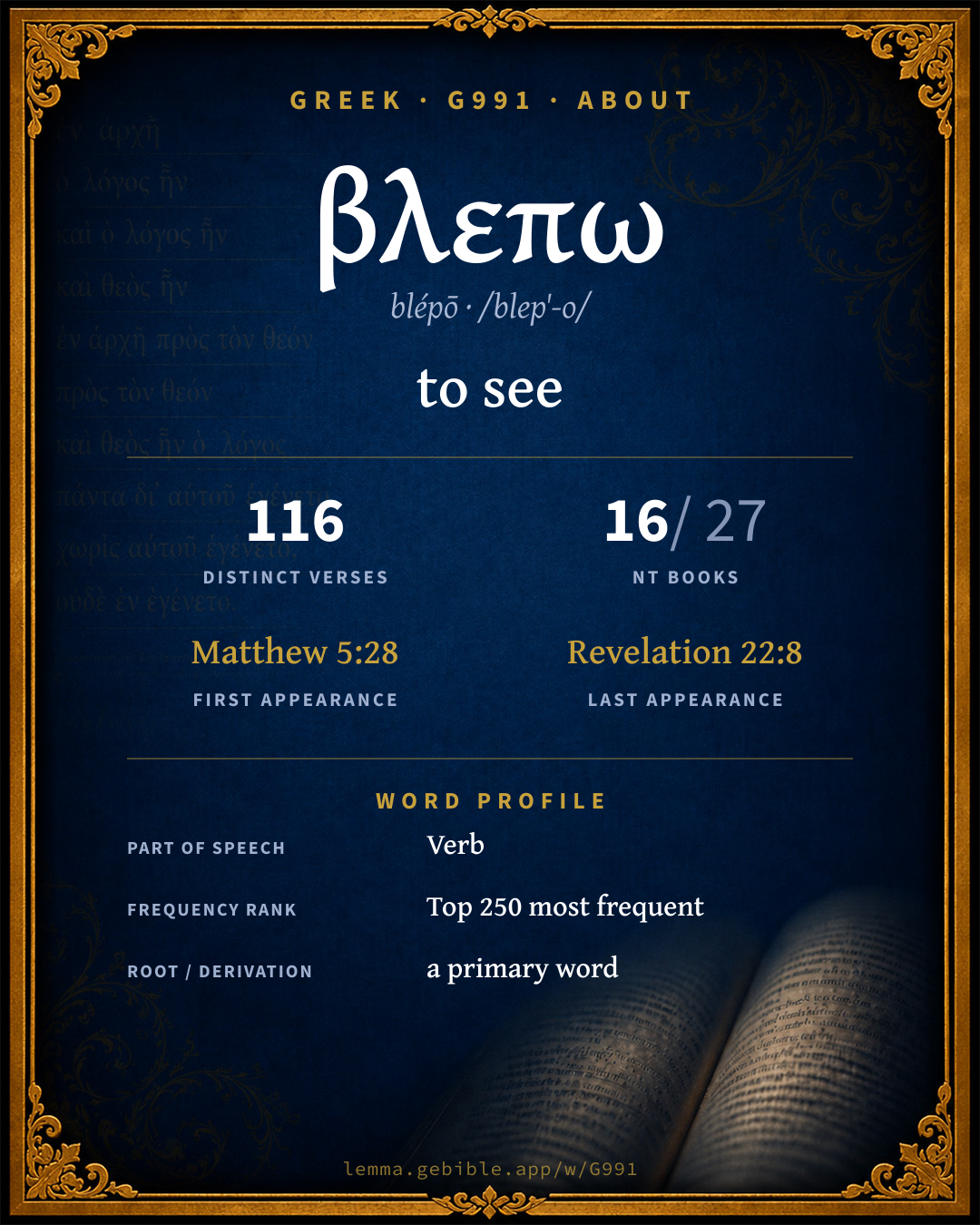
βλέπω
to see
‘to see’ is one of 3 main senses fuller range ↓
Full lexicon entry — Thayer's Greek Lexicon
From Thayer's Greek Lexicon
Where this word appears
Grammar key — what these labels mean
Part of speech
- Verb
- An action or state-of-being word.
Tense
- Present
- Ongoing or general action in present time (imperfective aspect).
- Future
- Action expected in future time.
- Aorist
- Action viewed as a simple whole, without regard to duration — often past (perfective aspect).
- Imperfect
- Continuous or repeated action in past time (“was writing”).
Voice
- Active
- The subject performs the action.
- Passive
- The subject receives the action.
Mood
- Imperative
- Expresses a command or request.
- Participle
- A verbal adjective (“writing,” “having written”).
- Indicative
- States a fact or asks a factual question (the mood of reality).
- Infinitive
- A verbal noun (“to write”), unmarked for person or number.
- Subjunctive
- Expresses probability, purpose, or possibility (the mood of contingency).
Case
- Nominative
- The case of the subject (and the predicate nominative).
- Accusative
- The case of the direct object and of extent.
- Genitive
- The case of source, possession, or “of” — answers “whose / from what.”
Person
- 2nd person
- The one addressed (“you”).
- 3rd person
- The one spoken about (“he / she / it / they”).
- 1st person
- The speaker (“I / we”).
Gender
- Masculine
- Grammatically masculine.
- Neuter
- Grammatically neuter.
- Feminine
- Grammatically feminine.
Number
- Plural
- More than one.
- Singular
- One.
Every verse where G991 appears in the Book of Colossians — 3 distinct verses. Click any verse to open its interlinear word-by-word view. Verse text shown in the World English Bible for context — . Each verse’s Greek form is shown with its reference; the English is not keyword-highlighted, since the data carries no word-level English alignment. Use “Compare translations” on any verse to read it across multiple English versions. This concordance covers the Greek New Testament; Septuagint (Greek Old Testament) occurrences of this word are not indexed here.
Colossians
- Colossians 2:5 βλέπων pres act ptcp nom sg masc For though I am absent in the flesh, yet am I with you in the spirit, rejoicing and seeing your order, and the steadfastness of your faith in Christ.
- Colossians 2:8 βλέπετε pres act impv 2pl Be careful that you don't let anyone rob you through his philosophy and vain deceit, after the tradition of men, after the elements of the world, and not after Christ.
- Colossians 4:17 βλέπε pres act impv 2sg Tell Archippus, "Take heed to the ministry which you have received in the Lord, that you fulfill it."
About this entry
At a glance — auto-summarized from this page’s data, not written by a person. Every figure links to its source below. This summary describes the numbers; it doesn’t interpret them.
βλεπω — transliterated blépō — is a Greek verb carrying the sense “to see.” Its English rendering has broadened — “see” classically, “seeing” (unfoldingWord Literal Text) in modern versions; see the renderings breakdown. Spanning 116 verses in 16 books, it ranks among the common words of the Greek New Testament. Its earliest occurrence is Matthew 5:28. Thayer's distinguishes 3 senses for it. Each statement above links to its evidence; the full detail follows below.
Gloss history
Strong's 1890 vs modern scholarship

About this word
Strong's G991 catalogs a Greek word from the Greek New Testament.
These counts are not copied from any lexicon or concordance. They are computed here, from the morphology-tagged Greek New Testament. What Lemma adds →
- 116
- distinct verses
- The word appears in 116 distinct verses.
- 16 / 27
- NT books
- The word appears in 16 of 27 New Testament books.
- #126
- by frequency
- Top 250 most frequent Greek words (rank 126 of 5,347 Greek words by occurrence).
View all 116 occurrences in the concordance →
By section of the New Testament
By traditional corpus
Conventional, traditional groupings — biblical authorship is debated, so this is a traditional corpus grouping, not an authorship claim. Some books belong to more than one corpus (Luke is in both the Gospels and the Lukan corpus, and so on), so these shares overlap and need not total 100%. Each figure is a share of the word’s 116 distinct verses.
- Gospels 59 verses · 51%
- Johannine 28 verses · 24%
- Lukan (Luke–Acts) 26 verses · 22%
- Pauline corpus 22 verses · 19%
- Revelation 12 verses · 10%
- Hebrews 8 verses · 7%
- General (Catholic) Epistles 2 verses · 2%
How translations render this word
Counts come from each version’s own published word-to-Strong’s tagging or interlinear alignment — an approximate guide to how each version renders this word, not a word-level alignment the data otherwise carries. Because each total is that version’s own tagged count, the per-version totals vary from one another and need not match the appearance or distinct-verse counts above. These counts may also differ from a printed concordance because Lemma counts each distinctly tagged rendering and does not collapse phrase taggings into a single head-word total. This is a fixed set of word-tagged versions (KJV, ASV, BSB, ULT) and does not change with the reading translation you choose elsewhere. Each version’s license is shown beside its name below (and on Sources).
- King James Version: See 19×, Take heed 11×, Seeth 8×
- American Standard Version: See 13×, Seeing 9×, Take heed 9×
- Berean Standard Bible: See 10×, See to it 7×, Seeing 6×
- unfoldingWord Literal Text: Seeing 21×, See 16×, Being seen 7×
King James Version Public Domain
Renders G991 across 146 tagged occurrences — most commonly:
Plus other, less common renderings. Plus 30 renderings that appear only once — usually multi-word phrases or single function words the recovered tagging swept in, not distinct renderings. Not rendered by a distinct English word in 1 further occurrence.
American Standard Version Public Domain
Renders G991 across 142 tagged occurrences — most commonly:
Plus other, less common renderings. Plus 29 renderings that appear only once — usually multi-word phrases or single function words the recovered tagging swept in, not distinct renderings.
Berean Standard Bible Public Domain
Renders G991 across 128 tagged occurrences — most commonly:
Plus other, less common renderings. Plus 43 renderings that appear only once — usually multi-word phrases or single function words the recovered tagging swept in, not distinct renderings. Not rendered by a distinct English word in 4 further occurrences.
unfoldingWord Literal Text CC BY-SA 4.0
Renders G991 across 147 tagged occurrences — most commonly:
Plus other, less common renderings. Plus 27 renderings that appear only once — usually multi-word phrases or single function words the recovered tagging swept in, not distinct renderings.
Senses in Thayer's
The 3 senses Thayer's distinguishes for this word, in lexicon order (not ranked by frequency or importance). The full entry — with sub-senses — is in the Lexicon Entry tab.
- to see, discern, of the bodily eye
- metaph. to see with the mind's eye
- in a geographical sense of places, mountains, buildings, etc. turning towards any quarter, as it were, facing it
Word origin
Origin: a primary word
A primary verb; to look at (literally or figuratively): - behold beware lie look (on to) perceive regard see sight take heed. Compare G3700 .
— Strong’s Exhaustive Concordance (1890), public domain.
Forms in the corpus
The 27 distinct written forms G991 takes in the Greek New Testament, most frequent first — each parse links to that tense’s occurrences in the concordance.
Same root — word family
Other Thayer's entries built from the same root as G991, grouped by Strong’s listed origin. These share a root / origin per the lexicon — not necessarily a shared meaning. Each links to that word’s own entry.
Derived from this word
Compare all same-root words → They share a root, not necessarily a meaning.
Septuagint usage
The same Greek word βλεπω appears 108 times in the Greek Old Testament (Septuagint), across 97 verses in 27 books.
- 108
- LXX occurrences
- Tagged occurrences of this Greek word in the Septuagint.
- 97
- verses
- Distinct Septuagint verses containing this word.
- 27 / 39
- OT books
- The word appears in 27 of the 39 Old Testament books.
Sample Septuagint occurrences
- Genesis 45:12 βλέπω
- Exodus 4:11 βλέπω
- Numbers 21:20 βλέπω
- Deuteronomy 4:34 βλέπω
- Joshua 18:14 βλέπω
- Judges 9:36 βλέπω
- 1 Samuel 3:2 βλέπω
- 2 Samuel 14:24 βλέπω
- 1 Kings 1:48 βλέπω
- 2 Kings 2:19 βλέπω
- 1 Chronicles 9:22 βλέπω
- 2 Chronicles 4:4 βλέπω
Septuagint occurrences (same lexeme)
Every verse where the same Strong’s number (G991) appears in the Greek Septuagint — showing the first 50 of 97. Verse text shown in the World English Bible for context; the Greek form is the matched word — the English is not keyword-highlighted.
- Genesis 45:12 βλέπω Behold, your eyes see, and the eyes of my brother Benjamin, that it is my mouth that speaks to you.
- Genesis 48:10 βλέπω Now the eyes of Israel were dim for age, so that he couldn't see. He brought them near to him; and he kissed them, and embraced them.
- Exodus 4:11 βλέπω Yahweh said to him, "Who made man's mouth? Or who makes one mute, or deaf, or seeing, or blind? Isn't it I, Yahweh?
- Exodus 23:8 βλέπω You shall take no bribe, for a bribe blinds those who have sight and perverts the words of the righteous.
- Numbers 21:20 βλέπω and from Bamoth to the valley that is in the field of Moab, to the top of Pisgah, which looks down on the desert.
- Deuteronomy 4:34 βλέπω Or has God tried to go and take him a nation from the midst of [another] nation, by trials, by signs, and by wonders, and by war, and by a mighty hand, and by an outstretched arm, and by great terrors, according to all that Yahweh your God did for you in Egypt before your eyes?
- Deuteronomy 28:32 βλέπω Your sons and your daughters shall be given to another people; and your eyes shall look, and fail with longing for them all the day: and there shall be nothing in the power of your hand.
- Deuteronomy 28:34 βλέπω so that you shall be mad for the sight of your eyes which you shall see.
- Deuteronomy 29:3 βλέπω the great trials which your eyes saw, the signs, and those great wonders:
- Joshua 18:14 βλέπω The border extended [there], and turned about on the west quarter southward, from the mountain that lies before Beth Horon southward; and the goings out of it were at Kiriath Baal (the same is Kiriath Jearim), a city of the children of Judah: this was the west quarter.
- Judges 9:36 βλέπω When Gaal saw the people, he said to Zebul, Behold, there come people down from the tops of the mountains. Zebul said to him, You see the shadow of the mountains as if they were men.
- Judges 13:19 βλέπω So Manoah took the kid with the meal-offering, and offered it on the rock to Yahweh: and [the angel] did wondrously, and Manoah and his wife looked on.
- Judges 13:20 βλέπω For it happened, when the flame went up toward the sky from off the altar, that the angel of Yahweh ascended in the flame of the altar: and Manoah and his wife looked on; and they fell on their faces to the ground.
- Judges 19:30 βλέπω It was so, that all who saw it said, There was no such deed done nor seen from the day that the children of Israel came up out of the land of Egypt to this day: consider it, take counsel, and speak.
- 1 Samuel 3:2 βλέπω It happened at that time, when Eli was laid down in his place (now his eyes had begun to grow dim, so that he could not see),
- 1 Samuel 4:15 βλέπω Now Eli was ninety-eight years old; and his eyes were set, so that he could not see.
- 1 Samuel 9:9 βλέπω (In earlier times in Israel, when a man went to inquire of God, thus he said, Come, and let us go to the seer; for he who is now called a Prophet was before called a Seer.)
- 1 Samuel 9:11 βλέπω As they went up the ascent to the city, they found young maidens going out to draw water, and said to them, Is the seer here?
- 1 Samuel 9:18 βλέπω Then Saul drew near to Samuel in the gate, and said, Tell me, Please, where the seer's house is.
- 1 Samuel 16:4 βλέπω Samuel did that which Yahweh spoke, and came to Bethlehem. The elders of the city came to meet him trembling, and said, Come you peaceably?
- 1 Samuel 25:35 βλέπω So David received of her hand that which she had brought him: and he said to her, Go up in peace to your house; behold, I have listened to your voice, and have accepted your person.
- 1 Samuel 26:12 βλέπω So David took the spear and the jar of water from Saul's head; and they got them away: and no man saw it, nor knew it, neither did any awake; for they were all asleep, because a deep sleep from Yahweh was fallen on them.
- 2 Samuel 14:24 βλέπω The king said, Let him turn to his own house, but let him not see my face. So Absalom turned to his own house, and didn't see the king's face.
- 1 Kings 1:48 βλέπω Also thus said the king, Blessed be Yahweh, the God of Israel, who has given one to sit on my throne this day, my eyes even seeing it.
- 1 Kings 12:24 βλέπω Thus says Yahweh, You shall not go up, nor fight against your brothers the children of Israel: return every man to his house; for this thing is of me. So they listened to the word of Yahweh, and returned and went their way, according to the word of Yahweh.
- 1 Kings 17:23 βλέπω Elijah took the child, and brought him down out of the chamber into the house, and delivered him to his mother; and Elijah said, Behold, your son lives.
- 2 Kings 2:19 βλέπω The men of the city said to Elisha, Behold, we pray you, the situation of this city is pleasant, as my lord sees: but the water is bad, and the land miscarries.
- 2 Kings 9:17 βλέπω Now the watchman was standing on the tower in Jezreel, and he spied the company of Jehu as he came, and said, I see a company. Joram said, Take a horseman, and send to meet them, and let him say, Is it peace?
- 1 Chronicles 9:22 βλέπω All these who were chosen to be porters in the thresholds were two hundred and twelve. These were reckoned by genealogy in their villages, whom David and Samuel the seer did ordain in their office of trust.
- 1 Chronicles 21:3 βλέπω Joab said, Yahweh make his people a hundred times as many as they are: but, my lord the king, aren't they all my lord's servants? why does my lord require this thing? why will he be a cause of guilt to Israel?
- 1 Chronicles 29:29 βλέπω Now the acts of David the king, first and last, behold, they are written in the history of Samuel the seer, and in the history of Nathan the prophet, and in the history of Gad the seer,
- 2 Chronicles 4:4 βλέπω It stood on twelve oxen, three looking toward the north, and three looking toward the west, and three looking toward the south, and three looking toward the east: and the sea was set on them above, and all their hinder parts were inward.
- 2 Chronicles 5:9 βλέπω The poles were so long that the ends of the poles were seen from the ark before the oracle; but they were not seen outside: and there it is to this day.
- 2 Chronicles 10:16 βλέπω When all Israel saw that the king didn't listen to them, the people answered the king, saying, What portion have we in David? neither have we inheritance in the son of Jesse: every man to your tents, Israel: now see to your own house, David. So all Israel departed to their tents.
- Ezra 12:17 βλέπω
- Esther 2:15 βλέπω Now when the turn of Esther, the daughter of Abihail the uncle of Mordecai, who had taken her for his daughter, was come to go in to the king, she required nothing but what Hegai the king's chamberlain, the keeper of the women, appointed. Esther obtained favor in the sight of all those who looked at her.
- Job 10:4 βλέπω Do you have eyes of flesh? Or do you see as man sees?
- Psalms 9:32 βλέπω
- Psalms 9:35 βλέπω
- Psalms 39:13 βλέπω Oh spare me, that I may recover strength, Before I go away, and be no more."
- Psalms 68:24 βλέπω They have seen your processions, God, Even the processions of my God, my King, into the sanctuary.
- Proverbs 4:25 βλέπω Let your eyes look straight ahead. Fix your gaze directly before you.
- Proverbs 12:13 βλέπω An evil man is trapped by sinfulness of lips, But the righteous shall come out of trouble.
- Proverbs 16:21 βλέπω The wise in heart shall be called prudent. Pleasantness of the lips promotes instruction.
- Ecclesiastes 8:16 βλέπω When I applied my heart to know wisdom, and to see the business that is done on the earth (for also there is that neither day nor night sees sleep with his eyes),
- Ecclesiastes 11:4 βλέπω He who observes the wind won't sow; And he who regards the clouds won't reap.
- Ecclesiastes 11:7 βλέπω Truly the light is sweet, And a pleasant thing it is for the eyes to see the sun.
- Ecclesiastes 12:3 βλέπω In the day when the keepers of the house shall tremble, And the strong men shall bow themselves, And the grinders cease because they are few, And those who look out of the windows are darkened,
- Song of Solomon 1:6 βλέπω Don't stare at me because I am dark, Because the sun has scorched me. My mother's sons were angry with me. They made me keeper of the vineyards. I haven't kept my own vineyard.
- Isaiah 6:9 βλέπω He said, "Go, and tell this people, 'You hear indeed, But don't understand; And you see indeed, But don't perceive.'
These are occurrences of the same Greek lexeme (G991) in the Septuagint — not a translation of any one Hebrew word. The store carries no word-level Hebrew↔Greek alignment, so no Hebrew original is asserted here. Counts come from the recovered LXX Strong's tagging — high-frequency vocabulary is well covered, while rare or late forms may be untagged — so they reflect tagged occurrences and may slightly undercount.