

Psalms 39:13

Hebrew (Westminster Leningrad Codex) Psalms 39:13 appears in the Hebrew Old Testament. The text above is from the Westminster Leningrad Codex. Each word links to its Strong’s number, a concise gloss, and parsing drawn from the Open Scriptures Hebrew Bible morphology. Click any word for its full Brown-Driver-Briggs (BDB) entry.
Download image
Cite this verse

Psalms 39:13 (World English Bible). Public Domain. Lemma interlinear Bible study tool, https://lemma.gebible.app/v/psalms/39/13.

Show BibTeX & RIS
BibTeX
RIS
English Translation
Oh spare me, that I may recover strength, Before I go away, and be no more."
World English Bible · Public Domain
Download a study sheet

One document with this verse’s original text, its word-by-word gloss line, the meaning frame, cross-references with their text, attributed commentary, and full source and license credits — printable, and it pastes into notes with its structure intact.

This verse Autodidact and up

Study sheet (.html) Plain text (.txt)

A passage Seminary Student

Up to 50 verses in one chapter. A passage sheet keeps up to 6 commentary sources and 12 cross-references per verse, in the order this page ranks them, and says so on the sheet whenever that leaves anything out. Ask for a single verse and you get the Autodidact verse sheet above.

Everything on this page stays free to read, with no account — the sheet is a download of what is already on screen, not access to it.

Want to remove ads? Support Godless Engineer
Compare translations 3

The same verse in 3 English versions, stacked beneath the original-language interlinear above. Click any original word for its lexicon entry.

Each is an independent rendering of the whole verse — the interlinear is not word-aligned to these translations.

Highlighted words mark where these versions differ — a whole-verse word diff, not a word-by-word alignment.

  • World English Bible Public Domain
    Oh spare me, that I may recover strength, Before I go away, and be no more."
  • King James Version Public Domain
    O spare me, that I may recover strength, before I go hence, and be no more.
  • unfoldingWord Literal Text CC BY-SA 4.0
    Look away from me that I may be cheerful before I go and I am no more.”

unfoldingWord Literal Text — © unfoldingWord, licensed CC BY-SA 4.0. Word-aligned USFM3 via Door43 (git.door43.org/unfoldingWord/en_ult).

Versions to compare (up to 4)

3 of 4 selected

Show all 18 translations

Every available English version of this verse, each an independent rendering of the whole verse.

  • World English Bible Public Domain
    Oh spare me, that I may recover strength, Before I go away, and be no more."
  • Berean Standard Bible Public Domain
    Turn Your gaze away from me, that I may again be cheered before I depart and am no more.”
  • Majority Standard Bible Public Domain
    Turn Your gaze away from me, that I may again be cheered before I depart and am no more.”
  • King James Version Public Domain
    O spare me, that I may recover strength, before I go hence, and be no more.
  • American Standard Version (1901) Public Domain
    Oh spare me, that I may recover strength, Before I go hence, and be no more. Psalm 40 For the Chief Musician. A Psalm of David.
  • Revised Version (1885) Public Domain
    O spare me, that I may recover strength, before I go hence, and be no more.
  • Geneva Bible (1599) Public Domain
    Stay thine anger from me, that I may recouer my strength, before I go hence and be not.
  • Douay-Rheims (1899) Public Domain
    Hear my prayer, O Lord, and my supplication: give ear to my tears. Be not silent: for I am a stranger with thee, and a sojourner as all my fathers were.
  • Young's Literal Translation Public Domain
    Look from me, and I brighten up before I go and am not!
  • Literal Standard Version CC BY-SA 4.0
    Look from me, and I brighten up before I go and am not!
  • Unlocked Literal Bible CC BY-SA 4.0
    Turn your gaze from me so that I may smile again before I die.”
  • unfoldingWord Literal Text CC BY-SA 4.0
    Look away from me that I may be cheerful before I go and I am no more.”
  • Darby Bible Public Domain
    Look away from me, and let me recover strength, before I go hence and be no more.
  • World Messianic Bible Public Domain
    Oh spare me, that I may recover strength, before I go away and exist no more.”
  • Webster's Bible Public Domain
    \\39:12\\Hear my prayer, O LORD, and give ear to my cry; hold not thy peace at my tears: for I am a stranger with thee, and a sojourner, as all my fathers were.
  • Free Bible Version CC BY-SA 4.0
    Please leave me alone so I can be cheerful again, before I am dead and gone.
  • Bible in Basic English Public Domain
    Let your wrath be turned away from me, so that I may be comforted, before I go away from here, and become nothing.
  • JPS Tanakh (1917) Public Domain
    (39-14) Look away from me, that I may take comfort, before I go hence, and be no more.'

Literal Standard Version (2020), Covenant Press — licensed CC BY-SA 4.0. Text via the HelloAO Bible API (eBible.org). Unlocked Literal Bible (unfoldingWord) — licensed CC BY-SA 4.0. Text via the HelloAO Bible API (eBible.org). unfoldingWord Literal Text — © unfoldingWord, licensed CC BY-SA 4.0. Word-aligned USFM3 via Door43 (git.door43.org/unfoldingWord/en_ult). Free Bible Version, Dr. Jonathan Gallagher — licensed CC BY-SA 4.0. Text via the HelloAO Bible API (eBible.org).

Word by word

More ways to search: Search by grammar → Find every occurrence → Compare this word →

Practice this passage: Drill this verse → Learn its vocabulary →

About this verse

These counts appear in no published source. They are computed here, from the morphology-tagged text and Lemma’s own curated glosses. What Lemma adds →

6
words
6
distinct lemmas
Wisdom
section

Notable vocabulary

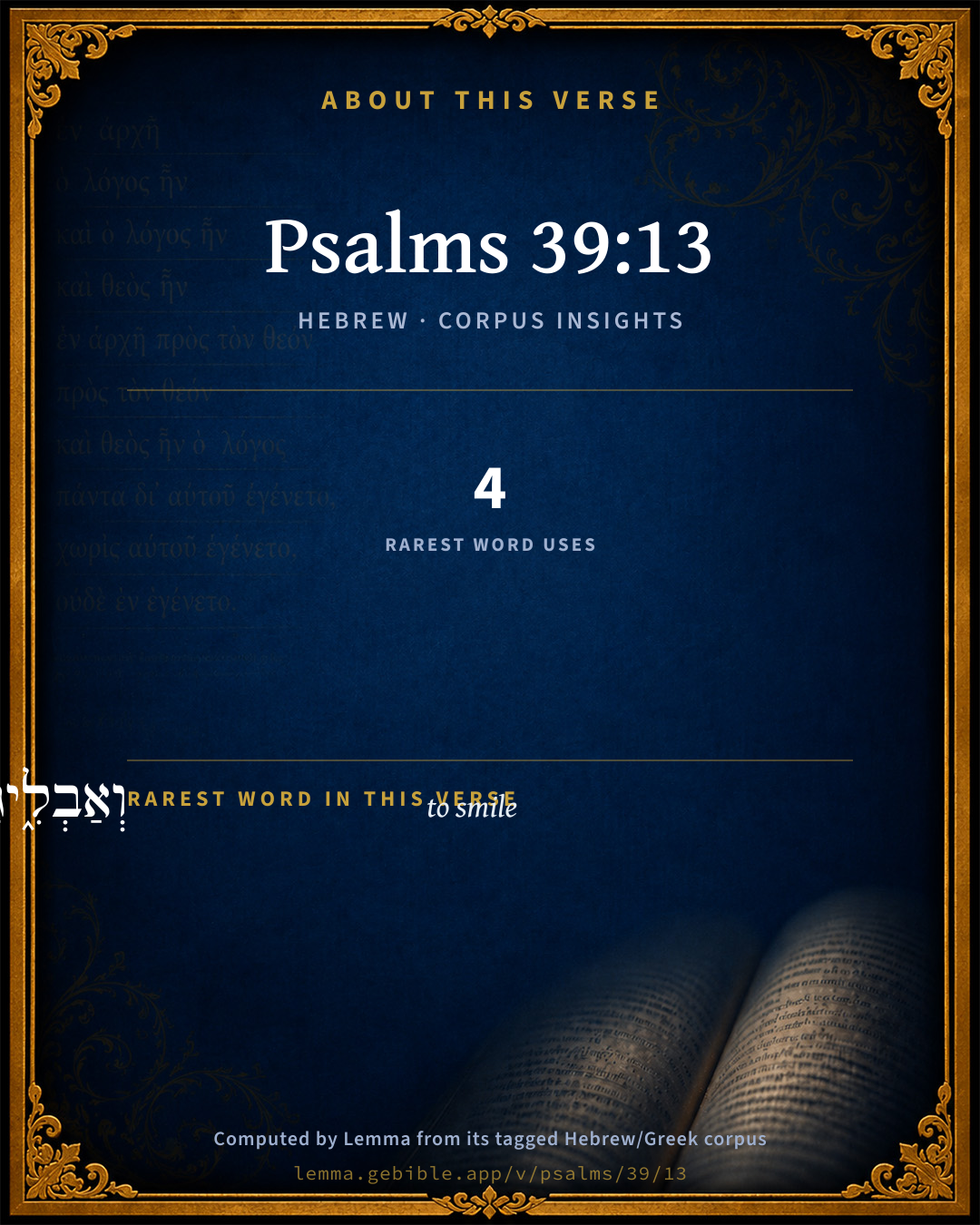
The rarest word here is וְאַבְלִ֑יגָה to smile H1082 — appearing just 4 times in the whole Hebrew Bible.

Shared distinctive vocabulary

וְאַבְלִ֑יגָה to smile H1082 occurs in 4 verses of the Hebrew Bible. Also found in:

Grammatical profile

  • 3 verbs
  • 1 preposition
  • 1 adverb
  • 1 particle

Verb forms

  • הָשַׁ֣ע Hiphil · Imperative
  • וְאַבְלִ֑יגָה Hiphil · Cohortative
  • אֵלֵ֣ךְ Qal · Imperfect

Hebrew & Septuagint length

In English translation the verse runs 16 words from the Hebrew and 14 from the Septuagint (LXX English) — closely comparable.

A rough comparison of the two English renderings, which tokenize alike — not a word-level alignment.

Word counts can differ between the Hebrew and the Greek without any difference in meaning — e.g. the Hebrew direct-object marker אֵת has no separate Greek word, and Greek often adds the article ὁ.

Cross-references

6

Topical passages linked to Psalms 39:13 in the Treasury of Scripture Knowledge — connected by theme and wording, ordered by reader-vote popularity; previews shown in the World English Bible.

  • Job 10:20–21 Aren't my days few? Cease then, Leave me alone, that I may find a little comfort,
  • Job 14:5–6 Seeing his days are determined, The number of his months is with you, And you have appointed his bounds that he can't pass;
  • Job 14:10–12 But man dies, and is laid low. Yes, man gives up the spirit, and where is he?
  • Job 7:19 How long will you not look away from me, Nor leave me alone until I swallow down my spittle?
  • Genesis 5:24 Enoch walked with God, and he was not, for God took him.
  • Genesis 42:36 Jacob, their father, said to them, "You have bereaved me of my children! Joseph is no more, Simeon is no more, and you want to take Benjamin away. All these things are against me."

Cross-references courtesy of OpenBible.info (CC BY 4.0).

Hebrew and Greek witnesses Masoretic Hebrew ↔ Greek Septuagint

The same verse in the two great witnesses to the Old Testament, shown verse-for-verse.

You’re reading Greek Psalm 38 (Hebrew Psalm 39). The Septuagint counts the superscription, so verse numbers can differ from the Hebrew — chapter-level alignment, not verse-by-verse. Numbering follows Rahlfs.

These are two independent witnesses, not word-aligned to each other, and the Septuagint is shown in lemma (dictionary) form.

Hebrew Psalms 39:13 Masoretic · Westminster Leningrad Codex

הָשַׁ֣ע מִמֶּ֣נִּי וְאַבְלִ֑יגָה בְּטֶ֖רֶם אֵלֵ֣ךְ וְאֵינֶֽנִּי

Oh spare me, that I may recover strength, Before I go away, and be no more."

World English Bible · Public Domain

Greek LXX Greek Psalm 38:13 Septuagint · lemma form

εἰςἀκούω ὁ προσευχή ἐγώ κύριος καί ὁ δέησις ἐγώ ἐνὠτίζομαι ὁ δάκρυ ἐγώ μή παρασιωπάω ὅτι πάροικος ἐγώ εἰμί παρά σύ καί παρεπίδημος καθώς πᾶς ὁ πατήρ ἐγώ

Spare me, that I may be refreshed, before I depart, and be no more.

LXX2012 (modern English Septuagint) · Public Domain

Hebrew: Westminster Leningrad Codex (CC BY 4.0). Greek: Septuagint (public domain); English from LXX2012 (modern English Septuagint) (Public Domain). How the Septuagint differs from the Hebrew →

Commentary

Notes on Psalms 39:13 from classic Christian and Jewish commentators (each source and its license shown beneath its notes). The classic Christian expositions comment on the surrounding passage and are grouped to its opening verse, so a note may address several verses; the Jewish commentaries on the Tanakh (Rashi and others) are per-verse, so they appear only where the commentator wrote on this verse.

Lemma curates 59 commentaries, every one of them public domain or Creative Commons licensed, each selected and text-cleaned for this edition rather than reprinted as found. About our sources →

Trapp's Complete Commentary

John Trapp

Psa 39:13 O spare me, that I may recover strength, before I go hence, and be no more.

Ver. 13. O spare me, that I may recover strength] Ut refociller, reficiar. Job maketh the like request, Job 10:20. Some breathing while they would have, and a time to recollect themselves, before that last, great encounter. They say in effect, Differ, habent parvae commoda magna morae.

Before I go hence, and be no more] No more seen among men. It is said that Richard III caused the dead corpses of his two smothered nephews to be closed in lead, and so put in a coffin full of holes, and hooked at the ends with two hooks of iron; and so be cast into a place called the Black Deeps, at the Thames’ mouth, whereby they should never rise up nor be any more seen. "Joseph is not, and Simeon is not," Gen 42:36. The righteous perish, Isa 57:1. When once I go hence, saith David here, viz. to my long home, Ecc 12:5, there will be a Non ego, an end of me and to this world; wherefore I beg a little respite.

Sοι μεν τουτο, Yεε, σμικρον, εμοι δε μεγα.

John Trapp, A Commentary or Exposition upon All the Books of the Old and New Testament (1647–1656) — public domain. Text from a community e-Sword module.

The Biblical Illustrator

Joseph S. Exell

Psa_39:13

O spare me, that I may recover strength, before I go hence and be no more!

A prayer in the prospect of death

I.

A departure anticipated. Death is clearly referred to, not annihilation. The text suggests the idea of departure--going hence. A traveller departs from an inn at which he has been refreshed; he pursues his journey, and reaches home. A mariner departs from the port at which he has touched; he completes his voyage, and arrives at the desired haven, Also, death is a going hence from present employments, and from present connections, trials, privileges, enjoyments, prospects.

II. The prayer presented. Here is implied a state of weakness--probably of the body. Or it may refer to political weakness.:But yet, more probably it refers to the state of the mind, its depression and declension. Hence he prays that his spiritual strength may be revived. No health is comparable to this in importance. Many are the motives which should lead us thus to pray.

1. Our safety.

2. Our comfort.

3. Activity.

4. Usefulness. Take notice of a man who has lost the power and spirit of religion; of what use is he in his family? He may have natural affection, and may be attentive to the temporal welfare of his connections; but in what does he benefit their souls? Of what use is this man in the church? He calls himself a member; his name is entered among those who have given themselves to the Lord and to one another, according to his will; but where is his zeal for the interest of the church? Would you be useful, as well as active and happy? You must feel the power of genuine religion; you must experience its vigour and its growth. O spare me, that I may, etc.

5. Your dying well pleads for this prayer. Many professors of religion die in a very doubtful way; others give real cause to fear that all is not well; but mark the perfect man, and behold the upright; for the end of this man is peace. It may not be triumph, though in some instances this is the case; but it is tranquil and happy.

III. Conclusion.

1. Death is certain--then prepare for it.

2. Live to some good purpose. What is life unless lived to some good purpose? Remember we are Christs, bought with a price. Therefore, let us in life and death seek to glorify Him. (T. Kidd.)

Davids view of the grave

The true mask of the Christian is in his solitary prayer. What men are before others does not say much, but it is when alone that their true character is revealed. But godly men vary much in their experiences, and here in this psalm we find many mingled feelings.

I. An affecting illustration of death. It is a going hence. This true of all. It is not a lonely path, but a highway open to all passengers, and along which all must go. And the traffic is continuous, uninterrupted. And the pace is swift. Swifter than a weavers shuttle, said Job. The wind passeth over it and it is gone. And our going this way is certain and unavoidable. The king of terrors hath no heart nor ears! From his arrest no state of eminence can screen us; and his summons no greatness can control. The added term, going hence, gives the idea that it is no short journey, or a near remove; but that he is going distantly, and beyond all ordinary space! And this going hence is for ever--no more seen. Not that David believed that the soul perished. He knew the contrary. He spake of this world only. And at death we do go hence, and are no more seen in the world!--whether the senator, the statesman, the teacher, the orator, the poet, the merchant. In his family, and in the church. And more especially is the text true of sinners (Psa_37:36-37.)

II. The avowed desire in consequence--O spare me, etc. Now, our strength consists in--

1. Clear evidence of our state.

2. Habitual readiness.

3. A recovery of strength.

III. Wherefore he thus prays--

1. From natural desire.

2. Nervous feeling.

3. Spiritual decay.

4. For greater good and better service.

Now, let the sinner use this prayer. The backslider. The spiritual, for themselves and others. (W. B. Williams, A. M.)

Death

The consideration that at death we are to go from hence, so as to be here no more, is that which makes life upon earth of the greatest moment, and what even good men may sometimes pray to have continued a while longer, that they may be better prepared for their everlasting remove. This the psalmist here does, from the consideration mentioned; having but one life wherein to prepare for an endless state, how earnest was he that it might not conclude till his work was finished, as it was to be done now or never.

I. The notion under, which death is represented, a going hence.

II. How, when once gone, we are to be no more.

III. Wherein our strength lies for going hence.

IV. How much we are concerned to pray that god would spare us, to get or recover strength preparatory to our final remove.

V. That this is the great thing good men have in their eye in desiring life,

VI. When they may be led to pray that God would spare them.

VII. The use of the whole. (D. Wilcox.)

Prayer for prolongation of life

The believer is not at all times blessed with a spiritual and happy frame of mind, at least not in an equal degree; for there are times when sin lies heavy upon his heart. No wonder, then, if he cries out, when death knocks at the door, Oh, spare me, etc.

I. Illustrate the passage.

1. Death is represented as a going hence, or departing from this world--out of time into eternity.

2. When persons go hence, they are said to be no more.

3. Death is often, even to good men, an object of fear and dread. Those who are tired of the wilderness, and long to see the goodly mountain and Lebanon, would nevertheless wish, if possible, to avoid the Jordan that lies between.

4. Where this fear becomes immoderate, it is criminal, and highly unbecoming the Christian character. Are we not willing to be at rest, to be at home in our Fathers house?

5. Yet this is not all he prays for, but that he may recover strength before he goes hence, and be no more. This may include the recovery of natural strength, or that he might be raised from his present infirm and languishing state; and such a prayer was offered by Job. But however desirable a revival of bodily strength may be, spiritual strength is still more so; and the prayer of a good man must be supposed to include both. This recovery of strength may embrace--

(1) A more eminent degree of spirituality and devotedness to God.

(2) Assurance of an interest in the Divine favour.

II. Apply the subject to ourselves.

1. If death be so dreadful to the righteous, what must it be to the wicked and ungodly. Their roots are so fastened in the earth, and their affections so firmly fixed on sensible objects, that it is no wonder they should start, back at the thoughts of dying.

2. Let Christians feel humbled and ashamed that their inordinate love of life should render death so formidable. Have you not forsaken all for Christ; and will you not forsake life itself for him? (B. Beddome, M. A.)

Death deprecated

1. Death is an event of dread significance.

I. It puts an end to our present mode of being. How the change is to be brought about; and what your experiences will be at the awful moment of transition, and afterwards, no mortal man can tell. No wonder, therefore, if in thought of these things your courage sinks, and you cry, O spare me.

2. It, separates us from all we hold dear on earth. Go hence. After all, this world is very dear to us. Here we were born. Here our minds have been formed, and our characters developed. Here we have tasted all the delights of knowledge, of friendship, and of personal achievement.

3. It settles for ever our spiritual destiny.

II. Good men sometimes shrink from death under a sense of weakness and unpreparedness. There are instances of good men who were prepared and ready to die. But such a state of mind is rare and inconstant. The best of men have their times of misgiving, as well as their moments of exulting faith. Doubting Castle and the Valley of the Shadow of Death lie in the pilgrims path, as well as the Delectable Mountains.

1. Strength is needed to face death with fortitude.

2. Strength is lost through sin (Psa_31:10; Isa_59:1-2).

3. Strength may be recovered if sought in due time.

III. Is the souls darkest hour God is a sufficient refuge.

1. He is the Lord of life (1Sa_2:6; Job_12:10; Job_14:5-6; Rev_1:18).

2. He is very pitiful, and of tender mercy (Psa_103:8; Psa_103:13; Eze_33:11).

3. He is mighty to save. (W. Forsyth, M. A.)

Prayer for recovery

When we thank God for our creation and preservation, we are true to an instinct which is rarely overpowered. We shrink from death just as the psalmist shrank from it, who, if he did net regard it as the end of all things, only dimly conjectured of a life to come. We shrink from death, and therefore from that which is wont to herald its approach, the loss of health, the decline of strength. True, there are those for whom the strain of incurable sorrow or hopeless disease has turned life into a living death; these cannot take into their lips the psalmists entreaty and ask to be spared ere they go hence. We have heard men and women pray for death, and press for the assurance that their hour was come; but for most men life is sweet, and strength a precious boon. And what is it that makes it so? Is there something higher than animal instinct, something worthier than even the strong ties of human love to bind us to this frail existence and prompt the prayer for its continuance? Why prolong the vain show in which man walketh and disquieteth himself in vain? Surely that which makes recovery of strength so welcome a thing if once we know what issues upon our use of it, is the prospect of a new probation, a new chance of employing aright Gods wondrous endowment of life. The living, the living, he shall praise Thee, cried the king, who hung between life and death; and we, who, whatever we may reverently hope, are told of no opportunities save those given to us here--we who know how much we have done amiss and left undone, may still cry for respite when the close of all is upon us. There is, indeed, no passage in human experience so solemn as the rescue from mortal sickness. Never does God seem to deal so directly with the soul as when He makes life over again to a man by a fresh grant, and even when its shades have begun to fall, adjourns for him the night in which no man can work. What depth of meaning there is in the return to life from the gates of the grave, if only we have eyes open to Gods dealing. Friends rejoice and congratulate, but there is something mere precious than the fondest welcome back to the world we were quitting; and that, I repeat, is the renewal of opportunity, the summons to redeem the time, to repair the mistakes and omissions of the past. Yes, now we see how the years, freighted with golden possibilities, have been buried one by one in the bosom of an eternity which never gives up its dead. Well may we fear, when all looked so faulty and disordered, to face the account we have to give. We have trifled with a high trust, and we would fain retrieve our shame. We have numbered our days now in the glare of the immediate future, and would apply our hearts unto wisdom, and therefore we cry, Oh, spare me, that I may recover my strength before I go hence, and be no more seen. This, far more than the renewal of earthly opportunities, far more than the averting of sorrow from those to whom we are dear, is what gives value to convalescence. The Christian prays to be spared above all that he may learn and unlearn; that he may do more for God, for his fellow-men. He knows that lengthened days, unless it serves these ends, can be no boon at all. (Canon Duckworth.)

Psa_40:1-17

The Biblical Illustrator, edited by Joseph S. Exell (c. 1880s–1900s) — public domain. Text from a community e-Sword module.

Joseph Benson's Commentary

Psa 39:13. O spare me — Hebrew, השׁע ממני, hashang, memenni — Desiste a me, desist, or cease from me, that is, from afflicting me: do not destroy me; my life at best is short, and full of trouble, and thou knowest sufficient for it is the evil thereof: do not add affliction to the afflicted. That I may recover strength — Both in my outward and inward man, both which are much weakened and oppressed. Hebrew, אבליגה, abligah, recreabo me, that I may refresh myself or may be refreshed, or comforted, namely, eased of the burden of my sins, and of thy terrors consequent upon them; and better prepared for a comfortable and happy dissolution. Before I go hence — Unto the grave, as this phrase is often used; or the way of all the earth, Jos 23:14; or whence I shall not return, as it is, Job 10:21. And be no more — Namely, among the living, or in this world.

Joseph Benson's Commentary on the Old and New Testaments (1811–1818) — public domain. Text from a community e-Sword module.

J. A. Alexander on Psalms

Joseph Addison Alexander

14. (Psa 39:13). Look away from me, and let me cheer up before I go (hence), and am no more. The Hebrew wordings here are causatives, and seem to govern face understood. "Cause thy face, thy angry countenance, to look away from me, and let me cheer up or exhilarate my own face." The last clause in Hebrew is exceedingly laconic; the literal translation is, before I go and am not. It has been justly represented as remarkable, that all the words and phrases of this verse occur in different places of the book of Job. How long wilt thou not look away from me? (Job 7:19). Look away from him and let him cease (Job xiv. 6). Are not my days few? Cease then and let me alone, that I may cheer up a little before I go (hence) and return no more (Job 10:20-21). Thine eyes are upon me, and I am not .thou shalt seek me in the morning and I am not, or I shall not be (Job 7:8; Job 7:21). These repeated coincidences, not in common but comparatively rare expressions, together with the analogies already mentioned in the explanation of Psa 39:6 (5) above, seem to shew, not only that the writer of that book was acquainted with the psalm before us, but that the germ or seminal idea of the book itself is really included in this psalm. We have seen already that the thirty-seventh psalm sustains a similar relation to the Book of Proverbs. See above, p. 159. Thus the Psalter, and especially the Psalms of David, furnished themes and models to the inspired writers of a later date, while at the same time they abound themselves with allusions to the Pentateuch and imitations of it. This was the more natural, and even unavoidable, because the books of Moses and the Psalms were especially familiar to all pious Jews from their incessant use in public worship. That the Book of Job is not, in this case, the original, is clear from the number and dispersion of the passages in which this one psalm is alluded to or copied.

Joseph Addison Alexander, The Psalms Translated and Explained (1850) — public domain. Text from a community e-Sword module.

Tyndale Open Study Notes

Tyndale Open Resources

39:13 Unlike the psalmist’s earlier request that God stay close to him (38:21-22), his present desire for God to leave him alone echoes Job’s disposition (Job 7:17-19).

Tyndale Open Study Notes — © Tyndale Open Resources, licensed CC BY-SA 4.0. Text via the HelloAO Bible API.

Geneva Bible (1599)

Geneva Bible translators

For his sorrow caused him to think that God would destroy him utterly: whereby we see how hard it is for the very Saints to keep a measure in their words, when death and despair assail them.

Geneva Bible (1599) marginal notes — public domain. Text via Bolls.life.

Adam Clarke's Commentary

Verse 13. O spare me] Take me not from this state of probation till I have a thorough preparation for a state of blessedness. This he terms recovering his strength - being restored to the favour and image of God, from which he had fallen. This should be the daily cry of every human spirit: Restore me to thine image, guide me by thy counsel, and then receive me to thy glory!

ANALYSIS OF THE THIRTY-NINTH PSALM

This Psalm was apparently written on the same occasion as the preceding. The psalmist is still suffering as before, yet is silent and patient; but the suffering at last becoming very sharp, he could hold his peace no longer: then he spoke. And we have reason to be thankful that he broke silence, as whoever considers the weighty truths which he spoke must allow.

There are three parts in this Psalm: -

I. His own account of his resolution to keep silence, Ps 39:1, and the consequences of it, Ps 39:2-3.

II. His expostulation with God on the shortness, uncertainty, and frailty of life, Ps 39:4-6.

III. His petition to have his sin pardoned, Ps 39:8; to be saved from punishment, Ps 39:10; and for farther grace and respite, Ps 39:12-13.

I. David acquaints us with his resolution: I said - I fully purposed to keep silence.

1. "I said, I will take heed to my ways, that I sin not with my tongue."

2. This resolution he kept for a while: "I was dumb; I held my peace even from good," even from making a just defence.

3. But in this I found great difficulty, nay, impossibility.

1. For all the time "my sorrow was stirred." My pain was increased by silence.

2. "My heart was hot." I was strongly incited to utter my mind.

3. "And, while thus musing, the fire burned;" what was within I saw should not be longer concealed: "Then spake I with my tongue."

II. He expostulates with God: and, being greatly oppressed both in body and mind, prays to know how long he is to live; or, rather, how soon he may get rid of his maladies, false friends, and deceitful enemies. Many considerations render his life uncomfortable.

1. It is very brittle and frail: "Make me to know how frail I am."

2. It is very short: "Behold, thou hast made my days as a handbreadth."

3. Yea, when carefully considered, it was even less, of no consideration: "Mine age is as nothing before thee."

4. It was full of vanity: "Verily, every man at his best estate (in his strength, riches, power) is altogether vanity." His labours promise much, perform little.

5. It is unstable and uncertain, as a shadow. "Surely, every man walketh in a vain shadow."

6. It is full of trouble and inquietude: "Surely, they are disquieted in vain."

7. Man labours for he knows not whom: "He heapeth up riches, and knoweth not who shall gather them."

Notwithstanding all this, he finds that even here God is a sufficient Portion for them that trust in him. Let others toil for riches; admire dignities, empires, pleasures; let them be proud of these, and complain that their life is too short to enjoy them; I have a stronger hold; I am persuaded that the Lord will have mercy upon me, and be my Support in all the troubles and uncertainties of life: "And now, Lord, what wait I for? My hope is in thee."

III. On this confidence he again begins to pray, -

1. For remission of sin: "Deliver me from all my transgressions."

2. For defence against malicious tongues: "Make me not a reproach to the foolish."

3. For submission under Divine chastisement: "I was dumb, because thou didst it."

4. For a removal of his punishment: "Take away thy plague from me."

1. And he adds the cause; - either remove thy hand, or I must needs perish: "I am even consumed by the blow of thy hand."

2. This he amplifies by the similitude of a moth; and adds a second reason: "When thou with rebukes dost correct man, thou makest his beauty to consume away like the moth," which frets and destroys a garment. And, for confirmation, delivers his former opinion, which is to be considered as an incontrovertible maxim: "Surely, every man is vanity. Selah." Mark that!

3. To which he adds a third - the consideration of our present condition in this life. We and all our fathers are but pilgrims in this life: "I am a stranger with thee, and a sojourner, as all my fathers were." Therefore, spare me.

Faith has always to struggle with difficulties. Though he was confident, Ps 39:7, that God was his hope; yet his calamities, his sickness, his enemies, the brevity, fugacity, and troubles of life, come ever into his memory; and, therefore, he prays again for them. And this rises by a climax or gradation: -

1. He prays for audience: "Hear my prayer, O Lord!"

2. That his cry, for such it was, be heard: "Give ear unto my cry."

3. For admission of his tears: "Hold not thy peace at my tears. The reason, as a stranger. Thy grace, thy favour.

4. For some relaxation and ease: "O spare me, that I may recover strength;" which he urges with this motive, "before I go hence, and be no more." Restore me to thy favour in this life. Hereafter, it will be too late to expect it. Let me not die unsaved!

Adam Clarke's Commentary on the Bible (1810–1826) — public domain. Text from a community e-Sword/MySword module.

John Calvin's Commentaries

13 Let me alone, that I may recover strength. Literally, it is, cease from me, and therefore some explain it, Let there be a wall raised betwixt us, that thy hand may not reach me. Others read, as a supplement, the word eyes; but as to the sense, it matters little which of the expositions be adopted, for the meaning is the same, That David entreats God to grant him a little relaxation from his trouble, that he might recover strength, or, at least, enjoy a short respite, before he depart from this world. This concluding verse of the psalm relates to the disquietude and sinful emotions which he had experienced according to the flesh; for he seems in the way of complaining of God, to ask that at least time might be granted him to die, as men are wont to speak who are grievously harassed by their affliction. I admit, that he speaks in a becoming manner, in acknowledging that there is no hope of his being restored to health, until God cease to manifest his displeasure; but he errs in this, that he asks a respite, just that he may have time to die. We might, indeed, regard the prayer as allowable, by understanding it in this sense: Lord, as it will not be possible for me to endure thy stroke any longer, but I must, indeed, miserably perish, if thou continuest to afflict me severely, at least grant me relief for a little season, that in calmness and peace I may commit my soul into thy hands. But we may easily infer, from the language which he employs, that his mind was so affected with the bitterness of his grief that he could not present a prayer pure and well seasoned with the sweetness of faith; for he says, before I depart, and be no more: a form of speech which indicates the feeling almost of despair. Not that David could regard death as the entire annihilation of man, or that, renouncing all hope of his salvation, he resigned himself to destruction; but he employs this language, because he had previously been so much depressed by reason of grief, that he could not lift up his heart with so much cheerfulness as it behoved him. This is a mode of expression which is to be found more than once in the complaints of Job. It is obvious, therefore, that, although David endeavored carefully to restrain the desires of the flesh, yet these occasioned him so much disquietude and trouble, that they forced him to exceed the proper limits in his grief.

John Calvin's Commentaries (1540-1563) — public domain. Text from the Calvin Translation Society English edition (1840s-50s) via the Christian Classics Ethereal Library (ccel.org). Calvin's coverage is partial (roughly two-thirds of the Bible); uncommented books and verses are honest gaps, never fabricated. The 19th-century editor's footnotes and remarks are omitted so the notes are faithfully Calvin's own voice.

Ellicott's Commentary for English Readers

(13) Recover strength.—Better, Let me become cheerful, i.e., look up with a glad look once more on my face, as the angry look fades from the Divine countenance.

Before.—Literally, before I go, and am not. All the words and phrases of this last verse occur in the Book of Job. (See Job_7:8; Job_7:19; Job_7:21; Job_14:6; Job_10:20-21.)

A Bible Commentary for English Readers, edited by Charles John Ellicott (1878–1897) — public domain. Text from a community e-Sword module.

The Cambridge Bible for Schools and Colleges

gen. ed. J. J. S. Perowne

13. O spare me] So Jerome, parce mihi. But more exactly, Look away from me. Cheyne renders, ‘avert thy frown.’

that I may recover strength] Lit. brighten up, as the sky when the clouds clear.

Parallels for every phrase in the verse are to be found in Job. See Job_7:19; Job_14:6; Job_10:20-21; Job_7:8 (R.V.).

It is, as Delitzsch remarks, the heroic character of Old Testament faith, that in the midst of the enigmas of life, and in full view of the deep gloom enshrouding the future, it throws itself unconditionally into the arms of God.

The Cambridge Bible for Schools and Colleges (gen. ed. J. J. S. Perowne; Cambridge University Press, 1878–1918) — public domain. Text from a community e-Sword module.

John Gill's Exposition

O spare me,.... Or "look from me" (f); turn away thy fierce countenance from me; or "cease from me (g), and let me alone"; as in Job 10:20; from whence the words seem to be taken, by what follows:

that I may recover strength; both corporeal and spiritual:

before I go hence; out of this world by death:

and be no more; that is, among men in the land of the living; not but that he believed he should exist after death, and should be somewhere, even in heaven, though he should return no more to the place where he was; see Job 10:20, when a man is born, he comes into the world; when he dies, he goes out of it; a phrase frequently used for death in Scripture; so the ancient Heathens called death "abitio", a going away (h).

(f) "respice aliorsum a me", Gejerus; "averte visum a me", Michaelis. (g) "Desine a me", Pagninus; "desiste a me", Junius & Tremellius, Piscator, Cocceius; "cessa a me", Vatablus. (h) Fest. Pomp. apud Schindler. Lexic. col. 440.

Next: Psalms Chapter 40

John Gill's Exposition of the Whole Bible (1746–1763) — public domain (CC PDM 1.0). Text via the HelloAO Bible API.

Albert Barnes' Notes on the Bible

O spare me - The word used here - from שׁעה shâ‛âh - means “to look;” and then, in connection with the preposition, “to look away from;” and it here means, “Look away from me;” that is, Do not come to inflict death on me. Preserve me. The idea is this: God seemed to have fixed his eyes on him, and to be pursuing him with the expressions of his displeasure (compare Job 16:9); and the psalmist now prays that he would “turn away his eyes,” and leave him.

That I may recover strength - The word used here - בלג bâlag - means, in Arabic, to be bright; to shine forth; and then, to make cheerful, to enliven one’s countenance, or to be joyful, glad. In Job 9:27, it is rendered “comfort;” in Job 10:20, that I “may take comfort;” in Amo 5:9, “strengtheneth.” It is not used elsewhere. The idea is that of being “cheered up;” of being strengthened and invigorated before he should pass away. He wished to be permitted to recover the strength which he had lost, and especially to receive consolation, before he should leave the earth. He desired that his closing days might not be under a cloud, but that he might obtain brighter and more cheerful views, and have more of the consolations of religion before he should be removed finally from this world. It is a wish not to leave the world in gloom, or with gloomy and desponding views, but with a cheerful view of the past; with joyful confidence in the government of God; and with bright anticipations of the coming world.

Before I go hence - Before I die.

And be no more - Be no more upon the earth. Compare Psa 6:5, note; Psa 30:9, note. See also the notes at Job 14:1-12. Whatever may have been his views of the future world, he desired to be cheered and comforted in the prospect of passing away finally from earth. He was unwilling to go down to the grave in gloom, or under the influence of the dark and distressing views which he had experienced, and to which he refers in this psalm. A religious man, about to leave the world, should desire to have bright hopes and anticipations. For his own comfort and peace, for the honor of religion, for the glory of God, he should not leave those around under the impression that religion does nothing to comfort a dying man, or to inspire with hope the mind of one about to leave the earth, or to give to the departing friend of God cheerful anticipations of the life to come. A joyful confidence in God and his government, when a man is about to leave the world, does much, very much, to impress the minds of others with a conviction of the truth and reality of religion, as dark and gloomy views can hardly fail to lead the world to ask what that religion is worth which will not inspire a dying man with hope, and make him calm in the closing scene.

Albert Barnes' Notes on the Bible (1834–1885) — public domain. Text from a community e-Sword/MySword module.

Matthew Poole's English Annotations

Spare me; or, cease from me, i.e. from afflicting me; do not destroy me. My life at best is but short and miserable, as I have said, and thou knowest; sufficient for it is the evil thereof: do not add affliction to the afflicted.

That I may recover strength, both in my outward and inward man, both which are much weakened and oppressed. Or, that I may be refreshed, or comforted, eased of the burden of my sins, and thy terrors consequent upon them, and better prepared for a comfortable and happy dissolution.

Before I go hence, Heb. before I go, to wit, unto the grave, as this phrase is used, Gen 15:2; 25:32; or the way of all the earth, as the phrase is completed, Jos 23:14; or whence I shall not return, as it is Job 10:21; or, which is all one, into that place and state in which I shall not be, to wit, amongst the living, or in this world, as this phrase is frequently used, both in Scripture, as Gen 5:24; 37:30; 42:36, and in heathen authors; of which see my Latin Synopsis.

Matthew Poole's English Annotations on the Holy Bible (1683–1685) — public domain. Text from a community e-Sword/MySword module.

The Treasury of David

Charles H. Spurgeon

Ver. 13. O spare me. Put by thy rod. Turn away thine angry face. Give me breathing time. Do not kill me. That I may recover strength. Let me have sufficient cessation from pain, to be able to take repose and nourishment, and so recruit my wasted frame. He expects to die soon, but begs a little respite from sorrow, so as to be able to rally and once more enjoy life before its close. Before I go hence, and be no more. So far as this world is concerned, death is a being no more; such a state awaits us, we are hurrying onward towards it. May the short interval which divides us from it be gilded with the sunlight of our heavenly Father's love. It is sad to be an invalid from the cradle to the grave, far worse to be under the Lord's chastisements by the month together, but what are these compared with the endurance of the endless punishment threatened to those who die in their sins!

Ver. 13. O spare me, that I may recover strength, before I go hence, and be no more. Man in his corrupt state is like Nebuchadnezzar, he hath a beast's heart, that craves no more than the satisfaction of his sensual appetite; but when renewed by grace, then his understanding returns to him, by which he is enabled in praying for temporals to elevate his desires to a nobler end. Doth David pray that some farther time may be added to his temporal life? It is not out of a fond love for this world, but to prepare himself the better for another. Is he comforted with hopes of a longer stay here? It is not this world's carnal pleasures that kindle this joy in his holy breast, but the advantage that thereby he shall have for praising God in the land of the living...O spare me, that I may recover strength. David was not yet recovered out of that sin which had brought him exceeding low as you may perceive, Ps 39:10-11. And the good man cannot think of dying with any willingness till his heart be in a holier frame: and for the peace of the gospel, serenity of conscience, and inward joy; alas! all unholiness is to it as poison is to the spirits which drink them up. William Gurnall.

Ver. 13. O spare me, etc. Attachment to life, the feeling cherished by the psalmist, when he thus appealed to the Sovereign of the universe, varies in its character with the occasions and the sentiments by which it is elicited and confirmed. Take one view of it, and you pronounce it criminal; take another, and you pronounce it innocent; take a third, and you pronounce it laudable.

I. Life may inspire a criminal attachment, warranting our censure. The most obvious and aggravated case is that in which the attachment has its foundations in the opportunities which life affords, of procuring "the wages of unrighteousness, "and "the pleasures of sin."

2. Life may inspire an innocent attachment, awakening our sympathy...Life is a scene in which we often descry a verdant and luxuriant spot, teeming with health, and ease, and harmony, and joy. We have beheld the husbands and the wives whose interwoven regards have, from year to year, alleviated all their afflictions, and heightened all their privileges. We have beheld the parents and the children whose fellowship has yielded them, through the shifting seasons, a daily feast. There are indulgent masters, and faithful servants; some neighbourhoods are undisturbed; some Christian societies are exquisitely attractive; here and there we have intercourse with those individuals in whom are seen the beauties of high character irradiated by the beans of general prosperity. You would pronounce no censure on a man thus happily connected, were he, when beginning to languish, as one "going the way of all the earth, to cry, "O spare me, that I may recover strength, before I go hence, and be no more.

3. The last view which it has been proposed to take of human life, shows that it may inspire a laudable attachment, at once challenging our approbation, and urging us to bring our minds under its influence. The language before us admits of being illustrated as the prayer of a penitent, a saint, and a philanthropist.

1. Commend him who pleads for life as a penitent. Was it recently that the Holy Spirit first wounded him with the arrows of conviction? Perhaps, he doubts the source, the quality, and the result, of his powerful feelings. He knows that we may be solemnly impressed, without being converted. There are many considerations which entitle to favourable opinion those who, not having arrived at a view of their moral state, at once evident and encouraging, wish earnestly to live till grace shall have carried them from victory to victory, and enabled them "to make" their "calling and election sure." Even they may fall from their steadfastness; and these words, "O spare me, that I may recover strength, "may proceed from the lips of a backslider, once more blushing, trembling, and petitioning to be restored.

2. Commend him, in the next place, who pleads for life, as a saint....The distinguishing office of pleading, acting, and suffering, for the advancement of the divine honour among the profane, the sensual, the formal, and the worldly is delegated, exclusively, to "the saints which are upon the earth." Yet, surely he whose attachment to life is strongly enhanced by a commission which dooms him to the contradiction of sinners, and defers "the fulness of joy, "a saint so magnanimous and devoted, puts forth the expressions of a piety which the very angels are compelled to revere.

3. Commend him, finally, who pleads for life as a philanthropist. I refer to the generous patron, a man intent on doing good. I would also refer to a fond parent. I would now refer to "a preacher of righteousness, ""a good minister of Jesus Christ."

Outline of a Sermon entitled "Attachment to Life, "preached by Joseph Hughes, M.A., as a Funeral Sermon for Rev. John Owen, M.A.,

1822.

Ver. 13. May not the very elect and faithful themselves fear the day of judgment, and be far from fetching comfort at it? I answer, he may. First, at his first conversion and soon after, before he have gotten a full persuasion of the remission of his sins. And again, in some spiritual desertion, when the Lord seems to leave a man to himself, as he did David and others, he may fear to think of the same. And lastly, when he hath fallen into some great sin after he is a strong man in Christ, he may fear death and judgment, and be constrained to pray with Job and David, O spare me, that I may recover strength, before I go hence, and be no more. John Barlow's Sermon, 1618.

Ver. 13.

1. The subject of his petitionnot that he may escape death and live always in this life, because he knows that he must go hence; but 1. That he may be recovered from his afflictions; and, 2. That he may continue longer in this life. Such a prayer is lawful when offered in submission to the will of God.

2. The reasons for this petition. 1. That he may remove by his future life, the calumnies that had been heaped upon him.

2. That he may have brighter evidences of his interest in the divine favour. 3. That he may become a blessing to others, his family and nation. 4. That he might have greater peace and comfort in death; and, 5. That he might "have an entrance ministered more abundantly, "etc.

G. Rogers.

Charles H. Spurgeon's The Treasury of David (1869–1885) — public domain. Psalms only. Text from a community e-Sword/MySword module.

The Pulpit Commentary

O spare me, that I may recover strength, before I go hence, and be no more. The Psalmist, no longer anxious for death, but still expecting it, requests of God, in conclusion, a breathing-space, a short time of refreshment and rest, before he is called on to leave the earth and "be no more;" i.e. bring his present state of existence to an end. Nothing is to be gathered from the expression used as to his expectation or non-expectation of a future life.

Death deprecated.

"Spare me!" This prayer is common. From many a bed of sickness, and in the time of weakness and of fear, the mournful cry goes up to heaven. Often there is a gracious answer. (Isa_38:2, Isa_38:5) But the mercy of God is not always remembered, nor the vows made in trouble performed. The words suggest

I THAT DEATH IS AN EVENT OF DREAD SIGNIFICANCE.

1. It puts an end to our present mode of being. "Be no more." Yet a little while, and what a change! You will see no more with those eyes; your heart will cease to beat; and your spirit, disengaged from the flesh, will wing its flight to other worlds. What your experiences will be at the awful moment of dissolution, and afterwards, none can tell. All is mystery.

2. It separates us from all we hold dear on earth. "Go hence." This world is dear to us. Here we were born, and have lived; here our minds have been formed and powers developed; here we have tasted the delights of knowledge, of friendship, and of personal achievement; here, in a word, has been our home. To separate from all, to have no more anything to do with what goes on under the sun, is a distressing thing. No wonder if we recoil with pain.

3. It settles for ever our spiritual destiny. "Before I go hence." Life is associated with hope, death with doom. So long as a man lives, there is a possibility of amendment. Errors may be corrected, follies retrieved, evil courses abandoned; but let death come, and it will end all this. Any event that affects our future is important, but this is the most important of all. "Great God, on what a slender thread Hang everlasting things! The eternal states of all the dead Upon life"s feeble strings!

No wonder, if in thought of these things, we should cry, "Spare me!

II THAT GOOD MEN SOMETIMES SHRINK FROM DEATH UNDER A SENSE OF WEAKNESS AND UNPREPAREDNESS. Some are prepared to die. But such a state of mind is rare and inconstant. The best of men have their times of misgiving, as well as their moments of exulting faith. Doubting Castle and the Valley of the Shadow of Death lie in the pilgrim"s path, as well as the Delectable Mountains. Even the sweet Land of Beulah is bounded by the cold flood and the swellings of Jordan. The moods of the soul vary. He who says to-day, "I will fear no evil", (Psa_23:4) may cry to-morrow from the dust, "Oh, spare me!" Paul had a large experience. He had been "in deaths oft"; (2Co_11:23) his heart had been well-nigh broken by separations; (Act_20:37) his whole soul shuddered at the thought of being a "castaway"; (1Co_9:27) but what chiefly moved him in the thought of death was sin. "The sting of death is sin." And this has been the feeling of many, and therefore the cry is not merely," Spare me!" but, "that I may recover strength.

1. Strength is needed to face death with fortitude.

2. Strength is lost through sin. There is the action of the body (ver. 11) and of the affections (ver. 12), but worst of all is sin. It clouds the mind, burdens the conscience, racks the heart, darkens the future. (Psa_31:10)

3. Strength may be recovered if sought in due time. Before I go hence." To everything there is a season. Hence the urgency of the prayer. Life should be used for invigoration of the soul. To be ready we must have our lamps burning. We all receive warnings Perhaps we have been "spared" already. Therefore take heed. It is as we can say, "To me to live is Christ," that we can add, "To die is gain.

III THAT IN THE SOUL"S DARKEST HOUR GOD IS A SUFFICIENT REFUGE. "Spare me!" Why? Is it that you are young, that you have bright hopes, that you are concerned about those near and dear to you, that you have the consciousness of powers unused, or that you desire to do more for God than you have yet done? The great thing is Are you seeking this high boon for yourself or for God? If you put your hand in the fire, or cast yourself before the railway car, what boots it to cry, "Spare me"? We can only be spared, in the truest and best sense, by being brought nearer God. God is the Lord of life; (1Sa_2:6 Rev_1:18) God is very pitiful and of tender mercy; (Exo_33:11) God is mighty to save. Let us, therefore, trust in him. "Spare me! if not the body, the soul; if not to longer life on earth, to eternal life with thee in heaven. W.F.

The Pulpit Commentary (1880–1919), ed. H.D.M. Spence-Jones & Joseph S. Exell — public domain. Text from a community e-Sword module.

John Wesley's Explanatory Notes

No more - Among the living, or in this world.

John Wesley, Explanatory Notes Upon the Whole Bible (1754–1765) — public domain. Text via the GEBible commentary corpus.

Lesson kit

Teaching starters — assembled from the data on this page, not authored interpretation. Every prompt links to the verse data it draws on. Edit before teaching.

Psalms, in the Wisdom, opens this verse with 6 words (6 distinct Hebrew lemmas). Its most distinctive word is bâlag (“to smile”). A historical commentator’s framing appears above. Read the whole chapter for the surrounding context.

Discussion questions

  1. What does “to smile” (bâlag) contribute to the verse as a whole?
  2. Job 9:27 shares the word «to smile» with this verse. How do the two illuminate each other?
  3. These translations render this verse differently; the difference is in the English rendering, not the original. What questions does that raise?
  4. The verb «הָשַׁ֣ע» is Hiphil Imperative. How does its form color the action?
  5. Reading how Trapp's Complete Commentary and The Biblical Illustrator read this verse, where do the two commentators agree and where do they part?

Things to notice

Reading settings

Reading text

Shown beneath each verse's original-language words.

Old Testament
Old Testament edition

Read the OT as the Masoretic Hebrew (MT) or the Greek Septuagint (LXX).

English shown for the Greek Septuagint (in the Hebrew ↔ Greek comparison).

Comparing translations? Open the Compare panel on any verse page to stack up to four side by side.