
Colossians 4:17

Greek (Tischendorf 8th ed.) Colossians 4:17 appears in the Greek New Testament. The text above is from the Tischendorf 8th edition. Each word links to its Strong’s number and a concise gloss. Click any word for its full Thayer’s Greek Lexicon entry.
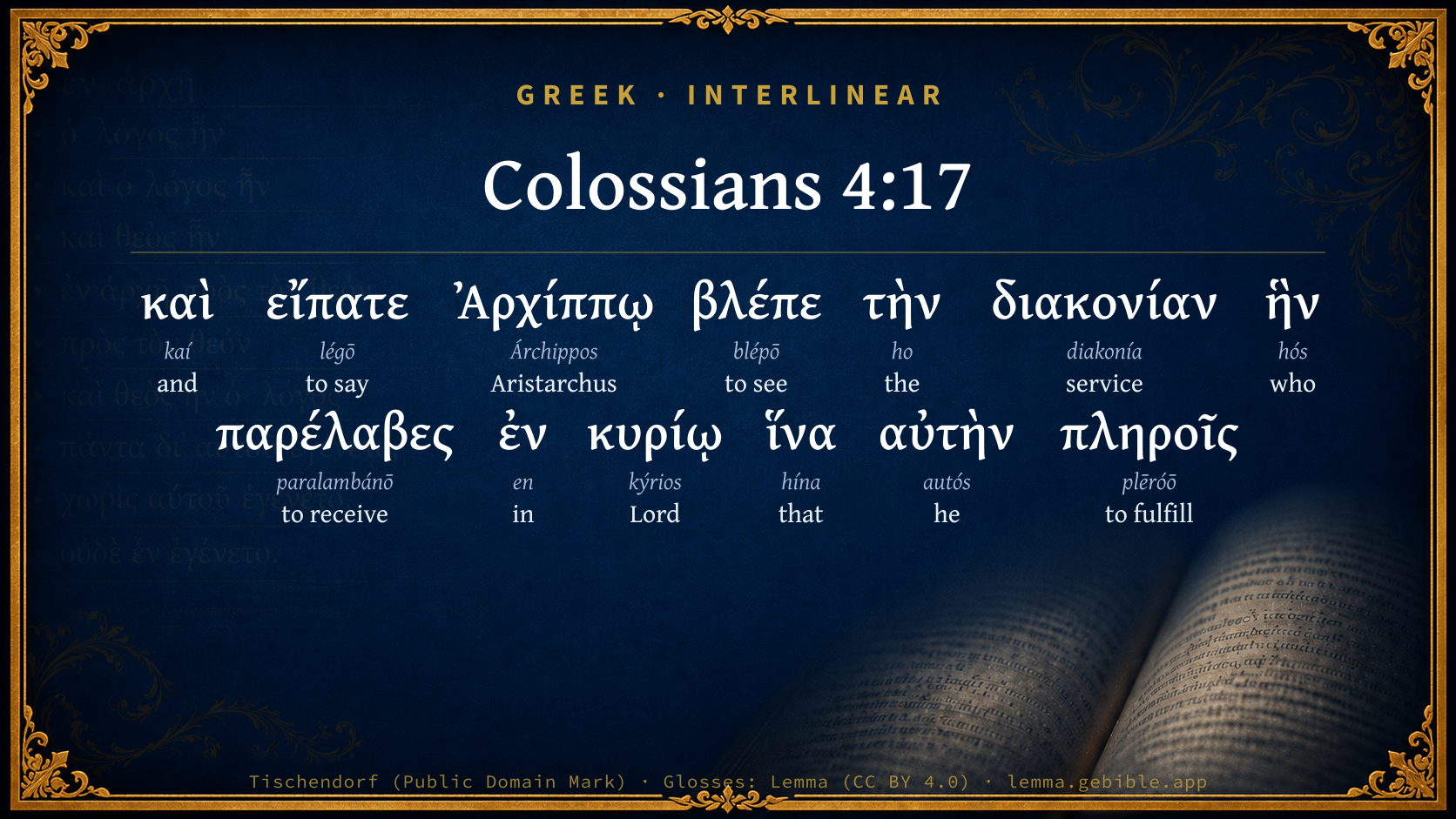
Download image
Cite this verse

Colossians 4:17 (World English Bible). Public Domain. Lemma interlinear Bible study tool, https://lemma.gebible.app/v/colossians/4/17.

Show BibTeX & RIS
BibTeX
RIS
English Translation
Tell Archippus, "Take heed to the ministry which you have received in the Lord, that you fulfill it."
World English Bible · Public Domain
Highlights
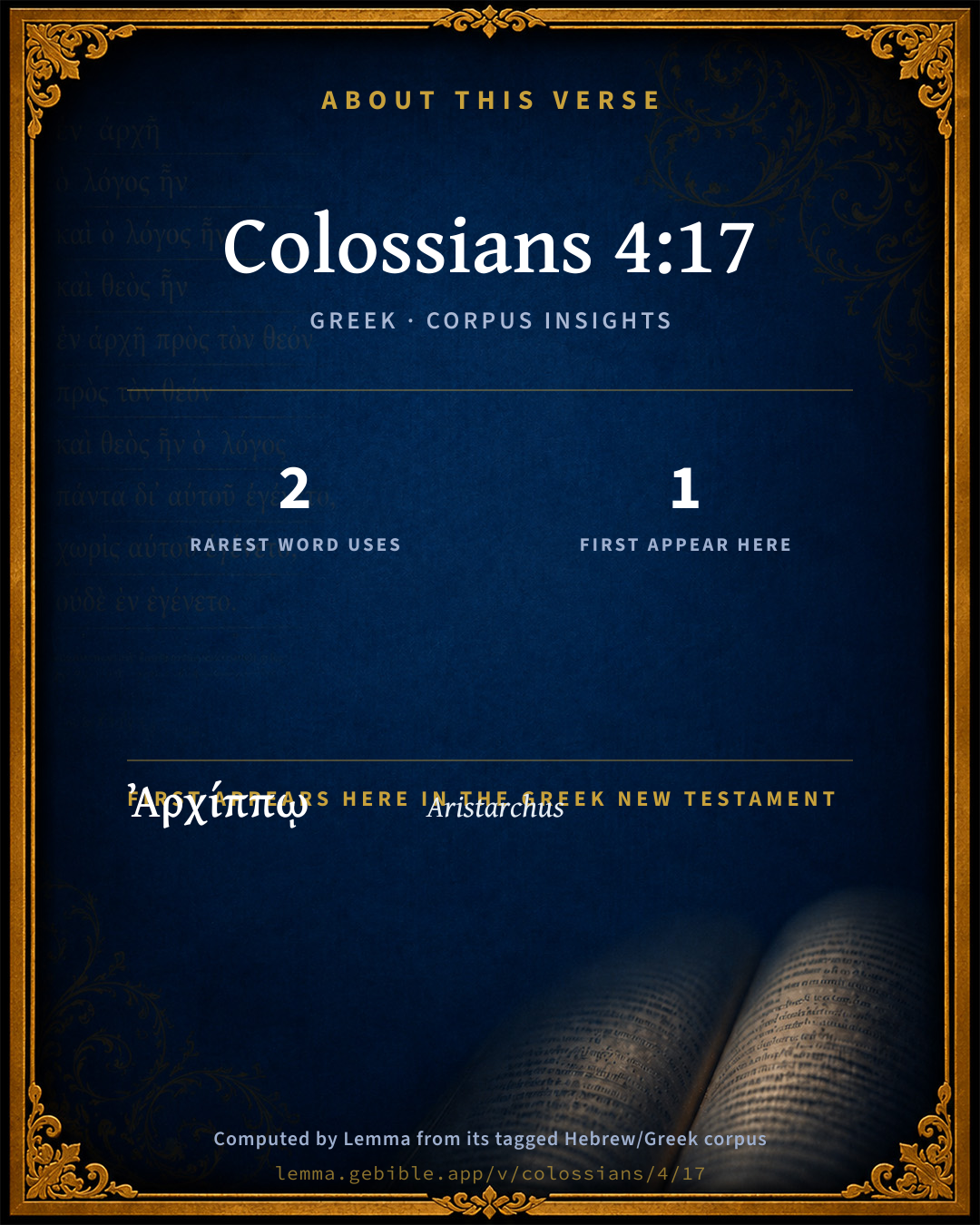
  • 1 first appearance in the Greek New Testament
Full analysis ↓
Download a study sheet

One document with this verse’s original text, its word-by-word gloss line, the meaning frame, cross-references with their text, attributed commentary, and full source and license credits — printable, and it pastes into notes with its structure intact.

This verse Autodidact and up

Study sheet (.html) Plain text (.txt)

A passage Seminary Student

Up to 50 verses in one chapter. A passage sheet keeps up to 6 commentary sources and 12 cross-references per verse, in the order this page ranks them, and says so on the sheet whenever that leaves anything out. Ask for a single verse and you get the Autodidact verse sheet above.

Everything on this page stays free to read, with no account — the sheet is a download of what is already on screen, not access to it.

Want to remove ads? Support Godless Engineer
Compare translations 3

The same verse in 3 English versions, stacked beneath the original-language interlinear above. Click any original word for its lexicon entry.

Each is an independent rendering of the whole verse — the interlinear is not word-aligned to these translations.

Highlighted words mark where these versions differ — a whole-verse word diff, not a word-by-word alignment.

  • World English Bible Public Domain
    Tell Archippus, "Take heed to the ministry which you have received in the Lord, that you fulfill it."
  • King James Version Public Domain
    And say to Archippus, Take heed to the ministry which thou hast received in the Lord, that thou fulfil it.
  • unfoldingWord Literal Text CC BY-SA 4.0
    And say to Archippus, “Look to the ministry that you have received in the Lord so that you may fulfill it.”

unfoldingWord Literal Text — © unfoldingWord, licensed CC BY-SA 4.0. Word-aligned USFM3 via Door43 (git.door43.org/unfoldingWord/en_ult).

Versions to compare (up to 4)

3 of 4 selected

Show all 19 translations

Every available English version of this verse, each an independent rendering of the whole verse.

  • World English Bible Public Domain
    Tell Archippus, "Take heed to the ministry which you have received in the Lord, that you fulfill it."
  • Berean Standard Bible Public Domain
    Tell Archippus: “See to it that you complete the ministry you have received in the Lord.”
  • Majority Standard Bible Public Domain
    Tell Archippus: “See to it that you complete the ministry you have received in the Lord.”
  • King James Version Public Domain
    And say to Archippus, Take heed to the ministry which thou hast received in the Lord, that thou fulfil it.
  • American Standard Version (1901) Public Domain
    And say to Archippus, Take heed to the ministry which thou hast received in the Lord, that thou fulfil it.
  • Revised Version (1885) Public Domain
    And say to Archippus, Take heed to the ministry which thou hast received in the Lord, that thou fulfill it.
  • Geneva Bible (1599) Public Domain
    And say to Archippus, Take heede to the ministerie, that thou hast receiued in the Lord, that thou fulfill it.
  • Douay-Rheims (1899) Public Domain
    And say to Archippus: Take heed to the ministry which thou hast received in the Lord, that thou fulfil it.
  • Young's Literal Translation Public Domain
    and say to Archippus, `See to the ministration that thou didst receive in the Lord, that thou mayest fulfil it.'
  • Literal Standard Version CC BY-SA 4.0
    and say to Archippus, “See to the ministry that you received in the LORD, that you may fulfill it.”
  • Unlocked Literal Bible CC BY-SA 4.0
    Say to Archippus, “Look to the ministry that you have received in the Lord, that you should fulfill it.”
  • unfoldingWord Literal Text CC BY-SA 4.0
    And say to Archippus, “Look to the ministry that you have received in the Lord so that you may fulfill it.”
  • Darby Bible Public Domain
    And say to Archippus, Take heed to the ministry which thou hast received in [the] Lord, to the end that thou fulfil it.
  • World Messianic Bible Public Domain
    Tell Archippus, “Take heed to the ministry which you have received in the Lord, that you fulfill it.”
  • Webster's Bible Public Domain
    And say to Archippus, take heed to the ministry which thou hast received in the Lord, that thou fulfill it.
  • Free Bible Version CC BY-SA 4.0
    Tell Archippus, “See that you follow through in doing the ministry God gave you.”
  • Bible in Basic English Public Domain
    Say to Archippus, See that you do the work which the Lord has given you to do.
  • Text-Critical English NT CC BY 4.0
    Tell Archippus, “Be sure to complete the ministry yoʋ have received in the Lord.”
  • Tyndale New Testament (1534) Public Domain
    And saye to Archippus: take hede to the office that thou hast receaved in the Lorde that thou fulfill it.

Literal Standard Version (2020), Covenant Press — licensed CC BY-SA 4.0. Text via the HelloAO Bible API (eBible.org). Unlocked Literal Bible (unfoldingWord) — licensed CC BY-SA 4.0. Text via the HelloAO Bible API (eBible.org). unfoldingWord Literal Text — © unfoldingWord, licensed CC BY-SA 4.0. Word-aligned USFM3 via Door43 (git.door43.org/unfoldingWord/en_ult). Free Bible Version, Dr. Jonathan Gallagher — licensed CC BY-SA 4.0. Text via the HelloAO Bible API (eBible.org).

Word by word

More ways to search: Search by grammar → Find every occurrence → Compare this word →

Practice this passage: Drill this verse → Learn its vocabulary →

Ἀρχίππῳ
Árchippos
G751
“Aristarchus”
Noun, Dative, Singular, Masculine
Part of Speech
Noun
Case
Dative
Number
Singular
Gender
Masculine
Full Thayer's Definition

Origin: from G746 and G2462

TDNT: None

Archippus = "master of the horse" 1. a certain Christian teacher in Colosse
  1. καὶ kaí G2532 “and” Conjunction
  2. εἴπατε légō G3004 “to say” Verb, Aorist, Active, Imperative, 2nd person, Plural
  3. βλέπε blépō G991 “to see” Verb, Present, Active, Imperative, 2nd person, Singular
  4. τὴν ho G3588 “the” Article, Accusative, Singular, Feminine
  5. διακονίαν diakonía G1248 “service” Noun, Accusative, Singular, Feminine
  6. ἣν hós G3739 “who” Relative pronoun, Accusative, Singular, Feminine
  7. παρέλαβες paralambánō G3880 “to receive” Verb, Aorist, Active, Indicative, 2nd person, Singular
  8. ἐν en G1722 “in” Preposition
  9. κυρίῳ kýrios G2962 “Lord” Noun, Dative, Singular, Masculine
  10. ἵνα hína G2443 “that” Conjunction
  11. αὐτὴν autós G846 “he” Personal pronoun, Accusative, Singular, Feminine
  12. πληροῖς plēróō G4137 “to fulfill” Verb, Present, Active, Subjunctive, 2nd person, Singular

About this verse

These counts appear in no published source. They are computed here, from the morphology-tagged text and Lemma’s own curated glosses. What Lemma adds →

13
words
13
distinct lemmas
Pauline Epistles
section

Notable vocabulary

The rarest word here is Ἀρχίππῳ Aristarchus G751 — appearing just 2 times in the whole Greek New Testament.

First appearance in Scripture

This word makes its first canonical appearance in the Greek New Testament here:

  • Ἀρχίππῳ Aristarchus G751

Shared distinctive vocabulary

Ἀρχίππῳ Aristarchus G751 occurs in 2 verses of the Greek New Testament. Also found in:
Cross-references

18

Topical passages linked to Colossians 4:17 in the Treasury of Scripture Knowledge — connected by theme and wording, ordered by reader-vote popularity; previews shown in the World English Bible.

  • Philemon 1:2 to the beloved Apphia, to Archippus, our fellow soldier, and to the assembly in your house:
  • Acts 1:17 For he was numbered with us, and received his portion in this ministry.
  • 2 Chronicles 29:11 My sons, don't be negligent now; for Yahweh has chosen you to stand before him, to minister to him, and that you should be his ministers, and burn incense.
  • Ezekiel 44:23–24 They shall teach my people the difference between the holy and the common, and cause them to discern between the unclean and the clean.
  • Acts 20:28 Take heed, therefore, to yourselves, and to all the flock, in which the Holy Spirit has made you overseers, to shepherd the assembly of the Lord and God which he purchased with his own blood.
  • 1 Corinthians 4:1–2 So let a man think of us as Christ's servants, and stewards of God's mysteries.
  • Ephesians 4:11 He gave some to be apostles; and some, prophets; and some, evangelists; and some, shepherds and teachers;
  • 1 Timothy 4:6 If you instruct the brothers of these things, you will be a good servant of Christ Jesus, nourished in the words of the faith, and of the good doctrine which you have followed.
  • 1 Timothy 4:16 Pay attention to yourself, and to your teaching. Continue in these things, for in doing this you will save both yourself and those who hear you.
  • 1 Timothy 6:20 Timothy, guard that which is committed to you, turning away from the empty chatter and oppositions of the knowledge which is falsely so called;
  • 2 Timothy 1:6 For this cause, I remind you that you should stir up the gift of God which is in you through the laying on of my hands.
  • 2 Timothy 4:1–5 I charge you therefore before God and the Lord Jesus Christ, who will judge the living and the dead at his appearing and his Kingdom:
  • Numbers 18:5 You shall keep the charge of the sanctuary, and the charge of the altar; that there be wrath no more on the children of Israel.
  • Leviticus 10:3 Then Moses said to Aaron, "This is what Yahweh spoke of, saying, "'I will show myself holy to those who come near me, And before all the people I will be glorified.'" Aaron held his peace.
  • Acts 14:23 When they had appointed elders for them in every assembly, and had prayed with fasting, they commended them to the Lord, on whom they had believed.
  • 1 Timothy 4:14 Don't neglect the gift that is in you, which was given to you by prophecy, with the laying on of the hands of the elders.
  • 1 Timothy 6:11–14 But you, man of God, flee these things, and follow after righteousness, godliness, faith, love, patience, and gentleness.
  • 2 Timothy 2:2 The things which you have heard from me among many witnesses, commit the same to faithful men, who will be able to teach others also.

Cross-references courtesy of OpenBible.info (CC BY 4.0).

Commentary

Notes on Colossians 4:17 from classic Christian and Jewish commentators (each source and its license shown beneath its notes). The classic Christian expositions comment on the surrounding passage and are grouped to its opening verse, so a note may address several verses; the Jewish commentaries on the Tanakh (Rashi and others) are per-verse, so they appear only where the commentator wrote on this verse.

Lemma curates 59 commentaries, every one of them public domain or Creative Commons licensed, each selected and text-cleaned for this edition rather than reprinted as found. About our sources →

The Biblical Illustrator

Joseph S. Exell

Col_4:17

And say to Archippus, Take heed to the ministry.

Often men who were once faithful grow negligent in the ministry.

1. Sometimes from discouragements from their people, either because they profit not, or because they weary their teachers.

2. Sometimes this comes from the corruption of their own natures; they grow soon weary of Gods work, or, having taken more work to do than they are sufficient for, they grow to neglect all; or they are drawn away with the love of the world.

3. Sometimes God Himself for the wickedness of their lives casts a barrenness upon their hearts, and blasteth their gifts. In this exhortation four things may be noted.

I. Who is he that is exhorted? Say to Archippus. This teaches us that--

1. The sinner must be told of his sin (Lev_19:17).

2. Such as offend publicly must be told of it publicly.

3. Ministers as well as others may be rebuked, though some clergymen are so sore and so proud, that they may not be touched; and many times it is a just judgment of God that no man should rebuke them. No mans learning or greatness of place can so protect them, but that they may be told of their faults; it is too commonly known they can sin as well as others; why, then, should they not be rebuked as well as others?

4. The people may put their teachers in mind of their faults; as they ought to encourage them in well-doing, so may they admonish them for what is evil.

5. Ministers must be told of their faults by their people with great reverence, and heedfulness, and wisdom, according to that direction: Rebuke not an elder, but exhort him as a father.

6. They must say it to him, not say it of him. Ministers ought not to be traduced behind their backs.

7. He doth not threaten him if he do not, which implies he hoped their exhortation would speed; certainly it is a great praise to profit by admonition.

II. The matter charged upon him. Take heed to thy ministry. Note--

1. Consideration, a weighing and meditation of the greatness of the function, of the dignity of it, and the duty also, with the accounts he must make to God and His high calling and the great price of souls, etc.

2. Divers of the worthy qualities of a minister, as care, attendance, watchfulness, aptness to teach, and divide the word aright; discretion, to give every one his portion; diligence, gentleness, in not marring the doctrine with passion; patience to endure the work and labour of his ministry, etc.

3. Caution, and so ministers must take heed both of

(1) what is within them of their own divinations, of idleness, of the objections of their own flesh, and the temptations of the devil.

(2) Without them they must take heed of the new errors that will daily rise; of the sins of the people, with all the methods of Satan in devising, committing, or defending of sin, of mens fancies; and for persons, they must take heed of hypocrites, and open adversaries, domestical vipers, and foreign foes, false brethren, and professed idolaters.

III. The reason by which it is urged. Which thou hast received in the Lord.

1. Because it is Gods free grace that he is chosen to be a minister (Rom_5:1).

2. Because he is inwardly called and qualified by God.

3. Because he received his outward authority, though from men, yet by direction and warrant of Gods Word.

4. Because he receives it for the Lord--that is to Gods glory, and the furtherance of His kingdom, over the mystical body of Christ. The use is threefold. First, the people should therefore learn to seek their ministers of God. Secondly, ministers should hence learn not to be proud, for they received their ministry of God; it was His gift, not their deserts; not idle, for they are to do Gods work. Thirdly, ministers may hence gather their own safety notwithstanding the oppositions of the world, that God that called them will perfect them.

IV. To fulfil it.

1. By constancy, holding out in it to the end, to go on, and not look back when they are at plough.

2. By faithful performance of it with a due respect of all the charge they have received of God, thus to fulfil it is to show the people all the counsel of God; it is to rebuke all sorts of sins and sinners; it is faithfully to do every kind of work that belongs to their ministry whether public or private. (N. Byfield.)

The ministry of Archippus

It is probable that Archippus was a young pastor recently appointed to the Church at Laodicea. Already signs of slackened zeal began to appear, which afterwards culminated in the state of lukewarmness for which this Church was denounced (Rev_3:19)

. The condition of preacher and people react upon each other; the Church takes its colour from, and communicates it to its pastor. Hence the apostle, well knowing the perils surrounding the inexperienced Archippus, sends to him this timely warning to take heed to his ministry. He is reminded of--

I. The direct authority of the ministry. In the Lord.

II. The implied dangers of the ministry. Take heed.

III. The imperative personal demands of the ministry. That thou fulfil it. (G. Barlow.)

Archippus and his ministry

A sharp message that, and especially sharp as being sent through others. If this Archippus were a member of the Church at Colossae, it is remarkable that Paul should not have spoken to him directly, as he did to Euodia and Syntyche (Php_4:2)

. But it is by no means certain that he was. He is named in the Epistle to Philemon in such immediate connection with the latter and his wife Apphia, that he has been supposed to be their son. At all events, he was intimately associated with the Church in the house of Philemon, who, as we know, was a Colossian. But, on the other hand, the difficulty referred to, and the fact that the whole section is concerned with Laodicea, points to the conclusion that Archippus, though perhaps a native and even resident at Colossae had his ministry in connection with a neighbouring Church. But what does it matter where he worked? Not very much perhaps; and yet one cannot but read this grave exhortation to a man who was evidently getting languid and negligent, without remembering what we hear about Laodicea and its angel when next we meet it. It is not impossible that Archippus may have received the message more awful than Pauls. Because thou art neither hot nor cold, etc. Be that as it may--

I. Each of us has a ministry, or sphere of service. We may fill it full, with earnest devotion and patient heroism, as some expanding gas fills out the silken round of its containing vessel, or we may breathe into it only enough to occupy a little portion, while all the rest hangs empty and flaccid.

II. A sacred motive enhances the obligation. We have received it in the Lord. In union with Him it has been laid upon us. No earthly hand has imposed it, nor does it arise from mere earthly relationships.

III. There must be diligent watchfulness to fulfil our ministry.

1. We have to take heed to our service, reflect upon it, its extent, nature, imperativeness, the manner of discharging it, and the means of fitting us for it. We have to keep it before us. Unless we are absorbed in it, we shall not fulfil it.

2. We have to take heed to ourselves, ever feeling our weakness and the strong antagonisms in our own natures which hinder our dis charge of the plainest and most imperative duties.

3. Let us remember, too, that if we begin, like Archippus, to be a little languid and perfunctory in our work, we may end where the Church at Laodicea ended. (A. Maclaren, D. D.)

The Christian ministry

I. The Christian ministry is a solemn and responsible trust.

1. It is Divine in its bestowal. Received in the Lord.

2. It is personal in its responsibility. Which thou hast received.

3. It involves the communication of good to others. Ministry.

4. It has a special aspect of importance for the individual minister. The Ministry.

II. The Christian ministry demands unswerving: fidelity in accomplishing its lofty mission. That thou fulfil it.

1. Divine truth must be clearly apprehended and profoundly realized.

2. The whole truth must be declared.

3. The declaration of truth must be full and courageous.

III. The Christian ministry is surrounded by peculiar perils. Take heed. A shrewd and ever wakeful vigilance is needed against--

1. The stealthy encroachments of error.

2. The pernicious influences of the world.

3. The subtle temptations to unfaithfulness. (G. Barlow.)

Ministers must look to Christ their Master for direction

At the battle of Lake Erie, when, in the sweeping havoc which was sometimes made, a number of men were shot away from around a gun, the survivors looked silently around to Perry, and then stepped into their places. When he looked at the poor fellows who lay wounded and weltering on the deck, he always found their faces turned towards him, and their eyes fixed on his countenance. In the midst of trials and labours the minister should keep his eyes on the great Leader, Christ.

The Biblical Illustrator, edited by Joseph S. Exell (c. 1880s–1900s) — public domain. Text from a community e-Sword module.

Joseph Benson's Commentary

Col 4:17-18. Say to Archippus — It is generally supposed that the person here mentioned was the Archippus spoken of Phm 1:2, where he is called Paul’s fellow-labourer and fellow-soldier. It seems he was one of the pastors of the church at Colosse; and many think that he had failed in the duties of his office, and that the apostle, in what he here says, ordered the Colossians to rebuke him publicly for his negligence: but others, perhaps with more truth, and certainly with more charity, as Macknight observes, “are of opinion that the apostle, in this direction, meant that the Colossians should encourage Archippus to diligence, because the false teachers at Colosse were very active in spreading their errors. And their opinion derives probability from the respectful manner in which Archippus is addressed in the epistle to Philemon, which was written about this time, and sent with the epistle to the Colossians.” Take heed — It is the duty of the flock to try them that say they are apostles; to reject the false; and to warn, as well as to receive, the true; to the ministry — Not a lordship, but

διακονια, a service, a laborious and painful work; an obligation to do and suffer all things; to be the least, and the servant of all; which thou hast received in the Lord — Christ, by his appointment; by whom, and for whose sake, his servants receive the various gifts of the Holy Spirit; that thou fulfil it — Properly; that thou faithfully discharge all the duties of it with diligence and care; for the consequence of neglecting any of them. after having solemnly undertaken to fulfil them, will be infinitely dangerous and fatal. A necessary and important caution this to all ministers of the gospel! The salutation by the hand of me Paul — Which I add as a token of the genuineness of this epistle. Remember my bonds — See an account of the manner of the apostle’s confinement at Rome, in the notes on Act 28:16; Eph 6:20. The apostle’s having suffered now almost four years’ imprisonment for the gospel, and in the course of that time many hardships and dangers, was such a demonstration of his certain knowledge of the truth and importance, yea, and necessity of the gospel to the salvation of mankind, as could not fail to confirm the faith of the Colossians, and of all the Gentiles who were informed of these his sufferings. This probably is the reason that, notwithstanding he had mentioned his bonds twice before in this letter, he brings the subject in a third time here at the conclusion.

Joseph Benson's Commentary on the Old and New Testaments (1811–1818) — public domain. Text from a community e-Sword module.

Tyndale Open Study Notes

Tyndale Open Resources

4:17 Archippus: See also Phlm 1:2. We have no way of knowing more about the ministry the Lord gave him.

Tyndale Open Study Notes — © Tyndale Open Resources, licensed CC BY-SA 4.0. Text via the HelloAO Bible API.

Bengel's Gnomon

Johann Albrecht Bengel

Col 4:17. Εἴπατε, say) Speak ye, in my name, as witnesses. This was more affecting than if he had addressed Archippus himself. And perhaps Archippus, a minister, was prevented from going to the public assembly by weak health or old age. For that he was near the end of his career, may be inferred from the word fulfil, Phm 1:2. Moreover it is not the different overseers of the Church, but the Church itself, which is commanded to speak to Archippus. Therefore the epistle was directed to the Church, although its subject is very sublime. [Why then are laymen, as they are called, to be prevented from reading the Scriptures?—V. g.]—ἣν παρέλαβες, which thou hast received) by a mediate calling [i.e. through the mediate instrumentality of men, who ordained him]; for there does not follow, from the Lord, but in the Lord.

Bengel's Gnomon of the New Testament — English translation (T&T Clark, Edinburgh, 1860) — public domain. Text from a community e-Sword module.

Meyer's Critical & Exegetical Commentary

Heinrich August Wilhelm Meyer

Col_4:17. The particular circumstances which lay at the root of this emphatic admonitory utterance[184] cannot be ascertained, nor do we even know whether the διακονία is to be understood in the narrower sense of the office of deacon (Primasius), or of any other office relating to the church (possibly the office of presbyter), or of the calling of an evangelist, or of some individual business relating to the service of the church. We cannot gather from ἐν κυρίῳ any more precise definition of the Christian διακονία. Ewald conjectures that Archippus was a still younger man (Bengel holds him to have been sick or weak through age), an overseer of the church, who had been during the absence of Epaphras too indulgent towards the false teachers. Even Fathers like Jerome and the older expositors regard him as bishop (so also Döllinger, Christenthum u. Kirche, ed. 2, p. 308), or as substitute for the bishop during the absence of Epaphras (similarly Bleek), whose successor he had also become (Cornelius a Lapide and Estius). Comp. further as to this Colossian,[185] on Phm_1:2.

The special motive for this precise form of reminding him of his duty is not clear.[186] But what merits attention is the relation of disciplinary admonitive authority, in which, according to these words, the church stood to the office-bearers, and which should here be the less called in question with Hofmann, since Paul in the letter to Philemon addressed jointly to Archippus would doubtless himself have given the admonition, if he had not conceded and recognised in the church that authority of which he invokes the exerciseand that even in the case, which cannot be proved, of the διακονία having been the service of an evangelist. The expedient to which Oecumenius and others have recourse can only be looked upon as flowing from the later hierarchical feeling: ἵνα ὅταν ἐπιτιμᾶ Ἄρχιππος αὐτοῖς, μὴ ἔχωσιν ἐγκαλεῖν ἐκείνῳ ὡς πικρῷ … ἐπεὶ ἄλλως ἄτοπον τοῖς μαθηταῖς περὶ τοῦ διδασκάλου διαλέγεσθαι (Theophylact).

βλέπε κ. τ. λ.] Grotius, Wolf, Flatt, Bähr, and many, take the construction to be: βλέπε, ἵνα τὴν διακ. ἣν παρέλ. ἐν κυρ., πληροῖς, from which arbitrary view the very αὐτήν should have precluded them. The words are not to be taken otherwise than as they stand: Look to the service (have it in thy view), which thou hast undertaken in the Lord, in order that thou mayest fulfil it, mayest meet its obligations; ἵνα αὐτ. πληρ. is the purpose, which is to be present in the βλέπειν τ. διακ, κ.τ.λ. Comp. 2Jn_1:8. On πληροῖς, comp. Act_12:25; 1Ma_2:55; Liban. Ep. 359; Philo, in Flacc. p. 988: τὴν διακονίαν ἐκπλήσαντες.

ἐν κυρίῳ] not: from the Lord (Bähr); not: for the sake of the Lord (Flatt); not: secundum Domini praecepta (Grotius). Christ, who is served by the διακονία (1Co_12:5), is conceived as the sphere, in which the act of the παραλαμβάνειν τὴν διακονίαν is accomplished objectively, as well as in the consciousness of the person concerned; he is in that act not out of Christ, but living and acting in Him. The ἐν κυρ. conveys the element of holy obligation. The less reason is there for joining it, with Grotius, Steiger, and Dalmer, to the following ἵνα αὐτ. πληρ.

[184] Bengel: vos meis verbis dicite tanquam testes. Hoc magis movebat, quam si ipsum Archippum appellaret.

[185] Theodoret already with reason declares himself against the opinion that Archippus had been a Laodicean teacher (so Theodore of Mopsuestia, Michaelis, and Storr), just as the Constitt. apost. vii. 46. 2 make him appointed by Paul as bishop of Laodicea. Recently it has been defended by Wieseler, Chronol. des apost. Zeitalt. p. 452, and Laurent in the Jahrb. f. D. Th. 1866, p. 130, arguing that, if Archippus had been a Colossian, it is not easy to see why Paul, in ver. 17, makes him he admonished by others; and also that ver. 17 is joined by καί to ver. 15 f., where the Laodiceans are spoken of. But the form of exhortation in ver. 17 has a motive not known to us at all; and the reason based on καί in ver. 17 would only be relevant in the event of ver. 17 following immediately after ver. 15. Lastly, we should expect, after the analogy of ver. 15, that if Archippus had not dwelt in Colossae, Paul would have caused a salutation to be sent to him as to Nymphas. Besides, it would be altogether very surprising that Paul should have conveyed the warning admonition to Archippus through a strange church, the more especially when he had written at the same time to himself jointly addressed with Philemon (Phm_1:2).

[186] Hitzig, p. 31 (who holds also vv. 9, 15, 16 to be not genuine), gives it as his opinion that Archippus is indebted for this exhortation, not to the apostle, but to the manipulator, who knew the man indeed from Phm_1:2, but probably had in his mind the Flavius Archippus, well known from Plin. Ep. x. 6668, and the proconsul Paulus, when he adjusted for himself the relation between the Apostle Paul and his fellow-warrior Archippus (Phm_1:2). I do not understand how any one could ascribe even to an interpolator so singular an anachronistic confusion of persons. Yet Holtzmann finds the grounds of Hitzig so cogent, that he ultimately regards vv. 1517 as the rivet, by means of which the Auctor ad Ephesios has made a connected triad out of his own work, the interpolated Colossian epistle, and the letter to Philemon.

Meyer — Critical and Exegetical Commentary on the New Testament — English translation by Peter Christie, edited by Frederick Crombie (T&T Clark, 1880) — public domain. Text from a community e-Sword module.

Expositor's Greek Testament

ed. W. Robertson Nicoll

Col 4:17 . Archippus may have been at Laodicea, but more probably not, for we should have expected the reference to him in Col 4:15 . The Church is entrusted with the duty of exhorting one of its ministers. There is no need to infer any slackness on his part. ἐν Κυρίῳ is added to emphasise its importance, and the need that it should be zealously fulfilled.

The Expositor's Greek Testament, edited by W. Robertson Nicoll (1897–1910) — public domain. Text from a community e-Sword module.

Jamieson, Fausset & Brown

Robert Jamieson, A. R. Fausset & David Brown

say to Archippus--The Colossians (not merely the clergy, but the laymen) are directed, "Speak ye to Archippus." This proves that Scripture belongs to the laity as well as the clergy; and that laymen may profitably admonish the clergy in particular cases when they do so in meekness. BENGEL suggests that Archippus was perhaps prevented from going to the Church assembly by weak health or age. The word, "fulfil," accords with his ministry being near its close (Col 1:25; compare Plm 1:2). However, "fulfil" may mean, as in Ti2 4:5, "make full proof of thy ministry." "Give all diligence to follow it out fully"; a monition perhaps needed by Archippus.

in the Lord--The element in which every work of the Christian, and especially the Christian minister, is to be done (Col 4:7; Co1 7:39; Phi 4:2).

Jamieson, Fausset & Brown — Commentary Critical and Explanatory on the Whole Bible (1871) — public domain (CC PDM 1.0). Text via the HelloAO Bible API.

Adam Clarke's Commentary

Verse 17. Say to Archippus] Who this person was we cannot tell; there have been various conjectures concerning him; some think he was bishop, or overseer of the Church at Colosse, in the absence of Epaphras. Whatever he was, it has been supposed that he had been remiss in discharging the duties of his office; and hence this direction of the apostle, which appears here in the light of a reprehension. But if the same person be meant as in the Epistle to Philemon, Phm 1:2, whom St. Paul calls his fellow labourer and fellow soldier, it cannot be supposed that any reproof is here intended; for, as the Epistle to the Colossians, and that to Philemon, were evidently written about the end of the year 62, Archippus could not be a fellow labourer and fellow soldier of the apostle at Rome, and yet a delinquent at Colosse at the same time. It is more likely, therefore, that the words of the apostle convey no censure, but are rather intended to stir him up to farther diligence, and to encourage him in the work, seeing he had so much false doctrine and so many false teachers to contend with.

Adam Clarke's Commentary on the Bible (1810–1826) — public domain. Text from a community e-Sword/MySword module.

John Calvin's Commentaries

17 Say to Archippus. So far as I can conjecture, this Archippus was, in the mean time, discharging the office of pastor, during the absence of Epaphras; but perhaps he was not of such a disposition as to be sufficiently diligent of himself without being stirred up. Paul, accordingly, would have him be more fully encouraged by the exhortation of the whole Church. He might have admonished him in his own name individually; but he gives this charge to the Colossians that they may know that they must themselves employ incitements, if they see their pastor cold, and the pastor himself does not refuse to be admonished by the Church. For the ministers of the word are endowed with signal authority, but such at the same time as is not exempt from laws. Hence, it is necessary that they should shew themselves teachable if they would duly teach others. As to Paul’s calling attention again to his bonds, he intimates by this that he was in no slight degree afflicted. For he was mindful of human infirmity, and without doubt he felt some twinges of it in himself, inasmuch as he was so very urgent that all pious persons, should be mindful of his distresses. It is, however, no evidence of distrust, that he calls in from all quarters the helps that were appointed him by the Lord. The subscription, with his own hand, means, as we have seen elsewhere, that there were even then spurious epistles in circulation, so that it was necessary to provide against imposition.

END OF THE COMMENTARY ON THE EPISTLE TO THE COLOSSIANS.

John Calvin's Commentaries (1540-1563) — public domain. Text from the Calvin Translation Society English edition (1840s-50s) via the Christian Classics Ethereal Library (ccel.org). Calvin's coverage is partial (roughly two-thirds of the Bible); uncommented books and verses are honest gaps, never fabricated. The 19th-century editor's footnotes and remarks are omitted so the notes are faithfully Calvin's own voice.

Ellicott's Commentary for English Readers

(17) Say to Archippus.—Archippus is included in the salutation of the Epistle to Philemon (Phm_1:1) apparently as a member of his family, and is generally thought to have been his son. He held a “ministry in the Church. The word is the same as the word “diaconate,” but it is obviously used in a more general sense, precisely as in the charge to Timothy (2Ti_4:5), “Make full proof of thy ministry; “and the whole tone of the passage here suggests that, like Timothy’s, it was a ministry of some prominence in the Church. Tradition makes him afterwards a bishop of Laodicea; it is likely enough that he had that leadership among the presbyters, from which the episcopate was developed at the close of the Apostolic period. Whether this was at Colossæ—his father’s native place—or Laodicea, cannot be gathered with any certainty from the context. The exhortation comes in close connection with Laodicea; yet, on the other hand, it seems strange to send through one church a message to a chief pastor of another. In any case this indirect transmission of a charge is curious, standing in marked contrast with the direct personal addresses of the Philippian Epistle (Php_4:2-3).

Which thou hast received in the Lord.—Properly, which thou dost receive. The probability seems to be that he received it from St. Paul, or perhaps Epaphras. The phrase is “in the Lord,” not “from the Lord.” Contrast Gal_1:12, “I received it not from man, neither was I taught but by revelation of Jesus Christ.”

A Bible Commentary for English Readers, edited by Charles John Ellicott (1878–1897) — public domain. Text from a community e-Sword module.

The Cambridge Bible for Schools and Colleges

gen. ed. J. J. S. Perowne

17. say to Archippus] Probably the son of Philemon (cp. Phm_1:2, and notes, and Lightfoot, Colossians &c., pp. 374, 5). He was apparently an ordained minister in the mission-church, either at Colossæ or (less probably, surely; see on Phm_1:2) at Laodicea. St Paul, perhaps, had misgivings about his zeal and care, and, without saying as much, aims here at his conscience through his flock. Or, quite possibly, Archippus had been appointed to take the place of Epaphras when Epaphras left for Rome; and this warning bears only on the thought that his work was just beginning. See further below, p. 152.—In those simple days such an appeal through the people to the pastor was easy; “lordship over God’s heritage” (1Pe_5:3) was no part of the Apostles’ programme of the pastorate.

the ministry] Diaconia; Latin Versions, ministerium. The word in itself has no necessary reference to an ordained “ministry.” But the context here makes such a reference at least highly probable; Archippus evidently stood out as a “worker” in a sense quite special and deeply sacred. On the other hand, the reference is probably not to the “diaconate” (Php_1:2; 1Ti_3:8, &c.) specially. In Laodicea, as in Philippi, there might well be more than one “deacon.” And the deacon’s office, while sacred and important, was scarcely such as to occasion this solemnity of appeal. Archippus, we believe, was (at least for the time) the chief “pastor and teacher” (Eph_4:12) of Colossæ.

which thou hast received] Lit. and better, didst receive. Cp. Act_14:23; Tit_1:5. And for St Paul’s own “reception of ministry,” and his ideal of it, see Act_20:24.

in the Lord] Pregnant words. It was only as a man in union with Christ that he had “received,” and could “fulfil,” his ministry.

fulfil it] Lit., fill it full; so that his “works should be found filled before God” (Rev_3:2). No duty of his ministry was to be ignored; he was to “take heed to himself, his doctrine, and his flock” (Act_20:28; 1Ti_4:16).—“A minister of Christ is often in highest honour with men for the performance of one half of his work, while God is regarding him with displeasure for the neglect of the other half” (R. Cecil, quoted by Abp Trench, on Rev_3:2).

The Cambridge Bible for Schools and Colleges (gen. ed. J. J. S. Perowne; Cambridge University Press, 1878–1918) — public domain. Text from a community e-Sword module.

John Gill's Exposition

And say to Archippus,.... A name common among the Grecians. This person the apostle calls his fellow soldier, in Plm 1:2 and who was now the minister of the Gospel at Colosse, his fellow minister, or co-pastor Epaphras, being at Rome, and a prisoner there; though by some he is said to be the first bishop of the Laodiceans, but it seems most likely that he now resided at Colosse, and was their minister: who being negligent in his office, they are called upon to say unto him,

take heed to the ministry which thou hast received in the Lord,

that thou fulfil it. The "ministry" he had, was not that of the office of a deacon, as some have thought, but of a preacher of the word; and this he had "received" gifts for, and was called unto it, and installed in it; and that "in", and "by the Lord" himself, and to whom he was accountable for it: and therefore it was incumbent on him to "fulfil it"; by constantly preaching the word, and faithfully administering the ordinances; by defending truth, detecting error, reproving vice, visiting the sick, and comforting the feeble minded; taking heed in all things to himself and doctrine, that he feed the whole flock of God with wholesome food; and, as a wise and faithful steward, give to everyone their portion of meat in due season: hence it appears, that when ministers are negligent in the discharge of their duty, the church has a power to admonish and exhort them to a diligent performance of it.

John Gill's Exposition of the Whole Bible (1746–1763) — public domain (CC PDM 1.0). Text via the HelloAO Bible API.

Trapp's Complete Commentary

John Trapp

17 And say to Archippus, Take heed to the ministry which thou hast received in the Lord, that thou fulfil it.

Ver. 17. And say to Archippus] Arehippus was a pastor of the Laodicean Church; so that before St John’s time in Patmos they began to cool.

Take heed to the ministry] Gr. see to it, that is, to thyself, and to all the flock, Act 20:28; cf. Eze 34:31, to strengthen the weak, to heal the infected: to splint the sprained, to reduce the wandering, to seek the lost, to cherish the strong: work enough. Age ergo quod tui muneris est, as Valentinian said to Ambrose. Clericus in oppido, piscis in arido, A preacher in the town, fish in the desert, saith another. "What is that to thee?" Joh 21:22. The Church is thy proper element, the pulpit thy right ubi where, the sanctuary should be the centre of all thy circumference. It is a good hearing that the Levite makes haste home, Jdg 19:10. An honest man’s heart is the place where his calling is. And this charge, by how much the more sacred it is, so much the more attendance it expects. Even a day breaks square with those with a good conscience.

That thou fulfil it] By preaching the word in season, out of season, &c., and so doing the work of an evangelist, fulfilling his ministry, 2Ti 4:2-5. This to do the people were to excite their pastor; yet with all due respect and reverence to his office, 1Ti 5:1, μη επιπληξης. An elder must not be lashed or jerked with the scourge of the tongue as a puny, but entreated as a father.

John Trapp, A Commentary or Exposition upon All the Books of the Old and New Testament (1647–1656) — public domain. Text from a community e-Sword module.

Albert Barnes' Notes on the Bible

And say to Archippus - Archippus is mentioned also in Phm 1:2. He is not elsewhere referred to in the New Testament, and nothing further is known of him.

Take heed to the ministry ... - The Greek here is, τὴν διακονίαν tēn diakonian - meaning the office of ministering in divine things; but it is not certain precisely what office he held there. It seems probable from the language which the apostle applies to him - “the ministry” - (compare Act 1:17, Act 1:25; Act 6:4; Act 20:24; Act 21:19; Rom 11:13; 1Co 12:5; 2Co 3:7-9; 2Co 4:1; 2Co 5:18; 2Co 6:3; Eph 4:12), that he was not a deacon, properly so called, but that he was a preacher of the word. In Phm 1:2, he is mentioned by Paul as his “fellow-soldier,” and it is evident that the apostle meant to speak of him with honor. There is no evidence, as has been supposed by some, that he intended to imply, by what he said, that he had been remiss in the performance of his duties, but the apostle doubtless meant to encourage him and to excite him to increased ardor and zeal in the work of the Lord; compare the notes at Act 20:28. It is always proper to caution even the most faithful and self-denying servants of the Lord to “take heed,” or see to it, that they perform their duties with fidelity. The office of the ministry is such, and the temptations to unfaithfulness are so great, that we need constant watchfulness.

That thou fulfil it - That there be nothing wanting, or lacking, in any of the departments of labor which you are called to perform.

Albert Barnes' Notes on the Bible (1834–1885) — public domain. Text from a community e-Sword/MySword module.

Haydock's Catholic Bible Commentary

What St. Paul here addresses to Archippus, gives us reason to presume that he was then bishop of the Colossians, having succeeded Epaphras, who was then prisoner at Rome with St. Paul. (Bible de Vence)

George Leo Haydock (1774–1849), Haydock's Catholic Family Bible and Commentary, 1859 edition — public domain. Excludes Psalms (Douay-Rheims chapter numbering differs from Protestant) and Deuterocanonical books (Catholic canon only).

Matthew Poole's English Annotations

He also enjoins them to advise or advertise Archippus, whom he doth elsewhere call his fellow soldier, i.e. minister in the gospel, Phm 1:2, on his and Timothy’s behalf, to see to, or be mindful of, the nature of that excellent ministry he had undertaken, Rom 11:13; Eph 3:7; 1Ti 4:6; yea, and to be more heedful, Act 20:28,29; 1Pe 5:1,2, considering the authority of the Lord Jesus, in whose name he had been called to it, and intrusted with it, Mat 9:38; Phi 1:17; 1Ti 5:1,21; having been colleague to Epaphras, or in his absence newly received into this sacred charge, to encourage him to a faithful discharge of his duty therein, to fill up all the parts of his office, and leave none of them unperformed: see Col 1:25; 1Co 9:16,17; 1Ti 4:16, with 2Ti 4:5.

Matthew Poole's English Annotations on the Holy Bible (1683–1685) — public domain. Text from a community e-Sword/MySword module.

Whedon's Commentary on the Bible

Daniel D. Whedon

17. Say to Archippus—An office-bearer in the Colossian Church, whose duties are not easy to be defined, because of the wide scope of the word ministry. Quite likely he was a deacon. From the association of him with Philemon and Apphia in the inscription to the Epistle to Philemon, we very naturally infer that Archippus was a member of their family. It has been suggested that he may have been their son. The apostle there calls him his “fellow-soldier.” The two epistles being written at the same time, the epithet there given is inconsistent with the reprehension for negligence, which some suppose intended in the present passage. It seems rather a hearty word of encouragement and stimulation from a soul full of fire to a young minister to do his best.

Daniel D. Whedon (gen. ed.), Commentary on the Old and New Testaments (1874–1909) — public domain. Text from a community e-Sword module.

The Pulpit Commentary

And say to Archippus, Take heed to the ministry which thou receivedst in (the) Lord, that thou fulfil it (Act_20:28; 1Ti_1:18, 19 4:6, 11-16 6:13, 14, 20, 21; 2Ti_2:15 2Ti_4:5) From the connection of this verse with the two preceding, it seems likely that "the ministry" of Archippus related to the Laodicean Church. Hence he is not addressed directly. If he was, as we gather from Phm_1:1-2, the son of Philemon, whose house formed a centre for the Colossian Church, (Phm_1:2) the warning would be suitably conveyed through this channel. In the letter to Philemon, the apostle calls him his" fellow soldier". (comp. Col_4:10; Php_1:29, 30) Both from this fact, and from the emphasis of the words before us, it would appear that his office was an important one, probably that of chief pastor. This warning addressed so early to the minister of the Laodicean Church is premonitory of the lapsed condition in which it is afterwards; (Rev_3:14-22) see Lightfoot, pp. 42, 43. (For "ministry" (diakonia), (comp. Col_1:7, Col_1:23; 1Co_4:1, etc. For "received," comp. note, Col_2:6) "In the Lord; "for every office in the Church is grounded in him as Head and Lord (Col_1:18 Col_2:6 Col_3:17, 24 4:7; Eph_1:22 Eph_4:5; 1Co_8:6 1Co_12:5, etc.) and must be administered according to his direction and as subject to his judgment. (see 1Co_3:5 1Co_4:1-5; 2Co_10:17, 18 13:10; Gal_1:1; 1Ti_1:12; 2Ti_4:1, 2Ti_4:2) "Fulfil". (comp. Col_1:26; 2Ti_4:5; Act_12:25) This admonition resembles those addressed to Timothy in the Pastoral Epistles.

The Pulpit Commentary (1880–1919), ed. H.D.M. Spence-Jones & Joseph S. Exell — public domain. Text from a community e-Sword module.

John Wesley's Explanatory Notes

And say to Archippus - One of the pastors of that church. Take heed - It is the duty of the flock to try them that say they are apostles to reject the false, and to warn, as well as to receive, the real. The ministry - Not a lordship, but a service; a labourious and painful work; an obligation to do and suffer all things; to be the least, and the servant, of all. In the Lord - Christ by whom, and for whose sake, we receive the various gifts of the Holy Spirit.

John Wesley, Explanatory Notes Upon the Whole Bible (1754–1765) — public domain. Text via the GEBible commentary corpus.

Burkitt's Expository Notes on the New Testament

William Burkitt

This Archippus is, with good reason, supposed to be the minister at Colosse, in the room of Epaphras, now with St. Paul at Rome. Some think, that in the absence of Epaphras, he was grown somewhat remiss and slack in his ministerial duty; he directs therefore the Colossians to admonish him to the exercise of greater diligence in discharging all the parts of his trust committed by Christ unto him, Say unto Archippus, Take heed, &c.

Observe here, A double charge, 1. A charge of message, Say unto Archippus: The Colossians must say it. St. Paul could have wrote a private letter to him; but they must excite him, yea, say to him to his face, not of him behind his back: It is the people’s duty to stir up their ministers to the faithful performance of their duty; the fire of our ministerial zeal doth not burn so bright, but we may need our people’s bellows to inflame it; but this must be done with prudence by the people, in a way of exhortation, not by the way of exprobation; so stir up your minister to his duty, that you forget not your own.

Observe, 2. The charge of an office, Take heed to the ministry which thou hast received of the Lord, that thou fulfil it.

Here note, 1. A duty enjoined, to fulfil the ministry: But what is that?

Negatively, not to secure the success of our ministry, we may deliver our own souls, though our people’s be not delivered; the nurse is not charged with the life of the child, but with the care of the child; she shall be paid whether it live or die: Nor is it absolutely to perform every part of our ministerial duty without the least deficiency; no, we rejoice in the testimony of our conscience, that in simplicity and godly sincerity we have done our duty:

Positively, to fulfil the ministry, is to perform all the parts of our duty with care and faithfulness, persevere in diligence, particularly, public preaching and private inspection. A non-preaching minister is no minister, a breastless nurse, a murderer of souls, a bell without a clapper, a cryer without a voice; yet doth not his work lye all in the pulpit, but the greatest part out of it: he is styled a watchman: For what? because he is to watch one hour with his people in a week? No, surely, but because he is to watch over them, and converse with them all the week, upon occasion. Is not the physician to visit his patient, as well as to prescribe his physic? Doth the husbandman cast his seed into the ground, and never come into his fields to see whether it comes up, or how it grows? Verily, our people are great gainers by them too. We may gain more experimental knowledge by an afternoon’s visiting our people, than by a week’s study.

Note, 2. The means here directed to, for the fulfilling of the ministry, Take heed to the ministry; What doth that import?

1. Take heed to thy study; ministerial abilities are not rained down like manna upon us. The apostles did not study indeed, but one reason was, they had no time to study, they were itinerary preachers.

2. Take heed to thy doctrine, that it be the pure word of God, and delivered purely; not only in opposition to error, but in opposition to levity.

3. Take heed, that is, to thy life and practice, that we may tread out the steps before our people, which they are to take towards heaven.

Note, 3. The motive to stir us all up to the fulfilling our ministerial trust: We have received it: There is the importance of a special favour, and also the importance of a strict account; what we have received, we must give an account for.

2. We have received it of or from the Lord; this implies assistance, that God has called us to it, will assist us in it: Lo, I am with you always to the end of the world; with you to assist, with you to succeed, with you to reward. Let Archippus then, every one in the work of Christ, take heed to the ministry which he has received of the Lord, that he fulfil it.

William Burkitt's Expository Notes on the New Testament (1700–1703) — public domain. Text from a community e-Sword module.

Godbey's Commentary on the New Testament

William B. Godbey

17. “Say to Archippus: See to the ministry which you received in the Lord, that you fill it.” Lord, send this admonition, with sledgehammer conviction, to every one whom the Lord has commissioned to preach the living Word!

William B. Godbey, Commentary on the New Testament (1896–1900) — public domain. Text from a community e-Sword module.

The People's New Testament

B. W. Johnson

17. Say to Archippus. He is named in Philemon 2. He had some important work, and was possibly a preacher.

B. W. Johnson's The People's New Testament with Notes (1889–1891) — public domain. Electronic text from the Christian Classics Ethereal Library (CCEL) ThML edition.

Cambridge Greek Testament for Schools and Colleges

17. καὶ. Probably continuing the immediately preceding subject of their relations with Laodicea (vide infra).

εἴπατε. “Forms belonging to εἴπα stand without var. in those persons of the imperative which contain τ (εἴπατε, εἰπάτω, -τωσαν)” W.H. Append. p. 164; cf. Blass, Gram. § 21. 1.

There seems to be no parallel in the N.T. for sending a message to an individual through the community addressed. It suggests therefore some special responsibility on the part of the community towards Archippus.

But we can hardly suppose that he was set over the Colossians spiritually, for, surely, it would be unseemly both for St Paul to give them, and for the Colossians to deliver, a message that would be virtually, “Do your duty towards us as our minister.” If, on the other hand, they had entrusted him with spiritual work on their behalf elsewhere St Paul would naturally be glad to recognise their zeal by sending the message through them. The mention of Laodicea in the preceding verse suggests that this work lay there.

Ἀρχίππῳ. Phm 1:2†, where συνστρατιώτης indicates that he was engaged in aggressive work for Christ.

He was evidently known personally to St Paul. It may, however, perhaps be assumed that he had had no recent intercourse with St Paul; for, from his apparently intimate relations with Philemon, there would then have been little necessity for St Paul to write so fully about Onesimus.

βλέπε. “Look to the ministry … that thou mayest,” etc. The construction, a direct object with the addition of ἵνα designating the purpose, is found also in 2Jn 1:8. But perhaps ἵνα does not depend on the preceding words, but takes the place of an imperative, see Moulton, Gram. Proleg. 1906, p. 178.

τὴν διακονίαν. Its nature is undefined. We are not justified in limiting so common a term to the technical diaconate at this early date (cf. Col 4:7, note).

ἥν παρέλαβες. At whose hands (see note on παρελάβετε, Col 2:6) he had received it is not stated (for Chrysostom’s interpretation see next note). The fact that St Paul had never been to Laodicea or Colossae (Col 2:1), and, further, the improbability that he had seen Archippus lately, make it unlikely that Archippus had received this charge from him. Perhaps he had received it from Epaphras (e.g. when the latter left for Rome), but even if so εἴπατε suggests (see note) that the Colossian Christians were largely responsible for it. It is therefore questionable whether the immediate reference of the παρά be not to them as a body rather than to any one person.

ἐν κυρίῳ, Col 4:7, Col 3:18; Col 3:20. Removing the charge wholly out of the sphere of any merely mundane duty. “In the Lord” is at once a mark of holy obligation and a pledge of success. Chrysostom says curiously (414 B), πάλιν τὸ, ἐν, διὰ κυρίου ἐστίν· αὐτός σοι ἔδωκε, φησὶν, οὐχ ἡμεῖς. Bengel says rightly “παρέλαβες, quod accepisti vocatione mediata. Non enim sequitur a Domino, coll. 1Co 11:23, sed, in Domino.”

ἵνα (see note on βλέπε) αὐτὴν πληροῖς, i.e. fill up to its ideal content (see note on πληρῶσαι, Col 1:25). Cf. Rev 3:2; Act 12:25; cf. 2Ti 4:5.

Cambridge Greek Testament for Schools and Colleges (Cambridge University Press, 1896; 21 vols, various authors incl. Carr, Maclear, Plummer, Farrar, Lumby, Moule, M. R. James, Simcox) — public domain. Text from a community e-Sword module.

Alford’s Greek Testament

Henry Alford

17.] Archippus is mentioned Phm 1:2, and called the Apostle’s συνστρατιώτης. I have treated on the inference to be drawn from this passage as to his abode, in the Prolegg. to Philemon, § iii.1. He was evidently some officer of the church, but what, in the wideness of διακονία, we cannot say: and conjectures are profitless (see such in Est. and Corn.-a-lap.). Meyer well remarks, that the authority hereby implied on the part of the congregation to exercise reproof and discipline over their teachers is remarkable: and that the hierarchical turn given to the passage by Thl. and Œc. (ἵνα ὅταν ἐπιτιμᾷ Ἀρχ. αὐτοῖς, μὴ ἔχωσιν ἐγκαλεῖν ἐκείνῳ ὡς πικρῷ, … ἐπεὶ ἄλλως ἄτοπον τοῖς μαθηταῖς περὶ τοῦ διδασκάλου διαλέγεσθαι, Thl.) belongs to a later age. As to the words themselves,—Take heed to the ministry which thou receivedst in the Lord (the sphere of the reception of the ministry; in which the recipient lived and moved and promised at his ordination: not, of the ministry itself (τὴν ἐν κυρ.),—nor is ἐν to be diverted from its simple local meaning), that (aim and end of the βλέπε,—in order that) thou fulfil it (reff.).

Henry Alford, The Greek Testament (1849–1861) — public domain. Text from a community e-Sword module.

Lightfoot's Colossians and Philemon

J. B. Lightfoot

τὴν ἐκ Λαοδικίας] i.e. ‘the letter left at Laodicea, which you will procure thence’. For this abridged expression compare Luke xi. 13 ὁ πατὴρ ὁ ἐξ οὐρανοῦ δώσει πνεῦμα ἅγιον, xvi. 26 (v. l.) μηδὲ ὁι ἐκεῖθεν πρὸς ἡμᾶς διαπερῶσιν, Susann. 26 ὡς δὲ ἤκουσαν τὴν κραυγὴν ἐν τῷ παραδέισῳ ὁι ἐκ τῆς οἰκίας, εἰσεπήδησαν κ.τ.λ. For instances of this proleptic use of the preposition in classical writers, where it is extremely common, see Kühner Gr. § 448 (II. p. 474), Jelf Gr. § 647, Matthiæ Gr. § 596: e.g. Plat. Apol. 32 B τοὺς οὐκ ἀνελομένους τοὺς ἐκ τῆς ναυμαχίας, Xen. Cyr. vii. 2. 5 ἁρπασόμενοι τὰ ἐκ τῶν οἰκιῶν, Isocr. Paneg. § 187 τὴν εὐδαιμονίαν τὴν ἐκ τῆς Ἀσίας εἰς τὴν )Ευρώπην διακομίσαιμεν. There are good reasons for the belief that St Paul here alludes to the so-called Epistle to the Ephesians, which was in fact a circular letter addressed to the principal churches of proconsular Asia (see above p. 37, and the introduction to the Epistle to the Ephesians). Tychicus was obliged to pass through Laodicea on his way to Colossæ, and would leave a copy there, before the Colossian letter was delivered. For other opinions respecting this ‘letter from Laodicea’ see the detached note.

ἵνα καὶ ὑμεῖς κ.τ.λ.] ‘see that ye also read’. At first sight it might seem as though this ἵνα also were governed by ποίησατε, like the former; but, inasmuch as ποίησατε would be somewhat awkward in this connexion, it is perhaps better to treat the second clause as independent and elliptical, (βλέπετἐ ἵνα κ.τ.λ. This is suggested also by the position of τὴν ἐκ Λαοδικίας before ἵνα; comp. Gal. ii. 10 μόνον τῶν πτωχῶν ἵνα μνημονεύωμεν (with the note). Ellipses before ἵνα are frequent; e.g. John ix. 3, 2 Cor. viii. 13, 2 Thess. iii. 9, 1 Joh. ii. 19.

17. Κὰι )έιπατε] Why does not the Apostle address himself directly to Archippus? It might be answered that he probably thought the warning would come with greater emphasis, when delivered by the voice of the Church. Or the simpler explanation perhaps is, that Archippus was not resident at Colossæ but at Laodicea: see the introduction to the Epistle to Philemon. On this warning itself see above, p. 42.

Βλέπε] ‘look to’, as 2 Joh. 8 βλέπετε ἑαυτοὺς ἵνα μὴ κ.τ.λ. More commonly it has the accusative of the thing to be avoided; see Phil. iii. 2 (with the note).

τὴν διακονίαν] From the stress which is laid upon it, the διακονία here would seem to refer, as in the case of Timothy cited below, to some higher function than the diaconate properly so called. In Acts xii. 25 the same phrase, πληροῦν τὴν διακονίαν, is used of a temporary ministration, the collection and conveyance of the alms for the poor of Jerusalem (Acts xi. 29); but the solemnity of the warning here points to a continuous office, rather than an immediate service.

παρέλαβες] i.e. probably παρ’ ἐμοῦ. The word suggests, though it does not necessarily imply, a mediate rather than a direct reception: see the note Gal. i. 12. Archippus received the charge immediately from St Paul, though ultimately from Christ. ‘Non enim sequitur’, writes Bengel, ‘a Domino (1 Cor. xi. 23), sed in Domino’.

πληροῖς] ‘fulfil’, i.e. ‘discharge fully’; comp. 2 Tim. iv. 5 τὴν διακονίαν σου πληροφόρησον.

J. B. Lightfoot, St Paul's Epistles to the Colossians and Philemon: a revised text with introductions, notes and dissertations (London: Macmillan, 1875) — public domain. Electronic text from Project Gutenberg (ebook #50857). Covers Colossians and Philemon only (the verse-by-verse notes; introductions and dissertations are omitted); Lightfoot's companion Galatians and Philippians volumes are not included, as the available public-domain scans carry garbled Greek that cannot be faithfully reproduced.

Lesson kit

Teaching starters — assembled from the data on this page, not authored interpretation. Every prompt links to the verse data it draws on. Edit before teaching.

Colossians, in the Pauline Epistles, opens this verse with 13 words (13 distinct Greek lemmas). Its most distinctive word is Árchippos (“Aristarchus”). A historical commentator’s framing appears above. Read the whole chapter for the surrounding context.

Discussion questions

  1. The word Árchippos carries the sense “Aristarchus.” How does it shape the verse?
  2. The word “Aristarchus” first appears here in Scripture. What is being introduced at this debut?
  3. Philemon 1:2 shares the word «Aristarchus» with this verse. How do the two illuminate each other?
  4. These translations render this verse differently; the difference is in the English rendering, not the original. What questions does that raise?
  5. Reading how The Biblical Illustrator and Joseph Benson's Commentary read this verse, where do the two commentators agree and where do they part?

Things to notice

  • 1 word makes its first canonical appearance in Scripture here.
  • These translations choose different wording for 11 words in this verse.
  • 13 distinct Greek lemmas span 13 words in this verse.

Reading settings

Reading text

Shown beneath each verse's original-language words.

Old Testament
Old Testament edition

Read the OT as the Masoretic Hebrew (MT) or the Greek Septuagint (LXX).

English shown for the Greek Septuagint (in the Hebrew ↔ Greek comparison).

Comparing translations? Open the Compare panel on any verse page to stack up to four side by side.