Galatians 5:15

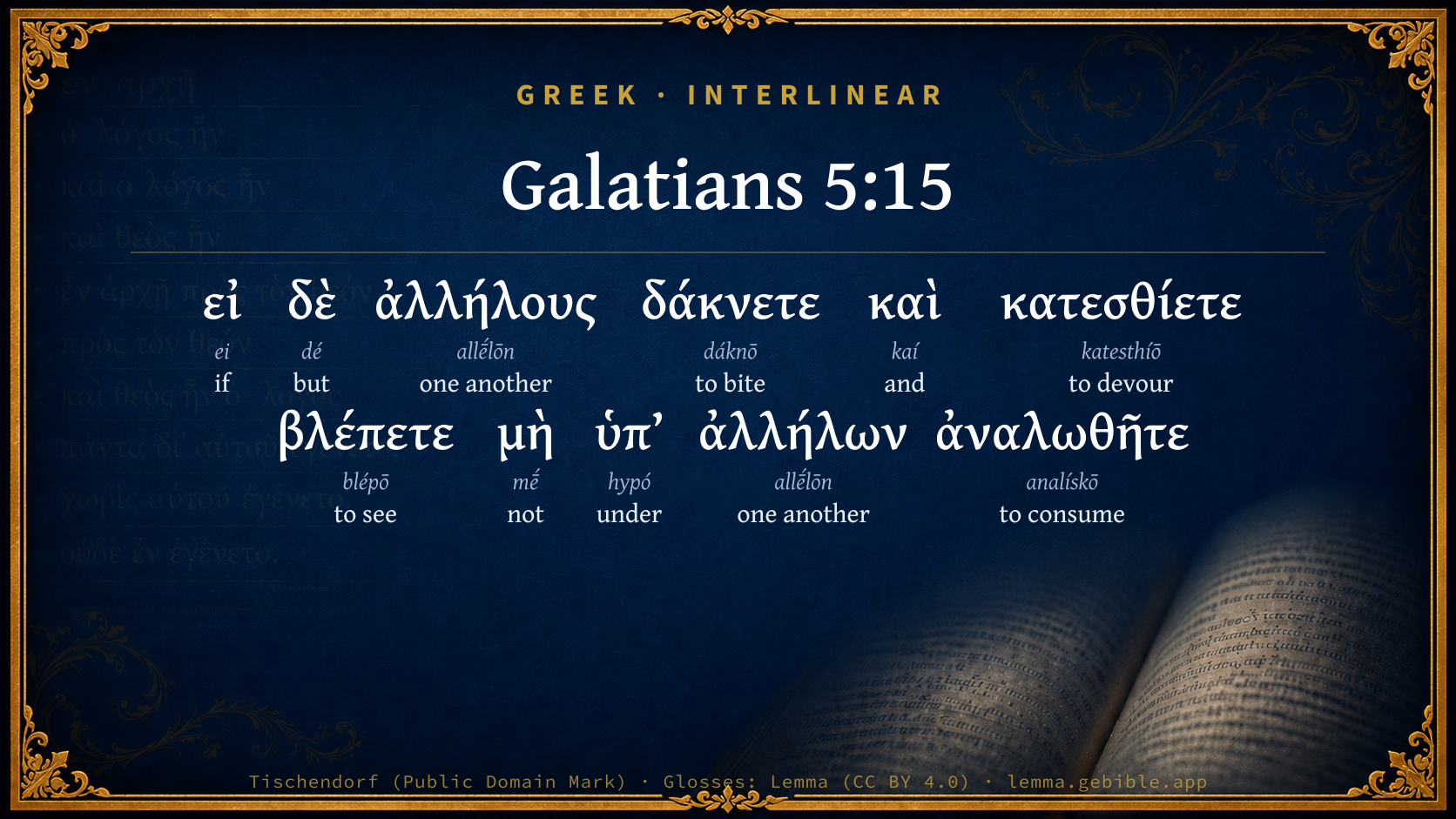
Greek (Tischendorf 8th ed.) Galatians 5:15 appears in the Greek New Testament. The text above is from the Tischendorf 8th edition. Each word links to its Strong’s number and a concise gloss. Click any word for its full Thayer’s Greek Lexicon entry.
Download image
Cite this verse

Galatians 5:15 (World English Bible). Public Domain. Lemma interlinear Bible study tool, https://lemma.gebible.app/v/galatians/5/15.

Show BibTeX & RIS
BibTeX
RIS
English Translation
But if you bite and devour one another, be careful that you don't consume one another.
World English Bible · Public Domain
Highlights
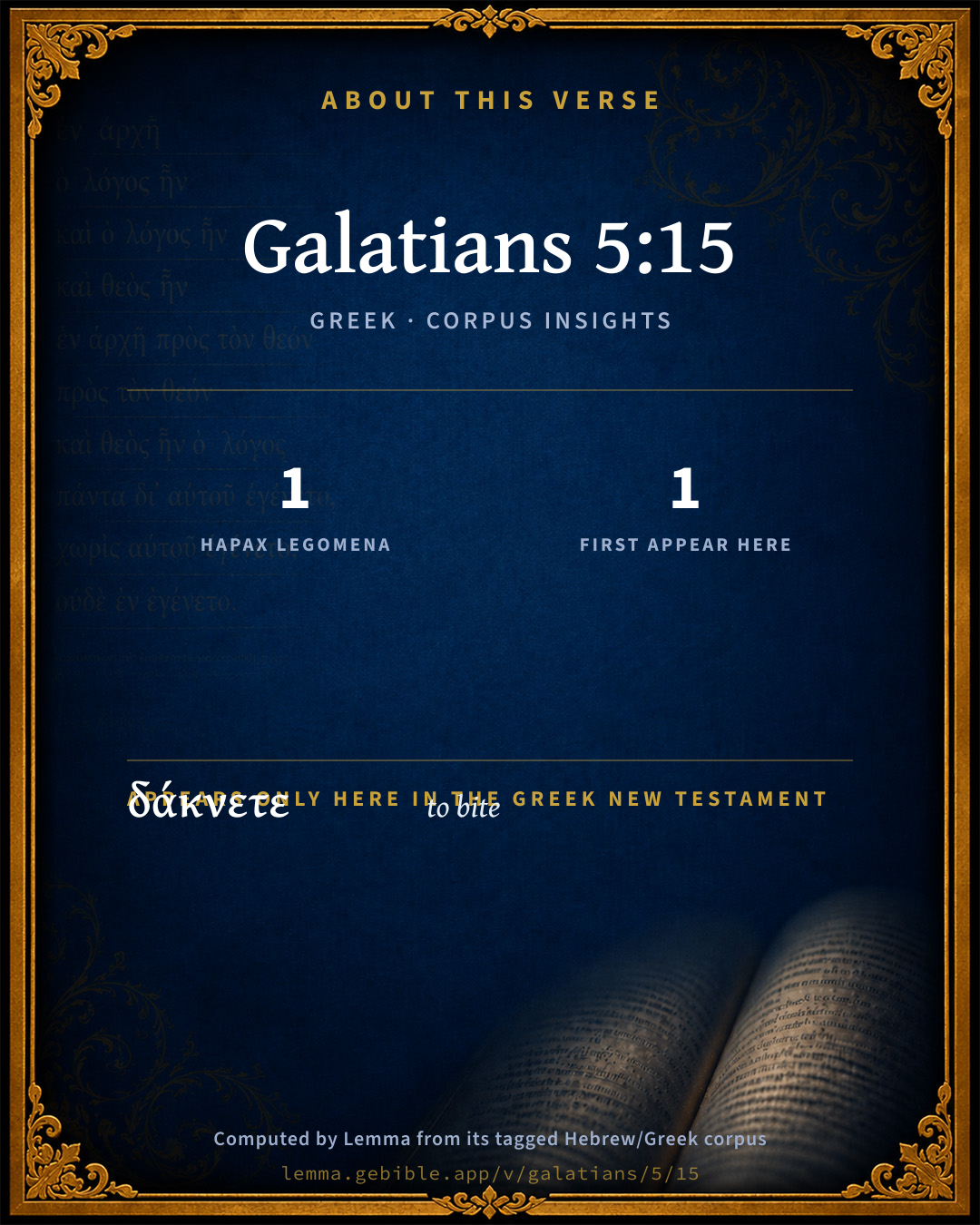
  • 1 hapax legomenon — only here in the Greek New Testament
  • 1 first appearance in the Greek New Testament
Full analysis ↓
Download a study sheet

One document with this verse’s original text, its word-by-word gloss line, the meaning frame, cross-references with their text, attributed commentary, and full source and license credits — printable, and it pastes into notes with its structure intact.

This verse Autodidact and up

Study sheet (.html) Plain text (.txt)

A passage Seminary Student

Up to 50 verses in one chapter. A passage sheet keeps up to 6 commentary sources and 12 cross-references per verse, in the order this page ranks them, and says so on the sheet whenever that leaves anything out. Ask for a single verse and you get the Autodidact verse sheet above.

Everything on this page stays free to read, with no account — the sheet is a download of what is already on screen, not access to it.

Want to remove ads? Support Godless Engineer
Compare translations 3

The same verse in 3 English versions, stacked beneath the original-language interlinear above. Click any original word for its lexicon entry.

Each is an independent rendering of the whole verse — the interlinear is not word-aligned to these translations.

Highlighted words mark where these versions differ — a whole-verse word diff, not a word-by-word alignment.

  • World English Bible Public Domain
    But if you bite and devour one another, be careful that you don't consume one another.
  • King James Version Public Domain
    But if ye bite and devour one another, take heed that ye be not consumed one of another.
  • unfoldingWord Literal Text CC BY-SA 4.0
    But if you are biting and devouring one another, watch out that you might not be consumed by one another.

unfoldingWord Literal Text — © unfoldingWord, licensed CC BY-SA 4.0. Word-aligned USFM3 via Door43 (git.door43.org/unfoldingWord/en_ult).

Versions to compare (up to 4)

3 of 4 selected

Show all 19 translations

Every available English version of this verse, each an independent rendering of the whole verse.

  • World English Bible Public Domain
    But if you bite and devour one another, be careful that you don't consume one another.
  • Berean Standard Bible Public Domain
    But if you keep on biting and devouring one another, watch out, or you will be consumed by one another.
  • Majority Standard Bible Public Domain
    But if you keep on biting and devouring one another, watch out, or you will be consumed by one another.
  • King James Version Public Domain
    But if ye bite and devour one another, take heed that ye be not consumed one of another.
  • American Standard Version (1901) Public Domain
    But if ye bite and devour one another, take heed that ye be not consumed one of another.
  • Revised Version (1885) Public Domain
    But if ye bite and devour one another, take heed that ye be not consumed one of another.
  • Geneva Bible (1599) Public Domain
    If ye bite and deuoure one another, take heede least ye be consumed one of another.
  • Douay-Rheims (1899) Public Domain
    But if you bite and devour one another; take heed you be not consumed one of another.
  • Young's Literal Translation Public Domain
    and if one another ye do bite and devour, see -- that ye may not by one another be consumed.
  • Literal Standard Version CC BY-SA 4.0
    and if you bite and devour one another, see that you may not be consumed by one another.
  • Unlocked Literal Bible CC BY-SA 4.0
    But if you bite and devour one another, watch out that you are not consumed by one another.
  • unfoldingWord Literal Text CC BY-SA 4.0
    But if you are biting and devouring one another, watch out that you might not be consumed by one another.
  • Darby Bible Public Domain
    but if ye bite and devour one another, see that ye are not consumed one of another.
  • World Messianic Bible Public Domain
    But if you bite and devour one another, be careful that you don’t consume one another.
  • Webster's Bible Public Domain
    But if ye bite and devour one another, take heed that ye be not consumed one by another.
  • Free Bible Version CC BY-SA 4.0
    But if you attack and tear into one another, watch out that you don't completely destroy yourselves!
  • Bible in Basic English Public Domain
    But if you are given to fighting with one another, take care that you are not the cause of destruction one to another.
  • Text-Critical English NT CC BY 4.0
    But if you bite and devour one another, watch out, or you will be consumed by one another.
  • Tyndale New Testament (1534) Public Domain
    Yf ye byte and devoure one another: take hede lest ye be consumed one of another.

Literal Standard Version (2020), Covenant Press — licensed CC BY-SA 4.0. Text via the HelloAO Bible API (eBible.org). Unlocked Literal Bible (unfoldingWord) — licensed CC BY-SA 4.0. Text via the HelloAO Bible API (eBible.org). unfoldingWord Literal Text — © unfoldingWord, licensed CC BY-SA 4.0. Word-aligned USFM3 via Door43 (git.door43.org/unfoldingWord/en_ult). Free Bible Version, Dr. Jonathan Gallagher — licensed CC BY-SA 4.0. Text via the HelloAO Bible API (eBible.org).

Word by word

More ways to search: Search by grammar → Find every occurrence → Compare this word →

Practice this passage: Drill this verse → Learn its vocabulary →

About this verse

These counts appear in no published source. They are computed here, from the morphology-tagged text and Lemma’s own curated glosses. What Lemma adds →

11
words
10
distinct lemmas
Pauline Epistles
section

Notable vocabulary

1 hapax legomenon — a word that appears only here in the entire Greek New Testament:

  • δάκνετε to bite G1143

First appearance in Scripture

This word makes its first canonical appearance in the Greek New Testament here:

  • δάκνετε to bite G1143

Shared distinctive vocabulary

ἀναλωθῆτε to consume G355 occurs in 2 verses of the Greek New Testament. Also found in:

Repetition

A word recurs within this verse:

  • ἀλλήλους one another G240 ×2

Cross-references

10

Topical passages linked to Galatians 5:15 in the Treasury of Scripture Knowledge — connected by theme and wording, ordered by reader-vote popularity; previews shown in the World English Bible.

  • 1 Corinthians 3:3 for you are still fleshly. For insofar as there is jealousy, strife, and factions among you, aren't you fleshly, and don't you walk in the ways of men?
  • Galatians 5:26 Let's not become conceited, provoking one another, and envying one another.
  • James 3:14–4:3 But if you have bitter jealousy and selfish ambition in your heart, don't boast and don't lie against the truth.
  • 2 Corinthians 11:20 For you bear with a man, if he brings you into bondage, if he devours you, if he takes you captive, if he exalts himself, if he strikes you on the face.
  • 2 Corinthians 12:20 For I am afraid that by any means, when I come, I might find you not the way I want to, and that I might be found by you as you don't desire; that by any means there would be strife, jealousy, outbursts of anger, factions, slander, whisperings, proud thoughts, riots;
  • 1 Corinthians 6:6–8 But brother goes to law with brother, and that before unbelievers!
  • Isaiah 9:20–21 One shall snatch on the right hand, and be hungry; and he shall eat on the left hand, and they shall not be satisfied: they shall eat every man the flesh of his own arm:
  • Isaiah 11:13 The envy also of Ephraim shall depart, and those who vex Judah shall be cut off: Ephraim shall not envy Judah, and Judah shall not vex Ephraim.
  • Isaiah 11:5–9 Righteousness shall be the belt of his waist, and faithfulness the belt of his loins.
  • Philippians 3:2 Beware of the dogs, beware of the evil workers, beware of the false circumcision.

Cross-references courtesy of OpenBible.info (CC BY 4.0).

Commentary

Notes on Galatians 5:15 from classic Christian and Jewish commentators (each source and its license shown beneath its notes). The classic Christian expositions comment on the surrounding passage and are grouped to its opening verse, so a note may address several verses; the Jewish commentaries on the Tanakh (Rashi and others) are per-verse, so they appear only where the commentator wrote on this verse.

Lemma curates 59 commentaries, every one of them public domain or Creative Commons licensed, each selected and text-cleaned for this edition rather than reprinted as found. About our sources →

The Biblical Illustrator

Joseph S. Exell

Gal_5:15

But if ye bite and devour one another, take heed that ye be not consumed one of another.

Uncharitable contentions in the Church of God

I. There ever were, are, and will be, differences among Gods own people in the matters of religion. Even amongst the Jews, who had such punctual rules prescribed before them, yet the school of Hillel went one way, and the school of Shammai went another; and their contentions sometimes were sprinkled with the blood one of another. And no sooner was the gospel planted, but the professors of it fell at variance about matters of religion: this is plain in the controversies about circumcision, for the quieting whereof that famous council met at Jerusalem (Act_15:1-41.). And the causes hereof are evident:--

1. Our general imperfection in this life. As the best men are imperfect in their holiness, so are they in their knowledge; there will be defects in our understanding, as well as in our will. So that it is scarce possible to prevent all diversity of opinions in religion.

2. Mens education contributes much hereunto. It is manifest how strong an influence this hath upon all peoples understandings.

3. Mens capacities are different. Some have a greater sagacity to penetrate into things than others; some have a clearer judgment to weigh and determine of things than others; some have more solid learning by far than others; and these, doubtless, will attain to a higher form and class than others can.

4. Mens natural tempers are different. Some more airy and mercurial, some more stiff and melancholy.

5. Mens interests are different. Not that any good man doth wittingly calculate his profession for his baser ends; but yet they may secretly bias him, especially in more minute and dubious matters belonging to religion.

II. These differences may and should be managed with charity. Better to have truth without public peace, than peace without saving truth: so Dr. Gauden. We must not sail for the commodity of peace beyond the line of truth; we must break the peace in truths quarrel: so another learned man. But this is to be understood of necessary and essential truths; in which case, that man little consults the will and honour of God, who will expose the truth, to obtain, as saith Nazianzen, the repute of an easy mildness. But when, after all such endeavours have been used as are within the reach of a mans parts and calling, still differences do remain in smaller matters, these ought to be managed with all charity; that is, with true love.

III. These dissensions are uncharitable, when persons bite and devour one another. The spring of all this poison is in the heart; for out of the abundance of the heart the mouth speaketh, and the hand acts. There is a defect of real and fervent love, and an excess of selfishness within; self-opinion, self-will, and self-interest: and this arrogance breeds insolence, and all the biting and devouring mentioned in this place. Now if these two expressions do bear a distinct signification, then--

1. Men do bite one another by keen and venomous words.

(1) Sometimes by censuring their brethren.

(2) Sometimes men bite one another by plain slandering one another, charging them with crimes which they abhor.

(3) And sometimes men bite by downright railing at, if not cursing, those that differ from them.

2. Men devour one another by actual endeavours to injure and hurt one another.

(1) By fraud.

(2) By force.

IV. These uncharitable contentions do prepare for utter destruction.

1. So saith Scripture (Hos_10:2.; Mat_12:25).

2. Histories and experience do attest the same. For contentions in general: it is evident that the divisions which were among the Trojans made way for their overthrow by the Greeks; the like animosities among the Greeks brought them under the slavery of Philip. The feuds that were among the Assyrians, brought in the Persians; and the like among the Persians subjected them to the Macedonians; and the contentions among Alexanders successors rendered them up to be swallowed by the Romans, one after another. Yea, the Roman Empire itself, near the tinge when the western and the eastern branches of it were hottest in contention about the supremacy of their bishops and about images,--behold, the Goths and Vandals destroyed the one, and the Saracens and Turks ruined the other. The scandalous discords among the Jews exposed Jerusalem at length to that dreadful desolation by Titus Vespasian. And for this island, it has been still accounted like some great animal, that can only be ruined by its own strength. The contentions of the Britons made the Romans conquerors. Afterwards the Saxons came in upon the divisions of the natives; and the contentions of the Saxons prepared the way for the Normans. And for religious differences: it is known how Julian the Apostate cherished those between the Catholics and the Donatists; saying, that no savage beasts were so cruel against one another as the Christians; so that he expected thereby to ruin them all. It is notorious what famous and numerous churches were once in Africa; but, by the contentions of the Manichees, then of the Donatists, they are now extinguished. The contentions among the Protestants in King Edward the Sixths reign ended in the persecution by Queen Mary: and if ever the Romans ruin us again, it will be procured by our contentions among ourselves.

3. There is too much reason for it.

(1) On the part of the thing itself. These dissensions have a natural tendency to promote our destruction; nothing can more properly bring it to effect.

(a) They weaken that confidence that is necessary for the preservation of a people.

(b) They destroy that love which is the cement of all societies. As they proceed from a defect of love, so they quite ruin the remainders of it. Now, this love unites, and so strengthens: but when mens hearts are once divided from each other, what care I what becomes of them whom I hate?

(c) They prepare for the most desperate actions. For when there is a dislike settled within, and that mens spirits are exasperated by provoking words and actions, there wants nothing but opportunity to produce the most violent effects.

(2) On the part of God they deserve destruction; and therefore they plainly prepare for it.

(a) They provoke the wrath of God.

(b) They consume the power and life of godliness. Gods grace never thrives in an unquiet spirit. Application:

1. Union is the true means of our preservation. Let us consider

(1) how many things we agree in. And if men would begin at this end, and not still at the wrong end--to wit, the few and small things wherein we differ--we could not, for very shame, be so implacable to one another.

(2) Consider the imperfections of our human nature. Our understandings were sorely wounded by the fall of Adam; and they are but imperfectly and unequally recovered by all the means which the gospel affords. Why should we condemn every one that is not endowed with our abilities, or advanced to our capacity?

(3) Consider, that you, who are so violent, do differ from others just as far as they differ from you.

(4) Consider, that there have been greater differences than ours among those that were the true members of Christs Church. Witness Act_15:1 : And certain men which came down from Judaea taught the brethren, Except ye be circumcised after the manner of Moses, ye cannot be saved: a material point, and urged, you see, with great confidence; and yet God forbid we should blot these out of the roll of true Christians!

(5) Consider your own personal moral failings. Hath not each of us some right eye? Are we perfectly good? Are not we all men of like passions?

2. If uncharitable contentions do prepare for utter destruction, then woe be to the instruments and bellows of our contentions!

(1) The devil.

(2) Atheistical and debauched persons.

(3) Ignorant and proud people.

These are many in number, and generally most conceited and contemptuous. Of such good old Mr. Greenham is to be understood, when, being asked by the lord-treasurer Cecil, where the blame of that great rent lay between the bishops of those times and others, The fault, said he, is on both sides, and on neither side: for the godly-wise on both sides bear with each other, and concur in the main; but there be some selfish, peevish spirits on both sides, and these make the quarrel.

3. If these prepare for destruction, then we in this sinful nation are in the ready way to misery. For,

(1) Our differences and contentions are notorious.

(2) We are uncharitable in these contentions.

(3) Too many of those that should quench these flames, exasperate them.

(4) Our common enemy is ready to devour us.

4. Let us all, then, be entreated, conjured, and persuaded to forbear biting and devouring one another. Leave off this brutish behaviour toward one another. To which end consider--

(1) The greatness and baseness of the sin.

(a) You break the great commandment of Gods law, which is love.

(b) You trample upon the great precept of the gospel, which is love.

(c) These contentions bring great dishonour to Jesus Christ.

(d) They grieve the Holy Spirit of God.

(e) They stir up much corruption, both in the aggressor and in the defendant.

(f) They greatly hinder the conversion of the ungodly, and the progress in holiness of the godly.

(g) These contentions in religion tempt men to be atheists.

(h) These biting and devouring contentions are uncivil, inhuman, and barbarous.

(2) The certainty and sadness of the danger. Lest ye be consumed one of another.

(a) It includes the ruin of our outward comforts.

(b) It threatens the ruin of our religion.

(c) This destruction infers the ruin of our posterity.

(3) The best method to cure this great evil, and to prevent this great danger.

(a) Lament your own and others sin in this particular.

(b) Learn Christian wisdom.

(c) Endeavour for a catholic spirit.

(d) Be clothed with humility. It is pride that begins and maintains our quarrels.

(e) Apply yourselves to the practice of real piety.

(f) Follow after charity. This is the healing grace; and if this be not applied to our bleeding wounds, they will never be cured. It were better, as one says, that Caesar should break all Pollios curious glasses, than that they should break the bond of charity, or that the breach of them should be the occasion of so much inhumanity of brethren one against another.

(g) Avoid extremes. Do not labour to screw-up one another to the utmost.

(h) Mind every one his own business.

(i) Observe that good old rule, of doing to others as you would be done to. You would have others to bear with you; and why will not you bear with others?

(j) My last advice is, to pray for the peace of Jerusalem. This every one may do, and this every one ought to do: Pray for the peace of Jerusalem: they shall prosper that love thee. Peace be within thy walls, and prosperity within thy palaces (Psa_122:6-7). (R. Steele, M. A.)

Dissensions in the Church

1. Are often due to trivial causes.

2. Are always unreasonable.

3. Are a hindrance to the progress of the gospel.

4. Enfeeble and imperil the Church.

5. Are a cause of rejoicing to the enemies of the truth.

6. Are offensive to God. (R. A. Bertram.)

Good results from cessation of party strife

A wall having become very feeble by age, a portion of it one day fell down. Great consequences followed the Falling of the piece of the old wall.

1. The sun was able to pour more light into the gardens on either side, which the height of the wall had obstructed, so that the flowers looked to greater advantage; and, owing to their having more air and sunshine, became really more beautiful.

2. The perfume was borne across the breach; so that the gardens were the, sweeter. What a pity that piece of old wall had not fallen down before, said the flowers.

3. The shrubs looked over to one another, and got into friendly talk; and so they said, What a good thing that piece of old wall fell down; it is a pity it stood so high so long.

4. The flowers and shrubs of each garden discovered that members of their own families had been living on the other side, and therefore really near to each other, though they had had no communion, owing to the wall between.

5. Finally, so many benefits were seen to be the result of the occurrence that, instead of rebuilding the fallen part, the remainder was pulled down to a low level, that air and sunshine might have freer course, and the gardens a free communication. And not a few afterwards acknowledged that a real good and blessing was the consequence to all parties, by the opportunely falling down of that old dividing wall Party spirit is a wall of separation which the coming and the work of Christ was intended to remove. For He is our peace, who hath broken down the middle wall of partition between us. Let none now seek to divide Christians by building up a wall of party spirit between them; for, behold how good and how pleasant it is for brethren to dwell together in unity. (G. Bowden.)

Satanic origin of quarrels among Christians

You all profess to have been baptized into the spirit of the gospel; but you do not show it when you bite and snarl at one another. The gospel, which makes wolves and lambs agree, does not teach the lambs to turn wolves and devour each the other. The gospel will not allow us to pay our enemies in their own coin, and give them wrath for wrath; much less will it suffer brethren to spit fire at one anothers face. No, when any such embers of contention begin to smoke among Christians, we may know who left the spark; no other but Satan, he is the great kindle-coal of all their contentions. If there be tempest (not in the air) in the spirits of Christians, and the wind of their passions be high and loud, it is easy to tell who is the conjuror; it is the devil that is practising his black art upon their lusts, which yet are so much unmortified, as gives him too great an advantage of raising many times sad storms of division and strife amongst them. There is nothing (next Christ and heaven) that the devil grudges believers more than their peace and mutual love; if he cannot rend them from Christ, or stop them from getting heaven, yet he takes some pleasure to see them go thither in a storm; like a shattered fleet severed one from another, that they may have no assistance from, nor comfort of, each others company all the way; though, where he can divide, he hopes to ruin also, well knowing this to be the most probable means to effect it; one ship is easier taken than a squadron. A town, if it can be but set on fire, the enemy may hope to take it with more ease. Let it, therefore, be your great care to keep the devils spark from your powder. (W. Gurnall.)

Consumed one of another: Strife in the fold

Two friends met the other day. One inquired of the other how his Church was prospering. Not at roll, I am sorry to say, was the answer; our numbers are diminishing weekly. Why, how is that? Has the wolf got into the fold? Worse than that, I fear. If it was only the wolf that was worrying the flock, we might cherish the hope that we could get him driven out. The fact is, the sheep have taken to worrying each other, and our condition, therefore, could not be worse.

The ideal brotherhood

A little boy, seeing two nestling birds pecking at each other, inquired of his elder brother what they were doing. They are quarrelling, was the answer. No, replied the child, that cannot be, for they are brothers. Would that this true and simple and natural logic were always borne in mind; then might the Christian nest be more peaceful, more like a family Divine!

Unity among Christians to be sought after

Melancthon mourned in his day the divisions among Christians, and sought to bring them together by the parable of the war between the wolves and the dogs. The wolves were somewhat afraid, for the dogs were many and strong, and therefore they sent out a spy to observe them. On his return the scout said, It is true the dogs are many, but there are not many mastiffs among them. There are dogs of so many sorts one can hardly count, them; and as for the worst of them, said he, they are little dogs, which bark loudly, but cannot bite. However, this did not cheer me so much, continued the wolf, as this, that as they came marching on, I observed they were all snapping right and left at one another, and I could see clearly that though they all hate the wolf, yet each dog hates every other dog with all his heart. Is not this still true--that many professed Christians snap right and left at their own brethren, when they had better save their teeth for the wolves?

Evils of strife

They say of bees, that, when they strive among themselves, it is a sign that the queen is about to leave the hive. When the sheep of Christ are malignant one against another, it is a fearful presage of ensuing ruin; when there are tumults in the Church, it may justly be feared that God is about to remove from us. (Spencer.)

Wranglings destroy Churches

Jars and divisions, wranglings and prejudices, eat out the growth, if not the life, of religion. These are those waters of Marah that embitter our spirits, and quench the Spirit of God. Unity and peace are said to be like the dew of Hermon, that descended upon Sion, where the Lord promised His blessing. Divisions run religions into briars and thorns, contention and parties. Divisions are to Churches like wars in countries; where war is, the ground lieth waste and untilled; none takes care of it. It is love that edifieth, but division pulleth down. Divisions are as the north-east wind to the fruits, which causeth them to dwindle away to nothing; but when the storms are over, everything begins to grow. When men are divided, they seldom speak the truth in love; and then, no marvel, they grow not up to Him in all things which is the Head. It is a sad presage of an approaching famine (as one well observes)--not of bread, nor of water, but of hearing the Word of God--when the thin ears of corn devour the plump full ones; when our controversies about doubtful things, and things of less moment, eat up our zeal for the more indisputable and practical things in religion. (American.)

How to defeat strife

A young fox asked his father if he could not teach him some trick to defeat the dogs, if he should fall in with them. The father had grown grey in a long life of depredation and danger, and his scars bore witness to his narrow escapes in the chase, or his less honourable encounters with the faithful guardians of the hen roost. He replied with a sigh, After all my experience, I am forced to confess that the best trick is, to keep out of their way. The safest mode of dealing with a quarrelsome person is to keep out of his way. (Persian Fables.)

How to end bickerings

The following incident, respecting two philosophers of old, may well put to the blush Christians who are unwilling to be reconciled, and who consequently have their intercourse with heaven hindered (Mat_5:24). We are told that, Aristippus and AEschines having differed, the former came to the latter and said--AEschines, shall we be friends? Yes, he replied, with all my heart. But, remember, said Aristippus, that I, being older than you, do make the first motion. Yes, replied AEschines, and therefore I conclude that you are the worthiest man: for I began the strife, and you began the peace. (C. Neil.)

The evil of dissensions

The English ambassador, some years since, prevailed so far with the Turkish emperor as to persuade him to hear some of our English music, from which (as from other liberal sciences) both he and his nation were naturally averse. But it happened that the musicians were so long in tuning their instruments that the great Turk, distasting their tediousness, went away in discontent before the music began. I am afraid that the dissensions betwixt Christian Churches (being so long in reconciling their discords) will breed in pagans such a disrelish of our religion, as they will not be invited to attend thereunto. (T. Fuller, D. D.)

The Biblical Illustrator, edited by Joseph S. Exell (c. 1880s–1900s) — public domain. Text from a community e-Sword module.

Tyndale Open Study Notes

Tyndale Open Resources

5:15 The opposite of love is biting and devouring one another (cp. Ps 35:25; Prov 30:14; Jer 8:17). People who do not love are characterized by strife and bitterness. They will end up destroying one another. By contrast, love gives life to others (John 3:16; 15:12-13).

Tyndale Open Study Notes — © Tyndale Open Resources, licensed CC BY-SA 4.0. Text via the HelloAO Bible API.

Bengel's Gnomon

Johann Albrecht Bengel

Gal 5:15. Δὲ, but) The opposite of the service to be rendered by love.—δάκνετε, ye bite) [backbite] in reference to character.—κατεσθίετε, devour) in regard to possessions [resources].—ἀναλωθῆτε, be consumed) strength of soul, health of body, character, and resources, are consumed by broils and sorrows. [Ah! how lamentable the extraordinary number of those, of whom the one cuts off the life of the other. Men of harsher disposition, careless and unthinking, consume others—those of softer disposition, silently swallow down (suppress the expression of) their anxiety, and die prematurely.—V. g.]

Bengel's Gnomon of the New Testament — English translation (T&T Clark, Edinburgh, 1860) — public domain. Text from a community e-Sword module.

Meyer's Critical & Exegetical Commentary

Heinrich August Wilhelm Meyer

Gal_5:15. Δάκνετε καὶ κατεσθίετε] A climactic figurative designation of the hateful working of party enmity, in which they endeavoured mutually to hurt and destroy one another. Figurative expressions of this nature, derived from ravenous wild beasts, are elsewhere in use. See Maji Obss. II. p. 86; Jacobs, ad Anthol. VIII. p. 230; Wetstein, in loc. κατεσθίειν is not, however, to be understood (with Schott) as to gnaw, but must retain the meaning which it always has, to eat up, to devour. See on 2Co_11:20; Hom. Il. ii. 314, xxi. 24, Od. i. 8, et al.; LXX. Gen_40:17; Isa_1:7; Add. ad Est_1:11. Observe the climax of the three verbs, to which the passive turn of the final result to be dreaded also contributes: μὴ ὑπὸ ἀλλήλων ἀναλωθῆτε] lest ye be consumed one of anotherconsumamini; that is (for Paul keeps by his figure), lest through these mutual party hostilities your life of Christian fellowship be utterly ruined and destroyed. What is meant is not the ceasing of their status as Christians (Hofmann), in other words, their apostasy; but, by means of such hostile behaviour in the very bosom of the churches, there is at length an utter end to what constitutes the Christian community, the organic life of which is mutually destroyed by its own members.

Meyer — Critical and Exegetical Commentary on the New Testament — English translation by Peter Christie, edited by Frederick Crombie (T&T Clark, 1880) — public domain. Text from a community e-Sword module.

Expositor's Greek Testament

ed. W. Robertson Nicoll

Gal 5:15 . If the spirit of mutual love does not prevent Christian brethren from preying on one another, they are in danger of utter destruction.

The Expositor's Greek Testament, edited by W. Robertson Nicoll (1897–1910) — public domain. Text from a community e-Sword module.

Geneva Bible (1599)

Geneva Bible translators

An exhortation to the duties of charity, by the profit that ensueth thereof, because that no men provide worse for themselves, than they that hate one another.

Geneva Bible (1599) marginal notes — public domain. Text via Bolls.life.

Jamieson, Fausset & Brown

Robert Jamieson, A. R. Fausset & David Brown

bite--backbite the character.

devour--the substance by injuring, extortion, &c. (Hab 1:13; Mat 23:14; Co2 11:20).

consumed, &c.--Strength of soul, health of body, character, and resources, are all consumed by broils [BENGEL].

Jamieson, Fausset & Brown — Commentary Critical and Explanatory on the Whole Bible (1871) — public domain (CC PDM 1.0). Text via the HelloAO Bible API.

Adam Clarke's Commentary

Verse 15. If ye bite and devour one another] These Churches seem to have been in a state of great distraction; there were continual altercations among them. They had fallen from the grace of the Gospel; and, as Christ no longer dwelt in their hearts by faith, pride, anger, ill-will, and all unkind and uncharitable tempers, took possession of their souls, and they were in consequence alternately destroying each other. Nothing is so destructive to the peace of man, and to the peace of the soul, as religious disputes; where they prevail, religion in general has little place.

Adam Clarke's Commentary on the Bible (1810–1826) — public domain. Text from a community e-Sword/MySword module.

John Calvin's Commentaries

15. But if ye bite and devour one another. From the nature of the subject, as well as from the language employed, we may conjecture that the Galatians had disputes among themselves; for they differed about doctrine. The apostle now demonstrates, from the result, how destructive such proceedings in the church must ultimately prove to be. False doctrine was probably a judgment from heaven upon their ambition, pride, and other offenses. This may be concluded from what frequently happens in the divine dispensations, as well as from an express declaration by the hand of Moses.

“Thou shalt not hearken unto the words of that prophet, or that dreamer of dreams; for the Lord your God proveth you, to know whether ye love the Lord your God with all your heart, and with all your soul.” (Deuteronomy 13:3.)

By biting and devouring he means, I think, slanders, accusations, reproaches, and every other kind of offensive language, as well as acts of injustice arising either from fraud or violence. And what is the end of them? To be consumed, while the tendency of brotherly love is to produce mutual protection and kindness. I wish we could always remember, when the devil tempts us to disputes, that the disagreement of members within the church can lead to nothing else than the ruin and consumption of the whole body. How distressing, how mad is it, that we, who are members of the same body, should be leagued together, of our own accord, for mutual destruction!

John Calvin's Commentaries (1540-1563) — public domain. Text from the Calvin Translation Society English edition (1840s-50s) via the Christian Classics Ethereal Library (ccel.org). Calvin's coverage is partial (roughly two-thirds of the Bible); uncommented books and verses are honest gaps, never fabricated. The 19th-century editor's footnotes and remarks are omitted so the notes are faithfully Calvin's own voice.

The Cambridge Bible for Schools and Colleges

gen. ed. J. J. S. Perowne

15. To bite and to devour is to act like wild beasts. The words are of course used figuratively to denote attacks made under the influence of evil passions, and especially through the rancour of party spirit. These attacks would consist of abuse or slander, invective or innuendo, followed up perhaps by fraud or violence.

The result can only be mutual destruction—the ruin of both parties in the conflict.

The Cambridge Bible for Schools and Colleges (gen. ed. J. J. S. Perowne; Cambridge University Press, 1878–1918) — public domain. Text from a community e-Sword module.

John Gill's Exposition

This I say then, walk in the Spirit,.... The advice the apostle thinks fit to give, and which he would have observed, is, to "walk in the Spirit", that is, either after the Spirit of God; making the word inspired by him the rule of behaviour, which as it is the standard of faith, so of practice, and is the lamp unto our feet, and the light unto our path; taking him himself for a guide, who not only guides into all truth, but in the way of holiness and righteousness unto the land of uprightness; and depending upon his grace and strength for assistance throughout the whole of our walk and conversation: or in the exercise of the graces of the Spirit of God; as in the exercise of faith upon the person and grace of Christ, of which the Spirit is the author; and in love to God, Christ, and one another, which is a fruit of the Spirit; and in humility, lowliness of mind, meekness and condescension; all which is to walk in the Spirit, or spiritually, and strengthens the argument for love the apostle is upon: and this he encourages to by observing,

and ye shall not fulfil the lust of the flesh; he does not say there shall be no flesh, nor any lust of the flesh in them if they walk spiritually; or that the flesh should not act and operate in them; or that they should do no sinful action; all which is only true of Christ; and the contrary is to be found and observed in all true Christians, though ever so spiritual; but that they should not fulfil or perfect the lust of the flesh; should not give up themselves entirely to the power and dictates of the flesh, so as to be under it and at its command, and be obedient servants and slaves unto it; for, in this sense only, such that are spiritual do not, commit sin, they do not make a trade of it, it is not their constant employ or course of conversation.

John Gill's Exposition of the Whole Bible (1746–1763) — public domain (CC PDM 1.0). Text via the HelloAO Bible API.

Trapp's Complete Commentary

John Trapp

15 But if ye bite and devour one another, take heed that ye be not consumed one of another.

Ver. 15. But if ye bite, &c.] Si collidimnr, frangimur, If we clash, we break. Dissolution is the daughter of dissension, saith Nazienzen. The Turks pray to God to keep the Christians at variance. Israelites in Egypt vexed one another; and Christians, as if they lacked enemies, fly in one another’s faces. This is a sad foretoken of a deadly consumption. {a} When the Eastern Churches were all to pieces among themselves, in came the Goths and Vandals, and afterward the Turks and Tartars. {b} When the French Churches began to jangle and jar about discipline, God suffered the Parisian massacre. Our present hideous dissensions (like those civil wars of Rome- nullos habitura triumphos, not any will hold a triumph. Lucan), do as plainly foretell the removing of our candlestick, in case we repent not, as if we had received letters from heaven to that purpose. We read in our chronicles, that those who were born in England in the year after the great mortality, A. D. 1349, wanted some of their cheek teeth. Men seem to have more now than usual; there was never such biting and snarling. England is a mighty animal (saith a great politician), which can never die except it kill itself. And to the same purpose the Lord Rich in a speech to the justices in King Edward VI’s days, "Never foreign power (saith he) could yet hurt, or in any part prevail in this realm, but by disobedience and misorder among themselves. That is the way wherewith God will plague us if he mind to punish us. And so long as we do agree among ourselves, we may be sure that God is with us, and that foreign power shall not prevail against us."

{a} Camer. Med. Hist. cent. 2.

{b} Melch. Adam. in Vita Bulling.

John Trapp, A Commentary or Exposition upon All the Books of the Old and New Testament (1647–1656) — public domain. Text from a community e-Sword module.

Albert Barnes' Notes on the Bible

But if ye bite - The word used here (δάκνω daknō), means, properly, to bite, to sting; and here seems to be used in the sense of contending and striving - a metaphor not improbably taken from dogs and wild beasts.

And devour one another - As wild beasts do. The sense is, “if you contend with each other;” and the reference is, probably, to the strifes which would arise between the two parties in the churches - the Jewish and the Gentile converts.

Take heed that ye be not consumed ... - As wild beasts contend sometimes until both are slain. Thus, the idea is, in their contentions they would destroy the spirituality and happiness of each other; their characters would be ruined; and the church be overthrown. The readiest way to destroy the spirituality of a church, and to annihilate the influence of religion, is to excite a spirit of contention.

Albert Barnes' Notes on the Bible (1834–1885) — public domain. Text from a community e-Sword/MySword module.

Matthew Poole's English Annotations

This lets us know, that there were great contentions and divisions amongst the members of this church, whether (which is probable) occasioned by their differences in and about the doctrine of justification, or upon other accounts, we are not told; but upon whatever account they were raised, they were contrary to that serving one another in love, to which the apostle had exhorted them. Nor did they terminate in a mere dislike of and displacency to each other, but broke out into overt acts, more becoming dogs than Christians, and therefore it is expressed under the notion of biting and devouring. The issue of which, the apostle prophesieth would be a consuming one another; they being actions that had a natural tendency to this end.

Matthew Poole's English Annotations on the Holy Bible (1683–1685) — public domain. Text from a community e-Sword/MySword module.

Whedon's Commentary on the Bible

Daniel D. Whedon

15. But—The contrast to the love of Gal_5:13-14.

Bite… devour… consumed—Terms drawn from the habits of wild beasts in the order of climax. Bite designates the momentary outbursts; devour, the steady purpose of injury; consume, the final result probable to both parties. For all these the true remedy is a revival of love, powerful enough to purge away angers, hates, and strifes. These strifes are the results, not of religion, but of the want of it.

Daniel D. Whedon (gen. ed.), Commentary on the Old and New Testaments (1874–1909) — public domain. Text from a community e-Sword module.

The Pulpit Commentary

But if ye bite and devour one another, take heed that ye be not consumed one of another (eij delouv daknete kaiete blepete mh uJpolwn ajnalwqhte); but if ye be biting and eating up one another, take heed that ye be not one of another utterly destroyed. "Biting" and "eating up" are images drawn from carnivorous animals furiously fighting with each other. The verb katesqien, eat up, which in 2Co_11:20 and Mat_23:14 is applied to the eating up of a neighbour"s goods, is here employed in its more literal sense, in order to furnish a figure describing that intense desire to vex and damage an antagonist, which but too often disgraces the so-called religious controversialist or partisan. The verb ajnaliskw, utterly destroy, occurs besides only in Luk_9:54 and liskona 2Th_2:8, of destruction by fire or lightning; so the compound katana Heb_12:29. It points to another sphere of hurt than that referred to in the two foregoing verbs; for while these latter describe the eager endeavour to sting and "run down" a theological opponent, the former describes the utter laying waste of the inward life of piety. The orthodox opinion may survive, and perhaps be even made clearer and more accurate; but the kernel of filial love and joy in God, and of love towards our brethren, may by the filoneiki) the bitter antagonism, of controversy have got to be altogether eaten out. A Christian disciple who has ceased to love, Christ teaches us, is salt which has lost its savour utterly refuse and hopeless of recovery. (Mar_9:50)

The evil effects of heresy.

if ye bite and devour one another, take heed that ye be not consumed one of another.

I HERESY GENDERS BITTER DISPUTES. The presence of the Judaists would naturally cause constant strife, whether they succeeded or whether they failed, for the Galatians would take sides, and be thus launched into endless debate. The strifes, of which Church history is so full, are not due to the truth, but to the efforts of errorists to debase it or to destroy it. Believers are bound to contend earnestly for the faith once delivered to the saints.

II THE INJURIOUS EFFECT OF DISSENSIONS UPON THE CHURCH.

1. They put an end to Christian peace. Spiritual life is impoverished and allbut killed.

2. They injure the credit, character, and usefulness of Christian People."hatred, envy, reviling, are as the teeth of snakes and lions" (Starke). If Christians appear to bite and devour one another, the world will receive an impression of extreme cruelty in the character of the followers of the gentle Jesus.

III THEY TEND TO SCATTER AND DESTROY THE CHURCH. "Ye will be consumed one of another." The contest will not end in a victory to either party, but will end in the common extinction of both. The idea is taken from wild beasts which tear their victims to pieces till nothing is left. "Dissolution is the daughter of dissension" (Naziauzen). The Gentiles, seeing Christians quarrelling, would be repelled from Christianity, converts would go back to their old heathenism or their old Judaism, and the Christian community might be entirely broken up.

The Pulpit Commentary (1880–1919), ed. H.D.M. Spence-Jones & Joseph S. Exell — public domain. Text from a community e-Sword module.

John Wesley's Explanatory Notes

But if - On the contrary, in consequence of the divisions which those troublers have occasioned among you, ye bite one another by evil speaking. And devour one another - By railing and clamour. Take heed ye be not consumed one of another - By bitterness, strife, and contention, our health and strength, both of body and soul, are consumed, as well as our substance and reputation.

John Wesley, Explanatory Notes Upon the Whole Bible (1754–1765) — public domain. Text via the GEBible commentary corpus.

Luther on Galatians

Martin Luther

VERSE 15. But if ye bite and devour one another take heed that ye be not consumed one of another.

When faith in Christ is overthrown peace and unity come to an end in the church. Diverse opinions and dissensions about doctrine and life spring up, and one member bites and devours the other, i.e., they condemn each other until they are consumed. To this the Scriptures and the experience of all times bear witness. The many sects at present have come into being because one sect condemns the other. When the unity of the spirit has been lost there can be no agreement in doctrine or life. New errors must appear without measure and without end.

For the avoidance of discord Paul lays down the principle: "Let every person do his duty in the station of life into which God has called him. No person is to vaunt himself above others or find fault with the efforts of others while lauding his own. Let everybody serve in love."

It is not an easy matter to teach faith without works, and still to require works. Unless the ministers of Christ are wise in handling the mysteries of God and rightly divide the word, faith and good works may easily be confused. Both the doctrine of faith and the doctrine of good works must be diligently taught, and yet in such a way that both the doctrines stay within their God-given sphere. If we teach only words, as our opponents do, we shall lose the faith. If we only teach faith people will come to think that good works are superfluous.

Martin Luther — Commentary on the Epistle to the Galatians (1535), English translation by Theodore Graebner (Zondervan, 1939) — public domain (U.S. copyright not renewed). Text from a community e-Sword module.

Burkitt's Expository Notes on the New Testament

William Burkitt

The apostle, to enforce the foregoing exhortation to mutual love, urges here the dangerous effects which their animosities and strifes, with their controversies and contentions, would most certainly produce. By biting one another, says he, you will destroy and consume one another; where it deserves a serious remark, that St. Paul compares the enmities and animosities which were amongst them, upon the score of their differences in religion, to the bitings, rendings, and devourings of wild beasts, If ye bite and devour one another; and gives them timely notice of the fatal mischiefs and consequences that will follow thereupon, namely, a total devastation and inevitable consumption of the whole church. Take heed that ye be not consumed one of another. It is a true saying, Odia religionum sunt Acerbissima, There is no such bitter hatred amongst men, as upon the score of religion. As the zeal of the Jews would not suffer an uncircumcised person to live amongst them, so probably these zealous judaizers in Galatia would not suffer those who had cast off legal observances to live quietly and peacably by them; which might give occasion to these words of the apostle, If ye bite and devour one another, take heed ye be not consumed one of another.

Learn hence, 1. That there ever have been, are, and will be, differences about matters of religion, in the best and purest churches here on earth.

Learn, 2. That these differences may and ought to be managed with great temper and charity.

Learn, 3. That then contentions are highly uncharitable, and I very sinful, when men bite and devour one another.

Learn, 4. That such uncharitable contentions are do prepare and make ready a people for utter destruction; If ye bite, &c.

William Burkitt's Expository Notes on the New Testament (1700–1703) — public domain. Text from a community e-Sword module.

McGarvey & Pendleton's Commentaries

J. W. McGarvey

But if ye bite and devour one another, take heed that ye be not consumed one of another. [Do not think because you are free that you are therefore free to do evil. As a contrast to the spirit of liberty which is indeed yours, I counsel you to become servants one to another, not because the law commands you, but because love constrains you. For ye are indeed under the law of love, and that whole law is summed up in one sentence, which is this: "Thou shalt love thy neighbor as thyself." But if, instead of having the spirit of love, which becomes men, ye be animated with the spirit of wild beasts, which, in their hasty rancor, bite each other, and, in their settled, inveterate malice, gnaw at and devour each other, take heed that your conduct does not result in your being consumed one of another.]

J. W. McGarvey (with Philip Y. Pendleton), Commentaries on the New Testament (The Fourfold Gospel, 1914; Acts; and the epistles) — public domain. Text from a community e-Sword/MySword module.

The People's New Testament

B. W. Johnson

15. But if ye bite and devour. Bite in sudden anger, and devour in continued hatred. Take heed. Mutual anger and hate must result in mutual destruction.

B. W. Johnson's The People's New Testament with Notes (1889–1891) — public domain. Electronic text from the Christian Classics Ethereal Library (CCEL) ThML edition.

Cambridge Greek Testament for Schools and Colleges

15. εἰ δὲ ἀλλήλους δάκνετε[141] καὶ κατεσθίετε. A glimpse of the strife engendered through the false teaching. You are like beasts or. dogs when being fed.

[141] Is affixed to a word it means that all the passages are mentioned where that word occurs in the New Testament.

βλέπετε (Col 2:8 note) μὴ ὑπʼ ἀλλήλων ἀναλωθῆτε. Luk 9:54[142] (2Th 2:8 var. lect.). “Lest ye be consumed,” and your organic life as a community perish.

[142] Is affixed to a word it means that all the passages are mentioned where that word occurs in the New Testament.

Cambridge Greek Testament for Schools and Colleges (Cambridge University Press, 1896; 21 vols, various authors incl. Carr, Maclear, Plummer, Farrar, Lumby, Moule, M. R. James, Simcox) — public domain. Text from a community e-Sword module.

Alford’s Greek Testament

Henry Alford

15.] ἀλλήλους has both times the emphasis. The form of the sentence is very like Mat 26:52,—πάντες οἱ λαβόντες μάχαιραν, ἐν μαχαίρᾳ ἀπολοῦνται, except that there λαβόντες, as having the stress, precedes. Chrys. says, ταῖς λέξεσιν ἐμφαντικῶς ἐχρήσατο. οὐ γὰρ εἶπε δάκνετε μόνον, ὅπερ ἐστὶ θυμουμένου, ἀλλὰ καὶ κατεσθίετε, ὅπερ ἐστὶν ἐμμένοντος τῇ πονηρίᾳ. ὁ μὲν γὰρ δάκνων, ὀργῆς ἐπλήρωσε πάθος· ὁ δὲ κατεσθίων, θηριωδίας ἐσχάτης παρέσχεν ἀπόδειξιν, δήγματα δὲ κ. βρώσεις οὐ τὰς σωματικάς φησιν, ἀλλὰ τὰς πολὺ χαλεπωτέρας. οὐ γὰρ οὕτως ὁ ἀνθρωπίνης ἀπογευσάμενος σαρκὸς ἔβλαψεν, ὡς ὁ δήγματα εἰς τὴν ψυχὴν πηγνύς· ὅσον γὰρ ψυχὴ τιμιωτέρα σώματος, τοσούτῳ χαλεπωτέρα ἡ ταύτης βλάβη.

ἀναλωθ.] The literal sense must be kept,—consumed (by one another),—your spiritual life altogether annihilated: ἡ γὰρ διάστασις κ. ἡ μάχη φθοροποιὸν κ. ἀναλωτικὸν καὶ τῶν δεχομένων αὐτὴν κ. τῶν εἰσαγόντων, καὶ σητὸς μᾶλλον ἅπαντα ἀνατρώγει. Chrys.

Henry Alford, The Greek Testament (1849–1861) — public domain. Text from a community e-Sword module.

International Critical Commentary

15. εἰ δὲ ἀλλήλους δάκνετε καὶ κατεσθίετε, βλέπετε μὴ ὑπʼ ἀλλήλων ἀναλωθῆτε. “But if ye are biting and devouring one another, take heed lest ye be consumed by one another.” The form of the conditional clause and the tense of the verbs imply that the apostle has in mind a condition which he knows to be, or thinks may be, even now existing. It would but slightly exaggerate this suggestion to translate, “If ye continue your biting and devouring of one another.” What the condition was to which he referred neither the passage nor the context discloses; most probably it was strife over the matters on which the judaisers were disturbing them.

The verbs δάκνω, κατεσθίω, ἀναλίσκω (all of common use in classical writers, the first two from Homer down, the third from Pindar down) suggest wild animals engaged in deadly struggle. The order is climactic, the first and second by virtue of their respective meanings, the third in relation to the other two by virtue of their tenses, δάκνετε and κατεσθίετε being conative presents and ἀναλωθῆτε a resultative aorist.

International Critical Commentary — older volumes (1896–1929), various authors — public domain. Text from a community e-Sword module.

Vincent's Word Studies in the New Testament

Marvin R. Vincent

Bite and devour [δακνετε και κατεσθιετε] . Strong expressions of partisan hatred exerting itself for mutual injury. Daknein to bite, N. T. o. In LXX metaphorically, Mic 3:5; Hab 2:7. For katesqiein devour, comp. Mt 23:13; 2Co 11:20; Rev 11:5.

Be consumed [αναλωθητε] . Rare in N. T. See Luk 9:54. Partisan strife will be fatal to the Christian community as a whole. The organic life of the body will be destroyed by its own members.

Marvin R. Vincent, Word Studies in the New Testament (1887–1900) — public domain. Text from a community e-Sword/MySword module.

Lesson kit

Teaching starters — assembled from the data on this page, not authored interpretation. Every prompt links to the verse data it draws on. Edit before teaching.

Galatians, in the Pauline Epistles, opens this verse with 11 words (10 distinct Greek lemmas). Its most distinctive word is dáknō (“to bite”). A historical commentator’s framing appears above. Read the whole chapter for the surrounding context.

Discussion questions

  1. What does “to bite” (dáknō) contribute to the verse as a whole?
  2. 1 word here appears nowhere else in the Greek New Testament. Why might the author reach for such rare wording?
  3. This is the first place “to bite” appears in Scripture (first appears here). What does its debut here establish?
  4. How does Luke 9:54, which shares the word «to consume», read alongside this verse?
  5. What does the repetition of “one another” (2× in this one verse) do in this verse?
  6. The translations on this page render this verse differently — a whole-verse word diff, not a word-by-word alignment. What might account for the different wordings?
  7. Compare how The Biblical Illustrator and Tyndale Open Study Notes read this verse. Where do they agree or differ?

Things to notice

  • 1 word in this verse appears nowhere else in the Greek New Testament.
  • 1 word makes its first canonical appearance in Scripture here.
  • These translations choose different wording for 14 words in this verse.
  • “one another” occurs 2× in this single verse.
  • 10 distinct Greek lemmas span 11 words in this verse.

Reading settings

Reading text

Shown beneath each verse's original-language words.

Old Testament
Old Testament edition

Read the OT as the Masoretic Hebrew (MT) or the Greek Septuagint (LXX).

English shown for the Greek Septuagint (in the Hebrew ↔ Greek comparison).

Comparing translations? Open the Compare panel on any verse page to stack up to four side by side.