
Judges 13:19

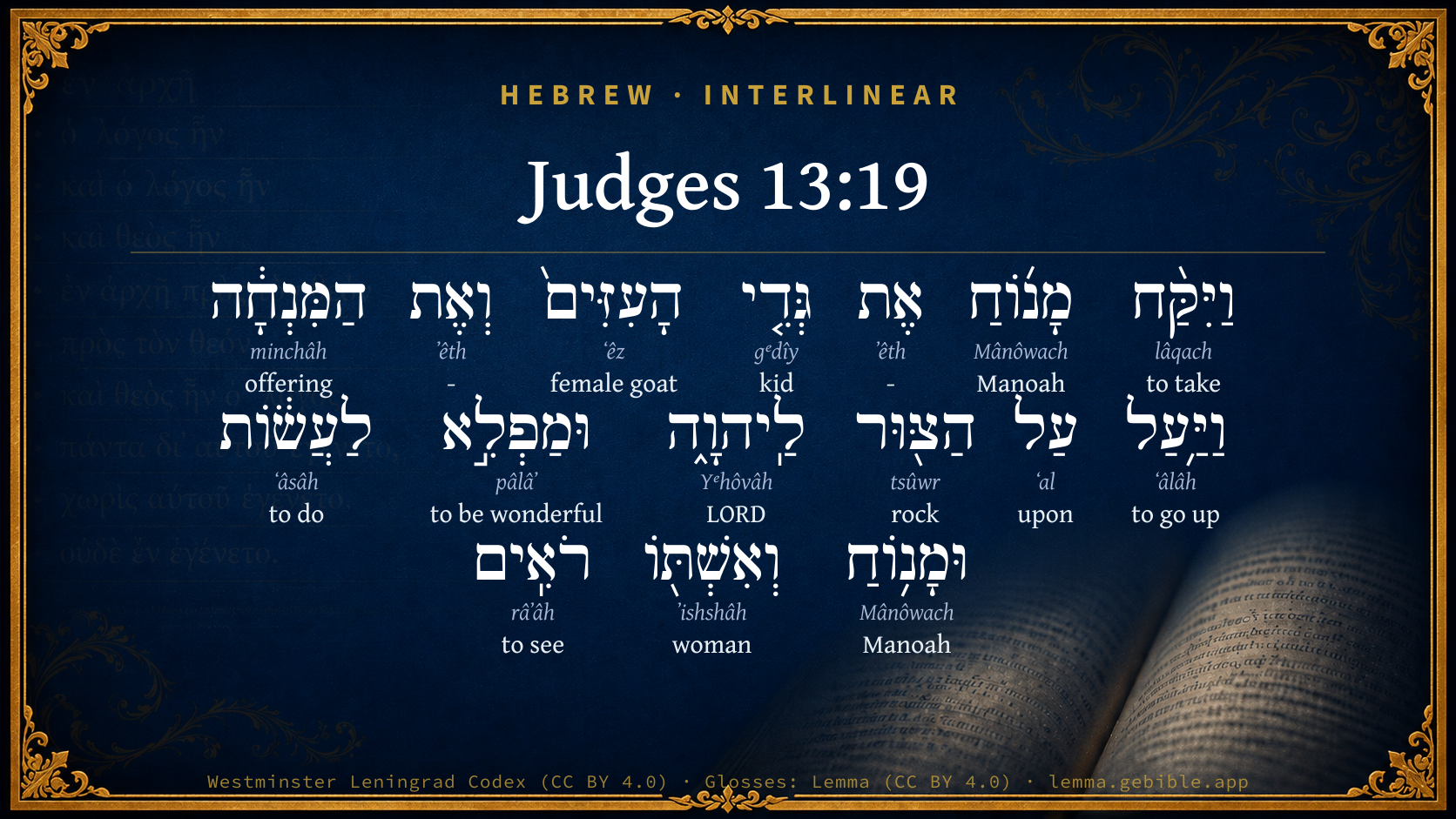
Hebrew (Westminster Leningrad Codex) Judges 13:19 appears in the Hebrew Old Testament. The text above is from the Westminster Leningrad Codex. Each word links to its Strong’s number, a concise gloss, and parsing drawn from the Open Scriptures Hebrew Bible morphology. Click any word for its full Brown-Driver-Briggs (BDB) entry.
Download image
Cite this verse

Judges 13:19 (World English Bible). Public Domain. Lemma interlinear Bible study tool, https://lemma.gebible.app/v/judges/13/19.

Show BibTeX & RIS
BibTeX
RIS
English Translation
So Manoah took the kid with the meal-offering, and offered it on the rock to Yahweh: and [the angel] did wondrously, and Manoah and his wife looked on.
World English Bible · Public Domain
Download a study sheet

One document with this verse’s original text, its word-by-word gloss line, the meaning frame, cross-references with their text, attributed commentary, and full source and license credits — printable, and it pastes into notes with its structure intact.

This verse Autodidact and up

Study sheet (.html) Plain text (.txt)

A passage Seminary Student

Up to 50 verses in one chapter. A passage sheet keeps up to 6 commentary sources and 12 cross-references per verse, in the order this page ranks them, and says so on the sheet whenever that leaves anything out. Ask for a single verse and you get the Autodidact verse sheet above.

Everything on this page stays free to read, with no account — the sheet is a download of what is already on screen, not access to it.

Want to remove ads? Support Godless Engineer
Compare translations 3

The same verse in 3 English versions, stacked beneath the original-language interlinear above. Click any original word for its lexicon entry.

Each is an independent rendering of the whole verse — the interlinear is not word-aligned to these translations.

Highlighted words mark where these versions differ — a whole-verse word diff, not a word-by-word alignment.

  • World English Bible Public Domain
    So Manoah took the kid with the meal-offering, and offered it on the rock to Yahweh: and [the angel] did wondrously, and Manoah and his wife looked on.
  • King James Version Public Domain
    So Manoah took a kid with a meat offering, and offered it upon a rock unto the LORD: and the angel did wonderously; and Manoah and his wife looked on.
  • unfoldingWord Literal Text CC BY-SA 4.0
    And Manoah took the kid of goats and the grain offering and offered on a rock to Yahweh. And he was being wonderful in doing, and Manoah and his wife watching.

unfoldingWord Literal Text — © unfoldingWord, licensed CC BY-SA 4.0. Word-aligned USFM3 via Door43 (git.door43.org/unfoldingWord/en_ult).

Versions to compare (up to 4)

3 of 4 selected

Show all 18 translations

Every available English version of this verse, each an independent rendering of the whole verse.

  • World English Bible Public Domain
    So Manoah took the kid with the meal-offering, and offered it on the rock to Yahweh: and [the angel] did wondrously, and Manoah and his wife looked on.
  • Berean Standard Bible Public Domain
    Then Manoah took a young goat and a grain offering and offered them on a rock to the LORD. And as Manoah and his wife looked on, the LORD did a marvelous thing.
  • Majority Standard Bible Public Domain
    Then Manoah took a young goat and a grain offering and offered them on a rock to the LORD. And as Manoah and his wife looked on, the LORD did a marvelous thing.
  • King James Version Public Domain
    So Manoah took a kid with a meat offering, and offered it upon a rock unto the LORD: and the angel did wonderously; and Manoah and his wife looked on.
  • American Standard Version (1901) Public Domain
    So Manoah took the kid with the meal-offering, and offered it upon the rock unto Jehovah: and `the angel' did wondrously, and Manoah and his wife looked on.
  • Revised Version (1885) Public Domain
    So Manoah took the kid with the meal offering, and offered it upon the rock unto the LORD: and the angel did wondrously, and Manoah and his wife looked on.
  • Geneva Bible (1599) Public Domain
    Then Manoah tooke a kid with a meate offering, and offered it vpon a stone vnto the Lord: and the Angell did wonderously, whiles Manoah and his wife looked on.
  • Douay-Rheims (1899) Public Domain
    Then Manue took a kid of the flocks, and the libations, and put them upon a rock, offering to the Lord, who doth wonderful things: and he and his wife looked on.
  • Young's Literal Translation Public Domain
    And Manoah taketh the kid of the goats, and the present, and offereth on the rock to Jehovah, and He is doing wonderfully, and Manoah and his wife are looking on,
  • Literal Standard Version CC BY-SA 4.0
    And Manoah takes the kid of the goats, and the present, and offers on the rock to YHWH, and He is doing wonderfully, and Manoah and his wife are looking on,
  • Unlocked Literal Bible CC BY-SA 4.0
    So Manoah took the young goat with the grain offering and offered them on the rock to Yahweh. He did something marvelous while Manoah and his wife were watching.
  • unfoldingWord Literal Text CC BY-SA 4.0
    And Manoah took the kid of goats and the grain offering and offered on a rock to Yahweh. And he was being wonderful in doing, and Manoah and his wife watching.
  • Darby Bible Public Domain
    So Mano'ah took the kid with the cereal offering, and offered it upon the rock to the LORD, to him who works wonders.
  • World Messianic Bible Public Domain
    So Manoah took the young goat with the meal offering, and offered it on the rock to the LORD. Then the angel did an amazing thing as Manoah and his wife watched.
  • Webster's Bible Public Domain
    So Manoah took a kid, with a meat-offering, and offered it upon a rock to the LORD; and the angel did wonderously, and Manoah and his wife looked on.
  • Free Bible Version CC BY-SA 4.0
    Manoah took a young goat and a grain offering and presented them on a rock to the Lord. As Manoah and his wife watched, the Lord did something amazing.
  • Bible in Basic English Public Domain
    So Manoah took the young goat with its meal offering, offering it on the rock to the Lord, who did strange things.
  • JPS Tanakh (1917) Public Domain
    So Manoah took the kid with the meal-offering, and offered it upon the rock unto the LORD; and the angel did wondrously, and Manoah and his wife looked on.

Literal Standard Version (2020), Covenant Press — licensed CC BY-SA 4.0. Text via the HelloAO Bible API (eBible.org). Unlocked Literal Bible (unfoldingWord) — licensed CC BY-SA 4.0. Text via the HelloAO Bible API (eBible.org). unfoldingWord Literal Text — © unfoldingWord, licensed CC BY-SA 4.0. Word-aligned USFM3 via Door43 (git.door43.org/unfoldingWord/en_ult). Free Bible Version, Dr. Jonathan Gallagher — licensed CC BY-SA 4.0. Text via the HelloAO Bible API (eBible.org).

Word by word

More ways to search: Search by grammar → Find every occurrence → Compare this word →

Practice this passage: Drill this verse → Learn its vocabulary →

גְּדִ֤י
gᵉdîy
H1423
“kid of”
Noun, Common, Masculine, Singular, Construct
Part of Speech
Noun
Type
Common
Gender
Masculine
Number
Singular
State
Construct
Full BDB Definition

Origin: from the same as H1415

TWOT: 314b

kid, young male goat
  1. וַיִּקַּ֨ח lâqach H3947 “and · to take” Conjunction + Verb, Qal, Sequential Imperfect, 3rd Person, Masculine, Singular
  2. מָנ֜וֹחַ Mânôwach H4495 “Manoah” Noun, Proper
  3. אֶת ʼêth H853 “-” Particle, Direct Object
  4. הָעִזִּים֙ ʻêz H5795 “the · female goats” Particle, Definite Article + Noun, Common, Feminine, Plural, Absolute
  5. וְאֶת ʼêth H853 “and · -” Conjunction + Particle, Direct Object
  6. הַמִּנְחָ֔ה minchâh H4503 “the · offering” Particle, Definite Article + Noun, Common, Feminine, Singular, Absolute
  7. וַיַּ֥עַל ʻâlâh H5927 “and · to go up” Conjunction + Verb, Hiphil, Sequential Imperfect, 3rd Person, Masculine, Singular
  8. עַל ʻal H5921 “upon” Preposition
  9. הַצּ֖וּר tsûwr H6697 “the · rock” Particle, Definite Article + Noun, Common, Masculine, Singular, Absolute
  10. לַֽיהוָ֑ה Yᵉhôvâh H3068 “to/for · LORD” Preposition + Noun, Proper
  11. וּמַפְלִ֣א pâlâʼ H6381 “and · being wonderful” Conjunction + Verb, Hiphil, Participle Active, Masculine, Singular, Absolute
  12. לַעֲשׂ֔וֹת ʻâsâh H6213 “to do” Preposition + Verb, Qal, Infinitive Construct
  13. וּמָנ֥וֹחַ Mânôwach H4495 “and · Manoah” Conjunction + Noun, Proper
  14. וְאִשְׁתּ֖וֹ ʼishshâh H802 “and · woman · his” Conjunction + Noun, Common, Feminine, Singular, Construct + Suffix, Personal, 3rd Person, Masculine, Singular
  15. רֹאִֽים râʼâh H7200 “seeing” Verb, Qal, Participle Active, Masculine, Plural, Absolute

About this verse

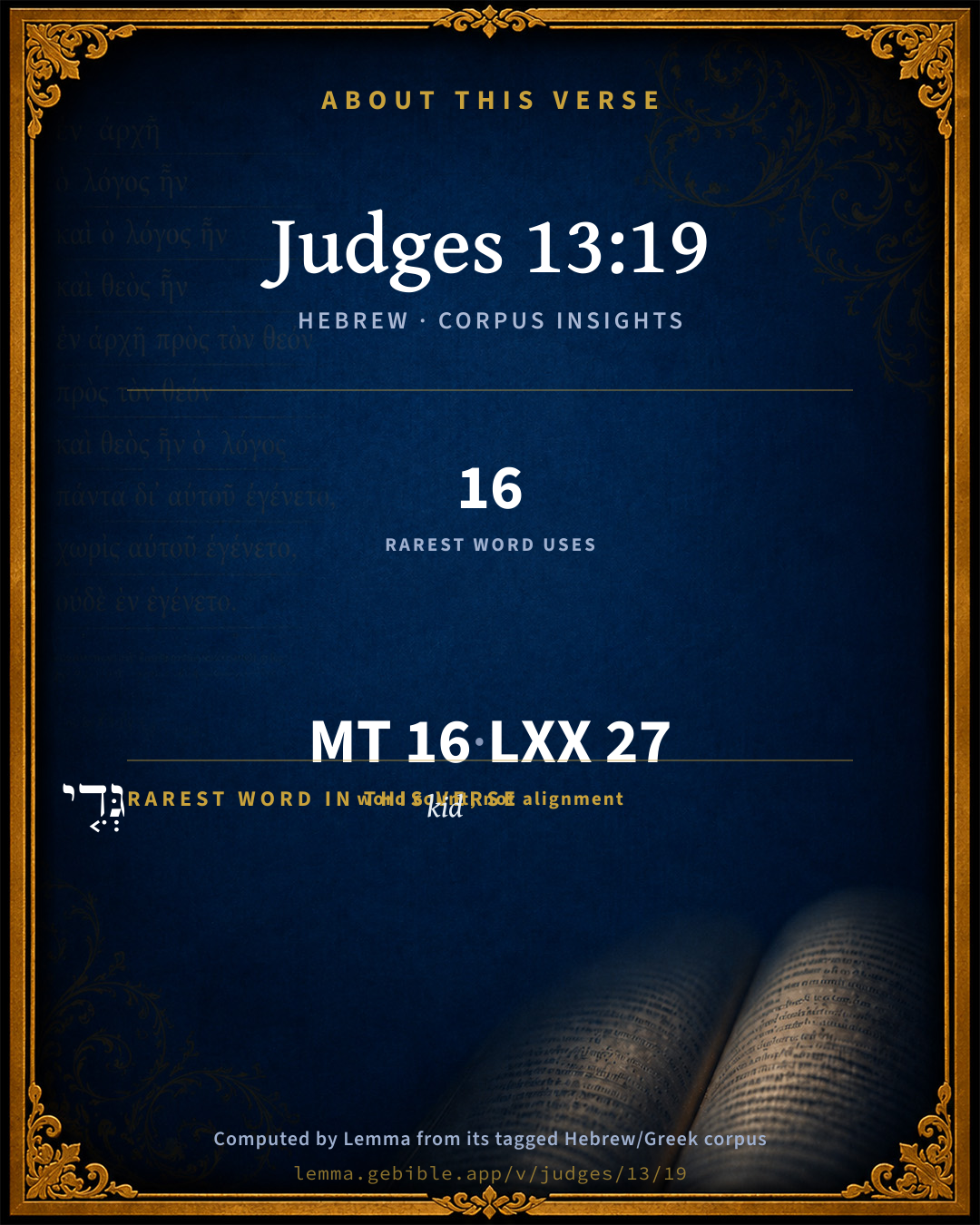
These counts appear in no published source. They are computed here, from the morphology-tagged text and Lemma’s own curated glosses. What Lemma adds →

16
words
14
distinct lemmas
Historical
section

Notable vocabulary

The rarest word here is גְּדִ֤י kid H1423 — appearing just 16 times in the whole Hebrew Bible.

Shared distinctive vocabulary

גְּדִ֤י kid H1423 occurs in 16 verses of the Hebrew Bible. Also found in:

Grammatical profile

  • 5 verbs
  • 8 nouns
  • 1 preposition
  • 2 particles

Verb forms

  • וַיִּקַּ֨ח Qal · Sequential Imperfect
  • וַיַּ֥עַל Hiphil · Sequential Imperfect
  • וּמַפְלִ֣א Hiphil · Participle Active
  • לַעֲשׂ֔וֹת Qal · Infinitive Construct
  • רֹאִֽים Qal · Participle Active

Repetition

A word recurs within this verse — often emphatic in Hebrew:

  • מָנ֜וֹחַ Manoah H4495 ×2

Hebrew & Septuagint length

In English translation the verse runs 28 words from the Hebrew and 35 from the Septuagint (LXX English) — closely comparable.

A rough comparison of the two English renderings, which tokenize alike — not a word-level alignment.

Word counts can differ between the Hebrew and the Greek without any difference in meaning — e.g. the Hebrew direct-object marker אֵת has no separate Greek word, and Greek often adds the article ὁ.

In the original languages it is 16 Hebrew tokens and 27 Greek tokens — but the two are counted differently (Hebrew bundles its prefixes and suffixes into one token; the Greek is in lemma form), so that isn’t a like-for-like length.

Cross-references

2

Topical passages linked to Judges 13:19 in the Treasury of Scripture Knowledge — connected by theme and wording, ordered by reader-vote popularity; previews shown in the World English Bible.

  • Judges 6:19–21 Gideon went in, and made ready a kid, and unleavened cakes of an ephah of meal: the flesh he put in a basket, and he put the broth in a pot, and brought it out to him under the oak, and presented it.
  • 1 Kings 18:30–38 Elijah said to all the people, Come near to me; and all the people came near to him. He repaired the altar of Yahweh that was thrown down.

Cross-references courtesy of OpenBible.info (CC BY 4.0).

Hebrew and Greek witnesses Masoretic Hebrew ↔ Greek Septuagint

The same verse in the two great witnesses to the Old Testament, shown verse-for-verse.

These are two independent witnesses, not word-aligned to each other, and the Septuagint is shown in lemma (dictionary) form.

Hebrew Judges 13:19 Masoretic · Westminster Leningrad Codex

וַיִּקַּ֨ח מָנ֜וֹחַ אֶת גְּדִ֤י הָעִזִּים֙ וְאֶת הַמִּנְחָ֔ה וַיַּ֥עַל עַל הַצּ֖וּר לַֽיהוָ֑ה וּמַפְלִ֣א לַעֲשׂ֔וֹת וּמָנ֥וֹחַ וְאִשְׁתּ֖וֹ רֹאִֽים

So Manoah took the kid with the meal-offering, and offered it on the rock to Yahweh: and [the angel] did wondrously, and Manoah and his wife looked on.

World English Bible · Public Domain

Greek LXX Judges 13:19 Septuagint · lemma form

καί λαμβάνω μανωε ὁ ἔριφος ὁ αἴξ καί ὁ θυσία καί ἀναφέρω ἐπί ὁ πέτρα ὁ κύριος καί διαχωρίζω ποιέω καί μανωε καί ὁ γυνή αὐτός βλέπω

And Manoe took a kid of the goats and its meat-offering, and offered it on the rock to the Lord; and the angel wrought a distinct work, and Manoe and his wife were looking on.

LXX2012 (modern English Septuagint) · Public Domain

On this verse, The Cambridge Bible for Schools and Colleges discusses the Septuagint’s reading. Read the note in Commentary ↓

Hebrew: Westminster Leningrad Codex (CC BY 4.0). Greek: Septuagint (public domain); English from LXX2012 (modern English Septuagint) (Public Domain). How the Septuagint differs from the Hebrew →

Targum (Aramaic paraphrase)

1

The Targum is the ancient Jewish Aramaic paraphrase of the Hebrew Scriptures — an interpretive translation, not the Hebrew text itself. Onkelos (literal) and Pseudo-Jonathan (expansive) render the Torah, and Jonathan the Prophets. Coverage is partial: where no permissively-licensed English translation exists for a verse, only the Aramaic is shown. This is verse-level text, not a word-by-word alignment to the Hebrew.

  1. Targum Jonathan Prophets (Joshua–Malachi)
    וּנְסִיב מָנוֹחַ יַת גַדְיָא בַּר עִזֵי וְיַת תִּקְרוֹבְתָּא וְאַסִיק עַל טִינָרָא קֳדָם יְיָ וּמַפְרַשׁ לְמֶעְבַּד וּמָנוֹחַ וְאִתְּתֵיהּ חָזָן:

    (no public-domain English translation for this verse)

    Targum Jonathan — Aramaic: “Mikraot Gedolot” (public domain). English: “Sefaria Community Translation” (CC0 1.0 (public-domain dedication)); “London "Chaldee Paraphrase," 1871” (public domain). Text via Sefaria.

Commentary

Notes on Judges 13:19 from classic Christian and Jewish commentators (each source and its license shown beneath its notes). The classic Christian expositions comment on the surrounding passage and are grouped to its opening verse, so a note may address several verses; the Jewish commentaries on the Tanakh (Rashi and others) are per-verse, so they appear only where the commentator wrote on this verse.

Lemma curates 59 commentaries, every one of them public domain or Creative Commons licensed, each selected and text-cleaned for this edition rather than reprinted as found. About our sources →

Trapp's Complete Commentary

John Trapp

Jdg 13:19 So Manoah took a kid with a meat offering, and offered [it] upon a rock unto the LORD: and [the angel] did wondrously; and Manoah and his wife looked on.

Ver. 19. So Manoah took a kid, &c.] Both the sacrifiser and the altar were extraordinary; but they had Christ’s warrant for it. {Jdg 19:16}

And the angel did wondrously.] Probably by bringing fire out of the rock, as before for Gideon, and consuming the sacrifice.

And Manoah and his wife looked on.] For the confirmation of their faith. This was a high favour. All Israel might see Moses go toward the rock of Rephidim. None but the elders might see him strike it: their unbelief made them unworthy of this privilege. It is no small favour of God to make us witnesses of his wondrous works.

John Trapp, A Commentary or Exposition upon All the Books of the Old and New Testament (1647–1656) — public domain. Text from a community e-Sword module.

Joseph Benson's Commentary

Jdg 13:19-20. And offered it upon a rock — The presence and command of the angel being a sufficient warrant for the offering of sacrifice by a person who was no priest, and in a place otherwise forbidden. Vitringa, however, supposes that “it was the angel who upon this occasion performed the principal functions of the priest; the most essential of which was to put the fire to the burnt-offering.” Manoah, he observes, “dared not to perform the offices of the priesthood in the presence of a personage whom he took for an extra-ordinary prophet, commissioned from God. All that he did was done by order of the angel, or as his minister; just as the Israelites obeyed Elijah afterward,” 1Ki 18:34. The angel, or rather he, (for there is nothing for angel in the original,) did wondrously — Bringing fire out of the rock, as in the case of Gideon, Jdg 6:21, to consume the burnt-offering, and then ascending in the midst of the flame, hereby manifesting his nature and essence to be spiritual. Off the altar — That is, from that part of the rock which served instead of an altar, upon which the sacrifice was laid. Manoah and his wife fell on their faces — Partly out of reverence for so glorious a person manifested in so wonderful a manner, and partly out of a religious horror and fear of death; for the prevention whereof they fell down in the way of supplication to God.

Joseph Benson's Commentary on the Old and New Testaments (1811–1818) — public domain. Text from a community e-Sword module.

Geneva Bible (1599)

Geneva Bible translators

God sent fire from heaven to consume their sacrifice, to confirm their faith in his promise.

Geneva Bible (1599) marginal notes — public domain. Text via Bolls.life.

Adam Clarke's Commentary

Verse 19. The angel did wondrously] He acted according to his name; he, being wonderful, performed wonderful things; probably causing fire to arise out of the rock and consume the sacrifice, and then ascending in the flame.

Adam Clarke's Commentary on the Bible (1810–1826) — public domain. Text from a community e-Sword/MySword module.

Ellicott's Commentary for English Readers

(19) Did wonderously.—With a reference to the word pelî in the previous verse. (Comp. Jdg_6:20-26.)

A Bible Commentary for English Readers, edited by Charles John Ellicott (1878–1897) — public domain. Text from a community e-Sword module.

The Cambridge Bible for Schools and Colleges

gen. ed. J. J. S. Perowne

19. offered it upon the rock] i.e. the rock which formed the altar (Jdg_13:20), and lay close at hand. Such an altar, hewn out of the living rock and reached by steps leading to a platform, actually exists near Ṣar‘a (Zorah), and may have been in the writer’s mind; see the illustration in Driver, Schweich Lectures (1909), 66, based on Schick, ZDPV.

10. (1887), 140 f., who first gave details of the discovery. The surface of the altar itself is almost covered with cup-shaped depressions connected in many cases by shallow channels. These hollows look as if they were intended to receive liquid offerings, and certainly there is little room left on the surface for a burnt sacrifice. Hence Kittel, Studien z. Hebr. Archäol. (1908), 97–108, concludes that the altar was primarily a table for a meal offering, and that its use as a hearth for a burnt offering marks the difference between Israelite and pre-Israelite practice. Jehovah would not receive a meal like a Canaanite god; He does not inhabit the sacred stone or tree; His offerings must be consumed by fire which rises to the heaven where He dwells. Kittel works out suggestively the theological significance of Gideon’s and Manoah’s sacrifice; but it must be remembered that his argument turns on the cup-like hollows found on the surface of this and similar altar-rocks1[52]; and the purpose of these is by no means certain at present.

[52] At Marmita, 2 m. S.E. of Ṣar‘a, at Nebî Samwîl = Mizpah, el-Jib = Gibeon, Petra, all ancient high-places. Rock-surfaces uncovered at Megiddo, at Taanach, at Gezer, exhihit similar cup-marks; see Driver, l.c. 51, 67, 81, and Vincent, Canaan (1907), 95 f.

with the meal offering] See on Jdg_6:18. Some scholars regard the words here and in Jdg_13:23 as a later addition made for the sake of ritual completeness.

and the angel did wondrously] As it stands the text is hardly grammatical; so the angel is inserted in the EV. to make sense. LXX. cod. A and Vulgate read with a slight change ‘unto the Lord who doeth wondrously,’ and many adopt this correction. The clause following is accidentally repeated from Jdg_13:20, where it is in place. Perhaps both clauses (and did wondrously2[53], and … looked on) came in here from Jdg_13:20.

[53] If restored to Jdg_13:20 read w‘hû maflî’ for umaflî’.

The Cambridge Bible for Schools and Colleges (gen. ed. J. J. S. Perowne; Cambridge University Press, 1878–1918) — public domain. Text from a community e-Sword module.

John Gill's Exposition

So Manoah took a kid with a meat offering,.... The kid which he proposed to make an entertainment with, for the man of God, he took him to be, he fetched and brought for a burnt offering, at the hint which the angel had given him, and joined to it a meat offering, as was usual whenever burnt offerings were made; see Num 15:3,

and offered it upon a rock unto the Lord; for though Manoah was not a priest, nor was this a proper place for sacrifice; high places were now forbidden, and only at the tabernacle in Shiloh were offerings to be brought; yet all this was dispensed with, and Manoah was justified in what he did by the warrant of the angel, Jdg 13:16. The rock was probably near the place where this meeting of Manoah and his wife with the angel was, and where the discourse between them passed; and which served instead of an altar, and on which Manoah sacrificed, not to idols, but to the true Jehovah, as the angel directed:

and the angel did wondrously; agreeably to his name, which was "Wonderful", Jdg 13:18 or "he, Jehovah, did wondrously" for this angel was no other than Jehovah the Son. The instance in which he did wondrously was, as Kimchi observes, by bringing fire out of the rock, which consumed the flesh of the kid, and the meat offering; and so Josephus (q) says, that he touched the flesh with a rod he had, and fire sparkled out, and consumed it with the bread, or meat offering; just in the same manner as the angel did with the kid and cakes that Gideon brought, Jdg 6:21.

and Manoah and his wife looked on; to see either fire come down from heaven, or spring up out of the rock, which consumed the sacrifice, and showed the Lord's acceptance of it, and also the angel's ascending in it, as follows.

(q) Ut supra. (Antiqu. l. 5. c. 8. sect. 3.)

John Gill's Exposition of the Whole Bible (1746–1763) — public domain (CC PDM 1.0). Text via the HelloAO Bible API.

Haydock's Catholic Bible Commentary

On. Manue was convinced that the person who had authorized him to offer sacrifice, had power to dispense with him. (Worthington) --- The angel "did wonderful things," as the Hebrew may be explained, causing a flame to proceed from the rock and to consume the victim, as Josephus assures us, (Calmet) and as the angel who had appeared to Gedeon had done, chap. vi. 21. (Menochius)

George Leo Haydock (1774–1849), Haydock's Catholic Family Bible and Commentary, 1859 edition — public domain. Excludes Psalms (Douay-Rheims chapter numbering differs from Protestant) and Deuterocanonical books (Catholic canon only).

Matthew Poole's English Annotations

Meat-offerings were generally joined with the chief sacrifices.

Offered it upon a rock; the angel’s presence and command being a sufficient warrant for the offering of sacrifice by a person who was no priest, and in a place otherwise forbidden.

Matthew Poole's English Annotations on the Holy Bible (1683–1685) — public domain. Text from a community e-Sword/MySword module.

Whedon's Commentary on the Bible

Daniel D. Whedon

19. Manoah took a kid — Here notice another instance of a person offering a burnt-offering with his own hands, and far from the tabernacle.

Offered it upon a rock — As Gideon offered his kid and unleavened cakes. Jdg_6:20.

Did wondrously — His acts accorded with his name. The great miracle was his ascension in the flame of the altar; by which sublime manifestation he overwhelmed Manoah and his wife with a sudden conviction of his divine essence and glory. This conviction only deepened and became more permanent with the lapse of time, and the fact that the Angel no more appeared.

Daniel D. Whedon (gen. ed.), Commentary on the Old and New Testaments (1874–1909) — public domain. Text from a community e-Sword module.

The Pulpit Commentary

Offered it, etc. He had the angel"s sanction for doing so in ver. 16. But we must not look for strict compliance with the Levitical law in the lawless days of the Judges, though we find many of its prescribed ordinances in use, as, for instance, the institution of Nazarites, and here the offering of the meat offering with the burnt offering. (Lev_2:1, etc.) And the angel. These words are rightly inserted, to give the sense of the original, as more fully explained in the following verse. Did wonderously literally, was wondrous in his doing. The verb here is the same root as the substantive or adjective wonder, or wonderful, in ver. 18. Compare the similar account in Jud_1:6:21.

The Pulpit Commentary (1880–1919), ed. H.D.M. Spence-Jones & Joseph S. Exell — public domain. Text from a community e-Sword module.

John Wesley's Explanatory Notes

Meal-offering - Which were generally joined with the chief sacrifices. A Rock - The angel's presence and command being a sufficient warrant for the offering of sacrifice by a person who was no priest, and in a place otherwise forbidden.

John Wesley, Explanatory Notes Upon the Whole Bible (1754–1765) — public domain. Text via the GEBible commentary corpus.

Keil & Delitzsch

C. F. Keil & F. Delitzsch

Manoah then took the kid and the minchah, i.e., according to Num 15:4., the meat-offering belonging to the burnt-offering, and offered it upon the rock, which is called an altar in Jdg 13:20, because the angel of the Lord, who is of one nature with God, had sanctified it as an altar through the miraculous acceptance of the sacrifice. לעשׁות מפלא, "and wonderfully (miraculously) did he act" (הפליא followed by the infinitive with ל as in Ch2 26:15). These words form a circumstantial clause, which is not to be attached, however, to the subject of the principal clause, but to ליהוה: "Manoah offered the sacrifice to the Lord, whereupon He acted to do wonderfully, i.e., He performed a wonder or miracle, and Manoah and his wife saw it" (see Ewald, Lehrb. 341, b., p. 724, note). In what the miracle consisted is explained in Jdg 13:20, in the words, "when the flame went up toward heaven from off the altar;" that is to say, in the fact that a flame issued from the rock, as in the case of Gideon's sacrifice (Jdg 6:21), and consumed the sacrifice. And the angel of the Lord ascended in this flame. When Manoah and his wife saw this, they fell upon their faces to the earth (sc., in worship), because they discovered from the miracle that it was the angel of the Lord who had appeared to them.

Keil & Delitzsch — Biblical Commentary on the Old Testament (1861–1891) — public domain (CC PDM 1.0). Text via the HelloAO Bible API. (Old Testament only.)

unfoldingWord translationNotes

Door43 World Missions Community

with the grain offering

This law requires a grain offering to be offered when a burnt offering is made. AT: "with the grain offering required with it" or "with the grain offering to accompany it" (See: Assumed Knowledge and Implicit Information)

on the rock

"on the altar." The altar Manoah sacrificed the offering on was a rock.

He did something

"The angel did something"

the angel of Yahweh went up in the flame of the altar

"the angel of Yahweh went back up into heaven through the flames on the altar"

lay facedown on the ground

"lay with their faces to the ground." This is a sign of respect and honor, but it also shows their fear of Yahweh. (See: Symbolic Action)

translationWords

goat

grain offering

Yahweh

amazed

altar

heaven

angel

unfoldingWord translationNotes — © Distant Shores Media and the Door43 World Missions Community, licensed CC BY-SA 4.0. Source: git.door43.org/Door43/en_tn.

Lesson kit

Teaching starters — assembled from the data on this page, not authored interpretation. Every prompt links to the verse data it draws on. Edit before teaching.

Judges, in the Historical, opens this verse with 16 words (14 distinct Hebrew lemmas). Its most distinctive word is gᵉdîy (“kid”). A historical commentator’s framing appears above. Read the whole chapter for the surrounding context.

Discussion questions

  1. The word gᵉdîy carries the sense “kid.” How does it shape the verse?
  2. Genesis 27:9 shares the word «kid» with this verse. How do the two illuminate each other?
  3. “Manoah” occurs 2× in this one verse. What is the effect of the repetition?
  4. These translations render this verse differently; the difference is in the English rendering, not the original. What questions does that raise?
  5. The verb «וַיִּקַּ֨ח» is Qal Sequential Imperfect. How does its form color the action?
  6. Reading how Trapp's Complete Commentary and Joseph Benson's Commentary read this verse, where do the two commentators agree and where do they part?

Things to notice

Reading settings

Reading text

Shown beneath each verse's original-language words.

Old Testament
Old Testament edition

Read the OT as the Masoretic Hebrew (MT) or the Greek Septuagint (LXX).

English shown for the Greek Septuagint (in the Hebrew ↔ Greek comparison).

Comparing translations? Open the Compare panel on any verse page to stack up to four side by side.