
Judges 9:36

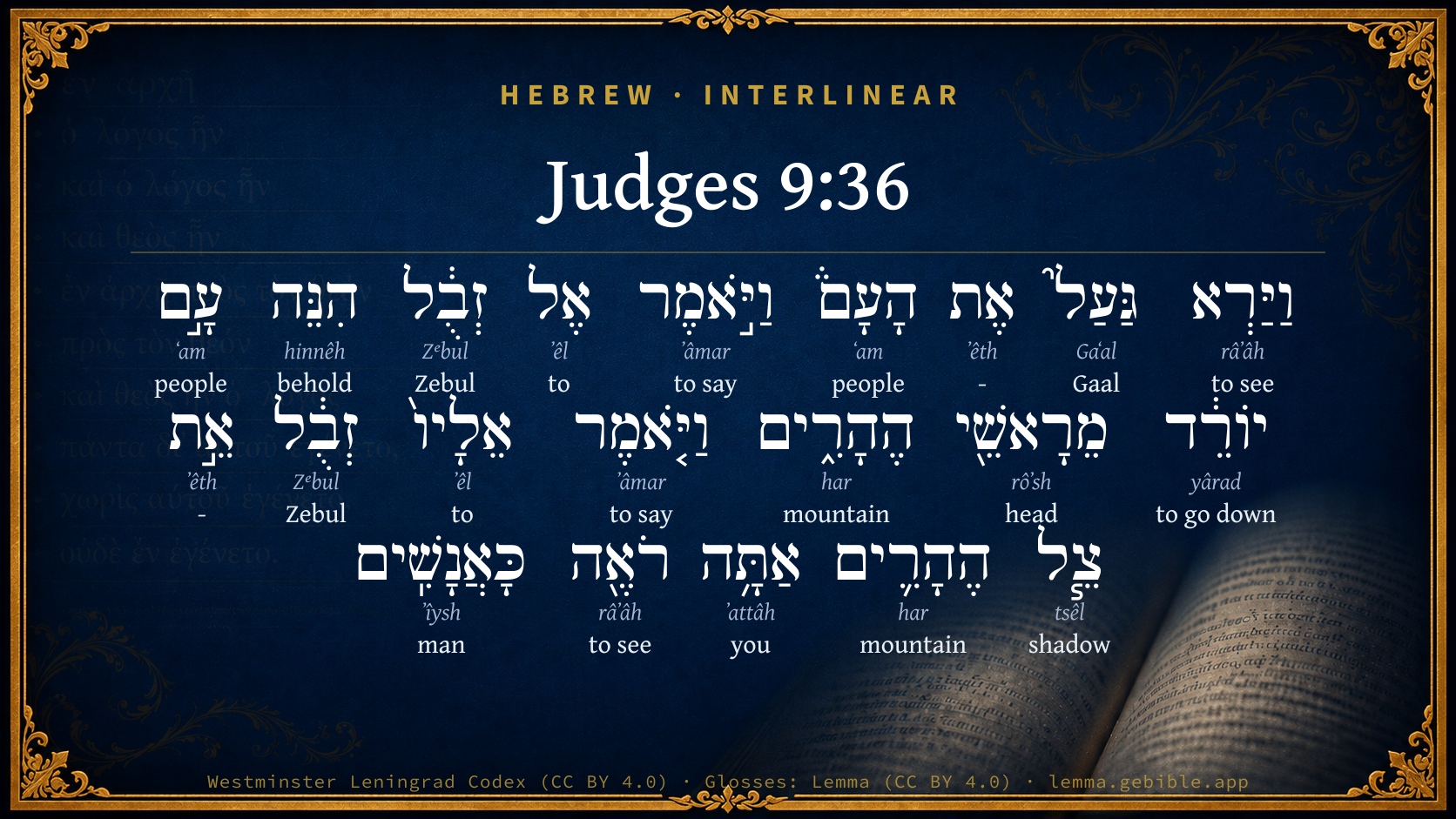
Hebrew (Westminster Leningrad Codex) Judges 9:36 appears in the Hebrew Old Testament. The text above is from the Westminster Leningrad Codex. Each word links to its Strong’s number, a concise gloss, and parsing drawn from the Open Scriptures Hebrew Bible morphology. Click any word for its full Brown-Driver-Briggs (BDB) entry.
Download image
Cite this verse

Judges 9:36 (World English Bible). Public Domain. Lemma interlinear Bible study tool, https://lemma.gebible.app/v/judges/9/36.

Show BibTeX & RIS
BibTeX
RIS
English Translation
When Gaal saw the people, he said to Zebul, Behold, there come people down from the tops of the mountains. Zebul said to him, You see the shadow of the mountains as if they were men.
World English Bible · Public Domain
Download a study sheet

One document with this verse’s original text, its word-by-word gloss line, the meaning frame, cross-references with their text, attributed commentary, and full source and license credits — printable, and it pastes into notes with its structure intact.

This verse Autodidact and up

Study sheet (.html) Plain text (.txt)

A passage Seminary Student

Up to 50 verses in one chapter. A passage sheet keeps up to 6 commentary sources and 12 cross-references per verse, in the order this page ranks them, and says so on the sheet whenever that leaves anything out. Ask for a single verse and you get the Autodidact verse sheet above.

Everything on this page stays free to read, with no account — the sheet is a download of what is already on screen, not access to it.

Want to remove ads? Support Godless Engineer
Compare translations 3

The same verse in 3 English versions, stacked beneath the original-language interlinear above. Click any original word for its lexicon entry.

Each is an independent rendering of the whole verse — the interlinear is not word-aligned to these translations.

Highlighted words mark where these versions differ — a whole-verse word diff, not a word-by-word alignment.

  • World English Bible Public Domain
    When Gaal saw the people, he said to Zebul, Behold, there come people down from the tops of the mountains. Zebul said to him, You see the shadow of the mountains as if they were men.
  • King James Version Public Domain
    And when Gaal saw the people, he said to Zebul, Behold, there come people down from the top of the mountains. And Zebul said unto him, Thou seest the shadow of the mountains as if they were men.
  • unfoldingWord Literal Text CC BY-SA 4.0
    And Gaal saw the people and he said to Zebul, “Behold, a people coming down from the tops of the hills!” But Zebul said to him, “The shadow of the hills, you seeing as men.”

unfoldingWord Literal Text — © unfoldingWord, licensed CC BY-SA 4.0. Word-aligned USFM3 via Door43 (git.door43.org/unfoldingWord/en_ult).

Versions to compare (up to 4)

3 of 4 selected

Show all 18 translations

Every available English version of this verse, each an independent rendering of the whole verse.

  • World English Bible Public Domain
    When Gaal saw the people, he said to Zebul, Behold, there come people down from the tops of the mountains. Zebul said to him, You see the shadow of the mountains as if they were men.
  • Berean Standard Bible Public Domain
    When Gaal saw the people, he said to Zebul, “Look, people are coming down from the mountains!” But Zebul replied, “The shadows of the mountains look like men to you.”
  • Majority Standard Bible Public Domain
    When Gaal saw the people, he said to Zebul, “Look, people are coming down from the mountains!” But Zebul replied, “The shadows of the mountains look like men to you.”
  • King James Version Public Domain
    And when Gaal saw the people, he said to Zebul, Behold, there come people down from the top of the mountains. And Zebul said unto him, Thou seest the shadow of the mountains as if they were men.
  • American Standard Version (1901) Public Domain
    And when Gaal saw the people, he said to Zebul, Behold, there come people down from the tops of the mountains. And Zebul said unto him, Thou seest the shadow of the mountains as if they were men.
  • Revised Version (1885) Public Domain
    And when Gaal saw the people, he said to Zebul, Behold, there come people down from the tops of the mountains. And Zebul said unto him, Thou seest the shadow of the mountains as if they were men.
  • Geneva Bible (1599) Public Domain
    And when Gaal sawe the people, he said to Zebul, Beholde, there come people downe from the tops of the mountaines: and Zebul said vnto him, The shadowe of the mountaines seeme men vnto thee.
  • Douay-Rheims (1899) Public Domain
    And when Gaal saw the people, he said to Zebul: Behold a multitude cometh down from the mountains. And he answered him: Thou seest the shadows of the mountains as if they were the heads of men, and this is thy mistake.
  • Young's Literal Translation Public Domain
    and Gaal seeth the people, and saith unto Zebul, `Lo, people are coming down from the top of the hills;' and Zebul saith unto him, `The shadow of the hills thou art seeing like men.'
  • Literal Standard Version CC BY-SA 4.0
    and Gaal sees the people and says to Zebul, “Behold, people are coming down from the top of the hills”; and Zebul says to him, “You are seeing the shadow of the hills like men.”
  • Unlocked Literal Bible CC BY-SA 4.0
    When Gaal saw the men, he said to Zebul, “See, men are coming down from the hilltops!” Zebul said to him, “You are seeing the shadows on the hills like they are men.”
  • unfoldingWord Literal Text CC BY-SA 4.0
    And Gaal saw the people and he said to Zebul, “Behold, a people coming down from the tops of the hills!” But Zebul said to him, “The shadow of the hills, you seeing as men.”
  • Darby Bible Public Domain
    And when Ga'al saw the men, he said to Zebul, "Look, men are coming down from the mountain tops!" And Zebul said to him, "You see the shadow of the mountains as if they were men."
  • World Messianic Bible Public Domain
    When Gaal saw the people, he said to Zebul, “Behold, people are coming down from the tops of the mountains.” Zebul said to him, “You see the shadows of the mountains as if they were men.”
  • Webster's Bible Public Domain
    And when Gaal saw the people, he said to Zebul, Behold, there come people down from the top of the mountains. And Zebul said to him, Thou seest the shadow of the mountains as if they were men.
  • Free Bible Version CC BY-SA 4.0
    Gaal saw the army approaching and said to Zebul, “Look! Some people are coming down from the hilltops!” “That's just shadows made by the hills that look like men,” Zebul replied.
  • Bible in Basic English Public Domain
    And when Gaal saw the people, he said to Zebul, See! people are coming down from the tops of the mountains. And Zebul said to him, You see the shade of the mountains like men.
  • JPS Tanakh (1917) Public Domain
    And when Gaal saw the people, he said to Zebul: 'Behold, there come people down from the tops of the mountains.' And Zebul said unto him: 'Thou seest the shadow of the mountains as if they were men.'

Literal Standard Version (2020), Covenant Press — licensed CC BY-SA 4.0. Text via the HelloAO Bible API (eBible.org). Unlocked Literal Bible (unfoldingWord) — licensed CC BY-SA 4.0. Text via the HelloAO Bible API (eBible.org). unfoldingWord Literal Text — © unfoldingWord, licensed CC BY-SA 4.0. Word-aligned USFM3 via Door43 (git.door43.org/unfoldingWord/en_ult). Free Bible Version, Dr. Jonathan Gallagher — licensed CC BY-SA 4.0. Text via the HelloAO Bible API (eBible.org).

Word by word

More ways to search: Search by grammar → Find every occurrence → Compare this word →

Practice this passage: Drill this verse → Learn its vocabulary →

זְבֻ֔ל
Zᵉbul
H2083
“Zebul”
Noun, Proper
Part of Speech
Noun
Type
Proper
Full BDB Definition

Origin: the same as H2073

TWOT: None

Zebul = "exalted" - chief man of the city of Shechem at the time of the contest between Abimelech and the native Canaanites
  1. וַיַּרְא râʼâh H7200 “and · to see” Conjunction + Verb, Qal, Sequential Imperfect, 3rd Person, Masculine, Singular
  2. גַּעַל֮ Gaʻal H1603 “Gaal” Noun, Proper
  3. אֶת ʼêth H853 “-” Particle, Direct Object
  4. הָעָם֒ ʻam H5971 “the · people” Particle, Definite Article + Noun, Common, Masculine, Singular, Absolute
  5. וַיֹּ֣אמֶר ʼâmar H559 “and · to say” Conjunction + Verb, Qal, Sequential Imperfect, 3rd Person, Masculine, Singular
  6. אֶל ʼêl H413 “to” Preposition
  7. הִנֵּה hinnêh H2009 “behold” Particle, Demonstrative
  8. עָ֣ם ʻam H5971 “people” Noun, Common, Masculine, Singular, Absolute
  9. יוֹרֵ֔ד yârad H3381 “going down” Verb, Qal, Participle Active, Masculine, Singular, Absolute
  10. מֵרָאשֵׁ֖י rôʼsh H7218 “from · heads of” Preposition + Noun, Common, Masculine, Plural, Construct
  11. הֶהָרִ֑ים har H2022 “the · mountains” Particle, Definite Article + Noun, Common, Masculine, Plural, Absolute
  12. וַיֹּ֤אמֶר ʼâmar H559 “and · to say” Conjunction + Verb, Qal, Sequential Imperfect, 3rd Person, Masculine, Singular
  13. אֵלָיו֙ ʼêl H413 “to · him” Preposition + Suffix, Personal, 3rd Person, Masculine, Singular
  14. זְבֻ֔ל Zᵉbul H2083 “Zebul” Noun, Proper
  15. אֵ֣ת ʼêth H853 “-” Particle, Direct Object
  16. צֵ֧ל tsêl H6738 “shadow of” Noun, Common, Masculine, Singular, Construct
  17. הֶהָרִ֛ים har H2022 “the · mountains” Particle, Definite Article + Noun, Common, Masculine, Plural, Absolute
  18. אַתָּ֥ה ʼattâh H859 “you” Pronoun, Personal, 2nd Person, Masculine, Singular
  19. רֹאֶ֖ה râʼâh H7200 “seeing” Verb, Qal, Participle Active, Masculine, Singular, Absolute
  20. כָּאֲנָשִֽׁים ʼîysh H376 “like/as the · men” Preposition, Determined + Noun, Common, Masculine, Plural, Absolute

About this verse

These counts appear in no published source. They are computed here, from the morphology-tagged text and Lemma’s own curated glosses. What Lemma adds →

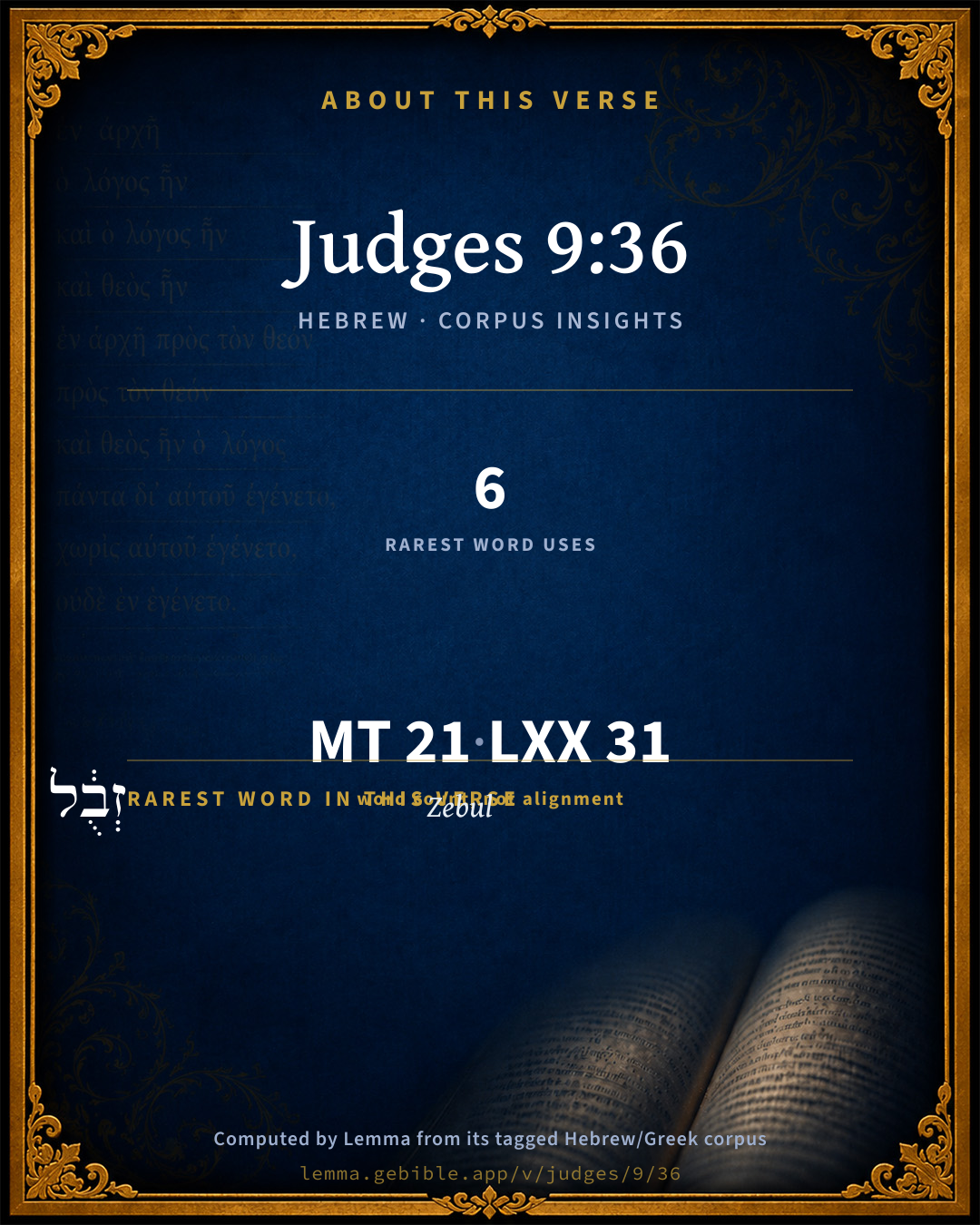
21
words
14
distinct lemmas
Historical
section

Notable vocabulary

The rarest word here is זְבֻ֔ל Zebul H2083 — appearing just 6 times in the whole Hebrew Bible.

Shared distinctive vocabulary

זְבֻ֔ל Zebul H2083 occurs in 5 verses of the Hebrew Bible. Also found in:

Grammatical profile

  • 5 verbs
  • 10 nouns
  • 1 pronoun
  • 2 prepositions
  • 3 particles

Verb forms

  • וַיַּרְא Qal · Sequential Imperfect
  • וַיֹּ֣אמֶר Qal · Sequential Imperfect
  • יוֹרֵ֔ד Qal · Participle Active
  • וַיֹּ֤אמֶר Qal · Sequential Imperfect
  • רֹאֶ֖ה Qal · Participle Active

Repetition

Words recur within this verse — often emphatic in Hebrew:

  • וַיַּרְא to see H7200 ×2
  • הָעָם֒ people H5971 ×2
  • וַיֹּ֣אמֶר to say H559 ×2
  • זְבֻ֔ל Zebul H2083 ×2
  • הֶהָרִ֑ים mountain H2022 ×2
  • אֶל to H413 ×2

Hebrew & Septuagint length

In English translation the verse runs 36 words from the Hebrew and 38 from the Septuagint (LXX English) — closely comparable.

A rough comparison of the two English renderings, which tokenize alike — not a word-level alignment.

Word counts can differ between the Hebrew and the Greek without any difference in meaning — e.g. the Hebrew direct-object marker אֵת has no separate Greek word, and Greek often adds the article ὁ.

In the original languages it is 21 Hebrew tokens and 31 Greek tokens — but the two are counted differently (Hebrew bundles its prefixes and suffixes into one token; the Greek is in lemma form), so that isn’t a like-for-like length.

Cross-references

2

Topical passages linked to Judges 9:36 in the Treasury of Scripture Knowledge — connected by theme and wording, ordered by reader-vote popularity; previews shown in the World English Bible.

  • Ezekiel 7:7 Your doom is come to you, inhabitant of the land: the time is come, the day is near, [a day of] tumult, and not [of] joyful shouting, on the mountains.
  • Mark 8:24 He looked up, and said, "I see men; for I see them like trees walking."

Cross-references courtesy of OpenBible.info (CC BY 4.0).

Hebrew and Greek witnesses Masoretic Hebrew ↔ Greek Septuagint

The same verse in the two great witnesses to the Old Testament, shown verse-for-verse.

These are two independent witnesses, not word-aligned to each other, and the Septuagint is shown in lemma (dictionary) form.

Hebrew Judges 9:36 Masoretic · Westminster Leningrad Codex

וַיַּרְא גַּעַל֮ אֶת הָעָם֒ וַיֹּ֣אמֶר אֶל זְבֻ֔ל הִנֵּה עָ֣ם יוֹרֵ֔ד מֵרָאשֵׁ֖י הֶהָרִ֑ים וַיֹּ֤אמֶר אֵלָיו֙ זְבֻ֔ל אֵ֣ת צֵ֧ל הֶהָרִ֛ים אַתָּ֥ה רֹאֶ֖ה כָּאֲנָשִֽׁים

When Gaal saw the people, he said to Zebul, Behold, there come people down from the tops of the mountains. Zebul said to him, You see the shadow of the mountains as if they were men.

World English Bible · Public Domain

Greek LXX Judges 9:36 Septuagint · lemma form

καί ὁράω γααλ υἱός ιωβηλ ὁ λαός καί εἶπον πρός ζεβουλ ἰδού λαός καταβαίνω ἀπό κεφαλή ὁ ὄρος καί εἶπον πρός αὐτός ζεβουλ ὁ σκιά ὁ ὄρος σύ βλέπω ὡς ἀνήρ

And Gaal the son of Jobel saw the people, and said to Zebul, Behold, a people comes down from the top of the mountains: and Zebul said to him, You see the shadow of the mountains as men.

LXX2012 (modern English Septuagint) · Public Domain

Hebrew: Westminster Leningrad Codex (CC BY 4.0). Greek: Septuagint (public domain); English from LXX2012 (modern English Septuagint) (Public Domain). How the Septuagint differs from the Hebrew →

Targum (Aramaic paraphrase)

1

The Targum is the ancient Jewish Aramaic paraphrase of the Hebrew Scriptures — an interpretive translation, not the Hebrew text itself. Onkelos (literal) and Pseudo-Jonathan (expansive) render the Torah, and Jonathan the Prophets. Coverage is partial: where no permissively-licensed English translation exists for a verse, only the Aramaic is shown. This is verse-level text, not a word-by-word alignment to the Hebrew.

  1. Targum Jonathan Prophets (Joshua–Malachi)
    וַחֲזָא גַעַל יַת עַמָא וַאֲמַר לִזְבוּל הָא עַמָא נָחִית מֵרֵישֵׁי טוּרַיָא וַאֲמַר לֵיהּ זְבוּל יַת טוּלָא דְטוּרַיָא אַתְּ חָזֵי כְּגַבְרַיָא:

    (no public-domain English translation for this verse)

    Targum Jonathan — Aramaic: “Mikraot Gedolot” (public domain). English: “Sefaria Community Translation” (CC0 1.0 (public-domain dedication)); “London "Chaldee Paraphrase," 1871” (public domain). Text via Sefaria.

Commentary

Notes on Judges 9:36 from classic Christian and Jewish commentators (each source and its license shown beneath its notes). The classic Christian expositions comment on the surrounding passage and are grouped to its opening verse, so a note may address several verses; the Jewish commentaries on the Tanakh (Rashi and others) are per-verse, so they appear only where the commentator wrote on this verse.

Lemma curates 59 commentaries, every one of them public domain or Creative Commons licensed, each selected and text-cleaned for this edition rather than reprinted as found. About our sources →

Trapp's Complete Commentary

John Trapp

Jdg 9:36 And when Gaal saw the people, he said to Zebul, Behold, there come people down from the top of the mountains. And Zebul said unto him, Thou seest the shadow of the mountains as [if they were] men.

Ver. 36. He said to Zebul.] Who had hitherto played on both hands, and seemed to side with Gaal, that he might bring him into the hands of Abimelech’s ambuscado. Huiusmodi homines instructi arte Pelasga, &c. Fair words make fools fain.

Thou seest the shadow of the mountains as if they were men.] Either thine eyes are not matches or thy fear hath blinded thee: -

“ Pessimus in dubiis augur timor. ” - Statius Theb., lib. iii.

The Burgundians, once expecting a battle, thought long thistles were lances. So saith Zebul here, in a jeer, thou takest mountains for men, shadows for substances.

John Trapp, A Commentary or Exposition upon All the Books of the Old and New Testament (1647–1656) — public domain. Text from a community e-Sword module.

Geneva Bible (1599)

Geneva Bible translators

Thou art afraid of a shadow.

Geneva Bible (1599) marginal notes — public domain. Text via Bolls.life.

Ellicott's Commentary for English Readers

(36) He said to Zebul.—The narrative is too brief to enable us to understand clearly the somewhat anomalous position of Zebul. He seems to have been deposed from his office, and yet to have retained the confidence of Gaal and the Shechemites.

Thou seest the shadow of the mountains.—The shadow advancing as the sun rose. It was, of course, Zebul’s object to keep Gaal deceived as long as possible. But it is evident that Gaal’s suspicions were by no means lulled. Zebul treats him almost as if he were still suffering from the intoxication of his vaunting feast.

A Bible Commentary for English Readers, edited by Charles John Ellicott (1878–1897) — public domain. Text from a community e-Sword module.

John Gill's Exposition

And Gaal spake again, and said,.... Looking towards the mountains, and taking another view of what he before saw, for further satisfaction:

see, there come people down by the middle of the land; either in the valley between the two mountains; or rather those he first saw on the top of the mountains were now come down about the middle of them, called in the Hebrew text the navel, from the prominence of the mountains thereabout, or because the navel is in the middle of the body, as this part of them was the middle on which he saw them. R. Isaiah interprets it, between the two cities:

and another company come along by the plain of Meonenim; of which we read nowhere else. Montanus renders it, "the oak of Meonenim"; or of the soothsayers; oaks being had in great esteem with idolaters for their oracles and divinations; and perhaps this was a place, whether an oak or, a plain, where such persons used to meet to make their divinations.

John Gill's Exposition of the Whole Bible (1746–1763) — public domain (CC PDM 1.0). Text via the HelloAO Bible API.

Haydock's Catholic Bible Commentary

To Zebul. It seems the latter had acted with such dissimulation, that Gaal supposed he had come over to his party. Zebul laughs at him, as if he were disturbed with groundless fears, (Haydock) in order that Abimelech may take him unawares. (Menochius)

George Leo Haydock (1774–1849), Haydock's Catholic Family Bible and Commentary, 1859 edition — public domain. Excludes Psalms (Douay-Rheims chapter numbering differs from Protestant) and Deuterocanonical books (Catholic canon only).

Matthew Poole's English Annotations

Zebul concealed the anger which he had conceived, Jdg 9:30, and pretended compliance with him in this expedition, that he might draw him forth into the field, where Abimelech might have the opportunity of lighting with him, and overthrowing him.

Thou seest the shadow of the mountains; for in the morning, as this was, and in the evening, the shadows are longest, and move most quickly. He intimates that he was afraid of shadows.

Matthew Poole's English Annotations on the Holy Bible (1683–1685) — public domain. Text from a community e-Sword/MySword module.

Whedon's Commentary on the Bible

Daniel D. Whedon

36. Shadow of the mountains — Zebul speaks to him in deceit; that is, for the purpose of deceiving him, just as he had sent to Abimelech. Jdg_9:31. He wishes to gain time for Abimelech, and pretends that the advancing forces are but the moving shadows of the heights of Ebal, which in the early morning always spread themselves upon the landscape of Shechem.

Daniel D. Whedon (gen. ed.), Commentary on the Old and New Testaments (1874–1909) — public domain. Text from a community e-Sword module.

The Pulpit Commentary

Saw the people, i.e. Abimelech"s followers. He said to Zebul, whom he looked upon as a friend and confederate. Zebul said to him, etc. Partly to give Abimelech time, and partly to conceal his own complicity in Abimelech"s movements, Zebul affected not to see the men, and explained the appearance as being merely the shadows of the mountains cast before the rising sun.

The Pulpit Commentary (1880–1919), ed. H.D.M. Spence-Jones & Joseph S. Exell — public domain. Text from a community e-Sword module.

John Wesley's Explanatory Notes

To Zebul - Who concealed the anger which he had conceived, ver. 30, and pretended compliance with him in this expedition, that he might draw him forth into the field where Abimelech might have the opportunity of fighting with him, and overthrowing him. The shadow - For in the morning, as this was, and in the evening, the shadows are longest, and move quickest.

John Wesley, Explanatory Notes Upon the Whole Bible (1754–1765) — public domain. Text via the GEBible commentary corpus.

unfoldingWord translationNotes

Door43 World Missions Community

Gaal

This is the name of a man. See how you translated this in Judges 9:26.

Zebul

This is the name of a man. See how you translated this in Judges 9:28.

You are seeing the shadows on the hills like they are men

Zebul is trying to confuse Gaal and keep him from preparing for battle. AT: "That is not people, it is only shadows on the hills"

one unit

"1 group" or "1 troop" (See: Numbers)

translationWords

oak

divination

unfoldingWord translationNotes — © Distant Shores Media and the Door43 World Missions Community, licensed CC BY-SA 4.0. Source: git.door43.org/Door43/en_tn.

Lesson kit

Teaching starters — assembled from the data on this page, not authored interpretation. Every prompt links to the verse data it draws on. Edit before teaching.

Judges, in the Historical, opens this verse with 21 words (14 distinct Hebrew lemmas). Its most distinctive word is Zᵉbul (“Zebul”). A historical commentator’s framing appears above. Read the whole chapter for the surrounding context.

Discussion questions

  1. What does “Zebul” (Zᵉbul) contribute to the verse as a whole?
  2. Judges 9:28 shares the word «Zebul» with this verse. How do the two illuminate each other?
  3. “to see” occurs 2× in this one verse. What is the effect of the repetition?
  4. The translations on this page render this verse differently — a whole-verse word diff, not a word-by-word alignment. What might account for the different wordings?
  5. The verb «וַיַּרְא» is Qal Sequential Imperfect. How does its form color the action?
  6. Reading how Trapp's Complete Commentary and Geneva Bible (1599) read this verse, where do the two commentators agree and where do they part?

Things to notice

Reading settings

Reading text

Shown beneath each verse's original-language words.

Old Testament
Old Testament edition

Read the OT as the Masoretic Hebrew (MT) or the Greek Septuagint (LXX).

English shown for the Greek Septuagint (in the Hebrew ↔ Greek comparison).

Comparing translations? Open the Compare panel on any verse page to stack up to four side by side.