Luke 18:28

Greek (Tischendorf 8th ed.) Luke 18:28 appears in the Greek New Testament. The text above is from the Tischendorf 8th edition. Each word links to its Strong’s number and a concise gloss. Click any word for its full Thayer’s Greek Lexicon entry.
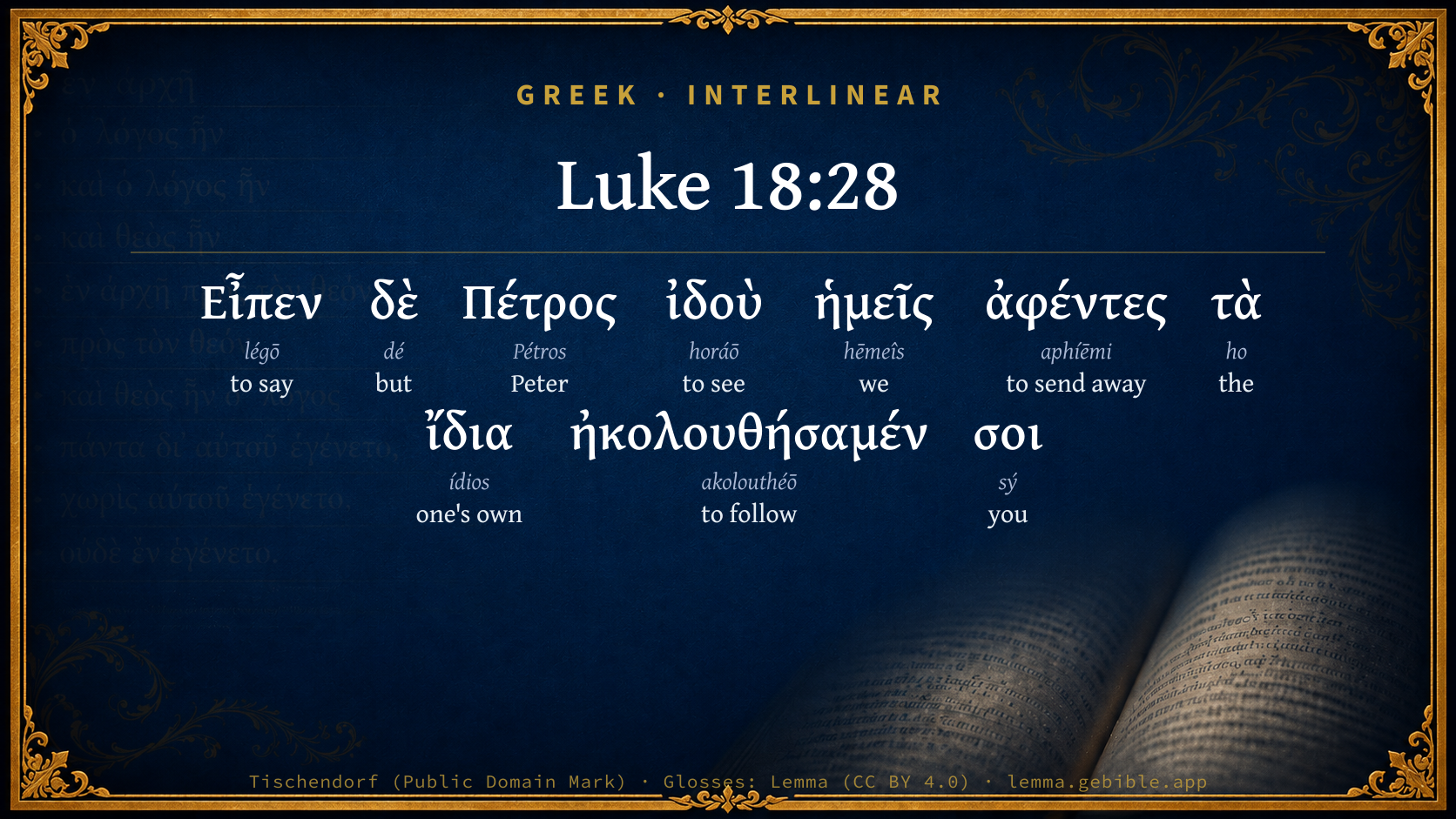
Download image
Cite this verse

Luke 18:28 (World English Bible). Public Domain. Lemma interlinear Bible study tool, https://lemma.gebible.app/v/luke/18/28.

Show BibTeX & RIS
BibTeX
RIS
English Translation
Peter said, "Look, we have left everything, and followed you."
World English Bible · Public Domain
Download a study sheet

One document with this verse’s original text, its word-by-word gloss line, the meaning frame, cross-references with their text, attributed commentary, and full source and license credits — printable, and it pastes into notes with its structure intact.

This verse Autodidact and up

Study sheet (.html) Plain text (.txt)

A passage Seminary Student

Up to 50 verses in one chapter. A passage sheet keeps up to 6 commentary sources and 12 cross-references per verse, in the order this page ranks them, and says so on the sheet whenever that leaves anything out. Ask for a single verse and you get the Autodidact verse sheet above.

Everything on this page stays free to read, with no account — the sheet is a download of what is already on screen, not access to it.

Want to remove ads? Support Godless Engineer
Compare translations 3

The same verse in 3 English versions, stacked beneath the original-language interlinear above. Click any original word for its lexicon entry.

Each is an independent rendering of the whole verse — the interlinear is not word-aligned to these translations.

Highlighted words mark where these versions differ — a whole-verse word diff, not a word-by-word alignment.

  • World English Bible Public Domain
    Peter said, "Look, we have left everything, and followed you."
  • King James Version Public Domain
    Then Peter said, Lo, we have left all, and followed thee.
  • unfoldingWord Literal Text CC BY-SA 4.0
    Then Peter said, “Behold, we left everything and followed you.”

unfoldingWord Literal Text — © unfoldingWord, licensed CC BY-SA 4.0. Word-aligned USFM3 via Door43 (git.door43.org/unfoldingWord/en_ult).

Versions to compare (up to 4)

3 of 4 selected

Show all 19 translations

Every available English version of this verse, each an independent rendering of the whole verse.

  • World English Bible Public Domain
    Peter said, "Look, we have left everything, and followed you."
  • Berean Standard Bible Public Domain
    “Look,” said Peter, “we have left all we had to follow You.”
  • Majority Standard Bible Public Domain
    “Look,” said Peter, “we have left all we had to follow You.”
  • King James Version Public Domain
    Then Peter said, Lo, we have left all, and followed thee.
  • American Standard Version (1901) Public Domain
    And Peter said, Lo, we have left our own, and followed thee.
  • Revised Version (1885) Public Domain
    And Peter said, Lo, we have left our own, and followed thee.
  • Geneva Bible (1599) Public Domain
    Then Peter said, Loe, we haue left all, and haue followed thee.
  • Douay-Rheims (1899) Public Domain
    Then Peter said: Behold, we have left all things, and have followed thee.
  • Young's Literal Translation Public Domain
    And Peter said, `Lo, we left all, and did follow thee;'
  • Literal Standard Version CC BY-SA 4.0
    And Peter said, “Behold, we left all, and followed You”;
  • Unlocked Literal Bible CC BY-SA 4.0
    Peter said, “Well, we have left everything that is our own and have followed you.”
  • unfoldingWord Literal Text CC BY-SA 4.0
    Then Peter said, “Behold, we left everything and followed you.”
  • Darby Bible Public Domain
    And Peter said, Behold, *we* have left all things and have followed thee.
  • World Messianic Bible Public Domain
    Peter said, “Look, we have left everything and followed you.”
  • Webster's Bible Public Domain
    Then Peter said, Lo, we have left all, and followed thee.
  • Free Bible Version CC BY-SA 4.0
    Peter said, “We left everything to follow you!”
  • Bible in Basic English Public Domain
    And Peter said, See, we have given up what is ours to come after you.
  • Text-Critical English NT CC BY 4.0
    Then Peter said, “Behold, we have left everything and followed yoʋ.”
  • Tyndale New Testament (1534) Public Domain
    Then Peter sayde: Loo we have lefte all and have folowed the.

Literal Standard Version (2020), Covenant Press — licensed CC BY-SA 4.0. Text via the HelloAO Bible API (eBible.org). Unlocked Literal Bible (unfoldingWord) — licensed CC BY-SA 4.0. Text via the HelloAO Bible API (eBible.org). unfoldingWord Literal Text — © unfoldingWord, licensed CC BY-SA 4.0. Word-aligned USFM3 via Door43 (git.door43.org/unfoldingWord/en_ult). Free Bible Version, Dr. Jonathan Gallagher — licensed CC BY-SA 4.0. Text via the HelloAO Bible API (eBible.org).

Word by word

More ways to search: Search by grammar → Find every occurrence → Compare this word →

Practice this passage: Drill this verse → Learn its vocabulary →

ἠκολουθήσαμέν
akolouthéō
G190
“to follow”
Verb, Aorist, Active, Indicative, 1st person, Plural
Part of Speech
Verb
Tense
Aorist
Voice
Active
Mood
Indicative
Person
1st person
Number
Plural
Full Thayer's Definition

Origin: from G1 (as a particle of union) and keleuthos (a road)

TDNT: 04:30,3

1. to follow one who precedes, join him as his attendant, accompany him 2. to join one as a disciple, become or be his disciple a. side with his party
  1. Εἶπεν légō G3004 “to say” Verb, Aorist, Active, Indicative, 3rd person, Singular
  2. δὲ dé G1161 “but” Conjunction
  3. Πέτρος Pétros G4074 “Peter” Noun, Nominative, Singular, Masculine
  4. ἰδοὺ horáō G3708 “to see” Verb, Aorist, Middle, Imperative, 2nd person, Singular
  5. ἡμεῖς hēmeîs G2249 “we” Personal pronoun, 1st person, Nominative, Plural
  6. ἀφέντες aphíēmi G863 “to send away” Verb, Aorist, Active, Participle, Nominative, Plural, Masculine
  7. τὰ ho G3588 “the” Article, Accusative, Plural, Neuter
  8. ἴδια ídios G2398 “one's own” Adjective, Accusative, Plural, Neuter
  9. σοι sý G4771 “you” Personal pronoun, 2nd person, Dative, Singular

About this verse

These counts appear in no published source. They are computed here, from the morphology-tagged text and Lemma’s own curated glosses. What Lemma adds →

10
words
10
distinct lemmas
Gospels
section

Cross-references

6

Topical passages linked to Luke 18:28 in the Treasury of Scripture Knowledge — connected by theme and wording, ordered by reader-vote popularity; previews shown in the World English Bible.

  • Mark 10:28 Peter began to tell him, "Behold, we have left all, and have followed you."
  • Philippians 3:7 However, what things were gain to me, these have I counted loss for Christ.
  • Matthew 19:27 Then Peter answered, "Behold, we have left everything, and followed you. What then will we have?"
  • Luke 5:11 When they had brought their boats to land, they left everything, and followed him.
  • Matthew 4:19–22 He said to them, "Come after me, and I will make you fishers for men."
  • Matthew 9:9 As Jesus passed by from there, he saw a man called Matthew sitting at the tax collection office. He said to him, "Follow me." He got up and followed him.

Cross-references courtesy of OpenBible.info (CC BY 4.0).

Commentary

Notes on Luke 18:28 from classic Christian and Jewish commentators (each source and its license shown beneath its notes). The classic Christian expositions comment on the surrounding passage and are grouped to its opening verse, so a note may address several verses; the Jewish commentaries on the Tanakh (Rashi and others) are per-verse, so they appear only where the commentator wrote on this verse.

Lemma curates 59 commentaries, every one of them public domain or Creative Commons licensed, each selected and text-cleaned for this edition rather than reprinted as found. About our sources →

Tyndale Open Study Notes

Tyndale Open Resources

18:28-30 We’ve left our homes to follow you: In contrast to the rich ruler, Peter and the other disciples had given up everything to follow Jesus. Jesus affirmed that they would receive back far more than they had given up.

Tyndale Open Study Notes — © Tyndale Open Resources, licensed CC BY-SA 4.0. Text via the HelloAO Bible API.

Meyer's Critical & Exegetical Commentary

Heinrich August Wilhelm Meyer

Luk_18:28-30. See on Mat_19:27-29; Mar_10:28-30, the latter of whom Luke follows with abridgment.

ὃς οὐ μὴ κ.τ.λ.] Comp. Mar_13:2. In respect of no one who has forsaken, etc., will it be the case that he does not receive, etc. In the choice of ἀπολάβῃ there is implied the idea of what he receives being due. Comp. Luk_16:25, Luk_6:34, Luk_23:41; Dem. 78. 3 : ἄν τε λάβητε, ἄν τʼ ἀπολάβητε; 162. 17 : λαμβάνειν μὲν οὐκ εἴων, ἀπολαμβάνειν δὲ συνεβούλευον.

Meyer — Critical and Exegetical Commentary on the New Testament — English translation by Peter Christie, edited by Frederick Crombie (T&T Clark, 1880) — public domain. Text from a community e-Sword module.

Expositor's Greek Testament

ed. W. Robertson Nicoll

Luk 18:28 . Peter’s remark about leaving all, as in Mk., without the question, what shall we have? appended to it in Mt.

The Expositor's Greek Testament, edited by W. Robertson Nicoll (1897–1910) — public domain. Text from a community e-Sword module.

Godet's Commentaries

Frédéric Louis Godet

3 d. Luk 18:28-30. The Conversation regarding the Disciples.

There had been a day in the life of the disciples when a similar alternative had been put before them; they had resolved it in a different way. What was to accrue to them from the course which they had taken? Peter asks the question innocently, in the name of all. The form of his inquiry in Matthew, What shall we have therefore? contains, more expressly than that of Luke and Mark, the idea of an expected recompense. In Matthew, the Lord enters at once into Peter’s thought, and makes a special promise to the Twelve, one of the grandest which He addressed to them. Then, in the parable of the labourers, He warns them against indulging pride, on the ground that they have been the first to follow Him. It is difficult fully to harmonize this parable with the special promise which precedes it, without holding that the promise was conditional, and was not to be fulfilled, except in so far as they did not abandon themselves to the spirit of pride combated in the parable, which savours of refinement. As, therefore, Luke places this same promise in a wholly different setting, Luk 22:28-30, a context with which it perfectly agrees, it is probable that Matthew placed it here through an association of ideas which admits of easy explanation. According to Luke and Mark, the promise by which Jesus answered Peter is such as to apply to all believers; and it behoved to be so, if Jesus did not wish to favour the feeling of self-exaltation which breathed in the question of the apostle. There is even in the form, There is no man that...(Mark and Luke), the express intention to give to this promise the widest possible application.

All the relations of natural life find their analogies in the bonds formed by community of faith. Hence there arises for the believer a compensation for the painful rupture of fleshly ties, which Jesus knew so well by experience (Luk 8:19-21; comp. with Luk 8:1-3); and every true believer can, like Him, speak of fathers and mothers, brethren and children, who form his new spiritual family. Luke and Mark speak, besides, of houses; Matthew, of lands. The communion of Christian love in reality procures for each believer the enjoyment of every sort of good belonging to his brethren; yet, to prevent His disciples from supposing that it is an earthly paradise to which He is inviting them, He adds in Mark, with persecutions. Matthew and Luke had assuredly no dogmatic reason for omitting this important correction, if they had known it.

Luke likewise omits here the maxim, “Many that are first shall be last, etc....,” with which this piece closes in Mark, and which in Matthew introduces the parable of the labourers.

The common source of the three Syn. cannot be the proto-Mark, as Holtzmann will have it, unless we hold it to be at their own hand that Luke ascribes to this rich man the title, ruler of the synagogue, and that Matthew calls him a young man. As to Luke’s Ebionite tendency, criticism is bound to acknowledge, with this piece before it, that if salvation by voluntary poverty is really taught in our Gospel, it is not less decidedly so by the other two Syn.; that it is a heresy, consequently, not of Luke, but of Jesus,—or rather, a sound exegesis can find no such thing in the doctrines which our three evangelists agree in putting in the Master’s mouth.

Frédéric Louis Godet — Commentaries on Luke, John, Romans, and 1 Corinthians — English translation (T&T Clark, Edinburgh, 1870s–1890s) — public domain. Text from a community e-Sword module.

Jamieson, Fausset & Brown

Robert Jamieson, A. R. Fausset & David Brown

Lo, &c.--in the simplicity of his heart (as is evident from the reply), conscious that the required surrender had been made, and generously taking in his brethren with him--"we"; not in the spirit of the young ruler. "All these have I kept,"

left all--"The workmen's little is as much his "all" as the prince's much" [BENGEL]. In Matthew (Mat 19:27) he adds, "What shall we have therefore?" How shall it fare with us?

Jamieson, Fausset & Brown — Commentary Critical and Explanatory on the Whole Bible (1871) — public domain (CC PDM 1.0). Text via the HelloAO Bible API.

Adam Clarke's Commentary

Verse 28. We have left all] Our trades, our houses, and families. The reader is desired to consult the notes on Mt 4:20; Mt 19:27, &c.

Adam Clarke's Commentary on the Bible (1810–1826) — public domain. Text from a community e-Sword/MySword module.

Ellicott's Commentary for English Readers

(28-30) Then Peter said, . . .—See Notes on Mat_19:27-30; Mar_10:28. The better MSS. have, “We have left our own (possessions).” “All” was probably substituted from a recollection of the words as found in the other reports.

A Bible Commentary for English Readers, edited by Charles John Ellicott (1878–1897) — public domain. Text from a community e-Sword module.

The Cambridge Bible for Schools and Colleges

gen. ed. J. J. S. Perowne

28. Then Peter said] The feeling which dictated his remark is uncertain; perhaps it was a passing touch of self-congratulation; perhaps a plea for pity in the hard task of salvation.

we have left all] Rather, we left all, alluding to a particular crisis, Luk_5:11.

The Cambridge Bible for Schools and Colleges (gen. ed. J. J. S. Perowne; Cambridge University Press, 1878–1918) — public domain. Text from a community e-Sword module.

John Gill's Exposition

And he said unto them,.... To his disciples, as the Ethiopic version reads; though the Syriac and Persic versions read, "and Jesus said to him"; that is, to Peter; he particularly replied to him:

verily I say unto you, there is no man: not only you shall have peculiar honour done you, as to sit on thrones, and judge the twelve tribes of Israel; but there is not a single person of a more private character,

that hath left house, or "houses", as read the Syriac and Persic versions;

or parents, or brethren, or wife, or children, for the kingdom of God's sake: that is, for Christ's sake, and for the sake of his Gospel, as the other evangelists have it; and which teaches us how to understand the kingdom of God here, and elsewhere.

John Gill's Exposition of the Whole Bible (1746–1763) — public domain (CC PDM 1.0). Text via the HelloAO Bible API.

Trapp's Complete Commentary

John Trapp

28 Then Peter said, Lo, we have left all, and followed thee.

Ver. 28. See Mat 19:27.

John Trapp, A Commentary or Exposition upon All the Books of the Old and New Testament (1647–1656) — public domain. Text from a community e-Sword module.

Matthew Poole's English Annotations

See Poole on "Mat 19:27" and following verses to Mat 19:30, See Poole on "Mar 10:28" and following verses to Mar 10:30. The difficulty is only to reconcile Luk 18:30 to God’s providences. For the everlasting life promised in the world to come, that is matter of faith, and not so much as seemingly contradicted by any providence of God. But how many lose much for Christ, that in this life do not receive manifold more, or a hundredfold!

Answer. It is true, if we understood it in specie. But the promise is not so to be interpreted. It is enough, if they do receive much more in valore, in value upon a true and just estimation. And this every sufferer for Christ hath, either,

1. In a joy, and peace, and assurance of God’s love, which is a thousand times more.

2. Or at least in a contentment of mind with that state into which the providence of God bringeth them: this also is much more, as any will judge it a happier state never to thirst, than to have much drink to satisfy the appetite.

Matthew Poole's English Annotations on the Holy Bible (1683–1685) — public domain. Text from a community e-Sword/MySword module.

The Pulpit Commentary

Then Peter said, Lo, we hays left all, and followed thee. Again the question of Peter, evidently acting as spokesman of the twelve, is repeated by the first three evangelists. Strangely faithful in their accounts of their own dealings with their adored Master, they never veil or hide any human weakness or error of their own which led to an important bit of teaching from their Lord. Now, in this place, they, in the person of Peter, gave utterance to a very worldly, but a very natural, thought. The ruler had failed when the test was applied to him; he was a conspicuous example of failure in the rich to enter the kingdom. But they had not failed when the test had been applied to them; they had given all up for his sake: what would be their reward?

Vers. 28, 29. Christ"s (comp. Mar_10:29, 30) estimate of a Christian life.

It is certain that no literalist could ever understand Jesus Christ. Men of this order of mind utterly failed to understand him in his own time, (see particularly Joh_6:41-46) and they are equally at fault to-day. It is clearly impossible to give a literal interpretation to these words of the Lord; the facts of the case do not permit it. But going to the heart of this Divine utterance, we understand that any one who for Christ"s sake suffers the loss of kindred and of worldly goods, shall have that which, in the sight of God and in the light of his truth, is worth a hundred times more than any human or earthly blessings can be. We shall better see the truthfulness of this declaration if we approach the main thought from a little distance, and consider that human life is something the value of which depends not on the quantity but on the kind of it. A small quantity of human life outweighs in value a large amount of animal life. A very small portion of the higher human life transcends in value a large extent of lower human life. "Better fifty years of Europe than a cycle of Cathay." Bailey has well written"Life"s more than breath and the quick round of blood; It is a great spirit and a busy heart. We live in deeds, not years; in thoughts, not breaths; In feelings, not in figures on a dial. We should count time by heart-throbs. He most lives Who thinks most, feels the noblest, acts the best.

And there is wisdom as well as strength in the lines"One crowded hour of glorious life Is worth an age without a name.

Lifting up this truth to the spiritual level of the teaching of Jesus Christ, we find that in such a life as that which is of him and in him for the attainment of which we may have to make very great sacrifices

I THERE IS AN ELEVATED AND TRANSPORTING JOY experienced in the very endurance of persecution; and this alone goes far towards fulfilling the Saviour"s word. This statement is simply historical. The apostles returned from the council, condemned and severely scourged, "rejoicing that they were counted worthy to suffer shame for his Name." Paul and Silas sang the praises of God in the darkness and foulness of a Philippian dungeon. And under every sky since then, men and women, old and young and in the midst of life, have gone to the dungeon and to the stake and to the open grave in which they were to be buried alive, not with tears in their eyes and lamentations on their tongues, but with songs of praise upon their lips, and with keen, exultant triumph in their hearts. Today there is far more of real and lasting joy to be found under the roof of the missionary compound than in the palatial buildings of European capitals, profounder and more lasting satisfaction in the self-sacrificing labours of the evangelist than in the lounging idleness of the sons and daughters of fashion and of pleasure.

II IN TRUE DISCIPLESHIP THERE ARE SOURCES OF JOY which altogether outweigh any losses that may be entailed by fidelity. Some people know just enough of "religion to find it a weariness, a burden, an anxiety. This is neither piety nor policy; it does not secure God"s favour, and it gives no satisfaction to them. But the true and thorough servant of Jesus Christ, heartily surrendering himself to his Divine Redeemer, and devotedly engaging in his service, has "manifold more" of blessedness than he loses by anything with which he parts. He has

(1) the favour, the forgiving and abiding love of God his Father; his lifelong, his unfailing friendship;

(2) happy, holy fellowship with Jesus Christ, and, through him, with the true and pure and good amongst men;

(3) a share in that holy service, outside of which is no rectitude for man, in which is rightness and wisdom, and therefore peace and joy;

(4) the luxury, the blessedness of usefulness, of doing good and communicating, of being a source of strength and healing to the poor and needy;

(5) "And in the world to come eternal life:" not the lingering and lasting shadows into which Greek and, Roman shrank from descending; not the uninviting sheol of the Hebrews; but everlasting day, eternal life life in its fulness, its freedom, its blessedness, its glory, life never ceasing but enlarging and unfolding evermore. What commanding, convincing, constraining reasons are here for choosing the Master"s service! What is it that he asks us to surrender for his sake? Anything in the way of profit, or pleasure, or companionship? Perhaps something in these ways. But what we gain by accepting him as Saviour and Friend is a thousand times more precious than all that we can be called upon to renounce. Even here and now God gives to us far more than he takes from us; and, beside this, in the world to come is" eternal life." We may well do as Peter said he and his associates had done leave all to follow Christ. C.

The Pulpit Commentary (1880–1919), ed. H.D.M. Spence-Jones & Joseph S. Exell — public domain. Text from a community e-Sword module.

Kretzmann's Popular Commentary

Paul E. Kretzmann

Peter’s question:

v. 28. Then Peter said, Lo, we have left all and followed Thee.

v. 29. And He said unto them, Verily I say unto you, There is no man that hath left house, or parents, or brethren, or wife, or children for the kingdom of God’s sake

v. 30. who shall not receive manifold more in this present time and in the world to come life everlasting.

The disciples of Jesus had experienced in their own lives the wonderful mercy of God, who had not only caused them to forsake the things of this world and had wrought faith in their hearts, but had given them the additional privilege of being disciples and friends of their Savior. Peter now reminded Jesus of the fact of their having forsaken all in order to follow Him. It appears even here, however, that the thoughts of Peter were still engaged with things of this world, that the idea of a temporal Messianic kingdom had not yet been driven out entirely. But Jesus deals with him in all patience. He tells him and all the apostles with solemn emphasis that there is no one that has left home or wife or brothers or parents or children for the sake of the kingdom of God who would not receive in return, as a reward of grace, much more, a hundred times more, even in this present world. Even here on earth, in Christ and in the Kingdom of Grace, a Christian finds full compensation for everything that he has given up and sacrificed in this world’s goods; for the standards of the kingdom of God are entirely different from those of the world, Mar 10:30. And finally, when the time set by God has come, He will give to the believers the inheritance of eternal life, not on account of any works or sacrifice, but as a reward of grace. Then all that he may have been obliged to suffer, to sacrifice, to deny, will sink into insignificance and be forgotten in the enjoyment of the heavenly bliss.

Paul E. Kretzmann, Popular Commentary of the Bible (1921–1924) — public domain. Text from a community e-Sword module.

Burkitt's Expository Notes on the New Testament

William Burkitt

It was well done and wisely done of Peter, to leave all and follow Christ; it was the best bargain he ever made in all his life.

But observe, how he magnifies that little he had left for Christ, and ushers it in with a note of admiration: Lo! We have left all and followed thee.

Learn hence, that though it be very little that we suffer for Christ, and have forsaken upon his account, yet we are prone to magnify and admire it, as if it were some great matter. Lord, says Peter, we have left all. what all, man, had thou to leave? A few ragged nets and tattered fisher-boat: a great all indeed, next to nothing at all: scarce worth mentioning, and yet how is it magnified? Behold, we have left all, and followed thee.

William Burkitt's Expository Notes on the New Testament (1700–1703) — public domain. Text from a community e-Sword module.

unfoldingWord translationNotes

Door43 World Missions Community

Connecting Statement:

This is the end of the conversation about entering the kingdom of heaven.

Well, we

This phrase refers only to the disciples, and contrasts them with the rich ruler.

we have left

"we have given up" or "we have left behind"

everything that is our own

"all our wealth" or "all our possessions"

Truly, I say to you

Jesus uses this expression to stress the importance of what he is about to say.

there is no one who

This expression is intended to include not only the disciples, but also everyone else who has made the same sacrifices.

there is no one who has left ... who will not receive

This could be stated in positive form. AT: "everyone who has left ... will receive" (See: Double Negatives)

in the world to come, eternal life

"also eternal life in the world to come"

translationWords

Peter

amen

kingdom of God

eternity

unfoldingWord translationNotes — © Distant Shores Media and the Door43 World Missions Community, licensed CC BY-SA 4.0. Source: git.door43.org/Door43/en_tn.

Cambridge Greek Testament for Schools and Colleges

28. ἀφέντες τὰ ἴδια אBDE, Gr[317] La[318] Ti[319] The Rec[320] is from the parallels.

[317] Gr. Griesbach.

[318] La. Lachmann.

[319] Ti. Tischendorf.

[320] Rec. The Textus Receptus.

28. εἶπεν δὲ ὁ Πέτρος. The feeling which dictated his remark is uncertain; perhaps it was a passing touch of self-congratulation; perhaps a plea for pity in the hard task of salvation.

ἀφέντες τὰ ἴδια. ‘Abandoning our own homes,’ alluding to a particular crisis, Luk 5:11.

Cambridge Greek Testament for Schools and Colleges (Cambridge University Press, 1896; 21 vols, various authors incl. Carr, Maclear, Plummer, Farrar, Lumby, Moule, M. R. James, Simcox) — public domain. Text from a community e-Sword module.

International Critical Commentary

28. εἶπεν δὲ ὁ Πέτρος. His being the one to speak is characteristic; but he does not speak in a spirit of boastfulness. Rather it is the reaction from their consternation which moves him to speak: spe ex verbis Salvatoris concepts (Bang.). He wants to be assured that God’s omnipotence has been exerted on their behalf, and that they may hope to enter the Kingdom. Mt adds τί ἄρα ἔσται ἡμῖν; Note the εἶπεν δέ, which neither Mt. nor Mk. has.

International Critical Commentary — older volumes (1896–1929), various authors — public domain. Text from a community e-Sword module.

Vincent's Word Studies in the New Testament

Marvin R. Vincent

All [παντα] . The best texts read ta idia, our own. So Rev.

31 - 34. Compare Mt 20:17 - 19. Mr 10:32 - 34.

Marvin R. Vincent, Word Studies in the New Testament (1887–1900) — public domain. Text from a community e-Sword/MySword module.

Lesson kit

Teaching starters — assembled from the data on this page, not authored interpretation. Every prompt links to the verse data it draws on. Edit before teaching.

Luke, in the Gospels, opens this verse with 10 words (10 distinct Greek lemmas). Its most distinctive word is akolouthéō (“to follow”). A historical commentator’s framing appears above. Read the whole chapter for the surrounding context.

Discussion questions

  1. The word akolouthéō carries the sense “to follow.” How does it shape the verse?
  2. Mark 10:28 shares this passage’s theme. How do the two illuminate each other?
  3. These translations render this verse differently. What is at stake in choosing one wording over another?
  4. Reading how Tyndale Open Study Notes and Meyer's Critical & Exegetical Commentary read this verse, where do the two commentators agree and where do they part?

Things to notice

Reading settings

Reading text

Shown beneath each verse's original-language words.

Old Testament
Old Testament edition

Read the OT as the Masoretic Hebrew (MT) or the Greek Septuagint (LXX).

English shown for the Greek Septuagint (in the Hebrew ↔ Greek comparison).

Comparing translations? Open the Compare panel on any verse page to stack up to four side by side.