
Matthew 6:12

Greek (Tischendorf 8th ed.) Matthew 6:12 appears in the Greek New Testament. The text above is from the Tischendorf 8th edition. Each word links to its Strong’s number and a concise gloss. Click any word for its full Thayer’s Greek Lexicon entry.
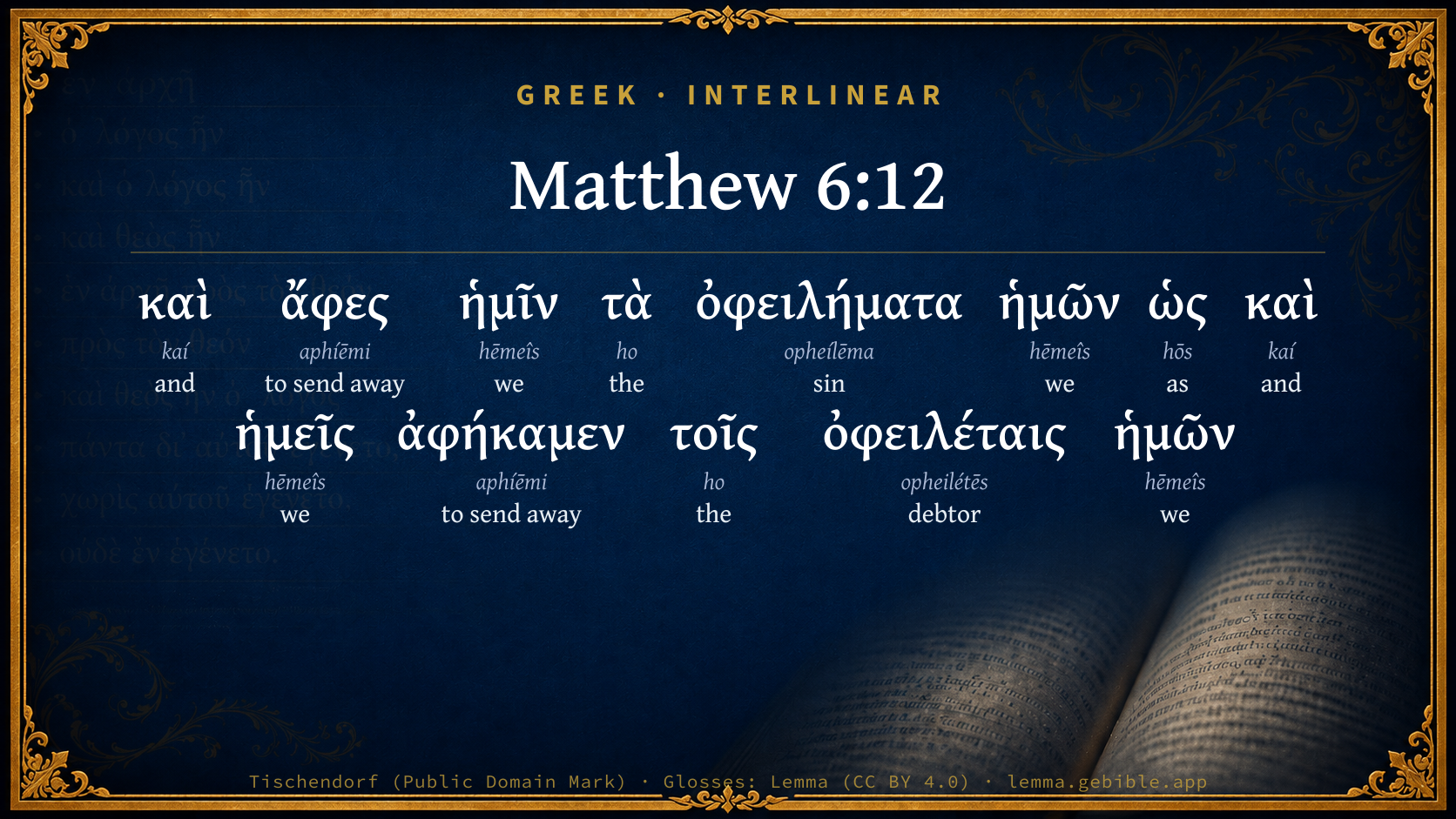
Download image
Cite this verse

Matthew 6:12 (World English Bible). Public Domain. Lemma interlinear Bible study tool, https://lemma.gebible.app/v/matthew/6/12.

Show BibTeX & RIS
BibTeX
RIS
English Translation
Forgive us our debts, as we also forgive our debtors.
World English Bible · Public Domain
Highlights
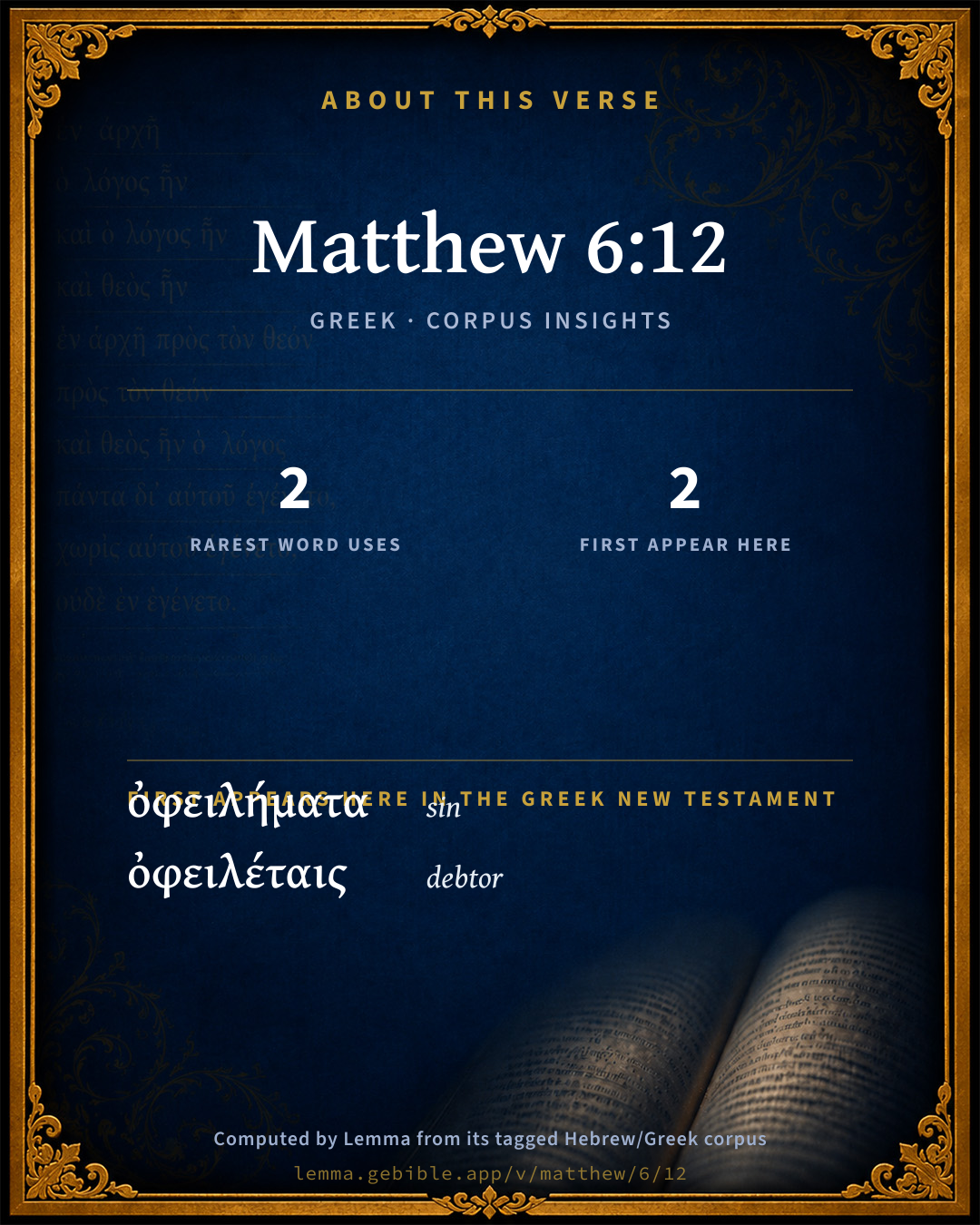
  • 2 first appearances in the Greek New Testament
Full analysis ↓
Download a study sheet

One document with this verse’s original text, its word-by-word gloss line, the meaning frame, cross-references with their text, attributed commentary, and full source and license credits — printable, and it pastes into notes with its structure intact.

This verse Autodidact and up

Study sheet (.html) Plain text (.txt)

A passage Seminary Student

Up to 50 verses in one chapter. A passage sheet keeps up to 6 commentary sources and 12 cross-references per verse, in the order this page ranks them, and says so on the sheet whenever that leaves anything out. Ask for a single verse and you get the Autodidact verse sheet above.

Everything on this page stays free to read, with no account — the sheet is a download of what is already on screen, not access to it.

Want to remove ads? Support Godless Engineer
Compare translations 3

The same verse in 3 English versions, stacked beneath the original-language interlinear above. Click any original word for its lexicon entry.

Each is an independent rendering of the whole verse — the interlinear is not word-aligned to these translations.

Highlighted words mark where these versions differ — a whole-verse word diff, not a word-by-word alignment.

  • World English Bible Public Domain
    Forgive us our debts, as we also forgive our debtors.
  • King James Version Public Domain
    And forgive us our debts, as we forgive our debtors.
  • unfoldingWord Literal Text CC BY-SA 4.0
    and forgive us our debts, as we also forgave our debtors;

unfoldingWord Literal Text — © unfoldingWord, licensed CC BY-SA 4.0. Word-aligned USFM3 via Door43 (git.door43.org/unfoldingWord/en_ult).

Versions to compare (up to 4)

3 of 4 selected

Show all 19 translations

Every available English version of this verse, each an independent rendering of the whole verse.

  • World English Bible Public Domain
    Forgive us our debts, as we also forgive our debtors.
  • Berean Standard Bible Public Domain
    And forgive us our debts, as we also have forgiven our debtors.
  • Majority Standard Bible Public Domain
    And forgive us our debts, as we also forgive our debtors.
  • King James Version Public Domain
    And forgive us our debts, as we forgive our debtors.
  • American Standard Version (1901) Public Domain
    And forgive us our debts, as we also have forgiven our debtors.
  • Revised Version (1885) Public Domain
    And forgive us our debts, as we also have forgiven our debtors.
  • Geneva Bible (1599) Public Domain
    And forgiue vs our dettes, as we also forgiue our detters.
  • Douay-Rheims (1899) Public Domain
    And forgive us our debts, as we also forgive our debtors.
  • Young's Literal Translation Public Domain
    `And forgive us our debts, as also we forgive our debtors.
  • Literal Standard Version CC BY-SA 4.0
    And forgive us our debts, as we also forgive our debtors.
  • Unlocked Literal Bible CC BY-SA 4.0
    Forgive us our debts, as we also have forgiven our debtors.
  • unfoldingWord Literal Text CC BY-SA 4.0
    and forgive us our debts, as we also forgave our debtors;
  • Darby Bible Public Domain
    and forgive us our debts, as we also forgive our debtors,
  • World Messianic Bible Public Domain
    Forgive us our debts, as we also forgive our debtors.
  • Webster's Bible Public Domain
    And forgive us our debts, as we forgive our debtors.
  • Free Bible Version CC BY-SA 4.0
    Forgive our sins, just as we have forgiven those who have sinned against us.
  • Bible in Basic English Public Domain
    And make us free of our debts, as we have made those free who are in debt to us.
  • Text-Critical English NT CC BY 4.0
    And forgive us our debts, as we forgive our debtors.
  • Tyndale New Testament (1534) Public Domain
    And forgeve vs oure treaspases even as we forgeve oure trespacers.

Literal Standard Version (2020), Covenant Press — licensed CC BY-SA 4.0. Text via the HelloAO Bible API (eBible.org). Unlocked Literal Bible (unfoldingWord) — licensed CC BY-SA 4.0. Text via the HelloAO Bible API (eBible.org). unfoldingWord Literal Text — © unfoldingWord, licensed CC BY-SA 4.0. Word-aligned USFM3 via Door43 (git.door43.org/unfoldingWord/en_ult). Free Bible Version, Dr. Jonathan Gallagher — licensed CC BY-SA 4.0. Text via the HelloAO Bible API (eBible.org).

Word by word

More ways to search: Search by grammar → Find every occurrence → Compare this word →

Practice this passage: Drill this verse → Learn its vocabulary →

About this verse

These counts appear in no published source. They are computed here, from the morphology-tagged text and Lemma’s own curated glosses. What Lemma adds →

13
words
7
distinct lemmas
Gospels
section

Notable vocabulary

The rarest word here is ὀφειλήματα sin G3783 — appearing just 2 times in the whole Greek New Testament.

First appearance in Scripture

These words make their first canonical appearance in the Greek New Testament here:

  • ὀφειλήματα sin G3783
  • ὀφειλέταις debtor G3781

Shared distinctive vocabulary

ὀφειλήματα sin G3783 occurs in 2 verses of the Greek New Testament. Also found in:
Repetition

Words recur within this verse:

  • ἄφες to send away G863 ×2
  • ἡμῖν we G2249 ×4
  • καὶ and G2532 ×2
  • τὰ the G3588 ×2

Cross-references

22

Topical passages linked to Matthew 6:12 in the Treasury of Scripture Knowledge — connected by theme and wording, ordered by reader-vote popularity; previews shown in the World English Bible.

  • Ephesians 4:32 And be kind to one another, tenderhearted, forgiving each other, just as God also in Christ forgave you.
  • Mark 11:25 Whenever you stand praying, forgive, if you have anything against anyone; so that your Father, who is in heaven, may also forgive you your transgressions.
  • Ephesians 1:7 in whom we have our redemption through his blood, the forgiveness of our trespasses, according to the riches of his grace,
  • Matthew 18:21–35 Then Peter came and said to him, "Lord, how often shall my brother sin against me, and I forgive him? Until seven times?"
  • Colossians 3:13 bearing with one another, and forgiving each other, if any man has a complaint against any; even as Christ forgave you, so you also do.
  • 1 John 1:7–9 But if we walk in the light, as he is in the light, we have fellowship with one another, and the blood of Jesus Christ, his Son, cleanses us from all sin.
  • Luke 11:4 Forgive us our sins, For we ourselves also forgive everyone who is indebted to us. Bring us not into temptation, But deliver us from the evil one.'"
  • Luke 6:37 Don't judge, And you won't be judged. Don't condemn, And you won't be condemned. Set free, And you will be set free.
  • Exodus 34:7 keeping loving kindness for thousands, forgiving iniquity and disobedience and sin; and that will by no means clear the guilty, visiting the iniquity of the fathers on the children, and on the children's children, on the third and on the fourth generation."
  • Psalms 32:1 Blessed is he whose disobedience is forgiven, Whose sin is covered.
  • Luke 17:3–5 Be careful. If your brother sins against you, rebuke him. If he repents, forgive him.
  • Psalms 130:4 But there is forgiveness with you, Therefore you are feared.
  • 1 Kings 8:30 Listen you to the supplication of your servant, and of your people Israel, when they shall pray toward this place: yes, hear in heaven, your dwelling-place; and when you hear, forgive.
  • 1 Kings 8:39 then hear in heaven, your dwelling-place, and forgive, and do, and render to every man according to all his ways, whose heart you know; (for you, even you only, know the hearts of all the children of men;)
  • Luke 7:40–48 Jesus answered him, "Simon, I have something to tell you." He said, "Teacher, say on."
  • Isaiah 1:18 "Come now, and let us reason together," says Yahweh: "Though your sins be as scarlet, they shall be as white as snow. Though they be red like crimson, they shall be as wool.
  • Matthew 6:14–15 "For if you forgive men their trespasses, your heavenly Father will also forgive you.
  • 1 Kings 8:34 then hear you in heaven, and forgive the sin of your people Israel, and bring them again to the land which you gave to their fathers.
  • Daniel 9:19 Lord, hear; Lord, forgive; Lord, listen and do; don't defer, for your own sake, my God, because your city and your people are called by your name.
  • 1 Kings 8:50 and forgive your people who have sinned against you, and all their transgressions in which they have transgressed against you; and give them compassion before those who carried them captive, that they may have compassion on them
  • Nehemiah 5:12–13 Then said they, We will restore them, and will require nothing of them; so will we do, even as you say. Then I called the priests, and took an oath of them, that they would do according to this promise.
  • Acts 13:38 Be it known to you therefore, brothers, that through this man is proclaimed to you remission of sins,

Cross-references courtesy of OpenBible.info (CC BY 4.0).

Commentary

Notes on Matthew 6:12 from classic Christian and Jewish commentators (each source and its license shown beneath its notes). The classic Christian expositions comment on the surrounding passage and are grouped to its opening verse, so a note may address several verses; the Jewish commentaries on the Tanakh (Rashi and others) are per-verse, so they appear only where the commentator wrote on this verse.

Lemma curates 59 commentaries, every one of them public domain or Creative Commons licensed, each selected and text-cleaned for this edition rather than reprinted as found. About our sources →

The Biblical Illustrator

Joseph S. Exell

Mat_6:12

Forgive us our debts.

Forgive us our debts

There is a twofold debt which man oweth to God.

I. A debt of duty, worship, and obedience;

II. A debt of punishment. (Thomas Manton, D. D.)

Our Debts

1. By this prayer we are reminded of our constant liability to sin.

2. We are led to separate between the fact and theory of forgiveness.

3. We are led to regard forgiveness as a favour, and not as a claim.

4. We are reminded of the only condition upon which forgiveness can be extended to us.

5. We are taught to comply with the condition which is required. (F. Edwards, B. A.)

Forgive us our trespasses as we forgive them that trespass against us

I. We must here take notice that we are obliged to go to our devotions with charity and good-will towards others.

(1) To depose all enmity before we bring our oblation to the altar of God.

(2) Reserving no spite or grudge toward any man, but having a heart

(3) clear of ill-will;

(4) being in affection of mind towards others, as we do wish, hope, and pray that God would be toward us.

II. It is implied on Gods part, that He vouchsafes pardon only upon these terms; yea, more, that He doth truly promise pardon upon our performing this condition.

(1) It also implies a consent on our part, and

(2) submission to this condition, as most equal and reasonable.

(3) If we break it, if we retain any uncharitable inclinations, we deal falsely with God; we forfeit all pretence to mercy and favour from Him; we are neither qualified for mercy, nor shall obtain it from God. (Isaac Barrow, D. D.)

The fifth petition

I. Observe how it begins-and forgive, etc. It follows prayer for daily bread. Life without forgiveness would not be worth having.

II. It is a prayer for the forgiving of our sins As the children of God.

III. Sin is described as a debt.

IV. This is a prayer for grace.

V. In this prayer for forgiveness we must fall in with the divine plan for its bestowment.

VI. The declaration connected with the prayer. (Dr. Stanford.)

The fifth petition

I. Sin considered as a debt to God.

1. A debt is what we owe.

2. We have failed to discharge it.

3. Let us glance at some items in the account.

(1) Wrong to the property of our neighbour;

(2) To his reputation;

(3) To his person.

4. Sins as debts

(1) are entered in Gods books.

(2) They increase.

(3) Can never be discharged.

(4) They cannot be transferred to any fellow creature.

(5) They cannot be escaped by lapse of years or change of residence.

(6) Payment will be claimed.

II. The debts of Gods pardoned children.

III. Our fathers forgiveness.

1. Absolute.

2. Immediate.

3. Complete.

IV. Prayer for pardon. Includes-

1. Conviction of guilt.

2. Contrition.

3. Confession.

4. Purpose of reformation.

V. Forgiveness of one another.

1. Human forgiveness.

2. Human forgiveness a condition of the Divine.

There can be no genuine prayer for pardon unless we cultivate a forgiving spirit:-

1. Pardon is always linked with repentance of sins, and these include an unforgiving spirit.

2. Faith in Gods mercy is incompatible with unmercifulness in ourselves.

3. Gratitude to God for pardon received or expected prompts forgiveness of others.

4. This prayer includes those who wrong us.

5. It is the prayer of a child of God. (Newman Hall, LL. B.)

Mercy in heaven and on earth

1. He who has not received the spirit of forgiveness has not truly received the gift of pardon.

2. Without this loving spirit we cannot truly worship God.

3. He who does not for give forsakes the spirit of the gospel, and returns to the spirit of legalism.

4. He who does not forgive will soon lose the sense and enjoyment of Gods pardon.

5. He who does not forgive lacks one of the great evidences and confirmations of faith. (Dr. Saphir.)

The penitential spirit of the Lords prayer

What is mere bread to a man under sentence of death?-forgiveness necessary.

I. Man is Gods debtor.

1. As regards his being.

2. His moral debtor.

3. Christ the real paymaster of His people.

II. The import of the petition.

1. It at once confronts us with the sin forgiving God.

2. There is unselfishness in the petition-us. (Dr. O. Winslow.)

The forgiving spirit of the Lords prayer

Forgiven, I am to forgive.

I. There exists a great necessity for the exercise of this godlike precept of forgiveness.

1. In the family circle.

2. Gods forgiveness of us the rule and measure of our forgiveness of others.

(1) God forgives immediately.

(2) God forgives fully.

(3) God forgives heartily.

(4) God forgets as well as forgives. I will remember them no more for ever. (Dr. O. Winslow.)

The fifth petition

I. Consider man as a sinner in need of Divine forgiveness. How could guilt be remitted? Through death of Christ. How can a righteous lawgiver who insists upon a righteous equivalent be said to forgive? Forgiveness and payment of price often combined by sacred writers-In whom we have redemption through His blood, even the forgiveness of sins.

II. A reference to our own moral condition and circumstances.

1. These words presuppose in us some failure of moral obligation.

2. That sin unremitred has an indelible place in the Divine remembrance. Debts are registered.

3. The need of an individual interest in the provided atonement for transgression.

III. The scriptural connection between the forgiveness we seek of God, and the forgiveness we may show to our fellow man.

1. The words suppose us to have sacred or relative rights which, as appertaining to our station, every other person is under obligation to acknowledge. This prayer implies that in the case of invaded rights we seek only such restitutions as are necessary to social security; not resentment.

2. The exact force of the connecting particle as in this petition. The word has various meanings, ground or reason-this would attribute to man the meritorious initiative in obtaining his own pardon. Sometimes the word is used in the sense of similitude-God infinitely above man in the way and measure of His forgiveness. It is used both as an ordained condition and as a ground of hope. This connection between our mercy and what we expect is one of unalterable necessity.

IV. The motives which concur to enforce the duty.

1. What kindness is it to ourselves to forgive.

2. What a victory is it over our enemy to forgive. (D. Moore, M. A.)

As we forgive our debts

The debtfulness of sin should be remembered. It implies the wrongful possession of what belongs to another. Say that sin occupied a moment: that moment was Gods. Sin has diminished the glory of God: therefore we owe God glory. Trespass implies the same thought; it is when you go on ground where you have no right to go. Forgiveness follows our request for daily bread, and is quite as necessary. Only they who show mercy can expect mercy. We must be careful to draw no parallel of degree between Gods forgiveness and ours, though there is a resemblance in kind. What is the nature of the forgiveness you expect from God?

1. Absolute in character.

2. Immediate in time.

3. Universal in extent.

4. It is an easy thing to use a result, while we are totally unobservant of the great processes by which that result has been produced.

If God had forgiven without this process He would not have manifested any great abhorrence of sin. (J. Vaughan, M. A.)

Concomitants of debts

1. A sense of burden.

2. A sense of fear.

3. A sense of perplexity.

4. A feeling of hatred. (F. C. Blyth, M. A.)

The condition of forgiveness

1. Let us think whose children we are (Mat_5:44-45).

2. Whose disciples we are (1Pe_2:23).

3. How often our Lord has forgiven us.

4. How small is the debt our fellow servants owe to us compared to the stun we owe to our Lord.

5. An unforgiving spirit towards others disqualifies us for forgiveness.

6. If we forgive our brethren their wrongs we turn those wrongs into blessings.

As we

1. As a plea with God.

2. As an argument.

3. As an example. (F. C. Blyth, M. A.)

The prayer of the penitent

I. The general petition.

1. An humble confession of sin.

2. True penitence.

3. Filial confidence in God.

II. The added clause.

1. This language as preceptive. It has the force of a precept.

2. It is solemnly admonitory. God will not forgive us unless we forgive.

3. It is promissory. I have forgiven, do Thou, Lord, forgive, as Thou hast promised.

4. It is abundantly consolatory. (J. Morgan)

Sin a debt

I. How is sin a debt?

1. It supposes obligation.

2. It supposes obligation undischarged.

3. It is an obligation that cannot be denied.

4. It is an obligation that cannot be ignored.

5. It is an obligation that cannot be transferred.

6. It is an obligation that cannot be run away from.

II. How this debt may be cancelled.

1. Not by repentance.

2. Not by good works.

3. Not by any amount of seeking and striving.

4. But solely by the grace of God forgiving the debt for the sake of Jesus Christ. (Amer. Hom. Rev.)

A secret record kept of all our sin-debts

A record is being kept unobserved by us. As a traveller calls for what he needs at his hotel and no demand is made at the time for payment, though every item is carefully recorded, so it is with our daily incurred debts against God. Sins record themselves. As a multitude entering some place of resort pass individually through the turnstile, and a record is unerringly made out of sight of the visitor, and as mechanical contrivances in factories register every beat of the piston and every fraction of the result produced, so, by the law of God impressed on our own nature, all our actions are registered, all our debts recorded. (Newman Hall, LL. B.)

Forgiveness of injuries a self-improving act

When thou forgivest, the man who has pierced thy heart stands to thee in the relation of the sea-worm that perforates the shell of the mussel, which straightway closes the wound with a pearl. Bishop Andrewes observes, David compares his enemies, not to wasps, but to bees (Psa_118:12), inasmuch as, if they have a sting, yet they have honey also, as ministering to his comfort before God.

The Biblical Illustrator, edited by Joseph S. Exell (c. 1880s–1900s) — public domain. Text from a community e-Sword module.

Joseph Benson's Commentary

Mat 6:12. And forgive us our debts, &c. — The suffering of punishment for transgressing God’s laws is a debt which sinners owe to the divine justice; and “when we ask God, in prayer, to forgive our debts, we beg that he would be mercifully pleased to remit the punishment of our sins, particularly the pains of hell; and that, laying aside his displeasure, he would graciously receive us into favour, and bless us with eternal life. In this petition, therefore, we confess our sins, and express the sense we have of their demerit, namely, that they deserve condemnation and wrath from God, than which nothing can be more proper in our addresses to him. The condition on which we are to ask forgiveness is remarkable. Forgive us, as we forgive. We must forgive others in order to our being forgiven ourselves, and are allowed to crave from God only such forgiveness as we grant to others; so that if we do not pardon our enemies, we, in this fifth petition, seriously and solemnly beg God to damn us eternally!” — Macknight.

Joseph Benson's Commentary on the Old and New Testaments (1811–1818) — public domain. Text from a community e-Sword module.

Tyndale Open Study Notes

Tyndale Open Resources

6:12 as we have forgiven (see also 6:14-15; 18:21-35): Forgiving others is a reflection of a repentant, regenerate heart, which makes our own forgiveness possible. Those who have experienced God’s forgiveness will forgive. Jesus implies that those who are unwilling to forgive have not perceived God’s mercy, and perhaps have never truly repented.

Tyndale Open Study Notes — © Tyndale Open Resources, licensed CC BY-SA 4.0. Text via the HelloAO Bible API.

Bengel's Gnomon

Johann Albrecht Bengel

Mat 6:12. Καὶ, and) The three remaining petitions regard the commencement, progress and conclusion of our spiritual life in this world; and those who utter them confess, not only their own need, but also their guilt, their peril, and their difficulties. When these have been removed, God is all in all to them, by virtue of the three first petitions.—ὀφειλήματα, debts) In Mat 6:14 we find παραπτώματα, lapses. In Luk 11:4, we have ἁμαρτίας, sins. Cf. Mat 18:24.[263]—Ὡς, as) Before it was “AS in heaven, SO on earth,” now it is “SO in heaven AS on earth.”

[263] We ought not merely in general to pray for deliverance from guilt contracted by our sins; but whoever offends God in this or any other peculiar manner, is bound also specially to acknowledge and pray for deliverance from such offences, and so to give Him the honour due to Him.—V. g.

Bengel's Gnomon of the New Testament — English translation (T&T Clark, Edinburgh, 1860) — public domain. Text from a community e-Sword module.

Meyer's Critical & Exegetical Commentary

Heinrich August Wilhelm Meyer

Mat_6:12. Ὡς καὶ ἡμεῖς, κ.τ.λ.] does not indicate the extent (Chrysostom, Baumgarten-Crusius) to which forgiveness is asked from God, which is not in harmony with the tone of the prayer; rather is ὡς the as which assigns the reason as well as makes the comparison, doubtless not as being directly equivalent to nam (Fritzsche), but it expresses the existence of a frame of mind on the part of the petitioner corresponding to the divine forgiveness: as then, we also, and so on. See on Joh_13:34; Schaeffer, ad Dem. V. p. 108; Hartung, Partikell. I. p. 460; Klotz, ad Devar. p. 766; comp. Luk_11:4. Yet not as though human forgiveness can be supposed to merit the divine pardon, but the former is the necessary moral requisitum subjecti (Calovius) in him who seeks forgiveness from God. Comp. Mat_18:21 ff.; Apol. Conf. A. p. 115 f.; Cat. maj. p. 528; Kamphausen, p. 113.

ἀφήκαμεν] see the critical remarks. Jesus justly presupposes that the believer who asks from God the remission of his own debts has already forgiven (Sir_28:2; Mar_11:25) those who are indebted to himthat, according to Luke, he does it at the same time.

Meyer — Critical and Exegetical Commentary on the New Testament — English translation by Peter Christie, edited by Frederick Crombie (T&T Clark, 1880) — public domain. Text from a community e-Sword module.

Expositor's Greek Testament

ed. W. Robertson Nicoll

Mat 6:12 . Fifth petition . ὀφειλήματα , in classics literal debts, here moral debts, sins ( ἁμαρτίας in Luk 11:4 ). The more men desire God’s will to be done the more conscious they are of shortcoming. The more conscious of personal shortcoming, the more indulgent towards the faults of others even when committed against themselves. Hence the added words: ὡς καὶ ἡ . ἀφήκαμεν , etc. It is natural and comforting to the sincere soul to put the two things together. ὡς must be taken very generally. The prayer proceeds from child-like hearts, not from men trained in the distinctions of theology. The comment appended in Mat 6:14-15 introduces an element of reflection difficult to reconcile with the spontaneity of the prayer. It is probably imported from another connection, e.g. , Mat 18:35 (so Weiss-Meyer).

The Expositor's Greek Testament, edited by W. Robertson Nicoll (1897–1910) — public domain. Text from a community e-Sword module.

Jamieson, Fausset & Brown

Robert Jamieson, A. R. Fausset & David Brown

And forgive us our debts--A vitally important view of sin, this--as an offense against God demanding reparation to His dishonored claims upon our absolute subjection. As the debtor in the creditor's hand, so is the sinner in the hands of God. This idea of sin had indeed come up before in this discourse--in the warning to agree with our adversary quickly, in case of sentence being passed upon us, adjudging us to payment of the last farthing, and to imprisonment till then (Mat 5:25-26). And it comes up once and again in our Lord's subsequent teaching--as in the parable of the creditor and his two debtors (Luk 7:41, &c.), and in the parable of the unmerciful debtor (Mat 18:23, &c.). But by embodying it in this brief model of acceptable prayer, and as the first of three petitions more or less bearing upon sin, our Lord teaches us, in the most emphatic manner conceivable, to regard this view of sin as the primary and fundamental one. Answering to this is the "forgiveness" which it directs us to seek--not the removal from our own hearts of the stain of sin, nor yet the removal of our just dread of God's anger, or of unworthy suspicions of His love, which is all that some tell us we have to care about--but the removal from God's own mind of His displeasure against us on account of sin, or, to retain the figure, the wiping or crossing out from His "book of remembrance" of all entries against us on this account.

as we forgive our debtors--the same view of sin as before; only now transferred to the region of offenses given and received between man and man. After what has been said on Mat 5:7, it will not be thought that our Lord here teaches that our exercise of forgiveness towards our offending fellow men absolutely precedes and is the proper ground of God's forgiveness of us. His whole teaching, indeed--as of all Scripture--is the reverse of this. But as no one can reasonably imagine himself to be the object of divine forgiveness who is deliberately and habitually unforgiving towards his fellow men, so it is a beautiful provision to make our right to ask and expect daily forgiveness of our daily shortcomings and our final absolution and acquittal at the great day of admission into the kingdom, dependent upon our consciousness of a forgiving disposition towards our fellows, and our preparedness to protest before the Searcher of hearts that we do actually forgive them. (See Mar 11:25-26). God sees His own image reflected in His forgiving children; but to ask God for what we ourselves refuse to men, is to insult Him. So much stress does our Lord put upon this, that immediately after the close of this prayer, it is the one point in it which He comes back upon (Mat 6:14-15), for the purpose of solemnly assuring us that the divine procedure in this matter of forgiveness will be exactly what our own is.

Sixth Petition:

Jamieson, Fausset & Brown — Commentary Critical and Explanatory on the Whole Bible (1871) — public domain (CC PDM 1.0). Text via the HelloAO Bible API.

Adam Clarke's Commentary

Verse 12. And forgive us our debts] Sin is represented here under the notion of a debt, and as our sins are many, they are called here debts. God made man that he might live to his glory, and gave him a law to walk by; and if, when he does any thing that tends not to glorify God, he contracts a debt with Divine Justice, how much more is he debtor when he breaks the law by actual transgression! It has been justly observed, "All the attributes of God are reasons of obedience to man; those attributes are infinite; every sin is an act of ingratitude or rebellion against all these attributes; therefore sin is infinitely sinful."

Forgive us.-Man has nothing to pay: if his debts are not forgiven, they must stand charged against him for ever, as he is absolutely insolvent. Forgiveness, therefore, must come from the free mercy of God in Christ: and how strange is it we cannot have the old debt cancelled, without (by that very means) contracting a new one, as great as the old! but the credit is transferred from Justice to Mercy. While sinners we are in debt to infinite Justice; when pardoned, in debt to endless Mercy: and as a continuance in a state of grace necessarily implies a continual communication of mercy, so the debt goes on increasing ad infinitum. Strange economy in the Divine procedure, which by rendering a man an infinite debtor, keeps him eternally dependent on his Creator! How good is God! And what does this state of dependence imply? A union with, and participation of, the fountain of eternal goodness and felicity!

As we forgive our debtors.] It was a maxim among the ancient Jews, that no man should lie down in his bed, without forgiving those who had offended him. That man condemns himself to suffer eternal punishment, who makes use of this prayer with revenge and hatred in his heart. He who will not attend to a condition so advantageous to himself (remitting a hundred pence to his debtor, that his own creditor may remit him 10,000 talents) is a madman, who, to oblige his neighbour to suffer an hour, is himself determined to suffer everlastingly! This condition of forgiving our neighbour, though it cannot possibly merit any thing, yet it is that condition without which God will pardon no man. See Mt 6:14; Mt 6:15.

Adam Clarke's Commentary on the Bible (1810–1826) — public domain. Text from a community e-Sword/MySword module.

Ellicott's Commentary for English Readers

(12) Forgive us our debts.—Duty—i.e., that which we owe, or ought to do—and debts are, it may be noted, only different forms of the same word. A duty unfulfilled is a debt unpaid. Primarily, therefore, the words “our debts” represent sins of omission, and “trespasses” the transgression of a law, sins of commission. The distinction, however, though convenient, is more or less technical. Every transgression implies the non-fulfilment of duty in a more aggravated form, and the memory of both presents itself to the awakened conscience under the character of an ever-accumulating debt. Even the sins against our neighbour are, in this sense, debts which we have incurred to God; and as the past cannot be undone, they are debts which we can never pay. For us, therefore, the one helpful prayer is, “Forgive the debt,” and the gospel which our Lord proclaimed was, that the Father was ready to forgive. The confession of the debt was enough to ensure its remission, and then there was to come the willing service of a grateful love instead of the vain attempt, which Pharisaism encouraged, to score up an account of good works, as part payment, and therefore as a set-off, reducing the amount of debt. The parables of the Two Debtors (Luk_7:41) and of the Unforgiving Creditor whose own debt had been forgiven (Mat_18:23-35) were but expansions of the thought which we find in its germ in this clause of the Lord’s Prayer.

In striking contrast with that clause is the claim of merit which insinuates itself so readily into the hearts of those who worship without the consciousness that they need forgiveness, and which uttered itself in the daring prayer attributed to Apollonius of Tyana, “Give me that which is my due—pay me, ye gods, the debts ye owe to me.”

As we forgive our debtors.—The better reading gives, We have forgiven, as a completed act before we begin to pray. In the very act of prayer we are taught to remind ourselves of the conditions of forgiveness. Even here, in the region of the free grace of God, there is a law of retribution. The temper that does not forgive cannot be forgiven, because it is ipso facto a proof that we do not realise the amount of the debt we owe. We forget the ten thousand talents as we exact the hundred pence, and in the act of exacting we bring back that burden of the greater debt upon ourselves.

Up to this point, in the petitions of the Lord’s Prayer, we may think of the Man Christ Jesus as having not only taught the Prayer, but Himself used it. During the years of youth and manhood it may well have been thus far the embodiment of the outpourings of His soul in communion with His Father. Even the prayer, “Give us this day our daily bread,” whether we take it in its higher or its lower meaning, would be the fit utterance of His sense of dependence as the Son of Man. Can we think the same of the prayer, “Forgive us our debts?” It is, of course, opposed to the whole teaching of Scripture to believe that there dwelt on His human spirit the memory of a single transgression. In the fullest sense of the word He was without sin, the Just One, needing no repentance. And yet the analogy of those of His saints and servants who have followed most closely in the footsteps of His holiness may lead us to think it possible that even these words also may have had a meaning in which He could use them. In proportion as men attain holiness and cease to transgress, they gain a clearer perception of the infinite holiness of God, and seek to be made partakers of it. They would fain pray and praise and work for Him evermore, but though the spirit is willing, the flesh is weak. They are weary and faint, and they become more intensely conscious of the limits of their human powers as contrasted with the limitless range of their desires. In this sense, therefore, and strictly in reference to the limitations of the true, yet absolutely sinless, humanity which He vouchsafed to assume, it is just conceivable that He too Himself may have used this prayer. And we must remember also that He prayed as the Brother of mankind, as the representative of the race. The intensity of His sympathy with sinners, which was the condition of His atoning work (Heb_4:15), would make Him, though He knew no sin, to identify Himself with sinners. He would feel as if their transgressions were His transgressions, their debts His debts.

A Bible Commentary for English Readers, edited by Charles John Ellicott (1878–1897) — public domain. Text from a community e-Sword module.

The Cambridge Bible for Schools and Colleges

gen. ed. J. J. S. Perowne

12. debts] Sins are debts, shortcomings in the service due to God.

forgive] The aorist should be read in the Greek text. The force would then be that an act of forgiveness on man’s part is past before he prays to receive forgiveness. Cp. ch. Mat_5:23-24, also the parable of the unforgiving servant, ch. Mat_18:23 seqq.

The Cambridge Bible for Schools and Colleges (gen. ed. J. J. S. Perowne; Cambridge University Press, 1878–1918) — public domain. Text from a community e-Sword module.

John Gill's Exposition

And forgive us our debts,.... Nothing is more frequent in the Jewish writings than to call sins "debts"; and the phrase, of forgiving, is used both of God and men. Thus the prayer of Solomon is paraphrased (y) by the Targumist:

"and hear thou the petition of thy servant, and of thy people Israel, which they shall make before this place; and do thou receive it from the place of the house of thy Shekinah, from heaven; and do thou accept their prayer , "and forgive their debts".''

So Joseph's brethren signify to him, that it was their father's orders to say unto him, "forgive, I pray thee now, the trespass of thy brethren, and their sin"; which is rendered by the Chaldee paraphrasts (z) , "forgive the debts" of thy brethren, and their sins. Accordingly, by "debts" are meant sins here, as appears from Luk 11:4 where it is read, "and forgive us our sin". These are called "debts"; not because they are so in themselves, for then it would be right to do them; debts should be paid; they are not debts we owe to God, but are so called, because on account of them we owe satisfaction to the law and justice of God: the proper debts we owe to God are love, obedience, and gratitude; and in default of these, we owe the debt of punishment. Now these debts are numerous, and we are incapable of paying, nor can any mere creature pay them for us; wherefore, we are directed to pray, that God would forgive them, or remit the obligation to punishment we lie under, on account of sin. This petition supposes a sense, acknowledgment, and confession of sin, and of inability to make satisfaction for it; and that God only can forgive it, who does, for Christ's sake, and on account of his blood, sacrifice, and satisfaction: what is here requested is a manifestation and application of pardon to the conscience of a sensible sinner; which, as it is daily needed, is daily to be asked for. The argument, or reason used, is,

as we forgive our debtors; which is to be understood not so much of pecuniary debtors, though they are to be forgiven, when poor and unable to pay; but of such who have offended, or done real injuries to others, either by word or deed: the injuries of enemies, the unkindness of friends, all sorts of offences, are to be forgiven by us; and not only so, but we are to pray to God to forgive them also. Now this is mentioned, not as if our forgiving others is the cause of God's forgiving us, or the model of it, or as setting him an example, or as if his and our forgiving were to be compared together, since these will admit of no comparison; but this is an argument founded upon God's own promise and grace, to forgive such who have compassion on their fellow creatures.

(y) Targum in 2 Chron. vi. 21. (z) Targum Onkelos & Jon. ben Uzziel in Gen. l. 17. Vid. Targum in 1 Chron. iv. 18. & in Cant. i. 1. & in Gen. iv. 13. & passim.

John Gill's Exposition of the Whole Bible (1746–1763) — public domain (CC PDM 1.0). Text via the HelloAO Bible API.

Trapp's Complete Commentary

John Trapp

12 And forgive us our debts, as we forgive our debtors.

Ver. 12. And forgive us our debts, &c.] Loose us (saith the original) and let us go free, (αφες): for unpardoned sinners are in the bond of iniquity, as Simon Magus, Act 8:23; and remission is called a relaxation (παρεσις), Rom 3:25. The guilt of sin is an obligation, binding us over to condign punishment. God hath against us, Mat 5:23, even our handwriting which is contrary to us, Col 2:14. This David confessed against himself, Psa 32:5, and upon his prayer obtained pardon. He only acknowledged the debt, and God crossed the book. God crossed the black lines of his sins with the red lines of his Son’s blood. Thou forgavest me, saith David, the iniquity of my sin; the malignity of it, the worst thing that was in it. For this shall every one that is godly pray unto thee, by mine example, and obtain like favour. For our God is a sin pardoning God, Neh 9:17, none like him, Mic 7:18. He forgiveth sin naturally, Exo 34:6; abundantly, Isa 55:7; constantly, Job 1:22. He doth take away the sins of the world. It is a perpetual act of his, as the sun doth shine, as the spring doth run, Zec 13:1. The eye is not weary of seeing, nor the ear of hearing, Ecc 1:8; no more is God of showing mercy. All sins, yea, and blasphemies, shall be forgiven to the sons of men, saith our Saviour, Mat 12:31. As the sea covers not only small sands but huge rocks, Christ is the propitiation or covering for our sins, are they how many and how great soever, as was sweetly shadowed of old by the ark covering the law, the mercy seat covering the ark, and the cherubims over them, both covering one another. In allusion whereunto, "Blessed," saith David, "is the man whose transgression is forgiven, whose sin is covered. Blessed is the man to whom the Lord imputeth not sin." {a} A metaphor from merchants, who when they will forgive a debt, do not put it into the reckoning, and so do not impute it. Sin casteth men deep into debt and arrearages with God. It is called a debt of ten thousand talents, Mat 18:24; Luk 7:47. It casteth a man into a comfortless condition, makes him hide his face for shame, as Adam, causeth a continual sound of fear in his ears; so that he thinks every bush a bailiff, every shrub a sergeant, &c. An evil conscience hunts him, follows him up and down so close, like a blood hound, hot foot, that he sometimes serves himself, as that Jesuit in Lancashire, followed by one that had found his glove, with a desire to restore it to him; but pursued inwardly with a guilty conscience, leaps over a hedge, plunges into a clay pit behind it unseen and unthought of, wherein he was drowned. This and worse is the case of a poor bankrupt sinner, he is caught and clapped up in prison, laid fast in bonds and chains of darkness; and "what can he give in exchange for his soul?" Mat 16:26. There is no feeing the sergeant, nor shifting off the arrest: sooner or later conscience will serve him with a writ to appear and answer at the great assizes before God’s tribunal. Neither doth ignorance excuse him: for debt is debt, whether a man know of it or not, and will light so much the more heavily, by how much the execution is done upon him more unexpectedly. Now there is no way in the world of discharging this debt, but by the satisfaction of Christ our surety, who hath paid the utmost farthing for his elect. This good Samaritan hath discharged all for us; and God for Christ’s sake accounts of our sins as if they had never been committed. He binds them in a bundle, seals them up as in a bag, Dan 9:24, and casteth them behind him, as old evidences, into the bottom of the sea, and all because mercy pleaseth him, Mic 7:19. This he doth at first conversion, when he justifieth a sinner, Rom 3:23. And whereas in many things we sin all, Jas 3:2, we have a pardon of courses for those weaknesses that are of daily incursion, included in that general pardon, which we have upon our general repentance. Only he looketh we should sue out our pardon, by daily prayer for it. Entreat we God to remit our debts; and since he must be satisfied, to take it out of his Son’s coffers who is become surety for us: and saith unto his Father, in effect, as Paul to Philemon: If this Onesimus of mine hath "wronged thee, or oweth thee aught, put that on mine account," Phm 1:18-19, so long as he prays in my name for daily pardon. But whether shall we think less excusable, those Anabaptists {b} in Germany that omit this petition, "Forgive us our trespasses" (as conceiving themselves to be pure, and to have no more need of remission of sins); or those Atheists in father Latimer’s days, who being not willing to forgive their enemies, would not say their Pater Noster at all. {See Trapp on "Mat 6:15"}

As we forgive our debtors] Not as if God should therefore forgive us, because we forgive others; but this is the argument. We do and can, by God’s grace, forgive them, therefore God can and will much more forgive us; since all our goodness is but a spark of his flame, a drop of his ocean. No article of our creed is so much opposed by Satan as that of the forgiveness of sin by Christ’s merits, which is the very soul of a church and the life of a good soul. All the former articles of the creed are perfected in this, and all the following articles are effects of this. Now one main means of settling us in the sound assurance of the pardon of our own debts, is, if we can forgive our debtors. He that can put away all purpose of revenge, and freely forgive his brother, may with boldness ask and expect forgiveness at God’s hands. For mercy rejoiceth against judgment, Jas 2:13; and our love to others is but a reflex of God’s love to us. It is a fruit of justifying faith, Luk 17:4-5. It is also a sweet seal of our election, Col 3:12-13, and an effectual expression of our thankfulness. For hereby our unrighteousness shall commend the righteousness of God, Rom 3:5, both in respect of his admirable goodness in pardoning so great sins, and our thankful acknowledging of that grace in walking worthy of it.

Now if any ask, why the petition for pardon of sin is set after that for daily bread? It is answered,

1. In the four former petitions we pray for good things, in the two latter we pray against evil.

2. Our Saviour condescends herein to our infirmity, who can sooner trust God for pardon than provision, for a crown than a crust.

3. That by an argument from the less to the greater we may the more boldly beg spirituals.

{a} ιλασμος, 1Jn 2:2. כפית Exo 25:17. επιθεμα, Sept. Tectorium, operculum, Psa 32:1-2.

{b} Bullinger, cont. Anabapt. lib. i. cap. 1.

John Trapp, A Commentary or Exposition upon All the Books of the Old and New Testament (1647–1656) — public domain. Text from a community e-Sword module.

Haydock's Catholic Bible Commentary

Of all the petitions this alone is repeated twice. God puts our judgment in our own hands, that none might complain, being the author of his own sentence. He could have forgiven us our sins without this condition, but he consulted our good, in affording us opportunities of practising daily the virtues of piety and mildness. (St. John Chrysostom, hom. xx.) --- These debts signify not only mortal but venial sins, as St. Augustine often teaches. Therefore every man, be he ever so just, yet because he cannot live without venial sin, out to say this prayer. (Cont. 2 epis. Pelag. lib. i. chap. 14.) --- (lib. xxi. de civit. Dei. chap. xxvii.) (Bristow)

George Leo Haydock (1774–1849), Haydock's Catholic Family Bible and Commentary, 1859 edition — public domain. Excludes Psalms (Douay-Rheims chapter numbering differs from Protestant) and Deuterocanonical books (Catholic canon only).

Matthew Poole's English Annotations

Our Saviour here doth not teach us the order in which we should pray for good things for ourselves, only in three petitions comprehends whatsoever we should ask of God. For doubtless we are obliged, according to Mat 6:32, first to seek the kingdom of God, and the righteousness thereof. That by our debts are here meant our sins is plain from Luk 11:4, as also from Mat 6:14 of this chapter, where they are called trespasses. The sense is, then, Discharge us from that obligation to death which our sins have laid us under; give us a pardon for our sins past and present; for who liveth, and sinneth not against thee?

As we forgive our debtors; not as perfectly, but in like manner as we, according to the imperfect state of our natures, forgive those who have done us injury, not seeking any revenge upon them, nor bearing them any malice: so as indeed those who, retaining their malice in their hearts, put up this prayer unto God, do in effect pray down Divine vengeance upon their souls: well therefore doth the apostle command, that we should lift up pure hands unto God, without wrath or doubting, 1Ti 2:8. So that not only faith but charity also, is necessary to our praying acceptably.

Matthew Poole's English Annotations on the Holy Bible (1683–1685) — public domain. Text from a community e-Sword/MySword module.

Whedon's Commentary on the Bible

Daniel D. Whedon

12. Debts — As by our offences we owe satisfaction, so they are all debts.

In business we incur debts of money; in morals we incur debts of reparation. In the former debts we pay coin; in the latter we pay in suffered penalty or atonement. So due penalty is often treated in Scripture as a debt. Forgive us our debts — Remit the penalty of our offences, and hold us as if we had not sinned.

Daniel D. Whedon (gen. ed.), Commentary on the Old and New Testaments (1874–1909) — public domain. Text from a community e-Sword module.

The Pulpit Commentary

And forgive us our debts, as we forgive our debtors. Forgive; a change in God"s relation to us and our sins. No plea is urged, for the atonement had not yet been made. Our debts (ta ofeilhmata hmwn) parallel passage in Luke, taav hJmw n). It is probable that Matthew took one meaning, perhaps the more primary, and Luke another, perhaps the more secondary (cf. Gesenius, Thes," s.v. bwh, and Professor Marshall, Expositor, IV 3:281), of the original Aramaic word (abwj); but, as "debtors" comes in the next clause, it seems reasonable to suppose that Matthew represents the sense in which our Lord intended the word to be understood. Luke may have avoided it as too strongly Hebraic a metaphor, even though he does use ofeiletai of men in relation to God. (Luk_13:4) The "Didache," 8., gives the singular, ofeilhn , (cf. infra, Mat_18:32) which Dr. Taylor ("Lectures," p. 62) thinks is preferable. The singular, especially with "debtors" following, would very naturally be corrupted to the plural. Sins are termed "debts," as not rendering to God his due. (Mat_22:21; cf. Mat_25:27) As we; Revised Version, as we also (wv kai hmeiv). In the same way as we have a comparison of fact, not of proportion. (cf. Mat_8:13 Mat_18:33) (For the thought, cf. Ecc 28:2.) Luke"s "for we ourselves also" (kai ga) lays more stress on our forgiving others being a reason for God forgiving us. Forgive; Revised Version, have forgiven, in the past (aorist). Luke"s present is of the habit. Our debtors. Luke individualizes (panti ofeilonti hmin).

The fifth petition.

It is to be pointed out that the Gospel version of the Lord"s Prayer uses here in this petition the words "debts" and "debtors;" while, in what may be regarded as a parallel passage, (Luk_11:4) the prayer reads, "Forgive us our sins, as we forgive our debtors" It might, possibly, and not altogether unplausibly, be held that this last form of the words designs to avoid bringing into near comparison the dread reality we call sin against God, with our sins (though still justly so called) against one another. At any rate, the version may suggest profitably the thought. Vast also and indeed immeasurable the difference between what we owe to God and what any one can owe to us; still these facts more naturally both fall under the description of "debts." Again, though the words "debts" and "debtors" are virtually commented upon by the "trespasses" of ver. 14, it is not impossible that they suggest the sequence of this petition upon the.one preceding it. We have just prayed, "Give us this day," etc. What debts, indeed, God"s daily innumerable givings, as Creator to all creation, as Father to all his family, entail upon them! These are not less to be thought of because they partake so much of a moral character, and are so analogous to those which children owe to their earthly parents. Though parents must give for the sake of the life of those to whom they give, their claim upon the gratitude, obedience, devotion, of their offspring is indefeasible, and the high, solemn sanctions of that claim in Scripture are second to none. Dwell on the consideration of

I THE EXISTENCE OF THIS GREAT THING, THIS GREAT FACT, IN THE WORLD WHAT DOES IT MARK?

1. It is a convincing proof of a moral element present in the world"s social structure.

2. It is a convincing proof that that moral element is not of the nature of a level, stern, logical justice by itself, without elasticity, without any possible method of compensation, without any provision of remedy, in the event of incursions of error, accident, fault.

3. The outward practice of forgiveness (leaving out of question any cultivating of the spirit of forgiving)is found an absolute necessity for carrying on the community of social life.

4. The three foregoing particulars may be viewed as a strong supporting argument of the species of analogy, justifying the article of the apostolic Creed, that says, "I believe in the forgiveness of sins." And they may be viewed so yet the more in the light of the second clause of the petition now before us, "as we forgive our debtors.

II THE WIDE RANGE THROUGH WHICH PRAYERS FOR GOD"S FORGIVENESS NEED TO BE OFFERED.

1. For debts in the matter of mercies innumerable and priceless, of which so little account has been made, and for which so little fruitful return has been shown.

2. For our debts in the matter of innumerable faults faults of omission and of carelessness.

3. For our debts in the solemn matter of what can be described as nothing less than sin against God; and which we must know to be such by reason, by conscience, by education, by the education further of his revealed Word, and by the most explicit and most tender revelation of his love in Christ Jesus.

4. For all the debts of all that vast family of which we are a part, and for which our "prayers and intercessions" are permitted and invited.

III THE EXCEEDINGLY SOLEMN FORM UNDER WHICH WE ARE TAUGHT TO ENTREAT GOD"S FORGIVENESS OF OUR SINS, VIZ. "AFTER THE MANNER" OF OUR OWN FORGIVENESS OF OUR BROTHER. The thrilling suggestions of warning that lie plain to every gaze in these words of prayer fitted to our lips by Jesus, emphasized in vers. 14, 15, and so often repeated by us, are only equalled by the matchless condescension of them. B.

Vers. 12-15. The Lord"s Prayer (part 3).

Having considered three of the seven petitions of this wonderful prayer, we come to consider those remaining, which have reference to the forgiveness of evil and deliverance from the evil one.

I THE FORGIVENESS OF EVIL.

1. We need this.

(1) For we inherit depravity with its guilt. God deals with individuals as belonging to a race. We are our brothers" keepers. We are responsible for our children. So are we responsible for our fathers. The individual is not lost in the public conscience. Directors of joint-stock companies should remember this.

(2) For sins of personal rebellion. From our youth up. Ever since we have professed to be Christians.

(3) For service imperfectly rendered. Imperfect obedience does not meet the requirements of a Law which, like the Lawgiver, is perfect. Has our conduct before men been faultless? Has our spirit before God bees faultless?

2. It is conditionally promised.

(1) "Forgive us our debts, as we " The Bible knows nothing of unconditional mercy. Man is ever treated by God as a moral agent.

(2) The atonement of Christ is a condition of mercy. "Our debts," equivalent to "trespasses" (ver. 14), equivalent to "sins". (Luk_11:4) Sin contracts a debt to be paid in suffering. If we shelter not in the vicarious suffering of Christ, we must still suffer in person for the satisfaction of the Law of God.

(3) Repentance also is a condition of mercy. Note: A condition not of merit, yet of necessity. We cannot receive the atonement without it. The hearty reception of the atonement is the perfecting of repentance.

(4) There is no mercy for the unmerciful. "Forgive us as we also have forgiven." Not that our forgiving merits God"s forgiveness. Here it is as in earth so in heaven (see vers. 14, 15). Confer also the parable of the debtors. (Mat_18:35) The ten thousand talents are equivalent to while the one hundred pence are equivalent to 10s. Can the sinner ever pay all his debt to God? He asks eternal vengeance on himself who, with an implacable heart, prays this prayer.

II DEFENCE AGAINST THE EVIL ONE.

1. Lead us not,into temptation.

(1) God is not the Author of temptation. (see Jam_1:13) Note: Temptation is ever in our way.

(2) This is an entreaty that God should not abandon us in temptation. So to abandon us would be to deliver us over to Satan. (cf. Act_26:18 1Co_5:5 2Ti_4:18)

(3) This prayer implies that we should have such diffidence of our own strength as to lead us to deprecate any severe trial of our fidelity. We should not covet martyrdom, lest in the trial we should fail.

(4) The spirit of this prayer will restrain us from rushing into circumstances of exposure to temptation. It is wanting in those who make haste to be rich. (see 1Ti_6:9) This passion leads to business gambling. To lotteries. Raffling at Church bazaars gives a sacred sanction to some of the worst evils of the world. The spirit of this prayer is wanting in those who coquette with the world in any of its evils.

2. Deliver us from the evil one.

(1) Then is Satan ubiquitous? For this petition ascends simultaneously from millions scattered over the world. In his emissaries he is, as the British monarch is representatively in all our colonial dependencies and in all foreign courts.

(2) Satan"s representatives are "legion." His hosts are marshalled under his generalship. What a call to us for vigilance!

(3) God alone can curb the power of Satan. The power of Satan was sufficient to delay Gabriel for one and twenty days. To triumph over Satan Gabriel needed the help of Michael, i.e. of Christ. (see Dan_10:6, Dan_10:13) Foolish is the man that would at his own charges engage in a warfare with such an antagonist. Foolish is the man who holds out in rebellion against the Conqueror of Satan.

(4) To be delivered from the evil one is equivalent to the hallowing of the Name of God. The petitions of this prayer, first and last, are wondrously interdependent. J.A.M.

The Pulpit Commentary (1880–1919), ed. H.D.M. Spence-Jones & Joseph S. Exell — public domain. Text from a community e-Sword module.

Scofield Reference Notes

C. I. Scofield

we forgive our debtors

This is legal ground. Cf. Eph 4:32 which is grace. Under law forgiveness is conditioned upon a like spirit in us; under grace we are forgiven for Christ’s sake, and exhorted to forgive because we have been forgiven.; Mat 18:32; Mat 26:28. (See Scofield "Mat 26:28").

For Another Point of View: See Topic 301235

debts sin

(See Scofield "Rom 3:23").

The Scofield Reference Bible (1917 edition), notes by C. I. Scofield — public domain. Text from a community e-Sword module.

Kretzmann's Popular Commentary

Paul E. Kretzmann

One of the greatest spiritual and temporal needs:

v. 12. And forgive us our debts, as we forgive our debtors.

We daily contract an enormous, an unbelievable amount of debts before God. And the more we desire the fulfillment of the first petitions, the more conscious we shall be of our shortcomings. This debt, in its nature, being an account of God against us, whether the sin is committed directly against Him, or whether it harms the neighbor and thus transgresses His Law, must stand charged against us forever, rendering us subject to the debtor’s damnation, Mat 18:24-25, unless we receive forgiveness, a full and free pardon from the free mercy of God in Jesus, which we here plead for. revenge and hatred can, of course, not be in any man’s heart when he prays this petition. The more conscious a person is of his own mistakes and shortcomings, the more indulgent his heart will be toward the faults of others, even when committed against himself. It would condemn him to everlasting damnation if his forgiveness would not be patterned after that of his heavenly Father, vv. 14, 15.

Paul E. Kretzmann, Popular Commentary of the Bible (1921–1924) — public domain. Text from a community e-Sword module.

The People's New Testament

B. W. Johnson

12. Forgive us our debts, as we forgive, etc. Debts mean moral obligations unfulfilled—our shortcomings, our sins. Let it be noted with emphasis that God is asked to forgive us as we forgive others. We ask, in other words, that he may mete out to us what we measure to others.

B. W. Johnson's The People's New Testament with Notes (1889–1891) — public domain. Electronic text from the Christian Classics Ethereal Library (CCEL) ThML edition.

Cambridge Greek Testament for Schools and Colleges

12. ἀφήκαμεν for ἀφίεμεν or ἀφίομεν: this important change has the highest support (אBZ). See notes.

12. ἄφες ἡμῖν τὰ ὀφειλήματα ἡμῶν. ἀφιέναι and ἄφεσις are the words used in the N.T. to express the act of forgiveness whether on the part of God or of man. It is important to fix as precisely as possible the meaning of terms intimately bound up with the thought of the Atonement. To the Jewish mind the figure would connect itself with the year of jubilee or release (ἔτος or ἐνιαυτὸς τῆς ἀφέσεως or simply ἄφεσις, Lev 25:31; Lev 25:40; Lev 27:24) in which all debts were remitted. See Trench, N.T. Syn. p. 131. To the Greek mind it would denote the thought of ‘letting go’ from a charge (ἐγκλήματα, φόνον, Demosth. passim), or from penalties (πληγάς, Aristoph. Nubes, 1426), but also the idea of forgiveness of debt and generally of condoning faults: ἀπῆκέ τʼ ἂν αὐτῷ τὴν αἰτίην, Hdt. VI. 30.

ὀφειλήματα. Sin is a debt—a shortcoming in the service due to God or a harm to fellow-men that requires reparation. St Paul gives vivid expression to the thought Col 2:14, ἐξαλείψας τὸ καθʼ ἡμῶν χειρόγραφον, ‘the bond against us’—‘the account standing against us.’ It is contemplated as a thing left undone, rather than an act of transgression.

ἀφήκαμεν. The force of the aorist (see Crit. Notes) is that the act of forgiveness on man’s part is past before he prays to receive forgiveness. Cp. ch. Mat 5:23-24, also the parable of the Unforgiving Servant, ch. Mat 18:23 seqq.

Cambridge Greek Testament for Schools and Colleges (Cambridge University Press, 1896; 21 vols, various authors incl. Carr, Maclear, Plummer, Farrar, Lumby, Moule, M. R. James, Simcox) — public domain. Text from a community e-Sword module.

Alford’s Greek Testament

Henry Alford

12. τὰ ὀφειλ.] i.e. sins, short-comings, and therefore ‘debts’ = παραπτώματα, ver. 14. Augustine remarks (contra Epist. Parmeniani, l. ii. c. 10 (20), vol. ix.): ‘Quod utique non de illis peccatis dicitur quæ in baptismi regeneratione dimissa sunt, sed de iis quæ quotidie de seculi amarissimis fructibus humanæ vitæ infirmitas contrahit.’

ὡς καί] Not ‘for we also,’ &c. (as in Luke, καὶ γὰρ αὐτοὶ ἀφ.) nor ‘in the same measure as we also,’ &c. but like as (quippe; not exactly nam, cf. Klotz ad Devar. p. 766. Hartung, Partikellehre, i. p. 460) we also, &c.; implying similarity in the two actions, of kind, but no comparison of degree. See especially the first ref., where manifestly while the kind of act was the same, the degrees were widely different.

‘Augustine uses the testimony of this prayer against all proud Pelagian notions of an absolutely sinless state in this life’ (Trench); and answers the various excuses and evasions by which that sect escaped from the conclusion.

ἀφήκαμεν here implies that (see ch. 5:23, 24) the act of forgiveness of others is completed before we approach the throne of grace.

Henry Alford, The Greek Testament (1849–1861) — public domain. Text from a community e-Sword module.

International Critical Commentary

12. ἀφήκαμεν] א* B Z. ἀφίομεν, D al; ἀφίεμεν, א c G al; ἀφίωμεν, L “So that we also may,” S2. The right reading in Luk 11:4 is άφίομεν. The renderings of the Syriac versions are striking. In Mt. S1 is wanting. S2 has: “so that we also may.” In Lk. S1 has: “and we also ourselves forgive”; S2 “and we also will forgive.” The Acts of Thomas has: “that also we may forgive.” S3 has: “have forgiven” in both Gospels. In other words, the early Synac tradition understood the clause as a final one. But vv. 14 and 15 demand comparative sense. ἀφήκαμεν has the best attestation. The variants seem to be assimilations to Lk.

International Critical Commentary — older volumes (1896–1929), various authors — public domain. Text from a community e-Sword module.

Vincent's Word Studies in the New Testament

Marvin R. Vincent

Debts [οφειληματα] . So rightly, A. V., and Rev. (compare Luk 11:4). Sin is pictured as a debt, and the sinner as a debtor (compare Mt 18:28, 30). Accordingly the word represents sin both as a wrong and as requiring satisfaction. In contrast with the prayer, "Forgive us our debts," Tholuck (" Sermon on the Mount ") quotes the prayer of Apollonius of Tyana, "O ye gods, give me the things which are owing to me."

Forgive [αφηκαμεν] . Lit., to send away, or dismiss. The Rev. rightly gives the force of the past tense, we have forgiven; since Christ assumes that he who prays for the remission of his own debts has already forgiven those indebted to him. 4

Marvin R. Vincent, Word Studies in the New Testament (1887–1900) — public domain. Text from a community e-Sword/MySword module.

Lesson kit

Teaching starters — assembled from the data on this page, not authored interpretation. Every prompt links to the verse data it draws on. Edit before teaching.

Matthew, in the Gospels, opens this verse with 13 words (7 distinct Greek lemmas). Its most distinctive word is opheílēma (“sin”). A historical commentator’s framing appears above. Read the whole chapter for the surrounding context.

Discussion questions

  1. The word opheílēma carries the sense “sin.” How does it shape the verse?
  2. 2 words make their first appearance in Scripture here. What does this debut establish?
  3. How does Romans 4:4, which shares the word «sin», read alongside this verse?
  4. What does the repetition of “to send away” (2× in this one verse) do in this verse?
  5. The translations on this page render this verse differently — a whole-verse word diff, not a word-by-word alignment. What might account for the different wordings?
  6. Compare how The Biblical Illustrator and Joseph Benson's Commentary read this verse. Where do they agree or differ?

Things to notice

  • 2 words make their first canonical appearance in Scripture here.
  • These translations choose different wording for 2 words in this verse.
  • “to send away” occurs 2× in this single verse.
  • 7 distinct Greek lemmas span 13 words in this verse.

Reading settings

Reading text

Shown beneath each verse's original-language words.

Old Testament
Old Testament edition

Read the OT as the Masoretic Hebrew (MT) or the Greek Septuagint (LXX).

English shown for the Greek Septuagint (in the Hebrew ↔ Greek comparison).

Comparing translations? Open the Compare panel on any verse page to stack up to four side by side.