
Matthew 6:11

Greek (Tischendorf 8th ed.) Matthew 6:11 appears in the Greek New Testament. The text above is from the Tischendorf 8th edition. Each word links to its Strong’s number and a concise gloss. Click any word for its full Thayer’s Greek Lexicon entry.
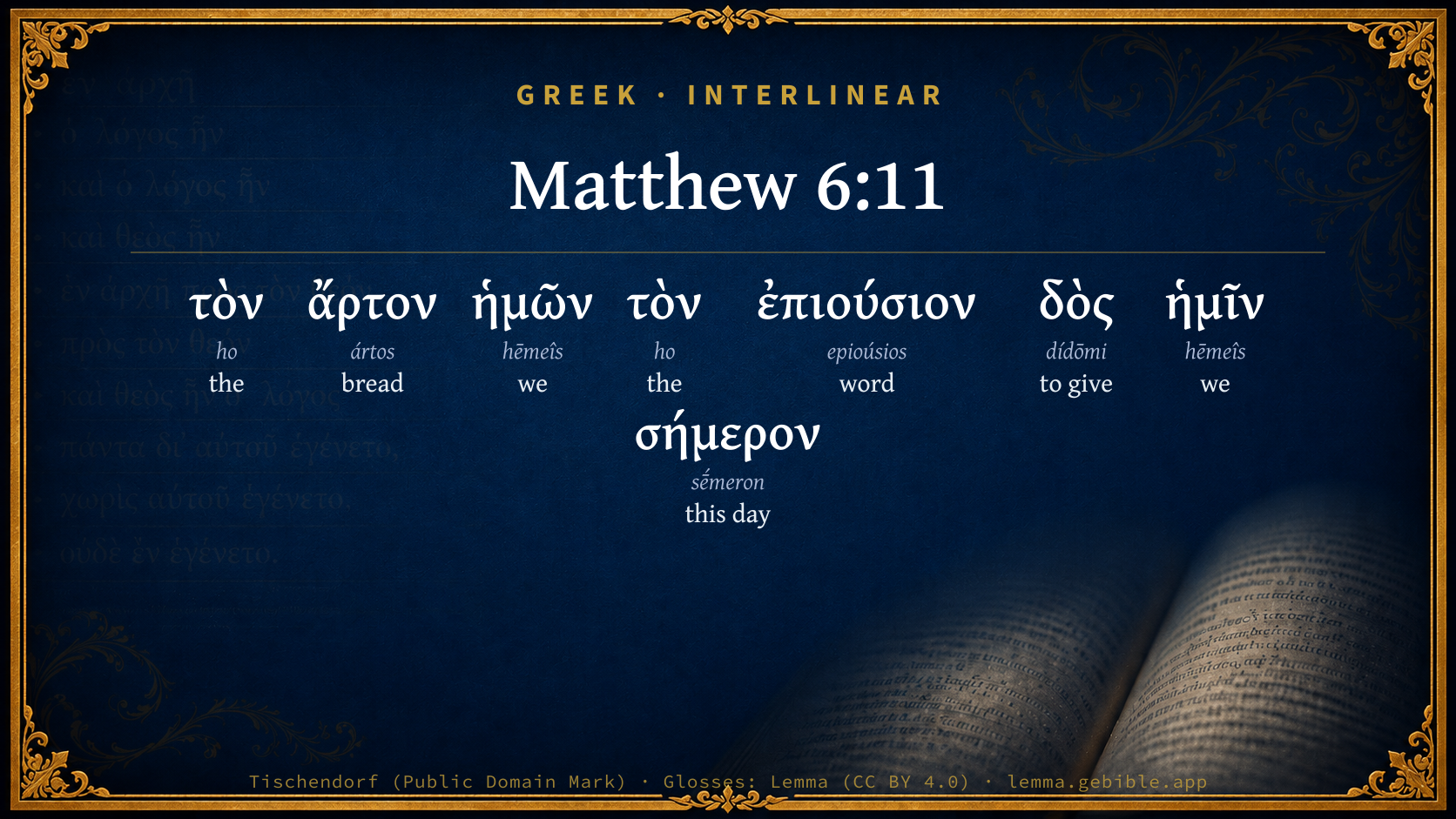
Download image
Cite this verse

Matthew 6:11 (World English Bible). Public Domain. Lemma interlinear Bible study tool, https://lemma.gebible.app/v/matthew/6/11.

Show BibTeX & RIS
BibTeX
RIS
English Translation
Give us today our daily bread.
World English Bible · Public Domain
Highlights
  • 2 first appearances in the Greek New Testament
Full analysis ↓
Download a study sheet

One document with this verse’s original text, its word-by-word gloss line, the meaning frame, cross-references with their text, attributed commentary, and full source and license credits — printable, and it pastes into notes with its structure intact.

This verse Autodidact and up

Study sheet (.html) Plain text (.txt)

A passage Seminary Student

Up to 50 verses in one chapter. A passage sheet keeps up to 6 commentary sources and 12 cross-references per verse, in the order this page ranks them, and says so on the sheet whenever that leaves anything out. Ask for a single verse and you get the Autodidact verse sheet above.

Everything on this page stays free to read, with no account — the sheet is a download of what is already on screen, not access to it.

Want to remove ads? Support Godless Engineer
Compare translations 3

The same verse in 3 English versions, stacked beneath the original-language interlinear above. Click any original word for its lexicon entry.

Each is an independent rendering of the whole verse — the interlinear is not word-aligned to these translations.

Highlighted words mark where these versions differ — a whole-verse word diff, not a word-by-word alignment.

  • World English Bible Public Domain
    Give us today our daily bread.
  • King James Version Public Domain
    Give us this day our daily bread.
  • unfoldingWord Literal Text CC BY-SA 4.0
    Give us today our daily bread;

unfoldingWord Literal Text — © unfoldingWord, licensed CC BY-SA 4.0. Word-aligned USFM3 via Door43 (git.door43.org/unfoldingWord/en_ult).

Versions to compare (up to 4)

3 of 4 selected

Show all 19 translations

Every available English version of this verse, each an independent rendering of the whole verse.

  • World English Bible Public Domain
    Give us today our daily bread.
  • Berean Standard Bible Public Domain
    Give us this day our daily bread.
  • Majority Standard Bible Public Domain
    Give us this day our daily bread.
  • King James Version Public Domain
    Give us this day our daily bread.
  • American Standard Version (1901) Public Domain
    Give us this day our daily bread.
  • Revised Version (1885) Public Domain
    Give us this day our daily bread.
  • Geneva Bible (1599) Public Domain
    Giue vs this day our dayly bread.
  • Douay-Rheims (1899) Public Domain
    Give us this day our supersubstantial bread.
  • Young's Literal Translation Public Domain
    `Our appointed bread give us to-day.
  • Literal Standard Version CC BY-SA 4.0
    Give us today our appointed bread.
  • Unlocked Literal Bible CC BY-SA 4.0
    Give us today our daily bread.
  • unfoldingWord Literal Text CC BY-SA 4.0
    Give us today our daily bread;
  • Darby Bible Public Domain
    give us to-day our needed bread,
  • World Messianic Bible Public Domain
    Give us today our daily bread.
  • Webster's Bible Public Domain
    Give us this day our daily bread.
  • Free Bible Version CC BY-SA 4.0
    Please give to us today the food we need.
  • Bible in Basic English Public Domain
    Give us this day bread for our needs.
  • Text-Critical English NT CC BY 4.0
    Give us this day our daily bread.
  • Tyndale New Testament (1534) Public Domain
    Geve vs this daye oure dayly breede.

Literal Standard Version (2020), Covenant Press — licensed CC BY-SA 4.0. Text via the HelloAO Bible API (eBible.org). Unlocked Literal Bible (unfoldingWord) — licensed CC BY-SA 4.0. Text via the HelloAO Bible API (eBible.org). unfoldingWord Literal Text — © unfoldingWord, licensed CC BY-SA 4.0. Word-aligned USFM3 via Door43 (git.door43.org/unfoldingWord/en_ult). Free Bible Version, Dr. Jonathan Gallagher — licensed CC BY-SA 4.0. Text via the HelloAO Bible API (eBible.org).

Word by word

More ways to search: Search by grammar → Find every occurrence → Compare this word →

Practice this passage: Drill this verse → Learn its vocabulary →

About this verse

These counts appear in no published source. They are computed here, from the morphology-tagged text and Lemma’s own curated glosses. What Lemma adds →

8
words
6
distinct lemmas
Gospels
section

Notable vocabulary

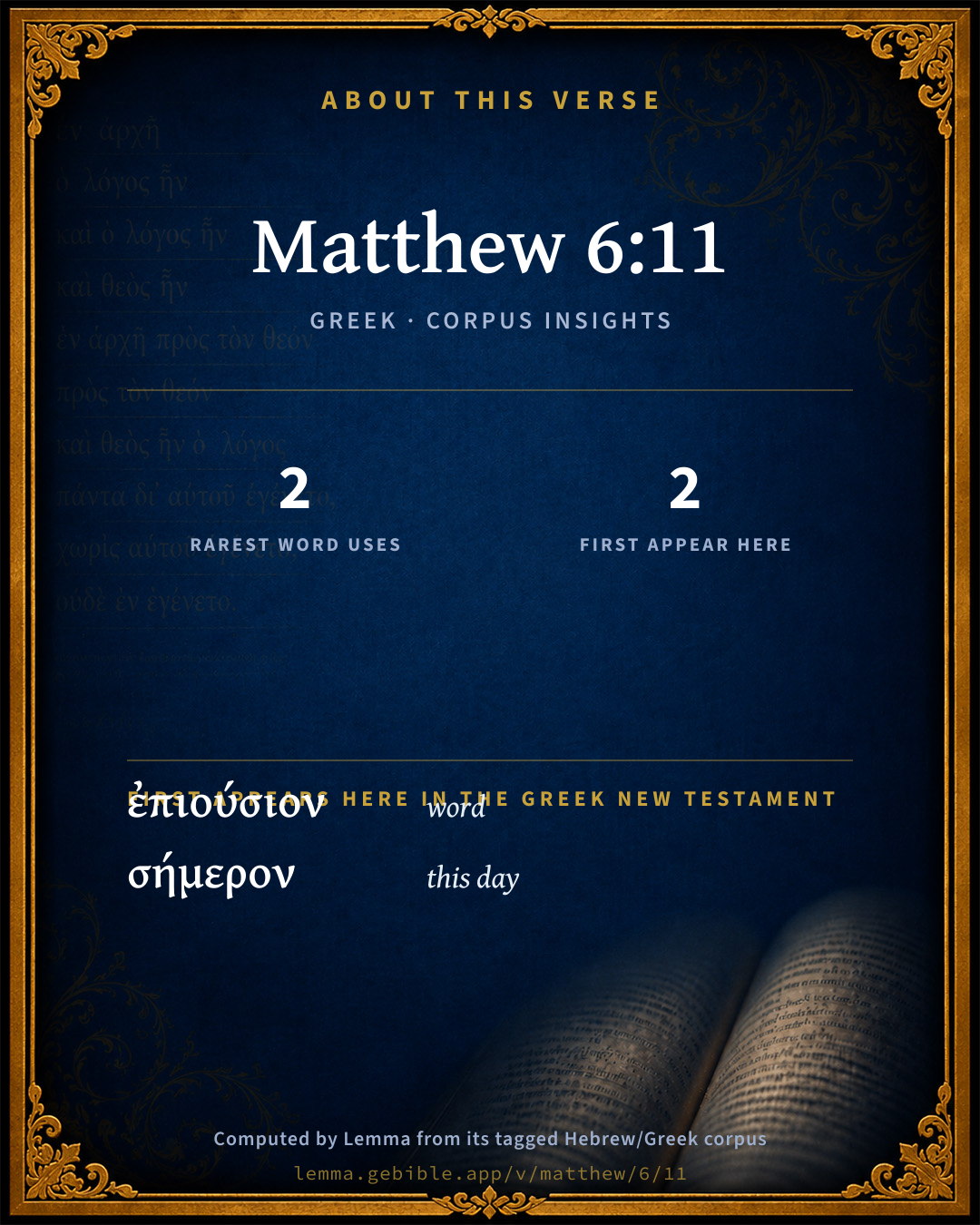
The rarest word here is ἐπιούσιον word G1967 — appearing just 2 times in the whole Greek New Testament.

First appearance in Scripture

These words make their first canonical appearance in the Greek New Testament here:

  • ἐπιούσιον word G1967
  • σήμερον this day G4594

Shared distinctive vocabulary

ἐπιούσιον word G1967 occurs in 2 verses of the Greek New Testament. Also found in:
Repetition

Words recur within this verse:

Cross-references

11

Topical passages linked to Matthew 6:11 in the Treasury of Scripture Knowledge — connected by theme and wording, ordered by reader-vote popularity; previews shown in the World English Bible.

  • Proverbs 30:8 Remove far from me falsehood and lies. Give me neither poverty nor riches. Feed me with the food that is needful for me;
  • Luke 11:3 Give us day by day our daily bread.
  • Matthew 4:4 But he answered, "It is written, 'Man shall not live by bread alone, but by every word that proceeds out of the mouth of God.'"
  • Psalms 34:10 The young lions do lack, and suffer hunger, But those who seek Yahweh shall not lack any good thing.
  • John 6:31–59 Our fathers ate the manna in the wilderness. As it is written, 'He gave them bread out of heaven to eat.'"
  • Job 23:12 I haven't gone back from the commandment of his lips. I have treasured up the words of his mouth more than my necessary food.
  • Psalms 33:18–19 Behold, Yahweh's eye is on those who fear him, On those who hope in his loving kindness;
  • Isaiah 33:16 He shall dwell on high; his place of defense shall be the munitions of rocks; his bread shall be given [him]; his waters shall be sure.
  • Exodus 16:16–35 This is the thing which Yahweh has commanded: "Gather of it everyone according to his eating; an omer a head, according to the number of your persons, shall you take it, every man for those who are in his tent."
  • 1 Timothy 6:8 But having food and clothing, we will be content with that.
  • 2 Thessalonians 3:12 Now those who are that way, we command and exhort in the Lord Jesus Christ, that with quietness they work, and eat their own bread.

Cross-references courtesy of OpenBible.info (CC BY 4.0).

Commentary

Notes on Matthew 6:11 from classic Christian and Jewish commentators (each source and its license shown beneath its notes). The classic Christian expositions comment on the surrounding passage and are grouped to its opening verse, so a note may address several verses; the Jewish commentaries on the Tanakh (Rashi and others) are per-verse, so they appear only where the commentator wrote on this verse.

Lemma curates 59 commentaries, every one of them public domain or Creative Commons licensed, each selected and text-cleaned for this edition rather than reprinted as found. About our sources →

Ellicott's Commentary for English Readers

(11) Give us this day our daily bread.—A strange obscurity hangs over the words that are so familiar to us. The word translated “daily” is found nowhere else, with the one exception of the parallel passage in Luk_11:3, and so far as we can judge must have been coined for the purpose, as the best equivalent for the unknown Aramaic word which our Lord actually used. We are accordingly thrown partly on its possible derivation, partly on what seems (compatibly with its derivation) most in harmony with the spirit of our Lord’s teaching. The form of the word (see Note in Excursus) admits of the meanings, (1) bread sufficient for the day now coming; (2) sufficient for the morrow; (3) sufficient for existence; (4) over and above material substance—or, as the Vulgate renders it, panis super substantialis. Of these, (1) and (2) are the most commonly received; and the idea conveyed by them is expressed in the rendering “daily bread.” So taken, it is a simple petition, like the prayer of Agur in Pro_30:8, for “food convenient for us;” and as such, has been uttered by a thousand child-like hearts, and has borne its witness alike against over-anxiety and far-reaching desires for outward prosperity. It is not without some hesitation, in face of so general a concurrence of authority, that I find myself constrained to say that the last meaning seems to me the truest. Let us remember (1) the words with which our Lord had answered the Tempter, “Man shall not live by bread alone, but by every word that proceedeth out of the mouth of God” (Mat_4:4); (2) His application of those words in “I have meat to eat that ye know not of” (Joh_4:32); (3) His own use of bread as the symbol of that which sustains the spiritual life (Joh_6:27-58); (4) the warnings in Mat_6:25-31 not only against anxiety about what we shall eat and drink, but against seeking these things instead of seeking simply the kingdom of God and His righteousness—and we can scarcely fail, I think, to see that He meant His disciples, in this pattern Prayer, to seek for the nourishment of the higher and not the lower life. So taken, the petition, instead of being a contrast to the rest of the Prayer, is in perfect harmony with it, and the whole raises us to the region of thought in which we leave all that concerns our earthly life in the hands of our Father, without asking Him even for the supply of its simplest wants, seeking only that He would sustain and perfect the higher life of our spirit. So when we ask for “daily bread,” we mean not common food, but the “Bread from heaven, which giveth life unto the world.” So the reality of which the Eucharistic bread is the symbol is the Lord’s gracious answer to the Prayer He has taught us.

II.—THE WORD “DAILY,” IN Matthew 6:11.

The word ἐπιούσιος has been derived (1) from ή ἐπιοῡσα (sc. ἡμέρα)=the day that is coming on; and this meaning is favoured by the fact that Jerome says that the Hebrew Gospel current in his time gave the word mahar (= crastinus) to-morrow’s bread, and by the very early rendering, quotidianum, in the Latin versions. On the other hand, this meaning introduces a strange tautology into St. Luke’s version of the prayer, “Give us day by day—i.e., daily—our daily bread.” (2) The other derivation connects it with οὐσία in some one or other of its many senses, and with ἐπὶ as signifying either “for” or “over”—the former force of the preposition suggesting the thought “for our existence or subsistence;” the latter, the supersubstantialis of Jerome, that is, “over or above our material substance.” It is said, and with truth, that in classical Greek the form would have been not ἐπιούσιος, but ἐπούσιος; but it is clear that that difficulty did not prevent a scholar like Jerome from accepting the derivation, and it was not likely that the Hellenistic Jew who first translated our Lord’s discourses should be more accurate than Jerome in coining a word which seemed to him wanted to express our Lord’s meaning. The derivation being then admissible, it remains to ask which of the two meanings of οὐσία and of ἐπὶ gives most force to the clause in which the word occurs, and for the reasons given above I am led to decide in favour of the latter. New words would hardly have been wanted for the meanings “daily” or “sufficient.” When a word is coined, it may fairly be assumed that it was wanted to express a new thought, and the new thought here was that which our Lord afterwards developed in John 6, that the spirit of a man needs sustenance not less than his body, and that that sustenance is found in the “bread of God which cometh down from heaven” (Joh_6:33). The student should, however, consult Dr. Lightfoot’s admirable excursus on the word in his Hints on a Revised Version of the New Testament.

On the assumption that the Lord’s Prayer included and spiritualised the highest thoughts that had previously been expressed separably by devout Israelites, we may note, as against the meaning of “bread for the morrow,” the saying of Rabbi Elieser, that “He who has a crumb left in his scrip, and asks, ‘What shall I eat to-morrow?’ belongs to those of little faith.”

There is, it must be admitted, a difficulty in conjecturing what Aramaic word could have answered to this meaning of ἐπιούσιος, and the fact that a word giving the other meaning is, as it were, ready to hand, and was actually found in the Hebrew Gospel in the fourth century, has some weight on the other side. That word may, however, itself have been not a translation of the original, but a re-translation of the Latin quotidianus; and the fact that Jerome, knowing of this, chose another rendering here, while he retained quotidianus in St. Luk_11:3, shows that he was not satisfied with it, and at last, it may be, halted between two opinions.

A Bible Commentary for English Readers, edited by Charles John Ellicott (1878–1897) — public domain. Text from a community e-Sword module.

The Biblical Illustrator

Joseph S. Exell

Mat_6:11

Our dally bread.

Daily bread

1. That even the wants of our bodies are to be subordinated to the purposes of religion.

2. That our dependence upon God for the supply of our bodily wants ought to be recognized.

3. That a sufficiency and not a superabundance of the supplies of life ought to be solicited.

4. That unneedful anxiety about the future ought to be condemned.

5. That all selfish grasping, and all unfair living upon others ought to be avoided. (F. Edwards, B. A.)

I. What is here asked. The poor of Gods flock have special interest in this prayer, and the rich have need of it.

1. That what they have may be preserved.

2. That they may have true enjoyment.

3. That they may suitably improve what they have.

II. The spiritual bread.

1. God alone can break this bread to you.

2. You shall eat bread in the kingdom of heaven. (W. Wilkinson, M. A.)

This is the language of-personal need, conscious dependence, quiet contentment, childlike trust, and fraternal sympathy. (F. J. A.)

Give us this day our daily bread

I. We begin as nature prompteth, with the preservation of our beings and lives; whereby we become capable of receiving and enjoying other good things.

II. By doing so, we also imply the sense we have of our total dependence upon God; avowing ourselves to subsist by His care and bounty.

(1) Disclaiming all confidence in any other means to maintain or support us; in

(2) any store we may have laid up, or

(3) estate we pretend to.

III. We are taught our duty of being willing continually to rely upon God.

(1) We ask not that God would give us at once what may serve us for ever, and put us out of any fear to want hereafter;

(2) we ask not for that which may suffice for a long time, for many years, months, or days; but

(3) that God would give us to-day, or rather day by day; that is, that He would constantly dispense what is needful for us.

IV. We must esteem

(1) Gods providence our surest estate;

(2) Gods bounty our best treasure; and

(3) Gods Fatherly care our most certain and most comfortable support.

V. We learn to ask only for so much as shall be fit to maintain us, not for

(1) rich or plentiful store; not for

(2) full barns nor

(3) heaps of treasures, wherewith to pamper ourselves; but for

(4) daily bread, a moderate provision then to be dealt to us when we need it. (Isaac Barrow, D. D.)

Give us this day our daily bread

Bread, by a common and natural figure, signifies the necessaries of life.

I. We are to make that the only subject of our prayers, which religion allows us to desire.

(1) The gospel, not the

(2) insatiate appetites of men, is to be the measure of their wants.

(3) A Christian must not by prayer seek for anything which is contrary to his holy profession to enjoy.

II. This petition for daily bread shows the true measure of Christian philosophy.

1. It requires us to restrain our wishes by our wants, which are both few and easily supplied.

2. God allows us to ask nothing of Him, but what we may with purity desire, and with innocence enjoy.

3. Religion makes us truly rich in making us temperate, content, and independent. True happiness of man consists not in the extent of possession, but in the restraint of desire. (Thomas Mangey.)

Daily bread

I. We may ask for temporal things if we ask for them lawfully. It is true, prayers to God for spiritual things are more acceptable. As your child pleaseth you better when it comes to you to be taught its book, rather than when it comes for an apple. But we may ask for other things.

1. For they are good and useful to us in the course of our service.

2. Without them we are exposed to many temptations. Prayer easeth you of a deal of carking about them.

II. We must ask for them lawfully.

1. Not preferring these temporal things before His favour, and the graces of His Spirit.

2. In moderate proportion.

III. We must ask them with humility and submission to the will of God.

1. Not for ostentation and riot, that we may live at large and at ease, but that Thy name may be glorified, and that we may be supported in service.

2. We must not come and challenge it, as if it were our due.

3. We must not use the plea of merit, but of mercy. (Thomas. Manton, D. D.)

The fourth petition

I. We put the emphasis on daily bread.

1. Bread means that which is needful to support the life of the body.

2. That which is needful to support all our life in this world.

3. Is prayer that we may have enough.

II. We would now separate the phrase give us that we may think over its special meaning.

1. It implies acknowledgment of dependence.

2. We know that giving is His delight.

3. We mean, give this, for thou art our Father.

4. We mean, through a blessing on our own right use of means.

5. When common means are not within our power, by means of Thine own.

III. Place the emphasis on our. We do not ask for the bread belonging to others.

IV. We next dwell on this day.

V. This petition suggests A higher petition-for heavenly broad. (Dr. Stanford.)

The fourth petition

I. The meaning, place, and reasonableness of this petition.

II. The Giver, our father. God is the universal giver. Giving implies personality, thought, emotion.

III. The gift-daily bread. Religion sanctifies common life.

IV. The community of the gift.

V. The conditions of the gift.

1. Honesty.

2. Industry.

VI. The period of the gift. A warning against covetousness. VII. Prayer for the gift.

1. It teaches humility.

2. It encourages filial confidence in little things.

3. It prompts to daily gratitude. (Newman Hall, LL. B.)

The daily gift

I. The giver, God is the only giver. He gives constantly and quietly. He gives simply. He delights in giving.

II. The gift. All bread comes from God. Bread has an eternal meaning.

III. The expansion of the gift.

1. This little word our excludes every calling which is injurious to the interests of our fellow men.

2. We are to think of the poor and needy.

IV. The limitation of the gift-To-day.

1. Christ would have us free from anxious care.

2. It teaches moderation and contentment.

3. Sometimes God tries the faith of His people, and they are in difficulties about their daily bread. (Dr. Saphir.)

Daily bread

1. These words show that earthly interests and animal wants have an appropriate place in our prayers.

2. Our intimate dependence upon God.

3. We virtually ask for ability and opportunity to obtain our daily bread. The blessing involved in the very effort for acquisition.

4. The relative dependence of others upon us.

5. Our wants are always new daily. (E. H. Chaplin.)

The dependent spirit of the Lords prayer

I. The source of the supply.

II. How the supply is granted. He grants strength of body for toil; by the wonder-working of His providence.

III. Gods blessings are gifts.

IV. God will have us live upon His bounty day by day.

V. The unselfishness and sympathy of the petition-give us.

VI. Contentment with Gods measure supplied is taught by this petition: not what we wish, but what we need. (Dr. O. Winslow.)

The fourth petition

I. Certain suppositions appear to be made in this petition.

1. That temporal blessings are necessary for our happiness.

2. That we can look for them only as they are the free gift of God.

3. It supposes our right to this form of good to be forfeited and lost.

II. The forms of desired good which are to be commended under this clause.

1. Bread the representative of all forms of temporal blessings; a healthy mind, continued energy, for the duties of our calling.

2. The Divine blessing on the gifts we have. Let us never ask for bread without the blessing.

III. Practical lessons.

1. A protest against our sumptuous and luxurious living.

2. Against all covetous and inordinate desires.

3. Against carefulness.

4. An admonition to mercifulness and brotherly love.

5. Prayer must be a daily exercise of the Christian life. (D. Moore, M. A.)

Daily bread

1. It is the believers piety that he seeks all his daily portion at the hand of God.

2. The faith of the prayer. Hard to trust God for temporals.

3. The moderation of the prayer

(1) of time,

(2) of matter,

(3) of degree.

A train of holy contemplation awakened by a morsel of bread

Did the corn wave freely in its beauty in the summer field? Just so was Christ once in the brightness and the expansion of His fathers glory. Did the reaper put in the sickle, and the free corn fall before the scythe: So, in the ripeness of time did the iron enter into the soul of Jesus, and He laid prostrate in the dust. Was the wheat ground within the mill? So was Jesus ground under the tremendous pressure of the worlds sin. Is the one bread broken into many parts? So is Jesus the one life of the whole Church. (J. Vaughan, M. A.)

Prayer for daily bread

I. The meaning.

1. The principle of dependence is developed in it.

2. The principle of moderation.

3. The principle of tenderness towards others.

II. The encouragement to go to God for the bread that perisheth.

1. It is to His Father He goes.

2. It is to the Father who gave us His Son.

III. The still higher encouragements to pray for the bread eternal.

1. From considering the Bread itself. Here no moderation is needed.

2. Here are absolute promises.

3. Covet larger portions of the Bread. (J. H. Evans.)

Men recognize secondary causes rather than the Divine Being in the gift of their daily bread

The Rev. J. H. Wilson of Edinburgh relates: One day I asked the children in our infant school, Who gives you the bread you get to your dinner? Almost every voice answered, My mother. But who gave it to your mother? The baker. And who gave it to the baker? The miller. And who gave it to the miller? The farmer. And who gave it to the farmer? The ground. And only when I asked, Who gave it to the ground? did I get the answer, It was God. How many children of a larger growth, like these infants, attribute their blessings to any second cause rather than to the gift of their Father!

It is suitableness, not superabundance, that gives enjoyment

A dress that fits is more useful to the wearer than one which is too large, though more costly. A shoe that pinches the foot is no easier for all the gold lace upon it. (Newman Hall, LL. D.)

The cry of the needy

I. It is an utterance of felt need.

II. It is an acknowledgment of entire and constant dependence on God.

III. It is the language, of moderation.

IV. It breathes a spirit of trustfulness.

V. The language implies personal effort to gain the bread.

VI. It is the language of brotherly anxiety and love. VII. The great end for which all bread, temporal and spiritual, should be sought and used-the promotion of Gods glory. (J. Morgan.)

All good things from God are gifts

One sharp winter day, so runs a nursery tale, a poor woman stood at the window of a kings conservatory, looking at a cluster of grapes, which she longed to have for her sick child. She went home to her spinning-wheel, earned half-a-crown, and offered it to the gardener for the grapes, He waved his hand, and ordered her away. She returned to her cottage, snatched the blanket from her bed, pawned it, and once more asked the gardener to sell her the grapes, offering him five shillings. He spoke furiously to her and was turning her out, when the princess came in, heard the mans passion, saw the womans tears, and asked what was wrong. When the story was told she said, My dear woman, you have made a mistake. My father is not a merchant, but a king; his business is not to sell but to give; so saying, she plucked the cluster from the vine and dropped it into the womans apron. (Dr. Stanford.)

Daily bread

1. Fastidiousness about food is condemned by this petition, so also is sumptuousness of apparel.

2. And as moderation in our desires is here commanded, so is thankfulness for ordinary benefits. (F. C. Blyth, M. A.)

Bread

1. The bread of righteousness.

2. The Word of God (Mat_4:4).

3. God the Word (Joh_6:35).

4. The Holy Eucharist. (F. C. Blyth, M. A.)

Our

1Such food as is suitable for us.

2. Diligence in our calling. 3, Necessities for us, superfluities for our brethren. (F. C. Blyth, M. A.)

Us

1. Excludes selfishness and incites to charity.

2. As we eat with our households so we should pray with them. (F. C. Blyth, M. A.)

This day

1. Uncertainty about the future no excuse for recklessness.

2. Each new day is a special gift from God, in which are contained all the possibilities of His grace.

3. What is our whole lifetime but a day!

4. To any earthly friend we should be ashamed thus frequently to ask a favour. (F. C. Blyth, M. A.)

Contentment

Contentment is a jewel which turns all into gold, yea, want into wealth. Covetousness is a canker which eats into the richest robes and the costliest treasures; a dropsy which, the more it drinks, the more it thirsts. (F. C. Blyth, M. A.)

The wise man, as he looks forth upon the riches and luxuries with which the worldling loves to surround himself, learns to say with Socrates, How many things there are that I do not want!

The Biblical Illustrator, edited by Joseph S. Exell (c. 1880s–1900s) — public domain. Text from a community e-Sword module.

Joseph Benson's Commentary

Mat 6:11. Give us this day our daily bread — As the original word, επιουσιον, here rendered daily, is not found anywhere else; neither in the LXX. nor in any Greek author, nor in any other part of the New Testament, save in the parallel passage in Luke, commentators differ in their interpretation of it. That given by Theophylact, one of the most approved of the Greek fathers, seems the best: “Bread sufficient for our sustenance or support:” which is the sense in which the word is understood by Chrysostom, and in Etymol. Magna, where it is explained thus: ο επι

τη ουσια ημων αρμοζων, “that which is sufficient to our life;” or what will strengthen us from day to day for serving God with cheerfulness and vigour. Thus, also, Mr. Mede interprets the expression. The Latin version, in Jerome’s time, had panem quotidianum, daily bread, which our translators have copied, because in the parallel passage, Luk 11:3, το καθ’ ημεραν, day by day, is joined with επιουσιον. Daily bread, it must be observed, according to the Hebrew idiom, signifies the whole provision of the table, see Gen 18:5; and here it includes raiment also, and every thing necessary to life. “Since, therefore, we are not allowed to ask provision to gratify a luxurious appetite, but only the necessaries of life, and that not for many years, but from day to day, the petition forbids anxious cares about futurity, and teaches us how moderate our desires of worldly things ought to be. And whereas, not the poor only, whose industry all acknowledge must be favoured by the concurrence of Providence to render it successful, but the rich are enjoined to pray for their bread, day by day, it is on account of the great instability of human affairs, which renders the possession of wealth absolutely precarious; and because, without the divine blessing, even the abundance of the rich is not of itself sufficient so much as to keep them alive, far less to make them happy.” Indeed, the petition teaches all men to exercise an humble dependance on Divine Providence for the most necessary supplies, be their possessions or abilities ever so great. It may be observed further here, that Erasmus, Heylin, and many others, following the fathers, understand it in a spiritual sense also. Bread, says Heylin, here signifies, “all things needful for our maintenance; the maintenance of the whole man, both body and soul; for each of these have their proper sustenance; to one belongs the natural bread, to the other the spiritual, and both are included in this petition.”

Joseph Benson's Commentary on the Old and New Testaments (1811–1818) — public domain. Text from a community e-Sword module.

Tyndale Open Study Notes

Tyndale Open Resources

6:11 Give us today the food we need: The disciple, after confidently asking God to provide for daily needs, can go about Kingdom ministry relieved of care (6:25-34).

Tyndale Open Study Notes — © Tyndale Open Resources, licensed CC BY-SA 4.0. Text via the HelloAO Bible API.

Bengel's Gnomon

Johann Albrecht Bengel

Mat 6:11. Τὸν ἄρτον, the bread) sc. nourishment of the body; see Mat 6:19, etc., 25, etc., from which it is evident that the disciples were not yet raised above the cares of this life. This short petition is opposed to the much speaking of the heathen, mentioned in Mat 6:7, which principally referred to the same object;[260] and it is placed first amongst those petitions which refer to ourselves, because the natural life is prior to the spiritual. Every want of ours is cared for in this prayer.—ἩΜῶΝ, of or belonging to us) our, sc. earthly. But the spiritual bread is the bread of God, i.e. that which is [given] by God, and [cometh forth] from God.—ἐπιούσιον, daily) This adjective is derived ἀπο τῆς ἐπιούσης, from the following day, and is composed of ἐπὶ and ἸΟῦΣΑ.[261] For from εἰμι, to be (from which also comes περιούσιος) or from ΟὐΣΊΑ, essence or private property, would be composed, ἐπούσιος, in the same manner as ἘΠΟΥΡΆΝΙΟς, etc.: since although ἘΠῚ does not always lose the in composition before a vowel, it does lose it in ἜΠΕΣΤΙΝ, as also in ἜΠΕΊΜΙ from which this adjective must be originally derived according to this hypothesis. Our heavenly Father gives each day what is needed each day. Nor is it necessary that He should give it before. This His paternal and providential distribution suggests the expression ἘΠΙΟΎΣΙΟς, for the coming day. The continuance, therefore, of our indigence, and of God’s fatherly beneficence as from year to year, so from day to day, is denoted by this phrase. Cf. 2Ki 25:30.—λόγον ἡμέρας ἐν ἡμέρᾳ αὐτοῦ, the proportion for the day on its day. Cf. Act 6:1, διακονία καθημερινὴ, daily ministration. The bread, as a whole, is appointed us for all our days; but the “giving” of it is distributed through the several days of our life, so as to take place each day. Both these ideas are expressed by the word ἐπιούσιος. What was necessary for the support of my life on any particular day, needed not to be given me on the day before that, but on that very day; and what was necessary on the following day, was given soon enough on that day, and so on. The sense therefore of ἘΠΙΟΎΣΙΟς extends more widely with regard both to the past and the future, than that of “crastinus” to-morrow’s.—σήμερον, to-day) In Luk 11:3, we find τὸ καθʼ ἡμέραν, day by day. Day by day we say and pray, “to-day.” Our confidence and contentedness (αὐτάρκεια)[262] are thus expressed. Thus in Jas 2:15, we have ἘΦΉΜΕΡΟς ΤΡΟΦῊ, daily food. Cf. also Pro 30:8. Thus was manna given.

[260] viz. the cares of this life.—ED.

[261] The feminine of ἰών, the participle present of εἶμι to go.—(I. B.)

[262] See p. 150 and f.n. 3.—(I. B.)

Bengel's Gnomon of the New Testament — English translation (T&T Clark, Edinburgh, 1860) — public domain. Text from a community e-Sword module.

Meyer's Critical & Exegetical Commentary

Heinrich August Wilhelm Meyer

Mat_6:11. Τὸν ἄρτον] same as לֶחֶם, victus; Gen_18:5; Pro_30:8; 2Th_3:12; Sir_10:26; Wis_16:20.

τὸν ἐπιούσιον] occurring nowhere else in the Greek language but here and in Luk_11:3. See Origen, de Orat. § Matthew 27 : ἔοικε πεπλᾶσθαι ὑπὸ τῶν εὐαγγελιστῶν. It is possible that it may be derived from οὐσία, and accordingly the phrase has been supposed to mean: the food necessary for subsistence, לֶחֶם חֻקִּי, Pro_30:8. So Syr., Origen, Chrysostom, Theophylact, Euth. Zigabenus, Etym. M.; Beza, Maldonatus, Kuinoel, Tholuck, Ewald (de Wette undecided), Arnoldi, Bleek, Weizsäcker, Keim, Hanne, and probably this explanation has also given rise to the rendering daily bread (It., Chrysostom, Luther), ἐφήμερος, Jam_2:15; comp. Victorinus, c. Ar. ii. p. 273, Augustine. But οὐσία does not mean subsistence (σύστασις), but (Ast, Lex. Plat. II. p. 491 f.) essence, as also reality, and, finally, possessions, res familiaris, in which sense also it is to be taken in Soph. Trach. 907 (911), where the words τὰς ἄπαιδας οὐσίας denote a home without children. In deriving the expression, therefore, from οὐσία, the idea of necessary food[421] must be brought out in a very indirect way (as Gregory of Nyssa: that which is requisite or sufficient for the support of the body; comp. Chrysostom, Tholuck, Hitzig). Again, if the word were to be derived from ΟὐΣΊΑ (ΕἾΝΑΙ), it would have to be spelt, not ἘΠΙΟΎΣΙΟς, but ἘΠΟΎΣΙΟς, in a way analogous to the forms ἘΠΟΥΣΊΑ, overplus, ἐπουσιώδης, non-essential, which come from εἶναι. Forms in which there is either a different preposition (such as ΠΕΡΙΟΎΣΙΟς), or in which the derivation has no connection with ΕἾΝΑΙ (as ἘΠΙΟΡΚΕῖΝ), have been brought forward without any reason with a view to support the above ordinary explanation. After all this we must, for reasons derived from grammatical considerations (in answer to Leo Meyer, Weizsäcker, Kamphausen, Keim), prefer the other possible derivation from Ἡ ἘΠΙΟῦΣΑ (therefore from ἘΠΙΈΝΑΙ), dies crastinus (Lobeck, ad Phryn. p. 464; Pro_27:1), which is already expressly given by Ambrose, lib. v. de sacram. 4. 24, and according to which we should have to interpret the words as meaning to-morrows bread.[422] So Ar., Aeth., Copt., Sahid., Erasmus, Annot., Scaliger, Salmasius, Grotius, Wolf, Bengel, Wetstein, Valckenaer, Schol. I. p. 190, and V; also Winer, p. 92 [E. T. 120], Fritzsche, Käuffer, Schegg, Döllinger, Hilgenfeld, Holtzmann, Schenkel, Wittichen. This explanation, furnished historically by the Gospel according to the Hebrews, where Jerome found מחר, is recommended in the context by the σήμερον, which, besides, has no correlative, nor is it incompatible with Mat_6:34, where the taking no thought for to-morrow does not exclude, but rather presupposes (1Pe_5:7), the asking for to-morrows bread, while, moreover, this request is quite justified as a matter of prayer, considering how certain is the uncertainty of lifes duration. The granting to-day of to-morrows bread is, accordingly, the narrow limit which Christ here assigns to prayers for earthly objects,a limit not open to the charge of want of modesty (Keim), inasmuch as it is fixed only at de die in diem. Of late, Olshausen and Delitzsch (the bread necessary for mans spiritual and physical life) have again adopted, at least along with the other view, the erroneous explanation,exegetically inconsistent with σήμερον, but originating in a supposed perverse asceticism, and favoured by the tendency to mystical interpretation generally, no less than by the early (Irenaeus,Haer. iv. 18) reference to the Lords Supper in particular,the explanation, namely, that what is here meant is supernatural,[423] heavenly food (John 6), as, indeed, many Fathers (Cyprian and Jerome) and older expositors understood both kinds of bread to be included

[421] To this amounts also the view of Leo Meyer in Kuhns Zeitschr. f. vergleich. Sprachforsch. VII. 6, p. 401 ff., who, however, regards the word as expressing adjectively the idea of the aim involved in the ἐπί: what ἐπί is. In this Kamphausen substantially concurs. The word is said to be derived from ἐπεῖναι: belonging to, in which the idea of being sufficient or necessary is understood to be implied. But in that case we should also have expected to find ἐπούσιος, and besides, ἐπεῖναι certainly does not mean to belong to, but to be by, also to be standing over, to impend, and so on. This explanation of ἐπιούσιος is an erroneous etymological conjecture. Bengel very properly observes: ἐπί non semper quidem in compositione ante vocalem amittit, sed amittit tamen in ἔπεστιν. [See Lightfoot, A Fresh Revision of the English New Testament, Appendix on the words ἐπιούσιος, περιούσιος.ED.]

[422] Not what is necessary for the next meal (Rettig in the Stud. u. Krit. 1838, p. 238). Baumgarten-Crusius, correctly, to-day, what we need for to-morrow. On σήμερον was founded the very ancient (Constitutt. apost. vii. 24. 1 f., Tertullian, Cyprian) daily use of the Lords Prayer.

[423] The expression was derived partly from ἐπιών (as Ambrose)the bread of the World to come (so again Weisse, Evangelienfr. p. 201); partly from οὐσία, in which case it was interpreted to mean: the bread requisite for the life of the soul; or, as though it were ὑπερούσιος: panis supersubstantialis; as in the Vulg. and Jerome (super omnes substantias). Melanchthon fully and pointedly expresses his opposition to the view of heavenly bread, when he says: Its advocates are deficient in eruditio et spirituale judicium. However, it is likewise found in Erasmus Paraphr.; but Calvin pronounces: prorsus absurdum est.

Meyer — Critical and Exegetical Commentary on the New Testament — English translation by Peter Christie, edited by Frederick Crombie (T&T Clark, 1880) — public domain. Text from a community e-Sword module.

Expositor's Greek Testament

ed. W. Robertson Nicoll

Mat 6:11 . Fourth petition . τὸν ἄρτον ἡμῶν : whatever the adjective qualifying ἄρτον may mean, it may be taken for granted that it is ordinary bread, food for the body, that is intended. All spiritualising mystical meanings of ἐπιούσιον are to be discarded. This is the one puzzling word in the prayer. It is a ἄπαξ λεγ ., not only in O. and N. T., but in Greek literature, as known not only to us, but even to Origen, who ( De Oratione , cap. xxvii.) states that it is not found in any of the Greeks, or used by private individuals, and that it seems to be a coinage ( ἔοικε πεπλάσθαι ) of the evangelists. It is certainly not likely to have proceeded from our Lord. This one word suffices to prove that, if not always, at least in uttering this prayer, Jesus spoke in Aramaean. He would not in such a connection use an obscure word, unfamiliar, and of doubtful meaning. The problem is to account for the incoming of such a word into the Greek version of His doubtless simple, artless, and well-understood saying. The learned are divided as to the derivation of the word, having of course nothing but conjecture to go on. Some derive it from ἐπὶ and οὐσία , or the participle of εἶναι ; others from ἐπιέναι , or ἡ ἐπιοῦσα = the approaching day ( ἡμέρα understood). In the one case we get a qualitative sense bread for subsistence, bread needed and sufficient ( τὰ δέοντα καὶ αὐτάρκη . Pro 30:8 , Sept [37] ); in the other, a temporal bread of the coming day, panem quotidianum (Vulg [38] , Luk 11:3 ), “daily bread”. Either party argues against the other on grammatical grounds, e.g. , that derived from οὐσία the word should be ἐπούσιος , and that derived from ἐπιοῦσα it should be ἐπιουσαῖος . In either case the disputants are ready with their answer. Another source of argument is suitableness of the sense. Opponents of the temporal sense say that to pray for to-morrow’s bread sins against the counsel, “Take no thought for the morrow,” and that to pray, “Give us to-day our bread of to-morrow,” is absurd ( ineptius , Suicer, Thesaurus, s.v. ἐπιούσιος ). On the other side it is said: Granting that the sense “sufficient” can be got from ἐπὶ , οὐσία , and granting its appropriateness, how comes it that a simpler, better-known word was not chosen to represent so plain a meaning? Early tradition should have an important bearing on the question. Lightfoot, in the appendix on the words ἐπιούσιος and περιούσιος , in his work “On a fresh Revision of the N. T.,” summarises the evidence to this effect: Most of the Greeks follow Origen, who favoured derivation from οὐσία . But Aramaic Christians put for ἐπιούσιος Mahar = crastinum. (Jerome comm. in Mt.) The Curetonian Syriac has words meaning, “our bread continual of the day give us”. The Egyptian versions have similar readings. The old Latin version has quotidianum , retained by Jerome in revision of L. V. in Luk 11:2 , while supersubstantialem is given in Mat 6:11 . The testimony of these early versions is important in reference to the primitive sense attached to the word. Still the question remains: How account for the coinage of such a word in Greek-speaking circles, and for the tautology: give us to-day ( σήμερον , Mt.) or daily ( τὸ καθʼ ἡμέραν , Luke), the bread of tomorrow? In his valuable study on “The Lord’s Prayer in the early Church” ( Texts and Studies , 1891), Principal Chase has made an important contribution to the solution of this difficulty by the suggestion that the coinage was due to liturgical exigencies in connection with the use of the prayer in the evening . Assuming that the original petition was to the effect: “to us give, of the day, our bread,” and that the Greek equivalent for the day was ἡ ἐπιοῦσα , the adjective ἐπιούσιος was coined to make the prayer suitable at all hours. In the morning it would mean the bread of the day now begun, in the evening the bread of to-morrow. But devotional conservatism, while adopting the new word as convenient, would cling to the original “of the day”; hence σήμερον in Matt. and τὸ καθʼ ἡμέραν in Luke, along with ἐπιούσιος . On the whole the temporal meaning seems to have the weight of the argument on its side. For a full statement of the case on that side vide Lightfoot as above, and on the other the article on ἐπιούσιος in Cremer’s Bib. Theol., W. B., 7te Aufl., 1893.

[37] Septuagint.

[38] Vulgate (Jerome’s revision of old Latin version).

The Expositor's Greek Testament, edited by W. Robertson Nicoll (1897–1910) — public domain. Text from a community e-Sword module.

Geneva Bible (1599)

Geneva Bible translators

That, that is meet for our nature for our daily food, or such, as may suffice our nature and complexion.

Geneva Bible (1599) marginal notes — public domain. Text via Bolls.life.

Jamieson, Fausset & Brown

Robert Jamieson, A. R. Fausset & David Brown

Give us this day our daily bread--The compound word here rendered "daily" occurs nowhere else, either in classical or sacred Greek, and so must be interpreted by the analogy of its component parts. But on this critics are divided. To those who would understand it to mean, "Give us this day the bread of to-morrow"--as if the sense thus slid into that of Luke "Give us day by day" (Luk 11:2, as BENGEL, MEYER, &c.) it may be answered that the sense thus brought out is scarcely intelligible, if not something less; that the expression "bread of to-morrow" is not at all the same as bread "from day to day," and that, so understood, it would seem to contradict Mat 6:34. The great majority of the best critics (taking the word to be compounded of ousia, "substance," or "being") understand by it the "staff of life," the bread of subsistence, and so the sense will be, "Give us this day the bread which this day's necessities require." In this case, the rendering of our authorized version (after the Vulgate, LUTHER and some of the best modern critics)--"our daily bread"--is, in sense, accurate enough. (See Pro 30:8). Among commentators, there was early shown an inclination to understand this as a prayer for the heavenly bread, or spiritual nourishment; and in this they have been followed by many superior expositors, even down to our own times. But as this is quite unnatural, so it deprives the Christian of one of the sweetest of his privileges--to cast his bodily wants in this short prayer, by one simple petition, upon his heavenly Father. No doubt the spiritual mind will, from "the meat that perisheth," naturally rise in thought to "that meat which endureth to everlasting life." But let it be enough that the petition about bodily wants irresistibly suggests a higher petition; and let us not rob ourselves--out of a morbid spirituality--of our one petition in this prayer for that bodily provision which the immediate sequel of this discourse shows that our heavenly Father has so much at heart. In limiting our petitions, however, to provision for the day, what a spirit of childlike dependence does the Lord both demand and beget!

Fifth Petition:

Jamieson, Fausset & Brown — Commentary Critical and Explanatory on the Whole Bible (1871) — public domain (CC PDM 1.0). Text via the HelloAO Bible API.

Adam Clarke's Commentary

Verse 11. Give us this day our daily bread] The word επιουσιαν has greatly perplexed critics and commentators. I find upwards of thirty different explanations of it. It is found in no Greek writer before the evangelists, and Origen says expressly, that it was formed by them, αλλ' εοικε πεπλασθαι υπο των ευαγγελιστων. The interpretation of Theophylact, one of the best of the Greek fathers, has ever appeared to me to be the most correct, Αρτος επι τη ουσιᾳ και συστασει ημων αυταρκης, Bread, sufficient for our substance and support, i.e. That quantity of food which is necessary to support our health and strength, by being changed into the substance of our bodies. Its composition is of επι and ουσια, proper or sufficient for support. Mr. Wakefield thinks it probable, that the word was originally written επιουσιαν, which coalesced by degrees, till they became the επιουσιον of the MSS. There is probably an allusion here to the custom of travellers in the east, who were wont to reserve a part of the food given them the preceding evening to serve for their breakfast or dinner the next day. But as this was not sufficient for the whole day, they were therefore obliged to depend on the providence of God for the additional supply. In Lu 15:12-13, ουσια signifies, what a person has to live on; and nothing can be more natural than to understand the compound επιουσιος, of that additional supply which the traveller needs, to complete the provision necessary for a day's eating, over and above what he had then in his possession. See Harmer.

The word is so very peculiar and expressive, and seems to have been made on purpose by the evangelists, that more than mere bodily nourishment seems to be intended by it. Indeed, many of the primitive fathers understood it as comprehending that daily supply of grace which the soul requires to keep it in health and vigour: He who uses the petition would do well to keep both in view. Observe

1. God is the author and dispenser of all temporal as well as spiritual good.

2. We have merited no kind of good from his hand, and therefore must receive it as a free gift: Give us, c.

3. We must depend on him daily for support we are not permitted to ask any thing for to-morrow: give us to-day.

4. That petition of the ancient Jews is excellent: "Lord, the necessities of thy people Israel are many, and their knowledge small, so that they know not how to disclose their necessities: Let it be thy good pleasure to give to every man, what sufficeth for food!" Thus they expressed their dependence, and left it to God to determine what was best and most suitable.

We must ask only that which is essential to our support, God having promised neither luxuries nor superfluities.

Adam Clarke's Commentary on the Bible (1810–1826) — public domain. Text from a community e-Sword/MySword module.

The Cambridge Bible for Schools and Colleges

gen. ed. J. J. S. Perowne

11. this day] In Luke, “day by day.”

our daily bread] The Greek word translated “daily” occurs only in the Lord’s Prayer here and Luk_11:3, it is not found in any classical author. The rendering of the E. V. “daily” as nearly as possible represents the probable force of the word, which is strictly (bread) “for the coming day,” i. e. for the day now beginning. Others render “bread for the future,” taking bread in a spiritual sense; others, following a different etymology, translate “bread of subsistence.” Bread, primarily the bread on which we subsist (see Prof. Lightfoot in appendix to his work On a Fresh Revision of the N. T.); subsistence as distinct from luxury; but the spiritual meaning cannot be excluded, Christ the Bread of Life is the Christian’s daily food.

The Cambridge Bible for Schools and Colleges (gen. ed. J. J. S. Perowne; Cambridge University Press, 1878–1918) — public domain. Text from a community e-Sword module.

John Gill's Exposition

Give us this day our daily bread. The Arabic version reads it, "our bread for tomorrow"; and Jerom says, that in the Hebrew Gospel, used by the Nazarenes, he found the word which signifies "tomorrow": but this reading and sense seem to be contradicted by Christ, Mat 6:34 were it not that it may be observed, that this signifies the whole subsequent time of life, and so furnishes us with a very commodious sense of this petition; which is, that God would give us, "day by day", as Luke expresses it, Luk 11:3 that is, every day of our lives, to the end thereof, a proper supply of food: or the meaning of it is, that God would give us, for the present time, such food as we stand in need of; is suitable to us, to our nature and constitution, state and condition, and is sufficient and convenient for us: to which agrees the petition of the (u) Jews:

"The necessities of thy people are great, and their knowledge short; let it be thy good will and pleasure, O Lord, our God, that thou wouldst give to everyone , "what is sufficient for his sustenance", and to every one's body what it wants.''

"Says R. Jose (w), all the children of faith seek "every day" , "to ask their food" of the Lord, and to pray a prayer for it.''

By "bread" is meant all the necessaries of life, and for the support of it: it is called "our's"; not that we have a right unto it, much less deserve it, but to distinguish it from that of beasts; and because it is what we need, and cannot do without; what is appointed for us by providence, is our's by gift, and possessed by labour. It is said to be "daily" bread, and to be asked for "day by day"; which suggests the uncertainty of life; strikes at all anxious and immoderate cares for the morrow; is designed to restrain from covetousness, and to keep up the duty of prayer, and constant dependence on God; whom we must every day ask to "give" us our daily bread: for he is the sole author of all our mercies; which are all his free gifts; we deserve nothing at his hands: wherefore we ought to be thankful for what we have, without murmuring at his providences, or envying at what he bestows on others. All kind of food, everything that is eatable, is with the Jews called "bread" (x).

(u) T. Bab. Beracot, fol. 29. 2. (w) Zohar in Exod. fol. 26. 2. (x) Jarchi in Job, vi. 7.

John Gill's Exposition of the Whole Bible (1746–1763) — public domain (CC PDM 1.0). Text via the HelloAO Bible API.

Trapp's Complete Commentary

John Trapp

11 Give us this day our daily bread.

Ver. 11. Give us this day] We have not a bit of bread of our own earning, but must get our living by begging. Peter himself was to obtain his very bread by humble petition, how much more his salvation? He that shall go to God, as the prodigal did, with, "Give me the portion that pertaineth to me," shall receive the wages of sin, which is eternal death, Rom 6:23. God "giveth meat in abundance," saith Elihu, Job 36:31; "That thou givest they gather," saith David, Psa 104:28. And again, "Thou givest them their meat in due season." Now what more free than gift? Beggars also pay no debts, but acknowledge their insufficiency, and speak supplications in a low language, as broken men ( non sum solvendo): so must we. Oh lie daily begging at the beautiful gate of heaven: look intently upon God, as he did, Act 3:1-8, upon Peter and John, expecting to receive something. And because beggars must be no choosers, ask, as our Saviour here directs, (1.) for quality, bread only, not manchets {a} or juncates, {b} but downright household bread {c} (as the word imports), "the bread of carefulness or sorrows," Psa 127:2, which the singing Psalms interpret "brown bread." Our Saviour gave thanks for barley bread; and his disciples were glad to make a sabbath day’s dinner of a few ears of grain rubbed between their fingers. A very philosopher could say, He that can feed upon green herbs need not please Dionysius, need not flatter any man. And Epicurus himself would not doubt to content himself as well as he that hath most, might he have but a morsel of coarse meat and a draught of cold water. {d} The Israelites had soon enough of their quails: they had quaffs with a vengeance, because manna would not content them. They died with the meat in their mouths: and by a hasty testament, bequeathed a new name to the place of their burial, Kibrothhattaavah, the graves of lust: Cibus et potus sunt divitiae Christianorum, saith Jerome: Meat and drink are the Christian man’s riches. Bread and cheese (saith another) with the gospel is good cheer. Nature is content with a little, grace with less, saith a third. A godly man, as he asketh but for bread, so (2.) for the quantity, but for daily bread, the bread of the day for the day, enough to bring him home with Jacob, so much only as will bear his charges, till he return again to his father’s house. {e} He passeth through the world, as Israel through the wilderness, content with his omer by the day, with his statute measure, with his Father’s allowance. As he journeyeth to the promised land, he bespeaks the world, as Israel did Edom through whose country they would have passed: "Let me pass through thy land: we will not turn aside into the fields nor vineyards; neither will we drink of the water of thy wells; we will go by the king’s highway, until we be past thy country," Num 21:21-22. And as a traveller when he cometh to his inn, if he can get a better room or lodging, he will; but if not, he is content, for he considereth it is but for a night. So the Christian pilgrim, if God send him in a plentiful estate, he gladly makes use of it; but if otherwise, he can live with a little: and if his means be not to his mind, he can bring his mind to his means, and live upon reversions. {f} Give him but necessaries, he stands not upon superfluities. Give him but daily bread, that is, bread for necessity, saith the Syriac, so much as will hold life and soul together, said Brentius. Sufficient to uphold and sustain nature, saith Beza (with the Greek scholar), that wherewith our nature and constitution may be content, and he is well paid and satisfied: {g} he cries out with Jacob, "I have enough;" and with David, "The lines are fallen unto me in a fair place." A little of the creature will serve turn to carry him through his pilgrimage; in his Father’s house he knows is bread enough, Luk 16:21-22. And on the hope of that he goes on as merrily, and feeds as sweetly, as Samson did from his honey-comb, or Hunniades when he supped with the shepherds.

This day] Or, as St Luke hath it, by the day: {h} for who is sure of tomorrow? May not his soul this night be taken from him? We are εφημεροβιοι, as Diogenes was wont to say of himself: {i} and should (as Quintillian speaketh of the birds and beasts) in diem vivere, to live for the day, taking no further thought than for the present sustenance. The Turks never build anything sumptuously for their own private use, but contenting themselves with their simple cottages, how mean so ever, commonly say, that they be good enough for the time of their short pilgrimage.

{a} A small loaf or roll of the finest wheaten bread. Now only arch. or dial. The bread was moulded into small loaves, round and flattish, or into rolls, thicker in the middle than at the ends. ŒD

{b} Any dainty sweetmeat, cake, or confection; a sweet dish; a delicacy ŒD

{c} Τροφην, και ου τρυφην. Horat. Opponit panem libis et placentis, 1 eph 10.

{d} Epicurus dicebat se cum Iove etiam paratum esse de felicitate certare, si aquam haberet et offam.

{e} Ale me pane praescripti vel demensi mei, Pro 30:8.

{f} Scite et breviter. Clem. Alex. Ολιγοδεης ο σπουδαιος, Socrates ab Archelao ad facultates ampliores accersitus, ει μη ικανα, inquit, τα οντα εμοι αλλ’ εγω τοιουτοις ικανος και ουτω κακεινα εμοι. Arian. ap. Stobaeum.

{g} Panem necessitatis. Syr. Vitae conservativum. Brent. In Annotat. Eum quo contenta esse possit natura et constitutio nostra. Camer.

{h} Επιουσιον, τουτ εστιν επι την ουσιαν ιπαρκουντα και αρμαζονται. Suid. καθ ημεραν, Luk 11:3; Luk 12:20.

{i} Dioque erat ανεστιος, απολις, απατρος, αχρηματος, αστατος, εφημεροβιος

John Trapp, A Commentary or Exposition upon All the Books of the Old and New Testament (1647–1656) — public domain. Text from a community e-Sword module.

Haydock's Catholic Bible Commentary

Our supersubstantial bread.[2] So it is at present in the Latin text: yet the same Greek word in St. Luke, is translated daily bread, as we say it in our Lord’s prayer, and as it was used to be said in the second or third age, as we find by Tertullian and St. Cyprian. Perhaps the Latin word, supersubstantialis, may bear the same sense as daily bread, or bread that we daily stand in need of; for it need not be taken for supernatural bread, but for bread which is daily added, to maintain and support the substance of our bodies. (Witham) --- In St. Luke the same word is rendered daily bread. It is understood of the bread of life, which we receive in the blessed sacrament. (Challoner) --- It is also understood of the supernatural support of the grace of God, and especially of the bread of life received in the blessed eucharist. (Haydock) --- As we are only to pray for our daily bread, we are not to be over solicitous for the morrow, nor for the things of this earth, but being satisfied with what is necessary, turn all our thoughts to the joys of heaven. (St. John Chrysostom, hom. xx.)

===============================

[BIBLIOGRAPHY]

Supersubstantialem, Greek: epiousion, which Greek word is translated, quotidianam, Luke xi. 3. So it is expounded by St. John Chrysostom Greek: om xv. p. 138. Greek: ti estin ton arton ton epiousion. St. Gregory of Nyssa (tom. i, p. 750, Edit. Paris. an. 1638) calls it, Greek: o artos tes semerines chreias esti. Panis hodiernæ, or quotidianæ necessitatis. Suidas expounds it, Greek: o te onsia emon armozon, qui est conveniens nostræ substantiæ or Greek: o kathemerinos, quotidianus.

George Leo Haydock (1774–1849), Haydock's Catholic Family Bible and Commentary, 1859 edition — public domain. Excludes Psalms (Douay-Rheims chapter numbering differs from Protestant) and Deuterocanonical books (Catholic canon only).

Matthew Poole's English Annotations

And forasmuch as in thee we live, and move, and have our life, so the means for the upholding and the preserving of our lives, and the blessing upon them, must be from thee. We beseech thee to give us food convenient for us, that which thou hast ordained for our nourishment and preservation; and that thou wouldst preserve it to us, that we may have it from day to day while we live in the world, with thy blessing upon it; that we may not be tempted to take bread which is not ours, nor be over solicitous and careful for tomorrow, but by daily prayer may obtain daily supplies from thee, so far as shall be necessary or convenient for us.

Matthew Poole's English Annotations on the Holy Bible (1683–1685) — public domain. Text from a community e-Sword/MySword module.

Whedon's Commentary on the Bible

Daniel D. Whedon

11. Daily bread — Including all the needs of life.

Daniel D. Whedon (gen. ed.), Commentary on the Old and New Testaments (1874–1909) — public domain. Text from a community e-Sword module.

The Pulpit Commentary

Give us this day our daily bread tosion domeron Here begin the petitions for our personal needs. The first is for earthly food, the means of maintaining our earthly life. For "in order to serve God it is first of all necessary that we live" (Godet, on Luke). Give us. The order in the Greek emphasizes not God"s grace in giving, but the thing asked for. This day. Parallel passage: Luk_11:3, "day by day (to kay hmeran)." The thought suggested there, of continuance in the supply, is seen also in the verb (didou). Daily (epiousion); and so Luke (compare especially the classical appendix in Bishop Lightfoot"s "Revision," etc., pp. 195, etc., and Chase, loc. cit. ). It will be sufficient to do little more than indicate the chief lines of proposed derivations and interpretations of this apax legomenon .

(1) Epi ousia

(a) physical, "for subsistence, sufficient or necessary to sustain us;

(b) spiritual, "for our essential being" (cf. Jerome"s rendering with a literalism that recalls the rabbis, super-substantially.

(2) Epi eimi "to be," "bread which is ready at hand or suffices" (similarly Delitzsch, in Thayer, s.v.). The chief and fatal objection to both (1) and (2) is that the form would be epousiov (cf. especially Lightfoot. loc. cit. , p. 201).

(3) Epi eimi , "to come;

(a) with direct reference to "bread our "successive," "continual," "ever-coming" bread (so the Old Syriac, and partly the Egyptian versions), that which comes as each supply is required; the prayer then meaning, "Our bread as it is needed give us to-day" (so apparently Dr. Taylor, "Sayings," etc., p. 140);

(b) derived mediately from epiousa sc. hmera , (cf. Act_16:11 Act_20:15 Act_21:18) "bread for the coming day," i.e. the same day, if the prayer be said in the morning; the next day if it be said in the evening (so Bishop Lightfoot). Between (3) (a) and (3) (b) it is very difficult to decide. Against (a) is the fact that it is hard to say why the common form epionta would not have served; against (b), while the use of the word is perfectly consistent with casting all care upon God for to-morrow, (Mat_6:34) there still remains the fact that there is some tautology in saying, "Our bread for the coming day give us to-day," or even the formula in the parallel passage in Luke, "Our bread for the coming day give us day by day." On the whole, perhaps (3) (a) presents the least difficulties. Bread. It is very doubtful if to use this petition of spiritual food is anything more than a legitimate application (made, indeed, as early as the "Didache," of words which in themselves refer only to material food (see further Chase, loc. cit.).

The fourth petition.

Introduce by a few remarks on the sublime simplicity of the petitions of this prayer, typified in none better perhaps than in this. Give also simple explanation of the word rendered here "daily," to the effect that it does not repeat the meaning contained in "this day," but designates rather the natural requirement of any one, and the portion needful and allotted to him by parental care and love. Then the petition may be vivified, and a grateful realizing of its significance and beauty may be helped by speaking of it as

I THE HUMBLE PRAYER OF CREATURE-NEED. Instance comparisons of the dependence of all life,

(1) inanimate;

(2) animate and conscious;

(3) animate, conscious, and intelligent; and show how fatal the fault when to these great facts of nature that of religious devoutness is not found added. (Psa_104:27, 28 145:15, 16)

The very sense of creature-need may be comfort, and help lead us to think on whom that need is permitted and invited to draw. How different our youth"s presumptuous challenge of responsibility from the craving after relief from that very thing in maturer life, mellower character, and declining age!

II THE HAPPY PRAYER OF CHILD-DEPENDENCE. The youngest child unconsciously depends for its portion every day upon its parents. And it becomes so natural to it that it knows not a doubt or fear for the same as years go on, till with the springing up of thought and the teaching of goodness and wisdom it becomes an effort to acknowledge its child-dependence and the grace that supplies it. That effort is healthful and useful. The very beginning of this prayer warrants us in this petition to ask, as the asking of the dependence that gives the child its claim, and a claim in its character something in advance of that which it utters as a creature.

III THE TRUSTFUL PRAYER OF NECESSITY INDEED, YET UNANXIOUS NECESSITY. When the portion that the day wants has changed from milk to bread, and from milk and bread to wine and strong meat, there are yet other imperious forms of necessity that it takes. In one known word, there is "strength equal to the day" wanted. Various is the day, very various such days! The strength of healing, of pity, of pardon, of gracious and unusual intervention, is wanted; and is to be prayed for, and may be even begged for; but then most successfully when from the calm, deep heart of trustful unanxiety (Psalm 37, passim). B.

The Pulpit Commentary (1880–1919), ed. H.D.M. Spence-Jones & Joseph S. Exell — public domain. Text from a community e-Sword module.

Kretzmann's Popular Commentary

Paul E. Kretzmann

Temporal gifts are also included:

v. 11. Give us this day our daily bread.

In putting the petition in this form, Christ teaches humility and frugality. For this day we pray, taking no thought for the morrow, not yielding to anxious care. And the daily bread we are to ask for, that which is sufficient for the present day, enough to nourish us from day to day. God, in His infinite goodness, includes much more than the things which are necessary for our bare existence, as Luther shows in his explanation of this petition.

Paul E. Kretzmann, Popular Commentary of the Bible (1921–1924) — public domain. Text from a community e-Sword module.

The People's New Testament

B. W. Johnson

11. Give us this day our daily bread. We are bidden to ask for our bread, not for future years, but for “this day.”

B. W. Johnson's The People's New Testament with Notes (1889–1891) — public domain. Electronic text from the Christian Classics Ethereal Library (CCEL) ThML edition.

unfoldingWord translationNotes

Door43 World Missions Community

General Information:

This is part of a prayer that Jesus was teaching the people. All instances of "we," "us," and "our" refer only to those who would pray this prayer. Those words do not also refer to God, to whom they would be praying. (See: Exclusive and Inclusive "We")

daily bread

Here "bread" refers to food in general. (See: Synecdoche)

debts

A debt is what one person owes another. This is a metaphor for sins. (See: Metaphor)

our debtors

A debtor is a person who owes a debt to another person. This is a metaphor for those who have sinned against us. (See: Metaphor)

Do not bring us into temptation

The word "temptation," an abstract noun, can be expressed as a verb. AT: "Do not let anything tempt us" or "Do not let anything cause us to desire to sin" (See: Abstract Nouns)

translationWords

bread

forgive

deliver

tempt

Satan

unfoldingWord translationNotes — © Distant Shores Media and the Door43 World Missions Community, licensed CC BY-SA 4.0. Source: git.door43.org/Door43/en_tn.

Cambridge Greek Testament for Schools and Colleges

11. ἄρτον, ‘Bread,’ primarily in a literal sense, subsistence as distinct from luxury; but the spiritual meaning cannot be excluded, Christ the Bread of Life is the Christian’s daily food.

The address to God as Father influences each petition—to feed, to forgive and to protect his children, are special acts of a father’s love.

ἐπιούσιον. This word is unknown to the Classics and in N.T. occurs in the Lord’s Prayer only. For a full discussion of the meaning and history of this word see Bp Lightfoot, On a Fresh Revision of the N.T., Appendix 195. His ultimate decision is, “that the familiar rendering ‘daily’ … is a fairly adequate representation of the original; nor indeed does the English language furnish any one word which would answer the purpose so well.” Dr McClellan has also written an exhaustive treatise on ἐπιούσιος (Notes on the Four Gospels, p. [632]); he translates, ‘give us to-day,’ and ‘give us day by day [Luke] our bread of life eternal.’

Two derivations have been given. A. ἐπὶ and οὐσία. B. The participle of ἐπιέναι, either masc. ἐπιών, or fem. ἡ ἐπιοῦσα (ἡμέρα).

A. The principal meanings which rely on this etymology are: (1) ‘for subsistence,’ so ‘necessary,’ ‘needful,’ or (2) ‘supersubstantial,’ i.e. above all essences, so ‘excellent’ or ‘preeminent.’ Both these renderings are open to exception; for οὐσία is very rare in the sense required by (1), and (2) belongs to a much later theological terminology, and is foreign to the simplicity of the Lord’s Prayer. But the form of the compound ἐπιούσιος rather than ἐπούσιος affords the most conclusive argument against any interpretation founded on a derivation from οὐσία. περιούσιος, sometimes adduced in support of such a form, is not to the point (for the ι in περὶ regularly remains unelided), nor are ἐπιανδάνω, ἐπιεικής, ἐπίορκος, and the like (see Bp Lightfoot’s Dissertation); for the words which here follow ἐπὶ originally began with a digamma.

B. (α) Derived immediately from the masc. participle ἐπιών, as ἐθελούσιος from ἐθέλων, ἑκούσιος from ἑκών, the adjective has received the meaning of ‘coming,’ ‘succeeding’ or ‘future,’ ‘futurus,’ ‘veniens,’ ‘adveniens,’ a meaning which by a very early interpretation of the word is extended to ‘belonging to the future, eternal life,’ so ‘heavenly’ or ‘spiritual.’

Against this meaning of the noun and adjective it may be argued: (1) A word made for the occasion could not have received the succession of meanings implied by this sense; (2) There would be no need to coin a word to express a meaning already conveyed by ἐπουράνιος, αἰώνιος, &c.; (3) ἐπιὼν implies the nearer future as distinct from μέλλων which relates to a more distant future; (4) The one petition for the supply of simple temporal wants is essential to this, the model of all Christian prayer. Therefore, though the spiritual sense is not excluded, it is present as a secondary and not as a primary meaning.

(β) Another line of interpretation connects ἐπιούσιος with the quasisubstantive ἡ ἐπιοῦσα (ἡμέρα) and gives the following meanings: (1) ‘for the morrow,’ ‘crastinum’; (2) ‘daily,’ ‘quotidianum’ of the Vetus Itala and of the Vulgate in Luke (not in Matthew where Jerome renders the word ‘supersubstantialem’); (3) ‘continual,’ ‘assiduum,’ perhaps from the notion of succeeding days.

Of these, (1) and (2) approach very nearly to the true meaning of the word, but against all these the same objection holds which was urged above, viz. that the ideas were expressed by existing adjectival forms. The necessity of a new word arises from the necessity of expressing a new idea, and the new idea expressed by ἐπιούσιος and by no other Greek adjective is that of the closely impending future, the moment, the hour, or the day that succeeds the present instant. Translate therefore ‘bread for instant need.’ For this precise thought no other adjective exists but ἐπιούσιος; but it is the thought that distinguishes ἡ ἐπιοῦσα from ἡ αὔριον. ἡ αὔριον implies the interval of a night, it implies delay, it excludes the present and is contrasted with it; ἡ ἐπιοῦσα (ἡμέρα, νύξ [Act 23:11] or ὥρα) implies absence of interval and immediate succession. See Bp Lightfoot’s Dissertation, p. 203, where this distinction is clearly shown, and comp. the following instances: Hdt. III. 85, ὥρη μηχανᾶσθαι καὶ μὴ ἀναβάλλεσθαι ὡς τῆς ἐπιούσης ἡμέρης ὁ ἀγὼν ἡμῖν ἐστι; Polyb. III. 42. 9, παρασκευαζόμενοι πρὸς τὴν ἐπιοῦσαν χρείαν, ‘ad instans negotium’ (Schweighäuser). ἡ ἐπιοῦσα occurs once only in the LXX., Pro 27:1 and in N.T. in the Acts only, where in three instances out of five it is used of pursuing a voyage on the ‘succeeding’ day, in one, ch. Mat 23:11, of the Lord appearing to Paul τῇ ἐπιούσῃ νυκτί, i.e. without an interval.

Thus this interesting word ἐπιούσιος beautifully and alone expresses our dependence, each succeeding day and hour, on our Father for the supply of needs temporal, and in a secondary sense, of needs spiritual. It is the thought expressed by Dr Newman:

‘Keep thou my feet; I do not ask to see

The distant scene, one step enough for me.’

Cambridge Greek Testament for Schools and Colleges (Cambridge University Press, 1896; 21 vols, various authors incl. Carr, Maclear, Plummer, Farrar, Lumby, Moule, M. R. James, Simcox) — public domain. Text from a community e-Sword module.

Alford’s Greek Testament

Henry Alford

11. τὸν ἄρτ. κ.τ.λ.] ἡμῶν—as ‘created for us,’ ‘provided for our use by Thee:’ τὸν διʼ ἡυᾶς γενόμενον, Euthym. The word ἐπιούσιον has been very variously explained. Origen says of it, πρῶτον δὲ τοῦτʼ ἰστέον, ὅτι ἡ λέξις ἡ ἐπιούσιος παρʼ οὐδενὶ τῶν Ἑλλήνων οὔτε τῶν σοφῶν ὠνόμασται, οὔτε ἐν τῇ τῶν ἰδιωτῶν συνηθείᾳ τέτριπται, ἀλλʼ ἔοικε πεπλάσθαι ὑπὸ τῶν εὐαγγελιστῶν. The derivations and meanings given may be thus classified (after Tholuck). I. ἐπί, εἶναι: and that, either (1) from the participle, as παρουσία, μετουσία, περιουσία, or (2) from the subst. οὐσία. Against both, an objection is brought that thus it would be ἐπούς., not ἐπιούς.; but this is not decisive; we have ἔποπτος and ἐπίοπτος, ἐπιανδάνω, ἐπίουρα, &c. Against (2) it is alleged that adjectives from substantives in -α and -ια end in -αιος or -ώδης,—ὡραῖος, ἀγοραῖος, βίαιος, and from οὐσία not οὔσιος but οὐσιώδης: συνούσιος, περιούσιος, not being from οὐσία but from the fem. particip. But this is not always so: we have πολυγώνιος from γωνία, ὑπεξούσιος from ἐξουσία, and ἐνούσιος and ἐξούσιος from οὐσία:—while περιούσιος itself is derived by some from οὐσία. II. ἐπί, ἰέναι: and that, either (1) from the fem. part. ἡ ἐπιοῦσα, understanding ἡμέρα, or (2) from ὁ ἐπιών, understanding χρόνος. (1) has much apparently in its favour. In the N.T., LXX, and Josephus, ἡ παροῦσα, ἡ προσιοῦσα, and this expression itself are often found in this elliptic sense. Jerome found for this word, in the Gospel according to the Hebrews, “mahar (מָחָר) quod dicitur crastinus.” (So also crastinum .) The objection brought against it (Salmas. Suicer), that, viz., from the analogy of δευτεραῖος, τριταῖος, ποσταῖος, &c. does not seem valid to disprove the existence of the more general possessive adj. in -ιος. But the great objection to this derivation is in the sense: which would then be in direct opposition to ver. 34. Nor does it answer this to say, that by making to-morrow’s bread the subject of prayer we divest ourselves of anxiety respecting it; since our Lord’s command is not to feel that anxiety at all. The same objection will apply to (2) ὁ ἐπιὼν χρόνος, or to giving (as Grot. al.) a wider sense to ἡ ἐπιοῦσα, as meaning all future time, according to the Hebr. usage of מָחָר. (Cf. venturum or venientem .) Nor will σήμερον bear the Hebraistic interpretation of ‘from day to day,’ יוֹם יוֹם. Add to this that independently of the discrepancy with ver. 34, Salmasius’s objection to this sense, ‘quid est ineptius, quam panem crastini diei (and we may say à fortiori ‘omnis futuri temporis’) nobis quotidie postulare?’ seems to me unanswerable. Returning then to the derivation from εἶναι, which has in its favour the authority of the Greek fathers, especially of Origen, and of the Peschito (indigentiæ nostræ), Tholuck thinks it most probable that it is formed after the analogy of περιούσιος, from the substantive οὐσία. The substantive signifies not merely existence (as alleged in the 1st edn. of this work), but also subsistence, compare Luk 15:12, where τὸ ἐπιβάλλον μέρος τῆς οὐσίας is a curious illustration of this word. And even were οὐσία existence only, it would still be open for us to take the meaning of the Greek fathers, ὁ ἐπὶ τῇ οὐσίᾳ ἡμῶν κ. συστάσει τῆς ζωῆς συμβαλλόμενος,—Theophylact: similarly , Basil, Nyss., and Suidas, and the Etym. Mag. Thus ἐπιούσιος will be required for our subsistence—proper for our sustenance, after the analogy of ἐπίγαμος, ‘fit for marriage,’ ἐπιδόρπιος, ‘proper for the banquet,’ &c. So that ὁ ἄρτος ὁ ἐπιούσιος will be equivalent to St. James’s τὰ ἐπιτήδεια τοῦ σώματος (2:16), and the expressions are rendered in . by the same word. Thus only, σήμερον has its proper meaning. The τὸ καθʼ ἡμέραν in Luk 11:3 is different; see there.

It yet remains to enquire how far the expression may be understood spiritually—of the Bread of Life. The answer is easy: viz. that we may safely thus understand it, provided we keep in the foreground its primary physical meaning, and view the other as involved by implication in that. To explain ἐπιούσιος (as Orig. ), ὁ ἐπὶ τὴν οὐσίαν τῆς ψυχῆς κατατασσόμενος, and understand the expression of the Eucharist primarily, or even of spiritual feeding on Christ, is to miss the plain reference of the petition to our daily physical wants. But not to recognize those spiritual senses, is equally to miss the great truth, that the ἡμεῖς whose bread is prayed for, are not mere animals, but composed of body, soul, and spirit, all of which want daily nourishment by Him from whom all blessings flow. See the whole subject treated in Tholuck (pp. 353-371): from whom much of this note is taken. Augustine well says (Serm. lviii. 4 (5), vol. v. pt. 1): ‘Quicquid animæ nostræ et carni nostræ in hac vita necessarium est, quotidiano pane concluditur.’ The Vulg. rendering, supersubstantialem (substituted for the old lat. quotidianum), tallies with a large class of patristic interpretations which understand the word to point exclusively to the spiritual food of the Word and Sacraments.

Henry Alford, The Greek Testament (1849–1861) — public domain. Text from a community e-Sword module.

International Critical Commentary

11. Give us to-day our daily bread.]—σήμερον] Lk. has τὸ καθʼ ἡμέραν and δίδου for δός.—ἐπιούσιος] The word is obscure. The Syriac versions S1 S2 have “continual bread,” but S3 “bread of our necessity.” Jerome says that the Gospel according to the Hebrews had “of the morrow,” and this would agree with the usual derivation of ἐπιούσιος from the participle ἐπιοῦσα Cf. the phrase ἡ ἐπιοῦσα (ἡμέρα) = “the morrow.” But this meaning does not harmonise readily with σήμερον in this verse, nor with 6:34 “Take no thought for the morrow,” and Greek phrases for “for the morrow” were ready to hand without coining a new adjective for the purpose. Jerome substituted supersubstantialem in Mt. For this and other renderings, see Chase, Texts and Studies, i. 3, pp. 42-53. It is difficult not to think that τὸν ἐπιουσίον rests upon misunderstanding (false transliteration?) of an original Aramaic phrase, or upon a Greek corruption. If Lk. did not borrow it from Mt., their agreement proves that the word must have become stereotyped in Greek versions of the prayer at a very early period. We should expect a phrase corresponding to the “my needful bread” of Pro 30:8; cf. Job 23:12.

The second is for the divine forgiveness of sin: “And remit to us our debts, as we also remitted to our debtors.” The conception of man’s indebtedness to God, and of his inability to pay the debt as constituting a state of sin which can only be removed by the divine remission of the debt and forgiveness of the sin, is illustrated in 18:21-35, where also the divine forgiveness is represented as conditional upon the forgiveness by men of their fellows. Cf. the saying of Rabbi Akiba in Aboth 30:20 “Everything is given on pledge, and the net is cast over all the living. The office is open; and the broker gives credit; and the ledger is open; and the hand writes; and whosoever will borrow comes and borrows; and the bailiffs go round continually day by day, and exact from a man whether he wills or not; and they have whereon to lean; and the judgement is a judgement of truth.” For the Aramaic חובא=debt or sin, cf. Targ. Isa 53:5Isa 53:5 = Heb. פשע.

The third petition is for deliverance from the evil that is in the world. The thought is that God allows men to be led into circumstances of moral danger and temptation. They are to pray that He will so overrule the circumstances of life that they may not come into positions of trial and difficulty, and that in any case He will deliver them from the snares of evil. The terms are left purposely ambiguous. ὁ πονηρός in 13:19, 28 means the Devil, who is the personification of evil. But here as in 5:37 it is better to assume a nominative τὸ πονηρόν, and to think of “the evil” as a wide generalisation of the evil element in life.

International Critical Commentary — older volumes (1896–1929), various authors — public domain. Text from a community e-Sword module.

Lesson kit

Teaching starters — assembled from the data on this page, not authored interpretation. Every prompt links to the verse data it draws on. Edit before teaching.

Matthew, in the Gospels, opens this verse with 8 words (6 distinct Greek lemmas). Its most distinctive word is epioúsios (“word”). A historical commentator’s framing appears above. Read the whole chapter for the surrounding context.

Discussion questions

  1. What does “word” (epioúsios) contribute to the verse as a whole?
  2. 2 words here appear for the first time in Scripture. What is being introduced at this debut?
  3. Luke 11:3 shares the word «word» with this verse. How do the two illuminate each other?
  4. “the” occurs 2× in this one verse. What is the effect of the repetition?
  5. These translations render this verse differently; the difference is in the English rendering, not the original. What questions does that raise?
  6. Reading how Ellicott's Commentary for English Readers and The Biblical Illustrator read this verse, where do the two commentators agree and where do they part?

Things to notice

  • 2 words make their first canonical appearance in Scripture here.
  • These translations choose different wording for 2 words in this verse.
  • “the” occurs 2× in this single verse.
  • 6 distinct Greek lemmas span 8 words in this verse.

Reading settings

Reading text

Shown beneath each verse's original-language words.

Old Testament
Old Testament edition

Read the OT as the Masoretic Hebrew (MT) or the Greek Septuagint (LXX).

English shown for the Greek Septuagint (in the Hebrew ↔ Greek comparison).

Comparing translations? Open the Compare panel on any verse page to stack up to four side by side.