Acts 7:15

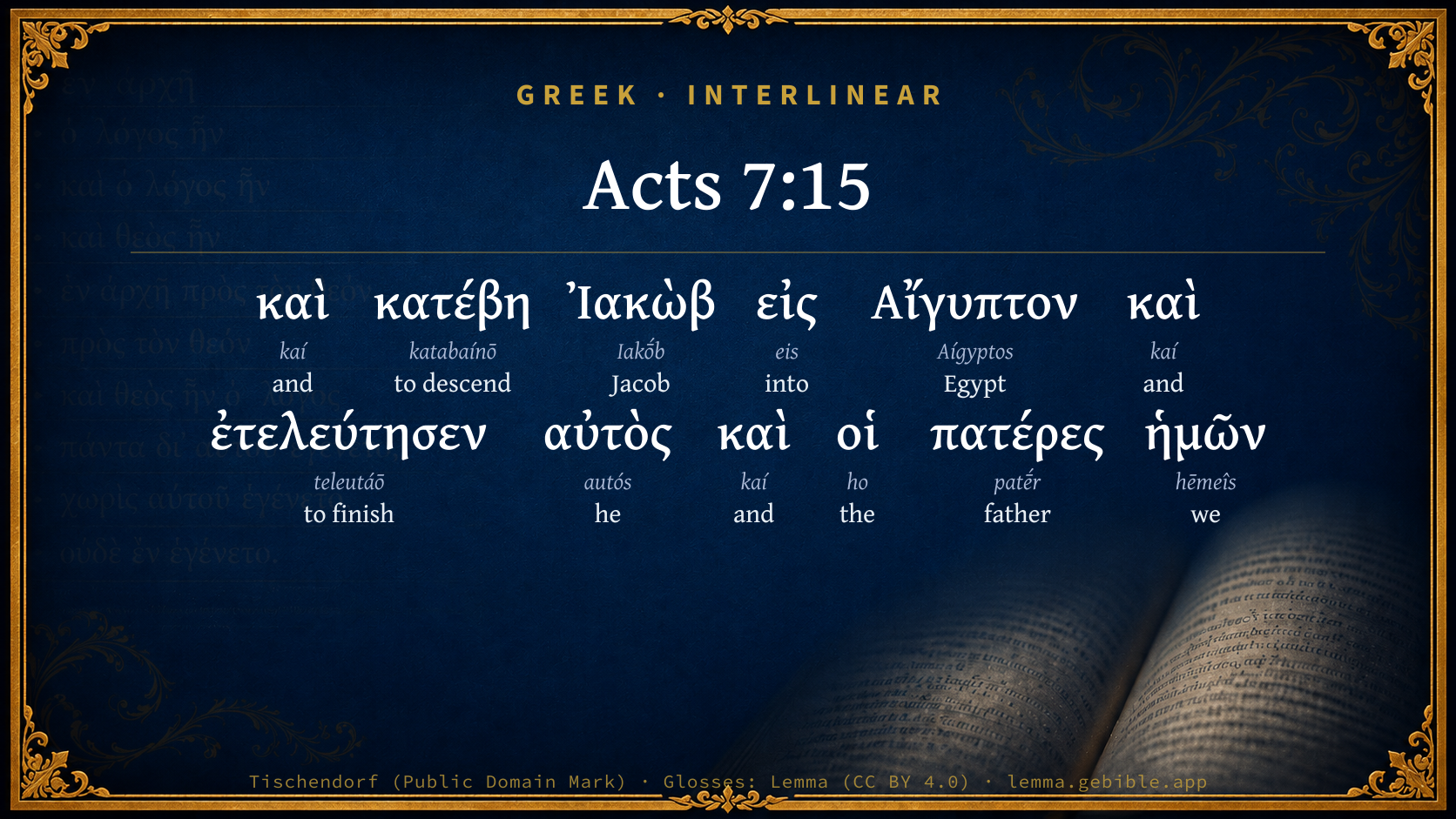
Greek (Tischendorf 8th ed.) Acts 7:15 appears in the Greek New Testament. The text above is from the Tischendorf 8th edition. Each word links to its Strong’s number and a concise gloss. Click any word for its full Thayer’s Greek Lexicon entry.
Download image
Cite this verse

Acts 7:15 (World English Bible). Public Domain. Lemma interlinear Bible study tool, https://lemma.gebible.app/v/acts/7/15.

Show BibTeX & RIS
BibTeX
RIS
English Translation
Jacob went down into Egypt, and he died, himself and our fathers,
World English Bible · Public Domain
Download a study sheet

One document with this verse’s original text, its word-by-word gloss line, the meaning frame, cross-references with their text, attributed commentary, and full source and license credits — printable, and it pastes into notes with its structure intact.

This verse Autodidact and up

Study sheet (.html) Plain text (.txt)

A passage Seminary Student

Up to 50 verses in one chapter. A passage sheet keeps up to 6 commentary sources and 12 cross-references per verse, in the order this page ranks them, and says so on the sheet whenever that leaves anything out. Ask for a single verse and you get the Autodidact verse sheet above.

Everything on this page stays free to read, with no account — the sheet is a download of what is already on screen, not access to it.

Want to remove ads? Support Godless Engineer
Compare translations 3

The same verse in 3 English versions, stacked beneath the original-language interlinear above. Click any original word for its lexicon entry.

Each is an independent rendering of the whole verse — the interlinear is not word-aligned to these translations.

Highlighted words mark where these versions differ — a whole-verse word diff, not a word-by-word alignment.

  • World English Bible Public Domain
    Jacob went down into Egypt, and he died, himself and our fathers,
  • King James Version Public Domain
    So Jacob went down into Egypt, and died, he, and our fathers,
  • unfoldingWord Literal Text CC BY-SA 4.0
    So Jacob went down to Egypt, and he and our fathers died,

unfoldingWord Literal Text — © unfoldingWord, licensed CC BY-SA 4.0. Word-aligned USFM3 via Door43 (git.door43.org/unfoldingWord/en_ult).

Versions to compare (up to 4)

3 of 4 selected

Show all 19 translations

Every available English version of this verse, each an independent rendering of the whole verse.

  • World English Bible Public Domain
    Jacob went down into Egypt, and he died, himself and our fathers,
  • Berean Standard Bible Public Domain
    So Jacob went down to Egypt, where he and our fathers died.
  • Majority Standard Bible Public Domain
    So Jacob went down to Egypt, where he and our fathers died.
  • King James Version Public Domain
    So Jacob went down into Egypt, and died, he, and our fathers,
  • American Standard Version (1901) Public Domain
    And Jacob went down into Egypt; and he died, himself and our fathers;
  • Revised Version (1885) Public Domain
    And Jacob went down into Egypt; and he died, himself, and our fathers;
  • Geneva Bible (1599) Public Domain
    So Iacob went downe into Egypt, and he dyed, and our fathers,
  • Douay-Rheims (1899) Public Domain
    So Jacob went down into Egypt; and he died, and our fathers.
  • Young's Literal Translation Public Domain
    and Jacob went down to Egypt, and died, himself and our fathers,
  • Literal Standard Version CC BY-SA 4.0
    and Jacob went down to Egypt, and died, himself and our fathers,
  • Unlocked Literal Bible CC BY-SA 4.0
    So Jacob went down into Egypt, and he died, he and our fathers.
  • unfoldingWord Literal Text CC BY-SA 4.0
    So Jacob went down to Egypt, and he and our fathers died,
  • Darby Bible Public Domain
    And Jacob went down into Egypt and died, he and our fathers,
  • World Messianic Bible Public Domain
    Jacob went down into Egypt and he died, himself and our fathers;
  • Webster's Bible Public Domain
    So Jacob went down into Egypt, and died, he, and our fathers,
  • Free Bible Version CC BY-SA 4.0
    Jacob traveled to Egypt, and died there—as did our forefathers.
  • Bible in Basic English Public Domain
    And Jacob went down to Egypt, and came to his end there, and so did our fathers;
  • Text-Critical English NT CC BY 4.0
    So Jacob went down to Egypt, and there he died, he and our fathers.
  • Tyndale New Testament (1534) Public Domain
    And Iacob descended into Egipte and dyed bothe he and oure fathers

Literal Standard Version (2020), Covenant Press — licensed CC BY-SA 4.0. Text via the HelloAO Bible API (eBible.org). Unlocked Literal Bible (unfoldingWord) — licensed CC BY-SA 4.0. Text via the HelloAO Bible API (eBible.org). unfoldingWord Literal Text — © unfoldingWord, licensed CC BY-SA 4.0. Word-aligned USFM3 via Door43 (git.door43.org/unfoldingWord/en_ult). Free Bible Version, Dr. Jonathan Gallagher — licensed CC BY-SA 4.0. Text via the HelloAO Bible API (eBible.org).

Word by word

More ways to search: Search by grammar → Find every occurrence → Compare this word →

Practice this passage: Drill this verse → Learn its vocabulary →

About this verse

These counts appear in no published source. They are computed here, from the morphology-tagged text and Lemma’s own curated glosses. What Lemma adds →

12
words
10
distinct lemmas
Acts
section

Notable vocabulary

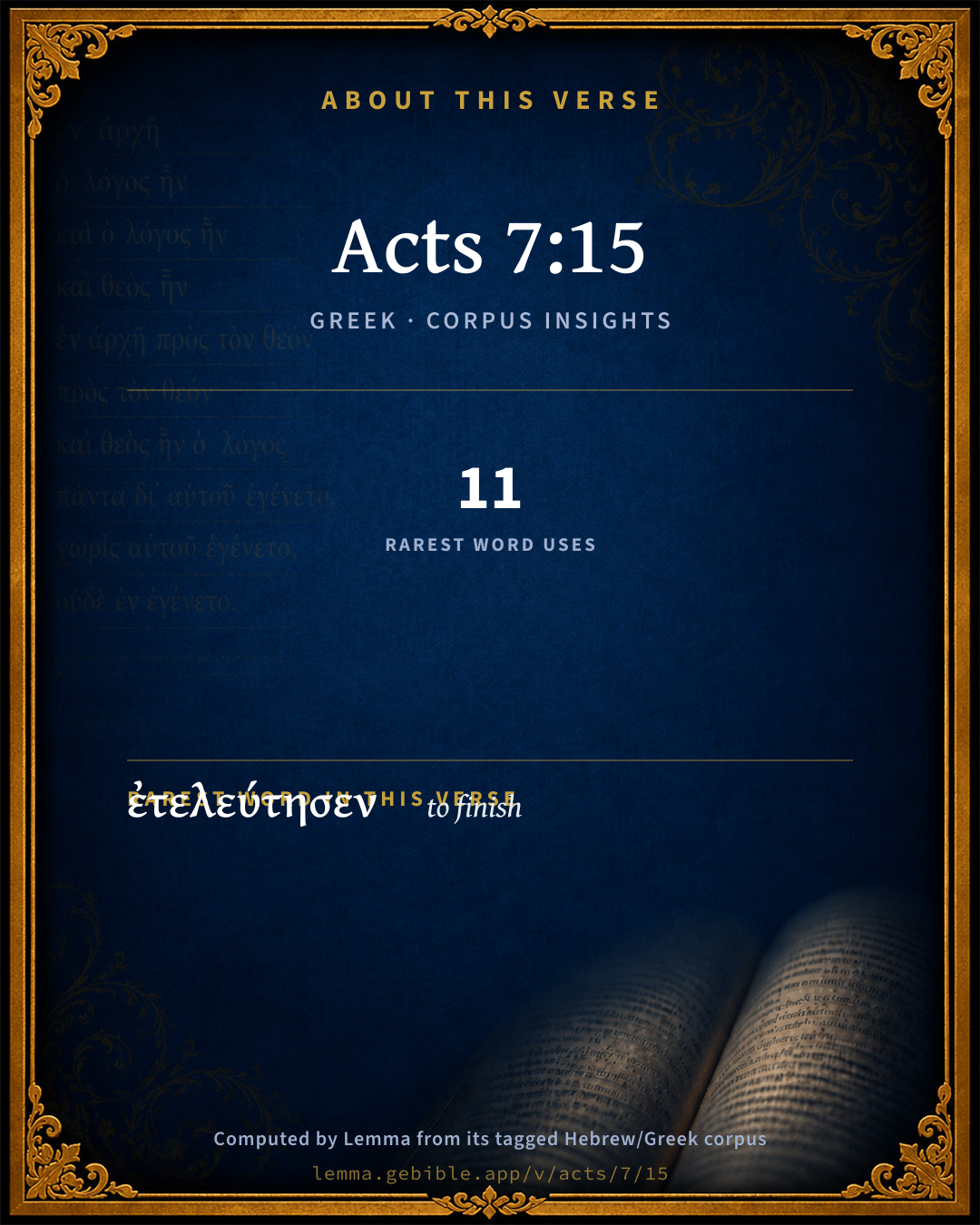
The rarest word here is ἐτελεύτησεν to finish G5053 — appearing just 11 times in the whole Greek New Testament.

Shared distinctive vocabulary

ἐτελεύτησεν to finish G5053 occurs in 11 verses of the Greek New Testament. Also found in:

Repetition

A word recurs within this verse:

Cross-references

8

Topical passages linked to Acts 7:15 in the Treasury of Scripture Knowledge — connected by theme and wording, ordered by reader-vote popularity; previews shown in the World English Bible.

  • Genesis 49:33 When Jacob made an end of charging his sons, he gathered up his feet into the bed, and yielded up the spirit, and was gathered to his people.
  • Exodus 1:6 Joseph died, as did all his brothers, and all that generation.
  • Genesis 46:3–7 He said, "I am God, the God of your father. Don't be afraid to go down into Egypt; for there I will make of you a great nation.
  • Numbers 20:15 how our fathers went down into Egypt, and we lived in Egypt a long time; and the Egyptians dealt ill with us, and our fathers:
  • Deuteronomy 10:22 Your fathers went down into Egypt with seventy persons; and now Yahweh your God has made you as the stars of the sky for multitude.
  • Deuteronomy 26:5 You shall answer and say before Yahweh your God, A Syrian ready to perish was my father; and he went down into Egypt, and sojourned there, few in number; and he became there a nation, great, mighty, and populous.
  • Joshua 24:4 I gave to Isaac Jacob and Esau: and I gave to Esau Mount Seir, to possess it: and Jacob and his children went down into Egypt.
  • Hebrews 11:21–22 By faith, Jacob, when he was dying, blessed each of the sons of Joseph, and worshiped, leaning on the top of his staff.

Cross-references courtesy of OpenBible.info (CC BY 4.0).

Commentary

Notes on Acts 7:15 from classic Christian and Jewish commentators (each source and its license shown beneath its notes). The classic Christian expositions comment on the surrounding passage and are grouped to its opening verse, so a note may address several verses; the Jewish commentaries on the Tanakh (Rashi and others) are per-verse, so they appear only where the commentator wrote on this verse.

Lemma curates 59 commentaries, every one of them public domain or Creative Commons licensed, each selected and text-cleaned for this edition rather than reprinted as found. About our sources →

Joseph Benson's Commentary

Act 7:15-16. Jacob went down into Egypt, and died — After having been supported there about seventeen years, by the filial gratitude and tenderness of his son Joseph; and our fathers — The patriarch’s children also ended their lives in the same country; and were carried over into Sychem — That is, as Jacob was immediately carried, with solemn funeral pomp and procession, to be buried in the cave of Machpelah, with Abraham and Isaac, (Gen 50:13,) so the patriarchs also, having been embalmed, and put into coffins, in Egypt, (Gen 50:26,) were, at the return of Israel from thence, carried over to Sychem, and laid in the sepulchre — Made in that field which Jacob bequeathed to Joseph, as a peculiar legacy; he having first, as Abraham had done in a like case, bought it for a sum of money, (that is, for one hundred pieces of silver,) of the sons of Emmor, the father of Sychem — From whom, in particular, the place was named; and the Amorites having afterward seized it, Jacob had by force recovered it out of their hands. See notes on Gen 48:22; Jos 24:32. It seems that St. Stephen, rapidly running over so many circumstances of history, had not leisure (nor was it needful, where they were so well known) to recite them all distinctly. Therefore he here contracts into one two different sepulchres, places, and purchases, so as, in the former history, to name the buyer, omitting the seller; in the latter, to name the seller, omitting the buyer. Abraham bought a burying-place of the children of Heth, Genesis 23. There Jacob was buried. Jacob bought a field of the children of Hamor. There Joseph was buried. You see here how St. Stephen contracts these two purchases into one. This concise manner of speaking, strange as it seems to us, was common among the Hebrews: particularly when, in a case notoriously known, the speaker mentioned but part of the story, and left the rest, which would have interrupted the current of his discourse, to be supplied in the mind of the hearer. And laid in the sepulchre that Abraham bought — The first land which these strangers bought was for a sepulchre. They sought for a country in heaven. Perhaps the whole sentence might be rendered thus: So Jacob went down into Egypt and died, he and our fathers, and were carried over into Shechem, and laid by the sons [that is, descendants] of Hamor, the father of Shechem, in the sepulchre that Abraham bought for a sum of money. So Bengelius and Wesley.

Joseph Benson's Commentary on the Old and New Testaments (1811–1818) — public domain. Text from a community e-Sword module.

Expositor's Greek Testament

ed. W. Robertson Nicoll

Act 7:15 . The frequent mention of Egypt may perhaps indicate that Stephen meant to emphasise the fact that there, far away from the land of promise, God’s Presence was with the chosen race (who were now all in a strange land) and His worship was observed. μετετέθησαν : only here in this sense in N.T. Some have supposed that only οἱ πατέρες and not αὐτός is the subject; this would no doubt avoid the first difficulty of the verse, viz. , that Jacob was buried in Shechem, whereas according to Gen 50:13 he was laid to rest in the cave of Machpelah. But a further difficulty must be met. Joseph is the only son of the Patriarch who is expressly stated to have been buried in Shechem, Jos 24:32 , and of the removal of the bodies from Egypt nothing is said. But the silence as to the latter fact need not trouble us, as whether we accept the tradition mentioned by Josephus or by St. Jerome, they both presuppose the removal of the bodies of the Patriarchs to the promised land, cf. the discussion on Exo 13:19 . Mechilta (Lumby, p. 164), Wetstein, in loco , and see also the tradition in the Book of Jubilees , chap. xlvi., that the children carried up the bones of the sons of Jacob, and buried them in Machpelah, except those of Joseph. But another tradition is implied in Sot. 7 b . According to Josephus, who probably repeats a local tradition, Ant. , ii., 8, 2, they were buried at Hebron. But according to St. Jerome their tombs were shown at Shechem, and the Rabbinical tradition mentioned by Wetstein and Lightfoot places their burial there, a statement supported by a Samaritan tradition existing to this day ( Palestine Exploration Fund , December, 1877, see Felten and Plumptre, in loco ). When we consider the prominent position of Shechem as compared with Hebron in the time of Joshua, there is nothing strange in the fact that the former place rather than Machpelah should have been chosen as the resting-place not only of Joseph but also of his brethren. Plumptre has ingeniously contended that St. Stephen might have followed the Samaritan tradition, cf. Act 6:5 , and see Expositor , vol. vii., first series: “The Samaritan element in the Gospels and Acts,” p. 21 ff., although we need not suppose that in this reference to the hated Samaritans Stephen proposed to show that not even they had been rejected by God. There is certainly no difficulty in supposing that here and elsewhere Stephen might easily have adopted some popular tradition, and at all events the fact that the mistake, if it is one, is left unnoticed by the historian is a plain proof of the truthfulness of the record. But a further difficulty. Abraham purchases the cave of Machpelah, but from Ephron the Hittite, Gen 23:16 . The sons of Hamor sell a field, but to Jacob a field at Shechem, Gen 33:19 , Jos 24:32 . How can we explain this with reference to the statement in the text? Shechem was the earliest settlement of Abraham when he entered Canaan, and there he built an altar, Gen 12:6-7 . But no devout Hebrew worshipper, with all his reverence for holy places, would be content to see the altar so consecrated belonging to others, and so exposed to desecration; the purchase of the ground on which an altar stood would therefore seem to follow as a kind of corollary from the erection of an altar on that ground. This is at all events a more satisfactory solution than omitting the word Ἀβραάμ or exchanging it for Ἰακώβ (see Hackett). Of course the reading of R.V., W.H [200] (as above), prevents a further difficulty as to the rendering of τοῦ Συχέμ if the reading τοῦ Συχέμ is retained, cf. Wendt, critical note, p. 157 (edition 1899), who follows A.V. in supporting “the father of Sichem,” so Hackett, but see on the other hand Plumptre, Acts, in loco , and Felten, in loco . For the way in which the two purchases and the two burials may have been confused in popular tradition, see Zöckler, Apostelgeschichte , p. 302, 2nd edit. ( cf. Bengel, Stier, Nösgen).

[200] Westcott and Hort’s The New Testament in Greek: Critical Text and Notes.

The Expositor's Greek Testament, edited by W. Robertson Nicoll (1897–1910) — public domain. Text from a community e-Sword module.

The Cambridge Bible for Schools and Colleges

gen. ed. J. J. S. Perowne

15. So Jacob went down into Egypt] Now the whole race whom God had chosen to Himself was in Egypt, away from the land of promise, and remained there for a long period, yet God was with them in their exile, and His worship was preserved for the whole time. This seems the point which Stephen desires to emphasize by so frequent a repetition of the words “into Egypt.”

and died, he, and our fathers] Better, and he died, himself, and our fathers. Of the transportation of the bodies of the patriarchs to Canaan we have no record in Holy Writ. Josephus (Antiq. ii. 8. 2) says “the posterity and sons of these men, after some time, carried their bodies and buried them at Hebron.” In the discussion of Exo_13:19, Carry up my bones away hence with you, it is said (Mechilta, ed. Weiss, 1865, Vienna, 8vo p. 30) that the bodies of the patriarchs were carried out of Egypt with the returning Israelites, and it is argued that this is implied in the expression with you, which Moses quotes as uttered by Joseph, who must have known that his brethren to whom he was speaking would all be dead before the Exodus. Therefore with you could only be used if their bodies were to be transported as well as his own.

The Cambridge Bible for Schools and Colleges (gen. ed. J. J. S. Perowne; Cambridge University Press, 1878–1918) — public domain. Text from a community e-Sword module.

John Gill's Exposition

So Jacob went down into Egypt,.... At the invitation of his son Joseph:

and died, he, and our fathers; both Jacob and his twelve sons died in Egypt, though we have no account of the death of any of them, but Jacob and Joseph, particularly; only in general, that Joseph died, and all his brethren, and all that generation, Gen 49:33 Exo 1:6 the Syriac version adds "there", that is, in Egypt.

John Gill's Exposition of the Whole Bible (1746–1763) — public domain (CC PDM 1.0). Text via the HelloAO Bible API.

Albert Barnes' Notes on the Bible

And died - Gen 49:33.

He and our fathers - The time which the Israelites remained in Egypt was 215 years, so that all the sons of Jacob were deceased before the Jews went out to go to the land of Canaan.

And were carried over - Jacob himself was buried in the field of Macpelah by Joseph and his brethren, Gen. 1, 13. It is expressly said that the bones of Joseph were carried by the Israelites when they went into the land of Canaan, and buried in Shechem, Jos 24:32; compare Gen 50:25. No mention is made in the Old Testament of their carrying the bones of any of the other patriarchs, but the thing is highly probable in itself. If the descendants of Joseph carried his bones, it would naturally occur to them to take also the bones of each of the patriarchs, and give them an honorable sepulchre together in the land of promise. Josephus (Antiq., book 2, chapter 8, section 2) says that “the posterity and sons of these men (of the brethren of Joseph), after some time, carried their bodies and buried them in Hebron; but as to the bones of Joseph, they carried them into the land of Canaan afterward, when the Hebrews went out of Egypt.” This is in accordance with the common opinion of the Jewish writers, that they were buried in Hebron. Yet the tradition is not uniform. Some of the Jews affirm that they were buried in Sychem (Kuinoel). As the Scriptures do not anywhere deny that the patriarchs were buried in Sychem, it cannot be proved that Stephen was in error. There is one circumstance of strong probability to show that he was correct. At the time when this defense was delivered, “Sychem” was in the hands of the Samaritans, between whom and the Jews there was a violent hostility. Of course, the Jews would not be willing to concede that the Samaritans had the bones of their ancestors, and hence, perhaps the opinion had been maintained that they were buried in Hebron.

Into Sychem - This was a town or village near to Samaria. It was called Sichar (see the notes on Joh 4:5), “Shechem,” and “Sychem.” It is now called “Naplous” or “Napolose,” and is ten miles from Shiloh, and about forty from Jerusalem, toward the north.

That Abraham bought - The word “Abraham” here has given rise to considerable perplexity, and it is now pretty generally conceded that it is a mistake. It is certain, from Gen 33:19 and Jos 24:32, that this piece of land was bought, not by Abraham, but by “Jacob,” of the sons of Hamor, the father of Shechem. The land which “Abraham” purchased was the cave of Macpelah, of the sons of Heth, in Hebron, Gen. 23. Various solutions have been proposed of this difficulty, which it is not necessary to detail. It may be remarked, however:

That as the text now stands, it is an evident error. This is clear from the passages cited from the Old Testament above.

(2)It is not at all probable that either Stephen or Luke would have committed such an error. Every consideration must lead us to the conclusion that they were too well acquainted with such prominent points of the Jewish history to commit an error like this.

(3)The “probability,” therefore, is, that the error has arisen since; but how, is not known, nor is there any way of ascertaining. All the ancient versions agree in reading “Abraham.” Only one manuscript reads “Abraham our father.” Some have supposed, therefore, that it was written “which our father bought,” and that some early transcriber inserted the name of Abraham. Others, that the name was omitted entirely by Stephen; and then the antecedent to the verb “bought” will be “Jacob,” in verse 15, according with the fact. Other modes have been proposed also, but none are entirely satisfactory. If there was positive proof of Stephen’s inspiration, or if it were necessary to make that out, the difficulty would be much greater. But it has already been remarked that there is no decisive evidence of that, and it is not necessary to make out that point to defend the Scriptures. All that can be demanded of the historian is, that he should give a fair account of the defense as it was delivered; and though the probability is that Stephen would not commit Such an error, yet, admitting that he did, it by no means proves that “Luke” was not inspired, or that Luke has committed any error in recording “what was actually said.”

Of the sons of Emmor - In the Hebrew Gen 33:19, “the children of Hamor” - but different ways of rendering the same word.

Albert Barnes' Notes on the Bible (1834–1885) — public domain. Text from a community e-Sword/MySword module.

Matthew Poole's English Annotations

Which St. Stephen puts them in mind of the rather, that he might insinuate, no country, nor place, nor temple, were so necessary, but that (notwithstanding they had none of them) their forefathers did live and die in the fear and favour of God, although in Egypt, out of the Promised Land, &c.

Matthew Poole's English Annotations on the Holy Bible (1683–1685) — public domain. Text from a community e-Sword/MySword module.

Whedon's Commentary on the Bible

Daniel D. Whedon

15. When they were come down—We do not, with Dr. Goulburn, (Acts of the Deacons,) extol Philip’s modesty in now standing in the background. Philip held the apostles as much his superiors here as in Jerusalem; and the apostles came with the same spirit of wise and holy supervision as they exerted in first establishing the deaconship.

Prayed for them—The apostles seemed to think that praying was better than criticism. Rather than be too ready at exercising their own authority, they sought the decision of the Lord Jesus Christ.

Daniel D. Whedon (gen. ed.), Commentary on the Old and New Testaments (1874–1909) — public domain. Text from a community e-Sword module.

The Pulpit Commentary

And for so, A.V.; he died, himself for died, he, A.V.

The Pulpit Commentary (1880–1919), ed. H.D.M. Spence-Jones & Joseph S. Exell — public domain. Text from a community e-Sword module.

McGarvey & Pendleton's Commentaries

J. W. McGarvey

See notes on verse 9

J. W. McGarvey (with Philip Y. Pendleton), Commentaries on the New Testament (The Fourfold Gospel, 1914; Acts; and the epistles) — public domain. Text from a community e-Sword/MySword module.

Cambridge Greek Testament for Schools and Colleges

15. καὶ κατέβη with אACEP.

15. καὶ κατέβη Ἰακώβ, and Jacob went down. Now the whole race whom God had chosen to himself was in Egypt, away from the land of promise, and remained there for a long period, yet God was with them in their exile, and His worship was preserved for the whole time. This seems the point which Stephen desires to emphasize by so frequent a repetition of the words ‘into Egypt.’

καὶ ἐτελεύτησεν αὐτὸς κ. ο. π. ἡ., and he died, himself, and our fathers. Of the transportation of the bodies of the patriarchs to Canaan we have no record in Holy Writ. Josephus (Ant. II. 8. 2) says ‘the posterity and sons of these men, after some time, carried their bodies and buried them at Hebron.’ In the discussion of Exo 13:19 Carry up my bones away hence with you, it is said (Mechilta, ed. Weiss, 1865, Vienna, 8vo. p. 30) that the bodies of the patriarchs were carried out of Egypt with the returning Israelites, and it is argued that this is implied in the expression with you, which Moses quotes as uttered by Joseph, who must have known that his brethren to whom he was speaking would all be dead before the exodus. Therefore with you could only be used if their bodies were to be transported as well as his own.

Cambridge Greek Testament for Schools and Colleges (Cambridge University Press, 1896; 21 vols, various authors incl. Carr, Maclear, Plummer, Farrar, Lumby, Moule, M. R. James, Simcox) — public domain. Text from a community e-Sword module.

Lesson kit

Teaching starters — assembled from the data on this page, not authored interpretation. Every prompt links to the verse data it draws on. Edit before teaching.

Acts, in the Acts, opens this verse with 12 words (10 distinct Greek lemmas). Its most distinctive word is teleutáō (“to finish”). A historical commentator’s framing appears above. Read the whole chapter for the surrounding context.

Discussion questions

  1. How does “to finish” (teleutáō) shape what this verse is saying?
  2. Matthew 2:19 shares the word «to finish» with this verse. How do the two illuminate each other?
  3. “and” occurs 3× in this one verse. What is the effect of the repetition?
  4. These translations render this verse differently. What is at stake in choosing one wording over another?
  5. Reading how Joseph Benson's Commentary and Expositor's Greek Testament read this verse, where do the two commentators agree and where do they part?

Things to notice

Reading settings

Reading text

Shown beneath each verse's original-language words.

Old Testament
Old Testament edition

Read the OT as the Masoretic Hebrew (MT) or the Greek Septuagint (LXX).

English shown for the Greek Septuagint (in the Hebrew ↔ Greek comparison).

Comparing translations? Open the Compare panel on any verse page to stack up to four side by side.