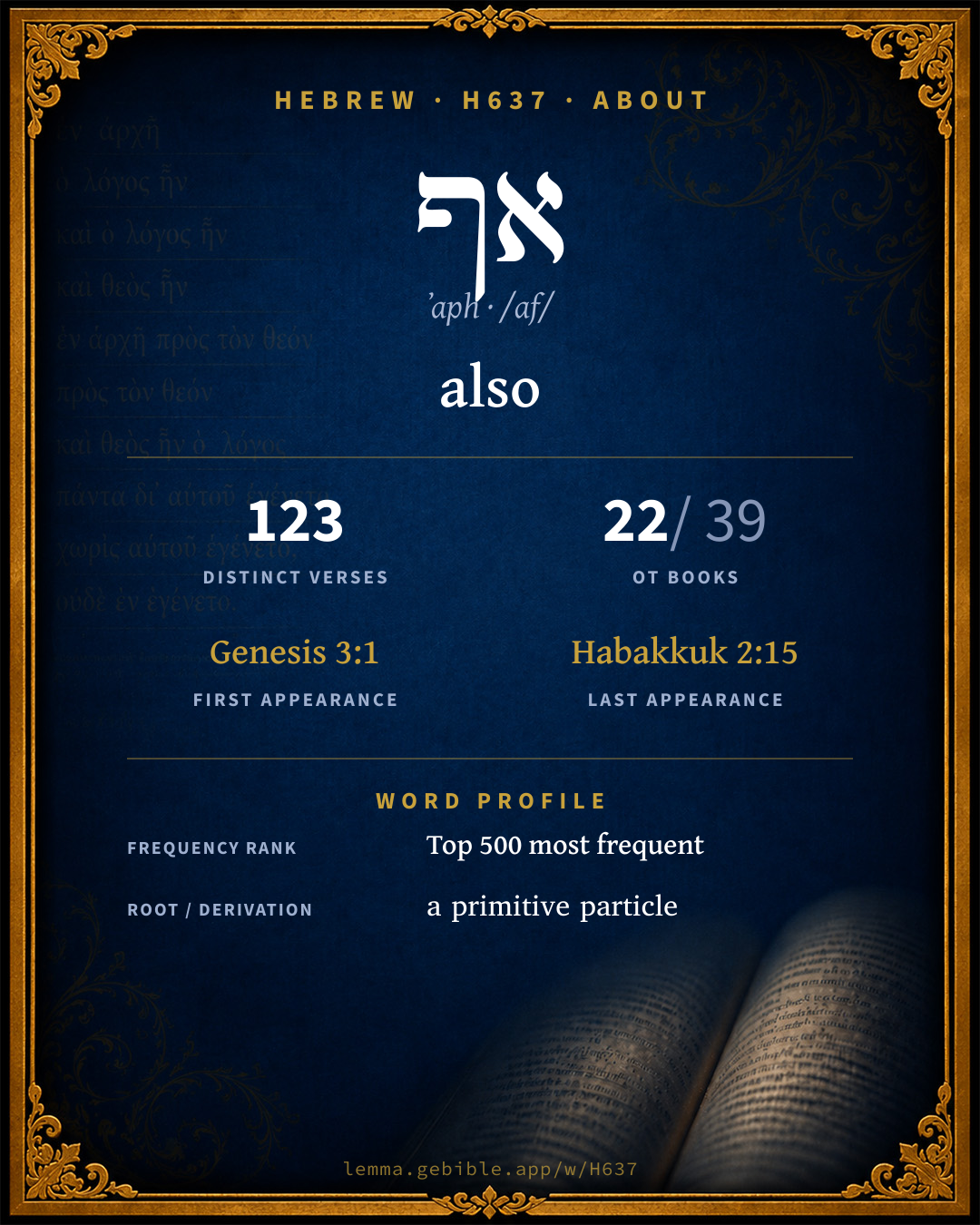
אַף
also
also: yea, though fuller range ↓
Full lexicon entry — Brown-Driver-Briggs (BDB)
From Brown-Driver-Briggs (BDB)
Where this word appears
Grammar key — what these labels mean
Part of speech
- Particle
- A short function word — article, negation, interrogative, the sign of the direct object, and the like.
Grammatical forms
- Particle, Accusative 106 times (79%)
- Adverb 28 times (21%)
Parsed forms decoded from the imported morphology (morphhb / Westminster Leningrad Codex — WLC text public domain, morphhb tagging CC BY 4.0), counted across 134 parsed occurrences — not distinct verses.
Every verse where H637 appears — 123 distinct verses across 22 books. Click any verse to open its interlinear word-by-word view. Verse text shown in the World English Bible for context — . Each verse’s Hebrew form is shown with its reference; the English is not keyword-highlighted, since the data carries no word-level English alignment. Use “Compare translations” on any verse to read it across multiple English versions. This concordance covers the Hebrew Bible; Septuagint (Greek Old Testament) occurrences are not indexed here.
Genesis 5 verses
- Genesis 3:1 אַ֚ף ptcl acc Now the serpent was more subtle than any animal of the field which Yahweh God had made. He said to the woman, "Yes, has God said, 'You shall not eat of any tree of the garden?'"
- Genesis 18:13 הַ/אַ֥ף ptcl inter + adv Yahweh said to Abraham, "Why did Sarah laugh, saying, 'Will I really bear a child, yet I am old?'
- Genesis 18:23 הַ/אַ֣ף ptcl inter + adv Abraham drew near, and said, "Will you consume the righteous with the wicked?
- Genesis 18:24 הַ/אַ֤ף ptcl inter + adv What if there are fifty righteous within the city? Will you consume and not spare the place for the fifty righteous who are therein?
- Genesis 40:16 אַף ptcl acc When the chief baker saw that the interpretation was good, he said to Joseph, "I also was in my dream, and, behold, three baskets of white bread were on my head.
Leviticus 8 verses
- Leviticus 26:16 אַף ptcl acc I also will do this to you: I will appoint terror over you, even consumption and fever, that shall consume the eyes, and make the soul to pine away; and you will sow your seed in vain, for your enemies will eat it.
- Leviticus 26:24 אַף ptcl acc then I will also walk contrary to you; and I will strike you, even I, seven times for your sins.
- Leviticus 26:28 אַף ptcl acc then I will walk contrary to you in wrath; and I also will chastise you seven times for your sins.
- Leviticus 26:39 וְ/אַ֛ף conj + adv Those of you who are left will pine away in their iniquity in your enemies' lands; and also in the iniquities of their fathers shall they pine away with them.
- Leviticus 26:40 וְ/אַ֕ף conj + adv "'If they confess their iniquity, and the iniquity of their fathers, in their trespass which they trespassed against me, and also that, because they walked contrary to me,
- Leviticus 26:41 אַף ptcl acc I also walked contrary to them, and brought them into the land of their enemies: if then their uncircumcised heart is humbled, and they then accept the punishment of their iniquity;
- Leviticus 26:42 וְ/אַף֩ וְ/אַ֨ף conj + adv conj + adv then I will remember my covenant with Jacob; and also my covenant with Isaac, and also my covenant with Abraham; and I will remember the land.
- Leviticus 26:44 וְ/אַף conj + adv Yet for all that, when they are in the land of their enemies, I will not reject them, neither will I abhor them, to destroy them utterly, and to break my covenant with them; for I am Yahweh their God;
Numbers 1 verse
Deuteronomy 7 verses
- Deuteronomy 2:11 אַף ptcl acc these also are accounted Rephaim, as the Anakim; but the Moabites call them Emim.
- Deuteronomy 2:20 אַף ptcl acc (That also is accounted a land of Rephaim: Rephaim lived therein before; but the Ammonites call them Zamzummim,
- Deuteronomy 15:17 וְ/אַ֥ף conj + adv then you shall take an awl, and thrust it through his ear to the door, and he shall be your servant forever. Also to your maid-servant you shall do likewise.
- Deuteronomy 31:27 וְ/אַ֖ף conj + adv For I know your rebellion, and your stiff neck: behold, while I am yet alive with you this day, you have been rebellious against Yahweh; and how much more after my death?
- Deuteronomy 33:3 אַ֚ף ptcl acc Yes, he loves the people; All his saints are in your hand: They sat down at your feet; [Everyone] shall receive of your words.
- Deuteronomy 33:20 אַף ptcl acc Of Gad he said, Blessed be he who enlarges Gad: He dwells as a lioness, Tears the arm, yes, the crown of the head.
- Deuteronomy 33:28 אַף ptcl acc Israel dwells in safety, The fountain of Jacob alone, In a land of grain and new wine; Yes, his heavens drop down dew.
Judges 1 verse
1 Samuel 4 verses
- 1 Samuel 2:7 אַף ptcl acc Yahweh makes poor, and makes rich: He brings low, he also lifts up.
- 1 Samuel 14:30 אַ֗ף ptcl acc How much more, if haply the people had eaten freely today of the spoil of their enemies which they found? for now has there been no great slaughter among the Philistines.
- 1 Samuel 21:5 וְ/אַ֕ף conj + adv David answered the priest, and said to him, Of a truth women have been kept from us about these three days; when I came out, the vessels of the young men were holy, though it was but a common journey; how much more then today shall their vessels be holy?
- 1 Samuel 23:3 וְ/אַף֙ conj + adv David's men said to him, Behold, we are afraid here in Judah: how much more then if we go to Keilah against the armies of the Philistines?
2 Samuel 3 verses
- 2 Samuel 4:11 אַ֞ף ptcl acc How much more, when wicked men have slain a righteous person in his own house on his bed, shall I not now require his blood of your hand, and take you away from the earth?
- 2 Samuel 16:11 וְ/אַ֨ף conj + adv David said to Abishai, and to all his servants, Behold, my son, who came forth from my bowels, seeks my life: how much more [may] this Benjamite now [do it]? let him alone, and let him curse; for Yahweh has invited him.
- 2 Samuel 20:14 אַף ptcl acc He went through all the tribes of Israel to Abel, and to Beth Maacah, and all the Berites: and they were gathered together, and went also after him.
1 Kings 1 verse
2 Kings 2 verses
- 2 Kings 2:14 אַף ptcl acc He took the mantle of Elijah that fell from him, and struck the waters, and said, Where is Yahweh, the God of Elijah? and when he also had struck the waters, they were divided here and there; and Elisha went over.
- 2 Kings 5:13 וְ/אַ֛ף conj + adv His servants came near, and spoke to him, and said, My father, if the prophet had bid you do some great thing, wouldn't you have done it? how much rather then, when he says to you, Wash, and be clean?
1 Chronicles 3 verses
- 1 Chronicles 8:32 וְ/אַף conj + adv Mikloth became the father of Shimeah. They also lived with their brothers in Jerusalem, over against their brothers.
- 1 Chronicles 9:38 וְ/אַף conj + adv Mikloth became the father of Shimeam. They also lived with their brothers in Jerusalem, over against their brothers.
- 1 Chronicles 16:30 אַף ptcl acc Tremble before him, all the earth: The world also is established that it can't be moved.
2 Chronicles 3 verses
- 2 Chronicles 6:18 אַ֕ף ptcl acc But will God in very deed dwell with men on the earth? behold, heaven and the heaven of heavens can't contain you; how much less this house which I have built!
- 2 Chronicles 12:5 וְ/אַף conj + adv Now Shemaiah the prophet came to Rehoboam, and to the princes of Judah, who were gathered together to Jerusalem because of Shishak, and said to them, Thus says Yahweh, You have forsaken me, therefore have I also left you in the hand of Shishak.
- 2 Chronicles 32:15 אַ֚ף ptcl acc Now therefore don't let Hezekiah deceive you, nor persuade you after this manner, neither believe you him; for no god of any nation or kingdom was able to deliver his people out of my hand, and out of the hand of my fathers: how much less shall your God deliver you out of my hand?
Nehemiah 3 verses
- Nehemiah 2:18 וְ/אַף conj + adv I told them of the hand of my God which was good on me, as also of the king's words that he had spoken to me. They said, Let us rise up and build. So they strengthened their hands for the good [work].
- Nehemiah 9:18 אַ֗ף ptcl acc Yes, when they had made them a molten calf, and said, This is your God who brought you up out of Egypt, and had committed awful blasphemies;
- Nehemiah 13:15 וְ/אַף conj + adv In those days saw I in Judah some men treading wine-presses on the Sabbath, and bringing in sheaves, and lading donkeys [therewith]; as also wine, grapes, and figs, and all manner of burdens, which they brought into Jerusalem on the Sabbath day: and I testified [against them] in the day in which they sold food.
Esther 1 verse
Job 19 verses
- Job 4:19 אַ֤ף ptcl acc How much more, those who dwell in houses of clay, Whose foundation is in the dust, Who are crushed before the moth!
- Job 6:27 אַף ptcl acc Yes, you would even cast lots for the fatherless, And make merchandise of your friend.
- Job 9:14 אַ֭ף ptcl acc How much less shall I answer him, Choose my words to argue with him?
- Job 14:3 אַף ptcl acc Do you open your eyes on such a one, And bring me into judgment with you?
- Job 15:4 אַף ptcl acc Yes, you do away with fear, And hinder devotion before God.
- Job 15:16 אַ֭ף ptcl acc How much less one who is abominable and corrupt, A man who drinks iniquity like water!
- Job 19:4 וְ/אַף conj + adv If it is true that I have erred, My error remains with myself.
- Job 25:6 אַ֭ף ptcl acc How much less man, who is a worm! The son of man, who is a worm!"
- Job 32:10 אַף ptcl acc Therefore I said, 'Listen to me; I also will show my opinion.'
- Job 32:17 אַף אַף ptcl acc ptcl acc I also will answer my part, And I also will show my opinion.
- Job 34:12 אַף ptcl acc Yes surely, God will not do wickedly, Neither will the Almighty pervert justice.
- Job 34:17 הַ/אַ֬ף ptcl inter + adv Shall even one who hates justice govern? Will you condemn him who is righteous and mighty?--
- Job 35:14 אַ֣ף ptcl acc How much less when you say you don't see him. The cause is before him, and you wait for him!
- Job 36:16 וְ/אַ֤ף conj + adv Yes, he would have allured you out of distress, Into a broad place, where there is no restriction. That which is set on your table would be full of fatness.
- Job 36:29 אַ֣ף ptcl acc Yes, can any understand the spreading of the clouds, And the thunderings of his pavilion?
- Job 36:33 אַ֣ף ptcl acc The noise of it tells about him, And the cattle also concerning the storm that comes up.
- Job 37:1 אַף ptcl acc "Yes, at this my heart trembles, And is moved out of its place.
- Job 37:11 אַף ptcl acc Yes, he loads the thick cloud with moisture. He spreads abroad the cloud of his lightning.
- Job 40:8 הַ֭/אַף ptcl inter + adv Will you even annul my judgment? Will you condemn me, that you may be justified?
Psalms 23 verses
- Psalms 16:6 אַף ptcl acc The lines have fallen to me in pleasant places. Yes, I have a good inheritance.
- Psalms 16:7 אַף ptcl acc I will bless Yahweh, who has given me counsel. Yes, my heart instructs me in the night seasons.
- Psalms 16:9 אַף ptcl acc Therefore my heart is glad, and my tongue rejoices. My body shall also dwell in safety.
- Psalms 18:48 אַ֣ף ptcl acc He rescues me from my enemies. Yes, you lift me up above those who rise up against me. You deliver me from the violent man.
- Psalms 44:9 אַף ptcl acc But now you rejected us, and brought us to dishonor, And don't go out with our armies.
- Psalms 58:2 אַף ptcl acc No, in your heart you plot injustice. You measure out the violence of your hands in the earth.
- Psalms 65:13 אַף ptcl acc The pastures are covered with flocks. The valleys also are clothed with grain. They shout for joy! They also sing.
- Psalms 68:8 אַף ptcl acc The earth trembled. The sky also poured down rain at the presence of the God of Sinai-- At the presence of God, the God of Israel.
- Psalms 68:16 אַף ptcl acc Why do you look in envy, you rugged mountains, At the mountain where God chooses to reign? Yes, Yahweh will dwell there forever.
- Psalms 68:18 וְ/אַ֥ף conj + adv You have ascended on high. You have led away captives. You have received gifts among men, Yes, among the rebellious also, that Yah God might dwell there.
- Psalms 74:16 אַף ptcl acc The day is yours, the night is also yours. You have prepared the light and the sun.
- Psalms 77:16 אַ֝֗ף ptcl acc The waters saw you, God. The waters saw you, and they writhed. The depths also convulsed.
- Psalms 77:17 אַף ptcl acc The clouds poured out water. The skies resounded with thunder. Your arrows also flashed around.
- Psalms 89:5 אַף ptcl acc The heavens will praise your wonders, Yahweh; Your faithfulness also in the assembly of the holy ones.
- Psalms 89:11 אַף ptcl acc The heavens are yours. The earth also is yours; The world and its fullness. You have founded them.
- Psalms 89:21 אַף ptcl acc With whom my hand shall be established. My arm will also strengthen him.
- Psalms 89:27 אַף ptcl acc I will also appoint him my firstborn, The highest of the kings of the earth.
- Psalms 89:43 אַף ptcl acc Yes, you turn back the edge of his sword, And haven't supported him in battle.
- Psalms 93:1 אַף ptcl acc Yahweh reigns! He is clothed with majesty! Yahweh is armed with strength. The world also is established. It can't be moved.
- Psalms 96:10 אַף ptcl acc Say among the nations, "Yahweh reigns." The world is also established. It can't be moved. He will judge the peoples with equity.
- Psalms 108:1 אַף ptcl acc My heart is steadfast, God. I will sing and I will make music with my soul.
- Psalms 119:3 אַ֭ף ptcl acc Yes, they do nothing wrong. They walk in his ways.
- Psalms 135:17 אַ֝֗ף ptcl acc They have ears, but they can't hear; Neither is there any breath in their mouths.
Proverbs 9 verses
- Proverbs 9:2 אַ֝֗ף ptcl acc She has prepared her meat. She has mixed her wine. She has also set her table.
- Proverbs 11:31 אַ֝֗ף ptcl acc Behold, the righteous shall be repaid in the earth; How much more the wicked and the sinner!
- Proverbs 15:11 אַ֝֗ף ptcl acc Sheol and Abaddon are before Yahweh-- How much more then the hearts of the children of men!
- Proverbs 17:7 אַ֝֗ף ptcl acc Arrogant speech isn't fitting for a fool, Much less do lying lips fit a prince.
- Proverbs 19:7 אַ֤ף ptcl acc All the relatives of the poor shun him: How much more do his friends avoid him! He pursues them with pleas, but they are gone.
- Proverbs 19:10 אַ֝֗ף ptcl acc Delicate living is not appropriate for a fool, Much less for a servant to have rule over princes.
- Proverbs 21:27 אַ֝֗ף ptcl acc The sacrifice of the wicked is an abomination: How much more, when he brings it with a wicked mind!
- Proverbs 22:19 אַף ptcl acc That your trust may be in Yahweh, I teach you today, even you.
- Proverbs 23:28 אַף ptcl acc Yes, she lies in wait like a robber, And increases the unfaithful among men.
Ecclesiastes 1 verse
Song of Solomon 1 verse
Isaiah 22 verses
- Isaiah 26:8 אַ֣ף ptcl acc Yes, in the way of your judgments, Yahweh, have we waited for you; to your name, even to your memorial [name], is the desire of our soul.
- Isaiah 26:9 אַף ptcl acc With my soul have I desired you in the night; yes, with my spirit within me will I seek you earnestly: for when your judgments are in the earth, the inhabitants of the world learn righteousness.
- Isaiah 26:11 אַף ptcl acc Yahweh, your hand is lifted up, yet they don't see: but they shall see [your] zeal for the people, and be disappointed; yes, fire shall devour your adversaries.
- Isaiah 33:2 אַף ptcl acc Yahweh, be gracious to us; we have waited for you: be our arm every morning, our salvation also in the time of trouble.
- Isaiah 35:2 אַ֚ף ptcl acc It shall blossom abundantly, and rejoice even with joy and singing; the glory of Lebanon shall be given to it, the excellency of Carmel and Sharon: they shall see the glory of Yahweh, the excellency of our God.
- Isaiah 40:24 אַ֣ף אַ֚ף אַ֛ף ptcl acc ptcl acc ptcl acc Yes, they have not been planted; yes, they have not been sown; yes, their stock has not taken root in the earth: moreover he blows on them, and they wither, and the whirlwind takes them away as stubble.
- Isaiah 41:10 אַף אַף ptcl acc ptcl acc Don't you be afraid, for I am with you; don't be dismayed, for I am your God; I will strengthen you; yes, I will help you; yes, I will uphold you with the right hand of my righteousness.
- Isaiah 41:23 אַף ptcl acc Declare the things that are to come hereafter, that we may know that you are gods: yes, do good, or do evil, that we may be dismayed, and see it together.
- Isaiah 41:26 אַ֣ף אַ֚ף אַ֥ף ptcl acc ptcl acc ptcl acc Who has declared it from the beginning, that we may know? and before, that we may say, [He is] right? yes, there is none who declares, yes, there is none who shows, yes, there is none who hears your words.
- Isaiah 42:13 אַף ptcl acc Yahweh will go forth as a mighty man; he will stir up [his] zeal like a man of war: he will cry, yes, he will shout aloud; he will do mightily against his enemies.
- Isaiah 43:7 אַף ptcl acc everyone who is called by my name, and whom I have created for my glory, whom I have formed, yes, whom I have made.
- Isaiah 43:19 אַ֣ף ptcl acc Behold, I will do a new thing; now shall it spring forth; shall you not know it? I will even make a way in the wilderness, and rivers in the desert.
- Isaiah 44:15 אַף אַף ptcl acc ptcl acc Then shall it be for a man to burn; and he takes of it, and warms himself; yes, he kindles it, and bakes bread: yes, he makes a god, and worships it; he makes it an engraved image, and falls down to it.
- Isaiah 44:16 אַף ptcl acc He burns part of it in the fire; with part of it he eats flesh; he roasts roast, and is satisfied; yes, he warms himself, and says, Aha, I am warm, I have seen the fire.
- Isaiah 44:19 וְ֠/אַף conj + adv None calls to mind, neither is there knowledge nor understanding to say, I have burned part of it in the fire; yes, also I have baked bread on the coals of it; I have roasted flesh and eaten it: and shall I make the residue of it an abomination? shall I fall down to the stock of a tree?
- Isaiah 45:21 אַ֥ף ptcl acc Declare you, and bring [it] forth; yes, let them take counsel together: who has shown this from ancient time? who has declared it of old? Haven't I, Yahweh? and there is no God else besides me, a just God and a Savior; there is no one besides me.
- Isaiah 46:6 אַף ptcl acc Some pour out gold from the bag, and weigh silver in the balance. They hire a goldsmith, and he makes it a god. They fall down--yes, they worship.
- Isaiah 46:7 אַף ptcl acc They bear it on the shoulder, they carry it, and set it in its place, and it stands, from its place it shall not move: yes, one may cry to it, yet it can not answer, nor save him out of his trouble.
- Isaiah 46:11 אַף אַף אַף ptcl acc ptcl acc ptcl acc calling a ravenous bird from the east, the man of my counsel from a far country; yes, I have spoken, I will also bring it to pass; I have purposed, I will also do it.
- Isaiah 48:12 אַ֖ף ptcl acc Listen to me, O Jacob, and Israel my called: I am he; I am the first, I also am the last.
- Isaiah 48:13 אַף ptcl acc Yes, my hand has laid the foundation of the earth, and my right hand has spread out the heavens: when I call to them, they stand up together.
- Isaiah 48:15 אַף ptcl acc I, even I, have spoken; yes, I have called him; I have brought him, and he shall make his way prosperous.
Ezekiel 3 verses
- Ezekiel 14:21 אַ֣ף ptcl acc For thus says the Lord Yahweh: How much more when I send my four sore judgments on Jerusalem, the sword, and the famine, and the evil animals, and the pestilence, to cut off from it man and animal!
- Ezekiel 15:5 אַ֣ף ptcl acc Behold, when it was whole, it was meet for no work: how much less, when the fire has devoured it, and it is burned, shall it yet be meet for any work!
- Ezekiel 23:40 וְ/אַ֗ף conj + adv Furthermore you have sent for men who come from far, to whom a messenger was sent, and, behold, they came; for whom you did wash yourself, paint your eyes, and deck yourself with ornaments,
Amos 1 verse
Habakkuk 2 verses
- Habakkuk 2:5 וְ/אַף֙ conj + adv Yes, moreover, wine is treacherous. A haughty man who doesn't stay at home, who enlarges his desire as Sheol, and he is like death, and can't be satisfied, but gathers to himself all nations, and heaps to himself all peoples.
- Habakkuk 2:15 וְ/אַ֣ף conj + adv "Woe to him who gives his neighbor drink, pouring your inflaming wine until they are drunk, so that you may gaze at their naked bodies!
About this entry
At a glance — auto-summarized from this page’s data, not written by a person. Every figure links to its source below. This summary describes the numbers; it doesn’t interpret them.
The Hebrew word אף centers on the idea of “also.” First canonically at Genesis 3:1, it enters the text early. It turns up in 123 verses across 22 books, a common footprint. Beyond “also” it also covers “yea” and “though” — see its full sense range. It clusters with אף under a shared root. Dig into 123-verse concordance and the renderings breakdown below.
Gloss history
Strong's 1890 vs modern scholarship
About this word
Strong's H637 catalogs a Hebrew word from the Hebrew Old Testament.
These counts are not copied from any lexicon or concordance. They are computed here, from the morphology-tagged Hebrew Old Testament. What Lemma adds →
- 123
- distinct verses
- The word appears in 123 distinct verses.
- 22 / 39
- OT books
- The word appears in 22 of 39 Old Testament books.
- #332
- by frequency
- Top 500 most frequent Hebrew words (rank 332 of 8,640 Hebrew words by occurrence).
View all 123 occurrences in the concordance →
By section of the Old Testament
By traditional corpus
Conventional, traditional groupings — biblical authorship is debated, so this is a traditional corpus grouping, not an authorship claim. Each share is this word’s portion of its verses in that division of the Hebrew canon. Each figure is a share of the word’s 123 distinct verses.
- Writings (Ketuvim) 63 verses · 51%
- Prophets (Nevi'im) 39 verses · 32%
- Torah (Pentateuch) 21 verses · 17%
How translations render this word
Counts come from each version’s own published word-to-Strong’s tagging or interlinear alignment — an approximate guide to how each version renders this word, not a word-level alignment the data otherwise carries. Because each total is that version’s own tagged count, the per-version totals vary from one another and need not match the appearance or distinct-verse counts above. These counts may also differ from a printed concordance because Lemma counts each distinctly tagged rendering and does not collapse phrase taggings into a single head-word total. This is a fixed set of word-tagged versions (KJV, ASV, BSB, ULT) and does not change with the reading translation you choose elsewhere. Each version’s license is shown beside its name below (and on Sources).
BDB lists this Strong’s number as 3 distinct words (homographs). Each count above pools all of them and is not split by sense — see the Senses section below. A low-frequency rendering may belong to a different one of those words, not the primary meaning.
- King James Version†: Yea 2×
- American Standard Version†: Yea 3×, How much more 2×, I also 2×
- Berean Standard Bible†: And 12×, Indeed 9×, How much more 7×
- unfoldingWord Literal Text†: Indeed 50×, Also 38×, Even 9×
King James Version Public Domain
Renders H637 across 17† tagged occurrences — most commonly:
Plus 15 renderings that appear only once — usually multi-word phrases or single function words the recovered tagging swept in, not distinct renderings.
American Standard Version Public Domain
Renders H637 across 17† tagged occurrences — most commonly:
Plus 10 renderings that appear only once — usually multi-word phrases or single function words the recovered tagging swept in, not distinct renderings.
Berean Standard Bible Public Domain
Renders H637 across 108† tagged occurrences — most commonly:
Plus other, less common renderings. Plus 31 renderings that appear only once — usually multi-word phrases or single function words the recovered tagging swept in, not distinct renderings. Not rendered by a distinct English word in 24 further occurrences.
unfoldingWord Literal Text CC BY-SA 4.0
Renders H637 across 141† tagged occurrences — most commonly:
Plus 20 renderings that appear only once — usually multi-word phrases or single function words the recovered tagging swept in, not distinct renderings.
Senses in the full BDB
What do BDB’s symbols mean?
BDB uses these scholarly abbreviations:
| Symbol | Meaning |
|---|---|
| 𝔊 | the Septuagint (the ancient Greek translation, LXX) |
| 𝔙 | the Vulgate (the Latin translation) |
| 𝔖 | the Syriac version (the Peshitta) |
| 𝔗 | the Targum (the Aramaic translation) |
| ψ | the Psalms |
| √ | root (the underlying root or stem) |
| ‖ | parallel passage (a synonymous or contrasted parallel) |
| † | the dagger: every passage where the word occurs is cited |
The 5 senses and sub-senses the full Brown-Driver-Briggs lexicon distinguishes for this word, in lexicon order (not ranked by frequency), with BDB’s own verbatim wording and sub-sense lettering. Shown in Hebrew script with BDB’s own scholarly abbreviations. The condensed entry is in the Lexicon Entry tab. See also the Forms in the corpus table below.
אף I
- 1. nostril, as organ of breathing Gn 2:7; 7:22; Jb 27:3 cf. Nu 11:20; 2 S 22:9 = ψ 18:9 cf. Is 65:5; Is 2:22; La 4:20; Ez 38:18 (del. Co) Am 4:10; רוּחַ אַפֶּיךָ (of י׳) i.e. wind Ex 15:8; cf. נִשְׁמַת רוּחַ אַפּוֹ 2 S 22:16 = ψ 18:16 (vid. also sub 3); nose sg. Ct 7:5, 9; Ez 8:17; 23:25; Pr 30:33 (where play upon diff. meaning of אַף & אַפַּיִם): (a) as organ of smelling Dt 33:10 ψ 115:6; (b) as place of ring for ornament Gn 24:47; Is 3:21 Ez 16:12; (c) as place of ring or hook for captive 2 K 19:28 = Is 37:29; for beasts, e.g. swine Pr 11:22; hippopot. Jb 40:24; crocod. v 26. e.g. Genesis 2:7
- 2. Du face (especially in phrase אַפַּיִם אַרְצָה) Gn 19:1; 42:6; 48:12 Nu 22:31; 1 S 20:41; 24:9; 25:41; 28:14; 2 S 14:4, 33; 18:28; 24:20; 1 K 1:23, 31; Is 49:23; 1 Ch 21:21; 2 Ch 7:3; 20:18; Ne 8:6 also Gn 3:19; גֹּבַהּ אַפּוֹ pride of his countenance ψ 10:4; לְאַפֵּי before, loc. sense (cf. לִפְנֵי) 1 S 25:23; אַפָּ֑יִם 1 S 1:5 read אֶפֶס 𝔊 We Dr (q.v.) e.g. Genesis 19:1
- 3. mostly anger, human Gn 27:45; 49:6, 7 + (45 times); oftener divine Ex 32:12; Dt 9:19; 2 K 24:20 + (177 times); often subj. חָרָה (וַיִּ֫חַר etc.) his anger was kindled Gn 30:2; 39:19; Ex 4:14; 22:23; 32:10, 11 +; in various combinations, especially חֲרוֹן אַף fierceness of anger Ex 32:12; Nu 25:4; 32:14 +; cf. חֳרִי־אַף 1 S 20:34; בַּעַל־אַף Pr 22:24 given to anger; אֶרֶךְ אַפַּיִם slow to anger Ex 34:6; Nu 14:18; Ne 9:17 + 7 times of God; Pr 14:29; 15:18; 16:32 of man; אֹרֶךְ א׳ 25:15. e.g. Genesis 27:45
אף II conj. denoting addition, especially of something greater, also, yea (so Ph. Aramaic ܐܳܦ, אַף, אוֹף
- 1. very rare in plain prose (in which גַּם is more usual): Gn 40:16 (with pron., as rather often) I also in my dream, Nu 16:14 Dt 2:11, 20 2 S 20:14 (v. Dr) 2 K 2:14 Est 5:12; more freq. in poetry, especially as introducing emphatically a new thought Dt 33:3, 20, 28 1 S 2:7 ψ 16:6, 7, 9; 18:49; 65:14 they shout for joy, yea, they sing! 68:9, 17; 74:16; 89:28; 93:1 Pr 22:19; 23:28 +; or in more elevated prose style, Lv 26:16, 24, 28, 41; and 25 times in the impassioned rhetoric of Is 2 (40:24–48:15), e.q. 40:24; 41:10, 26; 42:13; 43:7, 19; 46:11 yea, I have spoken, I will also bring it to pass; I have purposed, I will also do it! 48:12, 15. Implying something surprising or unexpected, even, indeed Jb 14:3; 15:4. וְאַף and also Lv 26:39, 40, 42, 44 Dt 15:17 Hb 2:15 ψ 68:19 1 Ch 8:32 = 9:38 2 Ch 12:5 Ne 2:18; 13:15; and even Jb 19:4 וְאַף־אָמְנָם שָׁגִיתִי and even indeed (if) I have erred … With הֲ, הַאַף indeed …? really …? †Gn 18:13, 23 wilt thou indeed sweep away the righteous with the wicked? v 24 Am 2:11 Jb 34:17; 40:8. In contrast to a preceding thought (expressed or implied) but, nay ψ 44:10; 58:3; cf. Ju 5:29. e.g. Genesis 40:16
- 2. (Equally in prose and poetry) with ref. to a preceding sentence, yea, à fortiori, the more so (= how much more! after an affirm. clause; = how much less! after a neg. one): †2 S 4:10 f. when one told me, Saul is dead … I took hold of him and slew him … אַף כִּי־אֲנָשִׁים רְשָׁעִים הָרְגוּ וג׳ à fortiori, how much more (should I do so), when wicked men have slain a righteous person, etc.! Ez 14:21 (Ew Hi) 15:5 Pr 21:27 (in all these passages כִּי = when) Jb 4:19. So וְאַף †1 S 23:3 2 K 5:13 … וְאַף כִּי־אָמַר אֵלֶיךָ and the more (= and how much rather), when he hath said to thee, etc. More commonly in this sense strengthened by כִּי (q.v.), v. infr. e.g. 2 Samuel 4:10
Senses from the full Brown-Driver-Briggs lexicon (Brown, Driver, Briggs; Oxford 1906 — public domain), digitized via Sefaria, supplemented by the OpenScriptures HebrewLexicon (CC BY 4.0). Full attribution on Sources.
Word origin
I. n.m. Gn 30:2 nostril, nose, face, anger (Assyrian appu, face Floodiii. 27, 29 cf. Hpt KAT2Gloss, Arabic أَنْفٌ, Ethiopic አንፍ nose; Aramaic ܐܰܦܶܐ, אַנְפִּין face)—abs. ψ 78:21 +; cstr. Gn 27:45 +; sf. אַפִּי Ex 22:23 +, etc.; du. אַפַּיִם Pr 14:17 +; אַפָּיו Gn 2:7 + etc.;—In Hex JE (Jos 7:1 P? 23:16 D?).
III. conj. denoting addition, especially of something greater, also, yea (so Ph. Aramaic ܐܳܦ, אַף, אוֹף; cf. فَ ).
— Brown-Driver-Briggs (Oxford 1906, public domain), digitized via Sefaria, supplemented by the OpenScriptures HebrewLexicon (CC BY 4.0). See Sources.
Origin: a primitive particle
Jastrow Dictionary
A second Hebrew/Aramaic lexicon for comparison, covering Aramaic and post-biblical (Talmudic, Targumic, Midrashic) usage that the biblical-Hebrew BDB does not. Matched by lemma rather than by Strong’s number, so a lemma may carry more than one Jastrow headword (shown separately below), and the entries cover usage well beyond the Bible.
אַף I
- also, too. Keth. 6ᵇ; a. fr. אף הוא the same. Aboth II, 6.—אף על פי (abbr. אע"פ) prop. even following the dictation of; אף על גב (abbr. אע"ג) prop. even on the top of, = notwithstanding, although (the former mostly in Mishnah, the latter in Gemara). Keth. V, 1 אע"פ שאמרו וכ׳ although the Rabbis have said; a. fr.—Meg. 3ᵃ אע"ג דאיהו לא חזא although he does not see it; a. v. fr.—אף על פי כן nevertheless. Snh. 98ᵃ; a. fr.—Chald. same. Targ. O. Num. XVI, 13; a. e. V. אוּף.
אַף II
- v. אָנַף) prop. breath, hence
- 1. nose. Midr. Till. to Ps. XVIII, 5 (interpret, ăfafuni, ib.) הגיעו הצרות עד א׳ the troubles have risen up to the nose.
- 2. panting, anger.—Du. אַפַּיִם. Y. Taan. II, 65ᵇ bot. ארך אף … ארך אפים וכ׳, it does not read (Jonah IV, 2), Slow of anger but of angers, which means that He is long suffering both to the righteous and the wicked; a. fr. e.g. Jonah 4:2
- 3. pr. n. m. Af, allegorical name of the angel administering justice., allegorical name of the angel administering justice. Ex. R. s. 41 end; s. 44; Deut. R. s. 3.—
- *4. overheated condition, wearines. Maksh. III, 8 בשעת האף when the animal is overheated, Var. יַחַף q. v.
אַף III
- , only in du. אַפַּיִם face (cheeks).
A Dictionary of the Targumim, the Talmud Babli and Yerushalmi, and the Midrashic Literature (Marcus Jastrow; London, Luzac, 1903) — Public Domain. Digitized via Sefaria. Digitized via Sefaria. Full attribution on Sources.
Forms in the corpus
The 30 distinct written forms H637 takes in the Hebrew Bible, most frequent first — each parse links to that state’s occurrences in the concordance. Hebrew forms include their vowel points and cantillation, so a single lemma takes many written forms.
| Form | Parsing | Example | Uses |
|---|---|---|---|
| אַף | Particle, Accusative | Deuteronomy 2:11 | 62 |
| אַ֣ף | Particle, Accusative | Esther 5:12 | 12 |
| אַ֝֗ף | Particle, Accusative | Proverbs 9:2 | 8 |
| וְ/אַף | Adverb | 1 Chronicles 8:32 | 7 |
| אַ֚ף | Particle, Accusative | Deuteronomy 33:3 | 6 |
| אַ֭ף | Particle, Accusative | Job 9:14 | 4 |
| אַ֥ף | Particle, Accusative | Ecclesiastes 2:9 | 3 |
| הַ/אַ֥ף | Adverb | Genesis 18:13 | 2 |
| אַ֕ף | Particle, Accusative | 1 Kings 8:27 | 2 |
| אַ֗ף | Particle, Accusative | 1 Samuel 14:30 | 2 |
| אַ֤ף | Particle, Accusative | Job 4:19 | 2 |
| וְ/אַ֕ף | Adverb | 1 Samuel 21:5 | 2 |
| וְ/אַ֛ף | Adverb | 2 Kings 5:13 | 2 |
| וְ/אַ֥ף | Adverb | Deuteronomy 15:17 | 2 |
| וְ/אַ֨ף | Adverb | 2 Samuel 16:11 | 2 |
| וְ/אַף֙ | Adverb | Habakkuk 2:5 | 2 |
| אַ֖ף | Particle, Accusative | Isaiah 48:12 | 1 |
| אַ֛ף | Particle, Accusative | Isaiah 40:24 | 1 |
| אַ֞ף | Particle, Accusative | 2 Samuel 4:11 | 1 |
| אַ֡ף | Particle, Accusative | Numbers 16:14 | 1 |
| הַ/אַ֣ף | Adverb | Genesis 18:23 | 1 |
| הַ/אַ֤ף | Adverb | Genesis 18:24 | 1 |
| הַ/אַ֬ף | Adverb | Job 34:17 | 1 |
| הַ֭/אַף | Adverb | Job 40:8 | 1 |
| וְ/אַ֖ף | Adverb | Deuteronomy 31:27 | 1 |
| וְ/אַ֗ף | Adverb | Ezekiel 23:40 | 1 |
| וְ/אַ֣ף | Adverb | Habakkuk 2:15 | 1 |
| וְ/אַ֤ף | Adverb | Job 36:16 | 1 |
| וְ/אַף֩ | Adverb | Leviticus 26:42 | 1 |
| וְ֠/אַף | Adverb | Isaiah 44:19 | 1 |
Same root — word family
Other BDB entries built from the same root as H637, grouped by Strong’s listed origin. These share a root / origin per the lexicon — not necessarily a shared meaning. Each links to that word’s own entry.
Derived from this word
Compare all same-root words → They share a root, not necessarily a meaning.
Septuagint verse parallels
This word appears in 115 verses that also exist in the Greek Old Testament (Septuagint), out of the 123 Hebrew verses it occurs in. You can read those verses in Greek by switching the Old Testament edition to the Septuagint.
Read these verses in the Septuagint
- Genesis 3:1
- Leviticus 26:16
- Numbers 16:14
- Deuteronomy 2:11
- Judges 5:29
- 1 Samuel 2:7
- 2 Samuel 4:11
- 1 Kings 8:27
- 2 Kings 2:14
- 1 Chronicles 8:32
- 2 Chronicles 6:18
- Esther 5:12
This is a verse-level parallel only — the same verses exist in both the Hebrew and Greek Old Testaments. No word-level Hebrew↔Greek correspondence is claimed: the data carries no such alignment, so no Greek word is shown as this Hebrew word’s translation. Coverage is not total — the Septuagint omits the deuterocanon and renumbers the Psalms, so some Hebrew verses have no direct Greek parallel.