Isaiah 43:7

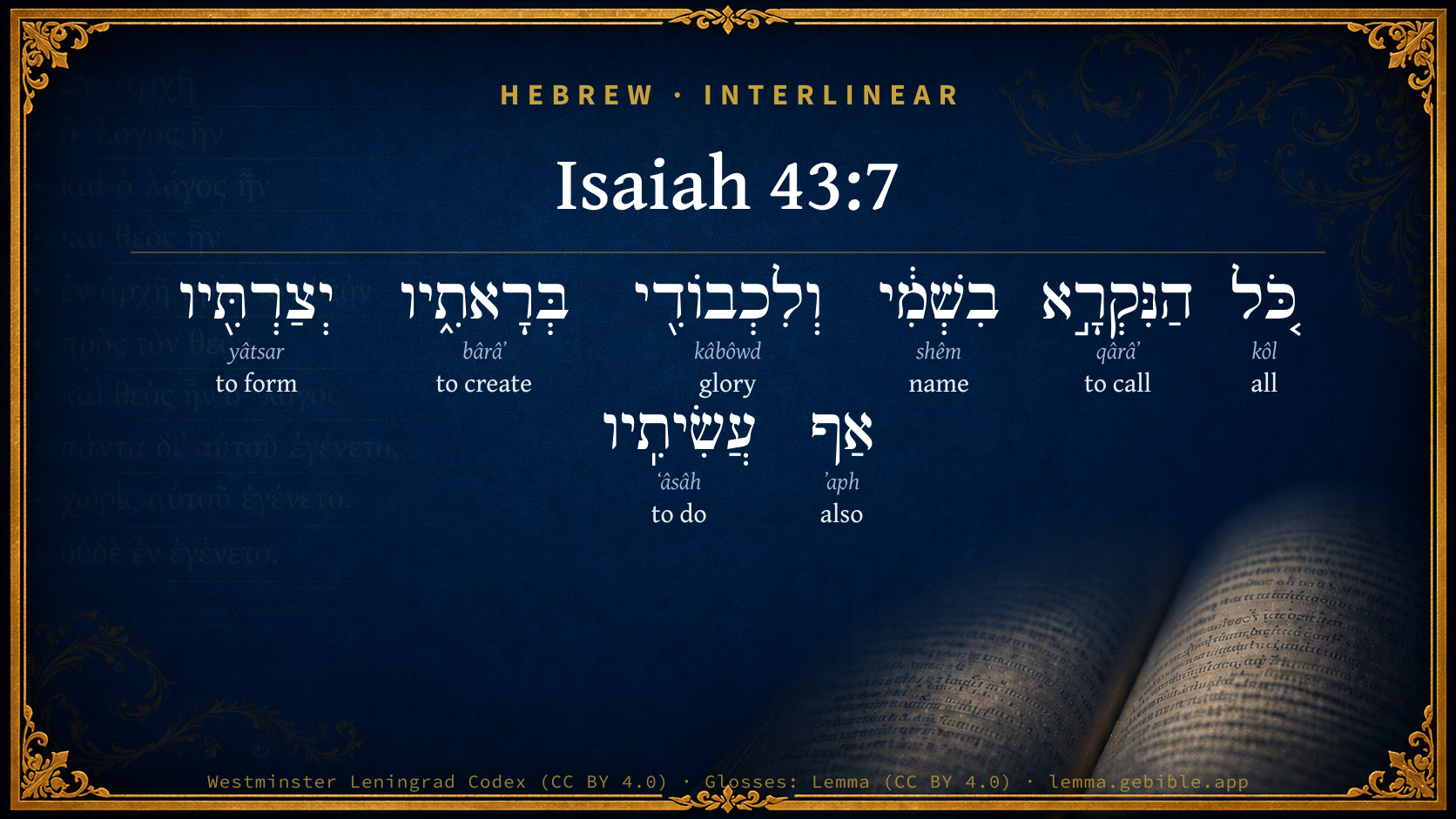
Hebrew (Westminster Leningrad Codex) Isaiah 43:7 appears in the Hebrew Old Testament. The text above is from the Westminster Leningrad Codex. Each word links to its Strong’s number, a concise gloss, and parsing drawn from the Open Scriptures Hebrew Bible morphology. Click any word for its full Brown-Driver-Briggs (BDB) entry.
Download image
Cite this verse

Isaiah 43:7 (World English Bible). Public Domain. Lemma interlinear Bible study tool, https://lemma.gebible.app/v/isaiah/43/7.

Show BibTeX & RIS
BibTeX
RIS
English Translation
everyone who is called by my name, and whom I have created for my glory, whom I have formed, yes, whom I have made.
World English Bible · Public Domain
Download a study sheet

One document with this verse’s original text, its word-by-word gloss line, the meaning frame, cross-references with their text, attributed commentary, and full source and license credits — printable, and it pastes into notes with its structure intact.

This verse Autodidact and up

Study sheet (.html) Plain text (.txt)

A passage Seminary Student

Up to 50 verses in one chapter. A passage sheet keeps up to 6 commentary sources and 12 cross-references per verse, in the order this page ranks them, and says so on the sheet whenever that leaves anything out. Ask for a single verse and you get the Autodidact verse sheet above.

Everything on this page stays free to read, with no account — the sheet is a download of what is already on screen, not access to it.

Want to remove ads? Support Godless Engineer
Compare translations 3

The same verse in 3 English versions, stacked beneath the original-language interlinear above. Click any original word for its lexicon entry.

Each is an independent rendering of the whole verse — the interlinear is not word-aligned to these translations.

Highlighted words mark where these versions differ — a whole-verse word diff, not a word-by-word alignment.

  • World English Bible Public Domain
    everyone who is called by my name, and whom I have created for my glory, whom I have formed, yes, whom I have made.
  • King James Version Public Domain
    Even every one that is called by my name: for I have created him for my glory, I have formed him; yea, I have made him.
  • unfoldingWord Literal Text CC BY-SA 4.0
    all of the ones called by my name. And for my glory I created him, I formed him, indeed, I made him.’” q1

unfoldingWord Literal Text — © unfoldingWord, licensed CC BY-SA 4.0. Word-aligned USFM3 via Door43 (git.door43.org/unfoldingWord/en_ult).

Versions to compare (up to 4)

3 of 4 selected

Show all 18 translations

Every available English version of this verse, each an independent rendering of the whole verse.

  • World English Bible Public Domain
    everyone who is called by my name, and whom I have created for my glory, whom I have formed, yes, whom I have made.
  • Berean Standard Bible Public Domain
    everyone called by My name and created for My glory, whom I have indeed formed and made.”
  • Majority Standard Bible Public Domain
    everyone called by My name and created for My glory, whom I have indeed formed and made.”
  • King James Version Public Domain
    Even every one that is called by my name: for I have created him for my glory, I have formed him; yea, I have made him.
  • American Standard Version (1901) Public Domain
    every one that is called by my name, and whom I have created for my glory, whom I have formed, yea, whom I have made.
  • Revised Version (1885) Public Domain
    every one that is called by my name, and whom I have created for my glory; I have formed him; yea, I have made him.
  • Geneva Bible (1599) Public Domain
    Euery one shall be called by my Name: for I created him for my glorie, formed him and made him.
  • Douay-Rheims (1899) Public Domain
    And every one that calleth upon my name, I have created him for my glory, I have formed him, and made him.
  • Young's Literal Translation Public Domain
    Every one who is called by My name, Even for My honour I have created him, I have formed him, yea, I have made him.
  • Literal Standard Version CC BY-SA 4.0
    Everyone who is called by My Name, || Even for My glory I have created him, || I have formed him, indeed, I have made him.
  • Unlocked Literal Bible CC BY-SA 4.0
    everyone who is called by my name, whom I have created for my glory, whom I have formed, yes, whom I have made.
  • unfoldingWord Literal Text CC BY-SA 4.0
    all of the ones called by my name. And for my glory I created him, I formed him, indeed, I made him.’” q1
  • Darby Bible Public Domain
    every one that is called by my name, and whom I have created for my glory: I have formed him, yea, I have made him.
  • World Messianic Bible Public Domain
    everyone who is called by my name, and whom I have created for my glory, whom I have formed, yes, whom I have made.’”
  • Webster's Bible Public Domain
    Even every one that is called by my name: for I have created him for my glory, I have formed him; verily, I have made him.
  • Free Bible Version CC BY-SA 4.0
    Bring back everyone who bears my name, those I created for my honor, those I formed and made.
  • Bible in Basic English Public Domain
    Every one who is named by my name, and whom I have made for my glory, who has been formed and designed by me.
  • JPS Tanakh (1917) Public Domain
    Every one that is called by My name, and whom I have created for My glory, I have formed him, yea, I have made him.'

Literal Standard Version (2020), Covenant Press — licensed CC BY-SA 4.0. Text via the HelloAO Bible API (eBible.org). Unlocked Literal Bible (unfoldingWord) — licensed CC BY-SA 4.0. Text via the HelloAO Bible API (eBible.org). unfoldingWord Literal Text — © unfoldingWord, licensed CC BY-SA 4.0. Word-aligned USFM3 via Door43 (git.door43.org/unfoldingWord/en_ult). Free Bible Version, Dr. Jonathan Gallagher — licensed CC BY-SA 4.0. Text via the HelloAO Bible API (eBible.org).

Word by word

More ways to search: Search by grammar → Find every occurrence → Compare this word →

Practice this passage: Drill this verse → Learn its vocabulary →

בְּרָאתִ֑יו
bârâʼ
H1254
“to create · him”
Verb, Qal, Perfect, 1st Person, Common, Singular + Suffix, Personal, 3rd Person, Masculine, Singular
Part of Speech
Verb
Stem
Qal
Form
Perfect
Person
1st Person
Gender
Common
Number
Singular
Full BDB Definition

Origin: a primitive root

TWOT: 278

to create, shape, form - (Qal) to shape, fashion, create (always with God as subject) - of heaven and earth - of individual man - of new conditions and circumstances - of transformations - (Niphal) to be created - of heaven and earth - of birth - of something new - of miracles - (Piel) - to cut down - to cut out - to be fat - (Hiphil) to make yourselves fat
  1. כֹּ֚ל kôl H3605 “all of” Noun, Common, Masculine, Singular, Construct
  2. הַנִּקְרָ֣א qârâʼ H7121 “the · calling” Particle, Definite Article + Verb, Niphal, Participle Active, Masculine, Singular, Absolute
  3. בִשְׁמִ֔י shêm H8034 “in/at · name · my” Preposition + Noun, Common, Masculine, Singular, Construct + Suffix, Personal, 1st Person, Common, Singular
  4. וְלִכְבוֹדִ֖י kâbôwd H3519 “and · to/for · glory · my” Conjunction + Preposition + Noun, Common, Both, Singular, Construct + Suffix, Personal, 1st Person, Common, Singular
  5. יְצַרְתִּ֖יו yâtsar H3335 “to form · him” Verb, Qal, Perfect, 1st Person, Common, Singular + Suffix, Personal, 3rd Person, Masculine, Singular
  6. אַף ʼaph H637 “also” Particle, Accusative
  7. עֲשִׂיתִֽיו ʻâsâh H6213 “to do · him” Verb, Qal, Perfect, 1st Person, Common, Singular + Suffix, Personal, 3rd Person, Masculine, Singular

About this verse

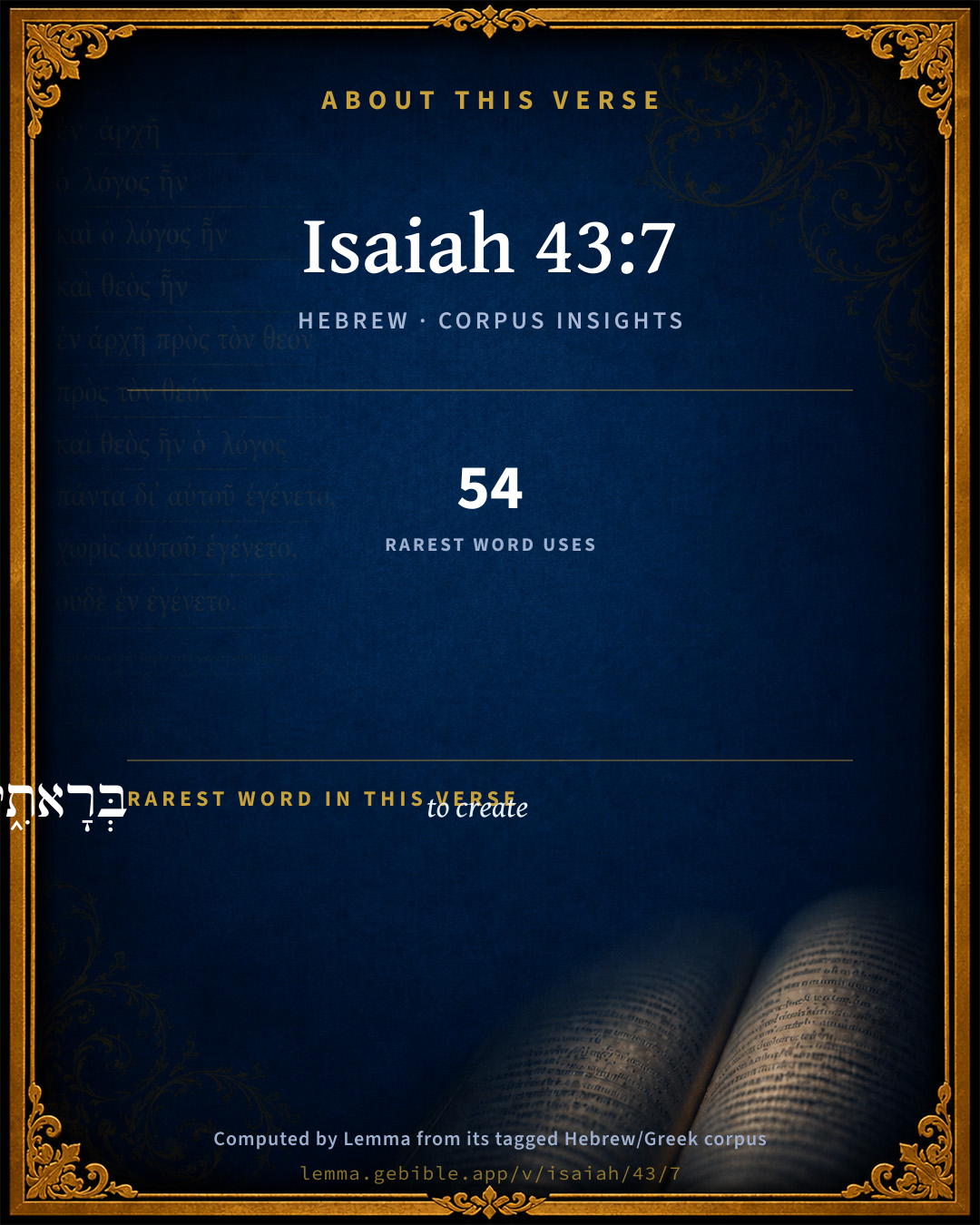
These counts appear in no published source. They are computed here, from the morphology-tagged text and Lemma’s own curated glosses. What Lemma adds →

8
words
8
distinct lemmas
Prophets
section

Shared distinctive vocabulary

בְּרָאתִ֑יו to create H1254 occurs in 46 verses of the Hebrew Bible. Also found in:

Grammatical profile

  • 4 verbs
  • 3 nouns
  • 1 particle

Verb forms

  • הַנִּקְרָ֣א Niphal · Participle Active
  • בְּרָאתִ֑יו Qal · Perfect
  • יְצַרְתִּ֖יו Qal · Perfect
  • עֲשִׂיתִֽיו Qal · Perfect

Hebrew & Septuagint length

In English translation the verse runs 24 words from the Hebrew and 25 from the Septuagint (LXX English) — closely comparable.

A rough comparison of the two English renderings, which tokenize alike — not a word-level alignment.

Word counts can differ between the Hebrew and the Greek without any difference in meaning — e.g. the Hebrew direct-object marker אֵת has no separate Greek word, and Greek often adds the article ὁ.

Cross-references

27

Topical passages linked to Isaiah 43:7 in the Treasury of Scripture Knowledge — connected by theme and wording, ordered by reader-vote popularity; previews shown in the World English Bible.

  • Ephesians 2:10 For we are his workmanship, created in Christ Jesus for good works, which God prepared before that we would walk in them.
  • Isaiah 43:21 the people which I formed for myself, that they might set forth my praise.
  • Ephesians 1:12 to the end that we should be to the praise of his glory, we who had before hoped in Christ:
  • 1 Peter 2:9 But you are a chosen race, a royal priesthood, a holy nation, a people for God's own possession, that you may show forth the excellencies of him who called you out of darkness into his marvelous light:
  • Romans 9:23 and that he might make known the riches of his glory on vessels of mercy, which he prepared beforehand for glory,
  • Isaiah 62:2–5 The nations shall see your righteousness, and all kings your glory, and you shall be called by a new name, which the mouth of Yahweh shall name.
  • Isaiah 43:1 But now thus says Yahweh who created you, Jacob, and he who formed you, Israel: Don't be afraid, for I have redeemed you; I have called you by your name, you are mine.
  • Psalms 100:3 Know that Yahweh, he is God. It is he who has made us, and we are his. We are his people, and the sheep of his pasture.
  • Isaiah 48:11 For my own sake, for my own sake, will I do it; for how should [my name] be profaned? and my glory I will not give to another.
  • Isaiah 56:5 To them will I give in my house and within my walls a memorial and a name better than of sons and of daughters; I will give them an everlasting name, that shall not be cut off.
  • John 15:8 "In this is my Father glorified, that you bear much fruit; and so you will be my disciples.
  • Psalms 50:23 Whoever offers the sacrifice of thanksgiving glorifies me, And prepares his way so that I will show God's salvation to him."
  • Revelation 3:12 He who overcomes, I will make him a pillar in the temple of my God, and he will go out from there no more. I will write on him the name of my God, and the name of the city of my God, the new Jerusalem, which comes down out of heaven from my God, and my own new name.
  • Psalms 95:6–7 Oh come, let's worship and bow down. Let's kneel before Yahweh, our Maker,
  • Isaiah 29:23 But when he sees his children, the work of my hands, in the midst of him, they shall sanctify my name; yes, they shall sanctify the Holy One of Jacob, and shall stand in awe of the God of Israel.
  • Jeremiah 33:16 In those days shall Judah be saved, and Jerusalem shall dwell safely; and this is [the name] by which she shall be called: Yahweh our righteousness.
  • John 3:3–7 Jesus answered him, "Most assuredly, I tell you, unless one is born anew, he can't see the Kingdom of God."
  • Acts 11:26 When he had found him, he brought him to Antioch. It happened, that for a whole year they were gathered together with the assembly, and taught many people. The disciples were first called Christians in Antioch.
  • Isaiah 63:19 We are become as they over whom you never bear rule, as those who were not called by your name.
  • Galatians 6:15 For in Christ Jesus neither is circumcision anything, nor uncircumcision, but a new creation.
  • Ephesians 1:6 to the praise of the glory of his grace, by which he freely bestowed favor on us in the Beloved,
  • Ephesians 2:4–7 But God, being rich in mercy, for his great love with which he loved us,
  • James 2:7 Don't they blaspheme the honorable name by which you are called?
  • 2 Corinthians 5:17 Therefore if anyone is in Christ, he is a new creation. The old things have passed away. Behold, all things have become new.
  • Titus 3:5–7 not by works of righteousness, which we did ourselves, but according to his mercy, he saved us, through the washing of regeneration and renewing by the Holy Spirit,
  • 1 Peter 4:14 If you are insulted for the name of Christ, blessed are you; because the Spirit of glory and of God rests on you. On their part he is blasphemed, but on your part he is glorified.
  • 1 Peter 4:11 If any man speaks, let it be as it were oracles of God. If any man serves, let it be as of the strength which God supplies, that in all things God may be glorified through Jesus Christ, to whom belong the glory and the dominion forever and ever. Amen.

Cross-references courtesy of OpenBible.info (CC BY 4.0).

Hebrew and Greek witnesses Masoretic Hebrew ↔ Greek Septuagint

The same verse in the two great witnesses to the Old Testament, shown verse-for-verse.

These are two independent witnesses, not word-aligned to each other, and the Septuagint is shown in lemma (dictionary) form.

Hebrew Isaiah 43:7 Masoretic · Westminster Leningrad Codex

כֹּ֚ל הַנִּקְרָ֣א בִשְׁמִ֔י וְלִכְבוֹדִ֖י בְּרָאתִ֑יו יְצַרְתִּ֖יו אַף עֲשִׂיתִֽיו

everyone who is called by my name, and whom I have created for my glory, whom I have formed, yes, whom I have made.

World English Bible · Public Domain

Greek LXX Isaiah 43:7 Septuagint · lemma form

πᾶς ὅσος ἐπικαλέω ὁ ὄνομα ἐγώ ἐν γάρ ὁ δόξα ἐγώ κατασκευάζω αὐτός καί πλάσσω καί ποιέω αὐτός

even all who are called by my name: for I have prepared him for my glory, and I have formed him, and have made him:

LXX2012 (modern English Septuagint) · Public Domain

Hebrew: Westminster Leningrad Codex (CC BY 4.0). Greek: Septuagint (public domain); English from LXX2012 (modern English Septuagint) (Public Domain). How the Septuagint differs from the Hebrew →

Targum (Aramaic paraphrase)

1

The Targum is the ancient Jewish Aramaic paraphrase of the Hebrew Scriptures — an interpretive translation, not the Hebrew text itself. Onkelos (literal) and Pseudo-Jonathan (expansive) render the Torah, and Jonathan the Prophets. Coverage is partial: where no permissively-licensed English translation exists for a verse, only the Aramaic is shown. This is verse-level text, not a word-by-word alignment to the Hebrew.

  1. Targum Jonathan Prophets (Joshua–Malachi)
    כָּל דָא בְּדִיל אֲבָהַתְכוֹן צַדִיקַיָא דְאִתְקְרֵי שְׁמִי עֲלֵיהוֹן וְלִיקָרִי בְרֵיתִינוּן אַתְקְנִית גַלְוַתְהוֹן אַף עֲבָדֵית לְהוֹן נִסִין:

    All these things shall come to pass for the sake of your righteous fathers, upon whom my name was called, yea, for my glory I have created them. I will restore their captivity, yea, I will work wonders for them.

    Targum Jonathan — Aramaic: “Mikraot Gedolot” (public domain). English: “Sefaria Community Translation” (CC0 1.0 (public-domain dedication)); “London "Chaldee Paraphrase," 1871” (public domain). Text via Sefaria.

Commentary

Notes on Isaiah 43:7 from classic Christian and Jewish commentators (each source and its license shown beneath its notes). The classic Christian expositions comment on the surrounding passage and are grouped to its opening verse, so a note may address several verses; the Jewish commentaries on the Tanakh (Rashi and others) are per-verse, so they appear only where the commentator wrote on this verse.

Lemma curates 59 commentaries, every one of them public domain or Creative Commons licensed, each selected and text-cleaned for this edition rather than reprinted as found. About our sources →

Trapp's Complete Commentary

John Trapp

Isa 43:7 [Even] every one that is called by my name: for I have created him for my glory, I have formed him; yea, I have made him.

Ver. 7. Even every one that is called by my name,] i.e., My sons and my daughters, {Isa 43:6 2Co 6:18} such as have Christian for their name, and Catholic for their surname.

I have created him for my glory.] See on Isa 43:1.

Yea, I have made him,] i.e., Advanced him, {a} as 1Sa 12:6.

{a} Feci, i.e., magnum effeci. - Pisc.

John Trapp, A Commentary or Exposition upon All the Books of the Old and New Testament (1647–1656) — public domain. Text from a community e-Sword module.

The Biblical Illustrator

Joseph S. Exell

Isa_43:7

I have created him for My glory

The glory of God the end of mans creation and redemption

What am I?

For what purpose was I created? Am I answering the great end of my existence?--are questions which should be frequently proposed by every rational being.

I. THE GREAT END OF JEHOVAH IN THE CREATION OF MAN WAS THE MANIFESTATION OF HIS OWN GLORY. By the glory of God we understand the display of His Divine perfections.

II. IN THE SCHEME OF HUMAN REDEMPTION THE GLORY OF GOD IS AGAIN STRIKINGLY MANIFESTED. The glory of God appears--

1. In their redemption.

2. In the application of its blessings by the Holy Ghost--in the spiritual renovation of man.

3. In the endeared relation into which those who have been thus redeemed and sanctified are admitted. They are made the sons and daughters of the Lord Almighty; and their disposition and character correspond with their distinguished privileges.

III. THE GLORY OF GOD IS THE GREAT END WHICH ALL THE PEOPLE OF GOD ARE TO SEEK TO PROMOTE.

1. By an increased acquaintance with the Divine perfections, as they are manifested in the work of creation and redemption, and as they are revealed in the Sacred Scriptures, and in the person and character of the Lord Jesus Christ.

2. By a cordial reception of all that God has revealed and promised.

3. By cheerful obedience to His commands.

4. By active efforts in the service of God, and by an entire consecration of all we have to Him. (Essex Remembrancer.)

The Biblical Illustrator, edited by Joseph S. Exell (c. 1880s–1900s) — public domain. Text from a community e-Sword module.

MacLaren's Expositions of Holy Scripture

Alexander MacLaren

Isaiah

THY NAME: MY NAME

Isa 43:1. - Isa 43:7.

Great stress is laid on names in Scripture. These two parallel and antithetic clauses bring out striking complementary relations between God and the collective Israel. But they are as applicable to each individual member of the true Israel of God.

I. What does God’s calling a man by his name imply?

1. Intimate knowledge.

Adam naming the creatures.

Christ naming His disciples.

2. Loving friendship.

Moses, ‘I know thee by name, and thou hast found grace in my sight.’

3. Designation and adaptation to work.

Bezaleel- Exo 31:2; Cyrus- Isa 45:3; Servant of the Lord- Isa 49:1.

II. What does God’s calling a man by His name imply?

1. God’s possession of him. That possession by God involves God’s protection and man’s safety. He does not hold His property slackly. ‘None shall pluck them out of My Father’s hand.’

2. Kindred. The man bears the family name. He is adopted into the household. The sonship of the receiver of the new name is dimly shadowed.

3. Likeness.

The Biblical meaning of ‘name’ is ‘character manifested.’

Nomen and omen coincide.

We must bring into connection with the texts the prominence given in the Apocalypse to analogous promises.

‘I will write on him the name of My God.’ That means a fuller disclosing of God’s character, and a clear impress of that character on perfected men ‘His name shall be in their foreheads.’

Alexander MacLaren, Expositions of Holy Scripture (1904–1910) — public domain. Text from a community e-Sword module.

Tyndale Open Study Notes

Tyndale Open Resources

43:7 One of God’s purposes in restoring his people was to display his glory to the watching world.

Tyndale Open Study Notes — © Tyndale Open Resources, licensed CC BY-SA 4.0. Text via the HelloAO Bible API.

Geneva Bible (1599)

Geneva Bible translators

Meaning, that he could not be unmindful of them, except he would neglect his own Name and glory.

Geneva Bible (1599) marginal notes — public domain. Text via Bolls.life.

Jamieson, Fausset & Brown

Robert Jamieson, A. R. Fausset & David Brown

called by my name--belong to Israel, whose people, as sons of God, bear the name of their Father (Isa 44:5; Isa 48:1).

for my glory-- (Isa 43:21; Isa 29:23).

Jamieson, Fausset & Brown — Commentary Critical and Explanatory on the Whole Bible (1871) — public domain (CC PDM 1.0). Text via the HelloAO Bible API.

Adam Clarke's Commentary

Verse 7. Every one that is called by my name] All who worship the true God, and are obedient to his laws.

I have created him] בראתיו berathiv. I have produced him out of nothing.

For my glory] Ten MSS., three ancient, and the Syriac and Vulgate, read לכבודי licabodi, without the conjunction ו vau, and.

I have formed him] יצרתיו yetsartiv. I have given him that particular form and shape which are best suited to his station in life.

I have made him] עשיתיו asithiv. I have adapted him to the accomplishment of my counsels and designs.

Adam Clarke's Commentary on the Bible (1810–1826) — public domain. Text from a community e-Sword/MySword module.

Ellicott's Commentary for English Readers

(7) Every one that is called by my name—i.e., who is marked as belonging to the people that is chosen as the Lord’s servant

A Bible Commentary for English Readers, edited by Charles John Ellicott (1878–1897) — public domain. Text from a community e-Sword module.

The Cambridge Bible for Schools and Colleges

gen. ed. J. J. S. Perowne

7. that is called by my name] i.e. who belongs to the community in which Jehovah is worshipped.

for I have created him] Render with R.V. and whom I have created.

for my glory] Although it is only the restored nation that can fully manifest Jehovah’s glory to the world, each of its scattered units shares the dignity which belongs to Israel as a whole.

The Cambridge Bible for Schools and Colleges (gen. ed. J. J. S. Perowne; Cambridge University Press, 1878–1918) — public domain. Text from a community e-Sword module.

John Gill's Exposition

Even everyone that is called by my name,.... That is called by the name of God, a son or daughter of his; or by the name of Christ, a Christian; whoever belongs to the Lord, whom he calls by his name; and who, being called by his grace, call upon his name, make a profession of his name, and serve and worship him:

for I have created him for my glory, I have formed him, yea, I have made him; all which is expressive of the power and grace of God, in the regeneration and conversion of his people; which is a creation, a formation, a making them for himself, for the glory of his grace, and to show forth his praise; and therefore he will gather them in, and bring them into a body together, into a church state, that this end may be answered.

John Gill's Exposition of the Whole Bible (1746–1763) — public domain (CC PDM 1.0). Text via the HelloAO Bible API.

Albert Barnes' Notes on the Bible

Every one that is called by my name - To be called by the name of anyone, is synonymous with being regarded as his son, since a son bears the name of his father (see Isa 44:5; Isa 48:1). The expression, therefore, means here, all who were regarded as the children of God; and the promise is, that all such should be re-gathered to their own land.

For I have created him - (See the note at Isa 43:1).

For my glory - In order to show forth, and illustrate my glory. They shall be, therefore, defended and protected; and my glory shall be shown in their recovery and salvation.

Albert Barnes' Notes on the Bible (1834–1885) — public domain. Text from a community e-Sword/MySword module.

Haydock's Catholic Bible Commentary

Calleth. Hebrew, "is called by my name." (Protestants) (Haydock) --- My people’s chastisements and liberation prove my divine perfections.

George Leo Haydock (1774–1849), Haydock's Catholic Family Bible and Commentary, 1859 edition — public domain. Excludes Psalms (Douay-Rheims chapter numbering differs from Protestant) and Deuterocanonical books (Catholic canon only).

Matthew Poole's English Annotations

Even every one that is called by my name: They are called by my name; I own them for my people and children; and therefore what kindness or cruelty you exercise to them I take it as done to myself. So it is an argument to move those people to let their captives go; or it is an argument to confirm the faith of God’s people, that God would deliver them, because they are his own.

I have created him for my glory; and therefore I will glorify my power, and goodness, and faithfulness in delivering them.

I have made him; I have not only created them out of nothing, as I did all other people, but I have also formed and made them my peculiar people.

Matthew Poole's English Annotations on the Holy Bible (1683–1685) — public domain. Text from a community e-Sword/MySword module.

The Pulpit Commentary

Every one that is called by my name. The very name of "Israel" meant "prince of God," or "soldier of God," and thus every Israelite was "called by God"s name." Israelites were also known among the nations as Jehovah-worshippers (see the Moabite Stone, line 18). I have created... formed... made him (comp. ver. 1). "The three verbs describe the process of formation from the first rough cutting to the perfecting of the work" (Cheyne). The third verb would, perhaps, be best translated. "I have perfected," or "I have completed (him)." All three acts creation, formation, and completion are done by God for his own glory. (comp. Pro_16:4)

Ver. 7. Man made for the glory of God.

The great end of all creation is God"s glory. Not that this is to be understood in such sort as that God was moved to create by the desire of getting glory thereby, for nothing could enlarge or enhance that glory which he had from all eternity, before even the angels were brought into being. The motive of God"s external working, if we may use the expression, was his goriness, or benevolence (Pearson on the Creed, art. 1. p. 99), which caused him to seek to communicate his own blessedness and happiness to others. But the law of his working was the exhibition of his glory. He so created all things that they should set this forth. From the lowest atom of dead inert matter, possessed of no qualities but substance and extension, to the highest crewed intelligence, endued with almost Divine attributes, every thing, as it issued from his hand, was so made as to show forth and proclaim his glorious and unapproachable majesty, power, and greatness. Hence the outburst of the psalmist, "The heavens declare the glory of God; and the firmament showeth his handiwork. One day telleth another, and one night certifieth another". (Psa_19:1, Psa_19:2) Hence the call upon all things to "Praise the Lord, since his Name only is excellent, and his glory above heaven and earth". (Psa_148:13) Hence the cry of the four and twenty elders in the heavenly place, "Thou art worthy, O Lord, to receive glory and honour and power: for thou hast created all things, and for thy pleasure they are and were created". (Rev_4:11) God"s glory rosy he set forth

(1) unconsciously, or

(2) consciously-unconsciously,

as it is by the things that are devoid of intelligence," sun, and moon, and stars of light, heavens, and waters above the heavens, earth, sea, fire, hail, snow and vapours, stormy wind, mountains, hills, fruitful trees, cedars, beasts, and all cattle, creeping things, and flying fowl"; (Psa_148:3-10) consciously, as by the host of heaven, the angels of all grades, (Psa_148:2) and also by the children of men men and maidens, old men and children, kings of the earth and all people, princes and all judges of the earth". (Psa_148:10, Psa_148:12) For the better setting forth of his glory, God "created man in his own image" (Gen_1:27) him, formed him, perfected him" (ver. 7). Then, when he had marred the image in which he was made, God redeemed him. Thus he is still able to set forth God"s glory, and to do so is the end of his being. "Whether ye eat, or drink, or whatsoever ye do," says the apostle, "do all to the glory of God"; (1Co_10:31) and again, "Ye are bought with a price: therefore glorify God in your body, and in your spirit, which are God"s". (1Co_6:20)

The Pulpit Commentary (1880–1919), ed. H.D.M. Spence-Jones & Joseph S. Exell — public domain. Text from a community e-Sword module.

John Wesley's Explanatory Notes

For my glory - And therefore I will glorify my power and goodness, and faithfulness in delivering them. Formed - I have not only created them out of nothing, but I have also formed and made them my peculiar people.

John Wesley, Explanatory Notes Upon the Whole Bible (1754–1765) — public domain. Text via the GEBible commentary corpus.

J. A. Alexander on Isaiah

Joseph Addison Alexander

“Every one called by my name, and for my glory I have created him; I have formed him, yea I have made him.” The construction is continued from the foregoing verse. ‘My sons and my daughters, even every one called by my name.’ And I have created them is a common Hebrew idiom equivalent to ‘whom I have created’. ‘For my glory’ is emphatic. God had not only made them what they were, but He had done it for His own sake, not for theirs. So likewise He now speaks of their being called by His name, as He did before of His calling them by their name, the latter denoting special designation, the former special authority and right.

Joseph Addison Alexander, The Prophecies of Isaiah (1846–1847; New York: Scribner, 1870–1878) — public domain. Text from a community e-Sword module.

Rashi

Rabbi Shlomo Yitzchaki (Rashi)

Everyone that is called by My name, and whom I created for My glory All the righteous, who are called by My name and everyone who was made for My glory, I formed him, yea, I made him. fixed him with all that is necessary for him, and I prepared everything. That is to say, that although they experienced exile and trouble, I prepared for them all the necessities of their redemption.

Rashi on the Tanakh — English translations: “The Judaica Press complete Tanach with Rashi, translated by A. J. Rosenberg” (CC BY 4.0); “Pentateuch with Rashi's commentary by M. Rosenbaum and A.M. Silbermann, 1929-1934” (public domain); “The Metsudah Tanach series, Lakewood, N.J” (CC BY 4.0); and “The Book of Joshua, Metsudah Publications, 1997” (CC BY 4.0). Text via Sefaria.

Ibn Ezra

Rabbi Abraham ibn Ezra

קורא ═ נקרא that calleth, as some explain; but this is wrong. It is to be taken literally. Every one that is called by my name, that is, all that belong to the people of the Lord.

And for my glory. To be a glory to my name.

בראתיו I have formed it, namely, that nation.

עשיתיו I have established it. —R. Salomo, the father of metrical poetry in Hebrew, explained this verse to contain the principles of the creation of the universe; but this explanation is not in accordance with the context.

Ibn Ezra on the Tanakh — English translations: “Sefaria Community Translation” (CC0 1.0 (public-domain dedication)); “Yalkut, Sifsei Chachomim Chumash, Metsudah Publications, 2009” (CC BY 4.0); and “Commentary of Ibn Ezra on Isaiah - trans. by M. Friedlander, 1873” (public domain). Text via Sefaria.

Lesson kit

Teaching starters — assembled from the data on this page, not authored interpretation. Every prompt links to the verse data it draws on. Edit before teaching.

Isaiah, in the Prophets, opens this verse with 8 words (8 distinct Hebrew lemmas). Its most distinctive word is bârâʼ (“to create”). A historical commentator’s framing appears above. Read the whole chapter for the surrounding context.

Discussion questions

  1. What does “to create” (bârâʼ) contribute to the verse as a whole?
  2. How does Genesis 1:1, which shares the word «to create», read alongside this verse?
  3. These translations render this verse differently. What is at stake in choosing one wording over another?
  4. «הַנִּקְרָ֣א» is a Niphal Participle Active verb. How does that grammatical form shape the action described?
  5. Compare how Trapp's Complete Commentary and The Biblical Illustrator read this verse. Where do they agree or differ?

Things to notice

Reading settings

Reading text

Shown beneath each verse's original-language words.

Old Testament
Old Testament edition

Read the OT as the Masoretic Hebrew (MT) or the Greek Septuagint (LXX).

English shown for the Greek Septuagint (in the Hebrew ↔ Greek comparison).

Comparing translations? Open the Compare panel on any verse page to stack up to four side by side.