
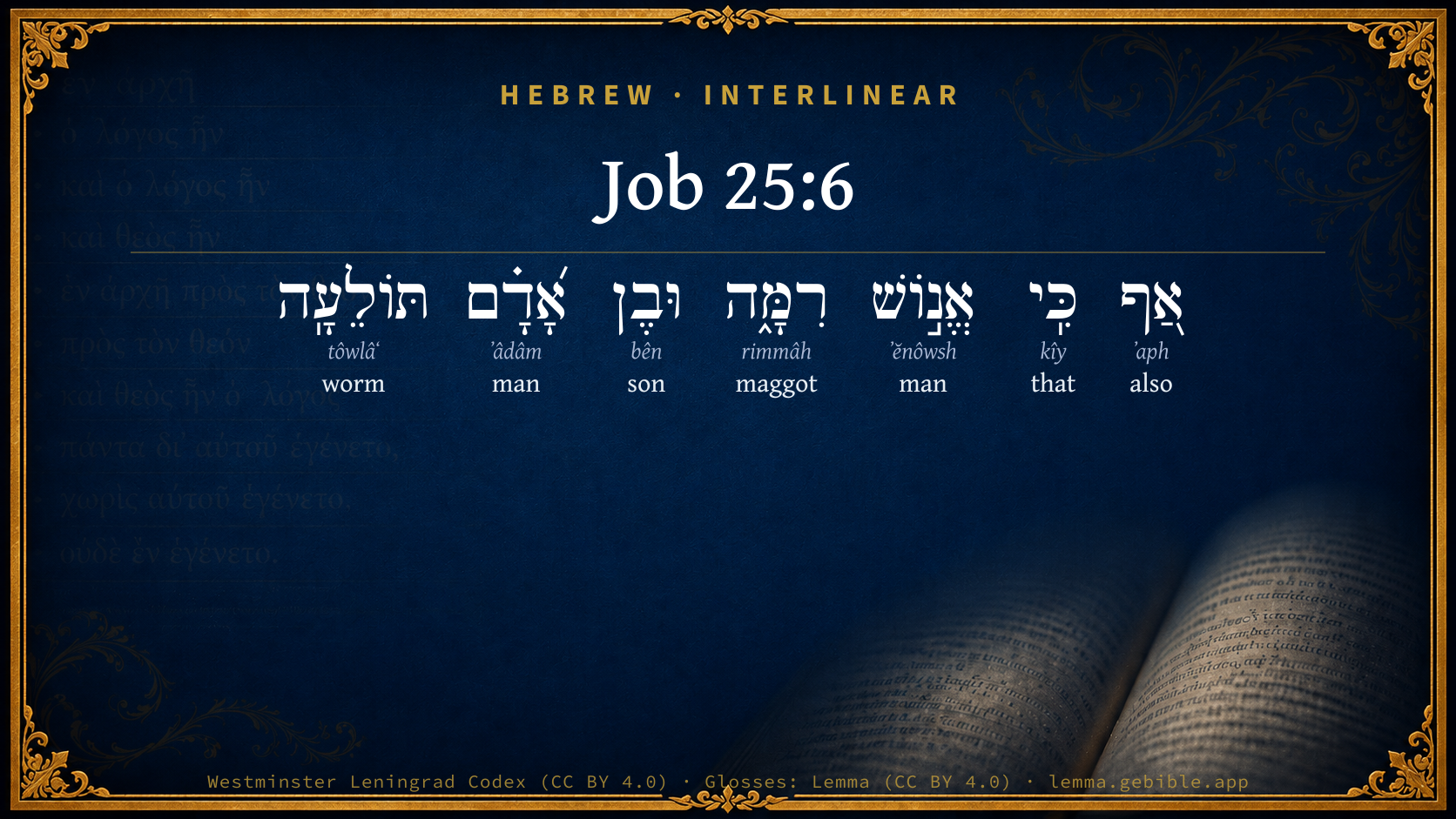
Job 25:6

Hebrew (Westminster Leningrad Codex) Job 25:6 appears in the Hebrew Old Testament. The text above is from the Westminster Leningrad Codex. Each word links to its Strong’s number, a concise gloss, and parsing drawn from the Open Scriptures Hebrew Bible morphology. Click any word for its full Brown-Driver-Briggs (BDB) entry.
Download image
Cite this verse

Job 25:6 (World English Bible). Public Domain. Lemma interlinear Bible study tool, https://lemma.gebible.app/v/job/25/6.

Show BibTeX & RIS
BibTeX
RIS
English Translation
How much less man, who is a worm! The son of man, who is a worm!"
World English Bible · Public Domain
Download a study sheet

One document with this verse’s original text, its word-by-word gloss line, the meaning frame, cross-references with their text, attributed commentary, and full source and license credits — printable, and it pastes into notes with its structure intact.

This verse Autodidact and up

Study sheet (.html) Plain text (.txt)

A passage Seminary Student

Up to 50 verses in one chapter. A passage sheet keeps up to 6 commentary sources and 12 cross-references per verse, in the order this page ranks them, and says so on the sheet whenever that leaves anything out. Ask for a single verse and you get the Autodidact verse sheet above.

Everything on this page stays free to read, with no account — the sheet is a download of what is already on screen, not access to it.

Want to remove ads? Support Godless Engineer
Compare translations 3

The same verse in 3 English versions, stacked beneath the original-language interlinear above. Click any original word for its lexicon entry.

Each is an independent rendering of the whole verse — the interlinear is not word-aligned to these translations.

Highlighted words mark where these versions differ — a whole-verse word diff, not a word-by-word alignment.

  • World English Bible Public Domain
    How much less man, who is a worm! The son of man, who is a worm!"
  • King James Version Public Domain
    How much less man, that is a worm? and the son of man, which is a worm?
  • unfoldingWord Literal Text CC BY-SA 4.0
    Indeed that a man, a worm, or a son of man, a grub!”

unfoldingWord Literal Text — © unfoldingWord, licensed CC BY-SA 4.0. Word-aligned USFM3 via Door43 (git.door43.org/unfoldingWord/en_ult).

Versions to compare (up to 4)

3 of 4 selected

Show all 18 translations

Every available English version of this verse, each an independent rendering of the whole verse.

  • World English Bible Public Domain
    How much less man, who is a worm! The son of man, who is a worm!"
  • Berean Standard Bible Public Domain
    how much less man, who is but a maggot, and the son of man, who is but a worm!”
  • Majority Standard Bible Public Domain
    how much less man, who is but a maggot, and the son of man, who is but a worm!”
  • King James Version Public Domain
    How much less man, that is a worm? and the son of man, which is a worm?
  • American Standard Version (1901) Public Domain
    How much less man, that is a worm! And the son of man, that is a worm!
  • Revised Version (1885) Public Domain
    How much less man, that is a worm! and the son of man, which is a worm!
  • Geneva Bible (1599) Public Domain
    How much more man, a worme, euen the sonne of man, which is but a worme?
  • Douay-Rheims (1899) Public Domain
    How much less man that is rottenness and the son of man who is a worm?
  • Young's Literal Translation Public Domain
    How much less man -- a grub, And the son of man -- a worm!
  • Literal Standard Version CC BY-SA 4.0
    How much less man—a grub, || And the son of man—a worm!”
  • Unlocked Literal Bible CC BY-SA 4.0
    How much less man, who is a worm— a son of man, who is a worm!”
  • unfoldingWord Literal Text CC BY-SA 4.0
    Indeed that a man, a worm, or a son of man, a grub!”
  • Darby Bible Public Domain
    How much less man, a worm, and the son of man, a worm!
  • World Messianic Bible Public Domain
    How much less man, who is a worm, and the son of man, who is a worm!”
  • Webster's Bible Public Domain
    How much less man, that is a worm; and the son of man, who is a worm?
  • Free Bible Version CC BY-SA 4.0
    how much less a human being—who by comparison is like a maggot or a worm!”
  • Bible in Basic English Public Domain
    How much less man who is an insect, and the son of man who is a worm!
  • JPS Tanakh (1917) Public Domain
    How much less man, that is a worm! and the son of man, that is a maggot!

Literal Standard Version (2020), Covenant Press — licensed CC BY-SA 4.0. Text via the HelloAO Bible API (eBible.org). Unlocked Literal Bible (unfoldingWord) — licensed CC BY-SA 4.0. Text via the HelloAO Bible API (eBible.org). unfoldingWord Literal Text — © unfoldingWord, licensed CC BY-SA 4.0. Word-aligned USFM3 via Door43 (git.door43.org/unfoldingWord/en_ult). Free Bible Version, Dr. Jonathan Gallagher — licensed CC BY-SA 4.0. Text via the HelloAO Bible API (eBible.org).

Word by word

More ways to search: Search by grammar → Find every occurrence → Compare this word →

Practice this passage: Drill this verse → Learn its vocabulary →

About this verse

These counts appear in no published source. They are computed here, from the morphology-tagged text and Lemma’s own curated glosses. What Lemma adds →

7
words
7
distinct lemmas
Wisdom
section

Notable vocabulary

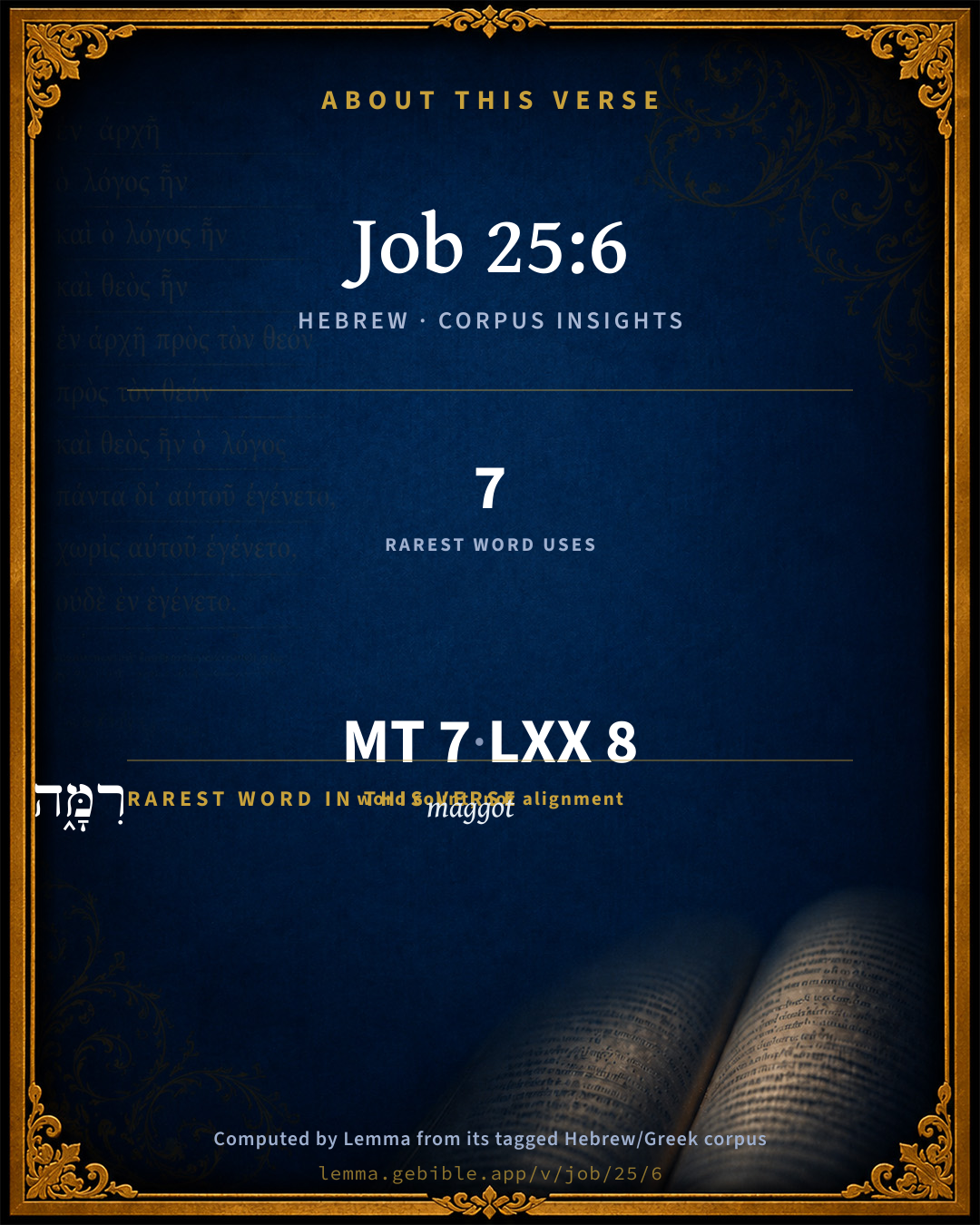
The rarest word here is רִמָּ֑ה maggot H7415 — appearing just 7 times in the whole Hebrew Bible.

Shared distinctive vocabulary

רִמָּ֑ה maggot H7415 occurs in 7 verses of the Hebrew Bible. Also found in:

Grammatical profile

  • 5 nouns
  • 1 conjunction
  • 1 particle

Hebrew & Septuagint length

In English translation the verse runs 16 words from the Hebrew and 12 from the Septuagint (LXX English) — closely comparable.

A rough comparison of the two English renderings, which tokenize alike — not a word-level alignment.

Word counts can differ between the Hebrew and the Greek without any difference in meaning — e.g. the Hebrew direct-object marker אֵת has no separate Greek word, and Greek often adds the article ὁ.

In the original languages it is 7 Hebrew tokens and 8 Greek tokens — but the two are counted differently (Hebrew bundles its prefixes and suffixes into one token; the Greek is in lemma form), so that isn’t a like-for-like length.

Cross-references

5

Topical passages linked to Job 25:6 in the Treasury of Scripture Knowledge — connected by theme and wording, ordered by reader-vote popularity; previews shown in the World English Bible.

  • Psalms 22:6 But I am a worm, and no man; A reproach of men, and despised by the people.
  • Isaiah 41:14 Don't be afraid, you worm Jacob, and you men of Israel; I will help you, says Yahweh, and your Redeemer is the Holy One of Israel.
  • Genesis 18:27 Abraham answered, "See now, I have taken it on myself to speak to the Lord, who am but dust and ashes.
  • Job 4:19 How much more, those who dwell in houses of clay, Whose foundation is in the dust, Who are crushed before the moth!
  • Job 7:17 What is man, that you should magnify him, That you should set your mind on him,

Cross-references courtesy of OpenBible.info (CC BY 4.0).

Hebrew and Greek witnesses Masoretic Hebrew ↔ Greek Septuagint

The same verse in the two great witnesses to the Old Testament, shown verse-for-verse.

These are two independent witnesses, not word-aligned to each other, and the Septuagint is shown in lemma (dictionary) form.

Hebrew Job 25:6 Masoretic · Westminster Leningrad Codex

אַ֭ף כִּֽי אֱנ֣וֹשׁ רִמָּ֑ה וּבֶן אָ֝דָ֗ם תּוֹלֵעָֽה

How much less man, who is a worm! The son of man, who is a worm!"

World English Bible · Public Domain

Greek LXX Job 25:6 Septuagint · lemma form

ἔα δέ ἄνθρωπος σαπρία καί υἱός ἄνθρωπος σκώληξ

But alas! man is corruption, and the son of man a worm.

LXX2012 (modern English Septuagint) · Public Domain

Hebrew: Westminster Leningrad Codex (CC BY 4.0). Greek: Septuagint (public domain); English from LXX2012 (modern English Septuagint) (Public Domain). How the Septuagint differs from the Hebrew →

Commentary

Notes on Job 25:6 from classic Christian and Jewish commentators (each source and its license shown beneath its notes). The classic Christian expositions comment on the surrounding passage and are grouped to its opening verse, so a note may address several verses; the Jewish commentaries on the Tanakh (Rashi and others) are per-verse, so they appear only where the commentator wrote on this verse.

Lemma curates 59 commentaries, every one of them public domain or Creative Commons licensed, each selected and text-cleaned for this edition rather than reprinted as found. About our sources →

Trapp's Complete Commentary

John Trapp

Job 25:6 How much less man, [that is] a worm? and the son of man, [which is] a worm?

Ver. 6. How much less man, that is a worm?] He saith not, as a worm, but a worm itself, so Psa 22:6, "I am a worm, and no man"; nullificamen hominis, as Tertullian somewhere phraseth it. David in the Arabic signifieth a worm, saith one, to which he may seem in that psalm to allude. The word here rendered a worm, signifieth a small worm bred in cheese or flesh, a mite, a maggot, Vermis parvus in carne aut caseo nascens, Exo 16:24. Others say, it signifieth rottenness, which hath no strength. Hereby man, convinced of his infirmity, vanity, and impurity, should learn Virium suarum ουδενειαν agnoscere, to give glory to God, and to take shame to himself.

And the son of man, which is a worm?] Lumbricus, quo vix quidquam contemptius nominari potest, So vile and abject a creature is man. The greater is God’s mercy to look upon such a walking dunghill: learn hereby to know God and thyself, which is the highest point of heavenly wisdom.

John Trapp, A Commentary or Exposition upon All the Books of the Old and New Testament (1647–1656) — public domain. Text from a community e-Sword module.

The Biblical Illustrator

Joseph S. Exell

Job_25:6

Man, that is a worm-The worm

1. With peculiar emphasis we may say of the worm, it is of the earth earthy. Springing out of it, boring into it, and feeding on it, or on that which grows upon it,--it is a singular image of man, who was formed out of the dust of the ground, and is destined to return to it, and who, alas! feeds on it. All men may not be equally represented by that which belongs to the extremely gross in character.

2. In the naturally repulsive character of a worm we have an illustration of sin. The only thing that repels God from man is sin. To mans weakness, ignorance, poverty, and sorrow, the Creator can and does graciously draw near; but from mans sin He recoils. What sin is to God, it should be to us--a repulsive thing--that which we should hate and flee from.

3. The carrion-worm and canker-worm afford us an illustration of the injurious character of man as a sinner. What are the ravages of war but the dread results of human carrion-worms revelling in human blood? What are the restless activities, passions, and pursuits of men, but the ceaseless gnawing of pride, envy, ambition, lust, anger, malice, deceit, and suchlike things--the canker-worms of the soul, and the carrion-worms of the body?

4. Learn a lesson of humility from the different classes and pursuits of worms. Some are great and some small; some attractive and some unsightly.

5. Worms are not without their use in the world, and some--such as silkworms--are of great value. (Anon.)

.

The Biblical Illustrator, edited by Joseph S. Exell (c. 1880s–1900s) — public domain. Text from a community e-Sword module.

Joseph Benson's Commentary

Job 25:6. How much less man, that is a worm — Mean, vile, and impotent; proceeding from corruption, and returning to it. And the son of man — For miserable man, in the last clause, he here puts the son of any man, to show that this is true, even of the greatest and best of men. Let us then wonder at the condescension of God, in taking such worms into covenant and communion with himself!

Joseph Benson's Commentary on the Old and New Testaments (1811–1818) — public domain. Text from a community e-Sword module.

Jamieson, Fausset & Brown

Robert Jamieson, A. R. Fausset & David Brown

(Job 4:19-21; Job 15:16).

worm . . . worm--Two distinct Hebrew words. The first, a worm bred in putridity; alluding to man's corruption. The second a crawling worm; implying that man is weak and grovelling.

Next: Job Chapter 26

Jamieson, Fausset & Brown — Commentary Critical and Explanatory on the Whole Bible (1871) — public domain (CC PDM 1.0). Text via the HelloAO Bible API.

Adam Clarke's Commentary

Verse 6. How much less man, that is a worm?] Or as the Targum. - "How much more man, who in his life is a reptile; and the son of man, who in his death is a worm." Almost all the versions read, "Truly man is corruption, and the son of man a worm." The original is degradingly expressive: "Even because אנוש enosh, miserable man, is רמה rimmah, a crawling worm; and the son of Adam, who is תולעה toleah, a worm, or rather maggot, from its eating into and dividing certain substances." - Parkhurst.

Thus endeth Bildad the Shuhite, who endeavoured to speak on a subject which he did not understand; and, having got on bad ground, was soon confounded in his own mind, spoke incoherently, argued inconclusively, and came abruptly and suddenly to an end. Thus, his three friends being confounded, Job was left to pursue his own way; they trouble him no more; and he proceeds in triumph to the end of the thirty-first chapter.

Adam Clarke's Commentary on the Bible (1810–1826) — public domain. Text from a community e-Sword/MySword module.

Ellicott's Commentary for English Readers

(6) How much less man . . .—Comp. Psa_8:4; Psa_22:6; Isa_41:14, &c.

A Bible Commentary for English Readers, edited by Charles John Ellicott (1878–1897) — public domain. Text from a community e-Sword module.

John Gill's Exposition

How much less man, that is a worm?.... Whose original is of the earth, dwells in it, and is supported by it, and creeps into it again; who is impure by nature and by practice, weak and impotent to do anything that is spiritually good, or to defend himself from his spiritual enemies; and is mean and despicable, as even the best of men are, in their own eyes, and in the eyes of the world: and, if the best of men are comparable to such creatures, and our Lord himself, in human nature, was content to be called a worm, and no man; what must the worst of men be, or man be in and of himself, without the grace of God and righteousness of Christ, by which he can be only clean and righteous? see Isa 41:14; and, if the celestial bodies above mentioned are eclipsed of all their brightness and glory, in the presence of God; what a contemptible figure must man make in the court of heaven, who, in comparison of them, is but a worm, and much more so, as appearing before God?

and the son of man, which is a worm; which is repeated with a little variation for the confirmation of it; or it may signify, that even the first man was no other than of the earth, earthy, and so are all his sons. The Targum is,

"how much more man, who in his life is a reptile, and the son of man, who in his death is a worm?''

to which may be added, that he is in his grave a companion for the worms; and indeed it appears by the observations made through microscopes, that man, in his first state of generation, is really a worm (p); so that, as Pliny says (q), one that is a judge of things may pity and be ashamed of the sorry original of the proudest of animals. By this short reply of Bildad, and which contains little more than what had been before said, it is plain that he was tired of the controversy, and glad to give out.

(p) Lewenhoeck apud Scheuchzer. Physic. Sacr. vol. 4. p. 721. Vid. Philosoph. Transact. abridged, vol. 2. p. 912, 913. (q) Nat. Hist. l. 7. c. 7.

Next: Job Chapter 26

John Gill's Exposition of the Whole Bible (1746–1763) — public domain (CC PDM 1.0). Text via the HelloAO Bible API.

Albert Barnes' Notes on the Bible

How much less man - See Job 4:19. Man is mentioned here as a worm; in Job 4:19 he is said to dwell in a house of clay and to be crushed before the moth. In both cases the design is to represent him as insignificant in comparison with God.

A worm - רמה rı̂mmâh; see Job 7:5. The word is commonly applied to such worms as are bred in putridity, and hence, the comparison is the more forcible.

And the son of man - Another mode of speaking of man. Any one of the children of man is the same. No one of them can be compared with God; compare the notes at Mat 1:1.

Which is a worm - תולעה tôlê‛âh; compare the notes at Isa 1:18. This word frequently denotes the worm from which the scarlet or crimson color was obtained. It is, however, used to denote the worm that is bred on putrid substances, and is so used here; compare Exo 16:20; Isa 14:11; Isa 66:24. It is also applied to a worm that destroys plants. Jon 4:7; Deu 28:39. Here it means, that man is poor, feeble, powerless. In comparison with God he is a crawling worm. All that is said in this chapter is true and beautiful, but it has nothing to do with the subject in debate. Job had appealed to the course of events in proof of the truth of his position. The true way to meet that was either to deny that the facts existed as he alleged, or to show that they did not prove what be had adduced them to establish. But Bildad did neither; nor did he ingenuously confess that the argument was against him and his friends. At this stage of the controversy, since they had nothing to reply to what Job had alleged, it would have been honorable in them to have acknowledged that they were in error, and to have yielded the palm of victory to him. But it requires extraordinary candor and humility to do that; and rather than do it, most people would prefer to say something - though it has nothing to do with the case in hand.

Albert Barnes' Notes on the Bible (1834–1885) — public domain. Text from a community e-Sword/MySword module.

Matthew Poole's English Annotations

A worm, to wit, mean, and vile, and impotent; proceeding from corruption, and returning to it; and withal filthy and loathsome, and so every way a very unfit person to appear before the high and holy God, and much more to contend with him. The same thing is repeated in other words; only for miserable man in the last branch he here puts the son of any man, of what degree or quality soever, to show that this is true even of the greatest and best of men.

Matthew Poole's English Annotations on the Holy Bible (1683–1685) — public domain. Text from a community e-Sword/MySword module.

Whedon's Commentary on the Bible

Daniel D. Whedon

6. Worm… worm — Two distinct Hebrew words. The worms were both kinds bred in putridity. The latter, תולעה, was the insect from which the scarlet colour was obtained, and is used in Isa_1:18 as a symbol for sin of the deepest hue, and in Isa_41:14 as one of helplessness. It was this worm that destroyed Jonah’s gourd. The Jews say, “that if a man hold a worm in his hand, all the water in Jordan can not wash him clean while he holds it there.” — LIGHTFOOT, Works, 7:415. Hengstenberg observes it is very significant for the speech of Bildad that it should have consisted of just five verses, the signature of the half, the incomplete. A continuation of the speech might have led to the renewal of direct reproaches against Job. But these will not cross his lips.

Daniel D. Whedon (gen. ed.), Commentary on the Old and New Testaments (1874–1909) — public domain. Text from a community e-Sword module.

The Pulpit Commentary

How much less man, that is a worm? and the son of man, which is a worm?. (comp. Psa_22:6) How much less can man be pure in God"s sight? An undoubted truth, or rather, perhaps, a truism, but not to the point, for Job has never really maintained that he is without sin. (see Job_7:20, 21 9:2, 20) He has only maintained that his sins have not been of such a character as to account for his sufferings.

The Pulpit Commentary (1880–1919), ed. H.D.M. Spence-Jones & Joseph S. Exell — public domain. Text from a community e-Sword module.

John Wesley's Explanatory Notes

Worm - Mean, and vile, and impotent; proceeding from corruption, and returning to it. The son - For miserable man in the last branch he here puts the son of any man, to shew that this is true even of the greatest and best of men. Let us then wonder at the condescension of God, in taking such worms into covenant and communion with himself!

John Wesley, Explanatory Notes Upon the Whole Bible (1754–1765) — public domain. Text via the GEBible commentary corpus.

Lesson kit

Teaching starters — assembled from the data on this page, not authored interpretation. Every prompt links to the verse data it draws on. Edit before teaching.

Job, in the Wisdom, opens this verse with 7 words (7 distinct Hebrew lemmas). Its most distinctive word is rimmâh (“maggot”). A historical commentator’s framing appears above. Read the whole chapter for the surrounding context.

Discussion questions

  1. What does “maggot” (rimmâh) contribute to the verse as a whole?
  2. Exodus 16:24 shares the word «maggot» with this verse. How do the two illuminate each other?
  3. These translations render this verse differently. What is at stake in choosing one wording over another?
  4. Reading how Trapp's Complete Commentary and The Biblical Illustrator read this verse, where do the two commentators agree and where do they part?

Things to notice

Reading settings

Reading text

Shown beneath each verse's original-language words.

Old Testament
Old Testament edition

Read the OT as the Masoretic Hebrew (MT) or the Greek Septuagint (LXX).

English shown for the Greek Septuagint (in the Hebrew ↔ Greek comparison).

Comparing translations? Open the Compare panel on any verse page to stack up to four side by side.