
Isaiah 46:11

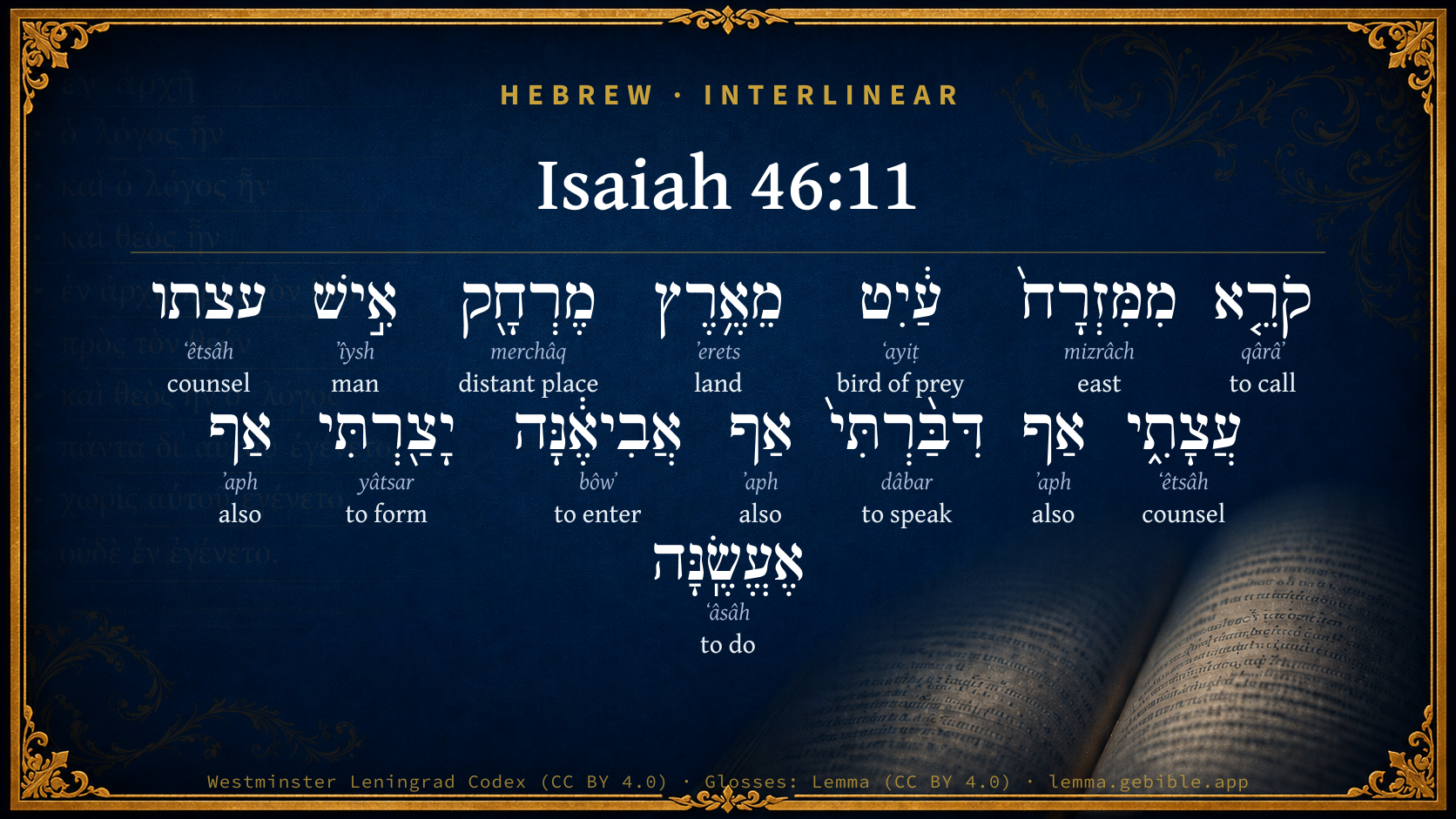
Hebrew (Westminster Leningrad Codex) Isaiah 46:11 appears in the Hebrew Old Testament. The text above is from the Westminster Leningrad Codex. Each word links to its Strong’s number, a concise gloss, and parsing drawn from the Open Scriptures Hebrew Bible morphology. Click any word for its full Brown-Driver-Briggs (BDB) entry.
Download image
Cite this verse

Isaiah 46:11 (World English Bible). Public Domain. Lemma interlinear Bible study tool, https://lemma.gebible.app/v/isaiah/46/11.

Show BibTeX & RIS
BibTeX
RIS
English Translation
calling a ravenous bird from the east, the man of my counsel from a far country; yes, I have spoken, I will also bring it to pass; I have purposed, I will also do it.
World English Bible · Public Domain
Download a study sheet

One document with this verse’s original text, its word-by-word gloss line, the meaning frame, cross-references with their text, attributed commentary, and full source and license credits — printable, and it pastes into notes with its structure intact.

This verse Autodidact and up

Study sheet (.html) Plain text (.txt)

A passage Seminary Student

Up to 50 verses in one chapter. A passage sheet keeps up to 6 commentary sources and 12 cross-references per verse, in the order this page ranks them, and says so on the sheet whenever that leaves anything out. Ask for a single verse and you get the Autodidact verse sheet above.

Everything on this page stays free to read, with no account — the sheet is a download of what is already on screen, not access to it.

Want to remove ads? Support Godless Engineer
Compare translations 3

The same verse in 3 English versions, stacked beneath the original-language interlinear above. Click any original word for its lexicon entry.

Each is an independent rendering of the whole verse — the interlinear is not word-aligned to these translations.

Highlighted words mark where these versions differ — a whole-verse word diff, not a word-by-word alignment.

  • World English Bible Public Domain
    calling a ravenous bird from the east, the man of my counsel from a far country; yes, I have spoken, I will also bring it to pass; I have purposed, I will also do it.
  • King James Version Public Domain
    Calling a ravenous bird from the east, the man that executeth my counsel from a far country: yea, I have spoken it, I will also bring it to pass; I have purposed it, I will also do it.
  • unfoldingWord Literal Text CC BY-SA 4.0
    calling from the rising a bird of prey, from a land of distance, the man of my counsel. Indeed, I have spoken; indeed, I will make it come. I have formed; indeed, I will do it.

unfoldingWord Literal Text — © unfoldingWord, licensed CC BY-SA 4.0. Word-aligned USFM3 via Door43 (git.door43.org/unfoldingWord/en_ult).

Versions to compare (up to 4)

3 of 4 selected

Show all 18 translations

Every available English version of this verse, each an independent rendering of the whole verse.

  • World English Bible Public Domain
    calling a ravenous bird from the east, the man of my counsel from a far country; yes, I have spoken, I will also bring it to pass; I have purposed, I will also do it.
  • Berean Standard Bible Public Domain
    I summon a bird of prey from the east, a man for My purpose from a far-off land. Truly I have spoken, and truly I will bring it to pass. I have planned it, and I will surely do it.
  • Majority Standard Bible Public Domain
    I summon a bird of prey from the east, a man for My purpose from a far-off land. Truly I have spoken, and truly I will bring it to pass. I have planned it, and I will surely do it.
  • King James Version Public Domain
    Calling a ravenous bird from the east, the man that executeth my counsel from a far country: yea, I have spoken it, I will also bring it to pass; I have purposed it, I will also do it.
  • American Standard Version (1901) Public Domain
    calling a ravenous bird from the east, the man of my counsel from a far country; yea, I have spoken, I will also bring it to pass; I have purposed, I will also do it.
  • Revised Version (1885) Public Domain
    calling a ravenous bird from the east, the man of my counsel from a far country; yea, I have spoken, I will also bring it to pass; I have purposed, I will also do it.
  • Geneva Bible (1599) Public Domain
    I call a birde from the East, and the man of my counsell from farre: as I haue spoken, so will I bring it to passe: I haue purposed it, and I will doe it.
  • Douay-Rheims (1899) Public Domain
    Who call a bird from the east, and from a far country the man of my own will, and I have spoken, and will bring it to pass: I have created, and I will do it. Hear me, O ye hardhearted, who are far from justice.
  • Young's Literal Translation Public Domain
    Calling from the east a ravenous bird, From a far land the man of My counsel, Yea, I have spoken, yea, I bring it in, I have formed `it', yea, I do it.
  • Literal Standard Version CC BY-SA 4.0
    Calling a ravenous bird from the east, || The man of My counsel from a far land, || Indeed, I have spoken, indeed, I bring it in, || I have formed [it], indeed, I do it.
  • Unlocked Literal Bible CC BY-SA 4.0
    I call a bird of prey from the east, the man of my choice from a distant land; yes, I have spoken; I will also accomplish it; I have purposed, I will also do it.
  • unfoldingWord Literal Text CC BY-SA 4.0
    calling from the rising a bird of prey, from a land of distance, the man of my counsel. Indeed, I have spoken; indeed, I will make it come. I have formed; indeed, I will do it.
  • Darby Bible Public Domain
    calling a bird of prey from the east, the man of my counsel from a far country. Yea, I have spoken, I will also bring it to pass; I have purposed it, I will also do it.
  • World Messianic Bible Public Domain
    I call a ravenous bird from the east, the man of my counsel from a far country. Yes, I have spoken. I will also bring it to pass. I have planned. I will also do it.
  • Webster's Bible Public Domain
    Calling a ravenous bird from the east, the man that executeth my counsel from a far country: yes, I have spoken it, I will also bring it to pass; I have purposed it, I will also perform it.
  • Free Bible Version CC BY-SA 4.0
    I'm calling a bird of prey from the east, a man from a distant country who will carry out my plan. I have spoken, and I will make sure it happens. I have made my plan, and I will carry it out.
  • Bible in Basic English Public Domain
    Sending for a bird of strong flight from the east, the man of my purpose from a far country; I have said it, and I will give effect to it; the thing designed by me will certainly be done.
  • JPS Tanakh (1917) Public Domain
    Calling a bird of prey from the east, the man of My counsel from a far country; yea, I have spoken, I will also bring it to pass, I have purposed, I will also do it.

Literal Standard Version (2020), Covenant Press — licensed CC BY-SA 4.0. Text via the HelloAO Bible API (eBible.org). Unlocked Literal Bible (unfoldingWord) — licensed CC BY-SA 4.0. Text via the HelloAO Bible API (eBible.org). unfoldingWord Literal Text — © unfoldingWord, licensed CC BY-SA 4.0. Word-aligned USFM3 via Door43 (git.door43.org/unfoldingWord/en_ult). Free Bible Version, Dr. Jonathan Gallagher — licensed CC BY-SA 4.0. Text via the HelloAO Bible API (eBible.org).

Word by word

More ways to search: Search by grammar → Find every occurrence → Compare this word →

Practice this passage: Drill this verse → Learn its vocabulary →

עַ֔יִט
ʻayiṭ
H5861
“bird of prey”
Noun, Common, Masculine, Singular, Absolute
Part of Speech
Noun
Type
Common
Gender
Masculine
Number
Singular
State
Absolute
Full BDB Definition

Origin: from H5860

TWOT: 1610a

bird of prey, a swooper
  1. קֹרֵ֤א qârâʼ H7121 “calling” Verb, Qal, Participle Active, Masculine, Singular, Absolute
  2. מִמִּזְרָח֙ mizrâch H4217 “from · east” Preposition + Noun, Common, Masculine, Singular, Absolute
  3. מֵאֶ֥רֶץ ʼerets H776 “from · land of” Preposition + Noun, Common, Both, Singular, Construct
  4. מֶרְחָ֖ק merchâq H4801 “distant place” Noun, Common, Masculine, Singular, Absolute
  5. אִ֣ישׁ ʼîysh H376 “man of” Noun, Common, Masculine, Singular, Construct
  6. עצתו ʻêtsâh H6098 “counsel · his” Noun, Common, Feminine, Singular, Construct + Suffix, Personal, 3rd Person, Masculine, Singular
  7. עֲצָתִ֑י ʻêtsâh H6098 “counsel · my” Noun, Common, Feminine, Singular, Construct + Suffix, Personal, 1st Person, Common, Singular
  8. אַף ʼaph H637 “also” Particle, Accusative
  9. דִּבַּ֨רְתִּי֙ dâbar H1696 “to speak” Verb, Piel, Perfect, 1st Person, Common, Singular
  10. אַף ʼaph H637 “also” Particle, Accusative
  11. אֲבִיאֶ֔נָּה bôwʼ H935 “to enter · her” Verb, Hiphil, Imperfect, 1st Person, Common, Singular + Suffix, Personal, 3rd Person, Feminine, Singular
  12. יָצַ֖רְתִּי yâtsar H3335 “to form” Verb, Qal, Perfect, 1st Person, Common, Singular
  13. אַף ʼaph H637 “also” Particle, Accusative
  14. אֶעֱשֶֽׂנָּה ʻâsâh H6213 “to do · her” Verb, Qal, Imperfect, 1st Person, Common, Singular + Suffix, Personal, 3rd Person, Feminine, Singular

About this verse

These counts appear in no published source. They are computed here, from the morphology-tagged text and Lemma’s own curated glosses. What Lemma adds →

15
words
12
distinct lemmas
Prophets
section

Notable vocabulary

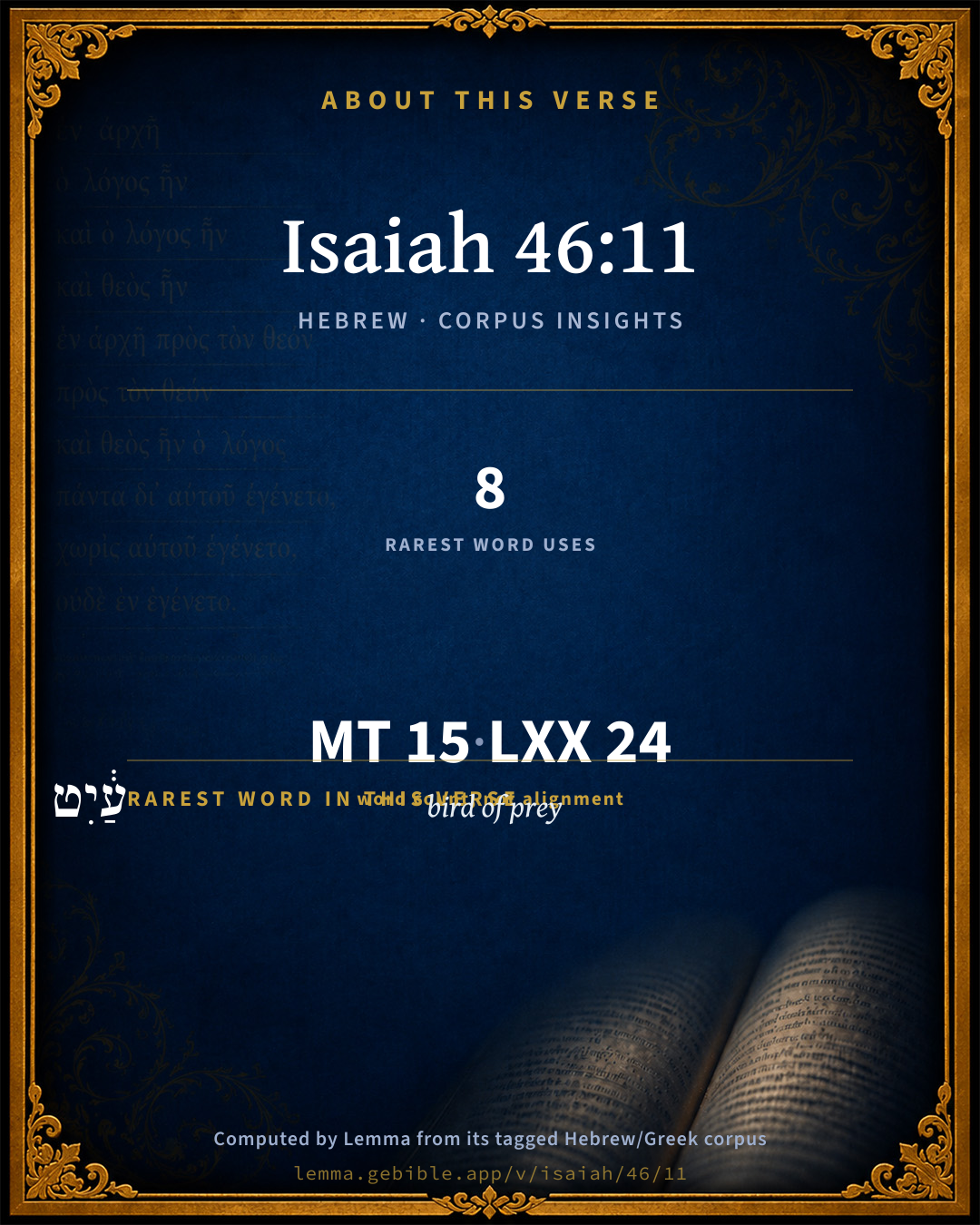
The rarest word here is עַ֔יִט bird of prey H5861 — appearing just 8 times in the whole Hebrew Bible.

Shared distinctive vocabulary

עַ֔יִט bird of prey H5861 occurs in 6 verses of the Hebrew Bible. Also found in:

Grammatical profile

  • 5 verbs
  • 7 nouns
  • 3 particles

Verb forms

  • קֹרֵ֤א Qal · Participle Active
  • דִּבַּ֨רְתִּי֙ Piel · Perfect
  • אֲבִיאֶ֔נָּה Hiphil · Imperfect
  • יָצַ֖רְתִּי Qal · Perfect
  • אֶעֱשֶֽׂנָּה Qal · Imperfect

Repetition

Words recur within this verse — often emphatic in Hebrew:

  • אַף also H637 ×3
  • עצתו counsel H6098 ×2

Hebrew & Septuagint length

In English translation the verse runs 35 words from the Hebrew and 39 from the Septuagint (LXX English) — closely comparable.

A rough comparison of the two English renderings, which tokenize alike — not a word-level alignment.

Word counts can differ between the Hebrew and the Greek without any difference in meaning — e.g. the Hebrew direct-object marker אֵת has no separate Greek word, and Greek often adds the article ὁ.

In the original languages it is 15 Hebrew tokens and 24 Greek tokens — but the two are counted differently (Hebrew bundles its prefixes and suffixes into one token; the Greek is in lemma form), so that isn’t a like-for-like length.

Cross-references

22

Topical passages linked to Isaiah 46:11 in the Treasury of Scripture Knowledge — connected by theme and wording, ordered by reader-vote popularity; previews shown in the World English Bible.

  • Numbers 23:19 God is not a man, that he should lie, Neither the son of man, that he should repent: Has he said, and will he not do it? Or has he spoken, and will he not make it good?
  • Isaiah 14:24–27 Yahweh of Hosts has sworn, saying, Surely, as I have thought, so shall it happen; and as I have purposed, so shall it stand:
  • Job 23:13 But he stands alone, and who can oppose him? What his soul desires, even that he does.
  • Isaiah 41:2 Who has raised up one from the east, whom he calls in righteousness to his foot? he gives nations before him, and makes him rule over kings; he gives them as the dust to his sword, as the driven stubble to his bow.
  • Ephesians 1:11 in whom also we were assigned an inheritance, having been foreordained according to the purpose of him who works all things after the counsel of his will;
  • Acts 5:39 But if it is of God, you will not be able to overthrow it, and you would be found even to be fighting against God!"
  • Ezra 1:2 Thus says Cyrus king of Persia, All the kingdoms of the earth has Yahweh, the God of heaven, given me; and he has charged me to build him a house in Jerusalem, which is in Judah.
  • Psalms 119:24 Indeed your statutes are my delight, And my counselors.
  • Isaiah 38:15 What shall I say? he has both spoken to me, and himself has done it: I shall go softly all my years because of the bitterness of my soul.
  • Isaiah 48:14–15 Assemble yourselves, all you, and hear; who among them has declared these things? He whom Yahweh loves shall perform his pleasure on Babylon, and his arm [shall be on] the Chaldeans.
  • Psalms 76:10 Surely the wrath of man praises you. The survivors of your wrath are restrained.
  • Isaiah 13:2–4 Set up an ensign on the bare mountain, lift up the voice to them, wave the hand, that they may go into the gates of the nobles.
  • Isaiah 41:25 I have raised up one from the north, and he has come; from the rising of the sun one who calls on my name: and he shall come on rulers as on mortar, and as the potter treads clay.
  • Isaiah 44:28–45:6 Who says of Cyrus, [He is] my shepherd, and shall perform all my pleasure, even saying of Jerusalem, She shall be built; and of the temple, Your foundation shall be laid.
  • Isaiah 45:13 I have raised him up in righteousness, and I will make straight all his ways: he shall build my city, and he shall let my exiles go free, not for price nor reward, says Yahweh of Hosts.
  • Jeremiah 50:45 Therefore hear the counsel of Yahweh, that he has taken against Babylon; and his purposes, that he has purposed against the land of the Chaldeans: Surely they shall drag them away, [even] the little ones of the flock; surely he shall make their habitation desolate over them.
  • Ephesians 3:11 according to the eternal purpose which he purposed in Christ Jesus our Lord;
  • Jeremiah 50:29 Call together the archers against Babylon, all those who bend the bow; encamp against her round about; let none of it escape: recompense her according to her work; according to all that she has done, do to her; for she has been proud against Yahweh, against the Holy One of Israel.
  • Jeremiah 51:20–29 You are my battle-axe and weapons of war: and with you will I break in pieces the nations; and with you will I destroy kingdoms;
  • Ezekiel 39:4 You shall fall on the mountains of Israel, you, and all your hordes, and the peoples who are with you: I will give you to the ravenous birds of every sort, and to the animals of the field to be devoured.
  • Acts 4:28 to do whatever your hand and your council foreordained to happen.
  • Isaiah 21:7–9 and when he sees a troop, horsemen in pairs, a troop of donkeys, a troop of camels, he shall listen diligently with much heed.

Cross-references courtesy of OpenBible.info (CC BY 4.0).

Hebrew and Greek witnesses Masoretic Hebrew ↔ Greek Septuagint

The same verse in the two great witnesses to the Old Testament, shown verse-for-verse.

These are two independent witnesses, not word-aligned to each other, and the Septuagint is shown in lemma (dictionary) form.

Hebrew Isaiah 46:11 Masoretic · Westminster Leningrad Codex

קֹרֵ֤א מִמִּזְרָח֙ עַ֔יִט מֵאֶ֥רֶץ מֶרְחָ֖ק אִ֣ישׁ עצתו עֲצָתִ֑י אַף דִּבַּ֨רְתִּי֙ אַף אֲבִיאֶ֔נָּה יָצַ֖רְתִּי אַף אֶעֱשֶֽׂנָּה

calling a ravenous bird from the east, the man of my counsel from a far country; yes, I have spoken, I will also bring it to pass; I have purposed, I will also do it.

World English Bible · Public Domain

Greek LXX Isaiah 46:11 Septuagint · lemma form

καλέω ἀπό ἀνατολή πετεινόν καί ἀπό γῆ πόρρωθεν περί ὅς βουλεύω λαλέω καί ἄγω κτίζω καί ποιέω ἄγω αὐτός καί εὐοδόω ὁ ὁδός αὐτός

calling a bird from the east, and from a land afar off, for the things which I have planned: I have spoken, and brought him; I have created and made him; I have brought him, and prospered his way.

LXX2012 (modern English Septuagint) · Public Domain

On this verse, Adam Clarke's Commentary discusses the Septuagint’s reading. Read the note in Commentary ↓

Hebrew: Westminster Leningrad Codex (CC BY 4.0). Greek: Septuagint (public domain); English from LXX2012 (modern English Septuagint) (Public Domain). How the Septuagint differs from the Hebrew →

Targum (Aramaic paraphrase)

1

The Targum is the ancient Jewish Aramaic paraphrase of the Hebrew Scriptures — an interpretive translation, not the Hebrew text itself. Onkelos (literal) and Pseudo-Jonathan (expansive) render the Torah, and Jonathan the Prophets. Coverage is partial: where no permissively-licensed English translation exists for a verse, only the Aramaic is shown. This is verse-level text, not a word-by-word alignment to the Hebrew.

  1. Targum Jonathan Prophets (Joshua–Malachi)
    דַאֲמַר לְכַנָשָׁא גַלְוָתָא מִמַדִינְחָא לְאַיְתָאָה בִגְלֵי כְעוֹף קַלִיל מַאֲרַע רְחִיקָא בְּנֵי אַבְרָהָם רְחִימִי אַף מַלְלֵית אַף אַיְתִינָהּ אַף אַתְקֵינְתָּא אַף אַעְבְּדִינָהּ:

    Who hath promised to gather together the captivity from the East, to bring openly, as a swift bird, the sons of Abraham, my chosen, from a distant land; yea, I have promised it; yea, I will bring it to pass! I have ordained it; yea, I will do it.

    Targum Jonathan — Aramaic: “Mikraot Gedolot” (public domain). English: “Sefaria Community Translation” (CC0 1.0 (public-domain dedication)); “London "Chaldee Paraphrase," 1871” (public domain). Text via Sefaria.

Commentary

Notes on Isaiah 46:11 from classic Christian and Jewish commentators (each source and its license shown beneath its notes). The classic Christian expositions comment on the surrounding passage and are grouped to its opening verse, so a note may address several verses; the Jewish commentaries on the Tanakh (Rashi and others) are per-verse, so they appear only where the commentator wrote on this verse.

Lemma curates 59 commentaries, every one of them public domain or Creative Commons licensed, each selected and text-cleaned for this edition rather than reprinted as found. About our sources →

Trapp's Complete Commentary

John Trapp

Isa 46:11 Calling a ravenous bird from the east, the man that executeth my counsel from a far country: yea, I have spoken [it], I will also bring it to pass; I have purposed [it], I will also do it.

Ver. 11. Calling a ravenous bird,] i.e., Cyrus, who was ‘hawk-nosed,’ and came swiftly to seize upon Babylon like a falcon, or some such ravenous bird. So Nebuchadnezzar is called an "eagle"; {Jer 48:40} Xenophone testifieth that Cyrus had in his standard a golden spread eagle, as had after him the Persian kings, and likewise the Romans. See Mat 24:28. {See Trapp on "Mat 24:28"}

{a} Cyropaed., lib. vii.

John Trapp, A Commentary or Exposition upon All the Books of the Old and New Testament (1647–1656) — public domain. Text from a community e-Sword module.

Tyndale Open Study Notes

Tyndale Open Resources

46:11 The swift bird of prey from the east refers to Cyrus, the Persian king (see study note on 41:2).

Tyndale Open Study Notes — © Tyndale Open Resources, licensed CC BY-SA 4.0. Text via the HelloAO Bible API.

Geneva Bible (1599)

Geneva Bible translators

That is, Cyrus, which shall come as swift as a bride, and fight against Babylon.

Him by whom I have appointed to execute that which I have determined.

Geneva Bible (1599) marginal notes — public domain. Text via Bolls.life.

Jamieson, Fausset & Brown

Robert Jamieson, A. R. Fausset & David Brown

ravenous bird--Cyrus so called on account of the rapidity of his marches from the distant regions of Persia to pounce on his prey (see on Isa 41:2; Isa 41:25; Jer 49:22; Eze 17:3). The standard of Cyrus, too, was a golden eagle on a spear (see the heathen historian, XENOPHON, 7, where almost the same word is used, aetos, as here, ayit).

executeth my counsel-- (Isa 44:28; Isa 45:13). Babylon represents, mystically, the apostate faction: the destruction of its idols symbolizes the future general extirpation of all idolatry and unbelief.

purposed . . . also do it-- (Isa 43:13).

Jamieson, Fausset & Brown — Commentary Critical and Explanatory on the Whole Bible (1871) — public domain (CC PDM 1.0). Text via the HelloAO Bible API.

Adam Clarke's Commentary

Verse 11. Calling a ravenous bird from the east - "Calling from the east the eagle"] A very proper emblem for Cyrus, as in other respects, so particularly because the ensign of Cyrus was a golden eagle, ΑΕΤΟΣ χρυσους, the very word עיט ayit, which the prophet uses here, expressed as near as may be in Greek letters. XENOPH. Cyrop. lib. vii. sub. init. Kimchi says his father understood this, not of Cyrus, but of the Messiah.

From a far country - "From a land far distant"] Two MSS. add the conjunction ו vau, ומארץ umeerets; and so the Septuagint, Syriac, and Vulgate.

Adam Clarke's Commentary on the Bible (1810–1826) — public domain. Text from a community e-Sword/MySword module.

Ellicott's Commentary for English Readers

(11) Calling a ravenous bird.—Cyrus is thus described as Nebuchadnezzar is in Jer_49:22; Eze_17:3. The image derives a special significance from the fact that the standard borne by Cyrus and his successors was a golden eagle (Xen., Cyrop. vii. 1. 4; Anab. i. 10, 12). (Comp. also Mat_24:28; Luk_17:37.) The “sun-rising” is, of course, Persia; the “far country” probably represents Media.

I have spoken.—The word of Jehovah passes, unlike that of the false gods, into a certain and immediate act.

A Bible Commentary for English Readers, edited by Charles John Ellicott (1878–1897) — public domain. Text from a community e-Sword module.

The Cambridge Bible for Schools and Colleges

gen. ed. J. J. S. Perowne

11. The supreme illustration of the foreknowledge and power of Jehovah is the raising up of Cyrus. Cyrus is compared to a ravenous bird on account of the celerity of his movements (ch. Isa_41:3), just as Nebuchadnezzar had been likened to an eagle (Jer_49:22; Eze_17:3). There can hardly be an allusion to the fact (if it be a fact) that the royal ensign of Persia was a golden eagle (Xenophon, Cyrop. vii. 1, 4).

from the east] Isa_41:2; Isa_41:25.

the man that executeth my counsel] Lit. as R.V. the man of my counsel (the consonantal text has “his counsel”). Not of course “my counsellor” (as in Isa_40:13), but in the sense expressed by the A.V.

I have purposed] Lit. I have formed, i.e. “foreordained,” as in ch. Isa_22:11, Isa_37:26.

The Cambridge Bible for Schools and Colleges (gen. ed. J. J. S. Perowne; Cambridge University Press, 1878–1918) — public domain. Text from a community e-Sword module.

John Gill's Exposition

Calling a ravenous bird from the east,.... Or "a flying fowl", or "swift winged bird" (u); for the word used does not so much denote rapaciousness as swiftness; which well agrees with Cyrus, who is here meant, and not Abraham, as Jarchi, nor Nebuchadnezzar, as others; and who was always swift in all his expeditions, and always recommended celerity and dispatch of business to his soldiers and others, as Xenophon (w) often observes; and very remarkable is that speech of Tigranes to him, in which he tells him (x), that he so far exceeded the king of Armenia in swiftness, that he came upon him with a great army, from a far country, before he could get his army together, which was just by him. And very observable are the words of Cyrus himself, who was desirous of being a thorough horseman, that he might seem to be , "a winged" or "flying man" (y) So the Targum here renders it, a swift bird. Aben Ezra, who interprets it of Cyrus, says he is so called, as if he flew to do the will of God; and Kimchi observes of Cyrus, that he has this name because he came swiftly, and in haste, as a bird that flies: and it is no unusual thing for a mighty monarch, or a general, marching with his army, to be compared to a flying bird, particularly an eagle, Jer 48:40 and may be the bird intended here, which well suits with Cyrus, who had, as Plutarch (z) reports, an aquiline nose; hence men that have such noses, among the Persians, are highly esteemed: and Xenophon (a) says, that the standard of Cyrus was a golden eagle upon the top of a high spear, and which is retained by the kings of Persia. Cyrus is said to be called from the east, because, as Kimchi observes, his country lay to the east of Babylon:

the man that executeth my counsel from afar country; as Persia was from Babylon, Assyria and other provinces lying between; but though he lived in a far country, and knew nothing of the affairs of the people of God in Babylon, or what work he was to do, yet God called him, and brought him to do his will, which he was ignorant of: so God sometimes puts into the hearts of men to fulfil his will, which they are strangers to, Rev 17:17. It is in the Hebrew text, "the man of my counsel" (b); not with whom the Lord consulted, for none are of his counsel in this sense; but whom in his counsels, decrees, and purposes, he appointed to such service, and whom he made use of as an instrument to do his pleasure; see Isa 44:8.

yea, I have spoken it, I will also bring it to pass: I have purposed, I will also do it; the counsel of the Lord, concerning the deliverance of his people from Babylon, by the hand of Cyrus; this he had purposed in his own breast, had spoken of in prophecy, and would certainly perform. R. Joseph Kimchi interprets this verse of the Messiah, and so does Jerom, of whom, no doubt, Cyrus was a type; and what is here said agrees with him: he may be compared to a flying bird for his swiftness in coming at the appointed time; he came from the east, as the rising sun of righteousness; he was the man of God's counsel in the highest sense, and came, being called, to execute it; the work of redemption was according to the eternal purpose of God, and spoke of by all the holy prophets, and now accomplished; and his righteousness and salvation are made mention of in the following verses.

(u) "avem, a velocitate", Munster; so Vatablus; ab "in volando celeriter et cum impetu", Forerius; so Ben Melech says, Cyrus is surnamed a fowl, because of his great swiftness and haste to come to Babylon; though he observes that some say, that a ravenous fowl is called the singular may be put for the plural; so Cocceius renders it, "volucres", birds, and may design the whole army of Cyrus. (w) Cyropaedia, l. 1. c. 17. and l. 3. c. 6. and l. 6. c. 17. (x) Cyropaedia, l. 3. c. 2. (y) Ib. l. 4. c. 17. (z) In Apothegm. (a) Cyropaedia, l. 7. c. 1. (b) "virum mei consilii", Munster, Pagninus, Montanus; so according to the Keri: but the Cetib is , "the man of his counsel".

John Gill's Exposition of the Whole Bible (1746–1763) — public domain (CC PDM 1.0). Text via the HelloAO Bible API.

Albert Barnes' Notes on the Bible

Calling a ravenous bird from the east - There can be no doubt that Cyrus is intended here (see the notes at Isa 41:2, Isa 41:25). The east here means Persia. The word rendered ‘ravenous bird’ (עיט ‛ayiṭ) is rendered ‘fowl’ in Job 28:7; ‘bird’ or ‘birds’ in Jer 12:9; ‘fowls’ in Gen 15:11; Isa 18:6; and ‘ravenous birds’ in Eze 39:4. It does not occur elsewhere in the Bible. It is used here as an emblem of a warlike king, and the emblem may either denote the rapidity of his movements - moving with the flight of an eagle; or it may denote the devastation which he would spread - an emblem in either sense especially applicable to Cyrus. It is not uncommon in the Bible to compare a warlike prince to an eagle Jer 49:22; Eze 17:3; and the idea here is, probably, that Cyrus would come with great power and velocity upon nations, like the king of birds, and would pounce suddenly and unexpectedly upon his prey. Perhaps also there may be here allusion to the standard or banner of Cyrus. Xenophon (Cyrop. vii.) says that it was a golden eagle affixed to a long spear; and it is well remarked by Lowth, that Xenophon has used the very word which the prophet uses here, as near as could be, expressing it in Greek letters. The word of the prophet is עיט ‛ayiṭ; the Greek word used by Xenophon is ἀετὸς aetos. The Chaldee has, however, given a different rendering to this passage: ‘I, who say that I will gather my captivity from the east, and will lead publicly like a swift bird from a distant land the sons of Abraham, my friend.’

The man that executeth my counsel - Margin, as Hebrew, ‘Of my counsel.’ It may either mean the man whom he had designated by his counsel; or it may mean the man who should execute his purpose.

Yea, I have spoken - He spake it by the prophets; and the idea is, that all that he had spoken should be certainly accomplished.

Albert Barnes' Notes on the Bible (1834–1885) — public domain. Text from a community e-Sword/MySword module.

Haydock's Catholic Bible Commentary

Bird; Cyrus, whose rapid conquests are thus denoted. (Calmet) --- He chose a golden eagle, with wings expanded, for his standard. (Xenophon vii.) --- Christ came from heaven to redeem the world, Psalm xviii. 6., and Malachias iv. 2. (Calmet) --- He was the orient, adored by the eastern sages, to whom the prophet refers. (St. Jerome) (Worthington)

George Leo Haydock (1774–1849), Haydock's Catholic Family Bible and Commentary, 1859 edition — public domain. Excludes Psalms (Douay-Rheims chapter numbering differs from Protestant) and Deuterocanonical books (Catholic canon only).

Matthew Poole's English Annotations

Calling a ravenous bird; Cyrus, called a bird for his swiftness and great expedition, and ravenous for his fierceness and victoriousness over his enemies.

From the east; from Persia, as Isa 41:2.

That executeth my counsel, concerning the deliverance of my people, and the destruction of their cruel oppressors, the Babylonians.

From a far country; from Persia, which was far from Babylon, but much farther from Judea.

Matthew Poole's English Annotations on the Holy Bible (1683–1685) — public domain. Text from a community e-Sword/MySword module.

Whedon's Commentary on the Bible

Daniel D. Whedon

11. Calling… from the east — Literally, from the sun rising.

A ravenous bird — Cyrus was rapid in movement and execution; quick, keen sighted, strong. He is said to have taken for his ensign a golden eagle standing with outstretched wings. XENOPHON, Cyrop., Isa_7:1.

Daniel D. Whedon (gen. ed.), Commentary on the Old and New Testaments (1874–1909) — public domain. Text from a community e-Sword module.

The Pulpit Commentary

Calling a ravenous bird; rather, a bird of prey. The imagery is quite natural, and exactly parallel to that by which Nebuchadnezzar is termed "an eagle," both by Jeremiah (Jer_44:22) and Ezekiel. (Eze_17:3) There is no need to suppose any allusion to the fact, if fact it be, that the Persians from the time of Cyrus had for a standard a golden eagle, with wings outspread, on the top of a spear-shaft (Xen., "Cyrop.," 7:1, "Anab.," 1:10, From the east. (comp. Isa_41:2, Isa_41:25) Both Persia and Susiana, which were the primary seats of the power of Cyrus, lay to the east of Babylon, the latter due east, the former somewhat to the south-east. Even Media might, according to Hebrew usage, be described as east, though lying almost due north-east.

The Pulpit Commentary (1880–1919), ed. H.D.M. Spence-Jones & Joseph S. Exell — public domain. Text from a community e-Sword module.

John Wesley's Explanatory Notes

A bird - Cyrus, called a bird for his swiftness, and ravenous for his fierceness, and victoriousness over his enemies.

John Wesley, Explanatory Notes Upon the Whole Bible (1754–1765) — public domain. Text via the GEBible commentary corpus.

J. A. Alexander on Isaiah

Joseph Addison Alexander

“Calling from the east a bird of prey, from a land of distance the man of his counsel; I have both said and will also bring it to pass, I have formed (the plan) and will also do it.” From the general assertion of His providence and power, He now passes to that specific proof of it which has so frequently been urged before, viz. the raising up of Cyrus; but without the mention of his name in this case, and with an indefiniteness of expression which is perfectly well suited to the general analogy of prophecy, as well as to the views already taken in the exposition of Isa 44:28. Calling includes prediction and efficiency, not only announcing but calling into being. The point of comparison is not mere swiftness or rapidity of conquest, (Hos 8:1; Hab 1:8; Jer 48:40) but rapacity and fierceness. ‘Man of His counsel’ does not mean his counselor, as it does in Isa 40:13, but either the executor of His purpose, or the agent himself purposed (i.e., foreordained by God). It is as if He had said, ‘I am He that calls the man of His counsel’, after which the construction is continued regularly in the first person. The antithesis expressed is that between design and execution.

Joseph Addison Alexander, The Prophecies of Isaiah (1846–1847; New York: Scribner, 1870–1878) — public domain. Text from a community e-Sword module.

Rashi

Rabbi Shlomo Yitzchaki (Rashi)

[I] call from the east a swift bird Heb. עַיִט. From the land of Aram, which is in the east, I called Abraham to Me to take counsel with Me. עַיִט Comp. (Dan. 2:14) “Answered with counsel (עֵיטָא) and discretion”; (ibid. 6:8) “All the presidents of the kingdom have taken counsel (אִתְיָעֲטוּ).” Alternatively, it can be interpreted as an expression of a bird. I called him to hasten after Me like a bird that flies and wanders from its place.

from a distant land I called My man of counsel, and with him I took counsel between the parts concerning the four exiles, as it is explained in Gen. Rabbah (44:17) “And behold, a fear, great darkness was falling upon him.” [“Fear” refers to Babylon... “Darkness” refers to Media, who darkened the eyes of Israel with fasting. “Great” refers to Greece... “Was falling upon him” refers to Edom..., etc.]

yea I spoke with him concerning the exiles and their redemption; I will also bring it.

Rashi on the Tanakh — English translations: “The Judaica Press complete Tanach with Rashi, translated by A. J. Rosenberg” (CC BY 4.0); “Pentateuch with Rashi's commentary by M. Rosenbaum and A.M. Silbermann, 1929-1934” (public domain); “The Metsudah Tanach series, Lakewood, N.J” (CC BY 4.0); and “The Book of Joshua, Metsudah Publications, 1997” (CC BY 4.0). Text via Sefaria.

Ibn Ezra

Rabbi Abraham ibn Ezra

A ravenous bird. Cyrus. He is called a bird, because he flew, as it were, to fulfil my will.

I have spoken this decree. אביאנה I will also bring it to pass. יצרתיה I have formed it by a heavenly decree, I will also do it on earth.

Ibn Ezra on the Tanakh — English translations: “Sefaria Community Translation” (CC0 1.0 (public-domain dedication)); “Yalkut, Sifsei Chachomim Chumash, Metsudah Publications, 2009” (CC BY 4.0); and “Commentary of Ibn Ezra on Isaiah - trans. by M. Friedlander, 1873” (public domain). Text via Sefaria.

Lesson kit

Teaching starters — assembled from the data on this page, not authored interpretation. Every prompt links to the verse data it draws on. Edit before teaching.

Isaiah, in the Prophets, opens this verse with 15 words (12 distinct Hebrew lemmas). Its most distinctive word is ʻayiṭ (“bird of prey”). A historical commentator’s framing appears above. Read the whole chapter for the surrounding context.

Discussion questions

  1. How does “bird of prey” (ʻayiṭ) shape what this verse is saying?
  2. How does Genesis 15:11, which shares the word «bird of prey», read alongside this verse?
  3. What does the repetition of “also” (3× in this one verse) do in this verse?
  4. These translations render this verse differently; the difference is in the English rendering, not the original. What questions does that raise?
  5. «קֹרֵ֤א» is a Qal Participle Active verb. How does that grammatical form shape the action described?
  6. Compare how Trapp's Complete Commentary and Tyndale Open Study Notes read this verse. Where do they agree or differ?

Things to notice

Reading settings

Reading text

Shown beneath each verse's original-language words.

Old Testament
Old Testament edition

Read the OT as the Masoretic Hebrew (MT) or the Greek Septuagint (LXX).

English shown for the Greek Septuagint (in the Hebrew ↔ Greek comparison).

Comparing translations? Open the Compare panel on any verse page to stack up to four side by side.