
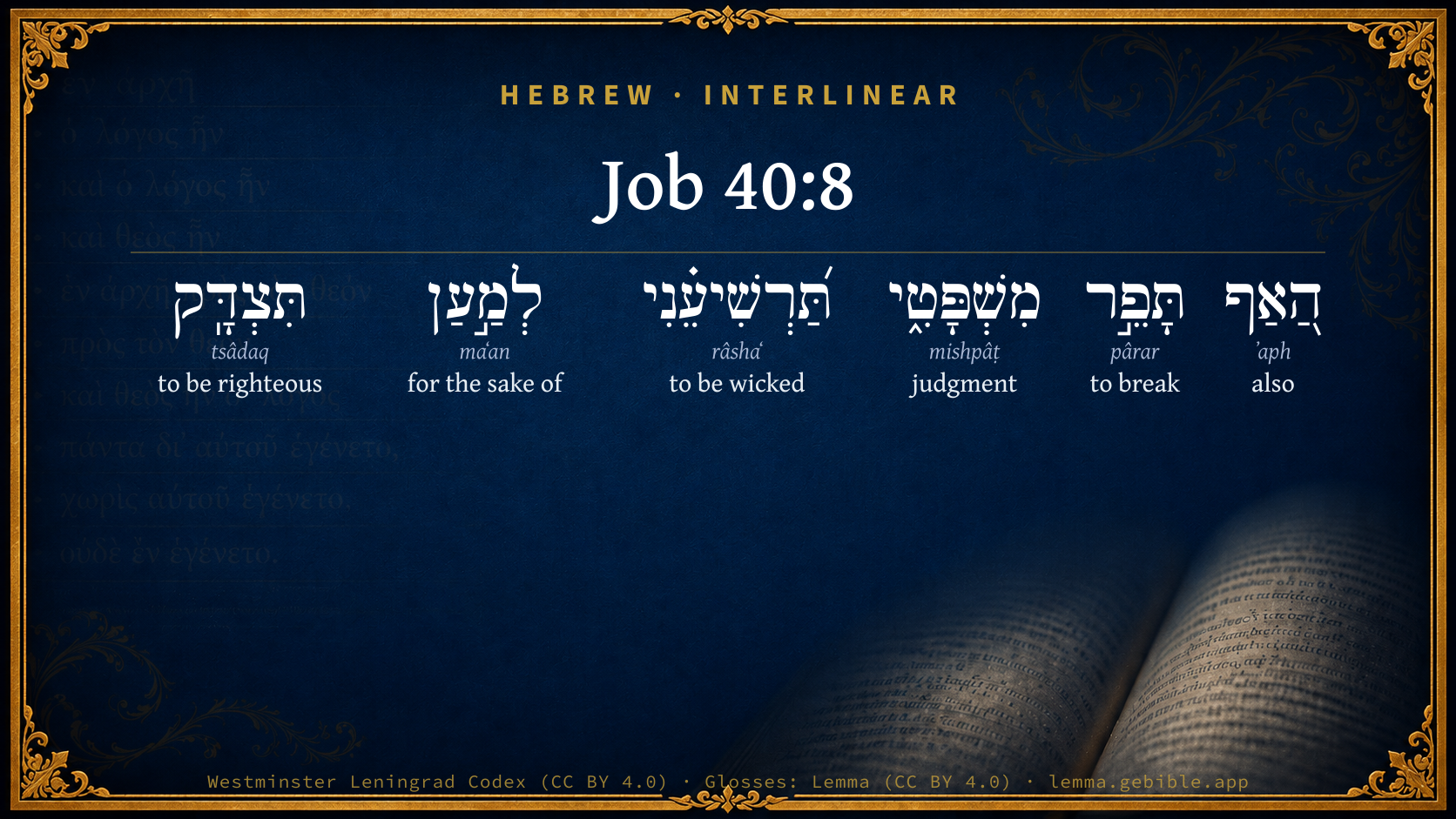
Job 40:8

Hebrew (Westminster Leningrad Codex) Job 40:8 appears in the Hebrew Old Testament. The text above is from the Westminster Leningrad Codex. Each word links to its Strong’s number, a concise gloss, and parsing drawn from the Open Scriptures Hebrew Bible morphology. Click any word for its full Brown-Driver-Briggs (BDB) entry.
Download image
Cite this verse

Job 40:8 (World English Bible). Public Domain. Lemma interlinear Bible study tool, https://lemma.gebible.app/v/job/40/8.

Show BibTeX & RIS
BibTeX
RIS
English Translation
Will you even annul my judgment? Will you condemn me, that you may be justified?
World English Bible · Public Domain
Download a study sheet

One document with this verse’s original text, its word-by-word gloss line, the meaning frame, cross-references with their text, attributed commentary, and full source and license credits — printable, and it pastes into notes with its structure intact.

This verse Autodidact and up

Study sheet (.html) Plain text (.txt)

A passage Seminary Student

Up to 50 verses in one chapter. A passage sheet keeps up to 6 commentary sources and 12 cross-references per verse, in the order this page ranks them, and says so on the sheet whenever that leaves anything out. Ask for a single verse and you get the Autodidact verse sheet above.

Everything on this page stays free to read, with no account — the sheet is a download of what is already on screen, not access to it.

Want to remove ads? Support Godless Engineer
Compare translations 3

The same verse in 3 English versions, stacked beneath the original-language interlinear above. Click any original word for its lexicon entry.

Each is an independent rendering of the whole verse — the interlinear is not word-aligned to these translations.

Highlighted words mark where these versions differ — a whole-verse word diff, not a word-by-word alignment.

  • World English Bible Public Domain
    Will you even annul my judgment? Will you condemn me, that you may be justified?
  • King James Version Public Domain
    Wilt thou also disannul my judgment? wilt thou condemn me, that thou mayest be righteous?
  • unfoldingWord Literal Text CC BY-SA 4.0
    Would you actually annul my judgment? Would you condemn me so that you may be right?

unfoldingWord Literal Text — © unfoldingWord, licensed CC BY-SA 4.0. Word-aligned USFM3 via Door43 (git.door43.org/unfoldingWord/en_ult).

Versions to compare (up to 4)

3 of 4 selected

Show all 18 translations

Every available English version of this verse, each an independent rendering of the whole verse.

  • World English Bible Public Domain
    Will you even annul my judgment? Will you condemn me, that you may be justified?
  • Berean Standard Bible Public Domain
    Would you really annul My justice? Would you condemn Me to justify yourself?
  • Majority Standard Bible Public Domain
    Would you really annul My justice? Would you condemn Me to justify yourself?
  • King James Version Public Domain
    Wilt thou also disannul my judgment? wilt thou condemn me, that thou mayest be righteous?
  • American Standard Version (1901) Public Domain
    Wilt thou even annul my judgment? Wilt thou condemn me, that thou mayest be justified?
  • Revised Version (1885) Public Domain
    Wilt thou even disannul my judgment? wilt thou condemn me, that thou mayest be justified?
  • Geneva Bible (1599) Public Domain
    Hide them in the dust together, and binde their faces in a secret place.
  • Douay-Rheims (1899) Public Domain
    Hide them in the dust together, and plunge their faces into the pit.
  • Young's Literal Translation Public Domain
    Dost thou also make void My judgment? Dost thou condemn Me, That thou mayest be righteous?
  • Literal Standard Version CC BY-SA 4.0
    Do you also make My judgment void? Do you condemn Me, || That you may be righteous?
  • Unlocked Literal Bible CC BY-SA 4.0
    Will you actually say that I am unjust? Will you condemn me so you may claim you are right?
  • unfoldingWord Literal Text CC BY-SA 4.0
    Would you actually annul my judgment? Would you condemn me so that you may be right?
  • Darby Bible Public Domain
    Wilt thou also annul my judgment? wilt thou condemn me that thou mayest be righteous?
  • World Messianic Bible Public Domain
    Will you even annul my judgment? Will you condemn me, that you may be justified?
  • Webster's Bible Public Domain
    \\40:13\\Hide them in the dust together; bind their faces in secret.
  • Free Bible Version CC BY-SA 4.0
    Are you really going to say my decisions are wrong? Are you going to condemn me so you can be right?
  • Bible in Basic English Public Domain
    Let them be covered together in the dust; let their faces be dark in the secret place of the underworld.
  • JPS Tanakh (1917) Public Domain
    Wilt thou even make void My judgment? Wilt thou condemn Me, that thou mayest be justified?

Literal Standard Version (2020), Covenant Press — licensed CC BY-SA 4.0. Text via the HelloAO Bible API (eBible.org). Unlocked Literal Bible (unfoldingWord) — licensed CC BY-SA 4.0. Text via the HelloAO Bible API (eBible.org). unfoldingWord Literal Text — © unfoldingWord, licensed CC BY-SA 4.0. Word-aligned USFM3 via Door43 (git.door43.org/unfoldingWord/en_ult). Free Bible Version, Dr. Jonathan Gallagher — licensed CC BY-SA 4.0. Text via the HelloAO Bible API (eBible.org).

Word by word

More ways to search: Search by grammar → Find every occurrence → Compare this word →

Practice this passage: Drill this verse → Learn its vocabulary →

About this verse

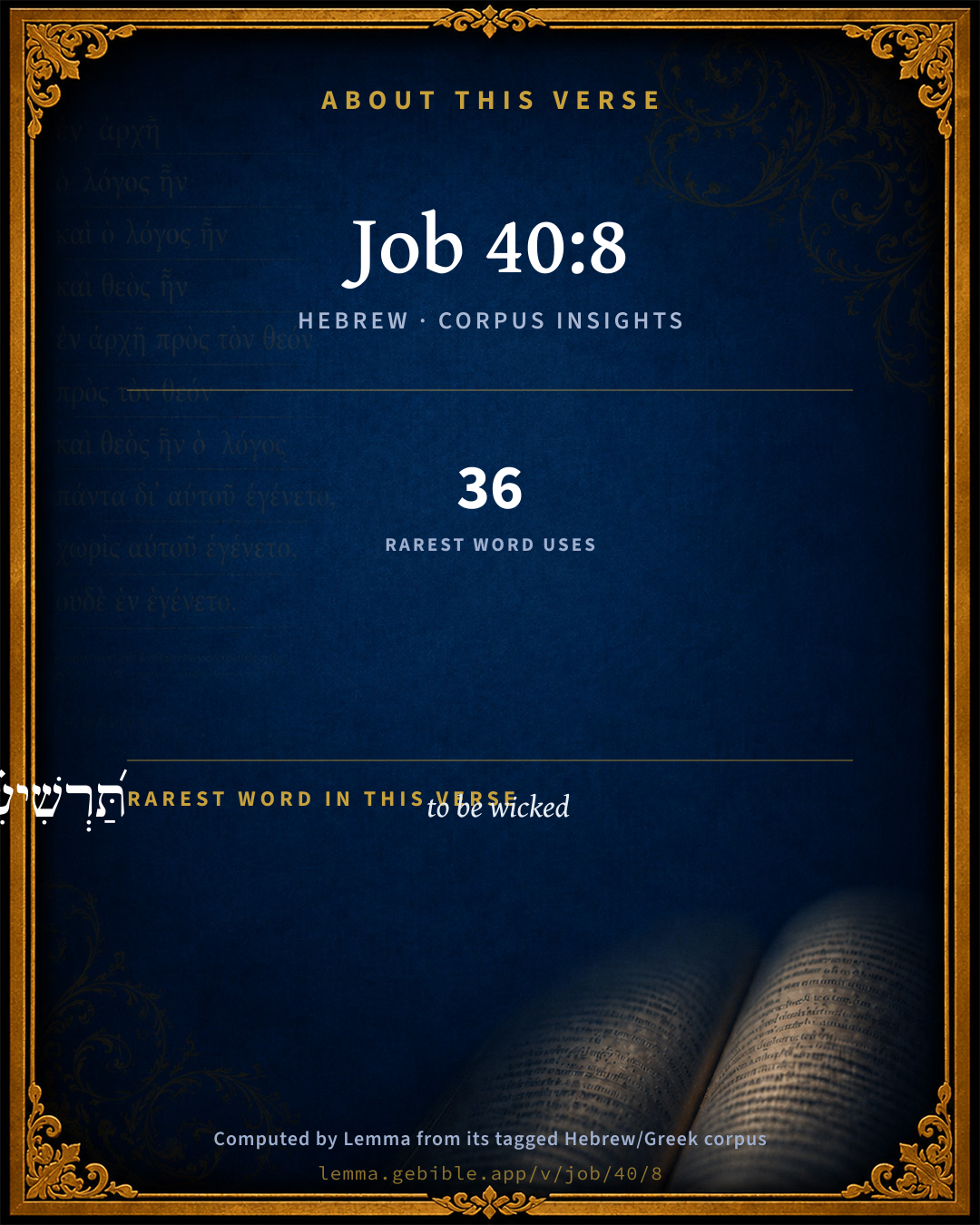
These counts appear in no published source. They are computed here, from the morphology-tagged text and Lemma’s own curated glosses. What Lemma adds →

6
words
6
distinct lemmas
Wisdom
section

Shared distinctive vocabulary

תַּ֝רְשִׁיעֵ֗נִי to be wicked H7561 occurs in 35 verses of the Hebrew Bible. Also found in:

Grammatical profile

  • 3 verbs
  • 1 noun
  • 1 preposition
  • 1 adverb

Verb forms

  • תָּפֵ֣ר Hiphil · Imperfect
  • תַּ֝רְשִׁיעֵ֗נִי Hiphil · Imperfect
  • תִּצְדָּֽק Qal · Imperfect

Hebrew & Septuagint length

In English translation the verse runs 15 words from the Hebrew and 13 from the Septuagint (LXX English) — closely comparable.

A rough comparison of the two English renderings, which tokenize alike — not a word-level alignment.

Word counts can differ between the Hebrew and the Greek without any difference in meaning — e.g. the Hebrew direct-object marker אֵת has no separate Greek word, and Greek often adds the article ὁ.

Cross-references

12

Topical passages linked to Job 40:8 in the Treasury of Scripture Knowledge — connected by theme and wording, ordered by reader-vote popularity; previews shown in the World English Bible.

  • Romans 3:4 May it never be! Yes, let God be found true, but every man a liar. As it is written, "That you might be justified in your words, And might prevail when you come into judgment."
  • Job 32:2 Then the wrath of Elihu the son of Barachel, the Buzite, of the family of Ram, was kindled against Job. His wrath was kindled because he justified himself rather than God.
  • Isaiah 28:18 Your covenant with death shall be annulled, and your agreement with Sheol shall not stand; when the overflowing scourge shall pass through, then you shall be trodden down by it.
  • Job 10:3 Is it good to you that you should oppress, That you should despise the work of your hands, And smile on the counsel of the wicked?
  • Job 34:5–6 For Job has said, 'I am righteous, God has taken away my right:
  • Psalms 51:4 Against you, and you only, have I sinned, And done that which is evil in your sight; That you may be proved right when you speak, And justified when you judge.
  • Isaiah 14:27 For Yahweh of Hosts has purposed, and who shall annul it? and his hand is stretched out, and who shall turn it back?
  • Job 27:2–6 "As God lives, who has taken away my right, The Almighty, who has made my soul bitter.
  • Job 35:2–3 "Do you think this to be your right, Or do you say, 'My righteousness is more than God's,'
  • Galatians 3:15 Brothers, I speak like men. Though it is only a man's covenant, yet when it has been confirmed, no one makes it void, or adds to it.
  • Galatians 3:17 Now I say this. A covenant confirmed beforehand by God in Christ, the law, which came four hundred thirty years after, does not annul, so as to make the promise of no effect.
  • Hebrews 7:18 For there is an annulling of a foregoing commandment because of its weakness and uselessness

Cross-references courtesy of OpenBible.info (CC BY 4.0).

Hebrew and Greek witnesses Masoretic Hebrew ↔ Greek Septuagint

The same verse in the two great witnesses to the Old Testament, shown verse-for-verse.

These are two independent witnesses, not word-aligned to each other, and the Septuagint is shown in lemma (dictionary) form.

Hebrew Job 40:8 Masoretic · Westminster Leningrad Codex

הַ֭אַף תָּפֵ֣ר מִשְׁפָּטִ֑י תַּ֝רְשִׁיעֵ֗נִי לְמַ֣עַן תִּצְדָּֽק

Will you even annul my judgment? Will you condemn me, that you may be justified?

World English Bible · Public Domain

Greek LXX Job 40:8 Septuagint · lemma form

μή ἀποποιέω ἐγώ ὁ κρίμα οἴομαι δέ ἐγώ ἄλλως σύ χρηματίζω ἤ ἵνα ἀναφαίνω δίκαιος

And hide them together in the earth; and fill their faces with shame.

LXX2012 (modern English Septuagint) · Public Domain

Hebrew: Westminster Leningrad Codex (CC BY 4.0). Greek: Septuagint (public domain); English from LXX2012 (modern English Septuagint) (Public Domain). How the Septuagint differs from the Hebrew →

Commentary

Notes on Job 40:8 from classic Christian and Jewish commentators (each source and its license shown beneath its notes). The classic Christian expositions comment on the surrounding passage and are grouped to its opening verse, so a note may address several verses; the Jewish commentaries on the Tanakh (Rashi and others) are per-verse, so they appear only where the commentator wrote on this verse.

Lemma curates 59 commentaries, every one of them public domain or Creative Commons licensed, each selected and text-cleaned for this edition rather than reprinted as found. About our sources →

Trapp's Complete Commentary

John Trapp

Job 40:8 Wilt thou also disannul my judgment? wilt thou condemn me, that thou mayest be righteous?

Ver. 8. Wilt thou also disannul my judgment?] Dost thou think to ruin my justice to establish thine own innocence? and wilt thou needs be a superior judge over me? Wilt thou not revoke thy former expostulations and complaints against me, and with open mouth give me my due glory? Here God showeth his dissatisfaction with Job’s former confession.

Wilt thou condemn me, that thou mayest be righteous?] Job had bolted out some words that either tended to this purpose, or seemed so to do, to the just grief and offence of his friends. For this, therefore, he must be better humbled, and henceforth learn to abstain not only from things simply evil, but seemingly so; quicquid fuerit male coloratum (as Bernard hath it), whatsoever looks but ill favouredly.

John Trapp, A Commentary or Exposition upon All the Books of the Old and New Testament (1647–1656) — public domain. Text from a community e-Sword module.

The Biblical Illustrator

Joseph S. Exell

Job_40:8

Wilt thou also disannul My judgment?

Wilt thou condemn Me, that thou mayest be righteous?

The excuses of sinners condemn God

I. Every excuse for sin condemns God.

1. Nothing can be sin for which there is a justifiable excuse.

2. If God condemns that for which there is a good excuse, He must be wrong.

3. But God does condemn all sin.

4. Consequently, every excuse for sin charges blame upon God, and virtually accuses Him of tyranny. Whoever pleads an excuse for sin, therefore, charges God with blame.

II. Consider some of these excuses.

1. Inability. It is affirmed that men cannot do what God requires of them. This charge is blasphemous against God. Shall God require natural impossibilities, and denounce eternal death upon men for not doing what they have no natural power to do? Never.

2. Want of time. If God really requires of you what you have not time to do, He is infinitely to blame.

3. A sinful nature.

4. Sinners, in self-excuse, say they are willing to be Christians. But this is insincere, if they persist in remaining in their sins.

5. Sinners say they are waiting Gods time.

6. They plead that their circumstances are very peculiar.

7. Or that their temperament is peculiar.

8. Or that their health is so poor they cannot get to meeting, and so cannot be religions.

9. Another excuse takes this form--My heart is so hard, that I cannot feel. Learn--

(1) No sinner lives a single hour in sin without some excuse, by which he justifies himself.

(2) Excuses render repentance impossible.

(3) Sinners should lay all their excuses at once before God.

(4) Sinners ought to be ashamed of their excuses, and repent of them. (C. G. Finney.)

The Biblical Illustrator, edited by Joseph S. Exell (c. 1880s–1900s) — public domain. Text from a community e-Sword module.

Joseph Benson's Commentary

Job 40:8. Wilt thou also disannul my judgment? — Wilt thou take exceptions to what I say and do, and not only call in question and dispute, but even censure, condemn, and endeavour to make void, my judgment? — My sentence against thee, and my government and administration of human affairs. God’s judgment cannot, must not, be disannulled, for we are sure it is according to truth, and therefore it is a great piece of impudence and iniquity in us to call it in question. Wilt thou condemn me, &c.? — Must my honour suffer for the support of thy reputation? Must I be charged as dealing unjustly with thee, because thou canst not otherwise clear thyself from the censures that thou liest under? Must I be represented as unrighteous, and be condemned, that thou mayest seem to be righteous, and be justified? Our duty is to condemn ourselves, that God may be righteous. David was, therefore, ready to own the evil he had done in God’s sight, that God might be justified when he spake, and clear when he was judged, Psa 51:4 : see Neh 9:33; Dan 9:7. But those are very proud, and very ignorant, both of God and themselves, who, to clear themselves, will condemn God. And the day is coming when, if the mistake be not rectified in time by repentance, the eternal judgment will be both the confutation of the plea, and the confusion of the prisoner; for the heavens shall declare God’s righteousness, and all the world shall become guilty before him.

Joseph Benson's Commentary on the Old and New Testaments (1811–1818) — public domain. Text from a community e-Sword module.

Tyndale Open Study Notes

Tyndale Open Resources

40:8 Job’s words (10:7; 27:2; 31:35-37) had angered Elihu (32:2; 34:5); now God himself challenged them.

Tyndale Open Study Notes — © Tyndale Open Resources, licensed CC BY-SA 4.0. Text via the HelloAO Bible API.

Geneva Bible (1599)

Geneva Bible translators

Cause them to die if thou canst.

Geneva Bible (1599) marginal notes — public domain. Text via Bolls.life.

Jamieson, Fausset & Brown

Robert Jamieson, A. R. Fausset & David Brown

Wilt thou not only contend with, but set aside My judgment or justice in the government of the world?

condemn--declare Me unrighteous, in order that thou mayest be accounted righteous (innocent; undeservingly afflicted).

Jamieson, Fausset & Brown — Commentary Critical and Explanatory on the Whole Bible (1871) — public domain (CC PDM 1.0). Text via the HelloAO Bible API.

Adam Clarke's Commentary

Verse 8. Wilt thou condemn me] Rather than submit to be thought in the wrong, wilt thou condemn MY conduct, in order to justify thyself? Some men will never acknowledge themselves in the wrong. "God may err, but we cannot," seems to be their impious maxim. Unwillingness to acknowledge a fault frequently leads men, directly or indirectly, to this sort of blasphemy. There are three words most difficult to be pronounced in all languages,-I AM WRONG.

Adam Clarke's Commentary on the Bible (1810–1826) — public domain. Text from a community e-Sword/MySword module.

Ellicott's Commentary for English Readers

(8) Wilt thou also disannul my judgment?—Comp. what Job said in Job_19:6-7; Job_27:2. God is about to show Job his inability to govern the world and administer judgment among men, so as to rule them morally, from his acknowledged inability to govern the more formidable animals of the brute creation. If he cannot restrain them, how is it likely that he will be able to tread down the wicked in their place? And if he cannot hold the wicked in check and compel them to submission, how, any more, can he protect himself from their violence? how can he save himself from the outbursts of their fury? or, if not save himself from them, how much less can he deliver himself from the hand of God? If he cannot hide them in the dust together, and bind them (i.e., restrain the threatenings of their rage in the hidden world) in the secret prison-house, how much less can he save himself, and be independent of the help of a saviour?

A Bible Commentary for English Readers, edited by Charles John Ellicott (1878–1897) — public domain. Text from a community e-Sword module.

The Cambridge Bible for Schools and Colleges

gen. ed. J. J. S. Perowne

8. The verse reads,

Wilt thou even disannul my right?

Wilt thou condemn me that thou mayest be righteous?

To disannul Jehovah’s “right” does not seem to mean, to depose Him from His place as Supreme, but rather to break, or make void, that is, deny His rectitude as Ruler of the world. The second clause suggests this meaning, and also adds the motive under which Job denied the rectitude of God, namely, that he himself might be righteous, or in the right. The word even suggests that this is an offence against God additional to the former one of daring to contend with Him (Job_40:2).

The Cambridge Bible for Schools and Colleges (gen. ed. J. J. S. Perowne; Cambridge University Press, 1878–1918) — public domain. Text from a community e-Sword module.

John Gill's Exposition

Wilt thou also disannul my judgment?.... The decrees and purposes of God concerning his dealings with men, particularly the afflictions of them, which are framed with the highest wisdom and reason, and according to the strictest justice, and can never be frustrated or made void; or the sentence of God concerning them, that is gone out of his mouth and cannot be altered; or the execution of it, which cannot be hindered: it respects the wisdom of God in the government of the world, as Aben Ezra observes, and the particular dealings of his providence with men, which ought to be submitted to; to do otherwise is for a man to set up his own judgment against the Lord's, which is as much as in him lies to disannul it; whereas God is a God of judgment, and his judgment is according to truth, and in righteousness, and will take place, let men do or say what they please;

wilt thou condemn me, that thou mayest be righteous? Is there no other way of vindicating thine own innocence and integrity, without charging me with unrighteousness; at least saying such things as are judged by others to be an arraignment of my justice, wisdom, and goodness, in the government of the world? Now though Job did not expressly and directly condemn the Lord, and arraign his justice, yet when he talked of his own righteousness and integrity, he was not upon his guard as he should have been with respect to the justice of God in his afflictions; for though a man may justify his own character when abused, he should take care to speak well of God; and be it as it will between man and man, God is not to be brought into the question; and though some of his providences are not so easily reconciled to his promises, yet let God be true and every man a liar.

John Gill's Exposition of the Whole Bible (1746–1763) — public domain (CC PDM 1.0). Text via the HelloAO Bible API.

Albert Barnes' Notes on the Bible

Wilt thou disannul my judgment? - Wilt thou “reverse” the judgment which I have formed, and show that it should have been different from what it is? This was implied in what Job had undertaken. He had complained of the dealings of God, and this was the same as saying that he could show that those dealings should have been different from what they were. When a man complains against God, it is always implied that he supposes he could show why his dealings should be different from what they are, and that they should be reversed.

Wilt thou condemn me, that thou mayest be righteous? - Or, rather, probably, “Wilt thou show that I am wrong because thou art superior in justice?” Job had allowed himself to use language which strongly implied that God was improperly severe. He had regarded himself as punished far beyond what he deserved, and as suffering in a manner which justice did not demand. All this implied that “he” was more righteous in the case than God, for when a man allows himself to vent such complaints, it indicates that he esteems himself to be more just than his Maker. God now calls upon Job to maintain this proposition, since he had advanced it, and to urge the arguments which would prove that “he” was more righteous in the case than God. It was proper to demand this. It was a charge of such a nature that it could not be passed over in silence, and God asks, therefore, with emphasis, whether Job now supposed that he could institute such an argument as to show that he was right and his Maker wrong.

Albert Barnes' Notes on the Bible (1834–1885) — public domain. Text from a community e-Sword/MySword module.

Haydock's Catholic Bible Commentary

Pit, or grave. Cause the earth to swallow them up, and I will confess thy power. (Calmet)

George Leo Haydock (1774–1849), Haydock's Catholic Family Bible and Commentary, 1859 edition — public domain. Excludes Psalms (Douay-Rheims chapter numbering differs from Protestant) and Deuterocanonical books (Catholic canon only).

Matthew Poole's English Annotations

Every word is emphatical,

Wilt (art thou resolved upon it)

thou (thou, Job, whom I took to be one of a better mind and temper; had it been a stranger or my enemy who had spoken thus of me, I could have borne it, but I cannot bear it from thee)

also (not only vindicate thyself, and thy own integrity, but also accuse me)

disannul (not only question and dispute, but even condemn, repeal, and make void, as if it were ungrounded and unjust)

my judgment, i.e. my sentence against thee, and my government and administration of human affairs? Wilt thou make me unrighteous, that thou mayst seem to be righteous?

Matthew Poole's English Annotations on the Holy Bible (1683–1685) — public domain. Text from a community e-Sword/MySword module.

Whedon's Commentary on the Bible

Daniel D. Whedon

8. Wilt thou also disannul my judgment — The word משׁפשׂ, judgment, means also right; “the right I exercise in the government of the world, is equivalent to my righteousness in the same.” — Hirtzel. As used by Elihu, and the Almighty also, the term involves both moral and physical power, for the ideas of might and right have been closely blended in the Elihuistic section, and thus far in the Jehovistic section. Elihu, it will be remembered begins his third discourse (Job_35:2) with the significant question, “Thinkest thou this to be right, למשׁפשׂ, [third word of first clause,] that thou saidst,” etc., and now the third address of the Almighty opens with the question, “Wilt thou altogether annul my right?” in which this word appears in the same order as in Elihu. Wilt thou “reduce to nothing my right?” “altogether destroy it?” תפר, from parar, “to break in pieces,” “crush;” a word which corresponds to καταργεω, to “make void,” (Rom_3:31,) to “destroy,” to “do away,” — a word used twenty-five times in Paul’s epistles. The word mishpat, “judgment,” “right,” appearing frequently in Job, (for varied meanings, see Job_8:3; Job_9:32; Job_13:18; Job_23:4; Job_27:2, etc.,) furnishes a key, we think, to the mystery of the monsters soon to be exposed to our view, viz: — instead of questioning my right (moral power) in the moral world, as implied in the challenge, try your right (mental or physical power) in the natural world. To both appeals Job has no reply to make; see further on Job_40:15.

That thou mayest be righteous — Self justification under the chastening of the Almighty arraigns the judgment and justice of God. It calls in question the righteousness of the divine ways, and thereby virtually condemns God. It assumes to know more than Jehovah, and justifies the challenge he now makes to Job. If Job be wiser than Deity, he must possess all the attributes of God — for instance, he must be almighty, he must have “an arm like God.”

Daniel D. Whedon (gen. ed.), Commentary on the Old and New Testaments (1874–1909) — public domain. Text from a community e-Sword module.

The Pulpit Commentary

Wilt thou also (rather, even) dis-annul my judgment? i.e. maintain that my judgment towards thee has not been just and equitable, and therefore, so far as it lies in thy power, disannul it? Wilt thou condemn me, that thou mayest be righteous? Dost thou think it necessary to accuse me of injustice, and condemn me, in order to establish thine own innocence? But there is no such necessity. The two things my justice and thy innocence are quite compatible. Only lay aside the notion that afflictions must be punitive.

Impugning God"s justice.

I MURMURING AT PROVIDENCE IS IMPUGNING GOD"S JUSTICE. This may not be clearly seen or admitted at once. The connection between the occurrences of human history and the Divine mind that controls them is not visible to the eye of sense. Thus we may complain freely of what God does without intending to charge God with wrong. And yet this is what the complaint leads to and involves. If we do not believe that things fall out by chance, and if we do not hold that the world is administered at present by a lower providence, we must be virtually impugning the justice of God when we object to what we cannot deny to be his actions. It may be desirable that complaints should be pushed to their ultimate results, for then we shall see whether they are reasonable or not. If we are persuaded that God is just, we shall see that it is unwise and wrong to murmur at what happens to us in the course of providence.

II WE ARE TEMPTED TO IMPUGN GOD"S JUSTICE. God seemed to be acting unjustly to Job. The present aspect of the world is not that which we should expect from a fair and equitable ruler. Our own lives are subjected to rude shocks that strike us as perplexingly unjust.

1. There is injustice arising from unjust men. Job was unjustly treated, not by God, but by his three friends. We should not charge God with the sins of our own brethren.

2. We cannot see the whole of God"s plan. The opening appears to be unfair. But wait for the end. God"s justice is large and far-reaching. It will be revealed when the whole sweep of his dealings with us is comprehended. The arc ends in an acute angle. Only the complete circle is without a break and smooth throughout.

III IT IS BOTH FOOLISH AND WRONG TO IMPUGN GOD"S JUSTICE,

1. It is foolish. We are not in a position to judge; we do not know all the facts, and our standard of judgment is perverted by our own prejudices and unjust claims. The tyro cannot wisely criticize the achievements of the master.

2. It is wrong. If we knew God we should not charge]aim foolishly. But we should know him if we drew near to him in the right spirit. Too often our doubt of God"s justice is not so much the product of a purely intellectual difficulty as the result of a moral fault. It shows lack of faith in his goodness, and it springs from a miserable weakness that will not venture to trust God.

IV CHRISTIAN FAITH FORBIDS US TO IMPUGN GOD"S JUSTICE. Even Christ does not clear up the mystery, and still we have to walk by faith. We cannot yet see that God is dealing justly with us. But we have good grounds for confidence in our Lord"s revelation of the nature and character of God. Christ shows us the fatherly nature of God. He makes us see that God is good and full of love for his children. At the same time, he exalts the perfect rectitude of God. Such a knowledge of God as we have in Christ should fill our souls with faith and hope, because such a God as Christ has made known cannot act unjustly, although for a time he may appear to do so. He who knows God in Christ cannot fall into pessimism. He should be able to say with Browning"...This world"s no blot, Nor blank: it means intensely, and means good. W.F.A.

The Pulpit Commentary (1880–1919), ed. H.D.M. Spence-Jones & Joseph S. Exell — public domain. Text from a community e-Sword module.

John Wesley's Explanatory Notes

Wilt thou - Every word is emphatical, wilt (art thou resolved upon it) thou (thou Job, whom I took to be one of a better mind) also (not only vindicate thyself, but also accuse me) disannul (not only question, but even repeal and make void, as if it were unjust) my judgment? My sentence against thee, and my government and administration of human affairs? Wilt thou make me unrighteous that thou mayst seem to be righteous?

John Wesley, Explanatory Notes Upon the Whole Bible (1754–1765) — public domain. Text via the GEBible commentary corpus.

unfoldingWord translationNotes

Door43 World Missions Community

Connecting Statement:

Yahweh continues to challenge Job.

Will you actually say that I am unjust?

The word "actually" indicates that Yahweh is surprised that Job would say that Yahweh is unjust and that Job should make sure that he really wants to say that. This can be translated as a statement. AT: "I am surprised that you are saying I am unjust." or "You should be sure that you want to say that I am unjust, because that is what you are saying." (See: Rhetorical Question)

Will you condemn me so you may claim you are right?

This can be translated as a statement. AT: "You are condemning me so you can claim that you are innocent." (See: Rhetorical Question)

an arm like God's

The arm is a metonym for the strength in the arm. AT: "strength like God's strength" (See: Simile)

Can you thunder with a voice like him?

This can be translated as a statement. AT: "You certainly cannot cause thunder with your voice the way God does with his." (See: Rhetorical Question and Metonymy)

a voice like him

"a voice the way he does" or "a voice like his voice"

translationWords

just

condemn

God

voice

unfoldingWord translationNotes — © Distant Shores Media and the Door43 World Missions Community, licensed CC BY-SA 4.0. Source: git.door43.org/Door43/en_tn.

Rashi

Rabbi Shlomo Yitzchaki (Rashi)

(God’s answer from the tempest)Will you even make void My judgment Will you even prove with your words to make My judgment void and to show that it is perverted?

Rashi on the Tanakh — English translations: “The Judaica Press complete Tanach with Rashi, translated by A. J. Rosenberg” (CC BY 4.0); “Pentateuch with Rashi's commentary by M. Rosenbaum and A.M. Silbermann, 1929-1934” (public domain); “The Metsudah Tanach series, Lakewood, N.J” (CC BY 4.0); and “The Book of Joshua, Metsudah Publications, 1997” (CC BY 4.0). Text via Sefaria.

Lesson kit

Teaching starters — assembled from the data on this page, not authored interpretation. Every prompt links to the verse data it draws on. Edit before teaching.

Job, in the Wisdom, opens this verse with 6 words (6 distinct Hebrew lemmas). Its most distinctive word is râshaʻ (“to be wicked”). A historical commentator’s framing appears above. Read the whole chapter for the surrounding context.

Discussion questions

  1. The word râshaʻ carries the sense “to be wicked.” How does it shape the verse?
  2. How does Exodus 22:9, which shares the word «to be wicked», read alongside this verse?
  3. The translations on this page render this verse differently — a whole-verse word diff, not a word-by-word alignment. What might account for the different wordings?
  4. «תָּפֵ֣ר» is a Hiphil Imperfect verb. How does that grammatical form shape the action described?
  5. Compare how Trapp's Complete Commentary and The Biblical Illustrator read this verse. Where do they agree or differ?

Things to notice

Reading settings

Reading text

Shown beneath each verse's original-language words.

Old Testament
Old Testament edition

Read the OT as the Masoretic Hebrew (MT) or the Greek Septuagint (LXX).

English shown for the Greek Septuagint (in the Hebrew ↔ Greek comparison).

Comparing translations? Open the Compare panel on any verse page to stack up to four side by side.