
Isaiah 40:24

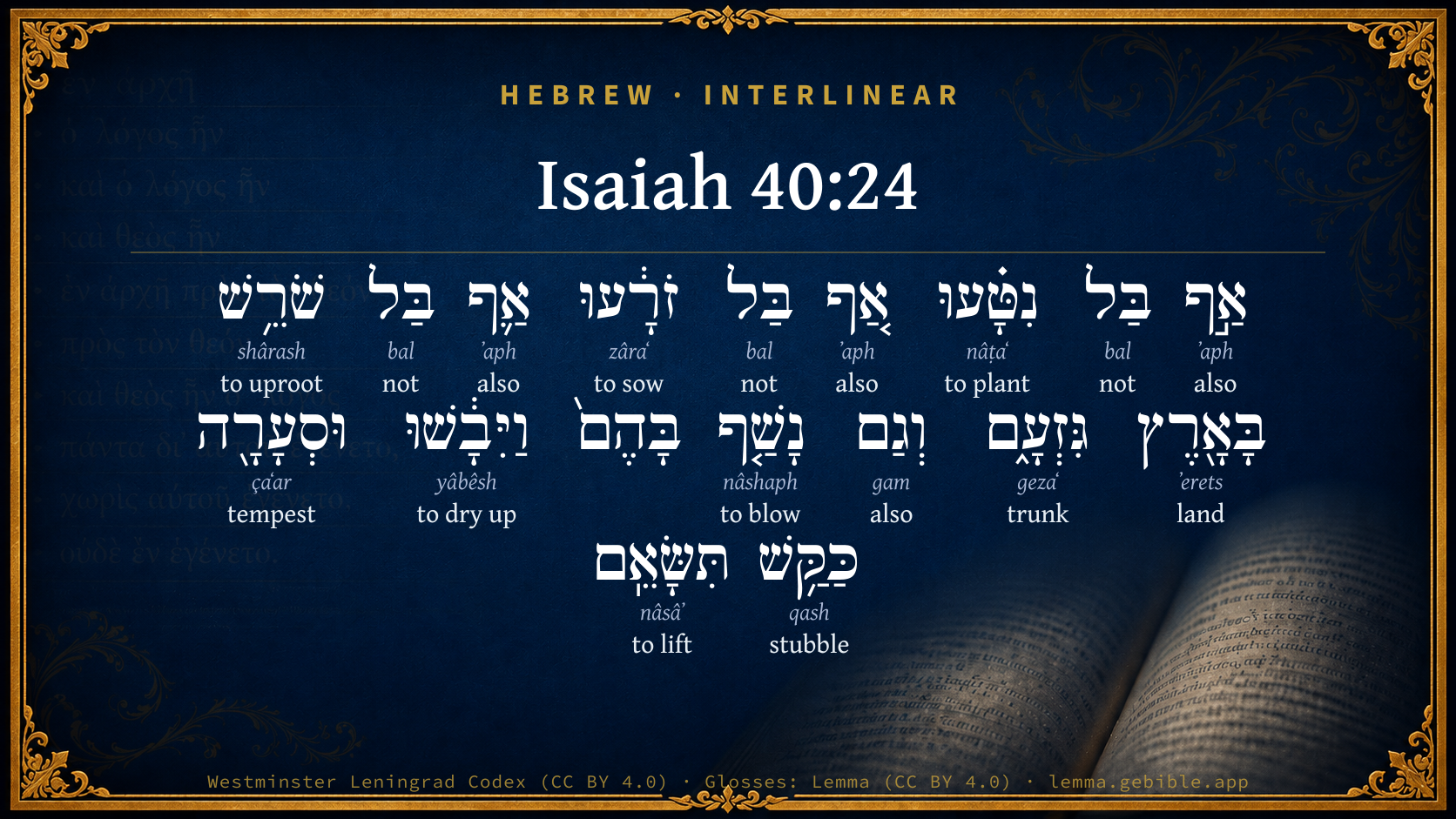
Hebrew (Westminster Leningrad Codex) Isaiah 40:24 appears in the Hebrew Old Testament. The text above is from the Westminster Leningrad Codex. Each word links to its Strong’s number, a concise gloss, and parsing drawn from the Open Scriptures Hebrew Bible morphology. Click any word for its full Brown-Driver-Briggs (BDB) entry.
Download image
Cite this verse

Isaiah 40:24 (World English Bible). Public Domain. Lemma interlinear Bible study tool, https://lemma.gebible.app/v/isaiah/40/24.

Show BibTeX & RIS
BibTeX
RIS
English Translation
Yes, they have not been planted; yes, they have not been sown; yes, their stock has not taken root in the earth: moreover he blows on them, and they wither, and the whirlwind takes them away as stubble.
World English Bible · Public Domain
Download a study sheet

One document with this verse’s original text, its word-by-word gloss line, the meaning frame, cross-references with their text, attributed commentary, and full source and license credits — printable, and it pastes into notes with its structure intact.

This verse Autodidact and up

Study sheet (.html) Plain text (.txt)

A passage Seminary Student

Up to 50 verses in one chapter. A passage sheet keeps up to 6 commentary sources and 12 cross-references per verse, in the order this page ranks them, and says so on the sheet whenever that leaves anything out. Ask for a single verse and you get the Autodidact verse sheet above.

Everything on this page stays free to read, with no account — the sheet is a download of what is already on screen, not access to it.

Want to remove ads? Support Godless Engineer
Compare translations 3

The same verse in 3 English versions, stacked beneath the original-language interlinear above. Click any original word for its lexicon entry.

Each is an independent rendering of the whole verse — the interlinear is not word-aligned to these translations.

Highlighted words mark where these versions differ — a whole-verse word diff, not a word-by-word alignment.

  • World English Bible Public Domain
    Yes, they have not been planted; yes, they have not been sown; yes, their stock has not taken root in the earth: moreover he blows on them, and they wither, and the whirlwind takes them away as stubble.
  • King James Version Public Domain
    Yea, they shall not be planted; yea, they shall not be sown: yea, their stock shall not take root in the earth: and he shall also blow upon them, and they shall wither, and the whirlwind shall take them away as stubble.
  • unfoldingWord Literal Text CC BY-SA 4.0
    Indeed, they are not planted; indeed, they are not sown; indeed, their stem has not rooted in the earth, and also he blows on them and they dry up, and a whirlwind carries them away like straw. q1

unfoldingWord Literal Text — © unfoldingWord, licensed CC BY-SA 4.0. Word-aligned USFM3 via Door43 (git.door43.org/unfoldingWord/en_ult).

Versions to compare (up to 4)

3 of 4 selected

Show all 18 translations

Every available English version of this verse, each an independent rendering of the whole verse.

  • World English Bible Public Domain
    Yes, they have not been planted; yes, they have not been sown; yes, their stock has not taken root in the earth: moreover he blows on them, and they wither, and the whirlwind takes them away as stubble.
  • Berean Standard Bible Public Domain
    No sooner are they planted, no sooner are they sown, no sooner have their stems taken root in the ground, than He blows on them and they wither, and a whirlwind sweeps them away like stubble.
  • Majority Standard Bible Public Domain
    No sooner are they planted, no sooner are they sown, no sooner have their stems taken root in the ground, than He blows on them and they wither, and a whirlwind sweeps them away like stubble.
  • King James Version Public Domain
    Yea, they shall not be planted; yea, they shall not be sown: yea, their stock shall not take root in the earth: and he shall also blow upon them, and they shall wither, and the whirlwind shall take them away as stubble.
  • American Standard Version (1901) Public Domain
    Yea, they have not been planted; yea, they have not been sown; yea, their stock hath not taken root in the earth: moreover he bloweth upon them, and they wither, and the whirlwind taketh them away as stubble.
  • Revised Version (1885) Public Domain
    Yea, they have not been planted; yea, they have not been sown; yea, their stock hath not taken root in the earth: moreover he bloweth upon them, and they wither, and the whirlwind taketh them away as stubble.
  • Geneva Bible (1599) Public Domain
    As though they were not plated, as though they were not sowen, as though their stocke tooke no roote in the earth: for he did euen blow vpon them, and they withered, and the whirlewinde will take them away as stubble.
  • Douay-Rheims (1899) Public Domain
    And surely their stock was neither planted, nor sown, nor rooted in the earth: suddenly he hath blown upon them, and they are withered, and a whirlwind shall take them away as stubble.
  • Young's Literal Translation Public Domain
    Yea, they have not been planted, Yea, they have not been sown, Yea, not taking root in the earth is their stock, And also He hath blown upon them, and they wither, And a whirlwind as stubble taketh them away.
  • Literal Standard Version CC BY-SA 4.0
    Indeed, they have not been planted, || Indeed, they have not been sown, || Indeed, their stock is not taking root in the earth, || And He has also blown on them, and they wither, || And a whirlwind takes them away as stubble.
  • Unlocked Literal Bible CC BY-SA 4.0
    They are barely planted, barely sown, their stem has barely taken root in the earth, when he blows upon them and they wither, and the wind carries them away like straw.
  • unfoldingWord Literal Text CC BY-SA 4.0
    Indeed, they are not planted; indeed, they are not sown; indeed, their stem has not rooted in the earth, and also he blows on them and they dry up, and a whirlwind carries them away like straw. q1
  • Darby Bible Public Domain
    Scarcely are they planted, scarcely are they sown, scarcely hath their stock taken root in the earth, but he also bloweth upon them and they wither, and the whirlwind taketh them away as stubble.
  • World Messianic Bible Public Domain
    They are planted scarcely. They are sown scarcely. Their stock has scarcely taken root in the ground. He merely blows on them, and they wither, and the whirlwind takes them away as stubble.
  • Webster's Bible Public Domain
    Yes, they shall not be planted; yes, they shall not be sown: yes, their stock shall not take root in the earth: and he shall also blow upon them, and they shall wither, and the whirlwind shall take them away as stubble.
  • Free Bible Version CC BY-SA 4.0
    In fact they are hardly even planted, hardly even sown, hardly even taken root, when he blows on them and they wither, and the wind carries them away like straw.
  • Bible in Basic English Public Domain
    They have only now been planted, and their seed put into the earth, and they have only now taken root, when he sends out his breath over them and they become dry, and the storm-wind takes them away like dry grass.
  • JPS Tanakh (1917) Public Domain
    Scarce are they planted, scarce are they sown, scarce hath their stock taken root in the earth; when He bloweth upon them, they wither, and the whirlwind taketh them away as stubble.

Literal Standard Version (2020), Covenant Press — licensed CC BY-SA 4.0. Text via the HelloAO Bible API (eBible.org). Unlocked Literal Bible (unfoldingWord) — licensed CC BY-SA 4.0. Text via the HelloAO Bible API (eBible.org). unfoldingWord Literal Text — © unfoldingWord, licensed CC BY-SA 4.0. Word-aligned USFM3 via Door43 (git.door43.org/unfoldingWord/en_ult). Free Bible Version, Dr. Jonathan Gallagher — licensed CC BY-SA 4.0. Text via the HelloAO Bible API (eBible.org).

Word by word

More ways to search: Search by grammar → Find every occurrence → Compare this word →

Practice this passage: Drill this verse → Learn its vocabulary →

נָשַׁ֤ף
nâshaph
H5398
“to blow”
Verb, Qal, Perfect, 3rd Person, Masculine, Singular
Part of Speech
Verb
Stem
Qal
Form
Perfect
Person
3rd Person
Gender
Masculine
Number
Singular
Full BDB Definition

Origin: a primitive root

TWOT: 1434

(Qal) to blow
  1. אַ֣ף ʼaph H637 “also” Particle, Accusative
  2. בַּל bal H1077 “not” Particle, Negative
  3. נִטָּ֗עוּ nâṭaʻ H5193 “to plant” Verb, Niphal, Perfect, 3rd Person, Common, Plural
  4. אַ֚ף ʼaph H637 “also” Particle, Accusative
  5. בַּל bal H1077 “not” Particle, Negative
  6. זֹרָ֔עוּ zâraʻ H2232 “to sow” Verb, Pual, Perfect, 3rd Person, Common, Plural
  7. אַ֛ף ʼaph H637 “also” Particle, Accusative
  8. בַּל bal H1077 “not” Particle, Negative
  9. שֹׁרֵ֥שׁ shârash H8327 “to uproot” Verb, Poel, Perfect, 3rd Person, Masculine, Singular
  10. בָּאָ֖רֶץ ʼerets H776 “in/at the · land” Preposition, Determined + Noun, Common, Both, Singular, Absolute
  11. גִּזְעָ֑ם gezaʻ H1503 “trunk · their” Noun, Common, Masculine, Singular, Construct + Suffix, Personal, 3rd Person, Masculine, Plural
  12. וְגַם gam H1571 “and · also” Conjunction + Particle, Accusative
  13. וַיִּבָ֔שׁוּ yâbêsh H3001 “and · to dry up” Conjunction + Verb, Qal, Sequential Imperfect, 3rd Person, Masculine, Plural
  14. וּסְעָרָ֖ה çaʻar H5591 “and · tempest” Conjunction + Noun, Common, Feminine, Singular, Absolute
  15. כַּקַּ֥שׁ qash H7179 “like/as the · stubble” Preposition, Determined + Noun, Common, Masculine, Singular, Absolute
  16. תִּשָּׂאֵֽם nâsâʼ H5375 “to lift · them” Verb, Qal, Imperfect, 3rd Person, Feminine, Singular + Suffix, Personal, 3rd Person, Masculine, Plural

About this verse

These counts appear in no published source. They are computed here, from the morphology-tagged text and Lemma’s own curated glosses. What Lemma adds →

18
words
13
distinct lemmas
Prophets
section

Notable vocabulary

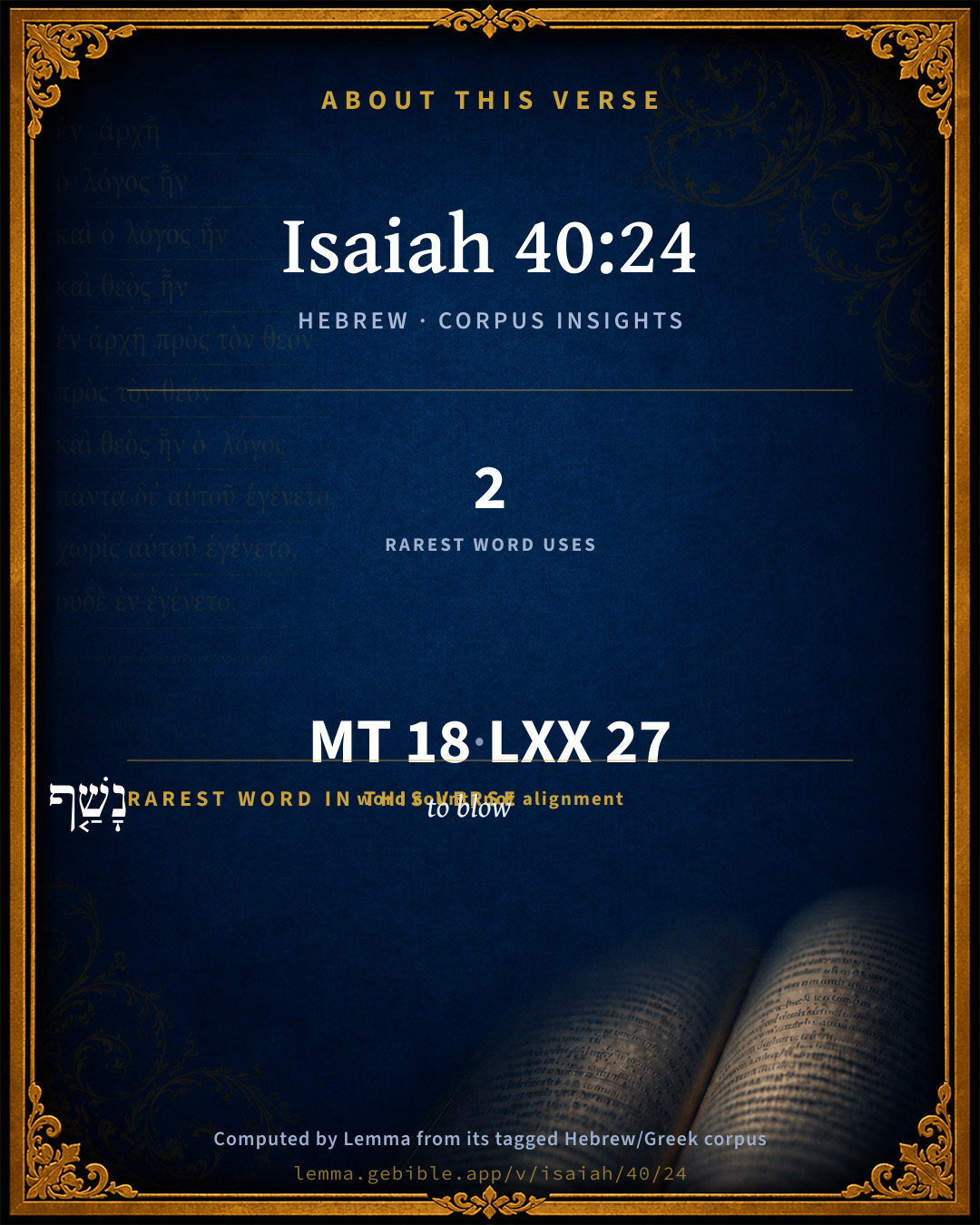
The rarest word here is נָשַׁ֤ף to blow H5398 — appearing just 2 times in the whole Hebrew Bible.

Shared distinctive vocabulary

נָשַׁ֤ף to blow H5398 occurs in 2 verses of the Hebrew Bible. Also found in:

Grammatical profile

  • 6 verbs
  • 4 nouns
  • 1 preposition
  • 7 particles

Verb forms

  • נִטָּ֗עוּ Niphal · Perfect
  • זֹרָ֔עוּ Pual · Perfect
  • שֹׁרֵ֥שׁ Poel · Perfect
  • נָשַׁ֤ף Qal · Perfect
  • וַיִּבָ֔שׁוּ Qal · Sequential Imperfect
  • תִּשָּׂאֵֽם Qal · Imperfect

Repetition

Words recur within this verse — often emphatic in Hebrew:

  • אַ֣ף also H637 ×3
  • בַּל not H1077 ×3

Hebrew & Septuagint length

In English translation the verse runs 38 words from the Hebrew and 36 from the Septuagint (LXX English) — closely comparable.

A rough comparison of the two English renderings, which tokenize alike — not a word-level alignment.

Word counts can differ between the Hebrew and the Greek without any difference in meaning — e.g. the Hebrew direct-object marker אֵת has no separate Greek word, and Greek often adds the article ὁ.

In the original languages it is 18 Hebrew tokens and 27 Greek tokens — but the two are counted differently (Hebrew bundles its prefixes and suffixes into one token; the Greek is in lemma form), so that isn’t a like-for-like length.

Cross-references

25

Topical passages linked to Isaiah 40:24 in the Treasury of Scripture Knowledge — connected by theme and wording, ordered by reader-vote popularity; previews shown in the World English Bible.

  • Isaiah 41:16 You shall winnow them, and the wind shall carry them away, and the whirlwind shall scatter them; and you shall rejoice in Yahweh, you shall glory in the Holy One of Israel.
  • Isaiah 17:13 The nations shall rush like the rushing of many waters: but he shall rebuke them, and they shall flee far off, and shall be chased as the chaff of the mountains before the wind, and like the whirling dust before the storm.
  • Jeremiah 23:19 Behold, the tempest of Yahweh, [even his] wrath, is gone forth, yes, a whirling tempest: it shall burst on the head of the wicked.
  • Haggai 1:9 "You looked for much, and, behold, it came to little; and when you brought it home, I blew it away. Why?" says Yahweh of Hosts, "Because of my house that lies waste, while each of you is busy with his own house.
  • 2 Samuel 22:16 Then the channels of the sea appeared, The foundations of the world were laid bare, By the rebuke of Yahweh, At the blast of the breath of his nostrils.
  • 1 Kings 21:21–22 Behold, I will bring evil on you, and will utterly sweep you away and will cut off from Ahab every man-child, and him who is shut up and him who is left at large in Israel:
  • 2 Kings 10:11 So Jehu struck all that remained of the house of Ahab in Jezreel, and all his great men, and his familiar friends, and his priests, until he left him none remaining.
  • Job 4:9 By the breath of God they perish, By the blast of his anger are they consumed.
  • Job 15:30–33 He shall not depart out of darkness; The flame shall dry up his branches, By the breath of God's mouth shall he go away.
  • Job 18:16–19 His roots shall be dried up beneath, Above shall his branch be cut off.
  • Job 21:18 That they are as stubble before the wind, As chaff that the storm carries away?
  • Psalms 58:9 Before your pots can feel the heat of the thorns, He will sweep away the green and the burning alike.
  • Proverbs 1:27 When calamity overtakes you like a storm, When your disaster comes on like a whirlwind; When distress and anguish come on you.
  • Isaiah 11:4 but with righteousness shall he judge the poor, and decide with equity for the humble of the earth; and he shall strike the earth with the rod of his mouth; and with the breath of his lips shall he kill the wicked.
  • Isaiah 14:21–22 Prepare slaughter for his children for the iniquity of their fathers, that they not rise up, and possess the earth, and fill the surface of the world with cities.
  • Isaiah 17:11 In the day of your planting you hedge it in, and in the morning you make your seed to blossom; but the harvest flees away in the day of grief and of desperate sorrow.
  • Isaiah 37:7 Behold, I will put a spirit in him, and he shall hear news, and shall return to his own land; and I will cause him to fall by the sword in his own land.
  • Isaiah 40:7 The grass withers, the flower fades, because the breath of Yahweh blows on it; surely the people is grass.
  • Jeremiah 22:30 Thus says Yahweh, Write you this man childless, a man who shall not prosper in his days; for no more shall a man of his seed prosper, sitting on the throne of David, and ruling in Judah.
  • Hosea 13:3 Therefore they will be like the morning cloud, And like the dew that passes away early, Like the chaff that is driven with the whirlwind out of the threshing floor, And like the smoke out of the chimney.
  • Hosea 13:15 Though he is fruitful among his brothers, an east wind will come, The breath of Yahweh coming up from the wilderness; And his spring will become dry, And his fountain will be dried up. He will plunder the storehouse of treasure.
  • Nahum 1:14 Yahweh has commanded concerning you: "No more descendants will bear your name. Out of the house of your gods, will I cut off the engraved image and the molten image. I will make your grave, for you are vile."
  • Zechariah 7:14 "but I will scatter them with a whirlwind among all the nations which they have not known. Thus the land was desolate after them, so that no man passed through nor returned: for they made the pleasant land desolate."
  • Zechariah 9:14 Yahweh will be seen over them; And his arrow will go flash like lightning; And the Lord Yahweh will blow the trumpet, And will go with whirlwinds of the south.
  • Isaiah 30:33 For a Topheth is prepared of old; yes, for the king it is made ready; he has made it deep and large; the pile of it is fire and much wood; the breath of Yahweh, like a stream of sulfur, does kindle it.

Cross-references courtesy of OpenBible.info (CC BY 4.0).

Hebrew and Greek witnesses Masoretic Hebrew ↔ Greek Septuagint

The same verse in the two great witnesses to the Old Testament, shown verse-for-verse.

These are two independent witnesses, not word-aligned to each other, and the Septuagint is shown in lemma (dictionary) form.

Hebrew Isaiah 40:24 Masoretic · Westminster Leningrad Codex

אַ֣ף בַּל נִטָּ֗עוּ אַ֚ף בַּל זֹרָ֔עוּ אַ֛ף בַּל שֹׁרֵ֥שׁ בָּאָ֖רֶץ גִּזְעָ֑ם וְגַם נָשַׁ֤ף בָּהֶם֙ וַיִּבָ֔שׁוּ וּסְעָרָ֖ה כַּקַּ֥שׁ תִּשָּׂאֵֽם

Yes, they have not been planted; yes, they have not been sown; yes, their stock has not taken root in the earth: moreover he blows on them, and they wither, and the whirlwind takes them away as stubble.

World English Bible · Public Domain

Greek LXX Isaiah 40:24 Septuagint · lemma form

οὐ γάρ μή σπείρω οὐδέ μή φυτεύω οὐδέ μή ῥιζόω εἰς ὁ γῆ ὁ ῥίζα αὐτός πνέω ἐπί αὐτός καί ξηραίνω καί καταιγίς ὡς φρύγανον ἀναλαμβάνω αὐτός

For they shall not plant, neither shall they sow, neither shall their root be fixed in the ground: he has blown upon them, and they are withered, and a storm shall carry them away like sticks.

LXX2012 (modern English Septuagint) · Public Domain

On this verse, Jamieson, Fausset & Brown discusses the Septuagint’s reading. Read the note in Commentary ↓

Hebrew: Westminster Leningrad Codex (CC BY 4.0). Greek: Septuagint (public domain); English from LXX2012 (modern English Septuagint) (Public Domain). How the Septuagint differs from the Hebrew →

Targum (Aramaic paraphrase)

1

The Targum is the ancient Jewish Aramaic paraphrase of the Hebrew Scriptures — an interpretive translation, not the Hebrew text itself. Onkelos (literal) and Pseudo-Jonathan (expansive) render the Torah, and Jonathan the Prophets. Coverage is partial: where no permissively-licensed English translation exists for a verse, only the Aramaic is shown. This is verse-level text, not a word-by-word alignment to the Hebrew.

  1. Targum Jonathan Prophets (Joshua–Malachi)
    אֲפִילוּ יִפְשׁוּן אֲפִילוּ יִסְגוּן אֲפִילוּ יִתְרַבּוּן בְּאַרְעָא בְנֵיהוֹן וְאַף רוּגְזֵהּ יְשַׁלַח בְּהוֹן וְיִבְהֲתוּן וּמֵימְרֵהּ כְּעַלְעֵילָא לְקַשָׁא יְדַבֵּר יַתְהוֹן:

    Although they multiply, although they increase, although their children become great in the earth, yet, nevertheless, He will send His wrath among them, and they shall be confounded: and His WORD shall scatter them, as the whirlwind the chaff.

    Targum Jonathan — Aramaic: “Mikraot Gedolot” (public domain). English: “Sefaria Community Translation” (CC0 1.0 (public-domain dedication)); “London "Chaldee Paraphrase," 1871” (public domain). Text via Sefaria.

Commentary

Notes on Isaiah 40:24 from classic Christian and Jewish commentators (each source and its license shown beneath its notes). The classic Christian expositions comment on the surrounding passage and are grouped to its opening verse, so a note may address several verses; the Jewish commentaries on the Tanakh (Rashi and others) are per-verse, so they appear only where the commentator wrote on this verse.

Lemma curates 59 commentaries, every one of them public domain or Creative Commons licensed, each selected and text-cleaned for this edition rather than reprinted as found. About our sources →

Trapp's Complete Commentary

John Trapp

Isa 40:24 Yea, they shall not be planted; yea, they shall not be sown: yea, their stock shall not take root in the earth: and he shall also blow upon them, and they shall wither, and the whirlwind shall take them away as stubble.

Ver. 24. Yea, they shall not be planted.] They are like grass, that is neither planted nor well rooted; but as weeds that grow on the top of the water, vel tanquam podii folium, quod mane candidum, meridie purpureum, vespere caeruleum aspicitur. {a}

And he shall blow upon them.] Two fits of an ague shook to death great Tamerlane, in the midst of his preparations for the conquest of Turkey.

{a} Jerome.

John Trapp, A Commentary or Exposition upon All the Books of the Old and New Testament (1647–1656) — public domain. Text from a community e-Sword module.

Geneva Bible (1599)

Geneva Bible translators

So that his power appeareth in every place wheresoever we turn our eyes.

Geneva Bible (1599) marginal notes — public domain. Text via Bolls.life.

Jamieson, Fausset & Brown

Robert Jamieson, A. R. Fausset & David Brown

they--the "princes and judges" (Isa 40:23) who oppose God's purposes and God's people. Often compared to tall trees (Psa 37:35; Dan 4:10).

not . . . sown--the seed, that is, race shall become extinct (Nah 1:14).

stock--not even shall any shoots spring up from the stump when the tree has been cut down: no descendants whatever (Job 14:7; see on Isa 11:1).

and . . . also--so the Septuagint. But MAURER translates, "They are hardly (literally, 'not yet', as in Kg2 20:4) planted (&c.) when He (God) blows upon them."

blow--The image is from the hot east wind (simoon) that "withers" vegetation.

whirlwind . . . stubble-- (Psa 83:13), where, "like a wheel," refers to the rotatory action of the whirlwind on the stubble.

Jamieson, Fausset & Brown — Commentary Critical and Explanatory on the Whole Bible (1871) — public domain (CC PDM 1.0). Text via the HelloAO Bible API.

Adam Clarke's Commentary

Verse 24. And he shall also blow upon them - "And if he but blow upon them"] The Septuagint, Syriac, Vulgate, and MS. Bodl., with another, have גם gam, only, without the conjunction ו vau, and.

Adam Clarke's Commentary on the Bible (1810–1826) — public domain. Text from a community e-Sword/MySword module.

Ellicott's Commentary for English Readers

(24) They shall not be planted . . .—Better, Hardly are they planted, hardly are they sown. Such are empires before the eternity of Jehovah: so soon withered that we cannot say that they were ever really planted (Psa_129:6).

A Bible Commentary for English Readers, edited by Charles John Ellicott (1878–1897) — public domain. Text from a community e-Sword module.

The Cambridge Bible for Schools and Colleges

gen. ed. J. J. S. Perowne

24. Yea, they shall not be …] Render: Scarcely have they been planted, scarcely have they been sown, scarcely has their stock struck root in the earth, when he bloweth etc. (see R.V. marg.).

their stock] The same word as “stem” in ch. Isa_11:1, but in a different sense. see the note there.

25, 26 form the peroration of a passage of striking elevation. The writer makes a final appeal to the imagination of his audience by pointing to the nightly pageant of the starry hosts mustered at the command of Him who is Jehovah of Hosts.

The Cambridge Bible for Schools and Colleges (gen. ed. J. J. S. Perowne; Cambridge University Press, 1878–1918) — public domain. Text from a community e-Sword module.

John Gill's Exposition

Yea, they shall not be planted,.... As trees are, like the cedars in Lebanon, though they may seem to be such; but be like the grass of the field, and herbs of the earth: or, "even they shall be", as if they were "not planted (c)", they shall not grow and flourish; or they shall be plucked up, and be no more; this is said of the princes and judges of the earth; nay,

they shall not be sown; as seed is, which springing up, brings forth fruit, but so it shall not be with them; or they shall be as if they had not been sown, no fruit being brought forth by them:

yea, their stock shall not take root in the earth; so as to continue and abide, but they shall soon vanish and disappear, as the most powerful princes and wisest judges do. The Targum is,

"although they multiply, although they increase, although their children become great in the earth:''

"and" or "yea",

he shall also blow upon them, and they shall wither; as grass withers, when a severe wind blows upon it:

and the whirlwind shall take them away as stubble; which is not able to stand before the force of it; and as unable are the greatest potentates on earth to stand before the tempest of divine wrath and vengeance; if God blows but upon them in anger, all their glory and grandeur, pomp and power, wither away like the flower of the field; and especially if he comes forth in all the fury of his wrath in a tempestuous way against them, they are no more able to stand before him that stubble before a violent storm: see Rev 6:15. The Targum is,

"yet, even he will send his fury upon them; and his word shall take them away, as a whirlwind stubble.''

(c) "perinde ut non plantati", Calvin; and so the following clauses.

John Gill's Exposition of the Whole Bible (1746–1763) — public domain (CC PDM 1.0). Text via the HelloAO Bible API.

Albert Barnes' Notes on the Bible

Yea, they shall not be planted - The kings and rulers - especially they who oppose God in the execution of his purposes. The idea in this verse is, that their name and family should become extinct in the same way as a tree does from which no shoot starts up. Although they were great and mighty, like the tree that sends out far-spreading branches, and strikes its roots deep, yet God would so utterly destroy them that they should have no posterity, and their family become extinct. Princes and kings are often compared to lofty and majestic trees of the forest (compare Psa 37:35; Dan 4:7 ff) Vitringa supposes that wicked rulers are particularly intended here, and that the idea is, that the wicked princes that persecuted his people should be entirely extinct on the earth. He refers particularly to Pharaoh, Antiochus Epiphanes, Nero, Domitian, Decius, Gallus, Galerius, Maxenus, Maximus, and some others, as instances of this kind, whose families soon became extinct. It may be remarked, in general, that the families of monarchs and princes become extinct usually much sooner than others. The fact may be owing in part to the usual luxury and vice in the families of the great, and in part to the direct arrangements of God, by which he designs that power shall not be forever perpetuated in one family, or line. The general idea in the passage is, that earthly princes and rulers are as nothing When compared with God, and that he can easily destroy their families and their name. But there is no improbability in the supposition of Vitringa, that the prophet refers particularly to the enemies of God and his cause, and that he intends specifically to affirm that none of these enemies could prevent or embarrass the execution of his purposes - since with infinite ease he could entirely destroy their name.

They shall not be sown - The same idea under another figure. The former referred to princes under the image of a tree; this refers to them under the image of grain that is sown. The idea is, that their family and name should be annihilated, and should not spring up in a future generation. The same image occurs in Nah 1:14, in respect to the king of Assyria: ‘The Lord hath given commandment concerning thee, that no more of thy name be sown;’ that is, that thy name and family should become entirely extinct.

Yea, their stock - Their stem - referring to the stump or stock of a tree. When a tree is cut down, the roots often still live, and send up shoots, or suckers, that grow into trees. Posterity is often, in the Scriptures, compared to such suckers or shoots from old and decayed trees (see the notes at Isa 11:1). The meaning here is, that as when a tree falls and dies without sending up any shoots, so princes should die. They should have no descendants; no one of their family should sit on their thrones.

Shall blow upon them - As God sends a tempest upon the forest and uproots the loftiest trees, so he will sweep away the families of princes. Or rather, perhaps, the idea here is, that God sends a strong and burning east wind, and withers up everything before it (see this wind described in the notes at Isa 37:26).

And they shall wither - Trees, and shrubs, and plants are dried up before that poisonous and fiery wind - the simoom - and so it would be with the princes before the blast of Yahweh.

And the whirlwind shall take them away as stubble - This, in its literal signification, means that the whirlwind bears away the trees of the forest, and with the same ease God would sweep away the families of the kings and princes that opposed him and oppressed his people. It may illustrate this to observe, that the effects of whirlwinds in the East are often much more violent than they are with us, and that they often bear away to a great distance the branches of trees, and even the trees themselves. The following description of a whirlwind observed by Mr. Bruce, may serve to illustrate this passage, as well as the passage in Psa 83:13 :

O my God, make them like a wheel;

As the stubble before the wind,

referring to the rotary action of the whirlwind, which often impels straw like a wheel set in rapid motion. ‘Mr. Bruce, in his journey through the desert of Senaar, had the singular felicity to contemplate this wonderful phenomenon in all its terrific majesty, without injury, although with considerable danger and alarm. In that vast expanse of desert, from west and to northwest of him, he saw a number of prodigious pillars of sand at different distances, moving, at times, with great celerity, at others, stalking on with majestic slowness; at intervals he thought they were coming, in a very few minutes, to overwhelm him and his companion. Again, they would retreat so as to be almost out of sight, their tops reaching to the very clouds. There, the tops often separated from the bodies; and these, once disjoined, dispersed in the air, and appeared no more. Sometimes they were broken near the middle, as if struck with a large cannon-shot.

About noon, they began to advance with considerable swiftness upon them, the wind being very strong at north. Eleven of these awful visitors ranged alongside of them, about the distance of three miles. The greatest diameter of the largest appeared to him, at that distance, as if it would measure ten feet. They retired from them with a wind at southeast, leaving an impression upon the mind of our intrepid traveler, to which he could give no name, though he candidly admits that one ingredient in it was fear, with a considerable deal of wonder and astonishment. He declares it was in vain to think of flying; the swiftest horse, or fastest sailing ship, could be of no use to carry them out of this danger; and the full persuasion of this riveted him to the spot where he stood. Next day, they were gratified with a similar display of moving pillars, in form and disposition like those already described, only they seemed to be more in number and less in size.

They came, several times, in a direction close upon them; that is, according to Mr. Bruce’s computation, within less than two miles. They became, immediately after sunrise, like a thick wood, and almost darkened the sun; his rays shining through them for near an hour, gave them an appearance of pillars of fire. At another time, they were terrified by an army (as it seemed) of these sand pillars, whose march was constantly south, a number of which seemed once to be coming directly upon them; and though they were little nearer than two miles, a considerable quantity of sand fell around them. On the 21st of November, about eight in the morning, he had a view of the desert to the westward, as before, and the sands had already begun to rise in immense twisted pillars, which darkened the heavens, and moved over the desert with more magnificence than ever. The sun, shining through the pillars, which were thicker, and contained more sand, apparently, than on any of the preceding days, seemed to give those nearest them an appearance as if spotted with stars of gold.’ (Paxton)

Albert Barnes' Notes on the Bible (1834–1885) — public domain. Text from a community e-Sword/MySword module.

Matthew Poole's English Annotations

They, the princes and judges last mentioned,

shall not be planted; yea, they shall not be sown: they shall take no root, as it follows; for planting and sowing are in order to taking root, and are necessary to it. They shall not continue and flourish, as they have vainly imagined; but shall be rooted up and perish, as is declared in the rest of the verse.

Blow upon them; blast them, as a vehement east wind doth plants.

Matthew Poole's English Annotations on the Holy Bible (1683–1685) — public domain. Text from a community e-Sword/MySword module.

The Pulpit Commentary

They shall not be planted... shall not be sown... shall not take root. The verbs are all of them in the past tense. Translate, have not been planted, ... sown, etc. The meaning is that princes and judges of the earth are not fixed in their places, have no firm root in the soil, are easily overturned. Even if the case were different, a breath from the Almighty would, as a matter of course, dry them up (see ver. 7) and blow them away. As stubble . (comp. Isa_5:24 Psa_83:13)

The Pulpit Commentary (1880–1919), ed. H.D.M. Spence-Jones & Joseph S. Exell — public domain. Text from a community e-Sword module.

John Wesley's Explanatory Notes

Sown - They shall take no root, for planting and sowing are in order to taking root. They shall not continue and flourish, as they have vainly imagined, but shall be rooted up and perish.

John Wesley, Explanatory Notes Upon the Whole Bible (1754–1765) — public domain. Text via the GEBible commentary corpus.

J. A. Alexander on Isaiah

Joseph Addison Alexander

“Not even sown were they, not even planted, not even rooted in the ground their stock, and He just breathed (or blew) upon them, and they withered, and a whirlwind like the chaff shall take them up (or away).” The transition to the future in the last clause is analogous to that in v. 19, and has the same effect of showing that the point of observation is an intermediate one between the beginning and the end of the destroying process. The essential meaning of the whole verse is, that God can extirpate them, not only in the end, but in a moment; not only in the height of their prosperity, but long before they have attained it. It is possible, that the words may have reference to the national existence of Israel as a nation, the end of which, with the continued and more glorious existence of the church independent of all national restrictions, may be said to constitute the great theme of these prophecies.

Joseph Addison Alexander, The Prophecies of Isaiah (1846–1847; New York: Scribner, 1870–1878) — public domain. Text from a community e-Sword module.

Rashi

Rabbi Shlomo Yitzchaki (Rashi)

Even [as though] they were not planted They are even as though they were not planted.

even [as though] they were not sown And still more than this, that they shall be uprooted and plucked out, as if they were not sown. Sowing is less than planting.

their trunk is not rooted in the earth When they will be plucked out, the trunk will not take root in the ground that it will grow up anew. Every שֹׁרֶשׁ, root, in Scripture is accented on the first letter, and the ‘reish’ is vowelized with a ‘pattah’ [segol]. This one, however, is accented on the latter syllable and it is vowelized with a ‘kamatz katan’ [tzeireh] because it is a verb, present tense, [enracinant in French] being rooted.

Rashi on the Tanakh — English translations: “The Judaica Press complete Tanach with Rashi, translated by A. J. Rosenberg” (CC BY 4.0); “Pentateuch with Rashi's commentary by M. Rosenbaum and A.M. Silbermann, 1929-1934” (public domain); “The Metsudah Tanach series, Lakewood, N.J” (CC BY 4.0); and “The Book of Joshua, Metsudah Publications, 1997” (CC BY 4.0). Text via Sefaria.

Ibn Ezra

Rabbi Abraham ibn Ezra

Yea, they shall not be planted, etc. They shall be like trees, that perished as completely as if they had never been planted. נטעו is Niphal; זרעו is Pual;

שרש is participle Kal.

נשף He shall blow. Comp. נשפת thou didst blow (Ex. 15:10). וגם And besides.

Ibn Ezra on the Tanakh — English translations: “Sefaria Community Translation” (CC0 1.0 (public-domain dedication)); “Yalkut, Sifsei Chachomim Chumash, Metsudah Publications, 2009” (CC BY 4.0); and “Commentary of Ibn Ezra on Isaiah - trans. by M. Friedlander, 1873” (public domain). Text via Sefaria.

Lesson kit

Teaching starters — assembled from the data on this page, not authored interpretation. Every prompt links to the verse data it draws on. Edit before teaching.

Isaiah, in the Prophets, opens this verse with 18 words (13 distinct Hebrew lemmas). Its most distinctive word is nâshaph (“to blow”). A historical commentator’s framing appears above. Read the whole chapter for the surrounding context.

Discussion questions

  1. The word nâshaph carries the sense “to blow.” How does it shape the verse?
  2. How does Exodus 15:10, which shares the word «to blow», read alongside this verse?
  3. What does the repetition of “also” (3× in this one verse) do in this verse?
  4. These translations render this verse differently. What is at stake in choosing one wording over another?
  5. «נִטָּ֗עוּ» is a Niphal Perfect verb. How does that grammatical form shape the action described?
  6. Compare how Trapp's Complete Commentary and Geneva Bible (1599) read this verse. Where do they agree or differ?

Things to notice

Reading settings

Reading text

Shown beneath each verse's original-language words.

Old Testament
Old Testament edition

Read the OT as the Masoretic Hebrew (MT) or the Greek Septuagint (LXX).

English shown for the Greek Septuagint (in the Hebrew ↔ Greek comparison).

Comparing translations? Open the Compare panel on any verse page to stack up to four side by side.