
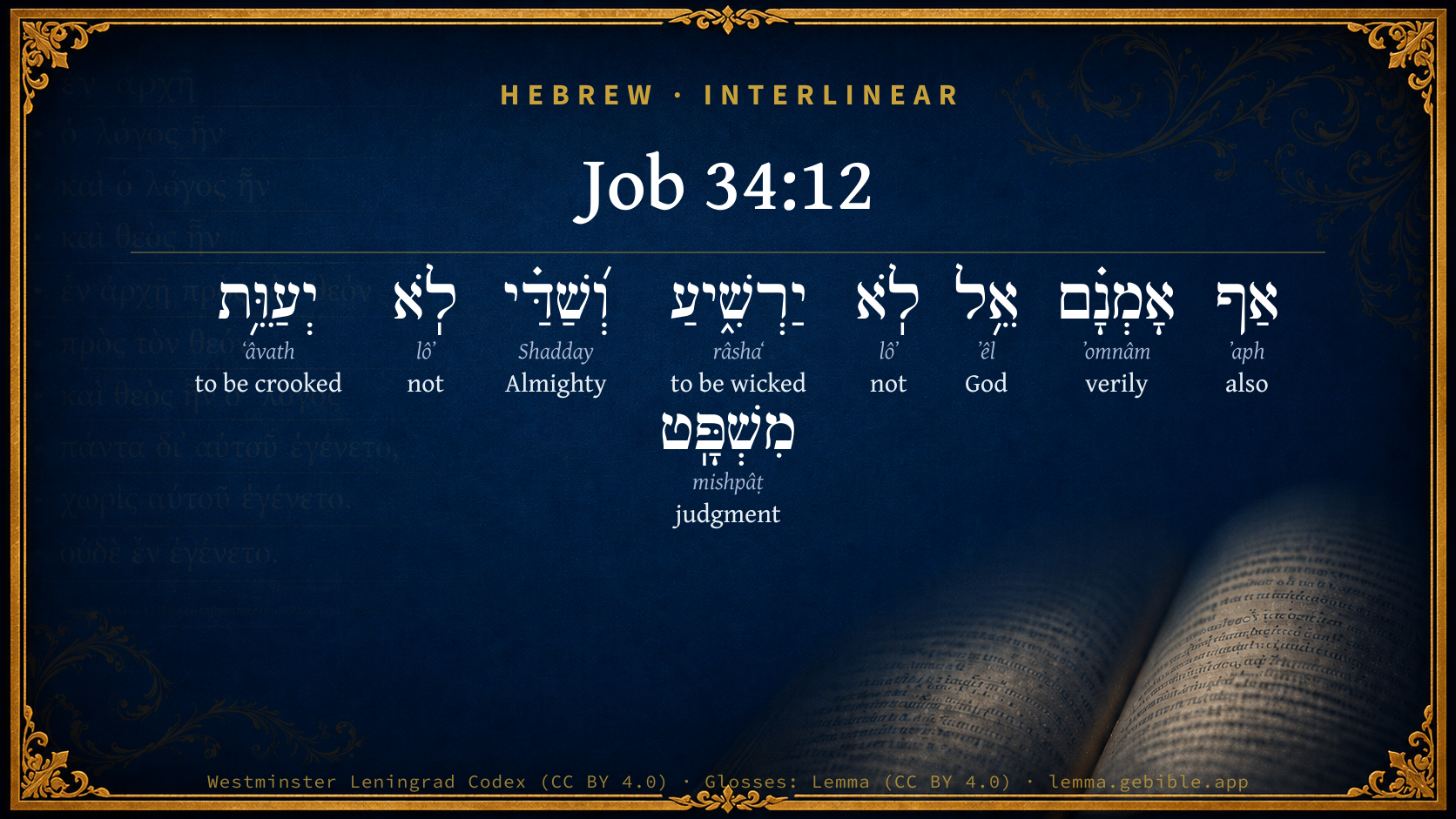
Job 34:12

Hebrew (Westminster Leningrad Codex) Job 34:12 appears in the Hebrew Old Testament. The text above is from the Westminster Leningrad Codex. Each word links to its Strong’s number, a concise gloss, and parsing drawn from the Open Scriptures Hebrew Bible morphology. Click any word for its full Brown-Driver-Briggs (BDB) entry.
Download image
Cite this verse

Job 34:12 (World English Bible). Public Domain. Lemma interlinear Bible study tool, https://lemma.gebible.app/v/job/34/12.

Show BibTeX & RIS
BibTeX
RIS
English Translation
Yes surely, God will not do wickedly, Neither will the Almighty pervert justice.
World English Bible · Public Domain
Download a study sheet

One document with this verse’s original text, its word-by-word gloss line, the meaning frame, cross-references with their text, attributed commentary, and full source and license credits — printable, and it pastes into notes with its structure intact.

This verse Autodidact and up

Study sheet (.html) Plain text (.txt)

A passage Seminary Student

Up to 50 verses in one chapter. A passage sheet keeps up to 6 commentary sources and 12 cross-references per verse, in the order this page ranks them, and says so on the sheet whenever that leaves anything out. Ask for a single verse and you get the Autodidact verse sheet above.

Everything on this page stays free to read, with no account — the sheet is a download of what is already on screen, not access to it.

Want to remove ads? Support Godless Engineer
Compare translations 3

The same verse in 3 English versions, stacked beneath the original-language interlinear above. Click any original word for its lexicon entry.

Each is an independent rendering of the whole verse — the interlinear is not word-aligned to these translations.

Highlighted words mark where these versions differ — a whole-verse word diff, not a word-by-word alignment.

  • World English Bible Public Domain
    Yes surely, God will not do wickedly, Neither will the Almighty pervert justice.
  • King James Version Public Domain
    Yea, surely God will not do wickedly, neither will the Almighty pervert judgment.
  • unfoldingWord Literal Text CC BY-SA 4.0
    Indeed, God truly does not act wickedly, and the Almighty does not pervert justice.

unfoldingWord Literal Text — © unfoldingWord, licensed CC BY-SA 4.0. Word-aligned USFM3 via Door43 (git.door43.org/unfoldingWord/en_ult).

Versions to compare (up to 4)

3 of 4 selected

Show all 18 translations

Every available English version of this verse, each an independent rendering of the whole verse.

  • World English Bible Public Domain
    Yes surely, God will not do wickedly, Neither will the Almighty pervert justice.
  • Berean Standard Bible Public Domain
    Indeed, it is true that God does not act wickedly, and the Almighty does not pervert justice.
  • Majority Standard Bible Public Domain
    Indeed, it is true that God does not act wickedly, and the Almighty does not pervert justice.
  • King James Version Public Domain
    Yea, surely God will not do wickedly, neither will the Almighty pervert judgment.
  • American Standard Version (1901) Public Domain
    Yea, of a surety, God will not do wickedly, Neither will the Almighty pervert justice.
  • Revised Version (1885) Public Domain
    Yea, of a surety, God will not do wickedly, neither will the Almighty pervert judgment.
  • Geneva Bible (1599) Public Domain
    And certainely God will not do wickedly, neither will the Almightie peruert iudgement.
  • Douay-Rheims (1899) Public Domain
    For in very deed God will not condemn without cause, neither will the Almighty pervert judgment.
  • Young's Literal Translation Public Domain
    Yea, truly, God doth not do wickedly, And the Mighty doth not pervert judgment.
  • Literal Standard Version CC BY-SA 4.0
    Indeed, truly, God does not do wickedly, || And the Mighty does not pervert judgment.
  • Unlocked Literal Bible CC BY-SA 4.0
    Indeed, God does nothing wicked, nor does the Almighty ever pervert justice.
  • unfoldingWord Literal Text CC BY-SA 4.0
    Indeed, God truly does not act wickedly, and the Almighty does not pervert justice.
  • Darby Bible Public Domain
    Yea, surely, ùGod acteth not wickedly, and the Almighty perverteth not judgment.
  • World Messianic Bible Public Domain
    Yes surely, God will not do wickedly, neither will the Almighty pervert justice.
  • Webster's Bible Public Domain
    Yes, surely God will not do wickedly, neither will the Almighty pervert judgment.
  • Free Bible Version CC BY-SA 4.0
    It's absolutely sure that God doesn't act wickedly; the Almighty would never pervert justice.
  • Bible in Basic English Public Domain
    Truly, God does not do evil, and the Ruler of all is not a false judge.
  • JPS Tanakh (1917) Public Domain
    Yea, of a surety, God will not do wickedly, neither will the Almighty pervert justice.

Literal Standard Version (2020), Covenant Press — licensed CC BY-SA 4.0. Text via the HelloAO Bible API (eBible.org). Unlocked Literal Bible (unfoldingWord) — licensed CC BY-SA 4.0. Text via the HelloAO Bible API (eBible.org). unfoldingWord Literal Text — © unfoldingWord, licensed CC BY-SA 4.0. Word-aligned USFM3 via Door43 (git.door43.org/unfoldingWord/en_ult). Free Bible Version, Dr. Jonathan Gallagher — licensed CC BY-SA 4.0. Text via the HelloAO Bible API (eBible.org).

Word by word

More ways to search: Search by grammar → Find every occurrence → Compare this word →

Practice this passage: Drill this verse → Learn its vocabulary →

About this verse

These counts appear in no published source. They are computed here, from the morphology-tagged text and Lemma’s own curated glosses. What Lemma adds →

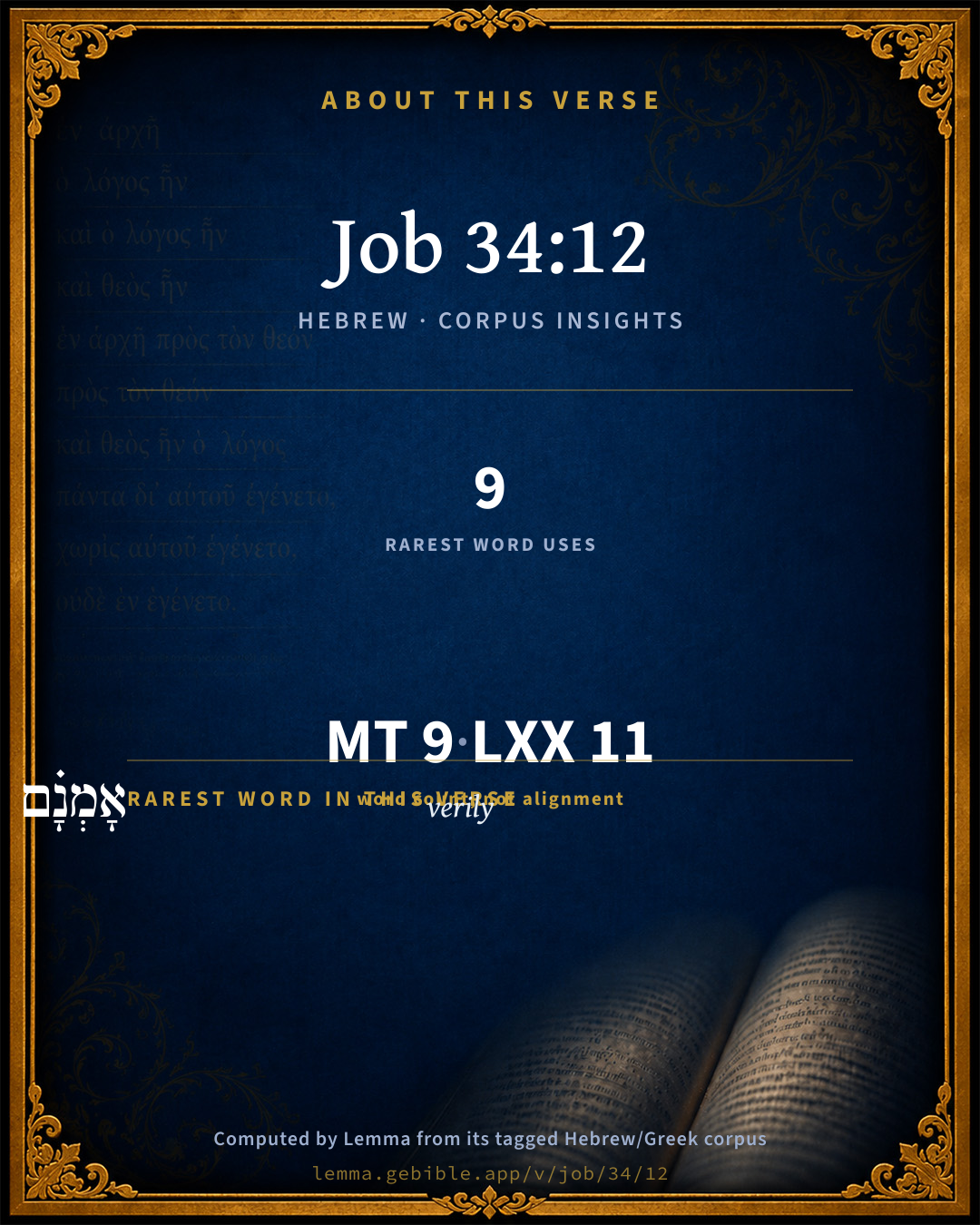
9
words
8
distinct lemmas
Wisdom
section

Notable vocabulary

The rarest word here is אָמְנָ֗ם verily H551 — appearing just 9 times in the whole Hebrew Bible.

Shared distinctive vocabulary

אָמְנָ֗ם verily H551 occurs in 9 verses of the Hebrew Bible. Also found in:

Grammatical profile

  • 2 verbs
  • 3 nouns
  • 1 adverb
  • 3 particles

Verb forms

  • יַרְשִׁ֑יעַ Hiphil · Imperfect
  • יְעַוֵּ֥ת Piel · Imperfect

Repetition

A word recurs within this verse — often emphatic in Hebrew:

Hebrew & Septuagint length

In English translation the verse runs 13 words from the Hebrew and 19 from the Septuagint (LXX English) — the Septuagint runs noticeably longer here. See the side-by-side →

A rough comparison of the two English renderings, which tokenize alike — not a word-level alignment.

Word counts can differ between the Hebrew and the Greek without any difference in meaning — e.g. the Hebrew direct-object marker אֵת has no separate Greek word, and Greek often adds the article ὁ.

In the original languages it is 9 Hebrew tokens and 11 Greek tokens — but the two are counted differently (Hebrew bundles its prefixes and suffixes into one token; the Greek is in lemma form), so that isn’t a like-for-like length.

Cross-references

4

Topical passages linked to Job 34:12 in the Treasury of Scripture Knowledge — connected by theme and wording, ordered by reader-vote popularity; previews shown in the World English Bible.

  • Job 8:3 Does God pervert justice? Or does the Almighty pervert righteousness?
  • Psalms 11:7 For Yahweh is righteous. He loves righteousness. The upright shall see his face.
  • Psalms 145:17 Yahweh is righteous in all his ways, And gracious in all his works.
  • Habakkuk 1:12–13 Aren't you from everlasting, Yahweh my God, my Holy One? We will not die. Yahweh, you have appointed him for judgment. You, Rock, have established him to punish.

Cross-references courtesy of OpenBible.info (CC BY 4.0).

Hebrew and Greek witnesses Masoretic Hebrew ↔ Greek Septuagint

The same verse in the two great witnesses to the Old Testament, shown verse-for-verse.

Here the Septuagint runs noticeably longer than the Hebrew — LXX2012 (modern English Septuagint) 19 words vs World English Bible 13. A rough length comparison of the two English translations, not a word-level alignment — read both below.

These are two independent witnesses, not word-aligned to each other, and the Septuagint is shown in lemma (dictionary) form.

Hebrew Job 34:12 Masoretic · Westminster Leningrad Codex

אַף אָמְנָ֗ם אֵ֥ל לֹֽא יַרְשִׁ֑יעַ וְ֝שַׁדַּ֗י לֹֽא יְעַוֵּ֥ת מִשְׁפָּֽט

Yes surely, God will not do wickedly, Neither will the Almighty pervert justice.

World English Bible · Public Domain

Greek LXX Job 34:12 Septuagint · lemma form

οἴομαι δέ ὁ κύριος ἄτοπος ποιέω ἤ ὁ παντοκράτωρ ταράσσω κρίσις

And think you that the Lord will do wrong, or will the Almighty who made the earth wrest judgment?

LXX2012 (modern English Septuagint) · Public Domain

On this verse, Keil & Delitzsch discusses the Septuagint’s reading. Read the note in Commentary ↓

Hebrew: Westminster Leningrad Codex (CC BY 4.0). Greek: Septuagint (public domain); English from LXX2012 (modern English Septuagint) (Public Domain). How the Septuagint differs from the Hebrew →

Commentary

Notes on Job 34:12 from classic Christian and Jewish commentators (each source and its license shown beneath its notes). The classic Christian expositions comment on the surrounding passage and are grouped to its opening verse, so a note may address several verses; the Jewish commentaries on the Tanakh (Rashi and others) are per-verse, so they appear only where the commentator wrote on this verse.

Lemma curates 59 commentaries, every one of them public domain or Creative Commons licensed, each selected and text-cleaned for this edition rather than reprinted as found. About our sources →

Trapp's Complete Commentary

John Trapp

Job 34:12 Yea, surely God will not do wickedly, neither will the Almighty pervert judgment.

Ver. 12. Yea, surely God will not do wickedly] This must be laid down for a certain truth, and is, therefore, so reiterated. Job had said as much to this purpose as Elihu could do; but then he had seemingly dashed all again with his inconsiderate complaints and murmurings. This Elihu could not bear, but again and again celebrateth the righteousness of God; and when he hath said his utmost, seemeth to say, as Cicero once did of Crassus and Antony, the Roman orators, That if any man think he had said too much in commendation of them, he must needs be such a one as either knew them not or was not able to judge their worth. As for Job, whom he here confuteth, he seems to say of him as Calvin somewhere doth of Luther, That as he excelled with great virtues, so he was not without his great failings. Atque utinam recognoscendis suis vitiis plus operae dedisset; And I spent less time in declaiming against others, and more in recognizing his own faults (Calv. ep. Bulling.).

Neither will the Almighty pervert judgment] For shall not the Judge of all the earth do right? {See Trapp on "Job 7:3"}

John Trapp, A Commentary or Exposition upon All the Books of the Old and New Testament (1647–1656) — public domain. Text from a community e-Sword module.

Jamieson, Fausset & Brown

Robert Jamieson, A. R. Fausset & David Brown

(Job 8:3). In opposition to Job, Job 34:5, will not--cannot.

Jamieson, Fausset & Brown — Commentary Critical and Explanatory on the Whole Bible (1871) — public domain (CC PDM 1.0). Text via the HelloAO Bible API.

John Gill's Exposition

Who hath given him a charge over the earth?.... Or who hath committed the earth unto him, and made it his care and charge? Is there any above him that has put him into this post and office? Under whose direction and command is he, and to whom is he accountable? None at all; he is no deputy or sub-governor: the kings of the earth are under him, and they have others subordinate to them; but he above all, higher than the highest: he is sole Governor of the world in his own right, by right of creation, and which he has from himself and not another; he has no rival, nor partner with him, none to whom he is accountable, or can control him; and since he is the Judge of all the earth, he will do right. Subordinate governors sometimes do unjust things in obedience to their superiors, or to please them, or through fear of them; but nothing of this kind is or can be the case with God; as he cannot do any injustice through inclination of nature, nor through ignorance, as men may; so neither through fear of any, there being none above him from whom he has received a charge, or that rules over him; and, as Jarchi expresses it, can say to him, what dost thou? as, I did not command thee so and so. And though he is sovereign and independent, and his power uncontrollable, it is contrary to his nature to make an ill use of it; and was justice perverted by him, the world would soon be in the utmost confusion: but it is a plain case there is a God that judgeth in the earth, and cannot commit iniquity. Or this may be said with respect to man; who has committed the earth to man, to be his charge, to be governed by him? if so, it would soon come to nothing; all creatures in it would be destroyed, as in the following verses; but this is not the case. Or who has given it to man to possess it, and to enjoy all things in it, and has put all things into his hands, and in subjection to him, to make use thereof, and for his good, delight, and pleasure, and visits him in it in a providential way, in great kindness and goodness? It is the Lord; and can it be thought that he that is so good and beneficent to men will do them any injustice? no, surely! Yea, should he take away all these good things he has given them, and even life itself, it could be no injustice, since he would only take away what he had given and had a right unto;

or who hath disposed the whole world? or created it, as Aben Ezra; that stored it with all the good things in it for the use of men? or put it in the beautiful order it is, so suitable and convenient for the good of his creatures? or made it the habitable earth it is for man and beast? so Mr. Broughton renders the whole,

"who before him looked to the earth, or who settled all the dwelt land?''

Or who made it the fruitful earth it is, abounding with plenty of food for man and beast? or who disposes of all things in it by his wise providence, so that everything is beautiful in its season? None but the Lord has done all this; how then can it be thought that he who has filled the earth with his goodness should do wickedly or pervert judgment?

John Gill's Exposition of the Whole Bible (1746–1763) — public domain (CC PDM 1.0). Text via the HelloAO Bible API.

Albert Barnes' Notes on the Bible

Yea, surely God will not do wickedly - So important does Elihu hold this principle to be, that he repeats it, and dwells upon it. He says, “it surely (אמנם 'omnâm) must be so.” The principle must be held at all hazards, and no opinion which contravenes this should be indulged for one moment. His ground of complaint against Job was, that he had not held fast to this principle, but, under the pressure of his sufferings, had indulged in remarks which implied that God might do wrong.

Neither will the Almighty pervert judgment - As Elihu supposed Job to have maintained; see Job 34:5. To “pervert judgment” is to do injustice; to place injustice in the place of right.

Albert Barnes' Notes on the Bible (1834–1885) — public domain. Text from a community e-Sword/MySword module.

Matthew Poole's English Annotations

As Job hath wickedly affirmed. For the phrase, See Poole "Job 8:3".

Matthew Poole's English Annotations on the Holy Bible (1683–1685) — public domain. Text from a community e-Sword/MySword module.

Whedon's Commentary on the Bible

Daniel D. Whedon

12. Surely — The word is radically the amen, verily, of the New Testament. In no stronger language could he lay down the proposition he is about to illustrate — God cannot do wrong. The titles God bears — El and Shaddai — are a guarantee that evil can in no form belong to God. “Sin, unrighteousness, dwells only in the sphere of the finite.” Dr. Samuel Clarke treats Job_34:10-12 in two sermons on “The Justice of God.”

Daniel D. Whedon (gen. ed.), Commentary on the Old and New Testaments (1874–1909) — public domain. Text from a community e-Sword module.

The Pulpit Commentary

Yea, surely God will not do wickedly, neither will the Almighty pervert judgment. Elihu is fond of rhetorical amplification, like most young speakers. Vers. 11, 12 contain nothing that is really additional to the statement in ver. 10.

The Pulpit Commentary (1880–1919), ed. H.D.M. Spence-Jones & Joseph S. Exell — public domain. Text from a community e-Sword module.

John Wesley's Explanatory Notes

Pervert - As Job hath affirmed.

John Wesley, Explanatory Notes Upon the Whole Bible (1754–1765) — public domain. Text via the GEBible commentary corpus.

Keil & Delitzsch

C. F. Keil & F. Delitzsch

12 Yea verily God acteth not wickedly,

And the Almighty perverteth not the right.

13 Who hath given the earth in charge to Him?

And who hath disposed the whole globe?

14 If He only set His heart upon Himself,

If He took back His breath and His inspiration to Himself:

15 All flesh would expire together,

And man would return to dust.

With אף אמנם (Yea verily, as Job 19:4, "and really") the counter-assertion of Job 34:11 is repeated, but negatively expressed (comp. Job 8:3). הרשׁיע signifies sometimes to act as רשׁע, and at others to be set forth and condemned as a רשׁע; here, as the connection requires, it is the former. Job 34:13 begins the proof. Ewald's interpretation: who searcheth, and Hahn's: who careth for the earth beside Him, are hazardous and unnecessary. פּקד with על of the person and the acc. of the thing signifies: to enjoin anything as a duty on any one, to entrust anything to any one, Job 36:23; Num 4:27; Ch2 36:23; therefore: who has made the earth, i.e., the care of it, a duty to Him? ארצה (Milel) is not to be refined into the meaning "to the earth" (as here by Schultens and a few others, Isa 9:1 by Luzzatto: he hath smitten down, better: dishonoured, to the earth with a light stroke), but is poetically equivalent to ארץ, as לילה (comp. modern Greek ἡ νύχθα) is in prose equivalent to ליל. Job 34:13 is by no means, with Ew. and Hahn, to be translated: who observes (considers) the whole globe, שׂים as Job 34:23; Job 4:20; Job 24:12 - the expression would be too contracted to affirm that no one but God bestowed providential attention upon the earth; and if we have understood Job 34:13 correctly, the thought is also inappropriate. A more appropriate thought is gained, if עליו is supplied from Job 34:13: who has enjoined upon Him the whole circle of the earth (Saad., Gecat., Hirz., Schlottm.); but this continued force of the עליו into the second independent question is improbable in connection with the repetition of מי. Therefore: who has appointed, i.e., established (שׂם as Job 38:5; Isa 44:7), - a still somewhat more suitable thought, going logically further, since the one giving the charge ought to be the lord of him who receives the commission, and therefore the Creator of the world. This is just God alone, by whose רוּח and נשׁמה the animal world as well as the world of men (vid., Job 32:8; Job 33:4) has its life, Job 34:14 : if He should direct His heart, i.e., His attention (שׂים לב אל, as Job 2:3), to Himself (emphatic: Himself alone), draw in (אסף as Psa 104:29; comp. for the matter Ecc 12:7, Psychol. S. 406) to Himself His inspiration and breath (which emanated from Him or was effected by Him), all flesh would sink together, i.e., die off at once (this, as it appears, has reference to the taking back of the animal life, רוח), and man would return (this has reference to the taking back of the human spirit, נשׁמה) to dust (על instead of אל, perhaps with reference to the usual use of the על־עפר, Job 17:16; Job 20:11; Job 21:26).

Only a few modern expositors refer אליו, as Targ. Jer. and Syr., to man instead of reflexively to God; the majority rightly decide in favour of the idea which even Grotius perceived: si sibi ipsi tantum bonus esse (sui unius curam habere) vellet. אם followed by the fut. signifies either si velit (lxx ει ̓ βούλοιτο), as here, or as more frequently, si vellet, Psa 50:12; Psa 139:8, Oba 1:4, Isa 10:22; Amo 9:2-4. It is worthy of remark that, according to Norzi's statement, the Babylonian texts presented ישׁיב, Job 34:14, as Chethb, ישׂים as Ker (like our Palestine text, Dan 11:18), which a MS of De Rossi, with a Persian translation, confirms; the reading gives a fine idea: that God's heart is turned towards the world, and is unclosed; its ethical condition of life would then be like its physical ground of life, that God's spirit dwells in it; the drawing back of the heart, and the taking back to Himself of the spirit, would be equivalent to the exclusion of the world from God's love and life. However, ישׂים implies the same; for a reference of God's thinking and willing to Himself, with the exclusion of the world, would be just a removal of His love. Elihu's proof is this: God does not act wrongly, for the government of the world is not a duty imposed upon Him from without, but a relation entered into freely by Him: the world is not the property of another, but of His free creative appointment; and how unselfishly, how devoid of self-seeking He governs it, is clear from the fact, that by the impartation of His living creative breath He sustains every living thing, and does not, as He easily might, allow them to fall away into nothingness. There is therefore a divine love which has called the world into being and keeps it in being; and this love, as the perfect opposite of sovereign caprice, is a pledge for the absolute righteousness of the divine rule.

Keil & Delitzsch — Biblical Commentary on the Old Testament (1861–1891) — public domain (CC PDM 1.0). Text via the HelloAO Bible API. (Old Testament only.)

Lesson kit

Teaching starters — assembled from the data on this page, not authored interpretation. Every prompt links to the verse data it draws on. Edit before teaching.

Job, in the Wisdom, opens this verse with 9 words (8 distinct Hebrew lemmas). Its most distinctive word is ʼomnâm (“verily”). The Greek Septuagint runs longer here. A historical commentator’s framing appears above. Read the whole chapter for the surrounding context.

Discussion questions

  1. The word ʼomnâm carries the sense “verily.” How does it shape the verse?
  2. How does Ruth 3:12, which shares the word «verily», read alongside this verse?
  3. What does the repetition of “not” (2× in this one verse) do in this verse?
  4. The Septuagint runs longer here than the Hebrew. What might account for the difference?
  5. These translations render this verse differently. What is at stake in choosing one wording over another?
  6. «יַרְשִׁ֑יעַ» is a Hiphil Imperfect verb. How does that grammatical form shape the action described?
  7. Compare how Trapp's Complete Commentary and Jamieson, Fausset & Brown read this verse. Where do they agree or differ?

Things to notice

Reading settings

Reading text

Shown beneath each verse's original-language words.

Old Testament
Old Testament edition

Read the OT as the Masoretic Hebrew (MT) or the Greek Septuagint (LXX).

English shown for the Greek Septuagint (in the Hebrew ↔ Greek comparison).

Comparing translations? Open the Compare panel on any verse page to stack up to four side by side.