
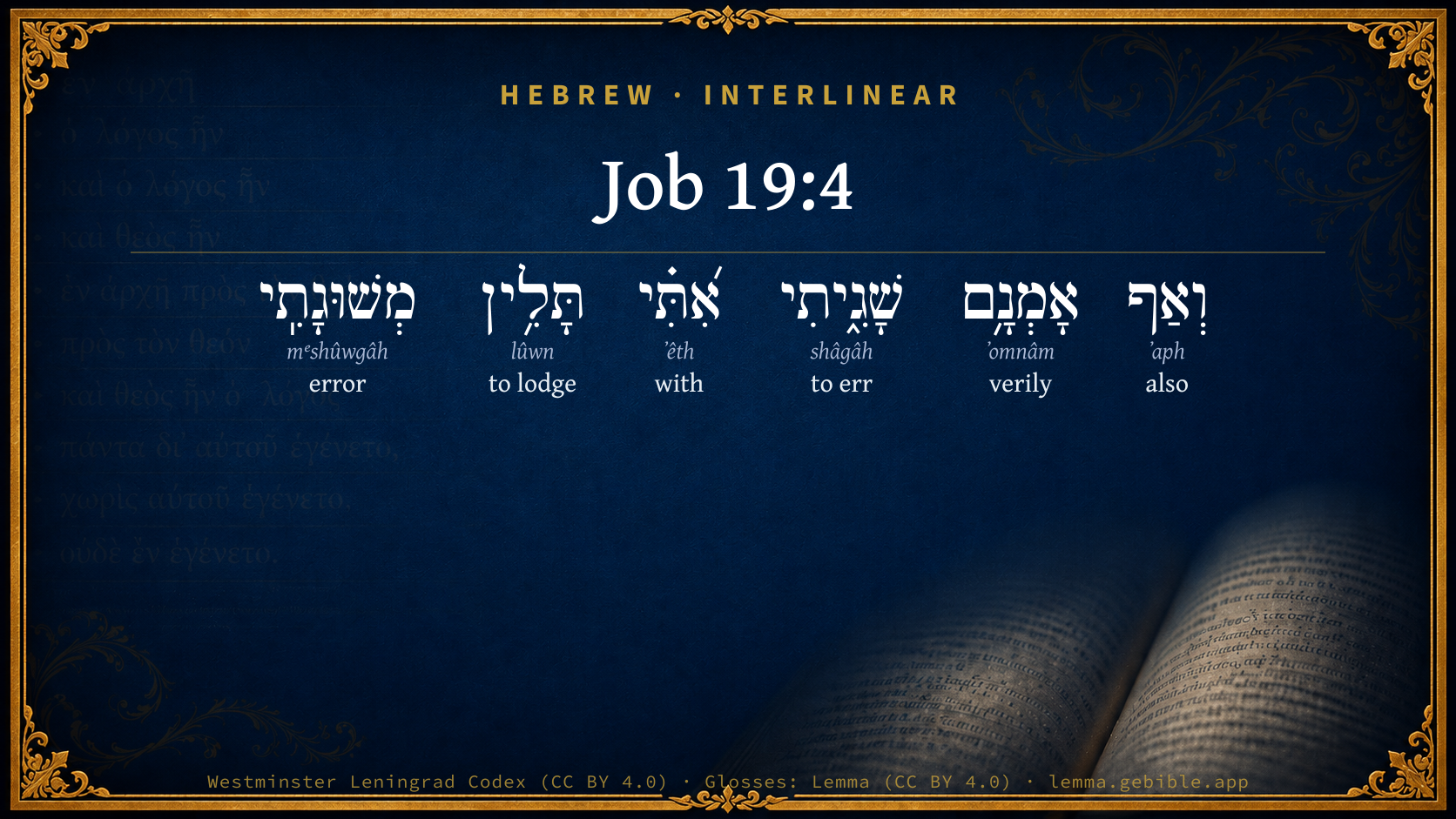
Job 19:4

Hebrew (Westminster Leningrad Codex) Job 19:4 appears in the Hebrew Old Testament. The text above is from the Westminster Leningrad Codex. Each word links to its Strong’s number, a concise gloss, and parsing drawn from the Open Scriptures Hebrew Bible morphology. Click any word for its full Brown-Driver-Briggs (BDB) entry.
Download image
Cite this verse

Job 19:4 (World English Bible). Public Domain. Lemma interlinear Bible study tool, https://lemma.gebible.app/v/job/19/4.

Show BibTeX & RIS
BibTeX
RIS
English Translation
If it is true that I have erred, My error remains with myself.
World English Bible · Public Domain
Highlights Full analysis ↓
Download a study sheet

One document with this verse’s original text, its word-by-word gloss line, the meaning frame, cross-references with their text, attributed commentary, and full source and license credits — printable, and it pastes into notes with its structure intact.

This verse Autodidact and up

Study sheet (.html) Plain text (.txt)

A passage Seminary Student

Up to 50 verses in one chapter. A passage sheet keeps up to 6 commentary sources and 12 cross-references per verse, in the order this page ranks them, and says so on the sheet whenever that leaves anything out. Ask for a single verse and you get the Autodidact verse sheet above.

Everything on this page stays free to read, with no account — the sheet is a download of what is already on screen, not access to it.

Want to remove ads? Support Godless Engineer
Compare translations 3

The same verse in 3 English versions, stacked beneath the original-language interlinear above. Click any original word for its lexicon entry.

Each is an independent rendering of the whole verse — the interlinear is not word-aligned to these translations.

Highlighted words mark where these versions differ — a whole-verse word diff, not a word-by-word alignment.

  • World English Bible Public Domain
    If it is true that I have erred, My error remains with myself.
  • King James Version Public Domain
    And be it indeed that I have erred, mine error remaineth with myself.
  • unfoldingWord Literal Text CC BY-SA 4.0
    And even truly I have erred, my error remains with me.

unfoldingWord Literal Text — © unfoldingWord, licensed CC BY-SA 4.0. Word-aligned USFM3 via Door43 (git.door43.org/unfoldingWord/en_ult).

Versions to compare (up to 4)

3 of 4 selected

Show all 18 translations

Every available English version of this verse, each an independent rendering of the whole verse.

  • World English Bible Public Domain
    If it is true that I have erred, My error remains with myself.
  • Berean Standard Bible Public Domain
    Even if I have truly gone astray, my error concerns me alone.
  • Majority Standard Bible Public Domain
    Even if I have truly gone astray, my error concerns me alone.
  • King James Version Public Domain
    And be it indeed that I have erred, mine error remaineth with myself.
  • American Standard Version (1901) Public Domain
    And be it indeed that I have erred, Mine error remaineth with myself.
  • Revised Version (1885) Public Domain
    And be it indeed that I have erred, mine error remaineth with myself.
  • Geneva Bible (1599) Public Domain
    And though I had in deede erred, mine errour remaineth with me.
  • Douay-Rheims (1899) Public Domain
    For if I have been ignorant, my ignorance shall be with me.
  • Young's Literal Translation Public Domain
    And also -- truly, I have erred, With me doth my error remain.
  • Literal Standard Version CC BY-SA 4.0
    And also—truly, I have erred, || My error remains with me.
  • Unlocked Literal Bible CC BY-SA 4.0
    If it is indeed true that I have erred, my error remains my own concern.
  • unfoldingWord Literal Text CC BY-SA 4.0
    And even truly I have erred, my error remains with me.
  • Darby Bible Public Domain
    And be it [that] I have erred, mine error remaineth with myself.
  • World Messianic Bible Public Domain
    If it is true that I have erred, my error remains with myself.
  • Webster's Bible Public Domain
    And be it indeed that I have erred, my error remaineth with myself.
  • Free Bible Version CC BY-SA 4.0
    Even if I did sin, that's my problem, and has nothing to do with you.
  • Bible in Basic English Public Domain
    And, truly, if I have been in error, the effect of my error is only on myself.
  • JPS Tanakh (1917) Public Domain
    And be it indeed that I have erred, mine error remaineth with myself.

Literal Standard Version (2020), Covenant Press — licensed CC BY-SA 4.0. Text via the HelloAO Bible API (eBible.org). Unlocked Literal Bible (unfoldingWord) — licensed CC BY-SA 4.0. Text via the HelloAO Bible API (eBible.org). unfoldingWord Literal Text — © unfoldingWord, licensed CC BY-SA 4.0. Word-aligned USFM3 via Door43 (git.door43.org/unfoldingWord/en_ult). Free Bible Version, Dr. Jonathan Gallagher — licensed CC BY-SA 4.0. Text via the HelloAO Bible API (eBible.org).

Word by word

More ways to search: Search by grammar → Find every occurrence → Compare this word →

Practice this passage: Drill this verse → Learn its vocabulary →

About this verse

These counts appear in no published source. They are computed here, from the morphology-tagged text and Lemma’s own curated glosses. What Lemma adds →

6
words
6
distinct lemmas
Wisdom
section

Notable vocabulary

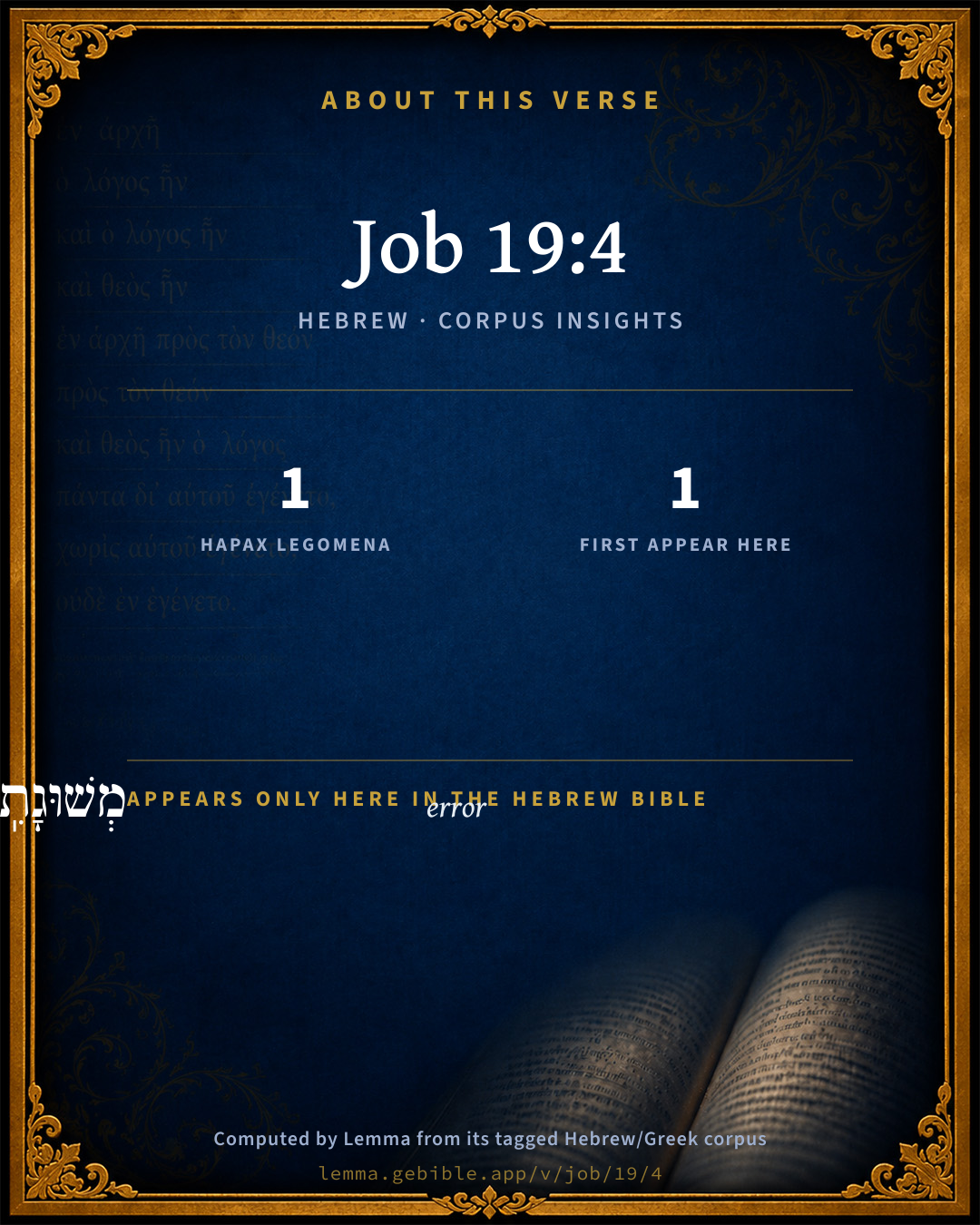
1 hapax legomenon — a word that appears only here in the entire Hebrew Bible:

  • מְשׁוּגָתִֽי error H4879

First appearance in Scripture

This word makes its first canonical appearance in the Hebrew Bible here:

  • מְשׁוּגָתִֽי error H4879

Shared distinctive vocabulary

אָמְנָ֥ם verily H551 occurs in 9 verses of the Hebrew Bible. Also found in:

Grammatical profile

  • 2 verbs
  • 1 noun
  • 1 preposition
  • 2 adverbs

Verb forms

  • שָׁגִ֑יתִי Qal · Perfect
  • תָּלִ֥ין Qal · Imperfect

Hebrew & Septuagint length

In English translation the verse runs 13 words from the Hebrew and 31 from the Septuagint (LXX English) — the Septuagint runs noticeably longer here. See the side-by-side →

A rough comparison of the two English renderings, which tokenize alike — not a word-level alignment.

Word counts can differ between the Hebrew and the Greek without any difference in meaning — e.g. the Hebrew direct-object marker אֵת has no separate Greek word, and Greek often adds the article ὁ.

Cross-references

6

Topical passages linked to Job 19:4 in the Treasury of Scripture Knowledge — connected by theme and wording, ordered by reader-vote popularity; previews shown in the World English Bible.

  • Proverbs 9:12 If you are wise, you are wise for yourself. If you mock, you alone will bear it.
  • Ezekiel 18:4 Behold, all souls are mine; as the soul of the father, so also the soul of the son is mine: the soul who sins, he shall die.
  • 2 Corinthians 5:10 For we must all be revealed before the judgment seat of Christ; that each one may receive the things in the body, according to what he has done, whether good or bad.
  • 2 Samuel 24:17 David spoke to Yahweh when he saw the angel who struck the people, and said, Behold, I have sinned, and I have done perversely; but these sheep, what have they done? Please let your hand be against me, and against my father's house.
  • Job 11:3–6 Should your boastings make men hold their peace? When you mock, shall no man make you ashamed?
  • Galatians 6:5 For each man will bear his own burden.

Cross-references courtesy of OpenBible.info (CC BY 4.0).

Hebrew and Greek witnesses Masoretic Hebrew ↔ Greek Septuagint

The same verse in the two great witnesses to the Old Testament, shown verse-for-verse.

Here the Septuagint runs noticeably longer than the Hebrew — LXX2012 (modern English Septuagint) 31 words vs World English Bible 13. A rough length comparison of the two English translations, not a word-level alignment — read both below.

These are two independent witnesses, not word-aligned to each other, and the Septuagint is shown in lemma (dictionary) form.

Hebrew Job 19:4 Masoretic · Westminster Leningrad Codex

וְאַף אָמְנָ֥ם שָׁגִ֑יתִי אִ֝תִּ֗י תָּלִ֥ין מְשׁוּגָתִֽי

If it is true that I have erred, My error remains with myself.

World English Bible · Public Domain

Greek LXX Job 19:4 Septuagint · lemma form

ναί δή ἐπί ἀλήθεια ἐγώ πλανάω παρά ἐγώ δέ αὐλίζω πλάνος λαλέω ῥῆμα ὅς οὐ δέω ὁ δέ ῥῆμα ἐγώ πλανάω καί οὐ ἐπί καιρός

Yes verily, I have erred in truth, (but the error abides with myself) in having spoken words which it was not right to speak; and my words err, and are unreasonable.

LXX2012 (modern English Septuagint) · Public Domain

On this verse, Haydock's Catholic Bible Commentary discusses the Septuagint’s reading. Read the note in Commentary ↓

Hebrew: Westminster Leningrad Codex (CC BY 4.0). Greek: Septuagint (public domain); English from LXX2012 (modern English Septuagint) (Public Domain). How the Septuagint differs from the Hebrew →

Commentary

Notes on Job 19:4 from classic Christian and Jewish commentators (each source and its license shown beneath its notes). The classic Christian expositions comment on the surrounding passage and are grouped to its opening verse, so a note may address several verses; the Jewish commentaries on the Tanakh (Rashi and others) are per-verse, so they appear only where the commentator wrote on this verse.

Lemma curates 59 commentaries, every one of them public domain or Creative Commons licensed, each selected and text-cleaned for this edition rather than reprinted as found. About our sources →

Trapp's Complete Commentary

John Trapp

Job 19:4 And be it indeed [that] I have erred, mine error remaineth with myself.

Ver. 4. And be it indeed that I have erred] Of human frailty; for that there is any way of wickedness in me (as you would have it) I shall never yield. But nimis angusta res est, nuspiam errare. Involuntary failings I am not free from; who knoweth the errors of his life? Psa 19:12. What man is he that liveth and sinneth not? It is the sad privilege of mortality, saith one, Licere aliquando peccare, to have licence sometimes to sin (Euphorm.).

Mine error remaineth with myself] q.d. It is little that you have done toward convincing me of any error in all this time, and talk, which until ye have done, I must still remain of the same mind. Or thus, You shall neither answer nor suffer for mine error; what need, then, all this heat and harshness? Not that every man must be left to himself, and let alone to live as he wishes. Admonition is a Christian duty, and the word of exhortation must be suffered, sharp though it be, and to the flesh irksome; better it is that the vine should bleed than die. Had Job been guilty, he would or should have been, as Vespasian is reported, patientissimus veri, patient of a reproof. But his friends falsely accused him for a hypocrite, and fell foul upon another man’s servant, whom they had nothing to do to condemn, Rom 14:10. And hence this expression of his discontent.

John Trapp, A Commentary or Exposition upon All the Books of the Old and New Testament (1647–1656) — public domain. Text from a community e-Sword module.

Joseph Benson's Commentary

Job 19:4-5. Be it that I have erred, &c. — If I have sinned, I myself suffer for my sins, and therefore deserve your pity rather than your reproaches. If you will magnify yourselves, &c. — Use imperious and contemptuous speeches against me; or seek praise from others by outreasoning me: and plead against me my reproach — Declaim against me, and allege my calamities, which have made me contemptible, as an argument to prove me a hypocrite, and condemn me as such.

Joseph Benson's Commentary on the Old and New Testaments (1811–1818) — public domain. Text from a community e-Sword module.

Geneva Bible (1599)

Geneva Bible translators

That is, I myself shall be punished for it, or you have not yet confuted it.

Geneva Bible (1599) marginal notes — public domain. Text via Bolls.life.

Jamieson, Fausset & Brown

Robert Jamieson, A. R. Fausset & David Brown

erred--The Hebrew expresses unconscious error. Job was unconscious of wilful sin.

remaineth--literally, "passeth the night." An image from harboring an unpleasant guest for the night. I bear the consequences.

Jamieson, Fausset & Brown — Commentary Critical and Explanatory on the Whole Bible (1871) — public domain (CC PDM 1.0). Text via the HelloAO Bible API.

Adam Clarke's Commentary

Verse 4. And be it indeed that I have erred] Suppose indeed that I have been mistaken in any thing, that in the simplicity of my heart I have gone astray, and that this matter remains with myself, (for most certainly there is no public stain on my life,) you must grant that this error, whatsoever it is, has hurt no person except myself. Why then do ye treat me as a person whose life has been a general blot, and whose example must be a public curse?

Adam Clarke's Commentary on the Bible (1810–1826) — public domain. Text from a community e-Sword/MySword module.

The Cambridge Bible for Schools and Colleges

gen. ed. J. J. S. Perowne

4. In this verse Job must mean to repudiate the offences insinuated against him. The precise force of the second clause, however, is obscure. It might mean, “my error is my own and no matter for your intermeddling”; or, “I alone am conscious of it and you can know nothing regarding it,”—in either case a mere passing rejection of the charges of his friends. Or, “had I indeed sinned my error would remain with myself, I should be conscious of it,” cf. ch. 9:36. Ewald’s idea that the “error” which Job alludes to is his mistaken hope of judgment and righteousness on God’s part is less suitable to the connexion.

The Cambridge Bible for Schools and Colleges (gen. ed. J. J. S. Perowne; Cambridge University Press, 1878–1918) — public domain. Text from a community e-Sword module.

John Gill's Exposition

If indeed ye will magnify yourselves against me,.... Look and talk big, set up themselves for great folk, and resolve to run him down; open their mouths wide against him and speak great swelling words in a blustering manner; or magnify what they called an error in him, and set it out in the worst light they could:

and plead against me my reproach; his affliction which he was reproached with, and was pleaded against him as an argument of his being a wicked man; if therefore they were determined to go on after this manner, and insist on this kind of proof, then he would have them take what follows.

John Gill's Exposition of the Whole Bible (1746–1763) — public domain (CC PDM 1.0). Text via the HelloAO Bible API.

Albert Barnes' Notes on the Bible

And be it indeed that I have erred - Admitting that I have erred, it is my own concern. You have a right to reproach and revile me in this manner.

Mine error abideth with myself - I must abide the consequences of the error.” The design of this seems to be to reprove what he regarded as an improper and meddlesome interference with his concerns. Or it may be an expression of a willingness to bear all the consequences himself. He was willing to meet all the fair results of his own conduct.

Albert Barnes' Notes on the Bible (1834–1885) — public domain. Text from a community e-Sword/MySword module.

Haydock's Catholic Bible Commentary

With me. I alone am answerable for it. But I am no wiser for your remarks. If I have sinned, have I not been sufficiently punished? (Calmet) --- Septuagint, "Yea, truly, I was under a mistake; and the mistake still remains with me, to have spoken a word which was not becoming. But my speeches are erroneous and importunate." He talks thus ironically. (Haydock)

George Leo Haydock (1774–1849), Haydock's Catholic Family Bible and Commentary, 1859 edition — public domain. Excludes Psalms (Douay-Rheims chapter numbering differs from Protestant) and Deuterocanonical books (Catholic canon only).

Matthew Poole's English Annotations

If my opinion in this point be faulty and erroneous, as you pretend it is. Or, if I have sinned, (for sin is oft called error in Scripture,) and am therefore punished.

Mine error remaineth with myself; either,

1. It is likely to continue, I see no cause from your reasons to change my judgment. Or,

2. I suffer deeply for my sins, and therefore deserve your pity and help, rather than your reproaches, whereby you add affliction to the afflicted.

Matthew Poole's English Annotations on the Holy Bible (1683–1685) — public domain. Text from a community e-Sword/MySword module.

Whedon's Commentary on the Bible

Daniel D. Whedon

4. Remaineth — Literally, Passes the night, תלין, with me. The busy and absorbing scenes of the day divert the mind from its errors, guilt, and wretchedness. At night, left to itself, the soul becomes the prey of thought and of the remindings of conscience. Amid the darkness, conscience asserts her supremacy, and lords it over the man. What of the man, if the night be forever protracted! An inscription on an Assyrian tablet (in the British Museum, K, No. 44) gives an invocation to the fire-god: —

God of fire, with the bright fire, In the house of darkness, light thou establishest.

…To the wicked in the night, the causes of trembling art thou.

The works of man, the child of his God, do thou purify.…

Daniel D. Whedon (gen. ed.), Commentary on the Old and New Testaments (1874–1909) — public domain. Text from a community e-Sword module.

The Pulpit Commentary

And be it indeed that I have erred; or, done wrong. Job at no time maintains his impeccability. Sins of infirmity he frequently pleads guilty to, and specially to intemperate speech. (see Job_6:26 Job_9:14, Job_9:20, etc) Mine error remaineth with myself; i.e. "it remains mine; and I suffer the punishment.

HOMILIES BY W.F. ADENEY Vers. 4-6. The erring soul and its God.

Job replies to the intrusive censures of his friends with the indignation of outraged privacy. Granted that he has erred, as his friends assume, that is his own business, not theirs it is a matter between himself and God only; they have no occasion to meddle in it.

I THERE IS A PRIVACY IN RELIGION. Each soul has to deal with God alone. Although we may help one another by sympathy, and although our internal religion must show itself in external conduct, still the roots and inner springs of religion are not for public Investigation. The breach of reserve on the deepest matters of the soul is like an offence against decency. The language of love is sacred, and is reserved for the ears of one only. When love has been wounded by wrong, the error is still a private concern, and one which strangers have no right to interfere with. No doubt there are ways in which our deepest experiences may be made serviceable to others. We ought to confess our faith, for the honour of Christ and for the encouragement of others. Too often a false shame keeps Christians back in this respect. We ought also to confess our faults one to another. But these faults are deeds in which we have injured one another. No one has a right to expose the secret sins of his brother, or to pry into the inner conflicts of his soul. The religion that is turned inside out in the light of day fades or coarsens. The roots that are dragged from their secret dwelling-place and exposed to the sun, wither and perish. The spiritual experience that is bandied by the multitude loses its finer character, if not its very life. We cannot help our brother by destroying his delicacy of feeling. Even if we think him too reserved, though it might be well for him to be more communicative, we cannot be justified in tearing down the veil which he has chosen to wear.

II THERE MUST BE THE UTMOST OPENNESS WITH GOD IN RELIGION. Here the reserve ceases. Here the most retiring soul must be completely frank. God claims our confidence. To attempt to hide anything from God is foolish, for he knows all our most secret thoughts. But we need to go further, and make our confessions consciously and willingly. The reasons for reserve among men do not apply to our relations with God. As God knows all, so he rightly understands everything. He will never misjudge us. Moreover, his love secures his perfect sympathy with us. Man"s prying curiosity subjects the quivering nerves of its victim to a process of vivisection; but God"s searching gaze of love and sympathy heals and saves. It is necessary that we should receive this willingly if we are to profit by it. A foolish shyness of God leaves us without the cheering of his presence. It is always a bad thing when one has to say, as a son exclaimed of his lately deceased father whom everybody was praising, "It may be all true; but I cannot say, as I never knew him." It is not our Father"s fault if we do not know him. He rewards confidence with an exchange of confidence. Now, our first and most necessary duty is to fling aside all reserve before God, to own that "we have erred and strayed from his ways like lost sheep," to confess ourselves utterly helpless and worthless, and, trusting our emptiness to him, to be ready to welcome tile fulness which he always bestows on his trusting children. W.F.A.

The Pulpit Commentary (1880–1919), ed. H.D.M. Spence-Jones & Joseph S. Exell — public domain. Text from a community e-Sword module.

John Wesley's Explanatory Notes

Erred - If I have sinned, I myself suffer for my sins, and therefore deserve your pity rather than reproaches.

John Wesley, Explanatory Notes Upon the Whole Bible (1754–1765) — public domain. Text via the GEBible commentary corpus.

Rashi

Rabbi Shlomo Yitzchaki (Rashi)

stay with me I am the one who receives blows for my error.

Rashi on the Tanakh — English translations: “The Judaica Press complete Tanach with Rashi, translated by A. J. Rosenberg” (CC BY 4.0); “Pentateuch with Rashi's commentary by M. Rosenbaum and A.M. Silbermann, 1929-1934” (public domain); “The Metsudah Tanach series, Lakewood, N.J” (CC BY 4.0); and “The Book of Joshua, Metsudah Publications, 1997” (CC BY 4.0). Text via Sefaria.

Lesson kit

Teaching starters — assembled from the data on this page, not authored interpretation. Every prompt links to the verse data it draws on. Edit before teaching.

Job, in the Wisdom, opens this verse with 6 words (6 distinct Hebrew lemmas). Its most distinctive word is mᵉshûwgâh (“error”). The Greek Septuagint runs longer here. A historical commentator’s framing appears above. Read the whole chapter for the surrounding context.

Discussion questions

  1. How does “error” (mᵉshûwgâh) shape what this verse is saying?
  2. 1 word here appears nowhere else in the Hebrew Bible. Why might the author reach for such rare wording?
  3. This is the first place “error” appears in Scripture (first appears here). What does its debut here establish?
  4. How does Ruth 3:12, which shares the word «verily», read alongside this verse?
  5. The Septuagint runs longer here than the Hebrew. What might account for the difference?
  6. The translations on this page render this verse differently — a whole-verse word diff, not a word-by-word alignment. What might account for the different wordings?
  7. «שָׁגִ֑יתִי» is a Qal Perfect verb. How does that grammatical form shape the action described?
  8. Compare how Trapp's Complete Commentary and Joseph Benson's Commentary read this verse. Where do they agree or differ?

Things to notice

  • 1 word in this verse appears nowhere else in the Hebrew Bible.
  • 1 word makes its first canonical appearance in Scripture here.
  • These translations choose different wording for 9 words in this verse.
  • 6 distinct Hebrew lemmas span 6 words in this verse.

Reading settings

Reading text

Shown beneath each verse's original-language words.

Old Testament
Old Testament edition

Read the OT as the Masoretic Hebrew (MT) or the Greek Septuagint (LXX).

English shown for the Greek Septuagint (in the Hebrew ↔ Greek comparison).

Comparing translations? Open the Compare panel on any verse page to stack up to four side by side.