
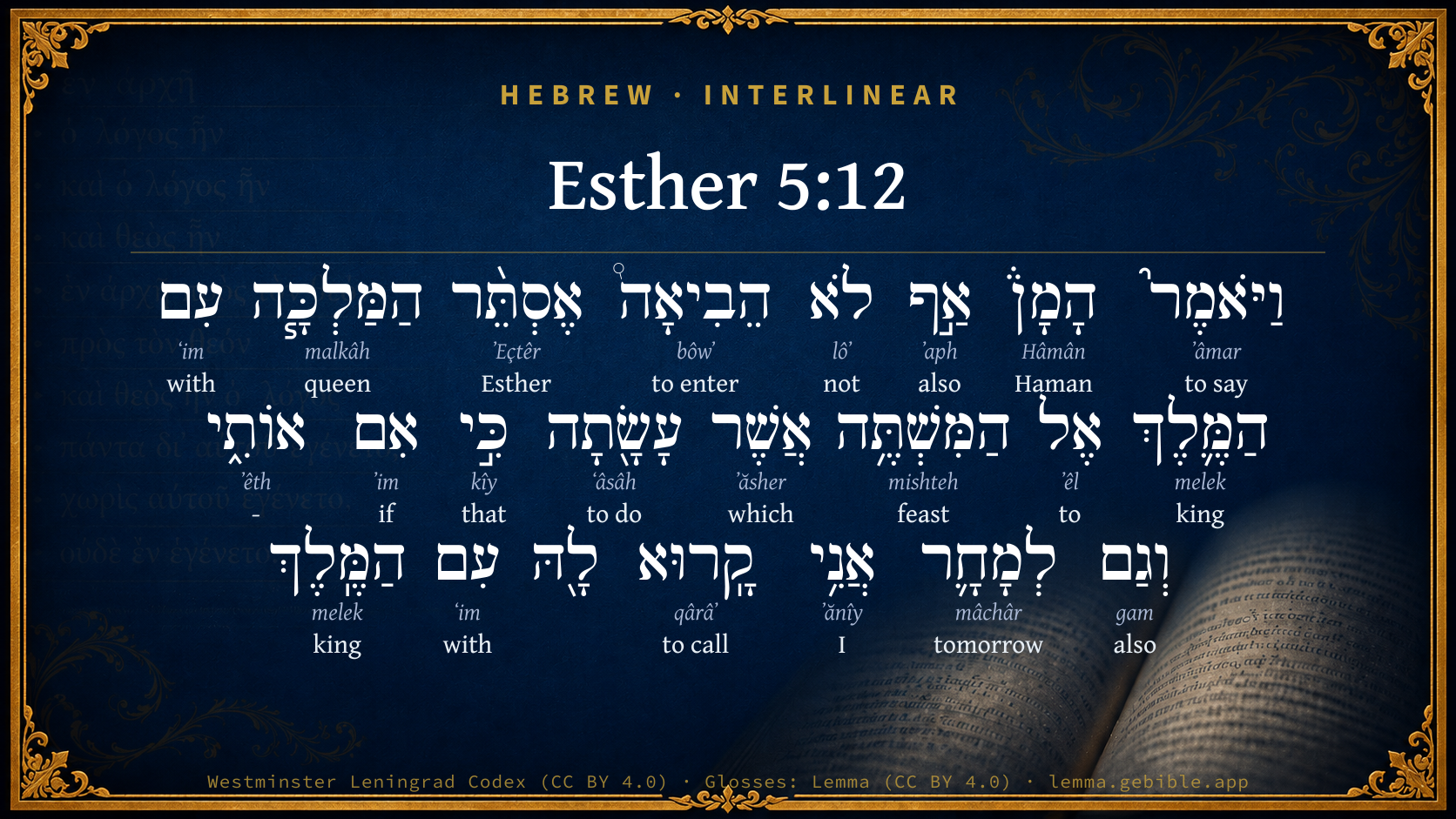
Esther 5:12

Hebrew (Westminster Leningrad Codex) Esther 5:12 appears in the Hebrew Old Testament. The text above is from the Westminster Leningrad Codex. Each word links to its Strong’s number, a concise gloss, and parsing drawn from the Open Scriptures Hebrew Bible morphology. Click any word for its full Brown-Driver-Briggs (BDB) entry.
Download image
Cite this verse

Esther 5:12 (World English Bible). Public Domain. Lemma interlinear Bible study tool, https://lemma.gebible.app/v/esther/5/12.

Show BibTeX & RIS
BibTeX
RIS
English Translation
Haman said moreover, Yes, Esther the queen did let no man come in with the king to the banquet that she had prepared but myself; and tomorrow also am I invited by her together with the king.
World English Bible · Public Domain
Download a study sheet

One document with this verse’s original text, its word-by-word gloss line, the meaning frame, cross-references with their text, attributed commentary, and full source and license credits — printable, and it pastes into notes with its structure intact.

This verse Autodidact and up

Study sheet (.html) Plain text (.txt)

A passage Seminary Student

Up to 50 verses in one chapter. A passage sheet keeps up to 6 commentary sources and 12 cross-references per verse, in the order this page ranks them, and says so on the sheet whenever that leaves anything out. Ask for a single verse and you get the Autodidact verse sheet above.

Everything on this page stays free to read, with no account — the sheet is a download of what is already on screen, not access to it.

Want to remove ads? Support Godless Engineer
Compare translations 3

The same verse in 3 English versions, stacked beneath the original-language interlinear above. Click any original word for its lexicon entry.

Each is an independent rendering of the whole verse — the interlinear is not word-aligned to these translations.

Highlighted words mark where these versions differ — a whole-verse word diff, not a word-by-word alignment.

  • World English Bible Public Domain
    Haman said moreover, Yes, Esther the queen did let no man come in with the king to the banquet that she had prepared but myself; and tomorrow also am I invited by her together with the king.
  • King James Version Public Domain
    Haman said moreover, Yea, Esther the queen did let no man come in with the king unto the banquet that she had prepared but myself; and to morrow am I invited unto her also with the king.
  • unfoldingWord Literal Text CC BY-SA 4.0
    And Haman said, “In addition, Esther the queen did not bring anyone with the king to the banquet that she had made except me. And also for tomorrow, I am called by her with the king.

unfoldingWord Literal Text — © unfoldingWord, licensed CC BY-SA 4.0. Word-aligned USFM3 via Door43 (git.door43.org/unfoldingWord/en_ult).

Versions to compare (up to 4)

3 of 4 selected

Show all 18 translations

Every available English version of this verse, each an independent rendering of the whole verse.

  • World English Bible Public Domain
    Haman said moreover, Yes, Esther the queen did let no man come in with the king to the banquet that she had prepared but myself; and tomorrow also am I invited by her together with the king.
  • Berean Standard Bible Public Domain
    “What is more,” Haman added, “Queen Esther invited no one but me to join the king at the banquet she prepared, and I am invited back tomorrow along with the king.
  • Majority Standard Bible Public Domain
    “What is more,” Haman added, “Queen Esther invited no one but me to join the king at the banquet she prepared, and I am invited back tomorrow along with the king.
  • King James Version Public Domain
    Haman said moreover, Yea, Esther the queen did let no man come in with the king unto the banquet that she had prepared but myself; and to morrow am I invited unto her also with the king.
  • American Standard Version (1901) Public Domain
    Haman said moreover, Yea, Esther the queen did let no man come in with the king unto the banquet that she had prepared but myself; and to-morrow also am I invited by her together with the king.
  • Revised Version (1885) Public Domain
    Haman said moreover, Yea, Esther the queen did let no man come in with the king unto the banquet that she had prepared but myself; and tomorrow also am I invited by her together with the king.
  • Geneva Bible (1599) Public Domain
    Haman sayde moreouer, Yea, Ester the Queene did let no man come in with the King to the banket that she had prepared, saue me: and to morowe am I bidden vnto her also with the King.
  • Douay-Rheims (1899) Public Domain
    And after this he said: Queen Esther also hath invited no other to the banquet with the king, but me: and with her I am also to dine to morrow with the king:
  • Young's Literal Translation Public Domain
    And Haman saith, `Yea, Esther the queen brought none in with the king, unto the feast that she made, except myself, and also for to-morrow I am called to her, with the king,
  • Literal Standard Version CC BY-SA 4.0
    And Haman says, “Indeed, Esther the queen brought none in with the king, to the feast that she made, except myself, and also for tomorrow I am called to her, with the king,
  • Unlocked Literal Bible CC BY-SA 4.0
    Haman said, “Queen Esther invited no one else but me to come with the king to the feast she prepared. Even tomorrow I am again invited by her along with the king.
  • unfoldingWord Literal Text CC BY-SA 4.0
    And Haman said, “In addition, Esther the queen did not bring anyone with the king to the banquet that she had made except me. And also for tomorrow, I am called by her with the king.
  • Darby Bible Public Domain
    And Haman said, Yea, Esther the queen let no man come in with the king to the banquet that she had prepared but myself; and to-morrow also I am invited to her with the king.
  • World Messianic Bible Public Domain
    Haman also said, “Yes, Esther the queen let no man come in with the king to the banquet that she had prepared but myself; and tomorrow I am also invited by her together with the king.
  • Webster's Bible Public Domain
    Haman said moreover, Yes, Esther the queen let no man come in with the king to the banquet that she had prepared but myself; and to-morrow I am invited to her also with the king.
  • Free Bible Version CC BY-SA 4.0
    “Added to all that,” Haman went on, “I was the only other person Queen Esther invited to come to a dinner she had prepared for the king. I'm also invited by her to eat together with the king tomorrow.”
  • Bible in Basic English Public Domain
    And Haman said further, Truly, Esther the queen let no man but myself come in to the feast which she had made ready for the king; and tomorrow again I am to be her guest with the king.
  • JPS Tanakh (1917) Public Domain
    Haman said moreover: 'Yea, Esther the queen did let no man come in with the king unto the banquet that she had prepared but myself; and to-morrow also am I invited by her together with the king.

Literal Standard Version (2020), Covenant Press — licensed CC BY-SA 4.0. Text via the HelloAO Bible API (eBible.org). Unlocked Literal Bible (unfoldingWord) — licensed CC BY-SA 4.0. Text via the HelloAO Bible API (eBible.org). unfoldingWord Literal Text — © unfoldingWord, licensed CC BY-SA 4.0. Word-aligned USFM3 via Door43 (git.door43.org/unfoldingWord/en_ult). Free Bible Version, Dr. Jonathan Gallagher — licensed CC BY-SA 4.0. Text via the HelloAO Bible API (eBible.org).

Word by word

More ways to search: Search by grammar → Find every occurrence → Compare this word →

Practice this passage: Drill this verse → Learn its vocabulary →

הַמַּלְכָּ֧ה
malkâh
H4436
“the · queen”
Particle, Definite Article + Noun, Common, Feminine, Singular, Absolute
Part of Speech
Particle + Noun
Type
Common
Gender
Feminine
Number
Singular
State
Absolute
Full BDB Definition

Origin: from H4428

TWOT: 1199b

queen
  1. וַיֹּאמֶר֮ ʼâmar H559 “and · to say” Conjunction + Verb, Qal, Sequential Imperfect, 3rd Person, Masculine, Singular
  2. הָמָן֒ Hâmân H2001 “Haman” Noun, Proper
  3. אַ֣ף ʼaph H637 “also” Particle, Accusative
  4. לֹא lôʼ H3808 “not” Particle, Negative
  5. הֵבִיאָה֩ bôwʼ H935 “to enter” Verb, Hiphil, Perfect, 3rd Person, Feminine, Singular
  6. אֶסְתֵּ֨ר ʼEçtêr H635 “Esther” Noun, Proper
  7. עִם ʻim H5973 “with” Preposition
  8. הַמֶּ֛לֶךְ melek H4428 “the · king” Particle, Definite Article + Noun, Common, Masculine, Singular, Absolute
  9. אֶל ʼêl H413 “to” Preposition
  10. הַמִּשְׁתֶּ֥ה mishteh H4960 “the · feast” Particle, Definite Article + Noun, Common, Masculine, Singular, Absolute
  11. אֲשֶׁר ʼăsher H834 “which” Particle, Relative
  12. עָשָׂ֖תָה ʻâsâh H6213 “to do” Verb, Qal, Perfect, 3rd Person, Feminine, Singular
  13. כִּ֣י kîy H3588 “that” Conjunction
  14. אִם ʼim H518 “if” Conjunction
  15. אוֹתִ֑י ʼêth H853 “- · me” Particle, Direct Object + Suffix, Personal, 1st Person, Common, Singular
  16. וְגַם gam H1571 “and · also” Conjunction + Particle, Accusative
  17. לְמָחָ֛ר mâchâr H4279 “to/for · tomorrow” Preposition + Noun, Common, Masculine, Singular, Absolute
  18. אֲנִ֥י ʼănîy H589 “I” Pronoun, Personal, 1st Person, Common, Singular
  19. קָֽרוּא qârâʼ H7121 “called” Verb, Qal, Participle Passive, Masculine, Singular, Absolute
  20. עִם ʻim H5973 “with” Preposition
  21. הַמֶּֽלֶךְ melek H4428 “the · king” Particle, Definite Article + Noun, Common, Masculine, Singular, Absolute

About this verse

These counts appear in no published source. They are computed here, from the morphology-tagged text and Lemma’s own curated glosses. What Lemma adds →

23
words
20
distinct lemmas
Historical
section

Shared distinctive vocabulary

הַמַּלְכָּ֧ה queen H4436 occurs in 34 verses of the Hebrew Bible. Also found in:

Grammatical profile

  • 4 verbs
  • 7 nouns
  • 1 pronoun
  • 4 prepositions
  • 2 conjunctions
  • 5 particles

Verb forms

  • וַיֹּאמֶר֮ Qal · Sequential Imperfect
  • הֵבִיאָה֩ Hiphil · Perfect
  • עָשָׂ֖תָה Qal · Perfect
  • קָֽרוּא Qal · Participle Passive

Repetition

Words recur within this verse — often emphatic in Hebrew:

  • הַמֶּ֛לֶךְ king H4428 ×2
  • עִם with H5973 ×2

Hebrew & Septuagint length

In English translation the verse runs 37 words from the Hebrew and 22 from the Septuagint (LXX English) — the Septuagint runs noticeably shorter here. See the side-by-side →

A rough comparison of the two English renderings, which tokenize alike — not a word-level alignment.

Word counts can differ between the Hebrew and the Greek without any difference in meaning — e.g. the Hebrew direct-object marker אֵת has no separate Greek word, and Greek often adds the article ὁ.

Cross-references

7

Topical passages linked to Esther 5:12 in the Treasury of Scripture Knowledge — connected by theme and wording, ordered by reader-vote popularity; previews shown in the World English Bible.

  • Proverbs 27:1 Don't boast about tomorrow; For you don't know what a day may bring forth.
  • Psalms 37:35–36 I have seen the wicked in great power, Spreading himself like a green tree in its native soil.
  • Job 8:12–13 While it is yet in its greenness, not cut down, It withers before any other reed.
  • Job 20:5–8 That the triumphing of the wicked is short, The joy of the godless but for a moment?
  • Proverbs 7:22–23 He followed her immediately, As an ox goes to the slaughter, As a fool stepping into a noose.
  • Luke 21:34–35 "So be careful, or your hearts will be loaded down with carousing, drunkenness, and cares of this life, and that day will come on you suddenly.
  • 1 Thessalonians 5:3 For when they are saying, "Peace and safety," then sudden destruction will come on them, like birth pains on a pregnant woman; and they will in no way escape.

Cross-references courtesy of OpenBible.info (CC BY 4.0).

Hebrew and Greek witnesses Masoretic Hebrew ↔ Greek Septuagint

The same verse in the two great witnesses to the Old Testament, shown verse-for-verse.

Here the Septuagint runs noticeably shorter than the Hebrew — LXX2012 (modern English Septuagint) 22 words vs World English Bible 37. A rough length comparison of the two English translations, not a word-level alignment — read both below.

These are two independent witnesses, not word-aligned to each other, and the Septuagint is shown in lemma (dictionary) form.

Hebrew Esther 5:12 Masoretic · Westminster Leningrad Codex

וַיֹּאמֶר֮ הָמָן֒ אַ֣ף לֹא הֵבִיאָה֩ אֶסְתֵּ֨ר הַמַּלְכָּ֧ה עִם הַמֶּ֛לֶךְ אֶל הַמִּשְׁתֶּ֥ה אֲשֶׁר עָשָׂ֖תָה כִּ֣י אִם אוֹתִ֑י וְגַם לְמָחָ֛ר אֲנִ֥י קָֽרוּא לָ֖הּ עִם הַמֶּֽלֶךְ

Haman said moreover, Yes, Esther the queen did let no man come in with the king to the banquet that she had prepared but myself; and tomorrow also am I invited by her together with the king.

World English Bible · Public Domain

Greek LXX Esther 5:12 Septuagint · lemma form

καί εἶπον πρός αὐτός ζωσαρα ὁ γυνή αὐτός καί ὁ φίλος κόπτω σύ ξύλον πῆχυς πεντήκοντα ὄρθρος δέ εἶπον ὁ βασιλεύς καί κρεμάζω μαρδοχαῖος ἐπί ὁ ξύλον σύ δέ εἰςἔρχομαι εἰς ὁ δοχή σύν ὁ βασιλεύς καί εὐφραίνω καί ἀρέσκω ὁ ῥῆμα ὁ αμαν καί ἑτοιμάζω ὁ ξύλον

And Aman said, The queen has called no one to the feast with the king but me, and I am invited to-morrow.

LXX2012 (modern English Septuagint) · Public Domain

Hebrew: Westminster Leningrad Codex (CC BY 4.0). Greek: Septuagint (public domain); English from LXX2012 (modern English Septuagint) (Public Domain). How the Septuagint differs from the Hebrew →

Commentary

Notes on Esther 5:12 from classic Christian and Jewish commentators (each source and its license shown beneath its notes). The classic Christian expositions comment on the surrounding passage and are grouped to its opening verse, so a note may address several verses; the Jewish commentaries on the Tanakh (Rashi and others) are per-verse, so they appear only where the commentator wrote on this verse.

Lemma curates 59 commentaries, every one of them public domain or Creative Commons licensed, each selected and text-cleaned for this edition rather than reprinted as found. About our sources →

Trapp's Complete Commentary

John Trapp

Est 5:12 Haman said moreover, Yea, Esther the queen did let no man come in with the king unto the banquet that she had prepared but myself; and to morrow am I invited unto her also with the king.

Ver. 12. Haman said moreover] He makes no end of vaunting and vapouring; and all to aggravate the indignity done him by Mordecai, in not stooping to so great a personage.

Yea, Esther the queen did let no man come in … but myself] This he mistaketh for a special favour, when as Esther’s banquet proved no better to him than Semiramis’s tomb did to them that rifled it; they expected to find treasure, but met with a deadly poison.

And tomorrow am I invited, &c.] Where thou shalt (as hypocrites do at the Lord’s table) eat thy bane, and drink thy poison; yet art thou over joyed as if highly favoured. A temporary may receive both the word audible and the word visible (the sacrament) with much seeming joy; which yet is but only as the commotion of the affections in a dream: it fareth with such in the end as with one that, sleeping on the top of a steep rock, dreameth of great matters befallen him, but, starting suddenly through joy thereof, tumbleth headlong into the sea, and breaketh his neck at the bottom.

John Trapp, A Commentary or Exposition upon All the Books of the Old and New Testament (1647–1656) — public domain. Text from a community e-Sword module.

John Gill's Exposition

Yet all this availeth me nothing,.... Is not equal or sufficient for me; it gives me no satisfaction and contentment:

so long as I see Mordecai the Jew sitting at the king's gate: not rising up to bow unto him; this single circumstance spoiled all his joy and pleasure.

John Gill's Exposition of the Whole Bible (1746–1763) — public domain (CC PDM 1.0). Text via the HelloAO Bible API.

Haydock's Catholic Bible Commentary

But me. It was thought very singular, when Artaxerxes invited his own brothers. (Plutarch) --- But when he also admitted a foreigner, the nobility became jealous, as that honour was reserved for the king’s relations. (Atheneus i.) --- Dine, or feast. Only one meal was taken, (Herodotus vii. 120.) and that in the evening. (Calmet)

George Leo Haydock (1774–1849), Haydock's Catholic Family Bible and Commentary, 1859 edition — public domain. Excludes Psalms (Douay-Rheims chapter numbering differs from Protestant) and Deuterocanonical books (Catholic canon only).

Matthew Poole's English Annotations

Thus he makes that matter of glorying which was designed for and the occasion of his utter ruin. So ignorant are the wisest men, and subject to fatal mistakes; rejoicing when they have most cause of fear and grief, and sorrowing for those things which tend to joy and comfort.

Matthew Poole's English Annotations on the Holy Bible (1683–1685) — public domain. Text from a community e-Sword/MySword module.

John Wesley's Explanatory Notes

Am I - Thus he makes that matter of glorying which was the occasion of his utter ruin. So ignorant are the wisest men, and subject to fatal mistakes, rejoicing when they have most cause of fear, and sorrowing for those things which tend to joy and comfort.

John Wesley, Explanatory Notes Upon the Whole Bible (1754–1765) — public domain. Text via the GEBible commentary corpus.

unfoldingWord translationNotes

Door43 World Missions Community

no one else but me

This can be expressed positively. AT: "only me"

is worth nothing to me

"does not make me happy" or "does not satisfy me"

translationWords

feast

Jew

unfoldingWord translationNotes — © Distant Shores Media and the Door43 World Missions Community, licensed CC BY-SA 4.0. Source: git.door43.org/Door43/en_tn.

Lesson kit

Teaching starters — assembled from the data on this page, not authored interpretation. Every prompt links to the verse data it draws on. Edit before teaching.

Esther, in the Historical, opens this verse with 23 words (20 distinct Hebrew lemmas). Its most distinctive word is malkâh (“queen”). The Greek Septuagint runs shorter here. A historical commentator’s framing appears above. Read the whole chapter for the surrounding context.

Discussion questions

  1. How does “queen” (malkâh) shape what this verse is saying?
  2. How does 1 Kings 10:1, which shares the word «queen», read alongside this verse?
  3. What does the repetition of “king” (2× in this one verse) do in this verse?
  4. The Septuagint runs shorter here than the Hebrew. What might account for the difference?
  5. These translations render this verse differently; the difference is in the English rendering, not the original. What questions does that raise?
  6. «וַיֹּאמֶר֮» is a Qal Sequential Imperfect verb. How does that grammatical form shape the action described?
  7. Compare how Trapp's Complete Commentary and John Gill's Exposition read this verse. Where do they agree or differ?

Things to notice

Reading settings

Reading text

Shown beneath each verse's original-language words.

Old Testament
Old Testament edition

Read the OT as the Masoretic Hebrew (MT) or the Greek Septuagint (LXX).

English shown for the Greek Septuagint (in the Hebrew ↔ Greek comparison).

Comparing translations? Open the Compare panel on any verse page to stack up to four side by side.