

Job 35:14

Hebrew (Westminster Leningrad Codex) Job 35:14 appears in the Hebrew Old Testament. The text above is from the Westminster Leningrad Codex. Each word links to its Strong’s number, a concise gloss, and parsing drawn from the Open Scriptures Hebrew Bible morphology. Click any word for its full Brown-Driver-Briggs (BDB) entry.
Download image
Cite this verse

Job 35:14 (World English Bible). Public Domain. Lemma interlinear Bible study tool, https://lemma.gebible.app/v/job/35/14.

Show BibTeX & RIS
BibTeX
RIS
English Translation
How much less when you say you don't see him. The cause is before him, and you wait for him!
World English Bible · Public Domain
Download a study sheet

One document with this verse’s original text, its word-by-word gloss line, the meaning frame, cross-references with their text, attributed commentary, and full source and license credits — printable, and it pastes into notes with its structure intact.

This verse Autodidact and up

Study sheet (.html) Plain text (.txt)

A passage Seminary Student

Up to 50 verses in one chapter. A passage sheet keeps up to 6 commentary sources and 12 cross-references per verse, in the order this page ranks them, and says so on the sheet whenever that leaves anything out. Ask for a single verse and you get the Autodidact verse sheet above.

Everything on this page stays free to read, with no account — the sheet is a download of what is already on screen, not access to it.

Want to remove ads? Support Godless Engineer
Compare translations 3

The same verse in 3 English versions, stacked beneath the original-language interlinear above. Click any original word for its lexicon entry.

Each is an independent rendering of the whole verse — the interlinear is not word-aligned to these translations.

Highlighted words mark where these versions differ — a whole-verse word diff, not a word-by-word alignment.

  • World English Bible Public Domain
    How much less when you say you don't see him. The cause is before him, and you wait for him!
  • King James Version Public Domain
    Although thou sayest thou shalt not see him, yet judgment is before him; therefore trust thou in him.
  • unfoldingWord Literal Text CC BY-SA 4.0
    How much less that you say you do not see him, the case to his face, and you are waiting for him,

unfoldingWord Literal Text — © unfoldingWord, licensed CC BY-SA 4.0. Word-aligned USFM3 via Door43 (git.door43.org/unfoldingWord/en_ult).

Versions to compare (up to 4)

3 of 4 selected

Show all 18 translations

Every available English version of this verse, each an independent rendering of the whole verse.

  • World English Bible Public Domain
    How much less when you say you don't see him. The cause is before him, and you wait for him!
  • Berean Standard Bible Public Domain
    How much less, then, when you say that you do not see Him, that your case is before Him and you must wait for Him,
  • Majority Standard Bible Public Domain
    How much less, then, when you say that you do not see Him, that your case is before Him and you must wait for Him,
  • King James Version Public Domain
    Although thou sayest thou shalt not see him, yet judgment is before him; therefore trust thou in him.
  • American Standard Version (1901) Public Domain
    How much less when thou sayest thou beholdest him not, The cause is before him, and thou waitest for him!
  • Revised Version (1885) Public Domain
    How much less when thou sayest thou beholdest him not, the cause is before him, and thou waitest for him!
  • Geneva Bible (1599) Public Domain
    Although thou sayest to God, Thou wilt not regard it, yet iudgement is before him: trust thou in him.
  • Douay-Rheims (1899) Public Domain
    Yea when thou shalt say: He considereth not: be judged before him, and expect him.
  • Young's Literal Translation Public Domain
    Yea, though thou sayest thou dost not behold Him, Judgment `is' before Him, and stay for Him.
  • Literal Standard Version CC BY-SA 4.0
    Indeed, though you say you do not behold Him, || Judgment [is] before Him, and stays for Him.
  • Unlocked Literal Bible CC BY-SA 4.0
    How much less will he answer you if you say that you do not see him, that your case is before him, and that you are waiting for him!
  • unfoldingWord Literal Text CC BY-SA 4.0
    How much less that you say you do not see him, the case to his face, and you are waiting for him,
  • Darby Bible Public Domain
    Although thou sayest thou dost not see him, judgment is before him, therefore wait for him.
  • World Messianic Bible Public Domain
    How much less when you say you don’t see him. The cause is before him, and you wait for him!
  • Webster's Bible Public Domain
    Although thou sayest thou shalt not see him, yet judgment is before him; therefore trust thou in him.
  • Free Bible Version CC BY-SA 4.0
    How much less will God hear you when you say he can't see you? Your case is before him, so you have to wait for him.
  • Bible in Basic English Public Domain
    How much less when you say that you do not see him; that the cause is before him, and you are waiting for him.
  • JPS Tanakh (1917) Public Domain
    Yea, when thou sayest thou canst not see Him — the cause is before Him; therefore wait thou for Him.

Literal Standard Version (2020), Covenant Press — licensed CC BY-SA 4.0. Text via the HelloAO Bible API (eBible.org). Unlocked Literal Bible (unfoldingWord) — licensed CC BY-SA 4.0. Text via the HelloAO Bible API (eBible.org). unfoldingWord Literal Text — © unfoldingWord, licensed CC BY-SA 4.0. Word-aligned USFM3 via Door43 (git.door43.org/unfoldingWord/en_ult). Free Bible Version, Dr. Jonathan Gallagher — licensed CC BY-SA 4.0. Text via the HelloAO Bible API (eBible.org).

Word by word

More ways to search: Search by grammar → Find every occurrence → Compare this word →

Practice this passage: Drill this verse → Learn its vocabulary →

תְשׁוּרֶ֑נּוּ
shûwr
H7789
“to see · us”
Verb, Qal, Imperfect, 2nd Person, Masculine, Singular + Suffix, Personal, 1st Person, Common, Plural
Part of Speech
Verb
Stem
Qal
Form
Imperfect
Person
2nd Person
Gender
Masculine
Number
Singular
Full BDB Definition

Origin: a primitive root [identical with H7788 through the idea of going round for inspection]

TWOT: 2354

to see, behold, observe, regard - (Qal) - to behold, observe - to regard - to watch, watch (stealthily), lie in wait
  1. אַ֣ף ʼaph H637 “also” Particle, Accusative
  2. כִּֽי kîy H3588 “that” Conjunction
  3. תֹ֭אמַר ʼâmar H559 “to say” Verb, Qal, Imperfect, 2nd Person, Masculine, Singular
  4. לֹ֣א lôʼ H3808 “not” Particle, Negative
  5. דִּ֥ין dîyn H1779 “judgment” Noun, Common, Masculine, Singular, Absolute
  6. לְ֝פָנָ֗יו pânîym H6440 “to/for · face(s) · his” Preposition + Noun, Common, Both, Plural, Construct + Suffix, Personal, 3rd Person, Masculine, Singular
  7. וּתְח֥וֹלֵֽל chûwl H2342 “and · to writhe” Conjunction + Verb, Polel, Imperfect, 2nd Person, Masculine, Singular

About this verse

These counts appear in no published source. They are computed here, from the morphology-tagged text and Lemma’s own curated glosses. What Lemma adds →

9
words
8
distinct lemmas
Wisdom
section

Notable vocabulary

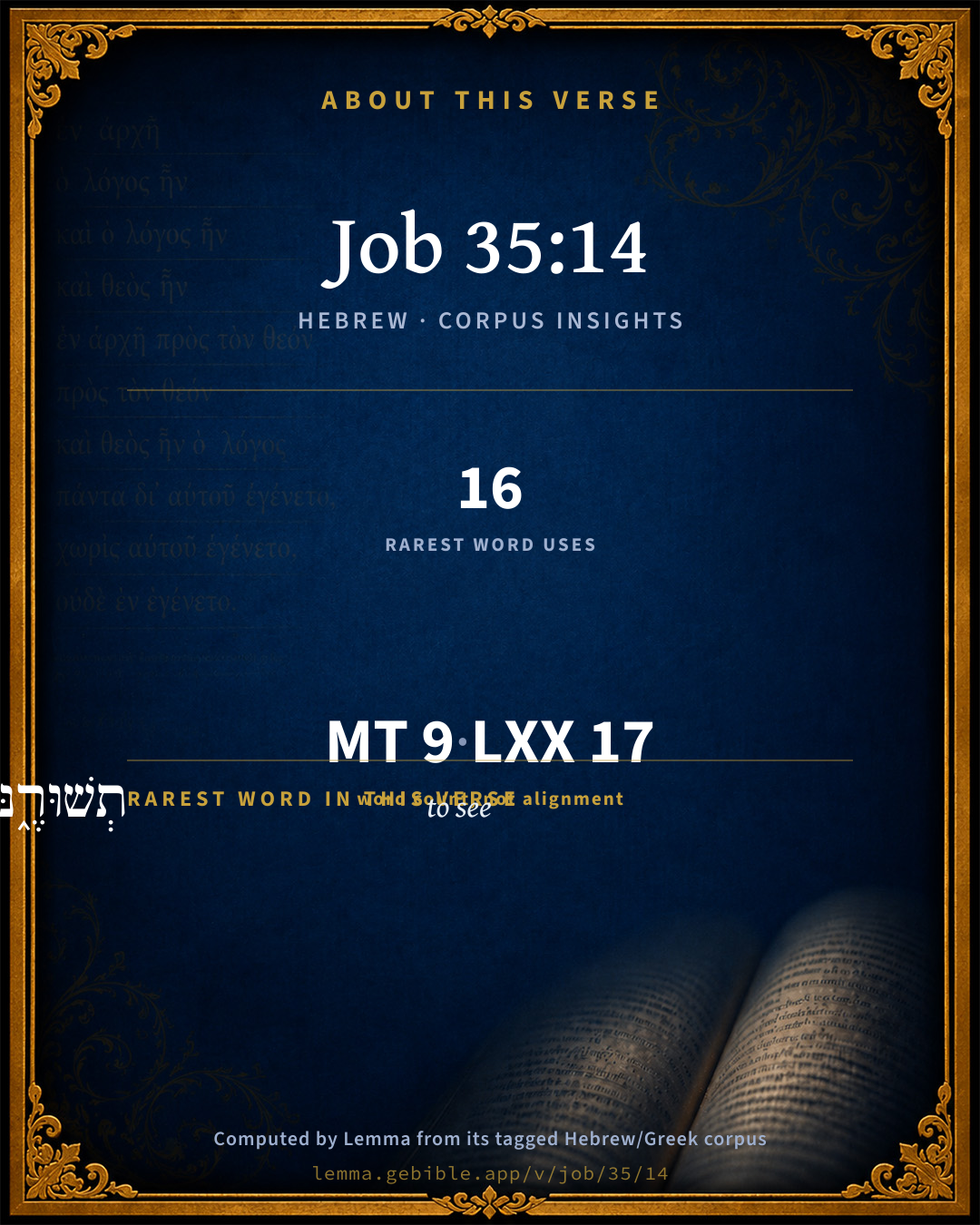
The rarest word here is תְשׁוּרֶ֑נּוּ to see H7789 — appearing just 16 times in the whole Hebrew Bible.

Shared distinctive vocabulary

תְשׁוּרֶ֑נּוּ to see H7789 occurs in 16 verses of the Hebrew Bible. Also found in:

Grammatical profile

  • 3 verbs
  • 2 nouns
  • 1 preposition
  • 1 conjunction
  • 2 particles

Verb forms

  • תֹ֭אמַר Qal · Imperfect
  • תְשׁוּרֶ֑נּוּ Qal · Imperfect
  • וּתְח֥וֹלֵֽל Polel · Imperfect

Hebrew & Septuagint length

In English translation the verse runs 20 words from the Hebrew and 29 from the Septuagint (LXX English) — the Septuagint runs noticeably longer here. See the side-by-side →

A rough comparison of the two English renderings, which tokenize alike — not a word-level alignment.

Word counts can differ between the Hebrew and the Greek without any difference in meaning — e.g. the Hebrew direct-object marker אֵת has no separate Greek word, and Greek often adds the article ὁ.

In the original languages it is 9 Hebrew tokens and 17 Greek tokens — but the two are counted differently (Hebrew bundles its prefixes and suffixes into one token; the Greek is in lemma form), so that isn’t a like-for-like length.

Cross-references

16

Topical passages linked to Job 35:14 in the Treasury of Scripture Knowledge — connected by theme and wording, ordered by reader-vote popularity; previews shown in the World English Bible.

  • Job 9:11 Behold, he goes by me, and I don't see him. He passes on also, but I don't perceive him.
  • Job 9:19 If it is a matter of strength, behold, he is mighty! If of justice, 'Who,' says he, 'will summon me?'
  • Job 19:7 "Behold, I cry out of wrong, but I am not heard: I cry for help, but there is no justice.
  • Job 23:3 Oh that I knew where I might find him! That I might come even to his seat!
  • Job 23:8–10 "If I go east, he is not there; If west, I can't find him;
  • Psalms 27:12–14 Don't deliver me over to the desire of my adversaries, For false witnesses have risen up against me, Such as breathe out cruelty.
  • Psalms 37:5–6 Commit your way to Yahweh. Trust also in him, and he will do this:
  • Psalms 62:5 My soul, wait in silence for God alone, For my expectation is from him.
  • Psalms 62:8 Trust in him at all times, you people. Pour out your heart before him. God is a refuge for us. Selah.
  • Psalms 77:5–10 I have considered the days of old, The years of ancient times.
  • Psalms 97:2 Clouds and darkness are around him. Righteousness and justice are the foundation of his throne.
  • Isaiah 30:18 Therefore will Yahweh wait, that he may be gracious to you; and therefore will he be exalted, that he may have mercy on you: for Yahweh is a God of justice; blessed are all those who wait for him.
  • Isaiah 50:10 Who is among you who fears Yahweh, who obeys the voice of his servant? He who walks in darkness, and has no light, let him trust in the name of Yahweh, and rely on his God.
  • Isaiah 54:17 No weapon that is formed against you shall prosper; and every tongue that shall rise against you in judgment you shall condemn. This is the heritage of the servants of Yahweh, and their righteousness which is of me, says Yahweh.
  • Micah 7:7–9 But as for me, I will look to Yahweh. I will wait for the God of my salvation. My God will hear me.
  • Romans 8:33–34 Who could bring a charge against God's chosen ones? It is God who justifies.

Cross-references courtesy of OpenBible.info (CC BY 4.0).

Hebrew and Greek witnesses Masoretic Hebrew ↔ Greek Septuagint

The same verse in the two great witnesses to the Old Testament, shown verse-for-verse.

Here the Septuagint runs noticeably longer than the Hebrew — LXX2012 (modern English Septuagint) 29 words vs World English Bible 20. A rough length comparison of the two English translations, not a word-level alignment — read both below.

These are two independent witnesses, not word-aligned to each other, and the Septuagint is shown in lemma (dictionary) form.

Hebrew Job 35:14 Masoretic · Westminster Leningrad Codex

אַ֣ף כִּֽי תֹ֭אמַר לֹ֣א תְשׁוּרֶ֑נּוּ דִּ֥ין לְ֝פָנָ֗יו וּתְח֥וֹלֵֽל לֽוֹ

How much less when you say you don't see him. The cause is before him, and you wait for him!

World English Bible · Public Domain

Greek LXX Job 35:14 Septuagint · lemma form

ὁ συντελέω ὁ ἄνομος καί σώζω ἐγώ κρίνω δέ ἐναντίον αὐτός εἰ δύναμαι αἰνέω αὐτός ὡς εἰμί

He beholds them that perform lawless deeds, and he will save me: and do you plead before him, if you can praise him, as it is possible even now.

LXX2012 (modern English Septuagint) · Public Domain

On this verse, Keil & Delitzsch discusses the Septuagint’s reading. Read the note in Commentary ↓

Hebrew: Westminster Leningrad Codex (CC BY 4.0). Greek: Septuagint (public domain); English from LXX2012 (modern English Septuagint) (Public Domain). How the Septuagint differs from the Hebrew →

Commentary

Notes on Job 35:14 from classic Christian and Jewish commentators (each source and its license shown beneath its notes). The classic Christian expositions comment on the surrounding passage and are grouped to its opening verse, so a note may address several verses; the Jewish commentaries on the Tanakh (Rashi and others) are per-verse, so they appear only where the commentator wrote on this verse.

Lemma curates 59 commentaries, every one of them public domain or Creative Commons licensed, each selected and text-cleaned for this edition rather than reprinted as found. About our sources →

Matthew Henry's Commentary

Here is, I. Another improper word for which Elihu reproves Job (Job 35:14): Thou sayest thou shalt not see him; that is, 1. "Thou complainest that thou dost not understand the meaning of his severe dealings with thee, nor discern the drift and design of them," Job 23:8, Job 23:9. And, 2. "Thou despairest of seeing his gracious returns to thee, of seeing better days again, and art ready to give up all for gone;" as Hezekiah (Isa 38:11), I shall not see the Lord. As, when we are in prosperity, we are ready to think our mountain will never be brought low, so when we are in adversity we are ready to think our valley will never be filled, but, in both, to conclude that to morrow must be as this day, which is as absurd as to think, when the weather is either fair or foul, that is will be always so, that the flowing tide will always flow, or the ebbing tide will always ebb.

II. The answer which Elihu gives to this despairing word that Job had said, which is this, 1. That, when he looked up to God, he had no just reason to speak thus despairingly: Judgment is before him, that is, "He knows what he has to do, and will do all in infinite wisdom and justice; he has the entire plan and model of providence before him, and knows what he will do, which we do not, and therefore we understand not what he does. There is a day of judgment before him, when all the seeming disorders of providence will be set to rights and the dark chapters of it will be expounded. Then thou shalt see the full meaning of these dark events, and the final period of these dismal events; then thou shalt see his face with joy; therefore trust in him, depend upon him, wait for him, and believe that the issue will be good at last." When we consider that God is infinitely wise, and righteous, and faithful, and that he is a God of judgment (Isa 30:18), we shall see no reason to despair of relief from him, but all the reason in the world to hope in him, that it will come in due time, in the best time. 2. That if he had not yet seen an end of his troubles, the reason was because he did not thus trust in God and wait for him (Job 35:15): "Because it is not so, because thou dost not thus trust in him, therefore the affliction which came at first from love has now displeasure mixed with it. Now God has visited thee in his anger, taking it very ill that thou canst not find in thy heart to trust him, but harbourest such hard misgiving thoughts of him." If there be any mixtures of divine wrath in our afflictions, we may thank ourselves; it is because we do not behave aright under them; we quarrel with God, and are fretful and impatient, and distrustful of the divine Providence. This was Job's case. The foolishness of man perverts his way, and then his heart frets against the Lord, Pro 19:3. Yet Elihu thinks that Job, being in great extremity, did not know and consider this as he should, that it was his own fault that he was not yet delivered. He concludes therefore that Job opens his mouth in vain (Job 35:16) in complaining of his grievances and crying for redress, or in justifying himself and clearing up his own innocency; it is all in vain, because he does not trust in God and wait for him, and has not a due regard to him in his afflictions. He had said a great deal, had multiplied words, but all without knowledge, all to no purpose, because he did not encourage himself in God and humble himself before him. It is in vain for us either to appeal to God or to acquit ourselves if we do not study to answer the end for which affliction is sent, and in vain to pray for relief if we do not trust in God; for let not that man who distrusts God think that he shall receive any thing from him, Jam 1:7. Or this may refer to all that Job had said. Having shown the absurdity of some passages in his discourse, he concludes that there were many other passages which were in like manner the fruits of his ignorance and mistake. He did not, as his other friends, condemn him for a hypocrite, but charged him only with Moses's sin, speaking unadvisedly with his lips when his spirit was provoked. When at any time we do so (and who is there that offends not in word?) it is a mercy to be told of it, and we must take it patiently and kindly as Job did, not repeating, but recanting, what we have said amiss.

Matthew Henry's Commentary on the Whole Bible (1708–1710) — public domain (CC PDM 1.0). Text via the HelloAO Bible API.

The Cambridge Bible for Schools and Colleges

gen. ed. J. J. S. Perowne

14–16. The interpretation and connexion of these verses is difficult. Job_35:14 might carry on the idea of Job_35:13,

13. Surely God will not hear vanity,

Neither will the Almighty regard it;

14. Much less when thou sayest, Thou seest him not,

The cause is before him and thou waitest for him.

God refuses to answer the cry which is vanity, not the voice of true religious trust; much less will He hear one who like Job complains that he cannot see Him (ch. Job_23:8 and often), who misses His righteous government in the world and charges Him with refusing to receive his just appeal (ch. Job_13:18 seq., Job_23:3, Job_31:35 seq.). There are objections to this interpretation, such as that much less when is not a natural translation of the words in Job_35:14, though in the elliptical and rather strained style of Elihu this might not go for much. Or, Job_35:14 might stand apart from Job_35:13,

Yea, when thou sayest, Thou seest him not,

The cause is before him; therefore wait thou for him.

the meaning being that though God appears indifferent to the cry of the distressed (Job_35:9; Job_35:12) He is not unaware of the evil, the cause has come before Him, or, His judgment upon it is determined, and therefore He is to be waited for till He manifest Himself by His just interposition. Though the second person thou be used, Job’s own case does not appear to be referred to; Elihu speaks generally, and Job is merely addressed as an example of persons who complain of God’s indifference to wrong-doing.

The Cambridge Bible for Schools and Colleges (gen. ed. J. J. S. Perowne; Cambridge University Press, 1878–1918) — public domain. Text from a community e-Sword module.

Trapp's Complete Commentary

John Trapp

Job 35:14 Although thou sayest thou shalt not see him, [yet] judgment [is] before him; therefore trust thou in him.

Ver. 14. Although thou sayest thou shalt not see him, &c.] This is that tertium Iobi pronuntiatum, Job’s third speech, which Elihu taketh upon him to reprehend and refute. It is taken out of Job 23:8-9, and the sense is, that God would never appear to do him right. But although thou sayest such a thing, and so seemest to chime in with those wicked ones who deny God’s providence; yet thou oughtest to be better persuaded of his presence with thee and providence over thee; for judgment is before him, and he will certainly do right; only thou must give glory to God and wait his time.

Yet judgment is before him] Or, Judge thyself in his sight; give glory to God, and confess thy sin; and then, stepping from the bar to the bench, judge thyself worthy to be destroyed, 1Co 11:31. This do, and then

Trust thou in me] For safety here and salvation hereafter; acting thy faith upon the precious promises, and hopefully expecting the performance thereof in due time. This was excellent counsel indeed, and worthy of all acceptation, Pia et salubris adhortatio (Mercer).

John Trapp, A Commentary or Exposition upon All the Books of the Old and New Testament (1647–1656) — public domain. Text from a community e-Sword module.

The Biblical Illustrator

Joseph S. Exell

Job_35:14

Therefore trust thou in Him.

The counsel of Elihu to the despondent

There is no word which the worshippers of God need to have whispered to their hearts more frequently than this, Trust thou in Him. We are in a world, and under a system of events, wonderfully adapted to try our faith.

I. If without faith it is impossible to please God, we might infer that faith is eminently pleasing. There is in Scripture no list of those who distinguished themselves for zeal, or humility, or hope; but the eleventh of Hebrews emblazons the names of men and women who through faith did marvellous things. Faith is the crowning glory of the Christian character.

II. A principal design of the Old Testament is to teach us faith. A wonderful illustration in connection with the text. God meant to teach mankind by this book, that the great business of man in this world is to trust God. In all this Job sinned not, nor charged God foolishly.

III. The counsel of Elihu in the text is profitable to a sinking heart. The meaning is, Although you say you will never see Him appear for you, yet He will exercise judgment when to do so; therefore trust thou in Him. There are times, when a dark providence has settled down like a cloud on our prospects. Something has happened which is the very worst thing which it seems to us God could have chosen wherewith to afflict us. There is no explanation, no mitigation, no cheerful outlook. Friends are mistaken if they tell us not to weep. Nature finds comfort in cries, groans, tears. There is no use in argument, we say, God was my friend once, now He has set me up as His mark. To such afflicted souls: the Word of God says, Although thou sayest thou shalt not see Him, yet, judgment is before Him. You think that you will never see His design to accomplish good in you and by you in this affliction. It seems to you without plan, confused, reckless. But judgment is for Him, whenever a child of His suffers; the arrow that pierces us wounds His heart ere it reaches ours.

IV. Our duty in dark hours is here made plain. Therefore trust in Him. This is done by special heartfelt address to God by word of mouth. To rise and go upon our knees, implies a serious determination to seek God, and the act of framing our speech, shows that we are in earnest. Having committed our prayer to God, declaring our trust in Him, we must show our sincerity by a quietness of mind which, be it remembered, is not inconsistent with importunity. We should never abandon ourselves to grief in the darkest hours. God takes pleasure in those who, against hope, believe in hope, taking part with God by insisting that He is able to do exceeding abundantly above all that we ask or think. Did We but know it, God is wooing those whom He is afflicting. He scourgeth, every son whom He receiveth. Therefore be of good courage, desponding souls. Submit yourselves under His rod. Finally--Everything which has been said of trust in God in times of despondency is eminently true of faith in the Saviour. (N. Adams, D.D.)

A God who hides Himself

1. These words suppose that there are seasons and situations, in which the ways of heaven seem dismaying and inexplicable. This is abundantly evident to whatever department of the Divine government we turn our eyes. If we look on the natural world we shall not always find unobscured the God of nature. If we look into the social department, here, too, we shall find His ways mysterious. There are times when the protection of His providence would seem to be withdrawn from society. Its interests appear subject to the caprices of fortune and the passions of men. If we turn our attention to the normal department, here, too, we shall find occurrences to astonish and perplex us. Affliction maintains a powerful and oppressive dominion among the sons of men. It is not uncommonly the lot of the righteous to bear the heaviest burdens, and experience the severest trials of life. In the management of their allotments, the ways of the Deity are inscrutable. When we compare the terrors of nature with His benevolence who rules her movements; when we contrast the triumphs of iniquity in the world, with His power and holiness by whom it is governed; when we combine the afflictions of the virtuous, and the trials of the Church, with His love to whom they are devoted: it must be confessed that there are seasons when he whose faith is most firmly fixed, may be ready to exclaim with the amazed prophet, Verily, Thou art a God that hidest Thyself, Oh God of Israel, the Saviour! Of this, however, we may be sure. His government must be as pure, just, and benevolent, as His nature; and consequently, righteous in every measure of it; seeking unceasingly the manifestation of justice, and the melioration and happiness of the creature. The Lord is righteous in all His ways and holy in all His works. We ought to maintain, in every situation in which His providence places us, an unshaken trust in His goodness, and obedience to His will. Nothing more frequently distresses the feelings, and disturbs the principles of men, than the inscrutableness of the dealings of God. But are the measures of His government wrong, because they do not coincide with our partial views? Are the methods of His providence to be condemned, because they cannot be comprehended by our limited understandings? That His ways are mysterious should fill us with humility. It should inspire us with reverence and godly fear; but it ought not to excite our surprise. We are assured by reason and by Scripture, that His government is infinitely and uniformly righteous. In the gift of His Son for our salvation, He has offered us the greatest pledge we are capable of receiving, that His aim, His wish, His constant care is the preservation and happiness of His offspring. In men assured of the perfection of a governor, and of the principles by which he acts, it is absurd to be dissatisfied with measures which they can see but in part. The most afflictive and inexplicable dispensations may often be the springs of the most important and happy operations. Let us learn, from what has been said, to preserve in every situation an unshaken reliance on the love of the Almighty, and a steadfast obedience to His will. (Bishop Dehon.)

.

The Biblical Illustrator, edited by Joseph S. Exell (c. 1880s–1900s) — public domain. Text from a community e-Sword module.

Joseph Benson's Commentary

Job 35:14. Thou shalt not see him — Or, thou canst not see him; thou canst not understand his dealings with thee. Here Elihu answers another objection of Job’s; and tells him that though God may, for a season, delay to answer, yet he will certainly do him right. Yet judgment is before him — Justice is at his tribunal, and in all his ways and administrations. Therefore trust thou in him — Instead of murmuring, repent of what is past, humble thyself under God’s hand, wait patiently in his way till deliverance come, for it will certainly come, if thou dost not hinder it.

Joseph Benson's Commentary on the Old and New Testaments (1811–1818) — public domain. Text from a community e-Sword module.

Keil & Delitzsch

C. F. Keil & F. Delitzsch

14 Although thou sayest, thou seest Him not:

The cause lieth before Him, and thou mayest wait for Him.

15 Now, then, if His wrath hath not yet punished,

Should He not be well acquainted with sullenness?

16 While Job openeth his mouth without reason,

Without knowledge multiplieth words.

The address is not direct to Job exclusively, for it here treats first of the acts of injustice which prevail among men and remain apparently unpunished; but to Job, however, also, so far as he has, Job 23:8-10, comp. Job 19:7; Job 30:20, thus complained concerning his prayer being unanswered. אף כּי signifies elsewhere quanto minus, Job 4:19, or also quanto magis, Pro 15:11, but nowhere quanto minus si (Hirz., Hlgst.) or quanto magis si (Hahn), also not Eze 15:5, where it signifies etiamne quum. As it can, however, naturally signify etiam quum, it can also signify etiamsi, etsi, as here and Neh 9:18. This quamvis dicas (opineris) is followed by the oratio obliqua, as Job 35:3. The relation of the matter - says the conclusion, Job 35:14 - is other than thou thinkest: the matter to be decided lies before Him, is therefore well known to Him, and thou mightest only wait for Him (חולל instead of יחל or הוחיל only here, comp. Psa 37:7, והתחולל לו); the decision, though it pass by, will not fail. In Job 35:15, Job 35:15 is taken by most modern commentators as antecedent to Job 35:16, in which case, apart from the distortions introduced, two interpretations are possible: (1) However now, because His (God's) wrath does not visit ... Job opens his mouth; (2) However now, because He (God) does not visit his (Job's) wrath (comp. on this reference of the אפּו to Job, Job 18:4; Job 36:13, Job 36:18)...Job opens, etc. That a clause with a confirmatory כי is made to precede its principal clause is not without example, Gen 3:14, Gen 3:17; but in connection with this arrangement the verb is accustomed always, in the principal clause or in the conclusion, to stand prominent (so that consequently we should expect ויפצה איוב), although in Arabic this position of the words, ואיוב יפצה, and in fact Arab. fâyûb instead of wâyûb (in connection with a difference of the subj. in the antecedent and in the conclusion, vid., De Sacy, Gramm. Arabe, 1201, 2), is regular. Therefore for a long time I thought that Job 35:15 was to be taken interrogatively: And now (ועתּה as logical inference and conclusion, which is here its most probable function, Ew. 353, b) should His wrath not punish (פּקד as absolute as Job 31:14), and should He not take notice, etc., כּי interrogative as Sa1 24:20; Sa1 28:1; Kg1 11:22, as הכי (is it so that, or: should it be so that), Job 6:22, and freq., in connection with which, what is said on Gen 21:7 concerning the modal use of the praet. might be compared on the two praett. But by this rendering the connection of Job 35:16 with what precedes is awkward. Ewald has given the correct rendering (apart from the misunderstanding of פּשׁ): Therefore, because His wrath has not yet punished, He does not know much about foolishness! Job 35:15 requires to be taken as the conclusion to Job 35:15, yet not as an exclamation, but as an interrogative. The interrogative use of ולא is not unusual, Sa2 20:1; Eze 16:43, Eze 16:47, Eze 16:56; Eze 32:27; and just as here, this interrogative ולא is found after a hypothetical antecedent clause, Sa1 20:9; Exo 8:22.

In connection with this interrogative rendering of Job 35:15, it still remains questionable whether it refers to Job's sin, or sin which prevails among men. The theme of this third speech of Elihu requires the latter reference, although perhaps not without a side-glance at Job's won arrogant behaviour. The translation shows how suitably Job 35:16 is connected with what precedes: Job 35:16 is a circumstantial clause, or, if one is not willing to take it as a subordinate clause, but prefers to take it as standing on a level with Job 35:15, an adversative clause attached with Waw, as is frequently the case: but (nevertheless) Job ... ; פּצה פּה of opening the mouth in derision, as Lam 2:16; Lam 3:46; הבל is the acc. of closer definition to it (= בּהבל), and the הכבּיר, which occurs only here and Job 36:31, signifies without distinction magnificare and multiplicare: Job multiplies high emotional words. As this יכבּיר is, so to speak, Hebraeo-Arabic (Arab. akbara), so is Job 35:15 full of Arabisims: (1) The combination אין פּקד, which has not its like in the Hebrew language (whether it be originally intended as relative or not: non est quod visitaverit, Ew. 321, b), corresponds to the popular Arabic use of lys for lâ, Ges. Thes. i. 82, b; probably אין has the value of an intensive negation (Carey: not at all). (2) The combination ידע בּ, to know about anything, to take knowledge of anything (differently Job 12:9, but comp. Job 24:12 on the idea), is like the Arab. construction of the verb (alima with bi (concerning) or bianna (because that) of the obj.; מאד (on this vid., on Psa 31:12) belongs not to בפשׁ (which is indeed possible), but, according to Psa 139:14, to ידע. (3) פּשׁ is especially to be explained from the Arabic. The signification a multitude (Jewish expositors, after פּוּשׁ, Niph. se diffundere, Nah 3:18) is not suitable; the signification evil (lxx, Jer., and others: פשׁ = פשׁע) presents a forcibly mutilated word, and moreover one devoid of significance in this connection; whereas the Arab. fšš (but not in its derivatives, fashsh, empty-headed; fâshûsh, empty-headedness, imbecility, with its metaphorical sense) indicates a development of signification which leads to the desired end, especially in the Syro-Arabic usage most natural here. The Arab. verb fšš (פשׁשׁ, cogn. Arab. fšr, frš, to extend, expandere) is used originally of water (fashsh el-mâ): to overflow its dam, to overflow its banks, whence a valley by the lake of el-Hgne, into which the waters of the lake flow after the winter rains, is called el-mefeshsh; then of a leathern bottle: to run out (tarf mefshûsh, an emptied bottle), of a tumour (waram): to disperse, disappear, and tropically of anger (el-chulq): to break forth, vent itself on anything, hence the phrase: dost thou make me a mefeshshe (an object for the venting) of thine anger? From this Arab. fšš (distinct from Arab. faš med. Waw, to swim on the surface, trop. to be above, not to allow one's self to be kept down, and med. Je, comp. פושׁ, Hab 1:8, Jer 50:11, Mal 4:2, signifies to be proud) is פּשׁ, formed after the forms בּד, מד, מס, a synon. of זדון, or even of עברה in the signification of excessive haughtiness, pride that bursts forth violently.

(Note: The signification expandere also underlies the noun fishshe, the lungs (in Egypt.); the signification discutere (especially carminare, to card wool), which the Talmud. פשׁפשׁ also has, is only a shade of the same signification; the origin of the trop. signification fatuum esse is clear from 'gaus fashûsh, empty nuts. The rice from the Palestine valley of Hle, it is somewhere said, is worse than the Egyptian, because (what is a fault in the East) in cooking tufeshfish, i.e., it bursts, breaks in pieces (comp. on the other hand: if the seed for sowing sinks to the bottom when put into water, it is good; if it swims on the surface, jefûsh, it is bad). The Piel of this fashsha signifies to cause the water to overflow, trop. fashshasha qalbahu, he gave air to his heart, i.e., he revealed a secret which burdened him. A proverb says: the market (with its life and changing scenes) is a feshshâsh of cares, i.e., consoles a trouble heart. In the Hiph. one says in like manner proverbially, el-bukâ jufishsh, weeping removes the anguish of the soul. - Wetzst.)

Thus, even at the close of this third speech of Elihu, the Arabic, and in fact Syro-Arabic colouring, common to this section with the rest of the book, is confirmed; while, on the other hand, we miss the bold, original figures which up to Job 31:1 followed like waves one upon another, and we perceive a deficiency of skill, as now and then between Koheleth and Solomon. The chief thought of the speech we have also heard already from the three friends and Job himself. That the piety of the pious profits himself without involving God in any obligation to him, Eliphaz has already said, Job 22:2.; and that prayer that is heard in time of need and the unanswered cry of the godly and the ungodly are distinct, Job said, Job 27:9. Elihu, however, deprives these thoughts of their hitherto erroneous application. If piety gives nothing to God which He ought to reward, Job dare not regard his affliction, mysterious as it is to him, as unjust; and if the godly do not directly experience the avenging wrath of God on the haughtiness of their oppressors, the question, whether then their prayer for help is of the right kind, is more natural than the complain of a want of justice in God's government of the world. Job is silent also after this speech. It does not contain the right consolation; it contains, however, censure which he ought humbly to receive. It touches his heart. But whether it touches the heart of the idea of the book, is another question.

Keil & Delitzsch — Biblical Commentary on the Old Testament (1861–1891) — public domain (CC PDM 1.0). Text via the HelloAO Bible API. (Old Testament only.)

Geneva Bible (1599)

Geneva Bible translators

God is just, howsoever thou judgest of him.

Geneva Bible (1599) marginal notes — public domain. Text via Bolls.life.

Jamieson, Fausset & Brown

Robert Jamieson, A. R. Fausset & David Brown

Although thou sayest thou shalt not see him--(as a temporal deliverer; for he did look for a Redeemer after death, Job 19:25-27; which passage cannot consistently with Elihu's assertion here be interpreted of "seeing" a temporal "redeemer"), Job 7:7; Job 9:11; Job 23:3, Job 23:8-9; yet, judgment . . . ; therefore trust . . . But the Hebrew favors MAURER, "How much less (will God . . . regard, Job 35:13), since thou sayest, that He does not regard thee." So in Job 4:19. Thus Elihu alludes to Job's words (Job 19:7; Job 30:20).

judgment--that is, thy cause, thy right; as in Psa 9:16; Pro 31:5, Pro 31:8.

trust--rather, "wait thou" on Him, patiently, until He take up thy cause (Psa 37:7).

Jamieson, Fausset & Brown — Commentary Critical and Explanatory on the Whole Bible (1871) — public domain (CC PDM 1.0). Text via the HelloAO Bible API.

Adam Clarke's Commentary

Verse 14. Thou sayest thou shalt not see HIM] Several MSS. have "Thou shalt not see me," and the Septuagint, and one other, "Thou shalt not see us," but without the points, תשורנו, the original may be read see HIM or see US, the third person singular, or the first person plural.

Yet judgment is before him] Rest assured that God has not forgotten either to punish or to save; therefore trust in him; choose to be a monument of his mercy, rather than of his justice.

Adam Clarke's Commentary on the Bible (1810–1826) — public domain. Text from a community e-Sword/MySword module.

Ellicott's Commentary for English Readers

(14) Although thou sayest thou shalt not see him.—Rather, Dost not behold Him.

A Bible Commentary for English Readers, edited by Charles John Ellicott (1878–1897) — public domain. Text from a community e-Sword module.

John Gill's Exposition

Although thou sayest thou shall not see him,.... Which is another expression of Job's taken notice of by Elihu, and to which he makes answer; he seems to refer to Job 23:3. God is indeed invisible in his nature and essence, but is to be seen in his works of creation and providence; which Job was acquainted with, and in which he had seen somewhat of the glory of God, and of his divine perfections in them. See Job 9:4. And he is to be seen in Christ by an eye of faith, and Job had trusted in him as his salvation; and he will be seen with the beatific vision in heaven as he is, in a more glorious and perfect manner, which Job had a full persuasion of, Job 13:15; and therefore is not to be understood in either of those senses, but of his not seeing him on a throne of judgment, hearing and trying his cause, judging and acquitting him; this he had often desired, but despaired of ever seeing it; see Job 23:4; to which Elihu replies;

yet judgment is before him; all things are naked and open to him, and stand clear before him; he has perfect knowledge of what is right and wrong; no cause is unknown to him, and needs not to be searched into by him; nor can he nor will he ever pass a wrong judgment: he is just and true, righteous in all his ways and works, the Judge of the whole earth, who will do right, and will plead and judge the cause of every good man sooner or later; if not now, there is a judgment to come with him, when all must appear before his judgment seat, and he will render unto every man according to his works;

therefore trust thou in him, or "wait for him" (c); wait for his coming to judgment: wait till that time comes when everything will be brought to light, and every good man shall have praise of God. Or, as we render it, "trust in him"; God alone is the object of trust and confidence, and happy is the man that trusts in him; he is to be trusted in for all things, both temporal, spiritual, and eternal; and particularly for this of doing justice to his people; if not now, yet hereafter, he will render tribulation to them that trouble them; he will right all their wrongs and avenge their injuries, and remove the rebuke that is upon them, and confess them before men and angels, and declare them righteous, and receive them into his kingdom and glory: and be is to be trusted in at all times, in times of adversity as well as prosperity; and even when he is not to be seen, and the dispensations of his providence are dark and intricate, see Isa 50:10; The word used signifies such a trust, hope, and waiting, as of a woman in travail, who bears her pains patiently, holding and trusting for a safe deliverance of a child, to the joy of her and her family.

(c) "et expectabis eum", Montanus; "expecta eum", Junius & Tremellius, Piscator, Mercerus; so Michaelis, Schultens.

John Gill's Exposition of the Whole Bible (1746–1763) — public domain (CC PDM 1.0). Text via the HelloAO Bible API.

Albert Barnes' Notes on the Bible

Although thou sayest thou shalt not see him - This is addressed to Job, and is designed to entreat him to trust in God. Elihu seems to refer to some remark that Job had made, like that in Job 23:8, where he said that he could not come near him, nor bring his cause before him. If he went to the east, the west, thc north, or the south, he could not see him, and could get no opportunity of bringing his cause before him: see the notes at that place. Elihu here says that though it is true in fact that God is invisible, yet this ought not to be regarded as a reason why he should not confide in him. The argument of Elihu here - which is undoubtedly sound - is, that the fact that God is invisible should not be regarded as any evidence that he does not attend to the affairs of people, or that he is not worthy of our love.

Judgment is before him - He is a God of justice, and will do that which is right.

Therefore trust him - Though he is invisible, and though you cannot bring, your cause directly before him. The word which is used here (תחולל tchûlēl, from חול chûl) means “to turn around”; to twist; to be firm - as a rope is that is twisted; and then to wait or delay - that is, to be firm in patience. Here it may have this meaning, that Job was to be firm and unmoved, patiently waiting for the time when the now invisible God would interpose in his behalf, though he could not now see him. The idea is, that we may trust the “invisible God,” or that we should patiently “wait” for him to manifest himself in our behalf, and may leave all our interests in his hands, with the feeling that they are entirely safe. It must be admitted that Job had not learned this lesson as fully as it might have been learned, and that he had evinced an undue anxiety for some public “manifestation” of the favor and friendship of God, and that he had not shown quite the willingness which he should have done to commit his interests into his hands, though he was unseen.

Albert Barnes' Notes on the Bible (1834–1885) — public domain. Text from a community e-Sword/MySword module.

Haydock's Catholic Bible Commentary

Before him. Try whether the assertion be true. (Haydock) --- Only change thy life, and hope in him, and thou wilt see the good effects. (Calmet)

George Leo Haydock (1774–1849), Haydock's Catholic Family Bible and Commentary, 1859 edition — public domain. Excludes Psalms (Douay-Rheims chapter numbering differs from Protestant) and Deuterocanonical books (Catholic canon only).

Matthew Poole's English Annotations

Thou shalt not see him; or, thou canst not see him; the future tense of the indicative mood being oft put potentially; i.e. thou canal not have thy desire in appearing and pleading thy cause before him. So this is a new matter, and Elihu answers another objection of Job’s, of which see Job 23:8,9, and tells him that he is not to judge of God by present appearance; because though God may for a season hide his face, and delay to give him an answer, yet he will certainly do him right. Before him, i.e. before God, or in his presence, or at his tribunal, or in all his ways and admininstrations. And

judgment is put for justice or just judgment, as it is Job 8:3; Psa 37:28; 99:4, and oft elsewhere. So the sense is, God is and will show himself to be just in all his ways, and therefore thou dost wickedly in reflecting upon God’s justice. Or, yet judge thyself

before him; instead of accusing God, condemn thyself, acknowledge thy sins, and then thou mayst hope for mercy. Compare 1Co 11:31.

Trust thou in him; instead of murmuring against him, put thy trust in him. Repent of what is past, and humble thyself under God’s hand, and do not despond for the future, but wait upon God patiently in his way till deliverance come to thee; for it will certainly come if thou dost not hinder it.

Matthew Poole's English Annotations on the Holy Bible (1683–1685) — public domain. Text from a community e-Sword/MySword module.

Whedon's Commentary on the Bible

Daniel D. Whedon

14. Although… trust thou in him — Read, much less when thou sayest thou beholdest him not! (Job_23:8.) The cause is before him; therefore wait thou on (or for) him.

Judgment — The cause, דין, neglected of men, is not neglected of God. It is before him.

b. A specific and sufficient reason for Job why his prayers are not heard is, that his speeches are dogmatic, vain, and foolish, 15, 16.

Daniel D. Whedon (gen. ed.), Commentary on the Old and New Testaments (1874–1909) — public domain. Text from a community e-Sword module.

The Pulpit Commentary

Although thou sayest thou shalt not see him; rather, How much less when thou sayest thou canst not see him! (compare the Revised Version); i.e. how much less will God attend to thy prayers when thou sayest that thou canst not see or find him, (Job_9:11 Job_23:3, Job_23:8-10) that he is altogether hid from thee, and treats thee as an enemy! (Job_33:10) Still, judgment (or, the cause, i.e. "thy cause") is before him, or "awaits his decision." Therefore trust thou in him. Wait on, in patience and trust. The last word is not yet spoken.

From despair to trust.

Job had often expressed a deep desire to meet with God. He had longed for an opportunity of making his case clear, and having it tried by his great Judge. He had felt like a prisoner languishing in gaol without a trial, greatly wishing for a habeas corpus; and he had despaired of ever being brought face to face with his Accuser, who, as he thought, was also his Judge. Now Elihu tells him that God is already attending to his case, and therefore that he should have faith.

I THE SUFFERER"S DESPAIR. Job despairs of seeing God. He has indeed expressed a confident assurance that he will behold his Redeemer with his own eyes; he himself, and not another. (Job_19:25-27) We need not be startled at the contradiction. In such darkness as that of Job"s faith ebbs and flows. For a moment the clouds break and a gleam of sunshine falls on the sufferer"s path, and at the sight of it he leaps up triumphant; but soon the blackness closes in again, and then the despair is as deep as ever.

1. God is not seen by the bodily eye. We may sweep the heavens with the most powerful telescope, but we shall never discover their King seated on his throne among the stars.

2. God does not give an immediate solution of our difficulties. We ask him to decide our case, to justify the right, and to destroy the false. Yet he does not seem to be interfering; for the confusion and the injustice remain. Then the weary waiting leads us to think that he will never appear. "Hope deferred maketh the heart sick," and in its sickness it loses its hope.

II THE ENCOURAGEMENT TO FAITH.

1. God is not neglecting us. Elihu assures Job that his case is already before his Judge. It is neither forgotten nor postponed. It is now being tried. Elihu was quite justified in making this statement, as we know from the prologue. (Job_1:8-12) Job was being tried before God throughout; and so also were his friends, as the conclusion of the book shows. (Job_42:7-9) Perhaps one lesson to be taught by this great poem is that God is watching man, and dealing justly with him, even when no indication of Divine interest or activity is vouchsafed to him. The verdict is not yet given nor the judgment pronounced; but the case is proceeding, and the Judge is carefully attending to it. That is what this book teaches concerning the great problem of life.

2. We should learn to trust God. We cannot see cur Judge as yet. We must wait for the verdict. All is dark to the eye of sense. But if we know that God is watching over us and considering our condition, we ought to be assured that we cannot suffer from neglect. The special region for faith is this present scene of darkness, and we are to expect the darkness to continue as long as the faith is to be exercised. But this will not be for ever. Job was right when, in a moment of strange elation, he leaped to the assurance that his Redeemer lived, and that he would see him at the latter day. W.F.A.

The Pulpit Commentary (1880–1919), ed. H.D.M. Spence-Jones & Joseph S. Exell — public domain. Text from a community e-Sword module.

John Wesley's Explanatory Notes

See him - Thou canst not understand his dealings with thee. Here Elihu answers another objection of Job's: and tells him that though God may for a season delay to answer, yet he will certainly do him right. Judgment - Justice is at his tribunal, and in all his ways and administrations. Trust - Instead of murmuring, repent of what is past, humble thyself under God's hand, wait patiently in his way, 'till deliverance come; for it will certainly come if thou dost not hinder it.

John Wesley, Explanatory Notes Upon the Whole Bible (1754–1765) — public domain. Text via the GEBible commentary corpus.

Rashi

Rabbi Shlomo Yitzchaki (Rashi)

Surely you who say Surely you, whose cry comes only because of Him, and you say and cry that you do not see Him to debate with Him. That is to say that those who complain and cry, He does not hasten to answer, yet you cry that you do not see Him?

present your case before Him (Your arguments—absent in some editions) wherever He is.

and wait And hope for consolations.

Rashi on the Tanakh — English translations: “The Judaica Press complete Tanach with Rashi, translated by A. J. Rosenberg” (CC BY 4.0); “Pentateuch with Rashi's commentary by M. Rosenbaum and A.M. Silbermann, 1929-1934” (public domain); “The Metsudah Tanach series, Lakewood, N.J” (CC BY 4.0); and “The Book of Joshua, Metsudah Publications, 1997” (CC BY 4.0). Text via Sefaria.

Lesson kit

Teaching starters — assembled from the data on this page, not authored interpretation. Every prompt links to the verse data it draws on. Edit before teaching.

Job, in the Wisdom, opens this verse with 9 words (8 distinct Hebrew lemmas). Its most distinctive word is shûwr (“to see”). The Greek Septuagint runs longer here. A historical commentator’s framing appears above. Read the whole chapter for the surrounding context.

Discussion questions

  1. The word shûwr carries the sense “to see.” How does it shape the verse?
  2. Numbers 23:9 shares the word «to see» with this verse. How do the two illuminate each other?
  3. Compared with the Hebrew, the Septuagint runs longer here. What questions does that raise?
  4. These translations render this verse differently. What is at stake in choosing one wording over another?
  5. The verb «תֹ֭אמַר» is Qal Imperfect. How does its form color the action?
  6. Reading how Matthew Henry's Commentary and The Cambridge Bible for Schools and Colleges read this verse, where do the two commentators agree and where do they part?

Things to notice

Reading settings

Reading text

Shown beneath each verse's original-language words.

Old Testament
Old Testament edition

Read the OT as the Masoretic Hebrew (MT) or the Greek Septuagint (LXX).

English shown for the Greek Septuagint (in the Hebrew ↔ Greek comparison).

Comparing translations? Open the Compare panel on any verse page to stack up to four side by side.