
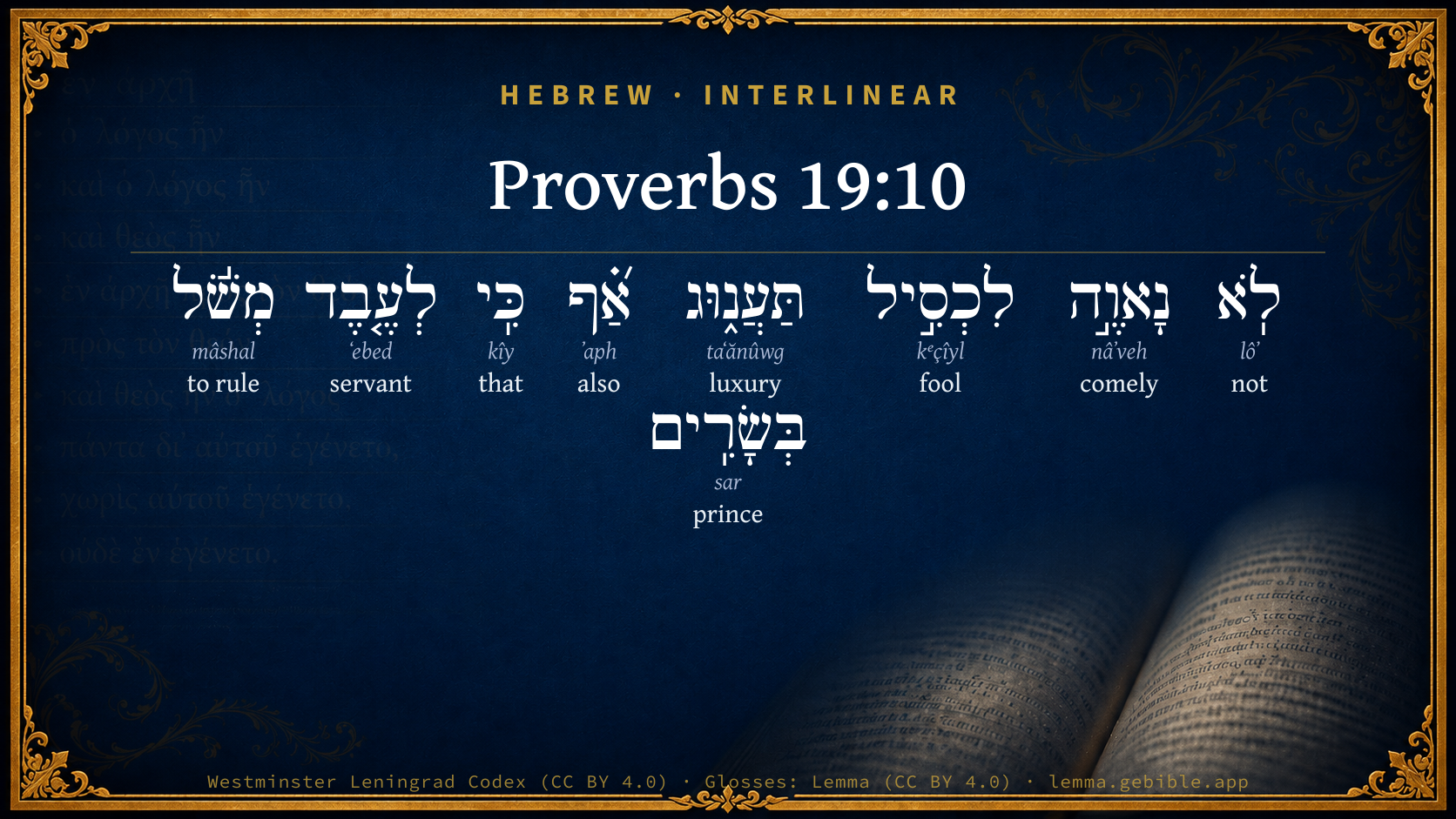
Proverbs 19:10

Hebrew (Westminster Leningrad Codex) Proverbs 19:10 appears in the Hebrew Old Testament. The text above is from the Westminster Leningrad Codex. Each word links to its Strong’s number, a concise gloss, and parsing drawn from the Open Scriptures Hebrew Bible morphology. Click any word for its full Brown-Driver-Briggs (BDB) entry.
Download image
Cite this verse

Proverbs 19:10 (World English Bible). Public Domain. Lemma interlinear Bible study tool, https://lemma.gebible.app/v/proverbs/19/10.

Show BibTeX & RIS
BibTeX
RIS
English Translation
Delicate living is not appropriate for a fool, Much less for a servant to have rule over princes.
World English Bible · Public Domain
Highlights
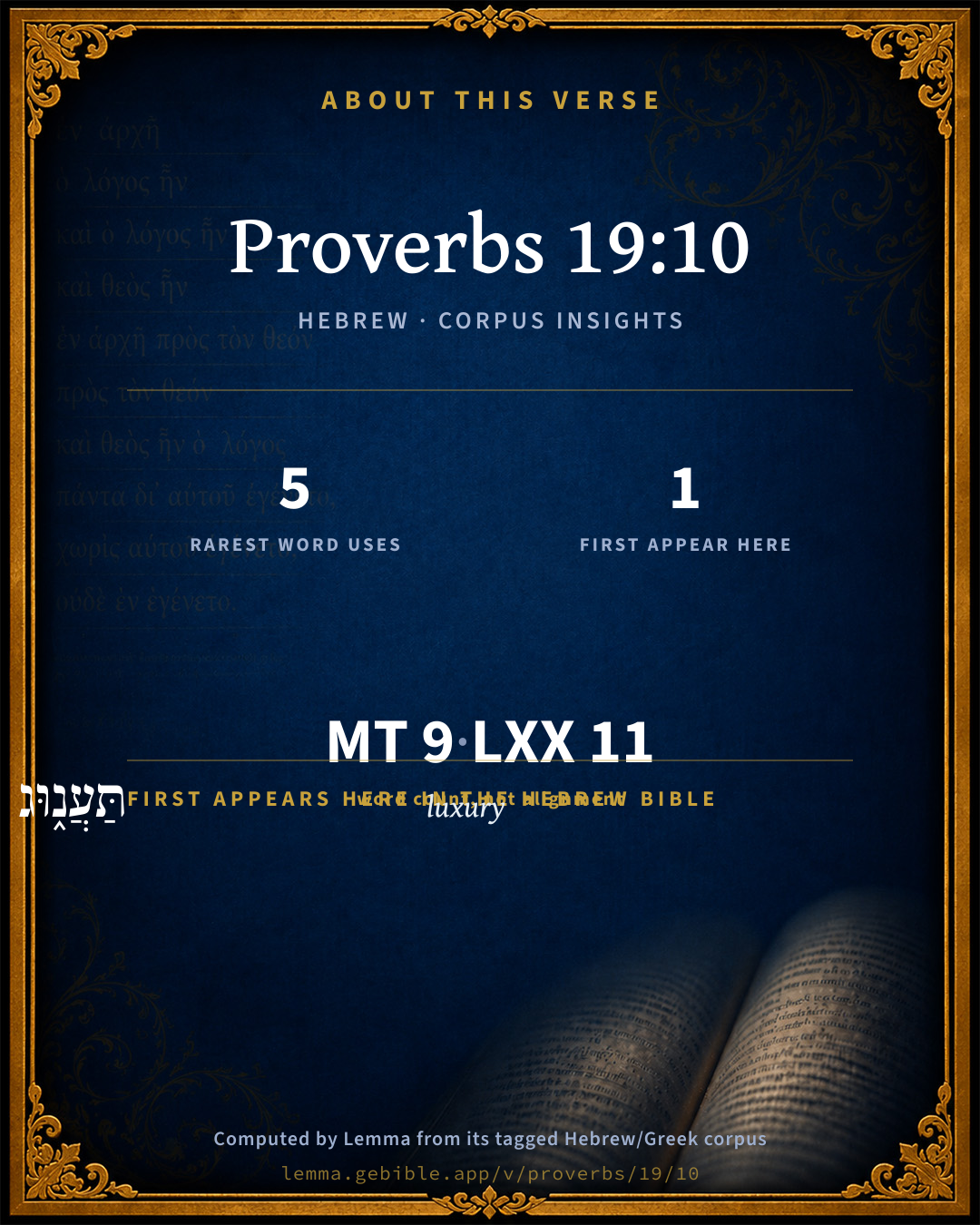
  • 1 first appearance in the Hebrew Bible
Full analysis ↓
Download a study sheet

One document with this verse’s original text, its word-by-word gloss line, the meaning frame, cross-references with their text, attributed commentary, and full source and license credits — printable, and it pastes into notes with its structure intact.

This verse Autodidact and up

Study sheet (.html) Plain text (.txt)

A passage Seminary Student

Up to 50 verses in one chapter. A passage sheet keeps up to 6 commentary sources and 12 cross-references per verse, in the order this page ranks them, and says so on the sheet whenever that leaves anything out. Ask for a single verse and you get the Autodidact verse sheet above.

Everything on this page stays free to read, with no account — the sheet is a download of what is already on screen, not access to it.

Want to remove ads? Support Godless Engineer
Compare translations 3

The same verse in 3 English versions, stacked beneath the original-language interlinear above. Click any original word for its lexicon entry.

Each is an independent rendering of the whole verse — the interlinear is not word-aligned to these translations.

Highlighted words mark where these versions differ — a whole-verse word diff, not a word-by-word alignment.

  • World English Bible Public Domain
    Delicate living is not appropriate for a fool, Much less for a servant to have rule over princes.
  • King James Version Public Domain
    Delight is not seemly for a fool; much less for a servant to have rule over princes.
  • unfoldingWord Literal Text CC BY-SA 4.0
    Luxury not suitable for a stupid one; how much less for a slave to rule over princes!

unfoldingWord Literal Text — © unfoldingWord, licensed CC BY-SA 4.0. Word-aligned USFM3 via Door43 (git.door43.org/unfoldingWord/en_ult).

Versions to compare (up to 4)

3 of 4 selected

Show all 18 translations

Every available English version of this verse, each an independent rendering of the whole verse.

  • World English Bible Public Domain
    Delicate living is not appropriate for a fool, Much less for a servant to have rule over princes.
  • Berean Standard Bible Public Domain
    Luxury is unseemly for a fool—how much worse for a slave to rule over princes!
  • Majority Standard Bible Public Domain
    Luxury is unseemly for a fool—how much worse for a slave to rule over princes!
  • King James Version Public Domain
    Delight is not seemly for a fool; much less for a servant to have rule over princes.
  • American Standard Version (1901) Public Domain
    Delicate living is not seemly for a fool; Much less for a servant to have rule over princes.
  • Revised Version (1885) Public Domain
    Delicate living is not seemly for a fool; much less for a servant to have rule over princes.
  • Geneva Bible (1599) Public Domain
    Pleasure is not comely for a foole, much lesse for a seruant to haue rule ouer princes.
  • Douay-Rheims (1899) Public Domain
    Delicacies are not seemly for a fool: nor for a servant to have rule over princes.
  • Young's Literal Translation Public Domain
    Luxury is not comely for a fool, Much less for a servant to rule among princes.
  • Literal Standard Version CC BY-SA 4.0
    Luxury is not fitting for a fool, || Much less for a servant to rule among princes.
  • Unlocked Literal Bible CC BY-SA 4.0
    It is not fitting for a fool to live in luxury— much less for a slave to rule over princes.
  • unfoldingWord Literal Text CC BY-SA 4.0
    Luxury not suitable for a stupid one; how much less for a slave to rule over princes!
  • Darby Bible Public Domain
    Good living beseemeth not a fool; how much less for a servant to have rule over princes.
  • World Messianic Bible Public Domain
    Delicate living is not appropriate for a fool, much less for a servant to have rule over princes.
  • Webster's Bible Public Domain
    Delight is not seemly for a fool; much less for a servant to have rule over princes.
  • Free Bible Version CC BY-SA 4.0
    It's not right for stupid people to live in luxury, and it's even worse for a slave to rule over leaders.
  • Bible in Basic English Public Domain
    Material comfort is not good for the foolish; much less for a servant to be put over rulers.
  • JPS Tanakh (1917) Public Domain
    Luxury is not seemly for a fool; much less for a servant to have rule over princes.

Literal Standard Version (2020), Covenant Press — licensed CC BY-SA 4.0. Text via the HelloAO Bible API (eBible.org). Unlocked Literal Bible (unfoldingWord) — licensed CC BY-SA 4.0. Text via the HelloAO Bible API (eBible.org). unfoldingWord Literal Text — © unfoldingWord, licensed CC BY-SA 4.0. Word-aligned USFM3 via Door43 (git.door43.org/unfoldingWord/en_ult). Free Bible Version, Dr. Jonathan Gallagher — licensed CC BY-SA 4.0. Text via the HelloAO Bible API (eBible.org).

Word by word

More ways to search: Search by grammar → Find every occurrence → Compare this word →

Practice this passage: Drill this verse → Learn its vocabulary →

About this verse

These counts appear in no published source. They are computed here, from the morphology-tagged text and Lemma’s own curated glosses. What Lemma adds →

9
words
9
distinct lemmas
Wisdom
section

Notable vocabulary

The rarest word here is תַּעֲנ֑וּג luxury H8588 — appearing just 5 times in the whole Hebrew Bible.

First appearance in Scripture

This word makes its first canonical appearance in the Hebrew Bible here:

  • תַּעֲנ֑וּג luxury H8588

Shared distinctive vocabulary

תַּעֲנ֑וּג luxury H8588 occurs in 5 verses of the Hebrew Bible. Also found in:

Grammatical profile

  • 1 verb
  • 3 nouns
  • 2 adjectives
  • 1 conjunction
  • 2 particles

Verb forms

  • מְשֹׁ֬ל Qal · Infinitive Construct

Hebrew & Septuagint length

In English translation the verse runs 18 words from the Hebrew and 19 from the Septuagint (LXX English) — closely comparable.

A rough comparison of the two English renderings, which tokenize alike — not a word-level alignment.

Word counts can differ between the Hebrew and the Greek without any difference in meaning — e.g. the Hebrew direct-object marker אֵת has no separate Greek word, and Greek often adds the article ὁ.

In the original languages it is 9 Hebrew tokens and 11 Greek tokens — but the two are counted differently (Hebrew bundles its prefixes and suffixes into one token; the Greek is in lemma form), so that isn’t a like-for-like length.

Cross-references

17

Topical passages linked to Proverbs 19:10 in the Treasury of Scripture Knowledge — connected by theme and wording, ordered by reader-vote popularity; previews shown in the World English Bible.

  • Proverbs 30:21–22 "For three things the earth tremble, And under four, it can't bear up:
  • Proverbs 26:1 Like snow in summer, and as rain in harvest, So honor is not fitting for a fool.
  • Luke 16:19 "Now there was a certain rich man, and he was clothed in purple and fine linen, living in luxury every day.
  • Luke 16:23 In Hades, he lifted up his eyes, being in torment, and saw Abraham far off, and Lazarus at his bosom.
  • 1 Samuel 25:36 Abigail came to Nabal; and, behold, he held a feast in his house, like the feast of a king; and Nabal's heart was merry within him, for he was very drunken: therefore she told him nothing, less or more, until the morning light.
  • 2 Samuel 3:24–25 Then Joab came to the king, and said, What have you done? behold, Abner came to you; why is it that you have sent him away, and he is quite gone?
  • 2 Samuel 3:39 I am this day weak, though anointed king; and these men the sons of Zeruiah are too hard for me. May Yahweh reward the evil-doer according to his wickedness."
  • Esther 3:15 The posts went forth in haste by the king's commandment, and the decree was given out in Shushan the palace. The king and Haman sat down to drink; but the city of Shushan was perplexed.
  • Ecclesiastes 10:5–7 There is an evil which I have seen under the sun, the sort of error which proceeds from the ruler.
  • Isaiah 3:5 The people will be oppressed, Everyone by another, And everyone by his neighbor. The child will behave himself proudly against the old man, And the base against the honorable.
  • Isaiah 5:11–12 Woe to those who rise up early in the morning, that they may follow strong drink; Who stay late into the night, until wine inflames them!
  • Isaiah 22:12–14 In that day did the Lord, Yahweh of Hosts, call to weeping, and to mourning, and to baldness, and to girding with sackcloth:
  • Hosea 7:3–5 They make the king glad with their wickedness, And the princes with their lies.
  • Hosea 9:1 Don't rejoice, Israel, to jubilation like the nations; For you were unfaithful to your God. You love the wages of a prostitute at every grain threshing floor.
  • Amos 6:3–6 Those who put far away the evil day, And cause the seat of violence to come near;
  • James 4:9 Lament, mourn, and weep. Let your laughter be turned to mourning, and your joy to gloom.
  • Proverbs 17:7 Arrogant speech isn't fitting for a fool, Much less do lying lips fit a prince.

Cross-references courtesy of OpenBible.info (CC BY 4.0).

Hebrew and Greek witnesses Masoretic Hebrew ↔ Greek Septuagint

The same verse in the two great witnesses to the Old Testament, shown verse-for-verse.

These are two independent witnesses, not word-aligned to each other, and the Septuagint is shown in lemma (dictionary) form.

Hebrew Proverbs 19:10 Masoretic · Westminster Leningrad Codex

לֹֽא נָאוֶ֣ה לִכְסִ֣יל תַּעֲנ֑וּג אַ֝֗ף כִּֽי לְעֶ֤בֶד מְשֹׁ֬ל בְּשָׂרִֽים

Delicate living is not appropriate for a fool, Much less for a servant to have rule over princes.

World English Bible · Public Domain

Greek LXX Proverbs 19:10 Septuagint · lemma form

οὐ συνφέρω ἄφρων τρυφή καί ἐάν οἰκέτης ἄρχω μετά ὕβρις δυναστεύω

Delight does not suit a fool, nor is it seemly if a servant should begin to rule with haughtiness.

LXX2012 (modern English Septuagint) · Public Domain

On this verse, The Cambridge Bible for Schools and Colleges discusses the Septuagint’s reading. Read the note in Commentary ↓

Hebrew: Westminster Leningrad Codex (CC BY 4.0). Greek: Septuagint (public domain); English from LXX2012 (modern English Septuagint) (Public Domain). How the Septuagint differs from the Hebrew →

Commentary

Notes on Proverbs 19:10 from classic Christian and Jewish commentators (each source and its license shown beneath its notes). The classic Christian expositions comment on the surrounding passage and are grouped to its opening verse, so a note may address several verses; the Jewish commentaries on the Tanakh (Rashi and others) are per-verse, so they appear only where the commentator wrote on this verse.

Lemma curates 59 commentaries, every one of them public domain or Creative Commons licensed, each selected and text-cleaned for this edition rather than reprinted as found. About our sources →

Trapp's Complete Commentary

John Trapp

Pro 19:10 Delight is not seemly for a fool; much less for a servant to have rule over princes.

Ver. 10. Delight is not seemly for a fool.] Dignitas in indigno est ornamentum in luto, saith Salvian. Health, wealth, nobility, beauty, honour, and the like, are ill bestowed upon a wicked man, who will abuse them all to his own and other men’s undoing. The wisest have enough to do to manage these outward good things. What may we hen expect from fools? {a} {See Trapp on "Pro 14:24"} If they make wise men fools, they will make fools mad men.

Much less for a servant to rule over princes.] As Abimelech, that bramble, did over the cedars of Lebanon; as Tobiah, the servant, the Ammonite, sought to do over Nehemiah and the princes of Judah; as the servants of the Emperor Claudius did over him and the whole State, which occasioned that verse to be pronounced on the theatre -

‘Aφορητος εστιν ευτυχων μαστιγιας.’

As Becket and Wolsey affected to do in their generations; and as the bridge maker of Rome, who styles himself servus servorum, a servant of servants, and yet acts as a dominus dominantium et rex regum, lord of lords, and king of kings. Round about the Pope’s coins are these words stamped, "That nation that will not serve thee shall be rooted out." His janissaries, also, the Jesuits, are as a most agile sharp sword, whose blade is sheathed at pleasure in the bowels of every commonwealth, but the handle reacheth to Rome and Spain. This made that most valiant and puissant prince, Henry IV of France, when he was persuaded by one to banish the Jesuits, say, "Give me then security for my life."

{a} Secundae res etiam sapientum animos fatigant; quanto magis insolescent stulti rerum successu prospero? - Salust.

John Trapp, A Commentary or Exposition upon All the Books of the Old and New Testament (1647–1656) — public domain. Text from a community e-Sword module.

Joseph Benson's Commentary

Pro 19:10. Delight is not seemly for a fool — To live in affluence, pleasure, and outward glory, doth not become him, nor suit with him; because prosperity corrupts even wise men, and makes fools mad; and because it gives him more opportunity to discover his folly, and to do mischief both to himself and others. He implies that a rod, or punishment, is fitter for him than pleasure; much less for a servant — For one who has been a slave, or who is in a servile condition, and of a servile disposition, not much differing from a fool; or who is a servant to his lusts, and wholly unfit to rule other men; to have rule over princes — Over men of better quality than himself: for servants are commonly ignorant; and when they are advanced, they grow insolent, presumptuous, and intolerable.

Joseph Benson's Commentary on the Old and New Testaments (1811–1818) — public domain. Text from a community e-Sword module.

The Preacher's Complete Homiletical Commentary

Joseph S. Exell (gen. ed.)

CRITICAL NOTES.—

Pro_19:10 Delight. Most commentators translate this word “luxury.” Miller, however, as will be seen from his comment, retains the reading of the English version.

MAIN HOMILETICS OF Pro_19:10

I. Where there is wealth or exalted station there ought to be correspondent qualifications. (For the real signification of the word translated delight see Critical Notes.) If a man is rich he ought to be wise, and if he is powerful he ought to have been instructed how to use his power well. A fool is useless in any condition of life, but a fool who is the possessor of a fortune is a power for evil. We must understand the word servant here to mean an ignorant and incapable man—one who, though able to serve, has no ability to rule. A man may be very well fitted to perform the duties of a common seaman, but if he is ignorant of the laws of navigation it would be a great misfortune for both himself and the rest of the crew if he were to be appointed to the captain’s post. If he had remained before the mast he might have done good service, but when he is promoted to a higher rank he is only an instrument of mischief. Of the two incongruities dealt with in the proverb this last is the most fruitful of evil. It is a lamentable thing when great riches come into the possession of a fool who does not know how to use his wealth either for his own or his neighbour’s good, and it may be productive of positive harm both to himself and others. Instances are not at all uncommon, and most men have met with them, in which a man in a very humble station, and destitute of true and spiritual wisdom, inherits suddenly a large fortune. In the majority of such cases the inheritance is a curse rather than a blessing, for the inheritor has no idea how to use it so as to promote his own real welfare. His higher nature has never been developed, consequently he has no spiritual or intellectual desires to gratify, and all he can do with his wealth is to minister to his appetites and gratify his passions, which he often does in a most unseemly way, and to an extent which makes him a worse man when he is rich than he was when he was poor. But this misuse of wealth is not so great a misfortune as the misuse of power. The evil effects of the first will be confined within comparatively narrow limits, but those of the latter are widespread. When a man is neither a prince by birth or by nature, and yet is in a position which gives him power over men who are either or both, there is a great disproportion in the moral fitness of things which generally brings much social and national trouble. For if a man’s only title to rule is that of birth, it is better for those whom he rules than if he had none at all. If he is an incapable man himself he may be the descendant of greater men, and those under him may be able to submit to him for what he represents, although they cannot reverence him for what he is. But when he has not even this small claim on their obedience, the unseemliness is so great that national anarchy, and consequently much individual suffering, is the almost certain result.

II. Either of these incongruities present a deep mystery in the Divine government. When we consider what a great power for good as well as for evil is wrapped up in wealth, the providence appears to us dark which often gives it to the moral fool and leaves the wise man destitute. But when we find a weak man apparently holding in his hands the destinies of many stronger and nobler men—a “servant” ruling over “princes”—the providence seems darker still. But there are two sources whence we can draw comfort. We can look forward to that “time of restitution of all things” (Act_3:21) when all these manifest inconsistencies shall be done away with, and we can assure ourselves that “things are not what they seem”—that the wisdom of the wise man is a greater power for good than the wealth of the rich, and that, after all, the choice of the ruler is in the hand of those whom he rules, and that if the latter are “princes” they will not long suffer themselves to be ruled by one who is “a servant.”

OUTLINES AND SUGGESTIVE COMMENTS

1. In its secular form this truth is obvious.

2. In its higher but intermediate form, it means that an ungodly sinner, here called “a stupid man,” on his way to death and judgment, is so shockingly off in all interests of his being, that “delight” is a mockery; it is anything but suited to his state. And to have him stand, as he often does, superior to Christians, overawing Christian life, and repressing Christian eminence of character, is indeed a servant ruling a prince; and it is as good an instance as could be met, of something that does not suit, or as the original has it, does not sit well.

3. But Solomon would carry it a story higher. He means to continue his pursuit of the impenitent. He means to tell them that their delight, in itself considered, would not sit well; that to reward a fool would bring dishonour upon government; and to release the outlaw from his bonds would really be to elect the slave to a post higher than the “princes.”—Miller.

With all the preference here expressed for virtuous poverty, the seemliness of rank, and the violence done by the upstart rule of the lower over the higher, are not overlooked.—Chalmers.

Abundance of wealth, dainty fare, and pastime or recreation, is not meet for a vain and wicked person. For, first of all, He rather deserveth correction than recreation; secondly, He abuseth all his delights and possessions to his own hurt, being drunken with his vanities; last of all, He is so puffed up and corrupted by prosperity, that he oppresseth his neighbours.… But if a light vanity beseem not a vain person, then authority, which carrieth with it a weight of glory, less beseemeth a vile person, who is of a servile disposition and condition, especially that rule which is exercised over noble personages.—Muffet.

Judge, then, how horrible it is that men should set the devil or his two angels, the world and the flesh, on the throne, while they place God on the footstool; or that in this commonwealth of man, reason, which is the queen or princess over the better powers and graces of the soul, should stoop to so base a slave as sensual lust.—T. Adams.

The reason is, because a wise man is master of his delight, a fool is servant unto it. And delight never doth well but where it is commanded, never doth so ill as where it is commander.… The command of delight is like the ruling of a servant over princes; and as he is foolish in ruling, so it is the quality of a fool to give the ruling of his heart unto delight.—Jermin.

The Preacher's Complete Homiletical Commentary (gen. ed. Joseph S. Exell; Funk & Wagnalls, c. 1892) — public domain (pre-1929). A full-Bible homiletical/sermon-outline anthology covering 65 of 66 books (2 John is absent from the source module). Text from a community e-Sword module.

Geneva Bible (1599)

Geneva Bible translators

The free use of things are not to be permitted to him that cannot use them aright.

Geneva Bible (1599) marginal notes — public domain. Text via Bolls.life.

Matthew Henry's Commentary

Note, 1. Pleasure and liberty ill become a fool: Delight is not seemly for such a one. A man that has not wisdom and grace has no right nor title to true joy, and therefore it is unseemly. It ill becomes those that do not delight in God to delight in any thing, nor how to manage themselves, and therefore they do but expose themselves. It becomes ungracious fools to be afflicted, and mourn, and weep, not to laugh and be merry; rebukes are more proper for them than delights. Delight is seemly for a man of business, to refresh him when he is fatigued, but not for a fool, that lives an idle life and abuses his recreations. The prosperity of fools discovers their folly and destroys them. 2. Power and honour ill become a man of a servile spirit. Nothing is more unseemly than for a servant to have rule over princes; it is absurd in itself, and very preposterous, for none are so insolent and intolerable as a beggar on horseback, a servant when he reigns, Pro 30:22. It is very unseemly for one that is a servant to sin and his lusts to rule over and oppress those that are God's freemen and made kings and priests to him.

Matthew Henry's Commentary on the Whole Bible (1708–1710) — public domain (CC PDM 1.0). Text via the HelloAO Bible API.

Jamieson, Fausset & Brown

Robert Jamieson, A. R. Fausset & David Brown

(Compare Pro 17:7). The fool is incapable of properly using pleasure as knowledge, yet for him to have it is less incongruous than the undue elevation of servants. Let each abide in his calling (Co1 7:20).

Jamieson, Fausset & Brown — Commentary Critical and Explanatory on the Whole Bible (1871) — public domain (CC PDM 1.0). Text via the HelloAO Bible API.

Adam Clarke's Commentary

Verse 10. Delight is not seemly for a fool] תענוג taanug, splendid or luxurious living, rank, equipage, c. These sit ill on a fool, though he be by birth a lord.

For a servant to have rule over princes.] I pity the king who delivers himself into the hands of his own ministers. Such a one loses his character, and cannot be respected by his subjects, or rather their subjects. But it is still worse when a person of mean extraction is raised to the throne, or to any place of power he is generally cruel and tyrannical.

Adam Clarke's Commentary on the Bible (1810–1826) — public domain. Text from a community e-Sword/MySword module.

Ellicott's Commentary for English Readers

(10) Delight is not seemly for a fool.—He is ruined by prosperity and luxury: much more is a slave unfit to rule over princes. The writer has in his mind the case of an emancipated slave being raised to high place by court favour, and then insolently trampling on those who were once far above him. (Comp. Pro_30:22; Ecc_10:6-7.)

A Bible Commentary for English Readers, edited by Charles John Ellicott (1878–1897) — public domain. Text from a community e-Sword module.

The Cambridge Bible for Schools and Colleges

gen. ed. J. J. S. Perowne

10. delight] Rather, luxury, or delicate living, R.V. οὐ συμφέρει ἄφρονι τρυφὴ, LXX. Comp. οἱ ἐν τρυφῇ ὑπάρχοντες ἐν τοῖς βασιλείοις εἰσίν, Luk_7:25; as “a servant” would be if he had “rule over princes.”

On this second clause Dean Plumptre (Speaker’s Comm.) quotes Claudian in Eutrop. 1. 183:

“nec bellua tetrior ulla est,

Quam servi rabies in libera colla furentis.”

The Cambridge Bible for Schools and Colleges (gen. ed. J. J. S. Perowne; Cambridge University Press, 1878–1918) — public domain. Text from a community e-Sword module.

John Gill's Exposition

Delight is not seemly for a fool,.... Such an one as Nabal, whose name and nature were alike; and whose prosperity ill became him, and the mirth and delight he had in it, Sa1 25:25; for, as the wise man elsewhere says, "the prosperity of fools shall destroy them", Pro 1:26; they do not know how to make a right use of their prosperity; nor to moderate their enjoyments, pleasures, and delights. Some understand this of spiritual delight in the Lord; in his ways and ordinances, which wicked men are strangers to: and a very uncomely thing it is for such persons to talk of spiritual joy and delight, and of their communion with God, when they live in sin;

much less for a servant to have rule over princes; this was a sight which Solomon had seen, but was very disagreeable to him; and was one of the four things the earth cannot bear; the insolence of a servant, when he becomes master over his superiors, is intolerable; see Pro 30:22. It may be spiritually applied to such who are servants of sin; to whose sensual appetites and carnal affections the more noble and princely powers of the soul, the understanding and mind, become subject; which is very improper and unseemly.

John Gill's Exposition of the Whole Bible (1746–1763) — public domain (CC PDM 1.0). Text via the HelloAO Bible API.

Albert Barnes' Notes on the Bible

“Delight,” high unrestrained enjoyment, is to the “fool” who lacks wisdom but a temptation and a snare. The second clause carries the thought on to what the despotism of Eastern monarchies often presented, the objectionable rule of some favored slave, it might be, of alien birth, over the princes and nobles of the land.

Albert Barnes' Notes on the Bible (1834–1885) — public domain. Text from a community e-Sword/MySword module.

Haydock's Catholic Bible Commentary

Fool. He would eat them, so as to prejudice his health. --- Princes. Chap. xxx. 21. Such are commonly insolent, and should attend to Ausonius. Fortunam reverenter habe.

George Leo Haydock (1774–1849), Haydock's Catholic Family Bible and Commentary, 1859 edition — public domain. Excludes Psalms (Douay-Rheims chapter numbering differs from Protestant) and Deuterocanonical books (Catholic canon only).

Matthew Poole's English Annotations

Delight, to live in pleasure, and plenty, and outward glory,

is not seemly for a fool; it doth not become him, nor suit with him; partly because prosperity corrupts even wise men, and makes fools mad; and partly because it gives him more opportunity to discover his folly, and to do mischief both to himself and others. He implies that a rod or punishment is fitter for him than pleasure, as is noted, Pro 10:13; 26:3.

A servant; who is of a servile condition and disposition, not much differing from a fool; who is a servant to his lusts, and wholly unfit to rule other men.

Over princes, i.e. over men of better quality than himself; for servants are commonly ignorant, and when they are advanced, they grow insolent, and presumptuous, and intolerable.

Matthew Poole's English Annotations on the Holy Bible (1683–1685) — public domain. Text from a community e-Sword/MySword module.

Whedon's Commentary on the Bible

Daniel D. Whedon

10. Delight — That kind of enjoyment which proceeds from delicate or luxurious living.

Is not seemly — Not suitable, does not sit well on a fool; a figure supposed to be taken from the fitting of a garment.

Much less — Much more unsuitable is it for a servant to have rule over princes. It is an old observation, that servants, (slaves,) who are commonly ignorant, when advanced grow insolent, presumptuous, and intolerable. A person of mean extraction raised to power is frequently self-willed, cruel, and tyrannical. Among us such cases as here named are rare; but in the East it is no unusual thing for a despot to exalt a low favourite to high honour. Compare Pro_17:2; Pro_26:1; Pro_26:8; Pro_30:22; Ecc_10:7.

Daniel D. Whedon (gen. ed.), Commentary on the Old and New Testaments (1874–1909) — public domain. Text from a community e-Sword module.

The Pulpit Commentary

Delight is not seemly for a fool. (comp. Pro_17:7 Pro_26:1) Taanug, rendered "delight," implies other delicate living, luxury; trufh , Septuagint. Such a life is ruin to a fool. who knows not how to use it properly; it confirms him in his foolish, sinful ways. A man needs religion and reason to enable him to bear prosperity advantageously, and these the fool lacks. "Secundae res," remarks Sallust ("Catil.," 11), "sapientium animos fatigant," "Even wise men are wearied and harassed by prosperity," much more must such good fortune try those who have no practical wisdom to guide and control their enjoyment. Vatablus explains the clause to mean that it is impossible for a fool, a sinner, to enjoy peace of conscience, which alone is true delight. But looking to the next clause, we see that the moralist is thinking primarily of the elevation of a slave to a high position, and his arrogance in consequence thereof. Much less for a servant to have rule over princes. By the unwise favouritism of a potentate, a slave of lowly birth might be raised to eminence and set above the nobles and princes of the land. The writer of Ecclesiastes gives his experience in this matter: "I have seen servants upon horses, and princes walking as servants upon the earth". (Ecc_10:7) The same anomaly is mentioned with censure. (Pro_30:22 and Ecc_11:5) What is the behaviour of unworthy persons thus suddenly raised to high position has formed the subject of many a satire. It is the old story of the "beggar on horseback." A German proverb declares, "Kein Scheermesser scharfer schiest, als wenn der Bauer zu Herrn wird." Claud., "In Eutrop.," 181, etc. "Asperius nihil est humili, quum surgit in altum; Cuncta ferit, dum cuncta timet; desaevit in omnes, Ut se posse putent; nec bellua tetrior ulla Quam servi rabies in libera colla furentis.

As an example of a different disposition, Cornelius a Lapide refers to the history of Agathocles. Tyrant of Syracuse, who rose from the humble occupation of a potter to a position of vast power, and, to remind himself of his lowly origin, used to dine off mean earthenware. Ausonius thus alludes to this humility ("Epigr.," 8.)"Fama est fictilibus coenasse Agathoclea regem, Atque abacum Samio saepe onerasse luto; Fercula gemmatis cum poneret horrida vasis, Et misceret opes pauperiemque simul. Quaerenti causam, respondit: Rex ego qui sum Sicaniae, figulo sum genitore satus Fortunam reverenter habe, quicunque repente Dives ab exili progrediere loco.

The Pulpit Commentary (1880–1919), ed. H.D.M. Spence-Jones & Joseph S. Exell — public domain. Text from a community e-Sword module.

John Wesley's Explanatory Notes

Delight - To live in pleasure and outward glory, doth not become him, nor suit with him; because prosperity corrupts even wise men, and makes fools mad; and because it gives him more opportunity to discover his folly, and to do mischief both to himself and others.

John Wesley, Explanatory Notes Upon the Whole Bible (1754–1765) — public domain. Text via the GEBible commentary corpus.

Keil & Delitzsch

C. F. Keil & F. Delitzsch

10 Luxury becometh not a fool;

How much less a servant to rule over princes.

Thus also with לא נאוה (3 p. Pil. non decet, cf. the adj. Pro 26:1) Pro 17:7 begins. אף כּי rises here, as at Pro 19:7, a minori ad majus: how much more is it unbecoming = how much less is it seemly. The contrast in the last case is, however, more rugged, and the expression harsher. "A fool cannot bear luxury: he becomes by it yet more foolish; one who was previously a humble slave, but who has attained by good fortune a place of prominence and power, from being something good, becomes at once something bad: an insolent sceleratus" (Fl.). Agur, xxx. 22f., describes such a homo novus as an unbearable calamity; and the author of the Book of Ecclesiastes, written in the time of the Persian domination, speaks, Ecc 10:7, of such. The lxx translates, καὶ ἐὰν οἰκέτης ἄρξηται μεθ ̓ ὕβρεως δυναστεύειν, rendering the phrase כּשׂרים by μεθ ̓ ὕβρεως, but all other translators had בּשׂרים before them.

Keil & Delitzsch — Biblical Commentary on the Old Testament (1861–1891) — public domain (CC PDM 1.0). Text via the HelloAO Bible API. (Old Testament only.)

Bridges on Proverbs

Charles Bridges

What has a fool to do with delight? This world’s prosperity, so far as he knows it, can only be a curse to him. (Pro 1:32 .) Delight "is comely to the righteous" (Psa 33:1 ), suitable to his character. He has a right and title to it. (Psa 32:11 .) But it is not seemly for the fool. He has indeed his merriment and folly.†1 But solid joy he knows not. Far more suitable to him is a chastening rod.†2 And should the Lord graciously sanctify this dispensation — as in how many instances he has done so! — it will introduce him to that "delight which will then be seemly to him."†3

Much less seemly is the exhibition of a servant having rule over princes. Such an elevation is dangerous to the individual.†4 In the kingdom, it is one of the "things which the earth cannot bear." (Pro 30:22 .) The servant has indeed the same rational power with his Sovereign. But contracted habits of mind unfit him to rule. Exceptions there are, as in the case of Joseph. (Gen 41:39-45 .) But seldom is God’s order reversed without anarchy and confusion.†5 Such was the reign of our second Edward, when worthless minions had rule over the prince; chosen either for their external accomplishments, or for their subserviency to his folly. Peace and happiness belong to godly contentment. (1Ti 6:6 .) "Let every man, wherein he is called, therein abide with God." (1Co 7:24 .) To those whom he has placed in a subordinate station, our Father’s voice is full of instruction — "Seekest thou great things for thyself? Seek them not." (Jer 45:5 .)

Footnotes:

†1 1Sa 25:25 . Ecc 7:5-6 . Isa 5:11-12 ; Isa 22:12-14 . Hos 7:3-5 . Amo 6:3-6 .

†2 Pro 10:13-14; Pro 26:3 .

†3 2Ch 33:11-13 . Luk 15:14-24 .

†4 Est 3:1-2; Est 7:10 . ’Ex insolentiâ, quibus nova bona fortuna det, impotentes lætitiæ insanire.’ Liv. Lib. 30. c. 42. Compare Lib. 23. c. 18.

†5 2Sa 3:24-25, 2Sa 3:39 . Isa 3:5 .

Charles Bridges, An Exposition of the Book of Proverbs (1846) — public domain. Text from a community e-Sword module.

Kretzmann's Popular Commentary

Paul E. Kretzmann

v. 10. Delight is not seemly for a fool, a life of luxury does not become him, much less for a servant to have rule over princes, this being possible at courts where the favorites of the sovereign ingratiate themselves and eventually direct the affairs of the realm.

Paul E. Kretzmann, Popular Commentary of the Bible (1921–1924) — public domain. Text from a community e-Sword module.

Rashi

Rabbi Shlomo Yitzchaki (Rashi)

Pleasure does not befit a fool, much less a slave It is derived by an a fortiori conclusion that it does not befit a slave to rule over princes.

Rashi on the Tanakh — English translations: “The Judaica Press complete Tanach with Rashi, translated by A. J. Rosenberg” (CC BY 4.0); “Pentateuch with Rashi's commentary by M. Rosenbaum and A.M. Silbermann, 1929-1934” (public domain); “The Metsudah Tanach series, Lakewood, N.J” (CC BY 4.0); and “The Book of Joshua, Metsudah Publications, 1997” (CC BY 4.0). Text via Sefaria.

Lesson kit

Teaching starters — assembled from the data on this page, not authored interpretation. Every prompt links to the verse data it draws on. Edit before teaching.

Proverbs, in the Wisdom, opens this verse with 9 words (9 distinct Hebrew lemmas). Its most distinctive word is taʻănûwg (“luxury”). A historical commentator’s framing appears above. Read the whole chapter for the surrounding context.

Discussion questions

  1. The word taʻănûwg carries the sense “luxury.” How does it shape the verse?
  2. The word “luxury” first appears here in Scripture. What is being introduced at this debut?
  3. Ecclesiastes 2:8 shares the word «luxury» with this verse. How do the two illuminate each other?
  4. These translations render this verse differently; the difference is in the English rendering, not the original. What questions does that raise?
  5. The verb «מְשֹׁ֬ל» is Qal Infinitive Construct. How does its form color the action?
  6. Reading how Trapp's Complete Commentary and Joseph Benson's Commentary read this verse, where do the two commentators agree and where do they part?

Things to notice

Reading settings

Reading text

Shown beneath each verse's original-language words.

Old Testament
Old Testament edition

Read the OT as the Masoretic Hebrew (MT) or the Greek Septuagint (LXX).

English shown for the Greek Septuagint (in the Hebrew ↔ Greek comparison).

Comparing translations? Open the Compare panel on any verse page to stack up to four side by side.