
Proverbs 22:19

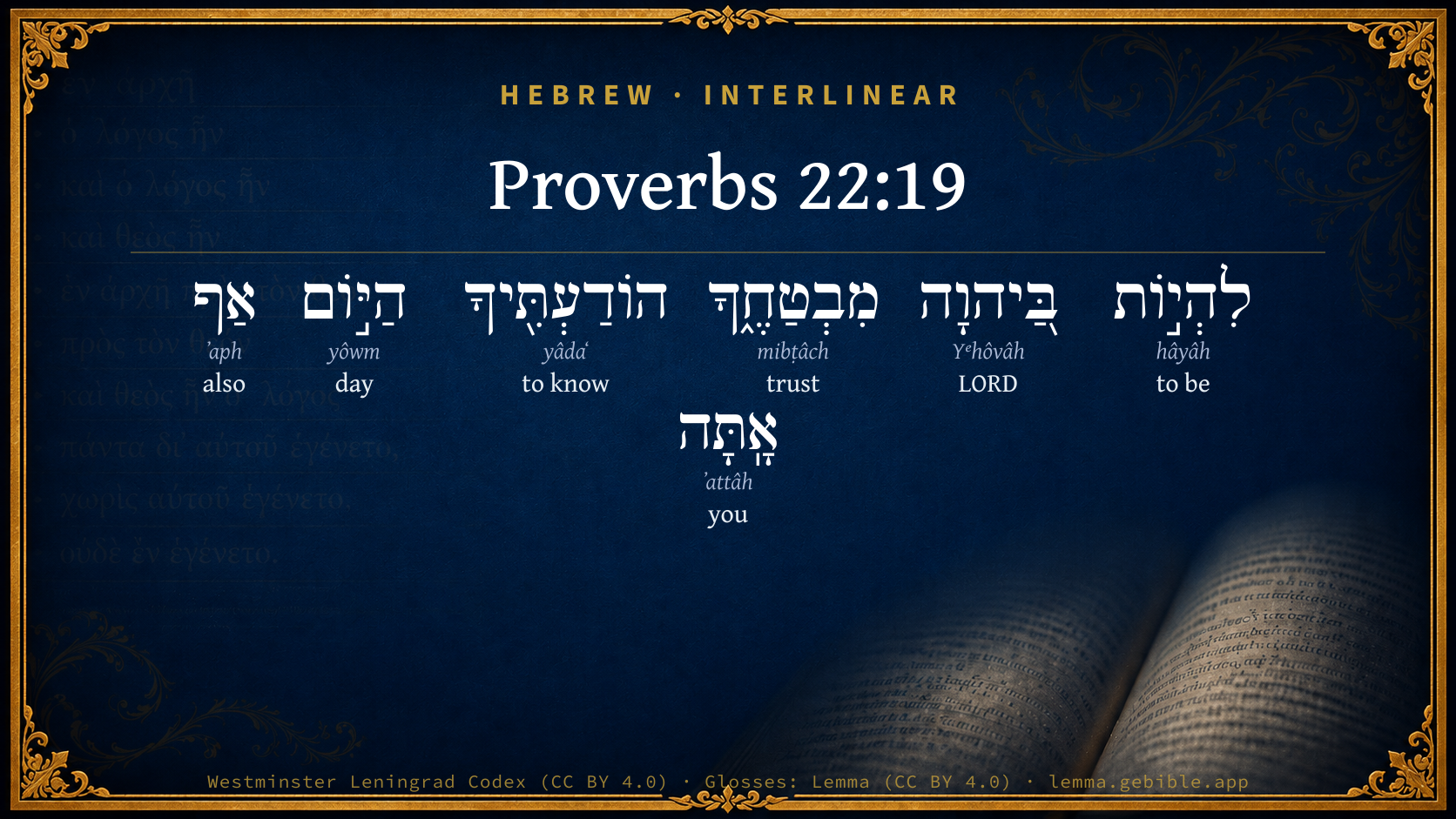
Hebrew (Westminster Leningrad Codex) Proverbs 22:19 appears in the Hebrew Old Testament. The text above is from the Westminster Leningrad Codex. Each word links to its Strong’s number, a concise gloss, and parsing drawn from the Open Scriptures Hebrew Bible morphology. Click any word for its full Brown-Driver-Briggs (BDB) entry.
Download image
Cite this verse

Proverbs 22:19 (World English Bible). Public Domain. Lemma interlinear Bible study tool, https://lemma.gebible.app/v/proverbs/22/19.

Show BibTeX & RIS
BibTeX
RIS
English Translation
That your trust may be in Yahweh, I teach you today, even you.
World English Bible · Public Domain
Download a study sheet

One document with this verse’s original text, its word-by-word gloss line, the meaning frame, cross-references with their text, attributed commentary, and full source and license credits — printable, and it pastes into notes with its structure intact.

This verse Autodidact and up

Study sheet (.html) Plain text (.txt)

A passage Seminary Student

Up to 50 verses in one chapter. A passage sheet keeps up to 6 commentary sources and 12 cross-references per verse, in the order this page ranks them, and says so on the sheet whenever that leaves anything out. Ask for a single verse and you get the Autodidact verse sheet above.

Everything on this page stays free to read, with no account — the sheet is a download of what is already on screen, not access to it.

Want to remove ads? Support Godless Engineer
Compare translations 3

The same verse in 3 English versions, stacked beneath the original-language interlinear above. Click any original word for its lexicon entry.

Each is an independent rendering of the whole verse — the interlinear is not word-aligned to these translations.

Highlighted words mark where these versions differ — a whole-verse word diff, not a word-by-word alignment.

  • World English Bible Public Domain
    That your trust may be in Yahweh, I teach you today, even you.
  • King James Version Public Domain
    That thy trust may be in the LORD, I have made known to thee this day, even to thee.
  • unfoldingWord Literal Text CC BY-SA 4.0
    your trust to be in Yahweh, I have caused you to know today, even you.

unfoldingWord Literal Text — © unfoldingWord, licensed CC BY-SA 4.0. Word-aligned USFM3 via Door43 (git.door43.org/unfoldingWord/en_ult).

Versions to compare (up to 4)

3 of 4 selected

Show all 18 translations

Every available English version of this verse, each an independent rendering of the whole verse.

  • World English Bible Public Domain
    That your trust may be in Yahweh, I teach you today, even you.
  • Berean Standard Bible Public Domain
    So that your trust may be in the LORD, I instruct you today—yes, you.
  • Majority Standard Bible Public Domain
    So that your trust may be in the LORD, I instruct you today—yes, you.
  • King James Version Public Domain
    That thy trust may be in the LORD, I have made known to thee this day, even to thee.
  • American Standard Version (1901) Public Domain
    That thy trust may be in Jehovah, I have made `them' known to thee this day, even to thee.
  • Revised Version (1885) Public Domain
    That thy trust may be in the LORD, I have made them known to thee this day, even to thee.
  • Geneva Bible (1599) Public Domain
    That thy confidence may be in the Lord, I haue shewed thee this day: thou therefore take heede.
  • Douay-Rheims (1899) Public Domain
    That thy trust may be in the Lord, wherefore I have also shewn it to thee this day.
  • Young's Literal Translation Public Domain
    That thy trust may be in Jehovah, I caused thee to know to-day, even thou.
  • Literal Standard Version CC BY-SA 4.0
    That your trust may be in YHWH, || I caused you to know today, even you.
  • Unlocked Literal Bible CC BY-SA 4.0
    So your trust may be in Yahweh, I teach them to you today—even to you.
  • unfoldingWord Literal Text CC BY-SA 4.0
    your trust to be in Yahweh, I have caused you to know today, even you.
  • Darby Bible Public Domain
    That thy confidence may be in Jehovah, I have made [them] known to thee this day, even to thee.
  • World Messianic Bible Public Domain
    I teach you today, even you, so that your trust may be in the LORD.
  • Webster's Bible Public Domain
    That thy trust may be in the LORD, I have made known to thee this day, even to thee.
  • Free Bible Version CC BY-SA 4.0
    I'm explaining this to you today so you can trust in the Lord—yes, you!
  • Bible in Basic English Public Domain
    So that your faith may be in the Lord, I have made them clear to you this day, even to you.
  • JPS Tanakh (1917) Public Domain
    That thy trust may be in the LORD, I have made them known to thee this day, even to thee.

Literal Standard Version (2020), Covenant Press — licensed CC BY-SA 4.0. Text via the HelloAO Bible API (eBible.org). Unlocked Literal Bible (unfoldingWord) — licensed CC BY-SA 4.0. Text via the HelloAO Bible API (eBible.org). unfoldingWord Literal Text — © unfoldingWord, licensed CC BY-SA 4.0. Word-aligned USFM3 via Door43 (git.door43.org/unfoldingWord/en_ult). Free Bible Version, Dr. Jonathan Gallagher — licensed CC BY-SA 4.0. Text via the HelloAO Bible API (eBible.org).

Word by word

More ways to search: Search by grammar → Find every occurrence → Compare this word →

Practice this passage: Drill this verse → Learn its vocabulary →

About this verse

These counts appear in no published source. They are computed here, from the morphology-tagged text and Lemma’s own curated glosses. What Lemma adds →

7
words
7
distinct lemmas
Wisdom
section

Notable vocabulary

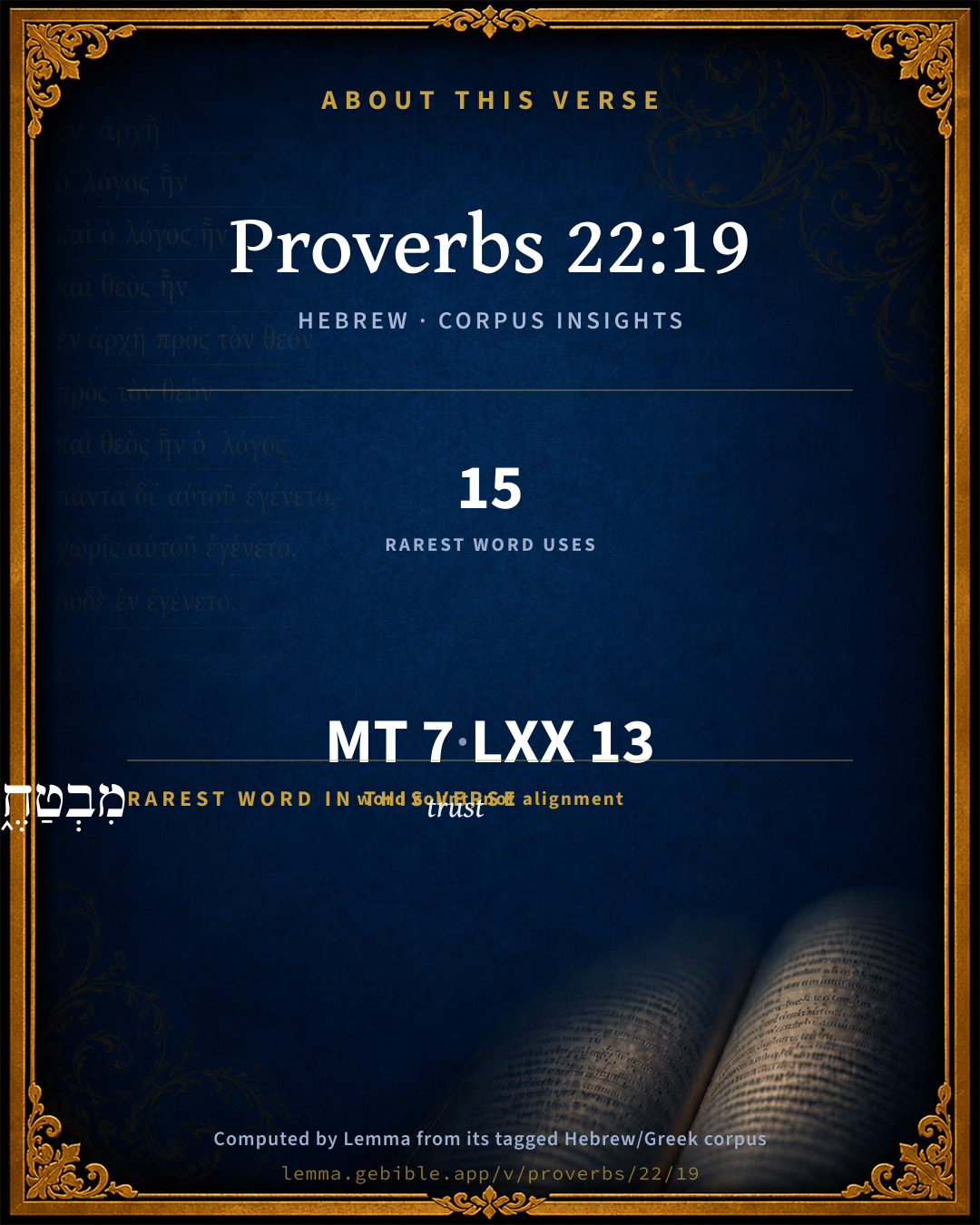
The rarest word here is מִבְטַחֶ֑ךָ trust H4009 — appearing just 15 times in the whole Hebrew Bible.

Shared distinctive vocabulary

מִבְטַחֶ֑ךָ trust H4009 occurs in 15 verses of the Hebrew Bible. Also found in:

Grammatical profile

  • 2 verbs
  • 3 nouns
  • 1 pronoun
  • 1 particle

Verb forms

  • לִהְי֣וֹת Qal · Infinitive Construct
  • הוֹדַעְתִּ֖יךָ Hiphil · Perfect

Hebrew & Septuagint length

In English translation the verse runs 13 words from the Hebrew and 17 from the Septuagint (LXX English) — closely comparable.

A rough comparison of the two English renderings, which tokenize alike — not a word-level alignment.

Word counts can differ between the Hebrew and the Greek without any difference in meaning — e.g. the Hebrew direct-object marker אֵת has no separate Greek word, and Greek often adds the article ὁ.

In the original languages it is 7 Hebrew tokens and 13 Greek tokens — but the two are counted differently (Hebrew bundles its prefixes and suffixes into one token; the Greek is in lemma form), so that isn’t a like-for-like length.

Cross-references

6

Topical passages linked to Proverbs 22:19 in the Treasury of Scripture Knowledge — connected by theme and wording, ordered by reader-vote popularity; previews shown in the World English Bible.

  • Psalms 62:8 Trust in him at all times, you people. Pour out your heart before him. God is a refuge for us. Selah.
  • Proverbs 3:5 Trust in Yahweh with all your heart, And don't lean on your own understanding.
  • Isaiah 12:2 Behold, God is my salvation. I will trust, and will not be afraid; for Yah, Yahweh, is my strength and song; and he has become my salvation."
  • Isaiah 26:4 Trust in Yahweh forever; for in Yah, Yahweh, is an everlasting Rock.
  • 1 Peter 1:21 who through him are believers in God, who raised him from the dead, and gave him glory; so that your faith and hope might be in God.
  • Jeremiah 17:7 Blessed is the man who trusts in Yahweh, and whose trust Yahweh is.

Cross-references courtesy of OpenBible.info (CC BY 4.0).

Hebrew and Greek witnesses Masoretic Hebrew ↔ Greek Septuagint

The same verse in the two great witnesses to the Old Testament, shown verse-for-verse.

These are two independent witnesses, not word-aligned to each other, and the Septuagint is shown in lemma (dictionary) form.

Hebrew Proverbs 22:19 Masoretic · Westminster Leningrad Codex

לִהְי֣וֹת בַּ֭יהוָה מִבְטַחֶ֑ךָ הוֹדַעְתִּ֖יךָ הַיּ֣וֹם אַף אָֽתָּה

That your trust may be in Yahweh, I teach you today, even you.

World English Bible · Public Domain

Greek LXX Proverbs 22:19 Septuagint · lemma form

ἵνα σύ γίγνομαι ἐπί κύριος ὁ ἐλπίς καί γνωρίζω σύ ὁ ὁδός αὐτός

That your hope may be in the Lord, and he may make your way known to you.

LXX2012 (modern English Septuagint) · Public Domain

On this verse, The Pulpit Commentary discusses the Septuagint’s reading. Read the note in Commentary ↓

Hebrew: Westminster Leningrad Codex (CC BY 4.0). Greek: Septuagint (public domain); English from LXX2012 (modern English Septuagint) (Public Domain). How the Septuagint differs from the Hebrew →

Commentary

Notes on Proverbs 22:19 from classic Christian and Jewish commentators (each source and its license shown beneath its notes). The classic Christian expositions comment on the surrounding passage and are grouped to its opening verse, so a note may address several verses; the Jewish commentaries on the Tanakh (Rashi and others) are per-verse, so they appear only where the commentator wrote on this verse.

Lemma curates 59 commentaries, every one of them public domain or Creative Commons licensed, each selected and text-cleaned for this edition rather than reprinted as found. About our sources →

Trapp's Complete Commentary

John Trapp

Pro 22:19 That thy trust may be in the LORD, I have made known to thee this day, even to thee.

Ver. 19. That thy trust may be in the Lord.] Only a divine word can beget a divine faith, and herein the Scripture excels all human writings, none of which can bring our hearts to the "obedience of faith." I can speak it by experience, saith Erasmus, {a} that there is little good to be got by the Scripture, if a man read it cursorily and carelessly; but if he exercise himself therein constantly and conscionably, he shall feel such a force in it, as is not to be found again in any other book whatsoever. I know, saith Peter Martyr, {b} that there are many that will never believe what we say of the power of God’s word hidden in the heart; and not a few that will jeer us, and think we are mad for saying so. But oh that they would but be pleased to make trial! Male mihi sit (ita enim in tanta causa iurare usim ausim), nisi tandem capiantur. Let it never go well with me - for so I am bold to swear in so weighty a business - if they find not themselves strangely taken and transformed into the same image, if they pass not into the likeness of this heavenly pattern. The Ephesians "trusted in God as soon as they heard the word of truth"; they "believed," and were "sealed." {Eph 1:13} And the Thessalonians’ faith was famous all the churches over, when once the gospel "came to them in power." {1Th 1:5; 1Th 1:8}

To thee, even to thee.] Men must read the Scriptures as they do the statute books, holding themselves as much concerned therein as any other, threatening themselves in every threat, binding themselves in every precept, blessing themselves in every promise, resolving to obey God in all things; as convinced of this, that these are verba vivenda, non legenda, Words to be lived, and not read only.

{a} Erasm., Praef in Lucam.

{b} Pet. Mart., Praef. in Com. in Ep. ad Rom.

John Trapp, A Commentary or Exposition upon All the Books of the Old and New Testament (1647–1656) — public domain. Text from a community e-Sword module.

Joseph Benson's Commentary

Pro 22:19-21. That thy trust may be in the Lord — That, knowing God, and his word and promises, thou mayest cheerfully and confidently trust in him, which is the only way to thy safety and happiness. I have made known to thee this day — More fully than ever before; in this day of light and knowledge; in this thy day, the day of thy merciful visitation; excellent things — שׁלישׁים, princely things, or leading things, “words fit for a prince to speak,” says Bishop Patrick, “and the best men of the world to hear, and therefore truly excellent.” Many of the ancient versions, however, read three-fold things, in which they are followed by Schultens and Grotius: the Jews distinguishing philosophy into three branches, morality, physics, and divinity; and Solomon having written in all those branches, as appears from 1 Kings 4., although most of his writings are lost. But, as the Hebrew word above quoted always signifies great captains, generals, nobles, or the best sort of musical instruments, “I look upon this,” namely, that first given, says the bishop, “the most proper interpretation of it.” In counsels and knowledge — Counsels to direct thy practice, and knowledge to inform thy mind. That I may make thee know the certainty, &c. — That I may teach thee, not false, or vain, or uncertain things, like the teachers of the heathen nations; but the true and infallible oracles of God; that thou mightest answer the words of truth — That, being instructed by me, thou mayest be able to give true, solid, and satisfactory answers; to them that send unto thee — Namely, for thy advice in great and difficult matters. Or, to those that send thee, that is, that employ thee in any business of moment, whereof they expect an account from thee.

Joseph Benson's Commentary on the Old and New Testaments (1811–1818) — public domain. Text from a community e-Sword module.

Geneva Bible (1599)

Geneva Bible translators

He showeth what the end of wisdom is: to wit, to direct us to the Lord.

Geneva Bible (1599) marginal notes — public domain. Text via Bolls.life.

Jamieson, Fausset & Brown

Robert Jamieson, A. R. Fausset & David Brown

That . . . Lord--This is the design of the instruction.

Jamieson, Fausset & Brown — Commentary Critical and Explanatory on the Whole Bible (1871) — public domain (CC PDM 1.0). Text via the HelloAO Bible API.

Adam Clarke's Commentary

Verse 19. That thy trust may be in the Lord, I have made known, c.]

III. The END for which the wise man gives these instructions: -

1. "That thy trust may be in the Lord." That thou mayest acknowledge HIM as the Fountain of all good and refer every thing to him.

2. That this end may be accomplished, the instructions are specific and particular: "I have made known to thee, even to thee."

3. And this has not only been done in times past, "I have made known:" but even in the present, "I have made known this day!"

IV. An appeal is made to the person himself relative to the matter and importance of the teaching.

1. "Have I not written to thee excellent things;" שלשים shalishim, literally threefold, thrice, in three different ways; which some think refers to his three books: -

1. Canticles.

2. Koheleth, or Ecclesiastes. And

3. Proverbs.

Others, understanding it of the voice of Divine wisdom, suppose the three grand divisions of the sacred oracles are intended; viz.,

1. The Law;

2. The Prophets; and

3. The Hagiographa.

And others interpret it of the three grand intellectual sciences: -

1. Morality, or Ethics.

2. Natural Philosophy, or Physics.

3. Theology, or the science of Divine things as reported in the Scriptures.

But Solomon's books of Natural Philosophy are lost.

And lastly, some of the rabbins and some Christians find in these shalishim the three senses of Scripture: 1. Literal; 2. Figurative; and 3. Allegorical.

After all, as we know the term thrice was used as the term seven, a certain number for an uncertain, (see Am 1:11; 2Co 12:8,) it may mean no more here than, I have written to thee often. But perhaps it is safer to apply it to the Scriptures, and the excellent doctrines they contain: for שלשים shalishim signifies also excellent, princely things; things which become a king to speak. Indeed, it would not be difficult to prove that there is not one important art or science which is not alluded to in the Holy Scriptures, and used to illustrate and inculcate heavenly truths.

2. These excellent, princely, or threefold teachings, consist of two grand parts:

1. COUNSELS, מעצות moetsoth, from יוץ yaats, to give advice, counsel, or information. These (1) show thee what thou shouldst know; and (2) advise thee what thou shouldst do.

2. KNOWLEDGE, דעת daath, from ידע yada, to perceive, or feel by means of the senses and internal perception; viz., what should be felt, experienced, known to be true by mental perception, and by their influence on the heart and affections.

V. All this is done to give the pupil the fullest satisfaction, and most plenary evidence concerning the truths of God.

Adam Clarke's Commentary on the Bible (1810–1826) — public domain. Text from a community e-Sword/MySword module.

Ellicott's Commentary for English Readers

(19) I have made known to thee this day, even to thee these counsels of the wise. The words, “this day,” recall the warning of Heb_3:13, and the emphatic “to thee, even to thee,” imply that the message of God, though it may be [general in its form, yet is addressed to each individual soul among His people (comp., “Ho, every one that thirsteth,” Isa_55:1); each being well known, and an object of love on the part of his Redeemer.

A Bible Commentary for English Readers, edited by Charles John Ellicott (1878–1897) — public domain. Text from a community e-Sword module.

The Cambridge Bible for Schools and Colleges

gen. ed. J. J. S. Perowne

19. made known] The R.V. made them known, makes the sense a little clearer.

The Cambridge Bible for Schools and Colleges (gen. ed. J. J. S. Perowne; Cambridge University Press, 1878–1918) — public domain. Text from a community e-Sword module.

John Gill's Exposition

That thy trust may be in the Lord,.... By means of the words of the wise, or doctrines of the Gospel, faith in Christ is first had; men are directed and encouraged hereby to believe in him; and by the same means faith is increased, confirmed, and established. This is the end of penning the Scriptures, and of the Gospel ministry, as follows:

I have made known to thee this day, even to thee; the said words and doctrines in the ministry of the word, by the Spirit of wisdom and revelation in the knowledge of them; giving not only a notional, but a spiritual and experimental knowledge of them. The Lord has particular persons to whom he will make known these things in a saving way; it is "to thee, even to thee"; and to everyone whom God has chosen, and Christ has redeemed: and he has particular times and seasons for it, "this day"; which is a time of life and love; when darkness is removed, and the light of grace shines, and makes it day; and may respect the whole Gospel dispensation, which is the accepted time and day of salvation.

John Gill's Exposition of the Whole Bible (1746–1763) — public domain (CC PDM 1.0). Text via the HelloAO Bible API.

Albert Barnes' Notes on the Bible

Even to thee - The wide general character of the teaching does not hinder its being a personal message to every one who reads it.

Albert Barnes' Notes on the Bible (1834–1885) — public domain. Text from a community e-Sword/MySword module.

Matthew Poole's English Annotations

That knowing God, and his word and promises, thou mayst cheerfully and confidently trust in him, which is the only way to thy safety and happiness.

Matthew Poole's English Annotations on the Holy Bible (1683–1685) — public domain. Text from a community e-Sword/MySword module.

Whedon's Commentary on the Bible

Daniel D. Whedon

19, 20. Made known… excellent things — The latter verse should probably read: Have I not written to thee heretofore concerning counsel and knowledge? The reference is supposed to be to the previous efforts for the pupil’s edification, especially to the first part of the book, where the mode of address is, like the present, exceedingly direct.

Daniel D. Whedon (gen. ed.), Commentary on the Old and New Testaments (1874–1909) — public domain. Text from a community e-Sword module.

The Pulpit Commentary

That thy trust may be in the Lord. The Greek and Latin versions make this clause depend on the preceding verse. It is better to consider it as dependent on the second hemistich, the fact of instruction being placed after the statement of its object. All the instruction herein afforded is meant to teach that entire confidence in the Lord which, as soon as his will is known and understood, leads a man to do it at any cost or pains, leaving the result in God"s hands. I have made them known to thee this day, even to thee. The repetition of the personal pronoun brings home the teaching to the disciple, and shows that it is addressed, not merely to the mass of men, but to each individual among them, who thus becomes responsible for the use which he makes of it. (comp. Pro_23:15) The expression, "this day," further emphasizes the exhortation. The learner is not to remember vaguely that some time or other he received this instruction, but that on this particular day the warning was given. So in Heb_3:7, 13 we read, "As the Holy Ghost saith, Today if ye will hear his voice, harden not your hearts....Exhort one another daily, so long as it is called Today, lest any of you be hardened by the deceitfulness of sin." Septuagint, "That thy hope may be in the Lord, and he may make thy way known unto thee." Cheyne ("Job and Solomon") quotes Biekell"s correction of this verse, "That thy confidence may be in Jehovah, to make known unto thee thy ways;" but the alteration seems arbitrary and unnecessary.

The Pulpit Commentary (1880–1919), ed. H.D.M. Spence-Jones & Joseph S. Exell — public domain. Text from a community e-Sword module.

Scofield Reference Notes

C. I. Scofield

trust

(See Scofield "Psa 2:12").

The Scofield Reference Bible (1917 edition), notes by C. I. Scofield — public domain. Text from a community e-Sword module.

Kretzmann's Popular Commentary

Paul E. Kretzmann

v. 19. That thy trust may be in the Lord I have made known to thee this day, even to thee, for it is the author’s object to teach the fear of Jehovah by his precepts.

Paul E. Kretzmann, Popular Commentary of the Bible (1921–1924) — public domain. Text from a community e-Sword module.

Rashi

Rabbi Shlomo Yitzchaki (Rashi)

That your trust shall be in the Lord, I have made known to you I make known to you that you should trust in the Lord and engage in the Torah, and you shall not say, “How will I be idle from my work, and how will I earn a livelihood?”

Rashi on the Tanakh — English translations: “The Judaica Press complete Tanach with Rashi, translated by A. J. Rosenberg” (CC BY 4.0); “Pentateuch with Rashi's commentary by M. Rosenbaum and A.M. Silbermann, 1929-1934” (public domain); “The Metsudah Tanach series, Lakewood, N.J” (CC BY 4.0); and “The Book of Joshua, Metsudah Publications, 1997” (CC BY 4.0). Text via Sefaria.

Lesson kit

Teaching starters — assembled from the data on this page, not authored interpretation. Every prompt links to the verse data it draws on. Edit before teaching.

Proverbs, in the Wisdom, opens this verse with 7 words (7 distinct Hebrew lemmas). Its most distinctive word is mibṭâch (“trust”). A historical commentator’s framing appears above. Read the whole chapter for the surrounding context.

Discussion questions

  1. How does “trust” (mibṭâch) shape what this verse is saying?
  2. How does Job 8:14, which shares the word «trust», read alongside this verse?
  3. These translations render this verse differently. What is at stake in choosing one wording over another?
  4. «לִהְי֣וֹת» is a Qal Infinitive Construct verb. How does that grammatical form shape the action described?
  5. Compare how Trapp's Complete Commentary and Joseph Benson's Commentary read this verse. Where do they agree or differ?

Things to notice

Reading settings

Reading text

Shown beneath each verse's original-language words.

Old Testament
Old Testament edition

Read the OT as the Masoretic Hebrew (MT) or the Greek Septuagint (LXX).

English shown for the Greek Septuagint (in the Hebrew ↔ Greek comparison).

Comparing translations? Open the Compare panel on any verse page to stack up to four side by side.