
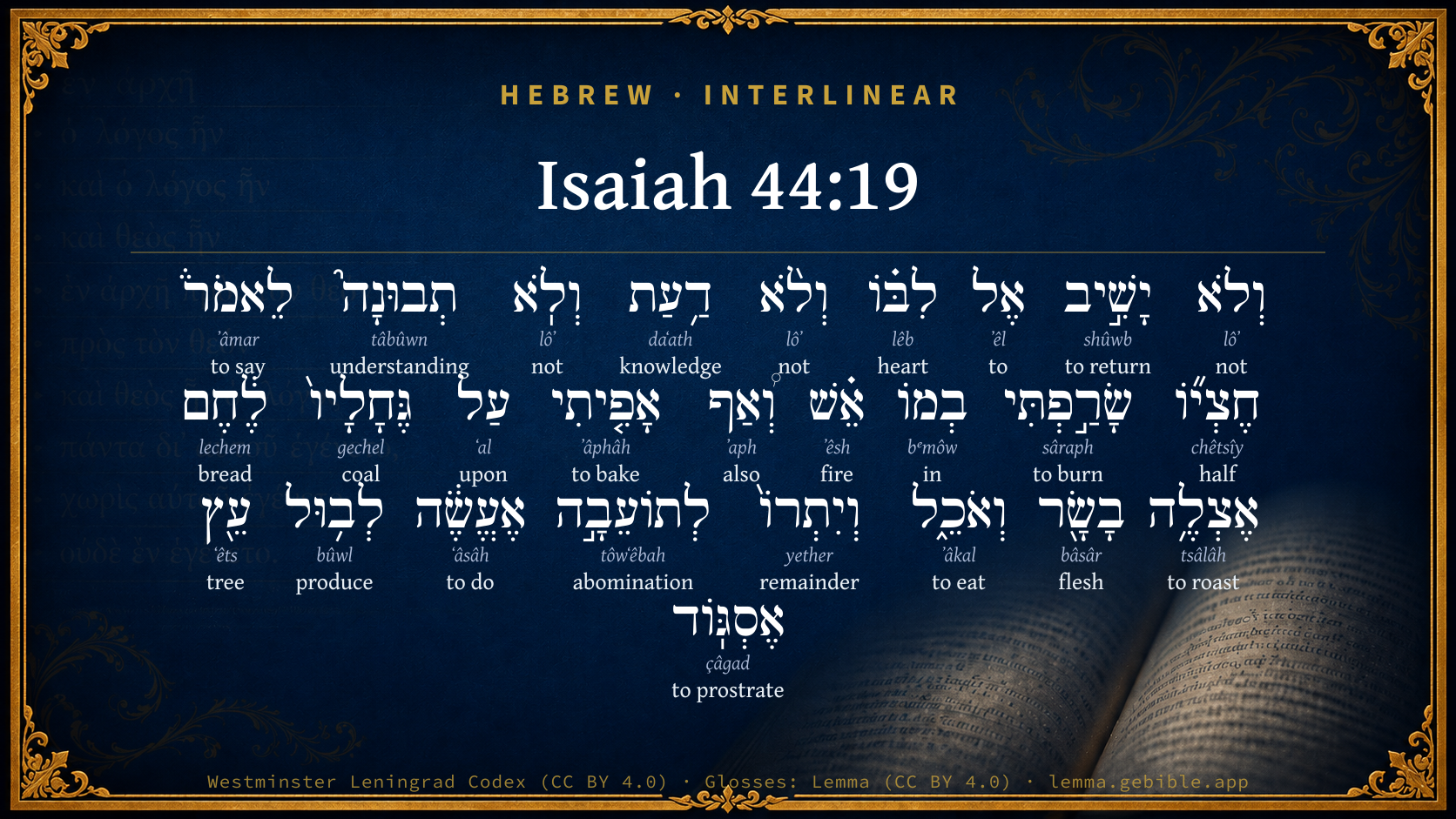
Isaiah 44:19

Hebrew (Westminster Leningrad Codex) Isaiah 44:19 appears in the Hebrew Old Testament. The text above is from the Westminster Leningrad Codex. Each word links to its Strong’s number, a concise gloss, and parsing drawn from the Open Scriptures Hebrew Bible morphology. Click any word for its full Brown-Driver-Briggs (BDB) entry.
Download image
Cite this verse

Isaiah 44:19 (World English Bible). Public Domain. Lemma interlinear Bible study tool, https://lemma.gebible.app/v/isaiah/44/19.

Show BibTeX & RIS
BibTeX
RIS
English Translation
None calls to mind, neither is there knowledge nor understanding to say, I have burned part of it in the fire; yes, also I have baked bread on the coals of it; I have roasted flesh and eaten it: and shall I make the residue of it an abomination? shall I fall down to the stock of a tree?
World English Bible · Public Domain
Download a study sheet

One document with this verse’s original text, its word-by-word gloss line, the meaning frame, cross-references with their text, attributed commentary, and full source and license credits — printable, and it pastes into notes with its structure intact.

This verse Autodidact and up

Study sheet (.html) Plain text (.txt)

A passage Seminary Student

Up to 50 verses in one chapter. A passage sheet keeps up to 6 commentary sources and 12 cross-references per verse, in the order this page ranks them, and says so on the sheet whenever that leaves anything out. Ask for a single verse and you get the Autodidact verse sheet above.

Everything on this page stays free to read, with no account — the sheet is a download of what is already on screen, not access to it.

Want to remove ads? Support Godless Engineer
Compare translations 3

The same verse in 3 English versions, stacked beneath the original-language interlinear above. Click any original word for its lexicon entry.

Each is an independent rendering of the whole verse — the interlinear is not word-aligned to these translations.

Highlighted words mark where these versions differ — a whole-verse word diff, not a word-by-word alignment.

  • World English Bible Public Domain
    None calls to mind, neither is there knowledge nor understanding to say, I have burned part of it in the fire; yes, also I have baked bread on the coals of it; I have roasted flesh and eaten it: and shall I make the residue of it an abomination? shall I fall down to the stock of a tree?
  • King James Version Public Domain
    And none considereth in his heart, neither is there knowledge nor understanding to say, I have burned part of it in the fire; yea, also I have baked bread upon the coals thereof; I have roasted flesh, and eaten it: and shall I make the residue thereof an abomination? shall I fall down to the stock of a tree?
  • unfoldingWord Literal Text CC BY-SA 4.0
    And none sets to his heart, and no knowledge and no understanding to say, “Half of it, I burned in the fire, and I also baked bread on its coals; I roasted flesh and ate. And shall I make its remainder into an abomination? Shall I prostrate to the product of a tree?”

unfoldingWord Literal Text — © unfoldingWord, licensed CC BY-SA 4.0. Word-aligned USFM3 via Door43 (git.door43.org/unfoldingWord/en_ult).

Versions to compare (up to 4)

3 of 4 selected

Show all 18 translations

Every available English version of this verse, each an independent rendering of the whole verse.

  • World English Bible Public Domain
    None calls to mind, neither is there knowledge nor understanding to say, I have burned part of it in the fire; yes, also I have baked bread on the coals of it; I have roasted flesh and eaten it: and shall I make the residue of it an abomination? shall I fall down to the stock of a tree?
  • Berean Standard Bible Public Domain
    And no one considers in his heart, no one has the knowledge or insight to say, “I burned half of it in the fire, and I baked bread on its coals; I roasted meat and I ate. Shall I make something detestable with the rest of it? Shall I bow down to a block of wood?”
  • Majority Standard Bible Public Domain
    And no one considers in his heart, no one has the knowledge or insight to say, “I burned half of it in the fire, and I baked bread on its coals; I roasted meat and I ate. Shall I make something detestable with the rest of it? Shall I bow down to a block of wood?”
  • King James Version Public Domain
    And none considereth in his heart, neither is there knowledge nor understanding to say, I have burned part of it in the fire; yea, also I have baked bread upon the coals thereof; I have roasted flesh, and eaten it: and shall I make the residue thereof an abomination? shall I fall down to the stock of a tree?
  • American Standard Version (1901) Public Domain
    And none calleth to mind, neither is there knowledge nor understanding to say, I have burned part of it in the fire; yea, also I have baked bread upon the coals thereof; I have roasted flesh and eaten it: and shall I make the residue thereof an abomination? shall I fall down to the stock of a tree?
  • Revised Version (1885) Public Domain
    And none calleth to mind, neither is there knowledge nor understanding to say, I have burned part of it in the fire; yea, also I have baked bread upon the coals thereof; I have roasted flesh and eaten it: and shall I make the residue thereof an abomination? shall I fall down to the stock of a tree?
  • Geneva Bible (1599) Public Domain
    And none considereth in his heart, neither is there knowledge nor vnderstanding to say, I haue burnt halfe of it, euen in the fire, and haue baked bread also vpon the coles thereof: I haue rosted flesh, and eaten it, and shall I make the residue thereof an abomination? shall I bowe to the stocke of a tree?
  • Douay-Rheims (1899) Public Domain
    They do not consider in their mind, nor know, nor have the thought to say: I have burnt part of it in the fire, and I have baked bread upon the coals thereof: I have broiled flesh and have eaten, and of the residue thereof shall I make an idol? shall I fall down before the stock of a tree?
  • Young's Literal Translation Public Domain
    And none doth turn `it' back unto his heart, Nor hath knowledge nor understanding to say, `Half of it I have burned in the fire, Yea, also, I have baked bread over its coals, I roast flesh and I eat, And its remnant for an abomination I make, To the stock of a tree I fall down.'
  • Literal Standard Version CC BY-SA 4.0
    And none turn [it] back to his heart, || Nor has knowledge nor understanding to say, “I have burned half of it in the fire, || Indeed, I have also baked bread over its coals, || I roast flesh and I eat, || And I make its remnant for an abomination, || I fall down to the stock of a tree.”
  • Unlocked Literal Bible CC BY-SA 4.0
    No one thinks, nor do they comprehend and say, “I have burned part of the wood in the fire; yes, I have also baked bread upon its coals. I have roasted meat over its coals and eaten. Now should I make the other part of the wood into something disgusting to worship? Should I bow down to a block of wood?”
  • unfoldingWord Literal Text CC BY-SA 4.0
    And none sets to his heart, and no knowledge and no understanding to say, “Half of it, I burned in the fire, and I also baked bread on its coals; I roasted flesh and ate. And shall I make its remainder into an abomination? Shall I prostrate to the product of a tree?”
  • Darby Bible Public Domain
    And none taketh it to heart, neither is there knowledge nor understanding to say, I have burned part of it in the fire, and have also baked bread upon the coals thereof, I have roasted flesh, and eaten [it], and with the rest thereof shall I make an abomination? shall I bow down to a block of wood?
  • World Messianic Bible Public Domain
    No one thinks, neither is there knowledge nor understanding to say, “I have burned part of it in the fire. Yes, I have also baked bread on its coals. I have roasted meat and eaten it. Shall I make the rest of it into an abomination? Shall I bow down to a tree trunk?”
  • Webster's Bible Public Domain
    And none considereth in his heart, neither is there knowledge nor understanding to say, I have burned part of it in the fire; I have also baked bread upon its coals; I have roasted flesh, and eaten it: and shall I make the residue of it an abomination? shall I fall down to the stock of a tree?
  • Free Bible Version CC BY-SA 4.0
    They can't think things over, they don't have the wisdom or the understanding to say, “Some of the wood I burned in the fire—I used it to bake my bread and roast my meat to eat. The rest of it I used to make a disgusting idol, and I bow down in worship to a block of wood.”
  • Bible in Basic English Public Domain
    And no one takes note, no one has enough knowledge or wisdom to say, I have put part of it in the fire, and made bread on it; I have had a meal of the flesh cooked with it: and am I now to make the rest of it into a false god? am I to go down on my face before a bit of wood?
  • JPS Tanakh (1917) Public Domain
    And none considereth in his heart, neither is there knowledge nor understanding to say: 'I have burned the half of it in the fire; yea, also I have baked bread upon the coals thereof; I have roasted flesh and eaten it; and shall I make the residue thereof an abomination? Shall I fall down to the stock of a tree?'

Literal Standard Version (2020), Covenant Press — licensed CC BY-SA 4.0. Text via the HelloAO Bible API (eBible.org). Unlocked Literal Bible (unfoldingWord) — licensed CC BY-SA 4.0. Text via the HelloAO Bible API (eBible.org). unfoldingWord Literal Text — © unfoldingWord, licensed CC BY-SA 4.0. Word-aligned USFM3 via Door43 (git.door43.org/unfoldingWord/en_ult). Free Bible Version, Dr. Jonathan Gallagher — licensed CC BY-SA 4.0. Text via the HelloAO Bible API (eBible.org).

Word by word

More ways to search: Search by grammar → Find every occurrence → Compare this word →

Practice this passage: Drill this verse → Learn its vocabulary →

לְב֥וּל
bûwl
H944
“to/for · produce of”
Preposition + Noun, Common, Masculine, Singular, Construct
Part of Speech
Preposition + Noun
Type
Common
Gender
Masculine
Number
Singular
State
Construct
Full BDB Definition

Origin: for H2981

TWOT: 835d

produce, outgrowth
  1. וְלֹא lôʼ H3808 “and · not” Conjunction + Particle, Negative
  2. יָשִׁ֣יב shûwb H7725 “to return” Verb, Hiphil, Imperfect, 3rd Person, Masculine, Singular
  3. אֶל ʼêl H413 “to” Preposition
  4. לִבּ֗וֹ lêb H3820 “heart · his” Noun, Common, Masculine, Singular, Construct + Suffix, Personal, 3rd Person, Masculine, Singular
  5. וְלֹ֨א lôʼ H3808 “and · not” Conjunction + Particle, Negative
  6. דַ֥עַת daʻath H1847 “knowledge” Noun, Common, Feminine, Singular, Absolute
  7. וְלֹֽא lôʼ H3808 “and · not” Conjunction + Particle, Negative
  8. תְבוּנָה֮ tâbûwn H8394 “understanding” Noun, Common, Feminine, Singular, Absolute
  9. לֵאמֹר֒ ʼâmar H559 “to say” Preposition + Verb, Qal, Infinitive Construct
  10. חֶצְי֞וֹ chêtsîy H2677 “half · his” Noun, Common, Masculine, Singular, Construct + Suffix, Personal, 3rd Person, Masculine, Singular
  11. שָׂרַ֣פְתִּי sâraph H8313 “to burn” Verb, Qal, Perfect, 1st Person, Common, Singular
  12. בְמוֹ bᵉmôw H1119 “in” Preposition
  13. אֵ֗שׁ ʼêsh H784 “fire” Noun, Common, Both, Singular, Absolute
  14. וְ֠אַף ʼaph H637 “and · also” Conjunction + Adverb
  15. אָפִ֤יתִי ʼâphâh H644 “to bake” Verb, Qal, Perfect, 1st Person, Common, Singular
  16. עַל ʻal H5921 “upon” Preposition
  17. גֶּחָלָיו֙ gechel H1513 “coals · his” Noun, Common, Both, Plural, Construct + Suffix, Personal, 3rd Person, Masculine, Singular
  18. לֶ֔חֶם lechem H3899 “bread” Noun, Common, Both, Singular, Absolute
  19. אֶצְלֶ֥ה tsâlâh H6740 “to roast” Verb, Qal, Imperfect, 1st Person, Common, Singular
  20. בָשָׂ֖ר bâsâr H1320 “flesh” Noun, Common, Masculine, Singular, Absolute
  21. וְאֹכֵ֑ל ʼâkal H398 “and · to eat” Conjunction + Verb, Qal, Imperfect, 1st Person, Common, Singular
  22. וְיִתְרוֹ֙ yether H3499 “and · remainder · his” Conjunction + Noun, Common, Masculine, Singular, Construct + Suffix, Personal, 3rd Person, Masculine, Singular
  23. לְתוֹעֵבָ֣ה tôwʻêbah H8441 “to/for · abomination” Preposition + Noun, Common, Feminine, Singular, Absolute
  24. אֶעֱשֶׂ֔ה ʻâsâh H6213 “to do” Verb, Qal, Imperfect, 1st Person, Common, Singular
  25. עֵ֖ץ ʻêts H6086 “tree” Noun, Common, Masculine, Singular, Absolute
  26. אֶסְגּֽוֹד çâgad H5456 “to prostrate” Verb, Qal, Imperfect, 1st Person, Common, Singular

About this verse

These counts appear in no published source. They are computed here, from the morphology-tagged text and Lemma’s own curated glosses. What Lemma adds →

27
words
25
distinct lemmas
Prophets
section

Notable vocabulary

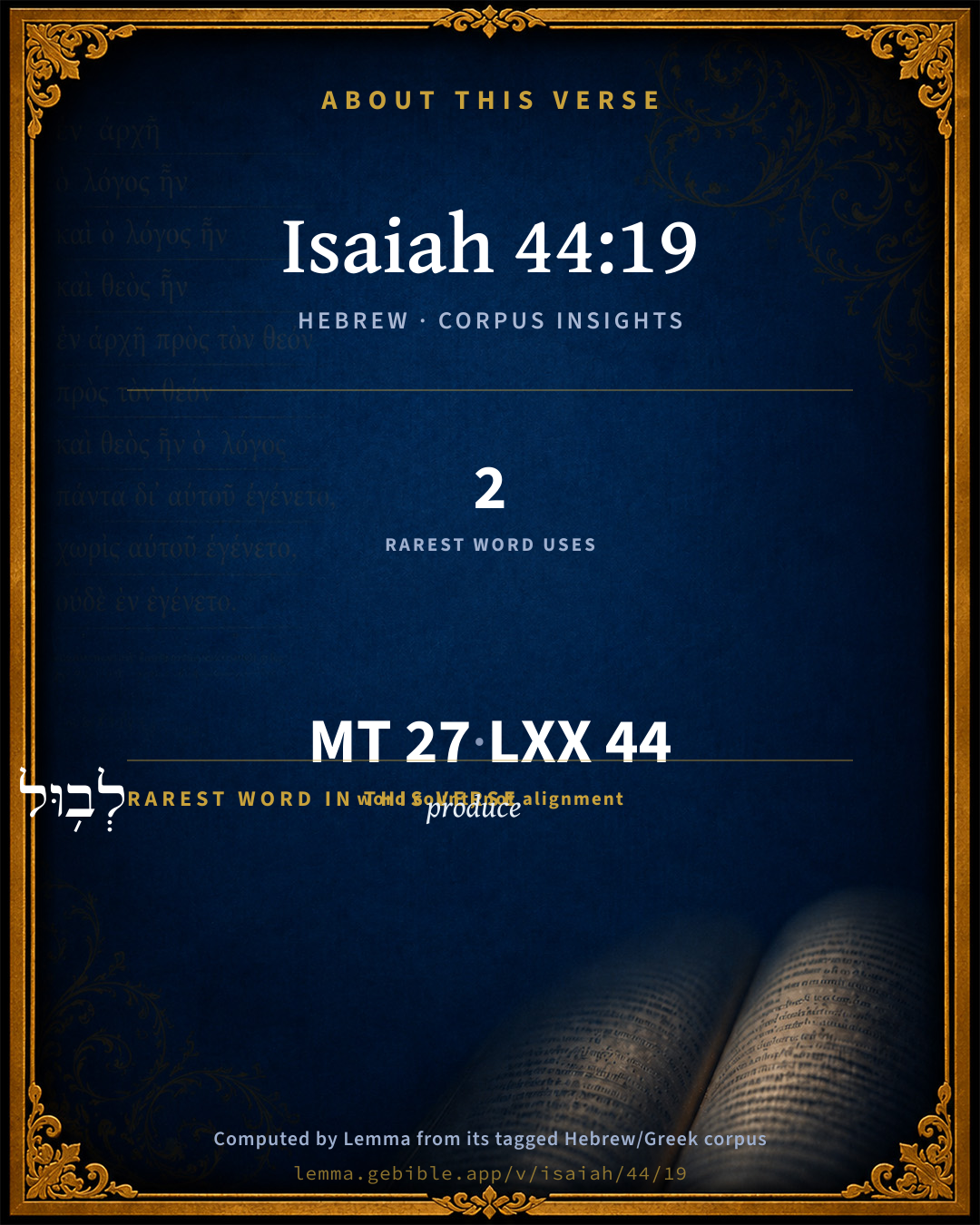
The rarest word here is לְב֥וּל produce H944 — appearing just 2 times in the whole Hebrew Bible.

Shared distinctive vocabulary

לְב֥וּל produce H944 occurs in 2 verses of the Hebrew Bible. Also found in:

Grammatical profile

  • 8 verbs
  • 12 nouns
  • 3 prepositions
  • 1 adverb
  • 3 particles

Verb forms

  • יָשִׁ֣יב Hiphil · Imperfect
  • לֵאמֹר֒ Qal · Infinitive Construct
  • שָׂרַ֣פְתִּי Qal · Perfect
  • אָפִ֤יתִי Qal · Perfect
  • אֶצְלֶ֥ה Qal · Imperfect
  • וְאֹכֵ֑ל Qal · Imperfect
  • אֶעֱשֶׂ֔ה Qal · Imperfect
  • אֶסְגּֽוֹד Qal · Imperfect

Repetition

A word recurs within this verse — often emphatic in Hebrew:

  • וְלֹא not H3808 ×3

Hebrew & Septuagint length

In English translation the verse runs 59 words from the Hebrew and 52 from the Septuagint (LXX English) — closely comparable.

A rough comparison of the two English renderings, which tokenize alike — not a word-level alignment.

Word counts can differ between the Hebrew and the Greek without any difference in meaning — e.g. the Hebrew direct-object marker אֵת has no separate Greek word, and Greek often adds the article ὁ.

In the original languages it is 27 Hebrew tokens and 44 Greek tokens — but the two are counted differently (Hebrew bundles its prefixes and suffixes into one token; the Greek is in lemma form), so that isn’t a like-for-like length.

Cross-references

12

Topical passages linked to Isaiah 44:19 in the Treasury of Scripture Knowledge — connected by theme and wording, ordered by reader-vote popularity; previews shown in the World English Bible.

  • Deuteronomy 27:15 Cursed be the man who makes an engraved or molten image, an abomination to Yahweh, the work of the hands of the craftsman, and sets it up in secret. All the people shall answer and say, Amen.
  • 1 Kings 11:5 For Solomon went after Ashtoreth the goddess of the Sidonians, and after Milcom the abomination of the Ammonites.
  • 1 Kings 11:7 Then did Solomon build a high place for Chemosh the abomination of Moab, on the mountain that is before Jerusalem, and for Molech the abomination of the children of Ammon.
  • Exodus 7:23 Pharaoh turned and went into his house, neither did he lay even this to heart.
  • Deuteronomy 32:46 He said to them, Set your heart to all the words which I testify to you this day, which you shall command your children to observe to do, [even] all the words of this law.
  • 2 Kings 23:13 The high places that were before Jerusalem, which were on the right hand of the mountain of corruption, which Solomon the king of Israel had built for Ashtoreth the abomination of the Sidonians, and for Chemosh the abomination of Moab, and for Milcom the abomination of the children of Ammon, did the king defile.
  • Isaiah 5:13 Therefore my people go into captivity for lack of knowledge; Their honorable men are famished, And their multitudes are parched with thirst.
  • Isaiah 45:20 Assemble yourselves and come; draw near together, you who have escaped from the nations: they have no knowledge who carry the wood of their engraved image, and pray to a god that can't save.
  • Ezekiel 40:4 The man said to me, Son of man, see with your eyes, and hear with your ears, and set your heart on all that I shall show you; for, to the intent that I may show them to you, are you brought here: declare all that you see to the house of Israel.
  • Hosea 7:2 They don't consider in their hearts that I remember all their wickedness. Now their own deeds have engulfed them. They are before my face.
  • Isaiah 46:8 Remember this, and show yourselves men; bring it again to mind, you transgressors.
  • Haggai 1:5 Now therefore this is what Yahweh of Hosts says: Consider your ways.

Cross-references courtesy of OpenBible.info (CC BY 4.0).

Hebrew and Greek witnesses Masoretic Hebrew ↔ Greek Septuagint

The same verse in the two great witnesses to the Old Testament, shown verse-for-verse.

These are two independent witnesses, not word-aligned to each other, and the Septuagint is shown in lemma (dictionary) form.

Hebrew Isaiah 44:19 Masoretic · Westminster Leningrad Codex

וְלֹא יָשִׁ֣יב אֶל לִבּ֗וֹ וְלֹ֨א דַ֥עַת וְלֹֽא תְבוּנָה֮ לֵאמֹר֒ חֶצְי֞וֹ שָׂרַ֣פְתִּי בְמוֹ אֵ֗שׁ וְ֠אַף אָפִ֤יתִי עַל גֶּחָלָיו֙ לֶ֔חֶם אֶצְלֶ֥ה בָשָׂ֖ר וְאֹכֵ֑ל וְיִתְרוֹ֙ לְתוֹעֵבָ֣ה אֶעֱשֶׂ֔ה לְב֥וּל עֵ֖ץ אֶסְגּֽוֹד

None calls to mind, neither is there knowledge nor understanding to say, I have burned part of it in the fire; yes, also I have baked bread on the coals of it; I have roasted flesh and eaten it: and shall I make the residue of it an abomination? shall I fall down to the stock of a tree?

World English Bible · Public Domain

Greek LXX Isaiah 44:19 Septuagint · lemma form

καί οὐ λογίζομαι ὁ καρδία αὐτός οὐδέ ἀναλογίζομαι ἐν ὁ ψυχή αὐτός οὐδέ γιγνώσκω ὁ φρόνησις ὅτι ὁ ἥμισυς αὐτός κατακαίω ἐν πῦρ καί πέσσω ἐπί ὁ ἄνθραξ αὐτός ἄρτος καί ὀπτάω κρέας ἐσθίω καί ὁ λοιπός αὐτός εἰς βδέλυγμα ποιέω καί προςκυνέω αὐτός

And one has not considered in his mind, nor known in his understanding, that he has burnt up half of it in the fire, and baked loaves on the coals thereof and has roasted and eaten flesh, and of the rest of it he has made an abomination, and they worship it.

LXX2012 (modern English Septuagint) · Public Domain

Hebrew: Westminster Leningrad Codex (CC BY 4.0). Greek: Septuagint (public domain); English from LXX2012 (modern English Septuagint) (Public Domain). How the Septuagint differs from the Hebrew →

Targum (Aramaic paraphrase)

1

The Targum is the ancient Jewish Aramaic paraphrase of the Hebrew Scriptures — an interpretive translation, not the Hebrew text itself. Onkelos (literal) and Pseudo-Jonathan (expansive) render the Torah, and Jonathan the Prophets. Coverage is partial: where no permissively-licensed English translation exists for a verse, only the Aramaic is shown. This is verse-level text, not a word-by-word alignment to the Hebrew.

  1. Targum Jonathan Prophets (Joshua–Malachi)
    וְלָא מֵתִיב לְלִבֵּהּ וְלָא מַדַע וְלָא סוּכְלְתָנוּ לְמֵימַר פַּלְגֵהּ אוֹקֵידַת בְּנוּרָא וְאַף אֲפִיתִי עַל גוּמְרוֹהִי לְחֵם טְוֵית בִּסְרָא וַאֲכַלֵית וּשְׁאֵרֵהּ לְתוֹעֵבָא אַעְבֵּיד לְיִבְלֵי אָעָא אֶסְגוֹד:

    And he does not consider in his heart, neither hath he knowledge or understanding to say, Half of it I have burned in the fire; yea, I have baked bread upon the coals thereof; I have roasted flesh and eaten it: and shall I make the remnant thereof a god? shall I bow myself down to the stock of a tree?

    Targum Jonathan — Aramaic: “Mikraot Gedolot” (public domain). English: “Sefaria Community Translation” (CC0 1.0 (public-domain dedication)); “London "Chaldee Paraphrase," 1871” (public domain). Text via Sefaria.

Commentary

Notes on Isaiah 44:19 from classic Christian and Jewish commentators (each source and its license shown beneath its notes). The classic Christian expositions comment on the surrounding passage and are grouped to its opening verse, so a note may address several verses; the Jewish commentaries on the Tanakh (Rashi and others) are per-verse, so they appear only where the commentator wrote on this verse.

Lemma curates 59 commentaries, every one of them public domain or Creative Commons licensed, each selected and text-cleaned for this edition rather than reprinted as found. About our sources →

Trapp's Complete Commentary

John Trapp

Isa 44:19 And none considereth in his heart, neither [is there] knowledge nor understanding to say, I have burned part of it in the fire; yea, also I have baked bread upon the coals thereof; I have roasted flesh, and eaten [it]: and shall I make the residue thereof an abomination? shall I fall down to the stock of a tree?

Ver. 19. Shall I fall down to the stock of a tree?] This the besotted Papists do to this day, by the command of the Council of Trent. But before that Council so decreed it, Ludovicus Vives, a learned Papist, confessed that there could no other difference be found of paganish and Popish worship before images, but only this, that names and titles were altered - viz., we cry Jehovah, and they Jupiter; we, Mary, they Diana; they, Minerva, we Katharine, &c. And here I bethink me of what Luther, on the ninth commandment, writeth of a base and beastly woman: Quae ut falleret eiusmodi superstitionis quendam fatuum cultorem, pubem suam totondit, et illi porrexit, suadens quod essent capilli S. Catharinae trans mare advecti. Credidit ille cuculus, et pro reliquiis osculandos praebuit et venerandos: et ecce quid fit? coepit etiam miracula operari pubes illa turpitudinis.

John Trapp, A Commentary or Exposition upon All the Books of the Old and New Testament (1647–1656) — public domain. Text from a community e-Sword module.

Geneva Bible (1599)

Geneva Bible translators

Hebrew, turneth.

Geneva Bible (1599) marginal notes — public domain. Text via Bolls.life.

Jamieson, Fausset & Brown

Robert Jamieson, A. R. Fausset & David Brown

considereth--literally, "layeth it to heart," (Isa 42:25; Jer 12:11).

abomination--the scriptural term for an idol, not merely abominable, but the essence of what is so, in the eyes of a jealous God (Kg1 11:5, Kg1 11:7).

Jamieson, Fausset & Brown — Commentary Critical and Explanatory on the Whole Bible (1871) — public domain (CC PDM 1.0). Text via the HelloAO Bible API.

The Cambridge Bible for Schools and Colleges

gen. ed. J. J. S. Perowne

19. considereth in his heart] R.V. calleth to mind; lit. “bringeth it back to his heart,” i.e. “recalls in thought,” a somewhat rare expression (see ch. Isa_46:8; Deu_4:39; Deu_30:1; 1Ki_8:47).

part of it] See on Isa_44:16. The word rendered stock occurs again only in Job_40:20, where it seems to mean “produce.”

The Cambridge Bible for Schools and Colleges (gen. ed. J. J. S. Perowne; Cambridge University Press, 1878–1918) — public domain. Text from a community e-Sword module.

John Gill's Exposition

And none considereth in his heart,.... Or, "and he does not return it to his heart" (k); he does not come to himself again, or return to his right mind, but lives and dies under the infatuation; never once revolving it in his mind, pondering within himself what he has done, or is doing, whether right or wrong:

neither is there knowledge nor understanding to say; within himself, and reason the matter in his own mind, and thus express himself:

I have burnt part of it in the fire; to warm myself with:

yea, also I have baked bread upon the coals thereof; both heated the oven, and baked bread with it; and also upon the live coals have laid kneaded dough, and baked a cake on them:

and I have roasted flesh, and eaten it; made a fire with another part of it, and roasted meat at it, and ate it with great pleasure and satisfaction:

and shall I make the residue thereof an abomination? an idol, which is an abominable thing to God, and to all men of sense and goodness:

shall I fall down to the stock of a tree? or "the bud of a tree?" (l) or that which is made out of a tree of my own planting, cutting down, and hewing, part of which has been used to the above purposes; and the remaining lifeless log, shall I worship it as a god? and yet, though such reasoning might be justly expected from a man that is a reasonable creature, sottish are idolaters, that they seem to be quite deprived of their rational powers, or at least these are disused by them.

(k) "et non reducet ad cor suum", Pagninus, Montanus; "reducit", Piscator. (l) "ante id quod provenit ex abore", Junius & Tremellius, Piscator; "germen ligni", Forerius.

John Gill's Exposition of the Whole Bible (1746–1763) — public domain (CC PDM 1.0). Text via the HelloAO Bible API.

Albert Barnes' Notes on the Bible

And none considereth in his heart - Margin, ‘Setteth to.’ He does not place the subject near his heart or mind; he does not think of it. A similar phrase occurs in Isa 46:8 : ‘Bring it again to mind.’ It is a phrase drawn from the act of placing an object near us, in order to examine it closely; and we express the same idea by the phrase ‘looking at a thing,’ or ‘looking at it closely.’ The sense is, they had not attentively and carefully thought on the folly of what they were doing - a sentiment which is as true of all sinners as it was of stupid idolaters.

An abomination - A name that is often given to an idol 2Ki 11:5, 2Ki 11:7; 2Ki 23:13. The meaning is, that an idol was abominable and detestable in the sight of a holy God. It was that which he could not endure.

Shall I fall down to the stock of a tree? - Margin, ‘That which comes of.’ The word בוּל bûl means properly “produce, increase,” and here evidently a stock or trunk of wood. So it is in the Chaldee.

Albert Barnes' Notes on the Bible (1834–1885) — public domain. Text from a community e-Sword/MySword module.

Matthew Poole's English Annotations

None considereth in his heart; whereby he implies that the true cause of this, as well as of other absurd and brutish practices of sinners, is the neglect of serious and impartial consideration of things.

Matthew Poole's English Annotations on the Holy Bible (1683–1685) — public domain. Text from a community e-Sword/MySword module.

The Pulpit Commentary

None considereth in his heart; literally, recalls it to his heart; i.e. returns to a sound way of thinking upon the subject. It is implied that the idolaters had once had it in their power to think and reason justly upon the absurdity of such conduct as that which was now habitual to them. But they had lost the power. They had suffered themselves little by little to be deluded. The stock of a tree. The marginal rendering, "that which comes of a tree," is preferable.

The Pulpit Commentary (1880–1919), ed. H.D.M. Spence-Jones & Joseph S. Exell — public domain. Text from a community e-Sword module.

J. A. Alexander on Isaiah

Joseph Addison Alexander

“And he will not bring it home to himself (or to his heart), and (there is) not knowledge, and (there is) not understanding to say, Half of it I have burned in the fire, and have also baked bread on its coals, I will roast flesh and eat, and the rest of it I will make to (be) an abomination, to a log of wood (or the trunk of a tree) I will cast myself down.” The essential meaning is, that they have not sense enough to describe their conduct to themselves in its true colors; if they did, they would stand amazed at its impiety and folly. In the form of expression the writer passes from the plural to the singular, (i.e., from idolaters in general to the individual idolater). The first phrase does not correspond exactly to the English lay to heart, but comprehends reflection and emotion. The construction of the last clause as an explanation or an interrogation has arisen from a wish to avoid the incongruity of making the man call himself a fool or express his resolution to perform a foolish act. But this very incongruity is absolutely necessary to the writer’s purpose, which is simply to tell what the infatuated devotee would say of his own conduct if he saw it in its true light. Instead of saying, ‘I will worship my god’, he would then say, ‘I will worship a stick of wood, a part of the very log which I have just burned, upon which I have just baked my bread, and on which I am just about to cook my dinner.’ The more revolting and absurd this language, the more completely does it suit and carry out the writer’s purpose. Hence too the use of the term ‘abomination’, (i.e., object of abhorrence), not in the worshipper’s actual belief, but as it would be if his eyes were opened.

Joseph Addison Alexander, The Prophecies of Isaiah (1846–1847; New York: Scribner, 1870–1878) — public domain. Text from a community e-Sword module.

unfoldingWord translationNotes

Door43 World Missions Community

Now should I make ... something disgusting to worship? Should I bow down to a block of wood?

Yahweh says that these people should be asking themselves these rhetorical questions. The questions anticipate negative answers and emphasize how foolish it would be for a person to do these things. These questions can be translated as statements. AT: "I should not now make ... something disgusting to worship. I should not bow down to a block of wood." (See: Rhetorical Question)

translationWords

worship

bow

unfoldingWord translationNotes — © Distant Shores Media and the Door43 World Missions Community, licensed CC BY-SA 4.0. Source: git.door43.org/Door43/en_tn.

Rashi

Rabbi Shlomo Yitzchaki (Rashi)

And he does not give it thought [lit. and he does not return to his heart.] Half of it I burnt with fire.

and he has neither knowledge nor understanding [lit. and there is neither knowledge nor understanding] in him to say this.

to rotten wood Heb. לְבוּל עֵץ, to decay of wood.

Rashi on the Tanakh — English translations: “The Judaica Press complete Tanach with Rashi, translated by A. J. Rosenberg” (CC BY 4.0); “Pentateuch with Rashi's commentary by M. Rosenbaum and A.M. Silbermann, 1929-1934” (public domain); “The Metsudah Tanach series, Lakewood, N.J” (CC BY 4.0); and “The Book of Joshua, Metsudah Publications, 1997” (CC BY 4.0). Text via Sefaria.

Ibn Ezra

Rabbi Abraham ibn Ezra

His heart. His intellect, which is the principal part of man.

במו=ב In. Comp. כמו=כ as (Ps. 58:10).

ויתרו And the residue thereof.

בול It is hap. leg. It means, according to some authorities, an image, or a statue. R. Moses Hakkohen compares it with בול plant (Job 40:20).

Ibn Ezra on the Tanakh — English translations: “Sefaria Community Translation” (CC0 1.0 (public-domain dedication)); “Yalkut, Sifsei Chachomim Chumash, Metsudah Publications, 2009” (CC BY 4.0); and “Commentary of Ibn Ezra on Isaiah - trans. by M. Friedlander, 1873” (public domain). Text via Sefaria.

Lesson kit

Teaching starters — assembled from the data on this page, not authored interpretation. Every prompt links to the verse data it draws on. Edit before teaching.

Isaiah, in the Prophets, opens this verse with 27 words (25 distinct Hebrew lemmas). Its most distinctive word is bûwl (“produce”). A historical commentator’s framing appears above. Read the whole chapter for the surrounding context.

Discussion questions

  1. How does “produce” (bûwl) shape what this verse is saying?
  2. How does Job 40:20, which shares the word «produce», read alongside this verse?
  3. What does the repetition of “not” (3× in this one verse) do in this verse?
  4. These translations render this verse differently. What is at stake in choosing one wording over another?
  5. «יָשִׁ֣יב» is a Hiphil Imperfect verb. How does that grammatical form shape the action described?
  6. Compare how Trapp's Complete Commentary and Geneva Bible (1599) read this verse. Where do they agree or differ?

Things to notice

Reading settings

Reading text

Shown beneath each verse's original-language words.

Old Testament
Old Testament edition

Read the OT as the Masoretic Hebrew (MT) or the Greek Septuagint (LXX).

English shown for the Greek Septuagint (in the Hebrew ↔ Greek comparison).

Comparing translations? Open the Compare panel on any verse page to stack up to four side by side.