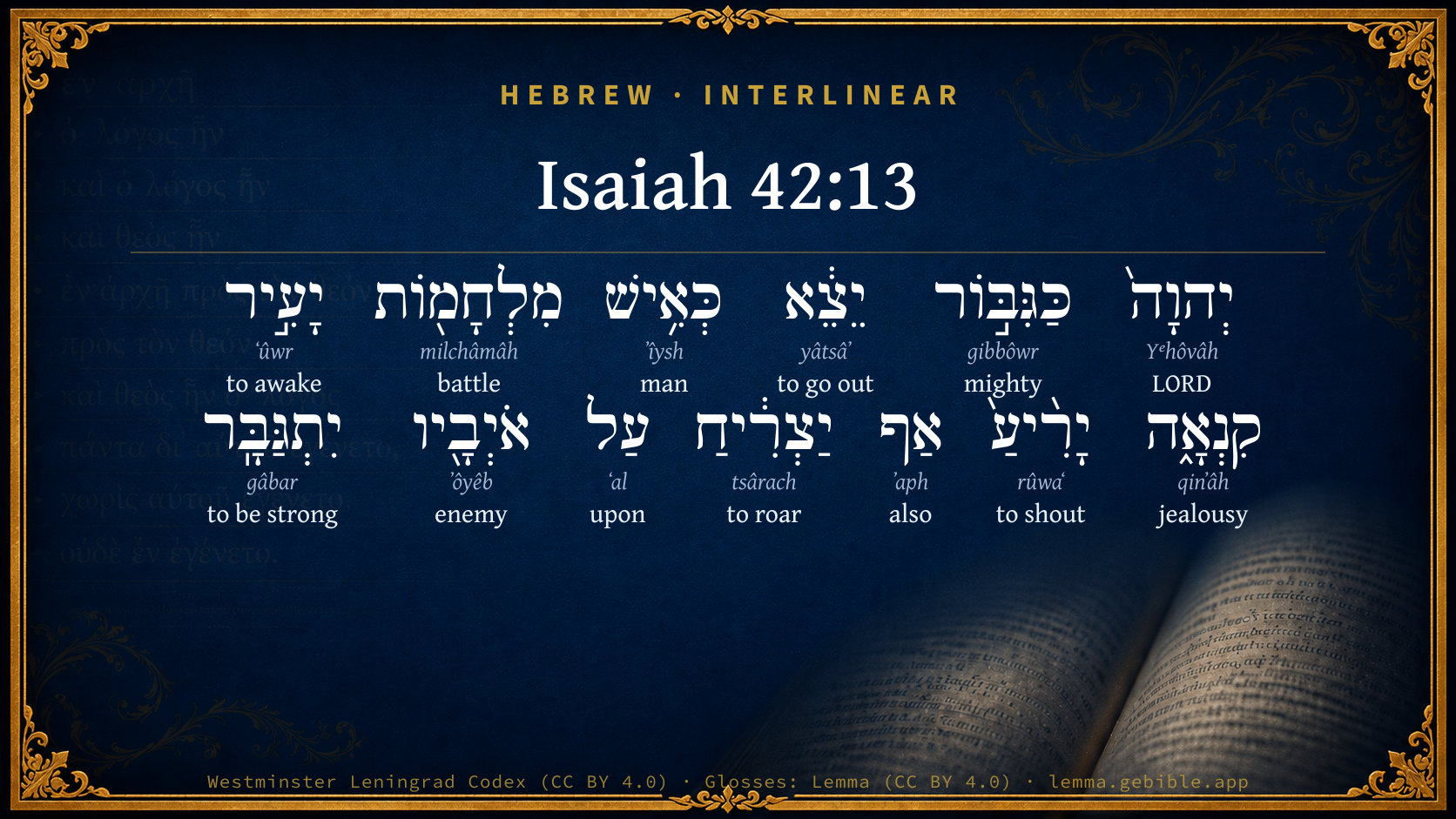
Isaiah 42:13

Hebrew (Westminster Leningrad Codex) Isaiah 42:13 appears in the Hebrew Old Testament. The text above is from the Westminster Leningrad Codex. Each word links to its Strong’s number, a concise gloss, and parsing drawn from the Open Scriptures Hebrew Bible morphology. Click any word for its full Brown-Driver-Briggs (BDB) entry.
Download image
Cite this verse

Isaiah 42:13 (World English Bible). Public Domain. Lemma interlinear Bible study tool, https://lemma.gebible.app/v/isaiah/42/13.

Show BibTeX & RIS
BibTeX
RIS
English Translation
Yahweh will go forth as a mighty man; he will stir up [his] zeal like a man of war: he will cry, yes, he will shout aloud; he will do mightily against his enemies.
World English Bible · Public Domain
Highlights Full analysis ↓
Download a study sheet

One document with this verse’s original text, its word-by-word gloss line, the meaning frame, cross-references with their text, attributed commentary, and full source and license credits — printable, and it pastes into notes with its structure intact.

This verse Autodidact and up

Study sheet (.html) Plain text (.txt)

A passage Seminary Student

Up to 50 verses in one chapter. A passage sheet keeps up to 6 commentary sources and 12 cross-references per verse, in the order this page ranks them, and says so on the sheet whenever that leaves anything out. Ask for a single verse and you get the Autodidact verse sheet above.

Everything on this page stays free to read, with no account — the sheet is a download of what is already on screen, not access to it.

Want to remove ads? Support Godless Engineer
Compare translations 3

The same verse in 3 English versions, stacked beneath the original-language interlinear above. Click any original word for its lexicon entry.

Each is an independent rendering of the whole verse — the interlinear is not word-aligned to these translations.

Highlighted words mark where these versions differ — a whole-verse word diff, not a word-by-word alignment.

  • World English Bible Public Domain
    Yahweh will go forth as a mighty man; he will stir up [his] zeal like a man of war: he will cry, yes, he will shout aloud; he will do mightily against his enemies.
  • King James Version Public Domain
    The LORD shall go forth as a mighty man, he shall stir up jealousy like a man of war: he shall cry, yea, roar; he shall prevail against his enemies.
  • unfoldingWord Literal Text CC BY-SA 4.0
    Yahweh will go forth as a warrior; as a man of battles he will awaken zeal. He will shout, indeed, he will yell; he will show himself mighty over his enemies. q1

unfoldingWord Literal Text — © unfoldingWord, licensed CC BY-SA 4.0. Word-aligned USFM3 via Door43 (git.door43.org/unfoldingWord/en_ult).

Versions to compare (up to 4)

3 of 4 selected

Show all 18 translations

Every available English version of this verse, each an independent rendering of the whole verse.

  • World English Bible Public Domain
    Yahweh will go forth as a mighty man; he will stir up [his] zeal like a man of war: he will cry, yes, he will shout aloud; he will do mightily against his enemies.
  • Berean Standard Bible Public Domain
    The LORD goes forth like a mighty one; He stirs up His zeal like a warrior. He shouts; yes, He roars in triumph over His enemies:
  • Majority Standard Bible Public Domain
    The LORD goes forth like a mighty one; He stirs up His zeal like a warrior. He shouts; yes, He roars in triumph over His enemies:
  • King James Version Public Domain
    The LORD shall go forth as a mighty man, he shall stir up jealousy like a man of war: he shall cry, yea, roar; he shall prevail against his enemies.
  • American Standard Version (1901) Public Domain
    Jehovah will go forth as a mighty man; he will stir up `his' zeal like a man of war: he will cry, yea, he will shout aloud; he will do mightily against his enemies.
  • Revised Version (1885) Public Domain
    The LORD shall go forth as a mighty man; he shall stir up jealousy like a man of war: he shall cry, yea, he shall shout aloud; he shall do mightily against his enemies.
  • Geneva Bible (1599) Public Domain
    The Lord shall go forth as a gyant: he shall stirre vp his courage like a man of warre: he shall shout and crie, and shall preuaile against his enemies.
  • Douay-Rheims (1899) Public Domain
    The Lord shall go forth as a mighty man, as a man of war shall he stir up zeal: he shall shout and cry: he shall prevail against his enemies.
  • Young's Literal Translation Public Domain
    Jehovah as a mighty one goeth forth. As a man of war He stirreth up zeal, He crieth, yea, He shrieketh, Against His enemies He showeth Himself mighty.
  • Literal Standard Version CC BY-SA 4.0
    YHWH goes forth as a mighty one. He stirs up zeal as a man of war, || He cries, indeed, He shrieks, || He shows Himself mighty against His enemies.
  • Unlocked Literal Bible CC BY-SA 4.0
    Yahweh will go out as a warrior; as a man of war he will stir up his zeal. He will shout, yes, he will roar his battle cries; he will show his enemies his power.
  • unfoldingWord Literal Text CC BY-SA 4.0
    Yahweh will go forth as a warrior; as a man of battles he will awaken zeal. He will shout, indeed, he will yell; he will show himself mighty over his enemies. q1
  • Darby Bible Public Domain
    Jehovah will go forth as a mighty man, he will stir up jealousy like a man of war: he will cry, yea, he will shout; he will shew himself mighty against his enemies.
  • World Messianic Bible Public Domain
    The LORD will go out like a mighty man. He will stir up zeal like a man of war. He will raise a war cry. Yes, he will shout aloud. He will triumph over his enemies.
  • Webster's Bible Public Domain
    The LORD will go forth as a mighty man, he will stir up jealousy like a man of war: he will cry, yes, roar; he will prevail against his enemies.
  • Free Bible Version CC BY-SA 4.0
    Like a mighty warrior the Lord will march out, like a seasoned soldier he goes out with courage. He gives his war-cry, shouting as he battles and defeats his enemies.
  • Bible in Basic English Public Domain
    The Lord will go out as a man of war, he will be moved to wrath like a fighting-man: his voice will be strong, he will give a loud cry; he will go against his attackers like a man of war.
  • JPS Tanakh (1917) Public Domain
    The LORD will go forth as a mighty man, He will stir up jealousy like a man of war; He will cry, yea, He will shout aloud, He will prove Himself mighty against His enemies.

Literal Standard Version (2020), Covenant Press — licensed CC BY-SA 4.0. Text via the HelloAO Bible API (eBible.org). Unlocked Literal Bible (unfoldingWord) — licensed CC BY-SA 4.0. Text via the HelloAO Bible API (eBible.org). unfoldingWord Literal Text — © unfoldingWord, licensed CC BY-SA 4.0. Word-aligned USFM3 via Door43 (git.door43.org/unfoldingWord/en_ult). Free Bible Version, Dr. Jonathan Gallagher — licensed CC BY-SA 4.0. Text via the HelloAO Bible API (eBible.org).

Word by word

More ways to search: Search by grammar → Find every occurrence → Compare this word →

Practice this passage: Drill this verse → Learn its vocabulary →

יַצְרִ֔יחַ
tsârach
H6873
“to roar”
Verb, Hiphil, Imperfect, 3rd Person, Masculine, Singular
Part of Speech
Verb
Stem
Hiphil
Form
Imperfect
Person
3rd Person
Gender
Masculine
Number
Singular
Full BDB Definition

Origin: a primitive root

TWOT: 1968

to cry, roar, make a shrill or clear sound - (Qal) to roar - (Hiphil) to utter a roar, cry out (a battle cry)
  1. יְהוָה֙ Yᵉhôvâh H3068 “LORD” Noun, Proper
  2. כַּגִּבּ֣וֹר gibbôwr H1368 “like/as the · mighty” Preposition, Determined + Adjective, Adjective, Masculine, Singular, Absolute
  3. יֵצֵ֔א yâtsâʼ H3318 “to go out” Verb, Qal, Imperfect, 3rd Person, Masculine, Singular
  4. כְּאִ֥ישׁ ʼîysh H376 “like/as · man of” Preposition + Noun, Common, Masculine, Singular, Construct
  5. מִלְחָמ֖וֹת milchâmâh H4421 “battles” Noun, Common, Feminine, Plural, Absolute
  6. יָעִ֣יר ʻûwr H5782 “to awake” Verb, Hiphil, Imperfect, 3rd Person, Masculine, Singular
  7. קִנְאָ֑ה qinʼâh H7068 “jealousy” Noun, Common, Feminine, Singular, Absolute
  8. יָרִ֨יעַ֙ rûwaʻ H7321 “to shout” Verb, Hiphil, Imperfect, 3rd Person, Masculine, Singular
  9. אַף ʼaph H637 “also” Particle, Accusative
  10. עַל ʻal H5921 “upon” Preposition
  11. אֹיְבָ֖יו ʼôyêb H341 “enemy · him” Verb, Qal, Participle Active, Masculine, Plural, Construct + Suffix, Personal, 3rd Person, Masculine, Singular
  12. יִתְגַּבָּֽר gâbar H1396 “to be strong” Verb, Hithpael, Imperfect, 3rd Person, Masculine, Singular

About this verse

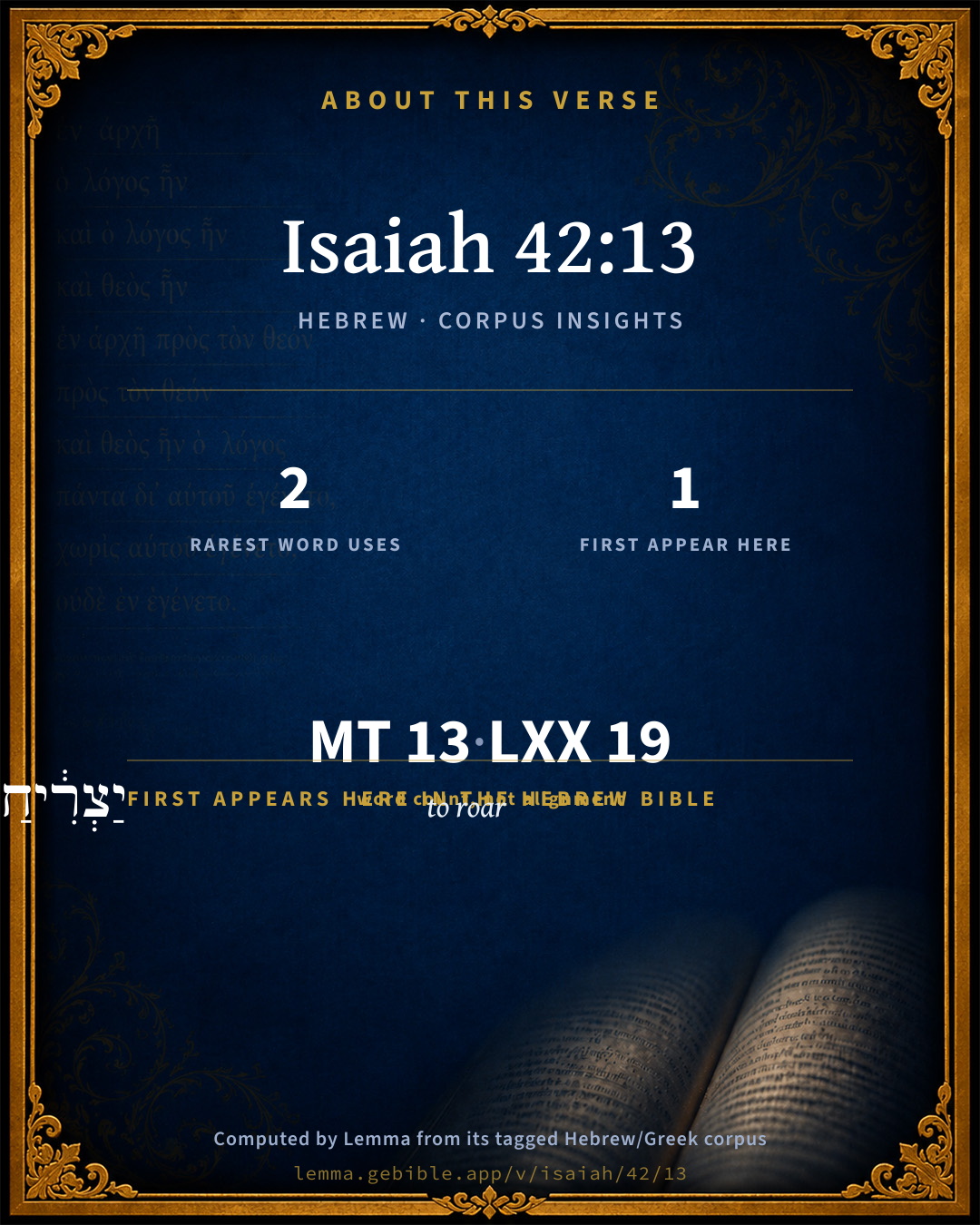
These counts appear in no published source. They are computed here, from the morphology-tagged text and Lemma’s own curated glosses. What Lemma adds →

13
words
13
distinct lemmas
Prophets
section

Notable vocabulary

The rarest word here is יַצְרִ֔יחַ to roar H6873 — appearing just 2 times in the whole Hebrew Bible.

First appearance in Scripture

This word makes its first canonical appearance in the Hebrew Bible here:

  • יַצְרִ֔יחַ to roar H6873

Shared distinctive vocabulary

יַצְרִ֔יחַ to roar H6873 occurs in 2 verses of the Hebrew Bible. Also found in:

Grammatical profile

  • 6 verbs
  • 4 nouns
  • 1 adjective
  • 1 preposition
  • 1 particle

Verb forms

  • יֵצֵ֔א Qal · Imperfect
  • יָעִ֣יר Hiphil · Imperfect
  • יָרִ֨יעַ֙ Hiphil · Imperfect
  • יַצְרִ֔יחַ Hiphil · Imperfect
  • אֹיְבָ֖יו Qal · Participle Active
  • יִתְגַּבָּֽר Hithpael · Imperfect

Hebrew & Septuagint length

In English translation the verse runs 34 words from the Hebrew and 24 from the Septuagint (LXX English) — the Septuagint runs noticeably shorter here. See the side-by-side →

A rough comparison of the two English renderings, which tokenize alike — not a word-level alignment.

Word counts can differ between the Hebrew and the Greek without any difference in meaning — e.g. the Hebrew direct-object marker אֵת has no separate Greek word, and Greek often adds the article ὁ.

In the original languages it is 13 Hebrew tokens and 19 Greek tokens — but the two are counted differently (Hebrew bundles its prefixes and suffixes into one token; the Greek is in lemma form), so that isn’t a like-for-like length.

Cross-references

17

Topical passages linked to Isaiah 42:13 in the Treasury of Scripture Knowledge — connected by theme and wording, ordered by reader-vote popularity; previews shown in the World English Bible.

  • Exodus 15:1–3 Then Moses and the children of Israel sang this song to Yahweh, and said, "I will sing to Yahweh, for he has triumphed gloriously: The horse and his rider he has thrown into the sea.
  • Psalms 78:65 Then the Lord awakened as one out of sleep, Like a mighty man who shouts by reason of wine.
  • Isaiah 59:16–19 He saw that there was no man, and wondered that there was no intercessor: therefore his own arm brought salvation to him; and his righteousness, it upheld him.
  • Psalms 110:5–6 The Lord is at your right hand. He will crush kings in the day of his wrath.
  • Amos 1:2 He said: "Yahweh will roar from Zion, And utter his voice from Jerusalem; And the pastures of the shepherds will mourn, And the top of Carmel will wither."
  • Zephaniah 3:8 "Therefore wait for me," says Yahweh, "until the day that I rise up to the prey, for my determination is to gather the nations, that I may assemble the kingdoms, to pour on them my indignation, even all my fierce anger, for all the earth will be devoured with the fire of my jealousy.
  • Isaiah 26:11 Yahweh, your hand is lifted up, yet they don't see: but they shall see [your] zeal for the people, and be disappointed; yes, fire shall devour your adversaries.
  • Isaiah 31:4 For thus says Yahweh to me, As the lion and the young lion growling over his prey, if a multitude of shepherds are called forth against him, will not be dismayed at their voice, nor abase himself for the noise of them: so will Yahweh of Hosts come down to fight on Mount Zion, and on the hill of it.
  • Isaiah 63:1–4 Who is this who comes from Edom, with dyed garments from Bozrah? this who is glorious in his clothing, marching in the greatness of his strength? I who speak in righteousness, mighty to save.
  • Jeremiah 25:30 Therefore prophesy you against them all these words, and tell them, Yahweh will roar from on high, and utter his voice from his holy habitation; he will mightily roar against his fold; he will give a shout, as those who tread [the grapes], against all the inhabitants of the earth.
  • Hosea 11:10 They will walk after Yahweh, Who will roar like a lion; For he will roar, and the children will come trembling from the west.
  • Nahum 1:2 Yahweh is a jealous God and avenges. Yahweh avenges and is full of wrath. Yahweh takes vengeance on his adversaries, and he maintains wrath against his enemies.
  • Zephaniah 1:18 Neither their silver nor their gold will be able to deliver them in the day of Yahweh's wrath, but the whole land will be devoured by the fire of his jealousy; for he will make an end, yes, a terrible end, of all those who dwell in the land.
  • Psalms 118:16 The right hand of Yahweh is exalted! The right hand of Yahweh does valiantly!"
  • Isaiah 9:7 Of the increase of his government and of peace there shall be no end, on the throne of David, and on his kingdom, to establish it, and to uphold it with justice and with righteousness from henceforth even forever. The zeal of Yahweh of Hosts will perform this.
  • Isaiah 66:14 You shall see [it], and your heart shall rejoice, and your bones shall flourish like the tender grass: and the hand of Yahweh shall be known toward his servants; and he will have indignation against his enemies.
  • Joel 3:16 Yahweh will roar from Zion, And thunder from Jerusalem; And the heavens and the earth will shake; But Yahweh will be a refuge to his people, And a stronghold to the children of Israel.

Cross-references courtesy of OpenBible.info (CC BY 4.0).

Hebrew and Greek witnesses Masoretic Hebrew ↔ Greek Septuagint

The same verse in the two great witnesses to the Old Testament, shown verse-for-verse.

Here the Septuagint runs noticeably shorter than the Hebrew — LXX2012 (modern English Septuagint) 24 words vs World English Bible 34. A rough length comparison of the two English translations, not a word-level alignment — read both below.

These are two independent witnesses, not word-aligned to each other, and the Septuagint is shown in lemma (dictionary) form.

Hebrew Isaiah 42:13 Masoretic · Westminster Leningrad Codex

יְהוָה֙ כַּגִּבּ֣וֹר יֵצֵ֔א כְּאִ֥ישׁ מִלְחָמ֖וֹת יָעִ֣יר קִנְאָ֑ה יָרִ֨יעַ֙ אַף יַצְרִ֔יחַ עַל אֹיְבָ֖יו יִתְגַּבָּֽר

Yahweh will go forth as a mighty man; he will stir up [his] zeal like a man of war: he will cry, yes, he will shout aloud; he will do mightily against his enemies.

World English Bible · Public Domain

Greek LXX Isaiah 42:13 Septuagint · lemma form

κύριος ὁ θεός ὁ δύναμις ἐκἔρχομαι καί συντρίβω πόλεμος ἐπιἐγείρω ζῆλος καί βοάω ἐπί ὁ ἐχθρός αὐτός μετά ἰσχύς

The Lord God of hosts shall go forth, and crush the war: he shall stir up jealousy, and shall shout mightily against his enemies.

LXX2012 (modern English Septuagint) · Public Domain

Hebrew: Westminster Leningrad Codex (CC BY 4.0). Greek: Septuagint (public domain); English from LXX2012 (modern English Septuagint) (Public Domain). How the Septuagint differs from the Hebrew →

Targum (Aramaic paraphrase)

1

The Targum is the ancient Jewish Aramaic paraphrase of the Hebrew Scriptures — an interpretive translation, not the Hebrew text itself. Onkelos (literal) and Pseudo-Jonathan (expansive) render the Torah, and Jonathan the Prophets. Coverage is partial: where no permissively-licensed English translation exists for a verse, only the Aramaic is shown. This is verse-level text, not a word-by-word alignment to the Hebrew.

  1. Targum Jonathan Prophets (Joshua–Malachi)
    יְיָ לְמֶעְבַּד גְבוּרָן אִתְגְלֵי לְמֶעְבַּד גְבוּרָא מִתְגְלֵי בִּרְגַז בְּמִלוּל אַף בְּזִיעַ עַל בַּעֲלֵי דְבָבוֹהִי מִתְגְלֵי בִּגְבוּרְתֵּהּ:

    The Lord shall be seen to do mighty things: He shall reveal Himself in anger to do a mighty work by the word of His wrath; He shall reveal Himself to His enemies by His might in an earthquake.

    Targum Jonathan — Aramaic: “Mikraot Gedolot” (public domain). English: “Sefaria Community Translation” (CC0 1.0 (public-domain dedication)); “London "Chaldee Paraphrase," 1871” (public domain). Text via Sefaria.

Commentary

Notes on Isaiah 42:13 from classic Christian and Jewish commentators (each source and its license shown beneath its notes). The classic Christian expositions comment on the surrounding passage and are grouped to its opening verse, so a note may address several verses; the Jewish commentaries on the Tanakh (Rashi and others) are per-verse, so they appear only where the commentator wrote on this verse.

Lemma curates 59 commentaries, every one of them public domain or Creative Commons licensed, each selected and text-cleaned for this edition rather than reprinted as found. About our sources →

Matthew Henry's Commentary

It comes all to one whether we make these verses (as some do) the song itself that is to be sung by the Gentile world or a prophecy of what God will do to make way for the singing of that song, that evangelical new song.

I. He will appear in his power and glory more than ever. So he did in the preaching of his gospel, in the divine power and energy which went along with it, and in the wonderful success it had in the pulling down of Satan's stronghold, Isa 42:13, Isa 42:14. He had long held his peace, and been still, and refrained himself, while he winked at the times of the ignorance of the Gentile world (Act 17:30), and suffered all nations to walk in their own ways (Act 14:16); but now he shall go forth as a mighty man, as a man of war, to attack the devil's kingdom and give it a fatal blow. The going forth of the gospel is thus represented, Rev 6:2. Christ, in it, went forth conquering and to conquer. The ministry of the apostles is called their warfare; and they were the soldiers of Jesus Christ. He shall stir up jealousy, shall appear more jealous than ever for the glory of his own name and against idolatry. 1. He shall cry, in the preaching of his word, cry like a travailing woman; for the ministers of Christ preached as men in earnest, and that travailed in birth again till they saw Christ formed in the souls of the people, Gal 4:19. He shall cry, yea, roar, in the gospel woes, which are more terrible than the roaring of a lion, and which must be preached along with gospel blessings to awaken a sleeping world. 2. He shall conquer by the power of his Spirit: He shall prevail against his enemies, shall prevail to make them friends, Col 1:21. Those that contradict and blaspheme his gospel, he shall prevail to put them to silence and shame. He will destroy and devour at once all the oppositions of the powers of darkness. Satan shall fall as lightning from heaven, and he that had the power of death shall be destroyed. As a type and figure of this, to make way for the redemption of the Jews out of Babylon, God will humble the pride, and break the power, of their oppressors, and will at once destroy and devour the Babylonian monarchy. In accomplishing this destruction of Babylon by the Persian army under the command of Cyrus, he will make waste mountains and hills, level the country, and dry up all their herbs. The army, as usual, shall either carry off the forage or destroy it, and by laying bridges of boats over rivers shall turn them into islands, and so drain the fens and low grounds, to make way for the march of their army, that the pools shall be dried up. Thus, when the gospel shall be preached, it shall have a free course, and that which hinders the progress of it shall be taken out of the way.

II. He will manifest his favour and grace towards those whose spirits he had stirred up to follow him, as Ezr 1:5. Those who ask the way to Zion he will show the way, and lead in it, Isa 42:16. Those who by nature were blind, and those who, being under convictions of sin and wrath are quite at a loss and know not what to do with themselves, God will lead by a way that they knew not, will show them the way to life and happiness by Jesus Christ, who is the way, and will conduct and carry them on in that way, which before they were strangers to. Thus, in the conversion of Paul, he was struck blind first, and then God revealed his Son in him, and made the scales to fall from his eyes. They are weak in knowledge, and the truths of God at first seem unintelligible; but God will make darkness light before them, and knowledge shall be easy to them. They are weak in duty, the commands of God seem impracticable, and insuperable difficulties are in the way of their obedience; but God will make crooked things straight; their way shall be plain, and the yoke easy. Those whom God brings into the right way he will guide in it. As a type of this, he will lead the Jews, when they return out of captivity, in a ready road to their own land again, and nothing shall occur to perplex or embarrass them in their journey. These are great things, and kind things, very great and very kind; but lest any should say, "They are too great, too kind, to be expected from God by such an undeserving people as that of the Jews, such an undeserving world as that of the Gentiles," he adds, These things will I do unto them, take my word for it I will, and I will not forsake them; he that begins to show this great mercy will go on to do them good.

III. He will particularly put those to confusion who adhere to idols notwithstanding the attempts made by the preaching of the gospel to turn them from idols (Isa 42:17): They shall be turned back, and greatly ashamed, that trust in graven images. The Babylonians shall when they see how the Jews, who despise their images, are owned and delivered by the God they worship without images, and the Gentiles when they see how idolatry falls before the preaching of the gospel, is scattered like darkness before the light of the sun, and melts like snow before its heat. They shall be ashamed that ever they said to these molten images, You are our gods; for how can those help their worshippers who cannot help themselves, nor save themselves from falling into contempt? In times of reformation, when many turn from iniquity, and sin, being generally deserted, becomes unfashionable, it may be hoped that those who will not otherwise be reclaimed will be wrought upon by that consideration to be ashamed of it.

Matthew Henry's Commentary on the Whole Bible (1708–1710) — public domain (CC PDM 1.0). Text via the HelloAO Bible API.

Trapp's Complete Commentary

John Trapp

Isa 42:13 The LORD shall go forth as a mighty man, he shall stir up jealousy like a man of war: he shall cry, yea, roar; he shall prevail against his enemies.

Ver. 13. The Lord shall go forth as a mighty man.] Or, As a giant. And here, by an elegant hypotyposis, {a} the fierce wrath of God against his foes is set forth to the life, and appointed also to be sung for a second part of the ditty - viz., Christ’s conquest over sin, death, and hell, whereby we are made "more than conquerors."

He shall cry, yea, roar.] Iubilabit atque etiam barriet; he shall make a hideous and horrible noise, such as the Roman soldiers did of old when they began the battle, and as the Turks do at this day on purpose to frighten their enemies. {b}

{a} Vivid description of a scene, event, or situation, bringing it, as it were, before the eyes of the hearer or reader.

{b} Vegetius.

John Trapp, A Commentary or Exposition upon All the Books of the Old and New Testament (1647–1656) — public domain. Text from a community e-Sword module.

The Biblical Illustrator

Joseph S. Exell

Isa_42:13

The Lord shall go forth as a mighty man

Jehovah, the Warrior.

Saviour

The Lord stirs Himself up to bring in the new things. (Prof. A. B. Davidson, D. D.)

The Biblical Illustrator, edited by Joseph S. Exell (c. 1880s–1900s) — public domain. Text from a community e-Sword module.

Joseph Benson's Commentary

Isa 42:13-15. The Lord shall go forth — Namely, to battle against his enemies. He shall stir up jealousy — His fierce indignation against the obstinate enemies of his Son and gospel. He shall cry, yea, roar — As a lion doth upon his prey, and as soldiers do when they begin the battle. I have long time held my peace — I have been long silent, and not interposed in behalf of my cause, but have suffered Satan and his servants to prevail in the world, to afflict my people, and hinder the entertainment of my doctrine and worship among mankind; and this my forbearance has increased the presumption of my enemies. Now will I cry like a travailing woman — Now I will no more contain myself than a woman in the pangs of travail can forbear crying out: but I will give vent to my just resentments for the injuries offered to myself and my oppressed people, by bringing some exemplary punishment upon their oppressors. I will destroy and devour at once — I will suddenly and utterly destroy the incorrigible enemies of my truth. When men’s provocations come to a great height, God is represented in Scripture as if his patience were quite tired out, and he could no longer forbear punishing them: see Jer 15:6; Jer 44:22. I will make waste mountains and hills — He does not mean dry and barren ones, for these were waste already, but such as were clothed with grass and herbs. Which clause is to be understood metaphorically of God’s destroying his most lofty and flourishing enemies, often compared in Scripture to mountains and hills. I will dry up the pools — Remove all the sources of their prosperity and comfort. “As God’s mercy is represented by pouring water upon the dry ground, chap. 35:6, and 44:3, so his wrath is described as if it were a consuming fire, parching up every thing, and reducing it to barrenness.

Joseph Benson's Commentary on the Old and New Testaments (1811–1818) — public domain. Text from a community e-Sword module.

The Expositor's Bible

CHAPTER VIII

THE PASSION OF GOD

Isa_42:13-17

AT the beginning of chapter 42 we reach one of those distinct stages, the frequent appearance of which in our prophecy assures us, that, for all its mingling and recurrent style, the prophecy is a unity with a distinct, if somewhat involved, progress of thought. For while chapters 40 and 41 establish the sovereignty and declare the character of the One True God before His people and the heathen, chapter 42 takes what is naturally the next step, of publishing to both these classes His Divine will. This purpose of God is set forth in the first seven verses of the chapter. It is identified with a human Figure, who is to be Gods agent upon earth, and who is styled "the Servant of Jehovah." Next to Jehovah Himself, the Servant of Jehovah is by far the most important personage within our prophets gaze. He is named, described, commissioned, and encouraged over and over again throughout the prophecy; his character and indispensable work are hung upon with a frequency and a fondness almost equal to the steadfast faith, which the prophet reposes in Jehovah Himself. Were we following our prophecy chapter by chapter, now would be the time to put the question, Who is this Servant, who is suddenly introduced to us? and to look ahead for the various and even conflicting answers, which rise from the subsequent chapters. But we agreed, for clearness sake, to take all the passages about the Servant, which are easily detached from the rest of the prophecy, and treat by themselves, and to continue in the meantime our prophets main theme of the power and Righteousness of God as shown forth in the deliverance of His people from Babylon. Accordingly, at present we pass over Isa_42:1-9, keeping this firmly in mind, however, that God has appointed for His work upon earth, including as it does, the ingathering of His people and the conversion of the Gentiles, a Servant, -a human figure of lofty character and unfailing perseverance, who makes Gods work of redemption his own, puts his heart into it, and is upheld by Gods hand. God, let us understand, has committed His cause upon earth to a human agent.

Gods commission of His Servant is hailed by a hymn. Earth answers the proclamation of the "new things" which the Almighty has declared (Isa_42:9) by "a new song" (Isa_42:10-13). But this song does not sing of the Servant; its subject is Jehovah Himself.

Sing to Jehovah a new song,

His praise from the end of the earth;

Ye that go down to the sea, and its fulness,

Isles, and their dwellers!

Let be loud, -the wilderness and its townships,

Villages that Kedar inhabits!

Let them ring out-the.dwellers of Sela!

From the top of the hills let them shout!

Let them give to Jehovah the glory,

And publish His praise in the Isles!

Jehovah as hero goes forth,

As a man of war stirs up zeal,

Shouts the alarm and battle cry,

Against his foes proves Himself hero.

The terms of the last four lines are military. Most of them will be found in the historical books, in descriptions of the onset of Israels battles with the heathen. But it is no human warrior to whom they are here applied. They who sing have forgotten the Servant. Their hearts are warm only with this, that Jehovah Himself will come down to earth to give the alarm, and to bear the brunt of the battle. And to such a hope He now responds, speaking also of Himself and not of the Servant. His words are very intense, and glow and strain with inward travail.

I have long time kept my peace,

Am dumb and hold myself in:

Like a woman in travail I gasp,

Pant and palpitate together.

Remember it is God who speaks these words of Himself, and then think what they mean of unsharable thought and pain, of solitary yearning and effort. But from the pain comes forth at last the power.

I waste mountains and hills,

And all their herb I parch;

And I have set rivers for islands,

And marshes I parch.

Yet it is not the passion of a mere physical effort that is in God; not mere excitement of war that thrills Him. But the suffering of men is upon Him, and He has taken their redemption to heart. He had said to His Servant (Isa_42:6-7): "I give thee to open the blind eyes, to bring out from prison the bound, from the house of bondage the dwellers in darkness." But here He himself puts on the sympathy and strain of that work.

And I will make the blind to walk in a way they know not,

By paths they know not I will guide them;

Turn darkness before them to light,

And serrated land to level.

These are the things that I do, and do not remit them.

They fall backwards, with shame are they shamed,

That put trust in a Carving,

That do say to a Cast, Ye are our Gods.

Now this pair of passages, in one of which God lays the work of redemption upon His human agent, and in another Himself puts on its passion and travail, are only one instance of a duality that runs through the whole of the Old Testament. As we repeatedly saw in the prophecies of Isaiah himself, there is a double promise of the future through the Old Testament:-first, that God will achieve the salvation of Israel by an extraordinary human personality, who is figured now as a king, now as a Prophet, and now as a Priest; but, second also, that God Himself, in undeputed, unshared power, will come visibly to deliver His people and to reign over them. These two lines of prophecy run parallel, and even entangled through the Old Testament, but within its bounds no attempt is made to reconcile them. They pass from it still separate, to find their synthesis, as we all know, in One of whom each is the incomplete prophecy. While considering the Messianic prophecies of Isaiah, which run upon the first of these two lines, we pointed out, that, though standing in historical connection with Christ, they were not prophecies of His divinity. Lofty and expansive as were the titles they attributed to the Messiah, these titles did not imply more than an earthly ruler of extraordinary power and dignity. But we added that in the other and concurrent line of prophecy, and especially in those well-developed stages of it which appear in Isaiah 40-66, we should find the true Old Testament promise of the Deity in human form and tabernacling among men. We urged that, if the divinity of Christ was to be seen in the Old Testament, we should more naturally find it in the line of promise, which speaks of God Himself descending to battle and to suffer by the side of men, than in the line that lifts a human ruler almost to the right hand of God. We have now come to a passage, which gives us the opportunity of testing this connection, which we have alleged between the so-called anthropomorphism of the Old Testament, and the Incarnation, which is the glory of the New.

When God presents Himself in the Old Testament as His peoples Saviour, it is not always as Isaiah mostly saw Him, in awful power and majesty-a "King high and lifted up," or as "coming from far, burning and thick-rising smoke, and overflowing streams; causing the peal of His voice to be heard, and the lighting down of His arm to be seen, in the fury of anger and devouring fire-bursting and torrent and hailstones." {Isaiah 31} But in a large number of passages, of which the one before us and the famous first six verses of chapter 63 (Isa_63:1-6), are perhaps the most forcible, the Almighty is clothed with human passion and agony. He is described as loving, hating, showing zeal or jealousy, fear, repentance, and scorn He bides His time, suddenly awakes to effort, and makes that effort in weakness, pain, and struggle, so extreme that He likens Himself not only to a solitary man, in the ardour of battle, but to a woman in her unsharable hour of travail. To use a technical word, the prophets in their descriptions of God do not hesitate to be anthropopathic-imparting to Deity the passions of men.

In order to appreciate the full effect of this habit of the Jewish religion, we must contrast it with some principles of that religion, with which at first it seems impossible to reconcile it.

No religion more necessarily implies the spirituality of God than does the Jewish. It is true that in the pages of the Old Testament, you will nowhere find this formally expressed. No Jewish prophet ever said in so many words what Jesus said to the woman of Samaria, "God is Spirit." In our own prophecy, spirit is frequently used, not to define the nature of God, but to express His power and the effectiveness of His will. But the Jewish Scriptures insist throughout upon the sublimity of God, or, to use their own term, . His holiness. He is the Most High, Creator, Lord, -the Force and Wisdom that are behind nature and history. It is a sin to make any image of Him; it is an error to liken Him to man. "I am God and not man, the Holy One." {Hos_11:9} We have seen how absolutely the Divine omnipotence and sublimity are expressed by our own prophet, and we shall find Him again speaking thus: "My thoughts are not your thoughts, neither are your ways My ways, saith the Lord. For as the heavens are higher than the earth, so are My ways higher than your ways, and My thoughts than your thoughts." {Isa_55:8-9} But perhaps the doctrine of our prophet which most effectively sets forth Gods loftiness and spirituality is his doctrine of Gods word. God has but to speak and a thing is created or a deed done. He calls and the agent He needs is there; He sets His word upon him and the work is as good as finished. "My word that goeth forth out of My mouth, it shall not return unto Me void, but it shall accomplish that which I please, and shall prosper in the thing whereto I sent it." {Isa_55:11} Omnipotence could not farther go. It would seem that all man needed from God was a word, -the giving of a command, that a thing must be.

Yet it is precisely in our prophecy that we find the most extreme ascriptions to the Deity of personal effort, weakness, and pain. The same chapters which celebrate Gods sublimity and holiness, which reveal the eternal counsels of God working to their inevitable ends in time, which also insist, as this very chapter does, that for the performance of works of mercy and morality God brings to bear the slow creative forces that are in nature, or which again (as in other chapters) attribute all to the power of His simple word, -these same Scriptures suddenly change their style and, after the most human manner, clothe the Deity in the travail and passion of flesh. Why is it, that instead of aspiring still higher from those sublime conceptions of God to some consummate expression of His unity, as for instance in Islam, or of His spirituality, as in certain modern philosophies, prophecy dashes thus thunderously down upon our hearts with the message, scattered in countless, broken words, that all this omnipotence and all this sublimity are expended and realised for men only in passion and in pain?

It is no answer, which is given by many in our day, that after all the prophets were but frail men, unable to stay upon the high flight to which they sometimes soared, and obliged to sacrifice their logic to the fondness of their hearts and the general habit of man to make his god after his own image. No easy sneer like that can solve so profound a moral paradox. We must seek the solution otherwise, and earnest minds will probably find it along one or other of the two following paths.

1. The highest moral ideal is not, and never can be, the righteousness that is regnant, but that which is militant and agonising. It is the deficiency of many religions, that while representing God as the Judge and almighty executor of righteousness, they have not revealed Him as its advocate and champion as well. Christ gave us a very plain lesson upon this. As He clearly showed, when He refused the offer of all the kingdoms of the world, the highest perfection is not to be omnipotence upon the side of virtue, but to be there as patience, sympathy, and love. To will righteousness, and to rule life from above in favour of righteousness, is indeed Divine; but if these were the highest attributes of divinity, and if they exhausted the Divine interest in our race, then man himself, with his conscience to sacrifice himself on behalf of justice or of truth, -man himself, with his instinct to make the sins of others his burden, and their purity his agonising endeavour, would indeed be higher than his God. Had Jehovah been nothing but the righteous Judge of all the earth, then His witnesses and martyrs, and His prophets who took to themselves the conscience and reproach of their peoples sins, would have been as much more admirable than Himself, as the soldier who serves his country on the battle-field or lays down his life for his people is more deserving of their gratitude and more certain of their devotion, than the king who equips him, sends him forth and himself stays at home.

The God of the Old Testament is not such a God. In the moral warfare to which He has predestined His creatures, He Himself descends to participate. He is not abstract-that is, withdrawn-Holiness, nor mere sovereign Justice enthroned in heaven. He is One who "arises and comes down" for the salvation of men, who makes virtue His Cause and righteousness His Passion. He is no whit behind the chiefest of His servants. No seraph burns as God burns with ardour for justice; no angel of the presence flies more swiftly than Himself to the front rank of the failing battle. The human Servant, who is pictured in our prophecy, is more absolutely identified with suffering and agonising men than any angel could be; but even he does not stand more closely by their side, nor suffer more on their behalf, than the God who sends him forth. "For the Lord stirreth up jealousy like a man of war; in all His peoples affliction He is afflicted; against His enemies He beareth Himself as a hero." So much from the side of righteousness.

2. But take the equally Divine attribute of love. When a religion affirms that God is love, it gives immense hostages. What is love without pity and compassion and sympathy? and what are these but self-imposed weakness and pain? Christ has told of the greatest love. "Greater love than this hath no man, that a man lay down his life for his friends"; and the cost and sacrifice in which He thus outmatched man is one that the prophets before He came did not hesitate to impute to God. As far as human language is adequate for such a task, they picture Gods love for men as costing Him so much. He painfully pleads for His peoples loyalty; He travails in pain for their new birth and growth in holiness; in all their afflictions He is afflicted, and He meets their stubbornness, not with the swift sentence of outraged holiness, but with longsuffering and patience, if so in the end He may win them. But the pain, that is thus essentially inseparable from love, reaches its acme when the beloved are not only in danger but in sin, when not only the future of their holiness is uncertain, but their guilty past bars the way to any future at all. We saw how Jeremiahs love thus took upon itself the conscience and reproach of Israels sin; how much distress and anguish, how much sympathy and self-sacrificing labour, and at last how much hopeless endurance of the common calamity, that sin cost the noble prophet, though he might so easily have escaped it all. Now even thus does God deal with His peoples sins; not only setting them in the light of His awful countenance, but taking them upon His heart; making them not only the object of His hate, but the anguish and the effort of His love. Jeremiah was a weak mortal, and God is the Omnipotent. Therefore, the issue of His agony shall be what His servants never could effect, the redemption of Israel from sin; but in sympathy and in travail the Deity, though omnipotent, is no whit behind the man.

We have said enough to prove our case, that the true Old Testament prophecy of the nature and work of Jesus Christ is found not so much in the long promise of the exalted human ruler, for whom Israels eyes looked, as in the assurance of Gods own descent to battle with His peoples foes and to bear their sins. In this God, omnipotent, yet in His zeal and love capable of passion, who before the Incarnation was afflicted in all His peoples affliction, and before the Cross made their sin His burden and their salvation His agony, we see the love that was in Jesus Christ. For Jesus, too, is absolute holiness, yet not far off. He, too, is righteousness militant at our side, militant and victorious. He, too, has made our greatest suffering and shame His own problem and endeavour. He is anxious for us just where conscience bids us be most anxious about ourselves. He helps us because He feels when we feel our helplessness the most. Never before or since in humanity has righteousness been perfectly victorious as in Him. Never before or since, in the whole range of being, has any one felt as He did all the sin of man with all the conscience of God. He claims to forgive, as God forgives; to be able to save, as we know only God can save. And the proof of these claims, apart from the experience of their fulfilment in our own lives, is that the same infinite love was in Him, the same agony and willingness to sacrifice Himself for men, which we have seen made evident in the Passion of God.

William Robertson Nicoll, ed., The Expositor's Bible (London: Hodder & Stoughton, 1887–1910) — public domain. 65 of 66 books (1 Corinthians is not separately keyed, as that volume carries no machine-parseable verse references); section-level commentary keyed to the opening verse. Introductory and overview sections not keyed to a specific passage are excluded.

Tyndale Open Study Notes

Tyndale Open Resources

42:13 a mighty hero . . . a warrior: The background of this theme is God’s victory at the Red Sea during the Exodus (Exod 15:3). • God will be victorious over all his enemies in order to rescue his people (Isa 51:9; 63:1-6; see also Pss 54:7; 108:9; 112:8).

Tyndale Open Study Notes — © Tyndale Open Resources, licensed CC BY-SA 4.0. Text via the HelloAO Bible API.

Geneva Bible (1599)

Geneva Bible translators

He showeth the zeal of the Lord, and his power in the conservation of his Church.

Geneva Bible (1599) marginal notes — public domain. Text via Bolls.life.

Jamieson, Fausset & Brown

Robert Jamieson, A. R. Fausset & David Brown

Jehovah will no longer restrain His wrath: He will go forth as a mighty warrior (Exo 15:3) to destroy His people's and His enemies, and to deliver Israel (compare Psa 45:3).

stir up jealousy--rouse His indignation.

roar--image from the battle cry of a warrior.

Jamieson, Fausset & Brown — Commentary Critical and Explanatory on the Whole Bible (1871) — public domain (CC PDM 1.0). Text via the HelloAO Bible API.

Ellicott's Commentary for English Readers

(13) The Lord shall go forth . . .—The boldly anthropomorphic image prepares the way for the yet more awful picture of Isa_63:1, which belongs outwardly to the same region. As if roused from slumber, Jehovah stirs up His jealous indignation against the idols, which had seemed to sleep, and rushes to the battle as with the war-cry of a mighty one.

A Bible Commentary for English Readers, edited by Charles John Ellicott (1878–1897) — public domain. Text from a community e-Sword module.

The Cambridge Bible for Schools and Colleges

gen. ed. J. J. S. Perowne

13. The reason for the universal exultation; Jehovah takes the field against His enemies. The gracious side of His intervention is reserved for Isa_42:16.

The Lord shall go forth] The technical expression for the initiation of a campaign (2Sa_11:1; Amo_5:3 &c.)

as a mighty man (or, hero) … a man of war] Similar representations in ch. Isa_28:21, Isa_59:16 f.; Exo_15:3; Zec_14:3, &c. Jealousy (better, zeal) means “passion” in very varied senses. Here it seems equivalent to the “battle fever.” see ch. Isa_9:7.

he shall cry, yea, roar] He shall raise His battle cry, yea, shout aloud.

he shall prevail] R.V. “he shall do mightily”; lit., he shall play the hero. The form occurs elsewhere only in Job (Job_15:25, Job_36:9).

The Cambridge Bible for Schools and Colleges (gen. ed. J. J. S. Perowne; Cambridge University Press, 1878–1918) — public domain. Text from a community e-Sword module.

John Gill's Exposition

The Lord shall go forth as a mighty man,.... In the ministry of the word,

conquering and to conquer; girding his "sword" on his thigh; causing his "arrows" to be sharp in the hearts of his enemies; clothing the word with power;

making the weapons of warfare, put into the hands of his ministering servants,

mighty, to pull down the "strong holds" of sin and Satan, to cast: down the proud "imaginations" of men's hearts, and to

bring into captivity every thought to the obedience of himself; or in the army of Constantine, whom he used as his instrument for the destruction of the Pagan empire, and of Paganism in it, and for the establishment of Christianity:

he shall stir up jealousy like a man of war; or "a man of wars" (x); that has been used to fight battles; Christ is represented as a warrior, Rev 19:11, his church is in a warfare state; his subjects are soldiers; his ministers are his generals under him, and with them he goes forth, and stirs up his own jealousy, his wrath and fury against his enemies, and takes vengeance on them, and the jealousy of his ministers and people, for his own glory:

he shall cry, yea, roar; not only shout aloud, as soldiers do, when they make an onset, but make a hideous noise, as the old Romans did, to frighten and dispirit their enemies. Christ, in the ministry of the word, not only cries, and calls, and invites souls, sensible of themselves and their condition, to come unto him, and partake of his grace; but he roars as the Lion of the tribe of Judah, and threatens impenitent and unbelieving sinners with his wrath and vengeance:

he shall prevail against his enemies: he shall conquer and subdue them by his Spirit and grace, and make them his willing people in the day of his power; and such who will not have him to reign over them, he will rule them with a rod of iron, and break them in pieces as a potter's vessel.

(x) "sicut vir bellorum", Montanus; "vir bellicosissimus", Junius & Tremcellius, Piscator.

John Gill's Exposition of the Whole Bible (1746–1763) — public domain (CC PDM 1.0). Text via the HelloAO Bible API.

Albert Barnes' Notes on the Bible

The Lord shall go forth - This and the following verses give the reasons why they should praise Yahweh. He would go forth in his might to overcome and subdue his foes, and to deliver his people. In his conquests, and in the establishment of his kingdom, all people would have occasion to rejoice and be glad.

As a mighty man - As a hero, as a warrior. Yahweh is often in the Scriptures represented as a hero, or a man of war:

Yahweh is a man of war:

Yahweh is his name. - Exo 15:3.

Who is this King of glory?

Yahweh, strong and mighty;

Yahweh mighty in battle. - Psa 24:8.

Compare Psa 45:3; Isa 27:1; Isa 30:30,

He shall stir up jealousy - He shall rouse his vengeance, or his indignation. The word קנאה qin'âh means vengeance, or indignation, as well as jealousy. The image here is that of a warrior who rushes on impetuously to take vengeance on his foes.

He shall cry - He shall give a shout, or a loud clamor. Warriors usually entered a battle with a loud shout, designed to stimulate their own courage, and to intimidate their foes. All this language is taken from such an entrance on an engagement, and denotes the fixed determination of God to overthrow all his enemies.

Albert Barnes' Notes on the Bible (1834–1885) — public domain. Text from a community e-Sword/MySword module.

Haydock's Catholic Bible Commentary

Enemies. The Chaldeans, (Calmet) by the hand of Cyrus.

George Leo Haydock (1774–1849), Haydock's Catholic Family Bible and Commentary, 1859 edition — public domain. Excludes Psalms (Douay-Rheims chapter numbering differs from Protestant) and Deuterocanonical books (Catholic canon only).

Matthew Poole's English Annotations

Shall go forth, to wit, to war, or battle, as this phrase is used, Num 1:3,28; 2Sa 11:1.

He shall stir up jealousy; he shall stir up himself, and his strength, and anger, against the obstinate and implacable enemies of his Son and gospel.

He shall cry, yea, roar, as a lion doth upon his prey, and as soldiers do when they begin the battle.

Matthew Poole's English Annotations on the Holy Bible (1683–1685) — public domain. Text from a community e-Sword/MySword module.

The Pulpit Commentary

The Lord shall go forth. The exhortation to "sing unto the Lord a new song" ends with ver. 12, and now the reason or groundwork for the exhortation has to be declared. God is about to make one of the great manifestations of his power upon the earth to go forth" against his enemies, and destroy and devour, and easily prevail against them not, however, simply in the way of punishment and vengeance, but with a further merciful object. He will punish Babylon, that he may deliver Israel. He has promised not to forsake his people. (Isa_41:17) He is nowabout to give effect to his promise by a "new" and strange deliverance. He "will bring his people by a way that they knew not, and lead them in paths that they have not known" (ver. 16). It has been said that "in effect it is the day of judgment which is here described" (Cheyne); but this seems to be only so far true as every manifestation of God"s wrath towards his enemies is a foreshadowing of the great and awful day. The event directly in view is the destruction of the Babylonian power by the irresistible arms of Cyrus. Hence the allusion to idolaters and images in ver. 17. As a mighty man... like a man of war. (For similar anthropomorpbisms, see Exo_15:3 Psa_24:8) He shall stir up jealousy; i.e. his own jealousy. God is "a jealous God", (Exo_20:5) so much SO that his very "name is Jealous". (Exo_34:14) He is jealous for his own honour (supra, ver. 8), and jealous also for his people"s honour and reputation and happiness. Occasionally he allows his jealousy to slumber; (comp. Act_12:3, "The times of this ignorance God winked at and this he had now done for some fifty or sixty years, since his people were carried into captivity. But the time of acquiescence has gone by he is about to waken up his "smouldering jealousy, and stir it, till it burns up into a bright flame" (Delitzsch). He shall cry, yea, roar; rather, yea, shout; i.e. utter his battle-cry with a clear, loud voice.

The Pulpit Commentary (1880–1919), ed. H.D.M. Spence-Jones & Joseph S. Exell — public domain. Text from a community e-Sword module.

John Wesley's Explanatory Notes

Go forth - To battle. Stir up - He shall stir up his strength, and anger against the obstinate enemies of his Son and gospel. Roar - As a lion doth upon his prey, and as soldiers do when they begin the battle.

John Wesley, Explanatory Notes Upon the Whole Bible (1754–1765) — public domain. Text via the GEBible commentary corpus.

J. A. Alexander on Isaiah

Joseph Addison Alexander

“Jehovah, like a strong one, will go forth; like a warrior (literally a man of battle) He will rouse (His) zeal; He will shout, yea He will cry; against His foes He will make (or show) Himself strong.” From the effect he now reverts to the efficient cause. The universal joy before described is to arise from Jehovah’s triumph over His enemies. The martial figures of the verse are intelligible in themselves and all familiar to the usage of the Scriptures. To go forth is the common Hebrew phrase for going out to war or battle. (See above, on Isa 40:26) Zeal may either have its general sense of ardor, strong and violent affection of whatever kind, or its more specific sense of jealousy or sensitive regard for His own honor and for the welfare of His people. The idea is that of an ancient warrior exciting his own courage by a shout or war-cry. The last clause may be understood to mean, He shall prevail over His enemies; but although this idea is undoubtedly included, it is best to retain the reflexive form and import of the verb as far as may be, in translation.

Joseph Addison Alexander, The Prophecies of Isaiah (1846–1847; New York: Scribner, 1870–1878) — public domain. Text from a community e-Sword module.

Ibn Ezra

Rabbi Abraham ibn Ezra

The Lord shall go forth, that is, the divine decrees, that were secret hitherto, shall now be revealed.

Jealousy because of the Babylonians, that worship Bel.

יריע He shall cry. Comp. תרועה shout (Jos. 6:5).

יצריח He shall roar. Comp. צורח crying (Zeph. 1:14), though of a different conjugation.

He shall show Himself mighty by the victory over Babylon.

Ibn Ezra on the Tanakh — English translations: “Sefaria Community Translation” (CC0 1.0 (public-domain dedication)); “Yalkut, Sifsei Chachomim Chumash, Metsudah Publications, 2009” (CC BY 4.0); and “Commentary of Ibn Ezra on Isaiah - trans. by M. Friedlander, 1873” (public domain). Text via Sefaria.

Lesson kit

Teaching starters — assembled from the data on this page, not authored interpretation. Every prompt links to the verse data it draws on. Edit before teaching.

Isaiah, in the Prophets, opens this verse with 13 words (13 distinct Hebrew lemmas). Its most distinctive word is tsârach (“to roar”). The Greek Septuagint runs shorter here. A historical commentator’s framing appears above. Read the whole chapter for the surrounding context.

Discussion questions

  1. How does “to roar” (tsârach) shape what this verse is saying?
  2. This is the first place “to roar” appears in Scripture (first appears here). What does its debut here establish?
  3. How does Zephaniah 1:14, which shares the word «to roar», read alongside this verse?
  4. The Septuagint runs shorter here than the Hebrew. What might account for the difference?
  5. These translations render this verse differently. What is at stake in choosing one wording over another?
  6. «יֵצֵ֔א» is a Qal Imperfect verb. How does that grammatical form shape the action described?
  7. Compare how Matthew Henry's Commentary and Trapp's Complete Commentary read this verse. Where do they agree or differ?

Things to notice

Reading settings

Reading text

Shown beneath each verse's original-language words.

Old Testament
Old Testament edition

Read the OT as the Masoretic Hebrew (MT) or the Greek Septuagint (LXX).

English shown for the Greek Septuagint (in the Hebrew ↔ Greek comparison).

Comparing translations? Open the Compare panel on any verse page to stack up to four side by side.