
1 Kings 8:27

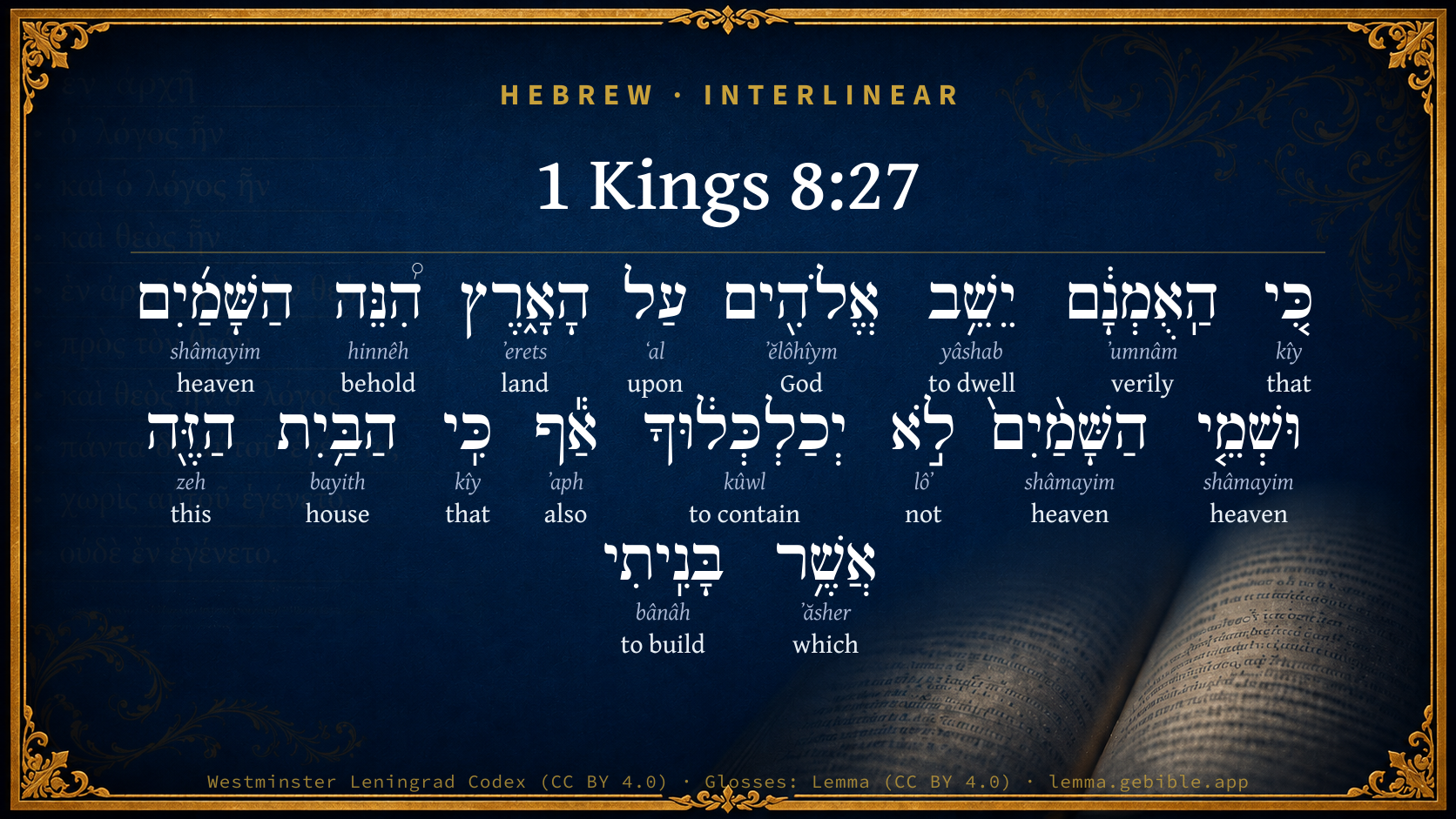
Hebrew (Westminster Leningrad Codex) 1 Kings 8:27 appears in the Hebrew Old Testament. The text above is from the Westminster Leningrad Codex. Each word links to its Strong’s number, a concise gloss, and parsing drawn from the Open Scriptures Hebrew Bible morphology. Click any word for its full Brown-Driver-Briggs (BDB) entry.
Download image
Cite this verse

1 Kings 8:27 (World English Bible). Public Domain. Lemma interlinear Bible study tool, https://lemma.gebible.app/v/1-kings/8/27.

Show BibTeX & RIS
BibTeX
RIS
English Translation
But will God in very deed dwell on the earth? behold, heaven and the heaven of heavens can't contain you; how much less this house that I have built!
World English Bible · Public Domain
Download a study sheet

One document with this verse’s original text, its word-by-word gloss line, the meaning frame, cross-references with their text, attributed commentary, and full source and license credits — printable, and it pastes into notes with its structure intact.

This verse Autodidact and up

Study sheet (.html) Plain text (.txt)

A passage Seminary Student

Up to 50 verses in one chapter. A passage sheet keeps up to 6 commentary sources and 12 cross-references per verse, in the order this page ranks them, and says so on the sheet whenever that leaves anything out. Ask for a single verse and you get the Autodidact verse sheet above.

Everything on this page stays free to read, with no account — the sheet is a download of what is already on screen, not access to it.

Want to remove ads? Support Godless Engineer
Compare translations 3

The same verse in 3 English versions, stacked beneath the original-language interlinear above. Click any original word for its lexicon entry.

Each is an independent rendering of the whole verse — the interlinear is not word-aligned to these translations.

Highlighted words mark where these versions differ — a whole-verse word diff, not a word-by-word alignment.

  • World English Bible Public Domain
    But will God in very deed dwell on the earth? behold, heaven and the heaven of heavens can't contain you; how much less this house that I have built!
  • King James Version Public Domain
    But will God indeed dwell on the earth? behold, the heaven and heaven of heavens cannot contain thee; how much less this house that I have builded?
  • unfoldingWord Literal Text CC BY-SA 4.0
    But will God truly dwell on the earth? Behold, the heavens and the heavens of the heavens do not contain you. How much less this house that I have built!

unfoldingWord Literal Text — © unfoldingWord, licensed CC BY-SA 4.0. Word-aligned USFM3 via Door43 (git.door43.org/unfoldingWord/en_ult).

Versions to compare (up to 4)

3 of 4 selected

Show all 18 translations

Every available English version of this verse, each an independent rendering of the whole verse.

  • World English Bible Public Domain
    But will God in very deed dwell on the earth? behold, heaven and the heaven of heavens can't contain you; how much less this house that I have built!
  • Berean Standard Bible Public Domain
    But will God indeed dwell upon the earth? Even heaven, the highest heaven, cannot contain You, much less this temple I have built.
  • Majority Standard Bible Public Domain
    But will God indeed dwell upon the earth? The heavens, even the highest heavens, cannot contain You, much less this temple I have built.
  • King James Version Public Domain
    But will God indeed dwell on the earth? behold, the heaven and heaven of heavens cannot contain thee; how much less this house that I have builded?
  • American Standard Version (1901) Public Domain
    But will God in very deed dwell on the earth? behold, heaven and the heaven of heavens cannot contain thee; how much less this house that I have builded!
  • Revised Version (1885) Public Domain
    But will God in very deed dwell on the earth? behold, heaven and the heaven of heavens cannot contain thee; how much less this house that I have builded!
  • Geneva Bible (1599) Public Domain
    Is it true in deede that God will dwell on the earth? beholde, the heauens, and the heauens of heauens are not able to conteine thee: howe much more vnable is this house that I haue built?
  • Douay-Rheims (1899) Public Domain
    Is it then to be thought that God should indeed dwell upon earth? for if heaven, and the heavens of heavens cannot contain thee, how much less this house which I have built?
  • Young's Literal Translation Public Domain
    But, is it true? -- God dwelleth on the earth! lo, the heavens, and the heavens of the heavens do not contain Thee, how much less this house which I have builded!
  • Literal Standard Version CC BY-SA 4.0
    But is it true [that] God dwells on the earth? Behold, the heavens and the heavens of the heavens cannot contain You, how much less this house which I have built!
  • Unlocked Literal Bible CC BY-SA 4.0
    But will God actually live on the earth? Look, the entire universe and heaven itself cannot contain you—how much less can this temple that I have built!
  • unfoldingWord Literal Text CC BY-SA 4.0
    But will God truly dwell on the earth? Behold, the heavens and the heavens of the heavens do not contain you. How much less this house that I have built!
  • Darby Bible Public Domain
    But will God indeed dwell on the earth? Behold, the heavens, and the heaven of heavens, cannot contain thee; how much less this house which I have built!
  • World Messianic Bible Public Domain
    But will God in very deed dwell on the earth? Behold, heaven and the heaven of heavens can’t contain you; how much less this house that I have built!
  • Webster's Bible Public Domain
    But will God indeed dwell on the earth? behold, the heaven and heaven of heavens cannot contain thee; how much less this house that I have built?
  • Free Bible Version CC BY-SA 4.0
    But will God really live here on earth? The heavens, even highest heaven, cannot contain you, much less this Temple I have built!
  • Bible in Basic English Public Domain
    But is it truly possible that God may be housed on earth? see, heaven and the heaven of heavens are not wide enough to be your resting-place; how much less this house which I have made!
  • JPS Tanakh (1917) Public Domain
    But will God in very truth dwell on the earth? behold, heaven and the heaven of heavens cannot contain Thee; how much less this house that I have builded!

Literal Standard Version (2020), Covenant Press — licensed CC BY-SA 4.0. Text via the HelloAO Bible API (eBible.org). Unlocked Literal Bible (unfoldingWord) — licensed CC BY-SA 4.0. Text via the HelloAO Bible API (eBible.org). unfoldingWord Literal Text — © unfoldingWord, licensed CC BY-SA 4.0. Word-aligned USFM3 via Door43 (git.door43.org/unfoldingWord/en_ult). Free Bible Version, Dr. Jonathan Gallagher — licensed CC BY-SA 4.0. Text via the HelloAO Bible API (eBible.org).

Word by word

More ways to search: Search by grammar → Find every occurrence → Compare this word →

Practice this passage: Drill this verse → Learn its vocabulary →

הַֽאֻמְנָ֔ם
ʼumnâm
H552
“verily”
Particle, Interrogative + Adverb
Part of Speech
Particle + Adverb
Full BDB Definition

Origin: an orthographical variation of H551

TWOT: 116i

verily, truly, indeed
  1. כִּ֚י kîy H3588 “that” Conjunction
  2. יֵשֵׁ֥ב yâshab H3427 “to dwell” Verb, Qal, Imperfect, 3rd Person, Masculine, Singular
  3. אֱלֹהִ֖ים ʼĕlôhîym H430 “God(s)” Noun, Common, Masculine, Plural, Absolute
  4. עַל ʻal H5921 “upon” Preposition
  5. הָאָ֑רֶץ ʼerets H776 “the · land” Particle, Definite Article + Noun, Common, Both, Singular, Absolute
  6. הִ֠נֵּה hinnêh H2009 “behold” Particle, Demonstrative
  7. הַשָּׁמַ֜יִם shâmayim H8064 “the · heaven(s)” Particle, Definite Article + Noun, Common, Masculine, Plural, Absolute
  8. וּשְׁמֵ֤י shâmayim H8064 “and · heaven(s) of” Conjunction + Noun, Common, Masculine, Plural, Construct
  9. הַשָּׁמַ֨יִם֙ shâmayim H8064 “the · heaven(s)” Particle, Definite Article + Noun, Common, Masculine, Plural, Absolute
  10. לֹ֣א lôʼ H3808 “not” Particle, Negative
  11. יְכַלְכְּל֔וּךָ kûwl H3557 “to contain · you” Verb, Pilpel, Imperfect, 3rd Person, Masculine, Plural + Suffix, Personal, 2nd Person, Masculine, Singular
  12. אַ֕ף ʼaph H637 “also” Particle, Accusative
  13. כִּֽי kîy H3588 “that” Conjunction
  14. הַבַּ֥יִת bayith H1004 “the · house” Particle, Definite Article + Noun, Common, Masculine, Singular, Absolute
  15. הַזֶּ֖ה zeh H2088 “the · this” Particle, Definite Article + Pronoun, Demonstrative, Masculine, Singular
  16. אֲשֶׁ֥ר ʼăsher H834 “which” Particle, Relative
  17. בָּנִֽיתִי bânâh H1129 “to build” Verb, Qal, Perfect, 1st Person, Common, Singular

About this verse

These counts appear in no published source. They are computed here, from the morphology-tagged text and Lemma’s own curated glosses. What Lemma adds →

18
words
15
distinct lemmas
Historical
section

Notable vocabulary

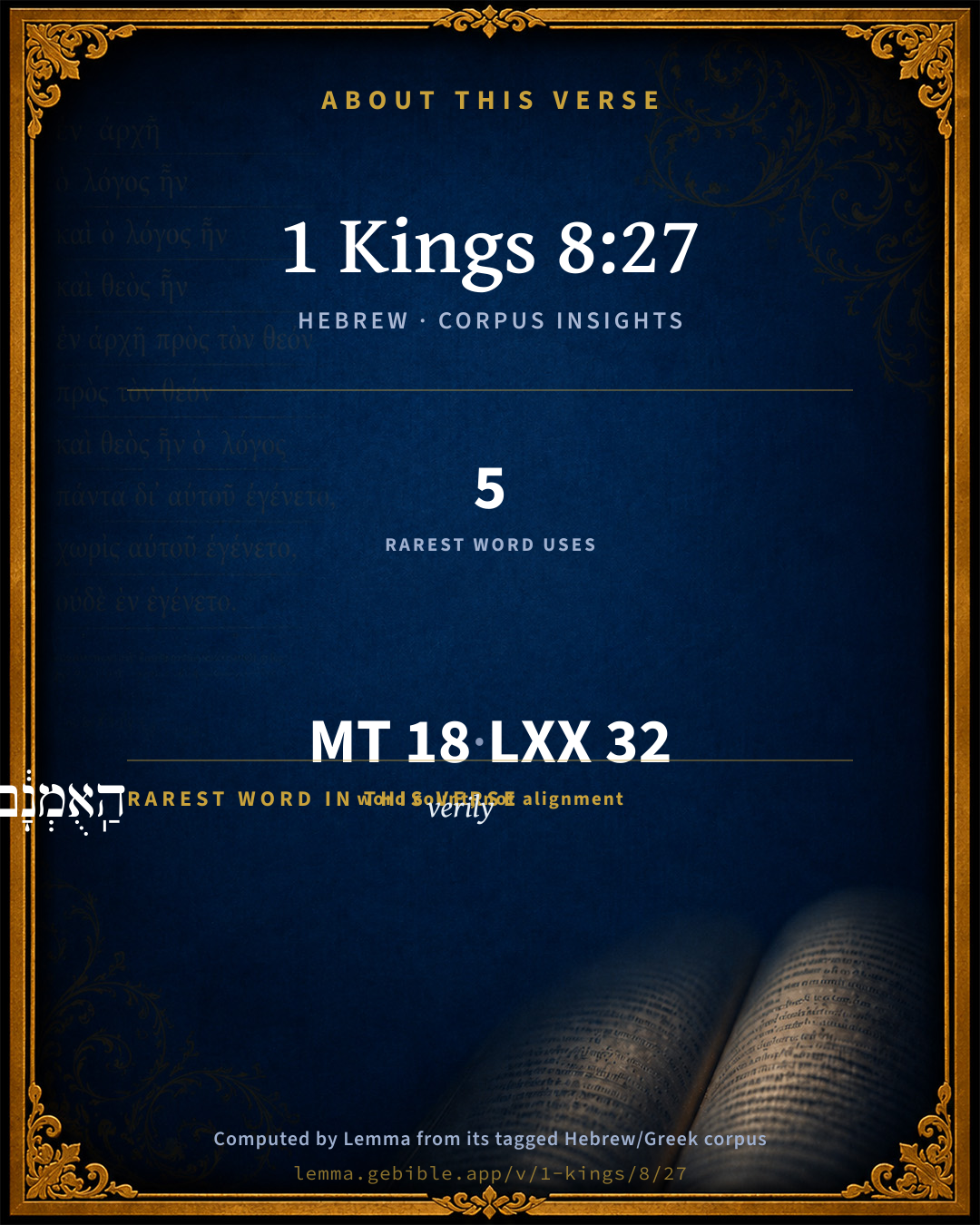
The rarest word here is הַֽאֻמְנָ֔ם verily H552 — appearing just 5 times in the whole Hebrew Bible.

Shared distinctive vocabulary

הַֽאֻמְנָ֔ם verily H552 occurs in 5 verses of the Hebrew Bible. Also found in:

Grammatical profile

  • 3 verbs
  • 6 nouns
  • 1 pronoun
  • 1 preposition
  • 2 conjunctions
  • 1 adverb
  • 4 particles

Verb forms

  • יֵשֵׁ֥ב Qal · Imperfect
  • יְכַלְכְּל֔וּךָ Pilpel · Imperfect
  • בָּנִֽיתִי Qal · Perfect

Repetition

Words recur within this verse — often emphatic in Hebrew:

  • הַשָּׁמַ֜יִם heaven H8064 ×3
  • כִּ֚י that H3588 ×2

Hebrew & Septuagint length

In English translation the verse runs 29 words from the Hebrew and 34 from the Septuagint (LXX English) — closely comparable.

A rough comparison of the two English renderings, which tokenize alike — not a word-level alignment.

Word counts can differ between the Hebrew and the Greek without any difference in meaning — e.g. the Hebrew direct-object marker אֵת has no separate Greek word, and Greek often adds the article ὁ.

In the original languages it is 18 Hebrew tokens and 32 Greek tokens — but the two are counted differently (Hebrew bundles its prefixes and suffixes into one token; the Greek is in lemma form), so that isn’t a like-for-like length.

Cross-references

13

Topical passages linked to 1 Kings 8:27 in the Treasury of Scripture Knowledge — connected by theme and wording, ordered by reader-vote popularity; previews shown in the World English Bible.

  • 2 Chronicles 2:6 But who is able to build him a house, seeing heaven and the heaven of heavens can't contain him? who am I then, that I should build him a house, save only to burn incense before him?
  • Isaiah 66:1 Thus says Yahweh, heaven is my throne, and the earth is my footstool: what manner of house will you build to me? and what place shall be my rest?
  • Jeremiah 23:24 Can any hide himself in secret places so that I shall not see him? says Yahweh. Don't I fill heaven and earth? says Yahweh.
  • 2 Chronicles 6:18 But will God in very deed dwell with men on the earth? behold, heaven and the heaven of heavens can't contain you; how much less this house which I have built!
  • Acts 7:48–49 However, the Most High doesn't dwell in temples made with hands, as the prophet says,
  • Psalms 139:7–16 Where could I go from your Spirit? Or where could I flee from your presence?
  • Deuteronomy 10:14 Behold, to Yahweh your God belongs heaven and the heaven of heavens, the earth, with all that is therein.
  • Psalms 113:4 Yahweh is high above all nations, His glory above the heavens.
  • John 1:14 The Word became flesh, and lived among us. We saw his glory, such glory as of the one and only Son of the Father, full of grace and truth.
  • Acts 17:24 The God who made the world and all things in it, he, being Lord of heaven and earth, doesn't dwell in temples made with hands,
  • 1 John 3:1 Behold, how great a love the Father has bestowed on us, that we should be called children of God! For this cause the world doesn't know us, because it didn't know him.
  • 2 Corinthians 12:2 I know a man in Christ, fourteen years ago (whether in the body, I don't know, or whether out of the body, I don't know; God knows), such a one caught up into the third heaven.
  • 2 Corinthians 6:16 What agreement has a temple of God with idols? For you are a temple of the living God. Even as God said, "I will dwell in them, and walk in them; and I will be their God, and they will be my people."

Cross-references courtesy of OpenBible.info (CC BY 4.0).

Hebrew and Greek witnesses Masoretic Hebrew ↔ Greek Septuagint

The same verse in the two great witnesses to the Old Testament, shown verse-for-verse.

These are two independent witnesses, not word-aligned to each other, and the Septuagint is shown in lemma (dictionary) form.

Hebrew 1 Kings 8:27 Masoretic · Westminster Leningrad Codex

כִּ֚י הַֽאֻמְנָ֔ם יֵשֵׁ֥ב אֱלֹהִ֖ים עַל הָאָ֑רֶץ הִ֠נֵּה הַשָּׁמַ֜יִם וּשְׁמֵ֤י הַשָּׁמַ֨יִם֙ לֹ֣א יְכַלְכְּל֔וּךָ אַ֕ף כִּֽי הַבַּ֥יִת הַזֶּ֖ה אֲשֶׁ֥ר בָּנִֽיתִי

But will God in very deed dwell on the earth? behold, heaven and the heaven of heavens can't contain you; how much less this house that I have built!

World English Bible · Public Domain

Greek LXX 1 Kings 8:27 Septuagint · lemma form

ὅτι εἰ ἀληθῶς καταοἱκέω ὁ θεός μετά ἄνθρωπος ἐπί ὁ γῆ εἰ ὁ οὐρανός καί ὁ οὐρανός ὁ οὐρανός οὐ ἀρκέω σύ πλήν καί ὁ οἶκος οὗτος ὅς οἰκοδομέω ὁ ὄνομα σύ

But will God indeed dwell with men upon the earth? if the heaven and heaven of heavens will not suffice you, how much less even this house which I have built to your name?

LXX2012 (modern English Septuagint) · Public Domain

On this verse, The Cambridge Bible for Schools and Colleges discusses the Septuagint’s reading. Read the note in Commentary ↓

Hebrew: Westminster Leningrad Codex (CC BY 4.0). Greek: Septuagint (public domain); English from LXX2012 (modern English Septuagint) (Public Domain). How the Septuagint differs from the Hebrew →

Targum (Aramaic paraphrase)

1

The Targum is the ancient Jewish Aramaic paraphrase of the Hebrew Scriptures — an interpretive translation, not the Hebrew text itself. Onkelos (literal) and Pseudo-Jonathan (expansive) render the Torah, and Jonathan the Prophets. Coverage is partial: where no permissively-licensed English translation exists for a verse, only the Aramaic is shown. This is verse-level text, not a word-by-word alignment to the Hebrew.

  1. Targum Jonathan Prophets (Joshua–Malachi)
    אֲרֵי מַן יְסוֹבַר וּמַן דָמֵי כִּי בְקוּשְׁטָא אִתְרְעֵי יְיָ לְאַשְׁרָאָה שְׁכִנְתֵּיהּ בְּגוֹ בְנֵי אֱנָשָׁא דְדַיְרִין עַל אַרְעָא הָא שְׁמַיָא וּשְׁמֵי שְׁמַיָא לָא יִכְלוּן לְסוֹבָרָא יְקָרָךְ אַף אֱלָהִין בֵּיתָא הָדֵין דִבְנֵיתִי:

    (no public-domain English translation for this verse)

    Targum Jonathan — Aramaic: “Mikraot Gedolot” (public domain). English: “Sefaria Community Translation” (CC0 1.0 (public-domain dedication)); “London "Chaldee Paraphrase," 1871” (public domain). Text via Sefaria.

Commentary

Notes on 1 Kings 8:27 from classic Christian and Jewish commentators (each source and its license shown beneath its notes). The classic Christian expositions comment on the surrounding passage and are grouped to its opening verse, so a note may address several verses; the Jewish commentaries on the Tanakh (Rashi and others) are per-verse, so they appear only where the commentator wrote on this verse.

Lemma curates 59 commentaries, every one of them public domain or Creative Commons licensed, each selected and text-cleaned for this edition rather than reprinted as found. About our sources →

Trapp's Complete Commentary

John Trapp

1Ki 8:27 But will God indeed dwell on the earth? behold, the heaven and heaven of heavens cannot contain thee; how much less this house that I have builded?

Ver. 27. Will God indeed dwell on the earth?] Mirabundus ita exclamat, saith Vatablus, who further observeth here, that the Hebrew words are preposterously put together, as importing an ecstasy of admiration.

Behold, the heaven.] The visible heaven.

And heaven of heavens.] The third heaven, the place of the blessed. {Gen 14:19 Psa 115:16}

Cannot contain thee.] Such is thine immensity: thou fillest all places, and art comprehended of no place. God is a circle, said Empedocles, whose centre is everywhere, whose circumference is nowhere. Orpheus, Aratus, and Aeschylus say the same in effect. God is higher than the heaven, saith a father, deeper than hell, broader than the earth, more diffuse than the sea. He is nowhere, and yet everywhere, quia nec abest illi, nec ullo capitur loco. {a} Neither yet must we conceive that God is commensurable by the place; for he is everywhere all-present. The heavens have a large place, but they have one part here and another there; but the Lord is totally present, wheresoever present. Oh, wonderful!

{a} Bernard.

John Trapp, A Commentary or Exposition upon All the Books of the Old and New Testament (1647–1656) — public domain. Text from a community e-Sword module.

The Biblical Illustrator

Joseph S. Exell

1Ki_8:27

But will God indeed dwell on the earth?

Of the omnipresence of God

I. The truth of the assertion itself. That God must of necessity be omnipresent; tis to be observed that if being or existence be at all a perfection, it will follow, that in like manner as continuing to exist through larger periods of Time, so also extent of existence through larger portions of space, is the having a greater degree of this Perfection. And as that Being, which is absolutely perfect, must with regard to duration be Eternal; so, in respect of greatness, it must likewise be immense. Otherwise its perfections will be limited; which is the notion of imperfection; and, by being supposed to be finite in extent, the perfection of its power will as totally be destroyed, as it would be, supposing it to be temporary in duration. For as any Being, which is not always; at the time when it is not, is as if it never was; so whatever Being is not everywhere; in those places where it is not, is as if it had no Being in any place at all. For no being can act where it is not, any more than when it is not. Power, without existence, is but an empty word without any reality; and the scholastic fiction of a being acting in all places without being present in all places, is either making the notion of God an express contradiction, or else a supposing Him so to act by the ministry of others, as not to be Himself present to understand and know what they do. It cannot but be evident, that He who made all things, as He could not but be before the things that He made, so it is not possible but He must be present also, with the things that He made and governs. For things could not be made without the actual presence of the Power that made them; nor can things ever be governed with any certainty, unless the Wisdom that governs them be present with them. Whatever arguments therefore prove the Being of God, and His unerring Providence, must all be understood to prove equally likewise His actual omnipresence. He who exists by necessity of nature, tis manifest must exist in all places alike. For absolute necessity is at all times and in all places the same. Whatever can be absent at any time, may be absent at all times; and whatever can be absent from one place, may be absent from another; and consequently can have no necessity of existing at all. He therefore who exists necessarily, must necessarily exist always and everywhere: that is, as he must in duration be eternal, so he must also in immensity be omnipresent.

II. To offer some particular observations concerning the nature and circumstances of this Divine attribute.

1. The excellency of the perfections of God does not consist in impossible and contradictory notions, but in true greatness, dignity, majesty, and glory. The eternity of God does not consist in making time past to be still present, and future time to be already come, but it consists in a true proper everlasting duration, without beginning and without end. And in like manner the Immensity of God does not consist in making things to be where they are not, or not to be where they are, but it consists in this; that whereas all finite beings can be present but in one determinate place at once: and corporeal beings even in that one place very imperfectly and unequally, to any purpose of power or activity, only by the successive motion of different members and organs; the Supreme Cause on the contrary, being a uniform Infinite Essence, and comprehending all things perfectly in Himself, is at all times equally present, both in His real essence, and by the immediate and perfect exercise of all His attributes, to every point of the boundless immensity, as if it were all but one single point. Tis worthy of observation, that this right notion of the omnipresence of God, will very much assist us to form a just apprehension of the nature of that Providence, which attends to and inspects, not only the great events, but even the minutest circumstances of every the smallest action and event in the world: Even that Providence, without which not a sparrow falls to the ground, and by which the very hairs of our head are all numbered. There is a certain determinate number or quantity of things, which every intelligent creature, according to the proportion of its sphere of power and activity, is able to attend to. And by this we may judge, that as creatures of larger capacities can observe a much greater number of things at one and the same time, than beings of a lower rank can imagine it possible they should, so God, who is present everywhere, can with infinitely greater ease direct and govern all things in the world at once, than we can attend to those few things which fall within the compass of our short observation.

3. As the beams of the sun are not at all soiled by the matter they shine upon, and as the purity and holiness of the Divine nature is not in the least diminished by beholding all the wickedness and moral impurity which is acted in the world, so the omnipresent Essence of God is not at all affected, by any natural impurity of things or places whatsoever; it being the superlative excellency and prerogative of His nature, to act always upon all things everywhere, and itself to be acted upon by nothing. All the sensible qualities of matter are merely relative to us in our present state, depending on the frame of our bodily organs, and not being anything really inherent in the things themselves. We behold only the outward surfaces of things, and are affected only by the various motions and figures of certain small parts of matter, which, by the help of microscopes, appear even to us to be really very different in themselves from what our senses represent them; and to a spirit, which sees the inward real essences of things, and not the external sensible images which affect us, they have no similitude at all with our imaginations.

4. The true meaning therefore of Gods being in heaven, is to express His height and dignity, not in place, but in power: It being only a similitude drawn into common speech, from the situation of things in nature. As the heavenly bodies, the sun and stars, are high above us in place, and all earthly blessings depend on the sun and rain and the descent of kindly influences literally from above, so, by an easy figure of speech, whatsoever is above us in power, we are from hence used to represent as being above us in place.

III. Some useful inferences from what has been said.

1. By this character of omnipresence, the true God of the universe is distinguished from all false deities; and the vanity of idolatry, made plainly to appear. The gods of the nations pretended to be but gods of particular countries; as the gods of Henah, Ivah, and Sepharvaim (2Ki_18:34). Or, of particular parts of the same country; as gods of the hills, and not of the valleys (1Ki_20:28).

2. If God is omnipresent, from hence it follows that he is to be worshipped and reverenced everywhere, in private as well as in public. Honour is to be paid Him, not only by angels before His throne in heaven, and by the congregation publicly in His Temple on earth, but also by every man singly in his most private retirements.

3. From the consideration of Gods being omnipresent, it follows that His power (as well as knowledge) is unlimited; to Be everywhere relied on by good men, and to be feared by bad. As there is no time, so neither is there any place, where He is not at hand to protect His servants (Psa_46:1). (S. Clarke, D. D.)

Gods dwelling-place

Collins the free-thinker met a simple countryman one Sunday morning going to church. He asked him where he was going. To church, sir, was the mans reply. And what do you do when you get there said the free-thinker. I worship God. Pray tell me, said Collins, whether your God is a great God or a little God? He is both, said the man. How can He be both? said Collins. Why, sir, was the answer, He is so great that the heavens cannot contain Him, and so little that He can dwell in my heart. Collins afterwards declared that this simple answer from the countryman had more effect upon his mind than all the books the learned men had written against him. (Quiver.)

The Biblical Illustrator, edited by Joseph S. Exell (c. 1880s–1900s) — public domain. Text from a community e-Sword module.

Joseph Benson's Commentary

1Ki 8:27. But will God indeed dwell on earth? — Is it possible that the great and high and holy God, the infinite, the eternal, should stoop so low as to take up his dwelling among men? Behold the heaven, &c. — All this vast space of the visible heaven; nay, the third and highest, therefore most extensive heaven, called, for its eminence and comprehensiveness, the heaven of heavens, cannot contain thee — For thy essence reacheth far beyond them, being omnipresent. Much less this house — Which, therefore, was not built as if it were proportionable to thy greatness, or could contain thee, but only that therein we might serve and glorify thee.

Joseph Benson's Commentary on the Old and New Testaments (1811–1818) — public domain. Text from a community e-Sword module.

Geneva Bible (1599)

Geneva Bible translators

He is ravished with the admiration of God’s mercies, who being incomprehensible and Lord over all will become familiar with men.

Geneva Bible (1599) marginal notes — public domain. Text via Bolls.life.

Adam Clarke's Commentary

Verse 27. But will God indeed dwell on the earth?] This expression is full of astonishment, veneration, and delight. He is struck with the immensity, dignity, and grandeur of the Divine Being, but especially at his condescension to dwell with men: and though he sees, by his filling the place, that he has come now to make his abode with them, yet he cannot help asking the question, How can such a God dwell in such a place, and with such creatures?

Behold, the heaven] The words are all in the plural number in the Hebrew: השמים ושמי השמים hashshamayim, ushemey hashshamayim; "the heavens, and the heavens of heavens." What do these words imply? That there are systems, and systems of systems, each possessing its sun, its primary and secondary planets, all extending beyond each other in unlimited space, in the same regular and graduated order which we find to prevail in what we call our solar system; which probably, in its thousands of millions of miles in diameter, is, to some others, no more than the area of the lunar orbit to that of the Georgium Sidus. When God, his manifold wisdom, his creative energy, and that space which is unlimited, are considered, it is no hyperbole to say that, although the earth has been created nearly six thousand years ago, suns, the centres of systems, may have been created at so immense a distance that their light has not yet reached our earth, though travelling at the rate of one hundred and ninety thousand miles every second, or upwards of a million times swifter than the motion of a cannon ball! This may be said to be inconceivable; but what is even all this to the vast immensity of space! Had God created a system like ours in every six days since the foundation of the world, and kept every seventh as a Sabbath; and though there might have been by this time [A.M. 5823 ineunte, A.D. 1819, ineunte] three hundred and three thousand five hundred and seventy-five mundane systems, they would occupy but a speck in the inconceivable immensity of space. Reader, all this and millions more is demonstrably possible; and if so, what must God be - illud inexprimibile - who i-n-h-a-b-i-t-e-t-h E-t-e-r-n-i-t-y!

Adam Clarke's Commentary on the Bible (1810–1826) — public domain. Text from a community e-Sword/MySword module.

Ellicott's Commentary for English Readers

(27, 28) Will God indeed dwell.—The thought expressed here exemplifies a constant antithesis which run through the Old Testament. On the one hand, there is the most profound and unvarying conception of the Infinity, eternal, invisible, incomprehensible, of the Lord, as “the High and Holy One who inhabiteth eternity,” whom “the heaven of heavens”—the heaven, that is, in all its vastest extent—“cannot contain;” and the spirituality of this conception is guarded by the sternest prohibition of that idolatry which limited and degraded the idea of God, and by rebuke of the superstition which trusted in an intrinsic sacredness of the Ark or the Temple. On the other hand, there is an equally vivid conviction that the Infinite Jehovah is yet pleased to enter into a special covenant with Israel, beyond all other nations, to reveal Himself by the cloud in the midst of His people, to bless, with a peculiar blessing, “the place which He chooses to place His Name there.” The two conceptions co-exist, as in the text, in complete harmony, both preparing for the perfect manifestation of a “God with us” in that kingdom of the Messiah, which was at once to perfect the covenant with Israel, and to include all peoples, nations, and languages for ever and ever. The words of Solomon in spirit anticipate the utterance of the prophet (Isa_66:1), quoted by St. Stephen against idolatry of the Temple (Act_7:48), and even the greater declaration of our Lord (Joh_4:21-24) as to the universal presence of God to all spiritual worship. Yet he feels the reality of the consecration of the House raised by the command of God; and prays that all who recognise it by prayer “toward this house,” may enter into the special unity with God which it symbolises, and be heard by Him from heaven. By an instructive contrast, the Temple is described as the place where God’s “Name”—that is, His self-revelation—is made to dwell; but heaven, and it alone, as the true dwelling- place of God Himself.

A Bible Commentary for English Readers, edited by Charles John Ellicott (1878–1897) — public domain. Text from a community e-Sword module.

The Cambridge Bible for Schools and Colleges

gen. ed. J. J. S. Perowne

27. will God in very deed dwell on the earth?] The LXX. adds ‘with men.’

the heaven and heaven of heavens] The expression is found in Deu_10:14; Ps. 67:36, Ps. 113:16, and is used to express the widest compass of heaven.

this house which I have builded] The LXX. adds ‘for Thy name.’

The Cambridge Bible for Schools and Colleges (gen. ed. J. J. S. Perowne; Cambridge University Press, 1878–1918) — public domain. Text from a community e-Sword module.

John Gill's Exposition

But will God indeed dwell on the earth?.... Is it true? Can any credit be given to it? Who could ever have thought it, that so great and glorious a Being, who inhabits eternity, dwells in the highest heavens, should ever condescend to dwell on earth? Such was the amazing condescension of Christ, the Son of God, to tabernacle in human nature with men on earth, to which Solomon perhaps might have respect; his temple being the figure of his body, in which the Godhead dwells, Joh 2:19.

behold, the heaven, and the heaven of heavens, cannot contain thee; not, only the visible heavens, but the third heaven, where the throne of God is, and is the habitation of angels and saints; though there God makes the most glorious displays of himself yet he is so immense and infinite, that he is not to be comprehended and circumscribed in any place whatever:

how much less this house that I have builded? Though temples built for idols contain them, and are large enough, yet Solomon had no notion, when he built his temple, though it was for the name of God, that he was restrained to it, but dwelt everywhere, filling heaven and earth with his presence.

John Gill's Exposition of the Whole Bible (1746–1763) — public domain (CC PDM 1.0). Text via the HelloAO Bible API.

Albert Barnes' Notes on the Bible

heaven of heavens - Compare Deu 10:14; Psa 148:4. It seems to mean the heaven in its most extended compass. Solomon combines with his belief in Yahweh’s special presence in the temple, the strongest conviction that He is no local or finite deity, but is ever present everywhere. Compare Psa 139:7-10.

Albert Barnes' Notes on the Bible (1834–1885) — public domain. Text from a community e-Sword/MySword module.

Haydock's Catholic Bible Commentary

Earth. Full of admiration, he breaks out into this pathetic exclamation, wondering that God should deign to accept of what he had done; and that, by the symbol of his presence, he should engage to honour this temple in a more particular manner, and to shower down his graces with a more liberal hand on those who should there present themselves before him.. This wise prince was not ignorant that God’s immensity fills all places. --- Heavens. We know not how many haveans the Jews admitted. We find, 1. the air, 2. the region of the stars, 3. the residence of God, thus specified; and this last is here denoted as the most excellent of all. St. Paul styles it the third heaven, 2 Corinthians xii. 2. The Basilidians counted as many heavens as there are days in the year. (St. Irenæus i. 23.)

George Leo Haydock (1774–1849), Haydock's Catholic Family Bible and Commentary, 1859 edition — public domain. Excludes Psalms (Douay-Rheims chapter numbering differs from Protestant) and Deuterocanonical books (Catholic canon only).

Matthew Poole's English Annotations

Reflecting upon God’s performance of his promise concerning the building of the temple, he breaks forth into admiration, Is it possible that the great, and high, and lofty God should stoop so low, as to take up his dwelling here amongst men? O astonishing condescension!

The heaven; all this vast space of the visible heaven.

And heaven of heavens; the third and highest, and therefore the largest heaven, called the heaven of heavens here, as also Deu 10:14; Psa 148:4, for its eminency and comprehensiveness.

Cannot contain thee; for thy essence teacheth far beyond them, being omnipresent.

How much less this house that I have builded? this house therefore was not built as if it were proportionable to thy greatness, or could contain thee, but only that therein we might serve and glorify thee.

Matthew Poole's English Annotations on the Holy Bible (1683–1685) — public domain. Text from a community e-Sword/MySword module.

Whedon's Commentary on the Bible

Daniel D. Whedon

27. Will God indeed dwell on the earth — An expression of pious wonder and astonishment, and, with the sequel, an utter refutation of those rationalistic critics who affirm that the Israelites had no worthy and enlarged conceptions of Deity.

Daniel D. Whedon (gen. ed.), Commentary on the Old and New Testaments (1874–1909) — public domain. Text from a community e-Sword module.

The Pulpit Commentary

But yKi. Bahr refers for this use of the word to 1Sa 11:22 2Ki_8:13 Jer_23:18 will God indeed Web. verily; same root as that of preceding verb, "verified." The repetition shows the connexion of thought. "But can these words be verified? Will God verily," etc. dwell on the earth? behold the heaven and heaven of heavens Same expression Deu_10:14. Cf. Psa_115:16 Psa_148:4 Isa_66:1. The Jewish belief respecting the seven heavens (see Wetstein on 2Co_12:2; Stanley, "Corinthians," l.c.) is of much later date, and a reference to it, or to the belief of some Rabbins in two heavens, after Deu_10:14) is altogether out of the question. The "heaven of heavens" =" all the spaces of heaven, however vast and infinite" (Gesen., cf. Psa_148:4). The analogy of "holy of holies" would, however, suggest that not all the heavens, but the highest heavens are intended) cannot contain thee; how much less yKi pa Ewald, 354 c this house that I have builded? Two points are to be noticed here.

(1) Solomon never denies for a moment that the temple was a real habitation of Jehovah, or that a real presence was manifested there. He only denies that the Deity is contained in earthly temples

(2) He had no unworthy ideas such as were prevalent in that age of God as a local deity, limited to space. The words clearly prove his grasp of the omnipresence and infinity of God. With this passage compare (Psa_139:7-10 Isa_66:1 (quoted in Act_7:49), and Act_17:24)

The Pulpit Commentary (1880–1919), ed. H.D.M. Spence-Jones & Joseph S. Exell — public domain. Text from a community e-Sword module.

John Wesley's Explanatory Notes

But will - Is it possible that the great, and high, and lofty God should stoop so low, as to take up his dwelling amongst men? The heaven - All this vast space of the visible heaven. And heaven, &c. - The third and highest, and therefore the largest heaven, called the heaven of heavens for its eminency and comprehensiveness. Contain - For thy essence reacheth far beyond them, being omnipresent. Much less - This house therefore was not built as if it were proportionable to thy greatness, or could contain thee, but only that therein we might serve and glorify thee.

John Wesley, Explanatory Notes Upon the Whole Bible (1754–1765) — public domain. Text via the GEBible commentary corpus.

unfoldingWord translationNotes

Door43 World Missions Community

But will God actually live on the earth?

Possible meanings of this question are 1) Solomon is asking a real question and expecting an answer or 2) the question is rhetorical and Solomon is emphasizing that God is too big and mighty to live on earth. AT: "But it surely cannot be that God will actually live on the earth!" (See: Rhetorical Question)

But will God

Here Solomon speaks about God in the third person. It can be stated in the second person. AT: "But will you" (See: First, Second, or Third Person)

Look

"What I am about to say is important" or "The truth is that"

you—how much less can this temple that I have built

"you, so this temple that I have built certainly cannot contain you"

respect this prayer of your servant and his request

The words "prayer" and "request" mean basically the same thing and emphasize that he is sincere as he makes his request. Solomon refers to himself as "your servant" to show that he respects Yahweh. This can be stated in first person. AT: "respect me, your servant, as I make this request" (See: Doublet and Pronouns)

listen to the cry and prayer that your servant prays before you today

The words "cry" and "prayer" mean basically the same thing and emphasize that he is sincere as he asks Yahweh to help him. Solomon refers to himself as "your servant" to show that he respects Yahweh. This can be stated in first person. AT: "listen to me, your servant, as I call today for you to help me" (See: Doublet and Pronouns)

translationWords

earth

heaven

temple

servant

Yahweh

unfoldingWord translationNotes — © Distant Shores Media and the Door43 World Missions Community, licensed CC BY-SA 4.0. Source: git.door43.org/Door43/en_tn.

Rashi

Rabbi Shlomo Yitzchaki (Rashi)

Will. [This is] an expression of wonder.

Cannot contain You. Cannot contain You.

Rashi on the Tanakh — English translations: “The Judaica Press complete Tanach with Rashi, translated by A. J. Rosenberg” (CC BY 4.0); “Pentateuch with Rashi's commentary by M. Rosenbaum and A.M. Silbermann, 1929-1934” (public domain); “The Metsudah Tanach series, Lakewood, N.J” (CC BY 4.0); and “The Book of Joshua, Metsudah Publications, 1997” (CC BY 4.0). Text via Sefaria.

Lesson kit

Teaching starters — assembled from the data on this page, not authored interpretation. Every prompt links to the verse data it draws on. Edit before teaching.

1 Kings, in the Historical, opens this verse with 18 words (15 distinct Hebrew lemmas). Its most distinctive word is ʼumnâm (“verily”). A historical commentator’s framing appears above. Read the whole chapter for the surrounding context.

Discussion questions

  1. What does “verily” (ʼumnâm) contribute to the verse as a whole?
  2. Genesis 18:13 shares the word «verily» with this verse. How do the two illuminate each other?
  3. “heaven” occurs 3× in this one verse. What is the effect of the repetition?
  4. The translations on this page render this verse differently — a whole-verse word diff, not a word-by-word alignment. What might account for the different wordings?
  5. The verb «יֵשֵׁ֥ב» is Qal Imperfect. How does its form color the action?
  6. Reading how Trapp's Complete Commentary and The Biblical Illustrator read this verse, where do the two commentators agree and where do they part?

Things to notice

Reading settings

Reading text

Shown beneath each verse's original-language words.

Old Testament
Old Testament edition

Read the OT as the Masoretic Hebrew (MT) or the Greek Septuagint (LXX).

English shown for the Greek Septuagint (in the Hebrew ↔ Greek comparison).

Comparing translations? Open the Compare panel on any verse page to stack up to four side by side.