
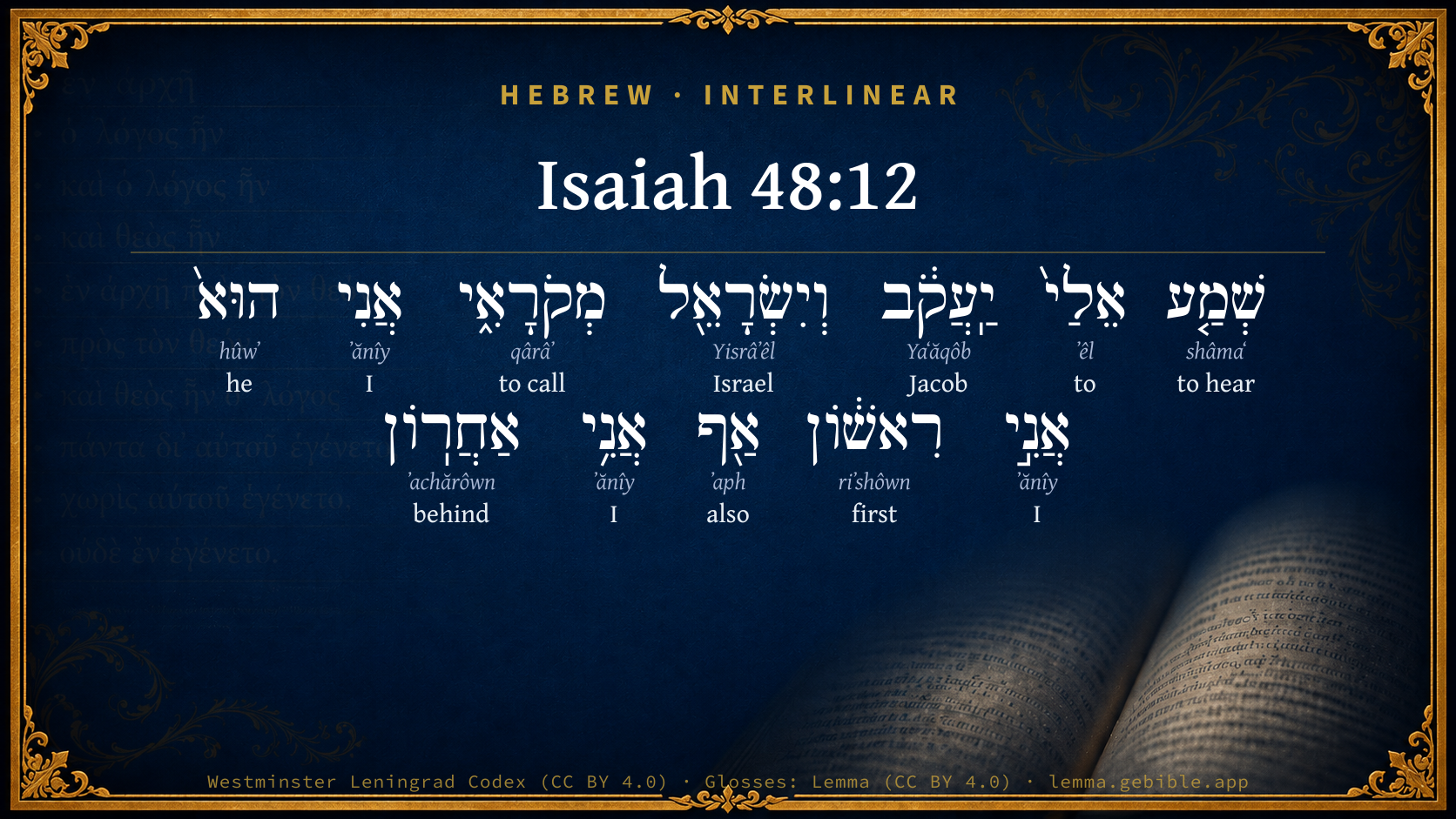
Isaiah 48:12

Hebrew (Westminster Leningrad Codex) Isaiah 48:12 appears in the Hebrew Old Testament. The text above is from the Westminster Leningrad Codex. Each word links to its Strong’s number, a concise gloss, and parsing drawn from the Open Scriptures Hebrew Bible morphology. Click any word for its full Brown-Driver-Briggs (BDB) entry.
Download image
Cite this verse

Isaiah 48:12 (World English Bible). Public Domain. Lemma interlinear Bible study tool, https://lemma.gebible.app/v/isaiah/48/12.

Show BibTeX & RIS
BibTeX
RIS
English Translation
Listen to me, O Jacob, and Israel my called: I am he; I am the first, I also am the last.
World English Bible · Public Domain
Download a study sheet

One document with this verse’s original text, its word-by-word gloss line, the meaning frame, cross-references with their text, attributed commentary, and full source and license credits — printable, and it pastes into notes with its structure intact.

This verse Autodidact and up

Study sheet (.html) Plain text (.txt)

A passage Seminary Student

Up to 50 verses in one chapter. A passage sheet keeps up to 6 commentary sources and 12 cross-references per verse, in the order this page ranks them, and says so on the sheet whenever that leaves anything out. Ask for a single verse and you get the Autodidact verse sheet above.

Everything on this page stays free to read, with no account — the sheet is a download of what is already on screen, not access to it.

Want to remove ads? Support Godless Engineer
Compare translations 3

The same verse in 3 English versions, stacked beneath the original-language interlinear above. Click any original word for its lexicon entry.

Each is an independent rendering of the whole verse — the interlinear is not word-aligned to these translations.

Highlighted words mark where these versions differ — a whole-verse word diff, not a word-by-word alignment.

  • World English Bible Public Domain
    Listen to me, O Jacob, and Israel my called: I am he; I am the first, I also am the last.
  • King James Version Public Domain
    Hearken unto me, O Jacob and Israel, my called; I am he; I am the first, I also am the last.
  • unfoldingWord Literal Text CC BY-SA 4.0
    Listen to me, Jacob, and Israel, my called one: I he; I the first, I also the last.

unfoldingWord Literal Text — © unfoldingWord, licensed CC BY-SA 4.0. Word-aligned USFM3 via Door43 (git.door43.org/unfoldingWord/en_ult).

Versions to compare (up to 4)

3 of 4 selected

Show all 18 translations

Every available English version of this verse, each an independent rendering of the whole verse.

  • World English Bible Public Domain
    Listen to me, O Jacob, and Israel my called: I am he; I am the first, I also am the last.
  • Berean Standard Bible Public Domain
    Listen to Me, O Jacob, and Israel, whom I have called: I am He; I am the first, and I am the last.
  • Majority Standard Bible Public Domain
    Listen to Me, O Jacob, and Israel, whom I have called: I am He; I am the first, and I am the last.
  • King James Version Public Domain
    Hearken unto me, O Jacob and Israel, my called; I am he; I am the first, I also am the last.
  • American Standard Version (1901) Public Domain
    Hearken unto me, O Jacob, and Israel my called: I am he; I am the first, I also am the last.
  • Revised Version (1885) Public Domain
    Hearken unto me, O Jacob, and Israel my called: I am he; I am the first, I also am the last.
  • Geneva Bible (1599) Public Domain
    Heare me, O Iaakob and Israel, my called, I am, I am the first, and I am the last.
  • Douay-Rheims (1899) Public Domain
    Hearken to me, O Jacob, and thou Israel whom I call: I am he, I am the first, and I am the last.
  • Young's Literal Translation Public Domain
    Hearken to me, O Jacob, and Israel, My called one, I `am' He, I `am' first, and I `am' last;
  • Literal Standard Version CC BY-SA 4.0
    Listen to me, O Jacob, and Israel, My called one, || I [am] He, || I [am] first, and I [am] last;
  • Unlocked Literal Bible CC BY-SA 4.0
    Listen to me, Jacob, and Israel, whom I called: I am he; I am the first, I also am the last.
  • unfoldingWord Literal Text CC BY-SA 4.0
    Listen to me, Jacob, and Israel, my called one: I he; I the first, I also the last.
  • Darby Bible Public Domain
    Hearken unto me, Jacob, and [thou] Israel, my called. I [am] HE; I, the first, and I, the last.
  • World Messianic Bible Public Domain
    “Listen to me, O Jacob, and Israel my called: I am he. I am the first. I am also the last.
  • Webster's Bible Public Domain
    Hearken to me, O Jacob and Israel, my called; I am he; I am the first, I also am the last.
  • Free Bible Version CC BY-SA 4.0
    Listen to me, Jacob, and Israel, the one I called. Only I am God. I am the first, and I am the last.
  • Bible in Basic English Public Domain
    Give ear to me, Jacob, and Israel, my loved one; I am he, I am the first and I am the last.
  • JPS Tanakh (1917) Public Domain
    Hearken unto Me, O Jacob, and Israel My called: I am He; I am the first, I also am the last.

Literal Standard Version (2020), Covenant Press — licensed CC BY-SA 4.0. Text via the HelloAO Bible API (eBible.org). Unlocked Literal Bible (unfoldingWord) — licensed CC BY-SA 4.0. Text via the HelloAO Bible API (eBible.org). unfoldingWord Literal Text — © unfoldingWord, licensed CC BY-SA 4.0. Word-aligned USFM3 via Door43 (git.door43.org/unfoldingWord/en_ult). Free Bible Version, Dr. Jonathan Gallagher — licensed CC BY-SA 4.0. Text via the HelloAO Bible API (eBible.org).

Word by word

More ways to search: Search by grammar → Find every occurrence → Compare this word →

Practice this passage: Drill this verse → Learn its vocabulary →

אַחֲרֽוֹן
ʼachărôwn
H314
“behind”
Adjective, Adjective, Masculine, Singular, Absolute
Part of Speech
Adjective
Type
Adjective
Gender
Masculine
Number
Singular
State
Absolute
Full BDB Definition

Origin: from H309

TWOT: 68e

behind, following, subsequent, western - behind, hindermost, western (of location) - later, subsequent, latter, last (of time)
  1. שְׁמַ֤ע shâmaʻ H8085 “hear” Verb, Qal, Imperative, 2nd Person, Masculine, Singular
  2. אֵלַי֙ ʼêl H413 “to · me” Preposition + Suffix, Personal, 1st Person, Common, Singular
  3. יַֽעֲקֹ֔ב Yaʻăqôb H3290 “Jacob” Noun, Proper
  4. וְיִשְׂרָאֵ֖ל Yisrâʼêl H3478 “and · Israel” Conjunction + Noun, Proper
  5. מְקֹרָאִ֑י qârâʼ H7121 “called · me” Verb, Pual, Participle Passive, Masculine, Singular, Construct + Suffix, Personal, 1st Person, Common, Singular
  6. אֲנִי ʼănîy H589 “I” Pronoun, Personal, 1st Person, Common, Singular
  7. הוּא֙ hûwʼ H1931 “he” Pronoun, Personal, 3rd Person, Masculine, Singular
  8. אֲנִ֣י ʼănîy H589 “I” Pronoun, Personal, 1st Person, Common, Singular
  9. רִאשׁ֔וֹן riʼshôwn H7223 “first” Adjective, Adjective, Masculine, Singular, Absolute
  10. אַ֖ף ʼaph H637 “also” Particle, Accusative
  11. אֲנִ֥י ʼănîy H589 “I” Pronoun, Personal, 1st Person, Common, Singular

About this verse

These counts appear in no published source. They are computed here, from the morphology-tagged text and Lemma’s own curated glosses. What Lemma adds →

12
words
10
distinct lemmas
Prophets
section

Shared distinctive vocabulary

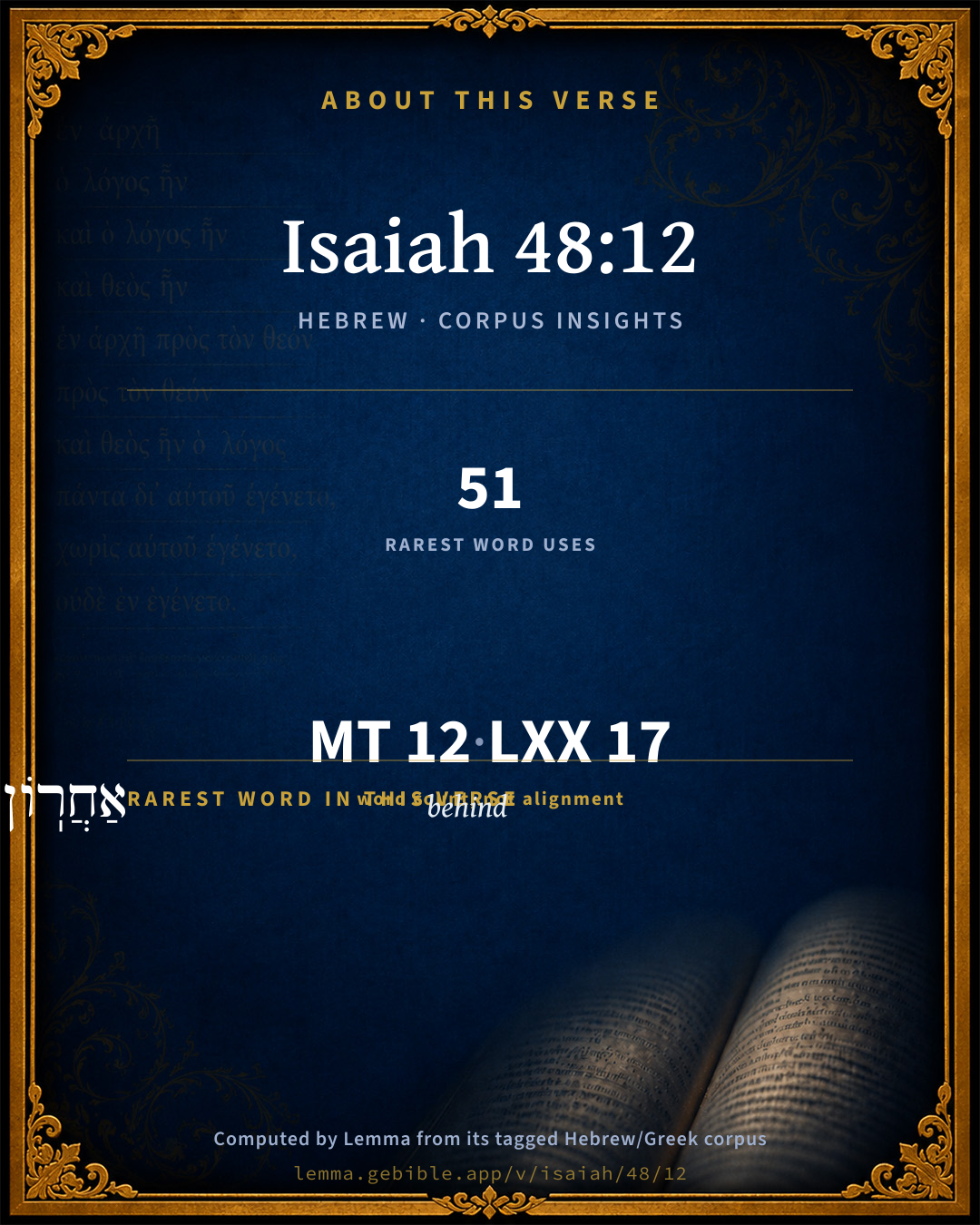
אַחֲרֽוֹן behind H314 occurs in 48 verses of the Hebrew Bible. Also found in:

Grammatical profile

  • 2 verbs
  • 2 nouns
  • 2 adjectives
  • 4 pronouns
  • 1 preposition
  • 1 particle

Verb forms

  • שְׁמַ֤ע Qal · Imperative
  • מְקֹרָאִ֑י Pual · Participle Passive

Repetition

A word recurs within this verse — often emphatic in Hebrew:

  • אֲנִי I H589 ×3

Hebrew & Septuagint length

In English translation the verse runs 21 words from the Hebrew and 18 from the Septuagint (LXX English) — closely comparable.

A rough comparison of the two English renderings, which tokenize alike — not a word-level alignment.

Word counts can differ between the Hebrew and the Greek without any difference in meaning — e.g. the Hebrew direct-object marker אֵת has no separate Greek word, and Greek often adds the article ὁ.

In the original languages it is 12 Hebrew tokens and 17 Greek tokens — but the two are counted differently (Hebrew bundles its prefixes and suffixes into one token; the Greek is in lemma form), so that isn’t a like-for-like length.

Cross-references

24

Topical passages linked to Isaiah 48:12 in the Treasury of Scripture Knowledge — connected by theme and wording, ordered by reader-vote popularity; previews shown in the World English Bible.

  • Isaiah 41:4 Who has worked and done it, calling the generations from the beginning? I, Yahweh, the first, and with the last, I am he.
  • Revelation 1:8 "I am the Alpha and the Omega," says the Lord God, "who is and who was and who is to come, the Almighty."
  • Revelation 22:13 I am the Alpha and the Omega, the First and the Last, the Beginning and the End.
  • Isaiah 44:6 Thus says Yahweh, the King of Israel, and his Redeemer, Yahweh of Hosts: I am the first, and I am the last; and besides me there is no God.
  • Romans 8:28 We know that all things work together for good for those who love God, to those who are called according to his purpose.
  • Revelation 17:14 These will war against the Lamb, and the Lamb will overcome them, for he is Lord of lords, and King of kings. They also will overcome who are with him, called and chosen and faithful."
  • Isaiah 43:11 I, even I, am Yahweh; and besides me there is no savior.
  • Isaiah 55:3 Turn your ear, and come to me; hear, and your soul shall live: and I will make an everlasting covenant with you, even the sure mercies of David.
  • 1 Peter 2:9 But you are a chosen race, a royal priesthood, a holy nation, a people for God's own possession, that you may show forth the excellencies of him who called you out of darkness into his marvelous light:
  • Revelation 2:8 "To the angel of the assembly in Smyrna write: "The first and the last, who was dead, and has come to life says these things:
  • Deuteronomy 32:39 See now that I, even I, am he, There is no god with me: I kill, and I make alive; I wound, and I heal; There is none who can deliver out of my hand.
  • Isaiah 46:3 Listen to me, house of Jacob, and all the remnant of the house of Israel, that have been borne [by me] from their birth, that have been carried from the womb;
  • Isaiah 49:1 Listen, isles, to me; and listen, you peoples, from far: Yahweh has called me from the womb; from the bowels of my mother has he made mention of my name:
  • Revelation 1:17–18 When I saw him, I fell at his feet like a dead man. He laid his right hand on me, saying, "Don't be afraid. I am the first and the last,
  • Proverbs 7:24 Now therefore, sons, listen to me. Pay attention to the words of my mouth.
  • Proverbs 8:32 "Now therefore, my sons, listen to me, For blessed are those who keep my ways.
  • Isaiah 34:1 Come near, you nations, to hear; and listen, you peoples: let the earth hear, and the fullness of it; the world, and all things that come forth from it.
  • Isaiah 51:1 Listen to me, you who follow after righteousness, you who seek Yahweh: look to the rock whence you were hewn, and to the hold of the pit whence you were dug.
  • Isaiah 51:4 Attend to me, my people; and give ear to me, my nation: for a law shall go forth from me, and I will establish my justice for a light of the peoples.
  • Isaiah 51:7 Listen to me, you who know righteousness, the people in whose heart is my law; don't you fear the reproach of men, neither be you dismayed at their insults.
  • Matthew 20:16 So the last will be first, and the first last. For many are called, but few are chosen."
  • Romans 1:6 among whom you are also called to belong to Jesus Christ;
  • 1 Corinthians 1:24 but to those who are called, both Jews and Greeks, Christ is the power of God and the wisdom of God.
  • Revelation 1:11 saying, "What you see, write in a book and send to the seven assemblies: to Ephesus, Smyrna, Pergamum, Thyatira, Sardis, Philadelphia, and to Laodicea."

Cross-references courtesy of OpenBible.info (CC BY 4.0).

Hebrew and Greek witnesses Masoretic Hebrew ↔ Greek Septuagint

The same verse in the two great witnesses to the Old Testament, shown verse-for-verse.

These are two independent witnesses, not word-aligned to each other, and the Septuagint is shown in lemma (dictionary) form.

Hebrew Isaiah 48:12 Masoretic · Westminster Leningrad Codex

שְׁמַ֤ע אֵלַי֙ יַֽעֲקֹ֔ב וְיִשְׂרָאֵ֖ל מְקֹרָאִ֑י אֲנִי הוּא֙ אֲנִ֣י רִאשׁ֔וֹן אַ֖ף אֲנִ֥י אַחֲרֽוֹן

Listen to me, O Jacob, and Israel my called: I am he; I am the first, I also am the last.

World English Bible · Public Domain

Greek LXX Isaiah 48:12 Septuagint · lemma form

ἀκούω ἐγώ ἰακώβ καί ἰσραήλ ὅς ἐγώ καλέω ἐγώ εἰμί πρῶτος καί ἐγώ εἰμί εἰς ὁ αἰών

Hear me, O Jacob, and Israel whom I call; I am the first, and I endure for ever.

LXX2012 (modern English Septuagint) · Public Domain

On this verse, Keil & Delitzsch discusses the Septuagint’s reading. Read the note in Commentary ↓

Hebrew: Westminster Leningrad Codex (CC BY 4.0). Greek: Septuagint (public domain); English from LXX2012 (modern English Septuagint) (Public Domain). How the Septuagint differs from the Hebrew →

Targum (Aramaic paraphrase)

1

The Targum is the ancient Jewish Aramaic paraphrase of the Hebrew Scriptures — an interpretive translation, not the Hebrew text itself. Onkelos (literal) and Pseudo-Jonathan (expansive) render the Torah, and Jonathan the Prophets. Coverage is partial: where no permissively-licensed English translation exists for a verse, only the Aramaic is shown. This is verse-level text, not a word-by-word alignment to the Hebrew.

  1. Targum Jonathan Prophets (Joshua–Malachi)
    קַבִּילוּ לְמֵימְרִי דְבֵית יַעֲקֹב וְיִשְׂרָאֵל מְזַמְנָא אֲנָא הוּא אֲנָא הוּא דְמִלְקָדְמִין אַף עַלְמֵי עַלְמַיָא דִילִי אִינוּן וּבַר מִנִי לֵית אֱלָהָא:

    Hearken unto my WORD, ye who are of the house of Jacob and Israel, my called, I am He, who was of old, yea, ages after ages are mine, and besides me there is no God.

    Targum Jonathan — Aramaic: “Mikraot Gedolot” (public domain). English: “Sefaria Community Translation” (CC0 1.0 (public-domain dedication)); “London "Chaldee Paraphrase," 1871” (public domain). Text via Sefaria.

Commentary

Notes on Isaiah 48:12 from classic Christian and Jewish commentators (each source and its license shown beneath its notes). The classic Christian expositions comment on the surrounding passage and are grouped to its opening verse, so a note may address several verses; the Jewish commentaries on the Tanakh (Rashi and others) are per-verse, so they appear only where the commentator wrote on this verse.

Lemma curates 59 commentaries, every one of them public domain or Creative Commons licensed, each selected and text-cleaned for this edition rather than reprinted as found. About our sources →

Trapp's Complete Commentary

John Trapp

Isa 48:12 Hearken unto me, O Jacob and Israel, my called; I [am] he; I [am] the first, I also [am] the last.

Ver. 12. I am he.] Heb., Hu; this the Rabbis make to be one of the names of God. Sanchez here observeth, that by this threefold "I" is meant the holy Trinity: the deity of Jesus Christ is rightly proved from this text, compared with Rev 1:11; Rev 22:13.

John Trapp, A Commentary or Exposition upon All the Books of the Old and New Testament (1647–1656) — public domain. Text from a community e-Sword module.

The Biblical Illustrator

Joseph S. Exell

Isa_48:12

Hearken unto Me, O Jacob

Gods unchangeableness throughout eternity

The eternity and immutability of God are in their own nature inseparable, and are so generally united in the Holy Scriptures that the passages which declare the one declare or imply the other also.

I. GOD IS ETERNAL.

1. Reason itself claims this attribute for God. Nor was it unknown even to the heathens. Proclus, a follower of Plato, proved God to be eternal, because He exists of Himself. Thales defined God to be a being without beginning and end; before all things; and who was never born.

2. What reason teaches, the Scriptures assert. They represent Gods eternity to be--

(1) An eternity of duration.

(2) An eternity of perfection.

From everlasting to everlasting, Thou art God! All that is involved in that great name He always was, and always will be!

II. GOD IS UNCHANGEABLE, eternally unchangeable.

1. Unchangeableness is an essential perfection of God.

(1) In His existence He cannot cease to be (Psa_102:27).

(2) In His nature or essence.

(3) In His purposes (Isa_46:10; Isa_14:24).

(4) In His promises to His people; in His threatenings against the wicked; and in all His predictions (Num_23:19).

2. All these declarations are in harmony with the teachings of Scripture and the conclusions of reason.

(1) Scripture (Mal_3:6; Psa_33:11; Isa_46:10;Jam_1:17).

(2) Reason. As God is self-existent, caused by none, He can be changed by none. As He is infinite in all His perfections, He cannot change, for nothing can be added to or taken from the infinite--any change would make Him less than infinite before or after. The unchangeableness of God is confirmed--

(a) By the stability of His natural government.

(b) By His moral government, and the identity of the several dispensations of grace.

III. PRACTICAL LESSONS WHICH THIS GREAT SUBJECT TEACHES.

1. It assures us of the essential Divinity of the Christ. The application to our Lord of the terms here used by God to describe Himself, places His Deity beyond doubt (Rev_1:8; Rev_1:17; Rev_22:13).

2. It assures us of the fulfilment of God s promises and the accomplishment of His plans.

3. It affords strong consolation amid all the trying changes of this mortal state.

4. It should stimulate us to seek stability of character (Heb_13:8-9).

5. It should alarm the impenitent. (A. Tucker.)

God s eternity a ground of confidence

Who can be too quick for Him that is the first, or prevent Him? Who can be too hard for Him that is the last, and will keep the field against all opposers, and will reign till they are all made His footstool? (M. Henry.)

The Biblical Illustrator, edited by Joseph S. Exell (c. 1880s–1900s) — public domain. Text from a community e-Sword module.

Joseph Benson's Commentary

Isa 48:12-13. Hearken unto me, Israel, my called — Whom I have called out of the world to be my peculiar people, to serve, and glorify, and enjoy me; and therefore you, of all others, have least cause to forsake me, or to follow after idols. My right hand hath spanned, or doth span, the heavens — Or, hath meted them out with a span, as the phrase is, Isa 40:12; hath stretched them out by an exact measure, as the workman sometimes metes out his work by spans. See also the margin. When I call them, they stand up together — “Nothing can give us a more sublime idea of God than this passage. The idea is taken from servants, who, at the voice of their masters, instantly rise up, and stand ready to execute their commands. The whole creation, at the call of God, arises with prompt obedience, and is ready to execute his sovereign will.” — Dodd.

Joseph Benson's Commentary on the Old and New Testaments (1811–1818) — public domain. Text from a community e-Sword module.

The Preacher's Complete Homiletical Commentary

Joseph S. Exell (gen. ed.)

GOD’S UNCHANGEABLENESS THROUGHOUT ETERNITY

Isa_48:12. I am He; I am the first, I also am the last

Having called on the Jews in Babylon to attend to what He was now about to say by His servant the Prophet, God begins by asserting that He is the same, the true and only God, who existed before all things, and therefore was able to accomplish all His purposes and promises of deliverance. The text introduces us to a subject of tremendous import—God’s unchangeableness throughout eternity. “The eternity and immutability of God are in their own nature inseparable, and are so generally united in the Holy Scriptures, that the passages which declare the one, declare or imply the other also.”

I. GOD IS ETERNAL.

1. Reason itself claims this attribute for God. Nor was it unknown even to the heathens. Proclus, a follower of Plato, proved God to be eternal, because He exists of Himself. Thales defined God to be a being that is without beginning and end; before all things; and who was never born (H. E. I. 2253; P. D. 1492, 2536).

2. What reason teaches, the Scriptures assert. They represent God’s eternity to be—

(1.) An eternity of duration, “I am He; I am the first, I also am the last” (Psa_90:2). Not merely everlasting, but eternal! He had no beginning, even as He shall have no end. This is the difference between the eternity of God and that of the angels and of “the spirits of just men made perfect.” They are, by the will of God, never to end; but, by His will also, they came into being. But to His being there was no beginning!

(2.) An eternity of perfection. There has been in Him no development of excellence, as in Him there will be no diminution of it. “From everlasting to everlasting, Thou art GOD!” All that is involved in that great name He always was, and always will be! (See pp. 187, 188, and outlines on Isa_57:15).

II. GOD IS UNCHANGEABLE—eternally unchangeable. “I am He,”—the same yesterday, to-day, and for ever.

1. Unchangeableness is an essential perfection of God. If He were subject to “variableness or the shadow of turning,” He would not be a perfect and eternal being, &c. When, therefore, it is said that God repents or alters His purpose, it must not be supposed that His nature changes, but that the Holy Spirit accommodates His language to the general comprehensions of men, &c. (H. E. I. 2254–2256). He continues always the same—

(1.) In His existence He cannot cease to be (Psa_102:27).

(2.) In His nature or essence—He cannot cease to be what He is in every perfection.

(3.) In His purposes (Isa_46:10; Isa_14:24).

(4.) In His promises to His people; in His threatening against the wicked; and in all His predictions (Num_23:19).

2. All these declarations are in harmony with the teachings of Scripture and the conclusions of Reason.

(1.) Scripture (Mal_3:6; Psa_33:11; Isa_44:10; Jas_1:17), &c.

(2.) Reason. As God is self-existent—caused by none, so He can be changed by none. As He preceded all and caused all, so His sovereign will determined the relations which all things are permitted to sustain to Him. As He is infinite in duration, He cannot know succession or change. As He is infinite in all perfection of knowledge, &c., therefore He cannot change; for nothing can be added to or taken from the infinite—any change would make Him less than infinite before or after.

The unchangeableness of God is confirmed

(1.) by the stability of His natural government;

(2.) by His moral government and the identity of the several dispensations of grace. But it does not exclude the exercise of dispositions and affections, nor involve a stoical indifference to the welfare of His creatures generally, or the character which may be assumed by moral agents. Nor does it involve uniformity of action or relation, much less fatalism, &c. (H. E. I. 3750–3753).

III. SOME PRACTICAL LESSONS WHICH THIS GREAT SUBJECT TEACHES.

1. It assures us of the essential Divinity of the Christ. The application to our Lord Jesus Christ of the terms here used by God to describe Himself, places His Deity beyond doubt (Rev_1:8; Rev_1:17; Rev_22:13; and many other passages which express or imply eternity). Hold fast the vital fact of our Lord’s Divinity. That gone, all is gone. “A divine Christ is the central sun of Christianity; quench it, and all is confusion, worse confounded.” Rev_1:8 did more than any other passage towards preventing Dr. Doddridge from assenting to the Socinian theory, which reduces our Lord to a deified creature.

2. It assures us of the fulfilment of God’s promises, and the accomplishment of His plans. (Jer_10:10; Dan_4:34; Isa_60:19; 2Pe_3:8-9).

3. It affords “strong consolation” amid all the trying changes of this mortal state. To this eternal and unchanging God we may commit ourselves with unwavering confidence, assured that He is both able and willing to sustain, &c.

4. It should stimulate us to seek stability of character. (Eph_5:1; Psa_77:7; Psa_108:1). How reasonable and weighty is the admonition which follows the declaration of our Saviour’s unchangeableness in Heb_13:9.

5. It should alarm the impenitent. What folly and audacity is there in rebellion against God, since an eternal being is offended thereby! How dreadful to lie under the displeasure of an eternal God! (Jer_10:10.) We are charged by this glorious Being with a message of reconciliation to you (2Co_5:18-21).—Alfred Tucker.

The Preacher's Complete Homiletical Commentary (gen. ed. Joseph S. Exell; Funk & Wagnalls, c. 1892) — public domain (pre-1929). A full-Bible homiletical/sermon-outline anthology covering 65 of 66 books (2 John is absent from the source module). Text from a community e-Sword module.

Lange's Commentary on the Holy Scriptures

3.THE CONTENTS OF THE NEW THINGS IS REPEATED

Isa_48:12-15

12          Hearken unto me, O Jacob

And Israel, my called;

I am he; I am the first, I also am the last.

13     Mine hand also hath laid the foundation of the earth,

And 8my right hand hath spanned the heavens:

When I call unto them, they stand up together.

14     All ye, assemble yourselves, and hear;

Which among them hath declared these things?

The Lord hath loved him: he will do his pleasure on Babylon,

And his arm shall be on the Chaldeans.

15      I, even I, have spoken; yea, I have called him:

I have brought him, and he shall make his way prosperous.

TEXTUAL AND GRAMMATICAL

On Isa_48:14. Expositors have made difficulty about construing זְרֹעוֹ as accusative, because “to perform Jehovah’s or His own arm “is an incomprehensible mode of speech even taken as zeugmatic (Delitzsch), Klostermann, too, (l. c., pp. 7,19) is of the opinion that to translate “He will accomplish his will on Babylon and his punitive work on the Chaldeans” needs a dispensation from Hebrew usus loquendi. זְרוֹעַ does, indeed, not mean “punitive work,” and this is not an instance of mere zeugma, but zeugma and metonymy. It is surely one of the most usual metonymical forms of expression in the Old Testament to put the arm for what is manifested by the arm, i.e., for the power or the might. Comp. Isa_33:2; Jer_17:5; Eze_31:17; Psa_83:9, etc Moreover Isa_44:12 proves that the Prophet conceives of the arm, as also in Isa_45:9 of the hand, as the seat of power. Might not our passage read: יַעֲֽשֶׂה בְּבָבֶל וּנְבוּרָתוֹ כַּשְׂדִּים (or כֹּחוֹ ,חֵילוֹ) חֶפְצוֹ? For one may very well say עָשָׂה נְכוּרָה for “to display strength, power” (1Ki_16:27). Accordingly, if taken strictly, one need not even assume a zeugma, if the slight difference be not urged that exists between עשׂה in עָשָׂה חֵפֵץ and עשׂה in עָשָׂה נְבוּרָה.—There can be no doubt that the prefix בּ should be repeated before כַּשְׂדִּים.

EXEGETICAL AND CRITICAL

1. Hearken unto me——up together, Isa_48:12-13. The verses of this section are almost wholly a compilation of the chief elements of chapts. 40–47. The words שׁמע as far as מקראי are only a solemn introductory formula, containing an emphatic summons to give attention, in order to intimate the importance of the subject. Comp. Isa_48:1; Isa_44:1; Isa_46:3.—מְקֹרָא, “the called,” as regards the word, occurs only here; but as regards the sense it is essentially one with what we read Isa_41:9; Isa_43:1. A double calling is spoken of here: Of the ancient and original one which Israel received in the person of its ancestor (Isa_41:9), and of the future one when the Lord calls back His people from the Exile (Isa_43:1; comp. Isa_48:5 sqq.; Isa_44:22). Thus Israel is named מְקֹרָא as the doubly called people. In what follows the Prophet calls to mind first those fundamental facts that are a guaranty that Jehovah can foretell and fulfil the deliverance by Cyrus. They are 1) His absoluteness and uniqueness. As such He is הוּא, the He par excellence, the absolute subject. As such the Prophet has already named Him, Isa_43:10; Isa_43:13; Isa_43:25; Isa_41:4; Isa_46:4. 2) His eternity, by virtue of which He is the first and the last. He has already been so called Isa_41:4; Isa_44:6; comp. Isa_43:13. 3) The creation of heaven and earth, which also has been spoken of in what precedes, in the same sense, viz. that He who created the world can also foretell and fulfil Israel’s deliverance: Isa_40:12 sqq., Isa_40:22; Isa_40:26; Isa_40:28; Isa_42:5; Isa_44:24; Isa_45:12; Isa_45:18.

2. All ye, assemble——his way prosperous, Isa_48:14-15. The words הקבצו as far as אֵלֶּה(“All ye assemble——these things”) represent here all those passages in which the Prophet has variously uttered the thought, that Jehovah, the Creator of heaven and earth, has challenged all idols to a contest in prophesying in order, by exposing their impotency, to prove their nothingness and His divinity. The passages are Isa_41:1 sqq., Isa_41:21 sqq., Isa_41:26 sqq.; Isa_43:9; Isa_44:7 sqq., Isa_44:24 sqq.; Isa_45:20 sqq.; Isa_46:9 sqq. Especially our passage recalls Isa_43:9 and Isa_45:20. In Isa_43:9 the interrogatory clause occurs almost verbatim, except the Niph. of קבץ. For there it reads מִי בָהֶם יַגִּיד זֹאת. In Isa_45:20, as here, the first word is הקבצו. It is self-evident that בָּהֶם in our passage, as in Isa_43:9, is to be referred to the idols, as that אֵלֶּה refers to the things concerning Cyrus. This appears from what immediately follows. For there again we have a collective citation, if I may so express myself. For there all that has been previously said of Cyrus is recalled by the brief words, Isa_48:14 b, 15, that emphasize the chief particulars. Jehovah hath loved him is said first. It is true this statement has not occurred literally before; but it has as to sense. For that the Lord loves Cyrus underlies all those passages that speak of him; Isa_41:2 sq., 25; Isa_44:28; Isa_45:1-7; Isa_45:13 sq.; Isa_46:11. Moreover the words: He will do His pleasure on Babylon, and His arm on the Chaldeans, though not literally, occur as to sense in what precedes (comp. Isa_41:25; Isa_43:14; Isa_44:28, where, moreover, the words כֹּל חֶפְצִי יַשְׁלִים occur; Isa_45:1 sqq.; Isa_46:1 sq., Isa_46:10; Isaiah 47 entire).—In Isa_48:15 the Lord Himself speaks, confirming the word of His Prophet. He, the Lord, has foretold that which concerns Cyrus (Isa_45:21); He called him (Isa_45:4), He brings him on, taking him by the hand (Isa_45:1), and sees to it that he completes his way (Isa_41:3).

Footnotes:

[8]Or, the palm of my right hand hath spread, out.

Lange's Commentary on the Holy Scriptures (Critical, Doctrinal, and Homiletical), ed. John Peter Lange, English translation edited by Philip Schaff (1864–1880) — public domain. Text from a community e-Sword module.

Tyndale Open Study Notes

Tyndale Open Resources

48:12-22 This final trial speech reviews the arguments of chs 40–48 and announces the final conclusion.

Tyndale Open Study Notes — © Tyndale Open Resources, licensed CC BY-SA 4.0. Text via the HelloAO Bible API.

Geneva Bible (1599)

Geneva Bible translators

Read Isa. 41:4.

Geneva Bible (1599) marginal notes — public domain. Text via Bolls.life.

Jamieson, Fausset & Brown

Robert Jamieson, A. R. Fausset & David Brown

The Almighty, who has founded heaven and earth, can, and will, restore His people.

the first . . . last-- (Isa 41:4; Isa 44:6).

Jamieson, Fausset & Brown — Commentary Critical and Explanatory on the Whole Bible (1871) — public domain (CC PDM 1.0). Text via the HelloAO Bible API.

Adam Clarke's Commentary

Verse 12. O Jacob - "O Jacob, my servant"] After יעקב yaakob, a MS. of Kennicott's, two of De Rossi's, and the two old editions of 1486 and 1488, add the word עבדי abdi, "my servant," which is lost out of the present text; and there is a rasure in its place in another ancient MS. The Jerusalem Talmud has the same word.

I also am the last - "I am the last"] For אף אני aph ani, "even I," two ancient MSS. and the ancient Versions, read ואני veani, "and I;" more properly.

Adam Clarke's Commentary on the Bible (1810–1826) — public domain. Text from a community e-Sword/MySword module.

Ellicott's Commentary for English Readers

(12) Hearken unto me, O Jacob.—The prophet is drawing near to the end of the first great section of his book, and his conclusion takes the form of a condensed epitome of the great argument of Isaiah 40-47, asserting the oneness, the eternity, the omnipotence, the omniscience of Jehovah.

A Bible Commentary for English Readers, edited by Charles John Ellicott (1878–1897) — public domain. Text from a community e-Sword module.

The Cambridge Bible for Schools and Colleges

gen. ed. J. J. S. Perowne

12. I am he] see on ch. Isa_41:4. I am the first … the last] Isa_44:6.

12–16. The substance of the “new things” (Isa_48:6) is that Jehovah has called Cyrus to execute His pleasure on the Chaldæans (14 f.), and now openly announces His purpose beforehand (16).

The Cambridge Bible for Schools and Colleges (gen. ed. J. J. S. Perowne; Cambridge University Press, 1878–1918) — public domain. Text from a community e-Sword module.

John Gill's Exposition

Hearken unto me, O Jacob and Israel, my called,.... Called before out of Egypt, and now out of Babylon, and who had the name of God called upon them, and who called upon the name of the Lord; so such who are called with a holy calling, according to the purpose and grace of God, by the Spirit and grace of Christ, unto fellowship with him, to partake of his grace here, and glory hereafter, are styled "the called of Jesus Christ", Rom 1:6 and who seems to be the person here speaking, as appears from the following clause: and it may be observed, that Jacob and Israel are described here in a different manner from what they are in the beginning of the chapter, since the Lord had declared his designs of grace towards them, and that he had chosen them, and would save them for his name's sake: which they had reason to believe he could and would do, from the account which he gives of himself: and they are called upon to hearken to him, as follows,

I am he, I am the first, and I also am the last; the everlasting I AM, the immutable Jehovah, the Alpha and Omega, the beginning and the ending, the first cause and last end of all things; phrases expressive of the self-existence, supremacy, eternity, and immutability of Christ, Rev 1:8, and what is it that such a sovereign, eternal and unchangeable Being cannot do?

John Gill's Exposition of the Whole Bible (1746–1763) — public domain (CC PDM 1.0). Text via the HelloAO Bible API.

Albert Barnes' Notes on the Bible

Hearken unto me - This is a solemn call on the Jews in Babylon to attend to what he was now about to say. It is the commencement of a new part of the argument, containing the assurance that he would deliver them, and utterly destroy the Chaldeans. He begins, therefore, by asserting that he is the only true God, and that he is able to accomplish all his purposes.

My called - The people whom I have chosen, or called.

I am he - I am the same; or I am the true and only God.

I am the first - (See the notes at Isa 41:4; Isa 44:6).

Albert Barnes' Notes on the Bible (1834–1885) — public domain. Text from a community e-Sword/MySword module.

Matthew Poole's English Annotations

Israel my called; whom I have called out of the world to be my peculiar people, to serve, and glorify, and enjoy me; and therefore you of all others have least cause to forsake me, or to follow after idols.

Matthew Poole's English Annotations on the Holy Bible (1683–1685) — public domain. Text from a community e-Sword/MySword module.

Whedon's Commentary on the Bible

Daniel D. Whedon

12, 13. Hearken unto me — Renewal of the consolation. The second and brighter part of the message begins here. The chief elements compiled from chapters xl to xlvii, are brought together in these verses, and addressed to Israel with emphasis.

My called — The double-called: from Chaldean Abram, first; the spiritual offspring from Abraham, next. The promise is re-settled by the oath several times before stated in terms. See Isa_41:4; Isa_42:8; Isa_43:11, etc.

Mine hand… laid the foundation — The prophet urgently impresses on the people God’s eternity, omniscience, and omnipotence, as evidence the highest possible that what he predicts or announces through his prophet is entitled to confidence. The oath can be made by none higher. The greater includes the less. Ability to create certainly implies the lesser ability to foretell. No words can characterize the absurdity and stupidity of doubting divine predictions.

Daniel D. Whedon (gen. ed.), Commentary on the Old and New Testaments (1874–1909) — public domain. Text from a community e-Sword module.

The Pulpit Commentary

Vers. 12-15. THE SECOND ADDRESS. The tone of complaint is now dropped. Israel is invited to reflect seriously on the chief points urged in the preceding chapters.

(1) Their near relation to Jehovah (ver. 12);

(2) Jehovah"s eternity and omnipotence (vers. 12, 13);

(3) the superiority of Jehovah to the gods of the nations, as shown by his prophetic power (ver. 14); and

(4) the near approach of deliverance by Cyrus (vers. 14, 15).

O Jacob and Israel. (comp. Isa_40:27 Isa_41:8, 14 43:1, 22 44:1, 21 46:3 48:1) The figure is used which rhetoricians call hendiadys. The two names designate one and the same object. My called . "Called" and "chosen" from of old, out of all the nations of the earth; (Isa_41:9 Isa_44:1, Isa_44:2, etc.) therefore bound to hear" and to attend. Still more bound, considering who it is by whom they have been called I AM HEi.e. "I am the absolute and eternally unchangeable One, the Alpha and Omega of all history" (Delitzsch). The first, and also the Last, from whom and to whom are all things". (Rom_11:36)

God the First and the Last.

It is readily intelligible, though not by finite minds conceivable, that "God is the First." Something must have existed from all eternity, or nothing could ever have existed. The first existence must either have been matter or spirit, or both. But it could not have been matter alone, since matter could never have produced spirit; and it was not matter and spirit, since the "things that are seen were not made of things that do appear". (Heb_11:3) It was therefore spirit alone; and that primeval Spirit which existed apart from matter, and apart from any created spirit, was God. Thus "God is the First the First Cause before all things the Origin of all things of heaven and earth, and of all things, both visible and invisible." But how is he "the Last"? Eternal life is promised to all created beings who do not fall from their first sinless estate, and also to all who, having fallen, repent and amend, turning to God, and putting their whole trust in the atonement of Christ. They will live on eternally in his eternal glory. Actually, then, God will not ever be in the future a single solitary Being, as he once was, but will always be a King and Governor of innumerable hosts of happy spirits, created by himself. Actually he will never be "the Last." But potentially he is "the Last." He could, if he so pleased, destroy with a word all that he has ever created, and be once more alone, without a second. And further, all things are "to him" and "for him they exist for his sake; he is their Aim and Object; their sole, final telov .

Vers. 12-22. The new revelation.

The verses contain a summary of the contents of Isaiah 40-47. God is the First and the Last the sole Creator. Prophecy is an evidence of his claims; and so is the mission of Cyrus.

I THE REVELATION CONCERNING GOD. First Jacob and Israel, the chosen people, are called to listen. Jehovah is the Alpha and the Omega of the universe. The First Cause and Reason of things; he gave the first impulse to their course, the goal of which will still be himself. Before the earth and the heavens were, his was the creative hand, guided by the creative mind. Then the idolatrous nations are summoned to assemble, and challenged to produce a power of prophecy to rival that of Jehovah.

II CONCERNING CYRUS. "He whom Jehovah hath loved," to whom he hath spoken, whom he hath called, shall have a prosperous career, performing the Divine pleasure on Babylon and on Chaldea. In ver. 20 the prophet sees the destruction of Babylon as an accomplished fact. Thence let a ringing cry go forth to the end of the earth! Jehovah hath redeemed the people! Already they have drunk of the refreshing waters in the desert. And that peace, which is the sum of all blessings, and which can never be the portion of the ungodly, is theirs.

III APPEAL TO CONSCIENCE AND EXPERIENCE. Let the chosen people draw neat. and commune with their God. From the first he has spoken to them, not in dark and ambiguous oracles, but in words of clearness and unmistakable purport. And now he is to speak again by the mouth of his present servant, and to crown his revelations by the greatest of them all. And what of Israel? Doubly tender is the reproach and the expostulation. Why have the people not walked in the straight way in which he would have led them? He is their "Teacher to their profit;" why have they chosen what is unprofitable? and followed after the "not profitable" gods? (Jer_2:11; cf. Mic_6:8 Psa_23:3) He would lead them in the straight path, but Israel has forced him, as it were, to lead them by the circuitous path of affliction. The appeal to experience turns upon this point the profitableness of godliness, which has the promise of the life that now is, and of that which is to come. "Deep down in human nature lies the idea of a covenant between the worshipper and his god. In return for external service, the god gives help and protection. The prophets, with a generous freedom, retain so much of this theory as matches with the truths revealed to them. Jehovah"s protection is still conditional, but the conditions extend to the inner as well as the outer man" (Cheyne). Obedience alone brings peace and prosperity. If men had but hearkened to God, their peace would have been as the great volume of the Euphrates, and their blessedness, reflecting the favour of Jehovah, as the multitudinous waves of the sea; its posterity as the sand of the sea, or as the fishes that swarm in its waters. Its name would have been imperishable. It is, then, the "hearing ear" and the "perceiving heart" which above all are needed as conditions of true temporal and spiritual well-being. To hear so as to be pricked in heart; to hear so as to follow and prosecute the things we hear; this alone is to hear in the Scripture sense.

And here we are reminded of the need of the Holy Spirit"s influence, without which we may see and never perceive, and hear and never understand. There must be an aptness between the object and the faculty. Things sensible must be known by sense; things mental by the mind; and things spiritual by some principle infused into the soul from above. "Two sit together and hear the same sermon. One finds a hidden spiritual virtue in the Word, by which he lives and grows and thrives. Another finds no such virtue in it; perhaps it pleases his reason, and there is an end. This proceeds from the want of the spiritual, perceiving heart. Why is it that a man is so affected with music that all his passions are moved by it, while brutes are not at all pleased? Because there is in man a principle of reason concurring with his sense, which discovers the sweetness and harmony of the sounds that bare sense is not able to discern." And so of the things of God. Open thou mine eyes and mine ears; let my noblest faculties be ever in communion with the noblest, my spiritual nature be awakened by the Spirit, and again respond to his influence! this should be our prayer. We will hearken unto and obey him who hath the words of eternal life: this should be our resolve. J.

The Pulpit Commentary (1880–1919), ed. H.D.M. Spence-Jones & Joseph S. Exell — public domain. Text from a community e-Sword module.

John Wesley's Explanatory Notes

O Israel - Whom I have called out of the world to be my peculiar people.

John Wesley, Explanatory Notes Upon the Whole Bible (1754–1765) — public domain. Text via the GEBible commentary corpus.

Keil & Delitzsch

C. F. Keil & F. Delitzsch

The prophecy opened with "Hear ye;" and now the second half commences with "Hear." Three times is the appeal made to Israel: Hear ye; Jehovah alone is God, Creator, shaper of history, God of prophecy and of fulfilment. "Hearken to me, O Jacob, and Israel my called! I am it, I first, also I last. My hand also hath laid the foundation of the earth, and my right hand hath spanned the heavens: I call to them, and they stand there together. All ye, assemble yourselves, and hear: Who among them hath proclaimed this? He whom Jehovah loveth will accomplish his will upon Babel, and his arm upon the Chaldeans. I, I have spoken, have also called him, have brought him here, and his way prospers. Come ye near to me! Hear ye this! I have not spoken in secret, from the beginning: from the time that it takes place, there am I: and now the Lord Jehovah hath sent me and His Spirit." Israel is to hearken to the call of Jehovah. The obligation to this exists, on the one hand, in the fact that it is the nation called to be the servant of Jehovah (Isa 41:9), the people of sacred history; and on the other hand, in the fact that Jehovah is הוּא (ever since Deu 32:39, the fundamental clause of the Old Testament credo), i.e., the absolute and eternally unchangeable One, the Alpha and Omega of all history, more especially of that of Israel, the Creator of the earth and heavens (tippach, like nâtâh elsewhere, equivalent to the Syriac tephach, to spread out), at whose almighty call they stand ready to obey, with all the beings they contain. אני קרא is virtually a conditional sentence (Ewald, 357, b). So far everything has explained the reason for the exhortation to listen to Jehovah. A further reason is now given, by His summoning the members of His nation to assemble together, to hear His own self-attestation, and to confirm it: Who among them (the gods of the heathen) has proclaimed this, or anything of the kind? That which no one but Jehovah has ever predicted follows immediately, in the form of an independent sentence, the subject of which is אהבו יהוה (cf., Isa 41:24): He whom Jehovah loveth will accomplish his will upon Babylon, and his arm (accomplish it) upon the Chaldeans. וּזרעו is not an accusative (as Hitzig, Ewald, Stier, and others maintain); for the expression "accomplish his arm" (? Jehovah's or his own) is a phrase that is quite unintelligible, even if taken as zeugmatic; it is rather the nominative of the subject, whilst כּשׂדּים = בּכּשׂדּים, like תהלתי = תהלתי למען in Isa 48:9. Jehovah, He alone, is He who has proclaimed such things; He also has raised up in Cyrus the predicted conqueror of Babylon. The prosperity of his career is Jehovah's work.

As certainly now as הקּבצוּ in Isa 48:14 is the word of Jehovah, so certain is it that אלי קרבוּ is the same. He summons to Himself the members of His nation, that they may hear still further His own testimony concerning Himself. From the beginning He has not spoken in secret (see Isa 45:19); but from the time that all which now lies before their eyes - namely, the victorious career of Cyrus - has unfolded itself, He has been there, or has been by (shâm, there, as in Pro 8:27), to regulate what was coming to pass, and to cause it to result in the redemption of Israel. Hofmann gives a different explanation, viz.: "I have not spoken in secret from the beginning; not from the time when it came to pass (not then for the first time, but long before); I was then (when it occurred)." But the arrangement of the words is opposed to this continued force of the לא, and the accents are opposed to this breaking off of the אני שׁם, which affirms that, at the time when the revolution caused by Cyrus was preparing in the distance, He caused it to be publicly foretold, and thereby proclaimed Himself the present Author and Lord of what was then occurring. Up to this point Jehovah is speaking; but who is it that now proceeds to say, "And now - namely, now that the redemption of Israel is about to appear (ועתּה being here, as in many other instances, e.g., Isa 33:10, the turning-point of salvation) - now hath the Lord Jehovah sent me and His Spirit?" The majority of the commentators assume that the prophet comes forward here in his own person, behind Him whom he has introduced, and interrupts Him. But although it is perfectly true, that in all prophecy, from Deuteronomy onwards, words of Jehovah through the prophet and words of the prophet of Jehovah alternate in constant, and often harsh transitions, and that our prophet has this mark of divine inspiration in common with all the other prophets (cf., Isa 62:5-6), it must also be borne in mind, that hitherto he has not spoken once objectively of himself, except quite indirectly (vid., Isa 40:6; Isa 44:26), to say nothing of actually coming forward in his own person. Whether this takes place further on, more especially in Isa 61:1-11, we will leave for the present; but here, since the prophet has not spoken in his own person before, whereas, on the other hand, these words are followed in Isa 49:1. by an address concerning himself from that servant of Jehovah who announces himself as the restorer of Israel and light of the Gentiles, and who cannot therefore be ether Israel as a nation or the author of these prophecies, nothing is more natural than to suppose that the words, "And now hath the Lord," etc., form a prelude to the words of the One unequalled servant of Jehovah concerning Himself which occur in chapter 49. The surprisingly mysterious way in which the words of Jehovah suddenly pass into those of His messenger, which is only comparable to Zac 2:12., Zac 4:9 (where the speaker is also not the prophet, but a divine messenger exalted above him), can only be explained in this manner. And in no other way can we explain the ועתּה, which means that, after Jehovah has prepared the way for the redemption of Israel by the raising up of Cyrus, in accordance with prophecy, and by his success in arms, He has sent him, the speaker in this case, to carry out, in a mediatorial capacity, the redemption thus prepared, and that not by force of arms, but in the power of the Spirit of God (Isa 42:1; cf., Zac 4:6). Consequently the Spirit is not spoken of here as joining in the sending (as Umbreit and Stier suppose, after Jerome and the Targum: the Septuagint is indefinite, καὶ τὸ πνεῦμα αὐτοῦ); nor do we ever find the Spirit mentioned in such co-ordination as this (see, on the other hand, Zac 7:12, per spiritum suum). The meaning is, that it is also sent, i.e., sent in and with the servant of Jehovah, who is peaking here. To convey this meaning, there was no necessity to write either ורוּחו אתי שׁלח or ואת־רוחו שׁלחוי, since the expression is just the same as that in Isa 29:7, וּמצדתהּ צביה; and the Vav may be regarded as the Vav of companionship (Mitschaft, lit., with-ship, as the Arabs call it; see at Isa 42:5).

Keil & Delitzsch — Biblical Commentary on the Old Testament (1861–1891) — public domain (CC PDM 1.0). Text via the HelloAO Bible API. (Old Testament only.)

J. A. Alexander on Isaiah

Joseph Addison Alexander

“Hearken unto me, oh Jacob, and Israel my called; I am He, I am the First, also I the last.” A renewed assurance of His ability and willingness to execute His promises, the latter being implied in the phrase ‘my called’, (i.e., specially elected by me to extraordinary privileges). The threefold repetition of the pronoun ‘I’ is supposed by some of the older writers to contain an allusion to the Trinity. ‘I am He’ is understood by the later writers to mean ‘I am the Being in question’, or, ‘it is I that am the First and the Last’. The older writers give the pronoun ‘He’ a more emphatic sense, as meaning He that really exists.

Joseph Addison Alexander, The Prophecies of Isaiah (1846–1847; New York: Scribner, 1870–1878) — public domain. Text from a community e-Sword module.

Kretzmann's Popular Commentary

Paul E. Kretzmann

An Urgent Invitation to Believe the Lord’s Word

v. 12. Hearken unto Me, O Jacob and Israel, My called, the form of address once more being in the usual cordial style used by the Lord in speaking to the people of His choice, here identical with His Church; I am He: I am the First, I also am the Last, this fundamental truth being repeated also here, where Jehovah prepares to preach salvation.

v. 13. Mine hand also hath laid the foundation of the earth, and My right hand hath spanned the heavens, stretching them out like a tent; Cf. Isa 40:28; Isa 42:5; Isa 44:24; Isa 45:12; Isa 45:18; when I call unto them, in the work of creations they stand up together, and this same power is evident in all His works.

v. 14. All ye, assemble yourselves and hear, this challenge going forth to the Lord’s adversaries, to the heathen; which among them, among those whom He here calls upon, hath declared these things? Not one of the opponents nor any of their gods could have predicted what the Lord intended to perform through Cyrus. The Lord hath loved him, and therefore chosen Cyrus to carry out His will; He, Jehovah, will do His pleasure on Babylon, and His arm shall be on the Chaldeans, to punish them.

v. 15. I, even I, have spoken, the one true God, who has just described Himself once more as the almighty and eternal Creator; yea, I have called him; I have brought him, and he shall make his way prosperous, being successful in the undertaking which Jehovah bade him perform. The Lord now once more turns directly to Israel:

v. 16. Come ye near unto Me, hear ye this. I have not spoken in secret from the beginning, revealing His will and intention concerning the mission of Cyrus very plainly, without the slightest ambiguity; from the time that it was, when He first determined upon this course, there am I, the only One able to control the destinies of individuals and nations according to His divine will. And now the Lord God and His Spirit hath sent me, that is, the salvation, the deliverance brought about by Cyrus itself, announces that it is here, ready to be performed and applied. And this salvation, which typifies the final great redemption, is now proclaimed and set before the eyes of all men, being offered in particular, however, to Israel at this time.

v. 17. Thus saith the Lord, thy Redeemer, the Holy One of Israel, the names which Jehovah has applied to Himself throughout this section: I am the Lord, thy God, which teacheth thee to profit, imparting the knowledge of that which is beneficial, truly profitable, spiritual advantages, which leadeth thee by the way that thou shouldest go, on paths of salvation, Psa 32:8.

v. 18. O that thou hadst hearkened to My commandments, willing now to be attentive; then had thy peace, the harmonious relation between the people and the God of salvation, been as a river, carrying blessings in richest measure, and thy righteousness as the waves of the sea, the salvation promised in the Lord’s covenant overwhelming His people by its greatness and power;

v. 19. thy seed also, the spiritual descendants of Israel, the believers everywhere, had been as the sand and the offspring of thy bowels like the gravel thereof, the Messianic idea of the great extent of Jehovah’s kingdom being set forth here; His name, that of Israel, should not have been cut off nor destroyed from before Me. On the basis of all this the Lord now issues an invitation to His people to accept and enjoy the redemption prepared for them:

v. 20. Go ye forth of Babylon, leaving the house of bondage, flee ye from the Chaldeans with a voice of singing, over the deliverance which they received; declare ye, tell this, utter it even to the end of the earth, the expressions being heaped to show the very height of exultant joy; say ye, The Lord hath redeemed His servant Jacob, the people thereby being received once more into the original relation toward Jehovah.

v. 21. And they thirsted not when He led them through the deserts; He caused the waters to flow out of the rock for them, Exo 17:6; He clave the rock also, and the waters gushed out, Num 20:11, the reference to these miracles of Jehovah in the wilderness being intended to emphasize the deliverance out of Babylon, in both the real and the figurative sense; for all believers are led in a similar manner, receiving the spiritual refreshment prepared by the Lord unto the salvation of their souls. Over against their happiness the unhappy condition of the Lord’s enemies stands out all the more glaringly.

v. 22. There is no peace, saith the Lord, in a solemn declaration, unto the wicked. Those who refuse to accept the salvation prepared by Him for all men will never know anything of the peace which passeth all understanding, the joyful assurance of their redemption through the merits of their Savior.

Paul E. Kretzmann, Popular Commentary of the Bible (1921–1924) — public domain. Text from a community e-Sword module.

unfoldingWord translationNotes

Door43 World Missions Community

General Information:

Yahweh continues speaking to the people of Israel.

Jacob, and Israel

Both of these refer to the people of Israel. (See: Doublet and Metonymy)

I am the first, I also am the last

This phrase emphasizes Yahweh's eternal nature. Possible meanings are 1) "I am the one who began all things, and I am the one who ends all things" or 2) "I am the one who has always lived, and I am the one who always will live." See how you translated a similar phrase in Isaiah 44:6. (See: Merism)

my hand laid the foundation of the earth, and my right hand spread out the heavens

Here "hand" refers to Yahweh. AT: "I laid the foundation of the earth, and I spread out the heavens" (See: Synecdoche)

the foundation of the earth

The word "foundation" normally refers to a stone structure that gives support to a building from underneath. Here it describes a similar structure that was thought to support and hold the earth in place. See how you translated this in Isaiah 24:18.

spread out the heavens

Yahweh speaks of creating the heavens as if they were fabric which Yahweh stretched out. See how you translated a similar phrase in Isaiah 42:5. (See: Metaphor)

when I call to them, they stand up together

Standing up when Yahweh calls is a metaphor for being ready to obey him. Yahweh speaks of the earth and the heavens as if they were able to hear him and obey him. (See: Metaphor and Personification)

when I call to them

Possible meanings are 1) "when I call the earth and the heavens" or 2) "when I call the stars in the heavens."

translationWords

Jacob

call

hand

found

earth

right hand

heaven

unfoldingWord translationNotes — © Distant Shores Media and the Door43 World Missions Community, licensed CC BY-SA 4.0. Source: git.door43.org/Door43/en_tn.

Rashi

Rabbi Shlomo Yitzchaki (Rashi)

Hearken to Me, O Jacob The name that your father called you.

and Israel, who was called by Me You were called Israel by Me (Gen. 32:29). Jonathan renders: Israel, My summoned one.

Rashi on the Tanakh — English translations: “The Judaica Press complete Tanach with Rashi, translated by A. J. Rosenberg” (CC BY 4.0); “Pentateuch with Rashi's commentary by M. Rosenbaum and A.M. Silbermann, 1929-1934” (public domain); “The Metsudah Tanach series, Lakewood, N.J” (CC BY 4.0); and “The Book of Joshua, Metsudah Publications, 1997” (CC BY 4.0). Text via Sefaria.

Ibn Ezra

Rabbi Abraham ibn Ezra

מקראי Called by me. They are called the children of God. You ought to believe that God is the first and last; this would be a true belief, for my hand, etc.

Ibn Ezra on the Tanakh — English translations: “Sefaria Community Translation” (CC0 1.0 (public-domain dedication)); “Yalkut, Sifsei Chachomim Chumash, Metsudah Publications, 2009” (CC BY 4.0); and “Commentary of Ibn Ezra on Isaiah - trans. by M. Friedlander, 1873” (public domain). Text via Sefaria.

Lesson kit

Teaching starters — assembled from the data on this page, not authored interpretation. Every prompt links to the verse data it draws on. Edit before teaching.

Isaiah, in the Prophets, opens this verse with 12 words (10 distinct Hebrew lemmas). Its most distinctive word is ʼachărôwn (“behind”). A historical commentator’s framing appears above. Read the whole chapter for the surrounding context.

Discussion questions

  1. The word ʼachărôwn carries the sense “behind.” How does it shape the verse?
  2. Genesis 33:2 shares the word «behind» with this verse. How do the two illuminate each other?
  3. “I” occurs 3× in this one verse. What is the effect of the repetition?
  4. These translations render this verse differently; the difference is in the English rendering, not the original. What questions does that raise?
  5. The verb «שְׁמַ֤ע» is Qal Imperative. How does its form color the action?
  6. Reading how Trapp's Complete Commentary and The Biblical Illustrator read this verse, where do the two commentators agree and where do they part?

Things to notice

Reading settings

Reading text

Shown beneath each verse's original-language words.

Old Testament
Old Testament edition

Read the OT as the Masoretic Hebrew (MT) or the Greek Septuagint (LXX).

English shown for the Greek Septuagint (in the Hebrew ↔ Greek comparison).

Comparing translations? Open the Compare panel on any verse page to stack up to four side by side.