Job 36:16

Hebrew (Westminster Leningrad Codex) Job 36:16 appears in the Hebrew Old Testament. The text above is from the Westminster Leningrad Codex. Each word links to its Strong’s number, a concise gloss, and parsing drawn from the Open Scriptures Hebrew Bible morphology. Click any word for its full Brown-Driver-Briggs (BDB) entry.
Download image
Cite this verse

Job 36:16 (World English Bible). Public Domain. Lemma interlinear Bible study tool, https://lemma.gebible.app/v/job/36/16.

Show BibTeX & RIS
BibTeX
RIS
English Translation
Yes, he would have allured you out of distress, Into a broad place, where there is no restriction. That which is set on your table would be full of fatness.
World English Bible · Public Domain
Highlights Full analysis ↓
Download a study sheet

One document with this verse’s original text, its word-by-word gloss line, the meaning frame, cross-references with their text, attributed commentary, and full source and license credits — printable, and it pastes into notes with its structure intact.

This verse Autodidact and up

Study sheet (.html) Plain text (.txt)

A passage Seminary Student

Up to 50 verses in one chapter. A passage sheet keeps up to 6 commentary sources and 12 cross-references per verse, in the order this page ranks them, and says so on the sheet whenever that leaves anything out. Ask for a single verse and you get the Autodidact verse sheet above.

Everything on this page stays free to read, with no account — the sheet is a download of what is already on screen, not access to it.

Want to remove ads? Support Godless Engineer
Compare translations 3

The same verse in 3 English versions, stacked beneath the original-language interlinear above. Click any original word for its lexicon entry.

Each is an independent rendering of the whole verse — the interlinear is not word-aligned to these translations.

Highlighted words mark where these versions differ — a whole-verse word diff, not a word-by-word alignment.

  • World English Bible Public Domain
    Yes, he would have allured you out of distress, Into a broad place, where there is no restriction. That which is set on your table would be full of fatness.
  • King James Version Public Domain
    Even so would he have removed thee out of the strait into a broad place, where there is no straitness; and that which should be set on thy table should be full of fatness.
  • unfoldingWord Literal Text CC BY-SA 4.0
    And indeed, he has drawn you from the mouth of distress a broad place no constriction under it, and the setting of your table he has filled fatness.

unfoldingWord Literal Text — © unfoldingWord, licensed CC BY-SA 4.0. Word-aligned USFM3 via Door43 (git.door43.org/unfoldingWord/en_ult).

Versions to compare (up to 4)

3 of 4 selected

Show all 18 translations

Every available English version of this verse, each an independent rendering of the whole verse.

  • World English Bible Public Domain
    Yes, he would have allured you out of distress, Into a broad place, where there is no restriction. That which is set on your table would be full of fatness.
  • Berean Standard Bible Public Domain
    Indeed, He drew you from the jaws of distress to a spacious and broad place, to a table full of richness.
  • Majority Standard Bible Public Domain
    Indeed, He drew you from the jaws of distress to a spacious and broad place, to a table full of richness.
  • King James Version Public Domain
    Even so would he have removed thee out of the strait into a broad place, where there is no straitness; and that which should be set on thy table should be full of fatness.
  • American Standard Version (1901) Public Domain
    Yea, he would have allured thee out of distress Into a broad place, where there is no straitness; And that which is set on thy table would be full of fatness.
  • Revised Version (1885) Public Domain
    Yea, he would have led thee away out of distress into a broad place, where there is no straitness; and that which is set on thy table should be full of fatness.
  • Geneva Bible (1599) Public Domain
    Euen so woulde he haue taken thee out of the streight place into a broade place and not shut vp beneath: and that which resteth vpon thy table, had bene full of fat.
  • Douay-Rheims (1899) Public Domain
    Therefore he shall set thee at large out of the narrow mouth, and which hath no foundation under it: and the rest of thy table shall be full of fatness.
  • Young's Literal Translation Public Domain
    And also He moved thee from a strait place, `To' a broad place -- no straitness under it, And the sitting beyond of thy table Hath been full of fatness.
  • Literal Standard Version CC BY-SA 4.0
    And He also moved you from a narrow place || [To] a broad place—no constriction under it, || And the sitting beyond of your table has been full of fatness.
  • Unlocked Literal Bible CC BY-SA 4.0
    Indeed, he would like to draw you out of distress into a broad place where there is no hardship and where your table would be set with food full of fatness.
  • unfoldingWord Literal Text CC BY-SA 4.0
    And indeed, he has drawn you from the mouth of distress a broad place no constriction under it, and the setting of your table he has filled fatness.
  • Darby Bible Public Domain
    Even so would he have allured thee out of the jaws of distress into a broad place, where there is no straitness; and the supply of thy table [would be] full of fatness.
  • World Messianic Bible Public Domain
    Yes, he would have allured you out of distress, into a wide place, where there is no restriction. That which is set on your table would be full of fatness.
  • Webster's Bible Public Domain
    Even so would he have removed thee out of the strait into a broad place, where there is no straitness; and that which should be set on thy table would be full of fatness.
  • Free Bible Version CC BY-SA 4.0
    God is trying to rescue you from the jaws of trouble to a place of freedom and safety, filling your table full of the very best food.
  • Bible in Basic English Public Domain
    ...
  • JPS Tanakh (1917) Public Domain
    Yea, He hath allured thee out of distress into a broad place, where there is no straitness; and that which is set on thy table is full of fatness;

Literal Standard Version (2020), Covenant Press — licensed CC BY-SA 4.0. Text via the HelloAO Bible API (eBible.org). Unlocked Literal Bible (unfoldingWord) — licensed CC BY-SA 4.0. Text via the HelloAO Bible API (eBible.org). unfoldingWord Literal Text — © unfoldingWord, licensed CC BY-SA 4.0. Word-aligned USFM3 via Door43 (git.door43.org/unfoldingWord/en_ult). Free Bible Version, Dr. Jonathan Gallagher — licensed CC BY-SA 4.0. Text via the HelloAO Bible API (eBible.org).

Word by word

More ways to search: Search by grammar → Find every occurrence → Compare this word →

Practice this passage: Drill this verse → Learn its vocabulary →

רַ֭חַב
rachab
H7338
“breadth”
Noun, Common, Masculine, Singular, Absolute
Part of Speech
Noun
Type
Common
Gender
Masculine
Number
Singular
State
Absolute
Full BDB Definition

Origin: from H7337

TWOT: 2143a

breadth, broad or wide expanse
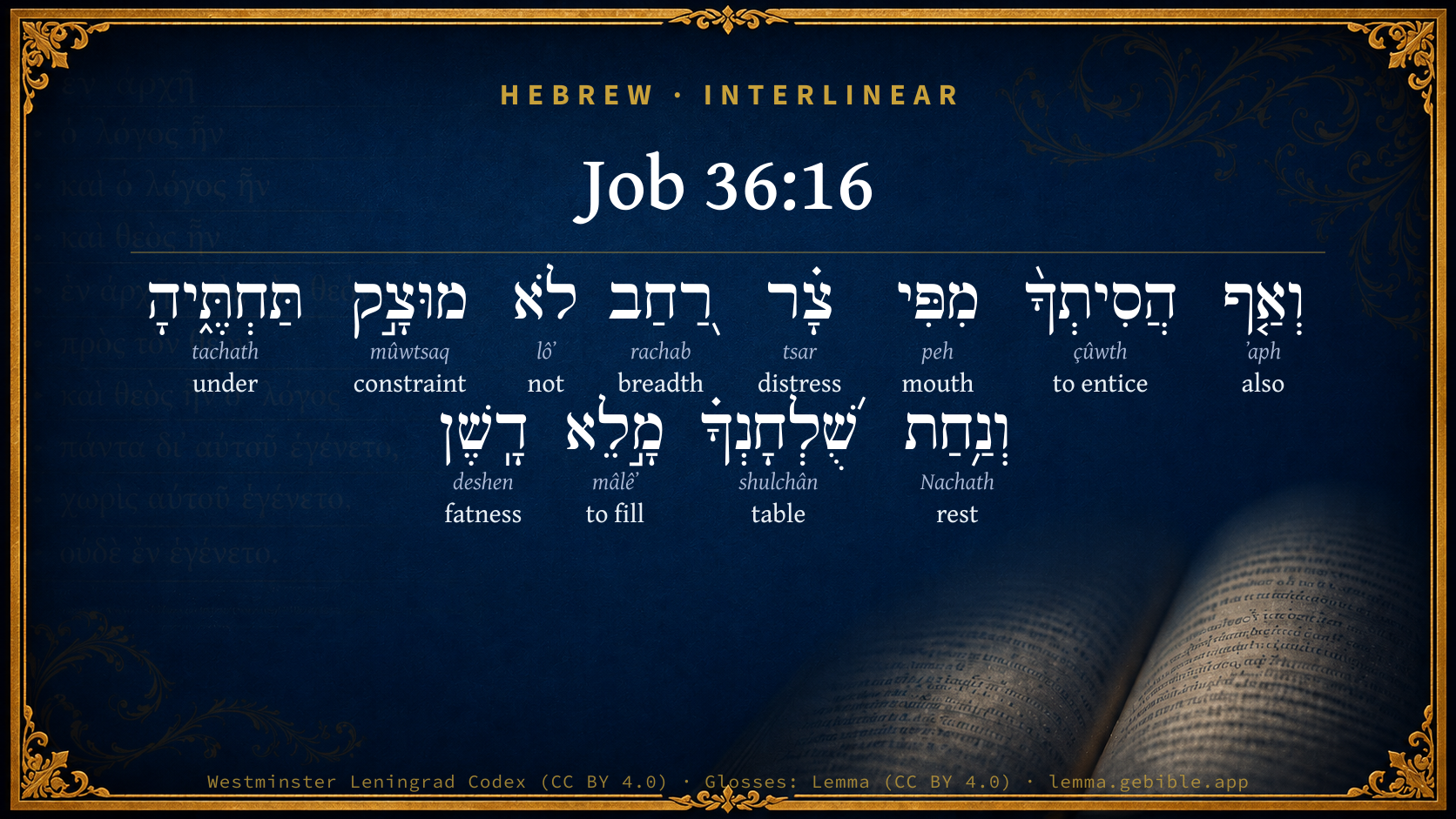
  1. וְאַ֤ף ʼaph H637 “and · also” Conjunction + Adverb
  2. הֲסִיתְךָ֨ çûwth H5496 “to entice · you” Verb, Hiphil, Perfect, 3rd Person, Masculine, Singular + Suffix, Personal, 2nd Person, Masculine, Singular
  3. מִפִּי peh H6310 “from · mouth of” Preposition + Noun, Common, Masculine, Singular, Construct
  4. צָ֗ר tsar H6862 “distress” Adjective, Adjective, Masculine, Singular, Absolute
  5. לֹא lôʼ H3808 “not” Particle, Negative
  6. מוּצָ֣ק mûwtsaq H4164 “constraint” Noun, Common, Masculine, Singular, Absolute
  7. תַּחְתֶּ֑יהָ tachath H8478 “under · her” Preposition + Suffix, Personal, 3rd Person, Feminine, Singular
  8. וְנַ֥חַת Nachath H5183 “and · rest of” Conjunction + Noun, Common, Feminine, Singular, Construct
  9. שֻׁ֝לְחָנְךָ֗ shulchân H7979 “table · your” Noun, Common, Masculine, Singular, Construct + Suffix, Personal, 2nd Person, Masculine, Singular
  10. מָ֣לֵא mâlêʼ H4390 “to fill” Verb, Qal, Perfect, 3rd Person, Masculine, Singular
  11. דָֽשֶׁן deshen H1880 “fatness” Noun, Common, Masculine, Singular, Absolute

About this verse

These counts appear in no published source. They are computed here, from the morphology-tagged text and Lemma’s own curated glosses. What Lemma adds →

12
words
12
distinct lemmas
Wisdom
section

Notable vocabulary

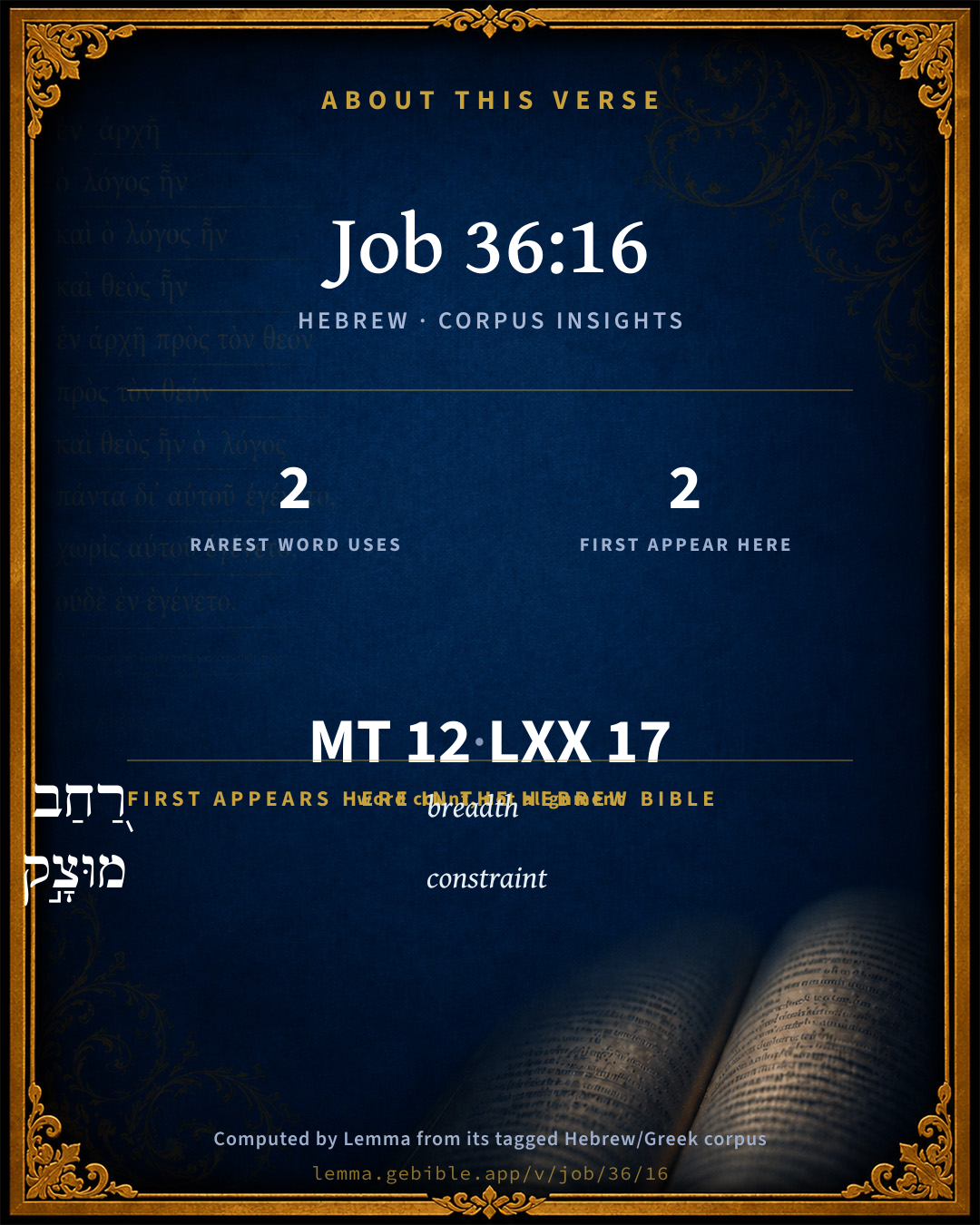
The rarest word here is רַ֭חַב breadth H7338 — appearing just 2 times in the whole Hebrew Bible.

First appearance in Scripture

These words make their first canonical appearance in the Hebrew Bible here:

  • רַ֭חַב breadth H7338
  • מוּצָ֣ק constraint H4164

Shared distinctive vocabulary

רַ֭חַב breadth H7338 occurs in 2 verses of the Hebrew Bible. Also found in:

Grammatical profile

  • 2 verbs
  • 6 nouns
  • 1 adjective
  • 1 preposition
  • 1 adverb
  • 1 particle

Verb forms

  • הֲסִיתְךָ֨ Hiphil · Perfect
  • מָ֣לֵא Qal · Perfect

Hebrew & Septuagint length

In English translation the verse runs 30 words from the Hebrew and 13 from the Septuagint (LXX English) — the Septuagint runs noticeably shorter here. See the side-by-side →

A rough comparison of the two English renderings, which tokenize alike — not a word-level alignment.

Word counts can differ between the Hebrew and the Greek without any difference in meaning — e.g. the Hebrew direct-object marker אֵת has no separate Greek word, and Greek often adds the article ὁ.

In the original languages it is 12 Hebrew tokens and 17 Greek tokens — but the two are counted differently (Hebrew bundles its prefixes and suffixes into one token; the Greek is in lemma form), so that isn’t a like-for-like length.

Cross-references

12

Topical passages linked to Job 36:16 in the Treasury of Scripture Knowledge — connected by theme and wording, ordered by reader-vote popularity; previews shown in the World English Bible.

  • Psalms 23:5 You prepare a table before me in the presence of my enemies. You anoint my head with oil. My cup runs over.
  • Psalms 118:5 Out of my distress, I called on Yah. Yah answered me with freedom.
  • Psalms 18:19 He brought me forth also into a large place. He delivered me, because he delighted in me.
  • Psalms 31:8 You have not shut me up into the hand of the enemy. You have set my feet in a large place.
  • Psalms 63:5 My soul shall be satisfied as with the richest food. My mouth shall praise you with joyful lips,
  • Isaiah 25:6 In this mountain will Yahweh of Hosts make to all peoples a feast of fat things, a feast of wines on the lees, of fat things full of marrow, of wines on the lees well refined.
  • Psalms 36:8 They shall be abundantly satisfied with the abundance of your house. You will make them drink of the river of your pleasures.
  • Psalms 40:1–3 I waited patiently for Yahweh. He turned to me, and heard my cry.
  • Job 19:8 He has walled up my way so that I can't pass, And has set darkness in my paths.
  • Job 42:10–17 Yahweh turned the captivity of Job, when he prayed for his friends. Yahweh gave Job twice as much as he had before.
  • Isaiah 55:2 Why do you spend money for that which is not bread? and your labor for that which doesn't satisfy? listen diligently to me, and eat you that which is good, and let your soul delight itself in fatness.
  • Hosea 2:14 "Therefore, behold, I will allure her, And bring her into the wilderness, And speak tenderly to her.

Cross-references courtesy of OpenBible.info (CC BY 4.0).

Hebrew and Greek witnesses Masoretic Hebrew ↔ Greek Septuagint

The same verse in the two great witnesses to the Old Testament, shown verse-for-verse.

Here the Septuagint runs noticeably shorter than the Hebrew — LXX2012 (modern English Septuagint) 13 words vs World English Bible 30. A rough length comparison of the two English translations, not a word-level alignment — read both below.

These are two independent witnesses, not word-aligned to each other, and the Septuagint is shown in lemma (dictionary) form.

Hebrew Job 36:16 Masoretic · Westminster Leningrad Codex

וְאַ֤ף הֲסִיתְךָ֨ מִפִּי צָ֗ר רַ֭חַב לֹא מוּצָ֣ק תַּחְתֶּ֑יהָ וְנַ֥חַת שֻׁ֝לְחָנְךָ֗ מָ֣לֵא דָֽשֶׁן

Yes, he would have allured you out of distress, Into a broad place, where there is no restriction. That which is set on your table would be full of fatness.

World English Bible · Public Domain

Greek LXX Job 36:16 Septuagint · lemma form

καί προσέτι ἀπατάω σύ ἐκ στόμα ἐχθρός ἄβυσσος κατάχυσις ὑποκάτω αὐτός καί καταβαίνω τράπεζα σύ πλήρης πιότης

And he has also enticed you out of the mouth of the enemy:

LXX2012 (modern English Septuagint) · Public Domain

Hebrew: Westminster Leningrad Codex (CC BY 4.0). Greek: Septuagint (public domain); English from LXX2012 (modern English Septuagint) (Public Domain). How the Septuagint differs from the Hebrew →

Commentary

Notes on Job 36:16 from classic Christian and Jewish commentators (each source and its license shown beneath its notes). The classic Christian expositions comment on the surrounding passage and are grouped to its opening verse, so a note may address several verses; the Jewish commentaries on the Tanakh (Rashi and others) are per-verse, so they appear only where the commentator wrote on this verse.

Lemma curates 59 commentaries, every one of them public domain or Creative Commons licensed, each selected and text-cleaned for this edition rather than reprinted as found. About our sources →

The Cambridge Bible for Schools and Colleges

gen. ed. J. J. S. Perowne

16. The words even so connect Job’s case with the general principles in regard to suffering just inculcated by Elihu. The figures of “straitness” and “broad place” are usual for affliction and prosperity, cf. ch. Job_18:7. The figure of a plenteous table is also common, Psa_23:5. The speaker does not say by what means God is alluring the sufferer out of the mouth or jaws of distress into a broad place. He means probably the disciplining effects of the distress itself, unless the “distress” here refer to a future, greater evil, from which Job’s present affliction is designed to save him. Comp., however, ch. Job_33:14-28.

16–25. Application to Job of the principles in regard to affliction just enunciated by Elihu.

Job_36:16-19 are difficult and have been understood in a great variety of ways. The general sense expressed by the A. V. is probably correct, unless probability be considered too strong a term to employ of any rendering.

16. Even so doth he allure thee out of the mouth of distress

Into a broad place, where there is no straitness;

And that which is set on thy table shall be full of fatness.

17. But if thou art filled with the judgment of the wicked,

Judgment and justice shall keep hold on thee.

18. For beware lest wrath entice thee into scorning,

And let not the greatness, of the ransom lead thee astray.

19. Will thy riches suffice, without stint?

Or all the forces of wealth?

Many objections may be urged against this rendering, as may be against any rendering that can be proposed.

The Cambridge Bible for Schools and Colleges (gen. ed. J. J. S. Perowne; Cambridge University Press, 1878–1918) — public domain. Text from a community e-Sword module.

Trapp's Complete Commentary

John Trapp

Job 36:16 Even so would he have removed thee out of the strait [into] a broad place, where [there is] no straitness; and that which should be set on thy table [should be] full of fatness.

Ver. 16. Even so would he have removed thee, &c.] Thesin revocat ad hypothesin. Here Elihu applieth to Job that which he had more generally discoursed concerning godly men’s afflictions turned to their greatest good, if they be careful to improve the same. Heb. He would have persuaded, or gently removed thee.

Out of the strait, &c.] Heb. out of the mouth of the strait. A metaphor from wild beasts, that hold some prey in the mouth, saith Piscator. Or from a pit, narrow at the top and wide at the bottom, as R. Solomon, and some others, who understand it of hell. Brentius to the same sense rendereth the text thus, Eripiet te ab ore angustiae lato, sub quo nullum est fundamentum, He shall deliver thee from the broad mouth of straitness, under which there is no bottom.

And that which should be set on the table, &c.] Thou shouldest eat of the fat and drink of the sweet, thou sbouldest have known no want of anything, if thou hadst not been wanting to thyself, in making the best use of thy troubles. See Psa 23:5.

John Trapp, A Commentary or Exposition upon All the Books of the Old and New Testament (1647–1656) — public domain. Text from a community e-Sword module.

The Biblical Illustrator

Joseph S. Exell

Job_36:16

Out of the strait into a broad place.

An invitation to straitened souls

What is literally straitness? The word strait means narrow. The place between two mountains or two seas is a strait or narrow passage. A strait implies a difficulty of choice. I am in a strait betwixt two. We say of a man, when he cannot pay his debts, that he is in straitened circumstances. Other countries have similar terms. In Scotland they say pinched, or hampered, in America that he has a hard row to hoe, alluding to the hoeing of sugar or corn. We say a man is in a strait when he has a large family and a small income. As strait places are unpleasant in temporal circumstances, they are also unpleasant in spiritual affairs. Then pray Bring me out of a strait place tonight.

1. One reason is, that the grand design of Christ may be answered.

2. Another reason is, that our heavenly Father wants to take us into a broad place.

3. His desire is, that we should be contented with all our circumstances. Contentment is great gain. (J. Caughey.)

The Biblical Illustrator, edited by Joseph S. Exell (c. 1880s–1900s) — public domain. Text from a community e-Sword module.

Whedon's Commentary on the Bible

Daniel D. Whedon

β. AN APPLICATION TO JOB OF THE PRECEDING PRINCIPLES, ENFORCED BY A POINTED EXHORTATION, Job_36:16-21.

Strophe a — An affectionate God seeks to lure the soul out of the narrow straits of trouble into the broad and rich experiences of spiritual prosperity: but if the soul prove contumacious against God, and be filled with the counsel of the wicked, then there is danger of destruction, from which no ransom shall avail to deliver, Job_36:16-18.

16. Even so… thee — Literally, “God also allures [urges] thee from the jaws of trouble into a broad place, [with] no straitness beneath it,” which stands as a figure for greater glory and happiness. The rendering of the Authorized Version is substantially that of Furst, Delitzsch, and Umbreit. On improbable grounds Ewald makes unbounded prosperity the subject of the sentence; prosperity having had the effect to seduce Job from hearkening to the voice of afflictions.

Out of the strait — מפי צר, literally, from the mouth of trouble. Distress is conceived of as a monster out of whose mouth God is seeking to deliver Job.

Table — A well-filled table among the Orientals was an image of the highest earthly bliss. It is also frequently employed in the Scriptures to denote spiritual enjoyment and salvation. Psa_22:26-29; Psa_23:5; Isa_25:6; Isa_55:1-5, etc. Rich (Nineveh 1:117) describes the table at which he sat with the Pasha as an oblong tray, with feet raising it a few inches from the floor. Such dishes as it would not contain were put beside it on the ground.

Daniel D. Whedon (gen. ed.), Commentary on the Old and New Testaments (1874–1909) — public domain. Text from a community e-Sword module.

Keil & Delitzsch

C. F. Keil & F. Delitzsch

16 And He even bringeth thee out of the jaws of distress

To a broad place, whose ground hath no straitness,

And the adorning of thy table shall be full of fatness.

17 Yet thou art become full of the judging of the evil-doer:

Judging and judgment lay hold on one another!

18 For let not anger indeed entice thee to scorning,

And let not the greatness of the ransom mislead thee.

With Job 36:16 Elihu passes over to the application to Job of what he said in the preceding strophe. Since it is usual to place אף (like גּם and אך) at the beginning of the sentence, although not belonging to the member of the sentence which immediately follows, ואף הסיתך for והסית אף אתך cannot be remarkable. The praet. הסיתך is not promissory, but Elihu says with what design God has decreed the present suffering for Job. הסית מן is like Ch2 18:31 : out of distress (צר for צר by Rebia magnum), which has him in its jaws, and threatens to swallow him, God brings him away to great prosperity; a thought which Elihu expresses in the imagery of the Psalms of a broad place and a bountiful table (comp. e.g., Psa 4:2; Psa 23:5). רחב is locative, and לא־מוּצק תּחתּיה is either a relative clause: whose beneath (ground) is not straitened, no-straitness (in which case מוּצק would not be constr. from the n. hophal. מוּצק, Isa.Isa 9:1, but absol. after the form מחנק, Job 7:15, Ew. 160, c, Anm. 4), Saad. Arab. lâ ḍı̂q fı̂ mûḍ‛hâ (cujus in loco non angustiae); or it is virtually an adj.: without (לא = בּלא, as Job 34:24), comp. on Job 12:24) straitness of what is beneath them, eorum quae sub se habet (comp. on Job 28:5). רחב is fem., like רחוב, Dan 9:25. A special clause takes the place of the locative, Job 36:16 : and the settling or spreading, i.e., the provision (from נוּח, to come down gradually, to seat one's self) of thy table shall be full of fatness. מלא (whether it be adj. or verb) is treated by attraction, according to the gender of the governed noun; and it is unnecessary, with Rosenm. and others, to derive נחת from נחת (Aram. for ירד).

In Job 36:17, דּין is intended of Job's negative judgment concerning God and His dealings (comp. Psa 76:9, where it signifies a judicial decision, and Pro 22:10, where it signifies a wrangling refusal of a fair decision). Job 36:17 is not a conditional clause (Hahn), in which case the praet. hypothet. would have a prominent position, but an adversative predicative clause: but (nevertheless) thou art full of the judging of the evil-doer (evil judging); after which, just as ἀσυνδέτως as Job 36:14, the sad issue in which this judging after the manner of evil-doers results is expressed: such judging and judgment border closely upon one another. Rd., Dietr., and Schlottm. have wrongly reproduced this idea, discerned by Ges., when they translate: judgment and sentence (guilt and punishment) shall seize thee. יתמכוּ, prehendunt scil. se (Ebr.: put forth the hand), is used like the Aram. סמך, to draw nearer, fasten together (Rabb. סמוּך, near at hand), Arab. tamâsaka (from Arab. msk = סמך, as e.g., hanash = נחשׁ). In Job 36:18 we leave the signification thick milk or cream (חמה = חמאה, as Job 29:6) to those who persuade themselves that cream can be metaphorically equivalent to superfluity (Ew., Hirz., Vaih., Hlgst.). Renan's translation: N'espre pas dtourner la colre de Dieu par une amende, we also leave as a simple puzzle to its discoverer, who, with this one exception, is destitute of thoughts proper to the book of Job. In general, the thought, "do not imagine by riches, by a great ransom, to be able to satisfy the claims of God," is altogether out of place here. Moreover, חמה, which, as e.g., דּאגה, Pro 12:25 (Ew. 174, g), is construed as masc., cannot be understood of God's wrath, since the poet by הסית will not at one time have ascribed to God a well-meant incitation, at another an enticement in malam partem. That which allures is Job's own חמה, and that not the excitement of his affliction (Hahn), but of his passion; comp. אף, Job 36:13. שׂפק is, however, to be explained according to Job 34:37, comp. Job 27:23 (clapping of hands = derision); and כּפר signifies reconciliation or expiation, as Job 33:24. Elihu admonishes Job not to allow himself to be drawn by the heat of passion into derision, or to deride; nor to be allured from the right way by the ransom which is required of him as the price of restoration to happiness, viz., humble submission to the divine chastisement, as though this ransom were exceeding great. The connection is clear: an adverse verdict (דּין) and condemnation (משׁפּט) are closely connected; for (כּי) hastiness of temper, let it not (פּן( ton ti ) lead thee astray ... thou wouldst not escape the judgment of God!

Keil & Delitzsch — Biblical Commentary on the Old Testament (1861–1891) — public domain (CC PDM 1.0). Text via the HelloAO Bible API. (Old Testament only.)

Geneva Bible (1599)

Geneva Bible translators

If thou hadst been obedient to God, he would have brought thee to liberty and wealth.

Geneva Bible (1599) marginal notes — public domain. Text via Bolls.life.

Jamieson, Fausset & Brown

Robert Jamieson, A. R. Fausset & David Brown

Rather, "He will lead forth thee also out of the jaws of a strait" (Psa 18:19; Psa 118:5).

broad place--expresses the liberty, and the well-supplied "table" the abundance of the prosperous (Psa 23:5; Isa 25:6).

Jamieson, Fausset & Brown — Commentary Critical and Explanatory on the Whole Bible (1871) — public domain (CC PDM 1.0). Text via the HelloAO Bible API.

Adam Clarke's Commentary

Verse 16. Even so would he have removed thee] If thou hadst turned to, obeyed, and served him, thy present state would have been widely different from what it is.

Adam Clarke's Commentary on the Bible (1810–1826) — public domain. Text from a community e-Sword/MySword module.

Ellicott's Commentary for English Readers

(16) Even so would he have removed thee. It is possible to understand this verse somewhat otherwise, and the sense may perhaps be improved. Elihu may be speaking, not of what God would have done, but of what He has actually done: “Yea, also He hath removed thee from the mouth of an adversary, even case and abundance in the place of which there was no straitness, and that which came down upon thy table full of fatness; but thou art full of the judgment of the wicked, therefore justice and judgment take hold on thee.” “God, in His mercy, saw that thou wast in danger, and He removed the cause of temptation, and thy chastisement would have been of short duration hadst thou been submissive and resigned; but thou hast been bold and daring, like the wicked, and hast reaped the judgment of the wicked.”

A Bible Commentary for English Readers, edited by Charles John Ellicott (1878–1897) — public domain. Text from a community e-Sword module.

John Gill's Exposition

Even so,.... Here Elihu accommodates what he had said to the case of Job; that had he hearkened and been obedient to the voice of God in his rod, and had submitted to his chastening hand, and patiently bore his afflictions;

he, God,

would have removed thee out of the strait into a broad place, where there is no straitness: that is, out of the strait circumstances in which he was, into liberty; would have brought him into a large place, where he might walk at liberty, as David experienced, Psa 4:1; and may be understood both in a temporal and spiritual sense. In a temporal sense; he was now in great straits, in poverty and affliction; these pressed him hard on every side, so that his way, as he says, was "fenced up, that he could not pass", Job 19:8. Now had he been rightly humbled under his affliction, God would have taken him out of the straits of adversity, and set his feet in a large room of prosperity; see Psa 31:7. In a spiritual sense; persons are as in a strait place and pent up, when they cannot come forth in the free exercise of grace and duty; their souls are as it were in prison, they are shut up, and have not freedom with God nor man; their faith is ready to fail, their hope is sunk very low, they are straitened in their own bowels or affections, in their love to God and his people: and then they are removed into a large place, when it is the reverse with them; when they are favoured with the free spirit of the Lord, for where he is there is liberty; and when their hearts are enlarged with the love of God, and in the exercise of grace; and then they can run cheerfully the ways of his commandments;

and that which should be set on thy table should be full of fatness; which in a temporal sense denotes, that he should have had a plentiful table, spread with the best of provisions, the richest dainties, the finest of the wheat, and the fattest of the creatures; and these should rest and remain upon his table, or be constantly renewed there: and in a spiritual sense, that his soul should have been satisfied with the love of God, shed abroad in his heart; with the blessings of the everlasting covenant of grace applied unto him; and with the goodness of the house of God, his word and ordinances, as with marrow and fatness; see Psa 63:5.

John Gill's Exposition of the Whole Bible (1746–1763) — public domain (CC PDM 1.0). Text via the HelloAO Bible API.

Albert Barnes' Notes on the Bible

Even so would he have removed thee - That is, if you had been patient and resigned, and if you had gone to him with a broken heart. Having stated the “principles” in regard to affliction which he held to be indisputable, and having affirmed that God was ever ready to relieve the sufferer if he would apply to him with a proper spirit, it was natural to infer from this that the reason why Job “continued” to suffer was, that he did not manifest a proper spirit in his trials. Had he done this, Elihu says, the hand of God would have been long since withdrawn, and his afflictions would have been removed.

Out of the strait into a broad place - From the narrow, pent up way, where it is impossible to move, into a wide and open path. Afflictions are compared with a narrow path, in which it is impossible to get. along; prosperity with a broad and open road in which there are no obstructions; compare Psa 18:19; Psa 31:8. “And that which should be set on thy table.” Margin, “the rest of thy table.” The Hebrew word (נחת nachath - from נוח nûach, “to rest,” and in the Hiphil to set down, to cause to rest) means properly a “letting,” or “settling down;” and then that which is set down - as e. g. food on a table. This is the idea here. that the food which would be set on his table would be rich and abundant; that is, he would be restored to prosperity, if he envinced a penitent spirit in his trials, and confessed his sins to God. The same image of piety occurs in Psa 23:5, “Thou preparest a table before me in the presence of mine enemies.”

Albert Barnes' Notes on the Bible (1834–1885) — public domain. Text from a community e-Sword/MySword module.

Haydock's Catholic Bible Commentary

CHAPTER XXXVI.

He shall. He would have prevented thee from falling into this irremediable distress, if thou hadst imitated the poor who trust in Him. (Calmet) --- Yea, he will still restore thee to favour, if thou wilt repent. (Haydock) --- He will fill thee with joy and plenty. (Menochius) --- Foundation. Hebrew, where there is not straitness. (Protestants) He would have rescued thee from distress, and set thee at large. (Haydock) --- The psalmist often speaks in the same language. (Calmet)

George Leo Haydock (1774–1849), Haydock's Catholic Family Bible and Commentary, 1859 edition — public domain. Excludes Psalms (Douay-Rheims chapter numbering differs from Protestant) and Deuterocanonical books (Catholic canon only).

Matthew Poole's English Annotations

Even so, if thou hadst opened thine ear to God’s counsels, and humbled thyself under his correcting hand, and sued to God for mercy,

would he have removed thee; as this verb is used, 2Ch 18:31. Or, allured, or enticed, or persuaded thee, as the word properly signifies; which possibly may here be emphatical, and may imply, as that Job had by his sins brought himself into these straits, so that God would have brought him out of them by the usual and regular way, to wit, by persuading him to turn from his sins, and humbly and earnestly to cry to God for mercy, which if he had complied with, God would have delivered him.

Out of the strait, Heb. out of the mouth or jaws of tribulation; which like a wild beast was read to swallow him up.

Into a broad place, i.e. into a state of ease and freedom.

Thy table; thy dishes, or the food in them.

Matthew Poole's English Annotations on the Holy Bible (1683–1685) — public domain. Text from a community e-Sword/MySword module.

The Pulpit Commentary

Even so would he have removed thee out of the strait into a broad pine, where there is no straitness; and that which should be set on thy table should be full of fatness. Another quite different interpretation has been proposed by Ewald, and adopted by Dillmann and Canon Cook, who suppose Elihu to speak, not of what would have happened to Job under certain circumstances, but of what had actually happened to him, and render, "Thee moreover hath thy unbounded prosperity seduced from listening to the voice of affliction, and the ease of thy table which was full of fatness." But the rendering of the Authorized Version, which is substantially that of Schultens and Rosenmuller, is still upheld by many scholars, and has been retained by our Revisers. If we adopt it, we must understand Elihu as assuring Job that he too would have been delivered and restored to his prosperity, if he had accepted his afflictions in a proper spirits and learnt the lesson they were intended to teach him (see vers. 9, 10).

"A broad place.

Elihu tells Job that it is the work of affliction to "lure" him out of a strait into a broad place.

I LIFE IS IN DANGER OF BECOMING NARROW. Various influences combine to narrow it.

1. Selfishness. The disposition to think much of ourselves dwarfs the world to us. But when we are thus living chiefly for our own ends, we are shut into a small circle of personal, private interests, and, the great world being ignored, we ourselves shrink into littleness.

2. Worldliness. When we are absorbed in things of this world, the other and larger world is lost to view. The consequence is that we become shortsighted, and thought and interest are shut in to the domain of the visible and temporal.

3. Conventionality. We lose the courage of personal conviction, and fall back on the ideas and practices of our neighbours.

4. Routine. Since all goes smoothly, the mill grinds on in a dreamy atmosphere of changeless indifference. Then our lives miss the stimulus of a rousing call to arduous service.

II GOD DELIVERS FROM NARROWNESS BY MEANS OF AFFLICTION.

1. A Divine work. Seeing how hurtful the narrowness is, and desiring us to escape from it, he puts forth his hand to draw us out of the imprisonment it involves. It is difficult for one who has fallen into a mountain gorge, and who lies among the stones bruised and battered, to lift himself up and climb the steep and treacherous crags. He who has fallen into a strait in life needs the strong arm of God to draw him out.

2. Accomplished through affliction. God comes to the rescue of his straitened servant. But the method of deliverance is strange and unexpected. Affliction is itself a strait; it seems to press on the soul, to hamper and limit its activity. Yet this is the very instrument employed in delivering the victim of narrowness, Narrowness of circumstances may deliver from narrowness of soul. The very pressure of this new strait rouses us and bids us exert ourselves. Then, as it cures our errors, it leads us out of its own constraints.

III GOD"S DELIVERANCE SETS US IS A BROAD PLACE. First there is a fresh strait, a hard pressure of trouble on the right hand and on the left, with no door of escape. But when the affliction has accomplished its work there is deliverance.

1. Liberty of action. "The truth shall make you free". (Joh_8:32) God desires his people to serve willingly and lovingly, not with fetters on their ankles. The freedom is of a soul "at leisure from itself." There is a large place with great scope for work, which can only be enjoyed in unselfishness and unworldliness.

2. Breadth of view. It is wonderful how the vision is broadened by the experience of sorrow. Although at first it may be cramped and confined to the immediate present by the absorbing influence of pain, when deliverance comes, this is followed by a wonderful mental expansion. No one knows the depth and breadth of life who has not been through the waters of affliction.

3. Largeness joy. The broad place is open to the fresh air and the bright sunshine. Delivered from dank and dreary narrow regions, we can rejoice in our God-given liberty. This bliss is partly enjoyed on earth; it will be perfect in heaven, the large place of life and liberty. W.F.A.

The Pulpit Commentary (1880–1919), ed. H.D.M. Spence-Jones & Joseph S. Exell — public domain. Text from a community e-Sword module.

John Wesley's Explanatory Notes

He would - If thou hadst opened thine ear to God's counsels. Into - A state of ease and freedom.

John Wesley, Explanatory Notes Upon the Whole Bible (1754–1765) — public domain. Text via the GEBible commentary corpus.

Rashi

Rabbi Shlomo Yitzchaki (Rashi)

Moreover This is yet another great benefit that He did for you with these sufferings: He allured you and enticed you out of Gehinnom, whose mouth is narrow and whose base is wide.

not cramped so that its smoke should be gathered into its midst, and furthermore, that you should merit the world to come; and the bedecking of your table shall be full of fatness.

Rashi on the Tanakh — English translations: “The Judaica Press complete Tanach with Rashi, translated by A. J. Rosenberg” (CC BY 4.0); “Pentateuch with Rashi's commentary by M. Rosenbaum and A.M. Silbermann, 1929-1934” (public domain); “The Metsudah Tanach series, Lakewood, N.J” (CC BY 4.0); and “The Book of Joshua, Metsudah Publications, 1997” (CC BY 4.0). Text via Sefaria.

Lesson kit

Teaching starters — assembled from the data on this page, not authored interpretation. Every prompt links to the verse data it draws on. Edit before teaching.

Job, in the Wisdom, opens this verse with 12 words (12 distinct Hebrew lemmas). Its most distinctive word is rachab (“breadth”). The Greek Septuagint runs shorter here. A historical commentator’s framing appears above. Read the whole chapter for the surrounding context.

Discussion questions

  1. What does “breadth” (rachab) contribute to the verse as a whole?
  2. 2 words make their first appearance in Scripture here. What does this debut establish?
  3. How does Job 38:18, which shares the word «breadth», read alongside this verse?
  4. The Septuagint runs shorter here than the Hebrew. What might account for the difference?
  5. The translations on this page render this verse differently — a whole-verse word diff, not a word-by-word alignment. What might account for the different wordings?
  6. «הֲסִיתְךָ֨» is a Hiphil Perfect verb. How does that grammatical form shape the action described?
  7. Compare how The Cambridge Bible for Schools and Colleges and Trapp's Complete Commentary read this verse. Where do they agree or differ?

Things to notice

Reading settings

Reading text

Shown beneath each verse's original-language words.

Old Testament
Old Testament edition

Read the OT as the Masoretic Hebrew (MT) or the Greek Septuagint (LXX).

English shown for the Greek Septuagint (in the Hebrew ↔ Greek comparison).

Comparing translations? Open the Compare panel on any verse page to stack up to four side by side.