
Job 32:17

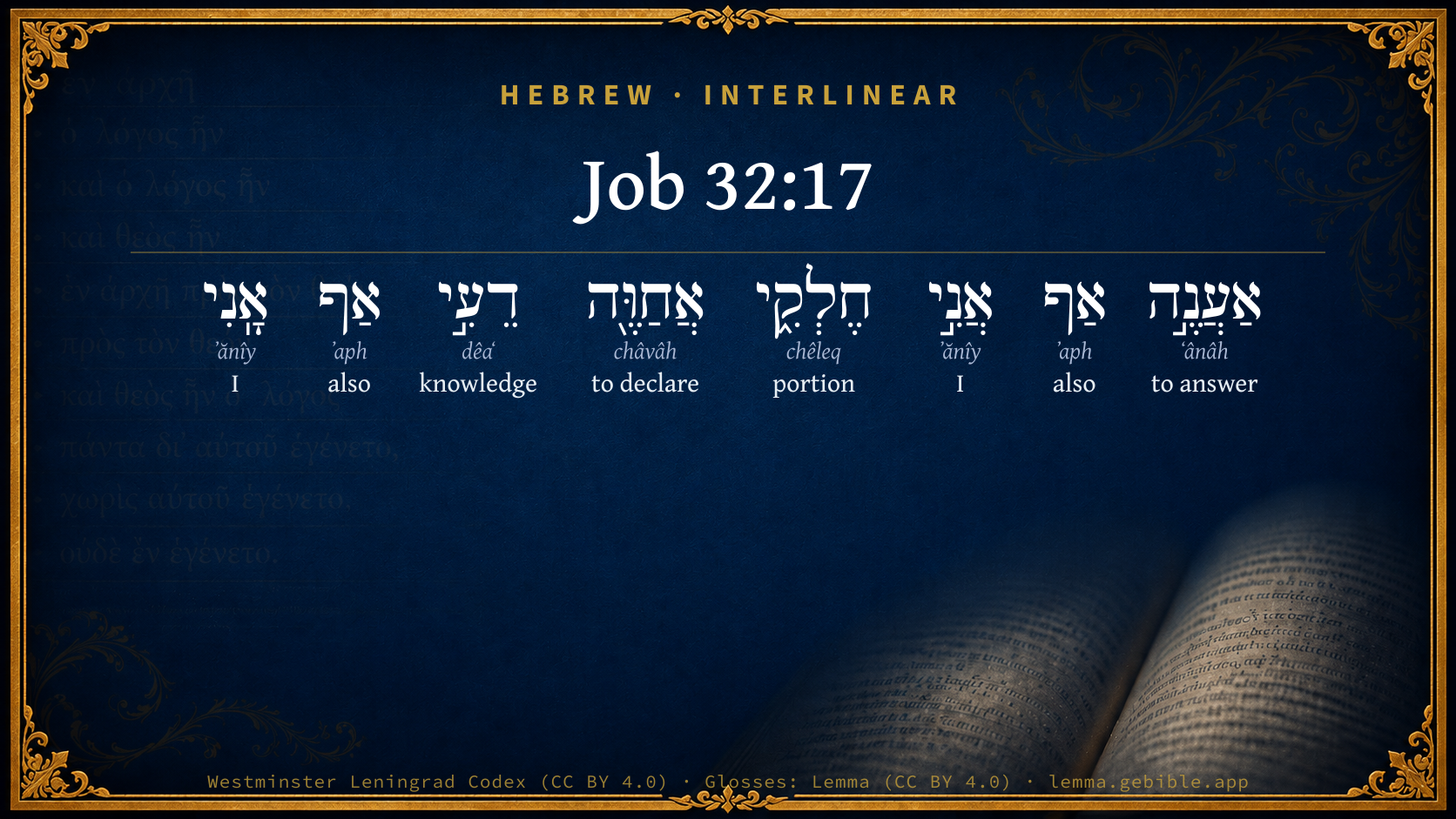
Hebrew (Westminster Leningrad Codex) Job 32:17 appears in the Hebrew Old Testament. The text above is from the Westminster Leningrad Codex. Each word links to its Strong’s number, a concise gloss, and parsing drawn from the Open Scriptures Hebrew Bible morphology. Click any word for its full Brown-Driver-Briggs (BDB) entry.
Download image
Cite this verse

Job 32:17 (World English Bible). Public Domain. Lemma interlinear Bible study tool, https://lemma.gebible.app/v/job/32/17.

Show BibTeX & RIS
BibTeX
RIS
English Translation
I also will answer my part, And I also will show my opinion.
World English Bible · Public Domain
Download a study sheet

One document with this verse’s original text, its word-by-word gloss line, the meaning frame, cross-references with their text, attributed commentary, and full source and license credits — printable, and it pastes into notes with its structure intact.

This verse Autodidact and up

Study sheet (.html) Plain text (.txt)

A passage Seminary Student

Up to 50 verses in one chapter. A passage sheet keeps up to 6 commentary sources and 12 cross-references per verse, in the order this page ranks them, and says so on the sheet whenever that leaves anything out. Ask for a single verse and you get the Autodidact verse sheet above.

Everything on this page stays free to read, with no account — the sheet is a download of what is already on screen, not access to it.

Want to remove ads? Support Godless Engineer
Compare translations 3

The same verse in 3 English versions, stacked beneath the original-language interlinear above. Click any original word for its lexicon entry.

Each is an independent rendering of the whole verse — the interlinear is not word-aligned to these translations.

Highlighted words mark where these versions differ — a whole-verse word diff, not a word-by-word alignment.

  • World English Bible Public Domain
    I also will answer my part, And I also will show my opinion.
  • King James Version Public Domain
    I said, I will answer also my part, I also will shew mine opinion.
  • unfoldingWord Literal Text CC BY-SA 4.0
    I also will answer my part; I also will declare my knowledge.

unfoldingWord Literal Text — © unfoldingWord, licensed CC BY-SA 4.0. Word-aligned USFM3 via Door43 (git.door43.org/unfoldingWord/en_ult).

Versions to compare (up to 4)

3 of 4 selected

Show all 18 translations

Every available English version of this verse, each an independent rendering of the whole verse.

  • World English Bible Public Domain
    I also will answer my part, And I also will show my opinion.
  • Berean Standard Bible Public Domain
    I too will answer; yes, I will declare what I know.
  • Majority Standard Bible Public Domain
    I too will answer; yes, I will declare what I know.
  • King James Version Public Domain
    I said, I will answer also my part, I also will shew mine opinion.
  • American Standard Version (1901) Public Domain
    I also will answer my part, I also will show mine opinion.
  • Revised Version (1885) Public Domain
    I also will answer my part, I also will shew mine opinion.
  • Geneva Bible (1599) Public Domain
    Then answered I in my turne, and I shewed mine opinion.
  • Douay-Rheims (1899) Public Domain
    I also will answer my part, and will shew my knowledge.
  • Young's Literal Translation Public Domain
    I answer, even I -- my share, I shew my opinion -- even I.
  • Literal Standard Version CC BY-SA 4.0
    I answer, even I—my share, || I show my opinion—even I.
  • Unlocked Literal Bible CC BY-SA 4.0
    No, I also will answer on my part; I will also tell them my knowledge.
  • unfoldingWord Literal Text CC BY-SA 4.0
    I also will answer my part; I also will declare my knowledge.
  • Darby Bible Public Domain
    I will answer, I also in my turn, I also will shew what I know:
  • World Messianic Bible Public Domain
    I also will answer my part, and I also will show my opinion.
  • Webster's Bible Public Domain
    I said, I will answer also my part, I also will show my opinion.
  • Free Bible Version CC BY-SA 4.0
    No—now I'll give my answer too. I'll tell you what I know.
  • Bible in Basic English Public Domain
    I will give my answer; I will put forward my knowledge:
  • JPS Tanakh (1917) Public Domain
    I also will answer my part, I also will declare mine opinion.

Literal Standard Version (2020), Covenant Press — licensed CC BY-SA 4.0. Text via the HelloAO Bible API (eBible.org). Unlocked Literal Bible (unfoldingWord) — licensed CC BY-SA 4.0. Text via the HelloAO Bible API (eBible.org). unfoldingWord Literal Text — © unfoldingWord, licensed CC BY-SA 4.0. Word-aligned USFM3 via Door43 (git.door43.org/unfoldingWord/en_ult). Free Bible Version, Dr. Jonathan Gallagher — licensed CC BY-SA 4.0. Text via the HelloAO Bible API (eBible.org).

Word by word

More ways to search: Search by grammar → Find every occurrence → Compare this word →

Practice this passage: Drill this verse → Learn its vocabulary →

About this verse

These counts appear in no published source. They are computed here, from the morphology-tagged text and Lemma’s own curated glosses. What Lemma adds →

8
words
6
distinct lemmas
Wisdom
section

Notable vocabulary

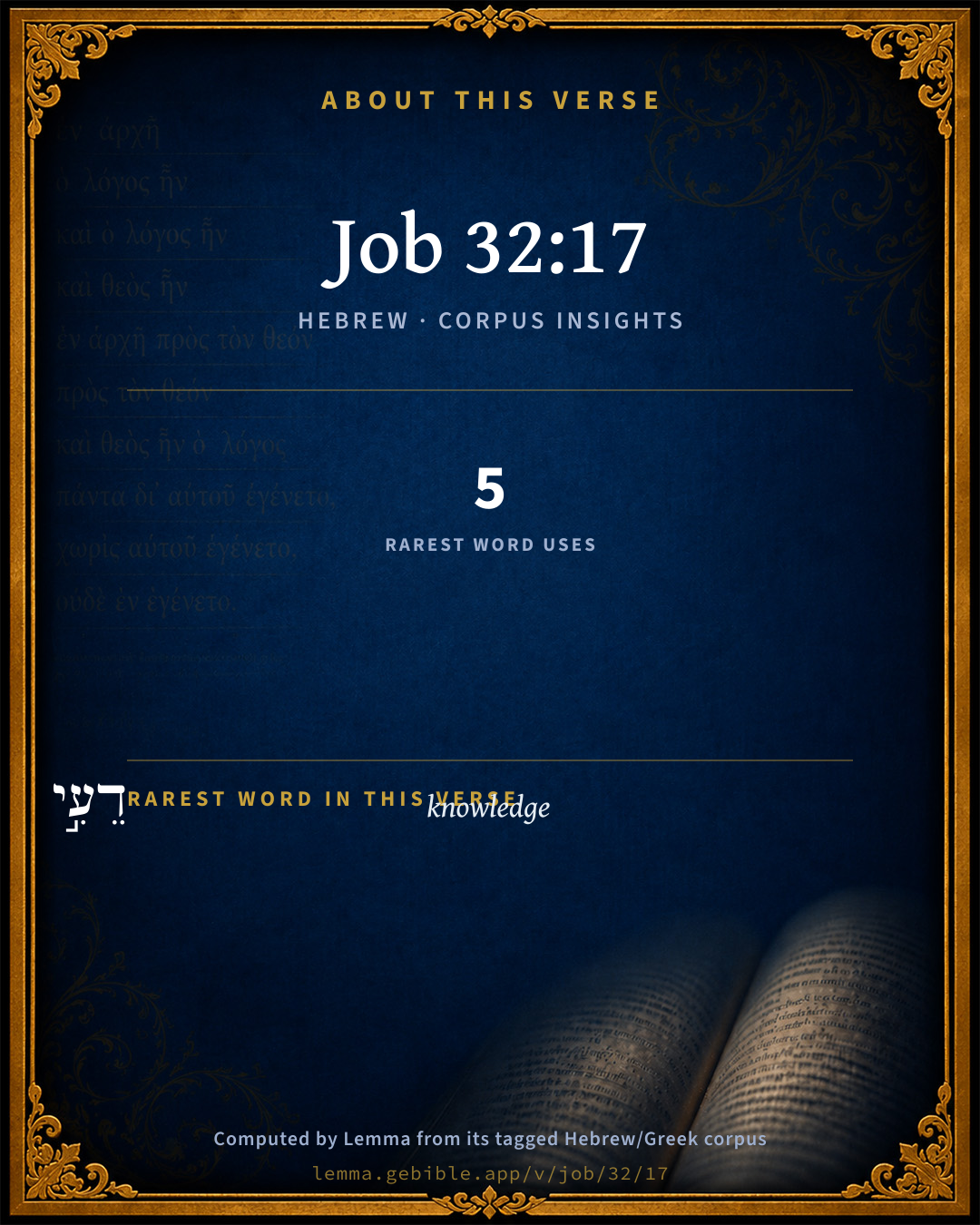
The rarest word here is דֵעִ֣י knowledge H1843 — appearing just 5 times in the whole Hebrew Bible.

Shared distinctive vocabulary

דֵעִ֣י knowledge H1843 occurs in 5 verses of the Hebrew Bible. Also found in:

Grammatical profile

  • 2 verbs
  • 2 nouns
  • 2 pronouns
  • 2 particles

Verb forms

  • אַעֲנֶ֣ה Qal · Imperfect
  • אֲחַוֶּ֖ה Piel · Imperfect

Repetition

Words recur within this verse — often emphatic in Hebrew:

  • אַף also H637 ×2
  • אֲנִ֣י I H589 ×2

Hebrew & Septuagint length

In English translation the verse runs 13 words from the Hebrew and 9 from the Septuagint (LXX English) — the Septuagint runs noticeably shorter here. See the side-by-side →

A rough comparison of the two English renderings, which tokenize alike — not a word-level alignment.

Word counts can differ between the Hebrew and the Greek without any difference in meaning — e.g. the Hebrew direct-object marker אֵת has no separate Greek word, and Greek often adds the article ὁ.

Cross-references

3

Topical passages linked to Job 32:17 in the Treasury of Scripture Knowledge — connected by theme and wording, ordered by reader-vote popularity; previews shown in the World English Bible.

  • Job 32:10 Therefore I said, 'Listen to me; I also will show my opinion.'
  • Job 33:12 "Behold, I will answer you. In this you are not just; For God is greater than man.
  • Job 35:3–4 That you ask, 'What advantage will it be to you? What profit shall I have, more than if I had sinned?'

Cross-references courtesy of OpenBible.info (CC BY 4.0).

Hebrew and Greek witnesses Masoretic Hebrew ↔ Greek Septuagint

The same verse in the two great witnesses to the Old Testament, shown verse-for-verse.

Here the Septuagint runs noticeably shorter than the Hebrew — LXX2012 (modern English Septuagint) 9 words vs World English Bible 13. A rough length comparison of the two English translations, not a word-level alignment — read both below.

These are two independent witnesses, not word-aligned to each other, and the Septuagint is shown in lemma (dictionary) form.

Hebrew Job 32:17 Masoretic · Westminster Leningrad Codex

אַעֲנֶ֣ה אַף אֲנִ֣י חֶלְקִ֑י אֲחַוֶּ֖ה דֵעִ֣י אַף אָֽנִי

I also will answer my part, And I also will show my opinion.

World English Bible · Public Domain

Greek LXX Job 32:17 Septuagint · lemma form

ὑπολαμβάνω δέ ελιους λέγω

And Elius continued, and said, I will again speak,

LXX2012 (modern English Septuagint) · Public Domain

Hebrew: Westminster Leningrad Codex (CC BY 4.0). Greek: Septuagint (public domain); English from LXX2012 (modern English Septuagint) (Public Domain). How the Septuagint differs from the Hebrew →

Commentary

Notes on Job 32:17 from classic Christian and Jewish commentators (each source and its license shown beneath its notes). The classic Christian expositions comment on the surrounding passage and are grouped to its opening verse, so a note may address several verses; the Jewish commentaries on the Tanakh (Rashi and others) are per-verse, so they appear only where the commentator wrote on this verse.

Lemma curates 59 commentaries, every one of them public domain or Creative Commons licensed, each selected and text-cleaned for this edition rather than reprinted as found. About our sources →

Trapp's Complete Commentary

John Trapp

Job 32:17 [I said], I will answer also my part, I also will shew mine opinion.

Ver. 17. I said, I will answer also my part] It is a virtue to be forward and forth putting in that which is good; and a vice to be shy and shame faced. A Christian should catch at opportunities of doing and receiving good, he should be ready to every good work; as the busy bee, so soon as ever the sun breaks forth, gets abroad to gather honey and wax.

I also will show my opinion] Heb. my knowledge, as Job 32:6, and so the Vulgate readeth it. Hereupon Gregory taking Elihu (but not well) for an arrogant person, showeth that such love to vaunt themselves, and out of ostentation to set forth their good parts to public view; and are therein like unto a vessel without a cover, touching which the law saith that it shall be counted unclean. Thus he. But to utter a man’s knowledge for the benefit of others, as good Elihu did, is not pride, but zeal, however the world censure it. And they have, doubtless, a heavy account to make who hide their talents; and, having a great treasure of rare abilities, will not be drawn to impart them; the canker of these men’s great skill shall be a swift witness against them. Vile latens virtus … worthless hidden virtue.

John Trapp, A Commentary or Exposition upon All the Books of the Old and New Testament (1647–1656) — public domain. Text from a community e-Sword module.

The Biblical Illustrator

Joseph S. Exell

Job_32:17

I also will show mine opinion.

The spirit and message of Elihu

This is the beginning of Elihus declaration. It is quite a new voice. We have heard nothing like this before. So startling indeed is the tone of Elihus voice that some have questioned whether iris speech really forms part of the original poem, or has been added by some later hand. We deal with it as we find it here. It is none the less welcome to us that it is a young voice, fresh, charmful, bold, full of vitality, not wanting in the loftier music that is moral, solemn, deeply religious. It appears, too, to be an impartial voice; for Elihu says--I am no party to tiffs controversy: Job has not said anything to me or against me, and therefore I come into the conference wholly unprejudiced: but I any bound to show mine opinion: I do not speak spontaneously; I am forced to this; I cannot allow the occasion to end, though the words have been so many and the arguments so vain, without also showing what I think about the whole matter. Such a speaker is welcome. Earnest men always refresh any controversy into which they enter: and young men must speak out boldly, with characteristic freshness of thought and word; they ought to be listened to; religious questions are of infinite importance to them: sometimes they learn from their blunders; there are occasions upon which self-correction is the very best tutor. It is well for us to know what men are thinking. It is useless to be speaking to thoughts that do not exist, to inquiries that really do not excite the solicitudes of men. Better know, straightly and frankly, what men are thinking about, and what they want to be at, and address oneself to their immediate pain and necessity. Elihu will help us in this direction. There comes a time when the old way of putting things must give way to some new method. But if the old are not always wise, the young are not always complete. We live in a time of doctrinal change. There is now an opportunity for an Elihu, whose wrath is divinely kindled, to make the great progress in attempting the higher education of the soul. Elihu must come; when he does come he will be killed: but another Elihu must take his place, and go forward with the work until the enemy is tired of blood, and lets the last Elihu have a hearing. We may change forms without changing substances. Let us allow that new methods of stating old truths are perfectly legitimate. Nor let us condemn a man who resorts to novel expressions, if he do not injure the substance of the thing which he intends to reveal. Take, for example, the doctrine of prayer. The doctrine of prayer has been mocked, or misunderstood, or imperfectly stated. Every man must state this doctrine for himself. Only the individual man knows what he means by prayer. There is no generic and final definition which can be shut up within the scope of a lexicon. Who can define prayer once for all? Only the Almighty. Every suppliant knows what he means when he prays to his Father in heaven. He must not be overloaded with other mens definitions; they will only burden his prayer; they will only stifle the music of his supplication. Suppose we say, Prayer is good in cases of sickness, but it stops short at surgery. What a wonderful thing to say--wonderful because of its emptiness and vanity. Yet how inclined we are to smile when we are told that prayer is exceedingly good in the removal of nervous or imaginary diseases, but prayer always stops short at surgery; prayer never prayed a mans limb hack again to him when he had once lost it. As well say, Nursing is very good, but it always stops short at death. So it does; so it must. As well say, Reaping is very good, but reaping always stops short at winter. That is true, and that is right. That which is lacking cannot be numbered. Law must have some reasonableness, or it ceases to be law: when it loses its reasonableness it loses its dignity and the power of getting hold upon the general judgment and the personal trust of man. Even miracles themselves might be played with, turned into commonplaces, debased into familiarities utterly valueless. Prayer may and does stop short at surgery, but love itself has a point at which it stops short; the living air has a point at which it falls back, so to speak, helplessly; all the ministries of nature stop short at assignable points, saying that without assent and consent and cooperation on the other side no miracle can be done. In all these cases consider reasonableness and law, and the necessity of boundary and fixture in the education and culture of mankind. Then again, others would deprive prayer of what many have considered to be an essential feature. In order to maintain what doctrine of prayer they may have, they are only too glad to eviscerate it of the element of petition. They are not unwilling to have aspiration, a species of poetical communion with the invisible, but they would complete a great work of evacuation in the direction of request, petition, solicitation; they would dismiss the beggar from the altar, and admit only the poetic contemplatist, or the spiritual enthusiast, or the mystic communicant. For this I see no reason. I hold to the old doctrine of Ask, and ye shall receive: ye have not, because ye ask not: if any man lack wisdom, let him ask of God. That there may be abuses in the direction of solicitation is obvious; but we must never give up the reality; because it can be abused. (Joseph Parker, D. D.)

The Biblical Illustrator, edited by Joseph S. Exell (c. 1880s–1900s) — public domain. Text from a community e-Sword module.

Joseph Benson's Commentary

Job 32:17-18. I will answer also my part — I will take my turn and speak what they have omitted. I am full of matter — I have many things to say in this cause; the spirit within me constraineth me — My spirit, or soul, is so entirely dissatisfied with what hath hitherto been spoken, and so clearly apprehends what may silence Job and end the dispute, that it forceth me to speak. Or rather he means, that God’s Spirit had so enlightened his understanding by discovering the truth of the matter to him, and had so inspired him with zeal, that he was constrained thereby to plead God’s cause against Job. “As he was a young man,” says Heath, “he dared not claim much authority from his own sayings; but he claims it from the inspiration of the Almighty, by whose Spirit he was actuated, and whose oracles he was delivering.”

Joseph Benson's Commentary on the Old and New Testaments (1811–1818) — public domain. Text from a community e-Sword module.

Jamieson, Fausset & Brown

Robert Jamieson, A. R. Fausset & David Brown

my part--for my part.

opinion--knowledge.

Jamieson, Fausset & Brown — Commentary Critical and Explanatory on the Whole Bible (1871) — public domain (CC PDM 1.0). Text via the HelloAO Bible API.

Adam Clarke's Commentary

Verse 17. I will answer also my part] אענה חלקי aaneh chelki, "I will recite my portion." We have already seen that the book of Job is a sort of drama, in which several persons have their different parts to recite. Probably the book was used in this way, in ancient times, for the sake of public instruction. Eliphaz, Zophar, and Bildad, had recited their parts, and Job had responded to each: nothing was brought to issue. Elihu, a bystander, perceiving this, comes forward and takes a part, when all the rest had expended their materials: yet Elihu, though he spoke well, was incapable of closing the controversy; and God himself appears, and decides the case.

Adam Clarke's Commentary on the Bible (1810–1826) — public domain. Text from a community e-Sword/MySword module.

John Gill's Exposition

I said, I will answer also my part,.... Or take his turn in giving an answer to Job; what they had given being quite insufficient and unsuitable:

I also will show mine opinion; knowledge, or sentiment; this for a while he was fearful of doing, but, upon a thorough and serious consideration of things, he determined upon it, and now repeats it, to assure he would do it; the reasons of which follow.

John Gill's Exposition of the Whole Bible (1746–1763) — public domain (CC PDM 1.0). Text via the HelloAO Bible API.

Albert Barnes' Notes on the Bible

I also will show mine opinion - In this language, as in Job 32:6, there is a delicate expression of modesty in the Hebrew which does not appear in our translation. It is אף־אני 'aph 'ănı̂y - even I. “Even one so young, and so humble as I, may be permitted to express my sentiments, when the aged and the great have nothing more to say. It will be no improper intrusion for even me to speak when no other one more aged and honorable desires to.” In all this we may discern a degree of courtesy, and a delicate sense of propriety, which may be commended to the imitation of all, and especially to the young. In the manners of the pious men whose biography is recorded in the Bible, there is a degree of refinement, delicacy, and courtesy, in their treatment of others, such as will seldom be found even in the most elevated walks of life, and such as religion only can produce. The outward form may be obtained by the world; the living principle is found only in the heart which is imbued with love to God and man.

Albert Barnes' Notes on the Bible (1834–1885) — public domain. Text from a community e-Sword/MySword module.

Matthew Poole's English Annotations

I will take my turn, and speak what they have omitted.

Matthew Poole's English Annotations on the Holy Bible (1683–1685) — public domain. Text from a community e-Sword/MySword module.

Whedon's Commentary on the Bible

Daniel D. Whedon

17. Mine opinion — Rather. My knowledge. “Elihu speaks more in the scholastic tone of controversy than the three.” — Delitzsch.

Daniel D. Whedon (gen. ed.), Commentary on the Old and New Testaments (1874–1909) — public domain. Text from a community e-Sword module.

The Pulpit Commentary

I said, I will answer also my part, I also will show mine opinion. The initial "I said" is superfluous. Elihu, having asked himself the question, "Shall I wait?" in ver. 16, here gives the answer. He will not wait any longer, he will take the word, he will set forth his conviction.

The Pulpit Commentary (1880–1919), ed. H.D.M. Spence-Jones & Joseph S. Exell — public domain. Text from a community e-Sword module.

unfoldingWord translationNotes

Door43 World Missions Community

General Information:

Elihu continues speaking using parallelisms.

I also will answer on my part

"I will now take my turn to answer"

I am full of words

Elihu speaks of having a lot to say as being full of words. AT: "I have so much to say" (See: Metaphor)

the spirit in me compels me

"my spirit forces me to say it"

my breast is like fermenting wine that has no vent; like new wineskins, it is ready to burst

While wine is fermenting, gas collects in the container. If the gas is not let out the container will burst. Elihu means that he has so much to say that if he does not speak he feels like he will burst. Also, these two phrases are parallel and have the same meaning. AT: "I feel like my breast is about to burst, like a container of fermenting wine that has no vent" (See: Simile and Parallelism)

my breast is

This represents Elihu, specifically his spirit. AT: "my spirit is" or "I am" (See: Synecdoche)

translationWords

spirit

wine

unfoldingWord translationNotes — © Distant Shores Media and the Door43 World Missions Community, licensed CC BY-SA 4.0. Source: git.door43.org/Door43/en_tn.

Lesson kit

Teaching starters — assembled from the data on this page, not authored interpretation. Every prompt links to the verse data it draws on. Edit before teaching.

Job, in the Wisdom, opens this verse with 8 words (6 distinct Hebrew lemmas). Its most distinctive word is dêaʻ (“knowledge”). The Greek Septuagint runs shorter here. A historical commentator’s framing appears above. Read the whole chapter for the surrounding context.

Discussion questions

  1. What does “knowledge” (dêaʻ) contribute to the verse as a whole?
  2. Job 32:6 shares the word «knowledge» with this verse. How do the two illuminate each other?
  3. “also” occurs 2× in this one verse. What is the effect of the repetition?
  4. Compared with the Hebrew, the Septuagint runs shorter here. What questions does that raise?
  5. These translations render this verse differently. What is at stake in choosing one wording over another?
  6. The verb «אַעֲנֶ֣ה» is Qal Imperfect. How does its form color the action?
  7. Reading how Trapp's Complete Commentary and The Biblical Illustrator read this verse, where do the two commentators agree and where do they part?

Things to notice

Reading settings

Reading text

Shown beneath each verse's original-language words.

Old Testament
Old Testament edition

Read the OT as the Masoretic Hebrew (MT) or the Greek Septuagint (LXX).

English shown for the Greek Septuagint (in the Hebrew ↔ Greek comparison).

Comparing translations? Open the Compare panel on any verse page to stack up to four side by side.