
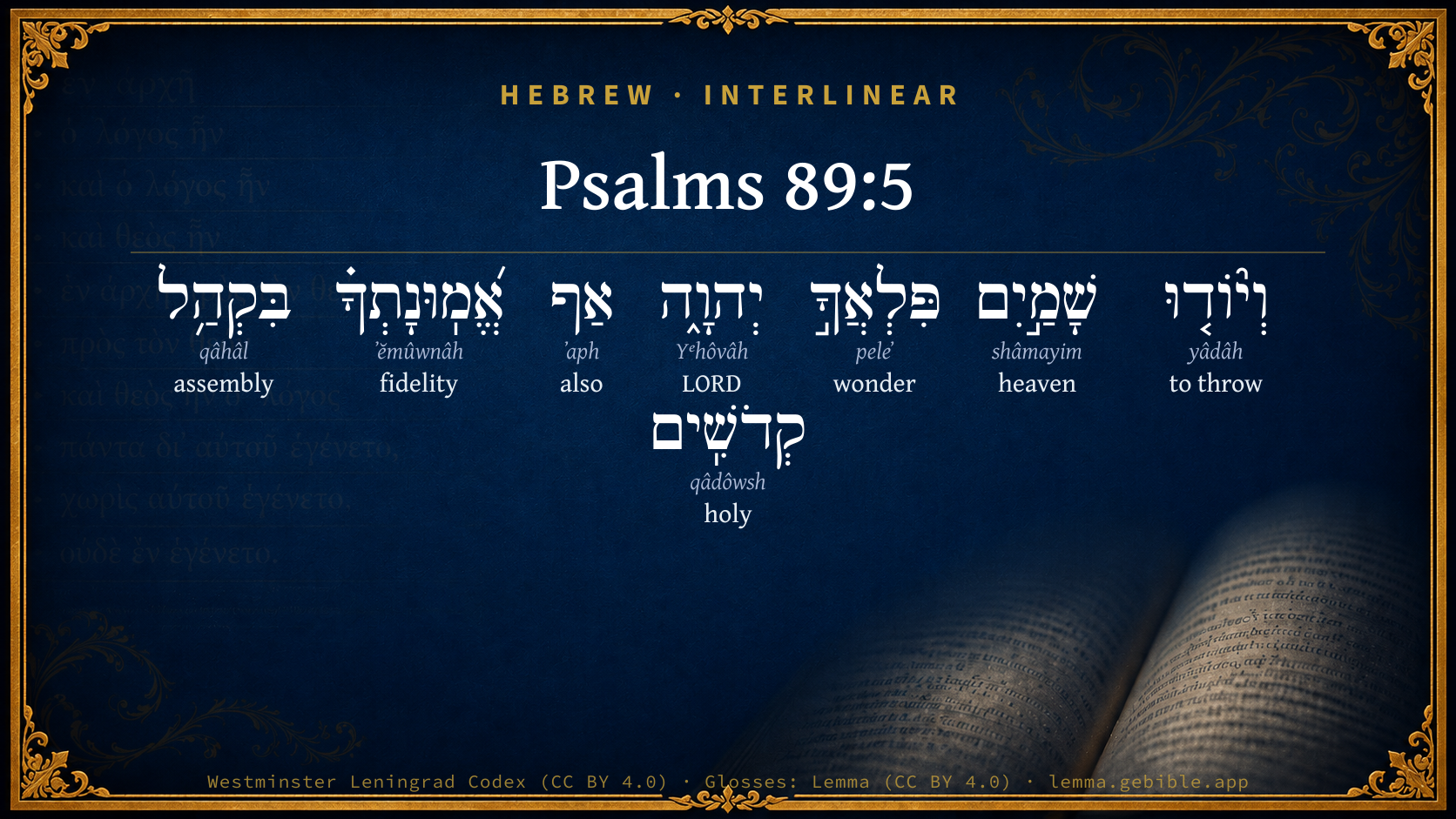
Psalms 89:5

Hebrew (Westminster Leningrad Codex) Psalms 89:5 appears in the Hebrew Old Testament. The text above is from the Westminster Leningrad Codex. Each word links to its Strong’s number, a concise gloss, and parsing drawn from the Open Scriptures Hebrew Bible morphology. Click any word for its full Brown-Driver-Briggs (BDB) entry.
Download image
Cite this verse

Psalms 89:5 (World English Bible). Public Domain. Lemma interlinear Bible study tool, https://lemma.gebible.app/v/psalms/89/5.

Show BibTeX & RIS
BibTeX
RIS
English Translation
The heavens will praise your wonders, Yahweh; Your faithfulness also in the assembly of the holy ones.
World English Bible · Public Domain
Download a study sheet

One document with this verse’s original text, its word-by-word gloss line, the meaning frame, cross-references with their text, attributed commentary, and full source and license credits — printable, and it pastes into notes with its structure intact.

This verse Autodidact and up

Study sheet (.html) Plain text (.txt)

A passage Seminary Student

Up to 50 verses in one chapter. A passage sheet keeps up to 6 commentary sources and 12 cross-references per verse, in the order this page ranks them, and says so on the sheet whenever that leaves anything out. Ask for a single verse and you get the Autodidact verse sheet above.

Everything on this page stays free to read, with no account — the sheet is a download of what is already on screen, not access to it.

Want to remove ads? Support Godless Engineer
Compare translations 3

The same verse in 3 English versions, stacked beneath the original-language interlinear above. Click any original word for its lexicon entry.

Each is an independent rendering of the whole verse — the interlinear is not word-aligned to these translations.

Highlighted words mark where these versions differ — a whole-verse word diff, not a word-by-word alignment.

  • World English Bible Public Domain
    The heavens will praise your wonders, Yahweh; Your faithfulness also in the assembly of the holy ones.
  • King James Version Public Domain
    And the heavens shall praise thy wonders, O LORD: thy faithfulness also in the congregation of the saints.
  • unfoldingWord Literal Text CC BY-SA 4.0
    And the heavens praise your wonder, Yahweh; your faithfulness also, in the assembly of the holy ones.

unfoldingWord Literal Text — © unfoldingWord, licensed CC BY-SA 4.0. Word-aligned USFM3 via Door43 (git.door43.org/unfoldingWord/en_ult).

Versions to compare (up to 4)

3 of 4 selected

Show all 18 translations

Every available English version of this verse, each an independent rendering of the whole verse.

  • World English Bible Public Domain
    The heavens will praise your wonders, Yahweh; Your faithfulness also in the assembly of the holy ones.
  • Berean Standard Bible Public Domain
    The heavens praise Your wonders, O LORD—Your faithfulness as well—in the assembly of the holy ones.
  • Majority Standard Bible Public Domain
    The heavens praise Your wonders, O LORD—Your faithfulness as well—in the assembly of the holy ones.
  • King James Version Public Domain
    And the heavens shall praise thy wonders, O LORD: thy faithfulness also in the congregation of the saints.
  • American Standard Version (1901) Public Domain
    And the heavens shall praise thy wonders, O Jehovah; Thy faithfulness also in the assembly of the holy ones.
  • Revised Version (1885) Public Domain
    And the heavens shall praise thy wonders, O LORD; thy faithfulness also in the assembly of the holy ones.
  • Geneva Bible (1599) Public Domain
    O Lord, euen the heauens shall prayse thy wonderous worke: yea, thy trueth in the Congregation of the Saints.
  • Douay-Rheims (1899) Public Domain
    Thy seed will I settle for ever. And I will build up thy throne unto generation and generation.
  • Young's Literal Translation Public Domain
    and the heavens confess Thy wonders, O Jehovah, Thy faithfulness also `is' in an assembly of holy ones.
  • Literal Standard Version CC BY-SA 4.0
    And the heavens confess Your wonders, O YHWH, || Your faithfulness [is] also in an assembly of holy ones.
  • Unlocked Literal Bible CC BY-SA 4.0
    The heavens praise your wonders, Yahweh; your truthfulness is praised in the assembly of the holy ones.
  • unfoldingWord Literal Text CC BY-SA 4.0
    And the heavens praise your wonder, Yahweh; your faithfulness also, in the assembly of the holy ones.
  • Darby Bible Public Domain
    And the heavens shall celebrate thy wonders, O Jehovah, and thy faithfulness in the congregation of the saints.
  • World Messianic Bible Public Domain
    The heavens will praise your wonders, LORD, your faithfulness also in the assembly of the holy ones.
  • Webster's Bible Public Domain
    \\89:4\\Thy seed will I establish for ever, and build up thy throne to all generations. Selah.
  • Free Bible Version CC BY-SA 4.0
    All the heavenly beings will sing of the wonderful things you have done, Lord; angels will gather to sing of your faithfulness.
  • Bible in Basic English Public Domain
    In heaven let them give praise for your wonders, O Lord; and your unchanging faith among the saints.
  • JPS Tanakh (1917) Public Domain
    (89-6) So shall the heavens praise Thy wonders, O LORD, Thy faithfulness also in the assembly of the holy ones.

Literal Standard Version (2020), Covenant Press — licensed CC BY-SA 4.0. Text via the HelloAO Bible API (eBible.org). Unlocked Literal Bible (unfoldingWord) — licensed CC BY-SA 4.0. Text via the HelloAO Bible API (eBible.org). unfoldingWord Literal Text — © unfoldingWord, licensed CC BY-SA 4.0. Word-aligned USFM3 via Door43 (git.door43.org/unfoldingWord/en_ult). Free Bible Version, Dr. Jonathan Gallagher — licensed CC BY-SA 4.0. Text via the HelloAO Bible API (eBible.org).

Word by word

More ways to search: Search by grammar → Find every occurrence → Compare this word →

Practice this passage: Drill this verse → Learn its vocabulary →

About this verse

These counts appear in no published source. They are computed here, from the morphology-tagged text and Lemma’s own curated glosses. What Lemma adds →

8
words
8
distinct lemmas
Wisdom
section

Notable vocabulary

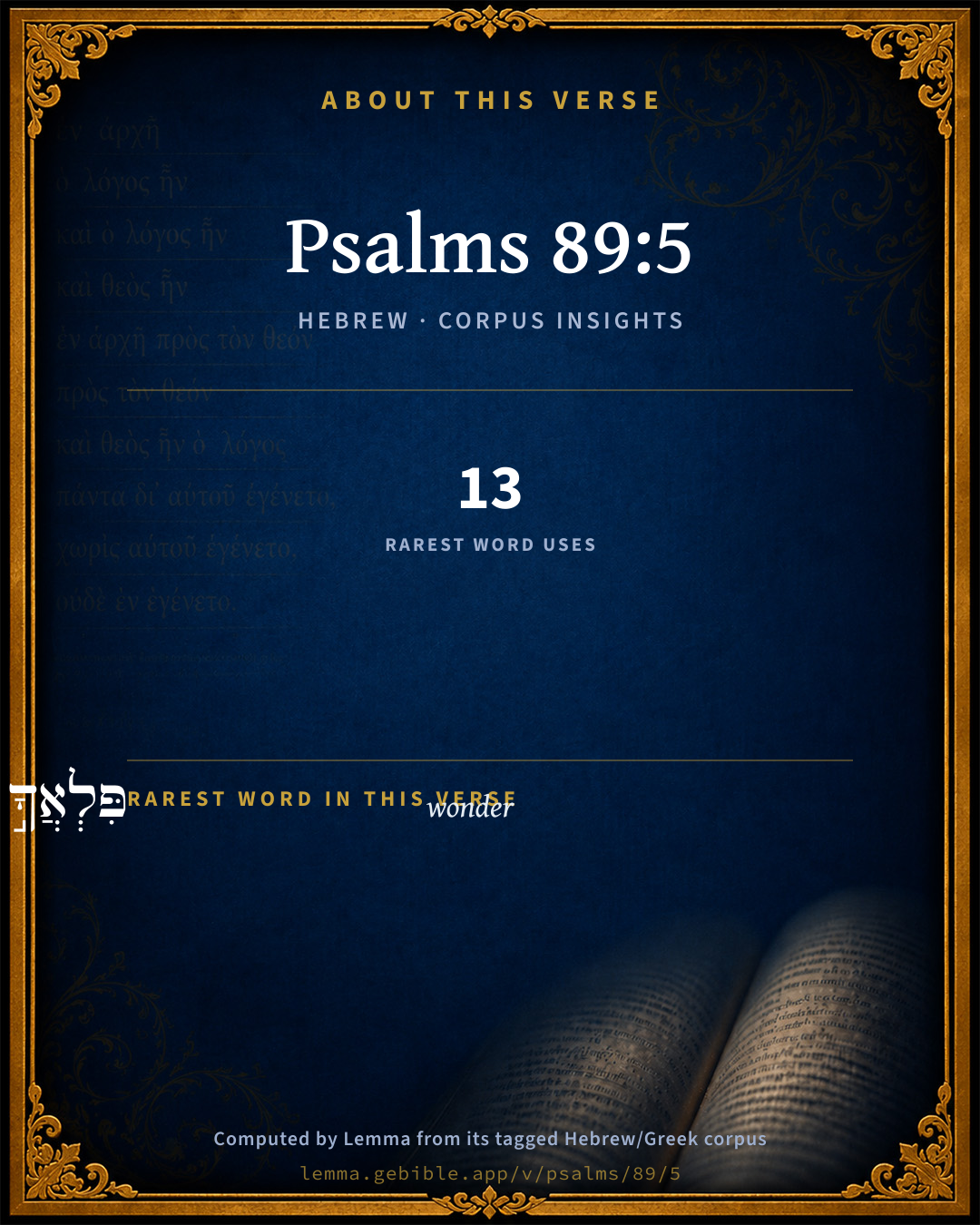
The rarest word here is פִּלְאֲךָ֣ wonder H6382 — appearing just 13 times in the whole Hebrew Bible.

Shared distinctive vocabulary

פִּלְאֲךָ֣ wonder H6382 occurs in 13 verses of the Hebrew Bible. Also found in:

Grammatical profile

  • 1 verb
  • 5 nouns
  • 1 adjective
  • 1 particle

Verb forms

  • וְי֘וֹד֤וּ Hiphil · Imperfect

Hebrew & Septuagint length

In English translation the verse runs 17 words from the Hebrew and 17 from the Septuagint (LXX English) — the same length.

A rough comparison of the two English renderings, which tokenize alike — not a word-level alignment.

Word counts can differ between the Hebrew and the Greek without any difference in meaning — e.g. the Hebrew direct-object marker אֵת has no separate Greek word, and Greek often adds the article ὁ.

Cross-references

17

Topical passages linked to Psalms 89:5 in the Treasury of Scripture Knowledge — connected by theme and wording, ordered by reader-vote popularity; previews shown in the World English Bible.

  • Psalms 97:6 The heavens declare his righteousness. All the peoples have seen his glory.
  • Psalms 19:1 The heavens declare the glory of God. The expanse shows his handiwork.
  • Isaiah 44:23 Sing, you heavens, for Yahweh has done it; shout, you lower parts of the earth; break forth into singing, you mountains, O forest, and every tree therein: for Yahweh has redeemed Jacob, and will glorify himself in Israel.
  • Psalms 50:6 The heavens shall declare his righteousness, For God himself is judge. Selah.
  • 2 Thessalonians 1:7 and to give relief to you that are afflicted with us, when the Lord Jesus is revealed from heaven with his mighty angels in flaming fire,
  • Revelation 7:10–12 They cried with a loud voice, saying, "Salvation be to our God, who sits on the throne, and to the Lamb!"
  • Deuteronomy 33:2 He said, Yahweh came from Sinai, Rose from Seir to them; He shined forth from Mount Paran, He came from the ten thousands of holy ones: At his right hand was a fiery law for them.
  • Job 5:1 "Call now; is there any who will answer you? To which of the holy ones will you turn?
  • Psalms 89:7 A very awesome God in the council of the holy ones, To be feared above all those who are around him?
  • Daniel 7:10 A fiery stream issued and came forth from before him: thousands of thousands ministered to him, and ten thousand times ten thousand stood before him: the judgment was set, and the books were opened.
  • Luke 2:10–15 The angel said to them, "Don't be afraid, for behold, I bring you good news of great joy which will be to all the people.
  • Ephesians 3:10 to the intent that now through the assembly the manifold wisdom of God might be made known to the principalities and the powers in the heavenly places,
  • Hebrews 12:22–23 But you have come to Mount Zion, and to the city of the living God, the heavenly Jerusalem, and to innumerable hosts of angels,
  • 1 Peter 1:12 To them it was revealed, that not to themselves, but to you, did they minister these things, which now have been announced to you through those who preached the Gospel to you by the Holy Spirit sent out from heaven; which things angels desire to look into.
  • Jude 1:14–15 About these also Enoch, the seventh from Adam, prophesied, saying, "Behold, the Lord came with ten thousands of his holy ones,
  • Revelation 5:11–14 I saw, and I heard something like a voice of many angels around the throne, the living creatures, and the elders; and the number of them was ten thousands of ten thousands, and thousands of thousands;
  • Revelation 19:1–6 After these things I heard something like a loud voice of a great multitude in heaven, saying, "Hallelujah! Salvation, power, and glory belong to our God:

Cross-references courtesy of OpenBible.info (CC BY 4.0).

Hebrew and Greek witnesses Masoretic Hebrew ↔ Greek Septuagint

The same verse in the two great witnesses to the Old Testament, shown verse-for-verse.

You’re reading Greek Psalm 88 (Hebrew Psalm 89). The Septuagint counts the superscription, so verse numbers can differ from the Hebrew — chapter-level alignment, not verse-by-verse. Numbering follows Rahlfs.

These are two independent witnesses, not word-aligned to each other, and the Septuagint is shown in lemma (dictionary) form.

Hebrew Psalms 89:5 Masoretic · Westminster Leningrad Codex

וְי֘וֹד֤וּ שָׁמַ֣יִם פִּלְאֲךָ֣ יְהוָ֑ה אַף אֱ֝מֽוּנָתְךָ֗ בִּקְהַ֥ל קְדֹשִֽׁים

The heavens will praise your wonders, Yahweh; Your faithfulness also in the assembly of the holy ones.

World English Bible · Public Domain

Greek LXX Greek Psalm 88:5 Septuagint · lemma form

ἕως ὁ αἰών ἑτοιμάζω ὁ σπέρμα σύ καί οἰκοδομέω εἰς γενεά καί γενεά ὁ θρόνος σύ διάψαλμα

The heavens shall declare your wonders, O Lord; and your truth in the assembly of the saints.

LXX2012 (modern English Septuagint) · Public Domain

On this verse, John Gill's Exposition discusses the Septuagint’s reading. Read the note in Commentary ↓

Hebrew: Westminster Leningrad Codex (CC BY 4.0). Greek: Septuagint (public domain); English from LXX2012 (modern English Septuagint) (Public Domain). How the Septuagint differs from the Hebrew →

Commentary

Notes on Psalms 89:5 from classic Christian and Jewish commentators (each source and its license shown beneath its notes). The classic Christian expositions comment on the surrounding passage and are grouped to its opening verse, so a note may address several verses; the Jewish commentaries on the Tanakh (Rashi and others) are per-verse, so they appear only where the commentator wrote on this verse.

Lemma curates 59 commentaries, every one of them public domain or Creative Commons licensed, each selected and text-cleaned for this edition rather than reprinted as found. About our sources →

Matthew Henry's Commentary

These verses are full of the praises of God. Observe,

I. Where, and by whom, God is to be praised. 1. God is praised by the angels above: The heavens shall praise thy wonders, O Lord! Psa 89:5; that is, "the glorious inhabitants of the upper world continually celebrate thy praises." Bless the Lord, you his angels, Psa 103:20. The works of God are wonders even to those that are best acquainted and most intimately conversant with them; the more God's works are known the more they are admired and praised. This should make us love heaven, and long to be there, that there we shall have nothing else to do but to praise God and his wonders. 2. God is praised by the assemblies of his saints on earth (praise waits for him in Zion); and, though their praises fall so far short of the praises of angels, yet God is pleased to take notice of them, and accept of them, and reckon himself honoured by them. "Thy faithfulness and the truth of thy promise, that rock on which the church is built, shall be praised in the congregation of the saints, who owe their all to that faithfulness, and whose constant comfort it is that there is a promise, and that he is faithful who has promised." It is expected from God's saints on earth that they praise him; who should, if they do not? Let every saint praise him, but especially the congregation of saints; when they come together, let them join in praising God. The more the better; it is the more like heaven. Of the honour done to God by the assembly of the saints he speaks again (Psa 89:7): God is greatly to be feared in the assembly of the saints. Saints should assemble for religious worship, that they may publicly own their relation to God and may stir up one another to give honour to him, and, in keeping up communion with God, may likewise maintain the communion of saints. In religious assemblies God has promised the presence of his grace, but we must also, in them, have an eye to his glorious presence, that the familiarity we are admitted to may not breed the least contempt; for he is terrible in his holy places, and therefore greatly to be feared. A holy awe of God must fall upon us, and fill us, in all our approaches to God, even in secret, to which something may very well be added by the solemnity of public assemblies. God must be had in reverence of all that are about him, that attend him continually as his servants or approach him upon any particular errand. See Lev 10:3. Those only serve God acceptably who serve him with reverence and godly fear, Heb 12:28.

II. What it is to praise God; it is to acknowledge him to be a being of unparalleled perfection, such a one that there is none like him, nor any to be compared with him, Psa 89:6. If there be any beings that can pretend to vie with God, surely they must be found among the angels; but they are all infinitely short of him: Who in the heaven can be compared with the Lord, so as to challenge any share of the reverence and adoration which are due to him only, or to set up in rivalship with him for the homage of the children of men? They are sons of the mighty, but which of them can be likened unto the Lord? Nobles are princes' peers; some parity there is between them. But there is none between God and the angels; they are not his peers. To whom will you liken me, or shall I be equal? saith the Holy One, Isa 40:25. This is insisted on again (Psa 89:8): Who is a strong Lord like unto thee? No angel, no earthly potentate, whatsoever, is comparable to God, or has an arm like him, or can thunder with a voice like him. Thy faithfulness is round about thee; that is, "thy angels who are round about thee, attending thee with their praises and ready to go on thy errands, are all faithful." Or, rather, "In every thing thou doest, on all sides, thou approvest thyself faithful to thy word, above whatever prince or potentate was." Among men it is too often found that those who are most able to break their word are least careful to keep it; but God is both strong and faithful; he can do every thing, and yet will never do an unjust thing.

III. What we ought, in our praises, to give God the glory of. Several things are here mentioned. 1. The command God has of the most ungovernable creatures (Psa 89:9): Thou rulest the raging of the sea, than which nothing is more frightful or threatening, nor more out of the power of man to give check to; it can swell no higher, roll no further, beat no harder, continue no longer, nor do any more hurt, than God suffers it. "When the waves thereof arise thou canst immediately hush them asleep, still them, and make them quiet, and turn the storm into a calm." This coming in here as an act of omnipotence, what manner of man then was the Lord Jesus, whom the winds and seas obeyed? 2. The victories God has obtained over the enemies of his church. His ruling the raging of the sea and quelling its billows was an emblem of this (Psa 89:10): Thou hast broken Rahab, many a proud enemy (so it signifies), Egypt in particular, which is sometimes called Rahab, broken it in pieces, as one that is slain and utterly unable to make head again. "The head being broken, thou hast scattered the remainder with the arm of thy strength." God has more ways than one to deal with his and his church's enemies. We think he should slay them immediately, but sometimes he scatters them, that he may send them abroad to be monuments of his justice, Psa 59:11. The remembrance of the breaking of Egypt in pieces is a comfort to the church, in reference to the present power of Babylon; for God is still the same. 3. The incontestable property he has in all the creatures of the upper and lower world (Psa 89:11, Psa 89:12): "Men are honoured for their large possessions; but the heavens are thine, O Lord! the earth also is thine; therefore we praise thee, therefore we trust in thee, therefore we will not fear what man can do against us. The world and the fulness thereof, all the riches contained in it, all the inhabitants of it, both the tenements and the tenants, are all thine; for thou hast founded them," and the founder may justly claim to be the owner. He specifies, (1.) The remotest parts of the world, the north and south, the countries that lie under the two poles, which are uninhabited and little known: "Thou hast created them, and therefore knowest them, takest care of them, and hast tributes of praise from them." The north is said to be hung over the empty place; yet what fulness there is there God is the owner of it. (2.) The highest parts of the world. He mentions the two highest hills in Canaan - "Tabor and Hermon" (one lying to the west, the other to the east); "these shall rejoice in thy name, for they are under the care of thy providence, and they produce offerings for thy altar." The little hills are said to rejoice in their own fruitfulness, Psa 65:12. Tabor is commonly supposed to be that high mountain in Galilee on the top of which Christ was transfigured; and then indeed it might be said to rejoice in that voice which was there heard, This is my beloved Son. 4. The power and justice, the mercy and truth, with which he governs the world and rules in the affairs of the children of men, Psa 89:13, Psa 89:14. (1.) God is able to do every thing; for his is the Lord God Almighty. His arm, his hand, is mighty and strong, both to save his people and to destroy his and their enemies; none can either resist the force or bear the weight of his mighty hand. High is his right hand, to reach the highest, even those that set their nests among the stars (Amo 9:2, Amo 9:3; Oba 1:4); his right hand is exalted in what he has done, for in thousands of instances he has signalized his power, Psa 118:16. (2.) He never did, nor ever will do, any thing that is either unjust or unwise; for righteousness and judgment are the habitation of his throne. None of all his dictates or decrees ever varied from the rules of equity and wisdom, nor could ever any charge God with unrighteousness or folly. Justice and judgment are the preparing of his throne (so some), the establishment of it, so others. The preparations for his government in his counsels from eternity, and the establishment of it in its consequences to eternity, are all justice and judgment. (3.) He always does that which is kind to his people and consonant to the word which he has spoken: "Mercy and truth shall go before thy face, to prepare thy way, as harbingers to make room for thee - mercy in promising, truth in performing - truth in being as good as thy word, mercy in being better." How praiseworthy are these in great men, much more in the great God, in whom they are in perfection!

Matthew Henry's Commentary on the Whole Bible (1708–1710) — public domain (CC PDM 1.0). Text via the HelloAO Bible API.

Trapp's Complete Commentary

John Trapp

Psa 89:5 And the heavens shall praise thy wonders, O LORD: thy faithfulness also in the congregation of the saints.

Ver. 5. And the heavens shall praise thy wonders] Heb. thy miracle, viz. in their circumgyration (which showeth a first mover), in their embroidery, influences, &c., yielding matter and occasion of praise. And thus, All thy works praise thee, O Lord; but thy saints bless thee, Psa 145:10. And so by heavens here we may understand the angels of heaven (as they are called, Mat 24:36), as by the congregation of saints the Church universal in heaven and earth, by whom God is highly praised for the covenant of grace.

John Trapp, A Commentary or Exposition upon All the Books of the Old and New Testament (1647–1656) — public domain. Text from a community e-Sword module.

The Biblical Illustrator

Joseph S. Exell

Psa_89:5

And, the heavens shall praise Thy wonders, O Lord.

The wondrousness of God

I. His wonderfulness is the inspiration of universal worship. Awe, reverence, amazement, enter into the highest worship, but these could not exist if the object were fully comprehended.

II. His wonderfulness is seen in his faithfulness. How wonderful that He has remained unaltered and unalterable amidst all the changes of nature, all the revolutions of millenniums! Faithful ever, to Himself and His word, no swerving from His promises, no deviations from His plans.

III. His wonderfulness is manifest in his absolute incomparableness. (Isa_40:18; Deu_33:29; Psa_53:10; Psa_71:19.) (Homilist.)

The Biblical Illustrator, edited by Joseph S. Exell (c. 1880s–1900s) — public domain. Text from a community e-Sword module.

J. A. Alexander on Psalms

Joseph Addison Alexander

6. (Psa 89:5) And the heavens acknowledge thy wonders, Jehovah, likewise thy faithfulness (is acknowledged) in the assembly of holy (ones). The promise just cited is entitled to men's confidence, because the omnipotence and faithfulness of Him who uttered it are thankfully acknowledged by superior beings. The parallelism of heavens and holy ones shews that the former are here put for their inhabitants. For the true meaning of the first verb, see above, on Psa 6:5, and for that of the following noun, on Psa 77:11; Psa 88:10. Wonders or miracles are here referred to, as proofs of a mighty power. The and, also, at the beginning of the clauses, have the force of even, yea, in our idiom. The word translated holy ones is entirely different from that usually rendered saints. The latter is always applied to men, the former usually to superior beings, i.e. angels. See Deu 33:2-3, Dan 8:13, Zec 14:5, Job 4:18; Job 15:15.

Joseph Addison Alexander, The Psalms Translated and Explained (1850) — public domain. Text from a community e-Sword module.

Tyndale Open Study Notes

Tyndale Open Resources

89:5-8 God is the absolute standard of faithfulness, commitment, and order. The angelic beings and the heavens testify to his constancy.

89:5 Praise for God’s greatness (see 8:1) comes from the inhabitants of heaven who witness his faithfulness.

Tyndale Open Study Notes — © Tyndale Open Resources, licensed CC BY-SA 4.0. Text via the HelloAO Bible API.

Geneva Bible (1599)

Geneva Bible translators

The Angels shall praise thy power and faithfulness in delivering thy Church.

That is, in the heavens.

Geneva Bible (1599) marginal notes — public domain. Text via Bolls.life.

Adam Clarke's Commentary

Verse 5. The heavens shall praise thy wonders] The works that shall be wrought by this descendant of David shall be so plainly miraculous as shall prove their origin to be Divine: and both saints and angels shall join to celebrate his praises.

Thy faithfulness also] All thy promises shall be fulfilled; and particularly and supereminently those which respect the congregation of the saints-the assemblies of Christian believers.

Adam Clarke's Commentary on the Bible (1810–1826) — public domain. Text from a community e-Sword/MySword module.

John Calvin's Commentaries

5. And the heavens shall praise thy wondrous work. The prophet, having spoken of God’s covenant, even as faith ought to begin at the word, now descends to a general commendation of his works. It is, however, to be observed, that when he treats of the wonderful power of God, he has no other end in view than to exalt and magnify more highly the holiness of the covenant. He exclaims, that this is the God who has rightful claims to be served and feared, who ought to be believed, and upon whose power the most unhesitating confidence may be reposed. The words wondrous work, in the first clause, I would therefore limit to the power which God displays in preserving and maintaining his Church. The heavens, it is true, are most excellent witnesses and preachers of God’s wonderful power; but from attending to the scope of the passage, it will be still more evident, that the encomiums here pronounced have all a special reference to the end of which I have spoken. Some interpreters judiciously explain the word heavens, of the angels, among whom there is a common joy and congratulation in the salvation of the Church. This interpretation is confirmed from the last clause of the verse, in which it is asserted, that God’s truth will be celebrated in the congregation of the saints There is no doubt, that the same subject is here prosecuted, and that by the word truth, it is intended to signalise the remarkable deliverances by which God had manifested his faithfulness to the promises made to his servants.

John Calvin's Commentaries (1540-1563) — public domain. Text from the Calvin Translation Society English edition (1840s-50s) via the Christian Classics Ethereal Library (ccel.org). Calvin's coverage is partial (roughly two-thirds of the Bible); uncommented books and verses are honest gaps, never fabricated. The 19th-century editor's footnotes and remarks are omitted so the notes are faithfully Calvin's own voice.

Ellicott's Commentary for English Readers

(5) The heavens.—Having repeated the Divine promise, the poet appeals to nature and history to confirm his conviction of the enduring character of the truth and grace of God. The heavens are witnesses of it as in Psa_1:4; Psa_1:6; Psa_97:6.

Shall praise.—The present tense would be better.

Wonders.—In the original the word is singular, perhaps as summing up all the covenant faithfulness as one great display of wonder.

Saints.—Here, apparently, not spoken of Israel, but of the hosts above. (See next verse; comp. Job_4:18; Job_15:15 for the same term, “holy ones,” for angels.)

A Bible Commentary for English Readers, edited by Charles John Ellicott (1878–1897) — public domain. Text from a community e-Sword module.

The Cambridge Bible for Schools and Colleges

gen. ed. J. J. S. Perowne

5. The heavens, in contrast to the earth, include the whole celestial order of being. Cp. Psa_19:1; Psa_50:6.

thy wonders] The word in the Heb. is in the singular. It denotes not the wondrousness of God in the abstract, but His wonderful course of action regarded as a whole, of which His ‘wonderful works’ are the several parts. The word conveys the idea of what is mysterious, supernatural, divine. (See on Psa_71:17.) It is especially appropriate here, since the choice of David was a factor in the great plan which was to be consummated in the mystery of the Incarnation. Cp. Isa_9:6.

thy faithfulness &c.] Yea, thy faithfulness in the assembly of the holy ones. It is not the congregation of Israel, but ‘the company of heaven’ that is meant, as in Job_5:1; Job_15:15, where we have the same parallel between ‘heavens’ and ‘holy ones.’ Holy themselves, as supernatural beings (though only relatively holy, Job_15:15), they best know the absolute holiness of God and can praise Him most worthily (Isa_6:3), as they watch the revelation of His wisdom in the unfolding of His purposes of grace (Eph_3:10).

5–7. Jehovah’s incomparableness is ever being celebrated in heaven. The angelic beings, “who best can tell,” as standing nearest to the throne of God, and partaking most of His nature, know that there is none like Him. (Cp. Milton, Par. Lost, Book 89:160, ff.).

5–18. The adoring recital of God’s attributes which follows here has a twofold purpose in relation to the subject of the Psalm. It is a plea with God, and it is an encouragement to Israel. His omnipotence guarantees His ability, His faithfulness is the pledge of His will, to perform His promises to David.

The Cambridge Bible for Schools and Colleges (gen. ed. J. J. S. Perowne; Cambridge University Press, 1878–1918) — public domain. Text from a community e-Sword module.

John Gill's Exposition

For who in the heaven can be compared unto the Lord?.... Or "ranked" (n), or put upon a par, with him; none of the angels in heaven; for though they are holy, wise, knowing, powerful, faithful, kind, and merciful creatures, yet not to be compared with the Lord for holiness, wisdom, knowledge, strength, faithfulness, and mercy; see Exo 15:11,

who among the sons of the mighty can be likened unto the Lord? the Syriac version very wrongly renders it "the sons of angels", seeing angels do not propagate their species, Luk 20:36 to which Kimchi agrees, who makes the "mighty" to be angels, and their sons to be the host of heaven, which are moved and guided by them: the Septuagint, Vulgate Latin, Ethiopic, and Arabic versions, render it "the sons of God"; and this phrase, indeed, is applicable to the angels, Job 38:7, and so the Targum interprets it of the multitude of the angels; but rather the mighty men of the earth, and their children, are meant; princes, nobles, judges, and civil magistrates of all sorts, men of power and authority in the world; there are none of them to be likened to the Lord, who is King of kings, and Lord of lords; see Psa 82:1.

(n) "par aestimetur", Junius & Tremellius; "par aestimabitur", Piscator.

John Gill's Exposition of the Whole Bible (1746–1763) — public domain (CC PDM 1.0). Text via the HelloAO Bible API.

Albert Barnes' Notes on the Bible

And the heavens shall praise thy wonders, O Lord - That is, the inhabitants of heaven shall find new occasion for praise in the faithfulness evinced in carrying out the promise to David, and in the marvelous things which will occur under that promise, and in its accomplishment. If we suppose that this promise embraced the Messiah and his reign, then we shall see what new occasions the angels would find for praise - in the incarnation of the Redeemer, and in all that would be accomplished by him.

Thy faithfulness also in the congregation of the saints - In the assembly of the holy ones; that is, the angels. In their songs of praise, this will be among the things which will fill them with joy. The idea is, that the inhabitants of the heavens - the holy angels - would take a deep interest in the fulfillment of this promise, as it would furnish new manifestations of the character of God. Compare Rev 5:11-14; 1Pe 1:12.

Albert Barnes' Notes on the Bible (1834–1885) — public domain. Text from a community e-Sword/MySword module.

Matthew Poole's English Annotations

The heavens, i.e. the inhabitants of heaven, the holy angels, as Job 15:15; who clearly discern and constantly adore thy mercy and faithfulness, when men upon earth are filled with doubts and perplexities about it.

Thy faithfulness also; understand, shall be praised, out of the foregoing clause; which supplements are most usual in Scripture, as hath been already showed by divers instances.

In the congregation of the saints; either, first, Of thy saints upon earth in their public assemblies; who always acknowledge and celebrate thy truth, although they cannot always discern the footsteps of it. Or rather, secondly, Of the angels of heaven, of whom he speaks in the foregoing clause; who are oft called saints or holy ones, as Deu 33:2; Job 15:15; Dan 4:13,17; 8:13.

Matthew Poole's English Annotations on the Holy Bible (1683–1685) — public domain. Text from a community e-Sword/MySword module.

The Treasury of David

Charles H. Spurgeon

Ver. 5. And the heavens shall praise thy wonders, O Lord. Looking down upon what God had done, and was about to do, in connection with his covenant of grace, all heaven would be filled with adoring wonder. The sun and moon, which had been made tokens of the covenant, would praise God for such an extraordinary display of mercy, and the angels and redeemed spirits would sing, "as it were, a new song."

Thy faithfulness also in the congregation of the saints. By which is probably intended the holy ones on earth. So that the "whole family in heaven and earth" would join in the praise. Earth and heaven are one in admiring and adoring the covenant God. Saints above see most clearly into the heights and depths of divine love, therefore they praise its wonders; and saints below, being conscious of their many sins and multiplied provocations of the Lord, admire his faithfulness. The heavens broke forth with music at the wonders of mercy contained in the glad tidings concerning Bethlehem, and the saints who came together in the temple magnified the faithfulness of God at the birth of the Son of David. Since that auspicious day, the general assembly on high and the sacred congregation below have not ceased to sing unto Jehovah, the Lord that keepeth covenant with his elect.

Ver. 5. The Heavens, etc. Now, for this kingdom of his, the heavens are said to praise his wonders, which is spoken of the angels, who are often called the heavens, from their place; as in Job it is said, "The heavens are not clean in his sight." And these knowing the wonders of that covenant of grace, they, even they are said to praise; "The heavens shall praise thy wonders, O Lord" In the Hebrew it is "thy wonder", or "thy miracle", in the singular number, which, in Eph 3:10, the angels are said to adore: and in

Lu 2:14, to "sing glory to the Highest"; for his grace to man is that miracle. Now the material heavens do not praise the mercy of God, or the grace of God, or the covenant of grace, or the throne of grace that is established in the heavens. They understand nothing of Christ; no, they do not so much as materially give occasion to man to praise God for these: and therefore this is meant of the angels; and most interpreters understand the next words of them: Thy faithfulness also in the congregation of the saints, angels, and the holy ones made perfect, for there the great congregation is. For even in the heavens, who can be compared to the Lord, where all his angels thus do praise him? Who among the sons of the mighty, of all the powers of the earth, can be likened unto the Lord? for he is the "King of kings, and he is the Lord of lords; "a God above all gods, even angels themselves, as elsewhere the Psalmist hath it. And he says not only, There is none like thee; but, Who is like unto thee? his excellency so exceeds. And in Ps 89:7, he is there presented with all his saints and angels round about him, as one that is greatly to be feared, or that is terrible in himself, by reason of his greatness, in this his council and assembly of his saints, and to be had in reverence of all that are about him. For saints and angels, they are of his council in heaven (as might be shewn), and encompass the manifestation of his glory there round about. Thomas Goodwin.

Ver. 5 Thy wonders, etc. As the heavens are a proof of God's power, in respect of his first framing them out of nothing; so are they a pattern of God's faithfulness, in their constant and orderly motion according to his word since their framing: The heavens shall praise thy faithfulness also. However the power and faithfulness of God may be seen and heard in the work and speech of the heavens by all men, yet are they not observed and hearkened unto except in the Church by God's children: therefore saith he, They shall praise thy faithfulness also in the congregation of the saints. David Dickson.

Ver. 5. Thy wonders. Thy wondrousness (literally, wonder), not "Thy wondrous works", but "Thy wonderful mysterious nature and being", as separate and distinct from all created beings. J.J.S. Perowne.

Ver. 5. Thy wonders, etc. It is a wonderful salvation, it is such a salvation as the angels desire to pry into it; and it is such a salvation, that all the prophets desire to pry into it; it is almost six thousand years since all the angels in heaven fell into a sea of wonder at this great salvation; it is almost six thousand years since Abel fell into a sea of wonder at this great salvation; and what think ye is his exercise this day? He is even wondering at this great salvation. Andrew Gray, 1616.

Psalms 89:6*

Charles H. Spurgeon's The Treasury of David (1869–1885) — public domain. Psalms only. Text from a community e-Sword/MySword module.

Whedon's Commentary on the Bible

Daniel D. Whedon

5. The heavens—Here to be understood as the abode of God and his angels, and by metonomy put for the inhabitants of heaven, the angels and saints. From this to Psa_89:14 the perfections of God are confessed, and illustrated by allusions to nature and to history.

Thy faithfulness… in the congregation of the saints—That is, the holy beings in heaven shall celebrate the “faithfulness” of God toward his Church. The idea is parallel to Eph_3:10

Daniel D. Whedon (gen. ed.), Commentary on the Old and New Testaments (1874–1909) — public domain. Text from a community e-Sword module.

The Pulpit Commentary

Vers. 5-37. The psalmist carries out the intention proclaimed in ver. 1, and proceeds to "sing of the mercies of the Lord" at great length. His song of praise divides into two portions. From ver. 5 to ver. 18 it is a general laudation of the Almighty for his greatness in heaven (vers. 5-7), in nature (vers. 9, 11, 12), and in the course of his rule on earth (vers. 10, 13-18), after which it passes into a laudation of him in respect of what he had done, and what he had promised, to David (vers. 19-37).

And the heavens shall praise thy wonders, O Lord. "The heavens" here are not the material heavens, as in Psa_19:1, but the company of the dwellers in heaven. God"s praise fittingly begins with them. Thy faithfulness also in the congregation of the saints. The "congregation of the saints" is the company of angels. (comp. Job_5:1 Job_15:15) Not on earth only (vers. 1, 2), but in heaven also God"s "faithfulness" is the theme of song.

The Lord"s saints.

The Bible writers seem to think that the angels must be referred to by this term. But God"s people are certainly called "saints" in the Psalms, as in Psa_116:15. There may be intended a contrast between heaven and earth in this verse. Heaven above and the earth below unite to praise the faithfulness of God. The term "saints" is one that we find difficult to apply, in a general way, to God"s people, because it seems to assume an actual and perfect holiness, which we can neither find in ourselves nor ascribe to others. And, on the other hand, the term "saints" has been deteriorated by its application to the hermit class, who, by bodily austerities, have endeavoured to cleanse away sin and master passion. We have but little admiration for "saints" after that pattern. The Old Testament term has a clear, well defined meaning. Its idea is "separated ones." It stands for all the people of Israel regarded as separated unto God his peculiar people. Then as "holiness" is specially associated with God, and is his supreme requirement of those who belong to him, God"s saints, or separated ones, come to be thought of as "holy ones," and so we get our modern idea of the saint. Giving the widest, and yet most searching, application of the term, we may say

I THE LORD"S SAINTS ARE THOSE WHO ARE SEPARATED FROM SELF. Illustrate this by the contrast of the Israelite nation with the Gentile nations. God left the Gentiles to a free experiment. By self-effort and self-service they were to win the highest possibilities of humanity, if they could. Israel was taken out of this self-experiment, separated from the nations and from the self-service. So now the Christian is the man who, in the world of self-interests, is separated from the self-seeking principle. The Christian"s Lord "pleased not himself." Christians do not "seek their own." Their saintliness ties in this: "By love they serve one another.

II THE LORD"S SAINTS ARE THOSE WHO ARE SEPARATED UNTO GOD.

(1) That they may praise his Name;

(2) carry out his mission;

(3) witness for his truth;

(4) obey his will;

(5) catch and reflect his Spirit.

So their saintliness comes to be godliness, God-likeness, and this really is Christliness, Christ-likeness. The Christian saint is the man in Christ. R.T.

The Pulpit Commentary (1880–1919), ed. H.D.M. Spence-Jones & Joseph S. Exell — public domain. Text from a community e-Sword module.

John Wesley's Explanatory Notes

Heavens - The inhabitants of heaven. Faithfulness - Understand, shall be praised; which supplements are usual in scripture.

John Wesley, Explanatory Notes Upon the Whole Bible (1754–1765) — public domain. Text via the GEBible commentary corpus.

Keil & Delitzsch

C. F. Keil & F. Delitzsch

At the close of the promises in Psa 89:4-5 the music is to become forte. And ויודוּ attaches itself to this jubilant Sela. In Psa 89:6-19 there follows a hymnic description of the exalted majesty of God, more especially of His omnipotence and faithfulness, because the value of the promise is measured by the character of the person who promises. The God of the promise is He who is praised by the heavens and the holy ones above. His way of acting is פלא, of a transcendent, paradoxical, wondrous order, and as such the heavens praise it; it is praised (יודו, according to Ges. 137, 3) in the assembly of the holy ones, i.e., of the spirits in the other world, the angels (as in Job 5:1; Job 15:15, cf. Deu 33:2), for He is peerlessly exalted above the heavens and the angels. שׁחק, poetic singular instead of שׁחקים (vid., supra on Psa 77:18), which is in itself already poetical; and ערך, not, as e.g., in Isa 40:18, in the signification to co-ordinate, but in the medial sense: to rank with, be equal to. Concerning בּני אלים, vid., on Psa 29:1. In the great council (concerning סוד, of both genders, perhaps like כּוס, vid., on Psa 25:14) of the holy ones also, Jahve is terrible; He towers above all who are about Him (Kg1 22:19, cf. Dan 7:10) in terrible majesty. רבּה might, according to Psa 62:3; Psa 78:15, be an adverb, but according to the order of the words it may more appropriately be regarded as an adjective; cf. Job 31:34, כּי אערץ המון רבּה, "when I feared the great multitude." In Psa 89:9 He is apostrophized with אלהי צבאות as being the One exalted above the heavens and the angels. The question "Who is as Thou?" takes its origin from Exo 15:11. חסין is not the construct form, but the principal form, like גּביר, ידיד, עויל ,יד, and is a Syriasm; for the verbal stem Syr. hṣan is native to the Aramaic, in which Syr. haṣı̄nā' = שׁדּי. In יהּ, what God is is reduced to the briefest possible expression (vid., Psa 68:19). In the words, "Thy faithfulness compasseth Thee round about," the primary thought of the poet again breaks through. Such a God it is who has the faithfulness with which He fulfils all His promises, and the promises given to the house of David also, as His constant surrounding. His glory would only strike one with terror; but the faithfulness which encompasses Him softens the sunlike brilliancy of His glory, and awakens trust in so majestic a Ruler.

Keil & Delitzsch — Biblical Commentary on the Old Testament (1861–1891) — public domain (CC PDM 1.0). Text via the HelloAO Bible API. (Old Testament only.)

unfoldingWord translationNotes

Door43 World Missions Community

The heavens praise

Here "heavens" represents those who are in heaven. (See: Metonymy)

praise your wonders, Yahweh

"praise you, Yahweh, because of the wonderful things you do"

your truthfulness is praised in the assembly of the holy ones

The abstract noun "truthfulness" can be stated as "you always do what you promise to do." This can also be stated in active form. AT: "The assembly of the holy ones praises you because you always do what you promise to do" (See: Active or Passive and Active or Passive)

the assembly of the holy ones

This refers to the angels in heaven.

For who in the skies can be compared to Yahweh? Who among the sons of the gods is like Yahweh?

Both questions mean the same thing. The writer is using question to emphasize that there in no one in heaven like Yahweh. (See: Parallelism and Rhetorical Question)

sons of the gods

Here "sons of" means having the characteristics of. This is a way of referring to other spiritual beings that live in heaven. AT: "angels" or "divine beings" (See: Idiom)

translationWords

heaven

praise

Yahweh

miracle

assembly

Holy One

sons of God

unfoldingWord translationNotes — © Distant Shores Media and the Door43 World Missions Community, licensed CC BY-SA 4.0. Source: git.door43.org/Door43/en_tn.

Lesson kit

Teaching starters — assembled from the data on this page, not authored interpretation. Every prompt links to the verse data it draws on. Edit before teaching.

Psalms, in the Wisdom, opens this verse with 8 words (8 distinct Hebrew lemmas). Its most distinctive word is peleʼ (“wonder”). A historical commentator’s framing appears above. Read the whole chapter for the surrounding context.

Discussion questions

  1. What does “wonder” (peleʼ) contribute to the verse as a whole?
  2. Exodus 15:11 shares the word «wonder» with this verse. How do the two illuminate each other?
  3. These translations render this verse differently; the difference is in the English rendering, not the original. What questions does that raise?
  4. The verb «וְי֘וֹד֤וּ» is Hiphil Imperfect. How does its form color the action?
  5. Reading how Matthew Henry's Commentary and Trapp's Complete Commentary read this verse, where do the two commentators agree and where do they part?

Things to notice

Reading settings

Reading text

Shown beneath each verse's original-language words.

Old Testament
Old Testament edition

Read the OT as the Masoretic Hebrew (MT) or the Greek Septuagint (LXX).

English shown for the Greek Septuagint (in the Hebrew ↔ Greek comparison).

Comparing translations? Open the Compare panel on any verse page to stack up to four side by side.