
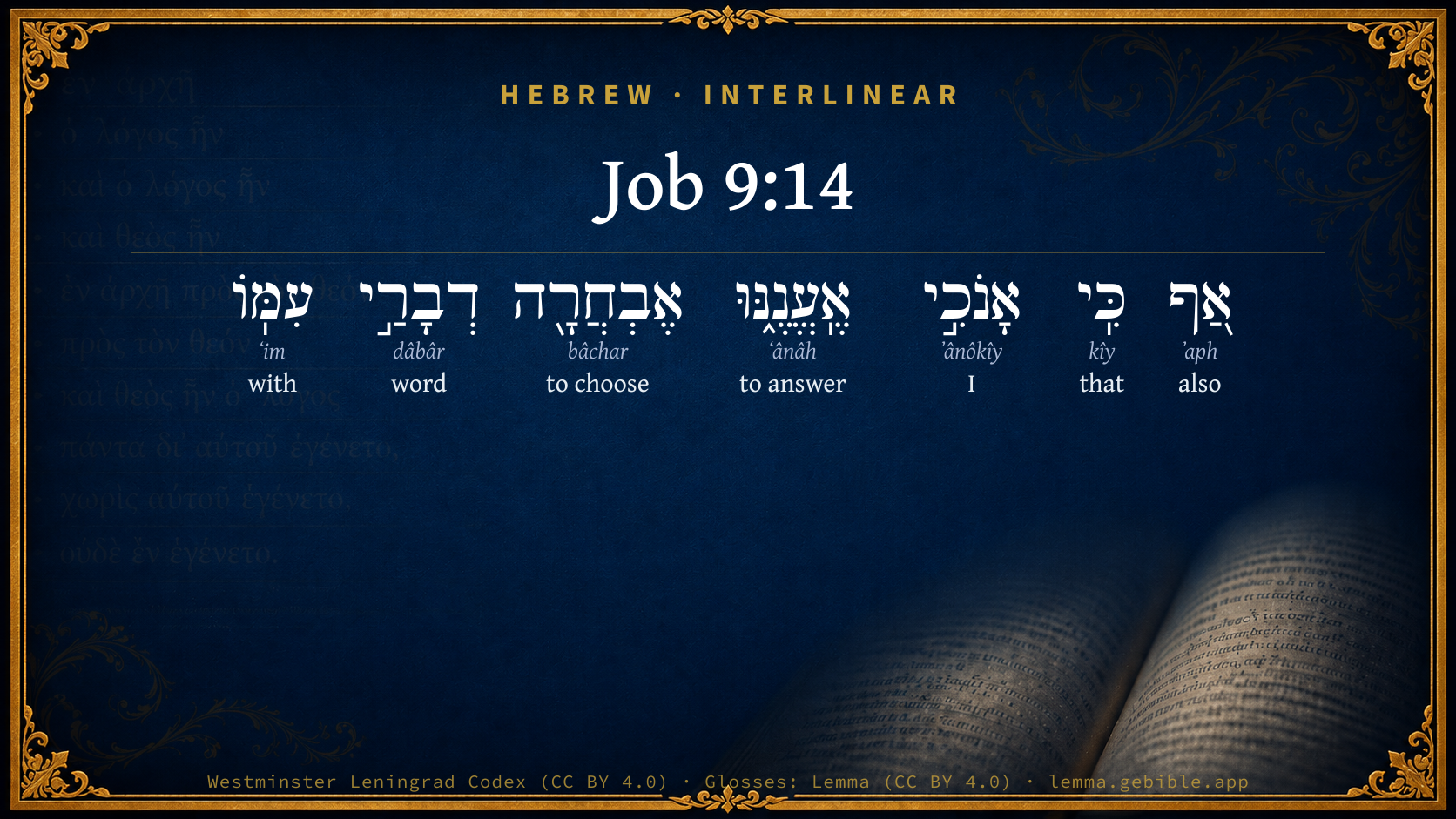
Job 9:14

Hebrew (Westminster Leningrad Codex) Job 9:14 appears in the Hebrew Old Testament. The text above is from the Westminster Leningrad Codex. Each word links to its Strong’s number, a concise gloss, and parsing drawn from the Open Scriptures Hebrew Bible morphology. Click any word for its full Brown-Driver-Briggs (BDB) entry.
Download image
Cite this verse

Job 9:14 (World English Bible). Public Domain. Lemma interlinear Bible study tool, https://lemma.gebible.app/v/job/9/14.

Show BibTeX & RIS
BibTeX
RIS
English Translation
How much less shall I answer him, Choose my words to argue with him?
World English Bible · Public Domain
Download a study sheet

One document with this verse’s original text, its word-by-word gloss line, the meaning frame, cross-references with their text, attributed commentary, and full source and license credits — printable, and it pastes into notes with its structure intact.

This verse Autodidact and up

Study sheet (.html) Plain text (.txt)

A passage Seminary Student

Up to 50 verses in one chapter. A passage sheet keeps up to 6 commentary sources and 12 cross-references per verse, in the order this page ranks them, and says so on the sheet whenever that leaves anything out. Ask for a single verse and you get the Autodidact verse sheet above.

Everything on this page stays free to read, with no account — the sheet is a download of what is already on screen, not access to it.

Want to remove ads? Support Godless Engineer
Compare translations 3

The same verse in 3 English versions, stacked beneath the original-language interlinear above. Click any original word for its lexicon entry.

Each is an independent rendering of the whole verse — the interlinear is not word-aligned to these translations.

Highlighted words mark where these versions differ — a whole-verse word diff, not a word-by-word alignment.

  • World English Bible Public Domain
    How much less shall I answer him, Choose my words to argue with him?
  • King James Version Public Domain
    How much less shall I answer him, and choose out my words to reason with him?
  • unfoldingWord Literal Text CC BY-SA 4.0
    Indeed that I will answer him, choose words with him!—

unfoldingWord Literal Text — © unfoldingWord, licensed CC BY-SA 4.0. Word-aligned USFM3 via Door43 (git.door43.org/unfoldingWord/en_ult).

Versions to compare (up to 4)

3 of 4 selected

Show all 18 translations

Every available English version of this verse, each an independent rendering of the whole verse.

  • World English Bible Public Domain
    How much less shall I answer him, Choose my words to argue with him?
  • Berean Standard Bible Public Domain
    How then can I answer Him or choose my arguments against Him?
  • Majority Standard Bible Public Domain
    How then can I answer Him or choose my arguments against Him?
  • King James Version Public Domain
    How much less shall I answer him, and choose out my words to reason with him?
  • American Standard Version (1901) Public Domain
    How much less shall I answer him, And choose out my words `to reason' with him?
  • Revised Version (1885) Public Domain
    How much less shall I answer him, and choose out my words to reason with him?
  • Geneva Bible (1599) Public Domain
    Howe much lesse shall I answere him? or howe should I finde out my words with him?
  • Douay-Rheims (1899) Public Domain
    What am I then, that I should answer him, and have words with him?
  • Young's Literal Translation Public Domain
    How much less do I -- I answer Him? Choose out my words with Him?
  • Literal Standard Version CC BY-SA 4.0
    How much less do I answer Him? Choose out my words with Him?
  • Unlocked Literal Bible CC BY-SA 4.0
    How much less could I answer him, could I choose words to reason with him?
  • unfoldingWord Literal Text CC BY-SA 4.0
    Indeed that I will answer him, choose words with him!—
  • Darby Bible Public Domain
    How much less shall I answer him, choose out my words [to strive] with him?
  • World Messianic Bible Public Domain
    How much less will I answer him, and choose my words to argue with him?
  • Webster's Bible Public Domain
    How much less shall I answer him, and choose out my words to reason with him?
  • Free Bible Version CC BY-SA 4.0
    So how much less could I answer God, or choose my words to argue with him!
  • Bible in Basic English Public Domain
    How much less may I give an answer to him, using the right words in argument with him?
  • JPS Tanakh (1917) Public Domain
    How much less shall I answer Him, and choose out my arguments with Him?

Literal Standard Version (2020), Covenant Press — licensed CC BY-SA 4.0. Text via the HelloAO Bible API (eBible.org). Unlocked Literal Bible (unfoldingWord) — licensed CC BY-SA 4.0. Text via the HelloAO Bible API (eBible.org). unfoldingWord Literal Text — © unfoldingWord, licensed CC BY-SA 4.0. Word-aligned USFM3 via Door43 (git.door43.org/unfoldingWord/en_ult). Free Bible Version, Dr. Jonathan Gallagher — licensed CC BY-SA 4.0. Text via the HelloAO Bible API (eBible.org).

Word by word

More ways to search: Search by grammar → Find every occurrence → Compare this word →

Practice this passage: Drill this verse → Learn its vocabulary →

About this verse

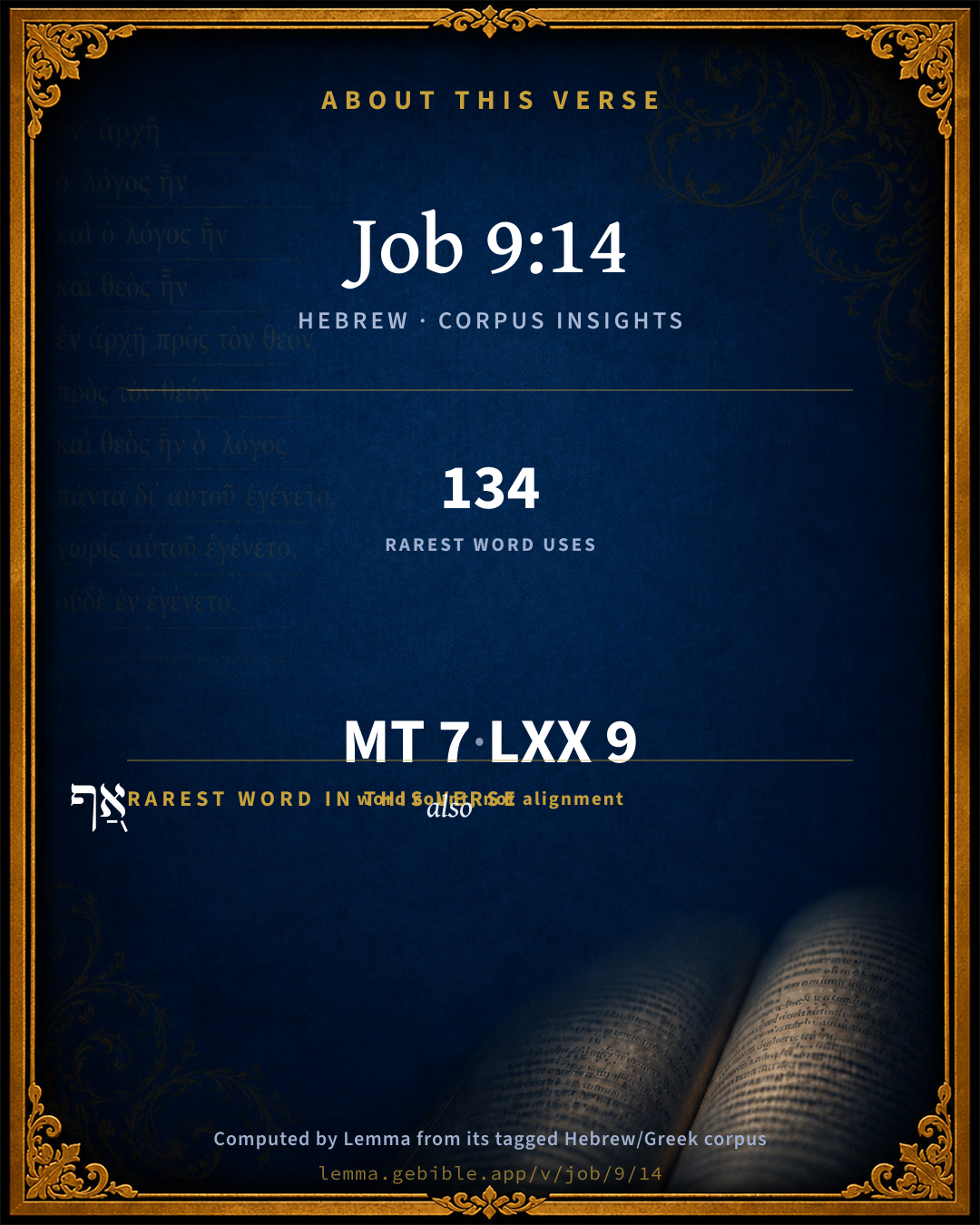
These counts appear in no published source. They are computed here, from the morphology-tagged text and Lemma’s own curated glosses. What Lemma adds →

7
words
7
distinct lemmas
Wisdom
section

Grammatical profile

  • 2 verbs
  • 1 noun
  • 1 pronoun
  • 1 preposition
  • 1 conjunction
  • 1 particle

Verb forms

  • אֶֽעֱנֶ֑נּוּ Qal · Imperfect
  • אֶבְחֲרָ֖ה Qal · Cohortative

Hebrew & Septuagint length

In English translation the verse runs 14 words from the Hebrew and 12 from the Septuagint (LXX English) — closely comparable.

A rough comparison of the two English renderings, which tokenize alike — not a word-level alignment.

Word counts can differ between the Hebrew and the Greek without any difference in meaning — e.g. the Hebrew direct-object marker אֵת has no separate Greek word, and Greek often adds the article ὁ.

In the original languages it is 7 Hebrew tokens and 9 Greek tokens — but the two are counted differently (Hebrew bundles its prefixes and suffixes into one token; the Greek is in lemma form), so that isn’t a like-for-like length.

Cross-references

8

Topical passages linked to Job 9:14 in the Treasury of Scripture Knowledge — connected by theme and wording, ordered by reader-vote popularity; previews shown in the World English Bible.

  • 1 Kings 8:27 But will God in very deed dwell on the earth? behold, heaven and the heaven of heavens can't contain you; how much less this house that I have built!
  • Job 4:19 How much more, those who dwell in houses of clay, Whose foundation is in the dust, Who are crushed before the moth!
  • Job 9:3 If he is pleased to contend with him, He can't answer him one time in a thousand.
  • Job 11:4–5 For you say, 'My doctrine is pure, I am clean in your eyes.'
  • Job 23:4 I would set my cause in order before him, And fill my mouth with arguments.
  • Job 23:7 There the upright might reason with him, So I should be delivered forever from my judge.
  • Job 25:6 How much less man, who is a worm! The son of man, who is a worm!"
  • Job 33:5 If you can, answer me; Set your words in order before me, and stand forth.

Cross-references courtesy of OpenBible.info (CC BY 4.0).

Hebrew and Greek witnesses Masoretic Hebrew ↔ Greek Septuagint

The same verse in the two great witnesses to the Old Testament, shown verse-for-verse.

These are two independent witnesses, not word-aligned to each other, and the Septuagint is shown in lemma (dictionary) form.

Hebrew Job 9:14 Masoretic · Westminster Leningrad Codex

אַ֭ף כִּֽי אָנֹכִ֣י אֶֽעֱנֶ֑נּוּ אֶבְחֲרָ֖ה דְבָרַ֣י עִמּֽוֹ

How much less shall I answer him, Choose my words to argue with him?

World English Bible · Public Domain

Greek LXX Job 9:14 Septuagint · lemma form

ἐάν δέ ἐγώ ὑποἀκούω ἦ διακρίνω ὁ ῥῆμα ἐγώ

Oh then that he would listen to me, or judge my cause.

LXX2012 (modern English Septuagint) · Public Domain

Hebrew: Westminster Leningrad Codex (CC BY 4.0). Greek: Septuagint (public domain); English from LXX2012 (modern English Septuagint) (Public Domain). How the Septuagint differs from the Hebrew →

Commentary

Notes on Job 9:14 from classic Christian and Jewish commentators (each source and its license shown beneath its notes). The classic Christian expositions comment on the surrounding passage and are grouped to its opening verse, so a note may address several verses; the Jewish commentaries on the Tanakh (Rashi and others) are per-verse, so they appear only where the commentator wrote on this verse.

Lemma curates 59 commentaries, every one of them public domain or Creative Commons licensed, each selected and text-cleaned for this edition rather than reprinted as found. About our sources →

Matthew Henry's Commentary

What Job had said of man's utter inability to contend with God he here applies to himself, and in effect despairs of gaining his favour, which (some think) arises from the hard thoughts he had of God, as one who, having set himself against him, right or wrong, would be too hard for him. I rather think it arises from the sense he had of the imperfection of his own righteousness, and the dark and cloudy apprehensions which at present he had of God's displeasure against him.

I. He durst not dispute with God (Job 9:14): "If the proud helpers do stoop under him, how much less shall I (a poor weak creature, so far from being a helper that I am very helpless) answer him? What can I say against that which God does? If I go about to reason with him, he will certainly be too hard for me." If the potter make the clay into a vessel of dishonour, or break in pieces the vessel he has made, shall the clay or the broken vessel reason with him? So absurd is the man who replies against God, or thinks to talk the matter out with him. No, let all flesh be silent before him.

II. He durst not insist upon his own justification before God. Though he vindicated his own integrity to his friends, and would not yield that he was a hypocrite and a wicked man, as they suggested, yet he would never plead it as his righteousness before God. "I will never venture upon the covenant of innocency, nor think to come off by virtue of that." Job knew so much of God, and knew so much of himself, that he durst not insist upon his own justification before God.

1. He knew so much of God that he durst not stand a trial with him, Job 9:15-19. He knew how to make his part good with his friends, and thought himself able to deal with them; but, though his cause had been better than it was, he knew it was to no purpose to debate it with God. (1.) God knew him better than he knew himself and therefore (Job 9:15), "Though I were righteous in my own apprehension, and my own heart did not condemn me, yet God is greater than my heart, and knows those secret faults and errors of mine which I do not and cannot understand, and is able to charge me with them, and therefore I would not answer." St. Paul speaks to the same purport: I know nothing by myself, am not conscious to myself of any reigning wickedness, and yet I am not hereby justified, Co1 4:4. "I dare not put myself upon that issue, lest God should charge that upon me which I did not discover in myself." Job will therefore wave that plea, and make supplication to his Judge, that is, will cast himself upon God's mercy, and not think come off by his own merit. (2.) He had no reason to think that there was anything in his prayers to recommend them to the divine acceptance, or to fetch in an answer of peace, no worth or worthiness at all to which to ascribe their success, but it must be attributed purely to the grace and compassion of God, who answers before we call and not because we call, and gives gracious answers to our prayers, but not for our prayers (Job 9:16): "If I had called, and he had answered, had given the thing I called to him for, yet, so weak and defective are my best prayers, that I would not believe he had therein hearkened to my voice; I could not say that he had saved with his right hand and answered me" (Psa 60:5), "but that he did it purely for his own name's sake." Bishop Patrick expounds it thus: "If I had made supplication, and he had granted my desire, I would not think my prayer had done the business." Not for your sakes, be it known to you. (3.) His present miseries, which God had brought him into notwithstanding his integrity, gave him too sensible a conviction that, in the ordering and disposing of men's outward condition in this world, God acts by sovereignty, and, though he never does wrong to any, yet he does not ever give full right to all (that is, the best do not always fare best, nor the worst fare worst) in this life, because he reserves the full and exact distribution of rewards and punishments for the future state. Job was not conscious to himself of any extraordinary guilt, and yet fell under extraordinary afflictions, Job 9:17, Job 9:18. Every man must expect the wind to blow upon him and ruffle him, but Job was broken with a tempest. Every man, in the midst of these thorns and briers, must expect to be scratched; but Job was wounded, and his wounds were multiplied. Every man must expect a cross daily, and to taste sometimes of the bitter cup; but poor Job's troubles came so thickly upon him that he had no breathing time, and he was filled with bitterness. And he presumes to say that all this was without cause, without any great provocation given. We have made the best of what Job said hitherto, though contrary to the judgment of many good interpreters; but here, no doubt, he spoke unadvisedly with his lips; he reflected on God's goodness in saying that he was not suffered to take his breath (while yet he had such good use of his reason and speech as to be able to talk thus) and on his justice in saying that it was without cause. Yet it is true that as, on the one hand, there are many who are chargeable with more sin than the common infirmities of human nature, and yet feel no more sorrow than that of the common calamities of human life, so, on the other hand, there are many who feel more than the common calamities of human life and yet are conscious to themselves of no more than the common infirmities of human nature. (4.) He was in no capacity at all to make his part good with God, Job 9:19. [1.] Not by force of arms. "I dare not enter the lists with the Almighty; for if I speak of strength, and think to come off by that, lo, he is strong, stronger than I, and will certainly overpower me." There is no disputing (said one once to Caesar) with him that commands legions. Much less is there any with him that has legions of angels at command. Can thy heart endure (thy courage and presence of mind) or can thy hands be strong to defend thyself, in the days that I shall deal with thee? Eze 22:14. [2.] Not by force of arguments. "I dare not try the merits of the cause. If I speak of judgment, and insist upon my right, who will set me a time to plead? There is no higher power to which I may appeal, no superior court to appoint a hearing of the cause; for he is supreme and from him proceeds every man's judgment, which he must abide by."

2. He knew so much of himself the he durst not stand a trial, Job 9:20, Job 9:21. "If I go about to justify myself, and to plead a righteousness of my own, my defence will be my offence, and my own mouth shall condemn me even when it goes about to acquit me." A good man, who knows the deceitfulness of his own heart, and is jealous over it with a godly jealousy, and has often discovered that amiss there which had long lain undiscovered, is suspicious of more evil in himself than he is really conscious of, and therefore will by no means think of justifying himself before God. If we say we have no sin, we not only deceive ourselves, but we affront God; for we sin in saying so, and give the lie to the scripture, which has concluded all under sin. "If I say, I am perfect, I am sinless, God has nothing to lay to my charge, my very saying so shall prove me perverse, proud, ignorant, and presumptuous. Nay, though I were perfect, though God should pronounce me just, yet would I not know my soul, I would not be in care about the prolonging of my life while it is loaded with all these miseries." Or, "Though I were free from gross sin, though my conscience should not charge me with any enormous crime, yet would I not believe my own heart so far as to insist upon my innocency nor think my life worth striving for with God." In short, it is folly to contend with God, and our wisdom, as well as duty, to submit to him and throw ourselves at his feet.

Matthew Henry's Commentary on the Whole Bible (1708–1710) — public domain (CC PDM 1.0). Text via the HelloAO Bible API.

Trapp's Complete Commentary

John Trapp

Job 9:14 How much less shall I answer him, [and] choose out my words [to reason] with him?

Ver. 14. How much less shall I answer him] If heaven, earth, and sea cannot stand before him; if strongest men, and strongly befriended and seconded, cannot make their party good with him, it is not for me to stout it out; but rather to stoop and strike sail, seeking to disarm his indignation by a humble yielding; especially since I am not able to hold discourse with him, to answer him one of a thousand; I not only have not arguments, but I lack fit words; not argumentative words only, but persuasive also.

And choose out my words to reason with him?] Heb. Shall I choose out words with him? Broughton renders it, Shall I choose to word it with God? Surely my best eloquence in this case will be a submissive silence. It can be neither wisdom nor duty in me to deal with and undertake God, either with an open or a closed hand, either with logical subtilties or rhetorical flourishes. If I should either be respondent or opponent, I should come off with loss.

John Trapp, A Commentary or Exposition upon All the Books of the Old and New Testament (1647–1656) — public domain. Text from a community e-Sword module.

Joseph Benson's Commentary

Job 9:14-15. How much less shall I answer him — Since no creature can resist his power, and no man can comprehend his counsels and ways, how can I contend with him; answer his allegations and arguments produced against me? Whom though I were righteous — Though I had a most just cause, and were not conscious to myself of any sin; yet would I not answer — That is, I durst not undertake to plead my cause against, or maintain my integrity before him, because he knows me better than I know myself, and because I am wholly in his hands and at his mercy. But I would make supplication to my judge — That he would judge favourably of me and my cause, and not according to the rigour of his justice.

Joseph Benson's Commentary on the Old and New Testaments (1811–1818) — public domain. Text from a community e-Sword module.

Geneva Bible (1599)

Geneva Bible translators

How should I be able to answer him by eloquence? whereby he noteth his friends, that albeit they were eloquent in talk, yet they felt not in heart, that which they spake.

Geneva Bible (1599) marginal notes — public domain. Text via Bolls.life.

Jamieson, Fausset & Brown

Robert Jamieson, A. R. Fausset & David Brown

How much less shall I? &c.--who am weak, seeing that the mighty have to stoop before Him. Choose words (use a well-chosen speech, in order to reason) with Him.

Jamieson, Fausset & Brown — Commentary Critical and Explanatory on the Whole Bible (1871) — public domain (CC PDM 1.0). Text via the HelloAO Bible API.

Adam Clarke's Commentary

Verse 14. How much less shall I answer] I cannot contend with my Maker. He is the Lawgiver and the Judge. How shall I stand in judgment before him?

Adam Clarke's Commentary on the Bible (1810–1826) — public domain. Text from a community e-Sword/MySword module.

The Cambridge Bible for Schools and Colleges

gen. ed. J. J. S. Perowne

14. Job now draws an inference from this instance to his own—how much less should he meet God in a hostile plea?

choose out my words] In a plea against God circumspection and careful selection of language would be needful, but the self-possession and calmness requisite for this would be destroyed by His overbearing might, and the terror of His majesty.

The Cambridge Bible for Schools and Colleges (gen. ed. J. J. S. Perowne; Cambridge University Press, 1878–1918) — public domain. Text from a community e-Sword module.

John Gill's Exposition

Whom, though I were righteous, yet would I not answer,.... This is not to be understood of the righteousness of his cause, that Job made no supposition of, but strongly asserted and determined to hold it fast as long as he lived; nor of his evangelic righteousness, the righteousness of faith he was acquainted with, even the righteousness of his living Redeemer, by which he knew he was, and should be, justified; and by which righteousness he could and did answer God, as every believer may, who, making mention of this righteousness, and of this only, such an one may plead the righteousness of Christ with God as his justifying one, and hold it up against all charges brought against him; yea, by presenting this to God by faith, he answers all the demands of the law of God, both with respect to the precepts and penalty of it, it being magnified and made honourable hereby, and all that the justice of God can require, and with which it is entirely satisfied; yea, this righteousness will answer to God for him in a time to come, in the last judgment: but Job speaks of his own legal and civil righteousness, as a good man, and a good magistrate; as the latter, he put on righteousness, and it clothed him; as the former, having grace, the root of the matter, in him, as he calls it, it taught him to live soberly, righteously, and godly; he was a man that feared God, and eschewed evil; and his sense is, that though he should so well behave in every respect, and so order his conversation aright before men that they could have nothing to lay to his charge, yet he would not bring such a righteousness before God, and pretend to answer him with it; for he knew that such a righteousness is no righteousness in the sight of God, in the eye of his law, and in the account of divine justice, being not only imperfect, but impure; not only rags, but filthy ones, attended with many sins, as well as imperfections; wherefore no good man will put his cause before God on such an issue, however he may before men; nay, Job seems to carry this point yet further, that though he had a sinless righteousness of his own, and were as righteous as Adam before his fall, or the holy angels in heaven, yet he would not insist upon such a righteousness before God, or pretend to answer him with it; for he knew that the inhabitants of the heavens, and so man in his paradise on earth, in his best estate, were not pure in his sight, but chargeable with folly and imperfection, in comparison of him: and when he says he could not "answer" him, his meaning is not that he would not answer to a question that was asked him, but that he would not answer him in a judicial way; that, if he should prefer a bill against him, he would not put in at answer to it, though he knew nothing by himself, and could not charge himself with anything wrong in thought, word, or deed; yet if God charged him with it, he would not reply against him, he would not contradict him, he would not answer again, or litigate the point with him, but give it up; because, though he might not know he had done any thing amiss, or there was imperfection in him, yet God, who was greater than his heart, and knows all things, is the heart searching and rein trying God, he knew better than he did, and therefore was determined to submit to him, and be set down by him what he was:

but I would make supplication to my Judge: that is, to God, the Judge of the whole earth; and who is particularly the Judge of his own people, their Patron and Defender, their Judge and Lawgiver, who will save them; for though he is a just God, and a righteous Judge, yet a Saviour; and it is one of the privileges of his people that they can come to him, not only as the God of all grace, and as their God and Father in Christ, but to him as to God the Judge of all, Heb 12:23; and lay their case before him, and entreat his protection; and this Job chose to do rather than contend with him; for by "supplication" prayer is meant, as it frequently is in both Testaments; and it signifies such prayer as consists of petitions for grace and mercy, or for things to be bestowed in a way of grace and mercy; not according to merit, but mercy; not for works of righteousness done, but through the favour and good will of God; and which prayer is put up in an humble supplicant manner, acknowledging a man's unworthiness, that he is not deserving of the least of mercies, nor expects any on account of any worth or worthiness in him, or his services; and in such a way a man prevails more with God, and is most likely to succeed, than by contending with him in a judicial way. Jacob had power with God and prevailed, but it was by weeping and supplication, see Hos 12:4; so Mr. Broughton reads the words,"my would crave pity of my Judge.''Some render it, "my adversary" (p), the opposite party in a court of judicature, whom he would not contest with, but supplicate, and in the way make up matters with him. Job seems resolved to take such a method Christ advises to in civil cases, Mat 5:24.

(p) "in jus me vocanti", Cocceius; "ei qui mecum judicatur", i.e. "parti meae adversae", Gussetius, p. 880.

John Gill's Exposition of the Whole Bible (1746–1763) — public domain (CC PDM 1.0). Text via the HelloAO Bible API.

Albert Barnes' Notes on the Bible

How much less shall I answer him? - I, who am so feeble, how can I contend with him? If the most mighty objects in the universe are under his control; if the constellations are directed by him; if the earth is shaken, and mountains moved from their places, by his power, and if the men of most exalted rank are prostrated by him, how can I presume to contend with God? This is the common view which is given of the passage, and is evidently that which our translators entertained. But I have given in the translation what appears to me to be a more literal version, and to express a better sense - though, I confess, the translation differs from all that I have seen. According to this, the sense is simply, that such was the veneration which Job had for the character of God, that should he attempt to answer him, he would select his words with the utmost care and attention.

Albert Barnes' Notes on the Bible (1834–1885) — public domain. Text from a community e-Sword/MySword module.

Haydock's Catholic Bible Commentary

What? Hebrew, "Much less shall I answer him, choosing even my words with him." (Haydock) --- This is the conclusion from the display of God’s power. (Calmet) --- No eloquence will persuade him. (Haydock) --- Though not conscious of any sin, Job will not justify himself (1 Corinthians iv.; Worthington) before God. (Haydock)

George Leo Haydock (1774–1849), Haydock's Catholic Family Bible and Commentary, 1859 edition — public domain. Excludes Psalms (Douay-Rheims chapter numbering differs from Protestant) and Deuterocanonical books (Catholic canon only).

Matthew Poole's English Annotations

Since no creature whatsoever can resist his power, and no man living can search out or comprehend his counsels and ways; how can I, who am a poor, contemptible, dispirited creature, contend with him?

Answer him, i.e. answer his allegations and arguments produced against me.

Choose out my words to reason with him, Heb. choose my words with (or before, or against, as this particle is used, Deu 9:7; Psa 94:16; Pro 30:31) him, i.e. shall I try whether God or I can choose fitter words, or stronger arguments? or shall I contend with him, and expect to get the better of him by using choice, and forcible, and elegant words, as one man doth with another?

Matthew Poole's English Annotations on the Holy Bible (1683–1685) — public domain. Text from a community e-Sword/MySword module.

Whedon's Commentary on the Bible

Daniel D. Whedon

14. How… shall I answer him — In the Hebrew the “I” is emphatic; such as I.

Daniel D. Whedon (gen. ed.), Commentary on the Old and New Testaments (1874–1909) — public domain. Text from a community e-Sword module.

The Pulpit Commentary

How much less shall I answer him? If he be the Lord of earth and heaven, if he rule the sun and the stars, if he tread down the sea, if he be impalpable and irresistible, if he hold the evil power and his helpers under restraint, how should I dare to answer him? How should any mere man do so? And choose out my words to reason with him? Job feels that he would be too much overwhelmed to choose his terms carefully, and yet a careless word might be an unpardonable offence.

The Pulpit Commentary (1880–1919), ed. H.D.M. Spence-Jones & Joseph S. Exell — public domain. Text from a community e-Sword module.

John Wesley's Explanatory Notes

How shall I - Since no creature can resist his power, and no man can comprehend his counsels and ways; how can I contend with him? Answer his allegations and arguments, produced against me.

John Wesley, Explanatory Notes Upon the Whole Bible (1754–1765) — public domain. Text via the GEBible commentary corpus.

Rashi

Rabbi Shlomo Yitzchaki (Rashi)

Surely Heb. אַף.

Rashi on the Tanakh — English translations: “The Judaica Press complete Tanach with Rashi, translated by A. J. Rosenberg” (CC BY 4.0); “Pentateuch with Rashi's commentary by M. Rosenbaum and A.M. Silbermann, 1929-1934” (public domain); “The Metsudah Tanach series, Lakewood, N.J” (CC BY 4.0); and “The Book of Joshua, Metsudah Publications, 1997” (CC BY 4.0). Text via Sefaria.

Lesson kit

Teaching starters — assembled from the data on this page, not authored interpretation. Every prompt links to the verse data it draws on. Edit before teaching.

Job, in the Wisdom, opens this verse with 7 words (7 distinct Hebrew lemmas). Its most distinctive word is ʼaph (“also”). A historical commentator’s framing appears above. Read the whole chapter for the surrounding context.

Discussion questions

  1. How does “also” (ʼaph) shape what this verse is saying?
  2. How does 1 Kings 8:27, which shares this passage’s theme, read alongside this verse?
  3. These translations render this verse differently; the difference is in the English rendering, not the original. What questions does that raise?
  4. «אֶֽעֱנֶ֑נּוּ» is a Qal Imperfect verb. How does that grammatical form shape the action described?
  5. Compare how Matthew Henry's Commentary and Trapp's Complete Commentary read this verse. Where do they agree or differ?

Things to notice

Reading settings

Reading text

Shown beneath each verse's original-language words.

Old Testament
Old Testament edition

Read the OT as the Masoretic Hebrew (MT) or the Greek Septuagint (LXX).

English shown for the Greek Septuagint (in the Hebrew ↔ Greek comparison).

Comparing translations? Open the Compare panel on any verse page to stack up to four side by side.