
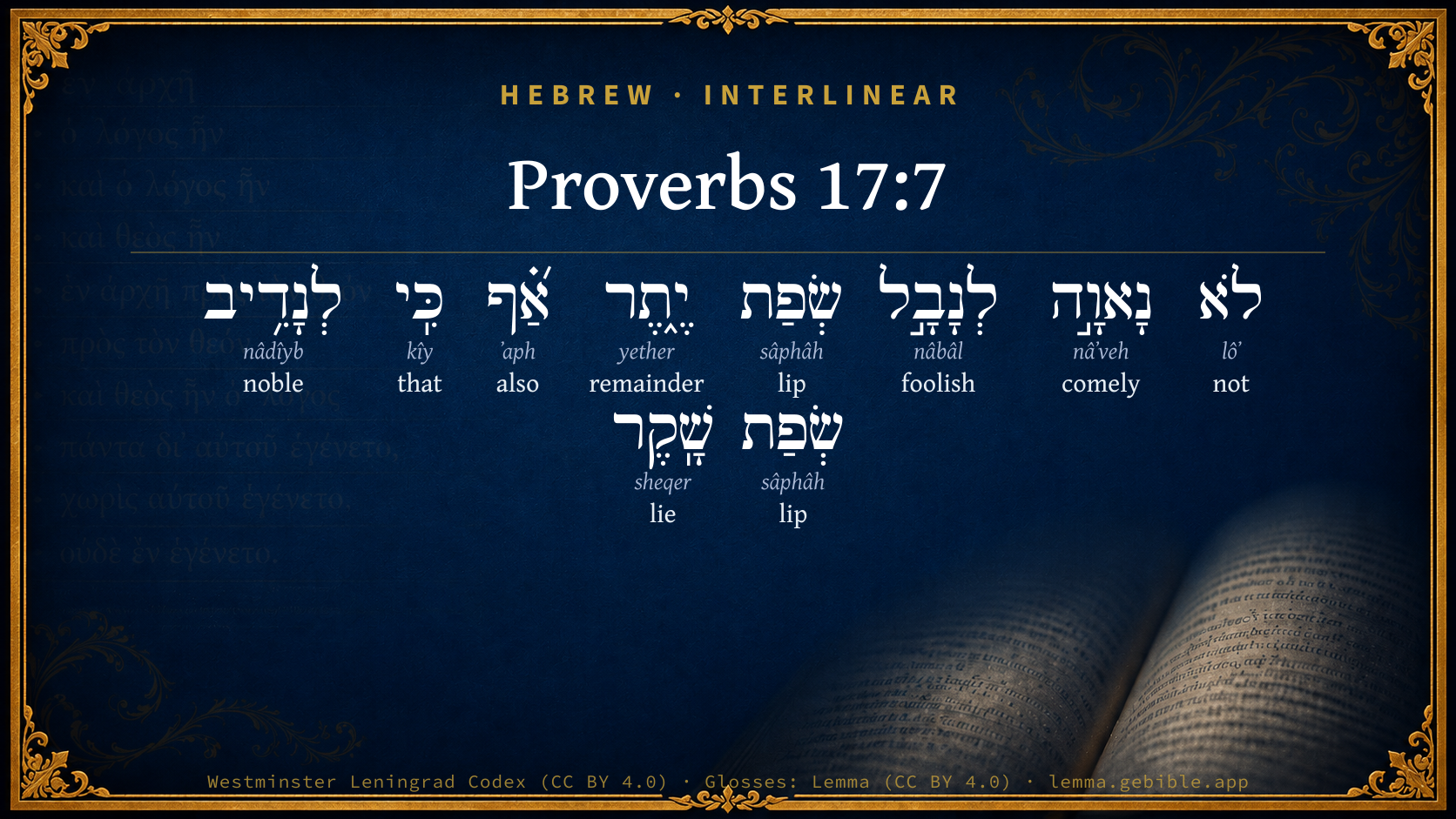
Proverbs 17:7

Hebrew (Westminster Leningrad Codex) Proverbs 17:7 appears in the Hebrew Old Testament. The text above is from the Westminster Leningrad Codex. Each word links to its Strong’s number, a concise gloss, and parsing drawn from the Open Scriptures Hebrew Bible morphology. Click any word for its full Brown-Driver-Briggs (BDB) entry.
Download image
Cite this verse

Proverbs 17:7 (World English Bible). Public Domain. Lemma interlinear Bible study tool, https://lemma.gebible.app/v/proverbs/17/7.

Show BibTeX & RIS
BibTeX
RIS
English Translation
Arrogant speech isn't fitting for a fool, Much less do lying lips fit a prince.
World English Bible · Public Domain
Download a study sheet

One document with this verse’s original text, its word-by-word gloss line, the meaning frame, cross-references with their text, attributed commentary, and full source and license credits — printable, and it pastes into notes with its structure intact.

This verse Autodidact and up

Study sheet (.html) Plain text (.txt)

A passage Seminary Student

Up to 50 verses in one chapter. A passage sheet keeps up to 6 commentary sources and 12 cross-references per verse, in the order this page ranks them, and says so on the sheet whenever that leaves anything out. Ask for a single verse and you get the Autodidact verse sheet above.

Everything on this page stays free to read, with no account — the sheet is a download of what is already on screen, not access to it.

Want to remove ads? Support Godless Engineer
Compare translations 3

The same verse in 3 English versions, stacked beneath the original-language interlinear above. Click any original word for its lexicon entry.

Each is an independent rendering of the whole verse — the interlinear is not word-aligned to these translations.

Highlighted words mark where these versions differ — a whole-verse word diff, not a word-by-word alignment.

  • World English Bible Public Domain
    Arrogant speech isn't fitting for a fool, Much less do lying lips fit a prince.
  • King James Version Public Domain
    Excellent speech becometh not a fool: much less do lying lips a prince.
  • unfoldingWord Literal Text CC BY-SA 4.0
    A lip of excess not suitable for a worthless; how much less a lip of falsehood for a noble.

unfoldingWord Literal Text — © unfoldingWord, licensed CC BY-SA 4.0. Word-aligned USFM3 via Door43 (git.door43.org/unfoldingWord/en_ult).

Versions to compare (up to 4)

3 of 4 selected

Show all 18 translations

Every available English version of this verse, each an independent rendering of the whole verse.

  • World English Bible Public Domain
    Arrogant speech isn't fitting for a fool, Much less do lying lips fit a prince.
  • Berean Standard Bible Public Domain
    Eloquent words are unfit for a fool; how much worse are lying lips to a ruler!
  • Majority Standard Bible Public Domain
    Eloquent words are unfit for a fool; how much worse are lying lips to a ruler!
  • King James Version Public Domain
    Excellent speech becometh not a fool: much less do lying lips a prince.
  • American Standard Version (1901) Public Domain
    Excellent speech becometh not a fool; Much less do lying lips a prince.
  • Revised Version (1885) Public Domain
    Excellent speech becometh not a fool: much less do lying lips a prince.
  • Geneva Bible (1599) Public Domain
    Hie talke becommeth not a foole, much lesse a lying talke a prince.
  • Douay-Rheims (1899) Public Domain
    Eloquent words do not become a fool, nor lying lips a prince.
  • Young's Literal Translation Public Domain
    Not comely for a fool is a lip of excellency, Much less for a noble a lip of falsehood.
  • Literal Standard Version CC BY-SA 4.0
    A lip of excellence is not fitting for a fool, much less a lip of falsehood for a noble.
  • Unlocked Literal Bible CC BY-SA 4.0
    Eloquent speech is not suitable for a fool; much less are lying lips suitable for royalty.
  • unfoldingWord Literal Text CC BY-SA 4.0
    A lip of excess not suitable for a worthless; how much less a lip of falsehood for a noble.
  • Darby Bible Public Domain
    Excellent speech becometh not a vile [man]; how much less do lying lips a noble!
  • World Messianic Bible Public Domain
    Excellent speech isn’t fitting for a fool, much less do lying lips fit a prince.
  • Webster's Bible Public Domain
    Excellent speech becometh not a fool: much less do lying lips a prince.
  • Free Bible Version CC BY-SA 4.0
    Fine words don't suit stupid people, how much less are lies suited to a ruler.
  • Bible in Basic English Public Domain
    Fair words are not to be looked for from a foolish man, much less are false lips in a ruler.
  • JPS Tanakh (1917) Public Domain
    Overbearing speech becometh not a churl; much less do lying lips a prince.

Literal Standard Version (2020), Covenant Press — licensed CC BY-SA 4.0. Text via the HelloAO Bible API (eBible.org). Unlocked Literal Bible (unfoldingWord) — licensed CC BY-SA 4.0. Text via the HelloAO Bible API (eBible.org). unfoldingWord Literal Text — © unfoldingWord, licensed CC BY-SA 4.0. Word-aligned USFM3 via Door43 (git.door43.org/unfoldingWord/en_ult). Free Bible Version, Dr. Jonathan Gallagher — licensed CC BY-SA 4.0. Text via the HelloAO Bible API (eBible.org).

Word by word

More ways to search: Search by grammar → Find every occurrence → Compare this word →

Practice this passage: Drill this verse → Learn its vocabulary →

About this verse

These counts appear in no published source. They are computed here, from the morphology-tagged text and Lemma’s own curated glosses. What Lemma adds →

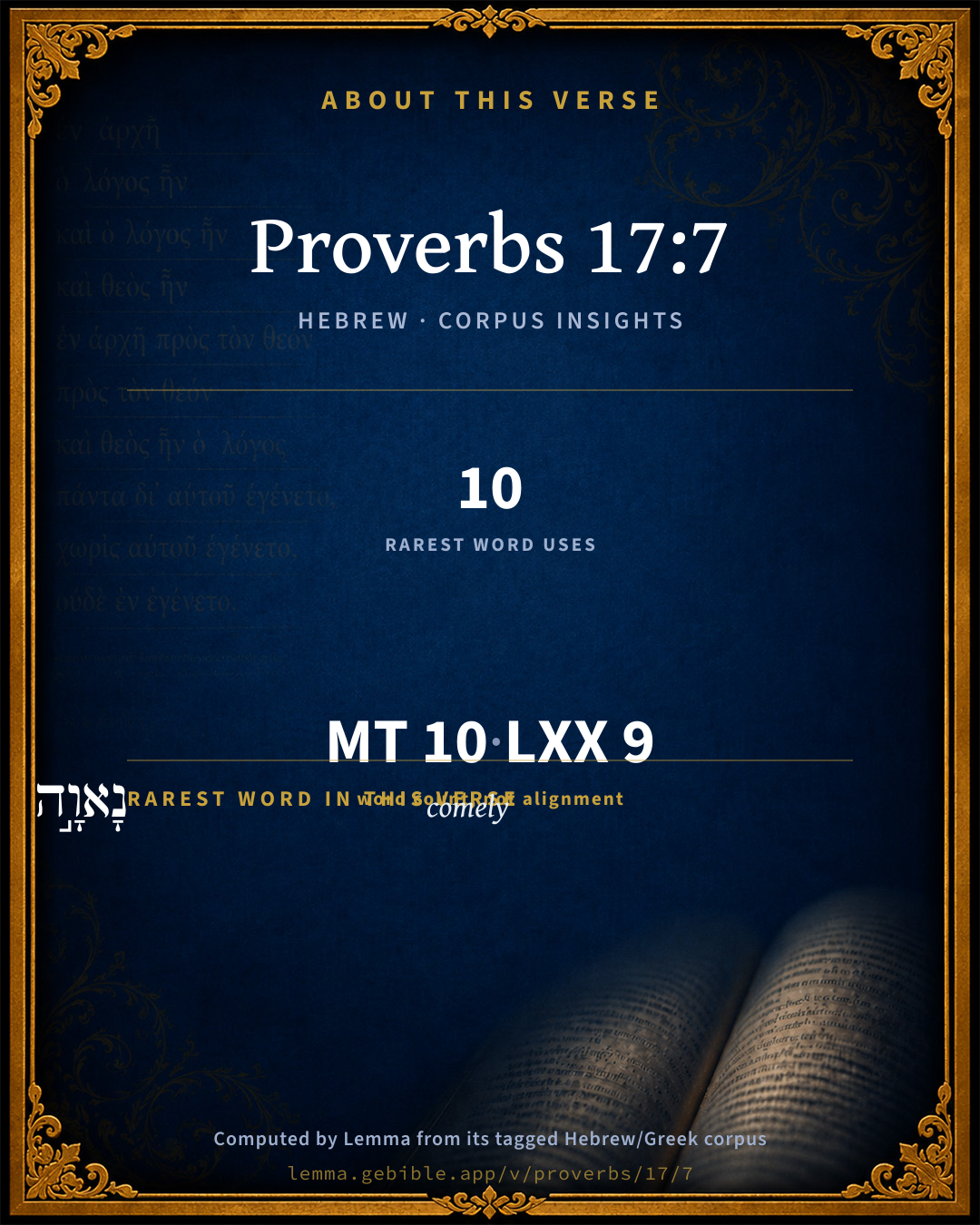
10
words
9
distinct lemmas
Wisdom
section

Notable vocabulary

The rarest word here is נָאוָ֣ה comely H5000 — appearing just 10 times in the whole Hebrew Bible.

Shared distinctive vocabulary

נָאוָ֣ה comely H5000 occurs in 10 verses of the Hebrew Bible. Also found in:

Grammatical profile

  • 4 nouns
  • 3 adjectives
  • 1 conjunction
  • 2 particles

Repetition

A word recurs within this verse — often emphatic in Hebrew:

  • שְׂפַת lip H8193 ×2

Hebrew & Septuagint length

In English translation the verse runs 15 words from the Hebrew and 13 from the Septuagint (LXX English) — closely comparable.

A rough comparison of the two English renderings, which tokenize alike — not a word-level alignment.

Word counts can differ between the Hebrew and the Greek without any difference in meaning — e.g. the Hebrew direct-object marker אֵת has no separate Greek word, and Greek often adds the article ὁ.

In the original languages it is 10 Hebrew tokens and 9 Greek tokens — but the two are counted differently (Hebrew bundles its prefixes and suffixes into one token; the Greek is in lemma form), so that isn’t a like-for-like length.

Cross-references

9

Topical passages linked to Proverbs 17:7 in the Treasury of Scripture Knowledge — connected by theme and wording, ordered by reader-vote popularity; previews shown in the World English Bible.

  • Proverbs 29:12 If a ruler listens to lies, All of his officials are wicked.
  • Psalms 50:16–17 But to the wicked God says, "What right do you have to declare my statutes, That you have taken my covenant on your lips,
  • 2 Samuel 23:3 The God of Israel said, The Rock of Israel spoke to me: One who rules over men righteously, Who rules in the fear of God,
  • Job 34:12 Yes surely, God will not do wickedly, Neither will the Almighty pervert justice.
  • Psalms 101:3–5 I will set no vile thing before my eyes. I hate the deeds of faithless men. They will not cling to me.
  • Proverbs 12:19 Truth's lips will be established forever, But a lying tongue is only momentary.
  • Proverbs 16:10–13 Inspired judgments are on the lips of the king. He shall not betray his mouth.
  • Proverbs 26:7 Like the legs of the lame that hang loose: So is a parable in the mouth of fools.
  • Matthew 7:5 You hypocrite! First remove the beam out of your own eye, and then you can see clearly to remove the speck out of your brother's eye.

Cross-references courtesy of OpenBible.info (CC BY 4.0).

Hebrew and Greek witnesses Masoretic Hebrew ↔ Greek Septuagint

The same verse in the two great witnesses to the Old Testament, shown verse-for-verse.

These are two independent witnesses, not word-aligned to each other, and the Septuagint is shown in lemma (dictionary) form.

Hebrew Proverbs 17:7 Masoretic · Westminster Leningrad Codex

לֹא נָאוָ֣ה לְנָבָ֣ל שְׂפַת יֶ֑תֶר אַ֝֗ף כִּֽי לְנָדִ֥יב שְׂפַת שָֽׁקֶר

Arrogant speech isn't fitting for a fool, Much less do lying lips fit a prince.

World English Bible · Public Domain

Greek LXX Proverbs 17:7 Septuagint · lemma form

οὐ ἁρμόζω ἄφρων χεῖλος πιστός οὐδέ δίκαιος χεῖλος ψευδής

Faithful lips will not suit a fool; nor lying lips a just man.

LXX2012 (modern English Septuagint) · Public Domain

On this verse, Keil & Delitzsch discusses the Septuagint’s reading. Read the note in Commentary ↓

Hebrew: Westminster Leningrad Codex (CC BY 4.0). Greek: Septuagint (public domain); English from LXX2012 (modern English Septuagint) (Public Domain). How the Septuagint differs from the Hebrew →

Commentary

Notes on Proverbs 17:7 from classic Christian and Jewish commentators (each source and its license shown beneath its notes). The classic Christian expositions comment on the surrounding passage and are grouped to its opening verse, so a note may address several verses; the Jewish commentaries on the Tanakh (Rashi and others) are per-verse, so they appear only where the commentator wrote on this verse.

Lemma curates 59 commentaries, every one of them public domain or Creative Commons licensed, each selected and text-cleaned for this edition rather than reprinted as found. About our sources →

Trapp's Complete Commentary

John Trapp

Pro 17:7 Excellent speech becometh not a fool: much less do lying lips a prince.

Ver. 7. Excellent speech becometh not a fool.] A Nabal, a sapless, worthless fellow, in whom all worth is withered and decayed, - qui nullas habet dicendi vires, as Cicero hath it, that can say no good except it be by rote, or at least by book, - what should he do discoursing of high points? God likes not fair words from a foul mouth. Christ silenced the devil when he confessed him to be the Son of the most high God. The leper’s lips should be covered, according to the law. The Lacedemonians, when a bad man had uttered a good speech in their council house, liking the speech but not the speaker, commanded one of better carriage to give the same counsel, and then they made use of it. {a} The people of Rome sware they would not believe Carbo though he sware. {b}

Much less do lying lips a prince.] Or any ingenuous man, as some render it. A prince’s bare word should be better security than another man’s oath, said Alphonsns, King of Arragon. When Amurath, the great Turk, was exhorted by his cruel son, Mohammed, to break his faith with the inhabitants of Sfetigrade, in Epirus, he would not listen, saying, "That he which was desirous to be great among men, must either be indeed faithful of his word and promise, or at least seem to be so." {c} - thereby to gain the minds of the people, who naturally abhor the government of a faithless and cruel prince. What a foul blur was that to Christian religion, that Ladislaus King of Hungary should, by the persuasion of the Pope’s envoy, break his oath given to this Amurath at the great battle of Varna, and thereby open the mouth of that dead dog to rail upon Jesus Christ! {d} And how will the Papists ever be able to wipe off from their religion that stain that lies upon it ever since the Emperor Sigismund, by the consent and advice of the Council of Constance, brake his promise of safe conduct to John Huss and Jerome of Prague, and burnt them! But they have a rule to walk by now, Fides cum haereticis non est servanda: Promises made to heretics are not to be observed. And it is for merchants, say they, and not for princes, to stand to their oaths, any further than may stand with the public good. This divinity they may seem to have drawn out of Plato, who, in his third Dialogue of the Commonwealth, saith, That if it be lawful for any one to lie, it may be lawful doubtless for princes and governors, that aim therein at the public welfare. But God, by the mouth of his servant and secretary, Solomon, here assures us it is otherwise.

{a} Odi hominem; ignava opera, philosopha sententia.

{b} Liv.

{c} Turkish History, fol. 321.

{d} Turkish History, fol. 291.

John Trapp, A Commentary or Exposition upon All the Books of the Old and New Testament (1647–1656) — public domain. Text from a community e-Sword module.

Joseph Benson's Commentary

Pro 17:7. Excellent speech — Either, 1st, Discourse concerning difficult, high, and excellent things, far above his capacity: or, 2d, Lofty, eloquent speech, which fools often affect: or, 3d, Virtuous and godly discourse; becometh not a fool — Either one properly so called, or, as the word fool is most commonly used in this book, a wicked man, whose actions give the lie to his expressions.

Joseph Benson's Commentary on the Old and New Testaments (1811–1818) — public domain. Text from a community e-Sword module.

The Preacher's Complete Homiletical Commentary

Joseph S. Exell (gen. ed.)

CRITICAL NOTES.—

Pro_17:7. Excellent speech, literally “a lip of excess or prominence, an assuming, imperious style of speech” (Zöckler). A prince, rather, a noble, a man of lofty disposition.

MAIN HOMILETICS OF Pro_17:7

A TWOFOLD INCONGRUITY

I. Truth from the mouth of a godless man. This is not an unknown case. A man of immoral practices may inculcate precepts of purity—a dishonest man may, for the purpose of cloaking his own character, be loud in his praises of integrity and uprightness. But the speech of such a man will fall powerless on his hearers, even if they do not know thoroughly the character of the speaker. There will be a lack of the true ring of sincerity about his words—being words only, and not convictions, they will be “as sounding brass or a tinkling cymbal.” Suppose that a barrister, who was very ignorant of law and possessed of very limited mental capacities, having undertaken the defence of an important case, were to apply to one of his most learned and eloquent legal brethren to write his speech for him. When he got up to deliver that which was not the production of his own mind—that which he was not able thoroughly to appreciate himself—would not the listeners be struck with a sense of incongruity, would they not feel that, however good the arguments, however vivid the illustrations, however powerful the appeals, there was something lacking—that the speaker was a stripling wearing the armour of a giant? Something of this same feeling is experienced when an immoral man gives utterance to moral sentiments—he does not know the meaning of his own words, he lacks the experience necessary to give weight to what he says. He speaks what is in itself true, but he is not a true man himself, and consequently the utterance is like a “jewel of gold in a swine’s snout.”

II. Untruth from the mouth of a man of exalted station. A prince (i.e., one who holds a high place among his fellow-men) is especially bound to be a man of truth and honour. It is here implied that he is to be an embodiment of truthfulness—that whether he owes his position to wealth, to birth, or to intellectual gifts—whatever else he lacks, he ought to be a truthful man; his words ought to be excellent, and they ought to be the reflection of excellence of character.

III. The second incongruity is more mischievous than the first. “Excellent speech becometh not a fool, much less do lying lips a prince.” If a moral fool is a man who holds no position in the world, what he says will not be of so much consequence, because his influence upon others is little. He will injure himself, and those immediately connected with him, but the harm done will not be so widely spread as if he were one of the great of the land. The first man, if he puts on a garb of morality, and adopts language which does not represent his true self, is a liar, but his lying does not injure others so much as it does himself. But a “lying prince” is an instrument of wide-spread evil. To lie in a cottage is a sin against God and man, but to lie in a palace is a greater sin, because the inmate of a palace holds in his hand an immense power for good and for evil. What he says and does is felt more or less indirectly throughout his dominion, and as his responsibility is so great, the guilt of using it wrongly is great also.

OUTLINES AND SUGGESTIVE COMMENTS

God likes not fair words from a foul mouth. Christ silenced the devil when he confessed Him to be the Son of the Most High God. The leper’s lips should be covered, according to the law.—Trapp.

Lying lips are no less unbecoming in the mouth of a prince, who ought to honour the dignity of his station by the dignity of his manners. A prince of our own is said to have frequently used this proverbial saying, “He that knows not how to dissemble knows not how to reign.” You may judge from the text before us whether he deserved to be called the Solomon of his age. It was certainly a nobler saying of one of the kings of France,—that if truth were banished from all the rest of the world it ought to be found in the breasts of princes. A man’s dignity obliges him to a behaviour worthy of it, and of him whose favour has conferred it. All Christians are advanced to spiritual honours of the most exalted kind. They are the children of God, and heirs of the eternal kingdom, and ought to resemble their heavenly Father, who is the God of truth. When a young prince desired a certain philosopher to give him a directory for his conduct, all his instructions were comprised in one sentence, “Remember that thou art a king’s son.” Let Christians remember who they are, and how they came to be what they are, and act in character.—Lawson.

Force not thyself above, degrade not thyself below thy condition.—Wohlfarth.

The Preacher's Complete Homiletical Commentary (gen. ed. Joseph S. Exell; Funk & Wagnalls, c. 1892) — public domain (pre-1929). A full-Bible homiletical/sermon-outline anthology covering 65 of 66 books (2 John is absent from the source module). Text from a community e-Sword module.

Keil & Delitzsch

C. F. Keil & F. Delitzsch

The proverbs following, Pro 17:7-10, appear to be united acrostically by the succession of the letters ש (שׂ, שׁ) and ת.

Pro 17:7

7 It does not become a fool to speak loftily,

How much less do lying lips a noble!

As at Isa 32:5., נבל and נדיב are placed opposite to one another; the latter is the nobly magnanimous man, the former the man who thinks foolishly and acts profligately, whom it does not become to use lofty words, who thereby makes the impression of his vulgarity so much the more repulsive (cf. Job 2:10). שּׂפת יתר (not יתר, for the word belongs to those which retain their Pathach or Segol, in pausa) is neither elevated (soaring) (Ewald) nor diffuse (Jo. Ernst Jungius in Oetinger: lingua dicax ac sermonem ultra quam decorum verbis extendere solita), rather imperative (Bertheau), better presumptuous (Hitzig) words, properly words of superfluity, i.e., of superabundant self-consciousness and high pretension (cf. the transitive bearing of the Arab. watr with ὑβρίζειν, from ὑπέρ, Aryan upar, Job, p. 363). Rightly Meri, שׂפת נאוה ושׂררה. It produces a disagreeable impression, when a man of vulgar mind and of rude conduct, instead of keeping himself in retirement, makes himself of importance, and weighty in a shameless, impudent manner (cf. Ps. 12:9, where זלּוּת, vilitas, in a moral sense); but yet more repulsive is the contrast, when a man in whom one is justified in expecting nobility of mind, in accordance with his life-position and calling, degrades himself by uttering deceitful words. Regarding the אף כּי, concluding a minori ad majus, we have already spoken at Pro 11:31; Pro 15:11. R. Ismael, in Bereschith Rabba, at 44:8, reckons ten such conclusions a minori ad majus in the Scriptures, but there are just as many quanto magis. The right accentuation (e.g., in Cod. 1294) is here אף כי־לנדיב, transformed from אף כי־לנדיב, according to Accentuationssystem, xviii. 2.

Pro 17:8

8 The gift of bribery appears a jewel to its receiver;

Whitherso'er he turneth himself he acteth prudently.

How 8b is to be understood is shown by Sa1 14:47, cf. Jos 1:7; the quoque se vertit, prudenter rem agit, has accordingly in both sentences the person meant by בּעליו as subject, not the gift (Hitzig), of which ישׂכּיל, "it maketh prosperous," is not said, for השׂכּיל means, used only of persons, prudent, and therefore successful, fortunate conduct. Such is said of him who has to give (Luther): he presses through with it whithersoever he turns. But the making of בּעיני the subj. does not accord with this: this means gift to one who has to give, appears to open doors and hearts, not merely as a golden key, it is truly such to him. Thus בעליו, as at Pro 3:27, will be meant of him to whom the present is brought, or to whom a claim thereto is given. But שׂחד means here not the gift of seasonable liberality (Zckler), but, as always, the gift of bribery, i.e., a gift by which one seeks to purchase for himself (Pro 17:23) preference on the part of a judge, or to mitigate the displeasure of a high lord (Pro 21:14); here (for one does not let it depend merely on the faithfulness of another to his duty) it is that by which one seeks to secure an advantage to himself. The proverb expresses a fact of experience. The gift of bribery, to which, as to a well-known approved means, השּׂחד, refers, appears to him who receives and accepts it (Targ.) as a stone of pleasantness, a charming, precious stone, a jewel (Juwl from joie = gaudium); it determines and impels him to apply all his understanding, in order that he may reach the goal for which it shall be his reward. What he at first regarded as difficult, yea, impossible, that he now prudently carries out, and brings to a successful conclusion, wherever he turns himself, overcoming the seemingly insurmountable hindrances; for the enticement of the gift lifts him, as with a charm, above himself, for covetousness is a characteristic feature of human nature - pecuniae obediunt omnia (Ecc 10:19, Vulg.).

Pro 17:9

9 He covereth transgressions who seeketh after love,

And he who always brings back a matter separateth friends.

The pred. stands first in the simple clause with the order of the words not inverted. That מכסה פשׁע is also to be interpreted here as pred. (cf. 19a) is shown by Pro 10:12, according to which love covereth all transgressions. We write מכסּה־פּשׂע with Dag. forte conjunctivum of פ (as of ב in Eze 18:6), and Gaja with the Sheva, according to the Meth.-Setzung, 37; the punctuation מכסּה פּשׁע also occurs. What the expression "to seek love" here means, is to be judged, with Hitzig, after Zep 2:3; Co1 14:1. It is in no case equivalent to seek to gain the love of another, rather to seek to preserve the love of men towards one another, but it is to be understood not after 9b, but after Pro 10:12 : he seeks to prove love who does not strike on the great bell when his neighbour has sinned however grievously against him, does not in a scandal-loving manner make much ado about it, and takes care not thereby to widen the breach between men who stand near to one another, but endeavours by a reconciling, soothing, rectifying influence, to mitigate the evil, instead of making it worse. He, on the contrary, who repeats the matter (שׁנה with ב of the obj., to come back with something, as Pro 26:11), i.e., turns always back again to the unpleasant occurrence (Theodotion, δευτερῶν ἐν λόγῳ; Symmachus, δευτερῶν λόγον, as Sir. 7:14; 19:7), divides friends (vid., Pro 16:28), for he purposely fosters the strife, the disharmony, ill-will, and estrangement which the offence produced; while the noble man, who has love for his motive and his aim, by prudent silence contributes to bring the offence and the division which it occasioned into forgetfulness.

Pro 17:10

10 One reproof maketh more impression on a wise man

Than if one reckoned a hundred to the fool

One of the few proverbs which begin with a future, vid., Pro 12:26. It expresses what influence there is in one reproof with a wise man (מבין, Pro 8:9); גּערה is the reproof expressed by the post-bibl. נזיפה .lbib, as the lowest grade of disciplinary punishment, admonitio, connected with warning. The verbal form תהת is the reading of the lxx and Syr. (συντρίβει ἀπειλὴ καρδίαν φρονίμου) for they read תחת גערה לב מבין, derived from חתת, and thus תּחת (from Hiph. החת); thus Luther: reproof alarms more the intelligent, but חחת with ב of the obj. is not Hebr.; on the contrary, the reading of the lxx is in accordance with the usage of the language, and, besides, is suitable. It is, however, first to be seen whether the traditional text stands in need of this correction. As fut. Niph. תּחת, apart from the ult. accent. to be expected, gives no meaning. Also if one derives it from חתה, to snatch away, to take away, it gives no appropriate thought; besides, חתה is construed with the object. accus., and the fut. Apoc., in itself strange here, must be pointed either תּהת or תּחתּ (after יחדּ) (Bttcher, Lehrb. ii. p. 413). Thus יחת, as at Job 21:13; Jer 21:13, will be fut. Kal of נחת = ינחת, Psa 38:3 (Theodotion, Targ., Kimchi). With this derivation, also, תּחת is to be expected; the reference in the Handwrterbuch to Gesen. Lehrgebude, 51, 1, Anm. 1, where, in an extremely inadequate way, the retrogression of the tone (נסוג אחור) is spoken of, is altogether inappropriate to this place; and Bttcher's explanation of the ult. tone from an intended expressiveness is ungrammatical; but why should not תּחת, from נחת, with its first syllable originating from contraction, and thus having the tone be Milel as well as Milra, especially here, where it stands at the head of the sentence? With ב connected with it, נחת means: to descend into anything, to penetrate; Hitzig appropriately compares altius in pectus descendit of Sallust, Jug. 11. Jerome rightly, according to the sense: plus proficit, and the Venet. ἀνεῖ (read ὀνεῖ) ἀπειλὴ τῷ συνίοντι. In 10b מכּה (cf. Deu 25:3; Co2 11:24) is to be supplied to מאה, not פאמים (an hundred times, which may be denoted correctly by מאה as well as מאת, Ecc 8:12). With the wise (says a Talmudic proverb) a sign does as much as with the fool a stick does. Zehner, in his Adagia sacra (1601), cites Curtius (vii. 4): Nobilis equus umbra quoque virgae regitur, ignavus ne calcari quidem concitari potest.

Keil & Delitzsch — Biblical Commentary on the Old Testament (1861–1891) — public domain (CC PDM 1.0). Text via the HelloAO Bible API. (Old Testament only.)

Geneva Bible (1599)

Geneva Bible translators

Hebrew, the lip of excellency.

Geneva Bible (1599) marginal notes — public domain. Text via Bolls.life.

Matthew Henry's Commentary

Two things are here represented as very absurd: 1. That men of no repute should be dictators. What can be more unbecoming than for fools, who are known to have little sense and discretion, to pretend to that which is above them and which they were never cut out for? A fool, in Solomon's proverbs, signifies a wicked man, whom excellent speech does not become, because his conversation gives the lie to his excellent speech. What have those to do to declare God's statutes who hate instruction? Psa 50:16. Christ would not suffer the unclean spirits to say that they knew him to be the Son of God. See Act 16:17, Act 16:18. 2. That men of great repute should be deceivers. If it is unbecoming a despicable man to presume to speak as a philosopher or politician, and nobody heeds him, being prejudiced against his character, much more unbecoming is it for a prince, for a man of honour, to take advantage from his character and the confidence that is put in him to lie, and dissemble, and make no conscience of breaking his word. Lying ill becomes any man, but worst a prince, so corrupt is the modern policy, which insinuates that princes ought not to make themselves slaves to their words further than is for their interest, and Qui nescit dissimulare nescit regnare - He who knows not how to dissemble knows not how to reign.

Matthew Henry's Commentary on the Whole Bible (1708–1710) — public domain (CC PDM 1.0). Text via the HelloAO Bible API.

Jamieson, Fausset & Brown

Robert Jamieson, A. R. Fausset & David Brown

Excellent speech--(Compare Margin). Such language as ill suits a fool, as lying (ought to suit) a prince (Pro 16:12-13).

Jamieson, Fausset & Brown — Commentary Critical and Explanatory on the Whole Bible (1871) — public domain (CC PDM 1.0). Text via the HelloAO Bible API.

Adam Clarke's Commentary

Verse 7. Excellent speech becometh not a fool] This proverb is suitable to those who affect, in public speaking, fine language, which neither comports with their ordinary conversation, nor with their education. Often fine words are injudiciously brought in, and are as unbecoming and irrelevant as a cart wheel among clockwork.

Adam Clarke's Commentary on the Bible (1810–1826) — public domain. Text from a community e-Sword/MySword module.

Ellicott's Commentary for English Readers

(7) Excellent speech becometh not a fool.—Rather, perhaps, Superfluous or pretentious words become not a vile person (nâbhâl), such as is described in Isa_32:6. (Comp. 1Sa_25:25.)

Much less do lying lips a prince.—Or, liberal person (Isa_32:8): noblesse oblige.

A Bible Commentary for English Readers, edited by Charles John Ellicott (1878–1897) — public domain. Text from a community e-Sword module.

The Cambridge Bible for Schools and Colleges

gen. ed. J. J. S. Perowne

7. Excellent] Or, arrogant, R.V. marg.

The Cambridge Bible for Schools and Colleges (gen. ed. J. J. S. Perowne; Cambridge University Press, 1878–1918) — public domain. Text from a community e-Sword module.

John Gill's Exposition

Excellent speech becometh not a fool,.... A wicked man. Eloquence, or a sublime grand way of speaking, a copiousness and fluency of expression, become not such; because hereby he may be capable of doing more mischief; or such a style is unsuitable to the subject of his discourse, which is nothing but folly and wickedness. The Gospel is excellent speech, sound speech, that cannot be condemned; it treats of excellent things; concerning the person, office, and grace of Christ, and salvation by him; and very unfit is a wicked man to take it into his mouth, talk of it, and declare it;

much less do lying lips a prince; they rather become a fool, as excellent speech does a prince; who neither should speak lies himself, nor encourage, but abhor them in others. The Septuagint, Syriac, and Arabic versions, render it, "a just man": but the word more property signifies a liberal man, as it is rendered in Isa 32:8; where it stands opposed to a churl or covetous man: and some Jewish (f) writers think by the "fool" is meant such an one to whom a "lip of abundance" (g), as it may be rendered, is very unsuitable; or to talk of his abundance, when he makes no good use of what he has for himself or others; and so, on the other hand, it is very disagreeable to the character of an ingenuous and liberal man to promise and not perform, and never intended it. It is true of such who are made a "willing" people in the day of Christ's power, Psa 110:3; where the same word is used as here; of his volunteers; that to speak lies one to another very ill becomes them; or to receive, or to speak, or profess false doctrines; for no lie is of the truth.

(f) Kabvenaki in Mercer. in loc. (g) "labium abundantiae".

John Gill's Exposition of the Whole Bible (1746–1763) — public domain (CC PDM 1.0). Text via the HelloAO Bible API.

Albert Barnes' Notes on the Bible

The margin renderings are more literal and give greater emphasis. What is pointed out is not the unfitness of lying lips for the princely-hearted, but the necessity of harmony, in each case, between character and speech.

Albert Barnes' Notes on the Bible (1834–1885) — public domain. Text from a community e-Sword/MySword module.

Haydock's Catholic Bible Commentary

Eloquent. Septuagint, "faithful." They cannot be expected from them.

George Leo Haydock (1774–1849), Haydock's Catholic Family Bible and Commentary, 1859 edition — public domain. Excludes Psalms (Douay-Rheims chapter numbering differs from Protestant) and Deuterocanonical books (Catholic canon only).

Matthew Poole's English Annotations

Excellent speech; either,

1. Discourse of high and excellent things far above his capacity. Or,

2. Lofty or eloquent speech, which fools oft affect, Or,

3. Virtuous and godly discourse.

A fool; either properly so called; or, as this word is most commonly used in this book, a wicked man, whose actions give the lie to his expressions.

Matthew Poole's English Annotations on the Holy Bible (1683–1685) — public domain. Text from a community e-Sword/MySword module.

Whedon's Commentary on the Bible

Daniel D. Whedon

7. Excellent speech — Hebrew, lips of excellence.

A fool — Several different words in this book are rendered by our word fool. They all seem to imply some bad qualifies, moral as well as intellectual. In the Hebrew mind the idea of folly and that of wickedness were so intimately blended as to find expression by the same word. The word used here is nabhal, which is about equivalent to our word dunce, or stupid fallow; one of no learning or intellectual culture, and impliedly incapable of it. Psa_14:1. The clause may be read thus: Not suitable (or agreeable) to a dunce is the lip of excellence, that is, cultivated, elevated language; or, as some think, assuming, imperious speech.

A prince — נדיב, (nadhibh,) a nobleman, one of liberal culture. The passage may be rendered, much less is the lip of falsehood suitable to a man of cultivated mind. The idea seems to be, that his freer culture liberates him from the ordinary temptations to falsehood. He ought to know better, and does. Plato justifies lying in princes, but others must abstain. “He who knows not how to dissemble, knows not how to reign,” has been a royal maxim. But much better is that of Louis IX., of France: “If truth be banished from all the rest of the world, it ought to be found in the breast of princes.”

Daniel D. Whedon (gen. ed.), Commentary on the Old and New Testaments (1874–1909) — public domain. Text from a community e-Sword module.

The Pulpit Commentary

Excellent speech becometh not a fool. rty tpc; verba composita, Vulgate, i.e. studied, complicated, expressions; ceilh pista , "faithful lips," Septuagint. Others translate, "arrogant," "pretentious." It is literally, a lip of excess or superabundance, and is best taken in the above sense, as arrogant or assuming. A nabal, a "vicious fool," ought not to flaunt his unwisdom and his iniquities before the eyes of men, but to keep them hidden as much as possible. As such presumptuous behaviour is incongruous in the case of a fool, much less do lying lips become a prince; a noble person, such a one as is called in Isaiah (Isa_32:8) "liberal," where the same word, nadib, is used. This is an illustration of the saying, "Noblesse oblige." Thus the Greek gnome Eleuyerou gayeian legein. "A free man"s part it is the truth to speak.

To John the Good, King of France, is attributed the noble maxim which well became his chivalrous character, "Si la bonne foi etait bannie du reste du monde, il faudrait qu"on la retrouvat dans le coeur des rois" (Bonnechose, "Hist. de France," 1:310). "My son," says the rabbi in the Talmud, "avoid lying first of all; for a lie will tarnish the brightness of thy honour." For "prince," the Septuagint has, "a just man," which makes the maxim a mere truism.

The Pulpit Commentary (1880–1919), ed. H.D.M. Spence-Jones & Joseph S. Exell — public domain. Text from a community e-Sword module.

John Wesley's Explanatory Notes

Excellent speech - Discourse of high and excellent things.

John Wesley, Explanatory Notes Upon the Whole Bible (1754–1765) — public domain. Text via the GEBible commentary corpus.

Bridges on Proverbs

Charles Bridges

Men naturally speak as they are. The lip is the organ of the heart. The lip of excellency, to speak suitably of high and lofty things, evidently becometh not a fool.†1 A grave discourse on godliness becometh not an ungodly man.†2 It carries no weight, and, so far from doing good, it often brings contempt.†3 Christ would not accept even a sound confession from the lips of Satan, lest it should bring an occasion of stumbling.†4 So unseemly was excellent speech from so corrupt a source!

Much less do lying lips become a prince — the Minister and Guardian of truth. (Pro 16:10 .) Yet in a world, where self reigns supreme, such inconsistencies are but too prevalent.†5 The pure doctrine of our Divine Master alone secures Christian consistency in heart, lip, and life. Never let us forget, that, if excellent speech becometh not a fool, it does become the gospel of Christ — the "saints of God." (Php 1:27 .) And oh! let it be fully manifested in all its gracious unction and power, for "the edifying" of the Church (Eph 4:29 ), and for the conviction of gain-sayers." (Col 4:6 .)

Footnotes:

†1 Pro 26:7, Pro 26:9 . Compare Sir 20:20 .

†2 Psa 50:16-17.

†3 Mat 7:3-5. Rom 2:21-24 .

†4 Mar 1:34. Compare Act 16:16-18 .

†5 Heathen morality from the lips of one of her wisest teachers allowed the lying lips of princes, because they governed for the public good. ’All others’ — he adds — ’must abstain.’ Plato, De Repub. ’Qui nescit dissimulare, nescit negnare’ — has been too often a royal maxim. Far more becoming a prince was the saying of Louis IX. of France — ’If truth be banished from all the rest of the world, it ought to be found in the breast of princes.’ Alphonsus of Arragon declared (Lavater in loco) that ’one word of a prince should be a greater security than a private man’s oath.’ Undoubtedly the royal character ought to display a grandeur and dignity of principle, that should shine through every dark cloud of trial and perplexity.

Charles Bridges, An Exposition of the Book of Proverbs (1846) — public domain. Text from a community e-Sword module.

Kretzmann's Popular Commentary

Paul E. Kretzmann

v. 7. Excellent speech, fine and high talk, in an assuming, dictatorial way, becometh not a fool; much less do lying lips a prince, for true nobility will have nothing to do with deceitfulness and crafty speeches.

Paul E. Kretzmann, Popular Commentary of the Bible (1921–1924) — public domain. Text from a community e-Sword module.

unfoldingWord translationNotes

Door43 World Missions Community

Eloquent speech

"Fine speech" or "Excellent speech"

much less are lying lips suitable for royalty

This describes people lying as if it were actually their "lips" that were lying. AT: "even more it is not suitable for royalty to lie" (See: Synecdoche)

A bribe is like a magic stone to the one who gives it

This speaks of a person's bribe working by comparing it to a magical stone or amulet. AT: "A bribe works like a magical stone for the one who gives it" or "A bribe works like magic for the one who is giving the bribe" (See: Simile)

wherever he turns

Here "turning" refers to the various things the person does. Specifically, this refers to the different things the person does by bribery. AT: "in whatever he does" or "in everything he tries to do by giving bribes" (See: Idiom and Assumed Knowledge and Implicit Information)

translationWords

fool

bribe

unfoldingWord translationNotes — © Distant Shores Media and the Door43 World Missions Community, licensed CC BY-SA 4.0. Source: git.door43.org/Door43/en_tn.

Rashi

Rabbi Shlomo Yitzchaki (Rashi)

Proud words Heb. שפת יתר, words of pride.

surely not lying speech a generous one And surely, lying speech does not befit a generous one.

Rashi on the Tanakh — English translations: “The Judaica Press complete Tanach with Rashi, translated by A. J. Rosenberg” (CC BY 4.0); “Pentateuch with Rashi's commentary by M. Rosenbaum and A.M. Silbermann, 1929-1934” (public domain); “The Metsudah Tanach series, Lakewood, N.J” (CC BY 4.0); and “The Book of Joshua, Metsudah Publications, 1997” (CC BY 4.0). Text via Sefaria.

Lesson kit

Teaching starters — assembled from the data on this page, not authored interpretation. Every prompt links to the verse data it draws on. Edit before teaching.

Proverbs, in the Wisdom, opens this verse with 10 words (9 distinct Hebrew lemmas). Its most distinctive word is nâʼveh (“comely”). A historical commentator’s framing appears above. Read the whole chapter for the surrounding context.

Discussion questions

  1. The word nâʼveh carries the sense “comely.” How does it shape the verse?
  2. Psalms 33:1 shares the word «comely» with this verse. How do the two illuminate each other?
  3. “lip” occurs 2× in this one verse. What is the effect of the repetition?
  4. These translations render this verse differently. What is at stake in choosing one wording over another?
  5. Reading how Trapp's Complete Commentary and Joseph Benson's Commentary read this verse, where do the two commentators agree and where do they part?

Things to notice

Reading settings

Reading text

Shown beneath each verse's original-language words.

Old Testament
Old Testament edition

Read the OT as the Masoretic Hebrew (MT) or the Greek Septuagint (LXX).

English shown for the Greek Septuagint (in the Hebrew ↔ Greek comparison).

Comparing translations? Open the Compare panel on any verse page to stack up to four side by side.