Isaiah 26:8

Hebrew (Westminster Leningrad Codex) Isaiah 26:8 appears in the Hebrew Old Testament. The text above is from the Westminster Leningrad Codex. Each word links to its Strong’s number, a concise gloss, and parsing drawn from the Open Scriptures Hebrew Bible morphology. Click any word for its full Brown-Driver-Briggs (BDB) entry.
Download image
Cite this verse

Isaiah 26:8 (World English Bible). Public Domain. Lemma interlinear Bible study tool, https://lemma.gebible.app/v/isaiah/26/8.

Show BibTeX & RIS
BibTeX
RIS
English Translation
Yes, in the way of your judgments, Yahweh, have we waited for you; to your name, even to your memorial [name], is the desire of our soul.
World English Bible · Public Domain
Download a study sheet

One document with this verse’s original text, its word-by-word gloss line, the meaning frame, cross-references with their text, attributed commentary, and full source and license credits — printable, and it pastes into notes with its structure intact.

This verse Autodidact and up

Study sheet (.html) Plain text (.txt)

A passage Seminary Student

Up to 50 verses in one chapter. A passage sheet keeps up to 6 commentary sources and 12 cross-references per verse, in the order this page ranks them, and says so on the sheet whenever that leaves anything out. Ask for a single verse and you get the Autodidact verse sheet above.

Everything on this page stays free to read, with no account — the sheet is a download of what is already on screen, not access to it.

Want to remove ads? Support Godless Engineer
Compare translations 3

The same verse in 3 English versions, stacked beneath the original-language interlinear above. Click any original word for its lexicon entry.

Each is an independent rendering of the whole verse — the interlinear is not word-aligned to these translations.

Highlighted words mark where these versions differ — a whole-verse word diff, not a word-by-word alignment.

  • World English Bible Public Domain
    Yes, in the way of your judgments, Yahweh, have we waited for you; to your name, even to your memorial [name], is the desire of our soul.
  • King James Version Public Domain
    Yea, in the way of thy judgments, O LORD, have we waited for thee; the desire of our soul is to thy name, and to the remembrance of thee.
  • unfoldingWord Literal Text CC BY-SA 4.0
    Indeed, the path of your judgments, Yahweh, we await you. The desire of the soul for your name and for your remembrance.

unfoldingWord Literal Text — © unfoldingWord, licensed CC BY-SA 4.0. Word-aligned USFM3 via Door43 (git.door43.org/unfoldingWord/en_ult).

Versions to compare (up to 4)

3 of 4 selected

Show all 18 translations

Every available English version of this verse, each an independent rendering of the whole verse.

  • World English Bible Public Domain
    Yes, in the way of your judgments, Yahweh, have we waited for you; to your name, even to your memorial [name], is the desire of our soul.
  • Berean Standard Bible Public Domain
    Yes, we wait for You, O LORD; we walk in the path of Your judgments. Your name and renown are the desire of our souls.
  • Majority Standard Bible Public Domain
    Yes, we wait for You, O LORD; we walk in the path of Your judgments. Your name and renown are the desire of our souls.
  • King James Version Public Domain
    Yea, in the way of thy judgments, O LORD, have we waited for thee; the desire of our soul is to thy name, and to the remembrance of thee.
  • American Standard Version (1901) Public Domain
    Yea, in the way of thy judgments, O Jehovah, have we waited for thee; to thy name, even to thy memorial `name', is the desire of our soul.
  • Revised Version (1885) Public Domain
    Yea, in the way of thy judgments, O LORD, have we waited for thee; to thy name and to thy memorial is the desire of our soul.
  • Geneva Bible (1599) Public Domain
    Also we, O Lord, haue waited for thee in the way of thy iudgemets: the desire of our soule is to thy Name, and to the remembrance of thee.
  • Douay-Rheims (1899) Public Domain
    And in the way of thy judgments, O Lord, we have patiently waited for thee: thy name, and thy remembrance are the desire of the soul.
  • Young's Literal Translation Public Domain
    Also, `in' the path of Thy judgments, O Jehovah, we have waited `for' Thee, To Thy name and to Thy remembrance `Is' the desire of the soul.
  • Literal Standard Version CC BY-SA 4.0
    Also, [in] the path of Your judgments, || O YHWH, we have waited [for] You, || To Your Name and to Your remembrance || [Is] the desire of the soul.
  • Unlocked Literal Bible CC BY-SA 4.0
    Yes, in the path of your judgments, Yahweh, we wait for you; your name and your reputation are our desire.
  • unfoldingWord Literal Text CC BY-SA 4.0
    Indeed, the path of your judgments, Yahweh, we await you. The desire of the soul for your name and for your remembrance.
  • Darby Bible Public Domain
    Yea, in the way of thy judgments, O Jehovah, have we waited for thee; the desire of [our] soul is to thy name, and to thy memorial.
  • World Messianic Bible Public Domain
    Yes, in the way of your judgments, LORD, we have waited for you. Your name and your renown are the desire of our soul.
  • Webster's Bible Public Domain
    Yes, in the way of thy judgments, O LORD, have we waited for thee; the desire of our soul is to thy name, and to the remembrance of thee.
  • Free Bible Version CC BY-SA 4.0
    Yes, we follow your instructions, Lord, we put our hope in you. What we most want is to remember you and your wonderful character.
  • Bible in Basic English Public Domain
    We have been waiting for you, O Lord; the desire of our soul is for the memory of your name.
  • JPS Tanakh (1917) Public Domain
    Yea, in the way of Thy judgments, O LORD, have we waited for Thee; to Thy name and to Thy memorial is the desire of our soul.

Literal Standard Version (2020), Covenant Press — licensed CC BY-SA 4.0. Text via the HelloAO Bible API (eBible.org). Unlocked Literal Bible (unfoldingWord) — licensed CC BY-SA 4.0. Text via the HelloAO Bible API (eBible.org). unfoldingWord Literal Text — © unfoldingWord, licensed CC BY-SA 4.0. Word-aligned USFM3 via Door43 (git.door43.org/unfoldingWord/en_ult). Free Bible Version, Dr. Jonathan Gallagher — licensed CC BY-SA 4.0. Text via the HelloAO Bible API (eBible.org).

Word by word

More ways to search: Search by grammar → Find every occurrence → Compare this word →

Practice this passage: Drill this verse → Learn its vocabulary →

תַּאֲוַת
taʼăvâh
H8378
“desire of”
Noun, Common, Feminine, Singular, Construct
Part of Speech
Noun
Type
Common
Gender
Feminine
Number
Singular
State
Construct
Full BDB Definition

Origin: from H183 (abbrev)

TWOT: 40d

desire - desire, wish, longings of one's heart - lust, appetite, covetousness (bad sense) - thing desired, object of desire
  1. אַ֣ף ʼaph H637 “also” Particle, Accusative
  2. אֹ֧רַח ʼôrach H734 “way of” Noun, Common, Both, Singular, Construct
  3. מִשְׁפָּטֶ֛יךָ mishpâṭ H4941 “judgments · your” Noun, Common, Masculine, Plural, Construct + Suffix, Personal, 2nd Person, Masculine, Singular
  4. יְהוָ֖ה Yᵉhôvâh H3068 “LORD” Noun, Proper
  5. קִוִּינ֑וּךָ qâvâh H6960 “to wait · you” Verb, Piel, Perfect, 1st Person, Common, Plural + Suffix, Personal, 2nd Person, Masculine, Singular
  6. לְשִׁמְךָ֥ shêm H8034 “to/for · name · your” Preposition + Noun, Common, Masculine, Singular, Construct + Suffix, Personal, 2nd Person, Masculine, Singular
  7. וּֽלְזִכְרְךָ֖ zêker H2143 “and · to/for · memorial · your” Conjunction + Preposition + Noun, Common, Masculine, Singular, Construct + Suffix, Personal, 2nd Person, Masculine, Singular
  8. נָֽפֶשׁ nephesh H5315 “soul” Noun, Common, Both, Singular, Absolute

About this verse

These counts appear in no published source. They are computed here, from the morphology-tagged text and Lemma’s own curated glosses. What Lemma adds →

9
words
9
distinct lemmas
Prophets
section

Notable vocabulary

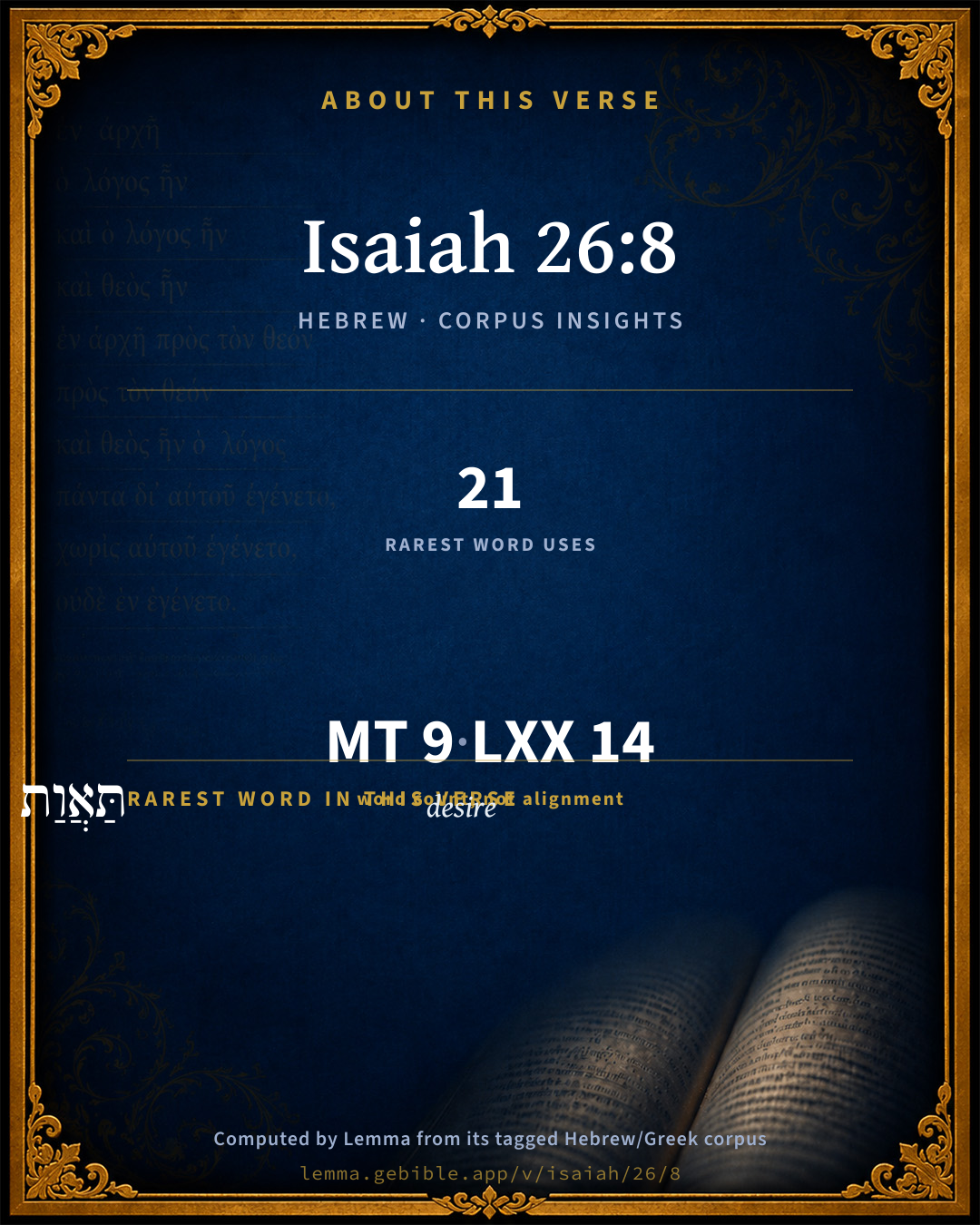
The rarest word here is תַּאֲוַת desire H8378 — appearing just 21 times in the whole Hebrew Bible.

Shared distinctive vocabulary

תַּאֲוַת desire H8378 occurs in 21 verses of the Hebrew Bible. Also found in:

Grammatical profile

  • 1 verb
  • 7 nouns
  • 1 particle

Verb forms

  • קִוִּינ֑וּךָ Piel · Perfect

Hebrew & Septuagint length

In English translation the verse runs 27 words from the Hebrew and 20 from the Septuagint (LXX English) — closely comparable.

A rough comparison of the two English renderings, which tokenize alike — not a word-level alignment.

Word counts can differ between the Hebrew and the Greek without any difference in meaning — e.g. the Hebrew direct-object marker אֵת has no separate Greek word, and Greek often adds the article ὁ.

In the original languages it is 9 Hebrew tokens and 14 Greek tokens — but the two are counted differently (Hebrew bundles its prefixes and suffixes into one token; the Greek is in lemma form), so that isn’t a like-for-like length.

Cross-references

31

Topical passages linked to Isaiah 26:8 in the Treasury of Scripture Knowledge — connected by theme and wording, ordered by reader-vote popularity; previews shown in the World English Bible.

  • Psalms 37:3–7 Trust in Yahweh, and do good. Dwell in the land, and enjoy safe pasture.
  • James 5:7–11 Be patient therefore, brothers, until the coming of the Lord. Behold, the farmer waits for the precious fruit of the earth, being patient over it, until it receives the early and late rain.
  • Isaiah 33:2 Yahweh, be gracious to us; we have waited for you: be our arm every morning, our salvation also in the time of trouble.
  • Exodus 3:15 God said moreover to Moses, "You shall tell the children of Israel this, 'Yahweh, the God of your fathers, the God of Abraham, the God of Isaac, and the God of Jacob, has sent me to you.' This is my name forever, and this is my memorial to all generations.
  • Psalms 65:6 Who by his power forms the mountains, Having armed yourself with strength;
  • 2 Thessalonians 3:5 May the Lord direct your hearts into the love of God, and into the patience of Christ.
  • Acts 1:4 Being assembled together with them, he charged them, "Don't depart from Jerusalem, but wait for the promise of the Father, which you heard from me.
  • Romans 8:25 But if we hope for that which we don't see, we wait for it with patience.
  • Numbers 36:13 These are the commandments and the ordinances which Yahweh commanded by Moses to the children of Israel in the plains of Moab by the Jordan at Jericho.
  • 2 Samuel 23:5 Most assuredly my house is not so with God; Yet he has made with me an everlasting covenant, Ordered in all things, and sure: For it is all my salvation, and all [my] desire, Although he doesn't make it grow.
  • Job 23:10–12 But he knows the way that I take. When he has tried me, I shall come forth like gold.
  • Psalms 18:23 I was also blameless with him. I kept myself from my iniquity.
  • Psalms 44:17–18 All this has come on us, Yet have we not forgotten you, Neither have we been false to your covenant.
  • Psalms 63:1–3 God, you are my God. I will earnestly seek you. My soul thirsts for you, My flesh longs for you, In a dry and weary land, where there is no water.
  • Psalms 73:25 Who do I have in heaven? There is no one on earth who I desire besides you.
  • Psalms 77:10–12 Then I thought, "I will appeal to this: The years of the right hand of the Most High."
  • Psalms 84:2 My soul longs, and even faints for the courts of Yahweh. My heart and my flesh cry out for the living God.
  • Psalms 106:3 Blessed are those who keep justice. Blessed is one who does what is right at all times.
  • Psalms 143:5–6 I remember the days of old. I meditate on all your doings. I contemplate the work of your hands.
  • Song of Solomon 1:2–4 Let him kiss me with the kisses of his mouth; For your love is better than wine.
  • Song of Solomon 2:3–5 As the apple tree among the trees of the wood, So is my beloved among the sons. I sat down under his shadow with great delight, His fruit was sweet to my taste.
  • Song of Solomon 5:8 I adjure you, daughters of Jerusalem, If you find my beloved, That you tell him that I am faint with love. Friends
  • Isaiah 12:4 In that day you will say, "Give thanks to Yahweh! Call on his name. Declare his doings among the peoples. Proclaim that his name is exalted!
  • Isaiah 25:9 It shall be said in that day, Behold, this is our God; we have waited for him, and he will save us: this is Yahweh; we have waited for him, we will be glad and rejoice in his salvation.
  • Isaiah 56:1 Thus says Yahweh, Keep you justice, and do righteousness; for my salvation is near to come, and my righteousness to be revealed.
  • Isaiah 64:4–5 For from of old men have not heard, nor perceived by the ear, neither has the eye seen a God besides you, who works for him who waits for him.
  • Psalms 13:1–2 How long, Yahweh? Will you forget me forever? How long will you hide your face from me?
  • Isaiah 30:18 Therefore will Yahweh wait, that he may be gracious to you; and therefore will he be exalted, that he may have mercy on you: for Yahweh is a God of justice; blessed are all those who wait for him.
  • Micah 7:7 But as for me, I will look to Yahweh. I will wait for the God of my salvation. My God will hear me.
  • Malachi 4:4 "Remember the law of Moses my servant, which I commanded to him in Horeb for all Israel, even statutes and ordinances.
  • Luke 1:6 They were both righteous before God, walking blamelessly in all the commandments and ordinances of the Lord.

Cross-references courtesy of OpenBible.info (CC BY 4.0).

Hebrew and Greek witnesses Masoretic Hebrew ↔ Greek Septuagint

The same verse in the two great witnesses to the Old Testament, shown verse-for-verse.

These are two independent witnesses, not word-aligned to each other, and the Septuagint is shown in lemma (dictionary) form.

Hebrew Isaiah 26:8 Masoretic · Westminster Leningrad Codex

אַ֣ף אֹ֧רַח מִשְׁפָּטֶ֛יךָ יְהוָ֖ה קִוִּינ֑וּךָ לְשִׁמְךָ֥ וּֽלְזִכְרְךָ֖ תַּאֲוַת נָֽפֶשׁ

Yes, in the way of your judgments, Yahweh, have we waited for you; to your name, even to your memorial [name], is the desire of our soul.

World English Bible · Public Domain

Greek LXX Isaiah 26:8 Septuagint · lemma form

ὁ γάρ ὁδός κύριος κρίσις ἐλπίζω ἐπί ὁ ὄνομα σύ καί ἐπί ὁ μνεία

For the way of the Lord is judgment: we have hoped in your name, and on the remembrance of you,

LXX2012 (modern English Septuagint) · Public Domain

On this verse, Adam Clarke's Commentary discusses the Septuagint’s reading. Read the note in Commentary ↓

Hebrew: Westminster Leningrad Codex (CC BY 4.0). Greek: Septuagint (public domain); English from LXX2012 (modern English Septuagint) (Public Domain). How the Septuagint differs from the Hebrew →

Targum (Aramaic paraphrase)

1

The Targum is the ancient Jewish Aramaic paraphrase of the Hebrew Scriptures — an interpretive translation, not the Hebrew text itself. Onkelos (literal) and Pseudo-Jonathan (expansive) render the Torah, and Jonathan the Prophets. Coverage is partial: where no permissively-licensed English translation exists for a verse, only the Aramaic is shown. This is verse-level text, not a word-by-word alignment to the Hebrew.

  1. Targum Jonathan Prophets (Joshua–Malachi)
    אַף לְאוֹרַח דִינָךְ יְיָ סְבַרְנָא לִשְׁמָךְ וּלְדָכְרָנָךְ חֲמֵדַת נַפְשָׁנָא:

    Yea, for the way of thy judgment, O Lord, have we hoped; to thy name and to the remembrance of thee is the desire of our soul.

    Targum Jonathan — Aramaic: “Mikraot Gedolot” (public domain). English: “Sefaria Community Translation” (CC0 1.0 (public-domain dedication)); “London "Chaldee Paraphrase," 1871” (public domain). Text via Sefaria.

Commentary

Notes on Isaiah 26:8 from classic Christian and Jewish commentators (each source and its license shown beneath its notes). The classic Christian expositions comment on the surrounding passage and are grouped to its opening verse, so a note may address several verses; the Jewish commentaries on the Tanakh (Rashi and others) are per-verse, so they appear only where the commentator wrote on this verse.

Lemma curates 59 commentaries, every one of them public domain or Creative Commons licensed, each selected and text-cleaned for this edition rather than reprinted as found. About our sources →

Trapp's Complete Commentary

John Trapp

Isa 26:8 Yea, in the way of thy judgments, O LORD, have we waited for thee; the desire of [our] soul [is] to thy name, and to the remembrance of thee.

Ver. 8. Yea, in the way of thy judgments.] Rough though it be and rugged; even when thou hast wrought against us in the rigour of thy punishments, as one paraphraseth it; in the discipline of thy chastisements, as another. There are those who by this phrase understand the doctrine of the gospel, which teacheth another way of judging of a righteous man than the law doth, and such as the Church trusteth to alone, and to none other, scil., justification by faith in Christ Jesus.

And to the remembrance of thee,] i.e., to all the signs, gauges, and tesitimonials which thou hast given us of thy grace by thy word, sacraments, and work. {a}

{a} Diod.

John Trapp, A Commentary or Exposition upon All the Books of the Old and New Testament (1647–1656) — public domain. Text from a community e-Sword module.

The Biblical Illustrator

Joseph S. Exell

Isa_26:8

Yea, in the way of Thy Judgments, O Lord, have we waited for Thee

Gods people waiting for Him in the way of His judgments

I.

THE WORDS CONTAIN A SOLEMN PROTESTATION--a protestation, on the part of these faithful people of the Lord, to Himself, in reference to His judgments. Yea, say they, Verily Thou, O Divine Searcher of hearts, knowest that we lie not, when we declare that in the way of Thy judgments we have waited for Thee. What a happy state of mind and heart is this! There may be a multiplication of observances, lastings, solemn assemblies, where, on the part of multitudes, there is nothing but form.

II. THESE GODLY JEWS SPEAK TO THE LORD OF HIS JUDGMENTS. If a sparrow cannot fall to the ground without. Thy knowledge and permission, how much more is Thy agency to be traced in those mighty desolations that have moved the earth, and come down with such appalling fury on the land of Thine own people!

III. THESE GODLY PEOPLE, IN THEIR SINNING AND CHASTENED LAND, SPEAK TO GOD OF THE WAY OF HIS JUDGMENTS. We read of Jehovahs

way in a gracious sense--His way of mercy to lost sinners--the wondrous and glorious path along which He has passed, and is still passing, in saving sinners of our fallen race through the atonement of His own beloved incarnate Son (Psa_67:1-2). Blessed, most blessed, are they who are Divinely taught this way of the Lord! A far other way of Judahs God is that to which her mourning children refer in the verse before us. It is His judicial way--the wrathful way in which He is provoked to come out of His place, and move towards highly favoured but deeply sinning and guilty lands.

IV. Let us contemplate and imitate the exercise of this small remnant of the fearers of the Lord in the land of Judah. THEY WAITED FOR HIM IN THE WAY OF HIS JUDGMENTS. What are the elements which should enter into the exercise to which we are this day called?

1. Solemn recognition of God.

2. Solemn adoration of this high and holy Lord God.

3. Justification of God.

4. Humiliation of soul before God.

5. Pouring out the heart in earnest supplication before the Lord. (W. Mackray, M. A.)

The right improvement of public or private calamities

I. IN EVERY AFFLICTIVE DISPENSATION OF DIVINE PROVIDENCE IT BECOMES US TO RECOGNISE THE HAND OF THE LORD. They are Thy judgments. In doing this we imitate the example of the wise and good in every age.

II. EVERY CALAMITY, WHETHER PRIVATE OR PUBLIC, SHOULD BE CONSIDERED AS A MANIFESTATION OF THE DIVINE DISPLEASURE AGAINST SIN. They are Thy judgments.

III. IN EVERY CALAMITY THE MIND OF THE BELIEVER SHOULD BE DIRECTED TO GOD. The desire of our soul is to Thy name, and to the remembrance of Thee.

1. This part of the passage expresses the most anxious solicitude that the Divine glory might be promoted by all the dispensations of His providence towards the children of men.

2. This part of our text seems to intimate also to whom the afflicted believer should apply for support. The desire of our soul is to Thy name, and to the remembrance of Thee.

3. This part of our text exhibits the believer finding a source of encouragement under present trouble, or in the anticipation of future difficulties, in a reference to his former experience of the power, the faithfulness and grace of his covenant God. The desire of our soul is to the remembrance of Thee.

IV. IN CIRCUMSTANCES OF AFFLICTION, WHETHER PRIVATE OR PUBLIC, IT IS THE DUTY AND PRIVILEGE OF THE BELIEVER TO BE FOUND WAITING UPON GOD. In the way of Thy judgments have we waited for Thee, O God. The verb to wait, as used in the text, denotes desire, expectation, patience, and perseverance. Learn--

1. That it is an evil thing and bitter to sin against God.

2. The infinite value of that system, which opens the way for the sinful creature to return to God, with the certain hope of being pardoned, adopted, and eternally blessed.

3. Let the sinner he exhorted to seek that Divine blessing which turns the curse into a blessing.

4. Let the believer labour to live in the exercise of the high and glorious privilege--waiting on God. (Essex Congregational Remembrancer.)

Christians, and their communion with God

(with Isa_26:9):--

I. THERE IS, IN THE PEOPLE OF GOD, A PRINCIPLE OF COMMUNION WITH GOD.

1. This is where their spiritual life begins.

2. This is where the life of the real Christian grows.

3. It becomes to the believer the tenor of his life to please God.

4. This principle of communion with God becomes the very flower of our lives.

5. This is the hunger and thirst of the Christian.

6. This proves that there has been a Divine renewal wrought in us.

7. This proves your sonship.

8. This proves your holiness, too, in a measure, for like will to like.

9. This proves your heavenliness, too, for that same desire which draws you to God is drawing you to Heaven.

II. THIS PRINCIPLE DISPLAYS ITSELF AND WORKS IN VARIOUS WAYS. Yea, in the way of Thy judgments, etc. We are longing for God, and it is dark and cloudy. What shall we do then?

1. Why, wait for Him. Sometimes, the way of Gods judgments may mean the appointed way, the regular way. Whenever thou hast a great trouble, expect a great mercy.

2. This communion leads to desiring. The desire of our soul, etc.

3. Your desire is to remember the Lord. And to the remembrance of Thee. I wish that I had a memory that was so narrow that it could only hold the things of God.

4. This principle of communion shows itself in a personal yearning. The eighth verse is in the plural, the ninth in the singular.

5. This principle of communion takes one other form, that of personal seeking. Yea, with my spirit within me, etc.

III. THE LORD TAKES PLEASURE IN THIS COMMUNION WITH HIS PEOPLE (Isa_26:20). (C. H. Spurgeon.)

The desire of our soul is to Thy name

The desire of the renewed soul

What is personal religion, and what is personal evidence of it? One single word, in my text is a key to all--desire. The sum and substance of a believers longings towards God is to know more of God, to enjoy more of God, to live more upon the fulness of the Son of God, and to become abstracted from all but God Himself. A sound creed is contained in these three things: I am a guilty wretch, deserving hell; Jesus is everything I want, for time and for eternity; I am His, and He is mine. Now, keeping this in view, let us descant upon--

I. THE OBJECT OF THE REGENERATED SOULS DESIRE. Look at this as it relates to the Holy Three in One. The soul may be longing for another sight of his Bible. But why? Because he longs to meet with God there. He may be longing to hear another Gospel sermon. Why? Because it sets forth the perfections of the God he loves, and therefore he expects to meet Him there. He may be longing for another ordinance day. Why? Because Jesus is often made known to him in breaking of bread. And so whatever means and ordinances are used, whatever externals are laid before the child of God and employed by him, it is not these that will satisfy him. It is God in them. I pass on to show--

II. WHAT WEANING WORK IS ESSENTIAL TO THIS. Until there is a great deal of weaning in the Christians experience there will not be a very great deal of spirituality.

III. THE NEGOTIATIONS THAT ARISE OUT OF THIS. If the earnest desire of my soul is after the enjoyment of God, I cannot grow careless about using means (J. Irons.)

The Biblical Illustrator, edited by Joseph S. Exell (c. 1880s–1900s) — public domain. Text from a community e-Sword module.

Joseph Benson's Commentary

Isa 26:8-9. Yea, in the way of thy judgments, O Lord — That is, as some understand it, of thine ordinances and commandments, in which we carefully and conscientiously walk; or, in the way of thy chastisements. As we, thy people, have loved and served thee, when thou didst make our way smooth and pleasant before us, so we have not forsaken thee, but waited upon thee, when thou didst see fit, for our trial, to make it difficult and troublesome. We have possessed our souls in patience under thy chastisements, and have waited thy time for our deliverance. The desire of our soul is to thy name — Hebrew, to thy name and thy memory; that is, to the remembrance of thy nature and attributes, according as thou hast made thyself known by thy word and works. And so the sense of this clause is, our affections are not alienated from thee by thy judgments, but we still continue to desire thy presence and favour, and we support and comfort ourselves with the remembrance of what thou art, and what thou hast done, and what thou hast promised to be to, and do for, thy people. With my soul — Sincerely and most affectionately; have I desired thee — The prophet speaks this in the name of all God’s people; in the night — In the time of affliction, often termed night, or darkness; or, rather, in the night, properly so called, as appears from the next clause, wherein early, or in the morning, is opposed to it. When others are sleeping, my thoughts and desires are working toward thee. Yea, with my spirit within me — By fervent and importunate prayer for thy loving-kindness; will I seek thee early — Betimes in the morning. For when thy judgments are in the earth — And good reason it is that we should thus desire and seek thee in the way of thy judgments, because this is the very design of thy judgments, that men should thereby be awakened to learn and return to their duty; and this is a common effect of them, that those who have been careless in prosperity are made wiser and better by afflictions.

Joseph Benson's Commentary on the Old and New Testaments (1811–1818) — public domain. Text from a community e-Sword module.

The Preacher's Complete Homiletical Commentary

Joseph S. Exell (gen. ed.)

THE WAY OF GOD’S JUDGMENTS

Isa_26:8. Yea, in the way of Thy judgments, O Lord, have we waited for Thee.

I. Observe what God’s judgments are. They are simply the expression of His thoughts. His final judgment is the declaration of His thoughts of a man’s character; His judgments here are also His declaration of what He thinks of our conduct and ways. One special thing for which psalmists and prophets adore Him is that men can see that His judgments are true and righteous (Psa_19:9; Psa_119:75, &c.) Their tendency and aim is to teach men what righteousness is (Isa_26:9).

II. The way of God’s judgments is the way of His laws. The calamities which men call “judgments” are generally the results of infraction by them of the laws by which He governs the universe.

The civil war in America was a judgment of God because it was a natural result of their toleration and defence of slavery; the war, with all its terrors, was a heavy penalty, and was clearly connected with their sin. So the cattle-plague in England was doubtless a natural result of some violation, through carelessness or greed, of God’s laws concerning the breeding and tending of cattle, and was thus one of God’s judgments.

III. The way of God’s judgments prescribes our way of prayer and expectation. We are to pray and expect, not that, while we continue as we were, God will remove the judgment; but that He will help us to understand it, and that He will dispose us to abandon the conduct that has brought it upon us. In thus waiting upon God—with penitence for our transgression, with prayer for light, and with sincere resolve to amend—we may expect God to bless us; but this we may expect only while we wait upon Him thus.—Alexander Mackennal, B.S: Sermon on the Cattle-plague.

Those who wait for God in the way of His judgments are,

1. Those who in prosperous and peaceful times endeavour to serve Him.

2. Those who desire to learn from them the lessons they were designed to teach. 3. Those who honour God by submission and trust in the trying hour.

4. These, even in the midst of judgment, may confidently expect the favour of God. A purpose of benevolence runs through even the stern and “strange work” of justice; and God, even when He chastises, will not utterly smite down the trusting heart.—William, Manning.

The Preacher's Complete Homiletical Commentary (gen. ed. Joseph S. Exell; Funk & Wagnalls, c. 1892) — public domain (pre-1929). A full-Bible homiletical/sermon-outline anthology covering 65 of 66 books (2 John is absent from the source module). Text from a community e-Sword module.

Keil & Delitzsch

C. F. Keil & F. Delitzsch

It then commences again in a lyrical tone in Isa 26:8 and Isa 26:9 : "We have also waited for Thee, that Thou shouldest come in the path of Thy judgments; the desire of the soul went after Thy name, and after Thy remembrance. With my soul I desired Thee in the night; yea, with my spirit deep within me, I longed to have Thee here: for when Thy judgments strike the earth, the inhabitants of the earth learn righteousness." In the opinion of Hitzig, Knobel, Drechsler, and others, the prophet here comes back from the ideal to the actual present. But this is not the case. The church of the last days, looking back to the past, declares with what longing it has waited for that manifestation of the righteousness of God which has now taken place. "The path of Thy judgments:" 'orach mishpâtēkâ belongs to the te; venientem (or venturum) being understood. The clause follows the poetical construction ארח בּוא, after the analogy of דרך הלך. They longed for God to come as a Redeemer in the way of His judgments. The "name" and "remembrance" ad the nature of God, that has become nameable and memorable through self-assertion and self-manifestation (Exo 3:15). They desired that God should present Himself again to the consciousness and memory of man, by such an act as should break through His concealment and silence. The prophet says this more especially of himself; for he feels himself "in spirit" to be a member of the perfected church. "My soul" and "my spirit" are accusatives giving a more precise definition (Ewald, 281, c). "The night" is the night of affliction, as in Isa 21:11. In connection with this, the word shichēr (lit. to dig for a thing, to seek it eagerly) is employed here, with a play upon shachar. The dawning of the morning after a night of suffering was the object for which he longed, naphshi (my soul), i.e., with his entire personality (Pyschol. p. 202), and ruchi b'kirbi (my spirit within me), i.e., with the spirit of his mind, πνεῦμα τοῦ νοός (Psychol. p. 183). And why? Because, as often as God manifested Himself in judgment, this brought men to the knowledge, and possibly also to the recognition, of what was right (cf., Psa 9:17). "Will learn:" lâmdu is a praet. gnomicum, giving the result of much practical experience.

Keil & Delitzsch — Biblical Commentary on the Old Testament (1861–1891) — public domain (CC PDM 1.0). Text via the HelloAO Bible API. (Old Testament only.)

Tyndale Open Study Notes

Tyndale Open Resources

26:8 we show our trust (see 26:3-4; literally we wait for you): Waiting involves trust in the Lord and longing for his redemption. • People express their commitment to God by obeying his laws; mere lip service is not sufficient.

Tyndale Open Study Notes — © Tyndale Open Resources, licensed CC BY-SA 4.0. Text via the HelloAO Bible API.

Geneva Bible (1599)

Geneva Bible translators

We have constantly aboade in the adversities wherewith thou had afflicted us.

Geneva Bible (1599) marginal notes — public domain. Text via Bolls.life.

Jamieson, Fausset & Brown

Robert Jamieson, A. R. Fausset & David Brown

way of thy judgments--We have waited for Thy proceeding to punish the enemy (Isa 26:9-10) [MAURER]. HORSLEY translates Isa 26:7-8, "The path of the Just One is perfectly even; an even road Thou wilt level for the Just One, even the path of Thy laws, O Jehovah. We have expected Thee."

name . . . remembrance--the manifested character of God by which He would be remembered (Isa 64:5; Exo 3:15).

Jamieson, Fausset & Brown — Commentary Critical and Explanatory on the Whole Bible (1871) — public domain (CC PDM 1.0). Text via the HelloAO Bible API.

Adam Clarke's Commentary

Verse 8. Have we waited for thee - "We have placed our confidence in thy name"] The Septuagint, Syriac, and Chaldee read קוינו kavinu, without the pronoun annexed.

Adam Clarke's Commentary on the Bible (1810–1826) — public domain. Text from a community e-Sword/MySword module.

Ellicott's Commentary for English Readers

(8) To thy name, and to the remembrance of thee . . .—The “name” of God is, as always, that which reveals His character and will. Those who have waited for Him in the path of His judgments long for a fuller manifestation of that character. Comp. the prayer, “Father, glorify thy Name,” in Joh_12:28. In the next verse the prophet identifies himself in spirit with the longing expectation of the time that precedes the final manifestation.

A Bible Commentary for English Readers, edited by Charles John Ellicott (1878–1897) — public domain. Text from a community e-Sword module.

The Cambridge Bible for Schools and Colleges

gen. ed. J. J. S. Perowne

8. Yea, in the way … for thee] i.e. have stood by the way along which we expected and desired Jehovah to appear—in judgment. The rest of the verse should be translated as in R.V., to thy name and to thy memorial is the desire of [our] soul (or, as Cheyne, “heartfelt desire”). “Name” and “memorial” are synonymous, as in Exo_3:15; Psa_135:13; Jehovah’s memorial is that by which He makes Himself to be remembered (see Isa_26:13).

The Cambridge Bible for Schools and Colleges (gen. ed. J. J. S. Perowne; Cambridge University Press, 1878–1918) — public domain. Text from a community e-Sword module.

John Gill's Exposition

Yea, in the way of thy judgments, O Lord, have we waited for thee,.... Meaning by "judgments" either the ministration of the word and ordinances, called statutes and judgments, Psa 147:19 an attendance on which is the right way of waiting upon God, and where it may be expected he will be found and manifest himself, and favour with his gracious presence; or else the corrections and chastisements, which are done in wisdom and with judgment, in measure and in mercy, and in a fatherly way, and for good; and so the sense is, that they had not only followed the Lord in a plain and even way, but even in the more rugged paths of afflictive dispensations; nor did these things at all move them from their duty to him, and worship of him:

the desire of our soul is to thy name, and to the remembrance of thee; to God himself, and to a remembrance of his nature, perfections, and works; to Christ, whose name is as ointment poured forth, and whose person is desirable, because of his glory, beauty, and fulness, because of his offices, and blessings of grace; and to his Gospel, which publishes and proclaims him, his grace, and salvation; and to his ordinances, which refresh the memory of his people concerning him, and his love to them shown in what he has done and suffered for them.

John Gill's Exposition of the Whole Bible (1746–1763) — public domain (CC PDM 1.0). Text via the HelloAO Bible API.

Albert Barnes' Notes on the Bible

Yea, in the way of thy judgements - The word ‘judgments’ often refers to the statutes or laws of God. But it may also refer to the afflictions and trials with which he visits or judges people; the punishments which they endure for their sins. In which sense the word is used here it is not easy to determine. Lowth understands it of the ‘laws’ of Yahweh. So Kimchi, who says that the sense is, that during their captivity and trials, they had not remitted anything of their love and piety toward God. I am inclined to the belief that this is the true interpretation, because in the corresponding member of the parallelism they are represented as saying that the desire of their soul was to God, and to the remembrance of him, implying that they sought by an observance of his laws to please him, and to secure his favor.

The desire of our soul is to thy name - The word ‘name’ is used here, as it is often, to denote God himself. They desired that he would come and deliver them; they earnestly wished that he would manifest himself to them as their friend.

And to the remembrance of thee - The word ‘remembrance’ (זכר zēker) is often equivalent to name, appellation, or that by which anyone is remembered, or known. Thus Exo 3:15 :

This is my name for ever;

And this is my memorial זכרי zikeriy unto all generations.

So Psa 30:4 :

Sing unto Yahweh, O ye saints of his;

And give thanks at the remembrance of his holiness;

That is, at his holy memorial (Margin,) or name. In the place before us it seems to be used in the sense of name or appellation; that is, that by which God would be remembered or known.

Albert Barnes' Notes on the Bible (1834–1885) — public domain. Text from a community e-Sword/MySword module.

Matthew Poole's English Annotations

Yea, in the way of thy judgments, O Lord, have we waited for thee: and as we thy people have loved and served thee when thou hast made our way plain and easy for us; so we have not forsaken thee, but waited upon thee, when thou hast made it rugged and troublesome by thy judgments. He speaks of the same just men Isa 26:7-9, though it be with a change of the numbers and persons, which is usual in prophetical writings, the just, Isa 26:7, we, Isa 26:1; 26:9.

To thy name, and to the remembrance of thee, Heb. to thy name and thy memory; which by a known figure called hendinduo may be put for the remembrance of thy name. And the name of God is here, as it is in many other places, put for God himself, as he hath made himself known by his word and works. And so the sense of this clause is, Our affections are not alienated from thee by thy judgments, but we still continue to desire thy presence and favour, and we support and comfort ourselves with the remembrance of what thou art, and what thou hast done, and what thou hast promised to be and do to thy people.

Matthew Poole's English Annotations on the Holy Bible (1683–1685) — public domain. Text from a community e-Sword/MySword module.

Whedon's Commentary on the Bible

Daniel D. Whedon

8, 9. In the way of thy judgments — In the song allusion is here made to the long discipline of the Judahites in Babylon, perhaps also elsewhere.

Waited — We waited in patient, trustful hope.

Thy name — Our desire was to thee, for the word “name” means all that belongs to the divine personality.

In the night… early — From night till morn, was our desire intense toward thee.

Daniel D. Whedon (gen. ed.), Commentary on the Old and New Testaments (1874–1909) — public domain. Text from a community e-Sword module.

The Pulpit Commentary

Yea, in the way of thy judgments... have we waited for thee; rather, we waited. During the long years of our affliction and persecution in the world, we waited in the constant expectation that "thy judgments" would fall upon our persecutors. We were not impatient. We knew that thou wouldst visit us at the tilting time. The desire of our soul is to thy Name; rather, the desire of our soul was to thy Name. During all the weary time of waiting, we longed for thee, and thy Name, or rather what thy Name indicates, thy own true self. In default of thy actual presence, we desired to have thee ever in remembrance.

Vers. 8, 9. A thirst for God.

"The desire of our soul is to thy Name... with my soul have I desired thee." The primary reference here is to the hope of troubled hearts for Divine deliverance; but the words of the text are suggestive of the general truths

I THAT MAN IS CONSTITUTED TO CRAVE AFTER GOD. We have many indications of this truth. We find it in the facts that:

1. The noblest spirits among cultivated peoples find their chief joy in communion with him.

2. The worthiest spirits among uncultivated peoples have been athirst for God.

3. Religious truth and Divine worship prove a powerful attraction to the vast majority of mankind.

4. Every human being is found to possess a capacity for religious knowledge and devotion.

5. Human life without God is found to be constantly unsatisfying and restless.

II THAT THIS GODWARD ASPIRATION, DULLED BY SIN, IS OFTEN AWAKENED BY AFFLICTION. "I desired thee in the night." Our interest in God, reduced by the various harmful and despoiling influences of a sinful society, sometimes so reduced as to be practically lost, is often awakened by affliction of some kind. It is not until the soul is brought down very low by sickness, by calamity, by bereavement, by treachery and disappointment, or by earthly failure and disenchantment, that it finds its deep and sore need of a heavenly Father, of an unfailing Friend, of a heavenly treasure. When thus injured and spoiled by sin, it is not until our souls are made to see their sinfulness in a fierce and awful light that we crave and cry out for an almighty and all-sufficient Savior; but then we do.

III THAT, REAWAKENED IN ADVERSITY, IT BECOMES A PERMANENT HABITUDE OF THE SOUL. "With my spirit... will I seek thee early." Whether or not we find this doctrine in the text, we find this truth in the will of God; and God expects to find this fact in human experience. It is bitterly disappointing to the good and is it not a disappointment to the Good One? when they who have been brought to the throne of grace by reflection are found, in after-days of comfort and sunshine, to leave the sanctuary unvisited, and to walk on their way, godless, prayerless, hopeless. Such men

(1) defeat God"s kind purposes;

(2) add iniquity to their iniquity;

(3) most seriously endanger their own future. C. (see Isa_1:5)

Attitude in times of judgment.

"In the way of thy judgments, O Lord, have we waited for thee." The connections of this chapter need sonic careful attention. The prophet, in the twelve preceding chapters, has given visions of the judgments that were ready to fall on the nations surrounding Israel judgments in which Israel itself must share, since Israel had shared in the idolatries and the moral evils which had called those judgments forth. To most of the nations Divine judgments would prove to be desolation and destruction; an irrecoverable doom. To Israel, because, even in its shame and sin, some held fast by righteousness and God, judgment would be but chastisement, by means of which the nation should be purified and established. Tyre should be wiped away; its place would be no longer known; the foundation of her palaces should be for the spreading of the fishermen"s nets. Babylon should be brought low, even to the dust; no shepherd"s hut, no wandering Arab"s tent, should rise on her foundations; the glory of Nebuchadnezzar should be the place of the satyr and the owl and the wild beasts of the desert. But Israel should come out of its time of judgment renewing its youth, purged from its idolatries, and witnessing, with a clearer voice than ever before, to its great truth, "The Lord Jehovah is one Lord." The prophet, in his vision, sees these judgments pass one by one; but, looking on beyond them, he sees the ransomed of Israel redeemed and saved, and he presents us beforehand with the song which they would unite to sing in the raptures of their deliverance. By telling the people the song which their noblest and best would sing when trials had wrought out their blessings, Isaiah teaches them the spirit which they ought to cherish, now, as they anticipated the judgments, or were wearying themselves under their burden. By-and-by they would rejoice that they had held fast by God under the gloom. Then "waiting on him, and waiting for him," is just the attitude they should seek and cherish.

I Viewed in one way, the circumstances through which Israel would be passing would be JUDGMENTS OF GOD; but viewed in another way, they would only be the ORDINARY COMMONPLACE FACTS OF THEIR NATIONAL LIFE. The growth into overwhelming power of some nations, until they swallowed up all the smaller nations around them, became proud, tyrannical, and luxurious; lost national virtue, and fell a prey to the enterprise and energy of fresher and younger nations. This process the Israelites actually saw going on, at different stages, in the kingdoms around them. The laws that ruled it, the final results of it, they could not discern, and they must have been gravely bewildered by it. All the more because they had themselves to suffer from the encroachments of these rising monarchies. In those trying days it could not have been an easy thing for a Jew to hold fast his faith in God. Reasoning could explain so little. Iniquity seemed to be triumphing over good. Jehovah appeared to have loosed his hand, and left the world to riot in its self-will. Those were great men indeed who could rise above the disasters and the helplessness of the times, and stay themselves on God, and hope in him, and wait for him.

II But that was quite A MODEL GENERATION. Each age, though expressing itself in new forms and terms, may find its own perplexities mirrored there. Early times had their chief difficulties in outward things, such as the aggrandizement of world-conquerors, and the debasing effect of idolatrous systems. As the world grows older, the perplexities and the trials of faith come more and more out of intellectual and moral conditions; and we incline to think that it is much harder work to hold on to God, with patient waiting, in times of mental and moral confusion than when the earth is disturbed with sword and spear and shield. Perhaps never were men called to steady themselves on God, and wait on him in the way of his judgments, as we are called. There are two peculiarities of our time which, seen on the one side, are just facts of life, but seen from the other side are judgments of God in the midst of which we are to wait upon him.

1. The disposition to accomplish all things by human effort, apart from God. Man, according to present-day teaching, is to be the Savior and Salvation of man. Let but every man lift up his brother so they say and the world"s golden age shall dawn; but the light that lightens it shall be the brilliancy of human genius, and not the "glory of the Lord.

2. The confusion which advancing knowledge has seemed to introduce into both doctrines and morals. Some of the greatest men of science have been reverent men who, while searching with a free spirit into all that can be known of creation, yet held God fast in the arms of trustful love, and found traces of his handiwork in everything they examined. But not a few are over-ready to discover some-times even ready to manufacture antagonisms between reason and revelation. And even the best of us cannot fail to be influenced by the atmosphere of doubt which has thus been created for us. We know what mental struggle means. We know what it is to search after truth that seems ever to glide beyond our grasp. We, too, are walking in the way of God"s judgments, and blessed are we if we can truly say, In the way of thy judgments, O Lord, have we waited for thee." We gather two lessons from these considerations.

3. The bottom, the foundation, the rest, of all things is God. The first truth which the child learns is the truth of God. The utmost truth towards which human intellects and human hearts can push their devious, struggling way, is God. The simplest word that infant Sips can utter is God;" the largest and awe-fullest word that can burn upon an archangel"s lips is the Name of God. That man knows something who knows a little of God. That man knows nothing all he may seem to know is not within the sphere of true being who does not know God. The steadying, the resting, of a man"s soul is impossible save in God. "Who is a Rock save our God?" Then our supreme work in life must be to know God to know him by waiting upon him;" to know him in the face of Jesus Christ.

4. And we learn that those who would hold by God will have to wait" for him. God tests the trusting ones by his mysterious doings and dealings. He hides, as it were, behind the clouds and the darkness that encircle his throne. He is even to be waited on in the "way of his judgments." And such a spirit of waiting alone can preserve us amid the judgments. It lies at the very basis of noble and regenerate character. And all life is to us according to our character. "To the pure all things are pure; to the impure nothing is pure." To the bad, godless man, the highest mercies become curses; the self-centered character can make poison even out of angels" food. To the bad mart, punishments are ruin, desolation, woe; even as to heathen nations these prophetic burdens were unredeemable calamity. But to the good man, the God-centered man, punishments are but chastisements, out of which are wrought "the peaceable fruits of righteousness." It has been said that the "dealings of God are punishments to the wicked, but chastisements to the righteous." It should rather be said that there is no difference in the Divine dealing judgments come both on the righteous and on the wicked; but the attitude in which we meet the judgments makes all the difference. The ungodly man bruises himself "against the bosses of Jehovah"s buckler." The godly man who "waits on the Lord binds to bear the rod of his heavenly Father"s chastening. To the godless man life is just stern iron and brass; but the Christian man, having learnt of God, is alchemist enough to turn all he touches to finest gold. Then "trust in the Lord forever: for in the Lord Jehovah is everlasting strength."

The Pulpit Commentary (1880–1919), ed. H.D.M. Spence-Jones & Joseph S. Exell — public domain. Text from a community e-Sword module.

J. A. Alexander on Isaiah

Joseph Addison Alexander

“Also in the way of Thy judgments, oh Jehovah, we have waited for Thee; to Thy name and Thy remembrance (was our) soul’s desire.” For this manifestation of thy righteousness and goodness we have long been waiting in the way of Thy judgments, (i.e., to see Thee come forth as a judge), for the vindication of Thy people and the destruction of their enemies. Name and remembrance or memorial denote the manifestation of God’s attributes in His works.

Joseph Addison Alexander, The Prophecies of Isaiah (1846–1847; New York: Scribner, 1870–1878) — public domain. Text from a community e-Sword module.

Rashi

Rabbi Shlomo Yitzchaki (Rashi)

Even [for] the way of Your judgments, O Lord, have we hoped for You When we looked forward to receiving benefit from You, likewise we hoped that You would show us the way of the judgments of Your revenge upon the wicked. ([Manuscripts read:] Upon the wicked Esau.)

for Your Name and Your remembrance was the desire of [our] soul Our soul longed to see the name You will gain from them, by wreaking vengeance upon Your adversaries.

Rashi on the Tanakh — English translations: “The Judaica Press complete Tanach with Rashi, translated by A. J. Rosenberg” (CC BY 4.0); “Pentateuch with Rashi's commentary by M. Rosenbaum and A.M. Silbermann, 1929-1934” (public domain); “The Metsudah Tanach series, Lakewood, N.J” (CC BY 4.0); and “The Book of Joshua, Metsudah Publications, 1997” (CC BY 4.0). Text via Sefaria.

Ibn Ezra

Rabbi Abraham ibn Ezra

We waited for thee, O Lord, even for the way of Thy judgment, etc. These are the words of the righteous that hope in the Lord, that He will show His judgment in the universe; for the soul is longing for Thy name. Before ארח path supply the preposition ל for.

Ibn Ezra on the Tanakh — English translations: “Sefaria Community Translation” (CC0 1.0 (public-domain dedication)); “Yalkut, Sifsei Chachomim Chumash, Metsudah Publications, 2009” (CC BY 4.0); and “Commentary of Ibn Ezra on Isaiah - trans. by M. Friedlander, 1873” (public domain). Text via Sefaria.

Lesson kit

Teaching starters — assembled from the data on this page, not authored interpretation. Every prompt links to the verse data it draws on. Edit before teaching.

Isaiah, in the Prophets, opens this verse with 9 words (9 distinct Hebrew lemmas). Its most distinctive word is taʼăvâh (“desire”). A historical commentator’s framing appears above. Read the whole chapter for the surrounding context.

Discussion questions

  1. What does “desire” (taʼăvâh) contribute to the verse as a whole?
  2. How does Genesis 3:6, which shares the word «desire», read alongside this verse?
  3. The translations on this page render this verse differently — a whole-verse word diff, not a word-by-word alignment. What might account for the different wordings?
  4. «קִוִּינ֑וּךָ» is a Piel Perfect verb. How does that grammatical form shape the action described?
  5. Compare how Trapp's Complete Commentary and The Biblical Illustrator read this verse. Where do they agree or differ?

Things to notice

Reading settings

Reading text

Shown beneath each verse's original-language words.

Old Testament
Old Testament edition

Read the OT as the Masoretic Hebrew (MT) or the Greek Septuagint (LXX).

English shown for the Greek Septuagint (in the Hebrew ↔ Greek comparison).

Comparing translations? Open the Compare panel on any verse page to stack up to four side by side.