
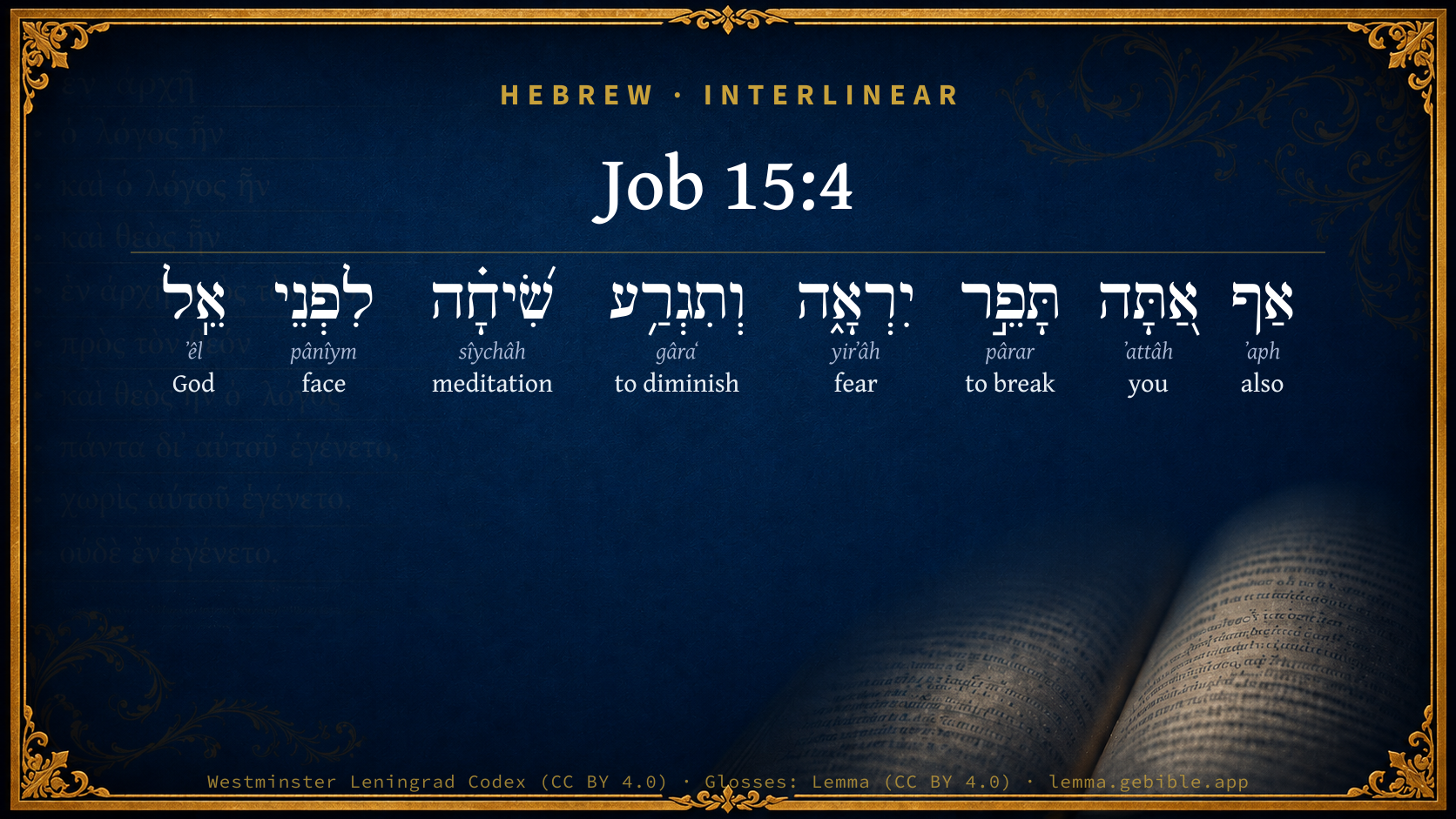
Job 15:4

Hebrew (Westminster Leningrad Codex) Job 15:4 appears in the Hebrew Old Testament. The text above is from the Westminster Leningrad Codex. Each word links to its Strong’s number, a concise gloss, and parsing drawn from the Open Scriptures Hebrew Bible morphology. Click any word for its full Brown-Driver-Briggs (BDB) entry.
Download image
Cite this verse

Job 15:4 (World English Bible). Public Domain. Lemma interlinear Bible study tool, https://lemma.gebible.app/v/job/15/4.

Show BibTeX & RIS
BibTeX
RIS
English Translation
Yes, you do away with fear, And hinder devotion before God.
World English Bible · Public Domain
Highlights
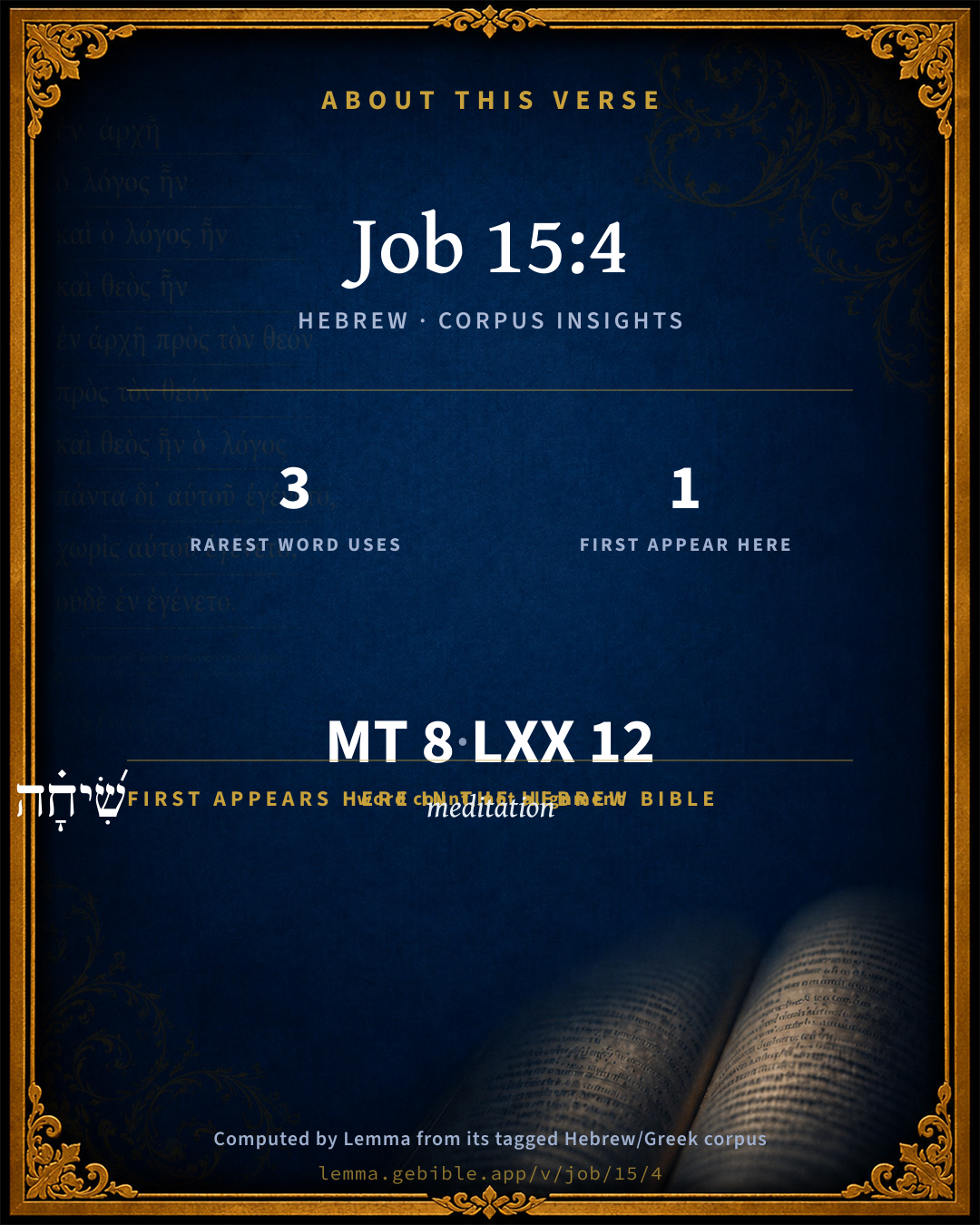
  • 1 first appearance in the Hebrew Bible
Full analysis ↓
Download a study sheet

One document with this verse’s original text, its word-by-word gloss line, the meaning frame, cross-references with their text, attributed commentary, and full source and license credits — printable, and it pastes into notes with its structure intact.

This verse Autodidact and up

Study sheet (.html) Plain text (.txt)

A passage Seminary Student

Up to 50 verses in one chapter. A passage sheet keeps up to 6 commentary sources and 12 cross-references per verse, in the order this page ranks them, and says so on the sheet whenever that leaves anything out. Ask for a single verse and you get the Autodidact verse sheet above.

Everything on this page stays free to read, with no account — the sheet is a download of what is already on screen, not access to it.

Want to remove ads? Support Godless Engineer
Compare translations 3

The same verse in 3 English versions, stacked beneath the original-language interlinear above. Click any original word for its lexicon entry.

Each is an independent rendering of the whole verse — the interlinear is not word-aligned to these translations.

Highlighted words mark where these versions differ — a whole-verse word diff, not a word-by-word alignment.

  • World English Bible Public Domain
    Yes, you do away with fear, And hinder devotion before God.
  • King James Version Public Domain
    Yea, thou castest off fear, and restrainest prayer before God.
  • unfoldingWord Literal Text CC BY-SA 4.0
    Indeed, you destroy fear, and you diminish devotion to the face of God,

unfoldingWord Literal Text — © unfoldingWord, licensed CC BY-SA 4.0. Word-aligned USFM3 via Door43 (git.door43.org/unfoldingWord/en_ult).

Versions to compare (up to 4)

3 of 4 selected

Show all 18 translations

Every available English version of this verse, each an independent rendering of the whole verse.

  • World English Bible Public Domain
    Yes, you do away with fear, And hinder devotion before God.
  • Berean Standard Bible Public Domain
    But you even undermine the fear of God and hinder meditation before Him.
  • Majority Standard Bible Public Domain
    But you even undermine the fear of God and hinder meditation before Him.
  • King James Version Public Domain
    Yea, thou castest off fear, and restrainest prayer before God.
  • American Standard Version (1901) Public Domain
    Yea, thou doest away with fear, And hinderest devotion before God.
  • Revised Version (1885) Public Domain
    Yea, thou doest away with fear, and restrainest devotion before God.
  • Geneva Bible (1599) Public Domain
    Surely thou hast cast off feare, and restrainest prayer before God.
  • Douay-Rheims (1899) Public Domain
    As much as is in thee, thou hast made void fear, and hast taken away prayers from before God.
  • Young's Literal Translation Public Domain
    Yea, thou dost make reverence void, And dost diminish meditation before God.
  • Literal Standard Version CC BY-SA 4.0
    Indeed, you make reverence void, and diminish meditation before God.
  • Unlocked Literal Bible CC BY-SA 4.0
    Indeed, you diminish respect for God; you obstruct devotion to him,
  • unfoldingWord Literal Text CC BY-SA 4.0
    Indeed, you destroy fear, and you diminish devotion to the face of God,
  • Darby Bible Public Domain
    Yea, thou makest piety of none effect, and restrainest meditation before ùGod.
  • World Messianic Bible Public Domain
    Yes, you do away with fear, and hinder devotion before God.
  • Webster's Bible Public Domain
    Yes, thou castest off fear, and restrainest prayer before God.
  • Free Bible Version CC BY-SA 4.0
    But you are doing away with the fear of God, and destroying communion with him.
  • Bible in Basic English Public Domain
    Truly, you make the fear of God without effect, so that the time of quiet worship before God is made less by your outcry.
  • JPS Tanakh (1917) Public Domain
    Yea, thou doest away with fear, and impairest devotion before God.

Literal Standard Version (2020), Covenant Press — licensed CC BY-SA 4.0. Text via the HelloAO Bible API (eBible.org). Unlocked Literal Bible (unfoldingWord) — licensed CC BY-SA 4.0. Text via the HelloAO Bible API (eBible.org). unfoldingWord Literal Text — © unfoldingWord, licensed CC BY-SA 4.0. Word-aligned USFM3 via Door43 (git.door43.org/unfoldingWord/en_ult). Free Bible Version, Dr. Jonathan Gallagher — licensed CC BY-SA 4.0. Text via the HelloAO Bible API (eBible.org).

Word by word

More ways to search: Search by grammar → Find every occurrence → Compare this word →

Practice this passage: Drill this verse → Learn its vocabulary →

About this verse

These counts appear in no published source. They are computed here, from the morphology-tagged text and Lemma’s own curated glosses. What Lemma adds →

8
words
8
distinct lemmas
Wisdom
section

Notable vocabulary

The rarest word here is שִׂ֝יחָ֗ה meditation H7881 — appearing just 3 times in the whole Hebrew Bible.

First appearance in Scripture

This word makes its first canonical appearance in the Hebrew Bible here:

  • שִׂ֝יחָ֗ה meditation H7881

Shared distinctive vocabulary

שִׂ֝יחָ֗ה meditation H7881 occurs in 3 verses of the Hebrew Bible. Also found in:

Grammatical profile

  • 2 verbs
  • 4 nouns
  • 1 pronoun
  • 1 particle

Verb forms

  • תָּפֵ֣ר Hiphil · Imperfect
  • וְתִגְרַ֥ע Qal · Imperfect

Hebrew & Septuagint length

In English translation the verse runs 11 words from the Hebrew and 14 from the Septuagint (LXX English) — closely comparable.

A rough comparison of the two English renderings, which tokenize alike — not a word-level alignment.

Word counts can differ between the Hebrew and the Greek without any difference in meaning — e.g. the Hebrew direct-object marker אֵת has no separate Greek word, and Greek often adds the article ὁ.

In the original languages it is 8 Hebrew tokens and 12 Greek tokens — but the two are counted differently (Hebrew bundles its prefixes and suffixes into one token; the Greek is in lemma form), so that isn’t a like-for-like length.

Cross-references

13

Topical passages linked to Job 15:4 in the Treasury of Scripture Knowledge — connected by theme and wording, ordered by reader-vote popularity; previews shown in the World English Bible.

  • Romans 3:31 Do we then nullify the law through faith? May it never be! No, we establish the law.
  • 1 Chronicles 10:13–14 So Saul died for his trespass which he committed against Yahweh, because of the word of Yahweh, which he didn't keep; and also because he asked counsel of one who had a familiar spirit, to inquire [thereby],
  • Job 4:5–6 But now it is come to you, and you faint; It touches you, and you are troubled.
  • Job 5:8 "But as for me, I would seek God, To God would I commit my cause;
  • Job 6:14 "To him who is ready to faint, kindness should be shown from his friend; Even to him who forsakes the fear of the Almighty.
  • Job 27:10 Will he delight himself in the Almighty, And call on God at all times?
  • Psalms 36:1–3 An oracle is within my heart about the disobedience of the wicked: "There is no fear of God before his eyes."
  • Psalms 119:126 It is time to act, Yahweh, For they break your law.
  • Hosea 7:14 They haven't cried to me with their heart, But they howl on their beds. They assemble themselves for grain and new wine. They turn away from me.
  • Amos 6:10 "When a man's relative carries him, even he who burns him, to bring bodies out of the house, and asks him who is in the innermost parts of the house, 'Is there yet any with you?' And he says, 'No;' then he will say, 'Hush! Indeed we must not mention the name of Yahweh.'
  • Zephaniah 1:6 those who have turned back from following Yahweh, and those who haven't sought Yahweh nor inquired after him.
  • Luke 18:1 He also spoke a parable to them that they must always pray, and not give up,
  • Galatians 2:21 I don't make void the grace of God. For if righteousness is through the law, then Christ died for nothing!"

Cross-references courtesy of OpenBible.info (CC BY 4.0).

Hebrew and Greek witnesses Masoretic Hebrew ↔ Greek Septuagint

The same verse in the two great witnesses to the Old Testament, shown verse-for-verse.

These are two independent witnesses, not word-aligned to each other, and the Septuagint is shown in lemma (dictionary) form.

Hebrew Job 15:4 Masoretic · Westminster Leningrad Codex

אַף אַ֭תָּה תָּפֵ֣ר יִרְאָ֑ה וְתִגְרַ֥ע שִׂ֝יחָ֗ה לִפְנֵי אֵֽל

Yes, you do away with fear, And hinder devotion before God.

World English Bible · Public Domain

Greek LXX Job 15:4 Septuagint · lemma form

οὐ καί σύ ἀποποιέω φόβος συντελέω δέ ῥῆμα τοιοῦτος ἔναντι ὁ κύριος

Have not you moreover cast off fear, and accomplished such words before the Lord?

LXX2012 (modern English Septuagint) · Public Domain

Hebrew: Westminster Leningrad Codex (CC BY 4.0). Greek: Septuagint (public domain); English from LXX2012 (modern English Septuagint) (Public Domain). How the Septuagint differs from the Hebrew →

Commentary

Notes on Job 15:4 from classic Christian and Jewish commentators (each source and its license shown beneath its notes). The classic Christian expositions comment on the surrounding passage and are grouped to its opening verse, so a note may address several verses; the Jewish commentaries on the Tanakh (Rashi and others) are per-verse, so they appear only where the commentator wrote on this verse.

Lemma curates 59 commentaries, every one of them public domain or Creative Commons licensed, each selected and text-cleaned for this edition rather than reprinted as found. About our sources →

Trapp's Complete Commentary

John Trapp

Job 15:4 Yea, thou castest off fear, and restrainest prayer before God.

Ver. 4. Yea, thou casiest off fear] Heb. Thou makest void fear; that is, religion, whereof the fear of God is both the beginning, Pro 1:7, and the end, Ecc 12:1. This is a heavy charge indeed; as if Job, by saying the extreme miseries of this life are common to the godly and the wicked, had by consequence taught men to cast off all religion as unprofitable, which none but such a shameless man as thyself, saith Eliphaz, would ever have averred. It cannot be denied but that Job, through the bitterness of his grief and the unreasonableness of his adversaries, was sometimes carried beyond the bounds of that reverence which is due unto God, and reasoneth the matter somewhat hotly with God; but that thereby he betrayed his manifest contempt of his majesty, casting off all awful regard and recourse thereto by prayer, as the wicked, who call not upon God, Psa 14:4, this was a mere conjecture, or rather an unsufferable injury done to the good man, who gave sufficient testimony of his fearing God, and soon poured out his prayer in his presence. All which, notwithstanding, he heareth in the next words,

And restrainest prayer before God] Thou forbearest to pray thyself, and thou discouragest others. If this had been true it had been a foul fault indeed, for while prayer standeth still, the whole trade of godliness standeth still likewise; and to cast off prayer is to cast off God, Jer 10:25. We must take heed of falling from the affections of prayer, though we continue doing the duty. As vessels of wine, when first tapped, are very smart and quick, but at last grow exceedingly flat; so do many Christians, through unbelief, and worldly cares and businesses, or domestic discords, or some other distempers, whereby prayers are hindered, 1Pe 3:7; either they pray not frequently, or not fervently, but in a customary, formal, dull way. And this Eliphaz might suspect Job of, and assign it as the cause of all his miscarriages in word and deed. Sure it is that, as sleep composeth drunkenness, so doth prayer the affections; a man may pray himself sober again, as a reverend man (Dr Preston) gathereth out of this text.

John Trapp, A Commentary or Exposition upon All the Books of the Old and New Testament (1647–1656) — public domain. Text from a community e-Sword module.

The Biblical Illustrator

Joseph S. Exell

Job_15:4

Thou restrainest prayer before God.

The hindrances to spiritual prayer

All the motives by which the heart of man can be influenced, combine to urge upon him the great duty of prayer. Whence, then, arises the guilty indifference to spiritual prayer, so prevalent among us? Why will men, whose only hope depends upon the undeserved compassion of their Heavenly Father, close up, as it were, by their own apathy and unbelief, the exhaustless fountain from whence it longs to flow, and restrain prayer before God? Examine some of the more common hindrances to comfort and success in the exercise of prayer; and inquire why so little growth in grace is derived from this essential element of the Christian life. Prayer is restrained before God--

I. When he is approached in a proud, unhumbled state of heart. Such was the sin of Job when the Temanite reproved him. Can an unrestrained communion be held with God by one whose spirit has not yet been subdued by the knowledge of his sin, the conviction of his danger, the shame of his ingratitude? If prayer be anything, it is the utterance of one self-condemned, to the Being by whom he was made, the Judge by whose verdict he must abide, the Redeemer through whose mercy he may be saved. If prayer have any special requisites, contrition must be its very essence. Without a proper sense of the evil predominating within us, there can be no holy freedom in prayer; no aspiration of the soul towards heaven; no unrestrained utterance of the Psalmists cry, Make me a clean heart, O God! An unhumbled mind and an unrestrained prayer are palpable contradictions.

II. When the suppliant is enslaved by the love and indulgence of any sin. Augustine relates of himself, that although he dared not omit the duty of prayer, but, with his lips constantly implored deliverance from the power and love of his besetting sins, they had so strongly entwined themselves around his heart, that every petition was accompanied with some silent aspiration of the soul, for a little longer delay amidst the unhallowed sources of his past gratifications. Judge, then, whether Augustine in this state did not restrain prayer before God. Forbidden acts, or the indulgence of unblest desires, overrule and hinder the transgressors prayer. Let me warn you also against a devotion to the pursuits, pleasures, and attractions of the world. The spirit thus entangled and ensnared, may indeed undertake the employment; but instead of being occupied by the majesty of Jehovah, the love of Immanuel, and the momentous aspect of eternal things, it will be fluttering abroad among the passing and perishing vanities in which it seeks its mean and grovelling good. Can he whose attention is mainly confined to the acquisition of temporal good, expand his heart in prayer for mercies unseen and spiritual? God comes to us in His Gospel, exhibiting on the one hand His greatness and His goodness, and on the other, exposing the emptiness of time and sense.

III. When we pray without fervency. What is the object of supplication? Is it not that we may share the privileges of the family of heaven; serving God with delight and love among His people below; and becoming meet to serve Him day and night in His temple above, among the spirits of the just made perfect? Are these, then, mercies which should be sought in the mere language of prayer, unanimated by its spirit and its fervency? The prayer which God will hear and bless, demands some touch of the spirit manifested by the believing Syrophenician woman. If this fervour of prayer be wanting, the deficiency originates in an evil heart of unbelief which departs from the living God.

IV. When we neglect to pray frequently. Our wants are continually recurring; but only the fulness of infinite mercy can supply them. We are, in fact, as absolutely dependent upon the daily mercies of our God, as were the Israelites upon the manna which fell every morning around their tents. Constant prayer, therefore, must be necessary. There is continual need of prayer for growth in grace.

V. When we regard prayer rather as a burdensome duty than a delightful privilege. A wondrous provision has been made to qualify guilty and polluted creatures for approaching the God of all purity and holiness. We who some time were far off are made nigh by the blood of Christ. Through Him we have access by one Spirit unto the Father. The Christian draws nigh with the united offering of prayer and thanksgiving. Do we then not restrain prayer, when, instead of addressing ourselves to it with glad hearts and holy boldness, we are led unwillingly to the duty, and urged only by the gloomy demands of a spirit of bondage? Until converse with God in prayer be the life and pleasure of the soul, the balm that best allays its pains, the consolation that best speaks peace and silence to its sorrows, the cordial that revives its fainting affection, there can be no unreservedness of heart in this great duty. We should open our whole hearts to the eye of His mercy; tell Him of every wish; relate every sorrow; entreat Him to sympathise in every suffering, and feel assured that He will minister to every want.

VI. When it is confined to requests for mercies of lesser concern and moment. We have immortal spirits, no less than perishable bodies. We are probationers for heaven. We have sinful souls which must be pardoned; we have carnal minds, which must be renewed. The spirit is more valuable than the body; eternity more momentous than time. Is not prayer then restrained, when, instead of employing it to seek the things which belong to our peace, we desire this worlds good with absorbing earnestness; and the better part, which cannot be taken away, feebly, if at all? Every mercy, we may be sure, waits upon the prayers of an open heart. (R. P. Buddicom, M. A.)

Restraining prayer

This is part of the charge brought by Eliphaz against Job. I address myself to the true people of God, who understand the sacred art of prayer, and are prevalent therein; but who, to their own sorrow and shame, must confess that they have restrained prayer. We often restrain prayer in the fewness of the occasions that we set apart for supplication. We constantly restrain prayer by not having our hearts in a proper state when we come to its exercise. We rush into prayer too often. We should, before prayer, meditate upon Him to whom it is to be addressed; upon the way through which my prayer is offered. Ought I not, before prayer, to be duly conscious of my many sins? If we add meditation upon what our needs are, how much better should we pray! How well if, before prayer, we would meditate upon the past with regard to all the mercies we have had during the day. What courage that would give us to ask for more! It is not to be denied, by a man who is conscious of his own error, that in the duty of prayer itself we are too often straitened in our own bowels, and do restrain prayer. This is true of prayer as invocation; as confession; as petition; and as thanksgiving. And lastly, it is very clear that, in many of our daily actions, we do that which necessitates restrained prayer. (C. H. Spurgeon.)

On formality and remissness in prayer

This is one of the many censures that Jobs friends passed upon him. He could not be convicted of the fact, without being convicted of sin. Prayer is most positively enjoined, as a primary duty of religion; a duty strictly in itself, as the proper manner of acknowledging the supremacy of God and our dependence. Prayer cannot be discountenanced on any principle which would not repress and condemn all earnest religious desires. Would it not be absurd to indulge these desires, if it be absurd to express them? And worse than absurd, for What are they less than impulses to control the Divine determinations and conduct? For these desires will absolutely ascend toward Him. Again, it is the grand object to augment these desires. Then here too is evidence in favour of prayer. For it must operate to make them more strong, more vivid, more solemn, more prolonged, and more definite as to their objects. Forming them into expressions to God will concentrate the soul in them, and upon these objects. As to the objection that we cannot alter the Divine determinations; it may well be supposed that it is according to the Divine determinations that good things shall not be given to those that will not petition for them; that there shall be this expression of dependence and acknowledgment of the Divine supremacy. Now for the manner in which men avail themselves of this most sublime circumstance in their condition. We might naturally have expected an universal prevalence of a devotional spirit. Alas! there are millions of the civilised portion of mankind that practise no worship, no prayer at all, in any manner; they are entirely without God in the world, To say of such an one, Thou restrainest prayer, is pronouncing on him an awful charge, is predicting an awful doom. We wish, however, to make a few admonitory observations on the great defectiveness of prayer in those who do feel its importance, and are not wholly strangers to its genuine exercise. How much of this exercise, in its genuine quality, has there been in the course of our life habitually? Is there a very frequent, or even a prevailing reluctance to it, so that the chief feeling regarding it is but a haunting sense of duty and of guilt in the neglect? This were a serious cause for alarm, lest all be wrong within. Is it in the course of our days left to uncertainties whether the exercise shall be attended to or not? Is there a habit of letting come first to be attended to any inferior thing that may offer itself? When this great duty is set aside for an indefinite time, the disposition lessens at every step, and perhaps the conscience too. Or, in the interval appropriate to this exercise, a man may defer it till very near what he knows must be the end of the allowed time. Again, an inconvenient situation for devotional exercise will often be one of the real evils of life. Sometimes the exercise is made very brief from real, unqualified want of interest. Or prayer is delayed from a sense of recent guilt. The charge in the text falls upon the state of feeling which forgets to recognise the value of prayer as an instrument in the transactions of life. And it falls, too, on the indulgence of cares, anxieties, and griefs, with little recourse to this great expedient. (John Foster.)

Restraining prayer

I. The employment, the importance of which is assumed. The employment of prayer. The end and object of all prayer is God. God, who is the only true object of prayer, has rendered, it a matter of positive and universal duty. The obligation cannot but be reasonably and properly inferred from those relations which are revealed as essentially existing between man and God.

II. The nature of the habit, the indulgence of which is charged. Instead of submitting to and absolutely obeying the injunctions which God has imposed upon thee, thou art guilty of holding back and preventing the exercise of supplication. Some of the modes in which men are guilty of restraining prayer before God.

1. He restrains prayer who altogether omits it.

2. Who engages but seldom in it.

3. Who excludes from his supplications the matters which are properly the objects of prayer.

4. Who does not cherish the spirit of importunity in prayer.

III. The evils, the infliction of which is threatened.

1. Restraining prayer prevents the communication of spiritual blessings.

2. It exposes positively to the judicial wrath of God. (James Parsons.)

Restraining prayer

This text helps us to put our finger on the cause of a great deal that is amiss in all of us. Here is what is wrong, Thou restrainest prayer before God. If you are restraining prayer, that is, neglecting prayer, pushing it into a corner, and making it give way to everything else,--offering it formally and heartlessly, and with no real earnestness and purpose, praying as if you were sure your prayer would go all for nothing,--then it is no wonder if you are downhearted and anxious; and if grace is languishing and dying in you, and you growing, in spite of all your religious profession, just as worldly as the most worldly of the men and Women round you. There can be no doubt at all that the neglect of prayer is a sadly common sin. It is likewise a most extraordinary folly. There are people who restrain prayer, who do not pray at all, because they believe that prayer will do them no good, that prayer is of no use. But we believe in prayer. We believe in the duty of it; we believe in the efficacy of it. It is not for any expressed erroneous opinion that professing Christians restrain prayer. It is through carelessness; lack of interest in it; vague dislike to close communion with God; lack of vital faith, the faith of the heart as well as head. That is what is wrong; want of sense of the reality of prayer; dislike to go and be face to face alone with God. It is just when we feel least inclined to pray, that we need to pray the most earnestly. Be sure of this, that at the root of all our failures, our errors, our follies, our hasty words, our wrong deeds, our weak faith, our cold devotion, our decreasing grace, there is the neglect of prayer. If our prayers were real; if they were hearty, humble, and frequent, then how the evil that is in us would sink down abashed; then how everything holy and happy in us would grow and flourish! (A. K. H. Boyd, D. D.)

Restraining prayer before God

When the fear of God is cast off, the first and fundamental principle of personal religion is removed; and when prayer before God is restrained, it is an evidence that this first and fundamental principle is either wanting altogether, or for a time suspended in its exercise. To cast off fear is to live without God in the world; and to restrain prayer before God is a sure indication that this godless, graceless life, is already begun in the soul, and will speedily manifest itself in the character and conduct.

I. What is prayer before God?

1. It has God for its object. To each of the persons of the Godhead prayer may and should be made. To pray unto any of the host of heaven, or any mere creature whatever, is both a senseless and a sinful exercise. Because none of them can hear or answer our prayers. They know not the heart. They cannot be everywhere present. They cannot answer. To pray to any creature is sinful, because giving to the creature the glory which belongs exclusively to the Creator. To hear, accept, and answer prayer, is the peculiar prerogative of the only living and true God. By this He is distinguished from the gods many and lords many of the heathen.

2. It has Christ for its only medium. In whom we have boldness, and access with confidence, by the faith of Him. He is our friend at the court of heaven.

3. It has the Bible for its rule and reason. For its rule to direct us. It is the reason for enforcing prayer.

4. It has the heart for its seat. It does not consist in eloquence, in fluency of speech, in animal excitement, in bodily attitudes, or in outward forms. Words may be necessary to prayer, even in secret, for we think in words; but words are not of the nature and essence of prayer. There may be prayer without utterance or expression; but there can be no prayer without the outgoing of the heart, and the offering up of the desires unto God.

II. What is it to restrain prayer before God? This fault does not apply to the prayerless. They who never pray to God at all, cannot be charged with restraining prayer before Him.

1. Prayer may be restrained as to times. Most people pray to God sometimes. It is a great privilege that we may pray to God at all times. The pressure of business and the want of time, form the usual excuse for infrequency in prayer. But is it not a duty to redeem time for this very purpose?

2. As to persons. For whom ought we to pray? Some are as selfish in their prayers as they are bigoted in their creed, and niggardly in their purse. Paul says, I exhort, therefore, that, first of all, supplications, prayers, intercessions, and giving of thanks, be made for all men.

3. As to formal prayer. The attitude of prayer is assumed, the language of prayer is employed, and the forms of prayer are observed; but the spirit of prayer, which gives it life and energy and efficacy, is wanting. Now look at prayer in its power. Three attributes are requisite to make prayer of much avail with God; faith, importunity, and perseverance.

III. What are the consequences of restraining prayer before God? These are just like the spirit and habit from which they flow,--evil, only evil, and that continually, to individuals, to families, and to communities, civil and sacred. The evils may be comprised and expressed in two particulars,--the prevention of Divinely promised blessings, and exposure to Divine judgments. Let these considerations be--

(1) A warning to the prayerless, and

(2) A monitor to the prayerful. (George Robson.)

You dont pray

This instructive anecdote relating to President Finney is characteristic:--A brother who had fallen into darkness and discouragement, was staying at the same house with Dr. Finney over night. He was lamenting his condition, and Dr. F., after listening to his narrative, turned to him with his peculiar earnest look, and with a voice that sent a thrill through his soul, said, You dont pray! that is whats the matter with you. Pray--pray four times as much as ever you did in your life, and you will come out. He immediately went down to the parlour, and taking the Bible he made a serious business of it, stirring up his soul to seek God as did Daniel, and thus he spent the night. It was not in vain. As the morning dawned he felt the light of the Sun of Righteousness shine upon his soul. His captivity was broken; and ever since he has felt that the greatest difficulty in the way of men being emancipated from their bondage is that they dont pray. The bonds cannot be broken by finite strength. We must take our case to Him who is mighty to save. Our eyes are blinded to Christ the Deliverer. He came to preach deliverance to the captive, to break the power of habit; and herein is the rising of a great hope for us. (Christian Age.)

Prayer the barometer of the spiritual state

Among the wonders which science has achieved, it has succeeded in bringing things which are invisible, and impalpable to our sense, within the reach of our most accurate observations. Thus the barometer makes us acquainted with the actual state of the atmosphere. It takes cognisance of the slightest variation, and every change is pointed out by its elevation or depression, so that we are accurately acquainted with the actual state of the air, and at any given time. In like manner the Christian has within him an index by which he may take cognisance and by which he may measure the elevation and degrees of his spirituality--it is the spirit of inward devotion. However difficult it may seem to be to pronounce on the invisibilities of our spirituality, yet there is a barometer to determine the elevation or depression of the spiritual principle. It marks the changes of the soul in its aspect towards God. As the spirit of prayer mounts up, there is true spiritual elevation, and as it is restrained, and falls low, there is a depression of the spiritual principle within us. As is the spirit of devotion and communion such is the man. (H. G. Salter.)

Restrained prayer of no effect

In vain do we charge the gun, if we intend not to let it off. Meditation filleth the heart with heavenly matter, but prayer gives the discharge, and pours it forth upon God, whereby He is overcome to give the Christian his desired relief and succour. The promise is the bill or bond, wherein God makes Himself a debtor to the creature. Now, though it is some comfort to a poor man that hath no money at present to buy bread with, when he reads his bills and bonds, to see that he hath a great sum owing him; yet this will not supply his present wants and buy him bread. No, it is putting his bond in suit must do this. By meditating on the promise thou comest to see there is support in, and deliverance out of, affliction engaged for; but none will come till thou commencest thy suit, and by prayer of faith callest in the debt. God expects to hear from you before you can expect to hear from Him. If thou restrainest prayer, it is no wonder the mercy promised is retained. Meditation is like the lawyers studying the case in order to his pleading it at the bar. When, therefore, thou hast viewed the promise, and affected thy heart with the riches of it, then fly thee to the throne of grace and spread it before the Lord. (W. Gurnall.)

The Biblical Illustrator, edited by Joseph S. Exell (c. 1880s–1900s) — public domain. Text from a community e-Sword module.

Joseph Benson's Commentary

Job 15:4. Yea, thou castest off fear — Hebrew, Thou makest void fear; the fear of God, piety, and religion, by thy unworthy speeches of God, and by those false and pernicious principles, that God makes no difference between good and bad in the course of his providence, but equally prospers or afflicts both: thou dost that which tends to the subversion of the fear and worship of God. And restrainest prayer — Thou dost, by thy words and principles, as far as in thee lies, banish prayer out of the world, by making it useless and unprofitable to men. Houbigant’s translation of the verse is, Truly, thou loosest the bonds of religion; thou preventest the groans or prayers which are sent up to God. Thy speeches, says Bishop Patrick, “destroy all religion, and discourage men from pouring out their complaint in prayer to God.”

Joseph Benson's Commentary on the Old and New Testaments (1811–1818) — public domain. Text from a community e-Sword module.

Geneva Bible (1599)

Geneva Bible translators

He chargeth Job as though his talk caused men to cast off the fear of God, and prayer.

Geneva Bible (1599) marginal notes — public domain. Text via Bolls.life.

Jamieson, Fausset & Brown

Robert Jamieson, A. R. Fausset & David Brown

fear--reverence for God (Job 4:6; Psa 2:11).

prayer--meditation, in Psa 104:34; so devotion. If thy views were right, reasons Eliphaz, that God disregards the afflictions of the righteous and makes the wicked to prosper, all devotion would be at an end.

Jamieson, Fausset & Brown — Commentary Critical and Explanatory on the Whole Bible (1871) — public domain (CC PDM 1.0). Text via the HelloAO Bible API.

Adam Clarke's Commentary

Verse 4. Thou castest off fear] Thou hast no reverence for God.

And restrainest prayer] Instead of humbling thyself, and making supplication to thy Judge, thou spendest thy time in arraigning his providence and justifying thyself.

When a man has any doubts whether he has grieved God's Spirit, and his mind feels troubled, it is much better for him to go immediately to God, and ask forgiveness, than spend any time in finding excuses for his conduct, or labouring to divest it of its seeming obliquity. Restraining or suppressing prayer, in order to find excuses or palliations for infirmities, indiscretions, or improprieties of any kind, which appear to trench on the sacred limits of morality and godliness, may be to a man the worst of evils: humiliation and prayer for mercy and pardon can never be out of their place to any soul of man who, surrounded with evils, is ever liable to offend.

Adam Clarke's Commentary on the Bible (1810–1826) — public domain. Text from a community e-Sword/MySword module.

Ellicott's Commentary for English Readers

(4) Yea, thou castest off fear.—The tendency also of Job has been to encourage a kind of fatalism (e.g., Job_12:16-25), and therefore to check the offering of prayer to God, besides setting an example which, if followed, as from Job’s position it was likely to be, would lead to murmuring and blasphemy.

A Bible Commentary for English Readers, edited by Charles John Ellicott (1878–1897) — public domain. Text from a community e-Sword module.

The Cambridge Bible for Schools and Colleges

gen. ed. J. J. S. Perowne

4. Job was more than unwise, he was doing away with all fear of God.

castest off fear] Or, as margin, makest void, doest away with, the fear of God.

restrainest prayer] Rather, impairest reverence or devotion. The charge of Eliphaz is not merely that Job was irreligious himself, but that the tendency of his conduct and principles must be to diminish and do away devoutness and religion among men.

The Cambridge Bible for Schools and Colleges (gen. ed. J. J. S. Perowne; Cambridge University Press, 1878–1918) — public domain. Text from a community e-Sword module.

John Gill's Exposition

Yea, thou castest off fear,.... Not of man; a slavish fear of man is to be cast off, because that brings a snare, deters men from their duty, and leads into sin; though there is a fear and reverence of men which ought to be given to them, "fear to whom fear", Rom 13:7; but here the fear of God is meant, which is to be understood of the grace of fear, of which Job was possessed; that could not be cast off, for this is not what is in a man naturally, or is by the light of nature, and arises from natural conviction, which may be cast off, as was by Pharaoh; but this is a blessing of the covenant of grace, sure and firm, and is one of the gifts of grace that are without repentance; it is a part of internal grace, which can never be lost; it is improved and increased by fresh discoveries of the grace and goodness of God, and is an antidote and preservative against apostasy: perhaps the whole worship of God may be meant, external worship, or outward religion in the form of it, which is sometimes signified by the fear of God: Ecc 12:14; and it is cast off when it is neglected and not attended to, or when men become profane, after they have made a profession of religion; but as neither of these can be thought to be the case of Job, rather the meaning of Eliphaz may be, that Job did not show that reverence to God he should, as his words may seem, in Job 13:20; or that by his way of talk and reasoning, and by the notions he had imbibed and gave out, and the assertions he laid down, all religion would be made void among men; for if, as he had said, God "destroys the perfect and the wicked, and the tabernacles of robbers prosper, and the just men are laughed to scorn", Job 9:22; who would fear God? it might be inferred from hence, that it is a vain thing to serve him, and there can be no profit got by keeping his ordinances, and walking before him; this is the way to put an end to all religion, as if Eliphaz should say, and discourage all regard unto it:

and restrainest prayer before God; prayer is to be made to God and to him only, it is a part of religious worship, directed to by the light of nature, and ought to be performed by every man; it is a special privilege of the saints, who have a covenant God on a throne of grace to go to, and can pray in a spiritual manner for spiritual things; and especially is to be observed in times of trouble, in which Job now was, and never to be disused; now this charge either respects Job himself, that he left off praying, which can hardly be supposed; or that he drew out prayer to a great length, as some understand the words (w), like the tautologies of the Heathen; or he diminished prayer, as others (x), lessened the times of prayer, and the petitions in it: or rather it may respect others; not that it can be thought he should lay his injunctions on those over whom he had any authority, forbidding his servants, or those about him, to pray; but that by his manner of reasoning he discouraged prayer, as Eliphaz thought, as an useless thing; for if God laughs at the trials and afflictions of the innocent, and suffers wicked men to prosper, who would pray to him, or serve him? see Job 9:23.

(w) "tulisti", V. L. "traheres", Cocceius; "multiplicasti", so some in Bar Tzemach. (x) "Imminues", Montanus; "imminuisti", Bolducius; "diminuis", Schmidt; "minuis", Schultens.

John Gill's Exposition of the Whole Bible (1746–1763) — public domain (CC PDM 1.0). Text via the HelloAO Bible API.

Albert Barnes' Notes on the Bible

Yea, thou castest off fear - Margin, Makest void. Fear here means the fear or reverence of God; and the idea is, that Job had not maintained a proper veneration or respect for his Maker in his argument. He had defended principles and made assertions which implied great disrespect for the Deity. If those doctrines were true; if he was right in his views about God, then he was not a being who could be reverenced. No confidence could be placed in his government; no worship of such a being could be maintained. Eliphaz does not refer here so much to what was personal with Job, as to his principles. He does not mean so much to affirm that he himself had lost all reverence for God, as that his arguments led to that. Job had maintained that God did not in this life reward and punish people strictly according to their deserts. If this was so, Eliphaz says, then it would be impossible to honor him, and religion and worship would be at an end.

The Hebrew word rendered “castest off” - more accurately rendered in the margin “makest void” (תפר tāpēr) - implies this. “And restrainest prayer before God.” Margin, “speech.” The Hebrew word שׂיחה śı̂ychâh means properly “meditation” - and particularly meditation about divine things: Psa 119:97. Then it means “devotion” - as to meditate on divine things is a part of devotion. It may be applied to any part of devotion, and seems to be not improperly rendered “prayer.” It is that devotion which finds utterance in the language of prayer. The word rendered “restrainest” - תגרע tı̂gâra‛ - means to shave off - like the beard; then to cut off, to take away, detract, withhold; and the idea here is, that the views which Job maintained were such as “to sap the very foundations of religion.” If God treated the righteous and the wicked alike, the one would have nothing to hope and the other nothing to fear.

There could be no ground of encouragement, to pray to him. How could the righteous pray to him, unless there was evidence that he was the friend of virtue? How could they hope for his special blessing, if he were disposed to treat the good and the bad alike? Why was it not just as well to live in sin as to be holy? And how could such a being be the object of confidence or prayer? Eliphaz mistook the meaning of Job, and pressed his positions further than he intended; and Job was not entirely able to vindicate his position, or to show how the consequences stated by Eliphaz could be avoided. “They both wanted the complete and full view of the future state of retribution revealed in the gospel, and that would have removed the whole difficulty.” But I see not how the considerations here urged by this ancient sage of the tendency of Job’s doctrine can be avoided, if it be applied to the views of those who hold that all people will be saved at death. If that be the truth, then who can fail to see that the tendency must be to make people cast off the fear of God and to undermine all devotion and prayer? Why should people pray, if all are to be treated alike at death? How can people worship and honor a Being who will treat the good and the bad alike? How can we have confidence in a being who makes no distinction in regard to character? And what inducement can there be to be pious, when all people shall be made as happy as they can be forever whether they are pious or not? We are not to wonder, therefore, that the system tends every where to sap the foundations of virtue and religion; that it makes no man better; and that where it prevails, it banishes religion and prayer from the world.

Albert Barnes' Notes on the Bible (1834–1885) — public domain. Text from a community e-Sword/MySword module.

Haydock's Catholic Bible Commentary

God. Another, after thy example, will assert his own innocence under affliction, and will not fear, nor have recourse to God by humble prayer. Behold the dangerous consequences of thy principle. (Calmet)

George Leo Haydock (1774–1849), Haydock's Catholic Family Bible and Commentary, 1859 edition — public domain. Excludes Psalms (Douay-Rheims chapter numbering differs from Protestant) and Deuterocanonical books (Catholic canon only).

Matthew Poole's English Annotations

Heb. Thou makest void fear, i.e. the fear of God, as the word is oft used

for the word of God; or piety and religion, which oft cometh under the name of fear. This may be understood either,

1. Of Job himself; that he cast off all reverence to God, by uttering such bold and reproachful expressions concerning God and his providence. Or,

2. With respect to others; that by his insolent and unworthy speeches of and carriage towards God, and by those false and pernicious principles which he had laid down; as that God dealt with men in way of absolute sovereignty, not of justice; and that he made no difference between good and bad in the course of his providence, but did equally prosper or afflict both of them; he did that which tended to the subversion of the fear and worship of God.

Restrainest prayer; as this Hebrew word signifies also, Psa 102:1. Or, meditation or speech; which well agrees to prayer, which is accompanied with serious thoughts and expressions. The sense is, either,

1. Instead of humble and fervent prayer to God, which thy condition calleth for, thou breathest forth false and blasphemous speeches against him. Or,

2. Thou dost by thy words, and examples, and principles, as far as in thee lies, banish prayer out of the world, by making it useless and unprofitable to men.

Matthew Poole's English Annotations on the Holy Bible (1683–1685) — public domain. Text from a community e-Sword/MySword module.

Whedon's Commentary on the Bible

Daniel D. Whedon

4. Thou castest off — Makest void.

Fear — The fear of God is the life of every form of religion. It is the keystone of the arch that upholds the morals of a people, and all that is dear to man. Irreligion, as the word signifies, is the unbinder; it gradually perverts the affections of the soul from the love and pursuit of things true, just, pure, and lovely; (Php_4:8;) it loosens the ties of society by removing the sense of responsibility to God; in fine, breaks the divine bond that binds the yearning God to a salvable soul. Eliphaz charges upon Job false principles, and reasons that these must spring from the neglect of religion.

And restrainest — Literally, lessenest. According to Eliphaz, Job’s theory, that God treats the righteous and the wicked alike, renders prayer unnecessary. It strikes a blow at the most universal of the institutions of religion. Not to pray is to do violence to nature. “The flow of prayer is just as natural as the flow of water; the prayerless man has become an unnatural man.”

Prayer — Hebrew, meditation, the fruitful source of prayer.

Daniel D. Whedon (gen. ed.), Commentary on the Old and New Testaments (1874–1909) — public domain. Text from a community e-Sword module.

The Pulpit Commentary

Yea, thou castest off fear. To Eliphaz, Job"s words his bold expostulations, (Job_13:3, Job_13:15, Job_13:22, etc.) his declarations that he knows he will be justified, (Job_13:8) and that God will be his Salvation (Job_13:16) seem to imply that he has cast off altogether the fear of God, and is entirely devoid of reverence. Some of his expressions certainly seem over-bold; but, on the other hand, his sense of God"s purity, perfectness, and transcendent power is continually manifest, and should have saved him from the rude reproach here launched against him. (comp. Job_9:1-13 Job_12:24 25 13:11, 21, etc.) And restrainest prayer before God; rather, and hinderest devout meditation before God. Eliphaz means that Job expresses himself in a way so offensive to devout souls, that he disturbs their minds and prevents them from indulging in those pious meditations on the Divine goodness which would otherwise occupy them. (Psa_119:97) Thus, according to Eliphaz, Job is not only irreligious himself, but the cause of irreligion in others.

Restraining prayer.

Of the reasons leading men to either neglect or discontinue the exercise of prayer, these will be found to be the chief.

I THERE IS NO GOD TO PRAY TO. This the reason of the atheist. But the existence of a supreme First Cause, possessed of intelligence and moral character, is to faith assured by:

1. The intuitions of the human mind"which may sometimes attempt to argue itself out of, but never needs to reason itself into, the belief in a Divine Being.

2. The witness of the creatures"which, by countless instances of special contrivance and design, attest the eternal power and Godhead of their Artificer. (Rom_1:20)

3. The intimations of Scripture"which never demonstrate, but always assume, that a God exists, and man knows it. Hence, since there is a Supreme Being, the folly, as well as sin, of withholding from him that tribute of devotion which is his due.

II THERE IS NO EFFICACY IN PRAYER. The usual objections to the possibility of prayer may be here stated, such as that the whole universe having been placed under the dominion of fixed and invariable law, there can, properly speaking, be no room for the exercise of prayer; that the Bible itself, by representing all things as coming to pass in accordance with a prearranged plan, seems expressly to exclude the idea of prayer; that the multiplicity and even contradictoriness of human interests is so great as to reduce the whole business of praying to an absurdity; and that, as no one pretends to be able to dispense with his own labours even while he prays, it seems hard to know precisely wherein lies the special virtue of devotion. Without replying to these seriatim in this place, it may suffice to observe:

1. The exact import of the assertion that there is no efficacy in prayer, which is that the individual so asserting has been able to place himself precisely where God stands in relation to the universe, to make a survey of the entire compass of created things, to sound the unfathomable depths of the Divine resources, and, as the result of his examination, to announce that prayer cannot be answered; in other words, such a confident dogmatist arrogates to himself the attributes of God.

2. The complete worthlessness of the assertion when set against the testimony of the human consciousness, especially when supported by the evidence of incontrovertible fact that prayer can be, and has been, answered.

III THE ABSENCE OF A FELT NEED OF PRAYER. This is the reason of the worldling. The things he regards as constituting the summum bonum of existence wealth, pleasure, fame, power, and such like seem to belong to a sphere that is not much affected by prayer; while, having never experienced any desire for those spiritual realities comprehended in the gospel, blessing of salvation, viz. the pardon of sin, the renovation of the heart, the spirit of adoption, and so on, he has never deemed it necessary to trouble the King of heaven with supplications for their bestowal. But

(1) the bleatings of the gospel are none the less indispensable for the soul"s happiness that the soul does not realize its lack of them;

(2) the absence of any felt necessity for prayer is the best proof the soul can desire that prayer is in reality its one thing needful;

(3) the exercise of prayer will not interfere with a just devotion to the ordinary businesses and duties of daily life;

(4) not even the most material of earthly blessings belongs to a region that lies beyond the influence of prayer. (Php_4:6)

IV THE LACK OF ANSWERS TO PRAYERS. This is the reason of the faithless Christian. And it is undoubtedly hard for a soul to keep on praying when to all appearance the ear of God is deaf. But in such circumstances the petitioner should consider

(1) whether a prayer might not be answered without the praying one being distinctly conscious of it at the time;

(2) whether the prayer to which no answer is returned may not simply be delayed, and not denied;

(3) whether, even on the hypothesis of its denial, it may not after all be for the best that the thing asked for should be withheld;

(4) whether the indispensable conditions of true prayer, such as faith, (Heb_11:6 Jam_1:6) humility, (Gen_32:10) sincerity, (Psa_66:18) etc.. have been complied with.

V THE WANT OF ANY TRUE RELISH IN PRAYER. This is the reason of the spiritually declining saint. Now

(1) it is certain that the exercise of prayer ought to be delightful to the Christian, prayer being as much a natural function of the gracious soul as breathing is of the body. But

(2) it is equally apparent that over spiritual as well us physical functions times of languor steal"these being induced in the former mostly by a want of watchfulness against the encroachments of the world, or by a careless dalliance with sin, or by a growing spirit of formality. Hence

(3) so far from being a reason for discontinuing devotion, the lack of spiritual relish should rather stir the praying soul to greater earnestness and zeal.

VI THE INDULGENCE OF KNOWN SIN. This is the reason of the conscious backslider. Nothing so effectually extinguishes the altar-fire of a spiritual devotion as the practice of secret sin.

(1) It disqualifies for coming to the throne; (Isa_1:15)

(2) it prevents God from listening to prayer; (Psa_66:18)

(3) it deadens the spiritual life from which prayer comes; (Psa_32:3)

(4) it represses all desire within the soul for converse with God; and

(5) it finally silences the voice of prayer altogether.

HOMILIES BY W.F. ADENEY Ver. 4. Restraining prayer.

Eliphaz thinks that Job"s wild words are a reproach to religion, and that the effect of them will be to undermine faith and discourage prayer. His is a common alarm of short-sighted, cautious people who think it safest to suppress doubt, and to whom the hasty utterances of a disturbed mind are most dreadful, although the fact is that the cold repetition of narrow and erroneous dogmas is far more hurtful to the cause of spiritual religion.

I THE EVIL OF RESTRAINING PRAYER. However it may be brought about, there cannot be two opinions of the evil of this course of action. It may be said that we need not pray because God knows what we require without our telling him knows it even better than we know it ourselves. The answer to this excuse or difficulty is that the object of prayer is not to add to God"s information, but to commit our needs to him.

1. We lose what God gives in response to prayer. He expects us to entrust ourselves to him. He has bidden us seek his face. (Psa_27:8) Christ has told us to ask, that we may receive. (Joh_16:24) St. James explains that we "have not" sometimes just "because we ask not". (Jam_4:2)

2. We miss the spiritual blessedness of prayer. The chief good of prayer is not in the gifts it calls down from heaven, but in the very exercise itself. It is a greater blessing than any of the things that it is the means of bringing to us. To be in communion with God is better than to receive any favours from God. "Prayer is the Christian"s vital breath.

Restraining prayer is the soul holding its breath. This must end in death. Even when it is not complete, the stifling of the spiritual activities must result.

II THE CAUSES OF RESTRAINING PRAYER.

1. Whatever leads to unbelief. This was Eliphaz"s thought, though he misapplied it, for he imagined that Job"s extravagant utterances would discourage men"s faith in religion and in the efficacy of prayer. But the truth is that the dreary formalism, the dismal orthodoxy which clung to antiquity and ignored spiritual instincts, the harsh uncharitableness that killed the spirit of religion while defending the name of it, were the greater hindrances to faith. When faith is thus hindered prayer freezes on our lips.

2. Worldly living. Some men are too busy to find time for prayer. But Luther is repotted to have said he had so much to do that he could not afford less than four hours a day for prayer, regarding prayer as the secret of strength for work. It is possible to be much in prayer, however, without giving a long time to acts of devotion; for prayer is inward and spiritual. It is not the occupation of one"s time, but the ensnaring of one"s heart with worldly things, that restrains prayer.

3. Sin. The penitent sinner may and will pray, casting himself on the mercy of God. Christ"s model of the prayer that is acceptable to God is the cry of the penitent, "God, be merciful to me a sinner." But sin harboured and loved completely crushes the spirit of prayer. No man can really pray who will not renounce his sin. Of course, it is possible to cry out selfishly for some gift from God. But the real prayer, which is communion with God, must be repressed and restrained by sin, because sin is separation from God. W.F.A.

The Pulpit Commentary (1880–1919), ed. H.D.M. Spence-Jones & Joseph S. Exell — public domain. Text from a community e-Sword module.

John Wesley's Explanatory Notes

Castest off - Hebrew. thou makes void fear; the fear of God, piety and religion, by thy unworthy speeches of God, and by those false and pernicious principles, that God makes no difference between good and bad in the course of his providence, but equally prospers or afflicts both: thou dost that which tends to the subversion of the fear and worship of God. Restrainest prayer - Thou dost by thy words and principles, as far as in thee lies, banish prayer out of the world, by making it useless and unprofitable to men.

John Wesley, Explanatory Notes Upon the Whole Bible (1754–1765) — public domain. Text via the GEBible commentary corpus.

unfoldingWord translationNotes

Door43 World Missions Community

you diminish respect for God

Possible meanings are 1) "because of what you say and do, other people no longer respect God" or 2) "you are no longer respecting God."

diminish

make smaller

you obstruct devotion to him

Possible meanings are 1) "you make it difficult for others to devote themselves to God" or 2) "you are no longer devoting yourself to God."

obstruct

block someone's path

devotion to

"meditation on" or "concern for"

your iniquity teaches your mouth

This describes "iniquity" as if it were a teacher and Job's mouth is described as if it is learning. This means that his speech is greatly influenced by his iniquity. AT: "your iniquity is like a teacher and your mouth is like its student" or "it is because of your sin that you speak the way you do" (See: Personification and Metaphor)

your mouth

This speaks of Job, but refers to his "mouth" to place emphasis on what he says. AT: "you to speak" or "you to say what you say" (See: Synecdoche)

to have the tongue of a crafty man

This refers to the way a crafty man speaks as his "tongue." AT: "to speak in the way of a crafty man" (See: Metonymy)

crafty man

man who harms others by lying to them

Your own mouth condemns you, not mine

This refers to Job and Eliphaz by their "mouths" to place emphasis on what they say. AT: "You are condemned by what you say, not by what I say" or "You condemn yourself by what you say, it is not I who condemns you" (See: Synecdoche)

your own lips testify

This speaks of Job, but refers to his "lips" to place emphasis on what he says. AT: "your own words" or "you testify" (See: Synecdoche)

translationWords

iniquity

tongue

condemn

testimony

unfoldingWord translationNotes — © Distant Shores Media and the Door43 World Missions Community, licensed CC BY-SA 4.0. Source: git.door43.org/Door43/en_tn.

Rashi

Rabbi Shlomo Yitzchaki (Rashi)

Surely you Surely you, who are very wise, will do away with fear by the multitude of your words.

and increase speech Heb. ותגרע, like (below 36:27) “He will increase (יגרע) the drops of water,” and like (ibid. 15:8), “and [did] you increase (ותגרע) wisdom to yourself.”

Rashi on the Tanakh — English translations: “The Judaica Press complete Tanach with Rashi, translated by A. J. Rosenberg” (CC BY 4.0); “Pentateuch with Rashi's commentary by M. Rosenbaum and A.M. Silbermann, 1929-1934” (public domain); “The Metsudah Tanach series, Lakewood, N.J” (CC BY 4.0); and “The Book of Joshua, Metsudah Publications, 1997” (CC BY 4.0). Text via Sefaria.

Lesson kit

Teaching starters — assembled from the data on this page, not authored interpretation. Every prompt links to the verse data it draws on. Edit before teaching.

Job, in the Wisdom, opens this verse with 8 words (8 distinct Hebrew lemmas). Its most distinctive word is sîychâh (“meditation”). A historical commentator’s framing appears above. Read the whole chapter for the surrounding context.

Discussion questions

  1. How does “meditation” (sîychâh) shape what this verse is saying?
  2. This is the first place “meditation” appears in Scripture (first appears here). What does its debut here establish?
  3. How does Psalms 119:97, which shares the word «meditation», read alongside this verse?
  4. The translations on this page render this verse differently — a whole-verse word diff, not a word-by-word alignment. What might account for the different wordings?
  5. «תָּפֵ֣ר» is a Hiphil Imperfect verb. How does that grammatical form shape the action described?
  6. Compare how Trapp's Complete Commentary and The Biblical Illustrator read this verse. Where do they agree or differ?

Things to notice

Reading settings

Reading text

Shown beneath each verse's original-language words.

Old Testament
Old Testament edition

Read the OT as the Masoretic Hebrew (MT) or the Greek Septuagint (LXX).

English shown for the Greek Septuagint (in the Hebrew ↔ Greek comparison).

Comparing translations? Open the Compare panel on any verse page to stack up to four side by side.