
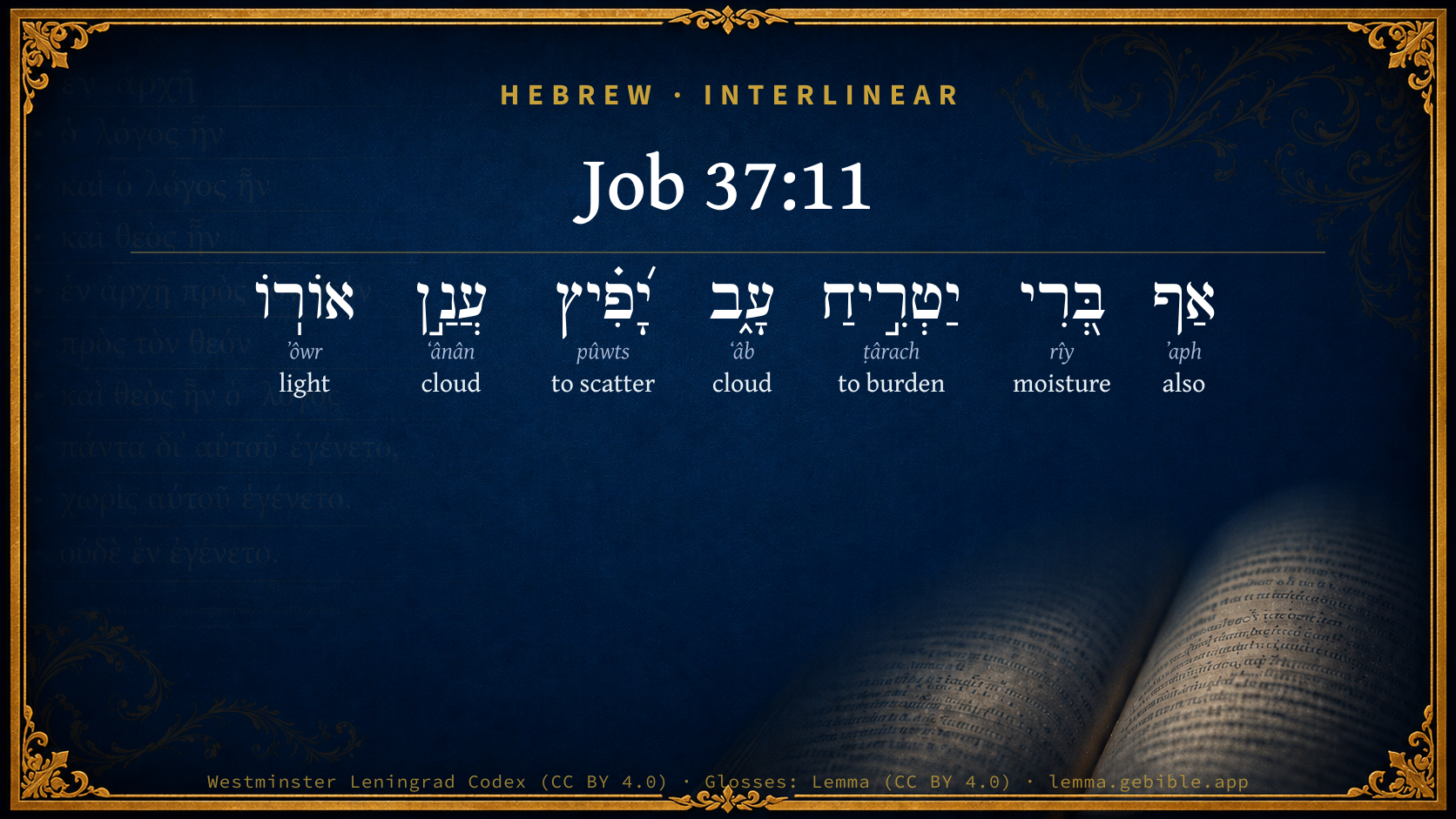
Job 37:11

Hebrew (Westminster Leningrad Codex) Job 37:11 appears in the Hebrew Old Testament. The text above is from the Westminster Leningrad Codex. Each word links to its Strong’s number, a concise gloss, and parsing drawn from the Open Scriptures Hebrew Bible morphology. Click any word for its full Brown-Driver-Briggs (BDB) entry.
Download image
Cite this verse

Job 37:11 (World English Bible). Public Domain. Lemma interlinear Bible study tool, https://lemma.gebible.app/v/job/37/11.

Show BibTeX & RIS
BibTeX
RIS
English Translation
Yes, he loads the thick cloud with moisture. He spreads abroad the cloud of his lightning.
World English Bible · Public Domain
Highlights
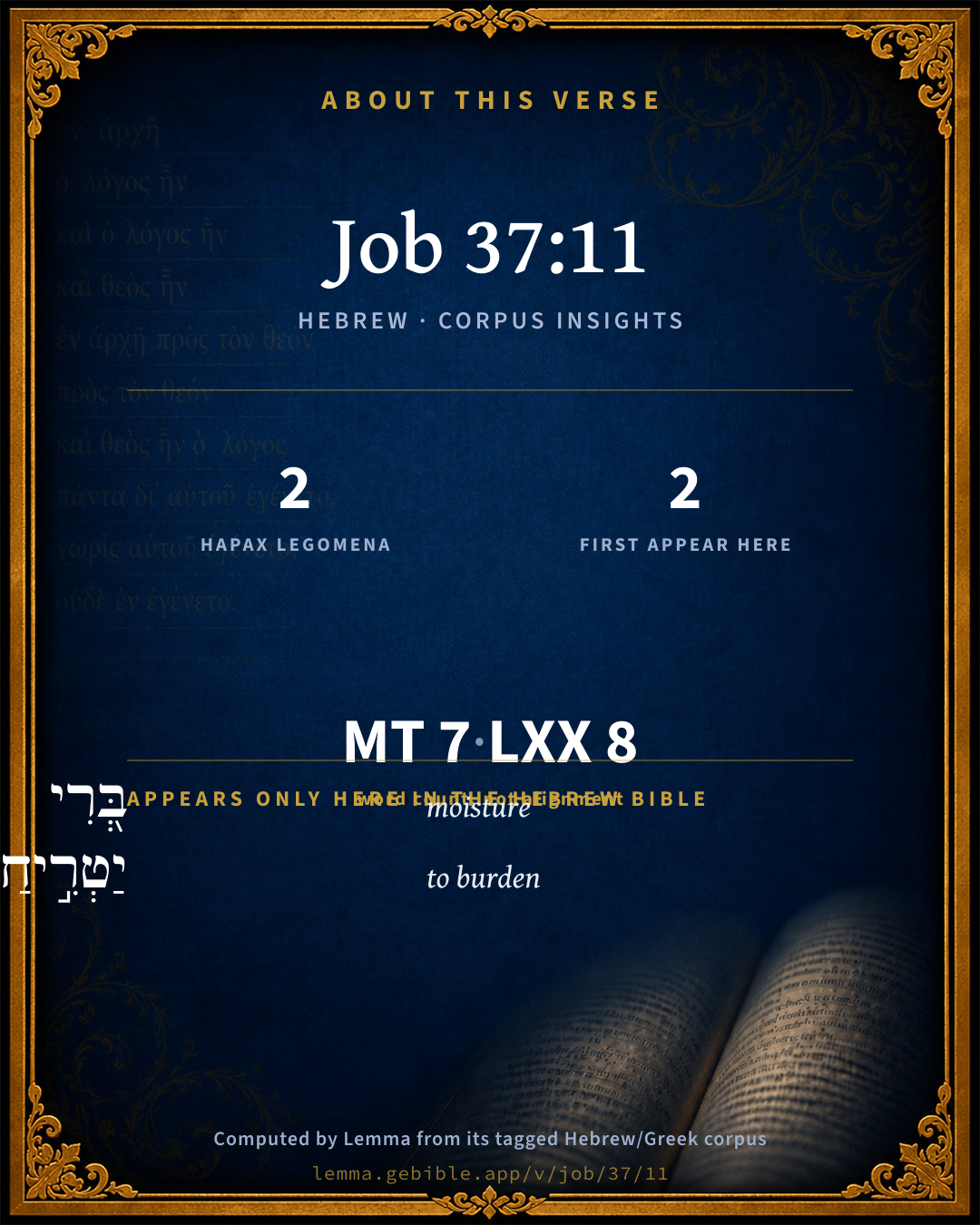
  • 2 hapax legomena — only here in the Hebrew Bible
  • 2 first appearances in the Hebrew Bible
Full analysis ↓
Download a study sheet

One document with this verse’s original text, its word-by-word gloss line, the meaning frame, cross-references with their text, attributed commentary, and full source and license credits — printable, and it pastes into notes with its structure intact.

This verse Autodidact and up

Study sheet (.html) Plain text (.txt)

A passage Seminary Student

Up to 50 verses in one chapter. A passage sheet keeps up to 6 commentary sources and 12 cross-references per verse, in the order this page ranks them, and says so on the sheet whenever that leaves anything out. Ask for a single verse and you get the Autodidact verse sheet above.

Everything on this page stays free to read, with no account — the sheet is a download of what is already on screen, not access to it.

Want to remove ads? Support Godless Engineer
Compare translations 3

The same verse in 3 English versions, stacked beneath the original-language interlinear above. Click any original word for its lexicon entry.

Each is an independent rendering of the whole verse — the interlinear is not word-aligned to these translations.

Highlighted words mark where these versions differ — a whole-verse word diff, not a word-by-word alignment.

  • World English Bible Public Domain
    Yes, he loads the thick cloud with moisture. He spreads abroad the cloud of his lightning.
  • King James Version Public Domain
    Also by watering he wearieth the thick cloud: he scattereth his bright cloud:
  • unfoldingWord Literal Text CC BY-SA 4.0
    Indeed, he loads the cloud with moisture; he scatters the cloud of his lightning.

unfoldingWord Literal Text — © unfoldingWord, licensed CC BY-SA 4.0. Word-aligned USFM3 via Door43 (git.door43.org/unfoldingWord/en_ult).

Versions to compare (up to 4)

3 of 4 selected

Show all 18 translations

Every available English version of this verse, each an independent rendering of the whole verse.

  • World English Bible Public Domain
    Yes, he loads the thick cloud with moisture. He spreads abroad the cloud of his lightning.
  • Berean Standard Bible Public Domain
    He loads the clouds with moisture; He scatters His lightning through them.
  • Majority Standard Bible Public Domain
    He loads the clouds with moisture; He scatters His lightning through them.
  • King James Version Public Domain
    Also by watering he wearieth the thick cloud: he scattereth his bright cloud:
  • American Standard Version (1901) Public Domain
    Yea, he ladeth the thick cloud with moisture; He spreadeth abroad the cloud of his lightning:
  • Revised Version (1885) Public Domain
    Yea, he ladeth the thick cloud with moisture; he spreadeth abroad the cloud of his lightning:
  • Geneva Bible (1599) Public Domain
    He maketh also the cloudes to labour, to water the earth, and scattereth the cloude of his light.
  • Douay-Rheims (1899) Public Domain
    Corn desireth clouds, and the clouds spread their light:
  • Young's Literal Translation Public Domain
    Yea, by filling He doth press out a cloud, Scatter a cloud doth His light.
  • Literal Standard Version CC BY-SA 4.0
    Indeed, by filling He presses out a cloud, [and] His light scatters a cloud.
  • Unlocked Literal Bible CC BY-SA 4.0
    Indeed, he weighs down the thick cloud with moisture; he scatters his lightning through the clouds.
  • unfoldingWord Literal Text CC BY-SA 4.0
    Indeed, he loads the cloud with moisture; he scatters the cloud of his lightning.
  • Darby Bible Public Domain
    Also with plentiful moisture he loadeth the thick clouds, his light dispels the cloud;
  • World Messianic Bible Public Domain
    Yes, he loads the thick cloud with moisture. He spreads abroad the cloud of his lightning.
  • Webster's Bible Public Domain
    Also by watering he wearieth the thick cloud: he scattereth his bright cloud:
  • Free Bible Version CC BY-SA 4.0
    He fills the clouds with moisture; he scatters his lightning from them.
  • Bible in Basic English Public Domain
    The thick cloud is weighted with thunder-flame, and the cloud sends out its light;
  • JPS Tanakh (1917) Public Domain
    Yea, He ladeth the thick cloud with moister, He spreadeth abroad the cloud of His lightning;

Literal Standard Version (2020), Covenant Press — licensed CC BY-SA 4.0. Text via the HelloAO Bible API (eBible.org). Unlocked Literal Bible (unfoldingWord) — licensed CC BY-SA 4.0. Text via the HelloAO Bible API (eBible.org). unfoldingWord Literal Text — © unfoldingWord, licensed CC BY-SA 4.0. Word-aligned USFM3 via Door43 (git.door43.org/unfoldingWord/en_ult). Free Bible Version, Dr. Jonathan Gallagher — licensed CC BY-SA 4.0. Text via the HelloAO Bible API (eBible.org).

Word by word

More ways to search: Search by grammar → Find every occurrence → Compare this word →

Practice this passage: Drill this verse → Learn its vocabulary →

About this verse

These counts appear in no published source. They are computed here, from the morphology-tagged text and Lemma’s own curated glosses. What Lemma adds →

7
words
7
distinct lemmas
Wisdom
section

Notable vocabulary

2 hapax legomena — words that appear only here in the entire Hebrew Bible:

  • בְּ֭רִי moisture H7377
  • יַטְרִ֣יחַ to burden H2959

First appearance in Scripture

These words make their first canonical appearance in the Hebrew Bible here:

  • בְּ֭רִי moisture H7377
  • יַטְרִ֣יחַ to burden H2959

Shared distinctive vocabulary

עָ֑ב cloud H5645 occurs in 32 verses of the Hebrew Bible. Also found in:

Grammatical profile

  • 2 verbs
  • 4 nouns
  • 1 particle

Verb forms

  • יַטְרִ֣יחַ Hiphil · Imperfect
  • יָ֝פִ֗יץ Hiphil · Imperfect

Hebrew & Septuagint length

In English translation the verse runs 16 words from the Hebrew and 16 from the Septuagint (LXX English) — the same length.

A rough comparison of the two English renderings, which tokenize alike — not a word-level alignment.

Word counts can differ between the Hebrew and the Greek without any difference in meaning — e.g. the Hebrew direct-object marker אֵת has no separate Greek word, and Greek often adds the article ὁ.

In the original languages it is 7 Hebrew tokens and 8 Greek tokens — but the two are counted differently (Hebrew bundles its prefixes and suffixes into one token; the Greek is in lemma form), so that isn’t a like-for-like length.

Cross-references

4

Topical passages linked to Job 37:11 in the Treasury of Scripture Knowledge — connected by theme and wording, ordered by reader-vote popularity; previews shown in the World English Bible.

  • Job 36:27–30 For he draws up the drops of water, Which distill in rain from his vapor,
  • Job 36:32 He covers his hands with the lightning, And commands it to strike the mark.
  • Isaiah 18:4 For thus has Yahweh said to me, I will be still, and I will see in my dwelling-place, like clear heat in sunshine, like a cloud of dew in the heat of harvest.
  • Matthew 17:5 While he was still speaking, behold, a bright cloud overshadowed them. Behold, a voice came out of the cloud, saying, "This is my beloved Son, in whom I am well pleased. Listen to him."

Cross-references courtesy of OpenBible.info (CC BY 4.0).

Hebrew and Greek witnesses Masoretic Hebrew ↔ Greek Septuagint

The same verse in the two great witnesses to the Old Testament, shown verse-for-verse.

These are two independent witnesses, not word-aligned to each other, and the Septuagint is shown in lemma (dictionary) form.

Hebrew Job 37:11 Masoretic · Westminster Leningrad Codex

אַף בְּ֭רִי יַטְרִ֣יחַ עָ֑ב יָ֝פִ֗יץ עֲנַ֣ן אוֹרֽוֹ

Yes, he loads the thick cloud with moisture. He spreads abroad the cloud of his lightning.

World English Bible · Public Domain

Greek LXX Job 37:11 Septuagint · lemma form

καί ἐκλεκτός καταπλάσσω νεφέλη διασκορπίζω νέφος φῶς αὐτός

And if a cloud obscures what is precious to him, his light will disperse the cloud.

LXX2012 (modern English Septuagint) · Public Domain

On this verse, Albert Barnes' Notes on the Bible discusses the Septuagint’s reading. Read the note in Commentary ↓

Hebrew: Westminster Leningrad Codex (CC BY 4.0). Greek: Septuagint (public domain); English from LXX2012 (modern English Septuagint) (Public Domain). How the Septuagint differs from the Hebrew →

Commentary

Notes on Job 37:11 from classic Christian and Jewish commentators (each source and its license shown beneath its notes). The classic Christian expositions comment on the surrounding passage and are grouped to its opening verse, so a note may address several verses; the Jewish commentaries on the Tanakh (Rashi and others) are per-verse, so they appear only where the commentator wrote on this verse.

Lemma curates 59 commentaries, every one of them public domain or Creative Commons licensed, each selected and text-cleaned for this edition rather than reprinted as found. About our sources →

Trapp's Complete Commentary

John Trapp

Job 37:11 Also by watering he wearieth the thick cloud: he scattereth his bright cloud:

Ver. 11. Also by watering he wearieth the thick clouds] That is, by showering down of much rain he disburdeneth and dissipateth them, seem they never so thick and large. These seem to be troubled and tired out when, as they are watering the earth, they are wasted and drawn dry by the heat of the sun.

He scattereth his bright cloud] Heb. the cloud of his light; that is, the cloud by dissolving whereof he restoreth light and fair weather, or the cloud which was covered over with lightning before, Job 36:30.

John Trapp, A Commentary or Exposition upon All the Books of the Old and New Testament (1647–1656) — public domain. Text from a community e-Sword module.

Joseph Benson's Commentary

Job 37:11-12. Also by watering — The earth; by causing the clouds first to receive, and then to convey to distant parts, and afterward to pour forth, abundance of water; he wearieth the thick clouds — Alluding to men’s being wearied with carrying burdens, travelling, and labour. By filling and burdening them with much water, and making them go long journeys to water remote countries, and, at last, to spend and empty themselves there, he, as it were, wearies and fatigues them. He scattereth his bright cloud — As for the white and lightsome clouds, he scattereth and dissolveth them by the wind or sun. But here also the Hebrew will easily admit a different translation. If we consider ברי, beri, here rendered by watering, as being one word, derived from barah, signifying serenity, the meaning is, Fair weather also disperseth the cloud; his sun scattereth the cloud abroad. It is turned round about — The cloud, now mentioned, is carried about to this or that place; by his counsels — Not by chance, (though nothing seems more casual than the motions of the clouds,) but by his order and governance. That they way do whatsoever he commandeth them — Either be dispersed and pass away without effect, to the disappointment of the husbandman’s hopes, or be dissolved in sweet and fertilizing showers.

Joseph Benson's Commentary on the Old and New Testaments (1811–1818) — public domain. Text from a community e-Sword module.

Whedon's Commentary on the Bible

Daniel D. Whedon

Strophe f — The constantly-flashing lightning, and the ever-changing and revolving clouds, lead Elihu to again speak of lightning and of cloud, and show that even these are under the guidance of God, Job_37:11-13.

“The storm in its magnificent approach drifts victoriously before all the senses of Elihu, so that from all other images, brought forward, as they are, with a certain haste, he ever recurs to that of the storm.” — Schlottmann.

11. By watering… cloud — Literally, with moisture he loadeth the cloud. While yet the burdened and wearied cloud discharges itself upon the earth, God spreadeth abroad the cloud of his light, which some regard as a lightning cloud.

Scattereth — For import of Hebrew word, compare Job_38:24.

Daniel D. Whedon (gen. ed.), Commentary on the Old and New Testaments (1874–1909) — public domain. Text from a community e-Sword module.

Geneva Bible (1599)

Geneva Bible translators

Gather the vapors and move to and fro to water the earth.

That is, the cloud that hath lightning in it.

Geneva Bible (1599) marginal notes — public domain. Text via Bolls.life.

Jamieson, Fausset & Brown

Robert Jamieson, A. R. Fausset & David Brown

How the thunderclouds are dispersed, or else employed by God, either for correction or mercy.

by watering--by loading it with water.

wearieth--burdeneth it, so that it falls in rain; thus "wearieth" answers to the parallel "scattereth" (compare, see on Job 37:9); a clear sky resulting alike from both.

bright cloud--literally, "cloud of his light," that is, of His lightning. UMBREIT for "watering," &c., translates; "Brightness drives away the clouds, His light scattereth the thick clouds"; the parallelism is thus good, but the Hebrew hardly sanctions it.

Jamieson, Fausset & Brown — Commentary Critical and Explanatory on the Whole Bible (1871) — public domain (CC PDM 1.0). Text via the HelloAO Bible API.

Adam Clarke's Commentary

Verse 11. By watering he wearieth the thick cloud] Perhaps it would be better to say, The brightness beri, dissipates the cloud; or, if we follow our version, By watering the earth he wearieth, wearieth out or emptieth, the thick cloud - causes it to pour down all its contents upon the earth, that they may cause it to bring forth and bud. The Vulgate understood it differently: Frumentum desiderat nubes, et nubes spargunt lumen suum. "The grain desireth the clouds; and the clouds scatter abroad their light."

Adam Clarke's Commentary on the Bible (1810–1826) — public domain. Text from a community e-Sword/MySword module.

Ellicott's Commentary for English Readers

(11) He wearieth the thick cloud.—Also He ladeth the thick cloud with moisture, maketh it to be charged with rain. “He scattereth the cloud of His lightning,” that is, which containeth His lightning. Others render, “Yea, the bright sun weareth out (disperseth) the thick cloud; it scattereth the cloud that holds His lightning. And it (the cloud) is turned round about by His counsels, that they may do His purpose, even all which He commandeth them, upon the face of the habitable world.” Whether for correction, or for His land generally, or whether He causeth the rain to come as a special mercy:—these are the various purposes for which God reserves His showers.

A Bible Commentary for English Readers, edited by Charles John Ellicott (1878–1897) — public domain. Text from a community e-Sword module.

The Cambridge Bible for Schools and Colleges

gen. ed. J. J. S. Perowne

11–13. The wonderful movements of the clouds directed by the guidance of God, and fulfilling His several behests.

These verses read,

11. Also he ladeth the thick cloud with moisture,

He spreadeth his lightning-cloud abroad;

12. And it is turned round about by his guidance,

That it may do whatsoever he commandeth it

Upon the face of the whole earth;

13. Whether it be for correction, or for his earth,

Or for mercy that he causeth it to come.

The Cambridge Bible for Schools and Colleges (gen. ed. J. J. S. Perowne; Cambridge University Press, 1878–1918) — public domain. Text from a community e-Sword module.

John Gill's Exposition

Also by watering he wearieth the thick cloud,.... By filling it with a multitude of water, it is as it were loaded and made weary with it; and especially by sending it about thus loaded from place to place before discharged, when it becomes as a weary traveller; and then by letting down the water in it, whereby it spends itself like one that is weary; an emblem of ministers that spend and are spent for the good of men: some render it by serenity or fair weather, and so Mr. Broughton,

"by clearness he wearieth the thick vapours;''

by causing a clear sky he dispels them;

he scattereth his bright cloud; thin light clouds that have nothing in them, and are soon dispersed and come to nothing, and are seen no more; all emblem of such as are clouds without water, Jde 1:12; see Zac 11:17; or "he scatters the cloud by his light" (s); by the sun, which dispels clouds and makes a clear sky; an emblem of the blotting out and forgiveness of sins, and of restoring the manifestations of divine love, and the joys of salvation; see Isa 44:22.

(s) "dispellit nubem luce sua", Munster.

John Gill's Exposition of the Whole Bible (1746–1763) — public domain (CC PDM 1.0). Text via the HelloAO Bible API.

Albert Barnes' Notes on the Bible

Also by watering - Very various interpretations have been given of this phrase. Herder renders it, “His brightness rendeth the clouds.” Umbreit, Und Heiterkeit vertreibt die Wolke - “and serenity or clearness drives away the clouds.” Prof. Lee, “For irrigation is the thick cloud stretched out.” Rosenmuller, “Splendor dispels the clouds.” Luther, “The thick clouds divide themselves that it may be clear.” Coverdale, “The clouds do their labor in giving moistness.” The Vulgate, “The grain desires the clouds,” and the Septuagint, “The cloud forms the chosen” - ἐκλεκτον eklekton. This variety of interpretation arises from the uncertainty of the meaning of the original word - ברי berı̂y. According to the Chaldee and the rabbis, this word means “clearness, serenity” of the heavens, and then the whole clause is to be rendered, “serenity dispelleth the cloud.” Or the word may be formed of the preposition ב (be), and רי rı̂y, meaning “watering” or “rain,” the same as רוי reviy. The word does not occur elsewhere in Hebrew, and hence, it is not easy to determine its meaning. The weight of authority is in favor of serenity, or clearness - meaning that the thick, dark cloud is driven away by the serenity or clearness of the atmosphere - as where the clear sky seems to light up the heavens and to drive away the clouds. This idea seems, also, to be demanded by the parallelism, and is also more poetical than that in the common version.

Wearieth - Or removes, or scatters. The verb used here (טרח ṭârach) occurs nowhere else in the Scriptures, though nouns derived from the verb are found in Isa 1:14, rendered “trouble,” and Deu 1:12, rendered “cumbrance.” In Arabic it means “to cast down, to project,” and hence, to lay upon as a burden. But the word may mean to impel, drive forward, and hence, the idea that the dark thick cloud is propelled or driven forward by the serenity of the sky. This “appears” to be so, and hence, the poetic idea as it occurred to Elihu.

He scattereth his bright cloud - Margin, “the cloud of his light.” The idea seems to be, that “his light,” that is, the light which God causes to shine as the tempest passes off, seems to scatter or disperse the cloud. The image before the mind of Elihu probably was, that of a departing shower, when the light seems to rise behind it, and as it were to expel the cloud or to drive it away. We are not to suppose that this is philosophically correct, but Elihu represents it as it appeared, and the image is wholly poetical.

Albert Barnes' Notes on the Bible (1834–1885) — public domain. Text from a community e-Sword/MySword module.

Haydock's Catholic Bible Commentary

Corn requires rain. (Haydock) --- Light. As they are transparent, they do not hinder the sun from appearing. Hebrew, "the brightness of the sky disperses the clouds, and the clouds shed their light" in the rainbow, (ver. 15.; Grotius) or lightning. (Junius; Calmet; Menochius) --- Protestants, "Also by watering, he wearieth the thick cloud, he scattereth his bright cloud, (12) and it is turned round about by his counsels, that they may do whatsoever," &c. God prohibits or gives rain. (Haydock) --- Nothing is left to chance. (Calmet) --- He directeth the clouds as a master does his ship. (Worthington)

George Leo Haydock (1774–1849), Haydock's Catholic Family Bible and Commentary, 1859 edition — public domain. Excludes Psalms (Douay-Rheims chapter numbering differs from Protestant) and Deuterocanonical books (Catholic canon only).

Matthew Poole's English Annotations

By watering, to wit, the earth; by causing them first to receive and return, and then to pour forth abundance of water.

He wearieth the thick cloud, by filling and burdening them with much water, and making them to go long journeys to water remote parts, and at last to spend and empty themselves there; all which things make men weary; and therefore are here said to make the clouds weary by a common figure called prosopopoeia.

He scattereth his bright cloud: as for the white and lightsome clouds, (which are opposed to the thick and black clouds in the former clause,) he scattereth and dissolveth them by the wind or sun. Or, he scattereth other clouds by his light, i.e. by the beams of the sun. So he gathereth some, and scattereth others, as he pleaseth, causing either clear, or dark and rainy weather.

Matthew Poole's English Annotations on the Holy Bible (1683–1685) — public domain. Text from a community e-Sword/MySword module.

The Pulpit Commentary

Also by watering he wearieth the thick cloud; rather, also with moisture he ladeth the thick cloud. Elihu returns from his description of the winter season to the more ordinary condition of things. Rain is the chief necessity of Eastern countries; and God is ever providing it, causing moisture to be drawn up from earth and sea, and safely lodged in the clouds, whence it descends, as needed, and as commanded by God, upon the fields and plains that man cultivates. He scattereth his bright cloud. Most commentators see a reference to lightning here; and it is possible, no doubt, that such a reference is intended. "His bright cloud literally, "the cloud of his light may mean "the cloud in which his lightning is stored." But perhaps no more is meant than that God spreads abroad over the earth the clouds on which his sunlight rests. The genial showers of spring fall generally from clouds that are, in part at any rate, steeped in the sun"s rays.

Vers. 11-13. The rainstorm.

I ITS SOURCE. It is produced by God, and it is directed by God. He brings it about, and he guides it.

1. It comes from God. Now, this is most certainly an integral part of nature. We have seen that the thunder belongs to nature. That was not always apparent to men; there seemed to be something so weird and awful about it that men attributed it to supernatural agencies. But the rain is manifestly in the order of natural phenomena. Yet this is as Divine as the thunder. God is in all nature, and as much in its quiet, normal occurrences as in what is startling and exceptional.

2. It is piloted by God. The clouds seem to pass over the heavens in wild confusion. We can see no reins to hold them in, nor any whip to drive them on. The science of meteorology is about the most backward of all the sciences, because it is so difficult to reduce the phenomena of the weather to their place in an orderly scheme, on account of their ceaseless variations and apparently boundless irregularities. But we are already seeing that there are laws behind the weather, and some of them are already known. Hence our weather prognostications in the newspapers. Now, the Scripture view of the weather, as much as that of the most orderly and changless phenomena, attributes all its movements to the will of God. God is in what looks to us most conflicting and purposeless. If he is steering it, we can trust to him to bring it to a happy end.

II ITS PURPOSE.

1. This is determined by God. The march of the clouds is commanded by their great Captain. In nature as well as in human life God works with a purpose, and the end is with him.

2. It is obscure. We cannot tell whether the rain is for one particular purpose which we have in mind, or for another that has never occurred to us. In all life God works out many purposes quite beyond the reach of our thoughts.

3. It may be "for a scourge." God sends what we regard as untimely rain rain in harvest; or too much rain floods that devastate fields, drown crops, and invade houses. For God sometimes looks very stern in his actions, whatever his thoughts may be. In other ways God chastises his people by natural calamities. Let us not be amazed when these things happen to us. They are predicted, and therefore they should be expected.

4. It may be in mercy. "For the good of his land." The dry soil needs rain. Thirsty crops are refreshed by the downpour that is distressing to the traveller. What looks like a calamity may be a blessing. Instead of complaining of the inconvenience of what happens to us, let us look round us and see if it is bringing good in some other direction.

5. In any case it is for a blessing. The scourge is a blessing in disguise. Though various results may issue from God"s various actions, in so far as they are designed by God they all make for righteousness and the welfare of his children. Thunder and rain bless even by their calamities. Sorrow and loss, pain and tears, scourges and thorns, are instruments of discipline that bless when they hurt. W.F.A.

The Pulpit Commentary (1880–1919), ed. H.D.M. Spence-Jones & Joseph S. Exell — public domain. Text from a community e-Sword module.

John Wesley's Explanatory Notes

Watering - The earth. They spend themselves and are exhausted watering the earth, until they are weary. Wearieth - Them with much water, and making them to go long journeys to water remote parts, and at last to empty themselves there: all which things make men weary; and therefore are here said to make the clouds weary by a common figure. Scattereth - As for the white and lightsome clouds, he scatters and dissolves them by the wind or sun.

John Wesley, Explanatory Notes Upon the Whole Bible (1754–1765) — public domain. Text via the GEBible commentary corpus.

Keil & Delitzsch

C. F. Keil & F. Delitzsch

11 Also He loadeth the clouds with water,

He spreadeth far and wide the cloud of His light,

12 And these turn themselves round about,

Directed by Him, that they execute

All that He hath commanded them

Over the wide earth.

13 Whether for a scourge, or for the good of His earth,

Or for mercy, He causeth it to discharge itself.

With אף extending the description, Elihu, in the presence of the storm that is in the sky, continually returns to this one marvel of nature. The old versions connect בּרי partly with בּר, electus (lxx, Syr., Theod.) or frumentum (Symm., Jer.), partly with בּרה = בּרר in the signification puritas, serenitas (Targ.); but בּרי is, as Schultens has already perceived, the Hebr.-Arabic רי, Arab. rı̂yun, rı̂j-un (from רוה = riwj), abundant irrigation, with בּ; and יטריח does not signify, according to the Arab. atraha, "to hurl down," so that what is spoken of would be the bursting of the clouds (Stick.),

(Note: This "atraha" is, moreover, a pure invention of our ordinary Arabic lexicons instead of ittaraha (VIII form): (1) to throw one's self, (2) to throw anything from one's self, with an acc. of the thing. - Fl.)

but, according to טרח, a burden (comp. Arab. taraha ala, to load), "to burden;" with fluidity (Ew., Hirz., Hahn, Schlottm.), better: fulness of water, He burdens the clouds (comp. rawij-un as a designation of cloud as the place of rain). ענן אורו, His cloud of light, is that that is charged with lightning, and הפיץ has here its Hebr.-Arab. radical signification effundere, diffundere, with a preponderance of the idea not of scattering, but of spreading out wide (Arab. faid, abundance). והוּא, Job 37:12, refers to the cloud pregnant with lightning; this turns round about (מסבּות, adv. as מסב, round about, Kg1 6:29) seeking a place, where it shall unburden itself by virtue of His (God's) direction or disposing (תחבּוּלת, a word belonging to the book of Proverbs; lxx, Cod. Vat. and Alex., untranslated: εν θεεβουλαθωθ, Cod. Sinait. still more monstrous), in order that they (the clouds full of lightning) may accomplish everything that He commands them over the surface of the earth; ארצה as Job 34:13, and the combination תּבל ארצה as Pro 8:31, comp. ארץ ותבל, Psa 90:2. The reference of the pronominal suff. to men is as inadmissible here as in Job 37:4. In Job 37:13 two אם have certainly, as Job 34:29, two ו, the correlative signification sive ... sive (Arab. in ... wa-in), in a third, as appears, a conditional, but which? According to Ew., Hirz., Hahn, Schlottm., and others, the middle one: if it (the rod) belongs to His land, i.e., if it has deserved it. But even the possessive suff. of לארצו shows that the ל is to be taken as dat. commodi: be it for a rod, be it for the good of His land; which is then followed by a conditional verbal clause: in case He mercifully causes it (the storm) to come, i.e., causes this His land to be overtaken by it (המציא here with the acc., the thing coming, whereas in Job 34:11 of the thing to be overtaken). The accentuation, indeed, appears to assume a threefold sive: whether He causeth it to discharge itself upon man for punishment, man for mercy, or His earth for good with reference to man. Then Elihu would think of the uninhabited steppe in connection with אם לארצו. Since a conditional אם by the side of two correlatives is hazardous, we decide finally with the lxx, Targ., and all the old versions, in favour of the same rendering of the threefold אם, especially since it corresponds to the circumstances of the case.

Keil & Delitzsch — Biblical Commentary on the Old Testament (1861–1891) — public domain (CC PDM 1.0). Text via the HelloAO Bible API. (Old Testament only.)

Rashi

Rabbi Shlomo Yitzchaki (Rashi)

Aph Beri The name of the angel who is appointed over the clouds, and he scatters the Omnipresent’s rain cloud.

Rashi on the Tanakh — English translations: “The Judaica Press complete Tanach with Rashi, translated by A. J. Rosenberg” (CC BY 4.0); “Pentateuch with Rashi's commentary by M. Rosenbaum and A.M. Silbermann, 1929-1934” (public domain); “The Metsudah Tanach series, Lakewood, N.J” (CC BY 4.0); and “The Book of Joshua, Metsudah Publications, 1997” (CC BY 4.0). Text via Sefaria.

Lesson kit

Teaching starters — assembled from the data on this page, not authored interpretation. Every prompt links to the verse data it draws on. Edit before teaching.

Job, in the Wisdom, opens this verse with 7 words (7 distinct Hebrew lemmas). Its most distinctive word is rîy (“moisture”). A historical commentator’s framing appears above. Read the whole chapter for the surrounding context.

Discussion questions

  1. What does “moisture” (rîy) contribute to the verse as a whole?
  2. 2 words here appear nowhere else in the Hebrew Bible. Why might the author reach for such rare wording?
  3. 2 words make their first appearance in Scripture here. What does this debut establish?
  4. How does Exodus 19:9, which shares the word «cloud», read alongside this verse?
  5. These translations render this verse differently. What is at stake in choosing one wording over another?
  6. «יַטְרִ֣יחַ» is a Hiphil Imperfect verb. How does that grammatical form shape the action described?
  7. Compare how Trapp's Complete Commentary and Joseph Benson's Commentary read this verse. Where do they agree or differ?

Things to notice

Reading settings

Reading text

Shown beneath each verse's original-language words.

Old Testament
Old Testament edition

Read the OT as the Masoretic Hebrew (MT) or the Greek Septuagint (LXX).

English shown for the Greek Septuagint (in the Hebrew ↔ Greek comparison).

Comparing translations? Open the Compare panel on any verse page to stack up to four side by side.