
Psalms 77:16

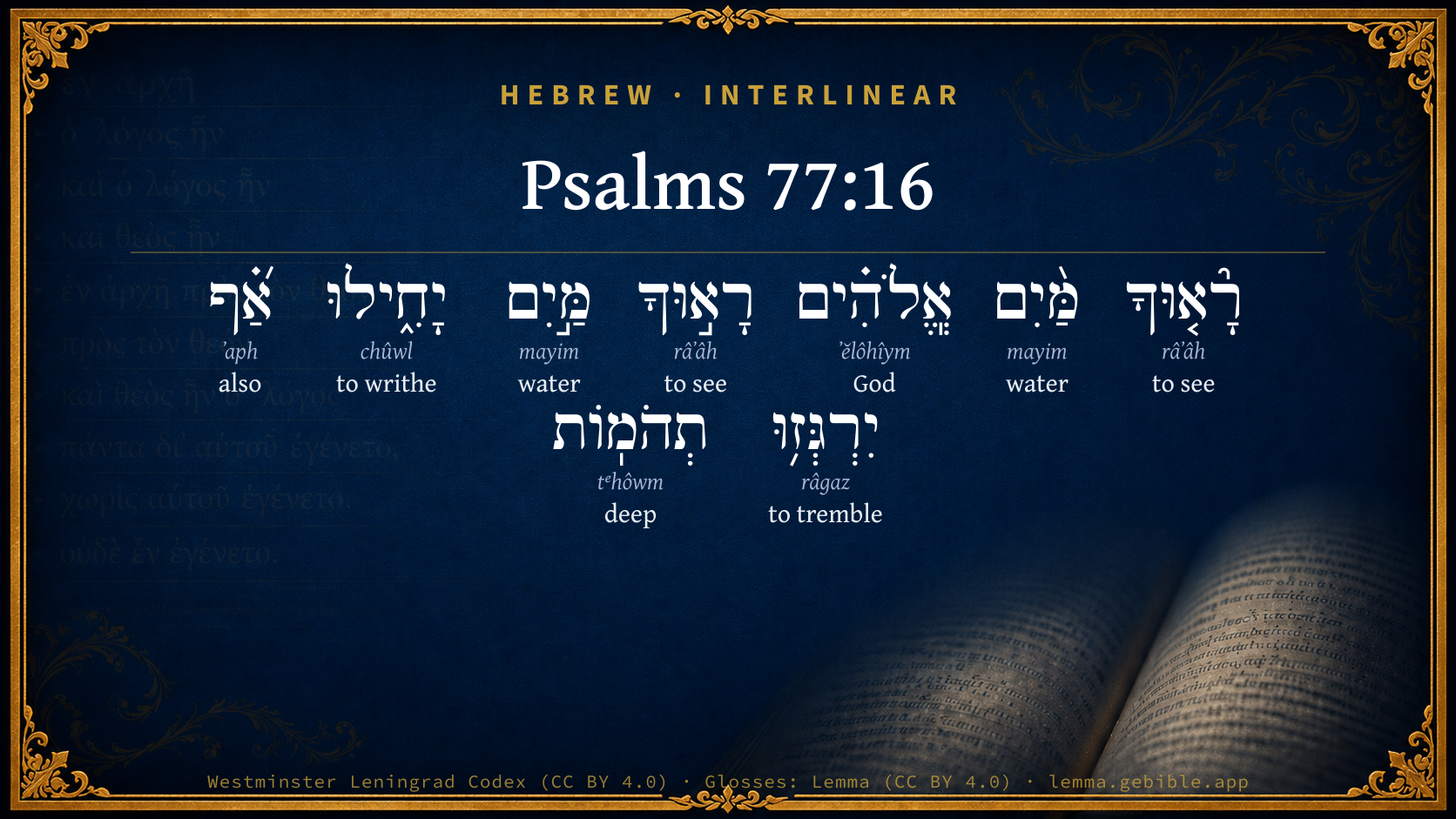
Hebrew (Westminster Leningrad Codex) Psalms 77:16 appears in the Hebrew Old Testament. The text above is from the Westminster Leningrad Codex. Each word links to its Strong’s number, a concise gloss, and parsing drawn from the Open Scriptures Hebrew Bible morphology. Click any word for its full Brown-Driver-Briggs (BDB) entry.
Download image
Cite this verse

Psalms 77:16 (World English Bible). Public Domain. Lemma interlinear Bible study tool, https://lemma.gebible.app/v/psalms/77/16.

Show BibTeX & RIS
BibTeX
RIS
English Translation
The waters saw you, God. The waters saw you, and they writhed. The depths also convulsed.
World English Bible · Public Domain
Download a study sheet

One document with this verse’s original text, its word-by-word gloss line, the meaning frame, cross-references with their text, attributed commentary, and full source and license credits — printable, and it pastes into notes with its structure intact.

This verse Autodidact and up

Study sheet (.html) Plain text (.txt)

A passage Seminary Student

Up to 50 verses in one chapter. A passage sheet keeps up to 6 commentary sources and 12 cross-references per verse, in the order this page ranks them, and says so on the sheet whenever that leaves anything out. Ask for a single verse and you get the Autodidact verse sheet above.

Everything on this page stays free to read, with no account — the sheet is a download of what is already on screen, not access to it.

Want to remove ads? Support Godless Engineer
Compare translations 3

The same verse in 3 English versions, stacked beneath the original-language interlinear above. Click any original word for its lexicon entry.

Each is an independent rendering of the whole verse — the interlinear is not word-aligned to these translations.

Highlighted words mark where these versions differ — a whole-verse word diff, not a word-by-word alignment.

  • World English Bible Public Domain
    The waters saw you, God. The waters saw you, and they writhed. The depths also convulsed.
  • King James Version Public Domain
    The waters saw thee, O God, the waters saw thee; they were afraid: the depths also were troubled.
  • unfoldingWord Literal Text CC BY-SA 4.0
    The waters saw you, God; the waters saw you, and they trembled; indeed the depths shook.

unfoldingWord Literal Text — © unfoldingWord, licensed CC BY-SA 4.0. Word-aligned USFM3 via Door43 (git.door43.org/unfoldingWord/en_ult).

Versions to compare (up to 4)

3 of 4 selected

Show all 18 translations

Every available English version of this verse, each an independent rendering of the whole verse.

  • World English Bible Public Domain
    The waters saw you, God. The waters saw you, and they writhed. The depths also convulsed.
  • Berean Standard Bible Public Domain
    The waters saw You, O God; the waters saw You and swirled; even the depths were shaken.
  • Majority Standard Bible Public Domain
    The waters saw You, O God; the waters saw You and swirled; even the depths were shaken.
  • King James Version Public Domain
    The waters saw thee, O God, the waters saw thee; they were afraid: the depths also were troubled.
  • American Standard Version (1901) Public Domain
    The waters saw thee, O God; The waters saw thee, they were afraid: The depths also trembled.
  • Revised Version (1885) Public Domain
    The waters saw thee, O God; the waters saw thee, they were afraid: the depths also trembled.
  • Geneva Bible (1599) Public Domain
    The waters sawe thee, O God: the waters sawe thee, and were afraide: yea, the depths trembled.
  • Douay-Rheims (1899) Public Domain
    with thy arm thou hast redeemed thy people the children of Jacob and of Joseph.
  • Young's Literal Translation Public Domain
    The waters have seen Thee, O God, The waters have seen Thee, They are afraid -- also depths are troubled.
  • Literal Standard Version CC BY-SA 4.0
    The waters have seen You, O God, || The waters have seen You, || They are afraid—also depths are troubled.
  • Unlocked Literal Bible CC BY-SA 4.0
    The waters saw you, God; the waters saw you, and they were afraid; the depths trembled.
  • unfoldingWord Literal Text CC BY-SA 4.0
    The waters saw you, God; the waters saw you, and they trembled; indeed the depths shook.
  • Darby Bible Public Domain
    The waters saw thee, O God, the waters saw thee; they trembled, yea, the depths were troubled:
  • World Messianic Bible Public Domain
    The waters saw you, God. The waters saw you, and they writhed. The depths also convulsed.
  • Webster's Bible Public Domain
    \\77:15\\Thou hast with thy arm redeemed thy people, the sons of Jacob and Joseph. Selah.
  • Free Bible Version CC BY-SA 4.0
    When the waters saw you, God, when they looked they trembled! Yes, they shook down to the very depths!
  • Bible in Basic English Public Domain
    The waters saw you, O God; the waters saw you, they were in fear: even the deep was troubled.
  • JPS Tanakh (1917) Public Domain
    (77-17) The waters saw Thee, O God; the waters saw Thee, they were in pain; the depths also trembled.

Literal Standard Version (2020), Covenant Press — licensed CC BY-SA 4.0. Text via the HelloAO Bible API (eBible.org). Unlocked Literal Bible (unfoldingWord) — licensed CC BY-SA 4.0. Text via the HelloAO Bible API (eBible.org). unfoldingWord Literal Text — © unfoldingWord, licensed CC BY-SA 4.0. Word-aligned USFM3 via Door43 (git.door43.org/unfoldingWord/en_ult). Free Bible Version, Dr. Jonathan Gallagher — licensed CC BY-SA 4.0. Text via the HelloAO Bible API (eBible.org).

Word by word

More ways to search: Search by grammar → Find every occurrence → Compare this word →

Practice this passage: Drill this verse → Learn its vocabulary →

תְהֹמֽוֹת
tᵉhôwm
H8415
“depths”
Noun, Common, Both, Plural, Absolute
Part of Speech
Noun
Type
Common
Gender
Both
Number
Plural
State
Absolute
Full BDB Definition

Origin: from H1949

TWOT: 2495a

deep, depths, deep places, abyss, the deep, sea - deep (of subterranean waters) - deep, sea, abysses (of sea) - primeval ocean, deep - deep, depth (of river) - abyss, the grave
  1. רָ֘א֤וּךָ râʼâh H7200 “to see · you” Verb, Qal, Perfect, 3rd Person, Common, Plural + Suffix, Personal, 2nd Person, Masculine, Singular
  2. מַּ֨יִם mayim H4325 “water(s)” Noun, Common, Masculine, Plural, Absolute
  3. אֱֽלֹהִ֗ים ʼĕlôhîym H430 “God(s)” Noun, Common, Masculine, Plural, Absolute
  4. רָא֣וּךָ râʼâh H7200 “to see · you” Verb, Qal, Perfect, 3rd Person, Common, Plural + Suffix, Personal, 2nd Person, Masculine, Singular
  5. מַּ֣יִם mayim H4325 “water(s)” Noun, Common, Masculine, Plural, Absolute
  6. יָחִ֑ילוּ chûwl H2342 “to writhe” Verb, Qal, Imperfect, 3rd Person, Masculine, Plural
  7. אַ֝֗ף ʼaph H637 “also” Particle, Accusative
  8. יִרְגְּז֥וּ râgaz H7264 “to tremble” Verb, Qal, Imperfect, 3rd Person, Masculine, Plural

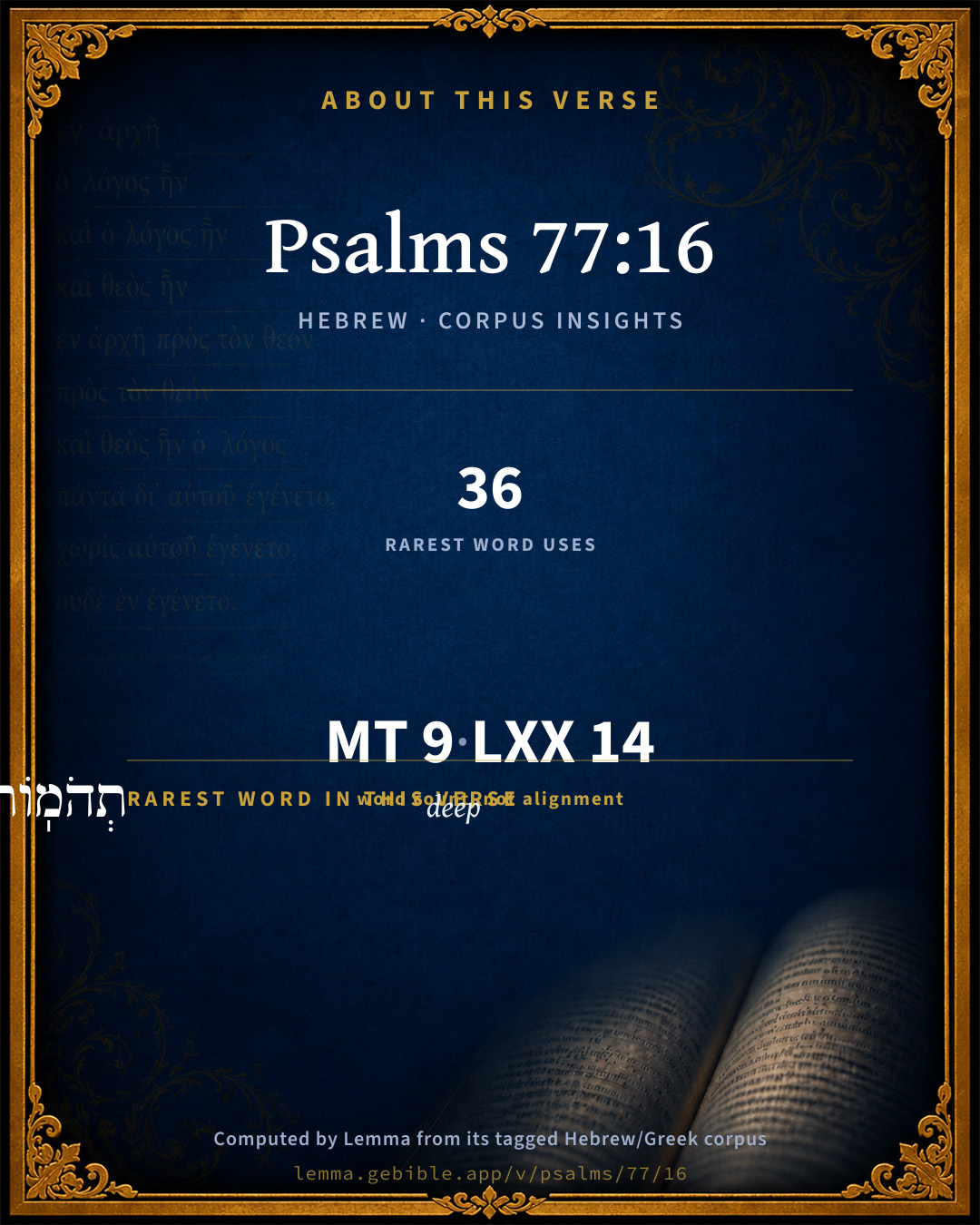
About this verse

These counts appear in no published source. They are computed here, from the morphology-tagged text and Lemma’s own curated glosses. What Lemma adds →

9
words
7
distinct lemmas
Wisdom
section

Shared distinctive vocabulary

תְהֹמֽוֹת deep H8415 occurs in 35 verses of the Hebrew Bible. Also found in:

Grammatical profile

  • 4 verbs
  • 4 nouns
  • 1 particle

Verb forms

  • רָ֘א֤וּךָ Qal · Perfect
  • רָא֣וּךָ Qal · Perfect
  • יָחִ֑ילוּ Qal · Imperfect
  • יִרְגְּז֥וּ Qal · Imperfect

Repetition

Words recur within this verse — often emphatic in Hebrew:

  • רָ֘א֤וּךָ to see H7200 ×2
  • מַּ֨יִם water H4325 ×2

Hebrew & Septuagint length

In English translation the verse runs 16 words from the Hebrew and 17 from the Septuagint (LXX English) — closely comparable.

A rough comparison of the two English renderings, which tokenize alike — not a word-level alignment.

Word counts can differ between the Hebrew and the Greek without any difference in meaning — e.g. the Hebrew direct-object marker אֵת has no separate Greek word, and Greek often adds the article ὁ.

In the original languages it is 9 Hebrew tokens and 14 Greek tokens — but the two are counted differently (Hebrew bundles its prefixes and suffixes into one token; the Greek is in lemma form), so that isn’t a like-for-like length.

Cross-references

5

Topical passages linked to Psalms 77:16 in the Treasury of Scripture Knowledge — connected by theme and wording, ordered by reader-vote popularity; previews shown in the World English Bible.

  • Exodus 14:21 Moses stretched out his hand over the sea, and Yahweh caused the sea to go back by a strong east wind all the night, and made the sea dry land, and the waters were divided.
  • Joshua 3:15–16 and when those who bore the ark were come to the Jordan, and the feet of the priests who bore the ark were dipped in the brink of the water (for the Jordan overflows all its banks all the time of harvest),
  • Habakkuk 3:15 You trampled the sea with your horses, Churning mighty waters.
  • Psalms 114:3–6 The sea saw it, and fled. The Jordan was driven back.
  • Habakkuk 3:8–10 Was Yahweh displeased with the rivers? Was your anger against the rivers, Or your wrath against the sea, That you rode on your horses, On your chariots of salvation?

Cross-references courtesy of OpenBible.info (CC BY 4.0).

Hebrew and Greek witnesses Masoretic Hebrew ↔ Greek Septuagint

The same verse in the two great witnesses to the Old Testament, shown verse-for-verse.

You’re reading Greek Psalm 76 (Hebrew Psalm 77). The Septuagint counts the superscription, so verse numbers can differ from the Hebrew — chapter-level alignment, not verse-by-verse. Numbering follows Rahlfs.

These are two independent witnesses, not word-aligned to each other, and the Septuagint is shown in lemma (dictionary) form.

Hebrew Psalms 77:16 Masoretic · Westminster Leningrad Codex

רָ֘א֤וּךָ מַּ֨יִם אֱֽלֹהִ֗ים רָא֣וּךָ מַּ֣יִם יָחִ֑ילוּ אַ֝֗ף יִרְגְּז֥וּ תְהֹמֽוֹת

The waters saw you, God. The waters saw you, and they writhed. The depths also convulsed.

World English Bible · Public Domain

Greek LXX Greek Psalm 76:16 Septuagint · lemma form

λυτρόω ἐν ὁ βραχίων σύ ὁ λαός σύ ὁ υἱός ἰακώβ καί ιωσηφ διάψαλμα

The waters saw you, O God, the waters saw you, and feared; and the depths were troubled.

LXX2012 (modern English Septuagint) · Public Domain

Hebrew: Westminster Leningrad Codex (CC BY 4.0). Greek: Septuagint (public domain); English from LXX2012 (modern English Septuagint) (Public Domain). How the Septuagint differs from the Hebrew →

Commentary

Notes on Psalms 77:16 from classic Christian and Jewish commentators (each source and its license shown beneath its notes). The classic Christian expositions comment on the surrounding passage and are grouped to its opening verse, so a note may address several verses; the Jewish commentaries on the Tanakh (Rashi and others) are per-verse, so they appear only where the commentator wrote on this verse.

Lemma curates 59 commentaries, every one of them public domain or Creative Commons licensed, each selected and text-cleaned for this edition rather than reprinted as found. About our sources →

Trapp's Complete Commentary

John Trapp

Psa 77:16 The waters saw thee, O God, the waters saw thee; they were afraid: the depths also were troubled.

Ver. 16. The waters saw thee, O God … they were afraid] This is check to such as will not see to fear so mighty a God. "Lord," saith the prophet, "when thy hand is lifted up, they will not see; but they shall see and be ashamed for their envy at the people; yea, the fire of thine enemies shall devour them," Isa 26:11.

John Trapp, A Commentary or Exposition upon All the Books of the Old and New Testament (1647–1656) — public domain. Text from a community e-Sword module.

The Treasury of David

Charles H. Spurgeon

Ver. 16. The waters saw thee, O God, the waters saw thee; they were afraid. As if conscious of its Maker's presence, the sea was ready to flee from before his face. The conception is highly poetical, the psalmist has the scene before his mind's eye, and describes it gloriously. The water saw its God, but man refuses to discern him; it was afraid, but proud sinners are rebellious and fear not the Lord.

The depths also were troubled. To their heart the floods were made afraid. Quiet caves of the sea, far down in the abyss, were moved with fear; and the lowest channels were left bare, as the water rushed away from its place, in terror of the God of Israel.

Whole Psalm. See Psalms on "Ps 77:1" for further information.

Ver. 16. The waters saw thee, O God, etc. "The waters of the Red Sea, "says Bishop Horne, "are here beautifully represented as endued with sensibility; as seeing, feeling, and being confounded, even to the lowest depths, at the presence and power of their great Creator, when he commanded them to open a way, and to form a wall on each side of it, until his people were passed over." This in fact is true poetry; and in this attributing of life, spirit, feeling, action, and suffering to inanimate objects, there are no poets who can vie with those of the Hebrew nation. Richard Mant.

Ver. 16. The depths also were troubled. The depths are mentioned in addition to the waters, to show that the dominion and power of God reach not only to the surface of the waters, but penetrate to the most profound abysses, and agitate and restrain the waters from their lowest bottom. Mollerus.

Ver. 16-18. The waters saw thee, but men do not see thee. The depths were troubled, but men say in their heart, There is no God. The clouds poured out water, but men pour not out cries and tears unto God. The skies send out a sound, but men say not, Where is God my Maker? Thine arrows also went abroad, but no arrows of contrition and supplication are sent back by men in return. The voice of thy thunder was in the heaven, but men hear not the louder thunders of the law. The lightnings lightened the world, but the light of truth shines in darkness and the darkness comprehends it not. The earth trembled and shook, but human hearts remain unmoved.

"My heart it shakes not at the wrath

And terrors of a God." George Rogers.

Ver. 16-19. As soon as ever the whole Egyptian army was within it, the sea flowed to its own place, and came down with a torrent raised by storms of wind, and encompassed the Egyptians. Showers of rain also came down from the sky, and dreadful thunders and lightning, with flashes of fire. Thunderbolts also were darted upon them; nor was there anything which used to be sent by God upon men, as indications of his wrath, which did not happen at this time; for a dark and dismal might oppressed them. And thus did all these men perish, so that there was not one man left to be a messenger of this calamity to the rest of the Egyptians. Josephus.

Ver. 16-18.

I. The homage of nature to the God of grace.

II. Its subserviency to his designs. G. R.

Psalms 77:17*

Ver. 16-18. See Psalms on "Ps 77:16" for further information.

"My heart it shakes not at the wrath

And terrors of a God." George Rogers.

Ver. 16-19. See Psalms on "Ps 77:16" for further information.

Ver. 16-18.

I. The homage of nature to the God of grace.

II. Its subserviency to his designs. G. R.

Psalms 77:18*

Ver. 16-18. See Psalms on "Ps 77:16" for further information.

"My heart it shakes not at the wrath

And terrors of a God." George Rogers.

Ver. 16-19. See Psalms on "Ps 77:16" for further information.

Ver. 16-18.

I. The homage of nature to the God of grace.

II. Its subserviency to his designs. G. R.

Psalms 77:19*

Ver. 16-19. See Psalms on "Ps 77:16" for further information.

Charles H. Spurgeon's The Treasury of David (1869–1885) — public domain. Psalms only. Text from a community e-Sword/MySword module.

Joseph Benson's Commentary

Psa 77:16-18. The waters saw thee, O God — They felt the visible effects of thy powerful presence. They were afraid — And stood still, as men or beasts astonished commonly do. The clouds poured out water — Namely, upon the Egyptians. The skies sent out a sound — In terrible thunder; thine arrows also went abroad — Hail-stones, or rather, lightnings, or thunderbolts, called God’s arrows, Psa 18:14; Psa 144:6. The earth trembled and shook — By an earthquake. This tempest is not particularly recorded in its proper place, yet it may well be collected from what is related Exo 14:24-25. That the Lord looked on the host of the Egyptians, through the pillar of fire and the cloud, and troubled the host of the Egyptians. For these verses of the Psalm seem to explain in what way he looked upon them, “namely, by thunders and lightnings, storms and tempests, rain, hail, and earthquake, the usual tokens and instruments of the Almighty’s displeasure. Josephus, in like manner, relates that the destruction of the Egyptians was accompanied by storms of rain, by dreadful thunders and lightnings; and, in short, by every possible circumstance of terror, which could testify and inflict upon man the vengeance of an incensed God.”

Joseph Benson's Commentary on the Old and New Testaments (1811–1818) — public domain. Text from a community e-Sword module.

J. A. Alexander on Psalms

Joseph Addison Alexander

17. (Psa 77:16). The waters saw thee, God, the waters saw thee; they shake, yea, the depths quake. The historical reference is of course to the passage of the Red Sea, but at the same time with allusion to the symbolical use of seas in Scripture. See above, on Psa 46:2. The transition from the past tense to the future or present shews that the writer suddenly transports himself into the midst of the events which he commemorates. The yea or nay in the last clause is emphatic. Not merely the surface of the water moves; its very depths are agitated and convulsed.

18 (Psa 77:17). The clouds poured water; the skies gave a sound: yea, thine arrows fly. These are natural phenomena of storms, here noted as betokening God's presence. See above, on Psa 18:11-14. The skies, the vapours constituting the visible heavens. See above, on Psa 68:34. Gave a sound, uttered their voice, a beautifiul description of the thunder. The yea indicates a climax. There was not only rain and thunder but lightning, the flashes of which are poetically spoken of as arrows. See above, on Psa 18:14. The word translated fly is an intensive form of the verb to go, implying swiftness and perhaps diversity of direction, hither and thither, to and fro. See above, on Psa 26:3; Psa 35:14. With this verse compare Hab 3:11.

Joseph Addison Alexander, The Psalms Translated and Explained (1850) — public domain. Text from a community e-Sword module.

Tyndale Open Study Notes

Tyndale Open Resources

77:16 the Red Sea: The Canaanites attributed divine power to the sea, but God is the one who made the sea and uses it for his own purposes.

Tyndale Open Study Notes — © Tyndale Open Resources, licensed CC BY-SA 4.0. Text via the HelloAO Bible API.

Geneva Bible (1599)

Geneva Bible translators

He declareth wherein the power of God was declared when he delivered the Israelites through the red sea.

Geneva Bible (1599) marginal notes — public domain. Text via Bolls.life.

Adam Clarke's Commentary

Verse 16. The waters saw thee] What a fine image! He represents God approaching the Red Sea; and the waters, seeing him, took fright, and ran off before him, dividing to the right and left to let him pass. I have not found any thing more majestic than this.

The depths also were troubled.] Every thing appears here to have life and perception. The waters see the Almighty, do not wait his coming, but in terror flee away! The deeps, uncovered, are astonished at the circumstance; and as they cannot fly, they are filled with trouble and dismay. Under the hand of such a poet, inanimate nature springs into life; all thinks, speaks, acts; all is in motion, and the dismay is general.

Adam Clarke's Commentary on the Bible (1810–1826) — public domain. Text from a community e-Sword/MySword module.

John Calvin's Commentaries

16. The waters saw thee, O God! Some of the miracles in which God had displayed the power of his arm are here briefly adverted to. When it is said that the waters saw God, the language is figurative, implying that they were moved, as it were, by a secret instinct and impulse to obey the divine command in opening up a passage for the chosen people. Neither the sea nor the Jordan would have altered their nature, and by giving place have spontaneously afforded a passage to them, had they not both felt upon them the power of God. It is not meant that they retired backward because of any judgment and understanding which they possessed, but that in receding as they did, God showed that even the inanimate elements are ready to yield obedience to him. There is here an indirect contrast, it being intended to rebuke the stupidity of men if they do not acknowledge in the redemption of the Israelites from Egypt the presence and hand of God, which were seen even by the waters. What is added concerning the deeps intimates, that not only the surface of the waters were agitated at the sight of God, but that his power penetrated even to the deepest gulfs.

John Calvin's Commentaries (1540-1563) — public domain. Text from the Calvin Translation Society English edition (1840s-50s) via the Christian Classics Ethereal Library (ccel.org). Calvin's coverage is partial (roughly two-thirds of the Bible); uncommented books and verses are honest gaps, never fabricated. The 19th-century editor's footnotes and remarks are omitted so the notes are faithfully Calvin's own voice.

Ellicott's Commentary for English Readers

(16) The waters saw thee.—Possibly alluding to the “look” which troubled the Egyptians (Exo_14:24).

Were afraid.—Better, writhed, as in travail pains.

Went abroad—i.e., darted hither and thither. The arrows are the lightnings.

(16-20) The prominence given to Joseph is a feature common to the Asaphic psalm. With this magnificent lyric of the passage of the Red Sea comp. Hab_3:10-11. The narrative in Exodus says nothing of a storm, but Josephus has preserved the tradition (Ant., 2:16. 3). Philo also mentions the storm.

A Bible Commentary for English Readers, edited by Charles John Ellicott (1878–1897) — public domain. Text from a community e-Sword module.

The Cambridge Bible for Schools and Colleges

gen. ed. J. J. S. Perowne

16. The waters and depths of the Red Sea are personified, as though they were conscious of the presence of their Creator and Lord. Cp. Heb_3:10, “The mountains saw thee, they were afraid”: and Psa_114:3; Exo_15:5; Exo_15:8. We miss in translation the pictorial force of the Heb. tenses: lit. they are afraid, the depths also tremble.

16–19. The manifestation of God’s sovereignty over nature in that supreme act of redemption.

The Cambridge Bible for Schools and Colleges (gen. ed. J. J. S. Perowne; Cambridge University Press, 1878–1918) — public domain. Text from a community e-Sword module.

John Gill's Exposition

The waters saw thee, O God,.... The waters not of Jordan, but of the Red sea; these felt and perceived the power of God, in causing a strong east wind, which dried it up, and made way for the children of Israel to pass through it as on dry land: compare with this Psa 114:3,

the waters saw thee; which is repeated for the confirmation of it, and to excite attention to it, as well as to express the psalmist's admiration at it; the Targum is,

"they saw thy majesty in the midst of the sea, O God; they saw thy power upon the sea;''

not the Egyptians, but the sons of Jacob and Joseph; the old Syriac church understood these waters of the waters of Jordan, at the baptism of Christ, when in their way they saw the incarnate God, and felt his sacred body laid in them, by which he was made manifest to Israel; but Jerom better interprets them, by the help of Rev 17:15 of people, nations, and tongues; some of which saw Christ corporeally, others spiritually, and by faith, as preached in the Gospel to the Gentile world:

they were afraid; of the majesty of God, obeyed their Sovereign, of whom they stood in awe, gave way unto him, and fled at his rebuke, see Psa 114:5 or "were in pain" (z), as a woman in travail, as were the Gentile world at the preaching of the Gospel of redemption and salvation by Christ, Rom 8:22,

the depths also were troubled; not only the surface, or waves of the waters, were moved by the strong east wind, through the power of God, but the bottom of the sea was reached by it; the depths were congealed in the midst of it, the channels of water were seen, and the foundation of the world discovered, and the children of Israel went through the deep as on dry land, see Exo 15:8.

(z) "parturierunt", Montanus, Vatablus; "dolore corruptae sunt, videl dolore parturientium", Piscator; so Ainsworth.

John Gill's Exposition of the Whole Bible (1746–1763) — public domain (CC PDM 1.0). Text via the HelloAO Bible API.

Albert Barnes' Notes on the Bible

The waters saw thee ... - The waters of the Red Sea and the Jordan. There is great sublimity in this expression; in representing the waters as conscious of the presence of God, and as fleeing in consternation at his presence. Compare Rev 20:11; Hab 3:10-11.

They were afraid - On the word used here - חול chûl - see Psa 10:5, note; Psa 55:4, note. It may mean here to tremble or quake, as in pain Deu 2:25; Joe 2:6. - Alarm, distress, anguish, came over the waters at the presence of God; and they trembled, and fled.

The depths also were troubled - The deep waters, or the waters “in” the depths. It was not a ripple on the surface; but the very depths - the usually calm and undisturbed waters that lie below the surface - were heaved into commotion at the divine presence.

Albert Barnes' Notes on the Bible (1834–1885) — public domain. Text from a community e-Sword/MySword module.

Matthew Poole's English Annotations

The waters saw thee; they felt the visible effects of thy powerful presence.

They were afraid; and stood still, as men or beasts astonished commonly do.

Matthew Poole's English Annotations on the Holy Bible (1683–1685) — public domain. Text from a community e-Sword/MySword module.

Whedon's Commentary on the Bible

Daniel D. Whedon

16. The waters saw thee—A bold figure. The waters saw God fighting for his people, and were afraid, or seized with pain, as the word denotes.

Troubled—Agitated. The word indicates an irregular motion, like an army which trembles, wavers, and staggers when stricken with fear. The allusion is to the Red Sea passage. Compare Psa_104:7-9

Daniel D. Whedon (gen. ed.), Commentary on the Old and New Testaments (1874–1909) — public domain. Text from a community e-Sword module.

The Pulpit Commentary

The waters saw thee, O God, the waters saw thee. Professor Cheyne regards this and the three following verses as not belonging properly to this psalm, but a "fragment of another," accidentally transferred to this place. But most commentators see in the passage a most essential portion of the poem. It is the thought of the deliverance from Egypt that especially sustains and comforts the psalmist in his extreme distress. The passage is prepared for by vers. 11 and 14, and is exegetical of ver. 15. They were afraid. They shrank from the sight of God, and made a way for his people to pass over. The depths also were troubled. The very abysses trembled with fear, and moved themselves, leaving the bottom of the sea dry. (see Exo_14:29)

The Pulpit Commentary (1880–1919), ed. H.D.M. Spence-Jones & Joseph S. Exell — public domain. Text from a community e-Sword module.

John Wesley's Explanatory Notes

Afraid - And stood still, as men astonished, do.

John Wesley, Explanatory Notes Upon the Whole Bible (1754–1765) — public domain. Text via the GEBible commentary corpus.

Keil & Delitzsch

C. F. Keil & F. Delitzsch

When He directed His lance towards the Red Sea, which stood in the way of His redeemed, the waters immediately fell as it were into pangs of travail (יחילוּ, as in Hab 3:10, not ויּחילו), also the billows of the deep trembled; for before the omnipotence of God the Redeemer, which creates a new thing in the midst of the old creation, the rules of the ordinary course of nature become unhinged. There now follow in Psa 77:18, Psa 77:19 lines taken from the picture of a thunder-storm. The poet wishes to describe how all the powers of nature became the servants of the majestic revelation of Jahve, when He executed judgment on Egypt and delivered Israel. זרם, Poel of זרם (cognate זרב, זרף, Aethiopic זנם, to rain), signifies intensively: to stream forth in full torrents. Instead of this line, Habakkuk, with a change of the letters of the primary passage, which is usual in Jeremiah more especially, has זרם מים עבר. The rumbling which the שׁחקים

(Note: We have indicated on Psa 18:12; Psa 36:6, that the שׁהקים are so called from their thinness, but passages like Psa 18:12 and the one before us do not favour this idea. One would think that we have more likely to go back to Arab. sḥq, to be distant (whence suḥḳ, distance; saḥı̂ḳ, distant), and that שׁהקים signifies the distances, like שׁמים, the heights, from שׁחק = suḥḳ, in distinction from שׁחק, an atom (Wetzstein). But the Hebrew affords no trace of this verbal stem, whereas שׁחק, Arab. sḥq, contundere, comminuere (Neshwn: to pound to dust, used e.g., of the apothecary's drugs), is just as much Hebrew as Arabic. And the word is actually associated with this verb by the Arabic mind, inasmuch as Arab. saḥâbun saḥqun (nubes tenues, nubila tenuia) is explained by Arab. sḥâb rqı̂q. Accordingly שׁהקים, according to its primary notion, signifies that which spreads itself out thin and fine over a wide surface, and according to the usage of the language, in contrast with the thick and heavy פני הארץ, the uppermost stratum of the atmosphere, and then the clouds, as also Arab. a‛nân, and the collective ‛anan and ‛anân (vid., Isaiah, at Isa 4:5, note), is not first of all the clouds, but the surface of the sky that is turned to us (Fleischer).)

cause to sound forth (נתנוּ, cf. Psa 68:34) is the thunder. The arrows of God (חצציך, in Habakkuk חצּיך) are the lightnings. The Hithpa. (instead of which Habakkuk has יחלּכוּ) depicts their busy darting hither and thither in the service of the omnipotence that sends them forth. It is open to question whether גּלגּל denotes the roll of the thunder (Aben-Ezra, Maurer, Bttcher): the sound of Thy thunder went rolling forth (cf. Psa 29:4), - or the whirlwind accompanying the thunder-storm (Hitzig); the usage of the language (Psa 83:14, also Eze 10:13, Syriac golgolo) is in favour of the latter. On Psa 77:19 cf. the echo in Psa 97:4. Amidst such commotions in nature above and below Jahve strode along through the sea, and made a passage for His redeemed. His person and His working were invisible, but the result which attested His active presence was visible. He took His way through the sea, and cut His path (Chethb plural, שׁביליך, as in Jer 18:15) through great waters (or, according to Habakkuk, caused His horses to go through), without the footprints (עקּבות with Dag. dirimens) of Him who passes and passed through being left behind to show it.

Keil & Delitzsch — Biblical Commentary on the Old Testament (1861–1891) — public domain (CC PDM 1.0). Text via the HelloAO Bible API. (Old Testament only.)

unfoldingWord translationNotes

Door43 World Missions Community

The waters saw you ... they were afraid ... the depths trembled

Asaph speaks of the water as if it were a person who saw something that terrified him. (See: Personification)

the waters saw you, and they were afraid; the depths trembled

"water" and "depth" refers to large bodies of water such as the sea or ocean. (See: Doublet)

depths

deepest waters

The clouds poured down water

Asaph speaks of the clouds as if they were people pouring water out of containers. AT: "Much rain fell" or "It rained very hard" (See: Personification)

your arrows flew about

This is a metaphor that describes lightning as God's arrows. AT: "the lightning you made flashed like arrows" (See: Metaphor)

flew

Use your language's word for what an arrow does after someone shoots it.

translationWords

water

fear

heaven

bow and arrow

unfoldingWord translationNotes — © Distant Shores Media and the Door43 World Missions Community, licensed CC BY-SA 4.0. Source: git.door43.org/Door43/en_tn.

Lesson kit

Teaching starters — assembled from the data on this page, not authored interpretation. Every prompt links to the verse data it draws on. Edit before teaching.

Psalms, in the Wisdom, opens this verse with 9 words (7 distinct Hebrew lemmas). Its most distinctive word is tᵉhôwm (“deep”). A historical commentator’s framing appears above. Read the whole chapter for the surrounding context.

Discussion questions

  1. What does “deep” (tᵉhôwm) contribute to the verse as a whole?
  2. How does Genesis 1:2, which shares the word «deep», read alongside this verse?
  3. What does the repetition of “to see” (2× in this one verse) do in this verse?
  4. The translations on this page render this verse differently — a whole-verse word diff, not a word-by-word alignment. What might account for the different wordings?
  5. «רָ֘א֤וּךָ» is a Qal Perfect verb. How does that grammatical form shape the action described?
  6. Compare how Trapp's Complete Commentary and The Treasury of David read this verse. Where do they agree or differ?

Things to notice

Reading settings

Reading text

Shown beneath each verse's original-language words.

Old Testament
Old Testament edition

Read the OT as the Masoretic Hebrew (MT) or the Greek Septuagint (LXX).

English shown for the Greek Septuagint (in the Hebrew ↔ Greek comparison).

Comparing translations? Open the Compare panel on any verse page to stack up to four side by side.